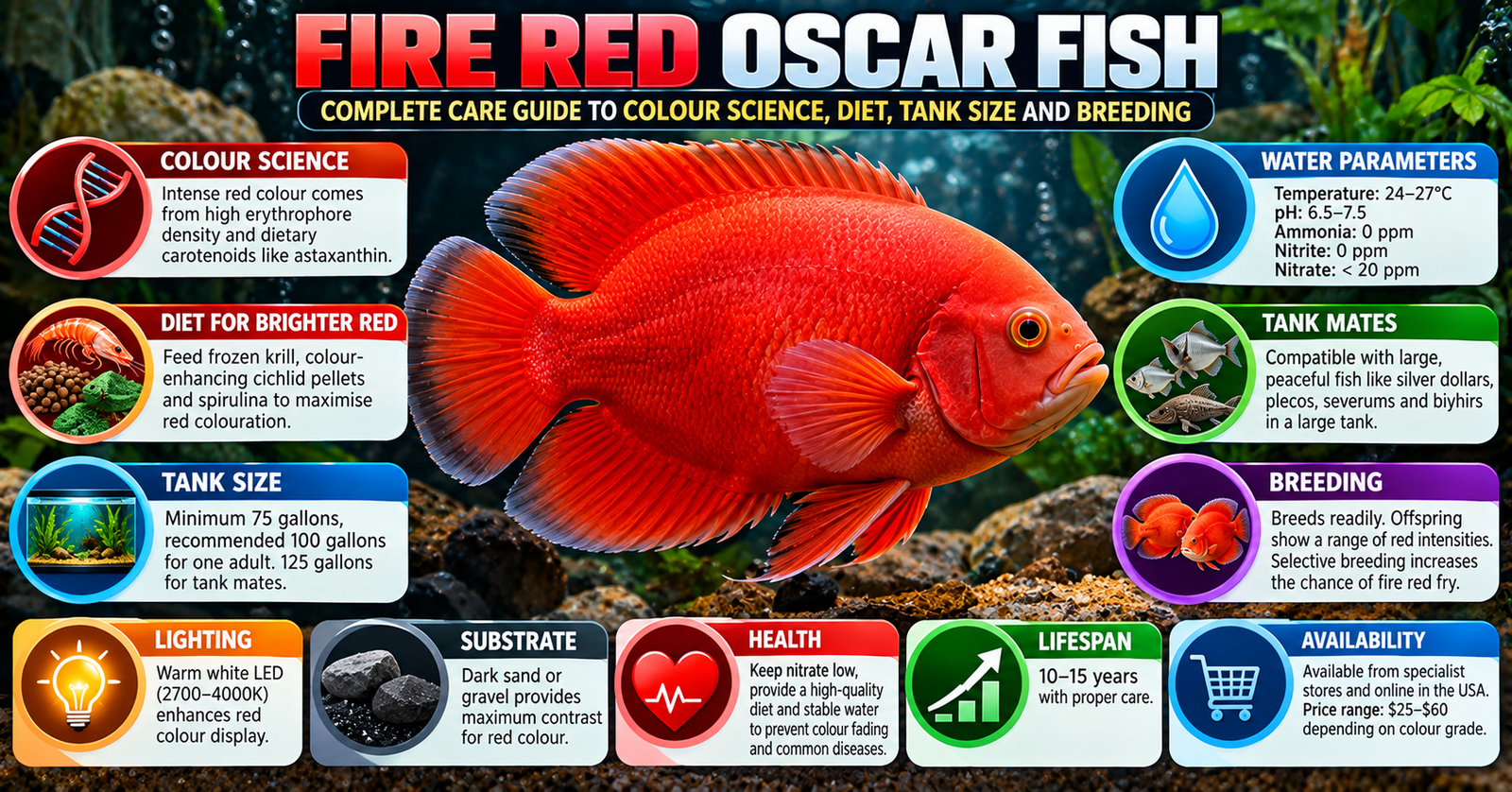
Fire red oscar fish are selectively bred colour forms of the Oscar cichlid, Astronotus ocellatus, valued by aquarium keepers for their intense red to scarlet body colouration. Unlike a wild Oscar, which normally shows darker mottling and an orange-ringed eyespot, a highly selected fire red specimen can display a much greater proportion of red across the body and fins. The terms Fire Red, Super Red, Red Chili and Blood Red are used inconsistently in the aquarium trade, so the seller’s description should be treated as a trade label rather than a formal taxonomic category.
This fire red oscar fish care guide explains what produces the colour, how genetics interact with dietary carotenoids, how to build a suitable aquarium, what to feed for health and colour support, how to manage water quality, which tank mates can be considered, and what to know about breeding. It also covers fire red oscar fish vs red oscar, the difference between Super Red and Chili Red terminology, colour genetics, astaxanthin and spirulina, rarity, and where American aquarists may encounter these fish.
The most important point is that a red Oscar’s appearance is not controlled by diet alone. Selective breeding establishes the fish’s colour potential, while nutrition and environmental conditions influence how strongly that potential is expressed. Research on fish pigmentation shows that carotenoids are important chromogenic substances in erythrophores and xanthophores, while Oscar-specific research has demonstrated that dietary spirulina can increase skin carotenoid content and total pigmentation. These findings provide a useful scientific framework, but they should not be interpreted as proof that one commercial food can transform any Oscar into a fire red specimen.
Table of Contents
What Is a Fire Red Oscar Fish?
A fire red Oscar fish is a selectively bred colour form of the Oscar cichlid, Astronotus ocellatus. It is not a separate species. The species itself is a large South American cichlid that occurs naturally in tropical freshwater systems and is widely established in the ornamental fish trade. The fire red label describes a cultivated appearance rather than a separate scientific classification.
Highly red specimens have been selected because aquarists value strong red or crimson colouration. Selective breeding can change the frequency and intensity of visible colour traits within an ornamental population. Fish pigmentation research has demonstrated that colour traits can be influenced by genetics, chromatophore development, pigment transport and dietary inputs (Luo et al., 2021).
The important distinction is between colour potential and colour expression. Genetics establish the biological foundation for the amount and distribution of pigmentation a fish can potentially display. Diet supplies carotenoids and other nutrients that contribute to pigment production and storage. Stress, environment, water quality and visual surroundings can also influence how the fish appears.
This means buying an intensely red juvenile does not remove the need for good husbandry. A fish with excellent genetic colour potential still needs appropriate nutrition and stable environmental conditions. Conversely, feeding a colour-enhancing food cannot reliably turn an ordinary Oscar into a genetically high-grade fire red specimen.
Fire red Oscars therefore belong in the same general husbandry category as other Oscars. They grow large, produce substantial waste, require strong filtration and can become territorial. Their colour changes the appearance of the fish, but it does not remove the underlying biological requirements of Astronotus ocellatus.
Fire Red Oscar Trade Names and Naming Confusion
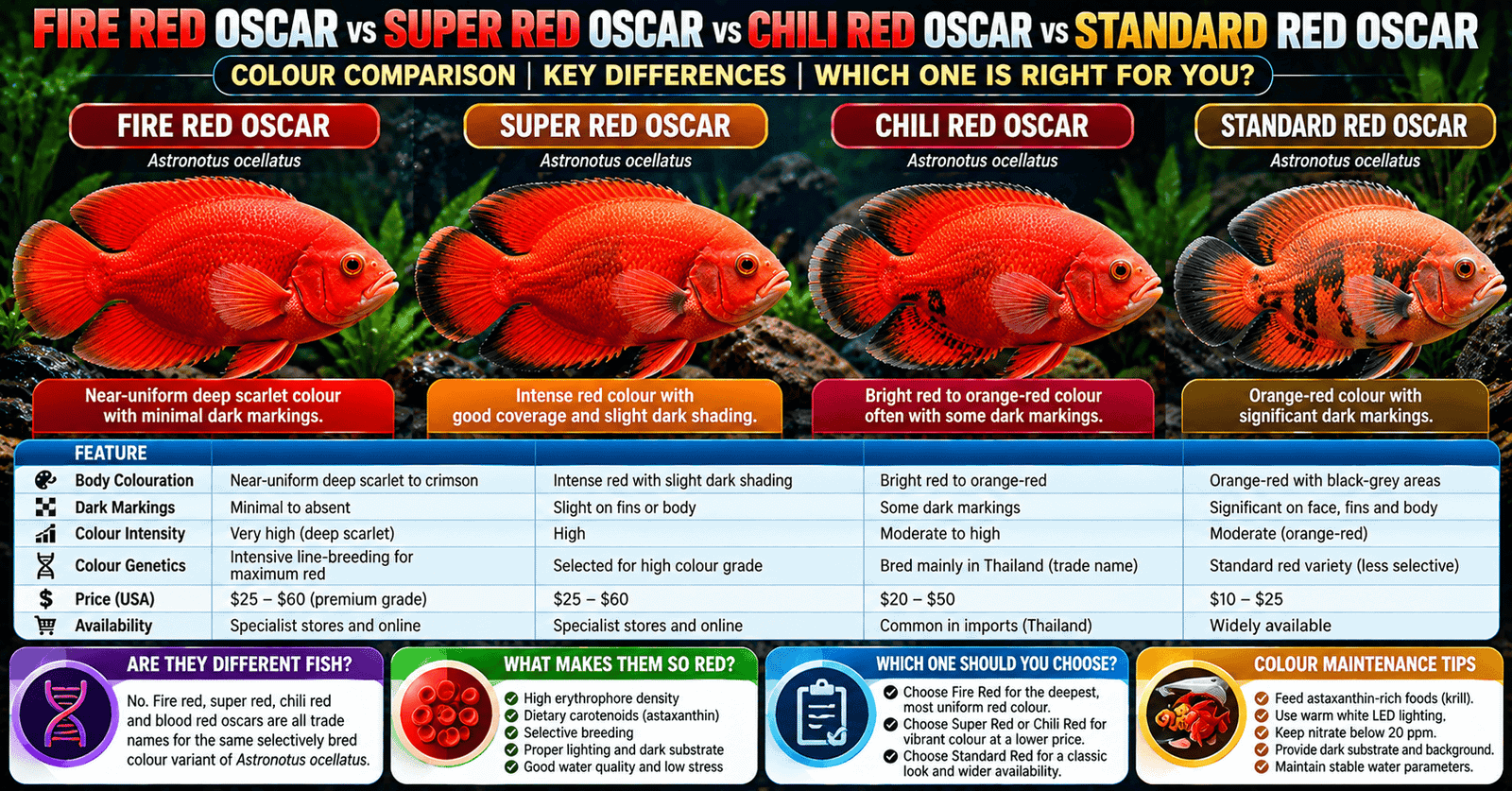
One of the most confusing parts of buying a red Oscar is terminology. Retailers may use Fire Red, Super Red, Chili Red, Red Chili, Blood Red, Super Red Chili and similar descriptions. These labels are not standardized scientific categories, and two sellers can use the same name for fish with visibly different colour patterns.
Fire Red Oscar vs Super Red Oscar vs Chili Red Oscar
| Trade Name | Typical Marketing Meaning | What Buyers Should Check |
|---|---|---|
| Fire Red Oscar | Strong red selectively bred Oscar | Actual body colour, dark markings and seller lineage information |
| Super Red Oscar | Very high-grade red coloration | Whether the fish is genuinely uniform red or still strongly mottled |
| Chili Red Oscar | Trade name associated with strongly red cultivated Oscars | Seller’s photographs and description rather than name alone |
| Blood Red Oscar | Marketing term emphasizing deep red colour | Actual phenotype and adult colour development |
Some retailers explicitly describe Red Chili Oscars as Fire Red or Blood Red and identify them as selectively bred fish. AquariumFish.com, for example, currently markets Red Chili Oscars as a Fire Red or Blood Red type and states that the fish are bred in Thailand. Retail listings can therefore help establish how the terms are being used commercially, but they should not be treated as formal scientific evidence that every fish sold under these labels belongs to one identical breeding line.
For a buyer, the practical solution is simple. Look at the fish itself, ask for its scientific name, ask where it was bred, inspect photographs of adult parents when available, and ask whether the seller considers the fish Fire Red, Super Red or Chili Red. The visual quality of the fish matters more than the label.
Fire Red Oscar vs Standard Red Oscar
The difference between a Fire Red Oscar and a standard Red Oscar is primarily one of colour intensity and distribution. A conventional Red Oscar may show red or orange areas combined with black, grey or darker pigmentation. A strongly selected Fire Red specimen can display a much greater percentage of red across the body, with fewer dark areas.
| Feature | Standard Red Oscar | Fire Red Oscar |
|---|---|---|
| Scientific species | Astronotus ocellatus | Astronotus ocellatus |
| Body colour | Orange-red to red with darker areas | Strong red to scarlet in high-grade specimens |
| Dark markings | Often prominent | Often reduced in strongly selected fish |
| Colour consistency | Varies substantially | Varies substantially between breeding lines |
| Behaviour | Oscar-like territorial behaviour | Oscar-like territorial behaviour |
| Adult care | Large aquarium required | Large aquarium required |
| Price | Usually lower than specialist high-grade colour fish | Often carries a premium depending on colour grade |
There is no separate Fire Red behaviour profile. A fish should not be assumed to be more peaceful or more aggressive because it is red. Temperament depends on the individual fish, its maturity, territory, tank environment and social context.
Similarly, colour does not determine adult size. Fire Red Oscars remain Oscars. A keeper should therefore purchase the aquarium for the expected adult fish rather than choosing a tank according to the juvenile size displayed at the store.
What Makes the Fire Red Oscar Fish So Red?
The science of fish colour is more complex than simply saying that a fish is genetically red. Fish skin contains specialized pigment cells called chromatophores. Different chromatophore types contribute different visible colours and patterns. Melanophores contain dark melanin pigments, while xanthophores and erythrophores are associated with yellow, orange and red pigmentation.
A major review of fish pigmentation describes the molecular and cellular mechanisms involved in fish colour development and explains how selective breeding has been used to modify ornamental fish colour traits (Luo et al., 2021). This provides a useful framework for understanding why cultivated Oscar lines can look dramatically different from wild-type fish even though they remain the same species.
For the red appearance of a Fire Red Oscar, carotenoids are particularly relevant. A 2025 study on Nile tilapia found that carotenoids were the decisive chromogenic substances associated with the colour of xanthophores and erythrophores in the experimental fish. The authors used genetic manipulation of carotenoid metabolism pathways and observed major effects on pigmentation (Liang et al., 2025).
That research was performed on tilapia rather than Oscars, so it should not be presented as a direct Fire Red Oscar experiment. However, it provides strong general evidence for the biological importance of carotenoids in red and yellow fish pigmentation.
Erythrophores: The Red Pigment Cells
Erythrophores are pigment cells associated with red coloration in fish. Their appearance depends on the pigments they contain and how those pigments interact with other chromatophores and the optical structure of the skin.
The key practical point for aquarists is that the red colour of an ornamental fish is not simply a layer of paint fixed permanently into the scales. Pigment biology is dynamic. The fish’s genetic background, nutrition and environment all contribute to the final visual appearance.
A high-grade Fire Red Oscar can therefore lose some of its visual intensity if it is chronically stressed or poorly nourished. That does not necessarily mean the genetic colour line has disappeared. It can mean that the environmental conditions are not allowing the fish to express its potential as strongly.
Carotenoids and Dietary Colour
Carotenoids are pigments that fish obtain from dietary sources. Astaxanthin is one of the carotenoids commonly used in ornamental fish feeds because of its association with red and orange coloration. Research in red-coloured fish has experimentally demonstrated that dietary astaxanthin supplementation can increase skin redness and carotenoid content (Li et al., 2025).
Again, that experiment involved a marine food fish rather than Astronotus ocellatus. It therefore supports the general pigmentation principle rather than proving an exact feeding response in Fire Red Oscars. This distinction matters because SEO articles often turn evidence from one species into an absolute rule for another species.
For Oscars specifically, spirulina has stronger direct evidence. Mohammadiazarm et al. (2021) studied Astronotus ocellatus and found that the highest tested spirulina supplementation increased total carotenoid content in fish skin alongside several physiological improvements. That is useful evidence for using spirulina as part of a varied diet, although it does not establish that spirulina alone creates a Fire Red phenotype.
How to Enhance the Red Colour of a Fire Red Oscar
The most responsible approach to colour enhancement is to think in terms of supporting genetic potential rather than creating a colour that the fish cannot genetically express. Six husbandry factors are particularly useful: a nutritionally complete staple diet, carotenoid-containing foods, spirulina as an optional supplement, stable water quality, low chronic stress and appropriate visual surroundings.
1. Use a Complete Cichlid Staple
A high-quality cichlid pellet should form the nutritional foundation. The staple food should provide adequate protein, fats, vitamins and minerals rather than being selected purely because the label contains the word “colour”. A fish cannot develop and maintain healthy pigmentation if its overall diet is nutritionally poor.
2. Add Carotenoid-Rich Foods
Carotenoid-rich foods can be incorporated into a varied feeding routine. Commercial colour-enhancing pellets may contain astaxanthin or other carotenoids. Frozen crustacean foods such as krill and shrimp can also contribute carotenoids, although their exact pigment concentrations vary according to species, processing and feed source.
Do not assume that feeding more colour food always produces more colour. Overfeeding increases waste and can compromise water quality, which can undermine the very environmental conditions needed for good appearance.
3. Consider Spirulina
Spirulina is one of the better-supported supplements for Oscar pigmentation because an experimental study directly evaluated it in Astronotus ocellatus. The study used several dietary inclusion levels and found that the highest tested treatment increased total carotenoid content in the skin (Mohammadiazarm et al., 2021).
That does not mean an aquarist should copy an experimental feed formulation without considering the complete diet. A practical home aquarium diet should remain balanced, and spirulina should be considered a supplement or ingredient rather than a complete replacement for a quality cichlid food.
4. Maintain Stable Water Quality
Water quality is one of the most important indirect factors in colour display. Ammonia and nitrite should remain at zero in a properly established aquarium. Nitrate should be controlled through sensible stocking, feeding and regular maintenance. Rather than treating a single nitrate number as a magical colour threshold, focus on stability and low accumulated waste.
5. Reduce Chronic Stress
Stress can alter fish behaviour, feeding and physiological condition. An Oscar repeatedly hiding, refusing food, breathing rapidly or showing persistent colour changes deserves investigation rather than another colour-enhancing food.
6. Use Lighting for Viewing, Not as a Miracle Treatment
Lighting affects how human observers perceive fish colour. Warm or neutral white light can make red pigments appear visually stronger than some blue-dominant lighting. However, it would be inaccurate to claim that a specific Kelvin value universally increases Fire Red Oscar pigmentation.
Experimental research in coral trout found that light intensity affected erythrophore numbers and skin astaxanthin content, demonstrating that environmental lighting can influence fish pigmentation biology (Zhao et al., 2025). Because this work was conducted on coral trout, it should be regarded as supporting background evidence rather than a Fire Red Oscar lighting prescription.
Colour Enhancement Priority
| Strategy | Potential Value | Practical Use |
|---|---|---|
| Complete cichlid diet | Very high | Use as the nutritional foundation |
| Carotenoid-rich foods | High | Use as part of dietary variety |
| Spirulina | Moderate to high | Supported by Oscar-specific pigmentation research |
| Stable water quality | Very high | Essential for health and stress control |
| Appropriate lighting | Moderate for visual presentation | Choose lighting that shows the fish naturally |
| Dark or contrasting background | Useful for visual contrast | Test the fish’s response rather than assuming one colour is best |
Fire Red Oscar Fish Tank Size
The Fire Red Oscar has the same adult-space requirements as other Astronotus ocellatus. Colour does not reduce body size, bioload or territorial behaviour. This is one of the most important purchasing considerations because Fire Red Oscars are frequently sold as attractive juveniles that look far smaller than the adult fish they will become.
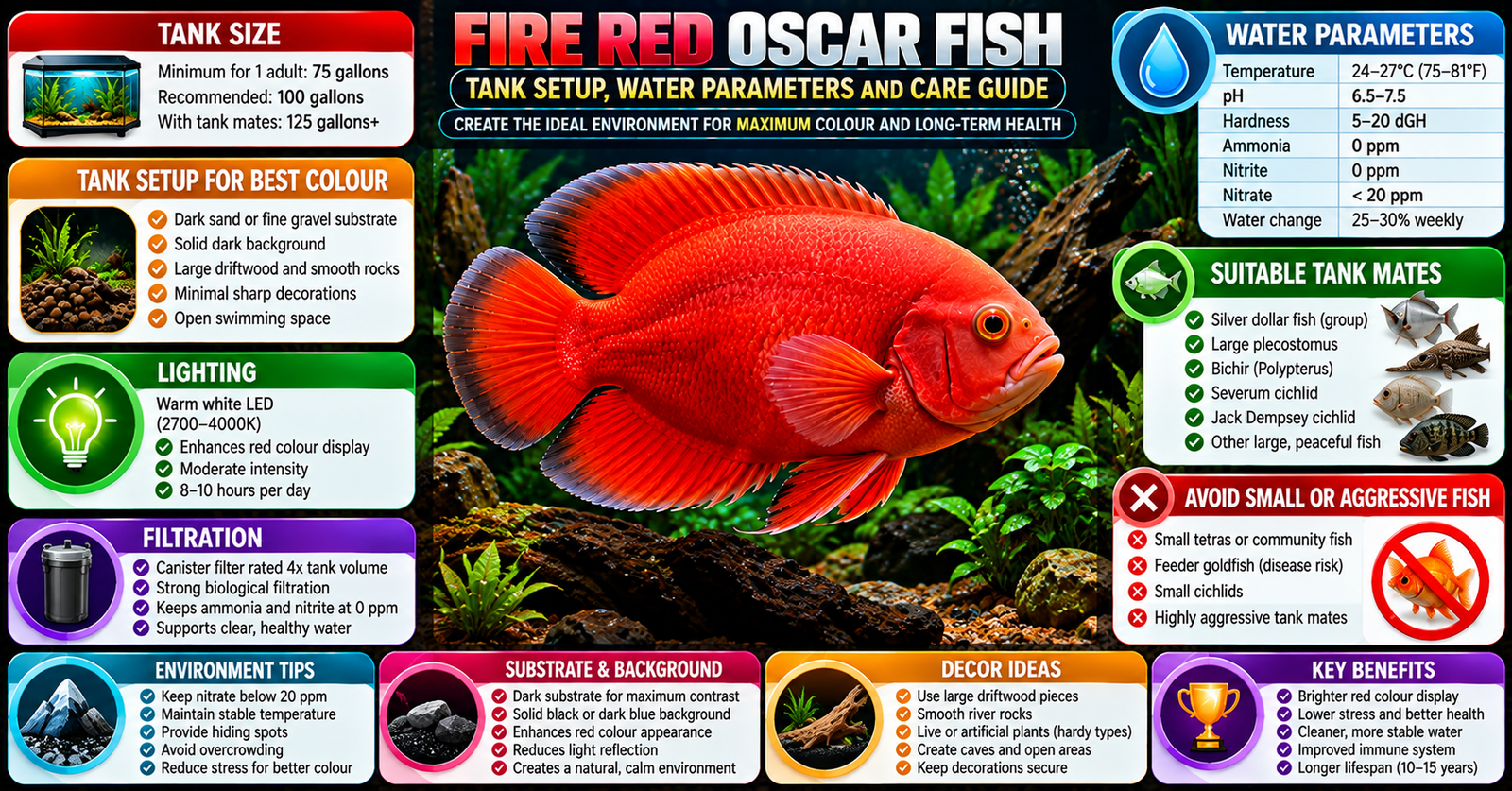
For one adult Oscar, 75 gallons is commonly used as a practical minimum in the hobby, while a 100-gallon aquarium gives a substantially more useful long-term footprint. Some husbandry sources recommend still larger aquariums, particularly for multiple Oscars or mixed communities. Aqueon, for example, lists a 180-gallon aquarium size in its monster fish care guide for Oscars, illustrating how much recommendations can vary between husbandry authorities.
For AquariumsWorld planning purposes, a 100-gallon aquarium is a strong target for a single adult Fire Red Oscar because it provides more swimming space and greater water volume than a smaller system. The exact tank should always be judged by dimensions, footprint, fish size, filtration and stocking rather than gallon number alone.
| Setup | Practical Planning Target | Consideration |
|---|---|---|
| One juvenile | 75 gallons or larger | Do not choose the final aquarium based on juvenile size |
| One adult | 100 gallons or larger | Provides more swimming and water volume |
| Adult with robust tank mates | 125 gallons or larger | Footprint and territories become increasingly important |
| Multiple Oscars | Large custom systems may be required | Individual aggression makes stocking unpredictable |
Fire Red Oscar Fish Tank Setup
A Fire Red Oscar aquarium should be designed around the adult fish. The ideal setup is functional rather than delicate. Oscars are powerful, active cichlids that can move substrate, knock decorations and uproot plants.
Substrate
Sand or smooth gravel is suitable. Avoid sharp material that can damage the fish while it is feeding or digging. A darker substrate may increase visual contrast with a red fish, but colour preference should remain secondary to safety and ease of maintenance.
Decor
Use sturdy driftwood, smooth rocks and securely positioned structures. Avoid unstable stacks that can collapse when the Oscar investigates them. Leave a generous open swimming area at the front and centre of the aquarium.
Plants
Live plants can be challenging with adult Oscars because digging and rearranging behaviour can uproot them. If plants are desired, choose robust species and secure them effectively. Artificial plants can also be used if they have smooth surfaces and cannot injure the fish.
Filtration
Filtration should be oversized relative to a lightly stocked community aquarium because Oscars produce a substantial bioload and are messy eaters. A large canister filter, sump or combination of robust filtration systems can be used depending on the aquarium design.
Filter turnover alone does not determine biological capacity. Media volume, oxygenation, maintenance, feeding load and stocking all matter. The aquarium should maintain zero ammonia and zero nitrite under normal operation.
Aeration
Strong surface movement helps maintain gas exchange. An air pump is not automatically mandatory if the main filter already provides adequate surface agitation, but additional aeration can be useful in large, heavily stocked systems or during equipment emergencies.
Fire Red Oscar Fish Water Parameters
Fire Red Oscars should be kept in stable tropical freshwater. The species is adaptable, but stability matters more than chasing an exact laboratory number.
| Parameter | Practical Target | Why It Matters |
|---|---|---|
| Temperature | Approximately 24–27°C | Supports normal tropical metabolism |
| pH | Approximately 6.5–7.5 | Stable pH is preferable to frequent correction |
| Ammonia | 0 ppm | Toxic and should not accumulate |
| Nitrite | 0 ppm | Toxic and should remain undetectable |
| Nitrate | Keep controlled and routinely monitored | Indicates accumulated nitrogen waste |
| Water change | Usually 25–30% weekly, adjusted to testing | Removes accumulated waste and restores water quality |
Temperature research on Astronotus ocellatus demonstrates that environmental temperature interacts with physiological stress, which is one reason stable tropical conditions are preferable to repeated temperature swings (Zare et al., 2024). The precise temperature selected should also account for the aquarium’s ambient conditions, equipment reliability and the health status of the fish.
For cichlid-specific temperature information, see the AquariumsWorld Water Temperature for Cichlids Guide. African cichlid temperature requirements are not identical to Oscar requirements, so do not transfer every recommendation from one cichlid group to another. The African Cichlid Water Temperature Guide is useful for understanding why species-specific temperature planning matters.
What Do Fire Red Oscar Fish Eat?
Fire Red Oscars are omnivorous predators with a strong preference for animal-based foods, but a balanced captive diet should be broader than simply feeding meat. A high-quality cichlid pellet or stick should normally provide the nutritional foundation, with frozen foods and selected supplements used for variety and enrichment.
Fire Red Oscar Fish Astaxanthin and Krill Diet
Krill is frequently used in colour-supporting diets because crustaceans can contain carotenoid pigments, including astaxanthin. However, the exact pigment content depends on the product and processing method. Frozen krill should therefore be viewed as one useful component of a varied diet rather than a guaranteed colour treatment.
Commercial Colour-Enhancing Pellets
Look for products that clearly disclose their ingredients and nutritional profile. A food containing astaxanthin or other carotenoid ingredients can be useful when used alongside a complete staple. Avoid choosing a food solely because its packaging shows an exceptionally red fish.
Spirulina
Spirulina has direct Oscar-specific research behind it. Mohammadiazarm et al. (2021) found that spirulina supplementation increased total carotenoid content in Oscar skin in their experimental feeding trial. The study also measured growth, biochemical and immune-related outcomes, making spirulina one of the more interesting functional dietary ingredients for Oscar keepers.
Earthworms and Frozen Foods
Earthworms, shrimp, krill and other suitable frozen foods can provide enrichment and dietary variety. They should be appropriately sourced and handled to reduce disease risk.
Foods to Avoid as Regular Staples
- Live feeder goldfish as a routine food.
- Unregulated wild-caught feeder organisms.
- Excessive fatty human foods.
- Beef heart as the main long-term diet.
- Overfeeding simply to accelerate growth or colour.
Example Weekly Feeding Pattern
| Day | Primary Food | Purpose |
|---|---|---|
| Monday | Quality cichlid pellets | Complete staple nutrition |
| Tuesday | Pellets plus frozen krill or shrimp | Variety and carotenoid contribution |
| Wednesday | Quality cichlid pellets | Staple nutrition |
| Thursday | Earthworms or suitable frozen food | Protein and enrichment |
| Friday | Pellets containing carotenoids or spirulina | Dietary variety and pigmentation support |
| Saturday | Reduced feeding or normal feeding based on fish condition | Prevent overfeeding |
| Sunday | Pellets with a small frozen supplement | Balanced weekly variety |
Young Oscars generally need more frequent feeding than adults because of their rapid growth. Adult feeding should be controlled according to body condition. The goal is a healthy, active fish rather than the fastest possible growth.
Are Fire Red Oscar Fish Aggressive?
Fire Red Oscars can be territorial and assertive, just like other Oscars. The red colour morph should not be treated as a separate behavioural type. Aggression can become particularly obvious during pairing, spawning, territory establishment or competition for food.
A Fire Red Oscar may chase another fish, defend a preferred cave or feeding area, push substrate and react strongly to new additions. Some individuals are relatively tolerant, while others become highly territorial. Individual behaviour is therefore one of the most important variables in Oscar community planning.
Small fish should not be selected simply because the aquarium appears large. Adult Oscars have large mouths and predatory instincts. If a potential tank mate can easily fit inside the Oscar’s mouth, predation risk is obvious.
Territorial aggression is also different from predation. A fish can be large enough not to be eaten but still be attacked because it enters the Oscar’s territory. This is why robust body size alone does not guarantee compatibility.
Fire Red Oscar Fish Tank Mates
Fire red oscar fish tank mates should be chosen using the same principles applied to other Astronotus ocellatus. The best candidates are large enough to avoid immediate predation, robust enough to tolerate an Oscar’s presence, and compatible with the aquarium’s temperature and water chemistry.
Potential options include large Plecostomus species, Silver Dollars, Bichirs and selected large cichlids. None should be described as universally compatible. The individual Oscar, aquarium footprint, number of hiding spaces, feeding strategy and territorial dynamics all matter.
| Potential Tank Mate | General Consideration | Important Risk |
|---|---|---|
| Large Plecostomus | Can work in large systems | Species size and behaviour must be considered |
| Silver Dollars | Active schooling fish may work in large tanks | Need a group and adequate swimming space |
| Bichir | Large bottom-oriented fish | Must be large enough to avoid predation |
| Large Severum | Possible in very spacious systems | Territorial conflict remains possible |
| Jack Dempsey | Robust cichlid sometimes kept with Oscars | High aggression risk |
| Small community fish | Generally unsuitable | Predation risk |
For additional compatibility context, AquariumsWorld’s Goldfish and Oscar Compatibility Guide explains why size, temperature and predatory behaviour matter when evaluating Oscar companions.
The same principle can be seen when comparing Oscars with Angelfish. The Angelfish Complete Care Guide explains why an Oscar can pose a direct risk to a smaller or more delicate cichlid despite both species being freshwater tropical fish.
Can I Breed Fire Red Oscar Fish?
Yes. Fire Red Oscars can breed because they are members of Astronotus ocellatus. Their breeding biology is fundamentally the same as other Oscars. The difficulty is not necessarily getting a mature pair to spawn. The greater challenge is producing a large number of healthy fry and finding suitable long-term homes for them.
Oscar pairs may choose a flat rock, hard substrate or another suitable spawning surface. Once paired, they can become extremely territorial. Tank mates should be monitored carefully and may need to be removed if the pair begins defending a spawning area.
Fire Red Oscar Breeding Colour Outcome
Breeding two intensely red parents does not guarantee that every offspring will become an equally intense Fire Red Oscar. Colour is influenced by multiple inherited traits, and offspring can show variation.
This is important for anyone searching for a fire red oscar breeding guide. Commercial breeders can select the reddest juveniles over successive generations, gradually concentrating desired traits. A home breeder should not expect one spawning to produce a uniform batch of high-grade Fire Red fish.
Breeding Conditions
- Use a mature, compatible pair.
- Provide a large breeding aquarium with stable water quality.
- Offer a clean, flat spawning surface.
- Maintain stable tropical temperatures.
- Provide high-quality nutrition before spawning.
- Remove incompatible tank mates if aggression increases.
- Plan fry housing before spawning occurs.
- Have a realistic rehoming plan for juveniles.
Oscar breeding can produce hundreds or even thousands of young, which is why breeding should be planned as a serious husbandry project rather than an experiment performed without a destination for the offspring.
Fire Red Oscar Fish Health Problems
Fire Red Oscars can experience the same major health problems as other Oscars. Colour can sometimes make symptoms easier to see because pale lesions, white spots or changes in pigmentation can contrast strongly against a red body.
Colour Fading
Colour fading is not automatically a disease. A fish can become temporarily pale because of stress, handling, environmental changes or normal colour-state changes. However, persistent fading combined with appetite loss, abnormal breathing, hiding or unusual swimming should trigger a full water-quality and health assessment.
Hole-in-the-Head Disease
Hole-in-the-head disease, often associated with head and lateral line erosion, is a well-known concern in large cichlids including Oscars. The condition is multifactorial and should not be reduced to one cause. Poor water quality, nutritional imbalance and chronic husbandry problems are commonly discussed in relation to the syndrome.
The safest prevention strategy is strong overall husbandry: maintain excellent water quality, provide a varied and nutritionally complete diet, avoid chronic overcrowding and investigate persistent stress.
Ich
Ich can affect Oscars just as it affects other freshwater fish. White spots, flashing, increased respiratory effort and reduced activity can be warning signs. Diagnosis should be based on the complete symptom pattern rather than treating every white mark as ich.
Fin Damage and Injuries
Territorial fights can produce torn fins, scale loss or mouth injuries. In a community aquarium, repeated injury indicates that the social arrangement needs to be reassessed. Adding more hiding spaces does not always solve aggression if the underlying aquarium footprint is inadequate.
Digestive Problems
Overfeeding can contribute to bloating and poor water quality. Feeding large amounts of food simply to accelerate colour or growth is counterproductive. Controlled portions and high-quality food are preferable.
Fire Red Oscar Fish Rarity and Availability
Fire Red Oscars are better described as specialty colour forms than as a biologically rare species. The underlying species, Astronotus ocellatus, is common in the aquarium trade. What is less consistently available is a particularly high-grade fish with strong, even red colouration.
Availability changes by country, importer, season, size and breeder. A specialist store may list Fire Red or Red Chili fish while a chain retailer may carry only standard Tiger or Red Oscars.
The difference between “rare fish” and “rare colour grade” is important. A fish can be uncommon in a local shop without being rare globally. Similarly, a premium price does not prove genetic quality.
American buyers should compare several photographs, ask about current size and ask whether the fish is captive-bred. If the seller makes claims about bloodline or colour genetics, request supporting information rather than assuming the trade name itself proves lineage.
Fire Red Oscar Fish Where to Buy USA
In the United States, specialty aquarium retailers and online fish stores may periodically list Fire Red or Red Chili Oscars. Current listings demonstrate that availability and pricing can change quickly.
For example, Monsteraquariumonline currently lists a Fire Red Oscar as Astronotus ocellatus and gives a retail price of $60 for the listed fish size. AquariumFish.com currently lists Red Chili Oscar stock and describes the fish as a Fire Red or Blood Red type. These are retailer examples, not a universal USA price guide.
When buying online, evaluate the seller rather than focusing only on colour. Check shipping policies, live-arrival guarantees, fish size, quarantine procedures, recent stock photographs and whether the photograph represents the exact fish being sold.
What to Ask a USA Seller
- What is the fish’s current size?
- Is the photograph of the actual fish?
- Was the fish captive-bred?
- What trade name does the breeder use?
- Are parent photographs available?
- What food is the fish currently eating?
- Has the fish been quarantined?
- What is the live-arrival policy?
- What shipping temperature controls are used?
Avoid buying based solely on the phrase “100% Fire Red” or “super rare genetics”. These are commercial claims unless backed by transparent breeding information.
How Long Does a Fire Red Oscar Fish Live?
A well-maintained Oscar can live for roughly 10 to 15 years, and some individuals may live longer. Lifespan depends on genetics, nutrition, water quality, disease management, aquarium size and overall husbandry.
The Fire Red colour form does not automatically have a different lifespan from other Astronotus ocellatus. The best way to support longevity is to treat the fish as a large, long-lived cichlid rather than as a decorative colour variety.
Long-term planning is particularly important. A juvenile Fire Red Oscar can fit comfortably in a temporary aquarium, but the adult fish may require a 100-gallon or larger system. A buyer should therefore be prepared for the adult commitment before purchasing.
Fire Red Oscar Fish Lighting for Colour
Lighting has two different roles: illuminating the aquarium for the fishkeeper and contributing to the fish’s environmental conditions. The first is certain. The second is biologically more complex.
Warm white lighting can make red fish appear visually warmer and more saturated. However, a lighting system should not be selected solely on the assumption that a specific Kelvin value will genetically increase red pigment.
Research on coral trout found that light intensity affected erythrophore numbers and astaxanthin accumulation, showing that light can influence pigmentation biology in some fish (Zhao et al., 2025). This evidence should be applied cautiously because coral trout and Oscars have different biology and the study was not performed on Fire Red Oscars.
A practical aquarium should therefore use moderate lighting that produces a natural appearance without excessive glare. A dark background may also increase the visual contrast of a red fish, although background colour effects are species- and context-dependent.
Interestingly, an Oscar-specific study by Dopeikar et al. (2024) found significant physiological differences among juvenile Oscars housed in tanks with different background colours. The red-background treatment produced several favourable growth and immune-related outcomes in that experiment, while blue tanks were associated with higher stress markers. This does not establish that a black background is best for a Fire Red Oscar display. It does show why background colour should be considered as part of the fish’s environment rather than treated as a purely decorative decision.
Fire Red Oscar vs Tiger Oscar Colour Comparison
A Tiger Oscar usually displays a darker body with orange-red markings, while a high-grade Fire Red Oscar can show substantially more red across the body. The difference is primarily visual and reflects selective breeding rather than species-level separation.
| Feature | Fire Red Oscar | Tiger Oscar |
|---|---|---|
| Species | Astronotus ocellatus | Astronotus ocellatus |
| Dominant appearance | Red to scarlet | Dark with orange-red patterning |
| Dark pattern | Reduced in high-grade specimens | Usually more obvious |
| Care | Oscar care requirements | Oscar care requirements |
| Behaviour | Territorial and potentially aggressive | Territorial and potentially aggressive |
| Tank requirement | Large aquarium | Large aquarium |
The comparison demonstrates why colour should not be confused with care requirements. A Tiger Oscar and Fire Red Oscar can look dramatically different while requiring essentially the same basic aquarium environment.
Common Fire Red Oscar Care Mistakes
1. Buying a Small Tank for a Juvenile
The most common mistake is planning around the fish’s purchase size. A juvenile may be only a few inches long, but the adult fish is much larger. A temporary grow-out aquarium may be acceptable if a permanent aquarium is already planned, but keeping the fish permanently in a small tank is not responsible long-term planning.
2. Focusing on Colour Food Instead of Complete Nutrition
A colour-enhancing pellet cannot compensate for an incomplete diet. Build the nutritional foundation first and use carotenoid-containing foods as part of the overall feeding strategy.
3. Overfeeding to Increase Colour
More food does not automatically mean more red. Excess feeding increases waste, which can reduce water quality and create health problems. Feed controlled portions and observe body condition.
4. Using Nitrate as the Only Health Indicator
Water quality involves ammonia, nitrite, nitrate, pH, temperature, oxygenation and stability. A single nitrate measurement does not describe the complete aquarium environment.
5. Choosing Tank Mates for Colour Contrast Alone
A silver fish may look visually attractive beside a Fire Red Oscar, but appearance should never be the primary compatibility criterion. Size, temperament, swimming behaviour, territory and predation risk come first.
6. Assuming Fire Red Means Rare Species
Fire Red is a trade description for an ornamental colour form of Astronotus ocellatus. It is not a separate rare species.
7. Believing Every Red Oscar Will Become Fire Red
Colour intensity varies among fish. Selective breeding can increase the likelihood of strong colour, but no feeding schedule can guarantee that every juvenile will develop the same phenotype.
8. Ignoring the Adult Bioload
Oscars are messy fish. Strong filtration and regular maintenance are essential. The Aquarium Stocking Calculator is useful for understanding why stocking should consider adult biomass and bioload rather than relying on the old one-inch-per-gallon rule.
Fire Red Oscar Fish Care Checklist
| Care Area | Recommended Approach |
|---|---|
| Species | Astronotus ocellatus |
| Tank size | 75 gallons or larger as a practical minimum, with 100 gallons or more preferable for one adult |
| Temperature | Approximately 24–27°C |
| pH | Approximately 6.5–7.5 with stability prioritized |
| Ammonia | 0 ppm |
| Nitrite | 0 ppm |
| Nitrate | Keep controlled through stocking, feeding and water changes |
| Diet | Quality cichlid staple plus varied frozen foods and selected carotenoid sources |
| Colour support | Carotenoids, spirulina and stable husbandry |
| Filtration | Strong biological and mechanical filtration |
| Decor | Stable rocks, driftwood and open swimming space |
| Tank mates | Large, robust and carefully selected only |
| Lifespan | Approximately 10–15 years with good care |
AquariumsWorld Blog
100 Gallon Fish Tank Complete Guide
Aquarium Stocking Calculator
Fish Aquarium Problems and Solutions
Water Temperature for Cichlids
African Cichlid Water Temperature Guide
Orange Plecostomus Complete Care Guide
Soil in Fish Tank Guide
Angelfish Complete Care Guide
African Cichlids Complete Guide
50 Gallon Fish Tank Dimensions
50 Gallon Fish Tank Complete Guide
20 Gallon Fish Tank Complete Guide
Corner Fish Tank Complete Guide
Fish Tank Stand and Size Guide
Can Goldfish Live with Oscar Fish?
How to Take Care of a Fish
Fish Tank Air Pump Complete Guide
Built-In Wall Fish Aquarium Guide
Frequently Asked Questions
What is a fire red oscar fish?
A Fire Red Oscar fish is a selectively bred colour form of the Oscar cichlid, Astronotus ocellatus. It is valued for stronger red to scarlet colouration than many conventional Red or Tiger Oscars. Fire Red is a trade description rather than a separate scientific species, and individual fish can vary substantially in colour intensity.
How is a fire red oscar different from a regular red oscar?
The main difference is the degree and distribution of red pigmentation. A standard Red Oscar may combine orange-red colour with substantial dark mottling, while a strongly selected Fire Red specimen can have a much greater proportion of red across its body. Both remain Astronotus ocellatus and require the same basic Oscar husbandry.
What makes the fire red oscar fish so red?
Its colour results from the interaction between inherited pigmentation traits and environmental and dietary factors. Selective breeding can increase the frequency of desirable red colour traits, while carotenoids supplied through food contribute to pigmentation biology. Research in other fish has demonstrated the importance of carotenoids and astaxanthin in red colour expression, while spirulina research provides direct pigmentation evidence in Oscars.
How do I enhance the red colour of my fire red oscar?
Start with a high-quality complete cichlid diet and add appropriate carotenoid-rich foods as part of a varied feeding routine. Spirulina has direct Oscar-specific research supporting increased skin carotenoid content. Maintain excellent water quality, minimise chronic stress and use lighting that presents the red colour naturally. Genetics remain the foundation, so food cannot guarantee a particular colour grade.
What tank size does a fire red oscar need?
A practical planning minimum for one adult is around 75 gallons, while a 100-gallon aquarium provides a more useful long-term environment for one adult. Larger aquariums are appropriate when keeping multiple Oscars or considering robust tank mates. Footprint, filtration and adult fish size should be considered alongside gallon capacity.
What do fire red oscar fish eat?
Fire Red Oscars should receive a quality cichlid pellet or stick as the nutritional staple, supplemented with appropriate frozen foods and selected carotenoid-containing ingredients. Krill, shrimp and spirulina can contribute dietary variety and pigmentation-related nutrients. Avoid using feeder fish as the regular diet and avoid excessive feeding.
Are fire red oscar fish aggressive?
They can be territorial and aggressive, particularly toward other Oscars or fish that enter an established territory. The Fire Red colour form does not have a separate aggression profile. Individual temperament, aquarium size, territory and tank mate selection all influence behaviour.
Can I breed fire red oscar fish?
Yes. Fire Red Oscars can breed because they are a colour form of Astronotus ocellatus. However, breeding two intensely red fish does not guarantee uniformly Fire Red offspring. Colour is influenced by multiple inherited characteristics, so juveniles can show a range of colour expression.
What tank mates are suitable for a fire red oscar fish?
Potential companions include appropriately sized robust fish such as large Plecostomus, Silver Dollars, Bichirs and selected large cichlids. Compatibility is never guaranteed because Oscars can be territorial and predatory. Small fish and delicate species are generally poor choices because of predation and injury risk.
How long does a fire red oscar fish live?
A well-cared-for Oscar can live approximately 10 to 15 years, with individual lifespan varying according to genetics, nutrition, water quality, disease prevention and general husbandry. Fire Red colouration does not automatically change the expected lifespan of the underlying species.
Scientific References
Liang, G., Yao, J., Wu, J., Liu, X., Wen, Z., Liu, H., Lu, B., Wang, C., Liu, X. and Wang, D. (2025). Carotenoids, instead of pteridines, determine color of xanthophores and erythrophores in tilapia. Journal of Heredity, 116(4), 466–478. https://doi.org/10.1093/jhered/esaf017
Li, et al. (2025). Molecular mechanisms underpinning astaxanthin-induced body coloration in Lutjanus erythropterus revealed by phenotypic, physiological and transcriptomic analyses. Frontiers in Marine Science. PMC article
Barman, C., Mukherjee, R. and Saikia, S.K. (2024). A brief perspective on the biology of pigmentation in freshwater ornamental fish. Biology Bulletin Reviews, 14(6). https://doi.org/10.1134/S2079086424600280
Zhao, N., Gao, J. et al. (2025). Effects of light intensity on erythrophore number and astaxanthin amount in the skin of coral trout Plectropomus leopardus. Aquaculture Reports, 43, 102883. https://doi.org/10.1016/j.aqrep.2025.102883
Luo, M., Lu, G., Yin, H., Wang, L., Atuganile, M. and Dong, Z. (2021). Fish pigmentation and coloration: Molecular mechanisms and aquaculture perspectives. Reviews in Aquaculture, 13(4), 2395–2412. https://doi.org/10.1111/raq.12583
Mohammadiazarm, H., Maniat, M., Ghorbanijezeh, K. and Ghotbeddin, N. (2021). Effects of spirulina powder (Spirulina platensis) as a dietary additive on Oscar fish, Astronotus ocellatus: assessing growth performance, body composition, digestive enzyme activity, immune-biochemical parameters, blood indices and total pigmentation. Aquaculture Nutrition, 27(1), 252–260. https://doi.org/10.1111/anu.13182
Dopeikar, H., Khoshkholgh, M., Ghasemi, S.A. and Morshedi, V. (2024). Effects of background color on growth, stress, biochemical, hematological, and immunological responses, and expression of growth-related genes in Oscar fish (Astronotus ocellatus). Aquaculture Research, 2024, 6957201. https://doi.org/10.1155/2024/6957201
Zare, M., Esmaeili, A.A., Safari, O. and Davoodi, R. (2024). Responses of Oscar (Astronotus ocellatus) to different temperatures and its interaction with early mild stress. Aquaculture, 591, 741176. https://doi.org/10.1016/j.aquaculture.2024.741176