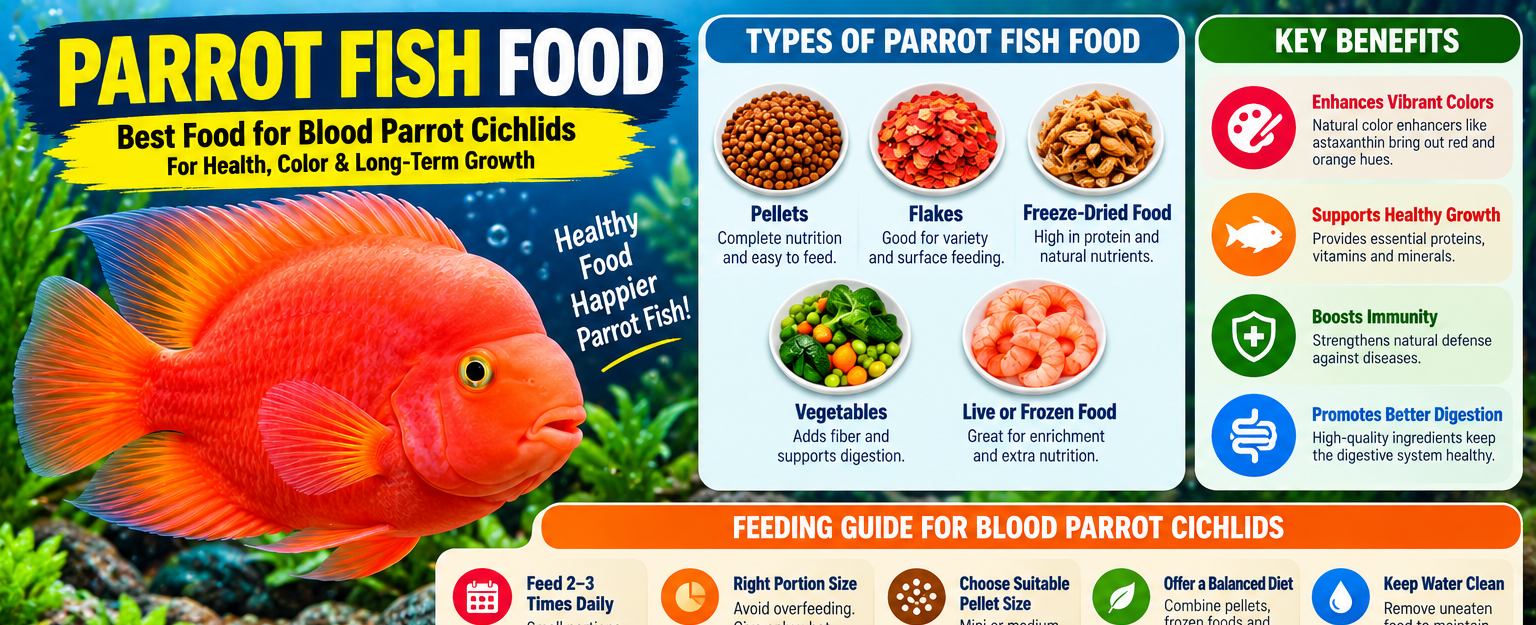
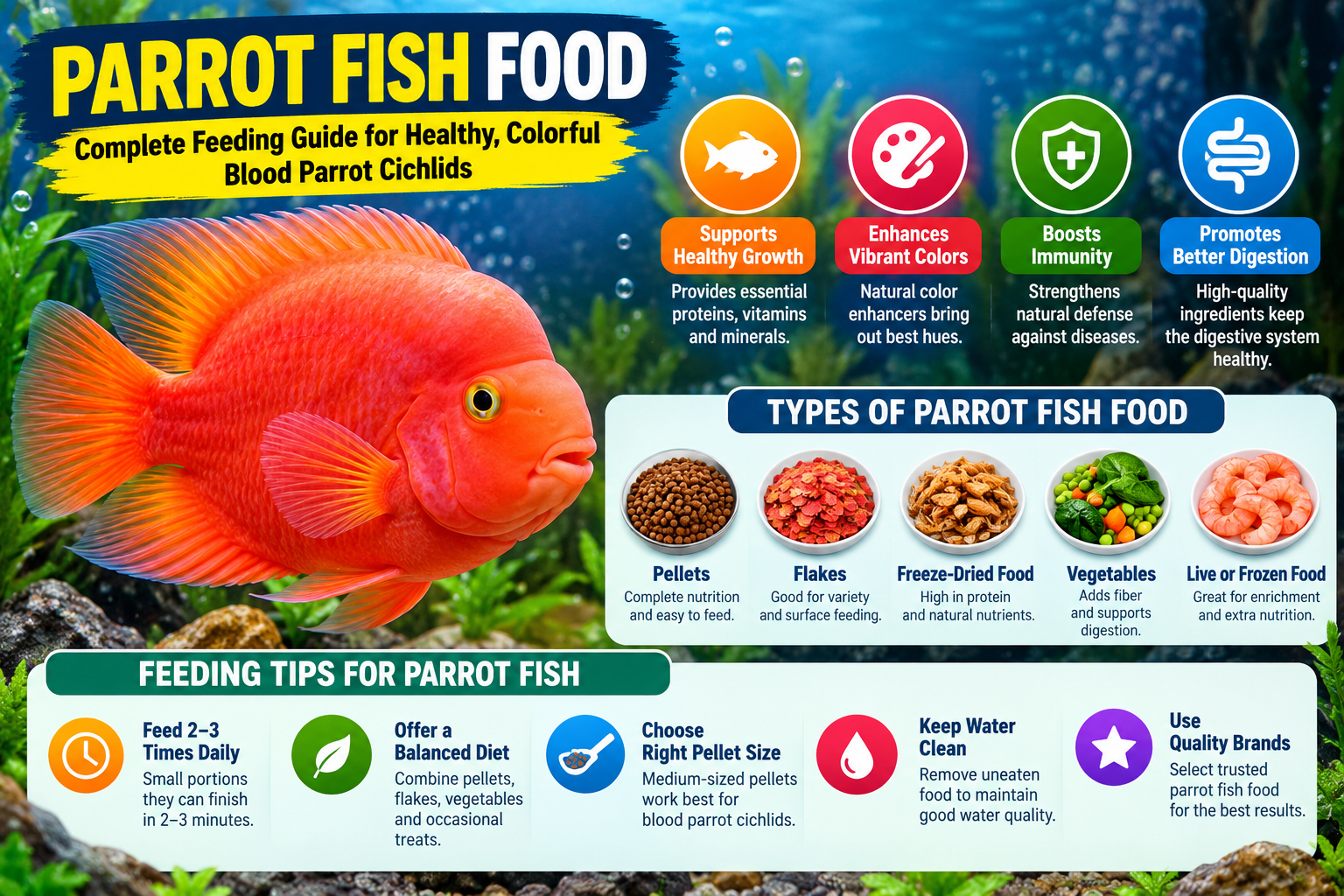
Parrot fish food is one of the most important parts of blood parrot cichlid care, yet choosing the right diet can be surprisingly difficult. Blood parrot cichlids have a distinctive body shape and restricted mouth opening that can make some ordinary cichlid pellets difficult to capture, manipulate or swallow. For that reason, the best food for blood parrot cichlids is not simply the food with the highest protein number or the most attractive packaging. Pellet size, texture, feeding behaviour, ingredients and portion control all matter.
This complete guide explains what blood parrot cichlids eat, how to choose parrot fish food pellets, whether sinking or floating foods are more suitable, how often to feed, how much to feed and how colour-enhancing ingredients such as astaxanthin fit into the diet. It also compares five products identified in the supplied USA-focused search research, including Hikari Blood Red Parrot+, Hikari Mini, Uni-President, Aqua Master and Sera Red Parrot Pellets.
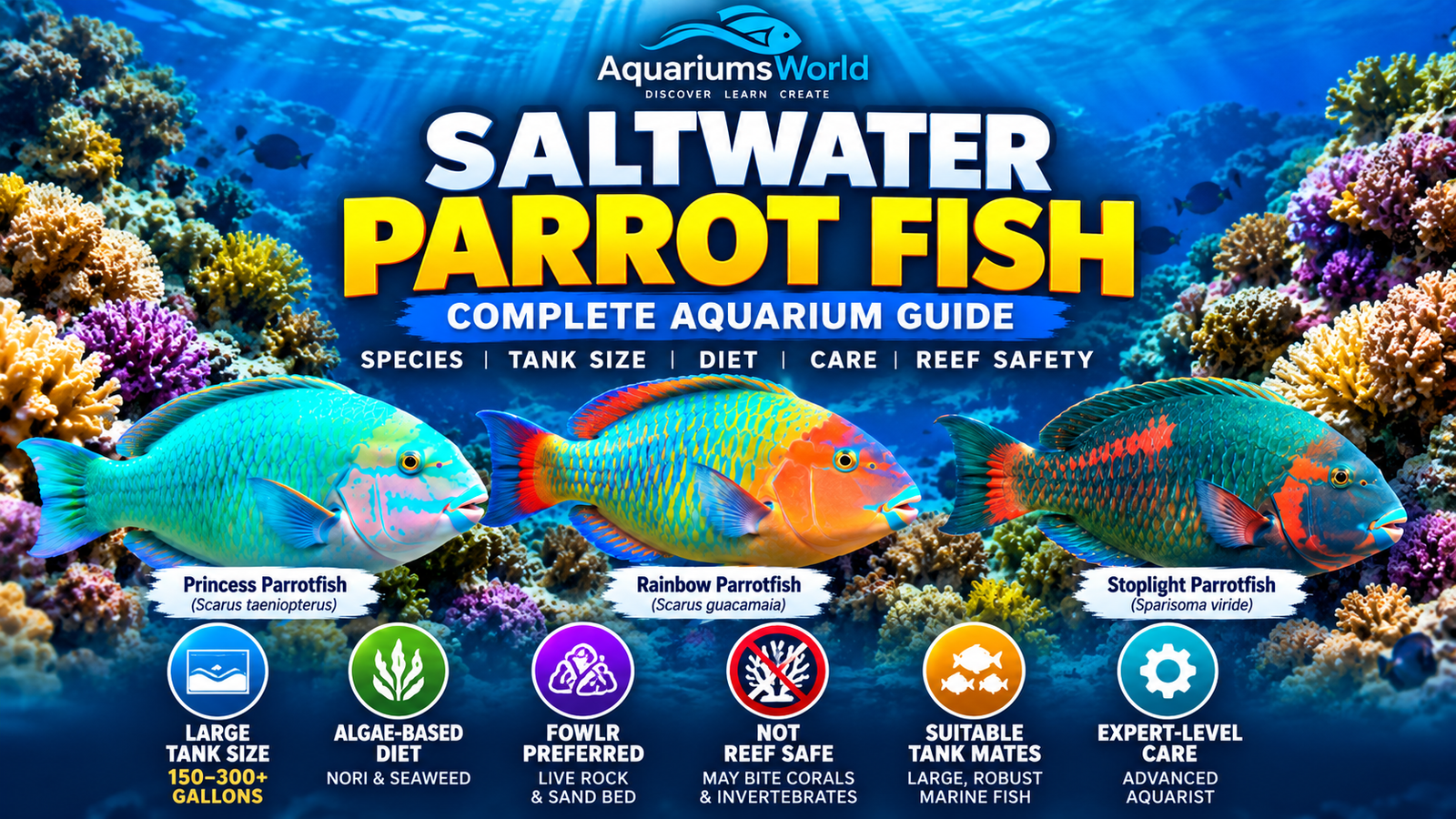
There is also an important terminology issue. In the aquarium trade, “parrot fish” can refer to freshwater blood parrot cichlids, while marine parrotfish are members of the family Scaridae. Their diets are completely different. This guide focuses primarily on freshwater blood parrot cichlids because they are the aquarium fish most commonly associated with searches for parrot fish food, while a separate section explains the distinction from true marine parrotfish.
What Do Parrot Fish Eat?
The answer depends on which fish is meant by “parrot fish.” Freshwater blood parrot cichlids and marine parrotfish have very different feeding biology. Confusing them can lead to completely inappropriate aquarium advice.
Freshwater Blood Parrot Cichlid Diet
Blood parrot cichlids are generally kept as omnivorous ornamental freshwater fish. A complete commercial cichlid food can provide the nutritional foundation of the diet, while carefully selected frozen foods and plant-based ingredients can add variety. The most important practical issue is making sure the fish can actually capture and swallow the food.
A suitable daily diet can include a complete colour-enhancing pellet or granule, provided the particle size is appropriate for the individual fish. Frozen bloodworm, brine shrimp and krill can be offered as supplementary foods rather than replacing the complete staple diet. Small quantities of suitable vegetables such as blanched peas or zucchini may also be used occasionally as part of a varied feeding routine.
The goal is not to feed the widest possible variety every day. Too much variety can become excessive feeding. Instead, use a quality staple food as the foundation and introduce supplementary foods in controlled quantities.
True Marine Parrotfish Diet
Marine parrotfish are entirely different animals. They belong to the family Scaridae and have specialised beak-like teeth that allow them to scrape algae and other material from reef surfaces. Their ecological role is closely associated with grazing on reef substrate.
A marine parrotfish should therefore never be given freshwater blood parrot cichlid feeding advice simply because both animals are called “parrot fish.” AquariumWorld’s article Can You Eat Parrot Fish? Taste, Safety, Ciguatera Risk and Sustainability discusses marine parrotfish as wild reef animals and also makes the distinction between marine parrotfish and freshwater aquarium parrot cichlids.
This article is primarily about freshwater blood parrot cichlids. If the fish in question is a marine parrotfish, specialist marine-herbivore husbandry information is required instead.
Why Blood Parrot Cichlids Need Special Attention at Feeding Time
The unusual mouth of the blood parrot cichlid changes the way feeding should be approached. Unlike many conventional cichlids that can open their mouths widely and bite larger food particles, blood parrots have a restricted mouth structure. They often approach food by positioning the body and scooping the food inward.
This means a food can be nutritionally excellent but still be a poor choice if the individual fish cannot comfortably take it. A large, hard pellet may be difficult to manipulate. A food that breaks apart immediately can increase waste. A pellet that is too small can sometimes disappear rapidly without providing an easy feeding opportunity when tank mates are present.
The practical solution is observation. Watch the fish during feeding. Does it approach confidently? Can it take the pellet? Does it repeatedly spit it out? Does it chew or manipulate the food for a long period? Is another fish taking everything before the blood parrot can feed?
These observations are more useful than choosing food purely from a label.
Pellet Size for a Small-Mouthed Blood Parrot
One of the most common searches around this topic is parrot fish food pellet size small mouth. Pellet size should be matched to the individual fish rather than selected purely by adult body length.
The Hikari Blood Red Parrot+ range is useful as an example because the manufacturer offers mini and medium pellet formats. Hikari lists the mini pellet at approximately 2.5–2.8 mm and the medium pellet at approximately 3.5–4.0 mm. That difference may be meaningful for fish with restricted mouths.
A juvenile or small-mouthed blood parrot may manage a mini pellet more easily. A larger adult may handle a medium pellet without difficulty. However, size alone does not determine feeding success. Individual mouth structure varies.
Sinking vs Floating Parrot Fish Food
The question of parrot fish food sinking vs floating is common among blood parrot keepers. There is no single answer that works for every fish because individual feeding behaviour varies.
Some blood parrots readily take floating pellets from below. Other fish appear more comfortable feeding from food that sinks or becomes available lower in the water column. Floating foods can make feeding behaviour easy to observe because the aquarist can see which fish are eating. Sinking foods may reduce competition in some community tanks by allowing a slower feeder to access food away from surface-feeding tank mates.
The supplied search research identifies sinking pellets as a commonly discussed option, while practical blood parrot husbandry sources also describe floating pellets as useful because the fish can approach them from underneath. Therefore, the sensible approach is to observe the individual fish rather than treating floating or sinking behaviour as an absolute rule.
When Floating Food May Work Well
Floating pellets can be useful when you want to monitor appetite closely. They can also help identify which fish are feeding and how much food remains. Hikari Blood Red Parrot+ is a floating food, and the manufacturer’s feeding instructions recommend giving the amount the fish can consume within a few minutes.
When Sinking Food May Work Better
Sinking food can be useful for a fish that naturally searches lower in the aquarium or struggles to compete at the surface. It can also be helpful when surface-feeding tank mates consume floating food before the blood parrot gets an opportunity.
The best feeding method is therefore the one that allows the blood parrot to eat comfortably while keeping waste low.
What Is the Best Food for Blood Parrot Cichlids?
The phrase best food for blood parrot cichlid is highly searched, but the answer should be based on several characteristics rather than one brand name.
A good staple food should provide complete nutrition appropriate for the fish, have a particle size that the fish can manage, remain usable in the aquarium long enough for the fish to eat it and avoid creating excessive waste when used correctly.
For red and orange blood parrots, colour-enhancing foods are also popular. These formulas commonly contain carotenoid-rich ingredients. Astaxanthin is one of the best-known carotenoids used in ornamental fish diets because dietary carotenoids can contribute to pigmentation.
However, food cannot change the fundamental genetics of a fish. A colour-enhancing diet can support expression of pigmentation but should not be treated as a way to manufacture an entirely different natural colour.
Hikari Blood Red Parrot Food
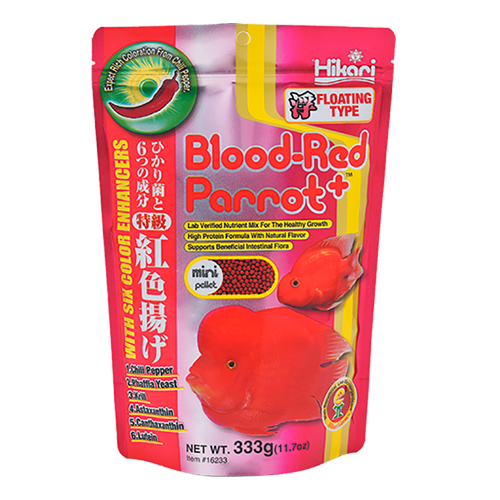
Hikari Blood Red Parrot+ is specifically formulated for blood red parrot cichlids. The manufacturer describes it as a probiotic-enhanced diet and lists colour-supporting ingredients including chili pepper, Phaffia yeast, krill, astaxanthin, canthaxanthin and marigold flower meal.
Hikari also provides mini and medium pellet formats. This makes the product particularly relevant to the search phrase Hikari blood red parrot food, because the aquarist can choose a pellet size according to the individual fish.
The manufacturer’s current information states that the food contains a minimum of 40% crude protein, minimum 5% crude fat and maximum 2% crude fiber. The feeding guidance recommends two to three feedings per day using an amount the fish can completely consume in a few minutes.
Sera Red Parrot Food
Sera Red Parrot Pellets are another specialist product designed for parrot cichlids. Sera describes the food as floating, water-stable granules containing astaxanthin and Haematococcus algae, with prebiotic ingredients.
The manufacturer’s USA product information lists 54 mg/kg astaxanthin in the product description and explains that the granules retain their shape for an extended period and are designed not to cloud the water.
This makes Sera particularly relevant to searches for Sera red parrot food and parrot fish food with astaxanthin.
Why Is Astaxanthin Used in Parrot Fish Food?
Astaxanthin is a carotenoid pigment that occurs naturally in organisms such as algae and aquatic animals. In ornamental fish nutrition, carotenoids are commonly included in diets to support coloration.
A blood parrot’s orange-red appearance is influenced by genetics, pigmentation biology, diet, lighting, health and environmental conditions. A colour-enhancing food can support the dietary side of this equation, but it should not be described as a magic colour treatment.
The key point is consistency. If colour-supporting ingredients are part of the selected staple diet, they can contribute to a long-term feeding programme. Short-term overfeeding with highly concentrated colour foods is not a substitute for balanced nutrition.
Common Astaxanthin Sources
| Ingredient or Source | Role in Aquarium Food | Examples in This Guide |
|---|---|---|
| Haematococcus algae | Natural source of astaxanthin | Sera Red Parrot |
| Krill | Animal-derived carotenoid source and protein ingredient | Hikari, Sera and other specialist formulas |
| Spirulina | Source of pigments and nutrients | Used in many ornamental fish foods |
| Astaxanthin | Concentrated carotenoid used for pigmentation support | Hikari, Sera and other colour foods |
| Canthaxanthin | Carotenoid pigment used in some ornamental fish diets | Hikari Blood Red Parrot+ |
Complete Blood Parrot Cichlid Feeding Guide
A good feeding routine should be predictable, moderate and easy to monitor. Blood parrots can be enthusiastic feeders, and their feeding behaviour can make it tempting to continue adding food when they appear interested.
Instead, establish a small portion and observe consumption. The fish should be able to consume the offered amount within a few minutes without significant leftovers.
How Often Should You Feed a Blood Parrot Cichlid?
The supplied USA SERP research identifies two to three small meals per day as a common search-intent answer, and Hikari’s manufacturer guidance also recommends feeding Blood Red Parrot+ two to three times daily in quantities the fish can consume in a few minutes.
For many adult home aquariums, two modest feedings can be easier to manage than three. Juveniles may benefit from more frequent small meals depending on growth and husbandry conditions. The key is portion size rather than simply increasing feeding frequency.
How Much Food Should You Give?
There is no universally correct gram quantity for every blood parrot. Fish size, number of fish, pellet density, food formulation and feeding frequency all change the appropriate portion.
A practical starting point is to offer a small quantity and watch the fish consume it. If food remains after the normal feeding period, reduce the next portion. If the fish consumes everything immediately and maintains good body condition, adjust cautiously rather than making a large increase.
Should You Feed Three Times a Day?
Three small meals can work well when each meal is genuinely small. It is not automatically better than two meals. The total daily amount still matters.
For busy aquarists, an automatic feeder can provide consistent timing, but it must be calibrated carefully. AquariumWorld’s automatic fish feeder guide explains how programmable feeders can support consistent feeding routines.
Weekly Parrot Fish Food Schedule
The following schedule is an example rather than a rigid prescription. The staple food should remain the nutritional foundation, while supplementary foods are used in controlled quantities.
| Day | Morning | Midday | Evening | Focus |
|---|---|---|---|---|
| Monday | Colour-enhancing pellets | Colour-enhancing pellets | Colour-enhancing pellets | Standard staple diet |
| Tuesday | Colour-enhancing pellets | Frozen bloodworm | Colour-enhancing pellets | Protein variety |
| Wednesday | Colour-enhancing pellets | Colour-enhancing pellets | Colour-enhancing pellets | Standard staple diet |
| Thursday | Colour-enhancing pellets | Frozen krill | Colour-enhancing pellets | Dietary variety and carotenoid source |
| Friday | Colour-enhancing pellets | Spirulina-based food | Colour-enhancing pellets | Plant and pigment variety |
| Saturday | Colour-enhancing pellets | Small or reduced meal | Colour-enhancing pellets | Portion control |
| Sunday | Colour-enhancing pellets | Blanched peas or zucchini | Colour-enhancing pellets | Dietary variety |
This schedule should be adjusted according to body condition, aquarium stocking, water quality and individual appetite. A fish that is becoming overweight should receive less food rather than additional “exercise” through more frequent meals.
Can Blood Parrot Cichlids Eat Bloodworms and Brine Shrimp?
Yes. Frozen bloodworm and frozen brine shrimp can be useful supplementary foods for blood parrot cichlids when offered appropriately. They should not automatically replace a complete staple diet.
Frozen Bloodworm
Bloodworm is commonly used as a protein-rich supplementary food for aquarium fish. For blood parrots, the soft texture can make it easier to consume than large hard pellets. Offer small amounts and remove leftovers.
Frozen bloodworm should be thawed before feeding. A practical method is to place a small portion into a clean container with aquarium water, allow it to thaw and then offer an appropriate quantity.
Frozen Brine Shrimp
Brine shrimp can provide dietary variety and are widely used as a supplementary aquarium food. They can be particularly useful when an aquarist wants to vary texture and feeding behaviour.
As with bloodworm, thaw frozen food before adding it to the aquarium and avoid feeding more than the fish can consume.
Frozen Krill
Krill is often included in colour-supporting fish diets because it naturally contains carotenoid pigments. Small quantities can be offered as a supplement to a complete diet.
Do not interpret a highly pigmented food as permission to feed unlimited quantities. The total diet remains more important than one colour-enhancing ingredient.
What Vegetables Can Blood Parrot Cichlids Eat?
Blood parrots can accept suitable plant-based foods, although individual preferences differ. Small portions of blanched peas or zucchini can be used as occasional dietary variety.
Peas should be softened and prepared appropriately before feeding. Avoid seasoned, salted or processed human foods. Aquarium fish should not receive food containing sauces, spices, oils or preservatives intended for people.
Vegetables should remain supplementary rather than replacing a complete commercial diet.
Why Won’t My Blood Parrot Cichlid Eat?
A blood parrot refusing food can have many causes. New fish may be stressed after transport. A pellet may be too large. Tank mates may be eating everything first. Water quality may be poor. The fish may be ill.
| Possible Cause | Common Sign | What to Check |
|---|---|---|
| New-tank stress | Hiding and refusing food | Acclimation, water quality and environmental disturbance |
| Pellet too large | Fish takes food and spits it out | Try a smaller pellet |
| Food preference | Fish ignores one food but approaches another | Try an alternative appropriate food texture |
| Poor water quality | Lethargy, rapid breathing or appetite loss | Test ammonia, nitrite, nitrate and other relevant parameters |
| Competition | Other fish consume food first | Observe feeding positions and consider targeted feeding |
| Illness | Visible lesions, spots or abnormal behaviour | Assess symptoms and seek appropriate fish-health advice |
If the fish has stopped eating and is also showing abnormal behaviour, do not simply switch foods repeatedly. Test the aquarium water first. AquariumWorld’s aquarium water test kit comparison provides a useful starting point for choosing testing equipment.
The broader fish aquarium problems and solutions guide can also help when appetite loss occurs alongside other aquarium problems.
Water Quality and Parrot Fish Food
Feeding and water quality are closely connected. Uneaten food breaks down, fish waste increases with feeding and excessive portions can add unnecessary organic load to the aquarium.
A colour-enhancing food is only useful when it is used responsibly. If the aquarist adds excessive quantities in an attempt to intensify colour quickly, the resulting waste can create more problems than the dietary benefit justifies.
This is especially important with larger cichlids. Oscar aquariums, for example, can produce significant waste. AquariumWorld’s Oscar Fish 55 Gallon Tank Filtration guide explains why filtration and water changes become increasingly important as fish grow.
Parrot Fish Food and Tank Mates
Feeding behaviour is also affected by tank mates. A blood parrot with an unusual mouth may take longer to capture food than another cichlid. If a faster fish consumes everything first, the blood parrot may gradually receive less nutrition than intended.
This is why feeding observation is essential in community aquariums. Do not assume that adding the correct food means every fish is receiving the correct amount.
AquariumWorld’s Oscar fish tank mates compatibility guide discusses the same broader principle for large cichlid communities: adult size, temperament, feeding access and aquarium space all matter.
If you keep a blood parrot with Oscars or other large cichlids, feed strategically so the slower fish has access to suitable food. A separate feeding area or carefully targeted feeding can sometimes reduce competition.
Colour-Enhancing Parrot Fish Food
The phrase colour enhancing parrot fish food is common in aquarium searches because blood parrots are known for their bright red, orange and yellow colours.
Colour should be considered as one part of overall fish condition. A fish with good colour but poor appetite, damaged fins or unstable water quality is not necessarily healthy.
Carotenoid-containing foods can support pigmentation, while genetics and environmental conditions establish the limits of what a fish can naturally display.
For example, AquariumWorld’s recent Copper Oscar Fish guide also discusses how diet, pigmentation and colour interact in ornamental cichlids.
Similarly, our Fire Red Oscar Fish guide examines colour, diet, genetics and environmental factors. These principles are useful when thinking about ornamental fish colour more generally.
Do Coloured Fish Need Special Food?
A specialist colour food can be useful, but it should still provide balanced nutrition. Colour enhancement should not become the only selection criterion.
When comparing two foods, look at the complete ingredient profile, guaranteed analysis, pellet size, feeding behaviour and how the fish responds to the food. A fish that refuses a theoretically excellent food is not benefiting from it.
Avoid products that make unrealistic promises about transforming the fish’s genetics. The purpose of a colour-enhancing diet is to provide nutritional pigments that can support normal pigmentation.
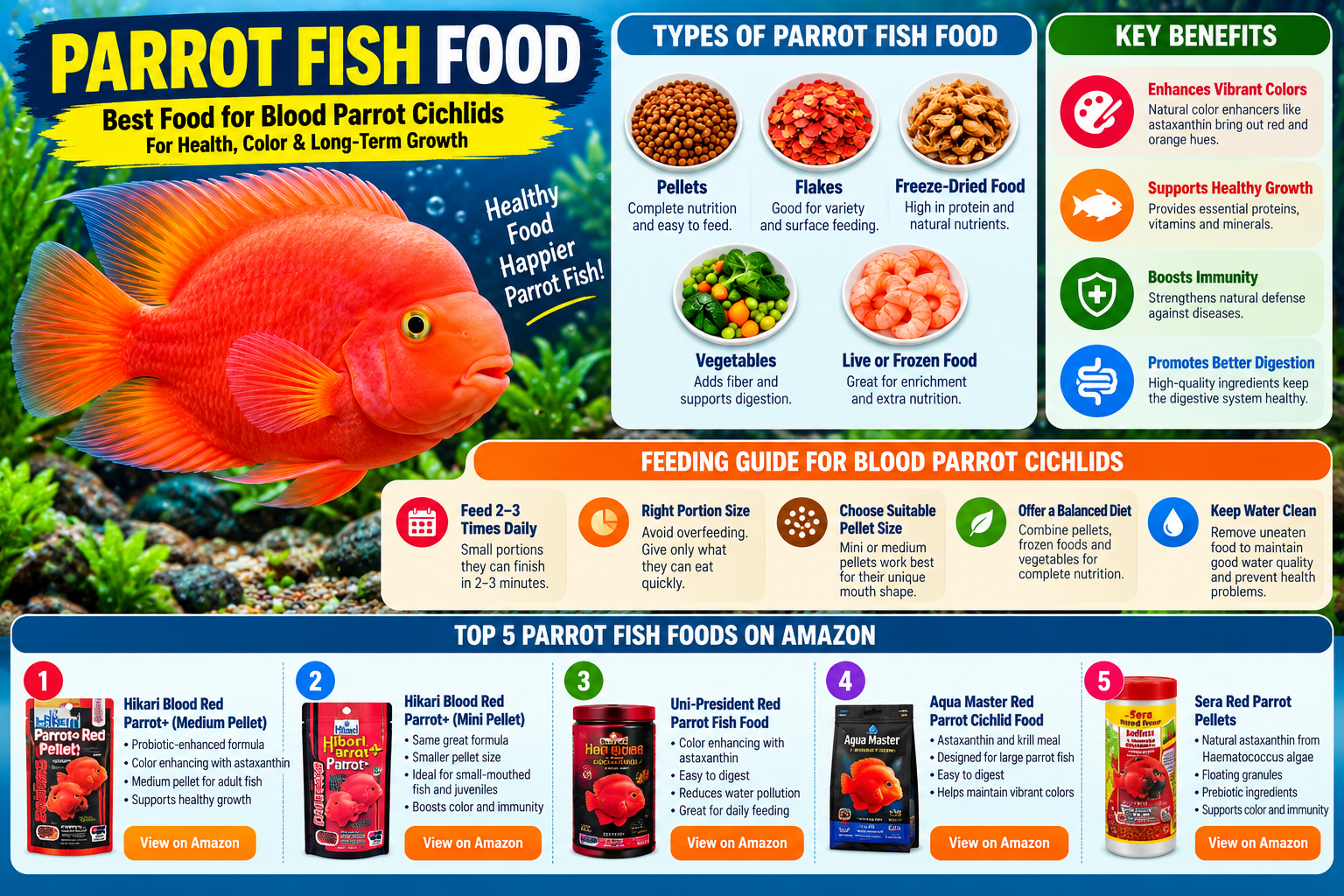
Five Best-Selling Parrot Fish Foods on Amazon in 2026
The five products below come from the USA-focused product research supplied for this article. The supplied data includes Amazon Best Seller Rank information, product characteristics and reported purchase activity. Amazon rankings, prices, availability, badges and purchase counts can change, so readers should verify current listing information before buying.
1. Hikari Blood Red Parrot+ Fish Food — Medium Pellet

Hikari Blood Red Parrot+ Medium is a specialist diet developed specifically for blood red parrot cichlids. The manufacturer describes it as a probiotic-enhanced diet and lists Hikari-Germ together with colour-supporting ingredients including chili pepper, Phaffia yeast, krill, astaxanthin, canthaxanthin and marigold flower meal.
The supplied USA product research identifies this medium pellet as the highest-priority product in the comparison, with an Amazon Best Seller Rank of #278 in Aquarium Fish Food at the time the research was compiled, a reported 4.3-star rating and an Amazon’s Choice badge for the relevant search phrase.
The medium pellet is approximately 3.5–4.0 mm according to Hikari’s current product information. That makes it more suitable for blood parrots that can comfortably manage a larger pellet. Smaller fish or individuals with more restricted mouths may be better matched to Hikari’s mini format.
Hikari recommends feeding two to three times daily, using an amount the fish can consume within a few minutes, and advises removing uneaten food to reduce water-quality problems.
| Feature | Details |
|---|---|
| Product | Hikari Blood Red Parrot+ |
| Format | Medium floating pellet |
| Size | Approx. 3.5–4.0 mm |
| Pack in supplied research | 11.7 oz / 333 g |
| Key colour ingredients | Astaxanthin, canthaxanthin, krill, Phaffia yeast and other listed ingredients |
| Special feature | Hikari-Germ probiotic component |
2. Hikari Blood Red Parrot+ Mini Pellets

The Hikari Blood Red Parrot+ Mini format uses the same specialist diet concept but provides a smaller pellet for fish that struggle with larger food particles. Hikari lists the mini pellet at approximately 2.5–2.8 mm.
This format is particularly relevant for juveniles, smaller adults and fish with restricted mouth openings. A smaller pellet can reduce the amount of time the fish spends attempting to manipulate food and may make feeding more efficient.
The supplied product research reports an Amazon Best Seller Rank of #744 in Aquarium Fish Food and 50+ purchases per month at the time the research was compiled.
The important lesson is that pellet size should be considered alongside nutritional composition. A highly nutritious medium pellet is not necessarily a better choice for a fish that cannot comfortably eat it.
If a blood parrot repeatedly spits out a medium pellet, trying the mini format is a logical feeding experiment. Monitor whether the fish begins consuming the food more easily rather than simply increasing the quantity.
Check Hikari Blood Red Parrot+ Mini on Amazon3. Uni-President Fish Color Enhancing Red Parrot and Cichlid Fish Feed

Uni-President Red Parrot and Cichlid Fish Feed is included in the supplied product research as a colour-enhancing option containing astaxanthin. The research reports a Best Seller Rank of #653 in Aquarium Fish Food and 50+ purchases per month at the time the data was compiled.
The product is described as a floating pellet designed specifically around red parrot and cichlid feeding. The supplied research also identifies larger package options, which may be relevant to aquarists keeping multiple blood parrots.
For a multi-fish aquarium, larger food containers can offer practical value, but freshness still matters. Avoid purchasing more food than you can use properly before it deteriorates. Store dry fish food in a cool, dry place and close the container after feeding.
This product may appeal to aquarists who want a dedicated colour-enhancing parrot cichlid formula while comparing different price points and package sizes.
Check Uni-President Red Parrot Food on Amazon4. Aqua Master Red Parrot Cichlid Fish Food

Aqua Master Red Parrot Cichlid Fish Food is included in the supplied product research as an option designed for larger ornamental fish, including giant blood parrots. The research identifies astaxanthin, krill meal and fish meal among its key ingredients and describes a pellet size around 2.8–3.0 mm.
The supplied research reports a Best Seller Rank of #1,276 in Aquarium Fish Food. Because marketplace rankings change continuously, that figure should be regarded as a snapshot rather than a permanent ranking.
The 500 g package may be useful for aquarists with several fish, provided the food is stored correctly and consumed while fresh. As always, choose the pellet according to the fish’s actual feeding ability rather than the product’s intended market category.
Check Aqua Master Red Parrot Food on Amazon5. Sera Red Parrot Pellets

Sera Red Parrot Pellets are formulated as a staple food for parrot cichlids, with floating granules, Haematococcus algae and astaxanthin used to support coloration. [ BUY NOW ]
Sera Red Parrot Pellets are specifically formulated as a staple food for parrot cichlids. Sera’s current USA product information describes floating, water-stable granules containing 54 mg/kg astaxanthin and a high proportion of Haematococcus algae.
Sera also states that the granules retain their shape for a long period and do not cloud the water. The ingredient list includes fish meal, wheat ingredients, krill, spirulina, fish oil, Haematococcus algae meal, vegetables, herbs and other nutritional ingredients.
The supplied USA research identifies Sera as #534 in Aquarium Fish Food at the time of its research and reports a 4.2-star rating with more than 126 verified ratings. These marketplace figures can change.
For aquarists specifically interested in a natural carotenoid source, the Haematococcus algae component makes this product particularly relevant. It is also a useful alternative when a fish does not respond well to another parrot-specific pellet.
Check Sera Red Parrot Pellets on AmazonParrot Fish Food Comparison Table
| Product | ASIN | Format | Supplied BSR | Colour Support | Useful For |
|---|---|---|---|---|---|
| Hikari Blood Red Parrot+ Medium | B00M4Q923E | Medium floating pellet | #278 | Astaxanthin, krill, canthaxanthin and other listed ingredients | Adult fish able to manage medium pellets |
| Hikari Blood Red Parrot+ Mini | B00A9E5SSG | Mini floating pellet | #744 | Same specialist formula family | Juveniles and smaller-mouthed fish |
| Uni-President Red Parrot | B0169E5TR4 | Medium floating pellet | #653 | Astaxanthin | Daily colour-enhancing feeding |
| Aqua Master Red Parrot | B01BUE16NE | 2.8–3.0 mm floating pellet | #1,276 | Astaxanthin and krill | Larger parrot cichlids |
| Sera Red Parrot Pellets | B0138NSCAK | Floating granules | #534 | Haematococcus algae and astaxanthin | Parrot cichlids seeking a specialist granule |
Which Parrot Fish Food Should You Choose?
Rather than selecting a single food for every blood parrot, match the product to the fish and feeding situation.
| Your Situation | Product to Consider | Reason |
|---|---|---|
| Adult blood parrot that eats medium pellets comfortably | Hikari Blood Red Parrot+ Medium | Specialist blood-parrot formula and medium pellet format |
| Juvenile or small-mouthed blood parrot | Hikari Blood Red Parrot+ Mini | Smaller approximately 2.5–2.8 mm pellet |
| Looking for another colour-enhancing floating pellet | Uni-President | Astaxanthin-based formula identified in supplied research |
| Large adult parrot cichlid | Aqua Master | 2.8–3.0 mm pellet and large package format |
| Interested in Haematococcus-derived astaxanthin | Sera Red Parrot Pellets | Specialist parrot granules with Haematococcus algae |
How to Compare Parrot Fish Food Labels
A food label contains more useful information than the front of the packet. Start with the intended fish, pellet size and feeding instructions. Then examine the guaranteed analysis and ingredient list.
Protein
Protein is important for fish growth and maintenance, but a higher protein percentage does not automatically make a food better. Protein sources and overall formulation matter as well.
Fat
Fish require dietary lipids, but excessive feeding remains problematic regardless of the food’s fat percentage. Portion control should therefore be considered alongside guaranteed analysis.
Fiber
Fiber levels can help explain how a food is formulated, although a single number should not be used to judge the complete quality of a fish food.
Carotenoids
If maintaining red or orange coloration is a priority, check whether the product contains carotenoid sources such as astaxanthin, krill, algae or other pigment-supporting ingredients.
Pellet Size
For blood parrots, pellet size can be one of the most immediately important label characteristics. A food that is too large may be nutritionally excellent but practically unsuitable for an individual fish.
How Food Choice Affects Aquarium Water Quality
Good parrot fish food should be eaten efficiently. Food that rapidly dissolves, is continuously rejected or is offered in excessive quantities can increase waste.
The best feeding routine is therefore not simply “buy the best food.” It is “choose appropriate food and feed the right amount.”
If your blood parrot repeatedly leaves food behind, reduce the portion. If it cannot physically manage the pellet, choose a smaller size. If another fish consumes everything, adjust the feeding method.
Water quality should be monitored alongside feeding. AquariumWorld’s marine aquarium water test kits guide is particularly relevant to saltwater keepers, while the general aquarium water test kit guide is useful for freshwater and saltwater aquarists.
Parrot Fish Food for Different Aquarium Sizes
Small Aquarium
In smaller aquariums, portion control becomes especially important because there is less water volume to dilute waste. Feed carefully and remove leftovers promptly.
Medium Aquarium
Medium aquariums provide more water volume but still require appropriate filtration. A 55-gallon aquarium can be suitable for certain blood-parrot setups, but adult size and tank-mate plans must be considered.
Large Aquarium
Large aquariums can support more complex communities, but they are not automatically maintenance-free. Larger fish produce larger waste loads, and stocking should be planned around adult size.
AquariumWorld’s Blue Oscar Fish guide and Blueberry Oscar Fish guide provide further examples of why ornamental colour labels should not replace careful consideration of adult fish size and husbandry.
Parrot Fish Food and Oscar Aquariums
Blood parrots are sometimes considered as companions for Oscars. If they are kept together, feeding access becomes particularly important because Oscars can be fast and assertive feeders.
The fish should be observed during every feeding. A blood parrot that repeatedly loses food to an Oscar may need a separate feeding location or a more carefully controlled feeding method.
Colour varieties do not change these basic requirements. AquariumWorld’s White Tiger Oscar Fish guide and Bumblebee Oscar Fish guide provide additional large-cichlid context.
Parrot Fish Food and Planted Aquariums
Some aquarists keep blood parrots in planted aquariums. Plants can add shelter and visual structure, although individual cichlids may interact with décor differently.
A planted aquarium still requires careful feeding. Excess food can accumulate around plants and decorations, where it may decompose unnoticed.
AquariumWorld’s best plants for Betta fish tanks guide provides broader information about planted freshwater aquariums and plant selection.
Parrot Fish Food and Responsible Fish Keeping
Food is part of responsible ownership because nutrition affects growth, body condition and long-term welfare. A fish should be able to feed normally without repeated struggle or competition.
This is particularly relevant to hybrid ornamental fish with unusual body structures. Feeding should be adapted to the individual rather than forcing the fish to eat food designed for a different mouth shape.
If a fish develops persistent feeding difficulty, seek advice from an experienced aquatic professional or aquatic veterinarian. Do not assume that changing brands will solve every health problem.
Foods to Avoid or Use Carefully
| Food | Reason for Caution |
|---|---|
| Very large hard pellets | May be difficult for a restricted blood parrot mouth to manage. |
| Feeder goldfish as a routine diet | Potential nutritional and disease risks make them unnecessary as a staple. |
| Human food scraps | Salt, seasoning, oils and additives are unsuitable. |
| Excessive freeze-dried foods | Should not replace a balanced complete diet. |
| Beef heart as a staple | Not necessary as a routine food and can create an imbalanced feeding programme. |
| Excessive food of any type | Increases waste and can contribute to poor aquarium water quality. |
How to Feed a Blood Parrot Without Overfeeding
Overfeeding is one of the most common aquarium feeding mistakes. Fish often appear interested in food even after receiving enough. The aquarist therefore needs to control the portion rather than allowing the fish’s enthusiasm to determine how much is offered.
Start with a small amount. Observe how quickly it disappears. If everything is eaten immediately and the fish remains in good body condition, increase only slightly if needed.
If food falls to the substrate and remains there, stop adding more. Remove leftovers where possible.
The same principle applies when using an automatic feeder. Test the feeder with the exact food before leaving it unattended. Our automatic aquarium fish feeder guide provides practical information about programming, setup and feeding consistency.
For pond owners, AquariumWorld’s automatic fish feeder for pond guide covers portion control and outdoor feeding considerations.
How Long Does Fish Food Stay Fresh?
Dry fish food should be stored in a cool, dry location and protected from humidity. Repeated exposure to air and moisture can reduce quality over time.
For this reason, avoid purchasing enormous quantities simply because the cost per gram appears lower. A smaller container used while fresh may be more practical for a single-fish aquarium.
Close the container immediately after feeding and use clean, dry hands or utensils when handling the food.
What If My Blood Parrot Eats Too Fast?
Fast feeding is not necessarily a problem if the portion is controlled, but rapid consumption can make it harder to judge whether the fish has received enough.
Divide the daily ration into multiple small feedings. This also gives you additional opportunities to observe the fish and identify changes in appetite.
If multiple fish are competing, distribute food across different areas of the aquarium rather than dropping everything in one place.
What If My Blood Parrot Spits Out Pellets?
Repeatedly spitting out pellets can indicate that the food is too large, too hard or simply not preferred. It can also indicate a health issue if the behaviour is new and occurs with all foods.
Start by trying a smaller pellet. Hikari’s mini Blood Red Parrot+ is one example of a specialist food with a smaller particle size.
If the fish continues refusing food, test water parameters and observe for other signs of illness.
Parrot Fish Food and Tiger Parrot Fish
The phrase “tiger parrot fish” is used in the ornamental trade for patterned freshwater parrot cichlids. It should not automatically be assumed that every tiger parrot has exactly the same genetics or mouth structure.
AquariumWorld’s Tiger Parrot Fish complete care guide explains the terminology, tank planning, diet, tank mates and buying considerations in greater detail.
For feeding purposes, observe the actual fish. If it has the characteristic restricted mouth associated with blood-parrot-type cichlids, choose food accordingly. If its anatomy differs, ask the seller or breeder about its feeding behaviour and current diet.
Parrot Fish Food and Fish Rehoming
Feeding is one reason why fish should not be purchased without considering long-term ownership. If a large cichlid becomes difficult to maintain, rehoming is preferable to releasing it into the wild.
AquariumWorld’s responsible Oscar fish rehoming guide explains safe alternatives for owners who can no longer keep large aquarium fish.
The same responsible approach applies to blood parrots and other ornamental fish. Never release aquarium livestock into rivers, lakes or local waterways.
Frequently Asked Questions About Parrot Fish Food
What do parrot fish eat?
Freshwater blood parrot cichlids generally do well on a complete appropriately sized cichlid food supplemented with suitable frozen or plant-based foods. Pellet size should be matched to the individual fish because their mouth structure can make large food difficult to manage. Marine parrotfish are different and have a primarily reef-grazing diet.
What is the best food for blood parrot cichlids?
There is no single food that is ideal for every individual. A good choice should provide complete nutrition, have a manageable particle size and be accepted by the fish. Specialist foods such as Hikari Blood Red Parrot+ and Sera Red Parrot Pellets are specifically formulated for parrot cichlids and include colour-supporting ingredients.
Can blood parrot cichlids eat regular cichlid food?
Yes, provided the food is nutritionally appropriate and the fish can comfortably eat it. Specialist parrot foods can be useful because their pellet sizes and formulations are designed around parrot cichlid feeding requirements. Always observe whether the individual fish can actually consume the food.
Do blood parrot cichlids need sinking or floating food?
Individual preferences vary. Some blood parrots readily eat floating pellets, while others may feed more comfortably on sinking foods. Start with an appropriate food and observe the fish. If the fish struggles with one feeding style, try another.
How often should I feed my blood parrot cichlid?
Two or three small meals per day can work well, provided each portion is controlled. Hikari’s manufacturer guidance for Blood Red Parrot+ recommends feeding two to three times daily in an amount the fish can consume within a few minutes. Adult fish may require fewer total calories than juveniles.
What colour enhancing food is best for parrot fish?
Foods containing carotenoid sources such as astaxanthin, krill or Haematococcus algae are commonly used for colour support. Hikari Blood Red Parrot+ and Sera Red Parrot Pellets are two specialist examples. Diet supports pigmentation but does not override genetics.
Can parrot fish eat bloodworms and brine shrimp?
Yes, freshwater blood parrot cichlids can receive suitable frozen bloodworm and brine shrimp as supplementary foods. These should be offered in controlled quantities and should not replace a nutritionally complete staple diet.
Why won’t my blood parrot cichlid eat?
Possible reasons include stress, unsuitable pellet size, competition, poor water quality, temperature problems or illness. Start by testing the aquarium water and observing the fish closely. If the fish has other abnormal symptoms, investigate health problems rather than repeatedly changing food.
How much food should I give my parrot fish per feeding?
Offer an amount the fish can consume promptly, generally within a few minutes. Start conservatively and adjust according to body condition, appetite and waste. If food remains in the aquarium, the portion is probably too large or the food is unsuitable.
What foods make parrot fish more colourful?
Colour-supporting foods often contain carotenoids such as astaxanthin. Ingredients such as krill, Haematococcus algae, spirulina and other pigment-rich components may be included in ornamental fish diets. Consistent balanced nutrition is more important than trying to intensify colour rapidly.
Is Hikari Blood Red Parrot+ good for blood parrots?
Hikari specifically formulates Blood Red Parrot+ for blood red parrot cichlids. The manufacturer lists both mini and medium pellet sizes and includes Hikari-Germ and several colour-supporting ingredients. Select the pellet size according to the individual fish.
Is Sera Red Parrot good for blood parrots?
Sera Red Parrot Pellets are specifically formulated as a staple food for parrot cichlids. Sera describes them as floating, water-stable granules containing astaxanthin and Haematococcus algae. The granule size should still be suitable for the individual fish.
Should I feed frozen food every day?
Not necessarily. Frozen foods can add variety but do not need to replace a complete staple food. Use modest portions and remove leftovers. A balanced staple diet should remain the foundation.
Can I use an automatic feeder for parrot fish?
Yes. An automatic feeder can help maintain a consistent schedule, but it should be tested and calibrated before being trusted. Portion size matters more than simply setting a feeding frequency.
Does colour-enhancing food change a fish’s genetics?
No. Dietary carotenoids can support pigmentation, but food cannot rewrite the fish’s genetic colour characteristics. Lighting, genetics, age, health and environmental conditions also influence appearance.
Can I feed my blood parrot vegetables?
Small portions of suitable vegetables such as blanched peas or zucchini can be used occasionally as dietary variety. Prepare them appropriately and avoid seasoning, salt, oils and human-food additives.
Final Parrot Fish Food Buying Guide
Choosing parrot fish food becomes much easier when the decision is broken into a few practical questions. First, can the fish comfortably eat the food? Second, does it provide a suitable nutritional foundation? Third, does the feeding behaviour fit the aquarium? Fourth, does the product support the aquarist’s preferred approach to colour maintenance and dietary variety?
For many blood parrot keepers, specialist foods make sense because the formulas and particle sizes are designed specifically for parrot cichlids. Hikari Blood Red Parrot+ offers mini and medium formats. Sera Red Parrot provides floating granules with Haematococcus algae and astaxanthin. Uni-President and Aqua Master provide additional options for aquarists comparing formulations, pellet sizes and package quantities.
However, the “best” food is ultimately the one that your individual fish can eat efficiently while maintaining good body condition and stable aquarium water quality. A premium food that is too large is not useful. A food that the fish refuses is not useful. A food fed in excessive quantities can also become a water-quality problem.
Start with a suitable staple food, feed modest portions and observe the fish. Introduce supplementary foods gradually. Monitor ammonia and other relevant water parameters. If the fish’s appetite changes suddenly, investigate the aquarium rather than assuming that a different food is the only solution.
For aquarists who want a specialist colour-enhancing diet, Hikari Blood Red Parrot+ and Sera Red Parrot Pellets are two established products worth comparing. For smaller fish, the Hikari mini format provides a smaller particle size. For larger fish, compare the actual pellet dimensions with the fish’s mouth rather than relying solely on the product’s marketing category.
Finally, remember that food is only one part of blood parrot cichlid care. Aquarium size, filtration, water quality, tank mates, temperature, enrichment and long-term welfare all contribute to the fish’s condition. Good feeding becomes much more effective when the rest of the aquarium is stable.
Related AquariumWorld Guides
Conclusion
The right parrot fish food should make feeding easier, not more complicated. Blood parrot cichlids have unusual mouth anatomy, so pellet size and feeding behaviour deserve as much attention as the ingredient list. Mini pellets can be useful for smaller or restricted mouths, while larger adults may comfortably manage medium pellets.
Colour-enhancing formulas containing astaxanthin, krill, Haematococcus algae, spirulina and other carotenoid sources can support the red and orange pigmentation that makes blood parrots so popular. However, colour should never be considered more important than balanced nutrition, good water quality and normal feeding behaviour.
The five products covered here provide several approaches. Hikari Blood Red Parrot+ offers dedicated mini and medium formats. Uni-President provides another colour-enhancing option. Aqua Master offers a larger package and pellet format aimed at larger ornamental fish. Sera Red Parrot Pellets provide floating granules with Haematococcus algae and astaxanthin.
Whichever food you choose, begin with a conservative portion. Watch the fish eat. Make sure the food can be swallowed comfortably. Remove leftovers and monitor aquarium water quality. If appetite changes suddenly, investigate the underlying cause instead of assuming that a different food will solve the problem.
A well-fed blood parrot is the result of a complete husbandry routine rather than one magic product. Choose an appropriate staple, add dietary variety carefully, maintain excellent filtration and water quality, and adjust feeding according to the actual condition and behaviour of your fish.