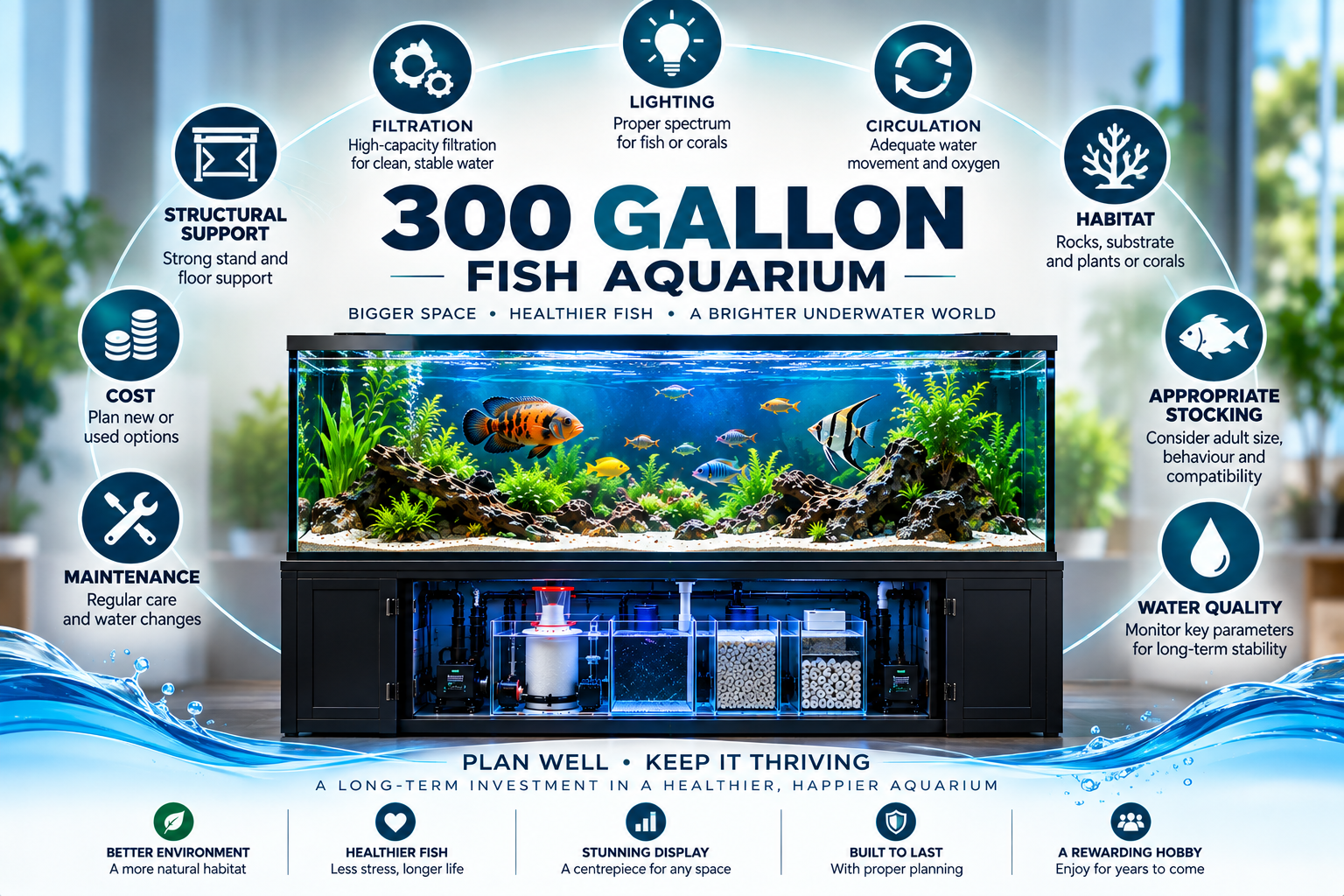
A complete guide to the 300 gallon fish aquarium covering exact dimensions in inches and cm, total filled weight breakdown, cost, glass versus acrylic, filtration, stand requirements, floor support, cycling time, freshwater and reef stocking, and long-term maintenance.
Introduction
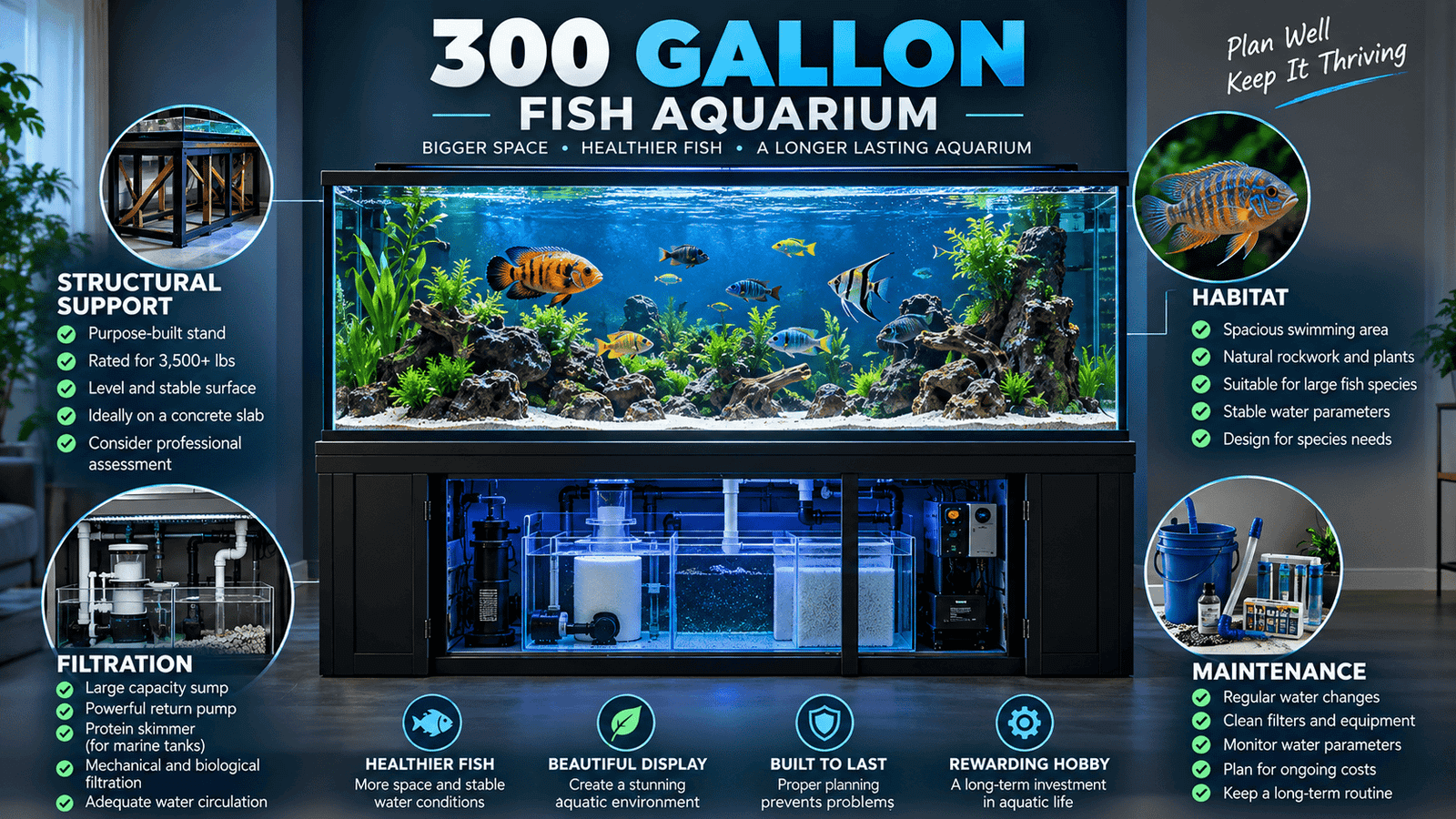
A 300 gallon fish aquarium is one of the largest home aquarium sizes available, and understanding its dimensions, weight, cost, filtration and support requirements should come before purchase or installation. Three hundred US gallons represents about 1,136 litres of nominal water capacity, but the completed system weighs far more than the water alone. Water contributes about 2,502 pounds before the tank, stand, substrate, rockwork, sump and equipment are added. At this scale, aquarium planning becomes a combination of fish husbandry, plumbing, electrical planning and structural assessment. The large volume can provide valuable stability and generous habitat, but it does not remove the consequences of overstocking, poor filtration or an unsuitable location. This guide examines the major decisions involved in designing a 300 gallon aquarium for freshwater or marine use, with practical calculations and evidence-based considerations throughout.
The most important principle is to design the complete system rather than treating the display tank as an isolated object. Weight must be transferred safely through the stand and building structure. Filtration must process the biological load created by the selected livestock. Circulation must move oxygen and waste effectively without creating harmful flow patterns. Stocking must reflect adult size, behaviour and water-quality demand rather than a simple fish-per-gallon formula. Research on stocking density, biofilters and fish welfare supports this systems approach because biological performance is influenced by oxygen, nitrogenous waste, microbial communities, environmental quality and behaviour (Aquapolis Research Group, 2024; Bagchi et al., 2014; Preena, Rejish Kumar and Singh, 2021).
How Big Is a 300 Gallon Fish Tank
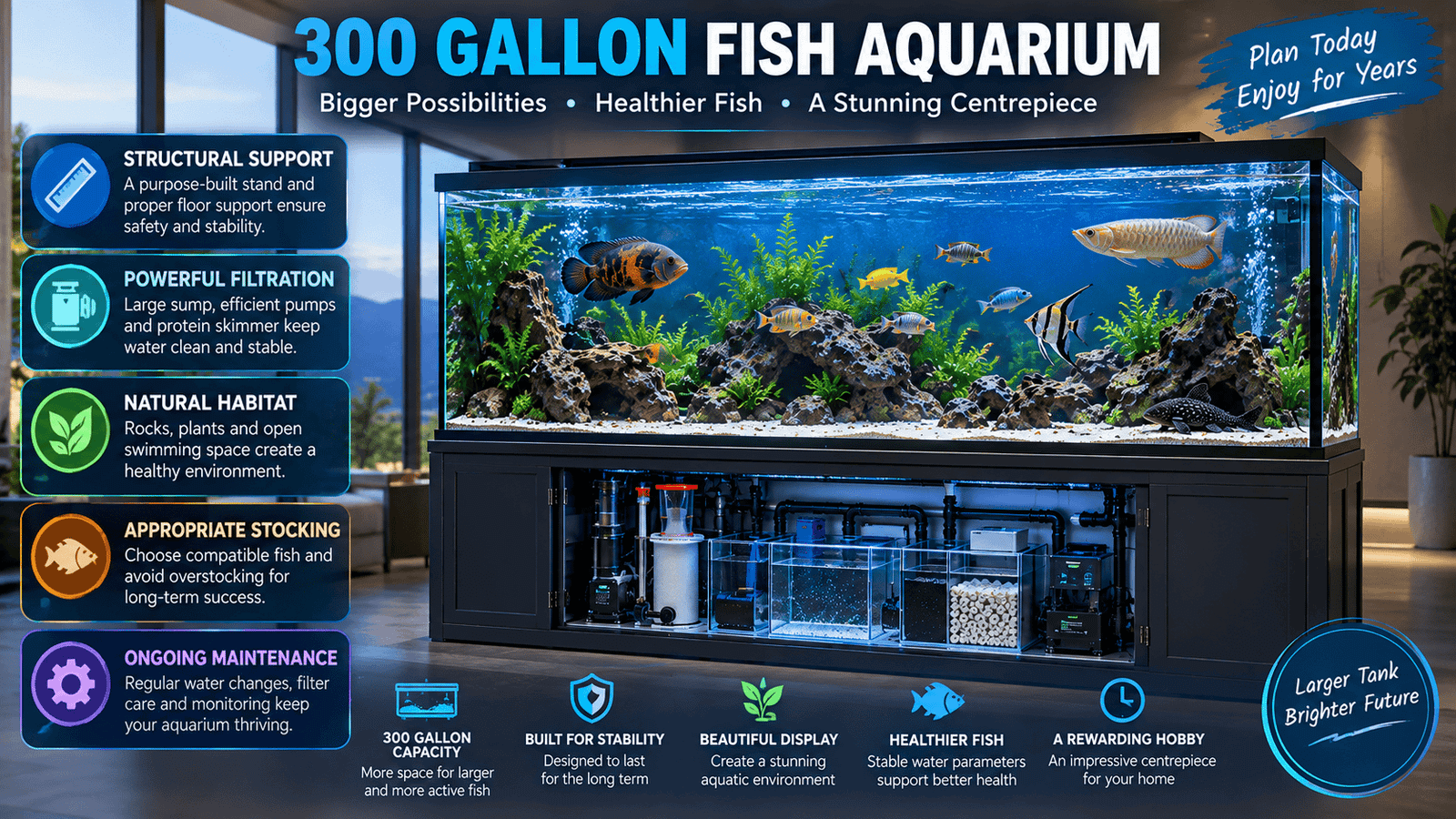
A 300 gallon fish tank does not have one universal set of dimensions because manufacturers and custom builders use different proportions. A common rectangular configuration is approximately 96 inches long, 24 inches wide and 30 inches high. This equals about 244 by 61 by 76 centimetres and creates a footprint of 16 square feet. Another deep configuration can measure about 72 by 36 by 28 inches, or roughly 183 by 91 by 71 centimetres, producing an 18 square foot footprint. A custom wide aquarium may measure about 84 by 30 by 30 inches, equivalent to approximately 213 by 76 by 76 centimetres. These differences matter because footprint influences floor loading, aquascaping, lighting, circulation and the amount of usable swimming space.
The advertised 300 gallon capacity should also be distinguished from actual operating volume. Substrate, rock, wood, internal equipment and a normal waterline below the rim displace water, so a filled aquarium may contain less than 300 gallons of actual water. This distinction becomes important for medication, water treatment, salt mixing and dosing. Physical dimensions also matter during delivery. A long 96 inch tank may require a large access route, wide doors and enough turning space to reach the final room. Measure the entire route before ordering, including door openings, stairs, lift dimensions and corners. For further dimensional comparison, use the AquariumsWorld fish tank dimensions guide as a complementary planning resource.
A larger footprint can be useful when the chosen fish are active swimmers or require territories. Length creates horizontal swimming lanes, while width allows deeper aquascaping and more effective visual barriers. Height is less useful if it cannot be reached comfortably for maintenance. A very tall tank can also complicate lighting, cleaning and access to the substrate. The best dimensions therefore depend on the species, room, structural conditions and maintenance plan. Before selecting a manufacturer, draw the footprint on the floor using tape and mark the stand, plumbing and working clearance. This simple exercise can reveal access problems long before the aquarium arrives.
300 Gallon Aquarium Dimensions in Inches and cm
| Configuration | Length | Width | Height | Footprint |
|---|---|---|---|---|
| Standard rectangle | 96 in (244 cm) | 24 in (61 cm) | 30 in (76 cm) | 16 sq ft |
| Deep dimension | 72 in (183 cm) | 36 in (91 cm) | 28 in (71 cm) | 18 sq ft |
| Wide custom | 84 in (213 cm) | 30 in (76 cm) | 30 in (76 cm) | 17.5 sq ft |
How Much Does a 300 Gallon Aquarium Weigh
Water is the dominant component of a 300 gallon aquarium. At approximately 8.34 pounds per US gallon, 300 gallons weighs about 2,502 pounds, or approximately 1,135 kilograms. A typical glass tank may contribute another 400 to 600 pounds, while a comparable acrylic tank can be around 250 to 350 pounds. A two to three inch substrate layer can add approximately 200 to 400 pounds across a large footprint. Rock, wood and other decorations may add 100 to 300 pounds, while a stand can contribute 150 to 400 pounds. Sump water and equipment can add another 50 to 150 pounds. These values are planning ranges and should be replaced by manufacturer specifications whenever those are available.
A complete glass system can therefore reach approximately 3,400 to 4,350 pounds, while an acrylic system may reach roughly 3,250 to 4,100 pounds. The exact operating weight depends on the actual tank, stand, aquascape and amount of water in the display and sump. This is why the common statement that a 300 gallon aquarium weighs about 2,500 pounds is incomplete. That figure describes water only. The structure supports everything together. Evaporation may reduce water weight slightly, while additional rock, deeper substrate or a larger sump can increase it. The safest planning method is to calculate every major component and then leave an appropriate margin for uncertainty.
The weight should be considered before delivery, not after the aquarium is inside the home. Moving a large empty aquarium already requires planning, but moving or adjusting a filled system is not realistic. The stand must be compatible with the tank base, and the contact points must transfer weight as intended. Manufacturer instructions regarding bracing, support surfaces and base material should be followed precisely. If the aquarium is custom built, request documented tank weight and support requirements. Combine those values with the actual substrate, rock, stand and operating water volume to create a realistic system-weight estimate.
300 Gallon Fish Tank Weight Filled
| Component | Planning weight |
|---|---|
| Water | 2,502 lb (1,135 kg) |
| Glass tank | 400 to 600 lb |
| Acrylic tank | 250 to 350 lb |
| Substrate | 200 to 400 lb |
| Rock or decorations | 100 to 300 lb |
| Stand | 150 to 400 lb |
| Sump and equipment | 50 to 150 lb |
| Total glass system | 3,400 to 4,350 lb |
| Total acrylic system | 3,250 to 4,100 lb |
Floor Support for a Large Aquarium
Floor support is one of the most important safety issues in a 300 gallon aquarium installation. A common residential live-load planning benchmark is around 40 pounds per square foot, with some contexts using higher values. A standard 96 by 24 inch footprint covers 16 square feet. A 3,400 pound system would produce a simple average load of about 213 pounds per square foot, while a 4,350 pound system would produce about 272 pounds per square foot. These simple averages demonstrate why a large aquarium should not be treated like ordinary furniture. Actual structural capacity depends on joist size and direction, spacing, span, beams, bearing walls, foundations, stand contact area and the path through which the load reaches the ground.
A basement on an appropriate concrete slab is often the simplest location because the load can be transferred directly into the ground, although the slab and surrounding structure still need to be suitable. A ground-floor installation may be practical when the structure is assessed correctly. Upper-floor installations deserve particular caution because joists can have limited capacity and long spans. Plywood can distribute contact pressure beneath a suitable stand, but it cannot make an inadequate floor structurally adequate. Likewise, placing a tank beside a wall does not automatically prove that a foundation or beam is carrying the load. These decisions require knowledge of the building structure rather than aquarium dimensions alone.
A qualified structural engineer should assess locations where capacity is uncertain, particularly on upper floors. Provide the engineer with the tank dimensions, estimated operating weight, stand design and intended position. This assessment should occur before the aquarium is purchased or moved. The installation also needs electrical and plumbing planning because a large aquarium can require several powered devices and frequent water changes. A permanent drain or nearby utility connection can reduce maintenance risk. Structural safety is therefore part of aquarium design, not a separate issue to solve after the display has been installed.
How Much Does a 300 Gallon Fish Tank Cost
The cost of a 300 gallon fish tank varies with material, dimensions, glass thickness, optical clarity, bracing, drilling, overflow design and whether the aquarium is stock or custom. A planning range of approximately 1,500 to 2,500 US dollars can apply to some stock glass tanks, while acrylic models may fall around 2,000 to 3,500 dollars. Custom high-clarity glass can reach roughly 3,500 to 6,000 dollars, while custom acrylic can range from approximately 2,500 to 5,000 dollars. Used tanks may appear at around 500 to 1,500 dollars, but inspection is essential. At this size, moving a defective tank, repairing seams or replacing panels can cost more than the initial saving.
The tank is only one part of the investment. A heavy-duty stand may cost about 500 to 1,500 dollars, while filtration can require another 500 to 2,000 dollars. Lighting, circulation pumps, heaters, plumbing, substrate, rock, testing equipment and livestock add further costs. A basic complete system may therefore reach approximately 3,500 to 6,000 dollars, while a high-end custom reef or display can reach 8,000 to 15,000 dollars or more. These are budgeting ranges rather than live quotations. Local availability, shipping, manufacturer and equipment choices can move the final price substantially.
Operating cost is also significant. A planning allowance of 100 to 200 dollars per month for electricity, 50 to 100 dollars for water changes, 50 to 100 dollars for food and supplements, and 25 to 75 dollars for filter media gives a broad estimate of about 225 to 475 dollars per month. Actual costs vary with electricity prices, room temperature, lighting intensity, marine versus freshwater operation and livestock. A responsible budget should also include an emergency reserve for pump, heater, lighting or filtration failures. Large aquariums contain expensive livestock, and delaying a repair because funds are unavailable can turn a manageable equipment problem into a water-quality emergency.
300 Gallon Aquarium Price: New and Used
| Option | Planning price | Notes |
|---|---|---|
| Stock glass tank | $1,500 to $2,500 | Standard configurations |
| Stock acrylic tank | $2,000 to $3,500 | Lighter and clear |
| Custom high-clarity glass | $3,500 to $6,000 | Custom fabrication |
| Custom acrylic | $2,500 to $5,000 | Custom dimensions |
| Used tank | $500 to $1,500 | Inspect seams carefully |
| Stand | $500 to $1,500 | Must support full load |
| Filtration | $500 to $2,000 | Sump or multiple filters |
| Basic complete system | $3,500 to $6,000 | Core equipment included |
| High-end system | $8,000 to $15,000+ | Custom or reef-grade |
Glass vs Acrylic for a 300 Gallon Aquarium
Glass and acrylic can both be suitable for a 300 gallon aquarium, but they create different handling and maintenance priorities. Glass is heavier and can have a slight green tint at substantial thickness, yet it provides excellent resistance to routine scratching. Acrylic is considerably lighter, highly clear and more resistant to impact because it can flex instead of shattering. Acrylic also provides better thermal insulation in many installations. The weight difference can simplify handling during delivery, but it does not eliminate structural assessment because the water remains the dominant part of the final load. Material choice should therefore be based on installation conditions, maintenance habits, budget and manufacturer specifications.
Scratch resistance is a major practical distinction. Glass can tolerate cleaning tools that would damage acrylic, while acrylic requires dedicated soft cleaning equipment and careful removal of sand or trapped particles. Acrylic tanks also need appropriate bracing and support because unsupported panels can bow. Glass tanks are less prone to this type of deformation, but their seams and panels still require inspection. When buying used, check silicone seams, chips, cracks, crazing, drilling, scratches and evidence of previous stress. A low purchase price is not a bargain if the aquarium cannot be safely moved, supported or restored.
For an upper-floor project, acrylic’s lower empty-tank weight may be advantageous, but it should never be interpreted as structural approval. For owners who prioritise scratch resistance and a rigid display, glass can be attractive. For custom shapes, impact resistance and lighter handling, acrylic may be preferable. Neither material automatically provides superior biological filtration or fish welfare. The most important choice is the material that fits the complete installation and is supported by appropriate stand design. Written manufacturer instructions are more valuable than generic claims about which material is always better.
| Feature | Glass | Acrylic |
|---|---|---|
| Weight | Heavier | Approximately 40% lighter in planning estimates |
| Clarity | Excellent, possible green tint at thickness | Very clear |
| Scratch resistance | Excellent | Requires careful cleaning |
| Thermal insulation | Lower | Higher |
| Impact resistance | Rigid and can break under impact | Flexible and impact resistant |
| Bowing | Less prone | Requires correct support |
Best Filtration for a 300 Gallon Aquarium
Filtration for a 300 gallon aquarium should combine biological processing, mechanical waste removal, chemical filtration where appropriate and strong circulation. A sump is particularly useful because it provides a separate equipment area and increases total system volume. A planning range of 75 to 100 gallons for the sump can provide substantial capacity, although the actual design depends on cabinet space and overflow configuration. A return pump should be chosen from its real flow at the required head height rather than its zero-head advertising figure. A planning target of about 3,000 to 4,500 gallons per hour through the system can be considered, but display circulation must be designed separately.
Biological filtration depends on microbial communities that convert ammonia and nitrite into less toxic nitrogen forms. Research on aquarium biofilters has identified ammonia-oxidising bacteria and archaea, while studies of recirculating systems describe broader nitrification and denitrification processes (Bagchi et al., 2014; Preena, Rejish Kumar and Singh, 2021; Schmautz et al., 2017). This explains why biological media should not be replaced unnecessarily and why mature media can be valuable when starting a new aquarium. Mechanical media should capture waste before decomposition, while biological media should provide protected surfaces for microbial communities. The two functions should be maintained together rather than treating one as a substitute for the other.
A freshwater 300 gallon aquarium can use multiple canister filters, and two suitably rated units can provide useful redundancy. A single filter may leave the system vulnerable if it fails or becomes blocked. A sump often simplifies maintenance and keeps equipment out of the display. Marine systems generally benefit from a protein skimmer rated above the display volume, together with strong internal circulation. Aeration and surface movement support gas exchange, particularly when biological demand is high. Equipment should therefore be selected as a coordinated system rather than by choosing the largest advertised flow number.
Best Stand for a 300 Gallon Aquarium
The stand must support the complete operating weight, not just the empty aquarium. A system weighing 3,500 pounds or more requires a purpose-built structure with a documented capacity that comfortably exceeds the expected load. Welded steel stands are popular because they can provide high strength with relatively little material, while professionally engineered wood stands can also be suitable. The key requirement is continuous, level support that matches the aquarium manufacturer’s instructions. Ordinary furniture should never be assumed to carry several thousand pounds safely. The stand should also resist twisting because uneven support can place unwanted stress on rigid tank panels and seams.
Levelness is particularly important for large glass aquariums. A stand can be strong but still unsuitable if it is twisted, uneven or incompatible with the tank base. Follow the manufacturer’s instructions about foam, support pads or other base materials rather than improvising. The stand should leave adequate space for plumbing, electrical equipment and maintenance. Doors and access panels should allow filters, pumps and valves to be serviced without moving the aquarium. When comparing stands, request the load rating in writing and verify that the rating applies to the complete footprint rather than a smaller test configuration.
The stand also contributes to the floor load. A lightweight stand may reduce total system weight, but it cannot compromise structural support. A heavier steel or wood frame can increase the load while improving rigidity. The correct balance is therefore a professionally designed structure with adequate safety margin and appropriate contact with the floor. Stand selection should be completed together with the structural assessment rather than treated as an independent furniture purchase.
How Long to Cycle a 300 Gallon Tank
A new 300 gallon aquarium should be biologically cycled before fish are introduced. A practical planning window is around six to eight weeks, but there is no universal timer because cycling depends on temperature, pH, ammonia availability, microbial inoculation, filter media and operating conditions. Tank volume itself does not determine the exact duration. The objective is stable biological processing, demonstrated through appropriate testing, rather than simply waiting a particular number of days. A clear aquarium can still be biologically immature, so appearance is not evidence of cycle completion.
Nitrification is driven by microbial communities. Ammonia-oxidising organisms convert ammonia into nitrite, and other organisms contribute to nitrite oxidation and further nitrogen transformations. Aquarium biofilter research has demonstrated stable communities of ammonia-oxidising bacteria and archaea, while recirculating aquaculture research describes the wider microbial processes involved (Bagchi et al., 2014; Preena, Rejish Kumar and Singh, 2021). Established filter media can shorten the time needed for biological establishment because it introduces mature microorganisms. Commercial bacterial products may assist under suitable conditions, but their use should never replace water testing.
During cycling, monitor ammonia and nitrite according to the chosen method and do not add fish simply because the water looks clean. Once biological processing is stable, introduce livestock gradually. This gives the microbial community time to adjust to new waste production. Large systems can appear forgiving because of their volume, but sudden stocking can still overwhelm filtration. Cycling should therefore be treated as the foundation of the entire aquarium rather than an inconvenience to complete as quickly as possible.
How Many Fish Can You Put in a 300 Gallon Tank
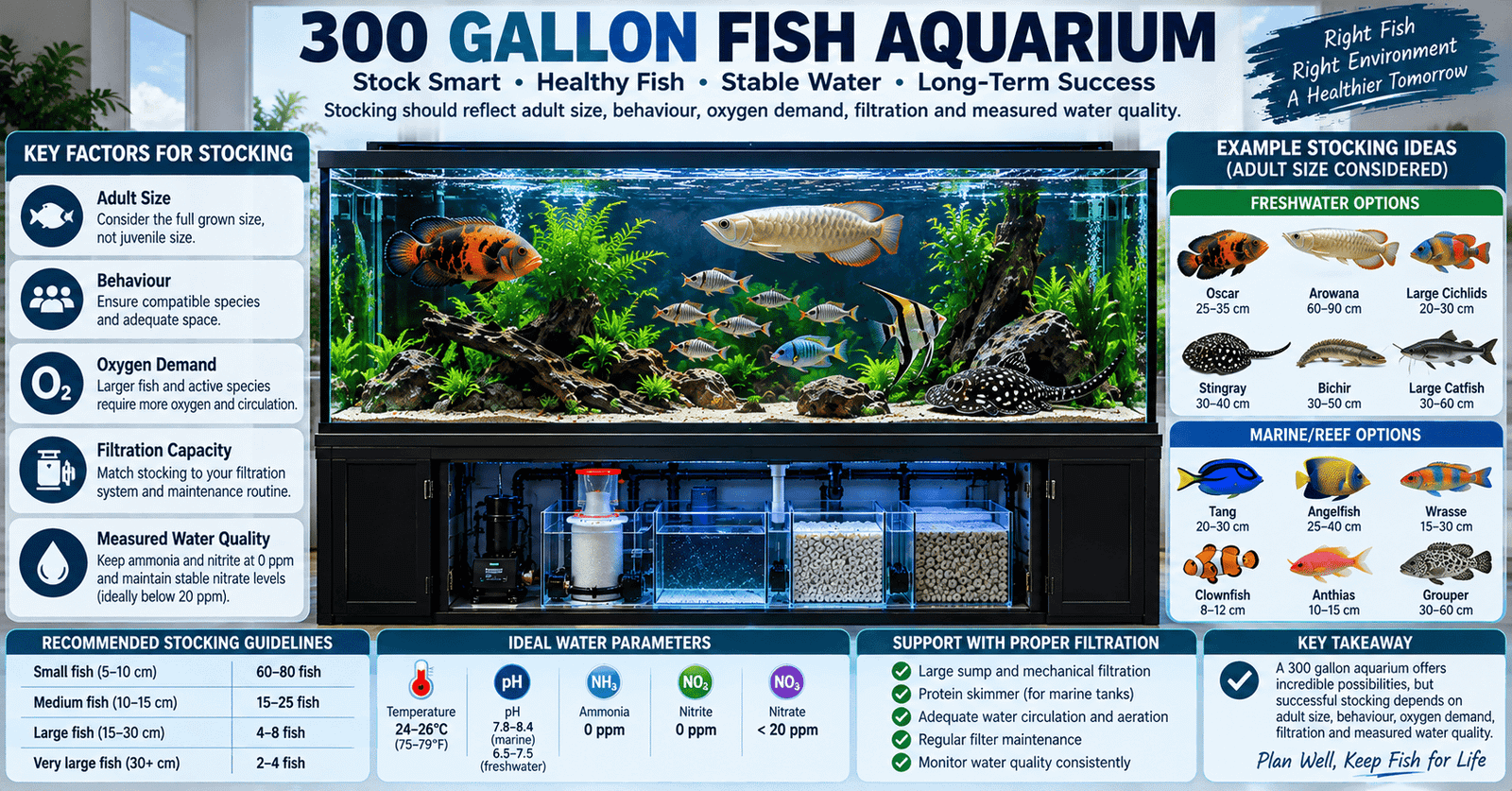
There is no single correct number of fish for a 300 gallon aquarium. Stocking depends on adult body size, behaviour, territoriality, feeding strategy, oxygen demand, filtration and the aquascape. As a conservative planning example, a system might accommodate roughly 60 to 80 small fish around one to three inches adult size, 15 to 25 medium fish around three to six inches, or four to eight large fish around six to twelve inches. These are broad examples, not universal limits. Adult size matters more than juvenile size, and species compatibility can reduce the practical stocking level substantially.
The one inch per gallon rule is a poor basis for a large aquarium because it ignores body mass, waste production, swimming behaviour and oxygen requirements. Stocking-density research links increased biological loading with changes in water quality and fish performance, including oxygen and nitrogenous waste dynamics (Aquapolis Research Group, 2024; Zhang et al., 2024). A better approach is to start with the adult requirements of the chosen species, establish the system gradually and use measured water quality as feedback. A tank should not be stocked to its theoretical maximum simply because its volume appears large.
Behaviour is equally important. Territorial fish need visual barriers and enough space to avoid constant confrontation, while schooling fish need appropriate group sizes and swimming lanes. Bottom-dwelling fish need usable floor area, not just total water volume. A successful stocking plan therefore considers where each species spends its time and how its behaviour interacts with tankmates. Introduce fish in stages, monitor respiration and feeding, and watch for aggression or persistent hiding. Water quality and behaviour together provide a much stronger assessment than a numerical stocking formula.
Best Fish for a 300 Gallon Freshwater Tank
A 300 gallon freshwater aquarium can support species that are unsuitable for many smaller home tanks, but the extra space does not remove compatibility requirements. Oscars and other large cichlids can make effective focal fish but may produce considerable waste and show territorial behaviour. Bichirs, appropriate plecostomus species and some large catfish can use a spacious aquarium when adult size and predatory behaviour are considered. Freshwater stingrays require specialist care, broad floor area, suitable substrate and excellent water quality. A silver arowana can require substantial length and surface space, while Asian arowana are subject to legal restrictions in the United States. Always verify current laws and adult dimensions before purchase.
A large community can instead use groups of medium fish. Compatible Geophagus species can benefit from a broad footprint, while suitable barbs or tetras can create movement through the middle and upper water column. Angelfish communities can also work in carefully selected combinations. The aim should be to create complementary ecological roles rather than filling every available litre. A large aquarium may look visually open while still providing excellent welfare if each fish has sufficient space and the habitat is designed around its natural behaviour. Research on aquarium welfare supports providing ecologically relevant environments and appropriate water quality (Fish Welfare in Public Aquariums and Zoological Collections, 2023; Enhancing Welfare for Aquarium Fishes with an Ecologically Relevant Environment, 2024).
Aquascaping should match the livestock. Open swimming lanes benefit active species, while rocks and wood can create visual barriers for territorial fish. Bottom fish need usable substrate and safe shelter. Plants can provide cover and nutrient uptake where compatible with the animals. Large decorations should be secured so digging fish cannot destabilise them. Every structure should also remain accessible for inspection and cleaning. The best aquascape is therefore not simply the most dramatic arrangement. It is the arrangement that combines habitat quality, swimming space, stable water flow and practical maintenance access.
300 Gallon Reef Tank Setup and Stocking
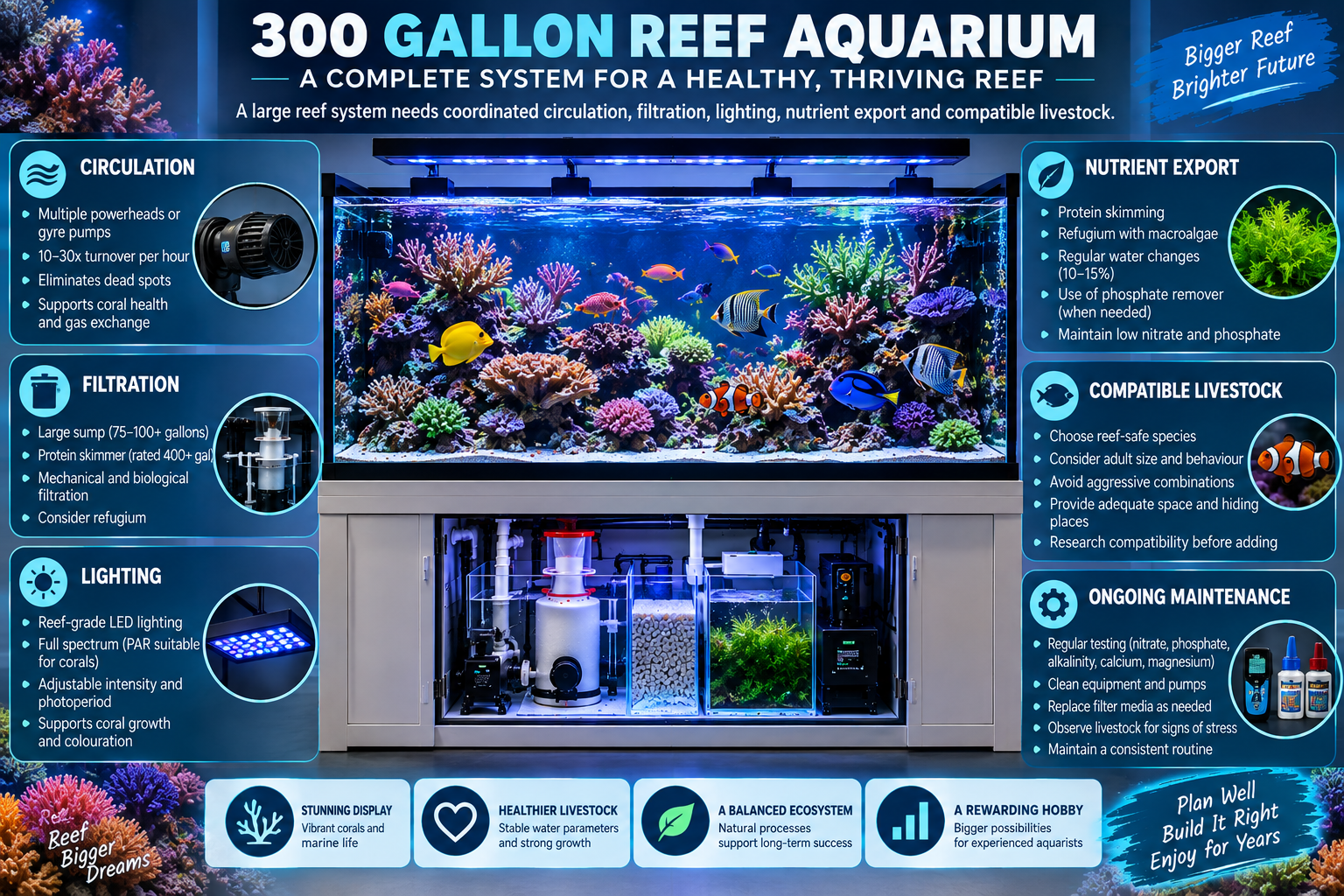
A 300 gallon reef tank provides substantial scope for a complex marine community, but its design must integrate circulation, gas exchange, nutrient export, lighting and livestock compatibility. A large reef may accommodate compatible tangs, wrasses, anthias and other active fish together with SPS, LPS and soft corals. A fish-only-with-live-rock system can support selected larger predators such as lionfish or groupers, but predation and adult size must be considered before adding smaller tankmates. A mixed reef has additional demands because corals require suitable light, flow, nutrient conditions and stable chemistry.
A protein skimmer rated above the display volume is a useful planning approach for marine systems, particularly when the sump is included. Strong display circulation is also essential. Two or three appropriately sized powerheads or gyre pumps may form a starting arrangement, but pump count is less important than actual flow distribution. The goal is broad movement through the rockwork without creating harmful jets or dead zones. Return flow from the sump should not be treated as the sole source of display circulation. Mechanical filtration, biological media and nutrient export should operate as complementary parts of the system.
Marine cycling requires the same patience as freshwater cycling. Live rock and established biological media can introduce useful microorganisms, while research into marine recirculating systems has examined approaches for accelerating nitrification and maintaining biofiltration performance (ScienceDirect, 2024). Even with mature media, test the system before livestock is introduced. Saltwater preparation should use a dedicated mixing container and pump rather than repeated bucket carrying. The marine fish tank stand and size guide can also help with physical planning for a large marine display.
Choosing the Right Location for a 300 Gallon Aquarium
The best location combines structural capacity, access, electrical supply, plumbing and environmental stability. A basement on a suitable concrete slab is often easier to plan than an upper floor because the load path can be more direct. A ground-floor installation may also work after structural assessment. Upper-floor placement requires particular caution because joist spans, directions and bearing conditions can make a several-thousand-pound system unsuitable without reinforcement. The tank should be kept away from direct sunlight and strong heat sources. Sunlight can increase algae and temperature fluctuations, while nearby heat can create uneven conditions.
Electrical planning should be completed before installation. A large aquarium may operate return pumps, circulation pumps, heaters, lights, skimmers and controllers. Appropriate electrical protection and installation should follow local requirements and use qualified professionals where necessary. Cables should be arranged with drip loops so water cannot travel directly toward outlets. Water-change access is equally important. A nearby drain, utility sink or permanent hose connection can turn a difficult lifting exercise into a controlled maintenance procedure. The room should also have enough space to access the back of the aquarium and remove equipment.
The delivery route should be measured before ordering. A 96 inch aquarium can require several people or specialist moving equipment, and tight corners can make an apparently suitable room inaccessible. Door frames, stairs and lift openings should all be checked. Once the aquarium is filled, relocation is not a practical solution to a planning mistake. Location decisions should therefore be completed before ordering the tank, stand and major equipment.
300 Gallon Aquarium Maintenance Guide
A 300 gallon aquarium becomes easier to maintain when the plumbing and equipment are designed around repeatable procedures. A ten to fifteen percent weekly water change represents approximately 30 to 45 gallons. Carrying this volume in buckets is inefficient and creates unnecessary lifting. A pump and hose connected to a suitable drain or mixing station is far more practical. Marine owners should mix replacement saltwater in a dedicated container large enough to prepare the required volume while maintaining circulation and temperature. Freshwater replacement water should also be conditioned and brought close to the aquarium temperature before use.
Mechanical filtration should be inspected frequently because it captures particulate waste before it decomposes. Filter socks, pads or other mechanical media may need cleaning or replacement every one to two weeks depending on loading. Biological media should normally be rinsed in removed aquarium water when cleaning is necessary, rather than repeatedly exposing it to untreated tap water. Return pumps should be checked for debris, calcium deposits and reduced flow. Protein skimmer necks should be cleaned regularly on marine systems. A planned maintenance schedule is preferable to waiting until equipment performance has visibly deteriorated.
Water testing should reflect the livestock and system type. Ammonia and nitrite are especially important when cycling or troubleshooting, while nitrate is useful for tracking nutrient accumulation. Marine reef systems require additional attention to salinity, alkalinity and other parameters relevant to their livestock. Substrate can influence water quality and bacterial presence, and research in ornamental fish tanks has examined these relationships (The Effect of Substrate on Water Quality in Ornamental Fish Tanks, 2022). Aquatic plants may also assist nutrient management. Research on ornamental fish production has demonstrated nitrate and phosphate removal by aquatic plants under aquarium conditions (Csontos, Bartal and Bakacsy, 2024).
300 Gallon Aquarium Substrate and Aquascaping
Substrate should be chosen according to livestock, chemistry goals and maintenance strategy. Sand provides a smooth base and suits many bottom-oriented fish, while gravel offers larger spaces and can be easier to vacuum in some designs. Crushed coral can contribute carbonate material and may be useful in selected marine or alkaline systems. A bare-bottom aquarium simplifies waste removal and can suit some specialist applications, although it creates a different visual and behavioural environment. Research indicates that substrate type can influence water quality and bacterial presence, so substrate should be treated as part of the aquarium system rather than decoration alone.
A two to three inch layer across a 16 to 18 square foot footprint can add hundreds of pounds. That weight becomes significant when the aquarium is already carrying more than 2,500 pounds of water. Deeper substrate increases both weight and the amount of material that must be cleaned or replaced. Large rocks can add another 100 to 300 pounds, and unstable structures may become hazardous if digging fish undermine them. Place heavy structures carefully and ensure they cannot topple against glass panels. Maintenance access should remain possible around major rockwork and equipment.
Aquascaping should provide visual barriers, shelter and open swimming space. Large active fish generally need unobstructed routes, while territorial species can benefit from divided sightlines. Plants, wood and rocks can create zones without blocking filter inlets or circulation. The more complex the aquascape becomes, the more important access becomes. Every major structure should be reachable for inspection, algae removal and debris management. An attractive display that creates inaccessible detritus traps can produce more maintenance work and poorer water quality than a simpler design.
300 Gallon Aquarium Maintenance Cost and Long-Term Planning
The financial commitment continues after installation. Electricity depends on local rates, room temperature, equipment efficiency and lighting requirements. A tropical freshwater system in a cool room can require more heating than one in a warm environment, while a reef can consume substantial power through lighting and circulation. Water costs depend on local tariffs and whether treated, filtered or reverse-osmosis water is used. Marine systems also require salt mix and potentially supplements and test reagents. These recurring expenses should be included in the household budget rather than treated as occasional purchases.
Redundancy can reduce the consequences of equipment failure. A spare heater, air pump or circulation pump can be valuable, particularly when the aquarium contains expensive livestock. Battery-backed aeration or circulation can provide temporary support during power outages. Owners should know how to maintain oxygen, temperature and water movement if power is unavailable for an extended period. Large aquariums can provide more thermal and chemical buffering than small systems, but biological demand remains high. Emergency preparation should therefore be part of normal planning, not something considered only after the first outage.
Long-term success depends on stability. Consistent feeding, appropriate stocking, predictable water changes and regular equipment checks generally create fewer problems than repeated corrective interventions. Observation is an important part of maintenance. Changes in appetite, respiration, swimming, aggression, colour, algae growth, coral response or equipment noise can reveal developing problems. Keeping simple maintenance records makes trends easier to identify. A 300 gallon aquarium should be viewed as a living system that requires ongoing observation, not a large container that becomes self-sufficient once it is filled.
FAQ: 300 Gallon Fish Aquarium
How big is a 300 gallon fish tank?
How big is a 300 gallon fish tank? A common rectangular 300 gallon configuration is about 96 inches long, 24 inches wide and 30 inches high, or approximately 244 by 61 by 76 centimetres. Other manufacturers use deeper or wider proportions. Always confirm the exact dimensions and footprint for the model being purchased.
How much does a 300 gallon aquarium weigh?
How much does a 300 gallon aquarium weigh? Three hundred gallons of water weigh about 2,502 pounds. A complete system can reach roughly 3,250 to 4,350 pounds after the tank, stand, substrate, decorations, sump and equipment are included. Manufacturer specifications should replace generic estimates whenever available.
How much does a 300 gallon fish tank cost?
How much does a 300 gallon fish tank cost? Stock tanks can cost several thousand dollars, while custom glass or acrylic systems can cost considerably more. A complete setup with stand and filtration may reach approximately 3,500 to 6,000 dollars, while high-end systems can reach 8,000 to 15,000 dollars or more.
How many fish can you put in a 300 gallon tank?
How many fish can you put in a 300 gallon tank? There is no universal number. Broad conservative planning examples include 60 to 80 small fish, 15 to 25 medium fish or four to eight large fish, but species compatibility, adult size, filtration and oxygen demand are more important than a simple fish count.
What filtration does a 300 gallon aquarium need?
What filtration does a 300 gallon aquarium need? A sump is strongly suited to this scale, with approximately 75 to 100 gallons as a planning range. Multiple canister filters can also provide freshwater redundancy. Marine systems commonly require a suitable protein skimmer and strong display circulation. Actual equipment should be selected according to livestock and plumbing conditions.
Will my floor support a 300 gallon tank?
Will my floor support a 300 gallon tank? This cannot be determined safely from tank volume alone. A complete system can weigh several thousand pounds and may create a high average floor load. A structural engineer should assess uncertain installations, particularly upper floors. The calculator in this article is a screening tool, not structural certification.
What is the best stand for a 300 gallon aquarium?
What is the best stand for a 300 gallon aquarium? The stand should be purpose-built or professionally rated for the full operating weight and should provide continuous, level support. Welded steel and correctly engineered heavy-duty wood stands can both work. Ordinary furniture should not be used as a substitute for an aquarium stand.
How long does it take to cycle a 300 gallon tank?
How long does it take to cycle a 300 gallon tank? A useful planning period is around six to eight weeks, but actual cycling time varies with microbial inoculation, filtration, temperature and water chemistry. Established biological media can accelerate maturation. Test ammonia and nitrite rather than relying on time alone.
Is glass or acrylic better for a 300 gallon aquarium?
Is glass or acrylic better for a 300 gallon aquarium? Both can be appropriate. Glass is heavier and highly scratch resistant, while acrylic is lighter, clear and impact resistant. Acrylic requires careful cleaning and appropriate support against bowing. The best choice depends on installation, maintenance habits, budget and manufacturer specifications.
What large fish can go in a 300 gallon tank?
What large fish can go in a 300 gallon tank? Suitable options can include selected large cichlids, Oscars, bichirs, appropriate plecostomus species and some large catfish. Specialist freshwater species such as stingrays require specific conditions. Marine systems can support larger reef fish or predators when compatible. Always check adult size, behaviour and legal restrictions.
Conclusion
A 300 gallon fish aquarium can become an exceptional long-term display, but its success depends on decisions made before installation. The water alone weighs approximately 2,502 pounds, and the completed system can weigh several thousand pounds. That makes floor support, stand construction and delivery planning fundamental. Filtration must be designed around biological demand, mechanical waste removal and circulation. Cycling must establish a stable microbial community before stocking, while stocking itself should reflect adult size, behaviour, oxygen demand and measured water quality. Research across stocking density, biofilters, substrate and fish welfare reinforces the principle that aquarium performance depends on the interaction of physical and biological conditions rather than tank volume alone.
The best 300 gallon aquarium is therefore not necessarily the one with the most fish or the largest equipment. It is the system in which structural support, water quality, habitat design, compatibility and maintenance work together. Before ordering, confirm dimensions, delivery access, stand rating, floor capacity, electrical requirements and water-change logistics. After installation, cycle patiently, stock gradually and maintain equipment consistently. For owners progressing from smaller systems, the AquariumsWorld 100 gallon fish tank guide and fish aquarium setup resources can provide useful context. A carefully planned 300 gallon system can offer years of stable, impressive fishkeeping when the scale of the project is matched by equally careful planning.
This scale also rewards deliberate documentation because measurements, maintenance history, equipment settings and livestock changes create a useful record for future decisions.
This scale also rewards deliberate documentation because measurements, maintenance history, equipment settings and livestock changes create a useful record for future decisions.
This scale also rewards deliberate documentation because measurements, maintenance history, equipment settings and livestock changes create a useful record for future decisions.
This scale also rewards deliberate documentation because measurements, maintenance history, equipment settings and livestock changes create a useful record for future decisions.
This scale also rewards deliberate documentation because measurements, maintenance history, equipment settings and livestock changes create a useful record for future decisions.
This scale also rewards deliberate documentation
References
- Aquapolis Research Group (2024). The Effect of Stocking Density on Fish Growth and Survival in Intensive Cultivation Systems. Journal of Aquaculture Research. Available online.
- Zhang, Y., Zhao, L., Duan, J., Tang, Y. and Lv, J. (2024). Effects of Stocking Density of Filter-Feeding Fishes on Water Quality and Bacterial Community in Rice-Crayfish Polyculture System. Water, 16(16), 2296. https://doi.org/10.3390/w16162296.
- Bagchi, S., Vlaeminck, S.E., Sauder, L.A., Mosquera, M., Neufeld, J.D. and Boon, N. (2014). Temporal and Spatial Stability of Ammonia-Oxidizing Archaea and Bacteria in Aquarium Biofilters. PLOS ONE, 9(12), e113515. https://doi.org/10.1371/journal.pone.0113515.
- Preena, P.G., Rejish Kumar, V.J. and Singh, I.S.B. (2021). Nitrification and denitrification in recirculating aquaculture systems: the processes and players. Reviews in Aquaculture, 13(4), 2053-2075. https://doi.org/10.1111/raq.12558.
- Schmautz, Z. et al. (2017). Freshwater Recirculating Aquaculture System Operations Drive Biofilter Bacterial Community Shifts around a Stable Nitrifying Consortium of Ammonia-Oxidizing Archaea and Comammox Nitrospira. Frontiers in Microbiology. Full text.
- Fish Welfare in Public Aquariums and Zoological Collections (2023). Animals, 13(16), 2548. https://doi.org/10.3390/ani13162548.
- Zhang, W. et al. (2025). Water Quality Impact on Fish Behavior: A Review From an Aquaculture Perspective. Reviews in Aquaculture. https://doi.org/10.1111/raq.12985.
- The Effect of Substrate on Water Quality in Ornamental Fish Tanks (2022). Animals, 12(19), 2679. https://doi.org/10.3390/ani12192679.
- Enhancing Welfare for Aquarium Fishes with an Ecologically Relevant Environment (2024). Animal Behaviour and Welfare Cases. https://doi.org/10.1079/abwcases.2024.0017.
- Csontos, D., Bartal, Z.P. and Bakacsy, L. (2024). Removal of nitrate and phosphate by aquatic plants during aquarium-based ornamental fish production. North American Journal of Aquaculture, 86(4), 413-423. https://doi.org/10.1002/naaq.10349.
- ScienceDirect (2024). Enhanced biofiltration coupled with ultrafiltration process in marine recirculating aquaculture system: Fast start-up of nitrification and long-term performance. Journal of Water Process Engineering. https://doi.org/10.1016/j.jwpe.2024.104606.