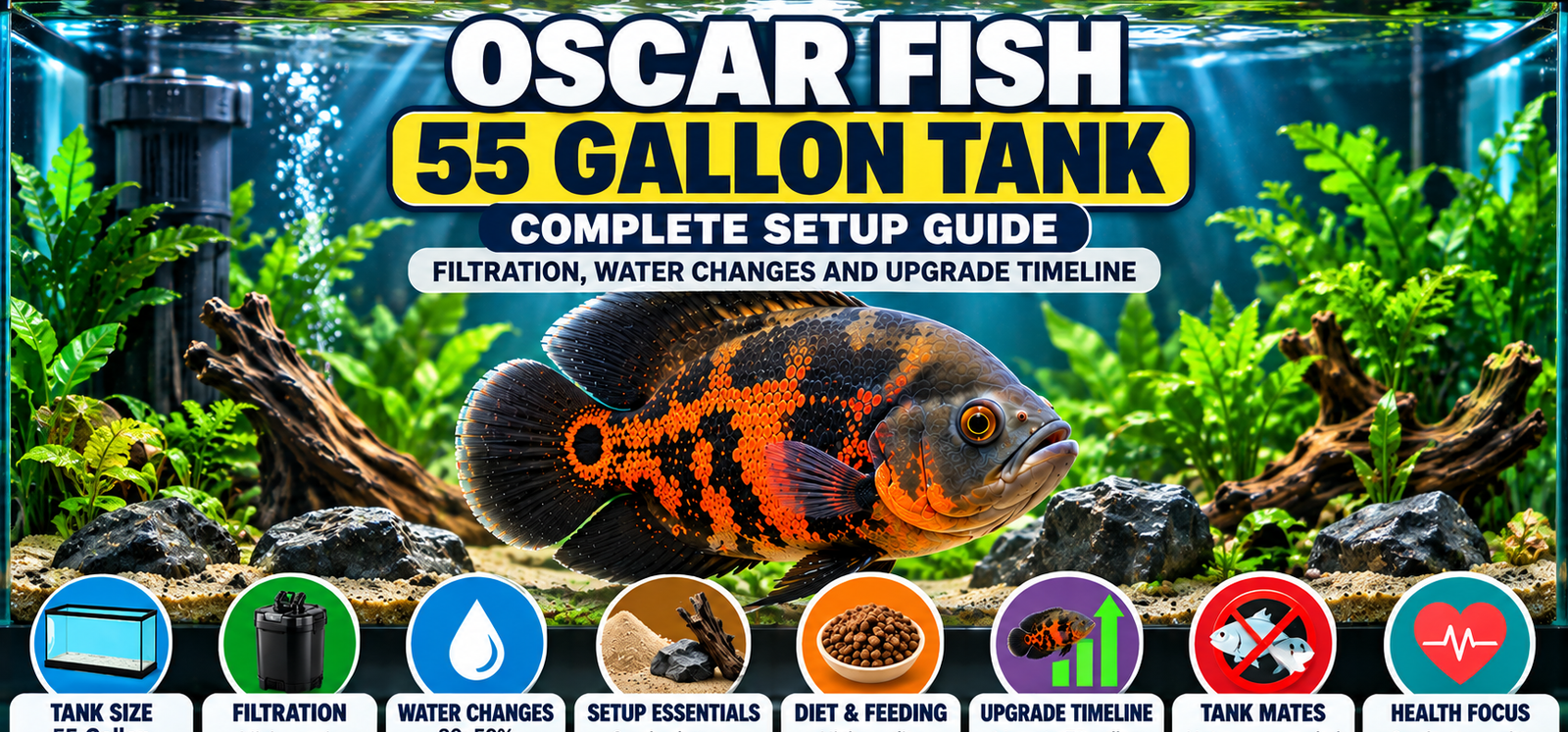
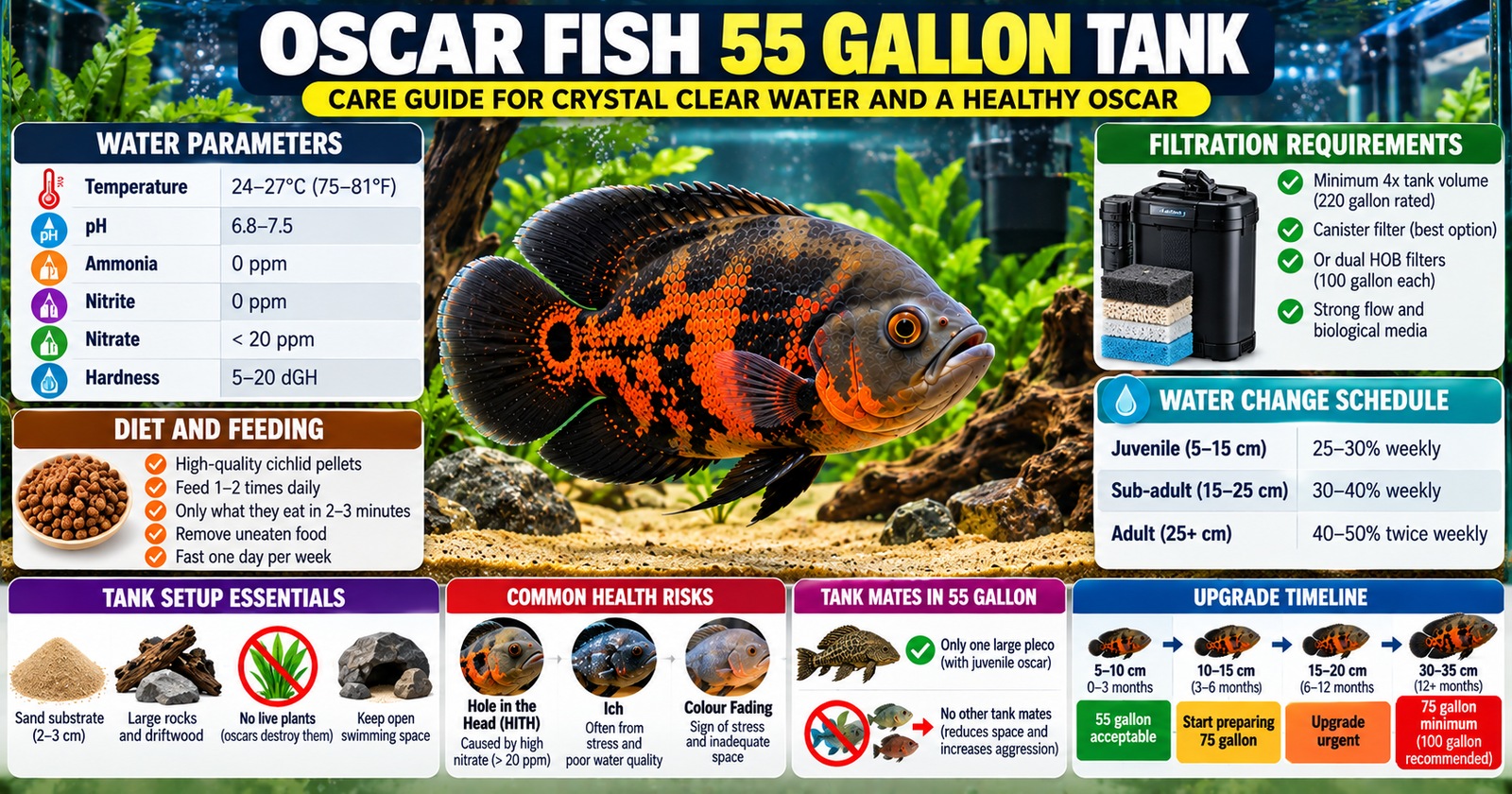
An oscar fish 55 gallon tank can work as temporary housing for a juvenile Oscar, but a standard 55 gallon aquarium should not be treated as the permanent adult home for this large cichlid. The practical answer depends on the Oscar’s current size, growth stage, aquarium footprint, filtration capacity, maintenance routine and the keeper’s upgrade plan.
The confusion comes from the fact that a 55 gallon aquarium can keep a small Oscar alive and can provide useful temporary swimming space. That does not mean the same aquarium remains suitable when the fish becomes a large adult. FishBase records Astronotus ocellatus at a maximum published total length of 45.7 cm, while individual aquarium fish vary considerably in final size.
This guide therefore separates temporary juvenile housing from long-term adult housing. It covers the oscar fish 55 gallon tank setup, filtration options, nitrogen cycling, water-change schedule, stocking, tank mates, decor, dimensions, growth, water parameters and the oscar fish 55 gallon upgrade timeline.
If you are planning a larger aquarium, also see the 100 gallon fish tank complete guide. For broader aquarium planning, the Fish Aquarium Types and Setup Guide covers tank selection, filtration, cycling and equipment.
Can an Oscar Fish Live in a 55 Gallon Tank?
Yes, a single juvenile Oscar can temporarily live in a 55 gallon tank, but a 55 gallon aquarium is not a suitable permanent adult setup. The smaller aquarium becomes progressively more restrictive as the fish grows, particularly because a standard 55 gallon has a relatively narrow footprint.
The question is often phrased as whether an Oscar can survive in a 55 gallon aquarium. Survival, however, is a much lower standard than good long-term husbandry. A responsible aquarium should support normal swimming, feeding, resting, exploration, stable physiological conditions and appropriate behaviour.
The distinction becomes especially important because Oscar fish are large-bodied cichlids. Their adult size means that a tank which looks enormous when the fish is only 5 cm long can appear dramatically different when that fish becomes 25, 30 or 35 cm long.
The 55 gallon can therefore be useful as a juvenile grow-out aquarium. It can provide a stable environment while the keeper prepares a larger system. The mistake is treating that temporary arrangement as evidence that the fish will remain appropriately housed throughout adulthood.
Fish welfare research recommends evaluating captive fish through multiple indicators rather than relying only on survival. Behaviour, physical performance and physiological condition can all provide information about whether the environment is supporting welfare.
The Honest Debate: Oscar Fish 55 vs 75 Gallon
The oscar fish 55 vs 75 gallon comparison is not simply a matter of adding 20 gallons. The physical footprint changes as well. A commonly manufactured 55 gallon aquarium is approximately 48 inches long and 13 inches wide, while a common 75 gallon format is approximately 48 inches long and 18 inches wide.
That additional width is important for a large cichlid. Oscar fish need room to turn, manoeuvre around decor and move between open swimming areas. A deeper tank can increase water volume without providing the same horizontal space.
Aquarium sources differ in the tank sizes they recommend for Oscars. Rather than presenting one number as a universal scientific law, it is more useful to distinguish between a temporary juvenile setup and a long-term adult aquarium. A 55 gallon may be used by some keepers for a juvenile, while a 75 gallon or larger system gives an adult considerably more room and water volume.
The practical lesson is straightforward. If you are buying an aquarium specifically for an Oscar that you intend to keep for many years, plan around the adult fish rather than the purchase size. If you already have a 55 gallon, use it as a temporary system and prepare the upgrade before the fish becomes large.
Why 55 Gallons Is Inadequate for an Adult Oscar
An adult Oscar in a 55 gallon tank creates two separate challenges: physical space and biological load. Filtration can help manage the second problem, but it cannot solve the first.
A standard 55 gallon aquarium holds approximately 55 US gallons nominally, or around 208 litres. Once substrate, rocks, driftwood and equipment are installed, the actual water volume is lower. This matters because the biological waste produced by the fish is being processed in less water than the nominal tank label suggests.
At the same time, the fish’s body size continues to increase. The aquarium does not become larger as the Oscar grows. The swimming space therefore becomes proportionally smaller.
This is why a keeper should not wait for the fish to become visibly distressed before considering a larger aquarium. By that point, the upgrade may already be overdue.
Oscar Fish Adult Size vs 55 Gallon Tank Dimensions
A typical US 55 gallon aquarium is approximately 48 inches long, 13 inches wide and about 21 inches high, although exact manufacturer dimensions vary. AquariumsWorld’s general aquarium setup information uses approximately 48 x 13 x 21 inches as a 55 gallon reference.
FishBase records Astronotus ocellatus at a maximum published total length of 45.7 cm. It also lists a common length of 24 cm. These figures demonstrate why the aquarium should be selected around potential adult size rather than the size of the juvenile sold by a retailer.
The narrow width is particularly important. At approximately 33 cm, the tank’s front-to-back dimension is close to the body length of an Oscar approaching 30 to 35 cm. This does not mean that a fish literally becomes unable to turn around. It demonstrates how little spare manoeuvring room remains once the fish becomes large.
For more aquarium dimensions and comparisons, see the 50 gallon fish tank dimensions guide and the 50 gallon fish tank setup guide. These resources also explain why footprint should be considered alongside nominal gallon capacity.
Oscar Fish Stunted Growth in a 55 Gallon
The statement that “fish grow to the size of their tank” is an oversimplification. Fish growth is influenced by nutrition, environmental conditions, endocrine regulation, temperature, oxygen, social environment and stress.
A 2023 review in Frontiers in Endocrinology explains that fish somatic growth is controlled by the GH/IGF endocrine axis and is influenced by environmental factors including temperature and oxygen.
Madison and colleagues also examined chronic cortisol and growth regulation in rainbow trout. Their work shows that chronic cortisol exposure can affect food intake and the endocrine growth axis. This is useful evidence for understanding the general biological relationship between chronic stress and fish growth, although it should not be misrepresented as a direct 55 gallon Oscar experiment.
A 2025 review in Fishes similarly discusses stunted fish as individuals that fail to reach their growth potential under environmental and ecological conditions. The review covers many fish species and should therefore be interpreted as general fish-growth evidence rather than direct evidence that every Oscar in a 55 gallon will become permanently stunted.
Important: A small aquarium should never be deliberately used to keep an Oscar small. If a fish remains undersized because environmental conditions restrict normal development, that is not a successful husbandry outcome.
Water Quality Deterioration in a 55 Gallon Oscar Tank
Oscar fish produce substantial waste relative to many commonly kept community fish. In a 55 gallon aquarium, the smaller water volume means that feeding errors, decaying food, filter interruption or excessive stocking can affect water quality more quickly than in a substantially larger system.
The nitrogen cycle converts ammonia into nitrite and then nitrate through biological processes. It does not eliminate the total waste burden. Nitrate continues to accumulate and must be controlled through water changes, appropriate stocking and other management strategies.
Research on aquarium biofilters confirms the importance of ammonia-oxidising microorganisms in maintaining nitrification. Bagchi and colleagues investigated ammonia-oxidising archaea and bacteria in aquarium biofilters and demonstrated the stability and importance of these microbial communities within filtration systems.
This means that an Oscar 55 gallon filtration system should be designed around biological capacity, mechanical waste removal and reliable circulation. A larger aquarium gives the keeper more water volume and operational margin, but it does not eliminate the need for appropriate filtration.
How Long Can a Juvenile Oscar Stay in a 55 Gallon?
There is no scientifically fixed number of months that applies to every juvenile Oscar. Growth rate varies according to genetics, feeding, water quality, temperature, health and individual development. A better oscar fish 55 gallon upgrade timeline therefore uses body size and aquarium performance rather than age alone.
A small juvenile purchased at only a few inches can have considerable swimming room in a 55 gallon aquarium. As the fish grows, the same tank provides progressively less usable space. At the same time, the fish produces more waste, consumes more food and requires more oxygen.
| Oscar Size | 55 Gallon Status | Recommended Action |
|---|---|---|
| 5 to 10 cm | Can function as temporary juvenile housing | Begin planning the larger aquarium |
| 10 to 15 cm | Increasingly restrictive | Purchase and begin preparing the upgrade |
| 15 to 20 cm | Should no longer be considered comfortable long-term housing | Complete the upgrade as soon as practical |
| Above 20 cm | Not appropriate as permanent housing | Use a substantially larger aquarium |
These stages are practical planning thresholds rather than biological laws. One Oscar may grow more quickly than another. The important point is to plan ahead.
If you buy a juvenile at approximately 5 cm, there is little reason to wait until the fish is 15 or 20 cm before thinking about the next tank. The larger aquarium itself must be purchased, supported, equipped and cycled.
A 75 gallon aquarium can therefore be prepared while the Oscar is still relatively small. If your long-term goal is a 100 gallon system, the planning period should begin even earlier.
For larger aquarium planning, see the 100 gallon fish tank dimensions, weight and setup guide.
Oscar Fish 55 Gallon Tank Setup Guide
The best oscar fish 55 gallon tank setup guide is intentionally simple. A juvenile Oscar needs swimming space, strong filtration, stable temperature and easy maintenance more than it needs a complicated aquascape.
Start with a level aquarium stand designed for the aquarium. A filled 55 gallon aquarium is a substantial load, so ordinary household furniture should not be used unless it is specifically rated for the aquarium’s weight and footprint.
Install the heater, thermometer, filter, intake protection, lid and lighting before introducing the fish. Add dechlorinated water and establish the nitrogen cycle before the Oscar arrives.
A tight-fitting lid is particularly important because Oscars can jump when startled or during feeding. Equipment openings should be covered as much as possible without restricting filter or heater operation.
For general aquarium installation principles, see the complete beginner’s guide to fish care.
Oscar Fish 55 Gallon Tank Dimensions
A common 55 gallon aquarium measures approximately 48 x 13 x 21 inches, or roughly 122 x 33 x 53 cm. Exact dimensions vary between manufacturers, so always check the tank specification before purchasing equipment.
The narrow 13-inch width is one reason a 55 gallon becomes restrictive for an adult Oscar. Height does not compensate fully for limited front-to-back swimming space.
Substrate for a 55 Gallon Oscar Tank
Fine sand or smooth rounded gravel is generally practical. Oscars frequently interact with the substrate while feeding and exploring, so sharp material should be avoided.
Keep the substrate relatively shallow so waste can be siphoned efficiently. Deep decorative layers can trap food and organic material and increase maintenance requirements.
If you are considering planted substrate, see the Soil in Fish Tank guide. For a temporary Oscar grow-out aquarium, however, a simple easy-to-clean substrate is usually more practical than a complex planted system.
Oscar Fish 55 Gallon Decor Ideas
The best oscar fish 55 gallon decor ideas preserve open swimming space. Use one or two large smooth rocks or pieces of driftwood rather than filling the tank with small ornaments.
- Use smooth, heavy structures that cannot easily be moved.
- Avoid sharp edges.
- Avoid unstable rock piles.
- Keep the central swimming area open.
- Do not use small objects that the Oscar can swallow or move.
- Position decor where it does not block filter circulation.
Oscars can be destructive toward plants and lightweight decorations. Robust hardscape attached securely to the aquarium floor or supported safely is usually more practical.
Lid and Safety
A secure lid reduces the risk of jumping. Check all openings around filter pipes, cables and feeding areas. If an Oscar repeatedly jumps, investigate the cause rather than simply adding weight to the lid.
Filtration for a 55 Gallon Oscar Tank
The oscar fish 55 gallon filtration system needs to manage both solid waste and dissolved nitrogenous waste. A strong filter is essential, but the printed gallon rating on a filter box should not be treated as a guarantee of biological capacity.
A large canister filter can provide substantial biological media and mechanical filtration. Dual HOB filters can provide redundancy. A canister combined with a sponge filter can provide both high biological capacity and a useful backup if the main filter is offline.
The actual performance of a filter depends on media loading, maintenance, plumbing, head pressure and how quickly the media becomes clogged. The correct system is the one that keeps ammonia and nitrite at zero and maintains acceptable nitrate between scheduled water changes.
| Filter Type | Practical Use | Advantage | Limitation |
|---|---|---|---|
| Large canister | Strong juvenile grow-out option | High biological media capacity | More complex maintenance |
| Dual HOB filters | Redundant filtration | Two independent units | Media capacity varies |
| Canister + sponge filter | High-redundancy setup | Biological backup and aeration support | More equipment |
| Small single HOB | Not recommended for a messy large cichlid | Low cost | Limited capacity and redundancy |
The AquariumsWorld fish tank aquarium air pump guide also explains why an air pump should not be confused with biological filtration. An air pump primarily increases surface agitation and operates air-driven equipment.
Biological Filtration and the Nitrogen Cycle
Nitrifying microorganisms convert ammonia through the nitrogen cycle. Aquarium biofilter research has demonstrated the role of ammonia-oxidising microorganisms in this process.
For that reason, filter media should be protected during maintenance. Do not routinely sterilise or replace all biological media at the same time. A sudden loss of the established microbial community can destabilise the aquarium.
The Fish Aquarium Problems and Solutions guide also covers filter maintenance, cloudy water, ammonia problems and nitrogen-cycle troubleshooting.
How to Cycle a 55 Gallon Oscar Tank
The oscar fish 55 gallon nitrogen cycle should be established before the fish is introduced. A new aquarium should not be considered safe simply because it has been running for a certain number of days.
AquariumsWorld’s general aquarium guidance uses approximately four to six weeks as a planning window for establishing a new freshwater aquarium, but actual cycling time varies according to the system and testing results.
- Set up the aquarium, filter, heater and circulation.
- Add dechlorinated water.
- Introduce an appropriate ammonia source for fishless cycling.
- Test ammonia and nitrite regularly.
- Continue until the biological system can process the intended ammonia input and return ammonia and nitrite to zero.
- Perform an appropriate water change before adding the fish.
- Continue testing after the Oscar is introduced.
The objective is biological capacity, not simply elapsed time. If ammonia or nitrite remains measurable, the system is not ready for a large, messy cichlid.
Avoid relying entirely on bottled bacterial products as proof of cycling. Such products may assist in some circumstances, but testing remains the best way to establish whether the biological system is functioning.
Oscar Fish 55 Gallon Water Change Schedule
The oscar fish 55 gallon water change schedule should be based on the fish’s size, feeding, nitrate trend and actual water-test results. A small juvenile may be maintained with a weekly 25 to 30 percent change, while a growing Oscar can require larger or more frequent changes.
| Oscar Stage | Starting Maintenance Plan | Main Indicators |
|---|---|---|
| Small juvenile | 25 to 30% weekly | Nitrate trend and feeding |
| Growing juvenile | 25 to 40% weekly | Nitrate accumulation and waste |
| Large juvenile | 30 to 50% as required | Water tests and fish condition |
| Adult | Not a suitable long-term 55 gallon plan | Upgrade instead of relying on escalating maintenance |
These percentages are practical starting points, not universal prescriptions. If nitrate accumulates quickly, increase maintenance or investigate the cause. If ammonia or nitrite is detectable in an established tank, respond immediately rather than waiting for the next scheduled change.
During a water change, siphon visible waste, remove uneaten food and inspect the filter intake. Replacement water should be treated with an appropriate conditioner and brought reasonably close to the aquarium temperature.
For broader water-quality troubleshooting, use the AquariumsWorld Aquarium Stocking Calculator alongside regular water testing. The calculator also explains why adult body size and bioload matter more than the outdated one-inch-per-gallon rule.
Can I Add Tank Mates to a 55 Gallon Oscar Tank?
For a standard 55 gallon aquarium, keeping one juvenile Oscar alone is the most practical stocking strategy. Adding other large fish becomes increasingly difficult as the Oscar grows because the aquarium has limited swimming space, limited territory and limited water volume.
Potential Oscar tank mates must be appropriately sized, robust and compatible with the same general environmental conditions. Even then, compatibility is never guaranteed by species name alone.
A fish that is too small can become prey. A similarly large fish may create territorial conflict. A slow-moving fish can become vulnerable during feeding or aggressive interactions.
AquariumsWorld’s Can Goldfish Live with Oscar Fish guide illustrates why temperature, adult size, behaviour and diet should be considered together rather than assuming that all freshwater fish can share a tank.
Oscar Fish Tank Mates in a 55 Gallon
A juvenile Oscar may temporarily coexist with a robust bottom-dwelling fish in some individual setups, but that does not make the combination a recommended permanent stocking plan for a 55 gallon aquarium.
Plecos can themselves become large and add considerable bioload. The Orange Plecostomus complete care guide explains why plecos should never be treated simply as aquarium cleaners.
Avoid small schooling fish and delicate species. The AquariumsWorld Angelfish care guide also warns that Oscars can injure or consume angelfish.
The most reliable principle is to stock for adult size and adult behaviour, not purchase-day size.
How Many Oscars Can I Keep in a 55 Gallon Tank?
One juvenile Oscar only, and temporarily. Two Oscars should not be housed in a standard 55 gallon aquarium.
Two large cichlids need sufficient territory, swimming space and biological capacity. A filter can process waste, but it cannot create additional territory or prevent one fish from being trapped by another.
The Aquarium Stocking Calculator explains why the one-inch-per-gallon rule is unsuitable for large fish. Body mass, metabolism, adult size, species behaviour and filtration all affect actual stocking capacity.
If your goal is to keep two Oscars, design the aquarium around the adult fish before buying them. A substantially larger aquarium is required, and the keeper should also have a contingency plan in case the pair becomes incompatible.
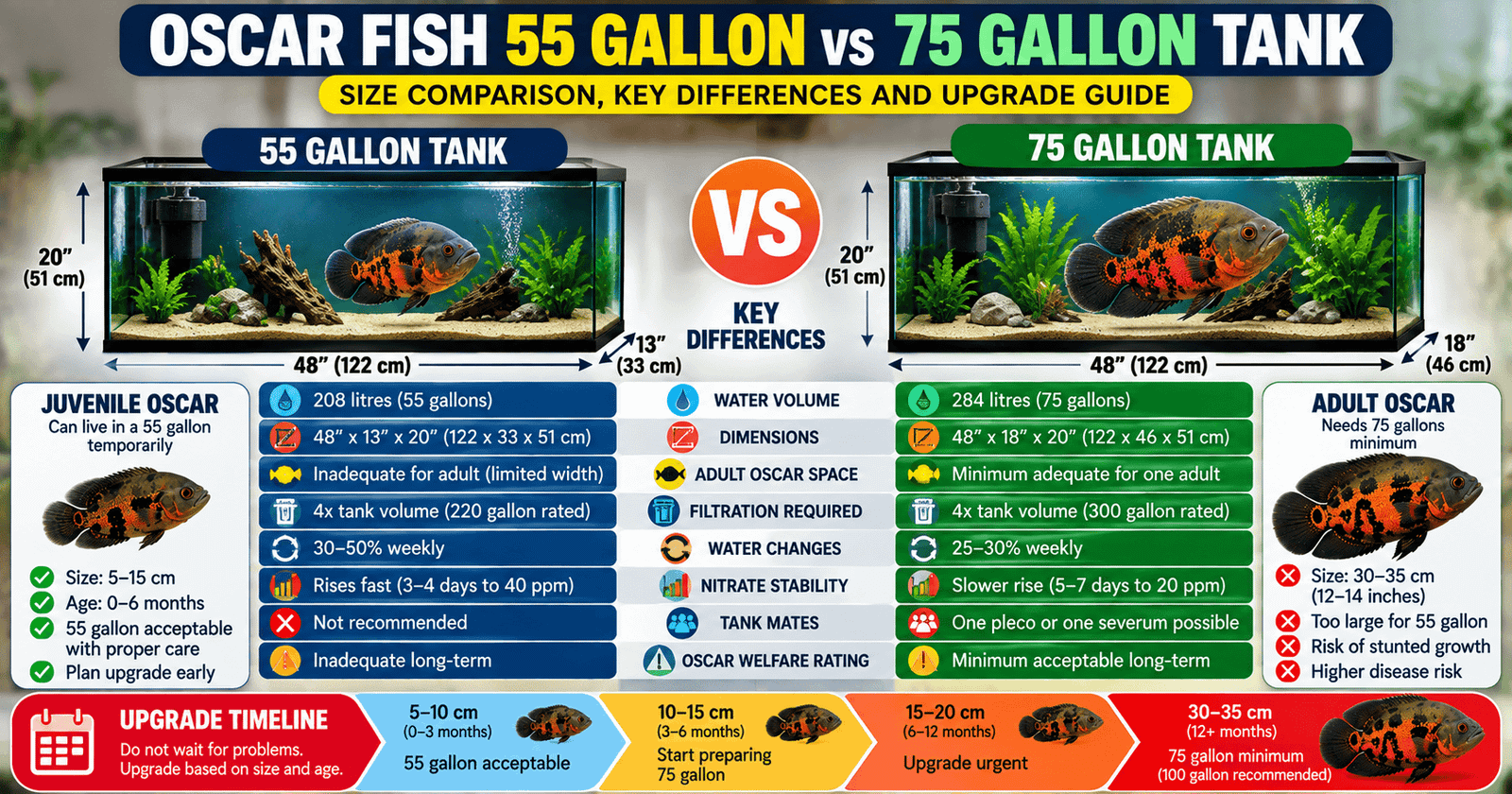
Oscar Fish 55 vs 75 Gallon Comparison
The oscar fish 55 vs 75 gallon comparison is one of the most important decisions for a keeper planning an upgrade.
| Feature | 55 Gallon | 75 Gallon |
|---|---|---|
| Nominal volume | 55 US gallons, approximately 208 L | 75 US gallons, approximately 284 L |
| Common footprint | 48 x 13 inches | 48 x 18 inches |
| Juvenile Oscar | Temporary grow-out option | More long-term flexibility |
| Adult Oscar | Not recommended as permanent housing | Common practical target, depending on individual setup |
| Water-quality buffer | Lower | Higher |
| Decor flexibility | Limited | Better |
| Potential tank mates | Very limited | Still requires careful planning |
The key difference is width. A standard 75 gallon commonly provides approximately five additional inches of front-to-back space. That additional area can materially improve movement and hardscape layout.
The 75 gallon is not a magical scientific threshold. A poorly maintained 75 gallon can provide worse conditions than a well-maintained 55 gallon. However, when husbandry quality is similar, the larger aquarium provides more room and water volume.
If you are deciding whether to buy a 75 or 100 gallon aquarium, the 100 gallon fish tank guide provides dimensions, weight, setup and equipment planning information.
Oscar Fish 55 Gallon Upgrade Timeline
The best oscar fish 55 gallon upgrade timeline is proactive. Start preparing the larger aquarium before the fish becomes visibly cramped.
A practical planning trigger is around 10 cm. This is not a universal welfare boundary. It simply gives the keeper enough time to purchase the larger aquarium, install the stand, select filtration and complete the nitrogen cycle.
A second trigger is rapidly rising nitrate. If the aquarium repeatedly reaches an undesirable nitrate level soon after a water change despite sensible feeding and established filtration, investigate the total bioload and consider whether the tank is simply too small for the growing fish.
A third trigger is behaviour. Repeated glass surfing, persistent hiding, abnormal inactivity, fin damage or difficulty navigating decor should prompt a review of water quality, temperature, environment and space.
- Measure the fish regularly.
- Record water-quality trends.
- Begin the upgrade around the early growth stage.
- Cycle the larger aquarium before transfer.
- Move the fish before space becomes an obvious welfare problem.
Do not wait for the fish to “look too big” before acting. The purpose of a growth-stage upgrade plan is to avoid reaching that point.
Oscar Fish 55 Gallon Water Parameters
Stable water parameters are more important than chasing one supposedly perfect number. FishBase lists Oscar habitat information including a pH range of approximately 6.0 to 8.0 and a tropical temperature reference around 22 to 25°C. :contentReference[oaicite:10]{index=10}
A 2025 Aquaculture study specifically examined juvenile Oscars exposed to different temperatures. The researchers found that excessive low temperature at 17°C and excessive high temperature at 32°C reduced growth and survival, demonstrating the importance of avoiding temperature extremes.
| Parameter | Practical Target | Why It Matters |
|---|---|---|
| Temperature | Approximately 24 to 27°C for many aquarium setups | Stable temperature supports normal metabolism and reduces avoidable stress |
| pH | Stable within a suitable freshwater range | Stability is more important than repeated chemical adjustment |
| Ammonia | 0 ppm | Toxic nitrogen compound that should not accumulate in a mature aquarium |
| Nitrite | 0 ppm | Indicates a functioning nitrogen cycle when consistently absent |
| Nitrate | Keep controlled through maintenance | Accumulation indicates the need for water changes and bioload management |
For broader cichlid temperature principles, see the AquariumsWorld Water Temperature for Cichlids guide.
Do not repeatedly manipulate pH with chemicals simply because the reading differs from an arbitrary target. Sudden changes can create additional stress. Stable, appropriate source water is usually easier to manage than constantly changing chemistry.
Oscar Fish Diet in a 55 Gallon Tank
Oscar diet is not fundamentally different because the aquarium is 55 gallons, but feeding directly affects the aquarium’s biological load. Every gram of uneaten food eventually becomes additional organic waste.
Use a high-quality cichlid pellet as a dietary foundation and vary foods appropriately. Avoid treating live feeder fish as a routine requirement. Food quality, disease risk and nutritional balance all matter.
- Feed appropriate portions rather than feeding until the fish stops begging.
- Remove uneaten food promptly.
- Use quality cichlid pellets as a practical staple.
- Vary suitable foods without overfeeding.
- Monitor body condition rather than relying solely on a feeding clock.
Because a 55 gallon aquarium has less water volume than a larger system, feeding discipline is particularly important. A single heavy feeding may not create an immediate visible problem, but repeated overfeeding can increase organic waste and nitrate production.
If the Oscar appears constantly hungry, do not automatically increase the food quantity. First check water quality, body condition, growth and the nutritional quality of the diet.
Oscar Fish Health in a 55 Gallon Tank
Health monitoring becomes increasingly important as the Oscar grows. A 55 gallon tank can provide good temporary conditions when maintained properly, but its smaller water volume means that problems can develop more quickly when filtration or maintenance fails.
Hole in the Head and Water Quality
Hole in the Head, often discussed in relation to Oscars and other cichlids, has a complex and multifactorial background. It is not scientifically responsible to claim that one nitrate number automatically causes the condition.
The sensible prevention strategy is broader: maintain excellent water quality, provide a complete diet, reduce chronic stress, avoid overcrowding, monitor behaviour and investigate visible lesions early.
If an Oscar develops facial pits, lesions, unusual mucus or other abnormalities, check ammonia, nitrite, nitrate, pH and temperature before assuming the cause. Persistent disease should be evaluated by an aquatic veterinarian or qualified fish-health professional where available.
Ich and Other Stress-Associated Problems
Stress can influence disease susceptibility, but an infection does not prove that tank size is the sole cause. Pathogen exposure, temperature, water quality, quarantine practices and immune condition all matter.
The recent Oscar temperature study demonstrates that non-optimal temperature can affect growth and survival in juvenile Oscars. :contentReference[oaicite:12]{index=12} This supports stable temperature management, but it should not be stretched into the unsupported claim that every disease outbreak in a 55 gallon tank is caused by inadequate space.
Colour Changes
Colour can change because of lighting, background, social interactions, stress, health and natural physiological responses. A faded Oscar should therefore trigger an investigation rather than an automatic diagnosis.
Check water quality, temperature, feeding, recent changes and behaviour together. If the fish continues to lose condition, seek specialist advice.
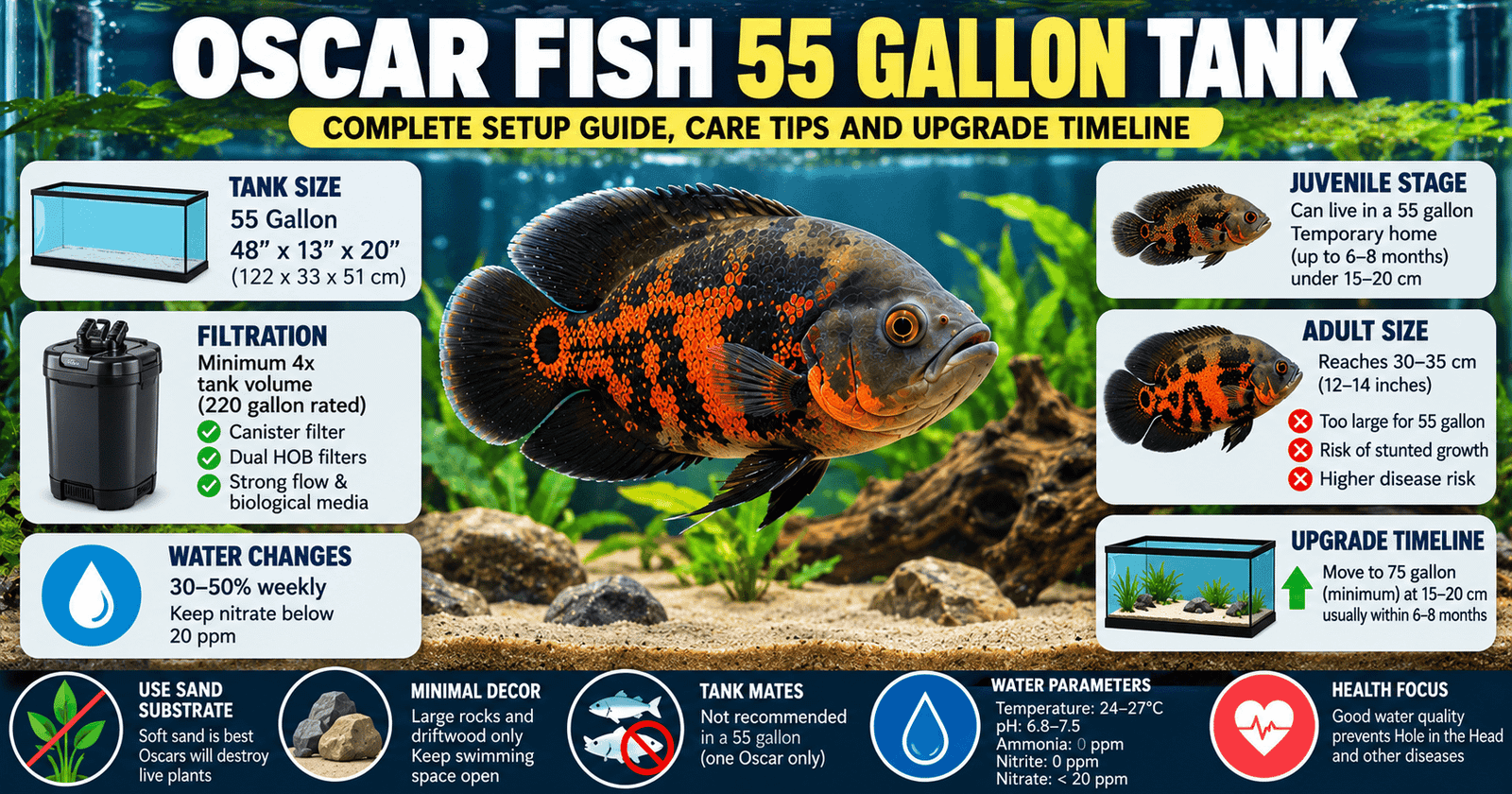
55 Gallon Oscar Tank Maintenance Checklist
A consistent maintenance routine is more reliable than emergency correction. The following checklist can be adapted to the individual aquarium’s test results.
Daily
- Observe appetite and swimming behaviour.
- Check that the filter is operating.
- Confirm that the heater is functioning.
- Look for leaks or equipment problems.
- Remove uneaten food.
Several Times Per Week
- Inspect the filter intake.
- Look for waste accumulation.
- Observe breathing and swimming behaviour.
- Check that decor has not shifted.
Weekly
- Test ammonia, nitrite and nitrate.
- Check pH and temperature.
- Perform the planned partial water change.
- Vacuum accumulated waste.
- Inspect hoses, intake and filter output.
Monthly or as Required
- Inspect filter seals and tubing.
- Clean mechanical media as required.
- Inspect the lid.
- Review the Oscar’s size and growth.
- Review whether the upgrade aquarium is ready.
Never replace all biological filter media at the same time without a clear reason. Maintaining the established biological community is an important part of stable aquarium filtration.
Common Oscar Fish 55 Gallon Tank Mistakes
1. Treating 55 Gallons as the Permanent Adult Tank
The most common mistake is buying a 55 gallon aquarium without planning for adult size. A small juvenile can make the tank appear much larger than it will later.
2. Waiting Until the Oscar Looks Cramped
An upgrade should be planned before visible distress. Purchasing, installing and cycling a larger aquarium takes time.
3. Believing Filtration Replaces Space
Filtration manages waste. It does not create swimming space, territory or additional turning room.
4. Using the One-Inch-Per-Gallon Rule
The one-inch rule is particularly misleading for large cichlids. A large-bodied Oscar cannot be treated as equivalent to a group of small community fish simply because the total number of inches appears similar.
5. Overdecorating the Aquarium
Heavy hardscape reduces usable swimming space. In a narrow 55 gallon, unnecessary decor can make the footprint even more restrictive.
6. Cycling by Calendar
A tank is not automatically cycled because it has been running for four weeks. Test results determine whether nitrification is functioning adequately.
7. Cleaning All Filter Media at Once
Replacing or aggressively cleaning all biological media simultaneously can destabilise nitrification. Maintain biological media carefully.
8. Overfeeding
Excess food becomes additional organic waste. This is especially problematic in a smaller high-bioload aquarium.
9. Buying Tank Mates Too Early
A juvenile Oscar’s current behaviour does not guarantee future compatibility. Adult size and temperament should determine the final community plan.
55 Gallon Oscar Tank Readiness Checklist
Before adding a juvenile Oscar, confirm that the system is ready rather than relying on appearance alone.
- The aquarium has been leak tested.
- The stand is rated for the completed aquarium load.
- The filter is mature and operating correctly.
- Ammonia is zero.
- Nitrite is zero.
- Nitrate is controlled.
- The heater maintains stable temperature.
- A thermometer is installed.
- The lid is secure.
- The substrate is smooth and easy to clean.
- Decor is secure.
- The swimming area remains open.
- A water conditioner is available.
- A liquid test kit is available.
- A siphon or gravel vacuum is available.
- The keeper has an upgrade plan.
The final point is critical. If the aquarium is temporary, the keeper should know what the next aquarium will be, where it will be installed, what filter it will use and when it will be cycled.
Useful AquariumsWorld Resources for Your Oscar Setup
A 55 gallon Oscar aquarium involves more than tank size alone. The following AquariumsWorld resources can help with different parts of the setup:
- AquariumsWorld Blog Archive for the wider collection of aquarium guides.
- Fish Aquarium Types and Setup Guide for aquarium selection, equipment and setup planning.
- 100 Gallon Fish Tank Guide for planning the larger permanent aquarium.
- 50 Gallon Fish Tank Guide for understanding the relationship between tank volume, dimensions and equipment.
- 50 Gallon Fish Tank Dimensions for comparing aquarium footprints.
- 20 Gallon Fish Tank Guide for understanding smaller aquarium planning and cycling principles.
- Fish Aquarium Problems and Solutions for water-quality troubleshooting.
- Aquarium Stocking Calculator for bioload-based stocking planning.
- Fish Tank Aquarium Air Pump Guide for aeration and surface agitation.
- Water Temperature for Cichlids for temperature stability and cichlid environmental planning.
- Soil in Fish Tank Guide for substrate and planted aquarium considerations.
- Can Goldfish Live with Oscar Fish? for species compatibility principles.
- Angelfish Care Guide for understanding why smaller or delicate fish are poor Oscar companions.
- Orange Plecostomus Care Guide for understanding pleco size, feeding and bioload.
- Corner Fish Tank Guide for comparing aquarium footprint and volume.
- Fish Tank Stand and Size Guide for aquarium support and equipment planning.
- Built-In Fish Aquarium Guide for structural support, access and equipment considerations.
- AquariumsWorld Aquarium Guide Archive for additional freshwater and aquarium maintenance resources.
Frequently Asked Questions
Can an oscar fish live in a 55 gallon tank?
Yes, a single juvenile Oscar can temporarily live in a 55 gallon aquarium when the tank is mature, well filtered and carefully maintained. It should not be treated as a permanent adult home. As the fish grows, swimming space, water volume and bioload become increasingly restrictive.
Is a 55 gallon big enough for one oscar fish?
A 55 gallon can be used as temporary housing for one juvenile Oscar, but it is not an ideal permanent target for an adult. The standard footprint is relatively narrow, and an adult Astronotus ocellatus can become a large, deep-bodied fish. A wider 75 gallon or larger aquarium provides greater swimming space and a larger water-quality buffer.
What filtration does a 55 gallon oscar tank need?
A 55 gallon Oscar tank needs established biological filtration, effective mechanical waste capture and good circulation. A large canister, dual HOB arrangement or canister plus sponge combination can provide useful capacity and redundancy. Actual water-test results are more important than the advertised filter rating.
How many oscars can I keep in a 55 gallon tank?
One juvenile Oscar only, and temporarily. Two Oscars should not be housed in a standard 55 gallon because the aquarium cannot provide adequate territory and water volume for two large cichlids. Filtration cannot solve a physical-space or territorial problem.
How long can a juvenile oscar stay in a 55 gallon?
There is no universal number of months. Growth varies between individual fish. A useful planning approach is to begin the upgrade process when the Oscar approaches approximately 10 cm and treat 15 cm as a point at which the 55 gallon should no longer be considered a comfortable long-term arrangement.
What is the minimum tank size for an oscar fish?
There is no single universally established scientific minimum that applies to every Oscar and every aquarium design. A 55 gallon is commonly discussed as temporary housing for a juvenile, while 75 gallons or larger is a more practical long-term target for one adult. Larger systems become increasingly important when additional fish are involved.
Can I add tank mates to a 55 gallon oscar tank?
For a standard 55 gallon, keeping one Oscar alone is the most practical approach. Potential tank mates must be appropriately sized, robust and compatible, but the aquarium also needs sufficient space for all adult fish. A juvenile’s current peaceful behaviour does not guarantee long-term compatibility.
How often should I change water in a 55 gallon oscar tank?
A small juvenile can often begin with approximately 25 to 30 percent weekly, while a growing Oscar may require 25 to 40 percent or more frequent maintenance depending on nitrate accumulation and feeding. Ammonia or nitrite in an established aquarium requires immediate investigation rather than waiting for the next scheduled water change.
What is the best setup for a 55 gallon oscar tank?
Use strong established filtration, stable heating, a reliable thermometer, smooth substrate, minimal secure decor, a tight-fitting lid and a broad open swimming area. Cycle the aquarium before adding the Oscar and test ammonia, nitrite and nitrate regularly. Most importantly, treat the 55 gallon as a temporary stage if the fish is expected to become large.
When should I upgrade from a 55 to a 75 gallon for my oscar?
Start planning before the fish becomes large. Around 10 cm is a useful planning trigger because it provides time to purchase, install and cycle the larger aquarium. If the fish approaches 15 cm, water quality becomes difficult to control, or behaviour suggests environmental problems, the upgrade should become an immediate priority.
Conclusion
A 55 gallon Oscar fish tank can be a useful temporary aquarium for a juvenile, but it should not be viewed as the final home for a large adult Oscar. The most important distinction is between keeping a small fish alive and providing appropriate long-term space for a large-bodied cichlid.
The physical footprint matters as much as nominal water volume. A common 55 gallon aquarium is relatively narrow, while a common 75 gallon format provides considerably more front-to-back space. That difference becomes increasingly important as the Oscar grows.
FishBase records Astronotus ocellatus at a maximum published total length of 45.7 cm, demonstrating why adult-size planning matters. Research on fish growth also shows that environmental stress can interact with endocrine pathways controlling growth, while fish-welfare literature supports evaluating captive conditions through behavioural, performance and physiological indicators.
If you already have a juvenile Oscar in a 55 gallon tank, there is no need for panic. Instead, use the aquarium deliberately. Maintain strong biological filtration, keep ammonia and nitrite at zero, control nitrate, avoid overfeeding, maintain stable temperature, preserve open swimming space and monitor the fish’s growth.
Most importantly, plan the upgrade before the fish becomes large. A 75 gallon aquarium provides more width and water volume, while a 100 gallon aquarium provides even greater flexibility for an adult Oscar or a carefully planned large-fish community.
The best Oscar aquarium is therefore not the smallest tank in which the fish can survive. It is the aquarium that gives the fish sufficient space, stable water quality, appropriate environmental conditions and room to express normal behaviour throughout its life.
Scientific References
- Madison, B.N., Tavakoli, S., Kramer, S. & Bernier, N.J. (2015). “Chronic cortisol and the regulation of food intake and the endocrine growth axis in rainbow trout.” Journal of Endocrinology, 226(2), pp. 103–119. DOI: https://doi.org/10.1530/JOE-15-0186
- Canosa, L.F. & Bertucci, J.I. (2023). “The effect of environmental stressors on growth in fish and its endocrine control.” Frontiers in Endocrinology, 14, 1109461. DOI: https://doi.org/10.3389/fendo.2023.1109461
- Jonsson, B. (2025). “Stunted Versus Normally Growing Fish: Adapted to Different Niches.” Fishes, 10(8), 376. DOI: https://doi.org/10.3390/fishes10080376
- Bagchi, S., Vlaeminck, S.E., Sauder, L.A., Mosquera, M., Neufeld, J.D. & Boon, N. (2014). “Temporal and Spatial Stability of Ammonia-Oxidizing Archaea and Bacteria in Aquarium Biofilters.” PLOS ONE, 9(12), e113515. DOI: https://doi.org/10.1371/journal.pone.0113515
- Esmaeili, N., Zare, M., Hosseini, S.M., Kazempour, M. et al. (2025). “Responses of oscar (Astronotus ocellatus) to different temperatures and its interaction with early mild stress.” Aquaculture, 594, 741454. DOI: https://doi.org/10.1016/j.aquaculture.2024.741454
- Smith, S.A. (2023). “Fish Welfare in Public Aquariums and Zoological Collections.” Animals, 13(16), 2548. DOI: https://doi.org/10.3390/ani13162548
- Froese, R. & Pauly, D. (eds.) (2026). FishBase: Astronotus ocellatus. Species summary database. https://www.fishbase.se/summary/Astronotus-ocellatus.html
- AquariumsWorld (2026). Fish Aquarium Problems and Solutions: The Complete 2026 Guide. AquariumsWorld. https://aquariumsworld.com/fish-aquarium-problems-and-solutions-the-complete-guide-for-every-one/