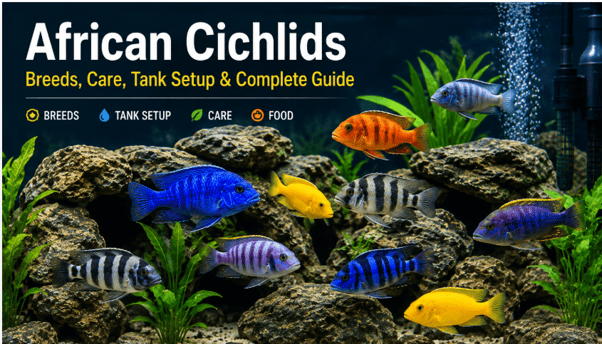
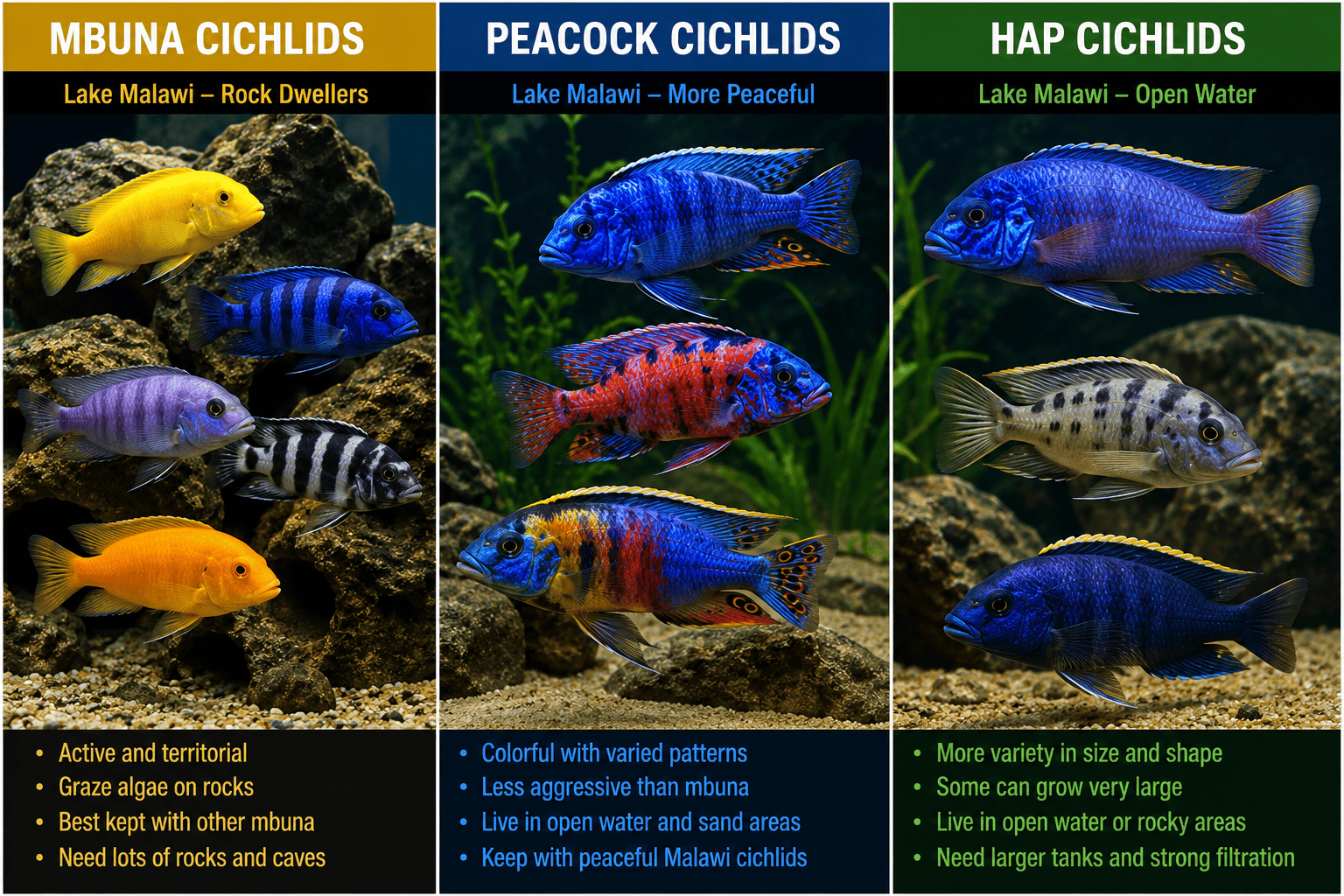
The breeds of African cichlids are among the most colourful and diverse freshwater fish available to aquarium keepers. African cichlid types include rock-dwelling mbuna cichlids, brilliantly coloured peacock cichlids, open-water hap cichlids, shell-dwelling species and many specialised fish from the major African Rift Lakes. The most important groups for aquarists come from Lake Malawi, Lake Tanganyika and Lake Victoria, each with different habitats, behaviours and aquarium requirements.
If you are researching an African cichlid species list, the first thing to understand is that “breed” is mainly an aquarium trade term rather than a formal scientific classification. African cichlids comprise hundreds of species, with many species occurring only in a particular lake or even a specific habitat within a lake. Scientific research describes the East African Rift Lakes as major centres of cichlid diversity and adaptive radiation.
That diversity explains why choosing a fish based only on colour can cause problems. A bright blue cichlid may be a rock-dwelling territorial species, while another blue fish may prefer open water or sandy habitats. The correct choice depends on adult size, temperament, diet, swimming zone, water chemistry and compatibility.
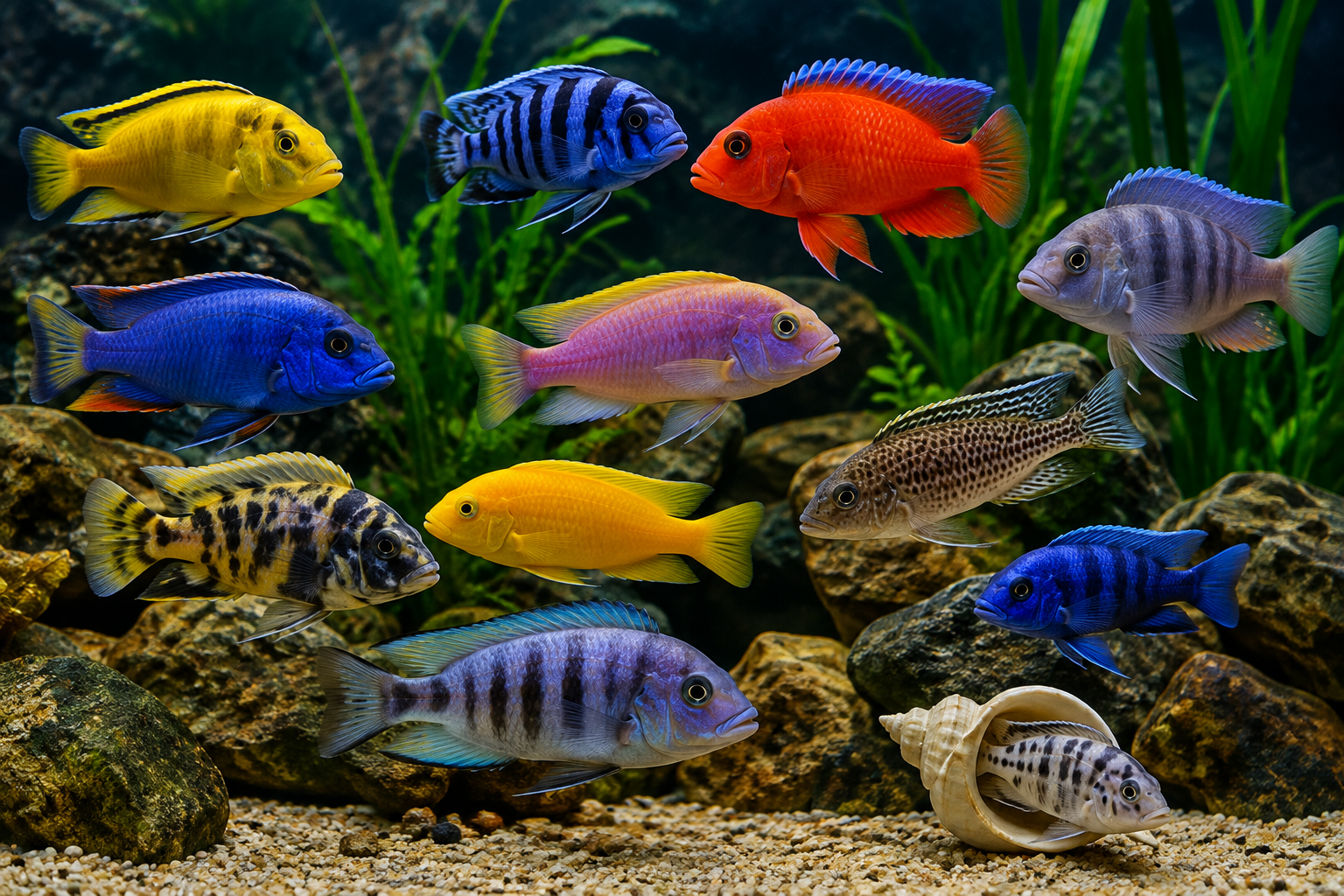
- What Are the Breeds of African Cichlids?
- Lake Malawi Cichlid Breeds
- Mbuna Cichlid Care
- Peacock Cichlid Care
- Hap Cichlids
- Lake Tanganyika Cichlid Species
- Lake Victoria Cichlid Types
- What Are the Easiest African Cichlids to Keep?
- What Is the Most Colorful African Cichlid?
- African Cichlid Tank Setup
- African Cichlid Food and Diet
- African Cichlid Compatibility and Aggression
- African Cichlid Breeding
- African Cichlid Water Parameters
- Frequently Asked Questions
- References
What Are the Breeds of African Cichlids?
African cichlids belong to the family Cichlidae, but there is no single scientific group called “African cichlid breeds”. The phrase is useful for aquarium searches, while scientific classifications are based on species, genera, tribes, evolutionary lineages and geographic distribution.
The East African Rift Lakes are particularly important. A major review identifies Lakes Malawi, Tanganyika and Victoria as biodiversity hotspots containing exceptionally large numbers of endemic cichlid species. The extraordinary diversity is associated with adaptive radiation, ecological specialisation and sexual selection.
This is why an African cichlid types guide should begin with geography rather than colour. Lake Malawi fish are not interchangeable with Lake Tanganyika fish, and neither group should automatically be mixed with Lake Victoria species.
Lake Malawi Cichlid Breeds
Lake Malawi is one of the world’s most important centres of cichlid diversity. Its fish occupy rocky shores, sandy areas and open-water habitats, producing major differences in feeding behaviour and body morphology.
For aquarium keepers, the most familiar Lake Malawi groups are mbuna cichlids, peacock cichlids and hap cichlids. These categories are useful for planning an aquarium, but they should not be treated as perfectly rigid scientific classifications.
| Group | Typical Habitat | General Behaviour | Aquarium Consideration |
|---|---|---|---|
| Mbuna | Rocky shorelines | Territorial and active | Rockwork, caves and careful stocking |
| Peacocks | Sandy and rocky transition zones | Generally less aggressive than many mbuna | Best kept with compatible peaceful Malawi species |
| Haps | Open water, rocky and sandy habitats | Varies considerably by species | Adult size must be considered carefully |
Mbuna Cichlid Care
Mbuna are among the most recognisable African cichlids. The word is commonly used for rock-associated Lake Malawi cichlids, many of which feed around rocky surfaces. Scientific work has documented hundreds of putative mbuna species and highlighted their rapid diversification, specialised feeding structures and strong territorial behaviour.
Popular aquarium examples include Yellow Labs, Melanochromis species, Pseudotropheus species, Metriaclima species and Tropheops species. Exact identification matters because fish sold under similar trade names can differ considerably in adult size and temperament.
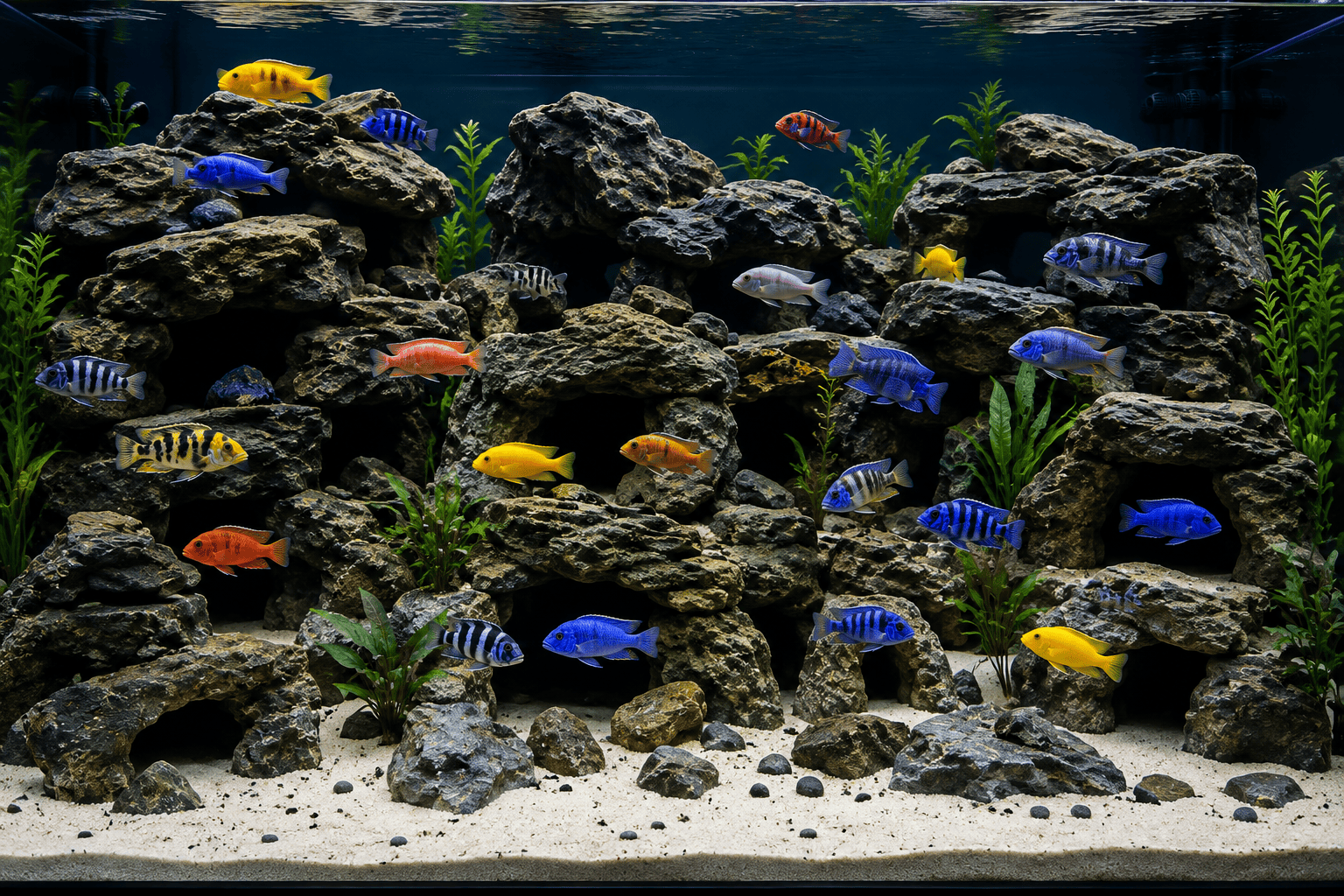
A mbuna aquarium should provide substantial rockwork with visual barriers. The objective is not simply to make the aquarium attractive. Rock structures divide territories and give subordinate fish opportunities to retreat from dominant individuals.
Yellow Lab Cichlid
The Yellow Lab, usually sold as Labidochromis caeruleus, is one of the most popular African cichlids because of its bright yellow colour and relatively manageable temperament. It still behaves like a Malawi cichlid, however, so it should not be treated as a typical peaceful community fish.
Electric Blue Hap Cichlid
The name Electric Blue Hap can refer to more than one fish in the aquarium trade, which makes scientific identification important. Buyers should confirm the scientific name before purchasing because adult size, diet and aggression can differ between species sold under similar commercial names.
Peacock Cichlid Care
Peacock cichlids are associated primarily with the genus Aulonocara. They are particularly popular because males can develop intense blue, orange, red or yellow colouration.
Compared with many mbuna, peacocks are often considered less aggressively territorial, but this does not mean they are suitable for a conventional community aquarium. They still require hard, alkaline water and carefully selected tank mates.
Their feeding behaviour also makes them different from many algae-grazing mbuna. A varied, nutritionally appropriate diet is preferable to treating all Lake Malawi cichlids as though they have identical nutritional needs.
OB Peacock Cichlid
OB peacocks are aquarium colour varieties associated with orange-blotched patterning. Their appearance makes them especially popular with hobbyists searching for colourful African cichlids. Because commercial names can be inconsistent, buyers should ask for the scientific background and parentage where available.
Hap Cichlids
Hap cichlids are another major aquarium category associated with Lake Malawi. The group includes species with very different body shapes, diets, adult sizes and behaviours.
This variation is important when planning a tank. A smaller peaceful hap cannot automatically be kept with a much larger predatory species simply because both are called haps. Adult size and ecological role should be evaluated before purchase.
Lake Tanganyika Cichlid Species
Lake Tanganyika is the oldest of the three major East African Rift Lakes discussed in aquarium literature and contains an exceptionally diverse cichlid fauna. A taxonomic review identified at least 241 cichlid species in the lake, with almost all endemic to the basin.
For aquarists, Tanganyika cichlids are especially interesting because they occupy highly specialised ecological niches. Some live among rocks, some occupy open water and others use empty snail shells as breeding and shelter sites.
Frontosa Cichlid
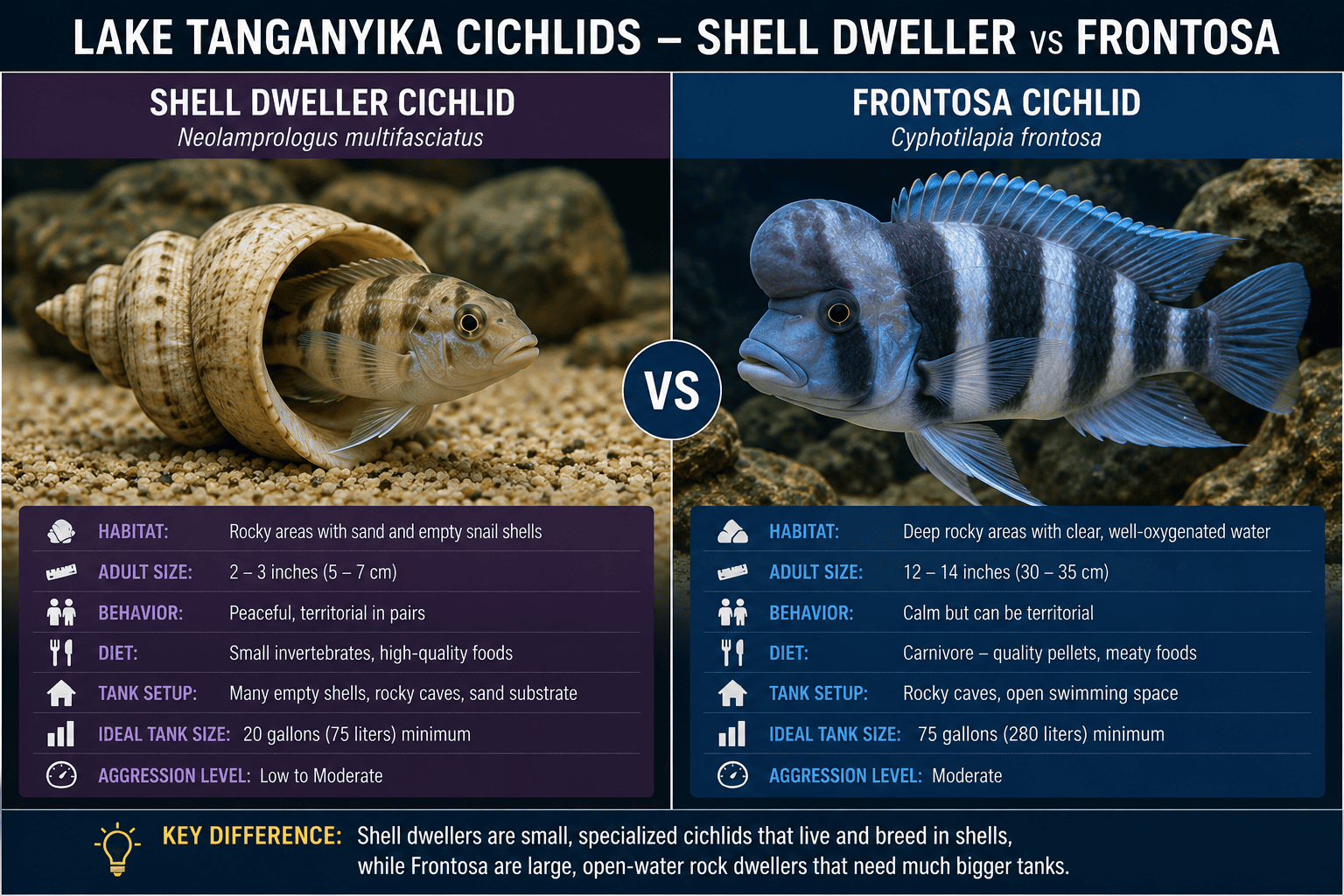
The Frontosa, Cyphotilapia frontosa, is one of the most recognisable Tanganyika cichlids. Its tall body, vertical barring and prominent forehead in mature individuals make it highly desirable, but its eventual size means it should not be treated as a typical medium aquarium fish.
A Frontosa aquarium needs substantial swimming space, strong filtration and careful planning around adult size. This is a species where purchasing a juvenile without planning for its adult dimensions can lead to an inappropriate aquarium later.
Shell Dwelling Cichlids
Shell-dwelling cichlids are among the most fascinating African cichlids for smaller aquariums. Species such as Neolamprologus multifasciatus use empty gastropod shells for shelter and breeding.
Research on Tanganyika lamprologines shows that shell breeding is a specialised evolutionary strategy. This behaviour also makes shell dwellers unusual aquarium fish because a relatively small footprint can support highly structured territorial behaviour when the layout is planned correctly.
Julidochromis Cichlids
Julidochromis species are rock-associated Tanganyika cichlids known for elongated bodies and distinctive patterns. They are often kept in rocky aquariums with caves and crevices that allow pairs to establish territories.
Lake Victoria Cichlid Types
Lake Victoria supports another major radiation of African cichlids, particularly haplochromine species. Scientific research has documented hundreds of species and has shown that the taxonomy and evolutionary history of this group are considerably more complex than common aquarium names suggest.
Many Lake Victoria cichlids are less commonly available than Malawi mbuna and peacocks, so identification can be especially important when purchasing them. Similar colour patterns can occur among different species, and aquarium trade names are not always reliable.
Victoria Haplochromis Cichlids
Victoria haplochromine cichlids include numerous species with specialised feeding behaviours and ecological niches. Their evolutionary diversity makes the group scientifically important, but their aquarium requirements vary substantially.
Kenya Gold Cichlid
The name Kenya Gold is used in the aquarium trade for brightly coloured East African cichlids. Before purchase, confirm the scientific name rather than relying solely on the common name because trade terminology can vary between suppliers.
What Are the Easiest African Cichlids to Keep?
There is no single African cichlid that is universally easiest because “easy” depends on aquarium size, water chemistry, experience and the other fish in the system.
For beginners who specifically want African cichlids, smaller and comparatively manageable Malawi species are often a better starting point than large predatory haps or demanding Tanganyika species. Yellow Labs are commonly considered one of the more approachable choices, although they still require an appropriate African cichlid environment.
Yellow Lab
Bright colour, manageable adult size and generally less intense aggression than many mbuna.
Peacock Cichlid
Excellent colour and often more moderate aggression, but requires compatible Malawi tank mates.
Small Shell Dweller
Interesting behaviour and smaller adult size, but requires a dedicated Tanganyika-style setup.
What Is the Most Colorful African Cichlid?
There is no scientifically objective answer to the question of which African cichlid is the most colourful. Colour depends on species, sex, age, dominance, breeding condition, genetics and lighting.
For aquarium popularity, peacock cichlids are among the strongest candidates because males can display intense blue, orange, red and yellow colours. Some mbuna, including Electric Yellow and several Metriaclima and Melanochromis species, are also exceptionally colourful.
Colour should never be the only selection criterion. A fish that looks perfect in a shop can become an inappropriate choice if its adult size, diet or aggression does not fit the aquarium.
African Cichlid Tank Setup
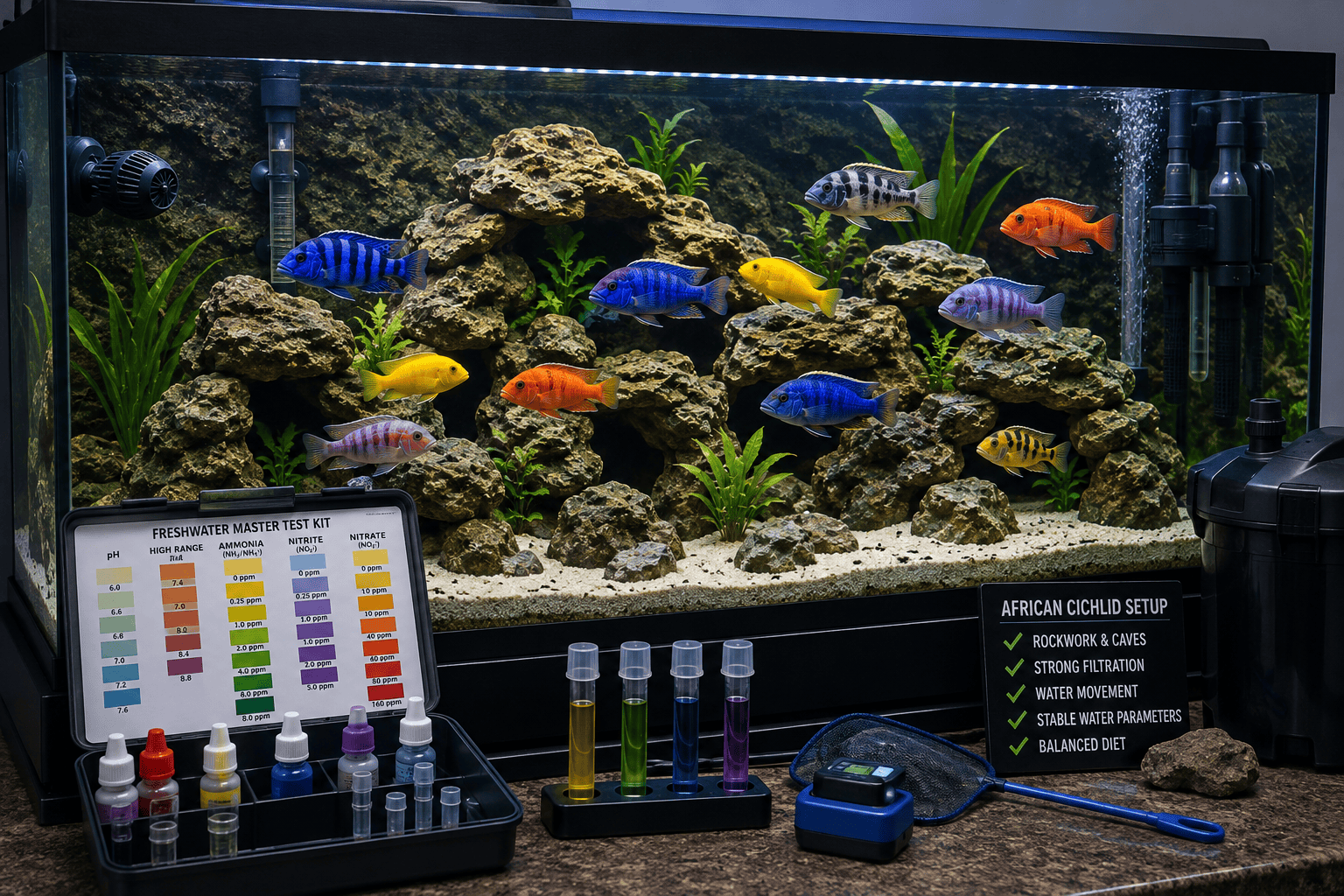
An African cichlid tank should be planned around the species rather than the other way around. The aquarium must provide enough swimming space, filtration, water movement, shelter and territory for the fish selected.
If you are comparing aquarium footprints before purchasing a tank, our detailed fish tank dimensions, weight and size guide can help you compare common aquarium sizes and understand the difference between nominal volume and actual dimensions.
55 Gallon African Cichlid Tank
A 55 gallon aquarium is a common starting point for African cichlid keepers, but the correct stocking depends on species. A long footprint provides useful horizontal swimming space, while rockwork creates separate territories.
Do not assume that a 55 gallon aquarium can safely house any number of African cichlids. A group of smaller mbuna has very different requirements from a collection of large haps or Tanganyika species.
For broader aquarium planning, explore the AquariumsWorld freshwater fish and aquarium care guides before choosing equipment or livestock.
Essential Equipment
- Strong biological filtration sized for the actual aquarium and stocking level.
- A reliable heater appropriate for the tank volume and room temperature.
- Rockwork that creates visual barriers and caves.
- A secure aquarium lid because active cichlids can jump.
- A reliable liquid test kit for ammonia, nitrite, nitrate and pH.
- Substrate suitable for the selected species and desired aquascape.
Before adding livestock, use a properly completed nitrogen cycle. AquariumsWorld also provides broader aquarium setup and fish care resources that can be used alongside this specialist cichlid guide.
African Cichlid Food and Diet
African cichlid food should match the natural feeding strategy of the species. This is one of the most important differences between mbuna, peacocks, haps and Tanganyika species.
Many mbuna feed heavily on algae and associated organisms in their natural environment. Some other cichlids are more insectivorous, carnivorous or generalist. Feeding every African cichlid an identical high-protein diet can therefore be inappropriate.
For wider information about aquarium maintenance and water quality, use the AquariumsWorld aquarium care resources alongside species-specific research.
African Cichlid Compatibility and Aggression
Aggression is one of the defining challenges of African cichlid keeping. Research on African cichlids has demonstrated that social rank, territory and relative body size can influence aggressive behaviour.
This means compatibility is not simply a question of whether two species have similar colours or live in the same lake. Fish can compete for territories, food and breeding areas even when their water requirements are similar.
Can You Mix Different Breeds of African Cichlids?
Yes, but only when their requirements and behaviour are compatible. Mixing every Malawi group together is not automatically safe, and mixing Malawi, Tanganyika and Victoria fish requires even greater caution.
A responsible stocking plan considers adult size, aggression, diet, water chemistry and habitat. It also considers whether males and females are likely to establish territories and whether subordinate fish have places to escape dominant individuals.
Can African Cichlids Live with Other Fish?
Some African cichlids can be kept with carefully selected tank mates, but a conventional peaceful community aquarium is usually not the right model. Small, slow or long-finned fish can become targets of chasing, fin damage or predation.
The safest approach is usually to build the aquarium around compatible African cichlids rather than adding unrelated community fish later.
African Cichlid Breeding
African cichlids display several fascinating reproductive strategies. Many Lake Malawi species are maternal mouthbrooders, meaning females incubate eggs or young in the mouth.
Tanganyika species show even greater variety. Research has documented substrate breeding, shell breeding and complex parental behaviours across different lineages.
For aquarium breeding, the biggest challenge is often not getting fish to spawn but managing the resulting population. Once a compatible group begins breeding regularly, the aquarium can become crowded quickly.
How to Improve Breeding Success
- Provide species-appropriate water chemistry.
- Give females and subordinate males places to retreat.
- Use suitable rocks, caves or shells depending on the species.
- Maintain stable temperature and water quality.
- Avoid excessive disturbance around breeding territories.
- Plan in advance for juvenile fish.
African Cichlid Water Parameters
African Rift Lake cichlids generally require harder, alkaline water than many soft-water tropical community fish. However, exact requirements vary between species and lakes.
| Parameter | General African Cichlid Planning Range | Important Note |
|---|---|---|
| Temperature | Approximately 24 to 27°C | Use the species requirement rather than relying on a generic number. |
| pH | Generally alkaline | Lake-specific and species-specific requirements vary. |
| Hardness | Moderate to high | Important for long-term stability and species suitability. |
| Ammonia | 0 ppm | Any detectable ammonia requires investigation. |
| Nitrite | 0 ppm | Maintain a mature biological filter. |
| Nitrate | Keep controlled through maintenance | Lower is generally preferable for long-term fish health. |
Do not attempt to force every African cichlid aquarium to one exact numerical target. Stable parameters appropriate for the selected species are more useful than constantly adjusting water to chase an arbitrary number.
For additional aquarium water-quality guidance, visit the AquariumsWorld aquarium care hub.
Choosing African Cichlids by Aquarium Size
Tank size should be selected from the adult requirements of the species, not the size of the juvenile fish in the store. A small juvenile can grow into a fish that needs considerably more swimming space.
| Aquarium Size | Potential Use | General Guidance |
|---|---|---|
| 30 gallons | Specialised small setup | Suitable only for carefully selected smaller species and dedicated stocking plans. |
| 40 gallons | Small African cichlid setup | Footprint and species selection remain critical. |
| 55 gallons | Common beginner Malawi setup | Useful footprint for smaller compatible Malawi groups. |
| 75 gallons | Larger community or species groups | Provides more swimming space and territory management options. |
| 90 gallons and above | Large species and more complex communities | Better suited to larger haps, Frontosa or carefully planned mixed systems. |
Remember that two aquariums with the same gallon capacity can have very different footprints. Length and width influence swimming space and territory distribution, which is why aquarium dimensions should be checked before purchase.
Our complete fish tank dimensions and weight guide is useful when comparing aquarium footprints and calculating how much a filled aquarium may weigh.
Common African Cichlid Keeping Mistakes
- Choosing fish only for colour: Appearance does not tell you whether a species fits your aquarium.
- Ignoring adult size: Juveniles can look deceptively small in aquarium shops.
- Mixing incompatible groups: Similar water chemistry does not guarantee behavioural compatibility.
- Using insufficient rockwork: Territorial fish need visual barriers and retreats.
- Overstocking without a plan: High stocking can increase aggression and water-quality problems.
- Feeding every species the same diet: Dietary adaptations differ substantially among cichlid groups.
- Skipping the nitrogen cycle: New biological filters cannot safely process a heavy fish load immediately.
- Constantly changing water chemistry: Stability is often more valuable than chasing exact numbers.
Best African Cichlids for Different Aquarists
Best for Colour
Peacock cichlids are strong choices for aquarists prioritising intense male colouration.
Best for Active Behaviour
Mbuna provide constant movement, territorial interactions and interesting rock-associated behaviour.
Best for Small Specialist Tanks
Selected Tanganyika shell dwellers can provide fascinating behaviour without requiring the space needed by large cichlids.
Frequently Asked Questions
What are the different breeds of African cichlids?
The major aquarium groups include Malawi mbuna, peacock cichlids and haps, Tanganyika species such as Frontosa and shell dwellers, and various Lake Victoria haplochromine cichlids. These are aquarium groupings rather than a single scientific classification.
How many types of African cichlids are there?
There are hundreds of African cichlid species, with especially large radiations in Lakes Malawi, Tanganyika and Victoria. Published scientific inventories change as new species are described and taxonomic classifications are revised.
What is the most popular African cichlid?
There is no universal ranking, but Yellow Labs, peacock cichlids and several mbuna are among the most widely recognised aquarium African cichlids.
What are the easiest African cichlids to keep?
Smaller, relatively manageable Malawi species such as Yellow Labs are often considered good starting points for aquarists who specifically want African cichlids. They still require appropriate hard, alkaline water, filtration and compatible stocking.
Are African cichlids aggressive?
Many African cichlids are territorial and can be aggressive, particularly around breeding sites. Aggression varies considerably by species, sex, tank footprint, stocking strategy and habitat design.
What size tank do African cichlids need?
Tank size depends on species. Smaller specialist species can be kept in smaller aquariums, while many Malawi communities are better suited to tanks around 55 gallons or larger. Large species require substantially more space.
What do African cichlids eat?
Diet varies between species. Some mbuna rely heavily on algae and associated organisms, while other African cichlids consume insects, small aquatic animals or mixed diets. Choose food according to the species rather than treating all African cichlids identically.
Can African cichlids live with other fish?
Some can, but compatibility is limited. Small peaceful community fish are often poor choices because African cichlids may chase, injure or consume them. A species-focused aquarium is generally easier to manage.
What is the most colorful African cichlid?
Peacock cichlids are among the strongest candidates because of their intense male colouration. However, many mbuna and other African cichlids are also exceptionally colourful.
Can you mix different breeds of African cichlids?
Yes, but only after checking adult size, aggression, diet, water chemistry and habitat requirements. Mixing fish simply because they are all called African cichlids is not a reliable compatibility strategy.
Final Verdict
The best way to choose among the breeds of African cichlids is to stop thinking about colour first and start with habitat, adult size and behaviour. Mbuna are ideal for aquarists who enjoy active territorial fish and rocky aquascapes. Peacocks are attractive choices for colour-focused Malawi aquariums. Haps offer greater variety but can include substantially larger species. Tanganyika cichlids provide some of the most specialised behaviours in the hobby, including shell dwelling, while Lake Victoria cichlids represent another extraordinary radiation with complex species diversity.
A successful African cichlid aquarium is therefore not simply a tank filled with colourful fish. It is a carefully planned ecosystem in which the species, aquarium footprint, filtration, water chemistry, diet and social structure work together.
References
- Genner, M.J. and Turner, G.F. (2005). The mbuna cichlids of Lake Malawi: a model for rapid speciation and adaptive radiation. Fish and Fisheries, 6(1), pp.1-34. DOI: 10.1111/j.1467-2679.2005.00173.x
- Kocher, T.D. (2004). Adaptive evolution and explosive speciation: the cichlid fish model. Nature Reviews Genetics, 5, pp.288-298. DOI: 10.1038/nrg1316
- Seehausen, O. (2006). African cichlid fish: a model system in adaptive radiation research. Proceedings of the Royal Society B, 273(1597), pp.1987-1998. DOI: 10.1098/rspb.2006.3539
- Santos, M.E., Lopes, J.F. and Kratochwil, C.F. (2023). East African cichlid fishes. Developmental Biology Advances, 14, Article 1. DOI: 10.1186/s13227-022-00205-5
- Ronco, F., Büscher, H.H., Indermaur, A. and Salzburger, W. (2020). The taxonomic diversity of the cichlid fish fauna of ancient Lake Tanganyika, East Africa. Journal of Great Lakes Research, 46(5), pp.1067-1078. DOI: 10.1016/j.jglr.2019.05.009
- Takahashi, T. and Koblmüller, S. (2011). The adaptive radiation of cichlid fish in Lake Tanganyika: a morphological perspective. International Journal of Evolutionary Biology, 2011, Article 620754. DOI: 10.4061/2011/620754
- Salzburger, W., Meyer, A., Baric, S., Verheyen, E. and Sturmbauer, C. (2002). Out of Tanganyika: genesis, explosive speciation, key-innovations and phylogeography of the haplochromine cichlid fishes. Journal of Evolutionary Biology, 15, pp.625-641. DOI: 10.1046/j.1420-9101.2002.00435.x
- Alward, B.A., Cathers, P.H., Blakkan, D.M., Hoadley, A.P. and Fernald, R.D. (2021). A behavioral logic underlying aggression in an African cichlid fish. Ethology, 127, pp.572-581. DOI: 10.1111/eth.13164