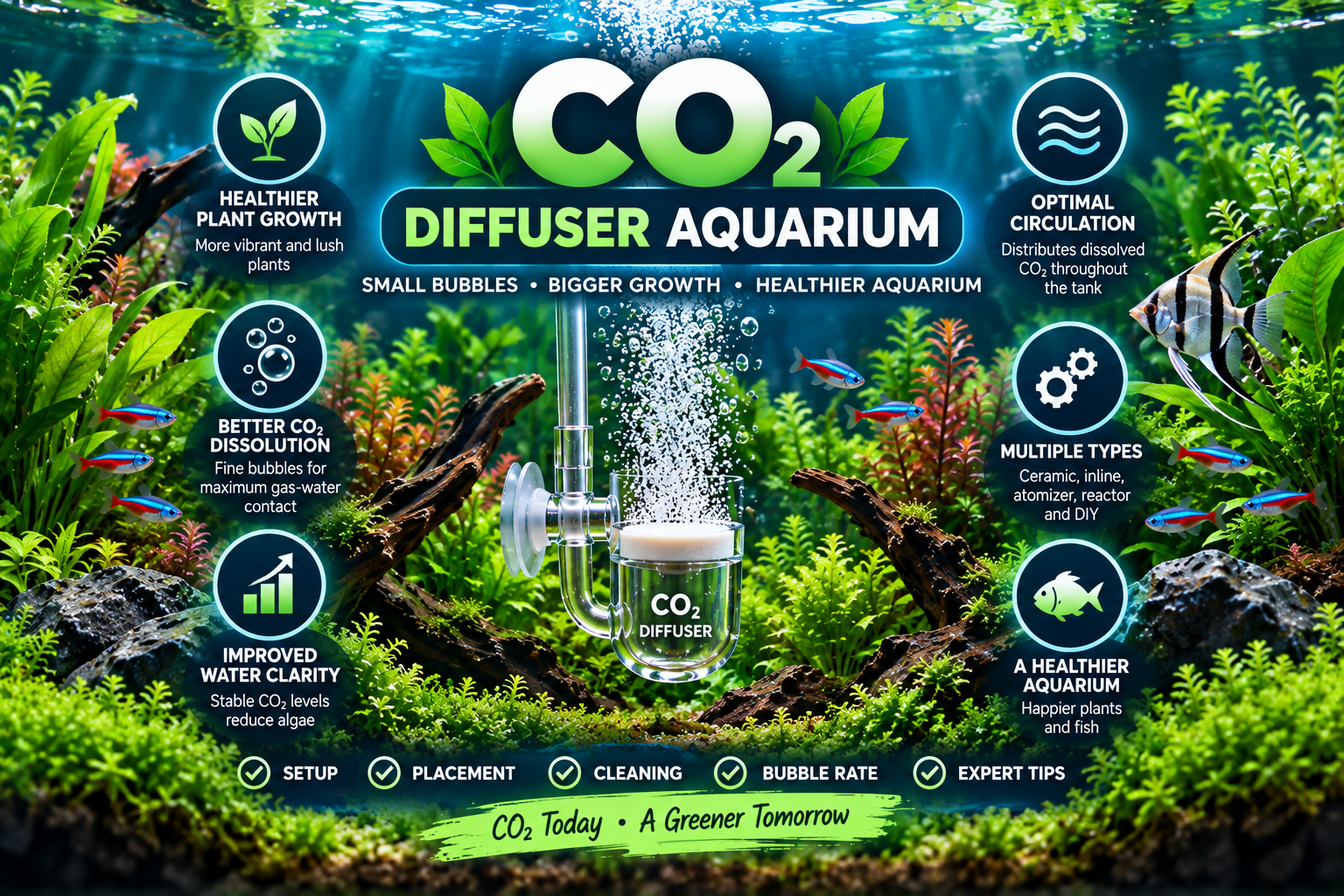
Learn how aquarium CO2 diffusers work, which type suits your planted tank, where to place one, how to set bubble rate, how to clean it and how to protect fish from excessive CO2.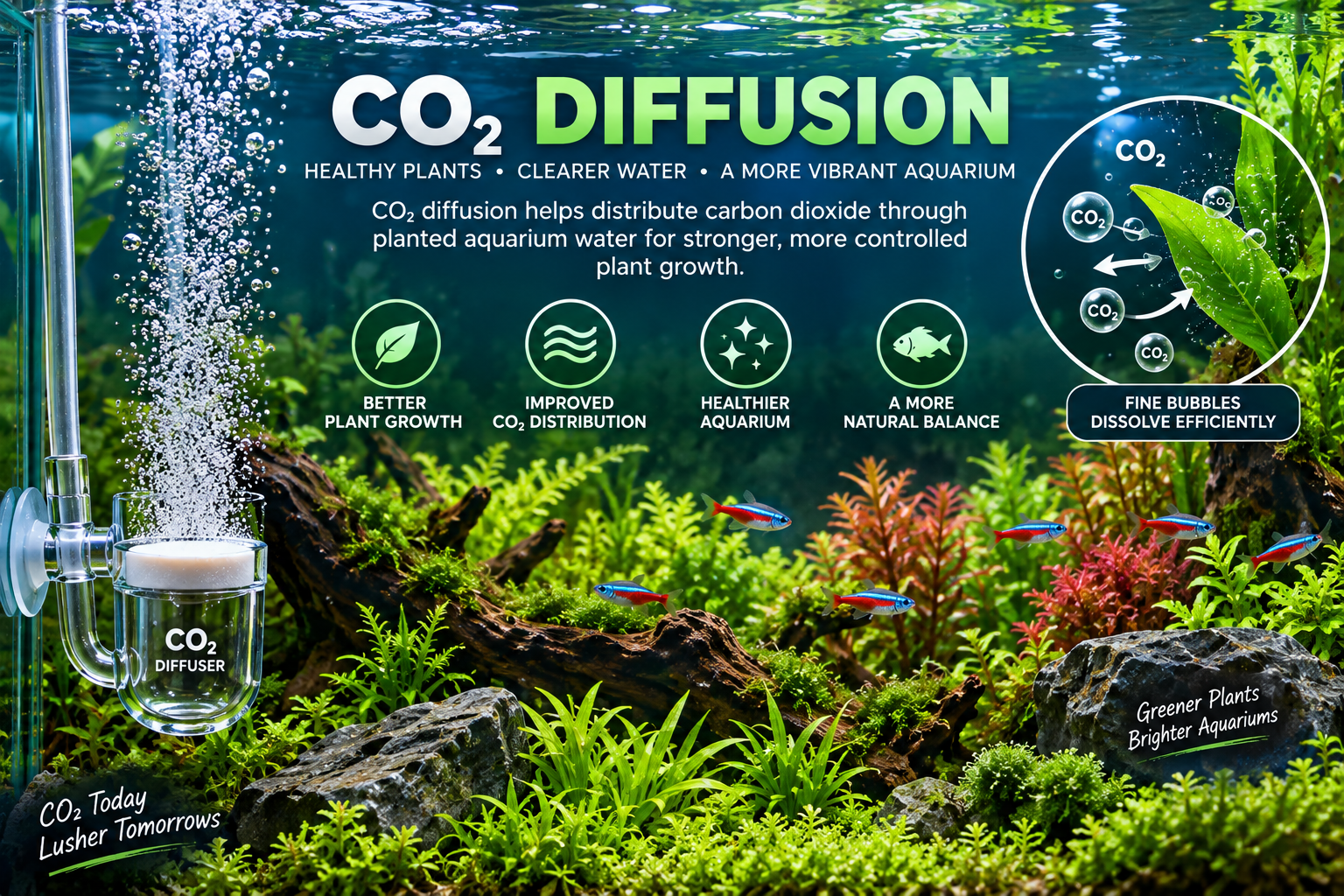
What Does a CO2 Diffuser Do in an Aquarium?
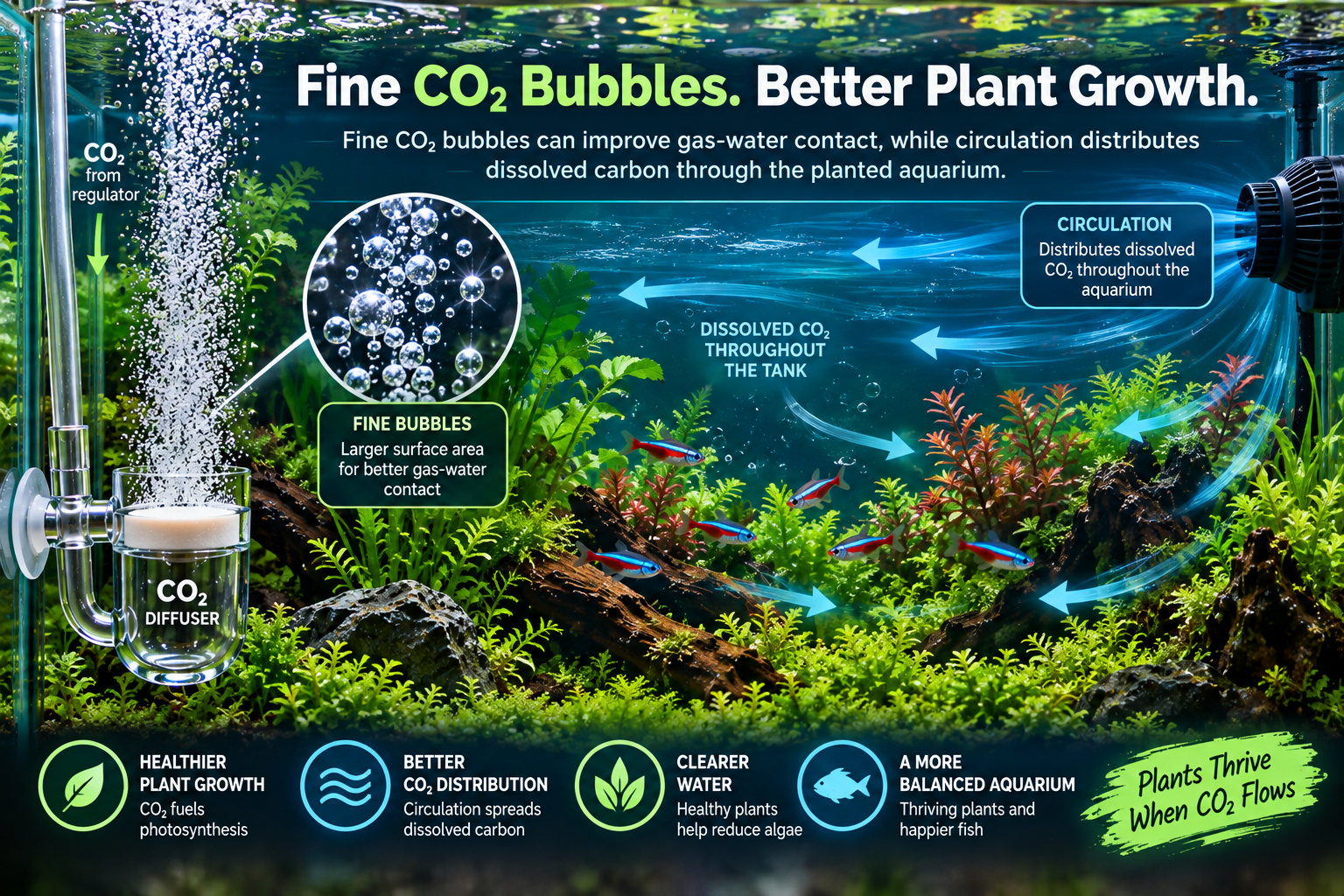
A CO2 diffuser is the interface between a pressurised carbon dioxide system and aquarium water. Its main job is to convert a stream of gaseous CO2 into many smaller bubbles, increasing the contact area between gas and water. When those bubbles remain within the water column long enough, more carbon dioxide dissolves before the gas escapes at the surface.
This matters particularly in planted aquariums because carbon dioxide availability can limit photosynthesis when lighting and other resources are sufficient. A diffuser does not create carbon dioxide and it does not automatically establish the correct concentration. Instead, it improves the physical delivery of gas so the aquarist can control CO2 addition through a regulator, needle valve, solenoid and diffuser.
The science behind bubble-based delivery is straightforward. As bubble diameter decreases, the surface-area-to-volume ratio increases. This gives a greater gas-water interface relative to the amount of gas contained in each bubble. Experimental work on gas bubbles rising through water shows that bubble size, pressure, liquid properties and hydrodynamic conditions all influence dissolution behaviour (Colombet et al., 2016). The diffusion coefficient of CO2 in water also varies with physical conditions such as temperature and pressure (Ahmadi et al., 2020).
For this reason, the phrase CO2 diffuser aquarium normally refers to a device designed to maximise CO2-water contact rather than simply release a large volume of gas. A coarse bubble that reaches the surface quickly can waste gas. A fine bubble that is carried through the aquarium by circulation has more opportunity to dissolve.
How a CO2 Diffuser Works: The Physics
Ceramic disc diffusers contain a porous membrane with microscopic passages. Pressurised CO2 is forced against the membrane until the gas emerges through the pores as a mist of small bubbles. The exact bubble size depends on pore structure, gas pressure, water depth, diffuser condition and the surrounding flow field.
Smaller bubbles generally provide a greater surface area relative to their volume. They can therefore transfer gas efficiently when the water around them remains sufficiently undersaturated with CO2. However, smaller is not automatically better in every aquarium. A very fine mist can be carried into high-flow areas, increase gas exchange at the surface or become difficult to control if the diffuser and circulation system are poorly matched.
The diffuser therefore works as one component of a larger delivery system. Regulator pressure controls the gas supply, the needle valve controls the approximate injection rate, the diffuser creates the bubble interface, and circulation distributes the dissolved gas. A drop checker can then provide a broad visual indication of changing CO2 conditions when correctly prepared and positioned.
Why Aquatic Plants Need CO2 Supplementation
Carbon dioxide is the carbon source used in photosynthesis. Submerged aquatic plants can obtain inorganic carbon from the surrounding water, but carbon transport in water is much less favourable than movement through air. Pedersen, Colmer and Sand-Jensen (2013) explain the importance of the aquatic diffusive environment and the boundary layer surrounding submerged leaves.
The supplied research brief identifies approximately 0.5 to 5 mg/L as a typical range for CO2 in air-equilibrated fresh water and approximately 30 mg/L as a concentration associated with photosynthetic saturation for some submerged plants. These figures should not be treated as universal requirements for every aquarium species. Plant physiology, light intensity, carbonate chemistry, temperature and circulation all influence carbon availability and photosynthetic response.
CO2 supplementation becomes especially useful when an aquarium combines strong lighting, rapid-growing plants and a desire for accelerated growth. Without enough available carbon, the additional light does not necessarily translate into proportionally stronger growth. This imbalance can also make algae management more difficult because algae can exploit unstable conditions even when plants are present.
CO2 and Aquatic Plant Photosynthesis
Photosynthesis converts light energy into chemical energy while incorporating inorganic carbon into organic compounds. Aquatic plants have evolved different strategies for acquiring carbon, including the use of dissolved CO2 and bicarbonate. Raven, Cockell and De La Rocha (2017) discuss the ecological importance of aquatic CO2-concentrating mechanisms and the challenge of carbon acquisition in aquatic environments.
For planted aquarium practice, a commonly targeted dissolved CO2 range is around 20 to 30 mg/L, particularly in high-light planted systems. This is a management target rather than a universal biological threshold. A drop checker is useful as a broad indicator, while pH and KH relationships can provide another estimation approach when the carbonate chemistry is appropriate.
Stable delivery is more important than chasing a single bubble count. Plants respond to the dissolved carbon environment rather than to the number of bubbles visible at the diffuser. That distinction explains why two aquariums with identical bubble rates can have different CO2 concentrations.
Types of CO2 Diffusers for Aquariums
There is no single best CO2 diffuser for every planted tank. The correct choice depends on aquarium volume, filter design, working pressure, visual preferences, desired efficiency and willingness to maintain equipment. The five common approaches are ceramic disc in-tank diffusers, inline diffusers, CO2 atomizers, CO2 reactors and simple DIY systems.
Ceramic Disc In-Tank CO2 Diffuser
The ceramic disc diffuser is the familiar option used inside the aquarium. A porous ceramic membrane sits in a small housing and is attached to the glass using a suction cup. Pressurised CO2 passes through the ceramic surface and forms a cloud of fine bubbles.
Its main advantage is simplicity. It can work with many filtration arrangements, it is inexpensive compared with reactors, and the aquarist can see the bubble stream directly. This makes it useful for learning how adjustments to the regulator and needle valve change gas delivery.
The disadvantages are equally practical. The equipment remains visible inside the display, ceramic pores can become clogged, and the bubble mist may not dissolve efficiently in very large tanks if circulation is inadequate. A quality ceramic disc is often a sensible option for smaller and medium planted aquariums, especially when the aquarist wants a straightforward installation.
Inline CO2 Diffuser
An inline CO2 diffuser is installed outside the aquarium, usually in the return hose of a canister filtration system. CO2 enters the pressurised water stream, where the gas is distributed before the water returns to the aquarium. This removes the diffuser from the visual display and can produce effective gas transfer when the filter and diffuser are correctly matched.
Inline systems are particularly attractive for aquascapes where visible equipment is undesirable. They are also useful when the aquarist wants the return flow to distribute CO2 throughout the tank. The main limitation is compatibility. The system needs suitable external filtration and correct hose connections, and installation errors can introduce leaks or reduce filter performance.
CO2 Atomizer
A CO2 atomizer is designed to produce an extremely fine mist of bubbles. It can be regarded as a specialised diffuser in which the membrane and operating conditions are selected for very fine gas dispersion. The supplied brief identifies working pressures around 20 to 30 psi or higher for some atomizer systems, but the correct pressure is always determined by the particular product.
Atomizers appeal to advanced planted-tank keepers who want efficient distribution and a fine mist. They can require more attention to pressure, cleaning and compatibility than a basic ceramic disc. The term atomizer is also used inconsistently by aquarium retailers, so specifications from the actual manufacturer are more useful than the label alone.
CO2 Reactor
A CO2 reactor differs fundamentally from a bubble diffuser. Rather than releasing a bubble stream directly into the aquarium, a reactor mixes CO2 with water inside a chamber connected to the filtration system. The aim is to dissolve the gas before the treated water returns to the aquarium.
Reactors can achieve very high gas utilisation under suitable conditions and eliminate visible bubbles from the display. They are therefore attractive for large planted aquariums and high-demand systems. Their disadvantages include greater installation complexity, additional plumbing, cost and the need to manage accumulated gas inside the reactor.
DIY CO2 Diffuser
DIY bell or bottle-based diffusion methods can be used with low-pressure yeast or fermentation CO2 systems. Their low cost can make them useful for experimentation, particularly on small aquariums. However, DIY systems usually provide less precise pressure and bubble-rate control than a regulated pressurised system.
DIY diffusion is not the preferred approach where precise CO2 control is important. Unstable production can cause large swings in dissolved CO2, and improvised pressure systems require careful attention to leak prevention and safe construction.
| Type | Efficiency | Typical Tank Size | Filter Required | Visibility | Relative Cost |
|---|---|---|---|---|---|
| Ceramic disc in-tank | Moderate | Under 55 gallons | Any suitable filter | Visible in tank | Low |
| Inline diffuser | High | 40 gallons and above | Canister or compatible external filter | Hidden | Medium |
| CO2 atomizer | Very high | 20 to 100 gallons | Depends on model | Fine visible mist | Medium to high |
| CO2 reactor | Very high | 75 gallons and above | Usually external filtration | Hidden | High |
| DIY bell or bottle | Low | Under 20 gallons | Any suitable filter | Visible | Very low |
The table should be treated as a practical comparison rather than a fixed performance ranking. Actual dissolution depends on pressure, diffuser condition, bubble size, water depth, circulation, temperature and the particular equipment design.
Where to Place a CO2 Diffuser in an Aquarium
CO2 diffuser placement determines how effectively the delivered gas is distributed. The objective is not simply to place the diffuser near the plants. The more important goal is to allow the bubble stream and dissolved CO2 to enter the main circulation pattern of the aquarium.
A useful arrangement is to place an in-tank diffuser in a region where the filter return current can capture and carry the bubble mist across the aquarium. Many aquarists place the diffuser low in the tank, often toward the opposite end from the return outlet, so the circulation pattern carries bubbles across the planted area before they rise toward the surface.
The exact position should be adjusted according to the aquascape. Dense rockwork can block circulation. Tall plants can alter local flow. Surface agitation can accelerate gas exchange and increase the amount of CO2 that leaves the water. A good setup therefore combines diffuser location with appropriate water movement rather than treating placement as an isolated decision.
CO2 Diffuser Placement Near Filter Output
Positioning the diffuser in or near the downstream circulation path can help distribute the fine bubble stream. The goal is to move bubbles horizontally or downward rather than allowing them to rise directly to the surface.
Do not position the diffuser so close to the filter intake that bubbles are continuously sucked into the filter. Large quantities of gas entering a canister filter can create noise, reduce effective water movement and potentially cause air accumulation. Conversely, excessive surface agitation can remove CO2 before it contributes to plant growth.
For broader water-movement guidance, see the Fish Tank Aquarium Air Pump Guide.
CO2 Diffuser for Large Planted Tanks
Large aquariums create a distribution challenge because a single diffuser may not provide uniform CO2 conditions throughout the entire aquascape. Tanks above approximately 75 gallons can benefit from an efficient inline diffuser, a reactor, or a carefully designed circulation pattern that carries CO2 across the full footprint.
Using two diffusers can be considered when the aquarium has separate circulation zones, although simply adding more diffusers does not solve poor flow. The first priority should be to establish a circulation pattern that prevents stagnant areas. Additional diffusion should then be evaluated using plant response, drop-checker position and measured water conditions.
CO2 Diffuser for Nano Aquariums
Nano aquariums need a more conservative approach because a small change in gas delivery can represent a large change relative to total water volume. A small ceramic disc is often adequate. The diffuser should be paired with gentle but effective circulation and a carefully adjusted bubble rate.
Because nano tanks contain little water to buffer dosing errors, sudden increases in CO2 should be avoided. Any sign of fish stress should be treated seriously, and the CO2 supply should be reduced or stopped while water movement and aeration are assessed.
How Many Bubbles Per Second for a CO2 Diffuser?
There is no universal bubble-per-second setting that guarantees a specific dissolved CO2 concentration. Bubble count is affected by diffuser pore size, gas pressure, tubing resistance, water depth, bubble size and the condition of the ceramic membrane. The aquarium’s circulation and surface gas exchange also influence the final concentration.
The supplied brief provides the following starting ranges. They are useful as initial settings only. A drop checker and consistent observation should guide subsequent adjustment.
| Tank Size | Low Planting | Medium Planting | High Planting |
|---|---|---|---|
| Under 10 gallons | 0.5 to 1 bps | 1 to 2 bps | 2 to 3 bps |
| 10 to 20 gallons | 1 to 2 bps | 2 to 3 bps | 3 to 4 bps |
| 20 to 55 gallons | 2 to 3 bps | 3 to 5 bps | 5 to 7 bps |
| 55 to 100 gallons | 3 to 5 bps | 5 to 8 bps | 8 to 12 bps |
These figures should not be treated as a prescription. For example, an efficient reactor may dissolve more CO2 at a lower visible bubble count than a small in-tank ceramic diffuser. Conversely, a clogged diffuser can produce larger bubbles and poorer gas transfer at the same regulator setting.
A practical starting method is to begin conservatively, observe the drop checker and fish, and make small changes rather than large jumps. The supplied brief recommends increasing by approximately 0.5 bps per day until the indicator reaches the desired green range. The timing of that adjustment should be slowed whenever livestock show unusual behaviour.
CO2 Bubble Size and Dissolution Rate
Bubble size is important because surface-area-to-volume ratio changes as the bubble becomes smaller. A fine bubble has proportionally more surface through which gas can transfer. Colombet et al. (2016) examined bubble dissolution experimentally and demonstrated that bubble characteristics influence dissolution as bubbles rise through water.
In an aquarium, the practical lesson is to maintain a clean diffuser and adequate circulation rather than chasing the smallest possible bubble. Extremely fine bubbles are useful only when the aquarium can distribute them effectively without excessive surface loss or livestock stress.
Can a CO2 Diffuser Harm Fish?
Yes. The diffuser itself is normally not the problem. The risk comes from excessive dissolved CO2 caused by an overly high injection rate, inadequate gas exchange or poor adjustment. Elevated CO2 can interfere with fish respiration and acid-base regulation, so livestock behaviour must always be considered alongside plant growth.
Potential warning signs include unusually rapid gill movement, lethargy, loss of normal schooling behaviour, unusual swimming and persistent surface gasping. These signs can also have other causes, so they should not be attributed to CO2 automatically. However, if they occur soon after a CO2 increase, the CO2 system should be treated as a possible cause.
The supplied research brief identifies respiratory acidosis and changes in gill function and blood pH as important biological consequences of elevated dissolved CO2 (Pedersen et al., 2013). This is why a planted aquarium should be managed around livestock tolerance rather than a plant-only target.
A common control strategy is to use a solenoid valve connected to a timer. The supplied setup recommends switching CO2 on approximately one hour before lights-on and switching it off approximately one hour before lights-off. The exact schedule can be adjusted according to the aquarium’s response and lighting period.
| Dissolved CO2 | Plant Interpretation | Livestock Consideration |
|---|---|---|
| Below 10 ppm | May be limiting in demanding planted systems | Generally low CO2 exposure |
| 15 to 25 ppm | Useful planted-tank range | Often tolerated by suitable community fish |
| 25 to 35 ppm | Upper management range for many systems | Monitor sensitive livestock carefully |
| Above 35 ppm | Additional benefit is not guaranteed | CO2 stress risk increases |
| Above 50 ppm | Not normally necessary for aquarium plants | Potentially dangerous conditions |
How to Clean a CO2 Diffuser
Cleaning is one of the most important maintenance tasks for ceramic CO2 diffusers. Biofilm, algae and mineral deposits can block the microscopic pores. As the membrane becomes restricted, bubble production may become weaker or coarser even when the regulator settings have not changed.
The supplied brief recommends a dilute household bleach soak for biofilm. A practical sequence is:
- Remove the diffuser from the aquarium and disconnect it from the CO2 tubing.
- Prepare a dilute bleach solution using one part household bleach to 20 parts water.
- Soak the ceramic disc for approximately 10 minutes.
- Rinse the diffuser thoroughly with clean water.
- Place it in dechlorinated water and rinse or soak thoroughly before aquarium use.
- Do not return the diffuser to the aquarium if a chlorine smell remains.
- Reconnect the diffuser and allow the ceramic membrane to rehydrate before evaluating bubble size.
The supplied brief also recommends a 5 percent citric-acid solution for approximately 30 minutes when calcium deposits are the main problem. Acid cleaning should be performed separately from bleach cleaning, followed by thorough rinsing. The purpose is different: bleach is useful for organic biofilm, while a mild acid can help dissolve mineral scale.
CO2 Diffuser Cleaning Frequency
Monthly inspection is a reasonable starting routine for many planted aquariums, but actual frequency depends on the tank. High light, algae growth, hard water and heavy biological activity can increase fouling. The most useful indicator is performance. If bubbles become noticeably larger or uneven, inspect the ceramic surface rather than increasing regulator pressure immediately.
Do not use abrasive tools that could damage the ceramic membrane. If the disc remains restricted after appropriate cleaning, replacement is often more reliable than attempting increasingly aggressive treatments.
CO2 Diffuser vs CO2 Reactor: Which Is Better?
The choice between a diffuser and reactor is primarily a choice between simplicity and system integration. A diffuser produces bubbles that dissolve during their movement through aquarium water. A reactor instead creates a controlled chamber where water and CO2 mix before the water returns to the aquarium.
A reactor can achieve very high gas utilisation under suitable operating conditions because the gas-water contact occurs inside the plumbing rather than relying entirely on bubble travel through the display. This can make reactors attractive for large planted aquariums with high carbon demand.
A diffuser is usually easier to understand, install and inspect. It can be used with a wide range of filtration configurations, while an inline diffuser or reactor generally depends on compatible external filtration. For many aquarists, an efficient diffuser provides enough CO2 delivery without the additional plumbing and maintenance of a reactor.
| Consideration | Diffuser | Reactor |
|---|---|---|
| Installation | Simple | More complex |
| Visible equipment | Usually visible for in-tank models | Usually hidden |
| Gas utilisation | High when correctly sized and circulated | Very high under suitable conditions |
| Compatibility | Broad for in-tank models | Usually requires external filtration |
| Maintenance | Ceramic cleaning or replacement | Chamber and plumbing maintenance |
| Best use | Small to medium planted tanks | Large or high-demand systems |
For a tank below approximately 75 gallons, a quality diffuser or atomizer is often sufficient. Larger aquariums can justify a reactor when gas efficiency, hidden equipment and high plant demand are more important than simplicity. The threshold is not absolute because aquarium design varies considerably.
How Long Does a CO2 Diffuser Last?
Diffuser lifespan depends on construction quality, water chemistry, cleaning frequency and handling. The supplied brief gives approximately 12 to 24 months as a practical range for ceramic disc diffusers under regular maintenance. Some glass bodies can last much longer if handled carefully, while the ceramic membrane itself may eventually need replacement.
Inline diffuser bodies can remain usable for many years when connections remain sound and the ceramic element is replaceable. Stainless steel and acrylic housings can also provide long service lives, but their ceramic components remain consumable parts.
The correct replacement indicator is performance rather than calendar age. If cleaning no longer restores an even fine bubble stream, the membrane may have reached the end of its useful life. A sudden need for much higher pressure to produce normal bubbles is another reason to inspect or replace the diffuser.
CO2 Diffuser Setup for Beginners: Step by Step
A pressurised CO2 system should be assembled as a complete system rather than treating the diffuser as a standalone accessory. A typical setup includes a CO2 cylinder, regulator, pressure gauge, needle valve, solenoid, CO2-rated tubing, bubble counter and diffuser or reactor.
- Prepare the diffuser. Submerge a ceramic diffuser in aquarium or clean water before initial operation so the membrane becomes fully wet.
- Choose the position. Install the diffuser low enough to provide adequate contact time while placing it within the aquarium’s circulation pattern.
- Use appropriate tubing. Use tubing intended for pressurised CO2. Do not assume ordinary soft silicone tubing will perform equally well in every pressurised system.
- Set working pressure. Follow the diffuser manufacturer’s recommended pressure. Many fine ceramic systems operate around 20 to 30 psi, but product specifications should take priority.
- Start conservatively. Begin with a low bubble rate instead of immediately targeting a high injection rate.
- Install a drop checker. Use an appropriate reference solution and place the checker where it can represent aquarium conditions without sitting directly in the bubble stream.
- Observe livestock. Watch fish closely whenever the CO2 rate is changed.
- Adjust gradually. Make small changes and allow the aquarium to respond before making another adjustment.
- Automate the schedule. A solenoid timer can switch CO2 on before the lighting period and off before lights-out.
- Maintain circulation. Ensure CO2-rich water reaches the planted areas rather than remaining concentrated in one region.
For broader troubleshooting, the Fish Aquarium Problems and Solutions Guide can be used alongside this CO2-specific setup guide.
New planted aquariums should also be considered as complete ecosystems. Substrate, filtration, planting density, lighting and livestock all affect the outcome. Aquarists working with planted substrates may find the Soil in Fish Tank Guide useful when planning the substrate layer.
CO2 Diffuser Maintenance and Long-Term Use
Long-term CO2 performance depends on consistency. A diffuser that works perfectly on installation day can gradually lose efficiency as its ceramic pores become fouled. At the same time, tubing connections can age, regulators can require adjustment and circulation patterns can change as plants grow.
Weekly CO2 Checks
- Check that the bubble stream remains consistent.
- Observe fish behaviour during the CO2 period.
- Confirm that the solenoid follows the intended schedule.
- Inspect the drop checker for an unexpected change.
- Look for visible leaks around connections.
- Check whether plant growth has changed the circulation pattern.
Monthly CO2 Checks
- Inspect and clean the ceramic diffuser when necessary.
- Check tubing for cracks, stiffness or poor connections.
- Inspect the regulator and bubble counter.
- Review the aquarium’s surface agitation.
- Confirm that the diffuser remains correctly positioned.
- Compare plant growth with water-quality observations rather than bubble count alone.
A stable CO2 system should support a stable aquarium routine. Increasing CO2, light and fertilisation simultaneously makes it difficult to determine which change caused a positive or negative result. Changing one major variable at a time makes troubleshooting more informative.
CO2 Drop Checker Aquarium Placement
A drop checker should not be placed directly above the diffuser where it is exposed to a concentrated bubble stream. Instead, position it in an area that represents the general water column. It provides a delayed indication because gas must equilibrate between the aquarium water and the indicator solution.
The colour should therefore be interpreted alongside fish behaviour, plant response, lighting duration, surface agitation and the timing of CO2 injection. A green reading is not a licence to increase CO2 indefinitely, and a blue reading does not automatically prove that the diffuser is faulty.
CO2 Diffuser vs In-Tank Diffuser: Practical Choice
For a small planted aquarium, a ceramic disc is usually the simplest choice. For a medium or large tank using a canister filter, an inline diffuser can improve visual cleanliness while using the return flow for distribution. For very demanding systems, a reactor can be considered when high gas utilisation and hidden equipment justify greater plumbing complexity.
The correct choice should be based on the whole system rather than the diffuser label. A high-efficiency diffuser installed in poor circulation can perform worse than a simpler diffuser positioned correctly.
Frequently Asked Questions
What does a CO2 diffuser do in an aquarium?
A CO2 diffuser breaks pressurised carbon dioxide into fine bubbles, increasing gas-water contact and helping more CO2 dissolve before it reaches the surface. Its effectiveness depends on bubble size, pressure, water depth and circulation.
Where should I place a CO2 diffuser in my aquarium?
Place an in-tank diffuser low in the aquarium where the filter circulation can carry the bubble stream through the planted area. Avoid locations where bubbles immediately escape at the surface or are continuously pulled into the filter intake.
What is the difference between a CO2 diffuser and a CO2 reactor?
A diffuser releases fine CO2 bubbles into aquarium water, while a reactor mixes CO2 and water inside a chamber connected to the filtration system. Reactors can provide very high gas utilisation but usually require more complex plumbing.
Do I need a CO2 diffuser for a planted tank?
Not every planted aquarium requires supplemental CO2. Low-light and low-demand planted tanks can often grow without injected CO2. High-light, densely planted aquariums commonly benefit from controlled CO2 supplementation.
What is the best CO2 diffuser for a planted aquarium?
The best diffuser depends on tank size and filtration. A ceramic disc is simple for smaller systems, an inline diffuser suits many canister-filter setups, and a reactor can be advantageous for larger high-demand planted aquariums.
How do I clean a CO2 diffuser?
Remove the diffuser, clean the ceramic membrane using an appropriate dilute cleaning method, rinse thoroughly and ensure no cleaning residue remains before returning it to the aquarium. Bleach can address organic biofilm, while a mild citric-acid solution can help with mineral deposits. Never mix cleaning chemicals.
How many bubbles per second should I set my CO2 diffuser?
Bubble rate depends on diffuser design, pressure, tank volume and circulation. The ranges in this guide are starting points only. Adjust gradually and use a drop checker, fish behaviour and other observations to prevent excessive CO2.
Is an inline CO2 diffuser better than an in-tank diffuser?
An inline diffuser can be better when you use compatible external filtration and want hidden equipment. An in-tank diffuser is simpler and works with a broader range of filtration systems. Neither is automatically better for every aquarium.
Can a CO2 diffuser harm fish?
Excessive CO2 can harm fish by interfering with respiration and acid-base balance. The risk comes from excessive dissolved CO2, not simply from the presence of a diffuser. Reduce or stop CO2 if fish show signs of distress and increase appropriate gas exchange.
How long does a ceramic CO2 diffuser last?
A ceramic diffuser may remain useful for roughly 12 to 24 months with regular cleaning, although lifespan varies. Replace the ceramic element when cleaning no longer restores normal fine bubble production or when the component is damaged.
Conclusion
A CO2 diffuser is the practical interface between a pressurised carbon dioxide supply and planted aquarium water. Its purpose is simple, but its performance depends on the entire system. Ceramic disc diffusers, inline diffusers, atomizers and reactors all use different approaches to increase CO2-water contact and improve gas delivery.
For many planted aquariums, a quality ceramic diffuser provides a strong balance between cost, simplicity and performance. Inline diffusers can improve visual presentation and integrate CO2 delivery with canister-filter circulation. Reactors become more attractive as aquarium size and carbon demand increase, especially when high gas utilisation and hidden equipment are priorities.
Placement, circulation and maintenance are as important as the diffuser itself. A clean membrane, stable pressure, controlled injection schedule and suitable water movement can produce more reliable results than simply increasing the bubble rate.
Most importantly, CO2 should be managed around the aquarium’s livestock. Plants may benefit from increased carbon availability, but excessive dissolved CO2 can stress or harm fish. Use conservative adjustments, observe livestock carefully and use the drop checker as one part of a wider assessment rather than treating its colour as an exact laboratory measurement.
For general fish-care principles, see the Beginner Fish Care Guide. A successful planted aquarium is ultimately a coordinated system in which CO2, light, nutrients, filtration, circulation, substrate and livestock work together.
Scientific References
- Ahmadi, H., Saeid, S., Arjmandi, M., Tohidi, B. and Sharafi, M.S. (2020). Experimental study and modelling on diffusion coefficient of CO2 in water. Fluid Phase Equilibria, 523, 112584. DOI: 10.1016/j.fluid.2020.112584.
- Colombet, D., Cockx, A., Guiraud, P. and Legendre, D. (2016). Detailed experimental study on the dissolution of CO2 and air bubbles rising in water. Chemical Engineering Science, 155, 533 to 545. DOI: 10.1016/j.ces.2016.09.032.
- Pedersen, O., Colmer, T.D. and Sand-Jensen, K. (2013). Underwater photosynthesis of submerged plants: recent advances and methods. Frontiers in Plant Science, 4, 140. DOI: 10.3389/fpls.2013.00140. Full text: PMC3654222.
- Sharkey, T.D. and Lv, J. (2026). Advancing our understanding of photosynthesis: discoveries and insights from aquatic plants. Frontiers in Plant Science / PMC. PubMed: 42405274. Full text: PMC13331804.
- Pajusalu, L., Martin, G., Paalme, T. and Põllumäe, A. (2016). The effect of CO2 enrichment on net photosynthesis of the red alga Furcellaria lumbricalis in a brackish water environment. PeerJ. DOI: 10.7717/peerj.2505.
- Raven, J.A., Cockell, C.S. and De La Rocha, C.L. (2017). Ecological imperatives for aquatic CO2-concentrating mechanisms. Journal of Experimental Botany, 68(14), 3797 to 3814. DOI: 10.1093/jxb/erx201.
- Raven, J.A. (1970). Uptake of CO2 by aquatic plants. Research publication. Source supplied for the aquatic carbon-uptake background.
- Meyer, F.W., Schubert, N., Diele, K., Teichberg, M., Wild, C. and Enríquez, S. (2016). Effect of inorganic and organic carbon enrichments on the photosynthesis and calcification rates of two calcifying green algae from a Caribbean reef lagoon. PLOS ONE. DOI: 10.1371/journal.pone.0160268.
- Acclimation of photosynthesis to supersaturated CO2 in dissolved inorganic carbon enrichment (2015). Freshwater Biology. Source supplied in the research brief: research PDF.
- Csontos, D., Bartal, Z.P. and Bakacsy, L. (2024). Removal of nitrate and phosphate by aquatic plants during aquarium-based ornamental fish production. North American Journal of Aquaculture, 86(4), 413 to 423. DOI: 10.1002/naaq.10349.
- The Effect of Substrate on Water Quality in Ornamental Fish Tanks (2022). Animals, 12(19), 2679. DOI: 10.3390/ani12192679.
- Role of Aquatic Plants in Carbon Dioxide Exchange Between the Littoral Zone (2025). Journal of Geophysical Research: Biogeosciences. Source supplied in the research brief: research PDF.