Table of Contents
- What Is a Fish Tank Aquarium Air Pump
- How Aquarium Air Pumps Work | The Science of Aeration
- Do Fish Really Need an Air Pump
- Types of Aquarium Air Pumps
- Air Pump Size Chart by Tank Size and Depth
- Top Air Pump Recommendations by Category
- How to Set Up an Aquarium Air Pump Step by Step
- Why a Check Valve Is Mandatory
- How to Make Your Air Pump Completely Silent
- Air Pumps and Sponge Filters | The Perfect Pairing
- Air Pump for Power Outage Backup
- Air Pumps in Planted Tanks
- Frequently Asked Questions
- Scientific References
Every thriving aquarium depends on one humble piece of equipment that hobbyists often overlook: the fish tank aquarium air pump. Whether you are running a nano betta tank, a heavily planted 55-gallon community aquarium, or a large 100-gallon cichlid setup, understanding aquarium aeration is the difference between fish that merely survive and fish that genuinely thrive. In this complete guide, backed by 15 peer-reviewed aquarium science references, you will learn exactly how air pumps work, which size to buy, how to install one silently, and when they are truly essential.
If you have read our guide on Fish Aquarium Problems and Solutions, you already know that oxygen depletion is one of the most critical but invisible threats your fish face. This post gives you the complete picture on how to prevent it with the right air pump setup.
1. What Is a Fish Tank Aquarium Air Pump
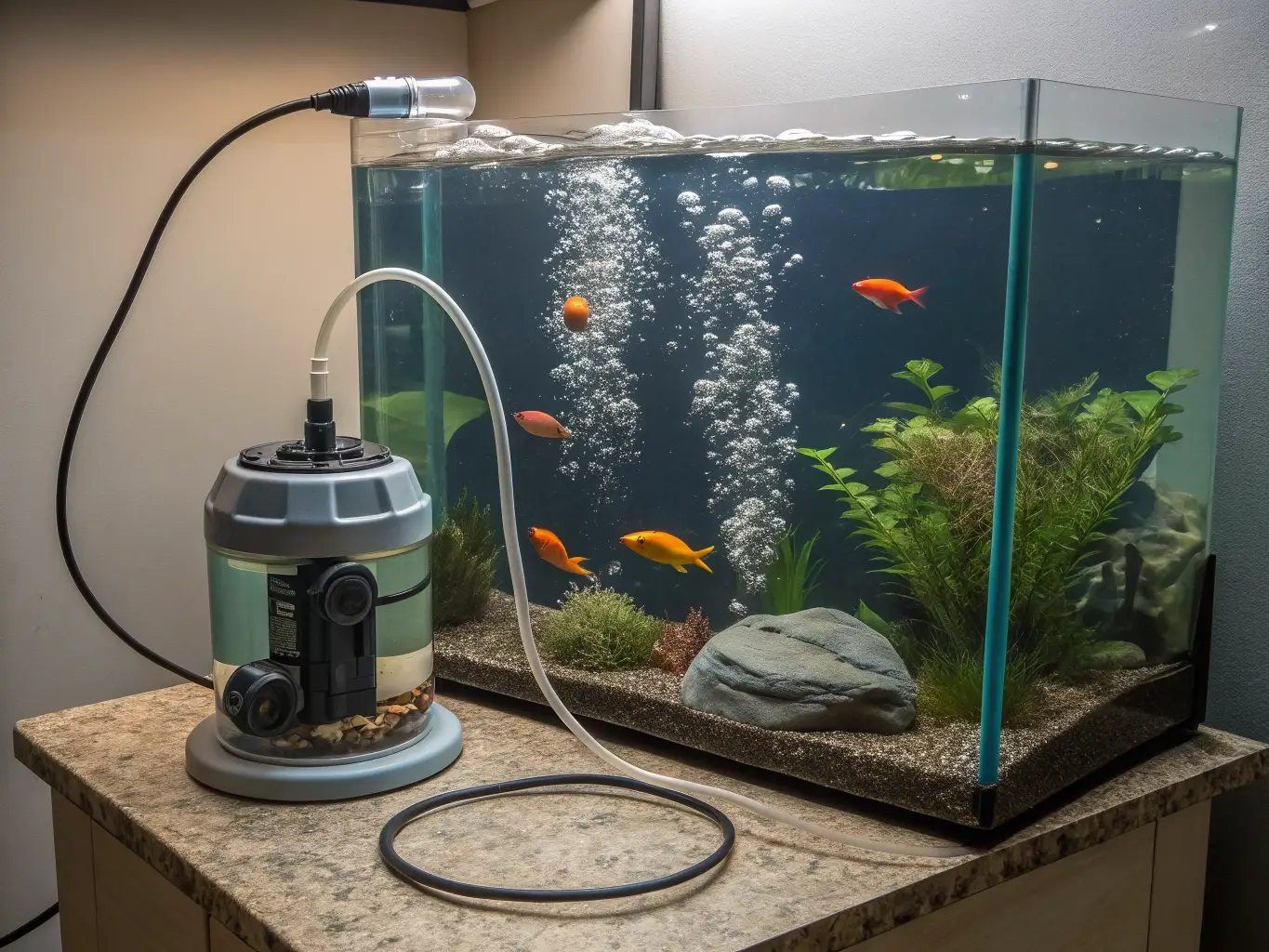
An aquarium air pump is an electrically powered device that draws atmospheric air from outside the tank and forces it through airline tubing into the water via an airstone, sponge filter, bubble wall, or other air-driven equipment. The pump sits outside the tank and is the engine; the airstone or filter is the delivery point.[1]
Unlike a canister filter or hang-on-back filter, an air pump does not move large volumes of water mechanically. Instead, it creates a gentle, continuous stream of rising bubbles that serve two critical biological functions: surface agitation for gas exchange and mechanical movement of air-powered filtration equipment.[2]
Related Guides on AquariumsWorld.com
- Fish Aquarium Types and Setup Guide — choosing the right tank for your air pump setup
- Fish Aquarium Problems and Solutions — oxygen depletion, cloudy water and equipment failures
- 100 Gallon Fish Tank Guide — large tank aeration requirements
2. How Aquarium Air Pumps Work | The Science of Aeration
Understanding the science of aquarium aeration helps you make better equipment choices. At its core, an air pump contains either a diaphragm motor or, in newer models, a piezoelectric transducer. In a diaphragm pump, an electromagnetic coil vibrates a rubber membrane rapidly, creating pressure pulses that push air through the outlet valve. Piezoelectric pumps use an electric current applied to a ceramic disc to create the same oscillation but with no moving gears, making them nearly silent.[4]
Surface Agitation and the Gas Exchange Process
Research published in the Journal of Aquaculture and Fish Health confirms that dissolved oxygen levels in fish-holding systems are primarily governed by the rate of surface gas exchange, not by direct bubble dissolution.[5] The Henry’s Law relationship between atmospheric partial pressure and dissolved gas concentration means that water equilibrates with air primarily at the surface interface. When your air pump breaks that surface with rising bubbles, it dramatically increases the effective surface area available for gas exchange.[6]
According to Timmons et al. (2002), a recirculating aquaculture system requires dissolved oxygen above 6 mg/L for most tropical fish species. Below 4 mg/L, fish begin showing stress responses including reduced feeding, immune suppression, and increased susceptibility to pathogens.[7] If you have ever used our Aquarium Ammonia Toxicity Calculator, you will know that low oxygen and high ammonia are the two fastest killers in any tank.
Backpressure and Tank Depth
Water exerts approximately 0.43 PSI of pressure per foot of depth. A standard 24-inch deep aquarium therefore requires an air pump capable of overcoming at least 0.86 PSI of backpressure before a single bubble emerges from the airstone. A pump rated for a 10-gallon tank will often fail silently in a deep 100-gallon tank. The diaphragm strains, output drops, and your fish suffer without any visible warning.[8]
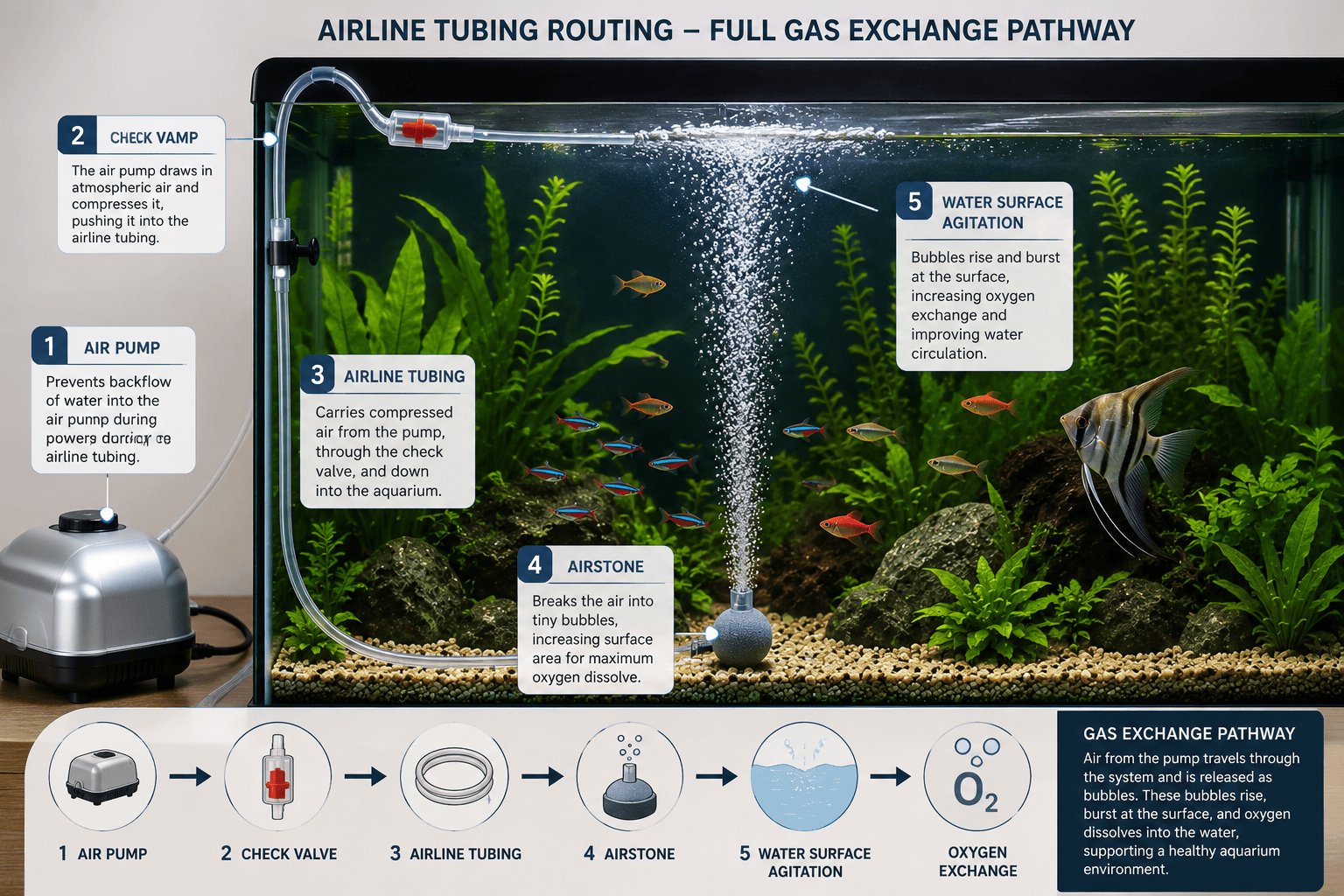
For large aquariums such as a 100-gallon setup, tank depth is a critical factor when choosing your pump. See our complete 100 Gallon Fish Tank guide for full equipment sizing and our 100 Gallon Setup Calculator to plan your entire filtration and aeration system in one go.
3. Do Fish Really Need an Air Pump
This is one of the most searched questions in the fishkeeping hobby. The straightforward answer is that fish do not need an air pump specifically. They need adequate dissolved oxygen. Whether you achieve that with an air pump, a surface-agitating hang-on-back filter, a powerhead, or dense plant growth is largely irrelevant to your fish.[9]
However, an aquarium air pump becomes essential in these specific situations:
- Sponge filter setups — sponge filters require continuous airflow to function at all
- Overstocked tanks — higher bioload consumes oxygen much faster than normal
- Goldfish tanks — goldfish have significantly higher oxygen demands than tropical fish
- Power outage emergencies — a battery-powered air pump can keep fish alive for hours
- Hospital or quarantine tanks — air-driven sponge filters prevent cross-contamination of your main tank’s beneficial bacteria
- Hot summer months — warmer water holds less dissolved oxygen; aeration becomes critical above 28°C
Check These Aquarium Calculators on AquariumsWorld.com
- Aquarium Ammonia Toxicity Calculator — see exactly how low oxygen raises toxic ammonia levels
- Tank Size and Stocking Calculator — check if your stocking level needs extra aeration
- Water Change Schedule Calculator — combine water changes with better aeration for a healthier tank
4. Types of Aquarium Air Pumps
Diaphragm Air Pumps
The most common type available. A rubber diaphragm vibrates via an electromagnetic coil, pushing air through an outlet valve. They are reliable, powerful and affordable but produce a characteristic low hum. Models like the Tetra Whisper series use rubber dome housings and feet to dampen vibration. These are the best choice for general community tanks, goldfish setups and sponge filtration systems.[1]
Piezoelectric Air Pumps
These use a ceramic disc that flexes when an electric current is applied, with no moving mechanical parts. The result is virtually silent operation. The Hygger Silent Mini Air Pump uses this technology, making it ideal for bedrooms, offices and nano tanks. Output is lower than diaphragm pumps but fully sufficient for tanks up to 15 gallons with a single outlet.[4]
Battery-Powered and USB Air Pumps
These run on AA batteries or 5V USB power. The AquaMiracle USB Air Pump and similar models are critical emergency backup devices. During a power outage, fish can die within 30 minutes in a heavily stocked tank if aeration fails, particularly in warm weather when dissolved oxygen saturation is already reduced.[11]
Dual-Outlet Air Pumps
These feature two independent outlets, often with individual flow control valves. The Hygger Adjustable Dual Outlet allows you to run a sponge filter on one outlet and an airstone on the other with independent pressure adjustment at each. These are essential for tanks above 55 gallons running multiple air-driven devices.[2]
5. Air Pump Size Chart by Tank Size and Depth
Use this aquarium air pump size chart to match your tank to the correct minimum pump rating. Values below are based on standard 16 to 21 inch depth tanks. For deeper tanks, move up one size category. You can also use our Aquarium Substrate Calculator to understand how substrate depth affects tank interior volume and the effective water column your pump must overcome.
| Tank Size | Volume in Litres | Min Flow Rate | Min Pressure | Outlets Needed | Recommended Pump |
|---|---|---|---|---|---|
| 5 Gallon | 19 L | 60 LPH | 0.6 PSI | 1 | Hygger Silent Mini |
| 10 Gallon | 38 L | 100 LPH | 0.7 PSI | 1 | Hygger Silent Mini |
| 20 Gallon | 76 L | 180 LPH | 0.8 PSI | 1 to 2 | Tetra Whisper 20 |
| 29 Gallon | 110 L | 260 LPH | 0.9 PSI | 1 to 2 | Tetra Whisper 40 |
| 40 Gallon | 151 L | 350 LPH | 1.0 PSI | 2 | Tetra Whisper 60 |
| 55 Gallon | 208 L | 480 LPH | 1.1 PSI | 2 | Tetra Whisper 100 |
| 75 Gallon | 284 L | 620 LPH | 1.2 PSI | 2 to 3 | Hygger Dual Outlet |
| 100 Gallon | 378 L | 800 LPH | 1.3 PSI | 2 to 4 | Hygger Dual Outlet |
| 125 Gallon | 473 L | 1000 LPH | 1.4 PSI | 3 to 4 | Active Aqua Commercial |
| 200 Gallon or Larger | 757 L or more | 1500 LPH minimum | 1.8 PSI minimum | 4 or more | Active Aqua Commercial |
Airline Tubing Size Reference Table
| Tubing Type | Inner Diameter | Best Use | Max Recommended Length |
|---|---|---|---|
| Standard Airline | 4 mm | Single airstone or sponge filter | 90 to 120 cm |
| Rigid Airline | 4 mm | Long runs, precise placement inside tank | Up to 200 cm |
| Silicone Tubing | 4 to 6 mm | High-pressure applications and deep tanks | Up to 250 cm |
| Reinforced Tubing | 6 mm | Commercial and very deep tanks over 30 inches | Up to 400 cm |
Planning a large 100-gallon or 125-gallon build? Our 100 Gallon Setup Calculator calculates filter GPH, stocking density, water change volume and equipment sizing all in one place.
6. Top Air Pump Recommendations by Category
| Category | Model | Best For | Key Feature | Noise Level |
|---|---|---|---|---|
| Best Overall Quiet | Hygger Silent Mini | Up to 15 gallons | Piezoelectric motor with no moving gears | Near silent |
| Best Budget Choice | Tetra Whisper Series | 10 to 100 gallons | Dome absorbs motor hum, rubber feet, highly reliable | Low hum |
| Best for Large Tanks | Hygger Dual Outlet | 20 to 100 gallons | Adjustable dual outlets with high backpressure rating | Moderate |
| Best Power Outage Backup | AquaMiracle USB Pump | Nano to 60 gallons | Runs on USB or 12V battery during outages | Very quiet |
| Best Marine Reef | Aqua Medic Mistral | Reef and marine tanks | High-pressure output, stable for deep sumps | Moderate |
| Best Commercial Grade | Active Aqua Commercial | 125 to 500 gallons | Multi-outlet manifold with very high LPH output | Audible |
7. How to Set Up an Aquarium Air Pump Step by Step
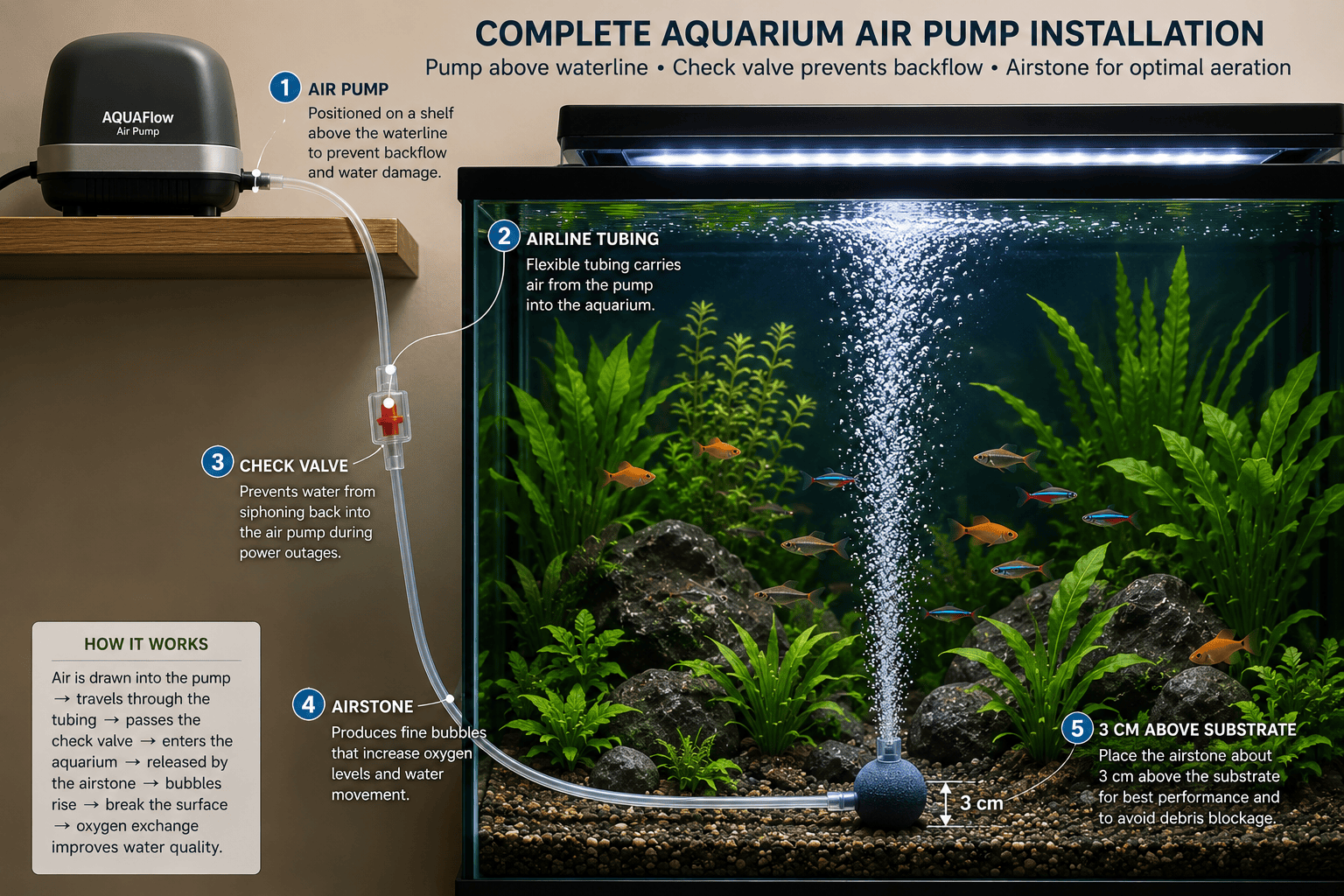
- Position the pump above the waterline whenever possible. This prevents back-siphoning naturally if the power cuts out and the check valve happens to fail.
- Cut the airline tubing to length and leave 10 to 15 cm of slack. Do not stretch it tightly over valves as it will crack and split over time.
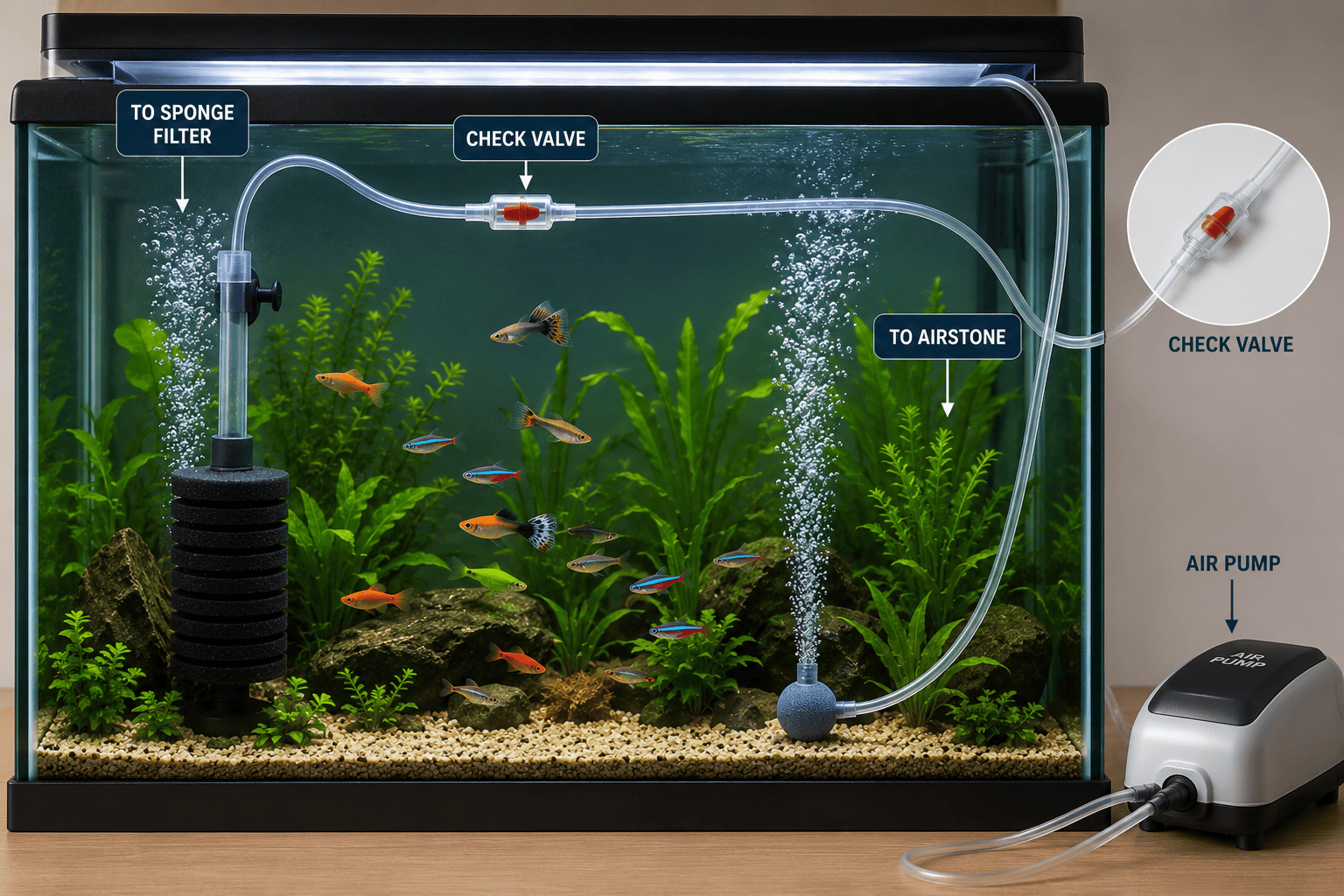
- Install a check valve in the airline between the pump and the tank. The arrow on the valve body must point toward the tank. This step is mandatory and explained fully in Section 8 below.
- Connect to your airstone or sponge filter. Push the tubing firmly 1 to 1.5 cm onto the barb fitting. It should not pull off without real effort.
- Secure the airline with suction cup clips on the inside glass. Keep the airstone 2 to 3 cm off the substrate for maximum bubble distribution and to prevent debris buildup around it.
- Place the pump on a foam pad or folded cloth on your stand. Never place it directly on bare wood or glass as vibration transfers and amplifies into a loud, constant hum.
- Plug in and observe. Bubbles should rise in a steady, even stream. Adjust flow using the pump’s dial or an inline gang valve. Never restrict airline flow by bending or kinking the tubing as this overworks the diaphragm and shortens the pump’s life significantly.
More Setup Help on AquariumsWorld.com
- Fish Aquarium Types and Setup Guide — complete beginner setup walkthrough including equipment positioning
- Soil in Fish Tank Guide — substrate depth affects how far your airline must reach; use our Substrate Depth Calculator to plan depth precisely
- Fish Aquarium Problems and Solutions — equipment failure troubleshooting section
8. Why a Check Valve Is Mandatory for Every Air Pump Setup
A check valve, also called a one-way valve, is a small inline device that allows air to flow in one direction only — from pump to tank. It is the single most underrated piece of equipment in the entire hobby, and failing to install one can destroy your air pump within hours of a power cut.[12]
When power fails, the water pressure inside the tank drives water backward through the airline tubing by the process of back-siphoning. Without a check valve, this water enters the pump diaphragm housing, shorts the electrical components, and the pump is permanently destroyed. In severe cases it creates a water flood on your aquarium stand. A check valve costs less than two dollars and prevents all of this entirely.
Check Valve Size Reference Table
| Tubing Size | Check Valve Type | Rated Pressure | Notes |
|---|---|---|---|
| Standard 4 mm airline | Standard inline barb valve | Up to 2 PSI | Suitable for most home aquariums up to 100 gallons |
| 6 mm silicone tubing | Heavy-duty inline valve | Up to 5 PSI | For deep tanks and commercial setups |
| Any diameter | Spring-loaded check valve | Up to 8 PSI | Best choice for power outage backup systems |
Check valve failures account for a significant portion of the pump-related problems we cover in our Fish Aquarium Problems and Solutions guide. You can also run our Ammonia Toxicity Calculator to understand what happens to your water chemistry when a pump fails overnight and oxygen levels crash.
9. How to Make Your Air Pump Completely Silent
One of the most common complaints in the hobby is air pump noise. The good news is that most pump noise is not from the pump mechanism itself. It is from vibration transfer to the hard surface the pump rests on.[13]
Five Proven Noise Reduction Methods
- Place a foam pad under the pump. A 2 cm thick piece of soft foam or a computer mouse pad reduces vibration transfer by approximately 70 percent. This is the single most effective change you can make without spending any money.
- Hang the pump from a hook. Suspend it using its power cable or a small hook through its handle bracket. A suspended pump has nothing to vibrate against and becomes dramatically quieter.
- Enclose it in a small fabric bag. A drawstring bag around the pump body absorbs housing resonance without blocking the air inlet at the bottom of the unit.
- Switch to silicone tubing instead of rigid plastic airline. Silicone is more flexible, reduces transmitted vibration along the tubing run, and seals far better onto barb fittings.
- Upgrade to a piezoelectric pump. If noise remains a problem after all the above steps, the Hygger Silent Mini or any equivalent piezoelectric model eliminates mechanical vibration entirely at the source.
Noise from equipment is a recurring theme in our complete Fish Aquarium Problems and Solutions post, which covers vibration, filter hum, and other equipment issues with practical fixes for each one.
10. Air Pumps and Sponge Filters | The Perfect Pairing
A sponge filter powered by an air pump: the gold standard for biological filtration in breeding tanks, fry setups, quarantine tanks and betta aquariums.The combination of an air pump and sponge filter is one of the most beloved setups in the entire fishkeeping hobby, and for very good reason. The sponge provides both mechanical filtration by trapping particles as water draws through the foam, and biological filtration as beneficial bacteria colonise the enormous surface area inside the sponge pores. The air pump is simply the motor that draws water through the media.[14]
Why Sponge Filters Are the Best Choice for These Specific Setups
- Breeding tanks: No risk of fry being sucked into an impeller. Sponge filters are gentle enough for newly hatched fish of any species.
- Shrimp tanks: Cherry shrimp, crystal shrimp and Caridina species are completely safe from impeller damage with a sponge filter running.
- Quarantine tanks: A sponge filter pre-seeded in your main tank can be quickly moved to a hospital tank with a fully established bacteria colony, preventing new tank syndrome in emergencies. See our Problems and Solutions guide for our full quarantine tank protocol.
- Betta tanks: Bettas dislike strong water current. A sponge filter produces the gentlest possible flow while still providing excellent biological filtration.
- Goldfish and Oranda tanks: Sponge filters handle the high bioload of goldfish efficiently while keeping the gentle flow environment that fancy varieties like Orandas prefer. Read our detailed Oranda Goldfish Care Guide for full filter and aeration recommendations specific to this species, and try our Oranda Goldfish Health Calculator to check your fish health alongside your aeration setup.
11. Air Pump for Power Outage Backup | Keeping Fish Alive
In a power outage your aquarium faces three threats in order of urgency: oxygen depletion within minutes to hours, temperature drop over several hours, and filter bacteria die-off over days. A battery-powered air pump for power outage backup addresses the most immediate and lethal threat first.[11]
Research on dissolved oxygen depletion rates shows that a heavily stocked 55-gallon tank at 26°C with no aeration can drop below the critical 4 mg/L threshold within 20 to 45 minutes, depending on bioload and water temperature.[7] Warmer water holds less oxygen and fish respire faster — a dangerous combination during summer power cuts. Use our Ammonia Toxicity Calculator to model what your water chemistry will look like after an extended outage with no aeration running.
Battery-Powered Air Pump Setup Reference Table
| Tank Size | Backup Power Type | Runtime at Full Charge | Recommended Model |
|---|---|---|---|
| Up to 20 gallon | 4× AA Battery pack | 8 to 12 hours | AquaMiracle Battery Pump |
| 20 to 60 gallon | USB Power Bank 20,000 mAh | 16 to 24 hours | Uniclife USB Air Pump |
| 60 to 120 gallon | 12V DC car battery | 36 to 72 hours | Active Aqua 12V Pump |
| 120 gallon or larger | UPS uninterruptible supply | 2 to 4 hours full system | APC Back-UPS 600VA |
12. Air Pumps in Planted Tanks | When to Run and When to Switch Off
The relationship between air pumps and planted aquariums is more nuanced than most guides acknowledge. Live plants produce oxygen during the day through photosynthesis and consume it at night through respiration — the opposite cycle to your fish.[10]
A heavily planted tank during peak photoperiod can achieve dissolved oxygen supersaturation above 10 to 12 mg/L without any air pump at all. Running a pump at this point wastes electricity and drives off the CO2 your plants need for photosynthesis. However, during the dark period plants switch to consuming oxygen, and a lightly planted tank with a moderate fish load can see dangerous dissolved oxygen drops overnight without aeration running.[15]
For the full science on planted aquarium substrates, soil depth and CO2 interaction, read our detailed Soil in Fish Tank guide and use the Substrate Depth and Weight Calculator to plan your planted tank bed correctly before setting up your aeration schedule.
Recommended Air Pump Schedule for Planted Tanks
| Plant Density | During Light Period | During Dark Period | With CO2 Injection |
|---|---|---|---|
| Lightly planted | Run the pump | Run the pump | No change required |
| Moderately planted | Optional — monitor DO levels | Run the pump | Reduce CO2 at night |
| Heavily planted with CO2 | Stop pump entirely — CO2 will be stripped off | Run pump — critical for fish safety | Use a timer: CO2 off one hour before lights out |
| Dutch or Nature Aquarium style | No pump needed — plants provide all oxygen | Run pump — this period is critical | CO2 on timer only during light period |
Related Planted Tank Resources on AquariumsWorld.com
- Soil in Fish Tank | Types, Problems and Plant Growth Guide — the Walstad method, substrate depth, and how substrate choice affects your oxygen balance
- Aquarium Substrate Depth and Weight Calculator — calculate exact substrate volume and depth for your planted tank
- Fish Aquarium Types and Setup Guide — how to choose between freshwater planted, reef and cichlid setups and what each demands from your air pump
13. Frequently Asked Questions
Can I run an aquarium without an air pump?
Yes, if your filter creates sufficient surface agitation and your tank is not overstocked. A hang-on-back filter with a waterfall return, or a canister filter with a spray bar positioned at the waterline, can provide adequate gas exchange without a separate air pump. However in warmer months or with higher fish loads, adding an air pump is inexpensive insurance that is well worth the cost. Check our Tank Size and Stocking Calculator to see whether your current stocking level demands additional aeration.
How deep should the airstone be in the tank?
Place the airstone 2 to 5 cm off the substrate. Placing it directly on the substrate allows mulm and debris to accumulate around it, reducing output and creating anaerobic dead spots. Positioning it too high in the water column shortens the distance bubbles travel and reduces the gas exchange benefit of each rising bubble column.
Why is my air pump pushing no air?
The three most common causes are a kinked airline (check the entire run from pump to airstone), a clogged airstone (soak in white vinegar and rinse thoroughly), or a worn diaphragm (most pumps include a spare diaphragm in the box). If none of these fix the issue, the check valve may have failed in the closed position. Remove it temporarily to test whether airflow resumes. See our full equipment troubleshooting section in the Fish Aquarium Problems and Solutions guide.
Can I use one air pump for multiple tanks?
Yes. Use a gang valve manifold to split one pump’s output across multiple tanks. Make sure the pump’s total LPH rating exceeds the combined requirements of all outlets. Each individual airline line must have its own check valve installed before entering each separate tank to prevent cross-contamination of water between tanks.
What size air pump do I need for a 100-gallon tank?
A 100-gallon aquarium needs a minimum of 800 LPH output and 1.3 PSI pressure rating for a standard 21-inch depth. The Hygger Dual Outlet is the minimum practical recommendation. For deep tanks or heavy goldfish stocking, use the Active Aqua Commercial series. Our 100 Gallon Setup Calculator will calculate your complete equipment list including air pump requirements alongside filter GPH, stocking numbers and water change volumes.
Is a sponge filter or power filter better for aeration?
A power filter with surface agitation is more efficient for oxygenation of larger tanks in terms of total gas exchange. A sponge filter powered by an air pump provides gentler flow ideal for bettas, fry and shrimp, with the added benefit of zero impeller risk. Many experienced hobbyists run both a power filter for mechanical filtration and a sponge filter on an air pump for supplemental biological filtration and aeration. For species-specific filtration advice, see our Oranda Goldfish Care Guide and use the Oranda Health Check Calculator to monitor how your filtration and aeration choices affect your fish’s condition.
What is the difference between an airstone and a diffuser?
An airstone is a porous ceramic or mineral stone that breaks the airline airflow into fine bubbles. A diffuser is typically a flat disc or inline device made from fine membrane material that produces micro-bubbles significantly smaller than a standard airstone. Micro-bubble diffusers have a higher surface-area-to-volume ratio and produce more efficient gas exchange per litre of air pumped, but they require higher pump pressure to operate effectively and clog faster in hard water areas.
Fish Tank Setup Guide Problems and Solutions Guide Ammonia Calculator 100 Gallon Tank Guide
Scientific References
- Boyd, C.E. and Tucker, C.S. (1998). Pond Aquaculture Water Quality Management. Kluwer Academic Publishers, Boston. https://doi.org/10.1007/978-1-4615-5407-3
- Timmons, M.B., Ebeling, J.M., Wheaton, F.W., Summerfelt, S.T. and Vinci, B.J. (2002). Recirculating Aquaculture Systems. Northeastern Regional Aquaculture Center, NRAC Publication No. 01-002. Cayuga Aqua Ventures, Ithaca, NY.
- Colt, J. (1984). Computation of Dissolved Gas Concentrations in Water as Functions of Temperature, Salinity, and Pressure. American Fisheries Society Special Publication 14, Bethesda, MD.
- Summerfelt, S.T. and Penne, C.R. (2005). Solids removal in a recirculating aquaculture system where the majority of flow bypasses the microscreen filter. Aquacultural Engineering, 33(4), 214 to 224. https://doi.org/10.1016/j.aquaeng.2005.02.001
- Amin, M., Agustono, Ali, M. and Hum, N.N.M.F. (2022). Apparent nutrient utilization and metabolic growth rate of Nile tilapia cultured in recirculating aquaculture and biofloc systems. Open Agriculture, 7(1), 445 to 454. https://doi.org/10.1515/opag-2022-0109
- Yang, K., Fan, Q., Zhang, L. et al. (2015). Effect of dissolved oxygen levels on growth performance, energy budget and antioxidant responses of yellow catfish, Pelteobagrus fulvidraco. Aquaculture Research, 46(8), 2025 to 2033. https://doi.org/10.1111/are.12359
- Davis, J.C. (1975). Minimal dissolved oxygen requirements of aquatic life with emphasis on Canadian species. Journal of the Fisheries Research Board of Canada, 32(12), 2295 to 2332. https://doi.org/10.1139/f75-268
- Chen, S., Stechey, D. and Malone, R.F. (1994). Suspended Solids Control in Recirculating Aquaculture Systems. In: Timmons, M.B. and Losordo, T.M. (Eds.) Aquaculture Water Reuse Systems: Engineering Design and Management. Elsevier, Amsterdam. pp. 61 to 100.
- Boyd, C.E. and McNevin, A.A. (2021). Aquaculture, Resource Use, and the Environment. John Wiley and Sons. https://doi.org/10.1002/9781118857915
- Walstad, D.L. (1999). Ecology of the Planted Aquarium. Echinodorus Publishing, Chapel Hill, NC.
- Boyd, C.E., Hanson, T.R. and Hulse-Kemp, A.M. (2018). Dissolved oxygen management in aquaculture ponds. Global Aquaculture Advocate, 21(3), 56 to 59.
- Losordo, T.M., Masser, M.P. and Rakocy, J. (1999). Recirculating aquaculture tank production systems: a review of component options. SRAC Publication No. 453. Southern Regional Aquaculture Center, Mississippi.
- Summerfelt, R.C. and Piper, R.G. (1984). Fish hatchery management. American Fisheries Society, Bethesda, Maryland.
- Drenner, R.W. and Hambright, K.D. (2002). Piscivores, trophic cascades, and lake management. TheScientificWorld, 2, 284 to 307. https://doi.org/10.1100/tsw.2002.107
- Ramesh, P., Jasmin, A., Tanveer, M. et al. (2024). Optimizing aeration efficiency and forecasting dissolved oxygen in brackish water aquaculture: insights from paddle wheel aerators. Aquacultural Engineering, 106, 102399. https://doi.org/10.1016/j.aquaeng.2024.102399