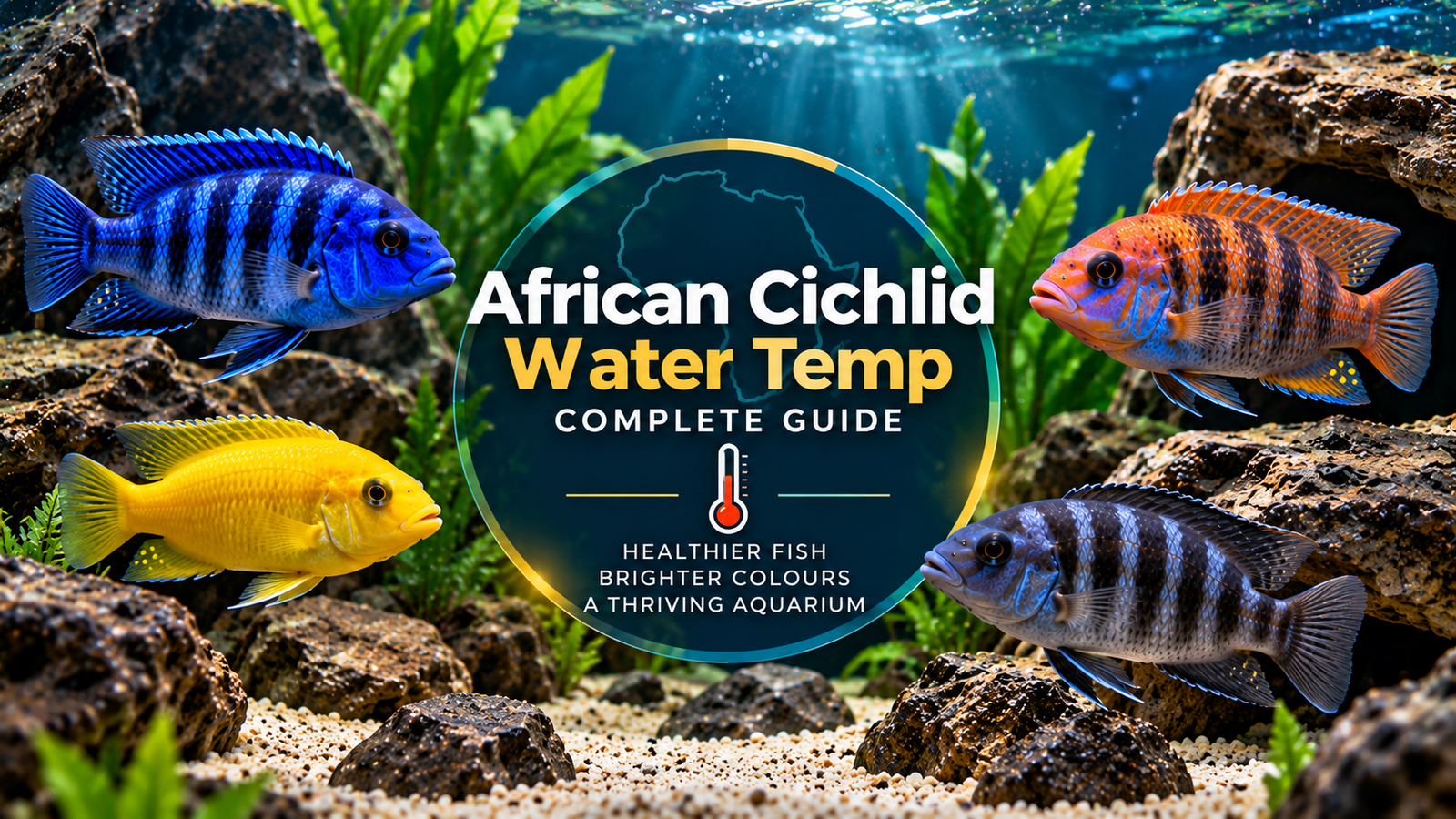
African cichlids generally need warm, stable water, with many commonly kept species doing well around 75 to 82°F (24 to 28°C). The exact target depends on the lake of origin, species, season, room temperature and the rest of the aquarium environment. For a home aquarium, stability is more useful than chasing a single perfect number. A reliable thermometer, correctly sized heater and sensible water-change routine usually matter more than moving the thermostat by one degree.
African cichlids are ectothermic, so the surrounding water influences their metabolic rate, activity, digestion, oxygen demand and immune function. McDonnell and Chapman (2015) showed that thermal conditions affect resting metabolism, hypoxia tolerance and upper critical thermal limits in an African cichlid. Broader teleost research also shows that temperature changes can alter immune responses. This is why temperature should be treated as part of the fish’s biological environment rather than simply an equipment setting.
The practical target for a mixed African cichlid aquarium is often about 77 to 79°F (25 to 26°C), provided the individual species have compatible requirements. A Malawi-focused tank can sit toward the upper part of that range, while some Tanganyika systems are better kept slightly cooler. Before adjusting a tank, identify the fish rather than relying on the label ‘African cichlid’, because the continent contains many species with different ecological histories.
African Cichlid Water Temperature by Lake
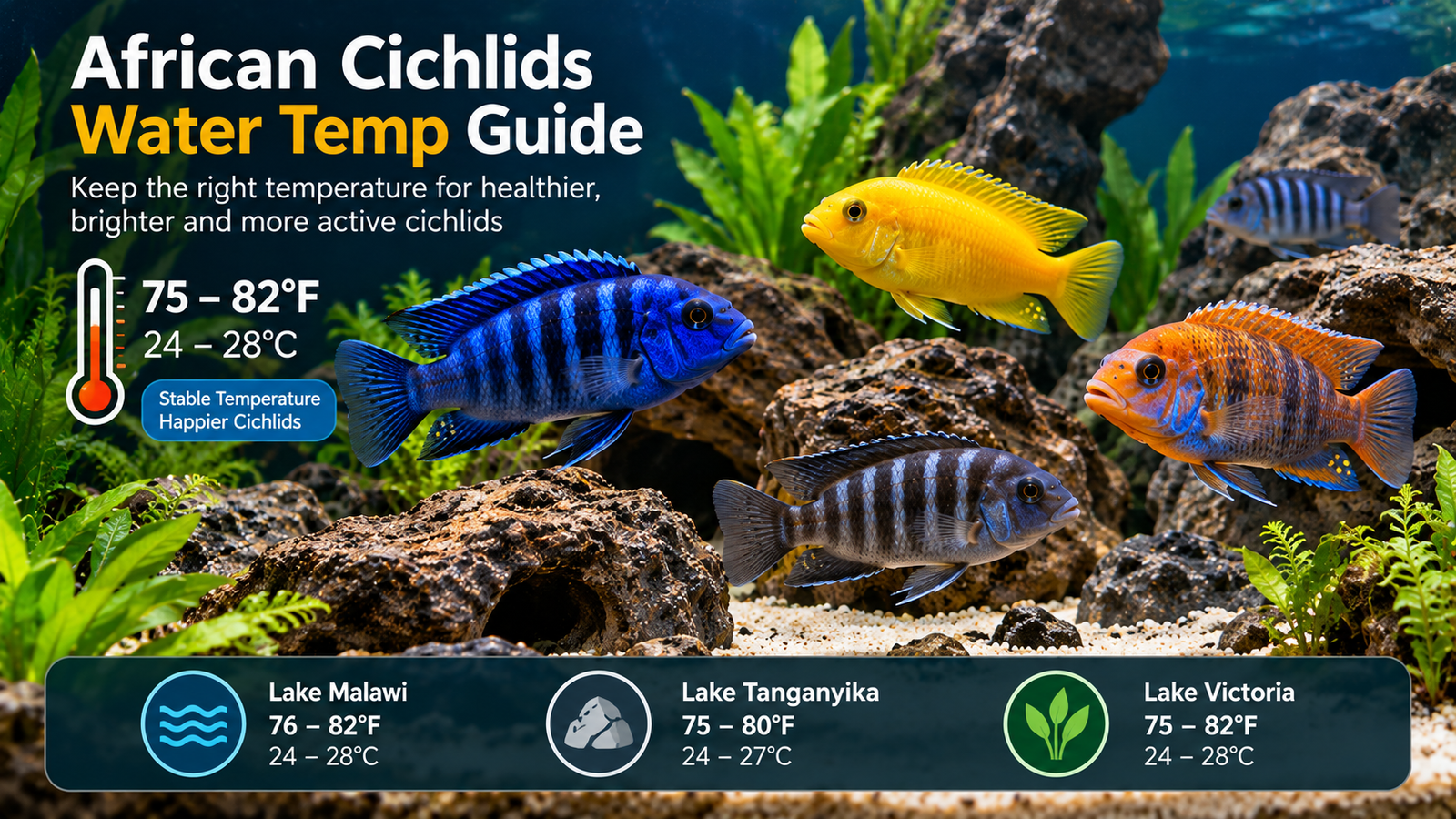
The three major African Rift Lakes represented in the aquarium trade are Malawi, Tanganyika and Victoria. They are not interchangeable habitats. Their chemistry, depth, food webs, shorelines and fish communities differ, so a useful temperature guide should begin with the lake rather than treating every cichlid as one group.
Lake Malawi cichlids are commonly maintained around 76 to 82°F (24 to 28°C), with about 78°F (25.5°C) serving as a practical middle target for many community aquariums. Malawi systems are usually alkaline and hard, so temperature should be managed alongside pH, carbonate buffering and mineral content. A stable 78°F is generally more useful than repeatedly shifting between the ends of the acceptable range.
Lake Tanganyika cichlids are commonly maintained around 76 to 80°F (24 to 27°C). A practical target of 77 to 78°F (25 to 25.5°C) works for many aquariums, particularly when the tank contains species with similar thermal requirements. Tanganyika setups also need attention to alkaline, mineral-rich water. Temperature alone cannot reproduce the lake environment, and a perfect thermometer reading cannot compensate for poor water quality or inappropriate stocking.
Lake Victoria cichlids are often maintained around 75 to 79°F (24 to 26°C). A target near 77°F (25°C) is a practical starting point for many systems, although species-level guidance should take priority. Victoria aquariums should be planned around the actual fish being kept, because the broad label ‘Victorian cichlid’ covers a diverse group.
The following comparison is useful as a starting framework, not as a substitute for species-specific care information.
| Lake | Practical Aquarium Range | Useful Middle Target | Common pH Context | Hardness Context |
|---|---|---|---|---|
| Lake Malawi | 76 to 82°F / 24 to 28°C | 78°F / 25.5°C | 7.8 to 8.6 | Hard, mineral-rich |
| Lake Tanganyika | 76 to 80°F / 24 to 27°C | 77 to 78°F / 25 to 25.5°C | 7.8 to 9.0 | Hard, mineral-rich |
| Lake Victoria | 75 to 79°F / 24 to 26°C | 77°F / 25°C | 7.8 to 8.6 | Moderate to hard |
What Temperature Do Mbuna Cichlids Need
Mbuna are rock-associated cichlids from Lake Malawi, and their temperature requirements therefore sit broadly within the Malawi range. A sensible maintenance target is 76 to 82°F (24 to 28°C), with 77 to 79°F (25 to 26°C) being a practical range for many home aquariums. The exact temperature should not be used as a behavioural control. Aggression is influenced much more strongly by stocking, territory, sex ratio, aquascape and species compatibility.
If a Mbuna tank is consistently warmer than intended, do not assume that lowering the temperature will solve territorial aggression. First examine whether there are too few hiding places, too much open territory, incompatible species or an unbalanced male-to-female ratio. Temperature should remain within the fish’s appropriate range while the social and environmental causes are addressed.
Can African Cichlids Live in Cold Water
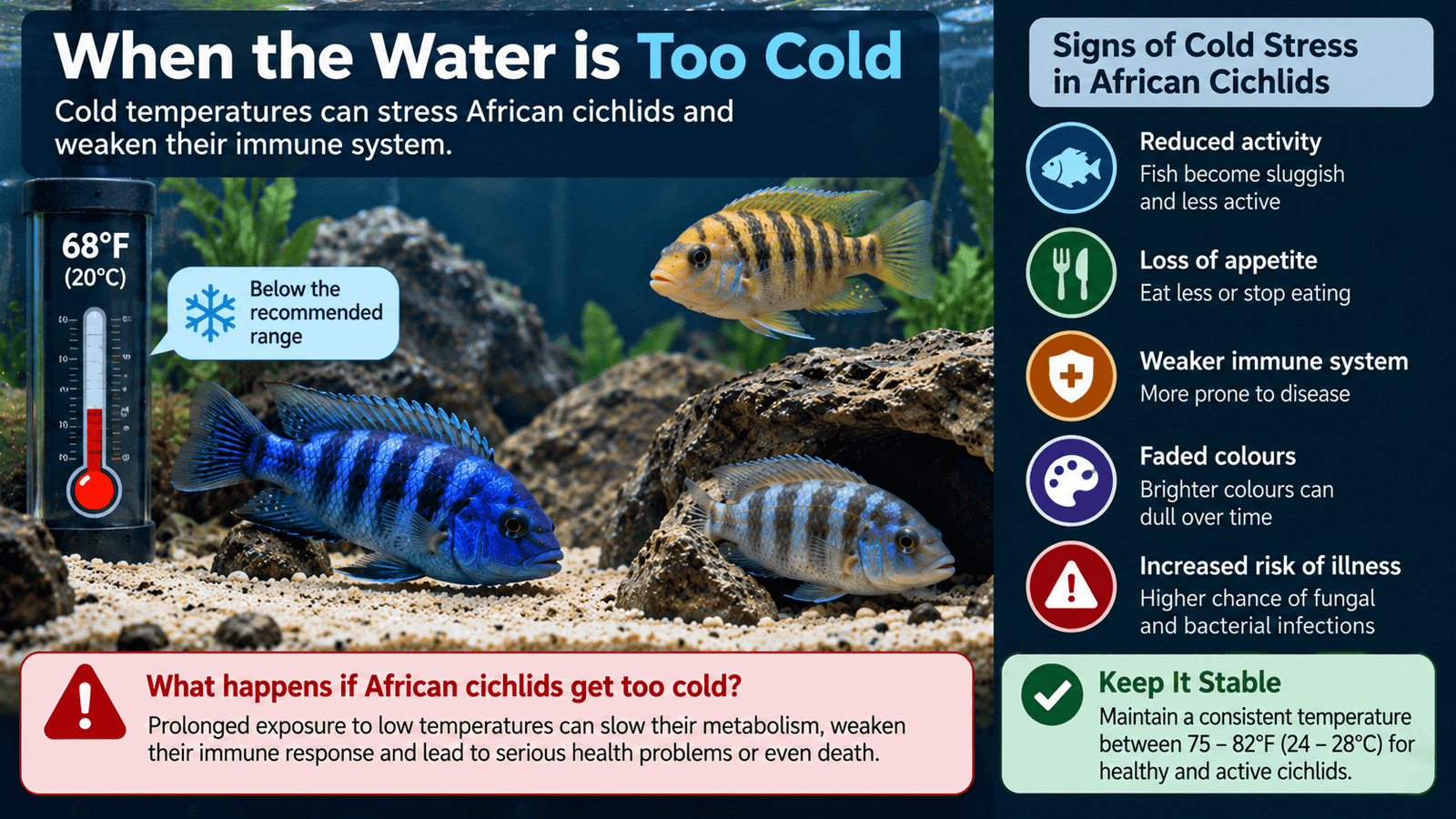
African Rift Lake cichlids are tropical fish and should not be deliberately kept in cold water. A brief temperature dip caused by a heater failure is different from deliberately running a tank below its normal range. The immediate response to a cold event should be measured, gradual correction and close observation rather than a sudden temperature shock.
As water becomes colder, fish metabolism and physiological processes change. Abram, Dixon and Katzenback (2017) reviewed the effects of low temperature on teleost immunity and described temperature as an important regulator of immune function. Scharsack et al. (2022) likewise reviewed temperature effects on teleost immunity in the context of environmental change. These studies support the broader principle that prolonged unsuitable temperature can make fish more vulnerable to physiological stress.
There is no single universal temperature at which every African cichlid suddenly becomes ill. Species, acclimation history, exposure duration and other water conditions all matter. Therefore, avoid publishing a simplistic fatal threshold as if it applied equally to every species. If a tank falls below its normal target, restore the intended temperature gradually and investigate why the heater or room conditions changed.
What Happens If African Cichlids Get Too Cold
Cold stress can first appear as reduced activity, slower feeding and unusual hiding. If the problem persists, the fish may become less responsive and more susceptible to secondary health problems. These signs are not temperature-specific, so water testing should accompany visual observation.
Temperature interacts with oxygen availability, metabolism and immune activity. A cold aquarium may therefore produce a different physiological challenge from an overheated aquarium, even though both are stressful. Do not diagnose disease from temperature alone. Check ammonia, nitrite, nitrate, pH, oxygenation and recent maintenance history before deciding that temperature is the only cause.
If the heater fails, use a second thermometer to confirm the reading before making changes. Correct the equipment problem, increase room-level warmth safely and raise aquarium temperature gradually. Avoid pouring hot water directly into the aquarium because rapid local changes can injure fish and create unstable conditions.
What Temperature Is Too Hot for African Cichlids
The danger of excessive heat is not simply that the fish feel warmer. As temperature rises, metabolic demand can increase while the capacity of water to hold dissolved oxygen decreases. McDonnell and Chapman (2015) demonstrated the importance of temperature for metabolic rate, hypoxia tolerance and upper critical thermal limits in an African cichlid. This makes overheating particularly concerning in heavily stocked tanks or aquariums with weak surface movement.
For most African cichlid aquariums, sustained temperatures in the mid to upper 80s°F should be treated as a warning condition rather than a normal target. The precise tolerance varies by species and acclimation history, so it is safer to focus on the direction of change, duration and fish behaviour than to claim that one number is universally lethal.
During a heat event, increase surface agitation, reduce unnecessary lighting and move the aquarium away from direct sunlight. A fan across the water surface can promote evaporative cooling. If water replacement is necessary, use conditioned water that is sensibly cooler than the aquarium rather than creating an abrupt temperature shock. For repeated summer problems, a temperature controller or aquarium chiller may be more reliable than emergency cooling every afternoon.
How to Lower Cichlid Tank Temperature in Summer
Start with the room, because a tank exposed to sunlight or a hot wall can gain heat faster than a small fan can remove it. Close blinds during the hottest part of the day, move portable heat sources away from the aquarium and check whether the aquarium light is adding unnecessary heat. Shortening the photoperiod temporarily can also reduce heat input while protecting fish from prolonged darkness.
A clip-on fan aimed across the water surface is a simple cooling method because evaporation removes heat. The trade-off is faster evaporation, so the keeper must replace evaporated water with appropriately conditioned water. Never top off an aquarium with saltwater in a freshwater tank, and never assume evaporated marine water should be replaced with additional saltwater without considering salinity.
For large aquariums or climates with repeated heat waves, a purpose-built aquarium chiller offers better control. Whatever method is used, monitor temperature with an independent thermometer and avoid rapid swings. Cooling is successful when the fish remain within their normal range, not when the water becomes as cold as possible.
How to Raise Cichlid Tank Temperature
Use an adjustable aquarium heater with a thermostat rather than a fixed heater. Place the heater where water movement distributes warmed water throughout the aquarium, and position the thermometer far enough away to measure the general tank temperature rather than the warmest local pocket.
If the aquarium is only slightly below target, make a modest thermostat adjustment and allow the system time to respond. Large, sudden changes are unnecessary when the fish are otherwise stable. If the temperature has fallen because of a heater failure, confirm the replacement heater is suitable for the tank volume and room conditions before leaving it unattended.
Never use boiling water, household heating elements or improvised devices in the aquarium. These approaches can create dangerous local temperature gradients, electrical hazards or burns. A second thermometer is inexpensive insurance because heater thermostats can drift or fail.
Do African Cichlids Need a Heater
In most indoor aquariums, yes. African cichlids are maintained as tropical fish, and many homes experience room temperatures below the range needed for consistent aquarium conditions. A heater provides controlled heat when the room is cooler, while a separate thermometer confirms whether the system is actually maintaining the target.
Choose wattage according to aquarium volume, room temperature and the temperature difference the heater must overcome. Bigger is not automatically safer. An oversized heater can create a greater risk if its thermostat sticks on, while an undersized heater may run continuously and still fail to maintain temperature. For large aquariums, two appropriately sized heaters can provide useful redundancy.
Place heaters where they receive good water movement, protect them from direct contact with substrate or hardscape where possible, and allow the unit to cool before removing it from water. Always follow the manufacturer’s installation requirements. Heater guards can be useful in active cichlid aquariums where fish or décor may strike equipment.
| Tank Size | Typical Heater Starting Range | Practical Approach |
|---|---|---|
| 20 gallon | 50 to 100 W | One adjustable heater in a moderate room |
| 40 gallon | 100 to 150 W | Verify against room temperature and manufacturer guidance |
| 55 gallon | 150 to 200 W | Independent thermometer strongly recommended |
| 75 gallon | 200 to 250 W | One large or two smaller heaters for redundancy |
| 100 gallon+ | 250 to 400 W total | Consider two heaters and independent monitoring |
Why Temperature Stability Matters More Than the Exact Number
Aquarists often focus on whether the thermometer reads 77, 78 or 79°F. That attention can miss the larger issue. A fish living at a stable 77°F may be better off than a fish repeatedly exposed to 74°F in the morning, 81°F in the afternoon and another fluctuation after a water change. The goal is a predictable environment that stays within the appropriate species range.
Rift Lake cichlids evolved in large aquatic environments where individual aquarium conditions are not reproduced by a thermostat alone. Inchaurregui et al. (2025) examined thermal responses in cichlid fish and reinforces the importance of understanding species responses to thermal challenge. The practical lesson is simple: reduce unnecessary temperature swings and respond to genuine deviations instead of constantly adjusting the thermostat.
Daily monitoring is especially useful during seasonal changes. Record the morning temperature for a week when you first establish a tank, then check whether the reading remains consistent across the day. If the range is wider than expected, investigate room temperature, heater placement, filter circulation, lighting and water-change practices.
How to Maintain a Stable Temperature in Your Cichlid Tank
Position the aquarium away from direct sunlight, strong drafts, exterior doors and heating or cooling vents. Keep the tank covered where appropriate to reduce evaporation and heat exchange, while still allowing safe gas exchange through the filter outlet or other surface movement.
Use a separate digital thermometer rather than relying only on the heater’s display. During water changes, prepare replacement water in advance and bring it close to the aquarium temperature before adding it. Large tanks are easier to temperature-match when replacement water is mixed in a container rather than taken directly from a cold tap.
Keep a simple maintenance record showing temperature, water-change date, heater setting and unusual events. If fish suddenly become lethargic or begin gasping, this record can reveal whether a temperature event occurred. Stable temperature management is part of a wider maintenance system that includes filtration, oxygenation, cycling and regular testing.
Mixed African Cichlid Tank Temperature
Mixed African cichlid aquariums require more planning than species-focused tanks because the keeper must satisfy multiple ecological preferences simultaneously. Malawi and Tanganyika fish can sometimes be maintained around a shared middle temperature when their chemistry, size, diet and behaviour are also compatible. A target around 77 to 79°F (25 to 26°C) is a practical compromise for many such setups.
Temperature compatibility does not make every mixed tank suitable. A species can tolerate the temperature yet remain inappropriate because of aggression, adult size, diet or territory. Never use a shared temperature as the only compatibility test. Check pH, hardness, feeding behaviour and expected adult size before combining fish.
Avoid using the phrase ‘all African cichlids need the same water’. The Rift Lakes differ, and aquarium strains may have been bred in different conditions. Species-level information should override a broad regional rule whenever reliable care information is available.
Cichlid Breeding Temperature
Temperature can influence reproductive activity in fish, but it should not be treated as a universal spawning switch. Healthy cichlids require suitable nutrition, mature water quality, appropriate social structure, territory and species-specific conditions before temperature adjustments are meaningful.
For a breeding aquarium, keep the normal maintenance temperature stable rather than repeatedly increasing it to force spawning. If a species-specific breeding protocol recommends a small change, make that change gradually and monitor behaviour and water quality. A sudden increase also increases metabolic demand and can reduce oxygen availability, especially in crowded tanks.
After spawning, there is usually little benefit in leaving the aquarium artificially hot. Return to the normal maintenance range appropriate for the species. The best breeding strategy is to reproduce the overall environmental conditions associated with healthy adults rather than relying on temperature alone.
African Cichlid Full Water Parameter Guide
Temperature is only one component of a successful African cichlid aquarium. Ammonia and nitrite should remain at zero, nitrate should be controlled through maintenance, and pH and hardness should suit the fish being kept. A stable temperature cannot compensate for toxic nitrogen compounds or inappropriate water chemistry.
For Malawi and Tanganyika systems, alkaline and relatively mineral-rich water is commonly used. Victoria systems also tend to be alkaline, but species-level requirements vary. Avoid making large chemistry corrections just because a test differs by a small amount from a target table. Stability and gradual adjustment are generally preferable to repeated swings.
The most useful testing routine is consistent rather than excessive. Test new aquariums frequently while the nitrogen cycle establishes, then monitor established tanks according to stocking, feeding and maintenance history. Any unexplained change in fish behaviour should trigger a water-quality check before the keeper makes major temperature or stocking changes.
African Cichlid Tank Setup for Temperature Success
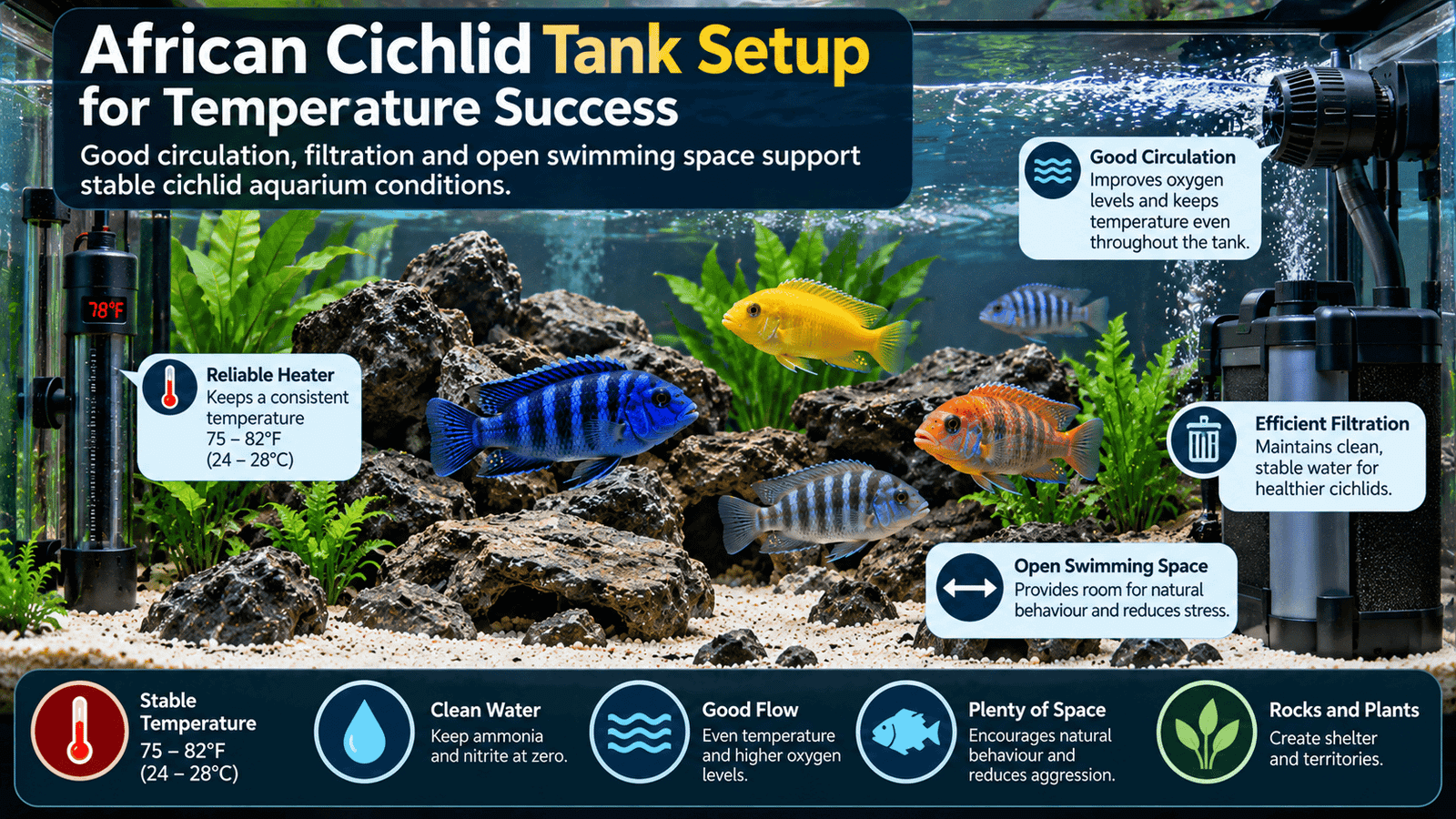
Tank design affects temperature because circulation determines how evenly heat spreads. The heater should not sit in a stagnant corner while the opposite side remains significantly cooler. Filter return flow, circulation pumps and sensible hardscape placement should create broad movement without producing exhausting currents for the fish.
African cichlids are often active, territorial fish, so equipment should be protected and securely installed. A heater guard can reduce impact risk, while external equipment should be positioned so maintenance is easy. Large tanks benefit from strong filtration and surface movement because warmer water can hold less dissolved oxygen.
Aquascaping also influences thermal consistency. Dense rock structures can create low-flow pockets, while excessive decoration can restrict circulation. Build caves and territories without blocking the main circulation path. The objective is not maximum flow everywhere but even distribution of heat and oxygen.
African Cichlid Filtration and Temperature
Filtration does not set temperature, but it strongly affects whether a warm aquarium remains physiologically comfortable. Biological filtration converts toxic nitrogen compounds, while water movement helps distribute heat and supports gas exchange. As temperature and fish activity rise, maintaining adequate oxygenation becomes increasingly important.
Canister filters are useful for larger cichlid systems because they provide substantial biological media capacity and mechanical filtration. Sponge filters can provide useful biological support and aeration, particularly in breeding or quarantine setups. Whatever filter type is chosen, maintain it without destroying the established biological community. Avoid replacing all biological media at once.
Surface agitation should be visible but not violent. An air pump and air stone can supplement gas exchange when the aquarium is heavily stocked or unusually warm. AquariumsWorld’s air-pump guide provides a useful equipment reference for planning aeration alongside temperature management.
African Cichlid Heater Wattage Guide
Heater wattage should be selected from the manufacturer’s guidance and the actual thermal load of the room. A rough aquarium hobby starting point is around 3 to 5 watts per gallon, but this is not a universal engineering rule. Insulation, room temperature, tank cover, ambient drafts and heater efficiency all change the required wattage.
For a 20 gallon aquarium, a 50 to 100 watt heater is commonly sufficient in a moderate room. A 40 gallon tank may need around 100 to 150 watts, while a 55 gallon tank may use around 150 to 200 watts. A 75 gallon system can use one larger heater or two smaller heaters, and 100 gallon or larger systems often benefit from redundant heating.
The safest choice is the one that maintains the target without running continuously or cycling excessively. Use the heater’s own instructions, verify the actual water temperature with an independent thermometer and inspect the equipment regularly. Wattage should never be treated as a substitute for temperature measurement.
Common Temperature Problems and Troubleshooting
A heater that never reaches the target may be undersized, incorrectly positioned, faulty or fighting an unusually cold room. A tank that repeatedly overshoots may have a defective thermostat, poor circulation around the sensor or a heater that is too powerful for the application. Always confirm the problem with a separate thermometer before replacing equipment.
If temperature changes immediately after a water change, measure both the replacement water and aquarium before the change. A large difference can create avoidable stress even when the new water is clean. Matching temperature does not need to be perfect to the decimal place, but the difference should be small enough that the aquarium changes gradually rather than abruptly.
If fish are gasping during a heat event, temperature may be contributing through lower dissolved oxygen, but do not assume it is the only cause. Increase surface agitation and test ammonia and nitrite immediately. If several fish deteriorate at once, investigate the entire water system rather than treating temperature as an isolated variable.
Temperature and Cichlid Behaviour
Temperature can influence activity because metabolism is temperature dependent, but behaviour is a poor thermometer by itself. A fish that is unusually inactive may be cold, stressed, ill, oxygen deprived or responding to poor water quality. Conversely, increased activity in warm water does not automatically mean the temperature is beneficial.
Observe behaviour alongside a measured temperature and water test results. Healthy fish should show normal feeding responses, species-appropriate activity and stable respiration. Persistent hiding, rapid breathing, loss of appetite or unusual swimming warrants a broader health assessment.
The same principle applies to aggression. Warmer water may increase activity in some fish, but it is not an appropriate method for managing social conflict. Territory, stocking and compatibility should be addressed first.
FAQ: African Cichlid Water Temperature
The questions below address the most common temperature searches and give concise answers while keeping the lake-specific differences clear.
Temperature advice should always be interpreted alongside species identity, aquarium conditions and duration of exposure. The ranges presented in this guide are practical husbandry ranges rather than guarantees that every individual species will have identical requirements.
Temperature by Fahrenheit and Celsius
Aquarists often switch between Fahrenheit and Celsius when comparing care sheets, especially when information comes from different countries. The conversion does not change the biological recommendation, but recording both values reduces mistakes. For practical use, 77°F is about 25°C, 78°F is about 25.5°C and 79°F is about 26°C. A thermometer that reports both scales is convenient, but the important point is to use one consistent reading when monitoring changes.
Avoid adjusting the heater every time a digital thermometer appears to move by a fraction of a degree. Aquarium heaters cycle on and off, room temperature changes naturally and different thermometers may have small measurement differences. Look for a sustained trend rather than reacting to every tiny fluctuation.
Seasonal Temperature Management
Winter and summer require different strategies. During winter, the heater has to overcome a larger difference between room and aquarium temperature. Check that the heater can maintain the set point overnight, because a room can become considerably colder after the heating system switches off. During summer, the problem reverses: the aquarium may remain warm even when the heater is no longer operating.
Seasonal maintenance is a good time to inspect heater cables, suction cups, guards, thermostats and thermometers. Do not wait for a heater failure to discover that the backup thermometer has stopped working. Large cichlid aquariums contain substantial biological value, so redundancy is particularly worthwhile.
Temperature During Water Changes
Water changes are one of the most common opportunities for accidental temperature shock. The replacement water should be dechlorinated and brought close to the aquarium temperature before it enters the tank. For large cichlid systems, preparing replacement water in advance makes matching easier and avoids repeatedly relying on a tap setting that changes with household plumbing conditions.
A temperature-matched water change can still be harmful if the chemistry is dramatically different. The same principle applies to pH and hardness: avoid making sudden corrections unless an emergency requires them. Healthy maintenance is usually gradual, predictable and repeatable.
Temperature Monitoring Routine
A simple routine is more useful than complicated equipment. Check the temperature at least daily while a new tank is stabilising or whenever seasons change. Record the reading if the aquarium has experienced a recent heater replacement, power outage or unexplained fish behaviour. Once the system is stable, regular visual checks and periodic thermometer verification can identify drift before it becomes a serious problem.
For valuable breeding groups or large display aquariums, an alerting thermometer can provide an additional layer of protection. The purpose is not to create anxiety over a one-degree change. It is to identify equipment failure early enough that the keeper can correct the cause before fish experience prolonged exposure.
What temperature water do African cichlids need?
Most commonly kept African cichlids are maintained in warm water around 75 to 82°F (24 to 28°C), with the exact target depending on lake and species. Malawi, Tanganyika and Victoria fish do not all have identical requirements. A stable target within the appropriate range is preferable to constant adjustment.
If the measured temperature is outside the expected range, confirm the reading with a second thermometer and look for a clear cause such as heater failure, room-temperature change, direct sunlight or an unplanned water change.
Can African cichlids live in cold water?
They should not be deliberately maintained in cold water. A temporary heater failure can be managed, but prolonged exposure below the normal tropical range can affect metabolism, activity and immune function. Restore temperature gradually and investigate the cause of the drop.
If the measured temperature is outside the expected range, confirm the reading with a second thermometer and look for a clear cause such as heater failure, room-temperature change, direct sunlight or an unplanned water change.
What is the best temperature for Lake Malawi cichlids?
A practical maintenance range is 76 to 82°F (24 to 28°C), with around 78°F (25.5°C) being a useful middle target for many community Malawi aquariums. Species-specific information should take priority where available.
If the measured temperature is outside the expected range, confirm the reading with a second thermometer and look for a clear cause such as heater failure, room-temperature change, direct sunlight or an unplanned water change.
What temperature do mbuna cichlids need?
Mbuna are Lake Malawi cichlids and are commonly maintained around 76 to 82°F (24 to 28°C). A stable 77 to 79°F (25 to 26°C) is practical for many tanks. Temperature should not be manipulated to control aggression.
If the measured temperature is outside the expected range, confirm the reading with a second thermometer and look for a clear cause such as heater failure, room-temperature change, direct sunlight or an unplanned water change.
What happens if African cichlids get too cold?
They may become less active, feed poorly and show abnormal hiding or slower responses. Prolonged unsuitable temperature can contribute to physiological stress and altered immune function. Check temperature together with ammonia, nitrite, oxygen and other water parameters.
If the measured temperature is outside the expected range, confirm the reading with a second thermometer and look for a clear cause such as heater failure, room-temperature change, direct sunlight or an unplanned water change.
Do African cichlids need a heater?
Most indoor African cichlid aquariums benefit from a thermostatically controlled heater because normal room temperature can fall below the fish’s preferred range. Use an independent thermometer to verify the actual water temperature.
If the measured temperature is outside the expected range, confirm the reading with a second thermometer and look for a clear cause such as heater failure, room-temperature change, direct sunlight or an unplanned water change.
What is the temperature of Lake Tanganyika?
For aquarium husbandry, Tanganyika cichlids are commonly kept around 76 to 80°F (24 to 27°C). A practical target for many systems is 77 to 78°F (25 to 25.5°C), subject to species-specific requirements.
If the measured temperature is outside the expected range, confirm the reading with a second thermometer and look for a clear cause such as heater failure, room-temperature change, direct sunlight or an unplanned water change.
What temperature is too hot for African cichlids?
Sustained temperatures in the mid to upper 80s°F should be treated as a warning condition for most African cichlid aquariums. Higher temperature raises metabolic demand while warm water holds less oxygen. Species tolerance varies, so duration and fish condition matter.
If the measured temperature is outside the expected range, confirm the reading with a second thermometer and look for a clear cause such as heater failure, room-temperature change, direct sunlight or an unplanned water change.
What pH do African cichlids need alongside temperature?
Most Rift Lake cichlid aquariums use alkaline water, but the exact pH and hardness depend on the lake and species. Malawi and Tanganyika systems are commonly kept in hard, alkaline water. Do not chase a precise number at the expense of stability.
If the measured temperature is outside the expected range, confirm the reading with a second thermometer and look for a clear cause such as heater failure, room-temperature change, direct sunlight or an unplanned water change.
How do I maintain a stable temperature in my cichlid tank?
Use a reliable adjustable heater, an independent thermometer, good water circulation and temperature-matched water for changes. Keep the aquarium away from direct sunlight and strong drafts, and inspect heating equipment regularly.
If the measured temperature is outside the expected range, confirm the reading with a second thermometer and look for a clear cause such as heater failure, room-temperature change, direct sunlight or an unplanned water change.
A Practical Temperature Checklist
Before changing the thermostat, measure the aquarium with an independent thermometer, confirm the heater is operating, check room conditions, inspect water circulation and test water quality. Then decide whether a correction is actually needed. This five-minute sequence prevents unnecessary temperature swings and helps distinguish a real thermal problem from a faulty thermometer or a wider aquarium issue. For long-term cichlid keeping, consistent observation is one of the simplest forms of preventive care.
Why Species Identification Comes First
Before selecting a final temperature, identify the cichlid as accurately as possible. Common names can cover several species, hybrids or locality forms. A scientific name, reliable breeder information or species-specific care sheet gives a stronger basis for temperature decisions than a generic regional label. This is especially important in mixed tanks where the safest compromise is determined by the least tolerant species.
Conclusion
Before selecting a final temperature, identify the cichlid as accurately as possible. Common names can cover several species or locality forms. A scientific name, reliable breeder information or species-specific care sheet gives a stronger basis for temperature decisions than a generic regional label. This is especially important in mixed tanks where the safest compromise depends on the least tolerant species.
When reliable species information conflicts with a broad aquarium rule, use the species-specific guidance and keep changes gradual.
That approach reduces unnecessary thermal stress.
for fish.
Frequently Asked Questions
What temperature water do African cichlids need?
Most commonly kept African cichlids are maintained in warm water around 75 to 82°F (24 to 28°C), with the exact target depending on lake and species. Malawi, Tanganyika and Victoria fish do not all have identical requirements. A stable target within the appropriate range is preferable to constant adjustment.
Can African cichlids live in cold water?
They should not be deliberately maintained in cold water. A temporary heater failure can be managed, but prolonged exposure below the normal tropical range can affect metabolism, activity and immune function. Restore temperature gradually and investigate the cause of the drop.
What is the best temperature for Lake Malawi cichlids?
A practical maintenance range is 76 to 82°F (24 to 28°C), with around 78°F (25.5°C) being a useful middle target for many community Malawi aquariums. Species-specific information should take priority where available.
What temperature do mbuna cichlids need?
Mbuna are Lake Malawi cichlids and are commonly maintained around 76 to 82°F (24 to 28°C). A stable 77 to 79°F (25 to 26°C) is practical for many tanks. Temperature should not be manipulated to control aggression.
What happens if African cichlids get too cold?
They may become less active, feed poorly and show abnormal hiding or slower responses. Prolonged unsuitable temperature can contribute to physiological stress and altered immune function. Check temperature together with ammonia, nitrite, oxygen and other water parameters.
Do African cichlids need a heater?
Most indoor African cichlid aquariums benefit from a thermostatically controlled heater because normal room temperature can fall below the fish’s preferred range. Use an independent thermometer to verify the actual water temperature.
What is the temperature of Lake Tanganyika?
For aquarium husbandry, Tanganyika cichlids are commonly kept around 76 to 80°F (24 to 27°C). A practical target for many systems is 77 to 78°F (25 to 25.5°C), subject to species-specific requirements.
What temperature is too hot for African cichlids?
Sustained temperatures in the mid to upper 80s°F should be treated as a warning condition for most African cichlid aquariums. Higher temperature raises metabolic demand while warm water holds less oxygen. Species tolerance varies, so duration and fish condition matter.
What pH do African cichlids need alongside temperature?
Most Rift Lake cichlid aquariums use alkaline water, but the exact pH and hardness depend on the lake and species. Malawi and Tanganyika systems are commonly kept in hard, alkaline water. Do not chase a precise number at the expense of stability.
How do I maintain a stable temperature in my cichlid tank?
Use a reliable adjustable heater, an independent thermometer, good water circulation and temperature-matched water for changes. Keep the aquarium away from direct sunlight and strong drafts, and inspect heating equipment regularly.
References
- McDonnell, L.H. and Chapman, L.J. (2015). At the edge of the thermal window: effects of elevated temperature on the resting metabolism, hypoxia tolerance and upper critical thermal limit of a widespread African cichlid. Conservation Physiology, 3(1), cov050. https://doi.org/10.1093/conphys/cov050
- Scharsack, J.P., Wieczorek, B., Schmidt-Drewello, A., Franke, F. and Büscher, J. (2022). Temperature effects on teleost immunity in the light of climate change. Journal of Fish Biology, 101(3), 934 to 946. https://doi.org/10.1111/jfb.15163
- Abram, Q.H., Dixon, B. and Katzenback, B.A. (2017). Impacts of Low Temperature on the Teleost Immune System. Biology, 6(4), 39. https://doi.org/10.3390/biology6040039
- Inchaurregui, S.H. et al. (2025). Native and invasive cichlid fish respond differently to thermal challenge. Journal of Fish Biology. https://doi.org/10.1111/jfb.70186
- Wright State University / Ohio University (2014). Effects of Increased Temperature and Decreased Food Quality on the Relative Growth Rate and Standard Metabolic Rate of an Algivorous Cichlid (Tropheus duboisi) from Lake Tanganyika. https://etd.ohiolink.edu/acprod/odb_etd/ws/send_file/send?accession=wright1409625207&disposition=inline
- Musilova, Z. et al. (2019). Phylogenomics uncovers early hybridization and adaptive loci shaping the radiation of Lake Tanganyika cichlid fishes. Nature Communications. https://www.ncbi.nlm.nih.gov/pmc/articles/PMC6082878/
- Penso-Dolfin, L. et al. (2025). Lake Malawi cichlid pangenome graph reveals extensive structural variation driven by transposable elements. Genome Research, 35(5), 1094. https://genome.cshlp.org/content/35/5/1094.full