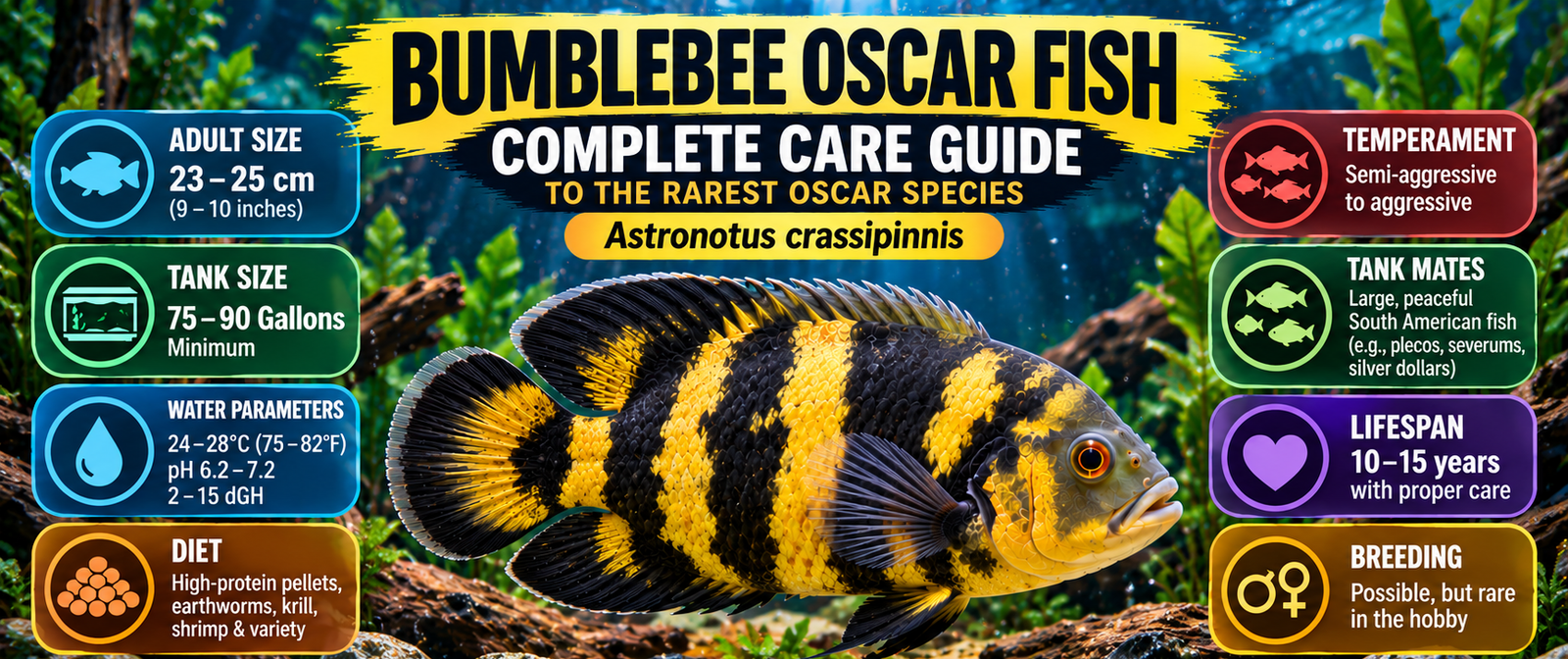
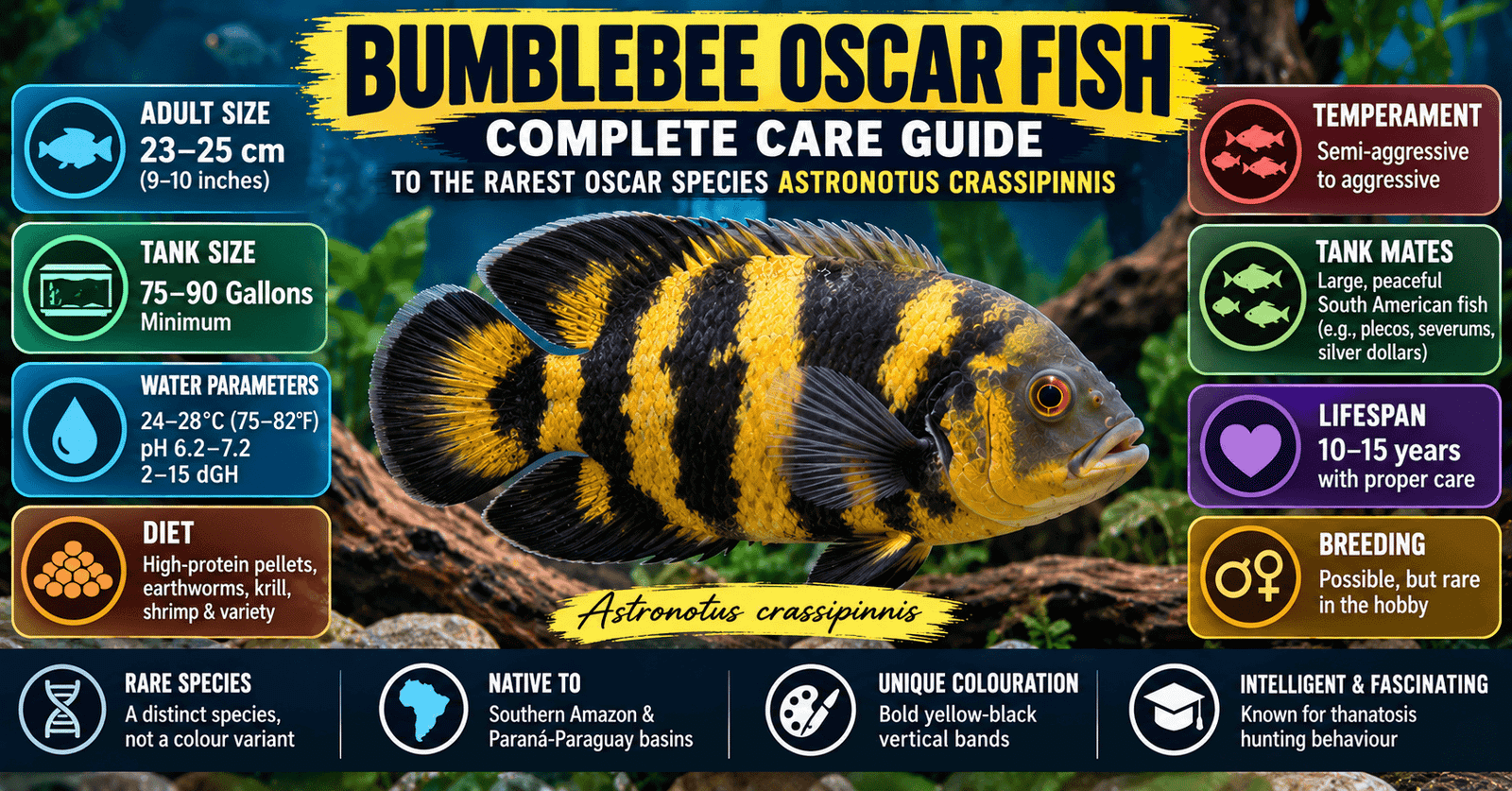
The bumblebee oscar fish is one of the most interesting fish available to experienced South American cichlid keepers because it combines the familiar intelligence and territorial behaviour associated with Oscars with a different species identity, distribution and appearance. In the aquarium trade, the name is generally associated with Astronotus crassipinnis, also known as the southern or fat Oscar in some sources. FishBase records the species from the southern parts of the Amazon, including the upper Madeira, and from the upper Paraguay basin, with a maximum recorded standard length of about 24 cm.
A useful bumblebee oscar fish care guide therefore needs to separate verified species information from trade descriptions. The yellow-and-black appearance is visually distinctive, but colour alone should not be treated as a perfect taxonomic test. Molecular research has shown that Astronotus contains deeper genetic structure than older two-species classifications suggested, which makes careful identification especially important for collectors interested in locality and species integrity.
This guide covers bumblebee oscar Astronotus crassipinnis identification, adult size, aquarium requirements, water parameters, feeding, behaviour, tank mates, breeding, health, rarity and availability in the USA. It also explains how the bumblebee Oscar differs from the common Oscar and why a smaller adult size does not automatically mean that a small aquarium is appropriate.
Recommended Aquarium Plan
Compatibility Assessment
Priority Recommendations
- What Is a Bumblebee Oscar Fish?
- The Astronotus Taxonomy Debate
- Why Is It Called the Bumblebee Oscar?
- Bumblebee Oscar vs Common Oscar
- Bumblebee Oscar Fish Appearance and Colouration
- How Big Does a Bumblebee Oscar Fish Get?
- How Rare Is the Bumblebee Oscar Fish?
- Bumblebee Oscar Fish Tank Size Requirements
- Bumblebee Oscar Fish Tank Setup
- Water Parameters
- What Do Bumblebee Oscar Fish Eat?
- Are Bumblebee Oscar Fish Aggressive?
- Bumblebee Oscar Fish Tank Mates
- Can Bumblebee Oscars Breed with Common Oscars?
- Bumblebee Oscar Fish Lifespan
- Bumblebee Oscar Fish Health Problems
- Thanatosis and Oscar Behaviour
- Where to Buy a Bumblebee Oscar Fish in the USA
- Maintenance Checklist
- Frequently Asked Questions
What Is a Bumblebee Oscar Fish?
The bumblebee oscar fish is a common aquarium-trade name associated with Astronotus crassipinnis, a freshwater cichlid from South America. FishBase currently lists A. crassipinnis as a recognised species within the genus Astronotus. Its recorded distribution includes southern parts of the Amazon basin, the upper Madeira system and the upper Paraguay basin.
This distinction matters because the fish should not be described simply as a yellow Oscar morph of Astronotus ocellatus. The common Oscar and A. crassipinnis are treated as separate species in current major taxonomic databases, although research has also shown that the genus has a complicated evolutionary history. The 2012 molecular study by Willis and colleagues found substantial genetic structure and questioned whether the traditional two-species framework fully captured the diversity within Astronotus.
In practical aquarium terms, the fish still behaves like a large Oscar. It grows much larger than typical community fish, produces substantial waste, digs through substrate and can become territorial. Consequently, a bumblebee oscar Astronotus crassipinnis should be planned as a large cichlid rather than treated like a medium-sized community species simply because its recorded maximum is lower than that of some common Oscars.
Astronotus crassipinnis Taxonomy Species
FishBase lists Astronotus crassipinnis as a species described by Heckel in 1840. Modern databases list three recognised species in the genus: A. crassipinnis, A. mikoljii and A. ocellatus. The description of A. mikoljii in 2022 expanded the formally recognised diversity of the genus and reinforced the need to treat Oscar taxonomy as more complex than the traditional hobby distinction between a common Oscar and a southern Oscar.
The older molecular research is particularly valuable because it demonstrated that visible colour pattern and conventional meristic characters do not always provide a simple species boundary. The study identified geographically structured genetic lineages and concluded that additional cryptic diversity may exist. For aquarium buyers, this means that a seller’s label should be treated as useful information rather than absolute proof of genetic identity.
The Astronotus Genus Species Taxonomy Debate
Astronotus taxonomy has attracted scientific attention because populations can differ substantially in appearance while sharing overlapping morphological characteristics. Willis et al. found that some characters traditionally used to separate A. crassipinnis and A. ocellatus did not provide a complete molecular species boundary.
FishBase currently recognises three species, while genetic studies indicate that the evolutionary structure of the genus may be more complicated than the formal species list suggests. Therefore, hobbyists should avoid presenting every colour pattern as a definitive species diagnostic. Locality information, collection records and, where necessary, genetic analysis can provide stronger evidence.
Why Is It Called the Bumblebee Oscar?
The name bumblebee Oscar comes from the visual impression created by contrasting dark and yellowish body bands. The pattern can resemble the black-and-yellow appearance associated with a bumblebee, making the trade name memorable.
Colour intensity is not necessarily identical between every specimen. Wild fish can show geographical variation, and aquarium conditions can influence the apparent intensity of pigments. Background, lighting, stress, nutrition and individual genetics can all affect how a fish appears to the observer.
For this reason, the most useful identification approach combines body pattern with other information rather than relying on one photograph. A reputable seller should be able to provide the scientific name being used, source information and, for wild fish, locality details where available.
Bumblebee Oscar vs Common Oscar: Complete Comparison
The most important question for anyone researching a bumblebee oscar fish vs common oscar is whether the two names describe different colour forms or different species. In the current taxonomic framework, Astronotus crassipinnis and Astronotus ocellatus are separate species.
| Feature | Bumblebee Oscar | Common Oscar |
|---|---|---|
| Scientific name | Astronotus crassipinnis | Astronotus ocellatus |
| Authority | Heckel, 1840 | Agassiz, 1831 |
| Maximum recorded size | About 24 cm standard length in FishBase | Much larger records exist, with FishBase listing 45.7 cm total length |
| General trade appearance | Often yellowish, orange and dark, with stronger vertical banding | Highly variable, commonly dark with orange-red marbling |
| Distribution | Southern Amazon and upper Paraguay systems | Broad Amazonian distribution and additional introduced populations |
| Aquarium availability | Much less frequently encountered | Widely available |
| Care style | Large aquarium, strong filtration and careful compatibility | Large aquarium, strong filtration and careful compatibility |
Bumblebee Oscar vs Common Oscar Comparison
The comparison is not simply about which fish looks more yellow or more attractive. The bumblebee Oscar is associated with a different species identity and a more restricted natural distribution. The common Oscar has become one of the most widely distributed ornamental cichlids and is available in numerous selectively bred colour forms.
Size is another important difference. FishBase records A. crassipinnis at about 24 cm standard length, whereas the database lists a considerably larger maximum for A. ocellatus. However, maximum database records should not be interpreted as a promise that every aquarium fish will reach that exact length.
Aquarium planning should therefore use a conservative adult-size assumption and sufficient floor area. A smaller species still needs swimming space, territorial room, robust equipment and water-quality management.
The Dorsal Ocellus Identification Question
Older identification literature often emphasised the presence or absence of dorsal ocelli when separating the two traditional Oscar species. Willis et al. demonstrated why this character should be interpreted carefully: their molecular analysis rejected the idea that dorsal ocelli alone provide an unambiguous species-level diagnosis across the entire genus.
This is an important distinction for SEO content because many hobby pages state that the absence of a dorsal ocellus is an absolute diagnostic test. The scientific literature is more cautious. It is a useful identification feature in traditional descriptions, but it should not be treated as stronger evidence than molecular, geographical and taxonomic information.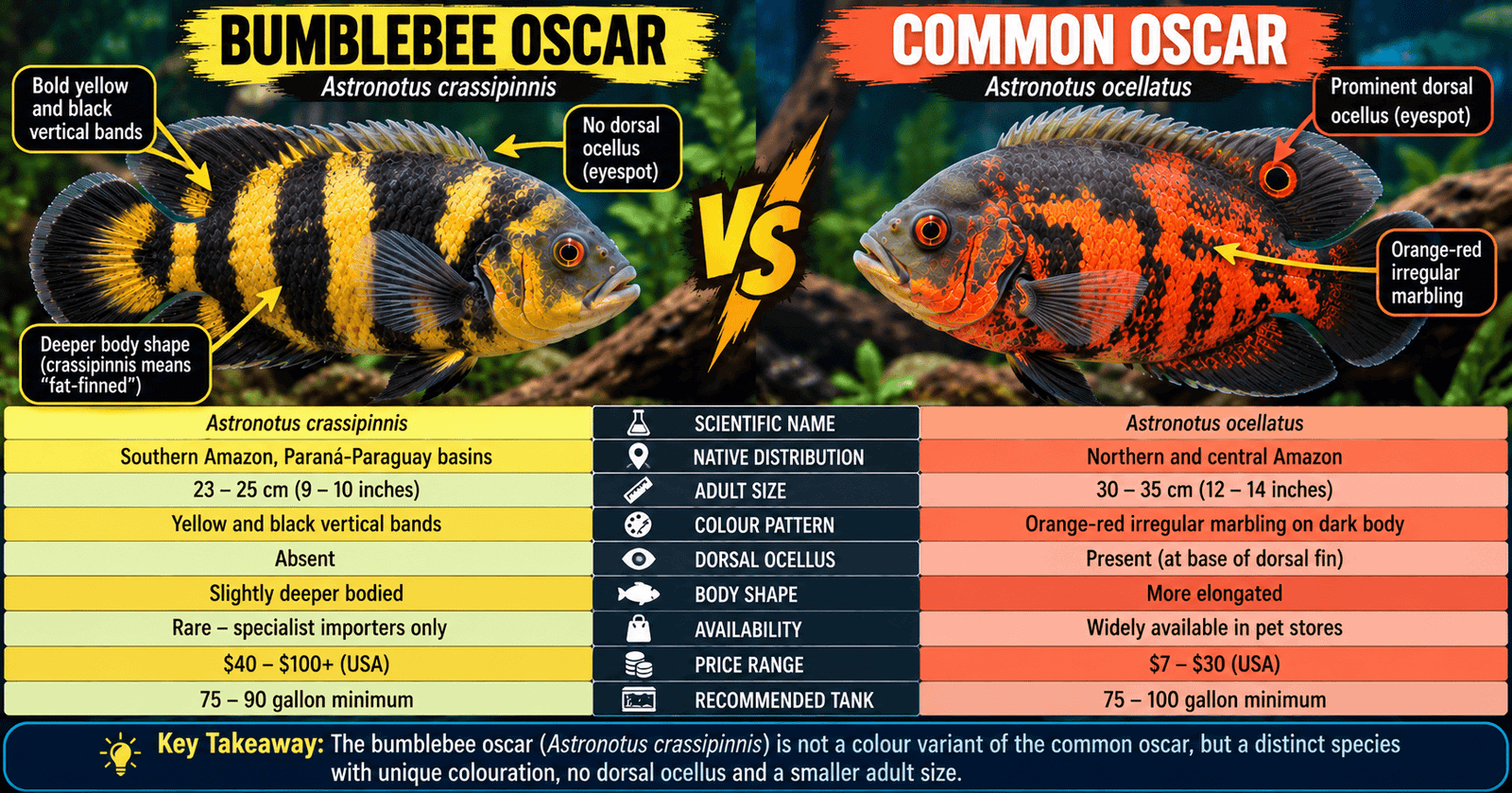
Bumblebee Oscar Fish Appearance and Colouration
The bumblebee oscar fish colour is the feature responsible for much of its aquarium appeal. Adults can display contrasting dark and yellowish or orange areas, while individual specimens can vary considerably in intensity and pattern. The species is generally darker than the brightly selected commercial forms of common Oscars.
Bumblebee Oscar Fish Colouration Pattern
Colouration in cichlids is produced through specialised pigment cells known as chromatophores. Different chromatophore types contribute different colours, and the final appearance results from their distribution, pigment content and interaction with light. Dietary pigments can also influence some visible colours.
This is why the same species can look noticeably different in two aquariums. A dark background may increase perceived contrast, while intense lighting can make certain colours appear stronger to the human eye without necessarily changing the underlying pigmentation.
Juvenile Colouration
Juvenile Astronotus often show strong contrasting markings that change as the fish matures. Juvenile appearance should therefore not be treated as a fixed preview of adult colouration.
This is particularly important when buying a small fish marketed as a bumblebee Oscar. Ask the seller for photographs of the parents, previous adult specimens from the same line or locality information where available. A single juvenile photograph may not provide enough information for confident species or adult-pattern identification.
Adult Colouration
Mature specimens generally develop a heavier, deeper appearance with more defined body markings. Some individuals can show yellow, orange, olive or brown tones alongside darker bands. Water quality and nutrition should be considered before interpreting a dull appearance as a genetic problem.
How Big Does a Bumblebee Oscar Fish Get?
According to FishBase, Astronotus crassipinnis reaches a maximum recorded standard length of about 24 cm. Another commonly reported total-length figure is around 25 cm. This is smaller than the largest recorded common Oscars and is one reason the species may appeal to aquarists who want an Oscar-like fish without keeping the largest possible Astronotus.
However, the difference in adult size should not be converted into an argument for a small aquarium. A 24 cm cichlid remains a substantial predator with a powerful body, high waste production and territorial behaviour. The aquarium needs enough length and depth for normal movement and enough floor area for the fish to establish space.
| Growth Stage | Practical Expectation | Planning Consideration |
|---|---|---|
| Small juvenile | Often sold at only a few centimetres | Do not choose a tank based on purchase size |
| Growing juvenile | Rapid increase in body mass | Filtration and water changes become increasingly important |
| Subadult | Approaching mature body proportions | Territorial behaviour may become more obvious |
| Adult | Up to about 24 cm standard length in FishBase | Plan the aquarium around adult size and behaviour |
For comparison, our 50 gallon fish tank guide explains why nominal tank volume does not tell the whole story. Aquarium footprint, exact dimensions and adult fish size all influence whether a setup is appropriate.
How Rare Is the Bumblebee Oscar Fish?
The bumblebee oscar fish rarity question is easier to answer in terms of aquarium availability than global population size. There is good evidence that A. crassipinnis is encountered much less frequently in the ornamental trade than A. ocellatus. That makes it a specialist fish for many hobbyists.
It is important, however, not to confuse trade rarity with conservation status. FishBase lists A. crassipinnis as Least Concern based on its IUCN assessment. Therefore, describing it as rare should refer to aquarium-trade availability rather than claiming that the species is globally endangered.
Availability can also vary by country and importer. Wild collection, shipping conditions, import regulations, seasonal availability and demand all affect how often specialist retailers list the fish.
Why Is It Less Common Than the Common Oscar?
The common Oscar has been produced commercially in large numbers and is available in many colour varieties. By contrast, A. crassipinnis has a much smaller established aquarium-trade presence. There is also less long-term captive breeding experience documented for it.
For a serious collector, this makes provenance especially useful. A seller who can explain whether a fish is wild collected, captive bred or sold as Astronotus cf. crassipinnis provides more useful information than a seller who relies entirely on a colour-based trade name.
Bumblebee Oscar Fish Tank Size Requirements
The correct bumblebee oscar fish tank size should be determined from adult body size, swimming behaviour, territorial needs, filtration requirements and the number of fish being kept. A practical long-term target should be substantially larger than the smallest volume in which a juvenile can temporarily survive.
There is no universally established scientific minimum aquarium volume specifically validated for every adult A. crassipinnis. Specialist husbandry sources commonly recommend very large aquariums, with some current care databases suggesting around 120 gallons or more for a single adult and larger systems for pairs.
For responsible planning, a 120 gallon or larger aquarium provides substantially more floor space than a conventional 75 gallon setup and gives an adult fish more room to turn, swim and establish territory. A 150 to 180 gallon aquarium can provide an even more forgiving environment, particularly when tank mates are involved.
This approach is consistent with the wider AquariumsWorld principle that stocking should be based on adult size and bioload rather than purchase size. Our Aquarium Stocking Calculator explains why the old one-inch-per-gallon rule does not adequately account for species differences.
Bumblebee Oscar Fish Tank Setup
| Tank Element | Practical Recommendation | Reason |
|---|---|---|
| Tank volume | Large aquarium, with 120 gallons or more a sensible planning target for one adult | Adult size, bioload and territorial behaviour |
| Footprint | Prioritise length and depth rather than excessive height | Provides useful swimming and territorial space |
| Substrate | Fine or smooth sand | Supports natural digging behaviour without sharp edges |
| Filtration | Oversized external filtration | Oscars produce substantial waste |
| Decor | Large, heavy driftwood and smooth rocks | Reduces the risk of unstable or sharp décor |
| Plants | Optional, but protect roots and expect disturbance | Large Oscars can dig and rearrange substrate |
| Lid | Secure, tight-fitting cover | Prevents jumping and equipment-related accidents |
Why a 75 Gallon Tank May Not Be Enough as a Long-Term Target
A 75 gallon aquarium is often mentioned in online Oscar care discussions, but volume alone does not establish suitability for every adult. The bumblebee Oscar may be smaller than some common Oscars, yet it remains a powerful cichlid with a high bioload.
For comparison, the AquariumsWorld 100 gallon fish tank guide explains the greater stability and equipment capacity available in large-format aquariums. Moving beyond 100 gallons also gives the keeper more options for creating territorial structure without filling the entire swimming area with décor.
Aquarium dimensions matter as much as the printed gallon number. Our 50 gallon fish tank dimensions guide demonstrates why different tank shapes can provide very different footprints even when nominal capacity is similar.
Water Parameters for Bumblebee Oscar Fish
The bumblebee oscar fish comes from warm freshwater environments, so temperature stability is important. FishBase classifies the species as tropical and benthopelagic. Specialist care sources commonly place the suitable temperature range around 23 to 28°C, with pH approximately 6.0 to 7.5.
| Parameter | Practical Target | Management Priority |
|---|---|---|
| Temperature | Approximately 23 to 28°C | Keep stable and avoid abrupt changes |
| pH | Approximately 6.0 to 7.5 | Stability is more important than chasing a precise number |
| Ammonia | 0 ppm | Essential in an established aquarium |
| Nitrite | 0 ppm | Essential in an established aquarium |
| Nitrate | Keep low through testing and maintenance | Manage according to stocking and water-change demand |
For more detailed cichlid temperature information, see the AquariumsWorld Water Temperature for Cichlids guide. The guide emphasises that temperature should be selected according to species rather than applying one universal cichlid temperature.
Aquarists who experience ammonia, nitrite, cloudy water or unexplained fish behaviour should also consult our Fish Aquarium Problems and Solutions guide. Water quality problems can produce behavioural changes that are easily mistaken for temperament.
Bumblebee Oscar Fish Tank Setup in Detail
Substrate
Fine sand or smooth gravel is appropriate for an Oscar-style aquarium because these fish can move substrate while feeding and digging. Sharp gravel should be avoided because repeated digging and turning can produce mouth or body injuries.
If the aquarium will contain live plants, substrate selection becomes more complicated. Our soil in fish tank guide explains how different substrates affect plant growth and aquarium management. With a large Oscar, however, physical stability of the aquascape should be considered alongside plant nutrition.
Filtration
Filtration is one of the most important parts of bumblebee oscar fish care. Large cichlids produce substantial organic waste, and the filter must support mechanical waste removal and biological nitrification.
An oversized canister filter, sump or combination filtration system is more appropriate than relying on a small internal filter. Filter capacity should be considered together with stocking density and water-change frequency rather than treated as a substitute for maintenance.
Aeration
Strong surface movement helps support gas exchange, especially in a heavily stocked large aquarium. An air pump is not automatically mandatory when the primary filtration system creates adequate surface agitation, but additional aeration can be useful when oxygen demand is high or during warm weather.
Our fish tank aquarium air pump guide explains air pumps, surface agitation, air-driven filtration and backup aeration in greater detail.
Lighting and Background
Moderate lighting is generally more practical than extremely intense illumination in an Oscar aquarium. A darker background can also increase the visual contrast of yellow and dark body markings, although this should be understood as an appearance effect rather than a guarantee of improved pigmentation.
Decor
Use heavy driftwood, large smooth rocks and stable structures. Oscars are capable of moving surprisingly large objects, so décor that can fall against glass or trap the fish should be avoided.
If you prefer an architectural aquarium, our built-in-wall fish aquarium guide covers structural planning, equipment access and maintenance considerations for large aquarium installations.
What Do Bumblebee Oscar Fish Eat?
The bumblebee oscar fish diet should be varied and nutritionally complete. The species is a predatory omnivore, and Oscar research shows that animal prey can form an important component of natural feeding while plant and other non-animal material may also be consumed.
A high-quality large-cichlid pellet should form the nutritional foundation in captivity. Frozen or live foods can then be used as supplements rather than allowing one high-protein food to dominate the entire diet.
Bumblebee Oscar Fish Diet and Colour
Dietary pigments can influence the appearance of many ornamental fish. Carotenoids are important pigments in aquatic animals and can contribute to yellow, orange and red colour expression through chromatophore systems.
Luo et al. reviewed the molecular mechanisms underlying fish pigmentation and discussed the role of dietary pigments in aquaculture. This supports using nutritionally complete foods containing appropriate pigment sources, but it does not justify claims that a particular supplement will transform the natural colour pattern of A. crassipinnis.
Spirulina can also be used as part of a varied diet. Research on Astronotus ocellatus found effects of spirulina supplementation on pigmentation and other physiological outcomes. Because that research was conducted on the common Oscar rather than directly on A. crassipinnis, it should be treated as related evidence rather than species-specific proof.
Recommended Foods
- High-quality large-cichlid pellets
- Frozen shrimp
- Earthworms from safe sources
- Krill as an occasional supplement
- Appropriate frozen aquatic invertebrates
- Quality foods containing carotenoids as part of a balanced diet
Foods to Avoid
- Regular feeding of feeder goldfish
- Unbalanced mammalian meat diets
- Excessive fatty treats
- Food from unknown or contaminated sources
- Overfeeding
Overfeeding is especially important because an Oscar that consumes excessive food can produce more waste than the biological filter can process comfortably. Uneaten food also contributes to organic loading.
Are Bumblebee Oscar Fish Aggressive?
Bumblebee Oscar fish should be considered territorial and potentially aggressive, especially when space is limited or breeding behaviour develops. The safest assumption is not that an individual will attack every fish, but that compatibility must be tested against adult size, temperament, territory and predatory behaviour.
Research on Oscar social behaviour has documented territorial and agonistic interactions in Astronotus ocellatus. Because detailed behavioural studies on A. crassipinnis are less abundant, common Oscar research can inform general husbandry but should not automatically be described as direct species-specific evidence.
A large aquarium can reduce forced contact by giving fish more space to move away from each other. It does not eliminate aggression. Individual temperament remains important.
Bumblebee Oscar Fish Tank Mates
Choosing bumblebee oscar fish tank mates requires more than finding species that share the same temperature. The proposed companion should be large enough not to be swallowed, robust enough to tolerate occasional territorial behaviour and compatible with the aquarium’s water conditions.
| Potential Tank Mate | Compatibility Consideration | Important Requirement |
|---|---|---|
| Large Plecostomus | Potentially suitable | Must be large enough and have adequate shelter |
| Large Silver Dollars | Potentially suitable | Keep an appropriate group and provide a very large aquarium |
| Large Bichir | Possible with caution | Require compatible water and sufficient floor space |
| Large Severum | Possible with caution | Territorial behaviour and aquarium footprint must be considered |
| Small tetras | Not recommended | Predation risk |
| Small Corydoras | Not recommended | Too small and vulnerable to predation or injury |
| Goldfish | Not recommended | Temperature and compatibility problems |
| Small African cichlids | Not recommended | Different environmental and behavioural requirements |
Our Can Goldfish Live with Oscar Fish compatibility guide explains why goldfish and Oscars should not be treated as compatible tank mates. The same principle applies here: temperature, adult size, predation and behaviour must all be considered.
A large plecostomus can be considered in a suitably large aquarium because of its size and defensive body structure. Our Orange Plecostomus care guide explains the importance of shelter, feeding and appropriate aquarium space for plecos.
Angelfish are generally not appropriate companions for an adult Oscar because of size, predation and aggression concerns. Our Angelfish complete care guide provides species-specific information about their size and community requirements.
Can Bumblebee Oscar Fish Breed with Common Oscars?
Because Astronotus crassipinnis and Astronotus ocellatus are closely related members of the same genus, hybridisation is biologically plausible, but documented aquarium outcomes should not be presented as predictable without evidence. For conservation-minded and species-focused aquarists, breeding verified A. crassipinnis with another verified specimen of the same species is the clearer approach.
Hybrid offspring can complicate identification and undermine the value of locality and species information. Anyone collecting rare or uncommon fish should therefore maintain clear records of parentage.
Bumblebee Oscar Fish Breeding Guide
Oscar breeding follows a substrate-spawning strategy. Mature pairs select and clean a suitable spawning surface, deposit eggs and provide parental care. The common Oscar is known to produce large broods, although species-specific reproductive data for A. crassipinnis are much less extensive.
A practical breeding aquarium needs enough space for both parents because courtship can become territorial. A divider or separate aquarium is useful if the pair becomes incompatible. Flat stones or stable hardscape can provide potential spawning surfaces.
Before breeding, decide what will happen to the offspring. Large cichlid fry grow quickly, and producing hundreds or potentially thousands of young can create a serious housing and rehoming problem.
How Long Does a Bumblebee Oscar Fish Live?
Species-specific lifespan data for Astronotus crassipinnis are limited compared with the common Oscar. Because it is closely related and has similar large-cichlid husbandry requirements, experienced keepers often expect a long aquarium lifespan when water quality, nutrition, space and disease prevention are consistently managed.
The most important point is that purchasing a juvenile creates a long-term commitment. A fish that looks small in a shop can become a substantial adult within a relatively short period. Tank upgrades should therefore be planned before the fish reaches its mature size.
Bumblebee Oscar Fish Health Problems
The bumblebee oscar fish health problems seen in aquariums are often connected to the same broad risk factors affecting other large cichlids: unstable water quality, excessive stocking, inadequate filtration, poor nutrition, physical injuries and chronic stress.
Water Quality Problems
Ammonia and nitrite should remain at zero in an established aquarium. Nitrate should be monitored because a high-waste fish can cause nitrate accumulation more rapidly than a lightly stocked community aquarium.
Sudden behavioural changes should trigger water testing before medication is added. Our Fish Aquarium Problems and Solutions guide provides a broader diagnostic framework covering cloudy water, nitrogen-cycle problems and common diseases.
Hole in the Head
Hole-in-the-head or lateral-line erosion is often discussed in relation to large cichlids. Its causes are multifactorial and should not be reduced to one single nitrate value or one pathogen. Good water quality, appropriate nutrition, low chronic stress and adequate aquarium management are sensible preventive priorities.
Ich
Ich can affect freshwater fish under stressful conditions. Typical signs include small white spots, flashing, clamped fins and altered behaviour. If symptoms appear, first confirm water quality and temperature and seek species-appropriate treatment guidance.
Physical Injury
Oscars are strong fish that can move rocks and driftwood. Sharp décor, unstable structures and exposed equipment can cause injury. Large, smooth, stable hardscape is safer.
Jumping
A secure lid is essential. Large cichlids can jump when startled, during territorial disputes or after sudden environmental changes. The cover should also prevent equipment and décor from becoming dangerous escape routes.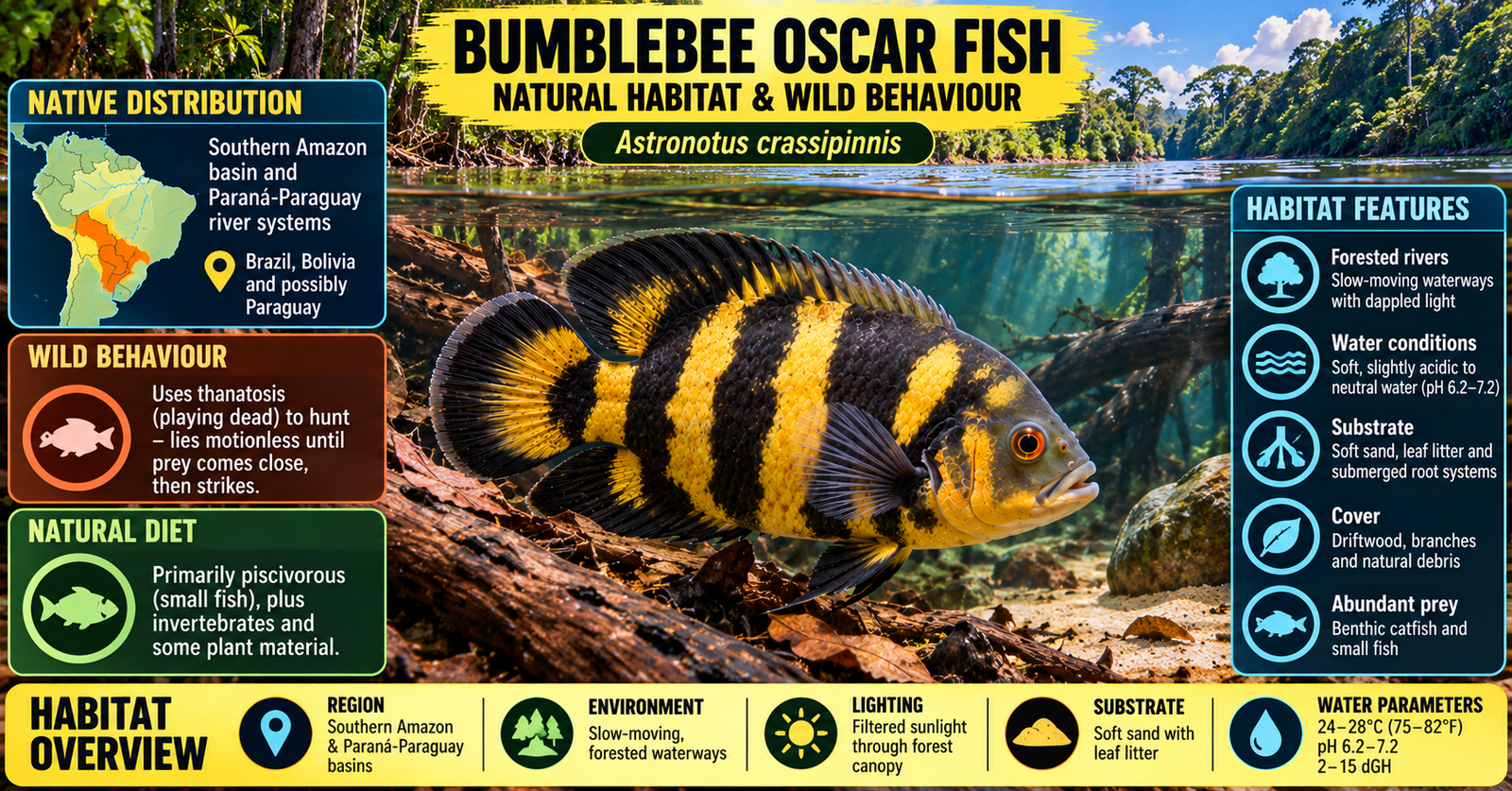
What Is Bumblebee Oscar Fish Thanatosis Behaviour?
The phrase bumblebee oscar fish thanatosis behaviour needs careful qualification. Thanatosis, or death-feigning behaviour used in predation, has been documented in the Oscar literature, but the best-known evidence concerns Astronotus ocellatus, the common Oscar, rather than providing a definitive species-specific behavioural study of A. crassipinnis.
Seriously Fish describes some wild common Oscars using a strategy in which the fish lies motionless and resembles a dead fish, potentially attracting prey that investigates the apparently vulnerable animal. This is a fascinating example of behavioural adaptation, but it should not automatically be presented as a proven defining trait of every bumblebee Oscar.
In an aquarium, a fish lying motionless on its side should never automatically be interpreted as normal thanatosis. Sudden lethargy can indicate poor water quality, temperature problems, injury or disease. Check ammonia, nitrite, nitrate, temperature, breathing and appetite before assuming the behaviour is intentional.
Bumblebee Oscar Fish Where to Buy USA
Searching for a bumblebee oscar fish for sale USA can be more difficult than finding a common Oscar because specialist availability is limited. The fish may appear through specialist cichlid importers, wild-fish import lists, aquarium society networks or private breeders.
Because availability changes frequently, buyers should avoid treating a single retailer listing or current price as a permanent market standard. Prices depend on size, source, wild or captive origin, locality information, shipping, season and seller.
What to Ask a Seller
- What scientific name is being used?
- Is the fish captive bred or wild collected?
- Is locality information available?
- Can the seller provide photographs of the actual fish?
- How large is the fish currently?
- What foods is it currently eating?
- What temperature and water chemistry has it been maintained in?
- Does the seller use Astronotus crassipinnis or Astronotus cf. crassipinnis?
The use of cf. can be informative. It indicates that the seller is identifying the specimen as close to or comparable with the named species without claiming absolute certainty. That is more scientifically cautious than presenting an uncertain fish as genetically verified.
Bumblebee Oscar Fish Maintenance Checklist
- Test ammonia and nitrite regularly, particularly after aquarium changes.
- Monitor nitrate and adjust water changes to the aquarium’s actual bioload.
- Maintain stable tropical freshwater temperature.
- Use oversized biological and mechanical filtration.
- Provide strong surface movement and adequate oxygen exchange.
- Use a secure aquarium lid.
- Choose smooth substrate and stable hardscape.
- Inspect décor after major rearrangement by the fish.
- Feed a varied, nutritionally complete diet.
- Avoid relying on feeder fish as a staple food.
- Observe behaviour daily.
- Separate incompatible fish rather than expecting aggression to disappear.
- Plan the aquarium around adult size rather than juvenile size.
- Keep accurate records if maintaining a rare or locality-specific specimen.
Bumblebee Oscar Fish Size Comparison and Tank Planning
One of the easiest mistakes is comparing the bumblebee Oscar with small community fish based only on length. A 24 cm cichlid has very different body mass, feeding behaviour and waste production from a 24 cm schooling fish with a slender body.
The AquariumsWorld aquarium stocking guide explains why adult size, species type and filtration need to be considered together. The same logic is particularly important for Oscars because they produce substantial waste relative to many smaller ornamental fish.
If you are comparing large aquarium options, the 100 gallon aquarium guide is useful for understanding dimensions, equipment and total system weight. For larger setups, stand design and floor support should also be considered before installation.
Aquarists using a specialist aquarium stand can also review the AquariumsWorld fish tank stand and size guide. Although that article focuses on marine aquariums, its general structural planning principles are relevant when supporting a large freshwater aquarium.
Bumblebee Oscar Fish Care Compared with Other Cichlids
The bumblebee Oscar belongs to the same broad South American cichlid context as several popular aquarium species, but its care requirements should not be copied blindly from every cichlid. African Rift Lake cichlids, for example, generally require different water chemistry and aquarium structure.
Our African cichlids complete guide explains why species origin matters when selecting water conditions, tank structure and compatible fish.
Similarly, angelfish require different structural planning because their tall body and long fins make aquarium height particularly important. This demonstrates a broader principle: cichlid compatibility should be assessed from species biology rather than the fact that two fish are both labelled cichlids.
Common Bumblebee Oscar Fish Care Mistakes
Choosing a Tank for a Juvenile
A tiny juvenile may appear comfortable in a medium aquarium, but the long-term aquarium should be selected before the fish reaches adult size. Upgrading repeatedly can also cause unnecessary stress and expense.
Using the One-Inch-Per-Gallon Rule
The one-inch-per-gallon rule is especially unsuitable for a large Oscar. It does not account for body mass, species waste production, aggression or swimming requirements.
Underestimating Filtration
A filter that technically moves water is not necessarily sufficient for a large cichlid aquarium. Biological capacity, mechanical waste collection and oxygenation must all be considered.
Overfeeding
Large Oscars can behave as though they are permanently hungry. Feeding more because the fish begs can rapidly increase waste production. Portion size should be based on body condition, growth stage and actual consumption.
Assuming Every Bumblebee Oscar Is Genetically Identical
Trade names are not substitutes for genetic verification. The scientific complexity of the Astronotus genus makes this especially important for collectors interested in pure species and locality forms.
Buying Without Asking About Provenance
If species identity matters to you, ask the seller for the scientific name, origin and parentage information. A slightly higher price for traceable stock may be more useful than purchasing an unidentified fish solely because it has an attractive colour pattern.
Bumblebee Oscar Fish Natural Habitat
FishBase records Astronotus crassipinnis from southern portions of the Amazon basin, including the upper Madeira, and the upper Paraguay basin. This distribution is important because it distinguishes the species geographically from many populations traditionally associated with the common Oscar.
The habitat context also helps explain why a natural-style aquarium can work well. Sand, submerged wood, open swimming space and stable warm water create a practical environment that supports the fish’s behaviour without requiring a heavily planted aquascape.
A natural aquarium should still be designed around maintenance. A beautiful arrangement that prevents access to the substrate or filter intake is less useful than a simple aquarium that can be cleaned consistently.
Bumblebee Oscar Fish Diet and Colour Enhancement
Many aquarists search for ways to enhance bumblebee Oscar colour. The most defensible approach is not a single colour-enhancing product but consistent nutrition and stable environmental conditions.
Carotenoids can contribute to fish colouration because they are incorporated into pigment systems. Foods containing appropriate carotenoid sources can support natural colour expression, but nutrition cannot create a genetic colour pattern that the fish does not possess.
Avoid interpreting colour changes in isolation. A fish that becomes dull may be experiencing stress, poor water quality, inappropriate lighting or illness. Correct the environmental issue before adding supplements.
Frequently Asked Questions
What is a bumblebee oscar fish?
The bumblebee Oscar fish is an aquarium trade name commonly associated with Astronotus crassipinnis, a recognised South American cichlid species. It is distinct from the common Oscar, Astronotus ocellatus, although the two belong to the same genus. The name refers to its contrasting dark and yellowish body pattern.
How big does a bumblebee oscar fish get?
FishBase lists a maximum recorded standard length of about 24 cm for Astronotus crassipinnis. Other sources report around 25 cm total length as a common upper reference. Individual aquarium growth varies according to genetics, nutrition, water quality and husbandry.
What is the difference between a bumblebee oscar and a common oscar?
The bumblebee Oscar is associated with Astronotus crassipinnis, while the common Oscar is Astronotus ocellatus. They have different distributions and can differ in adult size and colour pattern. The genus has a complicated evolutionary history, so identification should not rely exclusively on colour.
How rare is the bumblebee oscar fish?
It is uncommon in the aquarium trade compared with the common Oscar. Trade availability should not be confused with global conservation status, however. FishBase records A. crassipinnis as Least Concern based on its IUCN assessment.
What tank size does a bumblebee oscar fish need?
There is no universally validated scientific minimum aquarium volume specifically for every adult A. crassipinnis. Because it is a large, territorial, high-bioload cichlid, a very large aquarium is appropriate. A practical planning target of around 120 gallons or more for one adult provides considerably more space than a conventional medium aquarium.
What do bumblebee oscar fish eat?
Bumblebee Oscars should receive a varied diet based around quality large-cichlid pellets and supplemented with suitable frozen or live foods such as earthworms, shrimp and krill. Avoid making feeder fish the main diet. Good nutrition supports growth, health and natural colour expression.
Are bumblebee oscar fish aggressive?
They should be treated as territorial and potentially aggressive large cichlids. Individual temperament varies, but aggression becomes more difficult to manage when fish are crowded or incompatible. Large aquarium space and careful tank-mate selection reduce risk but do not guarantee peaceful behaviour.
Can bumblebee oscar fish breed with common oscars?
Hybridisation between closely related species may be biologically possible, but predictable breeding outcomes should not be assumed without species-specific evidence. Aquarists interested in preserving species identity should breed verified A. crassipinnis with another verified specimen rather than intentionally mixing species.
What are the best tank mates for a bumblebee oscar fish?
Potential companions include large, robust fish such as appropriately sized plecos, large silver dollars, some bichirs and selected similarly sized cichlids. Compatibility depends on the individual fish and aquarium size. Small fish that can fit into the Oscar’s mouth should be avoided.
How long does a bumblebee oscar fish live?
Species-specific lifespan data are limited compared with common Oscars. Because the species is closely related to other long-lived Oscars, a long captive lifespan is possible with excellent care. Stable water, appropriate nutrition, sufficient space and disease prevention are central to longevity.
Is Astronotus crassipinnis the same species as Astronotus ocellatus?
No. Current major taxonomic databases recognise Astronotus crassipinnis and Astronotus ocellatus as separate species. Molecular research nevertheless shows that the genus contains deeper genetic structure and unresolved diversity.
Why is my bumblebee Oscar lying on its side?
Do not automatically assume that side-lying is thanatosis. Sudden side-lying can indicate stress, poor water quality, injury or illness. Test ammonia, nitrite, nitrate and temperature and observe breathing and appetite before interpreting the behaviour.
Can a bumblebee Oscar live in a 55 gallon tank?
A 55 gallon aquarium should not be treated as an appropriate long-term target for an adult A. crassipinnis. Although the fish may be sold as a small juvenile, adult size and high bioload require substantially greater space.
Do bumblebee Oscars need live plants?
No. Live plants are optional rather than essential. Large Oscars may uproot plants while digging, so robust plants attached to décor or artificial alternatives may be easier to maintain. Open swimming space and stable hardscape are more important.
What temperature does a bumblebee Oscar need?
Specialist care sources commonly place Astronotus crassipinnis around 23 to 28°C. The most important practical point is to maintain a stable temperature appropriate for the species rather than making abrupt changes.
Does a bumblebee Oscar need a sand substrate?
Fine sand is a practical option because Oscars naturally interact with the substrate and may dig. Smooth gravel can also work if it has no sharp edges. The substrate should be selected with both fish safety and maintenance in mind.
Conclusion
The bumblebee oscar fish is a fascinating large South American cichlid associated with Astronotus crassipinnis, a species distinct from the common Oscar Astronotus ocellatus. Its contrasting dark and yellowish colouration makes it visually distinctive, while its restricted aquarium-trade availability makes it particularly interesting to specialist cichlid keepers.
The most important point for prospective owners is that its smaller recorded adult size does not make it a small aquarium fish. It remains a powerful, territorial and high-bioload cichlid that needs a large aquarium, strong filtration, stable water conditions, secure décor and carefully selected tank mates.
Species identification also deserves attention. Scientific research has shown that Astronotus taxonomy is more complicated than simple visual classification suggests. Buyers interested in verified A. crassipinnis should therefore ask about scientific naming, locality and provenance rather than relying only on the phrase “bumblebee Oscar.”
With sufficient space, a varied diet, excellent water quality and responsible compatibility planning, the species can become a remarkable long-term aquarium fish. The key is to plan around the adult animal rather than the small juvenile seen at the retailer.
Related AquariumsWorld Guides
- Aquarium Stocking Calculator
- 100 Gallon Fish Tank Complete Guide
- 50 Gallon Fish Tank Guide
- 50 Gallon Fish Tank Dimensions
- Water Temperature for Cichlids
- African Cichlids Water Temperature Guide
- Fish Aquarium Problems and Solutions
- Fish Tank Air Pump Guide
- Can Goldfish Live with Oscar Fish?
- Orange Plecostomus Care Guide
- Angelfish Complete Care Guide
- African Cichlids Complete Guide
- Soil in Fish Tank Guide
- Fish Aquarium Built in a Wall Guide
- Fish Tank Stand and Size Guide
- Complete Beginner’s Fish Care Guide
- 20 Gallon Fish Tank Complete Guide
- Corner Fish Tank Complete Guide
- AquariumsWorld Blog
Scientific References
1. Willis, S.C., Farias, I.P. and Ortí, G. (2012). Deep Phylogenetic Divergence and Lack of Taxonomic Concordance in Species of Astronotus (Cichlidae). PLoS ONE. DOI: https://doi.org/10.1371/journal.pone.0040274
2. Perez Lozano, A., Lasso-Alcalá, O.M., Bittencourt, P.S., Taphorn, D.C., Perez, N. and Farias, I.P. (2022). A new species of Astronotus from the Orinoco River and Gulf of Paria basins, northern South America. ZooKeys, 1113, 111-152. DOI: https://doi.org/10.3897/zookeys.1113.81240
3. Beeching, S.C. (1997). Functional groups in the social behavior of a cichlid fish, the Oscar, Astronotus ocellatus. Behavioural Processes, 39(1), 85-93. DOI: https://doi.org/10.1016/S0376-6357(96)00047-2
4. Gonçalves-de-Freitas, E., Teresa, F.B., Gomes, F.S. and Giaquinto, P.C. (2008). Effect of water renewal on territorial behaviour of juvenile Oscar fish. Applied Animal Behaviour Science, 112(1-2), 156-162. DOI: https://doi.org/10.1016/j.applanim.2007.09.013
5. Zare, M., Esmaeili, A.A., Safari, O. and Davoodi, R. (2024). Responses of Oscar (Astronotus ocellatus) to different temperatures and its interaction with early mild stress. Aquaculture, 591, 741176. DOI: https://doi.org/10.1016/j.aquaculture.2024.741176
6. Luo, M. et al. (2021). Fish pigmentation and coloration: Molecular mechanisms and aquaculture perspectives. Reviews in Aquaculture, 13(4), 2395-2412. DOI: https://doi.org/10.1111/raq.12583
7. Mohammadiazarm, H., Maniat, M., Ghorbanijezeh, K. and Ghotbeddin, N. (2021). Effects of spirulina powder as a dietary additive on Oscar fish Astronotus ocellatus. Aquaculture Nutrition, 27(1), 252-260. DOI: https://doi.org/10.1111/anu.13182
8. FishBase. Astronotus crassipinnis species summary. FishBase records the species as a freshwater tropical fish from southern parts of the Amazon and upper Paraguay basins, with a maximum recorded standard length of approximately 24 cm. FishBase species record