The tiger molly is one of the most striking colour variants of the common molly, Poecilia sphenops, displaying bold black, orange and pale markings that create its characteristic tiger-like appearance. This livebearer is popular because it combines attractive colouration with active behaviour, adaptable husbandry and straightforward breeding. For beginners, the tiger molly can be an excellent community fish when its need for warm, stable and moderately hard alkaline water is understood.
This complete tiger molly fish care guide explains identification, scientific classification, size, lifespan, natural habitat, aquarium setup, water parameters, diet, behaviour, male-to-female ratio, compatible tank mates, breeding, fry care and common health problems. It also compares standard tiger mollies with tiger balloon mollies and explains why body shape should be considered when choosing fish. If you are new to aquarium keeping, begin with the Fish Aquarium Types and Setup Guide, which covers tank selection, stocking, filtration, heaters and water testing.
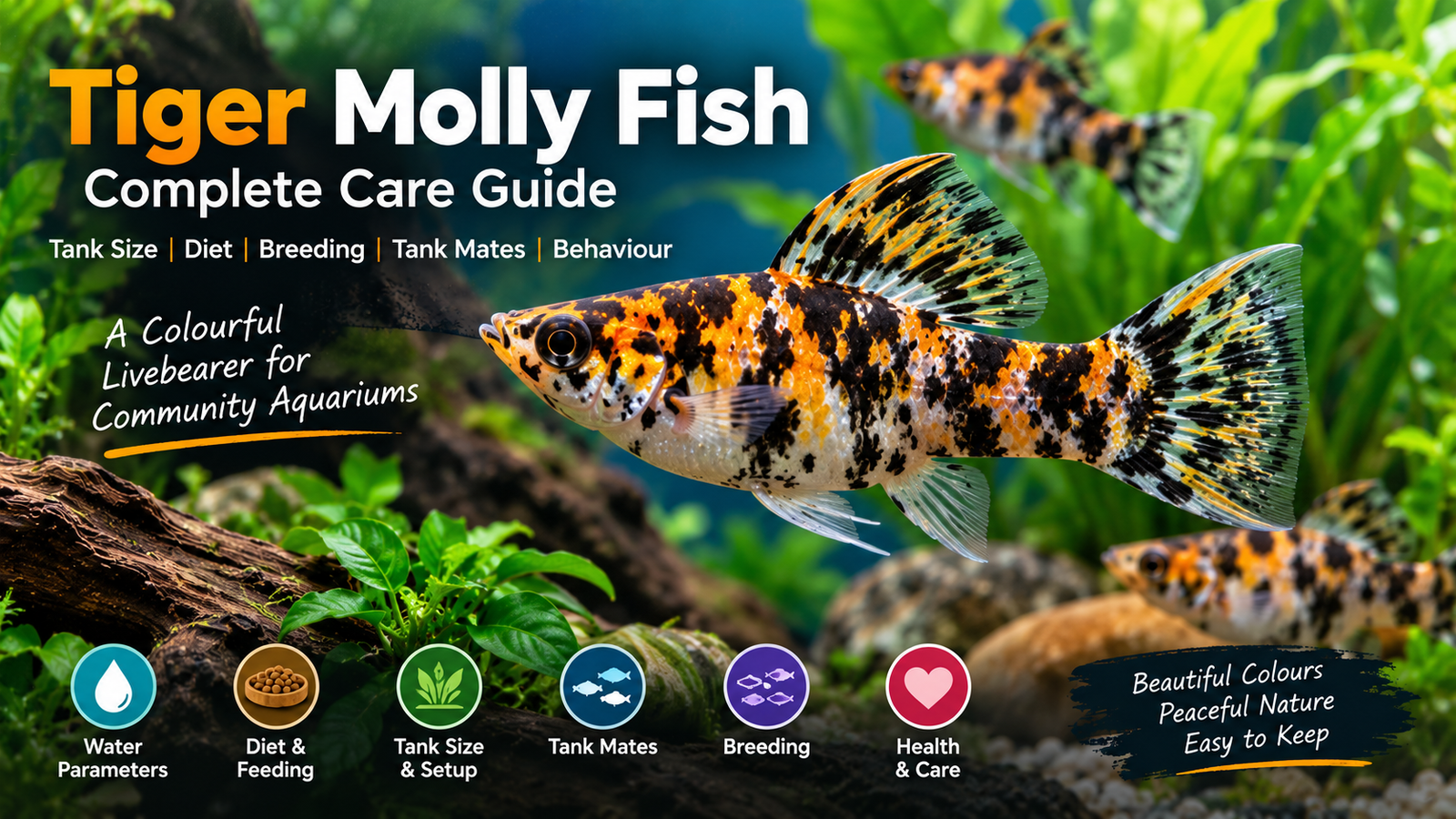
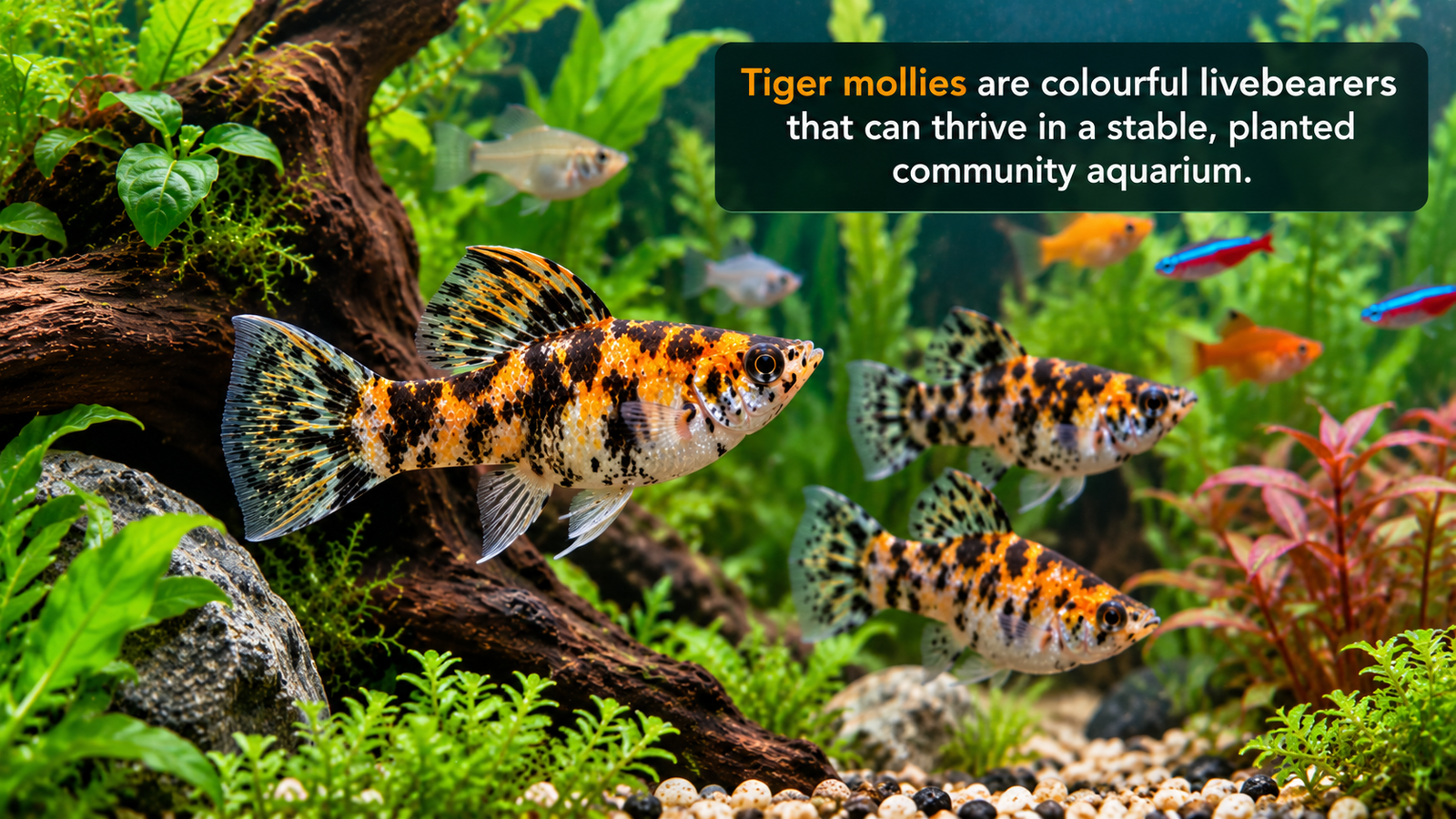
Tiger mollies are colourful livebearers that can thrive in a stable, planted community aquarium.
Tiger Molly Quick Answer
A tiger molly is an aquarium colour form of the common molly associated with Poecilia sphenops. Its bold tiger-like markings can include black, orange, cream and pale areas, while its general care remains similar to other common mollies. The species is a livebearer, meaning females give birth to free-swimming fry rather than laying external eggs.
For a small group, a 20 gallon aquarium can be a practical starting point, with larger tanks preferred for community setups and breeding colonies. Keep more females than males because persistent male courtship can stress females. A useful starting ratio is one male to two or three females.
Tiger mollies are omnivorous and benefit from a mixture of quality flakes or pellets, spirulina-based foods, algae and vegetables, plus occasional frozen or live foods. Stable warm water, alkaline pH, adequate hardness, filtration, oxygenation and regular maintenance are more important than chasing one perfect number.
Table of Contents
- What Is a Tiger Molly Fish?
- Tiger Molly Scientific Classification
- Tiger Molly vs Other Molly Varieties
- Tiger Molly Size and Lifespan
- Tiger Molly Natural Habitat and Origin
- Tiger Molly Tank Size Requirements
- Tiger Molly Water Parameters
- Tiger Molly Aquarium Setup
- What Do Tiger Molly Fish Eat?
- Tiger Molly Behaviour and Temperament
- Tiger Molly Tank Mates
- Can Tiger Mollies Breed with Other Mollies?
- Tiger Molly Breeding Guide
- Tiger Molly Health and Common Problems
- Tiger Molly vs Balloon Molly
- Frequently Asked Questions
- Conclusion
- References
1. What Is a Tiger Molly Fish?
A tiger molly is a distinctive colour variant sold within the aquarium trade under names such as tiger molly, tiger short fin molly and, in some cases, tiger balloon molly. The defining feature is its patterned body rather than a separate species identity. In practical fish keeping, this means the tiger molly should be cared for according to the requirements of the underlying molly lineage rather than treated as a completely different fish.
The name Poecilia sphenops is particularly relevant because the scientific literature supplied for this guide investigates the reproductive anatomy, reproductive biology and internal physiology of molly fish. Modern research has examined male reproductive development in detail, including the specialised testicular organisation that supports internal fertilisation in this livebearing fish. Mokhtar et al. (2025) found synchronised cystic spermatogenesis and specialised sperm ducts in P. sphenops, demonstrating how closely the reproductive system is adapted to viviparity.
For an aquarist, the most important point is that a tiger pattern does not remove the basic husbandry requirements of a molly. It still needs appropriate space, stable water chemistry, a suitable diet and compatible tank mates. A bright colour pattern is not evidence that a fish is unusually hardy or that it can tolerate poor water quality.
Tiger mollies are active mid-water fish. They spend much of the day swimming, exploring plants and investigating their surroundings. Females may seek shelter when heavily pregnant or when males are pursuing them. A planted aquarium therefore provides more than decoration. Vegetation creates visual barriers, resting places and potential refuge for fry.
Tiger mollies should enter healthy mature aquariums. The biological filter should already be processing waste, ammonia and nitrite should remain at zero, and the aquarist should have a regular testing and water-change routine.
2. Tiger Molly Scientific Classification
| Field | Detail |
|---|---|
| Common names | Tiger Molly, Tiger Short Fin Molly, Tiger Balloon Molly |
| Scientific name | Poecilia sphenops for the common molly lineage described in the supplied research |
| Family | Poeciliidae |
| Order | Cyprinodontiformes |
| Reproductive type | Livebearing, with internal fertilisation and free-swimming young |
| Geographic association | Central America and adjacent regions within the wider natural range |
The taxonomy of mollies is more complicated than aquarium trade names suggest. Alda et al. (2013) examined the phylogeny and biogeography of the Poecilia sphenops species complex and showed that geographic history and relationships within the group deserve careful consideration. Consequently, aquarium labels should not always be treated as precise taxonomic diagnoses.
3. Tiger Molly vs Other Molly Varieties
Molly fish types and colours vary widely in the aquarium trade. Tiger mollies are usually recognised by contrasting dark and warm-coloured markings, while other varieties may be solid black, dalmatian, white, gold, silver or mixed patterned. Body shape can also vary because selective breeding has produced sailfin, short fin and balloon forms.
| Variety | Body shape | Typical feature |
|---|---|---|
| Tiger short fin molly | Streamlined | Bold tiger-like markings |
| Tiger balloon molly | Rounded and compressed | Tiger colour pattern with balloon body shape |
| Sailfin molly | Standard body with enlarged dorsal fin | Large sail-like dorsal fin |
| Black molly | Streamlined | Mostly solid dark colouration |
| Dalmatian molly | Streamlined | White or pale body with dark spots |
The most useful comparison is not simply colour. Body shape, adult size, swimming ability and breeding condition should also influence the choice. A standard-bodied tiger molly generally has a more natural swimming profile than a strongly compressed balloon form. When selecting fish, look for clear eyes, intact fins, good body condition and active swimming rather than choosing solely on colour intensity.
Mixed molly aquariums can produce interesting offspring because different colour forms may interbreed. If maintaining a specific strain is important, separate breeding groups are necessary. Otherwise, mixed populations can gradually produce fry with combinations of patterns that do not resemble either parent exactly.
4. Tiger Molly Size and Lifespan
Adult tiger molly size varies with sex, genetics, breeding line, nutrition and environmental conditions. Standard-bodied mollies commonly reach several centimetres in length, while selectively bred forms may differ considerably. The attached research is more useful for understanding development and reproduction than for establishing one universal aquarium size limit, so aquarists should avoid treating a single number as guaranteed for every tiger molly.
Male and female mollies also differ in appearance. Females are generally deeper-bodied, particularly when carrying developing embryos. Males are usually slimmer and possess a modified anal fin called a gonopodium, which is used during internal fertilisation. This sexual difference becomes especially important when planning a breeding group because the number of males directly affects female stress.
Lifespan also depends heavily on husbandry. A molly kept in stable water with appropriate nutrition and sufficient space can live for several years, while chronic ammonia exposure, overcrowding, repeated temperature fluctuations, poor nutrition or persistent harassment can shorten useful lifespan. Balloon forms deserve additional welfare consideration because their compressed body shape can affect swimming efficiency and reproduction.
Rather than choosing a tank based on the size of young fish in a shop, plan for adult dimensions and social behaviour. A group that appears tiny at purchase can create substantial biological waste and reproductive pressure after several months. This is particularly important because mollies breed readily under suitable conditions.
The AquariumsWorld Blog archive contains additional aquarium size and fish-care resources that can help you plan around adult fish size rather than juvenile appearance.
5. Tiger Molly Natural Habitat and Origin
The ability of mollies to tolerate a range of environmental conditions is sometimes misunderstood as an ability to tolerate unstable conditions. Adaptability is not the same as immunity to poor water quality. A fish may survive a short-term parameter change without that environment being ideal for long-term health.
A naturalistic aquarium can therefore combine open swimming space with plants and visual barriers. Java fern, Anubias, hornwort and Vallisneria are practical options for many community setups, although plant selection should always reflect lighting, substrate and maintenance goals.
For planted aquarium planning, the AquariumsWorld guide to soil in a fish tank explains how substrate choice can affect plant growth, water chemistry and biological habitat.
6. Tiger Molly Tank Size Requirements
A 20 gallon aquarium can be a practical starting point for a small tiger molly group, provided the aquarium is fully cycled, well filtered and sensibly stocked. A 30 gallon tank is more comfortable for a mixed community because it provides greater swimming space and water volume. Larger aquariums become increasingly useful when the keeper wants a breeding colony or several different species.
| Setup | Practical starting point | Why larger space helps |
|---|---|---|
| Small tiger molly group | 20 gallons | Allows swimming and basic social structure |
| Community group | 30 gallons or larger | More room for tank mates and plants |
| Breeding colony | 40 gallons or larger | Provides space for adults and growing fry |
| Large community | 50 gallons or larger | Greater stability and territory separation |
7. Tiger Molly Water Parameters
Tiger mollies generally do best in warm, moderately hard to hard and alkaline freshwater. The supplied University of the West Indies profile gives a broad temperature range of 21 to 28°C and pH around 7.0 to 8.5. A stable target within that range is more useful than repeatedly changing the water to chase an exact value.
| Parameter | Practical range or target | Priority |
|---|---|---|
| Temperature | 22 to 28°C | High |
| pH | About 7.0 to 8.5 | High |
| Hardness | Moderate to hard | Important |
| Ammonia | 0 ppm | Essential |
| Nitrite | 0 ppm | Essential |
| Nitrate | Keep controlled through maintenance | Important |
Ammonia and nitrite should remain at zero in a mature aquarium. If either appears, the problem should be investigated immediately rather than masked by repeatedly adding products. Common causes include overfeeding, insufficient biological filtration, overstocking, a new uncycled aquarium or excessive filter cleaning.
pH should be changed slowly if it genuinely needs adjustment. Mollies are commonly associated with alkaline water, so forcing their aquarium into a very soft acidic environment simply because another fish prefers it can create an unsuitable community compromise. When choosing tank mates, overlap in temperature, pH and hardness is more useful than selecting species only because they look attractive together.
8. Tiger Molly Aquarium Setup
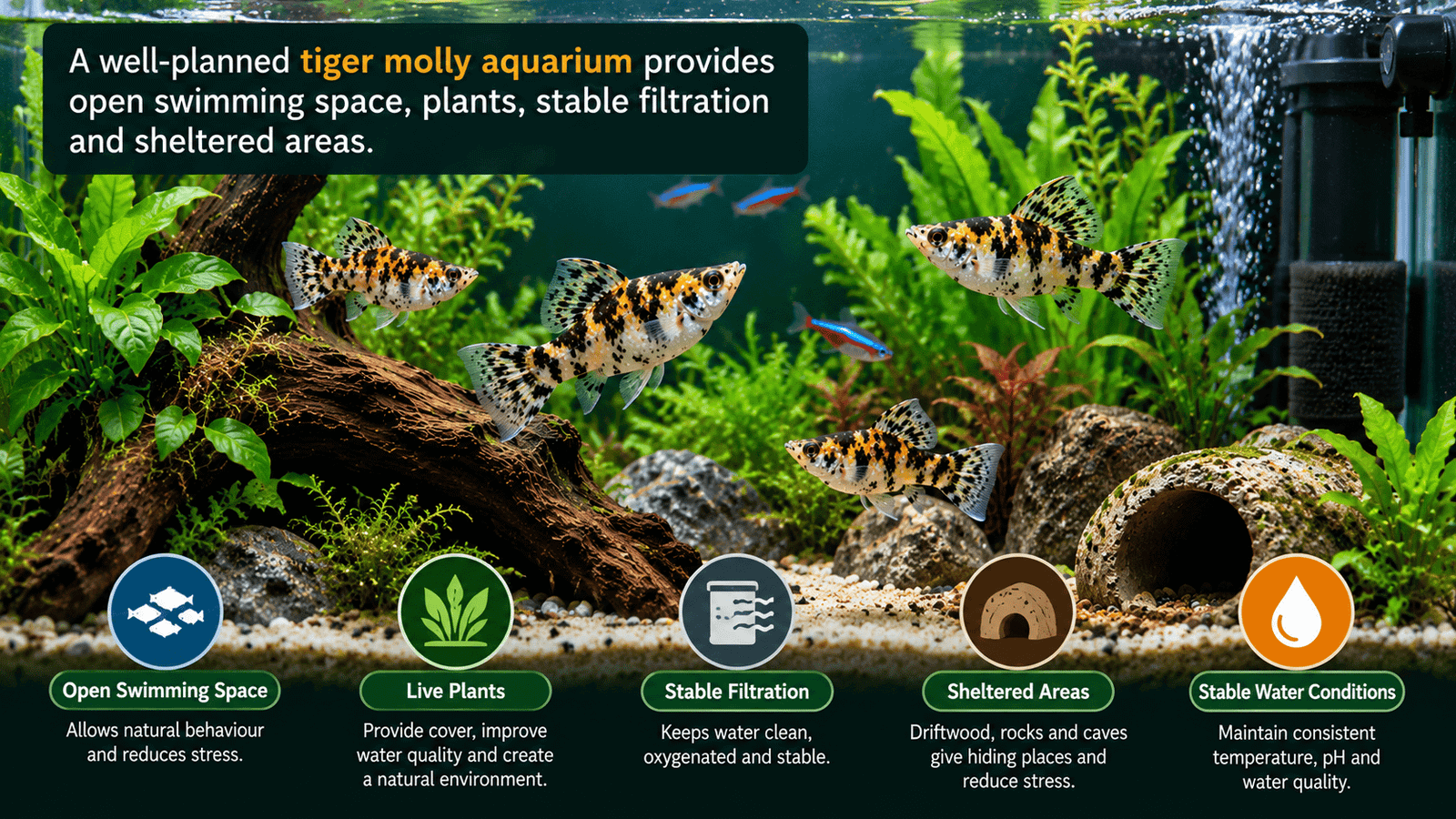
A good tiger molly aquarium combines open swimming space, live plants, moderate filtration, a reliable heater and shaded areas. The aim is not to reproduce every detail of a natural habitat but to provide the physical conditions that support normal swimming, feeding, social interaction and refuge.
Plants and Shelter
Live plants are useful because they provide visual barriers and can create refuge for females and fry. Dense plants can also reduce direct lines of sight between males and females. Floating plants can provide additional shade, while rooted or attached plants can structure the lower and middle sections of the aquarium.
Filtration and Aeration
Mollies are active fish and benefit from good oxygenation. The filter should provide biological filtration and enough circulation to keep the aquarium mixed without creating a current that constantly exhausts the fish. Surface agitation is especially useful because it supports gas exchange.
Heater and Lighting
Before adding fish, allow the aquarium to complete the nitrogen cycle. A new tank can look clean while still being biologically unsafe. The AquariumsWorld aquarium setup resource explains cycling, equipment and the relationship between tank volume and filtration.
9. What Do Tiger Molly Fish Eat?
Tiger mollies are omnivores with a strong tendency to graze on plant material and algae. Their diet should therefore be more varied than a single tropical flake. A high-quality staple food can provide a nutritional foundation, while spirulina, vegetables and occasional frozen foods add variety.
Tiger Molly Commercial Diet
Quality tropical flakes or small pellets can be used as regular staple foods. Choose products that provide a balanced nutrient profile rather than relying on colour-enhancing ingredients alone. Small portions are preferable to large meals because uneaten food quickly becomes an aquarium water-quality problem.
Vegetables and Plant Foods
Blanched zucchini, spinach, peas and other suitable vegetables can be offered periodically. Spirulina-based foods are particularly convenient for increasing plant-derived nutrition. Mollies naturally graze surfaces, so allowing some controlled biofilm and algae can complement the prepared diet.
Frozen and Live Foods
Brine shrimp, daphnia and other suitable frozen foods can be offered periodically. These foods should be treated as part of a varied diet rather than the sole food source. Feeding a high amount of rich animal protein every day is unnecessary for a fish that naturally consumes substantial plant material.
Tiger Molly Feeding Schedule
| Day | Food |
|---|---|
| Monday | Quality tropical flakes or pellets |
| Tuesday | Spirulina-based food |
| Wednesday | Staple food plus a small vegetable portion |
| Thursday | Quality tropical flakes or pellets |
| Friday | Frozen brine shrimp or daphnia |
| Saturday | Spirulina or vegetable-based food |
| Sunday | Light feeding day based on body condition |
Feed small portions that are consumed quickly. Pregnant females and growing juveniles may require more frequent feeding, but the aquarist should increase nutrition without allowing food to accumulate. If you are comparing livebearer feeding strategies, the AquariumsWorld Blog archive provides access to other freshwater fish care resources.
10. Tiger Molly Behaviour and Temperament
Tiger mollies are active, social and generally peaceful community fish. They spend most of their time swimming through the middle and upper sections of the aquarium and often investigate plants, decorations and feeding areas. Their activity makes them a good choice for aquarists who prefer a lively community aquarium rather than a species that spends most of the day hidden.
Males can be persistent in courtship. The problem is not usually severe aggression but repeated attention toward females. A single female with several males may have little opportunity to rest. This is why a female-heavy group is strongly preferable.
How Many Tiger Mollies Should You Keep Together?
| Group | Males | Females | Comment |
|---|---|---|---|
| 4 fish | 1 | 3 | Reasonable small group |
| 6 fish | 2 | 4 | Good starting community group |
| 9 fish | 3 | 6 | Needs more swimming space and filtration |
Keeping only males can avoid accidental breeding, but it can also create male competition. Keeping equal numbers of males and females can expose each female to repeated courtship. A female-heavy ratio is usually the most practical compromise for a mixed-sex community aquarium.
Plants and hardscape should create visual breaks without blocking the entire aquarium. Females should be able to move away from males and choose sheltered positions. This is particularly important during pregnancy, when a female may become less active and more vulnerable to stress.
11. Tiger Molly Tank Mates
Tiger molly tank mates should share broadly compatible water requirements and peaceful behaviour. Mollies are best combined with fish that can tolerate warm, moderately hard to hard water and that do not constantly harass them.
| Tank mate | Compatibility | Notes |
|---|---|---|
| Guppies | Excellent | Similar livebearer behaviour and overlapping conditions |
| Platies | Excellent | Peaceful livebearers with similar community habits |
| Swordtails | Good | Needs adequate swimming space |
| Corydoras | Good with compatible water | Occupy the bottom zone |
| Neon tetras | Conditional | Check temperature and hardness overlap carefully |
| Peaceful bristlenose pleco | Good | Different feeding and habitat zone |
| Zebra danios | Conditional | Active fish that require suitable temperature overlap |
| Aggressive cichlids | Poor | Risk of harassment or predation |
The AquariumsWorld Aquarium Setup and Guide archive includes compatibility resources that can help when building a mixed community. The key principle is to compare adult size, water chemistry, temperature, swimming behaviour and feeding competition rather than relying on a simple list of supposedly compatible fish.
When discussing aggressive species, the Can Goldfish Live with Oscar Fish compatibility guide is a useful example of why fish should not be mixed solely because they can survive similar water chemistry. Behaviour, adult size and predatory risk can be more important than temperature alone.
Very aggressive cichlids, large predatory fish and persistent fin-nippers should be avoided. Tiger barbs can be problematic with long-finned fish because of their reputation for fin nipping. Small fry can also be eaten by adult mollies, including their own offspring.
12. Can Tiger Mollies Breed with Other Mollies?
Yes. Different aquarium colour forms associated with the same molly lineage can interbreed. Tiger mollies can therefore produce mixed-pattern offspring when kept with other compatible mollies. This is one reason selective breeding programs usually maintain separate groups if a particular colour pattern is important.
Livebearing reproduction is internally fertilised. The male uses the gonopodium to transfer sperm to the female reproductive tract. Research by Mokhtar et al. (2025) provides detailed anatomical evidence for the specialised male reproductive system of Poecilia sphenops, including synchronised spermatogenesis and sperm transport structures.
Female mollies can also retain sperm, which means a female may continue producing broods after a previous mating. This makes accidental breeding particularly common in mixed-sex community tanks. A keeper who wants to avoid population growth should not assume that removing the male immediately after one birth will prevent future fry.
If a colour strain is allowed to mix freely, offspring may show unpredictable patterns. For a display community this can be interesting. For a breeding project, however, it makes selective control more difficult.
13. Tiger Molly Breeding Guide
Tiger molly breeding is relatively straightforward once healthy mature fish are maintained under stable conditions. The most important factors are adult health, adequate nutrition, warm stable water, appropriate sex ratio and shelter for females and fry.
How Tiger Mollies Breed
Mollies are livebearers. Internal fertilisation occurs when the male transfers sperm using his gonopodium. Embryos develop inside the female until she gives birth to free-swimming young. The University of the West Indies profile supplied for this article reports a gestation period of approximately three to four weeks and brood sizes that can range widely with female size and condition.
The 2025 spermatogenesis study adds important biological context. Mokhtar et al. documented synchronised cystic development of male germ cells, specialised sperm ducts and spermatozeugmata. This is evidence of reproductive specialisation rather than a simple egg-laying mechanism adapted to an aquarium.
Pregnancy Signs
A gravid female may become noticeably deeper-bodied. The gravid area near the rear abdomen can become darker, although the visibility of this feature depends on colour, lighting and individual fish. Near birth, some females may become more reclusive and spend additional time around dense vegetation or sheltered areas.
Tiger Molly Fry Care
Adult mollies may consume fry, so survival improves when fry have dense plants, floating vegetation or a separate nursery aquarium. A dedicated breeding tank can contain fine-leaved plants and gentle filtration that cannot easily pull in newborn fry.
Fry need appropriately sized food. Finely crushed quality flakes, specialised fry food and newly hatched brine shrimp can be used depending on availability. Small frequent meals support growth, but uneaten food must be removed or controlled because fry tanks can deteriorate quickly.
Breeding Tank Setup
A 10 to 20 gallon breeding tank can be useful for a small group. Keep the water stable, provide dense cover, use gentle filtration and avoid aggressive tank mates. The aquarium should be easy to clean because frequent feeding can increase waste production.
For a broader guide to aquarium dimensions, the AquariumsWorld tank-size resource explains how water volume, filter flow and stocking interact.
Breeding Ethics
Before encouraging breeding, consider what will happen to the offspring. Mollies can produce more young than an ordinary community aquarium can accommodate. Responsible breeding means planning for grow-out space, food, water quality and eventual homes for surplus fish.
14. Tiger Molly Health and Common Problems
Ich
Fin Rot
Velvet and Other External Problems
Velvet can produce a fine dusty appearance and irritation. Other external problems can produce flashing, excess mucus or abnormal skin colour. Because several diseases can look similar, diagnosis should not be based on one visual symptom alone.
Buoyancy and Body-Shape Problems
Balloon mollies deserve particular attention because compressed body shapes can affect swimming and reproduction. If a fish struggles to maintain position, has difficulty feeding or repeatedly sinks or floats abnormally, test the water first and assess body shape, diet and potential disease together.
For a broader diagnostic approach, use the Fish Aquarium Problems and Solutions guide. It covers cloudy water, pH problems, nitrogen-cycle issues and common fish disease symptoms.
Important: If a tiger molly shows severe breathing difficulty, widespread lesions, sudden loss of balance or multiple fish become ill at once, test the aquarium immediately and seek qualified aquatic veterinary advice where available. Correct diagnosis matters because different diseases require different treatments.
15. Tiger Molly vs Balloon Molly: Key Differences
| Feature | Tiger Short Fin Molly | Tiger Balloon Molly |
|---|---|---|
| Body profile | More streamlined | Rounded and compressed |
| Swimming | Generally normal for a molly | Can be less efficient |
| Breeding | Generally straightforward | Can be more challenging |
| Colour | Tiger pattern | Tiger pattern may be retained |
| Welfare consideration | Standard body form | Compressed body requires careful consideration |
The balloon molly is attractive to many aquarists, but body shape should not be treated as purely cosmetic. A strongly compressed body can alter swimming mechanics and internal anatomy. If choosing fish for long-term welfare, many keepers prefer naturally proportioned short-fin forms.
This distinction is also relevant to breeding. A fish that already has difficulty swimming may struggle more during pregnancy or when competing for food. Selective breeding should prioritise robust body condition and function rather than colour alone.
16. Frequently Asked Questions
What is a Tiger Molly fish?
A tiger molly is a patterned aquarium molly with distinctive dark and warm-coloured markings. It is generally treated as a colour form within the molly trade rather than a separate species. The underlying care principles are those of the molly lineage, including warm stable water, adequate hardness, suitable food and a peaceful community.
How big do Tiger Mollies get?
Adult size varies according to sex, genetics, breeding line and husbandry. Standard-bodied mollies commonly reach several centimetres, while balloon forms can be shorter in overall length but have a deeper body. Plan aquarium space around adult size rather than the small juveniles usually sold in shops.
What do Tiger Molly fish eat?
Tiger mollies are omnivores that benefit from quality flakes or pellets combined with spirulina, algae, vegetables and occasional frozen or live foods. Small meals are preferable to large feedings. A varied diet supports body condition while reducing the risk of relying on one food type.
Can Tiger Mollies breed with other mollies?
Yes. Compatible molly colour forms can interbreed, producing mixed-pattern offspring. If a keeper wants to preserve a particular tiger pattern, separate breeding groups are preferable. Mixed community tanks can otherwise produce fry with unpredictable combinations of colour and markings.
What fish can live with Tiger Mollies?
Peaceful livebearers such as compatible guppies, platies and swordtails can be suitable. Some peaceful bottom fish and other community species can also work when temperature, pH, hardness and temperament overlap. Avoid aggressive predators and persistent fin-nippers.
Are Tiger Mollies aggressive?
Tiger mollies are generally peaceful. The main social problem is persistent male courtship rather than serious aggression. Keeping more females than males helps distribute male attention. Plants and visual barriers also provide females with opportunities to rest.
What water temperature do Tiger Mollies need?
A practical tropical range is approximately 22 to 28°C, with the supplied University of the West Indies profile giving a broader range of 21 to 28°C for Poecilia sphenops. Stability is important, so avoid repeated large temperature swings.
How long do Tiger Mollies live?
Several years is a reasonable expectation for a well-kept molly, although lifespan varies with genetics, body form, disease, nutrition and water quality. Stable parameters, good food and sufficient space are more important than trying to guarantee a specific number of years.
How many Tiger Mollies should be kept together?
A small group of four to six can work in an appropriately sized aquarium, with a female-heavy ratio such as one male to two or three females. Larger groups require larger tanks and stronger filtration. Avoid overcrowding simply because young mollies appear small.
How do you breed Tiger Mollies?
Maintain healthy mature males and females in stable warm water with good nutrition and shelter. Mollies use internal fertilisation and females give birth to free-swimming fry. Dense plants or a separate breeding tank can improve fry survival because adult mollies may eat newborn young.
17. Conclusion
Tiger mollies are colourful, active and rewarding freshwater livebearers that can suit beginners and experienced aquarists alike. Their striking black and orange pattern makes them visually distinctive, but their long-term success depends on the same fundamentals that support other healthy mollies: stable water, adequate space, appropriate hardness, reliable filtration, balanced nutrition and compatible tank mates.
The most important social decision is the male-to-female ratio. A female-heavy group reduces persistent courtship pressure and gives females more opportunities to rest. Plants, floating cover and visual barriers further improve the social environment. If breeding is allowed, the aquarist should also prepare for fry and avoid creating an overcrowded population.
Scientific studies supplied for this guide add useful biological context. Recent research has described the specialised reproductive anatomy of Poecilia sphenops, while other studies have investigated immune-related tissues such as the pseudobranch, spleen and liver. These findings reinforce the broader lesson that successful aquarium care depends on supporting normal physiology, not simply keeping a fish alive.
If you are building your first tiger molly aquarium, start with a properly cycled tank, test the water regularly, introduce fish gradually and observe behaviour every day. For wider beginner advice, the AquariumsWorld Blog provides a growing collection of freshwater and aquarium setup guides.
For a larger community aquarium, compare your planned stocking with the AquariumsWorld tank-size and stocking calculator. If you experience water-quality problems, return to the Aquarium Problems and Solutions guide before adding unnecessary treatments.
References
- Mokhtar, D.M., Zaccone, G., Aragona, M., Guerrera, M.C., Alonizan, R. and Hussein, M.T. (2025). Unraveling Spermatogenesis in Molly Fish (Poecilia sphenops): An Integrative Study of Testicular Ultrastructure and Immunohistochemistry. Veterinary Sciences, 12(10), 930. https://doi.org/10.3390/vetsci12100930
- Mokhtar, D.M., Sayed, R.K.A., Zaccone, G., Alesci, A. and Hussein, M.M. (2023). The potential role of the pseudobranch of molly fish (Poecilia sphenops) in immunity and cell regeneration. Scientific Reports, 13, 8665. https://doi.org/10.1038/s41598-023-34044-8
- Sayed, R.K.A., Zaccone, G., Capillo, G., Albano, M. and Mokhtar, D.M. (2022). Structural and Functional Aspects of the Spleen in Molly Fish Poecilia sphenops (Valenciennes, 1846): Synergistic Interactions of Stem Cells, Neurons, and Immune Cells. Biology, 11(5), 779. https://doi.org/10.3390/biology11050779
- Hussein, M.M., Sayed, R.K.A. and Mokhtar, D.M. (2023). Structural and immunohistochemical analysis of the cellular compositions of the liver of molly fish (Poecilia sphenops), focusing on its immune role. Veterinary Research Communications, 47, 1 to 14. https://doi.org/10.1186/s40851-022-00200-7
- Alda, F., Reina, R.G., Doadrio, I. and Bermingham, E. (2013). Phylogeny and biogeography of the Poecilia sphenops species complex (Actinopterygii, Poeciliidae) in Central America. Molecular Phylogenetics and Evolution, 66(3), 1011 to 1026. https://doi.org/10.1016/j.ympev.2012.12.012
- Ramírez-García, A., Ramírez-Herrejón, J.P., Medina-Nava, M., Hernández-Morales, R. and Domínguez-Domínguez, O. (2018). Reproductive biology of the invasive species Pseudoxiphophorus bimaculatus and Poecilia sphenops in the Teuchitlán River, México. Journal of Applied Ichthyology, 34(1), 81 to 90. https://doi.org/10.1111/jai.13543
- University of the West Indies, Faculty of Science and Technology (2015). Poecilia sphenops – Common Molly. Species profile covering distribution, habitat, activity, diet, reproduction, brood size and environmental conditions. Full species profile