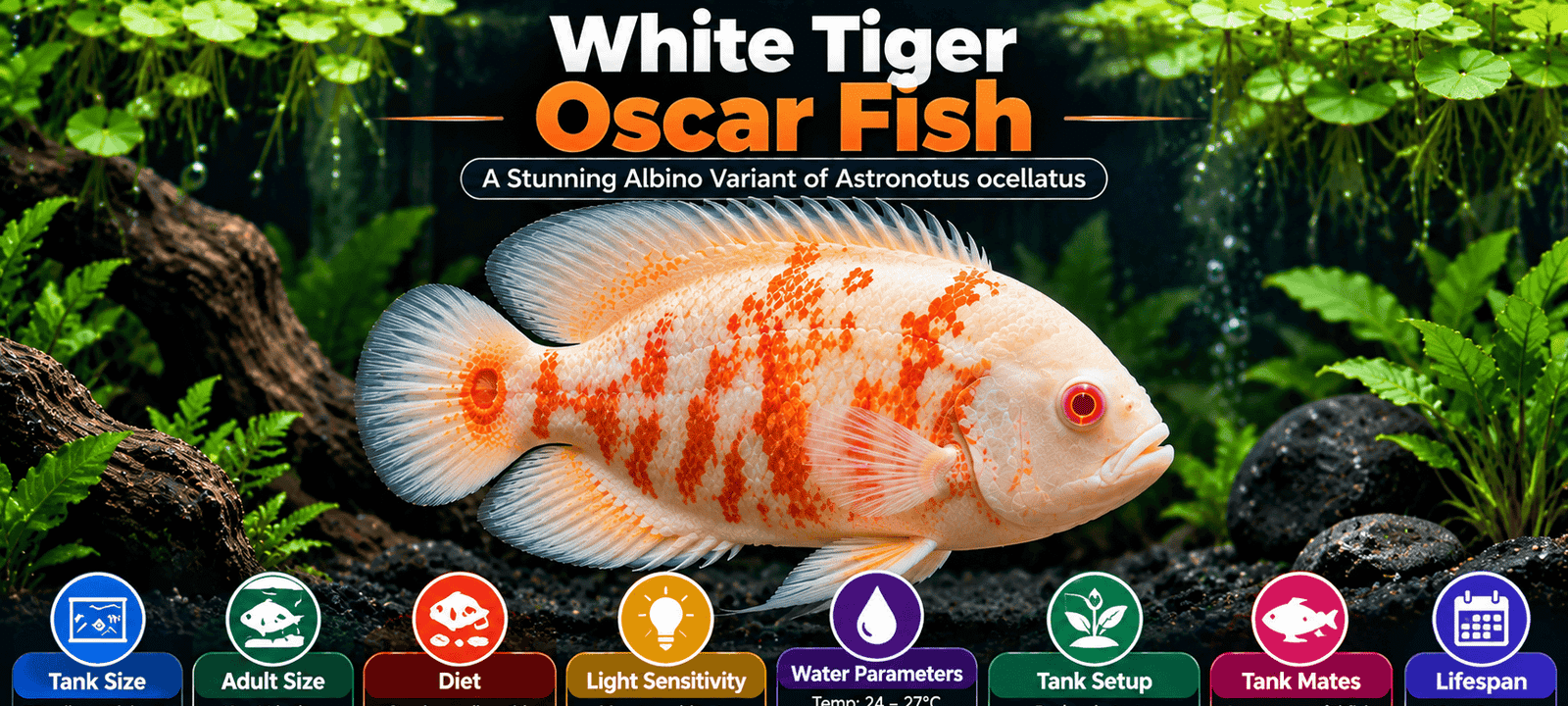
The white tiger oscar fish is a striking colour form of Astronotus ocellatus recognised in the aquarium trade for its pale cream or white body, orange-red tiger markings and often pink or red-looking eyes. It is not a separate species. Instead, the name describes a particular appearance within the highly variable ornamental Oscar trade.
For aquarists researching white tiger oscar fish care, the most important point is that colour does not change the basic biology of the species. The fish still becomes a large cichlid, produces substantial waste, requires strong filtration and needs adequate swimming space. The distinctive pigmentation does, however, make lighting, visual contrast and identification especially important.
The term albino tiger oscar is frequently used interchangeably with white tiger Oscar in the aquarium trade. True albinism involves a substantial reduction or absence of melanin pigmentation, while other pale fish can result from different pigmentation mechanisms. This distinction matters because a white-looking Oscar does not automatically have exactly the same pigmentation biology as a confirmed albino fish.
This complete guide explains the white tiger oscar fish colour, genetics, light sensitivity, tank size, diet, breeding, tank mates, health and lifespan. It also explains the difference between a white tiger Oscar, an albino tiger Oscar and other pale Oscar varieties without treating retailer terminology as a formal scientific classification.
If you are new to large cichlids, start with the complete beginner’s guide to fish care. For large aquarium planning, the 100 gallon fish tank guide is particularly useful.
What Is a White Tiger Oscar Fish?
A white tiger Oscar fish is an ornamental colour form of Astronotus ocellatus characterised by a pale or white body combined with orange-red tiger-style markings. The term is commonly used in the aquarium trade for fish sold as albino tiger Oscars, although retailer terminology is not a formal taxonomic classification.
Oscar fish belong to the family Cichlidae and originate from freshwater environments in South America. They are large, intelligent and behaviourally complex fish that can recognise routine, respond to feeding interactions and rearrange aquarium objects.
The white tiger appearance therefore sits on top of the same underlying species biology as the familiar tiger Oscar. The fish still needs appropriate water quality, strong filtration, adequate swimming space and a carefully planned diet.
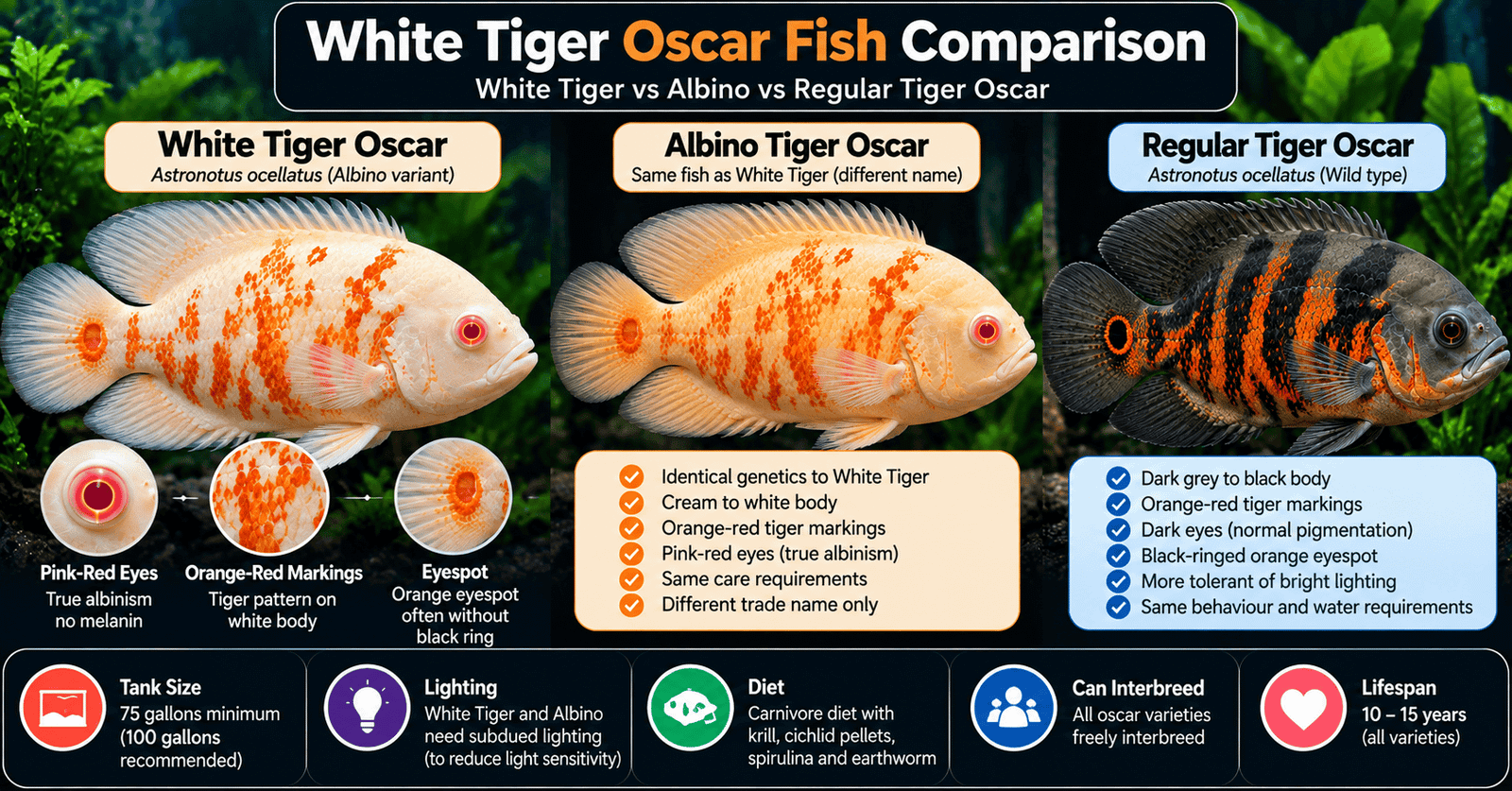
The most visible difference is pigmentation. A conventional tiger Oscar has a darker background over which orange, red and other colours appear. In a white tiger form, the darker pigmentation is greatly reduced, allowing the lighter background and warm markings to dominate visually.
Research into fish pigmentation shows that fish colour is produced by different classes of pigment cells and structural components. Melanophores are associated with melanin, while xanthophores and erythrophores contribute yellow, orange and red colours. Iridophores produce reflective effects through specialised structures.
That biology explains why two Oscars can have the same species name but look dramatically different.
White Tiger Oscar Fish vs Albino Tiger Oscar
In aquarium retail terminology, white tiger Oscar and albino tiger Oscar are often used for the same general appearance. The word “tiger” refers to the contrasting orange-red pattern, while “albino” describes the underlying pigmentation phenotype.
However, the names should not be treated as laboratory genetic diagnoses. A retailer may use “white tiger” because the fish appears predominantly white, while another seller may use “albino tiger” because the eyes and body indicate reduced melanin pigmentation.
Eye colour can provide an important clue. A genuinely albino fish typically has substantially reduced melanin in the eyes, which can make the eyes appear pink, red or reddish. A pale fish with normally pigmented dark eyes may instead represent another pigmentation phenotype.
This is why the safest identification approach combines eye colour, body pigmentation, pattern, breeder information and photographs rather than relying on the product name alone.
White Oscar Fish vs White Tiger Oscar
The phrase white Oscar is broader than white tiger Oscar. A white-looking Oscar may retain orange or red markings, may have very little visible pattern or may represent a different pigmentation line entirely.
The white tiger appearance is defined visually by contrast. The pale body remains the background while orange-red markings create the tiger-like pattern. A more uniformly white fish has less visible residual pattern.
Because ornamental fish colour names are not equivalent to scientific taxonomic names, buyers should ask the seller what breeding line the fish comes from rather than assuming that every “white Oscar” has identical genetics.
White Tiger Oscar Fish Appearance and Colour
What Does a White Tiger Oscar Fish Look Like?
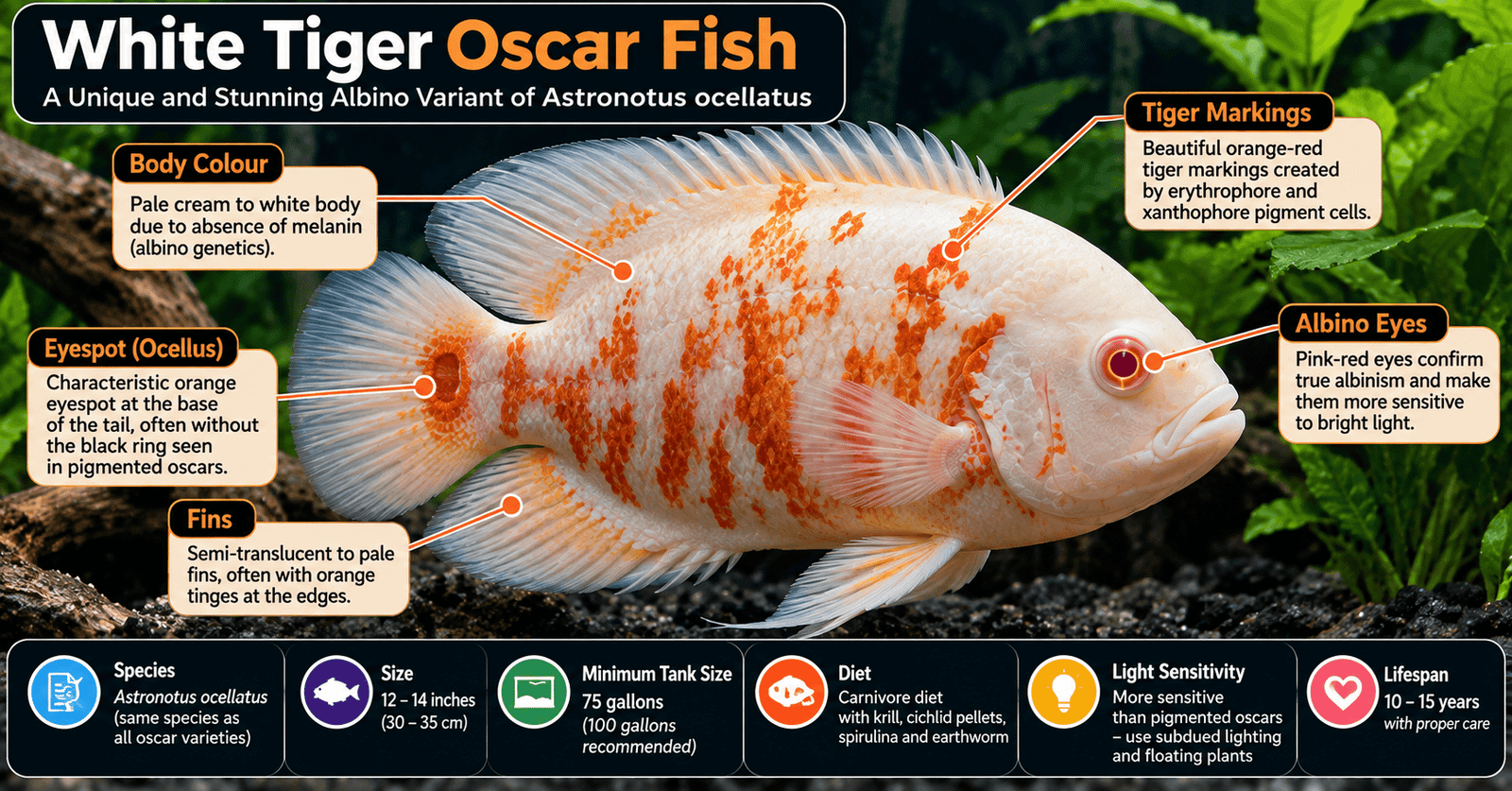
The most recognisable white tiger Oscar has a pale cream, ivory or white base colour combined with irregular orange-red markings across the body. The markings can vary substantially between individuals.
- Body: pale cream, ivory, silver-white or predominantly white.
- Pattern: orange-red or reddish markings arranged in tiger-like patches.
- Eyes: often pink or red in genuinely albino individuals.
- Fins: translucent, pale or lightly coloured, sometimes with orange-red accents.
- Tail ocellus: may be visible but can look different from the strongly outlined ocellus of darker Oscars.
- Juvenile pattern: often appears more sharply contrasted before adult colour develops.
Colour should not be judged only under the seller’s aquarium lighting. Aquarium LEDs can dramatically alter how white, cream, orange and red pigments appear.
A fish photographed under warm lighting may appear more golden, while a fish under cool white lighting may look more silver or stark white. For buying decisions, ask for photographs under neutral lighting whenever possible.
White Tiger Oscar Fish Colour Development
Colour changes naturally throughout Oscar development. Juveniles can have strong contrasting bands and patches that become more complex as the fish grows.
The orange-red component of the pattern is associated with pigment cells that obtain or concentrate carotenoid pigments. Dietary carotenoids can therefore influence colour intensity, although feeding cannot transform a genetically pale fish into a completely different colour morph.
Luo and colleagues’ review of fish pigmentation explains the biological roles of different chromatophore classes and the importance of pigment availability in aquaculture colour development.
For a white tiger Oscar, this means the goal should be maintaining healthy, naturally expressed orange-red pigmentation rather than attempting to force an artificial colour change.
Why the White Background Makes the Tiger Pattern Look Stronger
The visual impact of the white tiger Oscar comes partly from contrast. Orange-red pigment is highly visible against a pale background because there is less competing dark pigmentation.
Tank background also changes perceived contrast. A dark background can make a pale fish appear brighter, while a light background can reduce the visual separation between the fish and the aquarium.
Research into background colour in Oscars has found that environmental colour can influence physiological responses and other measured outcomes. The practical lesson is not that one background is universally healthiest, but that environmental colour should be considered as part of the overall aquarium design.
White Oscar Fish Colour Genetics and Melanin
The genetics of the white tiger Oscar are more complicated than simply saying “white equals one albino gene.” Albinism is a pigmentation phenotype associated with impaired melanin synthesis, while ornamental colour lines can involve multiple genetic and developmental factors.
How Albinism Produces Reduced Melanin
Melanin synthesis involves a biochemical pathway in which the enzyme tyrosinase plays a central role. Other proteins, including tyrosinase-related proteins, also participate in the pathway.
Research into fish albinism has identified mutations and altered expression in core melanin-related genes as important mechanisms behind pigmentation loss. Bian and colleagues reviewed these pathways across fish and showed why genetic disruption of the melanin system can produce albino phenotypes.
When functional melanin production is greatly reduced, melanophores cannot produce the normal dark pigment that would otherwise contribute to the fish’s background colour. Other chromatophore types can remain visible, which helps explain why an albino tiger Oscar can still show orange-red markings.
Albinism vs Leucism in Fish
Albinism and leucism should not be treated as identical conditions.
In true albinism, melanin production is greatly reduced or absent and pigmentation can also be affected in the eyes. In leucism, pigmentation is reduced in the skin but the eyes can retain normal pigmentation.
This distinction is useful when identifying a pale Oscar. A white-looking fish with normally dark eyes may not be a classic albino. A fish with a pale body and strongly pink or red-looking eyes is more consistent with an albino phenotype.
The precise visual diagnosis should still be treated cautiously because aquarium lighting, photography and individual variation can alter eye appearance.
Albino Tiger Oscar Genetics in Breeding
The supplied hobbyist description of albino inheritance as a simple recessive trait is a useful Mendelian model, but it should not be presented as a scientifically established universal breeding formula for every commercial Oscar line.
If a specific albino trait behaves as a simple recessive allele, two confirmed homozygous albino parents would be expected to produce albino offspring under that model. An albino crossed with a heterozygous carrier would theoretically produce approximately half albino and half carrier offspring.
However, actual ornamental Oscar breeding lines can contain additional pigmentation genes and selective-breeding effects. Therefore, breeders should not promise exact percentages unless the genetic line has been tested or its inheritance pattern has been established through controlled breeding.
Important genetics point: “White tiger Oscar” is an aquarium trade description, not a formally recognised scientific subspecies. The appearance can be described confidently, but the exact genotype of an individual fish cannot be established from appearance alone.
Why the Same Species Can Have Different Colours
Oscar colour diversity illustrates how selective breeding can produce striking differences within one species. Natural pigmentation variation is influenced by genetics, chromatophore development, hormones, environmental conditions and diet.
This is also why two juvenile Oscars sold under the same colour label may develop somewhat differently as adults.
The best approach is to treat colour as a biological trait with variation rather than a guaranteed visual specification.
How Rare Is the White Tiger Oscar Fish?
The white tiger Oscar is better described as uncommon in many retail settings rather than universally rare. Availability depends on breeding activity, regional demand, specialist retailers and the particular colour line being sold.
Large chain stores may occasionally stock albino tiger Oscars, while specialist cichlid retailers and online ornamental fish sellers can offer more colour varieties.
Availability can also change seasonally. A breeder may have several juveniles available after a successful spawn and then have none for months.
The term “rare” should therefore be used carefully. A fish can be uncommon locally but readily available nationally through specialist breeders.
White Tiger Oscar Fish Price in the USA
Prices vary substantially by seller, size, pattern, provenance and current availability. A small standard albino tiger Oscar may be relatively affordable, while a large fish with strong contrast and established breeding provenance can cost considerably more.
Because live-fish prices change rapidly, a fixed price should not be treated as an evergreen SEO fact. Instead, compare several specialist sellers and evaluate the fish itself.
A higher price does not prove that a fish is genetically superior. Ask whether the seller can explain the breeding line, adult appearance, current size, feeding history and health condition.
Are White Tiger Oscar Fish Sensitive to Light?
Albino white tiger Oscars can be more sensitive to bright light because reduced melanin pigmentation affects normal light filtering in the eyes. The safest aquarium design provides moderate lighting, shaded areas and the ability for the fish to move away from direct illumination.
Light sensitivity is one of the most important care considerations when keeping an albino Oscar. Melanin has optical functions in the eye, and reduced pigmentation can change how light reaches the retina.
This does not mean that every albino Oscar will be distressed by every aquarium LED. Individual tolerance varies, and the total environment matters. A fish with shaded refuges can choose where to position itself, while a bare aquarium under intense lighting removes that choice.
Why Albino Oscars Can Be More Light Sensitive
Pigment in the eye can absorb and scatter light before it reaches sensitive retinal structures. When pigmentation is reduced, more light can enter the eye.
Research on albino fish demonstrates differences in pigmentation cells and melanin-related structures compared with normally pigmented fish. Li and colleagues specifically investigated wild and albino Oscar skin and found substantial differences in melanophore and melanosome characteristics.
The practical aquarium implication is simple: avoid creating an environment in which the fish has no escape from intense illumination.
White Oscar Fish Light Sensitivity Care
- Use low to moderate lighting rather than unnecessarily intense illumination.
- Provide shaded areas below floating plants or overhangs.
- Use a consistent photoperiod.
- Avoid sudden transitions from complete darkness to very bright lighting.
- Observe the fish during the lighting period.
- Reduce intensity if the fish persistently hides whenever the light turns on.
Best Lighting Schedule
A practical starting point is approximately 7 to 9 hours of aquarium lighting per day, with the exact schedule adjusted according to room lighting, plant requirements and fish behaviour.
A timer is preferable to manually switching the light on and off at random times. Consistency makes the aquarium environment more predictable.
Signs the Lighting May Be Too Strong
- Persistent hiding immediately after lights switch on.
- Repeated attempts to remain underneath hardscape.
- Reduced feeding activity during the light period.
- Repeated frantic swimming after sudden illumination.
- Persistent avoidance of exposed areas despite otherwise suitable water quality.
These signs are not proof of light sensitivity because similar behaviours can result from poor water quality, aggression, inadequate cover or recent introduction. Test the water and evaluate the entire environment before attributing the behaviour to lighting alone.
White Tiger Oscar Fish Tank Size
The white tiger Oscar has the same basic tank-size requirements as other Astronotus ocellatus. A practical long-term target for one adult is generally 75 gallons or larger, while a 100 gallon aquarium provides additional swimming space and water volume. Larger aquariums are necessary when multiple large fish are kept together.
Colour does not make an Oscar smaller. A white tiger Oscar can become the same large-bodied cichlid as other Oscar varieties.
This means buyers should not choose a smaller aquarium because a white tiger Oscar is sold as a juvenile. Retail fish are frequently much smaller than their adult form.
For aquarium planning, adult body size and footprint matter more than the label on the shipping bag.
75 Gallon vs 100 Gallon for a White Tiger Oscar
| Feature | 75 Gallons | 100 Gallons |
|---|---|---|
| One adult Oscar | Practical long-term target depending on footprint and husbandry | More swimming and water-quality margin |
| Water volume | Approximately 284 litres nominal | Approximately 379 litres nominal |
| Decor space | Moderate | Greater flexibility |
| Filtration capacity | Strong filtration required | More room for redundant filtration |
| Tank mates | Limited and highly dependent on species | More practical, but compatibility remains essential |
The AquariumsWorld 100 gallon fish tank guide provides additional information about large aquarium dimensions, filled weight, stands, filtration and setup planning.
White Tiger Oscar Fish Tank Size for Juveniles
A juvenile can temporarily be kept in a smaller aquarium while a larger system is prepared. However, the upgrade should be planned before the fish becomes large.
Do not use a small aquarium deliberately to restrict growth. A fish appearing small because of environmental limitation is not a successful husbandry outcome.
The AquariumsWorld Aquarium Stocking Calculator also explains why adult fish size and bioload should be considered instead of relying on the outdated one-inch-per-gallon rule.
White Tiger Oscar Fish Tank Setup
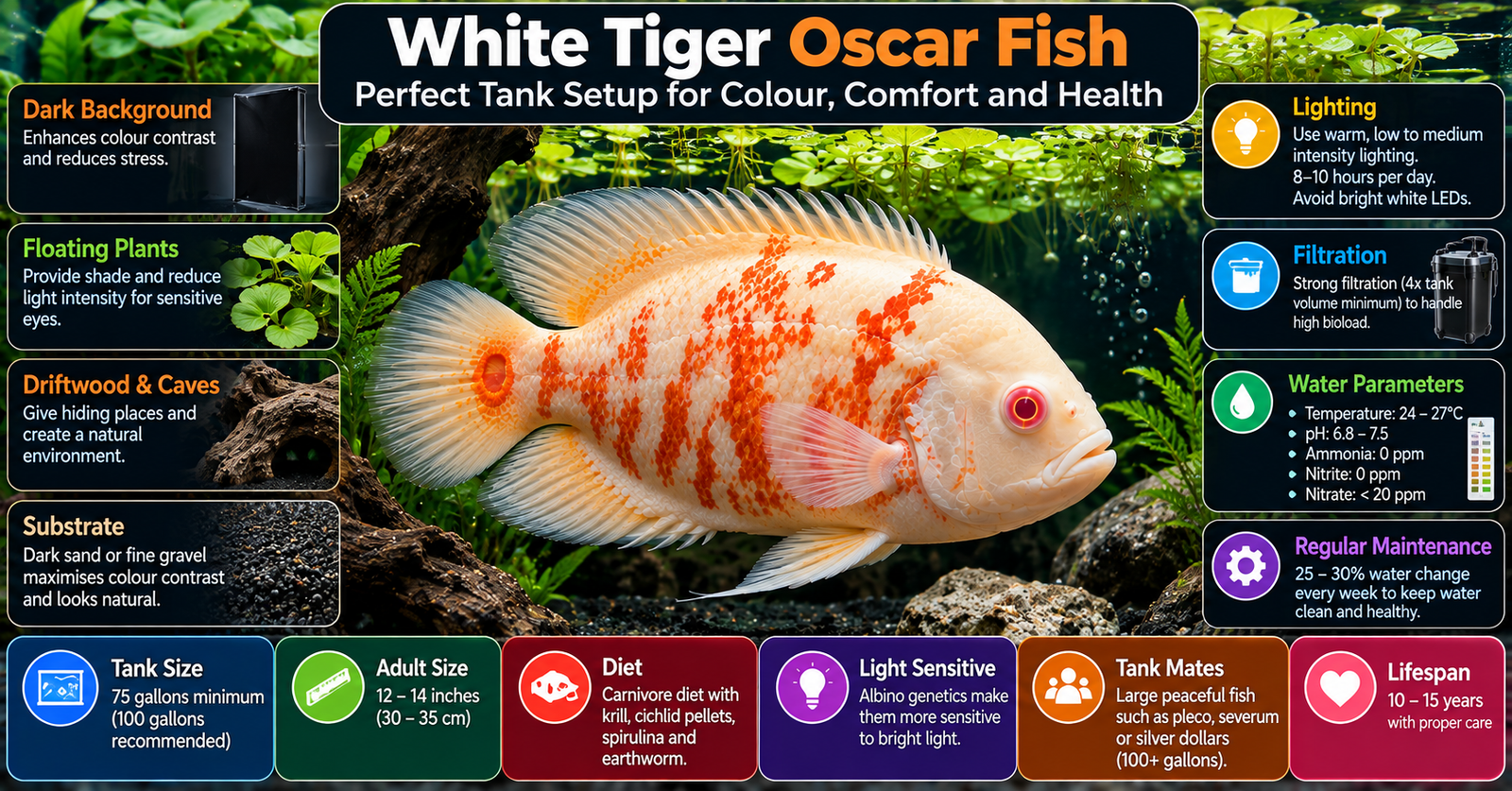
The ideal white tiger oscar fish tank setup combines open swimming space with shaded refuge, strong filtration, stable water temperature and a substrate that provides strong visual contrast.
| Tank Element | Recommendation | Purpose |
|---|---|---|
| Tank size | 75 gallons or larger for one adult | Provides appropriate swimming and water volume |
| Substrate | Dark sand or smooth fine gravel | Improves visual contrast and is easy to clean |
| Background | Dark or neutral | Creates stronger contrast with pale body colour |
| Lighting | Low to moderate | Reduces unnecessary light exposure |
| Floating cover | Optional but useful | Creates shaded refuge |
| Hardscape | Large smooth rocks and secure driftwood | Provides structure without excessive clutter |
| Filtration | Strong biological and mechanical filtration | Handles large-cichlid waste production |
| Lid | Secure fitted lid | Reduces jumping risk |
White Tiger Oscar Fish Substrate
Dark sand is particularly attractive with a pale Oscar because it increases visual contrast. Fine sand is also practical for a fish that interacts with the substrate.
Avoid sharp gravel. Oscars are powerful fish that can move substrate while feeding and exploring.
If you are considering planted substrates, see the AquariumsWorld guide to soil in fish tanks.
White Tiger Oscar Fish Decor
Oscar aquariums should not be packed with ornaments. Large cichlids need open swimming areas and can move lightweight objects.
Use large smooth rocks, sturdy driftwood and secure structures. Leave sufficient open space in front of the aquarium for uninterrupted swimming.
Avoid unstable rock piles. A large Oscar can push or reposition objects, creating a risk of collapse.
Floating Plants for Shade
Floating plants can create natural shade, but Oscars may uproot or damage many plants. If live floating plants do not remain stable, artificial shade structures can provide the same environmental function.
The purpose is not to keep the entire aquarium dark. The fish should have access to both illuminated and shaded areas so it can regulate its position.
Filtration for a White Tiger Oscar
Oscar fish are heavy waste producers. The filter should provide substantial biological media, effective mechanical filtration and strong circulation.
A large canister filter is one practical option. Another approach is a canister combined with a sponge filter, providing additional biological media and redundancy.
The filter’s advertised gallon rating should not be treated as a guaranteed stocking capacity. Actual performance depends on media, maintenance, flow, feeding and biological maturity.
For additional aeration information, see the fish tank air pump and aeration guide.
What Do White Tiger Oscar Fish Eat?
White tiger Oscars eat the same general diet as other Oscars. A quality cichlid pellet can form the staple, supported by appropriately selected frozen or prepared foods. Diet can influence the intensity of orange-red pigmentation, but feeding cannot change the fish’s underlying genetic colour pattern.
The most important feeding rule is moderation. Oscars are enthusiastic feeders and can quickly learn to associate the keeper with food.
Overfeeding creates unnecessary waste and can rapidly increase the organic load of a large-cichlid aquarium.
White Tiger Oscar Fish Diet and Colour
The orange-red markings are associated with pigment cells that use dietary carotenoids. Unlike mammals, fish can display strong colour changes based on available pigments in their diet.
Luo and colleagues’ pigmentation review explains the roles of xanthophores and erythrophores in fish colouration. Research involving Oscar fish has also examined dietary spirulina and its relationship with pigmentation.
This makes carotenoid-rich foods useful as part of a balanced diet, but “colour enhancing” should not be interpreted as a requirement to feed excessive amounts of one pigment source.
Useful Foods for a White Tiger Oscar
- High-quality large-cichlid pellets.
- Prepared foods containing appropriate carotenoid sources.
- Frozen krill in moderation.
- Frozen bloodworm as an occasional supplementary food.
- Spirulina-containing prepared foods.
- Other nutritionally complete frozen or prepared foods appropriate for large cichlids.
White Tiger Oscar Weekly Feeding Example
| Day | Food | Purpose |
|---|---|---|
| Monday | Quality cichlid pellets | Staple nutrition |
| Tuesday | Pellets plus small amount of frozen krill | Nutrition and carotenoid source |
| Wednesday | Quality cichlid pellets | Staple nutrition |
| Thursday | Frozen supplementary food | Dietary variety |
| Friday | Spirulina-containing prepared food | Dietary pigment support |
| Saturday | Reduced feeding or fasting according to condition | Prevents routine overfeeding |
| Sunday | Quality cichlid pellets | Staple nutrition |
This is an example rather than a mandatory schedule. Juveniles may need more frequent feeding than large adults, while individual fish vary in appetite and growth.
How Much Should a White Tiger Oscar Eat?
Offer an amount that the fish consumes promptly without leaving significant food behind. Remove uneaten food when necessary.
The correct quantity should be adjusted according to age, body condition, growth and food type rather than following a rigid number of pellets.
For broader aquarium feeding and maintenance principles, see the Fish Aquarium Problems and Solutions guide.
White Tiger Oscar Fish Water Parameters
White tiger Oscars require the same basic water conditions as other Oscars. Colour does not change their need for stable temperature, low nitrogenous waste and appropriate pH.
| Parameter | Practical Aquarium Target | Management Principle |
|---|---|---|
| Temperature | Approximately 24 to 27°C | Keep stable and species appropriate |
| pH | Approximately neutral to mildly acidic/alkaline depending on source water | Stability is more important than constant adjustment |
| Ammonia | 0 ppm | Should not accumulate in a mature aquarium |
| Nitrite | 0 ppm | Should remain undetectable |
| Nitrate | Keep low through regular maintenance | Monitor accumulation between water changes |
| Water changes | Typically 25 to 30% as a starting point | Adjust according to testing and stocking |
AquariumsWorld’s water temperature for cichlids guide explains why cichlid temperature should be selected by species rather than treating all cichlids as identical.
The Oscar-specific temperature literature also supports avoiding temperature extremes. A recent study of juvenile Astronotus ocellatus investigated temperature and early stress responses, showing that environmental temperature affects growth and survival.
Water Changes for White Tiger Oscars
A weekly partial water change is a useful starting point for many Oscar aquariums, but actual maintenance should be based on nitrate accumulation, feeding, fish size and test results.
A heavily stocked aquarium may need more frequent changes. A lightly stocked mature aquarium may require less frequent intervention, although regular testing remains important.
Always dechlorinate replacement water and avoid large sudden temperature differences.
Nitrogen Cycle
Before introducing a white tiger Oscar, the aquarium should have an established biological filtration system.
Ammonia is converted through the nitrogen cycle by microbial communities. Nitrite is then converted to nitrate. Water changes are required because nitrate is not simply eliminated by the biological filter.
The AquariumsWorld aquarium problems guide contains additional information about cycling, cloudy water, ammonia and other water-quality problems.
Can White Tiger Oscar Fish Breed with Other Oscar Varieties?
Yes. White tiger Oscars are forms of Astronotus ocellatus, so they can breed with other Oscars of the same species. The appearance of the offspring depends on the genetic characteristics of both parents and cannot be predicted from trade names alone.
Oscar breeding is a substantial undertaking because mature fish become large, territorial and protective of their eggs and fry.
A breeding pair can also become significantly more aggressive toward other fish during spawning.
White Tiger Oscar Fish Breeding Setup
A large aquarium with a smooth flat spawning surface is useful. The pair should have sufficient space to establish a territory without constantly confronting other fish.
Large flat rocks, slate or other stable smooth surfaces can provide suitable spawning sites.
Excellent filtration and water quality are essential because breeding fish produce additional waste and may spend more time defending a particular section of the aquarium.
White Tiger Oscar Breeding Behaviour
A breeding pair may clean a flat surface repeatedly before spawning. Courtship can involve parallel swimming, lip locking, territorial displays and increased interaction.
Once eggs are deposited, both parents may guard them. This parental behaviour is one of the most interesting aspects of Oscar breeding.
Other fish can become targets of aggression during this period, so community aquariums require careful observation.
Albino Genetics and Breeding Expectations
It is tempting to state that two white tiger Oscars always produce 100% white tiger offspring, but that conclusion requires knowledge of the actual genetic basis of the particular line.
If the relevant albino phenotype is controlled by a simple recessive allele and both parents are homozygous for that allele, all offspring would be expected to inherit the recessive allele from both parents. But commercial colour lines can involve additional genes and selection history.
Therefore, breeders should describe expected outcomes as genetic predictions based on a known line rather than promising a fixed percentage for every white tiger pairing.
Breeding With Other Oscar Varieties
A white tiger can be paired with another Oscar colour variety because they remain the same species. The resulting juveniles may show a range of pigmentation depending on the genetic combination.
The offspring should not automatically be labelled as a specific colour morph until their pigmentation develops.
White Oscar Fish Tank Mates
The best white oscar fish tank mates are large enough to avoid being swallowed, robust enough to tolerate Oscar behaviour and compatible with similar environmental conditions.
However, a tank mate is never guaranteed to be compatible simply because a website lists the species as a possible companion.
| Potential Tank Mate | Why It May Work | Important Limitation |
|---|---|---|
| Large Plecostomus | Armoured body and bottom-oriented behaviour | Species can become very large and add substantial bioload |
| Silver Dollar Fish | Fast-moving and appropriately sized | Requires a sufficiently large aquarium and group |
| Severum | Large South American cichlid with overlapping environmental needs | Territorial compatibility is individual |
| Bichir | Large bottom-oriented predator | Needs substantial floor space and careful feeding |
| Jack Dempsey | Similar size and robust temperament | Aggression and territory can become serious |
The Can Goldfish Live with Oscar Fish guide explains why species compatibility must consider temperature, size, behaviour and diet together.
Goldfish should not be selected as tank mates for Oscars simply because both are freshwater fish. Their environmental requirements and long-term biology differ.
The Orange Plecostomus complete care guide also demonstrates why a pleco should not be viewed simply as an aquarium cleaning animal. Plecos have their own nutritional, spatial and water-quality requirements.
White Tiger Oscar Tank Mates and Light Sensitivity
The albino appearance adds one additional consideration: avoid companions that constantly chase or harass the white tiger Oscar.
Persistent aggression can prevent the fish from using its shaded areas and increase overall environmental stress.
If the aquarium contains multiple large fish, a larger tank is generally easier to manage because it provides more opportunities for territorial separation.
How Long Does a White Tiger Oscar Fish Live?
A well-maintained Oscar can live for many years, and aquarium literature commonly places the lifespan of healthy Oscars in the range of approximately 10 years or more, with individual outcomes varying considerably.
Albinism does not automatically mean that a white tiger Oscar must have a short life. Good nutrition, water quality, adequate space, disease prevention and suitable lighting can support long-term welfare.
The biggest mistake is assuming that the colour morph changes the basic husbandry requirements. It does not.
A white tiger Oscar still needs an aquarium designed for a large adult fish.
White Oscar Fish Health Problems
The health problems of a white tiger Oscar overlap strongly with those of other Oscars. The additional care consideration is pigmentation and potential light sensitivity in genuinely albino fish.
Eye Problems and Bright Lighting
Persistent exposure to intense light can be particularly uncomfortable for an albino fish. However, claims that normal aquarium lighting automatically causes permanent retinal damage should be avoided unless supported by species-specific experimental evidence.
The practical approach is prevention through environmental choice. Use moderate lighting and provide shaded areas.
Hole in the Head and Water Quality
Head and lateral line erosion, commonly called Hole in the Head, has been associated with multiple potential factors including environmental stress, water quality and nutritional issues. It should not be reduced to one single cause.
Maintain clean water, avoid chronic overcrowding and provide a nutritionally complete diet.
If pits, erosions or unusual lesions appear on the head, test the aquarium immediately and consider professional aquatic veterinary advice.
Ich and Parasites
Ich can affect Oscars regardless of colour. Stress, pathogen exposure and environmental instability can increase disease risk.
One advantage of a white tiger Oscar is visibility. White spots can sometimes be easier to notice against a pale or lightly coloured body depending on the background and lighting.
Never diagnose Ich solely from one visual symptom. Test water quality and inspect the fish carefully.
Fin Damage and Bacterial Disease
Fin damage can create opportunities for secondary infection. Aggressive tank mates, sharp decorations and poor water quality can all contribute.
The first response should be environmental assessment. Check ammonia, nitrite, nitrate, temperature and tank-mate behaviour before assuming medication is the complete solution.
Colour Fading
A reduction in orange-red colour can occur for several reasons:
- Stress.
- Recent transfer to a new aquarium.
- Changes in lighting.
- Dietary differences.
- Age-related colour development.
- Water-quality problems.
- Individual genetic variation.
Colour fading alone is therefore not a disease diagnosis.
For general diagnosis and maintenance, use the Fish Aquarium Problems and Solutions guide.
How to Enhance White Tiger Oscar Colour
The best way to enhance a white tiger Oscar’s colour is to support normal health rather than attempt artificial colour manipulation.
1. Provide a Nutritionally Complete Diet
A high-quality cichlid pellet provides a predictable nutritional foundation. Supplementary foods can add variety and naturally occurring carotenoids.
2. Use Carotenoid-Rich Foods Responsibly
Krill, spirulina-containing foods and prepared diets formulated with carotenoids can support orange and red pigmentation.
Research involving Oscar fish has examined spirulina as a dietary additive and reported effects on pigmentation. This does not mean spirulina should replace a complete diet.
3. Use Dark Environmental Contrast
A dark substrate and background can make a pale fish and its orange-red markings appear more visually distinct.
Do not interpret visual contrast as a direct measurement of fish health. A fish can look striking in a particular environment without that environment necessarily being superior in every physiological respect.
4. Avoid Excessive Lighting
The goal is not maximum brightness. For a potentially light-sensitive albino Oscar, moderate lighting and shaded areas are more sensible than very intense illumination.
5. Maintain Stable Water Quality
Poor water quality can reduce appetite, increase stress and interfere with normal behaviour. A colour-enhancing diet cannot compensate for an unhealthy aquarium.
White Tiger Oscar vs Other White and Pale Oscar Varieties
| Oscar Type | Typical Appearance | Eye Appearance | Important Identification Point |
|---|---|---|---|
| White Tiger Oscar | Pale white or cream body with orange-red tiger markings | Often pink or red in albino individuals | Strong contrast between pale base and tiger pattern |
| Albino Tiger Oscar | Essentially the same general appearance | Pink or red-looking | Common alternative trade name for albino tiger appearance |
| Albino Red Oscar | Pale body with strong red or orange expression | Pink or red-looking | Pattern may be less tiger-like |
| Leucistic-looking Oscar | Pale body with reduced skin pigmentation | May retain normal dark eye pigmentation | Not automatically true albinism |
| Standard Tiger Oscar | Dark body with orange-red tiger pattern | Normally pigmented | Dark melanin background remains visible |
This comparison demonstrates why colour names should not be treated as exact genetic diagnoses. Two fish can look similar while having different pigmentation mechanisms.
White Tiger Oscar Maintenance Checklist
Daily
- Observe swimming behaviour.
- Check appetite.
- Look for unusual hiding.
- Check filter operation.
- Remove uneaten food.
- Observe the fish during the lighting period.
Weekly
- Test ammonia.
- Test nitrite.
- Test nitrate.
- Check temperature.
- Perform an appropriate partial water change.
- Vacuum visible waste.
- Inspect the filter intake.
- Check the lid and equipment.
Monthly
- Inspect filter tubing.
- Inspect heater condition.
- Review the fish’s growth.
- Check whether the aquarium remains appropriate for adult size.
- Review diet quality.
- Review lighting duration and fish behaviour.
The AquariumsWorld air pump guide can help when additional aeration is needed.
How to Buy a White Tiger Oscar Fish in the USA
Searching for a white tiger oscar fish for sale USA can produce many listings, but the most important question is not simply where the fish is cheapest.
Ask the Seller These Questions
- How large is the fish currently?
- What food is it eating?
- How long has it been in the seller’s system?
- Is it eating normally?
- Are the eyes naturally pink or red?
- Can you provide photographs under neutral lighting?
- What are the current water parameters?
- What is known about the breeding line?
- Has the fish been quarantined?
- Is the fish captive bred?
How to Identify a Healthy White Tiger Oscar
Look for active swimming, intact fins, clear eyes, a rounded but not bloated body, normal feeding behaviour and clean skin.
Avoid fish that remain completely inactive, breathe rapidly, have obvious lesions, show severe fin damage or refuse food consistently.
Do Not Buy Based Only on the Word “Rare”
Retailers may describe a particular fish as rare, premium, high-grade or show quality. These terms can have commercial rather than scientific meanings.
Ask for objective information about size, breeding line, health, feeding and provenance.
Online White Tiger Oscar Buying
When purchasing live fish online, consider shipping conditions, seller reputation, arrival guarantees and quarantine requirements.
Prepare the aquarium before the fish arrives. A new fish should not be introduced directly into an immature aquarium simply because the shipment has arrived.
Common White Tiger Oscar Fish Care Mistakes
Mistake 1: Treating the White Tiger as a Small Fish
The colour morph does not reduce adult body size. Plan the aquarium around the adult Oscar.
Mistake 2: Using Extremely Bright Lighting for Better Colour
More light does not automatically mean better colour. A potentially light-sensitive albino fish needs shaded areas and moderate illumination.
Mistake 3: Calling Every White Oscar Albino
A pale body alone does not establish albinism. Eye pigmentation and breeding information should also be considered.
Mistake 4: Overfeeding for Faster Growth
Excess food increases waste and can damage water quality. Feed according to body condition and growth.
Mistake 5: Using Colour Food as a Substitute for Good Husbandry
Carotenoids can support colour expression, but they cannot compensate for poor water quality, inadequate space or excessive stress.
Mistake 6: Assuming All White Tiger Oscars Have Identical Genetics
Trade names are not genetic certificates. Individual breeding lines can vary.
Mistake 7: Adding Small Tank Mates
An Oscar is a large predatory cichlid. Small fish can become prey or suffer persistent stress.
Mistake 8: Removing All Shade
A completely open, brightly lit aquarium gives a potentially light-sensitive fish nowhere to retreat.
Mistake 9: Ignoring Water Testing
Clear water is not necessarily healthy water. Ammonia, nitrite and nitrate should be monitored.
Related AquariumsWorld Aquarium Guides
If you are building a complete white tiger Oscar setup, these AquariumsWorld resources can help with related decisions:
- 100 Gallon Fish Tank Complete Guide for large aquarium dimensions, equipment, weight and setup planning.
- Aquarium Stocking Calculator for adult-size and bioload-based stocking planning.
- Fish Aquarium Problems and Solutions for water quality, disease and maintenance troubleshooting.
- Water Temperature for Cichlids for species-specific cichlid temperature planning.
- Can Goldfish Live with Oscar Fish? for temperature and compatibility differences between Goldfish and Oscars.
- Orange Plecostomus Complete Care Guide for pleco size, diet and aquarium requirements.
- Angelfish Complete Care Guide for comparison with another popular South American cichlid.
- African Cichlids Complete Guide for comparison with African cichlid care and colour varieties.
- Soil in Fish Tank Guide for aquarium substrate considerations.
- Fish Tank Air Pump and Aeration Guide for oxygenation and surface movement.
- 50 Gallon Fish Tank Dimensions for aquarium footprint comparison.
- 50 Gallon Fish Tank Guide for tank dimensions, equipment and stocking considerations.
- 20 Gallon Fish Tank Guide for understanding why juvenile size should not determine long-term aquarium selection.
- Corner Fish Tank Aquarium Guide for comparing aquarium shapes, footprints and larger setups.
- Fish Tank Stand and Size Guide for aquarium support and equipment planning.
- Built-In Fish Aquarium Guide for larger aquarium installation and structural planning.
- How to Take Care of a Fish for foundational fish-care principles.
- AquariumsWorld Blog Archive for additional aquarium care and species guides.
- Aquarium Setup and Guide Archive for additional aquarium setup resources.
Frequently Asked Questions
What is a white tiger oscar fish?
A white tiger Oscar fish is an ornamental colour form of Astronotus ocellatus with a pale white or cream body and contrasting orange-red tiger-style markings. The name is commonly used in the aquarium trade for albino tiger Oscars, although colour-trade terminology is not a formal scientific classification. The fish has the same general adult size, behaviour, diet and aquarium requirements as other Oscars.
Is the white tiger oscar the same as an albino oscar?
White tiger Oscar and albino tiger Oscar are often used interchangeably by aquarium retailers. The word “tiger” describes the orange-red pattern, while “albino” describes the reduced melanin pigmentation. However, a fish should not be diagnosed as genetically albino from a retail label alone. Eye pigmentation, body colour and breeding information provide additional identification clues.
How rare is the white tiger oscar fish?
White tiger Oscars are uncommon in some local stores but are regularly produced by specialist ornamental fish breeders and sellers. Availability depends on region, breeding activity and demand. The word “rare” should therefore be treated cautiously because local scarcity does not necessarily mean the fish is genetically rare worldwide.
What does a white tiger oscar fish look like?
A typical white tiger Oscar has a pale cream to white body with orange-red irregular tiger markings. Albino individuals often have pink or red-looking eyes because of reduced melanin pigmentation. The fins can be pale or translucent with orange accents, and the exact pattern varies between individuals and breeding lines.
What tank size does a white tiger oscar fish need?
White tiger Oscars have the same space requirements as other Oscars because they are the same species. A practical long-term target for one adult is generally 75 gallons or larger, while a 100 gallon aquarium provides additional swimming space and water volume. Multiple large fish require substantially more space and careful compatibility planning.
Are white tiger oscar fish sensitive to light?
Genuinely albino white tiger Oscars can be more sensitive to bright light because reduced melanin pigmentation affects normal optical filtering in the eyes. Use moderate lighting and provide shaded areas using floating plants, overhangs or other secure structures. Persistent hiding should also prompt checks of water quality and tank-mate behaviour because these can produce similar symptoms.
What do white tiger oscar fish eat?
White tiger Oscars eat a diet similar to other Oscars. A high-quality cichlid pellet can form the staple, supplemented with appropriate frozen or prepared foods. Carotenoid-containing foods such as spirulina-based diets and suitable crustacean foods can support orange-red pigmentation, but the fish should still receive a nutritionally complete diet rather than relying on colour-enhancing foods alone.
Can white tiger oscar fish breed with other oscar varieties?
Yes. White tiger Oscars are forms of Astronotus ocellatus and can breed with other Oscars of the same species. The appearance of the offspring depends on the genetic characteristics of both parents. Breeders should avoid promising exact colour ratios unless the inheritance pattern of the particular line is known.
What are the best tank mates for a white tiger oscar fish?
Potential companions include appropriately sized large fish such as large plecos, silver dollars, severums, bichirs and other robust species in sufficiently large aquariums. Compatibility is never guaranteed, and a white tiger Oscar should not be housed with small fish that could be eaten. Tank size, adult size, temperament, water conditions and territorial behaviour must all be considered.
How long does a white tiger oscar fish live?
A well-maintained Oscar can live for many years, commonly reaching around a decade or more under good aquarium conditions. Albinism does not automatically mean a shorter lifespan. Appropriate tank size, stable water quality, nutrition, disease prevention and suitable lighting are more important to long-term welfare.
How can I enhance a white tiger oscar fish’s colour?
Support colour through good health rather than artificial colour manipulation. Feed a high-quality complete diet with appropriate carotenoid sources, maintain excellent water quality and use a dark background or substrate if you want stronger visual contrast. Moderate lighting is preferable to intense lighting for potentially light-sensitive albino fish.
How can I tell whether a white Oscar is really albino?
Look at the eyes as well as the body. True albinism generally involves substantial melanin reduction in the eyes, which can make them appear pink or red. A pale fish with normally dark eyes may have a different pigmentation phenotype. Because lighting and photography can change eye appearance, breeder provenance is useful when available.
Conclusion
The white tiger oscar fish is a particularly striking form of Astronotus ocellatus, combining a pale cream or white background with orange-red tiger markings. Its appearance comes from differences in pigmentation rather than a different species, which means the fish retains the same fundamental biological requirements as other Oscars.
The most important distinction for keepers is between colour and care. A white tiger Oscar still grows into a large cichlid, produces substantial waste and needs an aquarium designed around adult size. A 75 gallon aquarium can be a practical long-term target for one adult, while a 100 gallon system offers greater swimming space, water volume and equipment flexibility.
Albinism also creates an additional lighting consideration. Reduced melanin pigmentation can make albino fish more vulnerable to intense illumination, so moderate lighting and shaded refuge are sensible features. The goal is not to keep the aquarium permanently dark but to give the fish control over its exposure to light.
Diet contributes to the appearance of the orange-red markings. High-quality cichlid pellets should provide the nutritional foundation, while appropriate carotenoid-containing foods can support normal pigment expression. No diet can replace good genetics, and no colour-enhancing food can compensate for poor water quality or inadequate aquarium space.
The same principle applies to breeding. White tiger Oscars can breed with other Oscars because they belong to the same species, but offspring colour should not be promised from trade names alone. The exact genetics of ornamental lines can be more complicated than a simple albino-versus-normal model.
Ultimately, the best white tiger oscar fish care strategy is straightforward: provide adequate adult space, strong filtration, stable water quality, appropriate nutrition, moderate lighting, shaded refuge and compatible surroundings. When these fundamentals are correct, the fish’s pale body and orange-red tiger pattern can remain one of the most distinctive displays in a large freshwater aquarium.
Scientific References
- Bian, C., Li, R., Wen, Z., Ge, W. and Shi, Q. (2021). Phylogenetic Analysis of Core Melanin Synthesis Genes Provides Novel Insights Into the Molecular Basis of Albinism in Fish. Frontiers in Genetics, 12, 707228. DOI: 10.3389/fgene.2021.707228.
- Li, J. et al. (2022). Distinct skin morphological and transcriptomic profiles between wild and albino Oscar Astronotus ocellatus. Aquaculture and Fisheries. DOI: 10.1016/j.aaf.2021.11.003.
- Luo, M. et al. (2021). Fish pigmentation and coloration: Molecular mechanisms and aquaculture perspectives. Reviews in Aquaculture, 13(4), pp. 2395-2412. DOI: 10.1111/raq.12583.
- Mohammadiazarm, H., Maniat, M., Ghorbanijezeh, K. and Ghotbeddin, N. (2021). Effects of spirulina powder as a dietary additive on Oscar fish Astronotus ocellatus. Aquaculture Nutrition, 27(1), pp. 252-260. DOI: 10.1111/anu.13182.
- Dopeikar, H. et al. (2024). Effects of background color on growth, stress, biochemical, hematological, and immunological responses, and expression of growth-related genes in Oscar fish (Astronotus ocellatus). Aquaculture Research. DOI: 10.1155/2024/6957201.
- Esmaeili, A.A. et al. (2025). Responses of Oscar (Astronotus ocellatus) to different temperatures and its interaction with early mild stress. Aquaculture, 594, 741454. DOI: 10.1016/j.aquaculture.2024.741454.
- Bagchi, S., Vlaeminck, S.E., Sauder, L.A., Mosquera, M., Neufeld, J.D. and Boon, N. (2014). Temporal and spatial stability of ammonia-oxidizing archaea and bacteria in aquarium biofilters. PLOS ONE, 9(12), e113515. DOI: 10.1371/journal.pone.0113515.
- Kolarevic, J. et al. (2022). Environmental factors and fish welfare considerations in ornamental aquarium systems. Animals.