AquariumsWorld Guide Aquarium Lighting LED for Plants
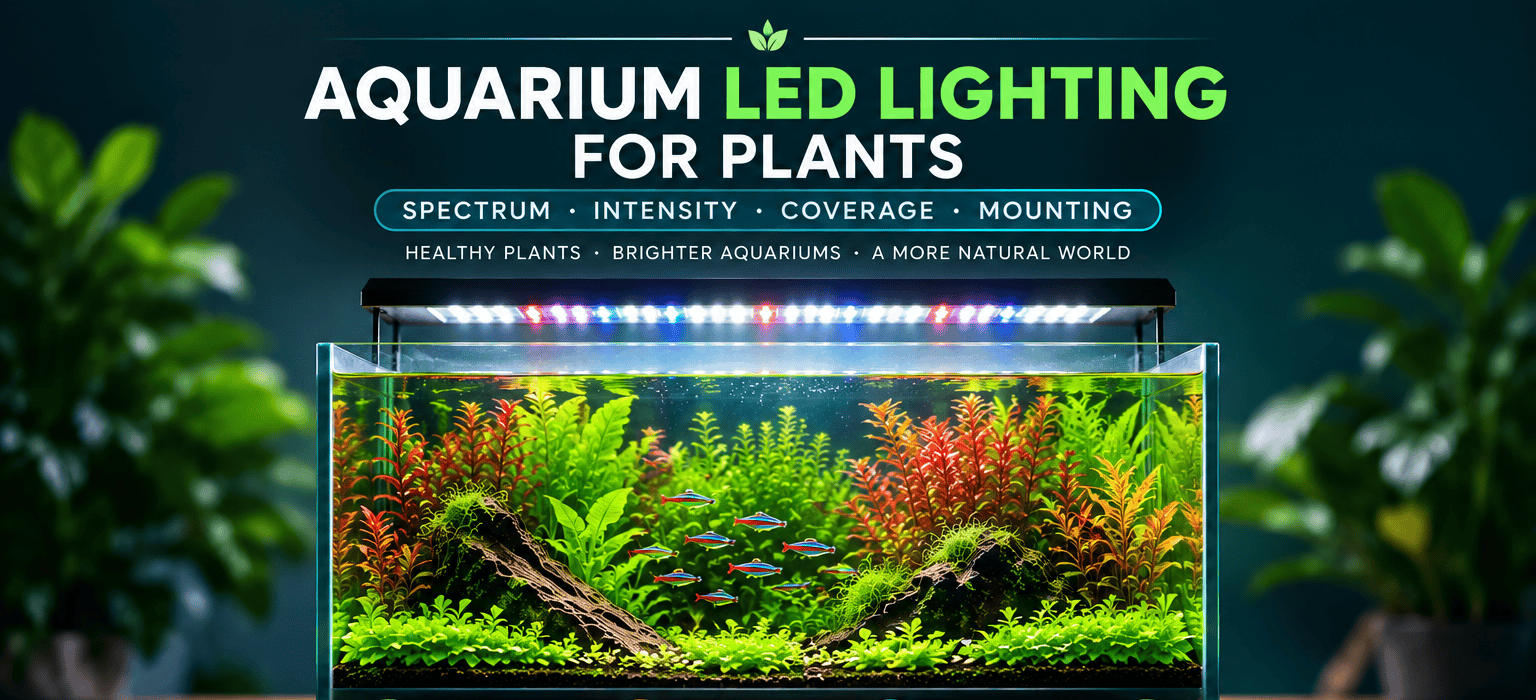
Choosing an aquarium LED light for plants is about matching usable light at the plant level with the plants you keep, the depth of your aquarium, and the carbon and nutrient conditions in the water. A bright-looking fixture is not automatically a suitable planted-tank light. This guide explains PAR, spectrum, photoperiod, low-tech and high-tech setups, and the practical questions to ask before buying an aquarium plant light.
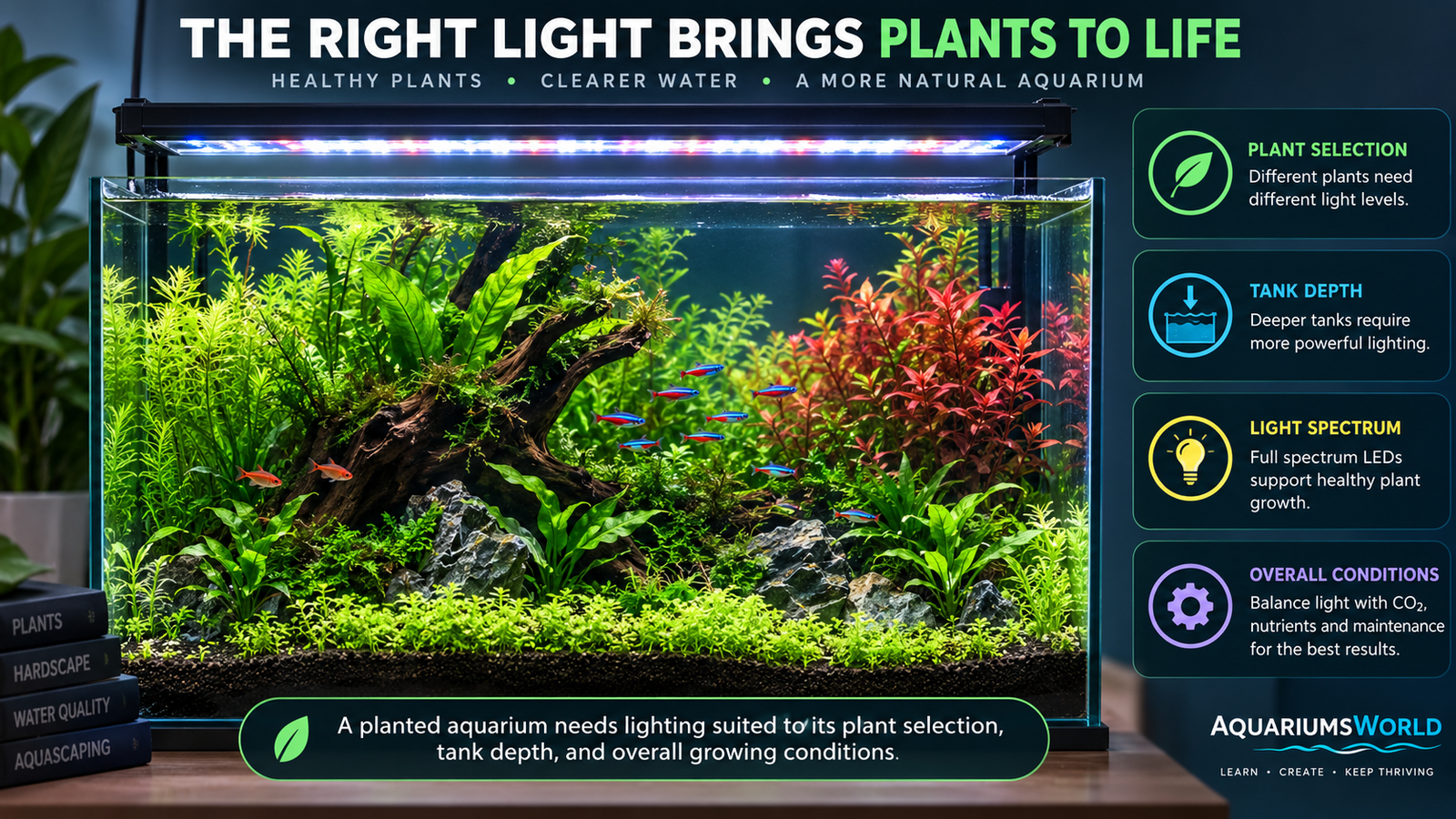
Why Aquarium LED Lighting for Plants Is Different
An aquarium light can make fish and decorations easy to see without delivering the amount or distribution of light that aquatic plants need. A fish-only setup may prioritise appearance, colour rendition, and convenient illumination. A planted aquarium has those needs too, but it also needs light that supports photosynthesis throughout the parts of the tank where plants grow.
The useful question is not simply, “How bright is this light?” It is, “How much photosynthetically useful light reaches the plants, and is that amount appropriate for the rest of the aquarium?” Plant species, water depth, floating plants, hardscape, shading, carbon availability, and nutrients all affect the answer.
A dedicated planted-tank LED often offers adjustable output, a broad spectrum, and dimensions suited to an aquarium. These features can make it easier to establish a repeatable lighting routine. They do not guarantee success by themselves: an expensive fixture can still be set too intensely, mounted poorly, or paired with plants that exceed the aquarium’s available resources.
Scientific lighting studies are useful for understanding how plants respond to intensity and wavelength. However, controlled studies on terrestrial crops such as lettuce do not establish an exact PAR target for every submerged aquarium plant. Aquarium recommendations should therefore be treated as practical starting ranges rather than universal biological thresholds.
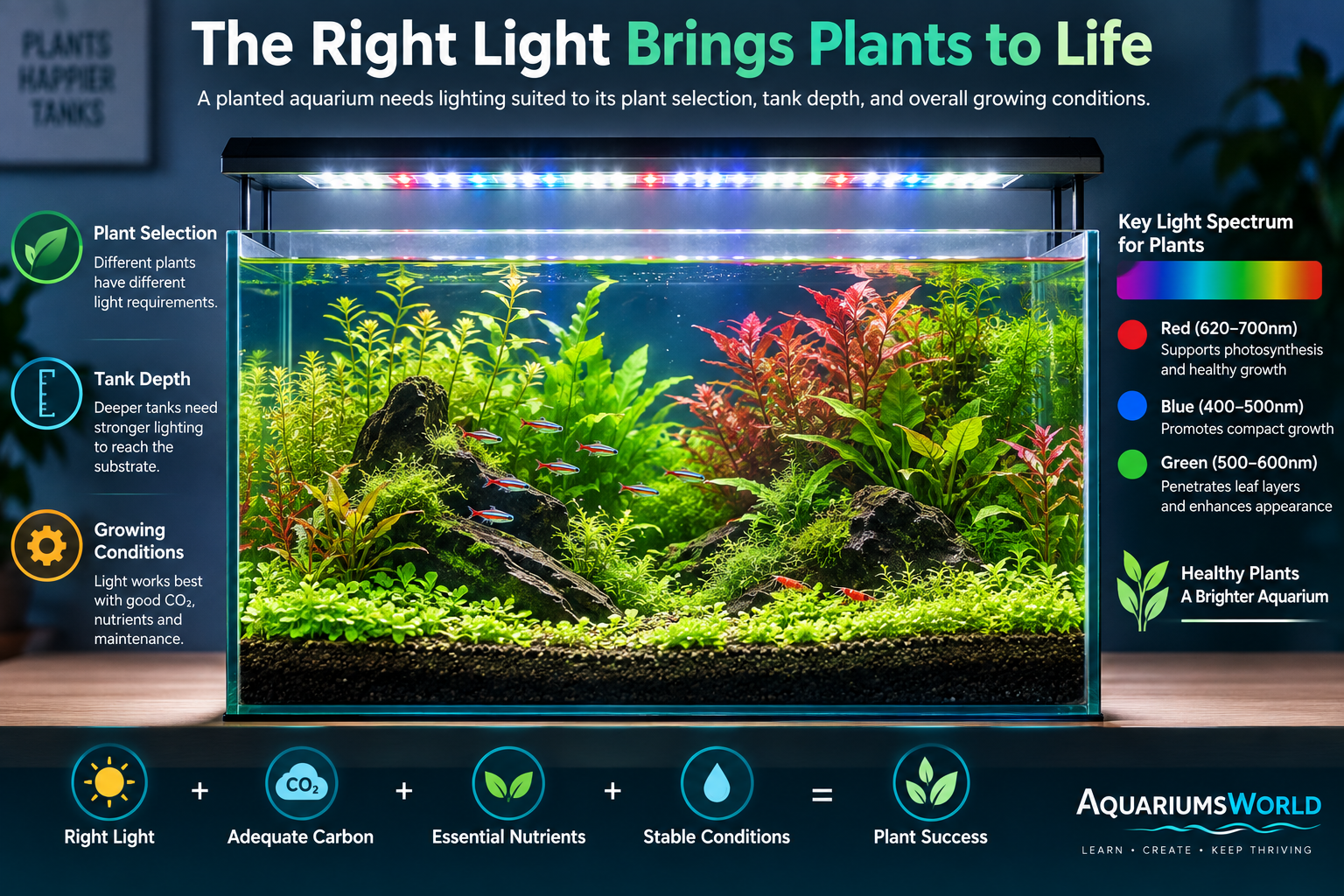
What Is PAR and Why Does It Matter?
PAR stands for photosynthetically active radiation. In common aquarium discussions, it refers to light in the 400–700 nanometre range that can contribute to photosynthesis. PAR is often reported as photosynthetic photon flux density, or PPFD, in micromoles of photons per square metre per second (µmol·m−2·s−1).
PAR is more informative than electrical wattage when comparing plant lights because watts describe energy consumed, not the photons that reach plant leaves. Lumens are weighted to human visual sensitivity, so two lights with different spectra can appear similarly bright while delivering different quantities of photosynthetically useful photons.
PAR is not the only consideration. A single PAR reading does not describe spectrum, coverage, daily light exposure, or whether plants have enough carbon and nutrients. Still, when comparing fixtures or adjusting intensity, a reliable PAR measurement at the plant level is usually more useful than relying on watts per gallon or visual brightness alone.
What PAR range should aquarium plants receive?
There is no single correct PAR value for every freshwater plant. As a broad hobby starting framework, lower-light plants are often maintained at modest substrate-level readings, while demanding carpeting and fast-growing species may require higher intensity and more careful control of carbon and nutrients.
| Planting approach | Illustrative substrate PAR range | Important context |
|---|---|---|
| Undemanding plants and beginner setup | About 20–40 µmol·m−2·s−1 | Use as a starting range; species and tank conditions vary. |
| Moderate plant demand | About 40–60 µmol·m−2·s−1 | Watch plant response and algae; do not increase intensity automatically. |
| Demanding plants or carpeting goals | Often higher than 60 µmol·m−2·s−1 | Higher light commonly requires closer attention to carbon, nutrients, and stability. |
These are approximate planning ranges, not experimentally established requirements for every aquarium species. A PAR meter, fixture-specific PAR chart, and gradual observation are preferable to treating the table as a guarantee.
PAR, watts, and lumens are not interchangeable
Wattage indicates electrical power draw. Lumens estimate brightness as perceived by the human eye. PAR/PPFD estimates the number of photons within the relevant wavelength band reaching a measured area. A more efficient fixture may deliver more photons per watt, while optics and mounting height influence how those photons are distributed.
This is why a low-wattage premium fixture may outperform a higher-wattage budget light in a particular aquarium, but wattage alone cannot prove that it will. Ask for PAR measurements at realistic distances and across the aquarium footprint, not only a maximum reading directly beneath the centre of the light.
How Water Depth Affects Aquarium Plant Lighting
Light intensity usually decreases as light travels through water. The amount reaching the substrate also depends on the fixture’s optics, distance above the water, water clarity, floating plants, surface movement, and the layout of rocks and wood. Consequently, two aquariums with the same footprint but different depths may receive very different light at the bottom.
A shallow aquarium may be easier to illuminate evenly with a modest fixture. A tall aquarium can require greater output or a different mounting arrangement to provide comparable light near the substrate. The exact reduction cannot be predicted from depth alone; it depends on the light and the water conditions.
Do not assume that a fixture’s advertised PAR figure applies to the substrate of your aquarium. Check the distance used for the measurement. If the manufacturer provides a PAR chart, compare the chart’s measurement height with the distance from your fixture to the plants. If no chart is available, begin conservatively and observe growth rather than assuming a particular intensity.
What Is the Best Colour Spectrum for Aquarium Plants?
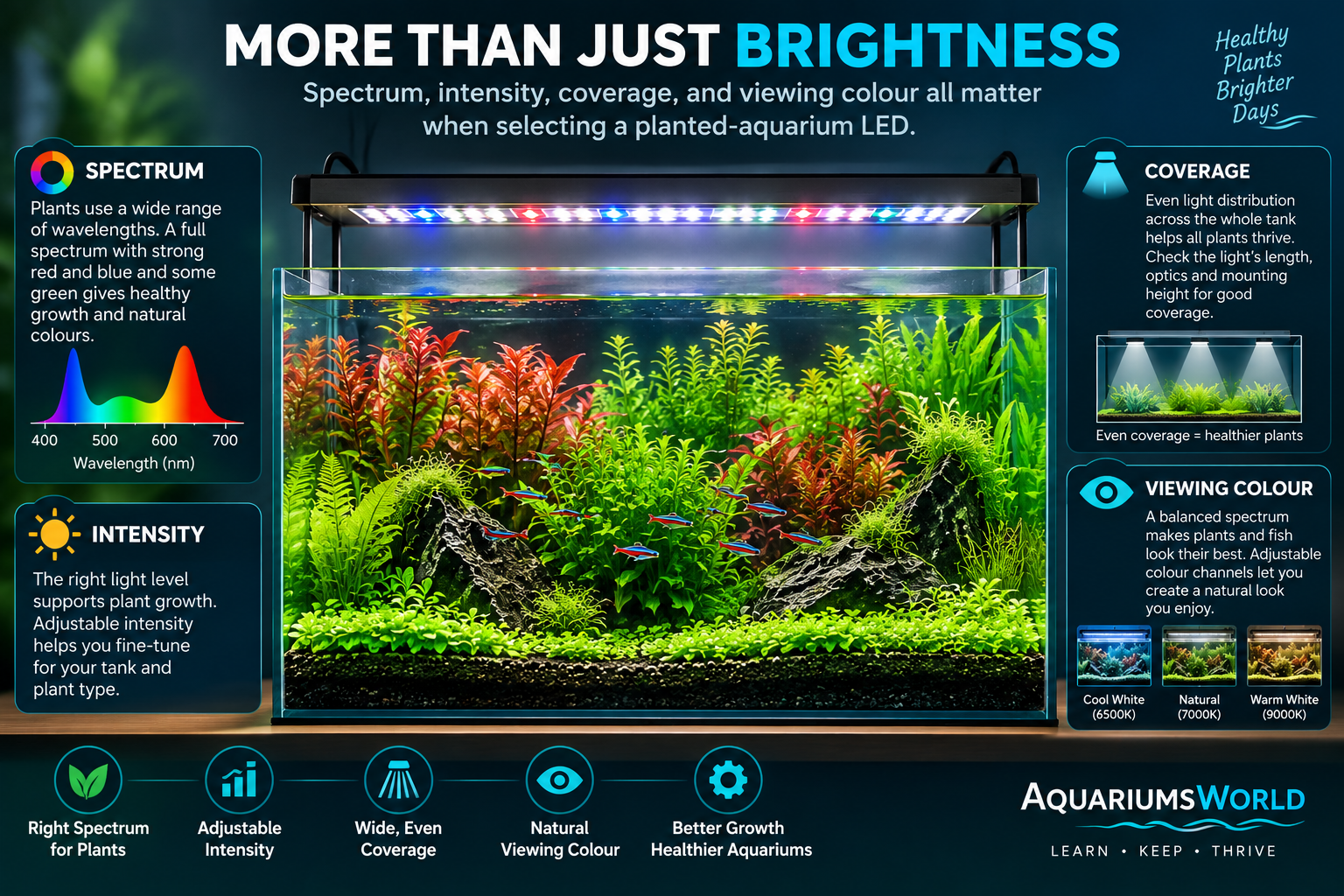
Plants use light across a broad range of wavelengths. Red and blue wavelengths are important in photosynthesis and plant signalling, while green wavelengths also contribute to photosynthetic activity. The idea that plants only use red and blue light is an oversimplification.
The research by Park and Runkle (2018) compared LED spectra in ornamental seedlings, including white and blue-plus-red treatments. It is relevant to understanding horticultural lighting and the trade-off between plant responses and visual colour quality. It was not an aquarium experiment, so it should not be used to claim that one aquarium LED configuration will always outperform another.
Red wavelengths
Red light can contribute strongly to photosynthesis, and many plant-growth fixtures include red output. Red wavelengths are also relevant to how plants perceive their light environment. However, it is not accurate to conclude that every red stem plant needs a specific red wavelength or that increasing red output alone will produce redder leaves. Plant pigmentation is affected by species, genetics, light intensity, nutrients, and other growing conditions.
Blue wavelengths
Blue light participates in photosynthesis and plant photoreceptor responses. It can influence plant form and development, but the result depends on species and the intensity and duration of exposure. A blue-heavy setting is not automatically ideal for a planted aquarium, especially if it makes it difficult to judge plant colour or creates an appearance the aquarist dislikes.
Green wavelengths
Green light can penetrate into leaf tissues and contribute to photosynthesis. The study by Muneer et al. (2014) examined green, red, and blue LED treatments in lettuce leaves under controlled conditions. Its results show that responses depend on both wavelength and intensity; they do not prove that a particular RGB aquarium fixture will grow submerged plants better than every white LED.
White LEDs versus RGB LEDs
White LEDs can provide a broad spectrum and a natural viewing appearance. RGB or multi-channel fixtures allow the user to adjust colour channels, which can be useful for visual preference and experimentation. The presence of separate red, green, and blue controls does not by itself establish better plant growth. Compare measured output, coverage, dimming range, control reliability, and the appearance of the aquarium.
For most buyers, a controllable full-spectrum fixture with reliable PAR information is a sensible feature set to consider. Spectrum adjustments should be made gradually, and a visually pleasing colour setting should not be confused with a scientifically proven growth advantage.
Low-Tech Versus High-Tech Planted Tank Lighting
“Low-tech” commonly describes a planted aquarium without pressurised CO₂ injection. “High-tech” usually refers to a setup with added CO₂ and more deliberate control of lighting, fertilisation, and maintenance. These labels are hobby shorthand rather than precise scientific categories.
Low-tech planted tank lighting
A low-tech aquarium can grow many attractive plants under moderate light. Since carbon availability may limit growth, increasing light substantially may not produce a matching increase in plant growth. A cautious approach is to begin with modest intensity, a consistent schedule, and plants suited to the setup.
Java fern, Anubias, many mosses, and some Cryptocoryne species are commonly selected for lower-light aquariums, although their exact needs vary. Place slower-growing plants where they will not be shaded, and avoid increasing light simply because growth appears slow. First consider plant health, nutrients, carbon availability, and whether the species is naturally slow-growing.
High-tech planted tank lighting
Injected CO₂ can support faster growth for suitable plants when light and nutrients are also adequate. A high-tech setup may therefore use greater light intensity, but high output is not a requirement in itself. The goal is a balanced system that can be maintained consistently.
If you increase light, do so in small steps and monitor plant response. Ensure that CO₂ delivery is stable and appropriate for the aquarium before pursuing more intense lighting. Avoid treating a high PAR reading as a target that every high-tech tank must reach.
| Setup | Starting approach | Photoperiod starting point | Carbon context |
|---|---|---|---|
| Low-tech, undemanding plants | Modest light; increase only if plant response supports it | About 6–8 hours | No injected CO₂; carbon remains a possible growth limitation. |
| Low-tech, moderate plant demand | Moderate light with careful observation | About 6–8 hours | Injected CO₂ is not automatically required, but growth may be limited. |
| High-tech, faster-growing plants | Adjust light alongside stable CO₂ and nutrient supply | Often around 7–9 hours, adjusted to response | CO₂ delivery and circulation need to be reliable. |
These are practical starting points, not universal requirements. Aquarium size, plant species, equipment, and maintenance routine can change what works.
For more background on carbon supplementation, see the AquariumsWorld guide to aquarium CO₂ diffuser placement and setup .
Does More Light Mean More Plant Growth?
Not necessarily. Plant growth depends on multiple resources and conditions, including light, carbon, nutrients, temperature, and the plant’s own biology. When one factor limits growth, increasing another factor may have little benefit. Excessive light can also make algae more noticeable or increase the need for careful maintenance.
Pedersen, Colmer, and Sand-Jensen (2013) review underwater photosynthesis and discuss how light and inorganic carbon affect aquatic photosynthesis. Their review is useful for understanding why underwater plant growth cannot be reduced to light intensity alone. It does not establish that excess light always causes algae; algae outcomes depend on the whole aquarium system.
If plants are growing slowly, check whether they are healthy and whether the species is naturally slow-growing. Consider nutrient availability, carbon supply, water conditions, shading, and the actual light reaching the leaves. If algae increases after a lighting change, reduce intensity or duration gradually and review the aquarium’s overall balance rather than assuming the light is the only cause.
How Many Hours Should Aquarium Lights Be On for Plants?
A consistent photoperiod helps make aquarium conditions predictable. For many beginner planted tanks, about 6–8 hours of light per day is a practical starting point. Some established aquariums use longer schedules, but there is no universal duration that guarantees plant growth or prevents algae.
Daily light exposure depends on both intensity and duration. A relatively intense light run for many hours can deliver a very different daily exposure from a dimmer light run for a shorter period. When adjusting a schedule, change one variable at a time so you can observe the result.
Should you use a split photoperiod?
Some aquarists divide the lighting period into two blocks with a break in between. This can fit household routines or provide a way to experiment with lighting. It is not a guaranteed algae-control method, and the dark break should not be presented as a universal requirement for plants or as a proven way to make CO₂ “recover.”
Use a timer
A plug-in timer or built-in controller can keep the schedule consistent without relying on memory. Start with a repeatable schedule, then adjust gradually if plant response suggests a change is needed. If the fixture supports ramping, sunrise and sunset effects can improve the viewing experience, but they do not replace an appropriate daily light level.
What Wattage LED Do I Need for a Planted Tank?
There is no reliable universal watts-per-gallon rule for modern LED aquarium lights. LED efficiency, spectrum, optics, fixture dimensions, mounting height, and aquarium depth all influence the light that reaches plants. Two fixtures with the same wattage can produce different PAR levels and coverage.
When PAR data is unavailable, use the manufacturer’s recommended aquarium dimensions as a rough compatibility check, not as proof of plant suitability. Look for a dimmer or adjustable output so you can begin conservatively. A fixture that is too powerful but dimmable may be easier to manage than one that cannot be adjusted, provided it still offers suitable coverage and control.
Ask the seller or manufacturer for PAR readings at several depths and positions. Check whether the figures were measured in air or water, at what mounting distance, and over what footprint. A single maximum value can conceal weak coverage near the front, back, or corners of the aquarium.
Can I Use a Regular LED Light for Aquarium Plants?
Sometimes. A household LED may support some undemanding plants if its output, spectrum, coverage, and mounting position are suitable. However, ordinary bulbs and desk lamps are not designed specifically for aquarium coverage, moisture exposure, or convenient mounting over a tank.
The important issue is not whether the light is marketed as “regular” or “aquarium.” It is whether the fixture can safely and consistently deliver appropriate light to the plants. Avoid placing non-aquarium-rated equipment where it can be splashed or exposed to condensation, and follow the manufacturer’s electrical safety guidance.
A dedicated planted-tank LED can be more convenient because it is designed for the aquarium’s footprint and often includes dimming or a timer. It is not automatically necessary for every low-light setup, but it may make reliable lighting easier.
How to Compare Aquarium LED Lights for Plants
Product names and price categories change frequently, so compare current specifications rather than relying on a fixed “best light” list. A suitable light for a small, shallow aquarium may not fit a long or deep tank. Consider the following features before buying.
Budget lights
A budget fixture may be suitable for an uncomplicated aquarium with undemanding plants. Check that it fits the tank securely, has an appropriate output level, and can be operated on a consistent schedule. If the manufacturer provides no PAR data, start at a conservative setting and monitor the aquarium before making changes.
Mid-range lights
Mid-range models may offer better controls, broader coverage, more output adjustment, or more useful manufacturer documentation. App control can be convenient, but it should not be the main reason to buy a fixture. Check whether manual control remains possible and whether the light remembers its schedule after a power interruption.
Advanced and premium lights
Advanced fixtures may offer higher output, adjustable channels, more mounting options, and detailed control. These features can be useful for demanding aquascapes, but they also make it easier to set the light too intensely. Choose premium equipment when its coverage, adjustability, build, and support address a real need in your aquarium.
Lights for carpeting plants
Carpeting species can be demanding, but their requirements differ. Light alone does not ensure a dense carpet. Plant choice, substrate, carbon availability, circulation, trimming, and the aquarium’s stability all influence the result. Before buying a high-output fixture, confirm that the selected plant is appropriate for your setup and that you can maintain the required conditions.
| Product family to compare | What to check | Potential fit |
|---|---|---|
| NICREW ClassicLED Plus / similar budget models | Exact size, output control, mounting, available PAR data | Simple planted tanks, depending on model and depth |
| Seaoura SR-series / similar budget models | Model-specific specifications, timer functions, tank compatibility | Beginner setups if coverage and output are suitable |
| Fluval Plant series | Current model features, app support, output, warranty terms | Users wanting adjustable lighting and scheduled control |
| Chihiros WRGB series | Model dimensions, output range, controller, mounting requirements | Users wanting channel control and strong output options |
| Twinstar S series / similar advanced fixtures | Exact model, coverage, control options, service support | Carefully planned planted aquascapes |
| Week Aqua M-series / similar fixtures | Model-specific PAR, dimensions, control and mounting | Setups requiring adjustable or higher output |
This is a comparison checklist, not a verified ranking or current price list. Product availability, specifications, warranty conditions, and prices can vary by model and retailer. Confirm the exact product details before purchase.
LED Light Mounting Height for Planted Tanks
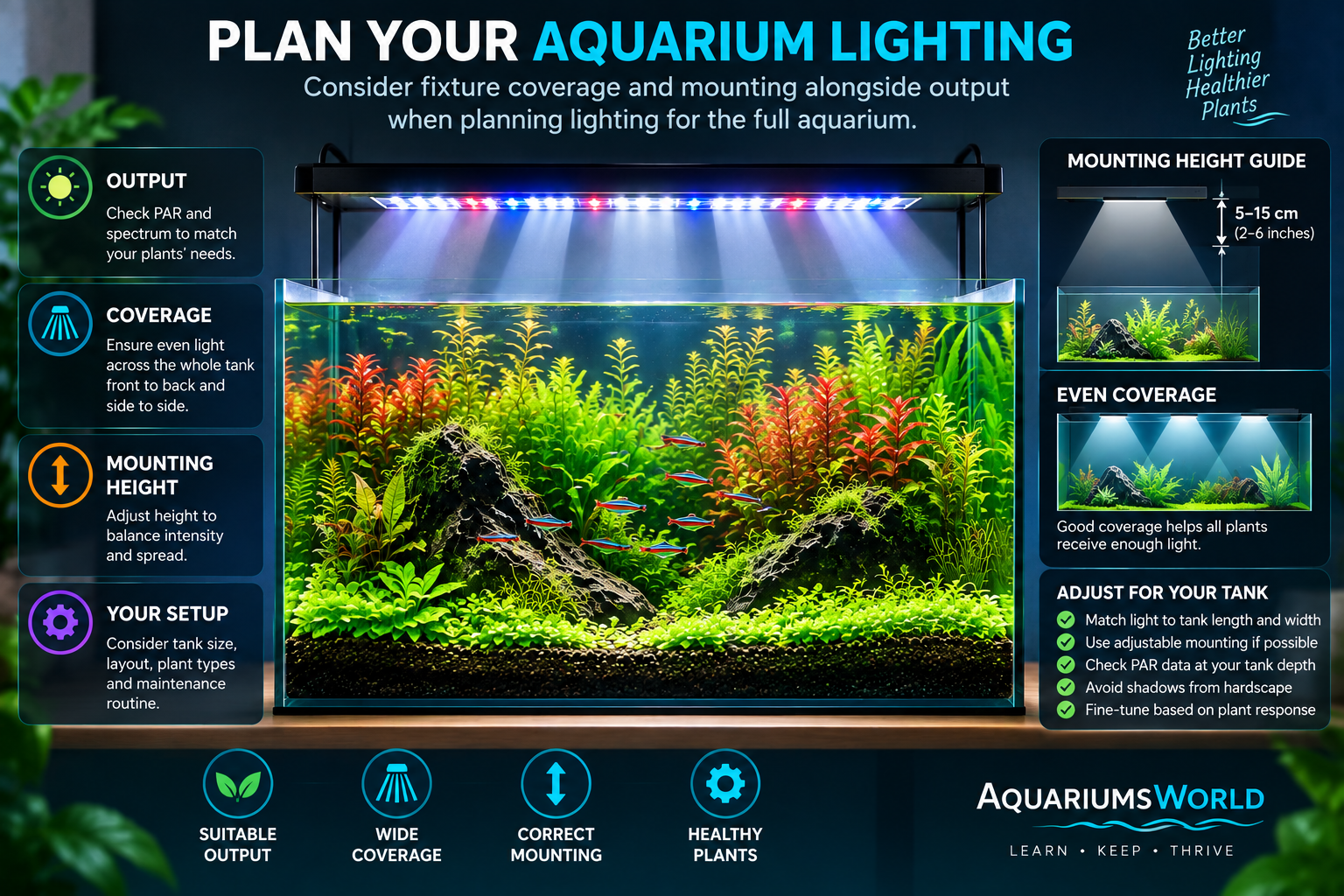
Mounting height affects both intensity and the spread of light. Moving a fixture closer to the water may increase the amount reaching the plants, but it can also create a more concentrated hotspot and less even coverage. Raising a light can spread illumination more broadly while reducing intensity at the substrate.
There is no universal mounting height that works for every fixture. Follow the manufacturer’s mounting instructions and use PAR information when available. If you change the height, check plant-level intensity and observe whether the edges of the aquarium remain adequately illuminated.
Keep the fixture stable and away from accidental contact with water unless it is rated for that environment. Cable management and a secure mounting system are part of a safe, reliable setup.
LED Versus T5 Lighting for Planted Aquariums
LED and T5 fluorescent fixtures can both provide light for plants. Their performance depends on the specific fixture, lamps, reflectors, spectrum, and installation. General statements that all LEDs are more efficient or that all T5 fixtures spread light better are too broad to guide a purchase.
| Consideration | LED | T5 fluorescent |
|---|---|---|
| Control | Many models offer dimming or channel control; features vary. | Often controlled by switching lamps or fixture channels; model dependent. |
| Replacement | LED modules may last a long time, but repairs depend on design. | Lamps are replaceable, with replacement intervals depending on use. |
| Heat | Heat is still produced and must be managed by the fixture. | Fixture and lamp heat may affect the aquarium area. |
| Coverage | Depends on optics, fixture length, and mounting. | Depends on reflectors, lamp arrangement, and fixture length. |
| Best comparison method | Compare measured output, coverage, control, and cost. | Compare measured output, lamp availability, coverage, and cost. |
For a new setup, LED is often convenient because of its compact form and available controls. A functioning T5 fixture may still be usable if it provides appropriate light and can be maintained safely. Compare actual performance and ownership costs rather than choosing by technology label alone.
How to Tell If Your Aquarium Light Is Suitable
Plant appearance can help identify possible problems, but no single symptom proves that lighting is the cause. Slow growth may reflect a naturally slow-growing species, nutrient limitations, carbon availability, acclimation, or other conditions. Check the whole setup before changing the light.
Possible signs of insufficient light
- Plants show weak growth despite otherwise suitable conditions.
- Some stems grow toward brighter areas or become unusually stretched.
- Lower leaves are shaded by floating plants or dense growth above them.
- Plants near the edges receive noticeably less light than those in the centre.
Possible signs of excessive light or imbalance
- Algae becomes more apparent after a major increase in intensity or duration.
- Slow-growing leaves collect algae while faster-growing plants remain healthy.
- The aquarium becomes difficult to maintain after increasing light without reviewing other conditions.
These are clues, not diagnoses. Algae can have multiple causes, and plant responses vary by species. Record the lighting schedule and intensity, make one change at a time, and allow enough time to observe the result.
Frequently Asked Questions
What is the best LED light for aquarium plants?
The right light depends on aquarium dimensions, plant selection, desired control, budget, and the light that reaches the substrate. Compare model-specific PAR and coverage information rather than relying on a universal product ranking.
How much PAR do aquarium plants need?
Requirements vary by species and growing conditions. Lower-light plants can often be maintained with modest substrate-level PAR, while demanding plants may need higher intensity and closer management of carbon and nutrients. Treat hobby ranges as starting points, not exact requirements for every species.
What is the best colour spectrum for aquarium plants?
Plants use a broad range of wavelengths. A full-spectrum white or adjustable multi-channel fixture can be suitable, but the label alone does not prove superior growth. Consider measured output, plant response, and the appearance you prefer.
How many hours should aquarium lights be on for plants?
Around 6–8 hours is a common starting photoperiod for a beginner planted tank. Adjust gradually according to plant response and the overall aquarium conditions. There is no universal schedule that guarantees algae prevention.
What is the difference between low-tech and high-tech lighting?
Low-tech setups generally do not inject CO₂ and often use moderate lighting with undemanding plants. High-tech setups commonly add CO₂ and manage light and nutrients more deliberately. The terms describe approaches, not fixed PAR categories.
Does more light mean more plant growth?
No. Growth can be limited by carbon, nutrients, or other conditions. More light may not help if another resource is limiting, and a major increase can make the aquarium harder to balance.
What wattage LED do I need for a planted tank?
Wattage alone cannot determine plant-level light. Check the fixture’s coverage and PAR information at a distance comparable to your aquarium. If those data are unavailable, choose a controllable light and begin conservatively.
Can I use a regular LED light for aquarium plants?
Some regular LEDs may support undemanding plants if their output and coverage are suitable. Ensure the equipment is safely installed around water and do not assume that visual brightness proves adequate plant light.
What aquarium light helps prevent algae?
No light can guarantee algae prevention. Use a consistent, appropriate photoperiod, avoid unnecessary intensity, and consider plant health, nutrients, carbon, feeding, and maintenance together.
What LED is best for carpeting plants?
The answer depends on the carpet species and the aquarium’s conditions. Confirm the plant’s light and carbon needs, check substrate-level PAR, and choose a fixture with suitable coverage and adjustable output.
Conclusion
Aquarium LED lighting for plants is not simply a matter of buying the brightest fixture. The useful choice is one that provides appropriate light across the aquarium, fits the tank’s depth, offers manageable controls, and suits the plants and growing conditions you can maintain.
Start with a consistent schedule and modest intensity, especially in a low-tech aquarium. Use PAR data when available, adjust gradually, and consider carbon, nutrients, shading, and plant species before increasing output. For a purchase, compare exact model specifications and current manufacturer information rather than relying on watts per gallon or broad claims about one spectrum being universally best.
For more planted-aquarium guidance, read our guides to aquarium CO₂ diffuser placement and setup , soil in a fish tank, and common aquarium problems.
Scientific References
- Park, Y. and Runkle, E.S. (2018) ‘Spectral effects of light-emitting diodes on plant growth, visual color quality, and photosynthetic photon efficacy: White versus blue plus red radiation’, PLoS ONE, 13(8), e0202386. https://doi.org/10.1371/journal.pone.0202386.
- Wu, B.-S., MacPherson, S., Kohn, S.F., Zhang, Y. and Lefsrud, M. (2021) ‘Filtering Light-Emitting Diodes to Investigate Amber and Red Spectral Effects on Lettuce Growth’, Plants, 10(6), 1075. https://doi.org/10.3390/plants10061075.
- Muneer, S., Kim, E.J., Park, J.S. and Lee, J.H. (2014) ‘Influence of Green, Red and Blue Light Emitting Diodes on Multiprotein Complex Proteins and Photosynthetic Activity under Different Light Intensities in Lettuce Leaves (Lactuca sativa L.)’, International Journal of Molecular Sciences, 15(3), pp. 4657–4670. https://doi.org/10.3390/ijms15034657.
- Pedersen, O., Colmer, T.D. and Sand-Jensen, K. (2013) ‘Underwater photosynthesis of submerged plants – recent advances and methods’, Frontiers in Plant Science, 4, article 140. https://doi.org/10.3389/fpls.2013.00140.
- Khan, A. et al. (2024) ‘Light emitting diode effect of red, blue, and amber light on photosynthesis and plant growth parameters’, Industrial Crops and Products, 210, 118733. The supplied citation and DOI could not be verified as written, so this reference is not used to support claims in this article. Confirm the original article details before adding it to the bibliography.