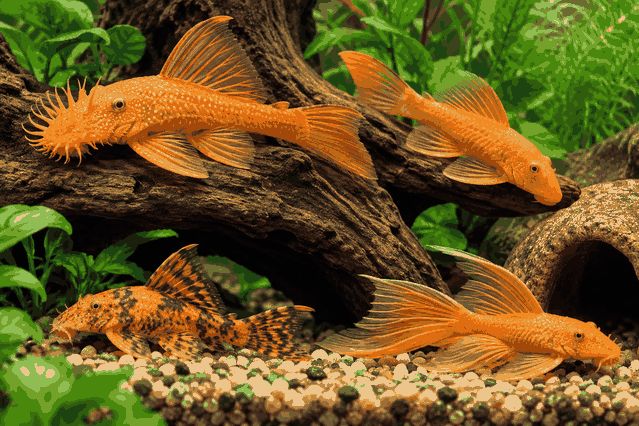
Orange plecostomus is a popular aquarium name for attractive orange, golden-orange and reddish forms of bristlenose plecos, particularly fish associated with Ancistrus. These freshwater catfish are valued for their distinctive colour, compact adult size, algae-grazing behaviour and peaceful temperament. However, they still require appropriate aquarium space, stable water quality, driftwood, caves, oxygenation and a nutritionally balanced diet.
This complete orange pleco care guide explains orange pleco varieties and types, adult size, natural habitat, tank requirements, water parameters, diet, algae eating, behaviour, tank mates, lifespan, breeding and common health problems. It also explains why the term orange plecostomus can refer to several aquarium trade forms rather than one clearly defined scientific species.
If you are planning a new aquarium, first review the Fish Aquarium Types and Setup Guide, which covers aquarium types, tank sizes, equipment, stocking and water-quality considerations.
Orange Plecostomus Quick Answer
An orange plecostomus is generally an orange, red-orange or golden-orange bristlenose pleco associated with Ancistrus. The term is primarily used within the aquarium trade rather than representing one universally recognised scientific species. L144 orange plecos and super red bristlenose plecos are examples of names aquarists may encounter.
Most orange bristlenose plecos remain considerably smaller than large common plecostomus species. Many adults reach approximately 10 to 15 cm, although exact size depends on genetics, sex, diet and environmental conditions.
Around 20 gallons can be a practical starting point for one adult orange bristlenose in an appropriately filtered aquarium. More space is preferable for multiple plecos, breeding groups or community setups.
Orange plecos are generally peaceful but mature males can defend caves. They eat algae and biofilm but should not be expected to survive entirely on algae. Algae wafers, specialist sinking foods, vegetables and occasional appropriate protein-rich foods should form a balanced feeding strategy.
Table of Contents
- What Is an Orange Plecostomus?
- Orange Plecostomus Varieties and Types
- How Big Do Orange Plecos Get?
- Orange Plecostomus Natural Habitat
- Orange Pleco Tank Size Requirements
- Orange Pleco Water Parameters
- What Do Orange Plecostomus Eat?
- Orange Pleco Behaviour and Temperament
- Best Tank Mates for Orange Plecostomus
- How Long Do Orange Plecos Live?
- Are Orange Plecos Easy to Keep?
- Orange Pleco Breeding Guide
- Orange Pleco Health and Common Problems
- Orange Pleco Driftwood Requirement
- Orange Plecostomus and Algae Control
- Orange Pleco Tank Maintenance Routine
- Frequently Asked Questions
- Conclusion
- References
1. What Is an Orange Plecostomus?
The term orange plecostomus is commonly used by aquarium keepers and sellers to describe orange-coloured plecos, particularly bristlenose plecos belonging to the genus Ancistrus. The terminology can create confusion because plecostomus is frequently used as a broad aquarium trade term for suckermouth catfish rather than as a precise identification of one species.
The family Loricariidae contains a large diversity of suckermouth armoured catfishes. Molecular studies have demonstrated complex evolutionary relationships within these fishes, while modern classifications continue to refine their taxonomy.
For aquarium keepers, the most useful distinction is between compact bristlenose forms and the much larger plecos that can eventually outgrow ordinary home aquariums. Orange bristlenose plecos are generally easier to accommodate because their adult size is substantially smaller than many large plecostomus species.
Orange colouration can range from pale orange and golden-orange to deeper red-orange. Appearance can vary between breeding lines, individuals, age and lighting. Juvenile fish can also look different as they mature.
The L144 orange pleco is one of the names frequently encountered in the aquarium trade. The L-number system was historically used by aquarists to identify distinctive loricariids before formal scientific descriptions were available. Therefore, an L-number should not automatically be interpreted as a complete scientific species name.
For practical care, orange plecos should be treated as bottom-dwelling freshwater catfish requiring shelter, oxygen-rich water, grazing surfaces, wood and supplemental food. Correct identification remains important because adult size and environmental requirements can vary significantly between pleco types.
2. Orange Plecostomus Varieties and Types
Orange pleco varieties are popular because their bright colour contrasts strongly with green plants, dark substrate and natural wood. Several aquarium trade names may describe fish with overlapping appearances, so buyers should examine body shape, adult size, breeding line and seller information instead of relying on colour alone.
Orange Bristlenose Pleco
The orange bristlenose pleco is generally associated with an orange-coloured Ancistrus form. It has the compact body, sucker-shaped mouth and armoured appearance characteristic of bristlenose catfish. Mature males commonly develop prominent facial bristles.
These fish spend much of their time attached to glass, wood, rocks and other surfaces. Their grazing behaviour makes them useful members of many community aquariums, although they should never be purchased solely as an algae-cleaning solution.
Orange Ancistrus Pleco
Orange Ancistrus is another trade description encountered by aquarists. The genus Ancistrus contains numerous species and forms, and selective breeding can make visual identification difficult. When purchasing fish under this name, ask the seller about parent stock and expected adult size.
Super Red Bristlenose Pleco
Super red bristlenose plecos are selectively bred for strong reddish-orange to red colouration. Their colour can be more intense than standard orange forms. Their fundamental husbandry remains similar to other healthy bristlenose plecos, including clean water, caves, wood and a varied diet.
L144 Orange Pleco
L144 orange pleco is a common aquarium trade label. It is important to understand that trade labels do not always provide the same precision as modern scientific taxonomy. The expected adult size and husbandry requirements should therefore be confirmed before purchase.
Rare Pleco Colour Variants
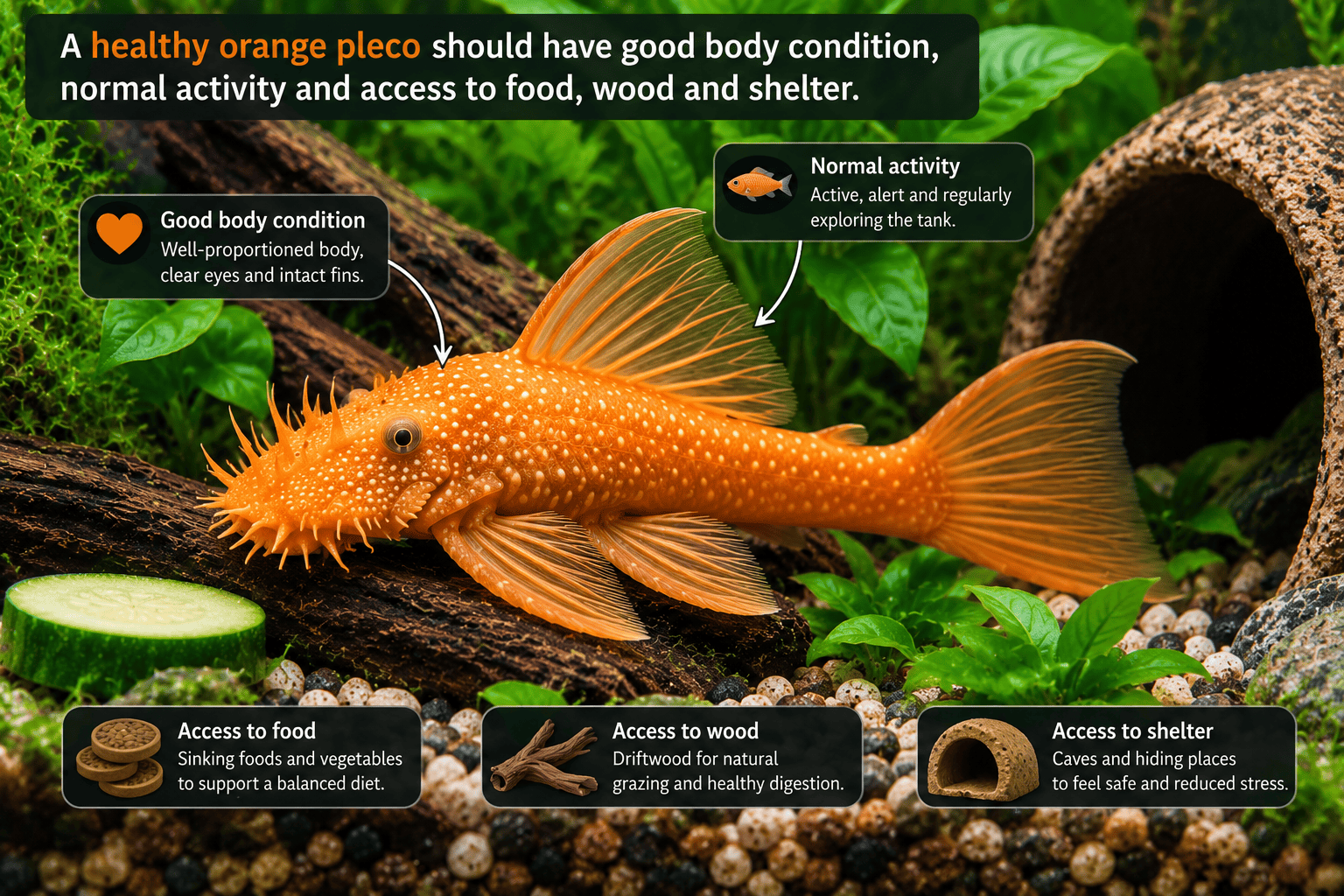
Orange, red, albino and other selectively developed colour forms are highly sought after. Colour alone, however, should not determine purchasing decisions. A healthy fish with clear eyes, good body condition, intact fins and normal behaviour is preferable to a fish selected only because it has an unusually intense colour.
| Type or Trade Name | Typical Appearance | Important Consideration |
|---|---|---|
| Orange bristlenose | Orange to golden-orange | Compact adult size and peaceful temperament |
| Orange Ancistrus | Orange or orange-brown | Confirm species or breeding line |
| Super red bristlenose | Deep orange to red-orange | Selective colour strain |
| L144 orange | Orange or golden-orange | Trade designation requiring careful identification |
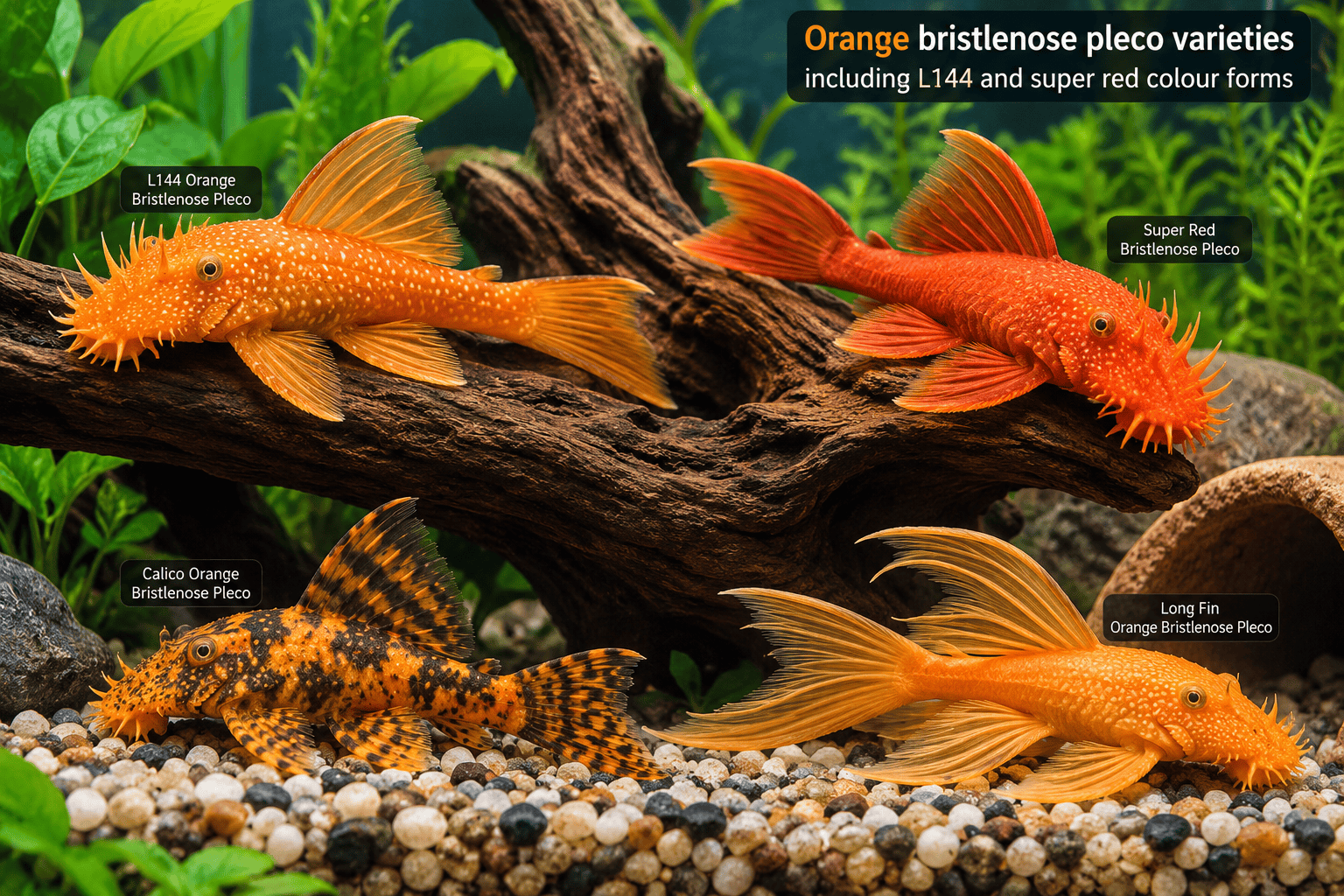
Orange pleco varieties can range from golden-orange to deep red-orange depending on the breeding line.
3. How Big Do Orange Plecos Get?
Adult size is one of the most important factors separating bristlenose plecos from large plecostomus species. Most orange bristlenose forms remain relatively compact, commonly reaching approximately 10 to 15 cm in aquarium conditions. Some individuals may remain smaller, while others can become larger depending on genetics, sex, feeding and environmental quality.
Young orange plecos can look deceptively small in an aquarium shop. Purchasing decisions should therefore be based on expected adult size rather than current juvenile length. A fish that looks suitable for a small aquarium still needs adequate space as it matures.
Growth is influenced by several factors. Consistent nutrition supports normal development, while poor water quality can compromise health. Excessive feeding can contribute to obesity rather than healthy growth, so food quantity should match fish numbers and available grazing opportunities.
Male bristlenose plecos can appear larger or more visually impressive because of head growth and facial bristles. These bristles become increasingly obvious as males mature and are one of the easiest features for aquarists to notice.
Aquarium dimensions also matter. A long tank can provide greater bottom area than a narrow aquarium with the same nominal volume. Since plecos are primarily bottom-oriented, floor space, caves, wood and swimming access should be considered alongside the gallon or litre measurement.
For a detailed comparison of aquarium dimensions and stocking considerations, see the Aquarium Tank Size and Stocking Guide.
4. Orange Plecostomus Natural Habitat
Understanding the habitat of Ancistrus-type plecos helps explain their aquarium requirements. These fish are associated with tropical South American freshwater environments, where related loricariids occupy rivers, streams and other habitats containing surfaces suitable for attachment and grazing.
Many suckermouth catfish are adapted to environments where water movement can be significant. Their sucker-shaped mouth provides a practical advantage when attaching to surfaces. In the aquarium, strong but not excessive circulation can therefore be useful, particularly when it maintains high dissolved oxygen without creating continuous stress.
Natural habitats can contain submerged wood, rocks, leaf litter, plants and algae-covered surfaces. A home aquarium cannot perfectly reproduce a river ecosystem, but it can reproduce important functional elements. Hiding places, wood, oxygenation and varied surfaces give the fish opportunities to forage and shelter.
Driftwood is particularly valuable in a bristlenose setup. It provides a natural grazing surface and contributes to environmental complexity. Although plecos should not obtain all their nutrition from wood, access to suitable aquarium-safe driftwood is beneficial.
Habitat complexity can also reduce stress. A bare aquarium may provide adequate water volume but limited opportunities for natural behaviour. Caves, shaded areas and wood allow plecos to choose between exposed and protected positions.
5. Orange Pleco Tank Size Requirements
Orange pleco tank size should be selected according to adult fish size, number of plecos, filtration, tank dimensions and the wider community. A single adult bristlenose can generally be maintained in an aquarium of around 20 gallons when filtration and maintenance are appropriate. More space is preferable when keeping multiple individuals.
Aquarium size should always be considered together with dimensions. A long and wide aquarium generally provides more useful bottom territory than a very tall tank with the same volume.
| Number of Orange Plecos | Suggested Minimum Aquarium | Recommended Setup |
|---|---|---|
| 1 adult | About 20 gallons | Filtration, driftwood and at least one cave |
| 2 adults | About 30 gallons or larger | Multiple shelters and adequate bottom space |
| Breeding pair | About 30 gallons or larger | Dedicated cave, filtration and additional hiding areas |
| Multiple plecos | 40 gallons or larger | Several caves, wood and strong biological filtration |
These figures should be treated as practical starting points rather than universal rules. A heavily stocked aquarium may need considerably more space, while a larger but poorly maintained aquarium can provide worse conditions than a smaller, mature and carefully managed system.
Aquarists considering a 20 gallon aquarium should also read the dedicated Aquarium Setup and Guide resources on AquariumsWorld. The site’s current setup archive includes a dedicated 20 gallon fish tank guide covering dimensions, volume, setup, stocking and equipment.
For larger community setups, the same archive also contains dedicated 50 gallon aquarium resources covering dimensions, equipment, setup and stocking. Larger tanks can be particularly useful when several bottom-dwelling fish share the aquarium.
Orange Pleco Tank Setup
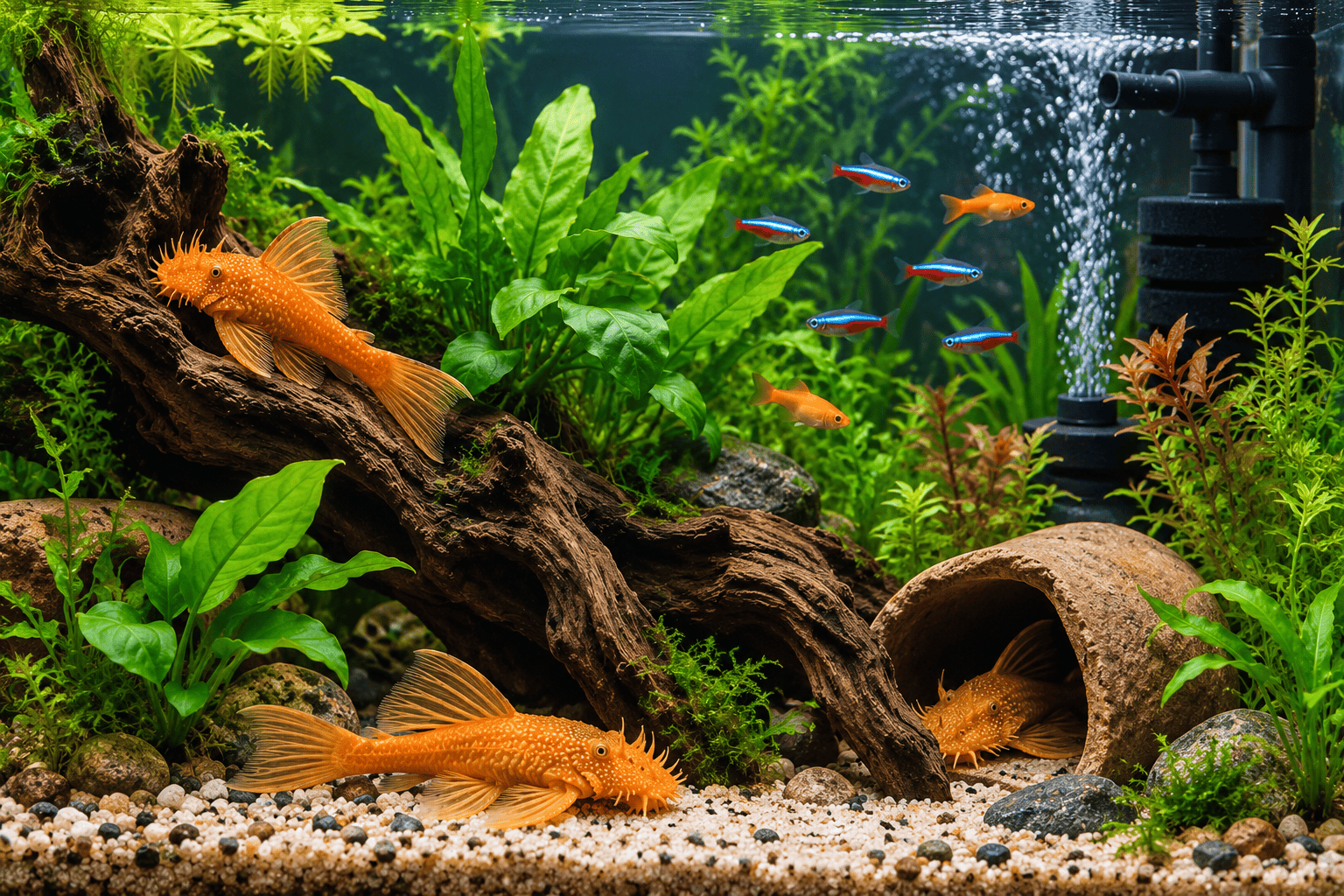
A suitable setup should contain smooth substrate, driftwood, caves and stable filtration. Sharp decorations should be avoided because plecos can injure their bodies and fins while moving through confined spaces.
At least one cave should be available for each territorial adult, especially when males are present. Additional shelters allow subordinate fish to avoid direct confrontation. Caves should have openings large enough for fish to enter and exit without becoming trapped.
Plants can be used extensively. Hardy plants attached to wood or rocks are particularly useful because they are less likely to be uprooted by bottom-dwelling activity. Live plants also increase environmental complexity and create additional surfaces for biofilm growth.
The AquariumsWorld Fish Aquarium Types and Setup Guide is also useful here because it covers aquarium types, standard tank sizes, filtration, heaters, plants and general setup planning.
6. Orange Pleco Water Parameters
Stable water quality is more important than attempting to maintain one perfect numerical value. Orange bristlenose plecos generally benefit from tropical freshwater conditions with consistent temperature and water chemistry appropriate for the confirmed strain and community.
| Parameter | Practical Target | Why It Matters |
|---|---|---|
| Temperature | Approximately 23 to 27°C | Supports normal tropical metabolism |
| pH | Approximately 6.5 to 7.8 | Suitable for many community setups |
| Ammonia | 0 ppm | Essential for fish safety |
| Nitrite | 0 ppm | Essential for fish safety |
| Nitrate | Preferably kept low | Indicates accumulation of nitrogenous waste |
The precise temperature should be selected according to the confirmed species and other inhabitants. Sudden changes are more concerning than a small difference within a reasonable tropical range. A reliable heater and thermometer can prevent large temperature fluctuations.
Water changes should be performed regularly. Exact frequency depends on stocking density, feeding, filtration and test results. Instead of following a rigid schedule without testing, aquarists should monitor ammonia, nitrite and nitrate and adjust maintenance accordingly.
High dissolved oxygen is particularly useful for plecos. Efficient surface agitation and appropriate filtration help maintain oxygen levels, especially at night when plants stop photosynthesising.
The AquariumsWorld Aquarium Water Parameter Health Checker can also be used to review ammonia, nitrite, nitrate, pH, temperature, GH and KH readings when assessing an established aquarium.
New aquariums must be fully cycled before introducing orange plecos. Adding fish to an immature system can expose them to ammonia and nitrite spikes that may cause serious illness or death.
7. What Do Orange Plecostomus Eat?
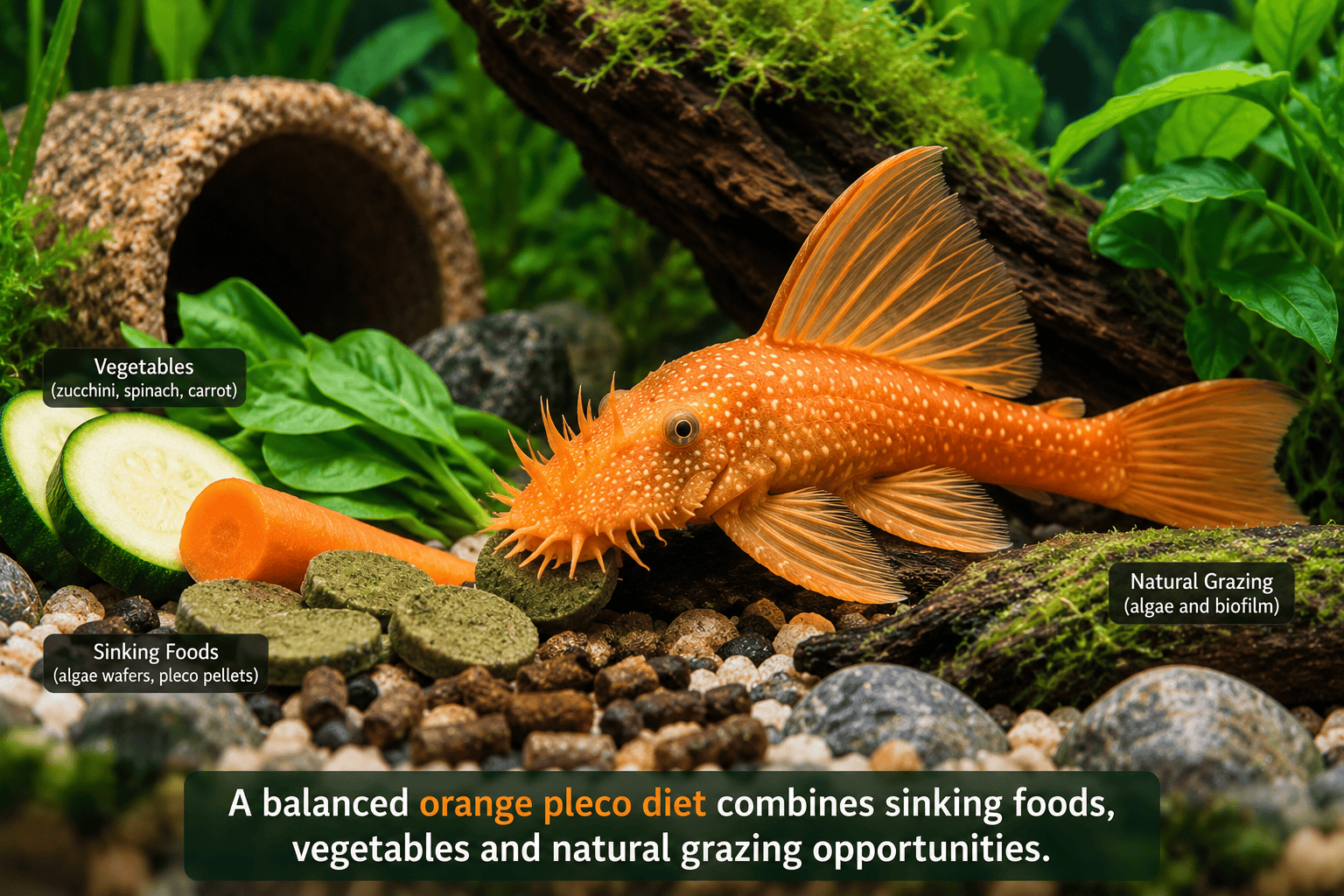
One of the biggest misconceptions about plecos is that they can survive on aquarium algae alone. Orange plecos may consume algae and biofilm, but this does not mean algae provides complete nutrition. A healthy diet should contain appropriate plant matter, sinking foods and controlled amounts of protein-rich foods.
High-quality algae wafers or specialist herbivore sinking pellets can form an important part of the diet. These foods remain available near the bottom and allow plecos to feed without competing heavily with midwater fish.
Vegetables for Orange Plecos
Suitable vegetables can include zucchini, cucumber, spinach and lettuce. Vegetables should be washed carefully and offered in manageable portions. Uneaten vegetables should be removed before they begin decomposing and damaging water quality.
Blanching firm vegetables can soften them and make them easier for plecos to rasp. A feeding clip or suitable aquarium weight can prevent food from floating around the tank.
Do Orange Plecos Eat Algae?
Yes, orange plecos can graze algae and biofilm from aquarium surfaces. Their sucker-shaped mouth is well adapted for scraping surfaces. However, they should not be described as automatic aquarium cleaners that eliminate all algae.
Algae availability varies according to lighting, nutrients, plant growth and cleaning routines. A newly established aquarium may contain very little natural grazing material. In that situation, supplemental foods are essential.
Protein in the Diet
Although bristlenose plecos have a strong association with plant-based feeding, a completely protein-free diet is unnecessary. Small amounts of appropriate protein-containing foods can be incorporated into a varied feeding plan, particularly for growing or breeding fish.
Feeding Frequency
Adult orange plecos can generally be fed small portions once daily, with vegetables offered periodically. Breeding fish and growing juveniles may need more frequent feeding. Observe body condition and remove uneaten food rather than continuously increasing portions.
| Food | Role | Frequency |
|---|---|---|
| Algae wafers | Plant-based staple | Regularly |
| Zucchini or cucumber | Fresh vegetable matter | Several times weekly |
| Specialist pleco pellets | Balanced sinking food | Regularly |
| Protein-rich sinking food | Additional nutrition | Occasionally |
| Natural biofilm and algae | Supplementary grazing | As available |
8. Orange Pleco Behaviour and Temperament
Orange plecos are generally peaceful community fish. They spend much of their time on the aquarium floor, attached to surfaces or moving between wood, plants and shelters. Their activity may become more noticeable during evening and night-time hours.
Despite their peaceful reputation, territorial behaviour can occur. Mature males are particularly likely to defend caves or preferred shelters. This behaviour becomes more important when several males are maintained in a confined aquarium.
Territorial disputes usually involve displays, chasing or pushing rather than sustained attacks, but repeated conflict can cause stress and injuries. Providing several caves and breaking up lines of sight can reduce competition.
Orange plecos should not normally harass peaceful community fish. They may occasionally interact with other bottom-dwelling species when competing for food or shelter. Adequate feeding and sufficient habitat complexity are therefore important.
A healthy pleco should show normal attachment, grazing, exploration and feeding behaviour. Sudden inactivity, persistent hiding, rapid breathing, loss of appetite or unusual swimming can indicate environmental or health problems and should prompt water testing.
9. Best Tank Mates for Orange Plecostomus
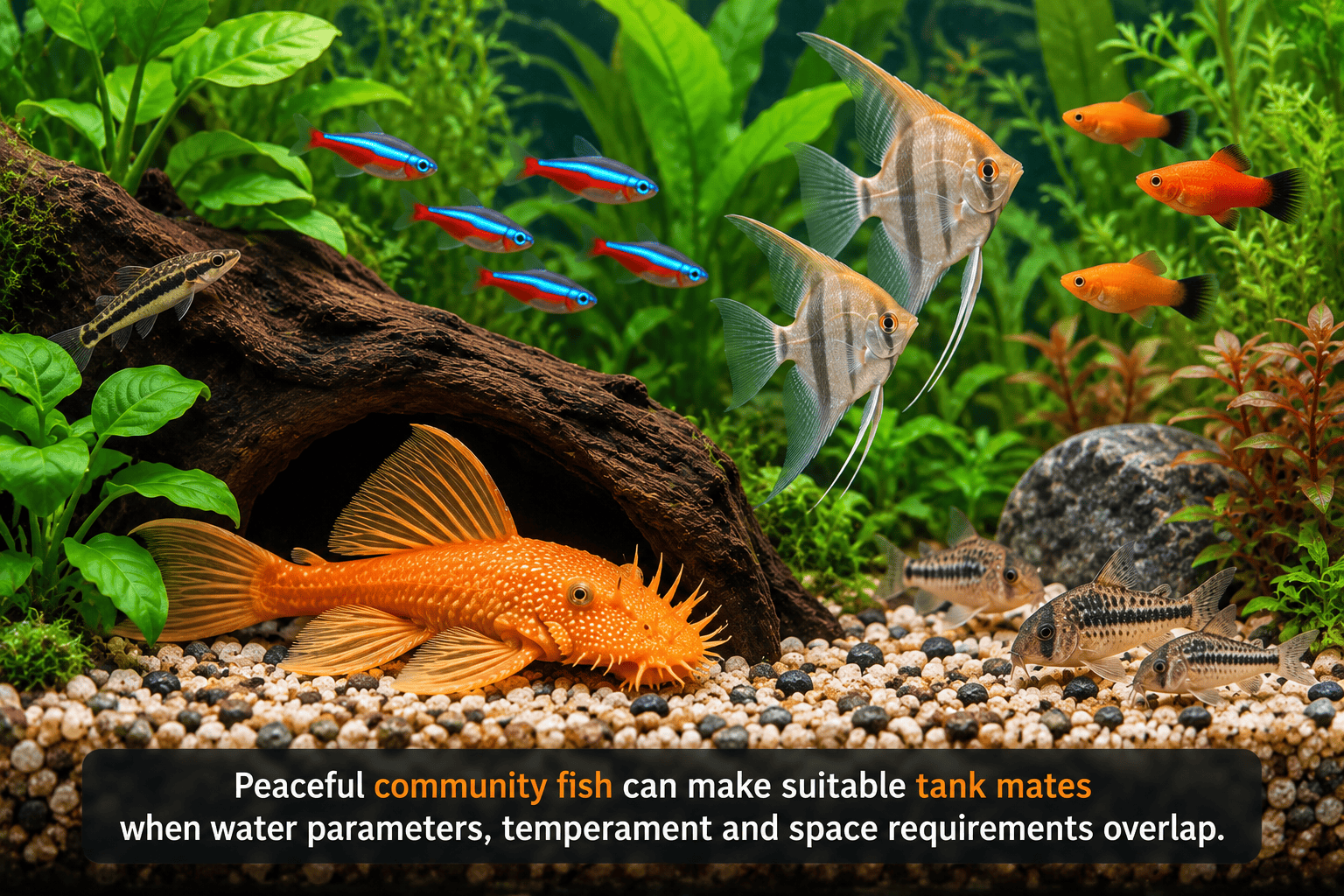
The best pleco tank mates are peaceful fish that occupy different parts of the aquarium and do not compete aggressively for caves or food. Small and medium-sized community species can work well when water parameters and temperature requirements overlap.
Good Community Tank Options
- Small peaceful tetras
- Rasboras
- Compatible danios
- Peaceful livebearers
- Compatible gourami species
- Other peaceful community fish with overlapping water requirements
Bottom-dwelling species require more careful planning. Keeping several species that depend on the same caves and feeding areas can increase competition even when all species are individually peaceful.
Fish to Avoid
Highly aggressive cichlids, persistent fin-nipping species and very large predatory fish are poor choices. Fish that continually harass plecos can cause chronic stress. Predators may also injure or consume smaller juveniles.
Multiple male bristlenose plecos should be kept with particular care. If several males are housed together, the aquarium should provide substantial bottom area and multiple caves. A larger aquarium is generally safer than maintaining several territorial males in a small tank.
Before selecting tank mates, compare temperature, pH, adult size, behaviour and feeding requirements. Compatibility is not simply a question of whether two species can physically survive in the same water.
For general aquarium planning, the AquariumsWorld Aquarium Setup and Guide section provides additional resources covering aquarium sizes, setup and stocking considerations.
10. How Long Do Orange Plecos Live?
A healthy orange bristlenose pleco can potentially live for several years in a well-maintained aquarium. Lifespan varies according to genetics, disease exposure, water quality, nutrition, stocking and general husbandry.
Good water quality is one of the strongest foundations for long-term health. Ammonia and nitrite should remain at zero, while nitrate should be controlled through appropriate stocking, filtration, feeding and water changes.
Nutrition also influences longevity. Fish that receive only occasional algae from the aquarium may not receive enough nutrients. A varied diet with specialist sinking foods and vegetables is more reliable.
Stress should also be considered. Repeated territorial conflict, overcrowding, unsuitable tank mates and inadequate shelter can weaken fish over time. Providing an environment that supports natural behaviour is therefore part of lifespan management.
11. Are Orange Plecos Easy to Keep?
Orange plecos are relatively manageable for aquarists who understand their requirements. They are not demanding because of complicated behaviour, but they still need mature filtration, stable water conditions, suitable food and appropriate shelter.
The biggest beginner mistake is assuming that a pleco can simply be placed into an aquarium to clean algae. Plecos are living animals with nutritional and environmental requirements. Their waste production can also be significant relative to their body size.
A beginner-friendly setup should ideally be mature before the fish arrives. The filter should have established biological media, the aquarium should have stable parameters and the aquarist should have a testing routine.
The Fish Aquarium Types and Setup Guide provides a useful starting point for beginners because it covers aquarium types, equipment, filtration, heaters, stocking and setup.
Regular observation is also essential. Plecos often hide during daylight, so beginners should become familiar with normal feeding and nighttime behaviour rather than assuming that a hidden fish is automatically sick.
12. Orange Pleco Breeding Guide
Orange bristlenose plecos are among the more achievable plecos to breed in home aquariums when healthy adults are provided with suitable caves, clean water and consistent food. Breeding behaviour is closely associated with cave selection and male territorial behaviour.
Sexing Orange Bristlenose Plecos
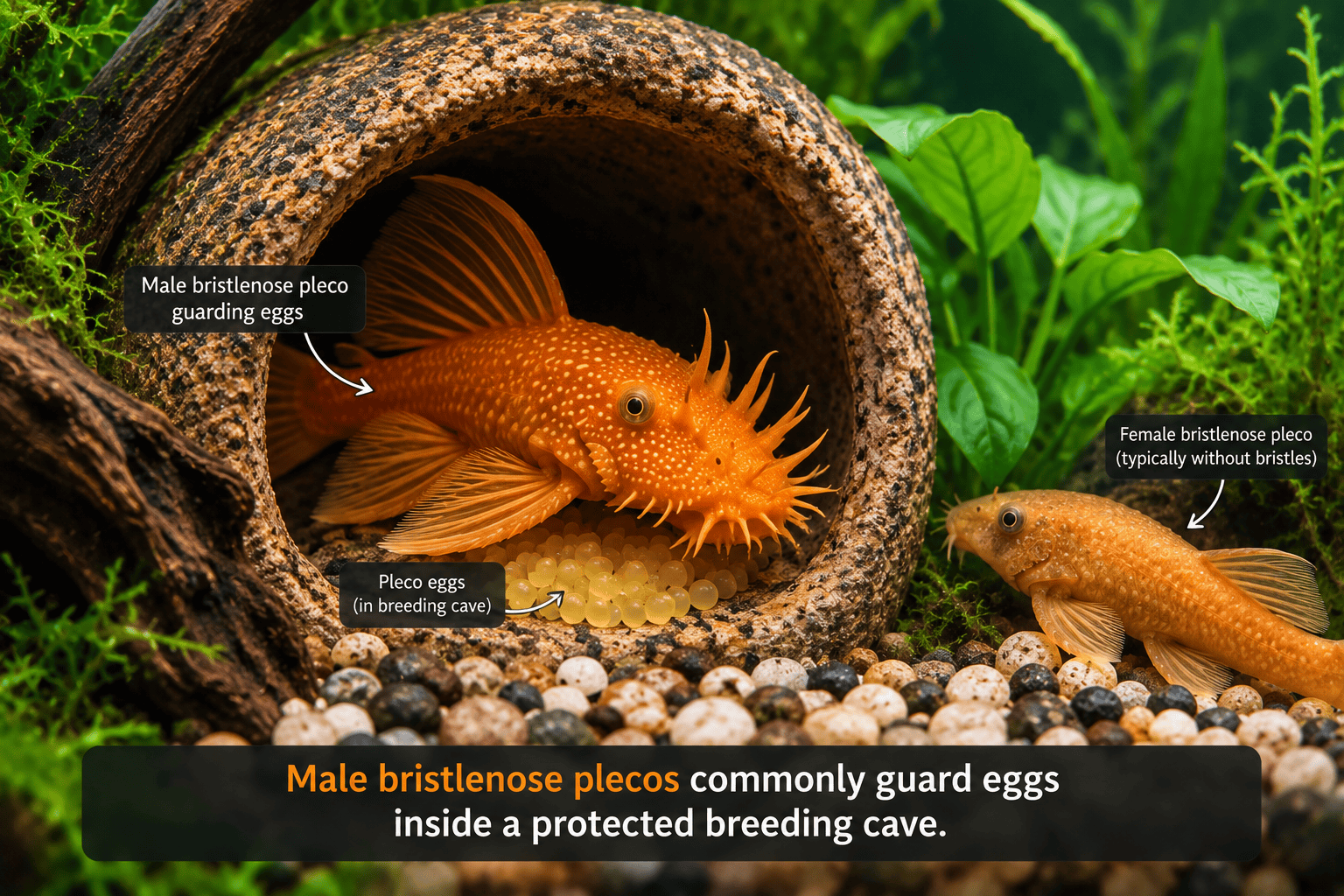
Sexual differences become clearer as fish mature. Males commonly develop prominent bristles on the head and facial area, while females generally have smaller or less developed bristles. Juveniles can be difficult to sex reliably.
Breeding Tank Setup
A breeding aquarium should contain a suitable cave with an opening that allows the male to enter while giving him a defensible space. Ceramic pleco caves and purpose-built shelters are commonly used by aquarists.
The aquarium should have excellent filtration and oxygenation. Breeding activity increases the importance of stable water quality because eggs and fry are sensitive to poor conditions.
Breeding Behaviour
The male generally selects and guards a cave. A female may enter the shelter and deposit eggs. The male then fertilises and guards them. During this period, he can become noticeably territorial.
Eggs are typically attached inside the protected cave. The male provides parental care by remaining near the clutch and maintaining water movement around the eggs through fin movement.
Eggs and Fry
Once fry become free swimming, they require appropriately sized food and excellent water quality. Newly hatched young can initially rely on yolk reserves, but feeding becomes increasingly important as they develop.
Fry can be offered appropriately sized vegetable-based and specialised sinking foods. Food should be available without allowing excessive leftovers to accumulate. Small, frequent feedings can be useful when raising larger numbers of juveniles.
Breeding should not be attempted simply to produce fish for sale. The aquarist should have a plan for the offspring because a successful breeding pair can produce more juveniles than an ordinary community aquarium can accommodate.
13. Orange Pleco Health and Common Problems
Most health problems seen in orange plecos are associated with environmental stress, poor nutrition, inappropriate tank conditions, infectious disease or physical injury. Prevention is generally easier than treatment.
Weight Loss
A thin pleco may not be receiving enough food. This is particularly common when aquarists assume the fish can survive entirely on algae. Check whether the fish receives regular sinking foods and vegetables and whether other bottom fish are taking food first.
Rapid Breathing
Rapid breathing can be associated with low oxygen, poor water quality, high temperature or disease. Test ammonia, nitrite and other relevant parameters immediately. Increasing surface agitation can improve oxygenation while the underlying problem is investigated.
White Spots or Abnormal Growths
White spots, ulcers, fungal-looking growths or damaged tissue should not be diagnosed solely from appearance. Several conditions can produce similar symptoms. Water quality should be checked first, and specialist aquatic veterinary advice may be required for persistent or severe cases.
Fin Damage
Fin damage can result from aggression, sharp decorations or poor water quality. Inspect caves and ornaments for rough edges and check whether tank mates are responsible.
Constipation and Digestive Problems
Overfeeding, poor diet variety and insufficient fibre can contribute to digestive problems. Vegetable matter can support a more appropriate feeding pattern, while excessive food should be avoided.
Preventive Care
- Maintain zero ammonia.
- Maintain zero nitrite.
- Keep nitrate under control.
- Perform regular partial water changes.
- Provide strong biological filtration.
- Maintain adequate oxygenation.
- Offer a varied diet.
- Provide driftwood and shelter.
- Avoid aggressive tank mates.
- Quarantine new fish when practical.
If you are researching broader aquarium disease and water-quality problems, the AquariumsWorld Blog contains dedicated fish disease and aquarium problem resources, including guides on recognising and managing common aquarium health issues.
Important: A pleco that suddenly stops eating, develops visible lesions, breathes rapidly or loses substantial body condition should be treated as a potentially serious health issue. Test aquarium water first and seek qualified aquatic veterinary advice when symptoms persist or worsen.
14. Orange Pleco Driftwood Requirement
Driftwood is one of the most useful additions to an orange pleco aquarium. Bristlenose plecos naturally interact with submerged surfaces, and wood provides a textured surface for grazing and exploration.
Not every piece of wood is suitable. Aquarium-safe driftwood should be used and prepared according to the manufacturer’s or seller’s instructions. Wood can initially float, release tannins and slightly alter water appearance.
Tannins can create a brown or tea-coloured appearance. This is generally a cosmetic issue rather than evidence that the wood is harmful. Aquarists who prefer clear water can reduce tannins through soaking and appropriate filtration media.
Wood should be positioned securely so that it cannot collapse or trap fish. Large pieces can also create shaded areas and visual barriers between territorial plecos.
Driftwood should therefore be considered part of the habitat rather than merely decorative equipment.
15. Orange Plecostomus and Algae Control
Orange plecos can contribute to algae control, but their role should be understood correctly. They graze surfaces and consume some algae and biofilm, but they do not guarantee an algae-free aquarium.
Algae develops through interactions between light, nutrients, carbon availability, plant growth and maintenance. Adding a pleco without correcting excessive lighting or nutrient accumulation will not solve the underlying cause.
In fact, a healthy aquarium does not necessarily need to have zero algae. Some biofilm and algae provide natural grazing opportunities. The goal should be ecological balance rather than complete removal of every surface organism.
Regular glass cleaning, controlled lighting, appropriate feeding and healthy plant growth can all contribute to algae management. The orange pleco can then act as one part of the overall aquarium ecosystem.
16. Orange Pleco Tank Maintenance Routine
A reliable maintenance routine makes orange pleco care considerably easier. Daily observation should focus on appetite, breathing, activity and interactions with other fish. Because plecos are often most active after lights-out, checking the aquarium during evening hours can reveal behaviour that is missed during the day.
Daily Tasks
- Check that all fish are behaving normally.
- Observe whether the orange pleco is feeding.
- Remove obviously uneaten vegetables.
- Check aquarium temperature.
- Look for signs of aggression or injury.
Weekly Tasks
- Test important water parameters.
- Perform an appropriate partial water change.
- Inspect filter and equipment.
- Clean viewing glass when necessary.
- Check caves and decorations for trapped waste.
- Inspect fish condition carefully.
Monthly Tasks
Monthly maintenance should include a broader assessment of filtration, equipment, stocking and aquarium layout. Filter media should not be aggressively cleaned with untreated tap water because chlorine or chloramine can damage beneficial bacteria. Media should generally be rinsed in removed aquarium water when cleaning is necessary.
It is also useful to assess whether fish have outgrown the current setup. A young orange pleco may initially have abundant space, but growth, breeding or additional tank mates can gradually change stocking pressure.
Aquarists can compare their setup against the tank-size and filtration guidance available in the AquariumsWorld aquarium setup resource.
17. Orange Plecostomus Frequently Asked Questions
What is an orange plecostomus?
An orange plecostomus is a common aquarium trade term for orange-coloured plecos, especially orange bristlenose or Ancistrus forms. L144 and super red types are examples of trade names associated with orange or reddish colouration. The name should not automatically be interpreted as one formally recognised species.
How big do orange plecos get?
Most orange bristlenose plecos remain relatively compact and commonly reach approximately 10 to 15 cm as adults. Exact size depends on genetics, sex, diet and environmental conditions. Buyers should confirm expected adult size for the specific strain rather than relying on juvenile size.
What do orange plecostomus eat?
Orange plecos should receive a varied diet containing quality algae wafers or specialist sinking foods, vegetables and occasional appropriate protein-rich foods. Natural algae and biofilm can supplement the diet but should not be considered a complete nutritional source.
Are orange plecos aggressive?
Orange plecos are generally peaceful, but mature males can become territorial, particularly around caves and breeding areas. Providing several shelters and enough bottom space can reduce conflict. Aggressive behaviour becomes more likely when several territorial males are confined in a small aquarium.
What tank size does an orange pleco need?
Around 20 gallons can be a practical starting point for one adult orange bristlenose pleco in a well-filtered aquarium. Larger aquariums are preferable for multiple plecos, breeding setups or community tanks. Aquarium dimensions, filtration and stocking should all be considered rather than volume alone.
How long do orange plecos live?
Orange bristlenose plecos can live for several years when maintained under stable aquarium conditions. Good filtration, clean water, appropriate nutrition, suitable tank mates and low stress all contribute to long-term health.
Can orange plecos live with other fish?
Yes. Their peaceful temperament makes them suitable for many community aquariums. Good tank mates can include peaceful tetras, rasboras and other compatible community fish. Aggressive predators and fish that constantly compete for bottom shelters should be avoided.
Do orange plecos eat algae?
Yes. Orange plecos graze algae and biofilm from aquarium surfaces. However, they should not be expected to remove all algae or survive entirely on algae. A balanced diet remains necessary, especially in clean or newly established aquariums with limited natural grazing material.
Are orange plecos easy to keep?
They are relatively easy to keep once the aquarium is properly established. Their core requirements are stable tropical water, effective filtration, adequate oxygenation, suitable food, driftwood, caves and compatible tank mates. The most common beginner mistake is treating them only as algae cleaners.
Can you breed orange plecos at home?
Yes. Healthy mature bristlenose plecos can often be bred in home aquariums. A suitable cave, stable water, good nutrition and an appropriate male and female combination can encourage spawning. Males commonly guard eggs inside the cave after spawning.
18. Choosing a Healthy Orange Pleco
When buying an orange pleco, appearance should be considered alongside health. The fish should have a reasonably full body, clear eyes, intact fins and normal posture. Avoid fish that appear extremely thin, lethargic, injured or unable to attach normally.
Ask the seller how long the fish has been in their system and what foods it has been eating. This information can make the transition to the home aquarium easier. If possible, observe the fish feeding before purchase.
Quarantine is a valuable precaution when introducing new fish. A separate quarantine aquarium allows the aquarist to observe behaviour and detect potential illness before the fish enters an established community tank.
19. Orange Pleco vs Common Plecostomus
New aquarists often confuse orange bristlenose plecos with common plecostomus because both are sold under broad pleco terminology. Their eventual size can be dramatically different.
| Feature | Orange Bristlenose Pleco | Large Common Plecostomus Types |
|---|---|---|
| Adult size | Generally compact | Can become very large |
| Tank suitability | Suitable for many medium community aquariums | Often requires very large aquarium |
| Facial bristles | Prominent in mature males | Not characteristic in the same way |
| Territorial behaviour | Possible around caves | Varies by species |
| Algae grazing | Yes | Yes in many species |
This distinction is important when buying a fish marketed simply as a plecostomus. If the seller cannot provide reliable information about species identity or expected adult size, research the specific fish before purchase.
20. Building the Best Orange Pleco Community Tank
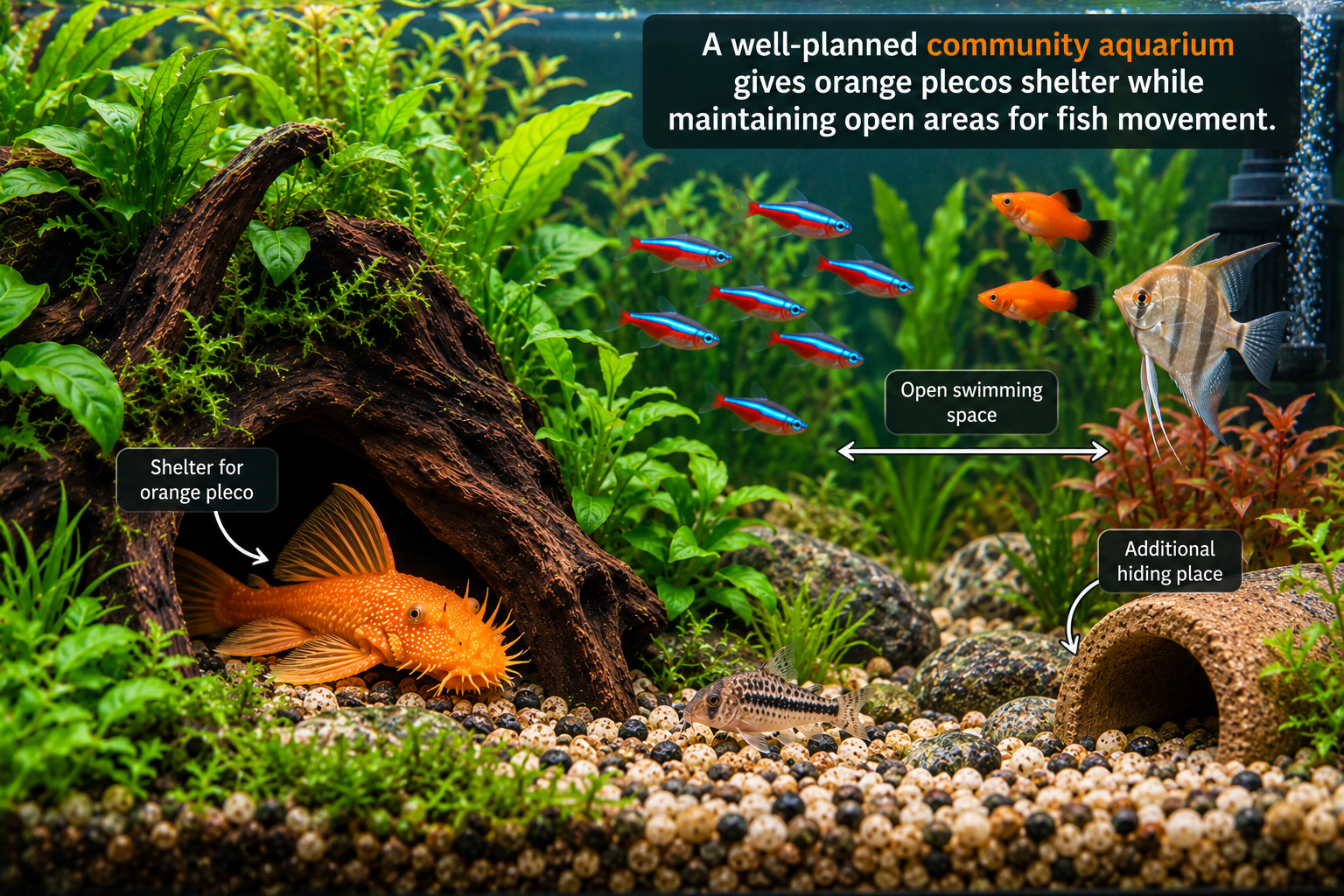
The best orange pleco community tank balances open swimming space with bottom structure. The aquarium should not be filled entirely with decorations because fish still need unobstructed areas for movement and maintenance access.
Start with reliable filtration and a mature biological cycle. Add substrate, driftwood, caves and plants in a way that creates shaded areas without blocking circulation. Introduce peaceful fish gradually and monitor interactions.
Feeding should also be planned around the entire community. Sinking foods can be added after lights-out when many plecos naturally become more active. This can reduce competition with fish that feed aggressively during the day.
Water changes should be based on stocking and testing rather than assuming that one percentage works for every aquarium. A lightly stocked mature tank and a heavily stocked breeding aquarium can have very different maintenance requirements.
For larger community aquariums, the AquariumsWorld setup archive includes a dedicated 50 Gallon Fish Tank Guide covering tank dimensions, litres, weight, setup, equipment, stocking and suitable fish. The same archive also contains larger aquarium resources for aquarists planning substantial community systems.
21. Common Orange Pleco Care Mistakes
Several mistakes appear repeatedly in orange pleco care. The first is purchasing the fish as a solution to algae without planning its long-term requirements. Plecos are not maintenance equipment. They are animals that need appropriate nutrition, space and water quality.
The second mistake is choosing a tank based solely on juvenile size. Young plecos can grow considerably, and additional fish can increase biological load.
The third mistake is providing too few shelters. One cave may be sufficient for one territorial male, but several adults may require several shelters to reduce competition.
The fourth mistake is underfeeding. A tank with clean glass may contain little algae, meaning the pleco could have limited natural food. Regular supplemental feeding is therefore important.
The fifth mistake is neglecting oxygenation. Good filtration does not automatically guarantee optimal oxygen levels if the surface is stagnant. Surface movement and appropriate circulation should be maintained.
Finally, unstable water conditions can undermine otherwise good care. Regular testing and consistent maintenance are more useful than repeatedly attempting to correct dramatic water changes.
For broader guidance on aquarium setup, equipment and water management, use the AquariumsWorld Fish Aquarium Types and Setup Guide.
22. Final Orange Pleco Care Checklist
- Choose a confirmed bristlenose or Ancistrus-type orange variety.
- Plan for adult size rather than juvenile size.
- Use an appropriately sized aquarium.
- Provide efficient biological filtration.
- Maintain stable tropical freshwater conditions.
- Keep ammonia and nitrite at zero.
- Control nitrate through maintenance and stocking.
- Provide strong but appropriate oxygenation.
- Add aquarium-safe driftwood.
- Provide caves and shaded hiding areas.
- Feed quality sinking foods regularly.
- Offer vegetables as part of a varied diet.
- Do not rely exclusively on algae.
- Choose peaceful tank mates.
- Monitor territorial behaviour between males.
- Perform regular water testing and partial water changes.
- Observe fish behaviour, appetite and body condition.
- Quarantine new fish whenever practical.
- Plan carefully before allowing breeding.
23. Conclusion
Orange plecostomus varieties are attractive freshwater catfish that can work exceptionally well in planted and peaceful community aquariums. Their compact size, orange colouration and interesting grazing behaviour make them popular among both new and experienced aquarists. However, successful care depends on understanding what these fish actually need rather than treating them as simple algae cleaners.
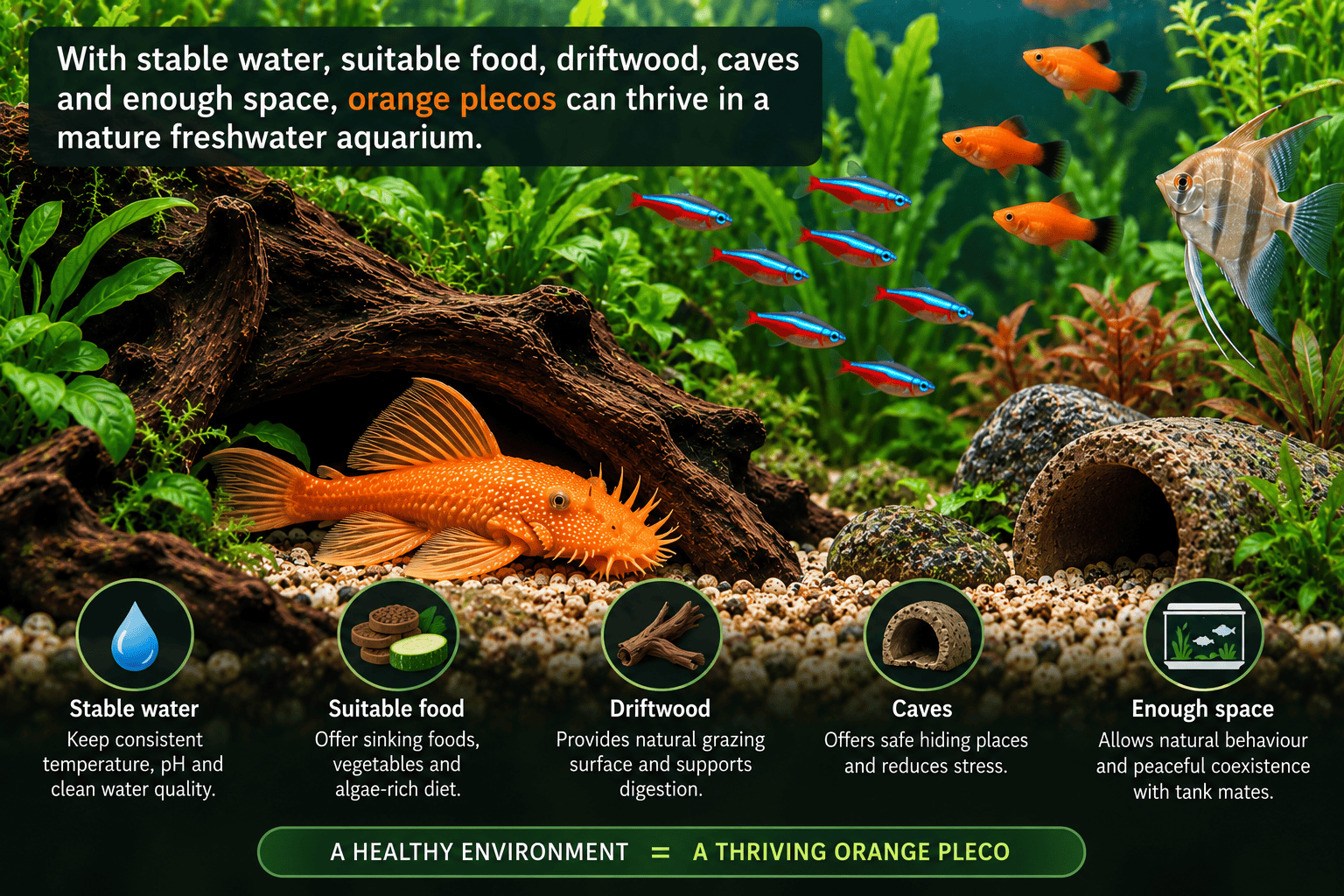
The most important priorities are stable water quality, appropriate aquarium space, effective filtration, adequate oxygenation, driftwood, caves and a varied diet. Orange plecos can eat algae and biofilm, but they still require supplemental nutrition. Vegetables and specialist sinking foods should form part of a balanced feeding routine.
Tank mates should be selected according to temperament, adult size and environmental requirements. Peaceful community fish are generally suitable, while aggressive predators and excessive competition for bottom territory should be avoided.
Breeding is achievable with mature healthy fish when an appropriate cave, stable water and suitable nutrition are provided. Male bristlenose plecos commonly guard eggs, making the breeding behaviour particularly interesting to observe.
Ultimately, the best orange pleco aquarium is not simply the one with the brightest fish. It is the aquarium that provides stable conditions, adequate space, appropriate nutrition and opportunities for natural behaviour. With these fundamentals in place, orange bristlenose plecos can become long-term and visually distinctive members of a healthy freshwater community.
Before purchasing or upgrading your aquarium, compare your planned setup with the AquariumsWorld tank-size and stocking guidance and use the site’s water parameter tools to help assess your aquarium conditions.
References
- Lujan, N.K. et al. (2015). Molecular phylogeny of suckermouth armoured catfishes. Molecular Phylogenetics and Evolution. DOI: 10.1016/j.ympev.2014.10.007.
- Armbruster, J.W. and Lujan, N.K. (2025). A new tribe-level classification of Hypostominae. Neotropical Ichthyology. DOI: 10.1590/1982-0224-2024-0108.
- Wikipedia (2026). Loricariidae. Reference information on the family of suckermouth armoured catfishes.
- LiveAquaria. Orange L-144 Bushy Nose Plecostomus. Aquarium trade and care information for the orange bristlenose type.
- AquariumSource (2026). Bristlenose Pleco 101. General information on bristlenose pleco care, feeding, size and aquarium requirements.
- Aqua-Fish.net (2024). Orange Spot Pleco. Aquarium information relating to orange pleco identification and care.
- FishKeepingWorld (2022). Plecostomus Care Guide. General aquarium care information for plecostomus and related suckermouth catfish.
- TankZen (2026). Bristlenose Pleco Care. Aquarium guidance relating to tank setup, feeding, water conditions and breeding.