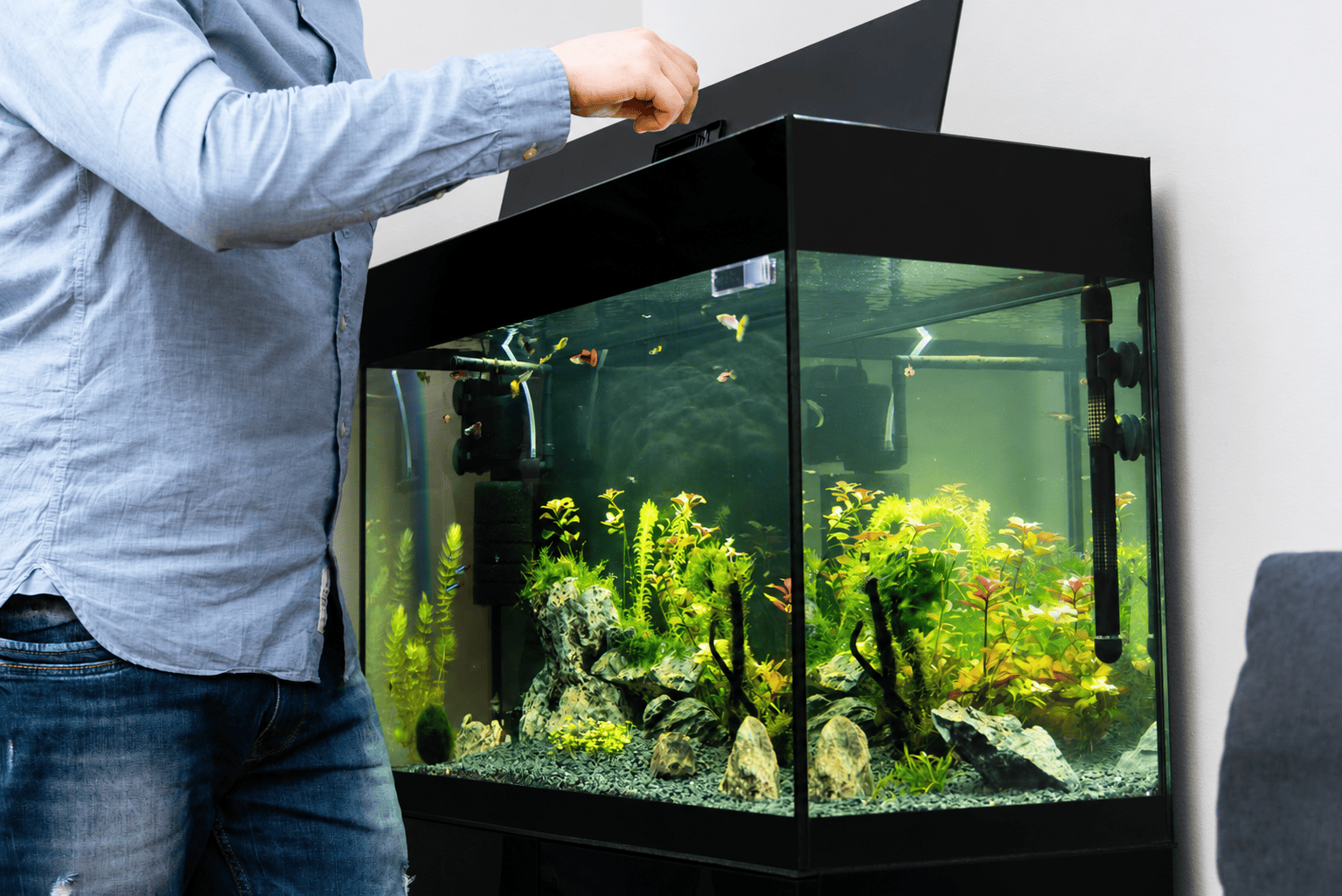
A well-planted betta aquarium can provide much more than an attractive background. The best plants for betta fish tanks can create cover, resting places and environmental complexity while also taking up nutrients from the water. For many beginners, real aquatic plants for a betta tank are therefore a more useful choice than relying entirely on artificial decoration. Anubias, Java fern, Java moss, Cryptocoryne and suitable floating plants are among the easiest choices because many varieties tolerate modest lighting and do not require injected CO2.
Plant selection also matters when a betta aquarium becomes a community aquarium. Peaceful species such as selected rasboras, small tetras and Corydoras can work in appropriately sized planted tanks, although compatibility depends on the individual fish, aquarium size and stocking plan. If you are still planning the aquarium itself, our Betta Fish Tank Complete Guide covers tank size, filtration, heating, cycling, water quality and general setup.
There is also an important distinction between aquatic plants and terrestrial house plants. Plants such as pothos can be grown with their roots in aquarium water while their foliage remains above the waterline, but that is different from completely submerging a house plant. Peace lily and philodendron require similar caution. The right plant can contribute to nutrient uptake, but it should never be treated as a replacement for filtration, cycling, testing and regular maintenance.
This guide explains the best live plants for betta fish tanks, real versus fake plants, good community fish for planted aquariums, fish safe for live plants, planted tank decoration ideas, low-light options, floating plants, Anubias, Java fern, Java moss, pothos in a fish tank, peace lily roots, and the important differences between aquatic plants and terrestrial house plants.
Why Real Plants Are Better Than Fake Plants for a Betta Fish Tank
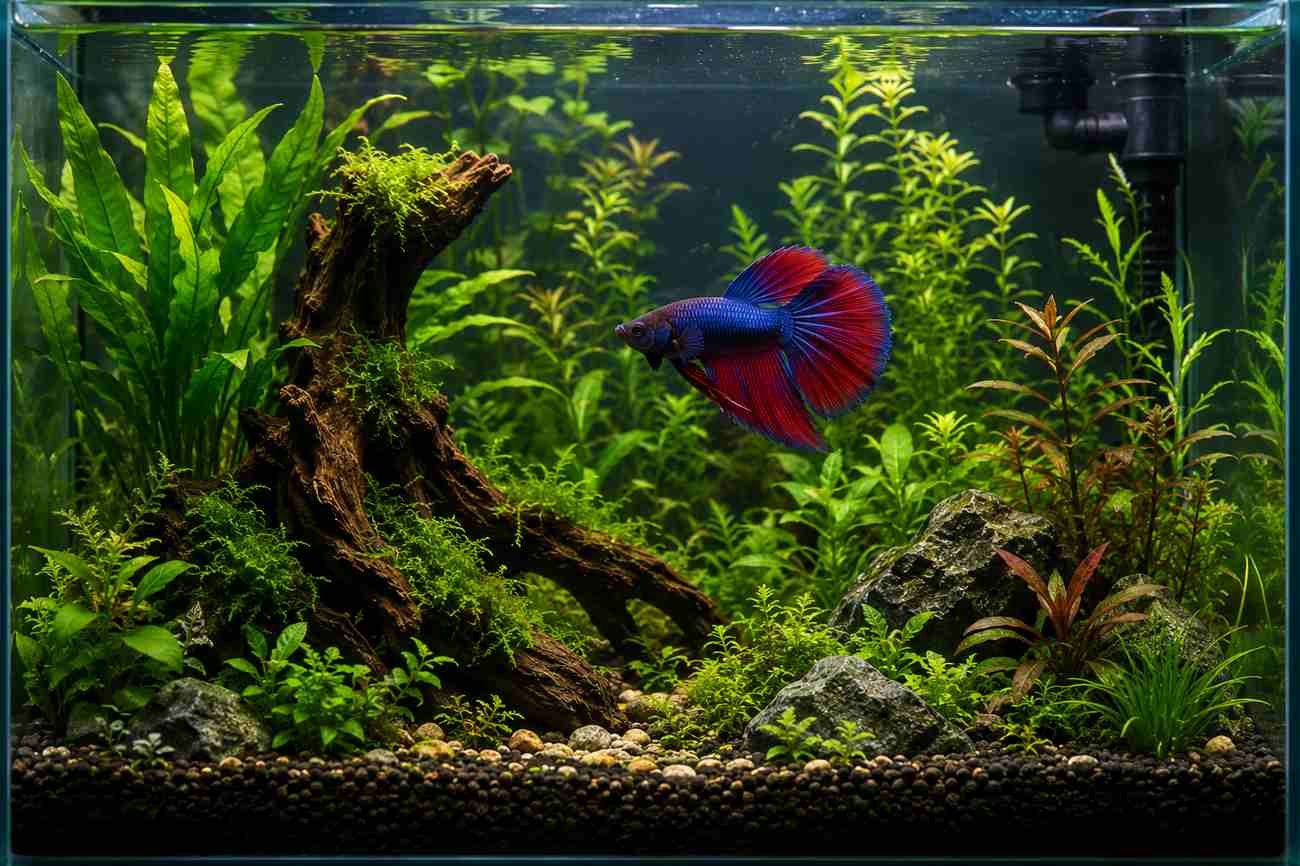
One of the first decisions when designing a betta aquarium is whether to use live plants, artificial plants or a mixture of both. The answer is not simply aesthetic. Live plants can perform biological functions that artificial decorations cannot. They photosynthesise when conditions are appropriate, take up nutrients and provide physical structure that can make an aquarium more complex.
However, saying that live plants automatically make every aquarium healthier would be misleading. A poorly maintained planted aquarium can still develop ammonia, nitrite, nitrate or algae problems. Plants do not replace a biological filter, water changes or responsible stocking. Their value is that they can become one component of a broader aquarium system.
Research on ornamental fish welfare supports the broader importance of environmental complexity. Walster et al. (2015) discuss the welfare importance of appropriate environmental conditions for ornamental fish kept in aquariums. More specifically, Pleeging and Moons (2017) reviewed welfare concerns associated with Siamese fighting fish and highlighted the importance of appropriate environmental conditions rather than treating bettas as fish that require little environmental complexity.
The evidence should therefore be interpreted carefully. Live plants are not a medicine and they do not guarantee good welfare. They are one practical way to increase habitat structure, shade, cover and environmental complexity while potentially contributing to nutrient uptake.
What Do Real Plants Do for a Betta Tank?
The main benefits can be grouped into five areas: water chemistry support, environmental enrichment, cover, visual structure and nutrient competition with algae. Aquatic plants use nutrients for growth, although the amount removed varies considerably between species and growing conditions.
Csontos, Bartal and Bakacsy (2024) experimentally examined aquatic plants in aquarium-based ornamental fish production and demonstrated that aquatic plants can contribute to nitrate and phosphate removal under controlled production conditions. That evidence supports the general biological principle that growing plants can take up nutrients, but the exact effect in a home betta aquarium will depend on plant biomass, light, nutrient availability, growth rate and maintenance.
- Nutrient uptake: growing plants can use dissolved nutrients.
- Oxygen production: photosynthesis produces oxygen during the light period.
- Cover: dense planting provides visual barriers and sheltered areas.
- Resting surfaces: broad leaves can provide locations where bettas can rest.
- Natural structure: plants create a more complex environment than a completely bare aquarium.
What Are the Best Plants for a Betta Fish Tank?
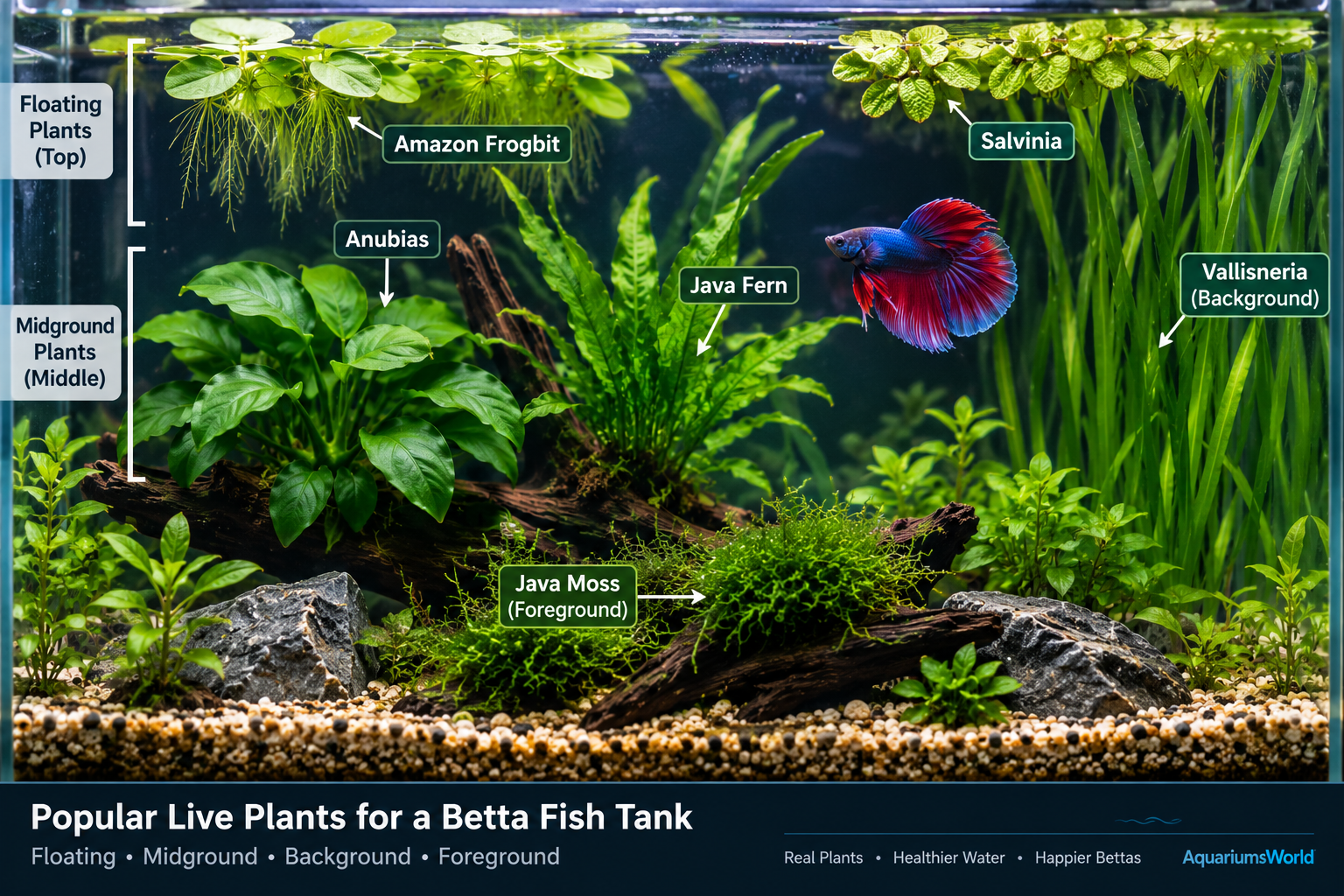
The best plants for a betta aquarium are not necessarily the fastest-growing or most expensive species. Beginners usually benefit from plants that tolerate low-to-moderate light, do not require CO2 injection and can survive modest changes in aquarium conditions.
Anubias, Java fern and Java moss are particularly useful because they can be attached to wood or rocks rather than planted deeply into substrate. Floating plants can provide surface cover, while Cryptocoryne and Amazon sword can create rooted midground and background structure in larger aquariums.
| Plant | Light | CO2 | Position | Betta Benefit | Difficulty |
|---|---|---|---|---|---|
| Anubias nana | Low | Not required | Midground | Broad resting leaves and cover | Very easy |
| Java fern | Low | Not required | Midground | Cover and structure | Very easy |
| Java moss | Low | Not required | Hardscape or foreground | Soft cover and microorganism habitat | Very easy |
| Amazon frogbit | Low to medium | No | Floating | Shade and surface cover | Easy |
| Cryptocoryne wendtii | Low to medium | Not required | Midground | Dense natural structure | Easy |
| Amazon sword | Medium | Not required | Background | Large leaves and cover | Easy |
| Water wisteria | Low to medium | Not required | Background | Fast-growing cover | Easy |
| Vallisneria | Low to medium | Not required | Background | Tall vertical structure | Easy |
Anubias Betta Tank Setup
Anubias is one of the easiest choices for a beginner betta aquarium. Anubias nana, Anubias barteri and compact varieties such as Anubias nana petite have thick leaves that tolerate relatively low light and grow slowly compared with many stem plants. This makes them particularly useful when the aquarist wants an attractive aquarium without aggressive trimming.
The most important planting rule is to avoid burying the rhizome. The rhizome is the thick horizontal stem from which the leaves and roots emerge. It should remain above the substrate. Instead, attach the plant to driftwood or aquarium rock using aquarium-safe thread, glue designed for aquarium plants or another secure method.
Anubias can work particularly well in a betta fish tank because its leaves create resting surfaces close to the upper and middle areas of the aquarium. The fish can choose whether to rest among the leaves or swim through open water.
For a detailed setup covering tank volume, filtration, heating, cycling and water quality, see the Betta Fish Tank Complete Guide .
Java Fern Betta Fish Aquarium
Java fern, commonly sold as Microsorum pteropus, is another strong choice for betta aquariums. It is tolerant of low light and can be grown attached to wood, rocks or other aquarium surfaces. It does not require a nutrient-rich substrate because its rhizome and roots can remain exposed.
Several forms are available, including standard Java fern, narrow leaf, trident and Windelov-type forms. Their different leaf shapes can create visual variety without changing the basic care approach.
A Java fern betta fish aquarium can therefore be designed around a small piece of driftwood with Java fern attached to its branches. Anubias can be added around the lower section while Java moss fills small gaps. Floating plants can then provide surface shade.
Java fern is particularly useful for beginners because its slower growth means less frequent trimming. However, slow growth also means it should not be treated as a rapid nitrate-removal solution.
Java Moss Betta Fish
Java moss is another beginner-friendly option. It can be attached to wood, rock and other hardscape, or allowed to grow as a loose mass. Its fine structure gives small organisms surfaces on which to live, creating additional microhabitat within the aquarium.
Java moss can also be used for planted tank decoration ideas such as moss-covered driftwood, small moss islands and natural-looking rock formations. Because its texture is relatively soft, it is useful when an aquarist wants to avoid hard, sharp artificial decorations.
The main disadvantage is that Java moss can collect debris if the water around it is stagnant. Gentle circulation is therefore useful. Regularly remove trapped waste and trim excessive growth so that the moss does not become a dense, unmaintained mass.
Floating Plants for Betta Fish
Floating plants for betta fish can transform the upper part of an aquarium. Their roots extend into the water while their leaves remain at the surface. This creates shade, visual complexity and additional surface structure.
Amazon Frogbit
Amazon frogbit develops rounded floating leaves and dangling roots. In a suitable aquarium, those roots can create a shaded area beneath the surface. Frogbit can be particularly attractive in a betta aquarium because the fish can move between open water and shaded areas.
Dwarf Water Lettuce
Dwarf water lettuce forms rosettes at the surface and can produce long roots. Growth can become rapid under strong lighting and high nutrient availability, so regular thinning may be necessary.
Red Root Floater
Red root floater can provide colour contrast when grown under appropriate light. It is more demanding than some basic floating plants and can respond poorly to water splashing onto its leaves. It is therefore better suited to an aquarium with controlled surface conditions.
Duckweed
Duckweed is extremely fast-growing. This can be useful for nutrient uptake but can also become a maintenance problem. A thick duckweed layer can cover most of the surface, reducing light penetration and making feeding and maintenance difficult. Keep part of the surface open so the betta can access atmospheric air.
Cryptocoryne Betta Tank
Cryptocoryne is one of the most useful rooted plant groups for a planted betta tank. Cryptocoryne wendtii is particularly popular because it is available in different colours and forms while tolerating relatively modest lighting.
Cryptocoryne can experience what aquarists commonly call “crypt melt” after being moved into a new aquarium. Existing leaves may deteriorate while the plant adapts to its new environment. This does not necessarily mean the plant is dead. If the root system remains healthy, new growth may appear after the transition.
Cryptocoryne should normally be planted in the substrate with the roots covered while the central crown remains above the substrate. Root tabs can help when the substrate does not contain sufficient nutrients.
Amazon Sword Planted Tank
An Amazon sword can become a strong centrepiece in a 10-gallon or larger planted tank. Its large leaves create substantial vertical and horizontal structure and can give a betta multiple sheltered areas.
Amazon sword is a heavier root feeder than Anubias or Java fern. A nutrient-rich substrate or appropriately positioned root tabs can therefore be useful. The plant may eventually become large enough to dominate a small aquarium, so consider the mature size before buying one for a 5-gallon tank.
For planted aquarium substrate planning, see the Soil in Fish Tank: Types, Problems and Plant Growth Guide .
Water Wisteria for a Betta Tank
Water wisteria is a relatively fast-growing plant that can be useful when an aquarist wants a planted aquarium to develop quickly. Its growth rate means it can consume nutrients more rapidly than slow-growing epiphytes under favourable conditions.
Fast growth also means more maintenance. Trim the plant regularly and remove damaged leaves. If it reaches the surface, pruning can encourage branching and prevent it from blocking too much light.
Vallisneria for a Betta Tank
Vallisneria produces long ribbon-like leaves and works well as a background plant. It spreads through runners, so a few plants can eventually create a larger planted area.
Plant Vallisneria toward the back of the aquarium and allow open swimming space toward the front. The long leaves can create a natural curtain without requiring complex aquascaping skills.
Marimo Moss Ball
Marimo moss balls are not technically conventional aquarium plants. They are spherical growths of the green alga Aegagropila linnaei. They are commonly sold as low-maintenance aquarium additions and can provide an unusual decorative feature.
Their contribution to water purification should not be exaggerated because their nutrient uptake is limited by their relatively small biomass. Their main advantage is simplicity and appearance rather than replacing biological filtration.
How to Set Up a Betta Fish Tank with Live Plants
A planted betta tank should be designed around the needs of both the fish and the plants. The easiest way to avoid problems is to establish the aquarium first and then gradually add plants rather than trying to create a dense aquascape in one step.
Choose the Tank Size
A larger aquarium gives a beginner more room to create planting zones while maintaining stable water conditions. A 10-gallon aquarium is particularly useful because it provides enough space for foreground, midground and background plants without making the aquarium difficult to maintain.
Choose the Substrate
Epiphytes such as Anubias and Java fern do not need nutrient-rich substrate because they can be attached to hardscape. Rooted plants such as Amazon sword and Cryptocoryne benefit more directly from a suitable substrate.
Inert gravel can be used with root tabs. Commercial aquasoils can provide nutrients for rooted plants but may influence water chemistry, particularly when first introduced. Read the AquariumsWorld soil and substrate guide before choosing a substrate system.
Position the Hardscape
Place driftwood and aquarium-safe rocks before filling the aquarium. Use the hardscape to create attachment points for Anubias, Java fern and Java moss. Avoid sharp decorations that could damage long betta fins.
Add Rooted Plants
Plant Cryptocoryne, Vallisneria and Amazon sword with their roots below the substrate. Avoid burying the crown of crown-forming plants. Leave enough distance between individual plants for growth and maintenance.
Add Epiphytes
Attach Anubias and Java fern to wood or rocks. Over time their roots will grip the surface. Do not bury the rhizome beneath gravel or soil.
Add Floating Plants
Floating plants should be introduced gradually. A completely covered surface may look attractive but is not always practical. Keep an open area so the betta can reach the surface and so the aquarist can feed the fish easily.
Lighting, CO2 and Plant Growth in a Betta Tank
Many beginner aquarium plants do not require specialist lighting. Anubias, Java fern and Java moss can grow under relatively modest aquarium lighting. This is one reason they are so useful for beginners.
Higher light can increase plant growth, but it can also increase algae growth if nutrient availability, photoperiod and maintenance are not balanced. More light is therefore not automatically better.
Basic LED Lighting
Basic LED lighting is suitable for many low-light plants. Keep the lighting consistent rather than leaving the aquarium light on for excessive periods.
Standard Aquarium Lighting
A standard aquarium light provides more flexibility. It can support Anubias, Java fern, Cryptocoryne, Vallisneria and many other beginner-friendly plants when the aquarium is otherwise suitable.
Full Spectrum Planted Lighting
Full-spectrum planted lighting can be useful for demanding plants or higher-growth aquascapes. However, stronger lighting should be introduced alongside a clear plan for nutrients and algae management.
Is CO2 Necessary?
No. CO2 injection is not necessary for the beginner-friendly plants recommended in this guide. Anubias, Java fern, Java moss and many Cryptocoryne varieties can be grown without injected CO2.
CO2 becomes more relevant when an aquarist wants to grow demanding carpeting plants under stronger light or achieve faster growth. For a simple betta aquarium, it often adds complexity that is not required.
What Fish Are Good for a Planted Tank?
The best community fish for a planted aquarium are generally species that do not eat plants, do not constantly uproot them and are compatible with the aquarium’s water conditions and size.
There is no universal list of fish that can safely live with every betta. Betta temperament varies considerably. A fish that is peaceful in one aquarium may be territorial in another. Therefore, community stocking should always be approached as a compatibility decision rather than a guaranteed combination.
What Makes a Fish Good for a Planted Tank?
- It does not routinely consume aquatic plants.
- It does not constantly dig up rooted plants.
- It fits the available aquarium volume.
- Its temperature and water chemistry preferences overlap with the aquarium.
- Its behaviour does not create persistent stress for other fish.
- Its adult size and swimming behaviour are appropriate for the aquarium.
Neon Tetra Planted Tank
Neon tetras are small schooling fish that can look particularly effective against a green planted background. They generally do not consume aquarium plants and their small size makes them compatible with many planted community aquarium designs.
A neon tetra planted tank should provide enough swimming space for a proper group. They should not be purchased as a solitary schooling fish simply because the aquarium contains plants.
When considering neon tetras with a betta, remember that betta temperament matters. A calm betta may tolerate small schooling fish, while another may chase them persistently. Separate housing may therefore be the better option when aggression appears.
Harlequin Rasbora Planted Tank
Harlequin rasboras are another attractive choice for planted aquariums. Their natural-looking body pattern contrasts well with green plants and their schooling behaviour can add movement to the middle water column.
A harlequin rasbora planted tank works best when the aquarium provides both open swimming space and dense areas of cover. Avoid filling every part of the tank with plants.
Corydoras Planted Aquarium
Corydoras are bottom-dwelling catfish that spend much of their time searching the substrate for food. Smaller species can be useful in appropriately sized planted aquariums.
A corydoras planted aquarium should have smooth substrate because rough or sharp substrate can damage the fish’s sensitive barbels. Fine sand or smooth aquarium substrate is often preferred.
Corydoras are social fish and should normally be kept in appropriate groups rather than individually. Their presence should also be considered when planning the available bottom area.
Otocinclus in a Planted Aquarium
Otocinclus are small algae-grazing catfish often associated with mature planted aquariums. They can consume soft algae from plant surfaces without deliberately feeding on healthy aquatic plants.
They should not be introduced simply as an algae-cleaning tool. Otocinclus can be sensitive to poor water quality and insufficient food, so a mature aquarium with reliable natural food availability is more appropriate than a newly established tank.
Celestial Pearl Danio
Celestial pearl danios are small fish with distinctive markings that work well in densely planted nano and community aquariums. They are plant-safe but should be provided with adequate group size and cover.
Ember Tetra
Ember tetras are another small schooling species that can complement planted aquariums. Their orange colour contrasts with green foliage and they generally do not damage live plants.
Fish That Do Not Eat Plants
Many small community fish do not deliberately consume healthy aquarium plants. However, “plant-safe” does not mean every fish will behave identically. Fish may disturb plants while feeding, moving through dense vegetation or spawning.
Goldfish and many large herbivorous species are poor choices when the objective is to maintain delicate live plants. Many cichlids can also uproot plants through digging or rearranging the substrate. Silver dollar fish are particularly well-known herbivores and are not suitable for a conventional heavily planted aquarium.
| Fish | Plant Compatibility | Social Requirement | Typical Aquarium Consideration |
|---|---|---|---|
| Neon tetra | High | Schooling species | Needs appropriate group and swimming space |
| Harlequin rasbora | High | Schooling species | Works well with planted layouts |
| Corydoras | High | Group species | Needs suitable bottom area and smooth substrate |
| Otocinclus | High | Group species | Best in mature aquariums |
| Ember tetra | High | Schooling species | Suitable for appropriately sized planted tanks |
| Goldfish | Low | Species dependent | Often eats or uproots plants |
| Silver dollar | Low | Schooling species | Strong herbivory makes planted setups difficult |
| Large digging cichlids | Low | Species dependent | Can uproot plants and disturb substrate |
Real Plants for Betta Fish Tank: Why They Matter
Real plants for a betta fish tank can provide environmental complexity that cannot be reproduced completely by a bare aquarium. A planted environment gives the fish more visual barriers, sheltered areas and surfaces to explore.
Pleeging and Moons (2017) examined potential welfare issues surrounding Siamese fighting fish in retail and hobbyist environments. Their review is useful because it places betta care in the broader context of environmental conditions rather than simply asking whether the fish can survive.
Walster et al. (2015) similarly discuss ornamental fish welfare in home aquariums. Their work supports considering the aquarium as an environment rather than a container.
The practical implication is straightforward: when choosing between an entirely bare aquarium and an appropriately planted aquarium, live plants can add useful structure. The exact welfare effect depends on the total environment, including water quality, temperature, stocking, filtration, lighting and opportunities for normal behaviour.
Do Bettas Damage Real Plants?
Bettas are not primarily herbivorous fish, so they do not normally behave like plant-eating fish. Some individuals may investigate or occasionally nibble soft plant material, but this does not mean they require artificial plants.
If a betta repeatedly interacts with a particular plant, observe whether the behaviour causes damage or whether the fish is simply investigating it. Broad, firm-leaved plants such as Anubias and Java fern are often useful where durability is a priority.
Fish Tank Plant Decorations: Live vs Fake vs Natural Hardscape
Fish tank plant decorations can be divided into three broad categories: live aquatic plants, artificial plants and natural hardscape such as driftwood and aquarium-safe rock.
Live vs Fake Plants Fish Tank Comparison
| Feature | Live Plants | Artificial Plants |
|---|---|---|
| Photosynthesis | Yes | No |
| Nutrient uptake | Yes, depending on growth and species | No |
| Environmental structure | Yes | Yes |
| Growth and change | Yes | No |
| Maintenance | Requires trimming and care | Low |
| CO2 requirement | Species dependent | No |
| Risk of sharp edges | Generally low with suitable species | Depends on material and design |
Artificial plants are not inherently dangerous. A soft, aquarium-safe silk decoration can provide structure when live plants are not practical. The main concern for bettas is avoiding hard, sharp plastic edges that can damage delicate fins.
Planted Tank Decoration Ideas
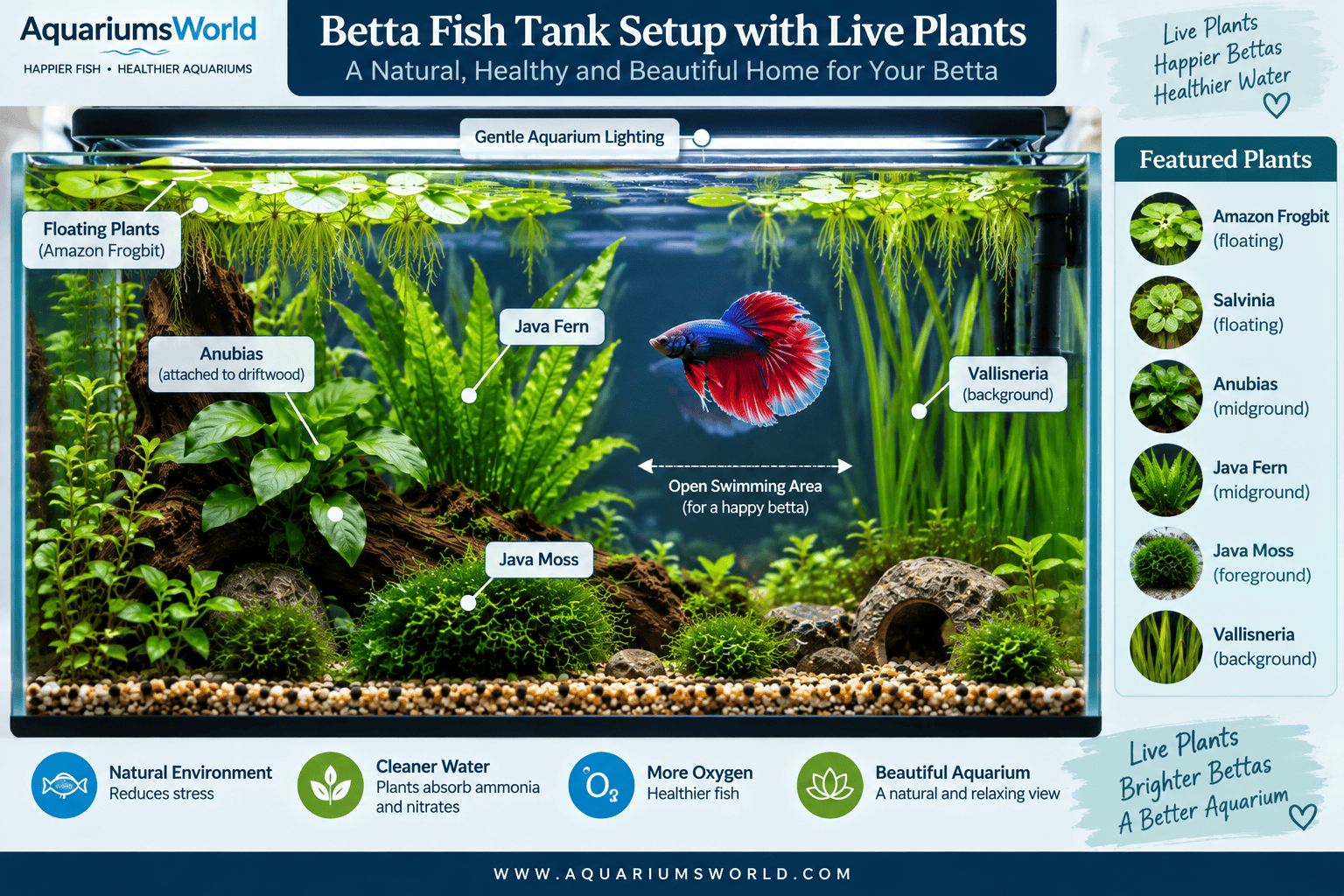
A simple planted aquarium does not need to look complicated. A useful layout can be created using a few pieces of driftwood, one or two rocks and three layers of planting.
- Foreground: low Cryptocoryne, Java moss or small carpeting plants.
- Midground: Anubias, Java fern and Cryptocoryne wendtii.
- Background: Vallisneria, Water wisteria or Amazon sword.
- Surface: Amazon frogbit or another controlled floating plant.
This layered approach gives the aquarium depth without filling every available space. It also makes maintenance easier because each plant group has a defined location.
Natural Hardscape
Driftwood is especially useful for Anubias and Java fern because both can be attached to its surface. Rocks can create caves, visual barriers and attachment points for epiphytes.
Always use aquarium-safe materials and avoid collecting unknown rocks or wood without understanding how they may affect the water. Some materials can alter water chemistry or contain contaminants.
Live House Plants in a Fish Tank: What Is Safe?
The phrase house plants safe for fish tank can be misleading because most terrestrial house plants are not true aquatic plants. Some can be grown hydroponically with their roots in aquarium water while the foliage remains above the waterline.
This technique is different from completely submerging a terrestrial plant. Leaves and stems that are not adapted to permanent underwater conditions may decompose. Decomposition can add organic waste and potentially contribute to water-quality problems.
Can House Plants Grow in a Fish Tank?
Yes, selected terrestrial plants can grow with their roots in aquarium water. Pothos is one of the most common examples. The plant uses nutrients available through the water while its leaves remain in air.
This approach can be attractive in open-top aquariums, breeder boxes and specialised riparium-style layouts. It should be considered an additional plant system rather than a substitute for the aquarium’s biological filter.
Pothos in Aquarium Safe?
Pothos is one of the most commonly used terrestrial plants in aquarium setups. The usual method is to place the roots in the aquarium while keeping leaves and most of the stem above the waterline.
Pothos grows rapidly when supplied with adequate light and nutrients. Its growth can therefore represent substantial nutrient uptake, particularly in systems with a healthy root mass.
Do not place a complete potted pothos plant into the aquarium. Remove soil and prevent decaying leaves from remaining submerged. The safest practical approach is to use a clean cutting or established plant with roots positioned in the water and foliage above it.
How to Add Pothos to an Aquarium
- Select a healthy pothos cutting with several nodes.
- Remove leaves from the portion that will be near the water.
- Rinse away soil or growing media from the roots.
- Place the roots in a breeder box, plant holder or aquarium rim system.
- Keep leaves above the waterline.
- Monitor the roots and trim them if they become excessively dense.
- Remove damaged leaves before they fall into the aquarium.
Peace Lily Aquarium Roots
Peace lily can also be grown with its roots in water while the foliage remains above the aquarium. However, the plant contains calcium oxalate crystals and its leaves should not be treated as edible. For that reason, keep the foliage securely above the aquarium and away from fish access, children and pets that might chew it.
When considering peace lily aquarium roots, the important distinction is between root exposure and complete plant submersion. The roots may be adapted to the wet environment while the leaves remain terrestrial.
Pothos is generally the simpler choice for a beginner because it is widely used in aquarium and hydroponic applications and grows readily from cuttings.
Philodendron in a Fish Tank
Philodendron can be grown using a similar root-in-water technique. Like pothos, the leaves should remain above the waterline. Many philodendron species contain calcium oxalate crystals, so they should be kept away from animals or children that may chew the foliage.
Lucky Bamboo in an Aquarium
Lucky bamboo, commonly sold as Dracaena sanderiana, is frequently grown with its roots in aquarium water. It can provide a vertical decorative feature and can grow hydroponically when provided with appropriate light.
As with pothos, avoid placing unnecessary soil or decomposing organic material into the aquarium.
House Plants to Treat With Caution
Not every house plant is suitable for aquarium use. Avoid experimenting with unknown plants simply because they look attractive. Terrestrial plant chemistry, sap compounds and growing requirements vary widely.
If a plant is not specifically known to tolerate hydroponic growth with aquarium fish, the conservative approach is not to place it into the aquarium. Never assume that a plant is fish-safe merely because it is safe as a household ornamental plant.
Safe House Plants for Fish Tanks Comparison
| Plant | Typical Aquarium Use | Important Consideration |
|---|---|---|
| Pothos | Roots submerged, foliage above water | Keep leaves and stems above water |
| Lucky bamboo | Roots or lower stem in water | Use healthy plants and avoid unnecessary soil |
| Philodendron | Roots submerged, foliage above water | Keep foliage away from children and pets |
| Peace lily | Roots submerged, foliage above water | Keep leaves and flowers away from ingestion |
Low Light Plants for Fish Tank Beginners
Low light plants fish tank beginners can manage should tolerate relatively modest illumination without demanding CO2 injection or complex fertilisation. This is why Anubias and Java fern are repeatedly recommended for beginner aquariums.
The Three Simplest Choices
- Anubias nana: slow-growing, durable and suitable for hardscape.
- Java fern: tolerant of modest lighting and easy to attach to wood.
- Java moss: adaptable and useful for covering hardscape.
These plants are particularly useful when the objective is to create a healthy looking aquarium without building a high-tech planted system.
Best Low Light Plants Betta Tank
For a best low light plants betta tank approach, prioritise plants according to their role rather than simply buying the largest number possible. One Anubias attached to a piece of wood may provide more useful structure than several random plants crowded into a small aquarium.
A practical beginner combination is one Anubias, one Java fern, a small amount of Java moss and a controlled quantity of floating plants. In a 10-gallon aquarium, this can then be expanded with Cryptocoryne or Vallisneria.
What Are the Benefits of Real Plants in a Fish Tank?
Real aquatic plants can contribute to an aquarium in several different ways. However, the effect depends on the amount of healthy plant biomass and the growth conditions.
1. Nutrient Uptake
Plants require nutrients to grow. Csontos et al. (2024) provide experimental evidence that aquatic plants can remove nitrate and phosphate in ornamental fish production systems. This supports using healthy aquatic plant growth as one part of nutrient management.
The important qualification is that not every plant removes nutrients at the same rate. A slow-growing Anubias plant should not be expected to control nitrate in a heavily stocked aquarium.
2. Oxygen During Photosynthesis
Photosynthesis produces oxygen during the light period. However, plants also respire, and the oxygen contribution of plants changes with lighting, biomass and time of day.
An aquarium should therefore not rely exclusively on plants for oxygen management. Adequate circulation and filtration remain important.
3. Environmental Complexity
Plants create visual barriers, shaded areas and surfaces that fish can investigate. This can make an aquarium more complex than a completely bare environment.
4. Natural Cover
Dense planting can provide places where a betta can move away from open areas. Floating plants can also reduce the intensity of overhead light.
5. Natural Appearance
Live plants change over time. New leaves appear, runners develop and stems can branch. This creates an aquarium that develops rather than remaining visually static.
How to Maintain Live Plants in a Betta Tank
Plant maintenance is usually straightforward when the species are matched to the lighting and aquarium conditions.
Remove Damaged Leaves
Dead or decomposing leaves should be removed before they accumulate in the aquarium. This is especially important with floating plants and fast-growing species.
Control Floating Plants
Thin floating plants regularly so that they do not form a solid surface layer. Leave an open section for feeding and surface access.
Trim Fast-Growing Plants
Water wisteria and Vallisneria may require regular trimming. Use clean aquarium scissors and remove damaged material rather than allowing excessive growth to block light.
Clean Around Moss
Java moss can trap uneaten food and debris. During water changes, gently remove loose waste with a siphon while avoiding excessive disturbance to the plant.
Common Betta Tank Plant Mistakes
Choosing Plants Based Only on Appearance
A beautiful plant is not necessarily a suitable plant for a low-light aquarium. Always match the plant’s requirements to the actual light and maintenance routine.
Using Too Much Light
High light without sufficient plant growth can encourage algae. Start with a moderate photoperiod and adjust according to plant response.
Planting Anubias Incorrectly
The rhizome should remain exposed. Burying it can lead to deterioration and plant loss.
Covering the Entire Water Surface
Floating plants should not be allowed to completely cover the surface. Bettas need access to atmospheric air and aquarists need clear access for feeding and maintenance.
Adding Too Many Fish Because the Tank Is Planted
Plants do not make overstocking safe. A planted aquarium can still accumulate waste and require appropriate filtration and water changes.
For broader troubleshooting, see the Fish Aquarium Problems and Solutions Guide .
Frequently Asked Questions
What are the best plants for a betta fish tank?
Some of the most beginner-friendly choices are Anubias, Java fern, Java moss, Cryptocoryne and suitable floating plants such as Amazon frogbit. The best choice depends on tank size, lighting, available space and the desired aquascape. Anubias and Java fern are particularly useful for low-light aquariums because they can be attached to wood or rock and do not require nutrient-rich substrate.
Do betta fish like real plants or fake plants?
A properly designed planted environment can provide more natural structure than a bare aquarium because live plants create cover, shade and surfaces to explore. Artificial plants can also provide structure, but soft aquarium-safe materials should be chosen to avoid fin damage. The overall quality of the environment, including water quality, temperature, filtration and enrichment, matters more than whether every decoration is live.
What live plants are safe for betta fish?
Anubias, Java fern, Java moss, Cryptocoryne, Vallisneria, Amazon sword, Water wisteria and appropriate floating plants are commonly used in betta aquariums. Select species according to lighting and aquarium size. Avoid sharp decorations and poorly identified plants.
What fish are good for a planted tank?
Plant-friendly community species can include neon tetras, ember tetras, harlequin rasboras, suitable Corydoras and Otocinclus in appropriately sized aquariums. However, compatibility with a betta depends on the individual fish and aquarium conditions. A planted tank should never be stocked solely because plants are present.
Can house plants grow in a fish tank?
Yes. Some terrestrial plants can grow with their roots in aquarium water while their foliage remains above the waterline. Pothos is one of the most common examples. This is a hydroponic or emersed growing method rather than completely submerging the terrestrial plant.
What is the easiest live plant to keep in a fish tank?
Anubias and Java fern are among the easiest aquatic plants for beginners. Both tolerate modest lighting and can be attached to hardscape rather than planted deeply in substrate. Java moss is another adaptable choice.
What plants can I put in my fish tank for decoration?
For a natural planted aquarium, consider Anubias, Java fern, Java moss, Cryptocoryne, Vallisneria, Amazon sword and appropriate floating plants. Combine foreground, midground, background and surface plants rather than filling the entire aquarium with one species.
What fish will not eat live plants?
Many small community fish such as neon tetras, ember tetras and harlequin rasboras generally do not consume healthy aquatic plants. Corydoras and many other small bottom fish are also plant-safe. Herbivorous species such as silver dollars are much less suitable for heavily planted aquariums.
Can I put pothos in my fish tank?
Pothos can be grown with its roots in aquarium water while its leaves remain above the surface. Do not fully submerge the foliage. Use clean roots or cuttings without soil and prevent dead leaves from decomposing in the aquarium.
What are the benefits of real plants in a fish tank?
Real plants can provide environmental structure, cover and natural visual complexity while using nutrients for growth. Under suitable conditions they can also contribute to nitrate and phosphate uptake. Research by Csontos et al. (2024) demonstrates nutrient-removal potential of aquatic plants in ornamental fish production systems. The effect in a home aquarium depends on plant species, biomass, light, nutrient availability and maintenance.
Related Plant Guides and Setup Topics
Anubias Betta Tank Setup
Use Anubias on driftwood or aquarium-safe rock, keeping the rhizome exposed. This is one of the simplest ways to create a natural resting and cover area without requiring specialised substrate.
Java Fern Betta Fish Aquarium
Java fern can be attached to wood or rock and is suitable for low-light planted aquariums. It is especially useful where the aquarist wants a leafy midground without complex substrate management.
Floating Plants for Betta Fish
Amazon frogbit, Salvinia and other controlled floating plants can provide shade and surface structure. Keep sufficient open water at the surface for feeding and air access.
Amazon Sword Planted Tank
Amazon sword works best as a larger background or centrepiece plant in a tank with sufficient space and nutrient availability. It can become too large for a small betta aquarium.
Cryptocoryne Betta Tank
Cryptocoryne wendtii is a popular low-to-medium-light rooted plant. Allow time for the plant to adapt after moving it into a new aquarium.
Java Moss Betta Fish
Java moss can be attached to driftwood or rocks to create soft, natural-looking cover and texture.
Neon Tetra Planted Tank
Neon tetras can provide schooling movement in an appropriately sized planted community aquarium. Their compatibility with a betta must be assessed separately.
Corydoras Planted Aquarium
Corydoras are bottom-oriented community fish that work well with planted layouts when kept in appropriate groups and provided with suitable substrate.
Harlequin Rasbora Planted Tank
Harlequin rasboras can complement a planted Southeast Asian-inspired aquarium, although tank size, group size and compatibility should be considered carefully.
Pothos in Aquarium Safe
Pothos is commonly grown hydroponically with its roots in aquarium water and foliage above the surface. Avoid submerging the leaves.
Peace Lily Aquarium Roots
Peace lily can be grown with roots exposed to aquarium water, but the leaves and flowers should remain above water and inaccessible to animals or children that might ingest them.
Fish Tank Plant Decoration Ideas
Combine driftwood, rocks, Anubias, Java fern, Cryptocoryne and controlled floating plants to create layered natural decoration without overcrowding the aquarium.
Live vs Fake Plants Fish Tank
Live plants provide biological functions that artificial plants cannot, while artificial plants require less care. If using artificial plants with bettas, choose soft aquarium-safe materials and avoid sharp edges.
Low Light Plants Fish Tank Beginners
Anubias, Java fern and Java moss are particularly suitable for beginners who have basic aquarium lighting and do not want to run CO2 injection.
Betta Fish Tank Setup with Plants
A balanced planted betta aquarium combines appropriate tank size, gentle filtration, stable temperature, cycling, suitable lighting, live plants and open swimming space. Plants should complement the husbandry system rather than replace it.
What Does the Research Say About Aquarium Plants and Fish Welfare?
The scientific evidence should be interpreted according to what each study actually examined. No single paper proves that one particular aquarium plant is universally best for every betta.
Pleeging and Moons (2017) reviewed potential welfare issues associated with Siamese fighting fish and highlighted the importance of appropriate environmental conditions in retail and hobbyist settings. Their work is relevant when considering why aquarium design should go beyond simply providing water, food and filtration.
Walster et al. (2015) examined the welfare of ornamental fish in home aquariums and discussed the importance of husbandry and environmental conditions. This supports treating aquarium design as a welfare consideration rather than purely as an interior decoration exercise.
Csontos, Bartal and Bakacsy (2024) provide particularly useful evidence for the water-quality side of the discussion. Their study examined nitrate and phosphate removal by aquatic plants during aquarium-based ornamental fish production. The findings demonstrate the potential for aquatic plants to contribute to nutrient removal, while also showing why the effect should be understood in relation to plant species and growing conditions.
Research on aquarium substrates also demonstrates why substrate choice should not be treated as purely decorative. The interaction between substrate, water chemistry and plant growth is important when designing a planted aquarium. For this reason, new aquarists should choose substrate based on the plants they intend to grow rather than selecting soil solely because it looks attractive.
Simple Betta Planted Tank Plans
5-Gallon Beginner Betta Tank
For a 5-gallon aquarium, keep the design simple. One piece of driftwood with Anubias attached, a small Java fern and a controlled amount of floating plant can create substantial structure without consuming the entire swimming area.
Avoid choosing a large Amazon sword simply because it looks attractive in the shop. Its mature size can overwhelm a small aquarium.
10-Gallon Betta Planted Tank
A 10-gallon aquarium provides more freedom. Use Cryptocoryne or another rooted midground plant, Anubias on hardscape and Vallisneria or Water wisteria toward the back. A small floating section can provide shade.
This layout provides three-dimensional structure while preserving a clear swimming area.
20-Gallon Planted Betta Community Aquarium
A 20-gallon aquarium can support a substantially larger planted layout and may also allow carefully selected community fish, depending on the betta’s temperament. Use tall background plants, multiple midground structures and a defined open swimming area.
If community fish are added, evaluate stocking according to adult size, social requirements and compatibility rather than simply counting how many fish appear small at the point of purchase.
Betta Fish Tank Plant Checklist
- Choose plants that match the aquarium’s actual lighting.
- Use Anubias and Java fern as easy epiphyte plants.
- Consider Java moss for soft hardscape coverage.
- Use floating plants in controlled quantities.
- Keep part of the surface open.
- Use suitable substrate for rooted plants.
- Do not bury Anubias or Java fern rhizomes.
- Do not rely on plants instead of biological filtration.
- Do not use plants to justify overstocking.
- Remove decaying plant material.
- Trim fast-growing plants regularly.
- Use only identified aquarium-safe materials and plants.
- For terrestrial plants, keep foliage above the aquarium water.
- Keep potentially toxic house-plant foliage away from children and pets.
- Monitor ammonia, nitrite and nitrate rather than assuming plants solve water-quality problems.
Conclusion
The best plants for betta fish tanks are not simply the species that look attractive in a photograph. The strongest choices are plants that match the aquarium’s lighting, tank size, maintenance routine and the behaviour of the fish. Anubias, Java fern and Java moss are particularly useful for beginners because they are adaptable, low-maintenance and can be attached to hardscape. Cryptocoryne, Vallisneria, Water wisteria and Amazon sword provide additional options when the aquarium has enough space and suitable growing conditions.
Real plants can provide functions that artificial decorations cannot, including photosynthesis, nutrient uptake and living habitat structure. Research by Csontos et al. (2024) demonstrates the potential of aquatic plants to remove nitrate and phosphate under ornamental fish production conditions. At the same time, live plants should not be presented as a replacement for filtration, cycling, testing or water changes.
For bettas, environmental complexity is also important. A planted aquarium can provide cover, resting surfaces and shaded areas that make the environment more varied. The welfare literature on ornamental fish and Siamese fighting fish supports approaching aquarium design as a broader husbandry issue rather than treating the aquarium as a simple container.
For community planted aquariums, species such as neon tetras, ember tetras, harlequin rasboras and suitable Corydoras can complement live plants. However, compatibility with a betta remains individual and should never be guaranteed. Fish that eat plants heavily, grow too large or constantly disturb the substrate are poor choices for a traditional planted aquarium.
Finally, terrestrial house plants can be useful when used correctly. Pothos is a popular option because its roots can grow in aquarium water while its leaves remain above the surface. Peace lily and philodendron require additional caution because their foliage should not be accessible for ingestion. The key principle is simple: choose a known species, keep terrestrial foliage above water and do not introduce unidentified plants into a fish aquarium.
A successful planted betta tank therefore combines the right plants with appropriate tank size, stable temperature, gentle filtration, suitable lighting, responsible stocking and regular maintenance. Plants are an important part of that system, but they work best when they complement sound aquarium husbandry rather than attempting to replace it.
References
- Pleeging, C.C.F. and Moons, C.P.H. (2017) ‘Potential welfare issues of the Siamese fighting fish (Betta splendens) at the retailer and in the hobbyist aquarium’, Vlaams Diergeneeskundig Tijdschrift, 86, pp. 213–223. Available at: https://doi.org/10.21825/vdt.v86i4.16182 .
- Walster, C., Rasidi, E., Saint-Erne, N. and Loh, R. (2015) ‘The welfare of ornamental fish in the home aquarium’, Companion Animal, 20(5), pp. 302–306. Available at: https://doi.org/10.12968/coan.2015.20.5.302 .
- Csontos, D., Bartal, Z.P. and Bakacsy, L. (2024) ‘Removal of nitrate and phosphate by aquatic plants during aquarium-based ornamental fish production’, North American Journal of Aquaculture, 86(4), pp. 413–423. Available at: https://doi.org/10.1002/naaq.10349 .
- Various Authors (2022) ‘The Effect of Substrate on Water Quality in Ornamental Fish Tanks’, Animals, 12(19), 2679. Available at: https://doi.org/10.3390/ani12192679 .
- Various Authors (2024) ‘Enhancing Welfare for Aquarium Fishes with an Ecologically Relevant Environment’, Animal Behaviour and Welfare Cases. Available at: https://doi.org/10.1079/abwcases.2024.0017 .