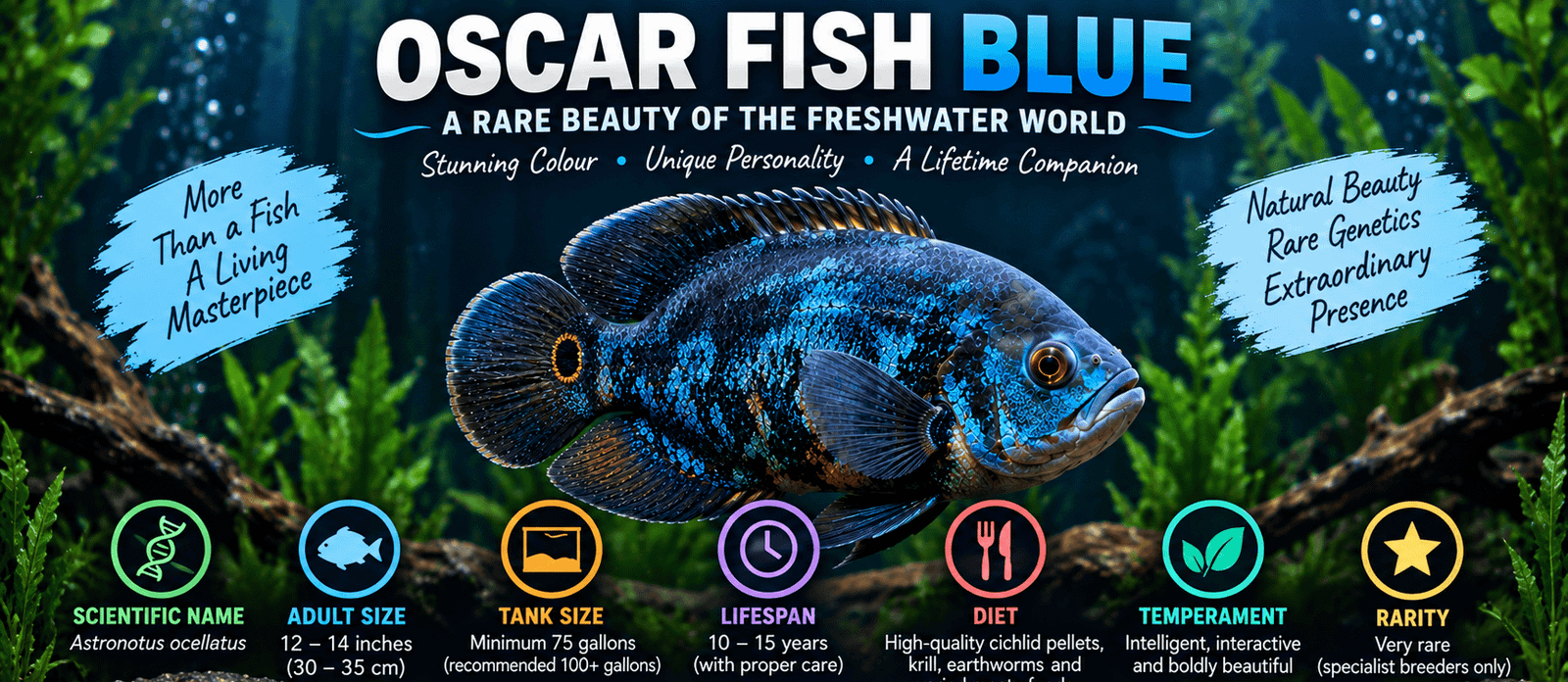
Blue Oscar Tank Size and Lighting Checker
Use this interactive checker to estimate whether your aquarium provides enough space for an adult Oscar and to compare the expected visual effect of different lighting types. The lighting result is a display index rather than a measured PAR reading because true PAR depends on the actual fixture, mounting height, water depth, spectrum, lens and tank layout.
The phrase oscar fish blue creates a surprisingly complicated question for aquarium keepers. A blue-looking Oscar may refer to naturally occurring colour variation, a selectively bred fish sold under a specialist trade name, a blue tiger Oscar, or an artificially coloured fish marketed as a blue or blueberry Oscar. These fish should not automatically be treated as the same thing.
This distinction matters because the colour of a fish is not simply a matter of paint-like pigment. Fish colour can involve several chromatophore types, including melanophores, xanthophores, erythrophores and iridophores. Iridophores can create reflective structural colour through microscopic arrangements of guanine crystals. Reviews of fish pigmentation describe how genetic, developmental and environmental mechanisms interact to produce the colours seen in ornamental fish.
For anyone searching for a blue oscar fish care guide, the practical message is straightforward. A blue-looking Oscar still has the biology of Astronotus ocellatus. It needs adequate swimming space, powerful biological filtration, stable water conditions, suitable nutrition and careful selection of tank mates. Lighting can change how reflective colours appear, but lighting cannot turn an ordinary Oscar into a genetically blue fish.
This guide therefore covers the science behind blue colour, the question "is blue oscar fish real or dyed", the difference between a blue Oscar and a blueberry Oscar, blue tiger Oscar terminology, tank size, lighting, diet, breeding, health, rarity, pricing and how to assess claims made by sellers. The article also explains why the phrase blue oscar fish natural iridophore colour should be interpreted carefully rather than used as proof of a specific genetic variety.
If you are new to Oscar keeping, begin with the complete beginner's fish care guide .
- Is There a Real Blue Oscar Fish?
- What Makes a Blue Oscar Fish Blue?
- How Rare Is the Blue Oscar Fish?
- Blue Tiger Oscar Fish
- How to Tell a Real Blue Oscar from a Dyed One
- How Much Does a Blue Oscar Fish Cost?
- How to Source a Genuine Blue Oscar Fish
- Blue Oscar Fish Tank Size
- Blue Oscar Fish Lighting for Colour
- Blue Oscar Fish Diet and Colour Maintenance
- Can You Breed Blue Oscar Fish?
- Blue Oscar Fish Health and Common Problems
- Blue Oscar Fish Tank Mates
- Blue Oscar Fish Lifespan
- Frequently Asked Questions
- Conclusion
Is There a Real Blue Oscar Fish?
Blue Oscar Fish Real vs Dyed Identification
The first problem is terminology. In the aquarium trade, a fish may be called blue because its body contains blue-grey iridescence, because a tiger pattern appears blue under particular lighting, because a breeder has selected for a specific colour line, or because the fish has been artificially coloured. These descriptions do not have equal scientific meaning.
Research on fish pigmentation confirms that structural colour is a genuine biological phenomenon. However, research describing structural colour in cichlids should not automatically be interpreted as proof that every fish sold as a "pure blue Oscar" represents a formally recognised genetic morph. Cichlid colour variation is genetically and developmentally complex, and aquarium trade names frequently move faster than formal taxonomic or genetic documentation.
A second category is the artificially coloured fish. Literature on the ornamental fish trade documents the use of artificial colouring methods, including dyeing, painting and other colour-enhancement practices. The documented welfare concerns surrounding artificial colouring are one reason buyers should establish exactly what a seller means by "blue Oscar".
Two Broad Categories Buyers Should Understand
| Category | What the Name May Mean | Colour Basis | How to Verify |
|---|---|---|---|
| Blue-looking natural or bred Oscar | Natural colour variation or a breeder-selected line with visible blue or blue-grey iridescence | Chromatophores and structural reflection | Breeder records, parent photographs and consistent colour across multiple generations |
| Blue tiger Oscar | Trade term for an Oscar showing blue or blue-grey iridescence combined with tiger markings | Natural chromatophore pattern and reflective colour | Scientific name, parentage and photographs under normal lighting |
| Blueberry Oscar | Commercial term generally associated with an artificially coloured Oscar | Artificial colour treatment | Look for unnatural uniform colour, fading and seller disclosure |
| Ordinary Oscar marketed as blue | A fish whose natural markings appear blue under particular lighting | Normal colour variation and reflected light | Compare photographs under different lighting conditions |
The most important lesson is that colour alone is not genetic documentation. A responsible seller should be able to explain what line the fish comes from, what the parents looked like and whether the colour has remained stable as the fish matured.
What Makes a Blue Oscar Fish Blue? The Science
Blue Oscar Fish Iridophore Colour Science
Fish colour is produced by specialised cells called chromatophores. Melanophores contain melanin and contribute black, brown and dark tones. Other chromatophore types contribute yellow, orange and red colours, while iridophores can create reflective effects rather than conventional pigment colour.
The review by Luo et al. explains that fish coloration involves multiple chromatophore classes and complex interactions between cellular development, genetic regulation and environmental conditions. Iridophores are especially interesting because their reflective properties can produce metallic or iridescent visual effects.
In structural colour, the visual effect is produced by the physical interaction between light and microscopic structures. The colour can therefore change with viewing angle and illumination. This is very different from adding a blue pigment to the surface of a fish.
Iridophores and Structural Colour
An iridophore can contain reflective guanine structures. The arrangement of these structures influences which wavelengths of light are reflected toward the observer. When the reflected wavelengths fall within the blue portion of the visible spectrum, the fish can appear blue, blue-grey or metallic.
This is why genuine structural colour often has visual depth. As the fish turns, different parts of the body can appear brighter or darker. A blue reflection can become stronger at one angle and weaker at another. Aquarium lighting can therefore influence how much blue an observer sees without changing the underlying biology of the fish.
Why Blue Is More Complicated Than Orange or Red
Colour traits in fish are not controlled by one universal mechanism. Some colour traits involve pigment production, while others involve reflective structures and the organisation of chromatophores. Cichlid colour research shows that colour variation can be associated with development, sexual selection, ecological conditions and evolutionary divergence. Maan and Sefc emphasise that cichlid colour is a complex biological trait rather than a simple cosmetic characteristic.
For aquarists, this means that breeding a blue-looking Oscar is not equivalent to mixing blue paint into a fish line. A breeder may select individuals with desirable reflective traits, but the resulting offspring depend on the genetic background of the line and the inheritance of multiple traits.
Blue Oscar Fish Genetics
Genetic studies of cichlid colour variation demonstrate that structural variation at genomic regions can contribute to colour pattern diversification. Kratochwil et al. examined structural variation associated with colour pattern diversification in cichlids, demonstrating why cichlid colour genetics can be more complicated than a single dominant or recessive label suggests.
That evidence is useful when interpreting breeder claims about blue Oscars. It supports the general principle that cichlid colour can have a substantial genetic component, but it does not establish a universal inheritance formula for a commercially defined "blue Oscar". The distinction is important because aquarium trade genetics and peer-reviewed species genetics are not always describing the same thing.
Can Lighting Change Blue Colour?
Lighting can dramatically change perceived colour without changing the fish's genotype. A cool white LED can make reflective blue-grey scales appear more obvious, while warm lighting can emphasise yellow, cream and orange tones. Water clarity, viewing angle, tank background and the intensity of the light also influence what the human eye sees.
This is one reason photographs should never be the only evidence used when buying a rare colour variety online. Sellers can photograph the same fish under different lighting conditions and produce noticeably different results.
How Rare Is the Blue Oscar Fish?
Blue Oscar Fish Rarity and Price
The rarity of a blue Oscar is difficult to quantify because there is no universally accepted registry defining a single pure-blue Oscar morph. Unlike a recognised species or formally described taxon, aquarium trade varieties can be named differently by breeders, importers and retailers.
A fish described as rare may therefore be rare because a particular breeder has produced relatively few specimens, because the line is geographically limited, or because the commercial name is unusual. Those are different forms of rarity.
For this reason, buyers should be cautious about fixed claims such as "all genuine blue Oscars cost exactly X dollars" or "chain stores never sell real blue Oscars". Retail markets vary by region, size, season, importer and breeder. A higher price can reflect genuine rarity, but price alone cannot authenticate colour genetics.
What Makes a Blue Oscar Valuable?
- Documented parentage.
- Consistent colour across multiple fish from the same line.
- Photographs of the parents and previous generations.
- Evidence that the colour remains stable during growth.
- Clear disclosure of whether artificial colour has ever been used.
- Accurate identification of the fish and its lineage.
- Healthy body condition and appropriate quarantine practices.
A responsible buyer should pay for documented quality rather than simply paying for a colour name.
Blue Tiger Oscar Fish: The More Recognisable Trade Type
Blue Tiger Oscar Fish Care
The term blue tiger oscar fish is generally easier to understand visually than the phrase pure blue Oscar. A blue tiger usually refers to an Oscar with the familiar tiger-style pattern combined with blue-grey, steel or metallic-looking areas.
The important point is that the phrase remains a trade description rather than a universally standardised scientific classification. Individual breeders may use it differently. Ask for the scientific name, parentage and photographs rather than assuming that every fish carrying the label has identical genetics.
From a husbandry perspective, a blue tiger Oscar is still an Oscar. It can reach the substantial adult size associated with Astronotus ocellatus and therefore needs the same attention to tank footprint, filtration, temperature, diet and water quality.
What Does a Blue Tiger Oscar Look Like?
- Dark blue-grey or steel-coloured reflective areas.
- Orange or red tiger-style markings.
- Visible contrast between the dark base and warmer markings.
- Colour that may change visually under different lighting.
- A conventional Oscar body shape and fin structure.
Do not confuse blue tiger colouration with the flat, highly saturated blue often seen in artificially coloured fish. The two can look dramatically different under close inspection.
How to Tell a Real Blue Oscar from a Dyed One
Blue Oscar Fish Real vs Dyed Identification
Identifying an artificially coloured fish is one of the most important skills for anyone searching for a blue Oscar. Artificially coloured aquarium fish have been documented in the ornamental trade, and scientific literature has raised welfare concerns about dyeing and other cosmetic colour treatments. Eşanu et al. documented several artificial colouring practices and highlighted the importance of customer education and fish welfare.
No single visual clue is perfect. Instead, examine several characteristics together and ask the seller for information about the fish's history.
| Feature | Natural or Bred Colour | Possible Artificial Colour |
|---|---|---|
| Colour depth | Often shows variation and reflective depth | Can appear unusually uniform or saturated |
| Viewing angle | Reflective colour may change with angle | Artificial pigment may remain visually flatter |
| Scale pattern | Natural markings remain integrated with the body pattern | Colour may appear unnaturally overlaid on normal markings |
| Fins | Colour follows normal pigmentation and pattern development | Unusual colour may extend into areas where it looks inconsistent |
| Body condition | Normal fish condition when healthy | Injection or handling damage may be visible in some cases |
| Seller documentation | Breeder can explain parentage and history | Seller may avoid explaining colour origin |
| Colour over time | Genetic colour should not simply disappear because a temporary dye has left the body | Artificial colour may fade or change |
The Lighting Test
Ask to see the fish under ordinary white aquarium lighting rather than only under highly saturated blue or RGB lighting. Compare the fish under more than one lighting condition if possible.
A reflective colour can change in intensity as the angle of the light changes. That behaviour is consistent with structural colour biology. However, the lighting test is not a laboratory authentication method. A seller can manipulate lighting, camera settings and white balance, so photographs should be treated as supporting evidence rather than proof.
The Time Test
Time can provide useful evidence. Artificial colour may fade as the treatment wears off, whereas inherited colour is expected to remain part of the fish's normal appearance. However, there is no scientifically validated universal "three to nine month" fading clock for every fish sold as a blueberry Oscar. Fade rate can depend on the species, treatment, fish condition and method used.
Ask the Seller Five Questions
- What is the scientific name?
- Is the fish naturally coloured?
- Has any dye, injection, immersion or other colour treatment been used?
- Can you show photographs of the parents?
- Can you show photographs of older fish from the same line?
A seller who can answer these questions clearly gives you substantially more information than a listing that simply says "rare blue Oscar".
How Much Does a Blue Oscar Fish Cost?
There is no reliable universal price for a blue Oscar because the commercial name can describe several different types of fish. Prices vary according to juvenile size, breeder reputation, locality, import costs, availability, parentage and whether the seller can document the line.
| Seller Type | What to Check | Price Interpretation |
|---|---|---|
| Chain pet store | Ask whether artificial colouring has been used | Low price does not prove or disprove authenticity |
| Local fish store | Request scientific name and source information | Compare several specimens rather than one fish |
| Specialist breeder | Parent photographs and breeding history | Higher price may reflect documented lineage |
| Aquarium society | Speak directly with the breeder | Useful opportunity to inspect fish in person |
| Online seller | Request unedited video under normal lighting | Do not rely solely on edited photographs |
If you are interested in a colour variety but want to avoid uncertain trade names, compare the fish with documented Oscar varieties and focus first on health and provenance. A well-conditioned fish with transparent history is a more useful purchase than an expensive fish sold with an unsupported rarity claim.
How to Source a Genuine Blue Oscar Fish in the USA
How to Buy Genuine Blue Oscar Fish USA
The safest purchasing approach is to treat "blue Oscar" as a claim that needs verification rather than as a guaranteed scientific identity. Specialist breeders can provide more information than general retailers because they may have access to parent fish, breeding records and photographs across different growth stages.
What Good Breeder Documentation Looks Like
- Scientific name clearly stated as Astronotus ocellatus.
- Parent fish photographed before breeding.
- Older photographs showing colour development.
- Clear disclosure of artificial colouring.
- Information about the line or breeding programme.
- Consistent terminology across the listing and communication.
- Normal, unedited aquarium photographs.
Local aquarium societies can also be valuable because buyers can see fish directly and ask the breeder questions. Online purchases require additional care because camera white balance, blue LEDs and post-processing can all alter the perceived colour of a fish.
Before purchasing any large Oscar, consider the aquarium first. The AquariumsWorld 100 gallon fish tank guide provides dimensions, equipment planning and filled-tank considerations for large aquariums.
Blue Oscar Fish Tank Size
Blue Oscar Fish Tank Setup
A blue Oscar does not need a smaller aquarium because it is a colour variety. All colour forms marketed as Astronotus ocellatus retain the same basic body size, swimming behaviour and waste-production characteristics. Tank planning should therefore be based on adult size rather than juvenile appearance.
The AquariumsWorld 100 gallon guide gives a standard large-tank footprint of approximately 72.5 inches in length, with variations between manufacturers. The exact footprint matters because horizontal swimming space is more useful for an active large cichlid than volume alone.
For smaller aquarium comparisons, see the 50 gallon fish tank dimensions guide and the 50 gallon fish tank setup guide . A 50 gallon tank may be useful for temporary planning or juvenile stages, but it should not be treated as an automatic long-term adult Oscar solution.
| Tank Size | Blue Oscar Planning | Comments |
|---|---|---|
| 20 gallons | Not suitable for an adult Oscar | Adult size and bioload make this inappropriate |
| 50 gallons | Generally temporary for an Oscar | Adult swimming space is limited |
| 75 gallons | Planning minimum for one adult | Footprint should be checked carefully |
| 100 gallons | Strong long-term target for one adult | Provides more swimming space and water volume |
| 125 gallons or larger | Useful for larger community plans | Tank footprint and compatibility become increasingly important |
Do not use a traditional one-inch-per-gallon rule for Oscars. Adult size, bioload, behaviour, filtration and swimming space are more useful planning variables. The AquariumsWorld aquarium stocking calculator can help with broader bioload planning.
Blue Oscar Fish Lighting for Colour
Lighting can influence how blue or metallic an Oscar appears, but lighting cannot create inherited colour. The objective should therefore be to reveal the fish's existing colour rather than to manipulate the fish into appearing something it is not.
Cool White Lighting
Cool white aquarium LEDs can make blue-grey reflective tones visually prominent. This is useful when photographing an Oscar because the light can make structural reflections easier to see.
Warm Lighting
Warm lighting can emphasise cream, yellow and orange tones. This does not mean the fish has lost its blue colour. It simply changes the spectrum reaching the eye and camera.
RGB Lighting
RGB lighting can produce dramatic aquarium displays, but it makes colour authentication more difficult. A fish photographed under intense blue RGB lighting may look significantly bluer than it does under ordinary white light. For this reason, request neutral photographs when assessing a rare colour.
Dark Backgrounds and Colour Perception
A dark background can increase visual contrast and make reflective colour more noticeable. However, it should not be assumed that a dark background will automatically improve the fish's physiological condition.
In fact, an Oscar study examining tank background colour found significant differences in growth, stress, biochemical and immune-related measures among different tank colours. Interestingly, blue tank colour was not the best performer in that experiment. Therefore, the evidence does not justify a blanket recommendation that a blue Oscar should always be kept against a blue or black background for health reasons.
For general aquarium planning, the Fish Aquarium Types and Setup Guide explains how tank shape, equipment and environment interact.
Blue Oscar Fish Diet and Colour Maintenance
Blue Oscar Fish Diet and Colour Maintenance
A blue Oscar should not be fed a special diet simply to "make it blue". Structural colour is fundamentally different from carotenoid-based orange and red colouration. Good nutrition is still essential because poor health can affect appearance, activity and normal physiological function.
Daily Staple Food
Use a high-quality commercial food formulated for large cichlids as the foundation of the diet. Pellets should be appropriately sized for the fish and fed in controlled portions.
Supplemental Foods
Suitable frozen or prepared foods can be used as dietary variety. Examples include appropriately sourced earthworms, krill and other suitable aquatic foods. Supplements should not replace a balanced staple diet.
What About Colour-Enhancing Food?
Colour-enhancing foods may support pigment-based red or orange colouration, depending on their ingredients, but they cannot genetically transform an Oscar into a blue morph. Eşanu et al. also distinguish temporary colour effects from other forms of artificial colouring in the ornamental trade.
Simple Weekly Feeding Framework
| Day | Primary Food | Optional Supplement |
|---|---|---|
| Monday | Quality cichlid pellets | None required |
| Tuesday | Quality cichlid pellets | Small frozen food portion |
| Wednesday | Quality cichlid pellets | None required |
| Thursday | Quality cichlid pellets | Krill or suitable frozen food |
| Friday | Quality cichlid pellets | None required |
| Saturday | Quality cichlid pellets | Suitable protein supplement |
| Sunday | Controlled feeding | Monitor appetite and condition |
Avoid overfeeding. Excess food becomes waste, increasing the biological load placed on the filtration system. If you are struggling with water quality, use the AquariumsWorld fish aquarium problems and solutions guide .
Can You Breed Blue Oscar Fish?
Blue Oscar Fish Genetics and Breeding
Oscars can be bred in captivity, but breeding a specific colour phenotype is more complicated than pairing two visually similar fish and expecting every offspring to look the same.
Cichlid colour genetics involve multiple developmental and genomic mechanisms. The research literature supports substantial genetic complexity in colour pattern diversification, but there is not sufficient evidence to provide a universal percentage such as "70 percent blue fry" for all supposed blue Oscar crosses.
Therefore, claims such as "blue x blue always produces blue" or "blue x blue produces exactly 60 percent blue offspring" should be treated as breeder-line claims unless supported by documented genetic data.
What a Breeding Project Needs
- A mature compatible male and female.
- A large aquarium with a suitable footprint.
- A stable temperature appropriate for Oscars.
- Excellent water quality.
- A flat spawning surface.
- Enough space for territorial behaviour.
- A plan for fry and future population management.
Temperature and Oscar Breeding
Research examining juvenile Oscars under different temperatures found that 27°C performed well in the experimental conditions, while both 17°C and 32°C were associated with poorer outcomes. The authors concluded that 22 to 27°C was the suitable experimental range for growth, immune response and health status in the studied juveniles.
This does not mean that every adult breeding Oscar should be maintained at one exact temperature. Stability and species-appropriate conditions matter more than chasing a single number.
For broader cichlid temperature information, see the AquariumsWorld cichlid temperature guide .
Blue Oscar Fish Health and Common Problems
Blue Oscar Fish Health Problems
Blue Oscars have the same fundamental health risks as other Oscars. Colour does not make the fish immune to water quality problems, parasites, injury, nutritional imbalance or stress.
Water Quality Problems
Ammonia and nitrite should be maintained at zero in a properly cycled aquarium. Nitrate should be controlled through appropriate maintenance, stocking and water changes. A large Oscar produces substantial waste, so filtration should be planned around the adult fish rather than its juvenile size.
Hole in the Head and Head Lesions
Head and lateral-line lesions in cichlids have historically been associated with a combination of environmental, nutritional and husbandry factors. It is better to investigate the entire aquarium rather than attribute the condition to one single cause.
Ich
Ich can cause white spots, flashing, irritation and abnormal behaviour. New fish should be quarantined before entering an established aquarium, and water quality should be assessed whenever disease symptoms appear.
Stress and Colour Changes
Colour can change naturally with stress, social status, environmental conditions and physiological state. Research on cichlid colour change shows that neural processes can influence the organisation of colour-producing cells and associated reflective effects.
However, it is not scientifically justified to diagnose illness simply because a blue-looking Oscar becomes temporarily less blue. A colour change should instead be treated as one observation among many. Check appetite, breathing, swimming, aggression, hiding, injuries and water parameters.
For detailed troubleshooting, visit the complete fish aquarium problems guide .
Blue Oscar Fish Tank Mates
Blue Oscar Fish Tank Mates
A blue Oscar has exactly the same fundamental compatibility considerations as any other Oscar. The colour variety does not make it more peaceful or smaller. Tank mates should therefore be selected according to adult size, temperament, territory, swimming space and water requirements.
Potential Tank Mate Categories
| Potential Companion | General Consideration | Important Risk |
|---|---|---|
| Silver Dollars | Large, active schooling fish may work in a sufficiently large aquarium | Need group size and substantial swimming space |
| Large Plecos | Can sometimes coexist with Oscars | Species identification and adult size are essential |
| Severum | Possible in a large, carefully planned cichlid aquarium | Territorial conflict can occur |
| Bichir | Large robust fish may work in suitable systems | Predation and nocturnal behaviour must be considered |
| Small Community Fish | Generally poor candidates | Adult Oscars may prey on smaller fish |
| Angelfish | Risky combination | Different body shape, temperament and aggression dynamics |
Do not assume that a tank mate listed online will work in every aquarium. Individual fish can behave differently, and aquarium footprint matters.
The AquariumsWorld angelfish guide provides species-specific information that is useful when evaluating why large cichlid compatibility should not be based on colour alone.
What About Plecos?
A large pleco may be compatible with an Oscar in some large aquariums, but species identification matters. Do not assume that every fish sold as a "pleco" stays small.
For comparison, see the AquariumsWorld orange plecostomus guide .
Never Choose Tank Mates by Colour Alone
A blue Oscar may look visually compatible with another blue fish, but colour has almost nothing to do with biological compatibility. Temperature, territorial behaviour, adult size and diet are much more important.
Blue Oscar Fish Lifespan
A blue Oscar should be considered a long-term commitment. Colour does not change the basic lifespan expectations of Astronotus ocellatus. Healthy Oscars can live for many years when kept in a suitable aquarium with good nutrition, stable water quality and appropriate space.
Exact lifespan varies between individual fish and husbandry conditions. Rather than promising a fixed number, plan for a long-lived fish and build the aquarium around its adult requirements from the beginning.
This is particularly important when purchasing an unusually coloured juvenile. The visual appeal of a small fish can hide the practical commitment of keeping a large adult cichlid.
Blue Oscar Fish Tank Environment and Filtration
Filtration is one of the most important parts of keeping a large Oscar. Mechanical filtration removes suspended waste, while biological filtration provides surfaces for microorganisms involved in nitrogen processing.
An Oscar aquarium also benefits from strong surface movement and adequate oxygen exchange. The AquariumsWorld aquarium air pump guide explains how aeration supports gas exchange and air-driven equipment.
For large aquariums, filtration should be chosen according to actual flow, media capacity, maintenance requirements and the fish's waste production rather than relying only on the manufacturer's headline gallon rating.
Substrate
Oscars can disturb substrate while feeding and moving objects. Smooth sand or rounded gravel can be easier to manage than sharp material. If you are planning a planted aquarium, the AquariumsWorld soil in fish tank guide explains substrate types and their effects.
Hardscape
Use smooth rocks and stable decorations. Avoid unstable structures that can fall when a large Oscar moves substrate. Open swimming space is usually more important than filling the aquarium with decorations.
Blue Oscar Fish Water Quality and Maintenance
A stable aquarium is more important than chasing an exact cosmetic colour. Water should be tested regularly, especially in a newly established system or after adding a large fish.
| Parameter | Practical Target | Why It Matters |
|---|---|---|
| Ammonia | 0 ppm | Essential for preventing acute toxicity |
| Nitrite | 0 ppm | Essential for safe biological conditions |
| Nitrate | Keep controlled through maintenance | Indicates accumulated nitrogen waste |
| Temperature | Stable species-appropriate tropical range | Affects metabolism, immunity and behaviour |
| pH | Stable and appropriate for the species | Stability is more useful than unnecessary rapid adjustment |
Use partial water changes according to the aquarium's actual nitrate accumulation, stocking level and maintenance schedule. Do not rely on a universal percentage without testing the system.
For general aquarium setup planning, visit the Aquarium Stocking Calculator and the Fish Aquarium Types and Setup Guide .
Blue Oscar Fish vs Blueberry Oscar
The terms blue oscar fish and blueberry oscar fish should not be treated as synonyms.
| Feature | Blue Oscar Trade Description | Blueberry Oscar |
|---|---|---|
| Meaning | Can refer to natural colour variation or breeder-selected colour | Generally associated with artificially coloured Oscars |
| Colour basis | Natural chromatophores and reflective effects | Artificial colour treatment |
| Genetic inheritance | Requires breeder evidence for a specific line | Artificial colour is not inherited |
| Colour persistence | Natural colour remains part of the fish's phenotype | Artificial colour may fade |
| Welfare question | Focus on normal husbandry and responsible breeding | Artificial colouring raises welfare concerns |
The literature on artificially coloured aquarium fish makes it clear that colour treatments can be used commercially to increase market appeal and that fish welfare is an important consideration. :contentReference[oaicite:10]{index=10}
If you are comparing these two search terms because you have seen a very bright blue Oscar for sale, ask the seller whether the fish has been artificially coloured before making any purchase.
Blue Oscar Fish and Aquarium Design
The visual presentation of a blue Oscar can be improved without manipulating the fish. A simple, uncluttered aquarium often provides a better viewing environment than an aquarium packed with decorations.
Useful Design Principles
- Provide substantial open swimming space.
- Use stable, smooth hardscape.
- Choose a background that provides visual contrast.
- Use lighting that shows the fish's natural colour accurately.
- Avoid excessive RGB lighting when evaluating authenticity.
- Keep the aquarium clean and visually uncluttered.
A corner aquarium can sometimes be useful where room layout is restrictive, although the footprint must still suit the fish. See the AquariumsWorld corner fish tank guide for shape and setup considerations.
If you are considering a built-in display, the built-in wall aquarium guide covers structural support, access and equipment planning.
Frequently Asked Questions About Oscar Fish Blue
Is there a real blue oscar fish?
Blue-looking Oscars exist, and natural or selectively bred colour variation can produce visible blue or blue-grey reflective effects. However, there is not strong peer-reviewed evidence establishing a universally recognised pure-blue genetic Oscar morph with a standard genetic definition. The phrase "blue Oscar" is therefore best treated as an aquarium trade description that requires verification through breeder records, parentage and colour history.
What makes a blue oscar fish blue?
Blue appearance can involve reflective structural colour produced by specialised chromatophores such as iridophores, together with the fish's other pigment cells and pattern. Iridophore structures can reflect light in ways that create metallic or blue visual effects. Fish pigmentation research shows that colour is influenced by cellular, genetic and environmental mechanisms.
How do you tell a real blue oscar from a dyed one?
Look at the colour under ordinary white lighting, inspect whether the pattern has natural depth and variation, ask whether the colour changes with viewing angle, and request breeding documentation. Also ask directly whether dye, injection, immersion or another artificial treatment has been used. No single visual test is conclusive, so provenance is particularly important.
How rare is the blue oscar fish?
The answer depends on what the seller means by "blue Oscar". There is no universally recognised population registry for a pure-blue Oscar morph. Specific breeder lines may be uncommon, while blue-looking tiger Oscars can be more readily encountered. Claims about rarity should therefore be supported with breeding history rather than marketing language alone.
What is a blue tiger oscar fish?
A blue tiger Oscar is an aquarium trade term generally used for an Oscar with blue-grey or metallic-looking colour combined with tiger-style markings. Terminology varies between sellers, so buyers should confirm the scientific name, parentage and source rather than assuming all blue tiger Oscars belong to one formally defined genetic line.
How much does a blue oscar fish cost?
There is no reliable universal price. Cost depends on fish size, breeder, location, availability, parentage and the seller's reputation. A higher price does not prove genetic authenticity, while a lower price does not automatically prove that a fish is dyed. Documentation is more useful than price alone.
What tank size does a blue oscar fish need?
A blue Oscar has the same space requirements as other Oscars. A 75 gallon aquarium can be used as a practical planning minimum for one adult, while a 100 gallon aquarium provides a more useful long-term target for a single adult. Larger tanks are necessary for multiple large fish or carefully planned communities.
Can you breed blue oscar fish?
Oscars can be bred in captivity, and breeders can select for desirable colour traits. However, the scientific literature does not justify universal percentages for blue offspring from commercial "blue Oscar" crosses. Colour inheritance depends on the genetic background of the breeding line. Ask breeders for actual offspring records rather than relying on a fixed percentage.
What do blue oscar fish eat?
Blue Oscars can be fed the same nutritionally appropriate diet as other Oscars. A quality large-cichlid pellet can form the staple diet, with suitable frozen or prepared foods used for variety. Feeding should focus on balanced nutrition and controlled portions rather than trying to manipulate structural blue colour with special colour-enhancing food.
How long does a blue oscar fish live?
A blue Oscar should be treated as a long-term fishkeeping commitment. Its colour does not create a separate lifespan category. Lifespan depends on genetics, health, nutrition, water quality, aquarium size and husbandry. Planning for a large, long-lived cichlid is more useful than relying on a fixed maximum age.
Conclusion
The oscar fish blue search term looks simple, but the biology behind it is considerably more complicated. A blue-looking Oscar may represent natural colour variation, reflective structural colour, a selectively bred trade line, a blue tiger type, or an artificially coloured fish. These categories should not be treated as interchangeable.
The strongest scientific conclusion is that fish colour is produced through complex interactions between chromatophores, genetics, development, physiology and environmental conditions. Iridophores can generate structural reflective effects, and cichlid colour research demonstrates that colour variation can have substantial genetic and developmental complexity.
At the same time, the available literature does not justify presenting "pure blue Oscar" as a universally standardised genetic morph with fixed inheritance percentages or guaranteed market prices. Those claims should be attributed to specific breeder lines unless independently documented.
For buyers, the practical solution is simple. Ask what the seller means by blue, request parent photographs, ask about artificial colour treatment, view the fish under neutral lighting and consider the long-term aquarium before buying the fish.
Once the fish is home, colour should become secondary to welfare. A large aquarium, stable water quality, effective filtration, appropriate temperature, balanced nutrition and compatible stocking matter far more than whether the fish looks blue under a particular LED.
For large aquarium planning, compare the 100 gallon fish tank guide , the fish tank dimensions comparison guide , and the aquarium stocking calculator .
Most importantly, do not buy a fish solely because a retailer uses the words "rare blue Oscar". Learn what the fish actually is, where it came from and whether the colour is natural. That approach protects your investment and, more importantly, supports better welfare for the fish.
Related AquariumsWorld Guides
Continue your Oscar and aquarium research with these related AquariumsWorld resources:
- How to Take Care of a Fish: Complete Beginner's Guide
- 100 Gallon Fish Tank Complete Guide
- 50 Gallon Fish Tank Dimensions
- 50 Gallon Fish Tank Guide
- 20 Gallon Fish Tank Complete Guide
- Fish Aquarium Problems and Solutions
- Aquarium Stocking Calculator
- Fish Aquarium Types and Setup Guide
- Fish Tank Aquarium Air Pump Guide
- Water Temperature for Cichlids Guide
- Corner Fish Tank Aquarium Guide
- Soil in Fish Tank Guide
- Angelfish Tank Size, Diet, Breeding and Lifespan
- Breeds of African Cichlids Guide
- Orange Plecostomus Complete Care Guide
- Marine Fish Tank Stand and Size Guide
- Fish Aquarium Built in a Wall Guide
- Can Goldfish Live with Oscar Fish?
- AquariumsWorld Blog Archive
Scientific References
- Luo, M., Lu, G., Yin, H., Wang, L., Atuganile, M. and Dong, Z. (2021). Fish pigmentation and coloration: Molecular mechanisms and aquaculture perspectives. Reviews in Aquaculture, 13(4), pp.2395-2440. DOI: 10.1111/raq.12583 .
- Maan, M.E. and Sefc, K.M. (2013). Colour variation in cichlid fish: Developmental mechanisms, selective pressures and evolutionary consequences. Seminars in Cell and Developmental Biology, 24(6-7), pp.516-528. DOI: 10.1016/j.semcdb.2013.05.003 .
- Kratochwil, C.F., Liang, Y., Urban, S., Torres-Dowdall, J. and Meyer, A. (2019). Evolutionary dynamics of structural variation at a key locus for color pattern diversification in cichlid fishes. Genome Biology and Evolution, 11(12), pp.3452-3465. DOI: 10.1093/gbe/evz261 .
- Liang, Y., Meyer, A. and Kratochwil, C.F. (2020). Neural innervation as a potential trigger of morphological color change and sexual dimorphism in cichlid fish. Scientific Reports, 10, 12329. DOI: 10.1038/s41598-020-69239-w .
- Li, X. et al. (2024). Harnessing Hue: Advances and Applications of Fish Skin Pigmentation Genetics in Aquaculture. Fishes, 9(6), 220. DOI: 10.3390/fishes9060220 .
- Wang, Q., Zhang, Y.S., Peng, Q.L., Wen, B., Gao, J.Z. and Chen, Z.Z. (2022). Distinct skin morphological and transcriptomic profiles between wild and albino Oscar Astronotus ocellatus. Comparative Biochemistry and Physiology Part D: Genomics and Proteomics, 41, 100944. DOI: 10.1016/j.cbd.2021.100944 .
- Esmaeili, A.A. et al. (2025). Responses of oscar (Astronotus ocellatus) to different temperatures and its interaction with early mild stress. Aquaculture, 594, 741454. DOI: 10.1016/j.aquaculture.2024.741454 .
- Dopeikar, H. et al. (2024). Effects of Background Color on Growth, Stress, Biochemical, Hematological, and Immunological Responses, and Expression of Growth-Related Genes in Oscar Fish (Astronotus ocellatus). Aquaculture Research. DOI: 10.1155/2024/6957201 .
- Eşanu, V.O., Gavriloaie, C., Oroian, I.G. and Burny, P. (2015). Some considerations concerning the artificially colored aquarium fish trade. AACL Bioflux, 8(1), pp.116-121. Available through the University of Liège repository: ORBi record .
Related Posts:-
Rose Bubble Anemone | Lig …
Gold Rim Tang | Acanthuru …