Aquarium Light PAR and Photoperiod Calculator
Estimate a starting PAR target and daily lighting period for your aquarium. These are planning ranges, not a substitute for measuring PAR or observing plant, coral, and fish responses.
Your starting guide
Choose your aquarium settings and select “Calculate lighting guide”.
PAR is measured as PPFD in µmol/m²/s. The calculator does not measure your light output. Use a PAR meter or reliable manufacturer measurements at the plant or coral location, and acclimate livestock gradually.
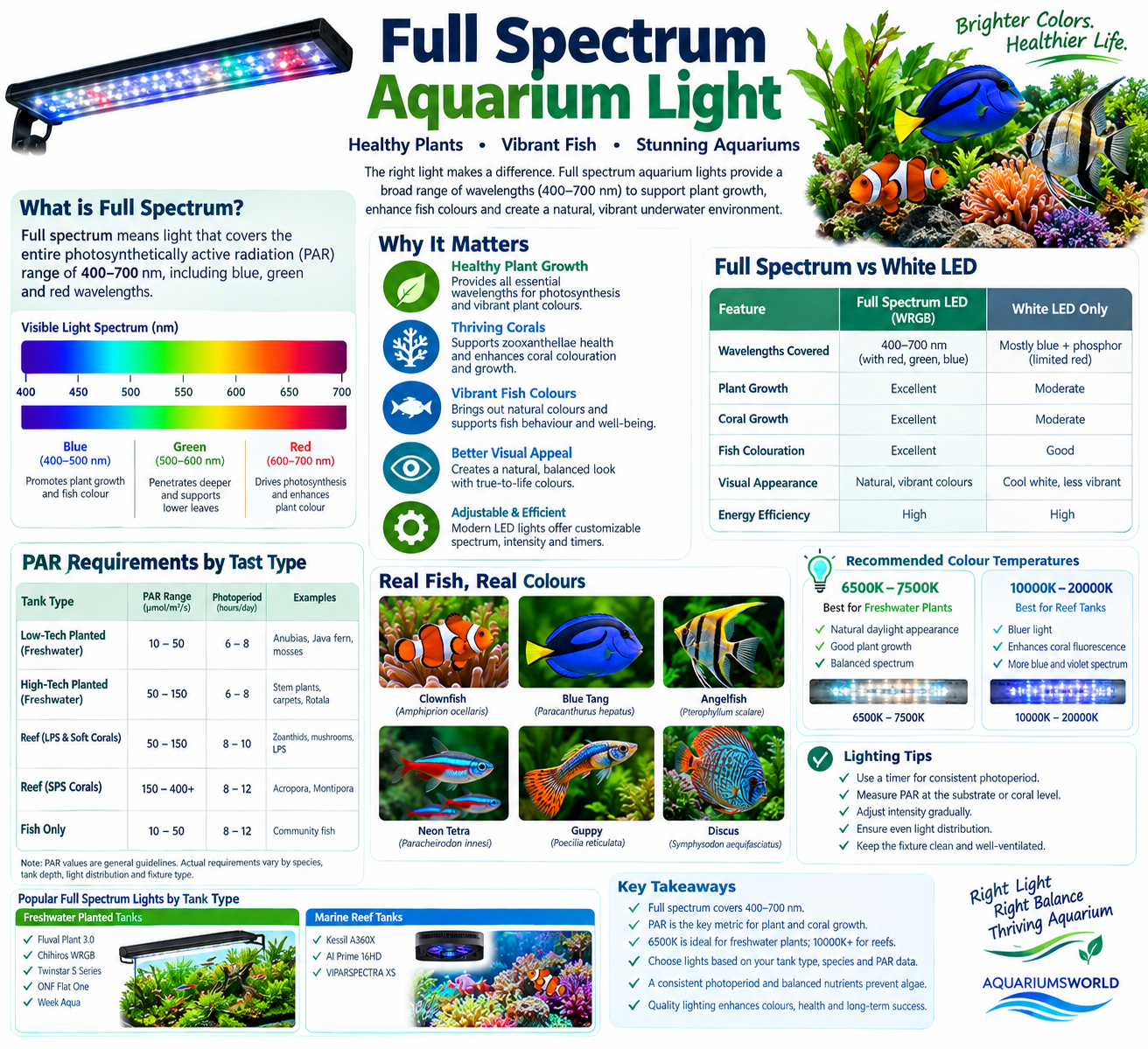
Full Spectrum Aquarium Light | Complete Guide to PAR, Wavelength, Planted Tank and Reef Setup
A full spectrum aquarium light provides a broad range of visible wavelengths for aquarium display and, when appropriately designed, photosynthesis. Choosing the right fixture means considering PAR at the plants or corals, tank depth, light intensity, colour temperature, photoperiod, and the needs of the livestock. This guide explains how full spectrum aquarium LED lights work, how to interpret PAR values, and how to plan lighting for freshwater planted and marine reef aquariums.
What Does Full Spectrum Mean for Aquarium Lights?
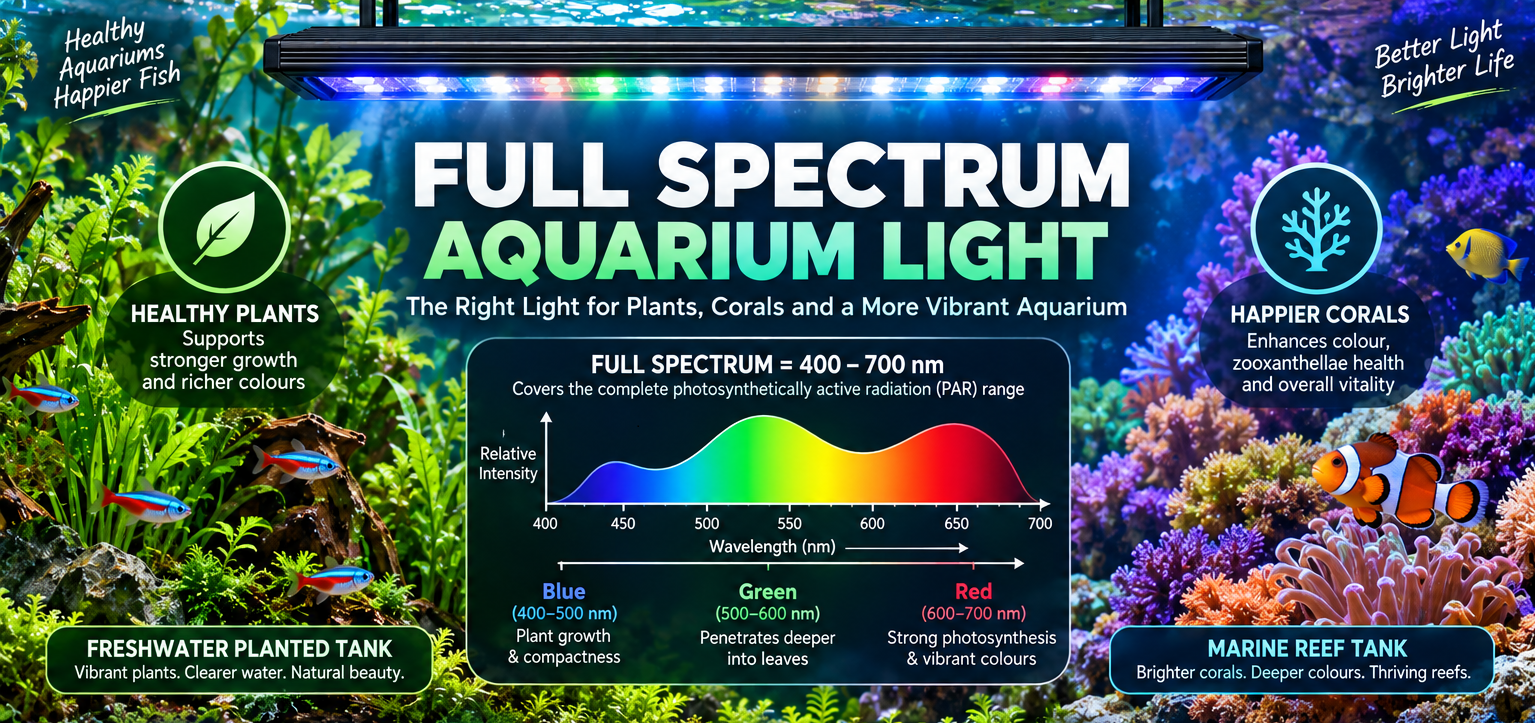
In aquarium lighting, full spectrum generally describes a light source that emits a broad range of wavelengths across the visible spectrum. For photosynthesis, the conventional photosynthetically active radiation range, or PAR, is 400 to 700 nanometres. This includes blue, green, and red wavelengths, although the exact spectral output differs between fixtures.
A full spectrum aquarium LED light can help illuminate plant colours naturally while supplying wavelengths that aquatic plants use for photosynthesis. However, the label “full spectrum” is not a standardized guarantee of output, intensity, or plant-growing performance. Two fixtures carrying the same label may have different spectral distributions and different PAR values at the substrate.
Full Spectrum vs White LED Aquarium Light
White LEDs commonly combine a blue LED with a phosphor coating that converts some of the blue output into longer wavelengths. Many white LEDs therefore emit light across a broad visible range, even if their spectrum is not perfectly even. Some aquarium fixtures add dedicated red, green, or blue channels to adjust colour rendering and spectral output.
A white LED is not automatically unsuitable for plants, and a fixture with separate red and blue LEDs is not automatically superior. Compare the fixture’s measured spectrum, PAR output, spread, controllability, and performance at the actual depth of your aquarium.
The Science of Light and Aquatic Plant Photosynthesis
Photosynthesis converts light energy into chemical energy. Chlorophyll pigments absorb strongly in parts of the blue and red regions, while green light is also able to contribute to photosynthesis. Green wavelengths can penetrate further into some leaves than strongly absorbed wavelengths, so it is misleading to describe green light as useless to plants.
Light is only one part of plant growth. Aquatic plants also depend on available carbon, nutrients, suitable water conditions, and species-specific requirements. Increasing light without considering these factors can create an imbalance rather than improve growth.
What Is PAR and Why Does It Matter?
PAR stands for photosynthetically active radiation. Aquarium keepers commonly use a PAR meter to measure photosynthetic photon flux density (PPFD), expressed in micromoles per square metre per second (µmol/m²/s). A measurement at the substrate is more useful for plant planning than a fixture’s wattage alone.
Lumens describe light in relation to human visual sensitivity, while watts describe electrical power. Neither directly tells you how many photosynthetically useful photons reach a particular plant or coral. PAR is useful, but it does not describe spectrum by itself. A PAR reading should be considered alongside spectral output and the organism’s needs.
Red, Blue and Green Wavelengths for Aquarium Plants
Red and blue wavelengths are important to photosynthesis, but plant growth cannot be predicted from a simple red-to-blue ratio. Results depend on plant species, intensity, exposure time, carbon availability, and the environment in which the plant is growing. Research on terrestrial crops can inform general light science, but it should not be treated as a direct aquarium-specific lighting prescription.
For a planted aquarium, choose a fixture with reliable PAR information, useful spectral coverage, and adjustable intensity. Avoid choosing a light solely because its marketing emphasizes one wavelength or a particular colour effect.
PAR Levels for Different Aquarium Types
PAR targets are best treated as approximate planning ranges rather than fixed requirements. Plant species, coral species, tank depth, light distribution, water clarity, and acclimation all affect the appropriate level. Measure at the location where the organism will live whenever possible.
PAR Chart for Freshwater Planted Tanks
| Approximate PAR | Typical planting approach | Practical notes |
|---|---|---|
| 10-30 | Low-light plants, such as many Anubias, Java fern, and mosses | Often suitable for lower-intensity, lower-maintenance setups. |
| 30-80 | Many common stem plants, crypts, and Vallisneria | Species and tank conditions still determine performance. |
| 80-150 | Some carpeting plants and more demanding stems | Higher light usually requires closer attention to carbon and nutrients. |
| Above 150 | High-intensity setups for experienced keepers | Not necessary for many aquariums; acclimation and balance matter. |
These ranges are broad examples, not guarantees that every plant in a category will thrive at the same PAR. A plant’s placement and the distribution of light across the tank are also important.
PAR Chart for Reef and Marine Tanks
| Approximate PAR | Possible use | Practical notes |
|---|---|---|
| 50-150 | Some soft corals and lower-light LPS | Species-specific tolerance varies considerably. |
| 150-250 | Some LPS and selected SPS placements | Acclimate carefully and observe coral response. |
| 250-400 | Higher-light SPS placements | Not every SPS coral requires the same intensity. |
| Above 400 | High-intensity reef setups | Use only with appropriate species knowledge and careful acclimation. |
Reef lighting should not be selected by PAR alone. Spectrum, distribution, coral placement, acclimation, and the specific species all influence suitability. Avoid abrupt increases in intensity.
Is 6500K Good for Aquarium Plants?
Yes. A 6500K aquarium light is a reasonable colour-temperature choice for many freshwater planted tanks. The Kelvin rating describes the appearance of the light, not its PAR output or exact spectral distribution. Two 6500K fixtures can therefore perform differently.
A 10000K light generally appears cooler or bluer than a 6500K light, but Kelvin ratings alone do not establish whether a fixture is suitable for plants or corals. For freshwater plants, prioritize measured PAR, distribution, adjustability, and a visually pleasing colour balance. For reef tanks, consider a reef-oriented fixture with suitable blue and violet output and independently controllable channels.
What Is the Difference Between Full Spectrum and Regular LED Aquarium Lights?
“LED” describes the light-producing technology, while “full spectrum” describes a claimed or measured spectral characteristic. An LED aquarium light may be broad-spectrum, narrow-spectrum, or a mixture of channels. The terms are not mutually exclusive.
WRGB Aquarium Lights Explained
WRGB fixtures combine white, red, green, and blue LED channels. Separate channels can provide control over colour appearance and spectral balance. Their actual plant-growing performance still depends on PAR, fixture design, and how the light is set up.
| Light type | General characteristics | What to check |
|---|---|---|
| Full spectrum LED or WRGB | Broad output, sometimes with separate colour channels | PAR, spectrum, spread, controls, and reliable measurements. |
| White LED | Often uses a blue LED and phosphor conversion | Actual spectrum and PAR at the aquarium floor. |
| Red and blue LED | Emphasizes selected wavelength bands | Visual appearance, coverage, and whether the spectrum suits the setup. |
| T5 fluorescent | Uses fluorescent lamps with broad or specialized spectra | Lamp type, replacement schedule, heat, and output at the tank. |
Do Aquarium Fish Need Full Spectrum Light?
Fish do not use light for photosynthesis, so they do not need a full spectrum aquarium light for that purpose. Lighting can still influence how fish colours appear and can contribute to a regular day-night cycle. Fish vision differs between species, so one lighting setup should not be assumed to suit every fish.
A fish-only aquarium can often use a simpler light selected for visibility, natural-looking colour, and a consistent schedule. Provide shaded areas and avoid unnecessarily bright or abrupt lighting changes, especially where fish show signs of stress.
How Many Hours Should Aquarium Lights Be On?
A consistent photoperiod is generally more useful than repeatedly changing the schedule. The appropriate duration depends on intensity, plant or coral needs, ambient light, and the aquarium’s overall balance.
| Aquarium type | Example starting photoperiod | Notes |
|---|---|---|
| Low-tech planted freshwater | 6-8 hours | Adjust based on plant growth and algae response. |
| High-tech planted freshwater | 6-8 hours | Higher intensity does not automatically require longer lighting. |
| SPS-dominant reef | Use the fixture and coral plan as a guide | Account for ramping, intensity, and coral acclimation. |
| Mixed or LPS reef | Use the fixture and coral plan as a guide | Viewing periods should not create excessive total exposure. |
| Fish-only aquarium | 6-10 hours | Keep a regular day-night rhythm and provide shaded areas. |
Use a timer to keep the schedule consistent. For CO₂-injected planted tanks, coordinate CO₂ delivery with the lighting period according to your setup and monitor livestock closely. Do not use a generic timing rule as a substitute for checking actual CO₂ levels and fish behaviour.
What Wattage Do I Need for a Planted Tank Light?
The watts-per-gallon rule is an unreliable way to compare modern aquarium lights. LED efficiency, optics, fixture height, tank dimensions, and spectrum vary, so electrical wattage alone cannot tell you the PAR delivered to plants.
Use manufacturer PAR maps or measurements from a PAR meter where possible. Compare readings at the substrate and across the tank, not only directly beneath the centre of the fixture. If measurements are unavailable, begin conservatively and adjust based on plant response rather than assuming that a specific wattage guarantees a particular result.
Does Full Spectrum Light Cause Algae in Aquariums?
Full spectrum lighting does not automatically cause algae. Algae growth can be affected by light intensity and duration, nutrient availability, carbon supply, maintenance, and other aquarium conditions. A sudden increase in light can contribute to an imbalance, particularly when plant growth is limited by another factor.
If algae increases, review the photoperiod, intensity, nutrient routine, carbon delivery, water movement, and maintenance together. Avoid making several large changes at once, because it becomes harder to identify what helped. For broader troubleshooting, see the fish aquarium problems and solutions guide .
Can I Use a Full Spectrum Light for a Reef Tank?
Yes, provided the fixture is designed for reef use and can deliver suitable intensity and spectral output for the corals being kept. Reef fixtures often emphasize blue and violet channels, while offering white and other channels for appearance and adjustment.
Do not choose a reef light by Kelvin rating or a single wavelength claim alone. Check PAR distribution at coral locations, fixture coverage, channel controls, and manufacturer guidance. Introduce new lighting gradually and observe coral response.
Best Full Spectrum Aquarium Lights by Tank Type
There is no single best full spectrum aquarium light for every tank. A useful shortlist begins with the aquarium type, dimensions, mounting height, desired plant or coral species, and available budget. The following are examples of product lines to compare, not a ranked or independently tested recommendation.
Full Spectrum Lights for Freshwater Planted Tanks
When comparing planted-tank fixtures, look for:
- PAR information at realistic tank depths.
- Even light distribution across the aquarium footprint.
- Adjustable intensity and a dependable timer.
- A spectrum and colour rendering that suit the plants and your viewing preference.
- Practical mounting, maintenance, warranty, and replacement support.
Product lines that planted-tank keepers may compare include Fluval Plant 3.0, Chihiros WRGB, Twinstar S Series, ONF Flat One, and Week Aqua. Confirm the current model specifications and tank-size suitability before purchasing.
Full Spectrum Lights for Marine Reef Tanks
For a reef fixture, compare:
- PAR maps and coverage at the intended coral locations.
- Adjustable blue and violet channels where appropriate.
- Control over intensity, ramping, and daily schedule.
- Acclimation features and reliable mounting options.
- Published guidance for the coral types you intend to keep.
Reef-light product lines that may be worth comparing include Kessil A360X, AI Prime 16HD, and VIPARSPECTRA XS. Check the exact model, current specifications, coverage, and manufacturer recommendations before buying.
How to Set Up Aquarium Lighting
- Identify the aquarium’s needs. Decide whether the main goal is fish display, low-light plants, demanding plants, or a reef with particular coral species.
- Check the tank dimensions and mounting height. A deep or wide aquarium may need different output or coverage from a shallow tank.
- Position the fixture securely. Follow the manufacturer’s mounting and electrical safety instructions. Keep electrical connections protected from water and splashes.
- Set a conservative starting intensity. Avoid beginning at maximum output, especially when introducing new plants or corals.
- Set a consistent timer. Choose a practical daily schedule and avoid frequent, unnecessary changes.
- Measure and observe. Check PAR at organism level when possible, then monitor plant growth, algae, coral response, and fish behaviour.
For planted aquariums, substrate choice can also influence plant establishment. See the aquarium soil guide for more information.
Common Aquarium Lighting Mistakes
- Choosing a light by wattage alone instead of checking PAR and coverage.
- Assuming every product labelled “full spectrum” has the same output.
- Increasing intensity and photoperiod at the same time.
- Using a reef light without considering the needs of the specific corals.
- Ignoring shaded areas, uneven spread, or light loss with depth.
- Responding to algae by changing lighting without reviewing nutrients and carbon.
- Changing the schedule frequently instead of using a consistent timer.
Lighting Maintenance and Troubleshooting
Keep the fixture and its ventilation areas clean according to the manufacturer’s instructions. Salt spray, dust, and moisture can affect equipment, particularly around marine aquariums. Disconnect power before cleaning and never allow water to enter electrical components.
If plants are stretching, losing leaves, or growing unevenly, check species requirements, light distribution, nutrients, and carbon before replacing the fixture. If corals show signs of stress after a lighting change, review intensity and acclimation, and make adjustments cautiously. Lighting symptoms can overlap with other water-quality or husbandry issues.
Frequently Asked Questions
What does full spectrum mean for aquarium lights?
It generally means a broad range of visible wavelengths. For photosynthesis, PAR is conventionally defined as 400 to 700 nm, but the label alone does not guarantee a particular spectrum or output.
Do aquarium fish need full spectrum light?
Fish do not need full spectrum light for photosynthesis. Aquarium lighting can affect how fish appear and helps provide a regular day-night cycle.
What is the best full spectrum light for a planted tank?
The best choice depends on tank dimensions, plant species, mounting height, PAR, coverage, controls, and budget. Compare measured performance rather than relying on the “full spectrum” label alone.
What PAR level do I need for a planted aquarium?
Many low-light plants can grow at relatively low PAR, while demanding plants may require more. Use species-specific guidance and measure PAR where the plants are positioned.
Is 6500K good for aquarium plants?
Yes, 6500K is a common colour-temperature choice for planted aquariums. Kelvin describes the appearance of the light, not its PAR output.
How many hours should aquarium lights be on?
A consistent schedule is a useful starting point. Many planted aquariums begin around 6 to 8 hours daily, then adjust based on intensity, plant response, and algae.
What is the difference between full spectrum and LED aquarium lights?
LED refers to the light technology. Full spectrum refers to a broad spectral output. An LED fixture may or may not provide broad coverage.
Can I use a full spectrum light for a reef tank?
Yes, if the fixture provides appropriate output and coverage for the corals. Check PAR distribution, spectral controls, and coral-specific requirements.
What wattage do I need for a planted tank light?
There is no reliable universal watts-per-gallon target for modern LEDs. Compare PAR at the substrate and the fixture’s coverage instead.
Does full spectrum light cause algae in aquariums?
Not by itself. Algae is influenced by several interacting factors, including light intensity and duration, nutrients, carbon availability, and aquarium maintenance.
Conclusion
A full spectrum aquarium light can provide broad visible illumination for planted and reef aquariums, but the label alone does not determine whether a fixture is suitable. Focus on PAR at the organism’s location, spectral output, light distribution, tank depth, and a consistent photoperiod.
For freshwater planted tanks, choose lighting according to plant demands and manage intensity alongside carbon and nutrients. For reef tanks, prioritize coral-specific requirements, measured coverage, and gradual acclimation. In both cases, observe the aquarium and adjust carefully rather than relying on a single wattage, Kelvin rating, or PAR number.
For more aquarium setup guidance, explore the fish aquarium types and setup guide , the aquarium problems and solutions guide , and the 20-gallon fish tank guide .
References
The following references were supplied for this article. Check author names, article titles, publication details, and DOI or URL resolution before publication. Research on terrestrial crops may provide background on light science, but it does not automatically establish aquarium-specific PAR recommendations.
- Khan, A. et al. (2024) ‘Light emitting diode effect of red, blue, and amber light on photosynthesis and plant growth parameters’, Industrial Crops and Products. https://doi.org/10.1016/j.indcrop.2024.118733
- Park, Y. and Runkle, E.S. (2018) ‘Spectral effects of light-emitting diodes on plant growth, visual color quality, and photosynthetic photon efficacy: White versus blue plus red radiation’, PLOS ONE. https://doi.org/10.1371/journal.pone.0202386
- ‘Filtering Light-Emitting Diodes to Investigate Amber and Red Spectral Effects on Lettuce Growth’ (2021), Frontiers in Plant Science. PubMed Central record. Verify the author list and article metadata.
- ‘The Impact of Light Spectrum and Intensity on the Growth, Physiology, and Antioxidant Activity of Lettuce (Lactuca sativa L.)’ (2021), Applied Sciences. PubMed Central record. Verify the author list and article metadata.
- ‘Dependence of far-red light on red and green light at increasing growth of lettuce’ (2024), Frontiers in Plant Science. PubMed Central record. Verify the exact title and author list.
- Zhen, S. and van Iersel, M.W. (2017) ‘Far-red light is needed for efficient photochemistry and photosynthesis’, Journal of Plant Physiology. https://doi.org/10.1016/j.jplph.2016.12.004
- Sharkey, T.D. et al. (2026) ‘Advancing our understanding of photosynthesis: discoveries and insights from aquatic plants’. PubMed Central record. Verify the article’s publication status and metadata before citing.
- Pedersen, O., Colmer, T.D. and Sand-Jensen, K. (2013) ‘Underwater photosynthesis of submerged plants: recent advances and methods’, Frontiers in Plant Science, 4, 140. https://doi.org/10.3389/fpls.2013.00140
- Pajusalu, L., Martin, G., Paalme, T. and Põllumäe, A. (2016) ‘The effect of CO₂ enrichment on net photosynthesis of the red alga Furcellaria lumbricalis’. https://doi.org/10.7717/peerj.2505
- ‘Fish Welfare in Public Aquariums and Zoological Collections’ (2023), Animals, 13(16), 2548. https://doi.org/10.3390/ani13162548. Verify the author list and the specific claims supported by this review.
- ‘The Effect of Substrate on Water Quality in Ornamental Fish Tanks’ (2022), Animals, 12(19), 2679. https://doi.org/10.3390/ani12192679. Verify the author list and article metadata.
- Csontos, D., Bartal, Z.P. and Bakacsy, L. (2024) ‘Removal of nitrate and phosphate by aquatic plants during aquarium-based ornamental fish production’, North American Journal of Aquaculture, 86(4), pp. 413-423. https://doi.org/10.1002/naaq.10349