Betta Fish Tank
The betta fish tank is one of the most misunderstood pieces of aquarium equipment in the hobby. The science says otherwise. A landmark 2024 study published in Animal Welfare found that betta fish kept in large, furnished tanks were significantly more active, performed fewer abnormal behaviours such as hovering and stereotypic swimming, and showed clear behavioural differences that indicated improved welfare
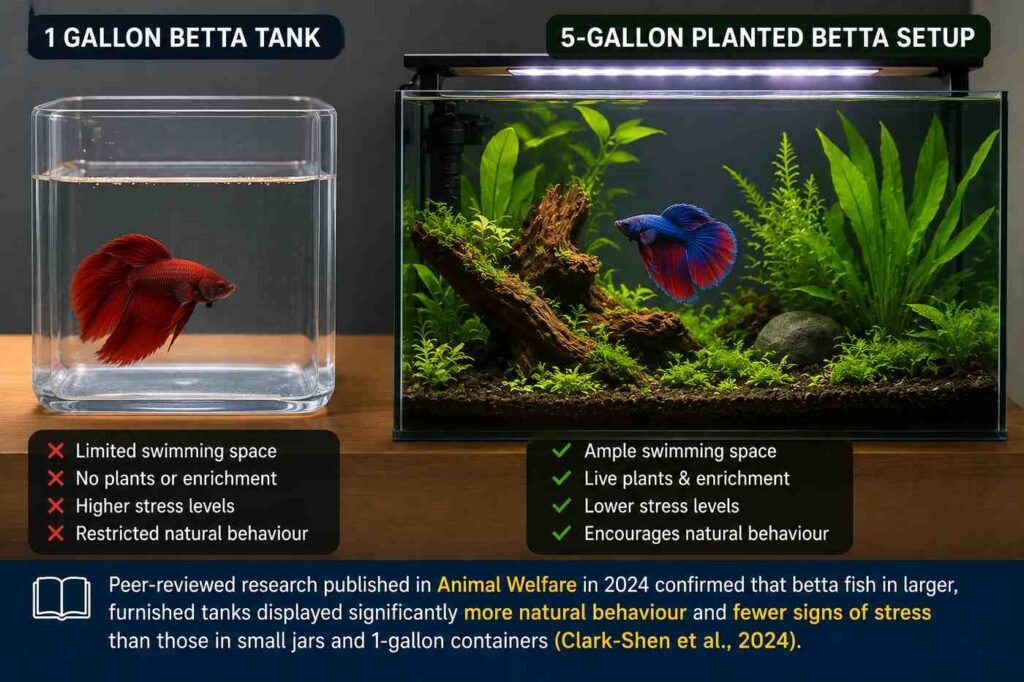
The 1 gallon betta tank is one of the most searched and most debated topics in the aquarium hobby. Walk into any pet shop and you will likely see betta fish displayed in small containers, sometimes as small as a cup. A 1-gallon tank seems like a reasonable upgrade from that — compact, affordable, easy to place on a desk or shelf. But is a 1 gallon tank actually suitable for a betta fish?
This guide gives you the honest, science-backed answer. It covers what peer-reviewed research actually says about betta welfare in small tanks, what a 1 gallon betta tank can and cannot do in terms of water chemistry, temperature stability and fish health, and what the realistic alternatives are at 2 gallons, 2.5 gallons and 5 gallons. Whether you already own a 1-gallon tank or are deciding whether to buy one, this guide gives you the information you need to make a decision you will not regret six months down the line. If you are completely new to fishkeeping, start with our complete beginner’s guide to fish care before making any purchase.
- Can a Betta Go in a 1 Gallon Tank — Direct Answer
- What Science Says About Betta Tank Size
- Why a 1 Gallon Betta Tank Is Problematic
- 1 Gallon Betta Tank with Filter — Does It Help
- 1 Gallon Betta Tank Setup — If You Already Own One
- How Many Betta Fish in a 1 Gallon Tank
- Can a Betta Fish Live in a 1.5 Gallon Tank
- Is 2 Gallons Too Small for a Betta
- Betta Tank Size Comparison Table
- 5 Gallon Betta Tank — Why It Makes Everything Easier
- 1 Gallon Betta Tank Kit — What to Look For
- 1 Gallon Betta Fish Tank for Sale — Buyer Checklist
- Siamese Fighting Fish — Understanding the Species
- Betta Tank Water Quality and Parameters
- Maintenance Routine by Tank Size
- Common Betta Tank Mistakes
- Frequently Asked Questions
- Conclusion
- References
1. Can a Betta Go in a 1 Gallon Tank — Direct Answer
A betta fish can survive in a 1 gallon tank. But survival and welfare are not the same thing. The honest, science-backed answer is: a 1 gallon tank is not a suitable long-term home for a betta fish. The water volume is insufficient for stable water chemistry, effective temperature control, meaningful environmental enrichment or proper biological filtration. In a 1-gallon unfiltered tank, ammonia from a single betta can reach harmful levels within 24 to 48 hours (Davis, 1975).
The peer-reviewed research is unambiguous. Clark-Shen et al. (2024), publishing in the journal Animal Welfare, studied thirteen male betta fish across five housing conditions ranging from 1.5-litre jars to 19.3-litre aquariums. Fish in the smallest containers displayed significantly more abnormal behaviours, spent significantly less time actively swimming, and showed clear differences in activity levels that indicated compromised welfare. The researchers concluded that a minimum of 5.6 litres is required even for retail display of bettas — and recommended larger tanks for permanent home keeping. A 1-gallon tank holds only 3.8 litres, falling well below even this retail minimum.
2. What Science Says About Betta Tank Size
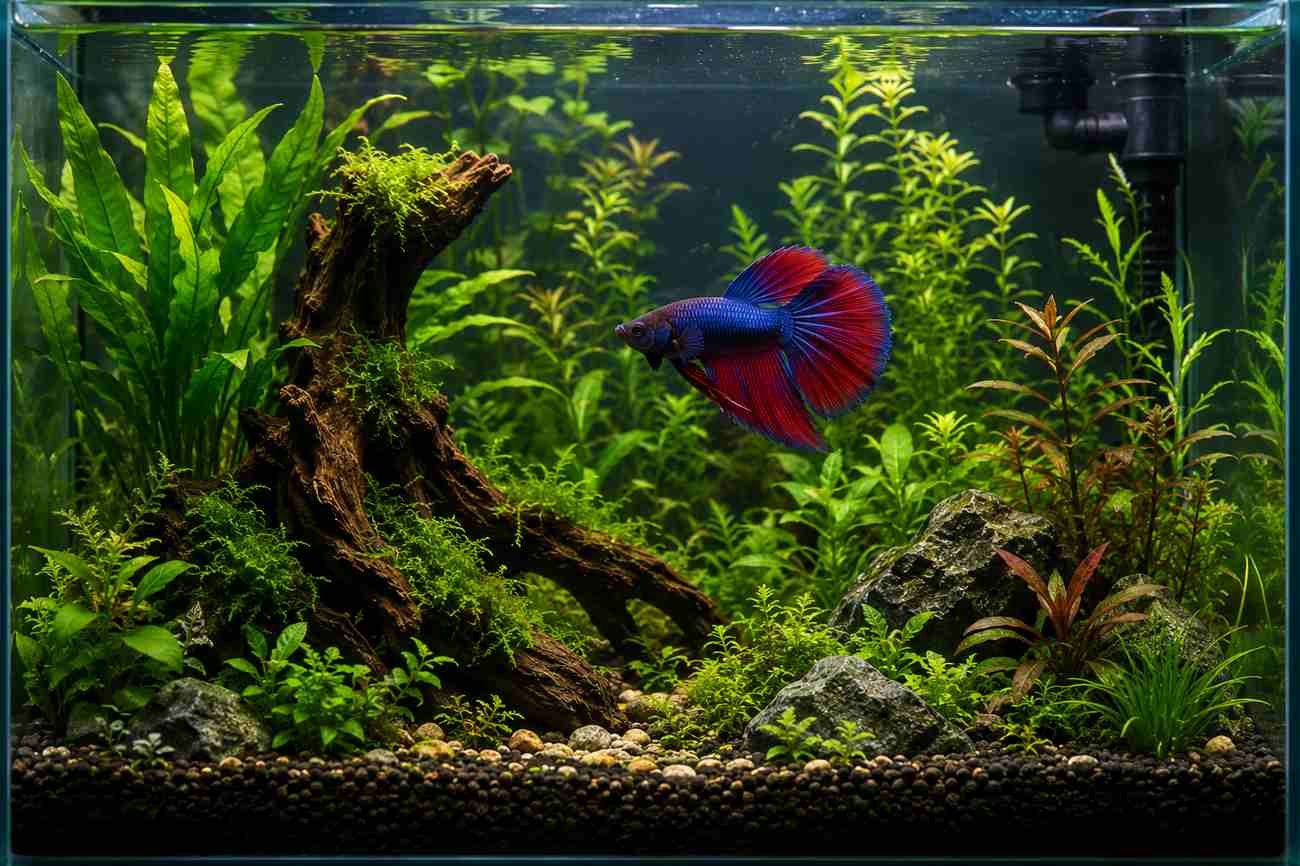
Three peer-reviewed scientific studies are most directly relevant to the question of betta tank size requirements.
Clark-Shen et al. (2024) — Life Beyond a Jar
Published in Animal Welfare (DOI: 10.1017/awf.2024.67), this landmark study remains the most comprehensive peer-reviewed investigation of betta tank size and welfare. Thirteen male betta fish were rotated across five different housing conditions: a 1.5-litre jar, a 3.3-litre small tank, a 5.6-litre medium tank, a 19.3-litre large tank, and a 19.3-litre large barren tank with no furnishings. Tank size significantly influenced behaviour. Fish in the 1.5-litre condition spent significantly more time hovering and significantly less time actively swimming compared to fish in larger tanks. The researchers recommended a minimum of 5.6 litres for retail betta display and explicitly stated that larger tanks are appropriate for home keeping (Clark-Shen et al., 2024).
Pleeging and Moons (2017) — Welfare at Retail and in the Home Aquarium
This peer-reviewed study documented conditions in both retail and hobbyist betta keeping, identifying small tank size and lack of environmental enrichment as the two primary welfare concerns for Betta splendens across the hobby. The study recommended minimum tank sizes of at least 15 to 20 litres for home keeping, with live plants and hiding places identified as independent welfare factors (Pleeging and Moons, 2017).
Kajimura et al. (2023) — Ammonia and Nitrite Toxicity
Published in BMC Zoology (DOI: 10.1186/s40850-023-00188-3), this study confirmed the acute toxicity thresholds of ammonia and nitrite in Betta splendens, providing the physiological basis for understanding why small tanks without filtration create welfare-compromising ammonia conditions rapidly. A single betta fish in a 1-gallon unfiltered tank can push ammonia to stressful levels within 24 hours under typical feeding conditions.
3. Why a 1 Gallon Betta Tank Is Problematic
Understanding exactly why a 1-gallon tank creates welfare problems for a betta helps you make genuinely informed decisions — not just follow a rule without understanding the reason behind it.
Ammonia Accumulates Rapidly
In a 1-gallon tank without filtration, a single betta fish produces enough ammonia to reach measurably stressful levels within 24 to 48 hours depending on temperature and feeding (Kajimura et al., 2023; Davis, 1975). Ammonia at even low concentrations damages gill tissue, suppresses the immune system and reduces a betta’s ability to fight off bacterial and parasitic infections. In a 5-gallon cycled tank with a sponge filter, the same fish’s ammonia output is processed biologically within minutes.
Temperature Is Impossible to Stabilise
Betta splendens requires consistently warm water between 24 and 28°C. A 1-gallon tank has so little thermal mass that it tracks room temperature closely and quickly. A room that drops to 18°C overnight will pull a 1-gallon tank to near that temperature within hours. Bettas exposed to temperatures below 20°C experience metabolic slowdown, immune suppression and, with extended exposure, cold stress that can be fatal (Watson et al., 2019). A small heater can be fitted to some 1-gallon tanks, but maintaining a stable temperature in 3.8 litres of water is genuinely difficult even with a heater, because the water volume is so small that any slight heater fluctuation creates noticeable temperature swings.
Biological Filtration Cannot Establish Effectively
The nitrifying bacteria that convert ammonia to nitrite and then to nitrate — the nitrogen cycle that makes an aquarium habitable — require porous surface area to colonise (Bagchi et al., 2014). In a 1-gallon tank with a small or no filter, this surface area is severely limited. The result is that even in a filtered 1-gallon tank, the bacterial colony is too small to process a betta’s waste load between water changes, meaning ammonia spikes remain a persistent risk.
Environmental Enrichment Is Nearly Impossible
Clark-Shen et al. (2024) found that tank furnishings — live plants, substrate, hiding places — independently improve betta welfare beyond tank size alone. In a 1-gallon tank, there is almost no space for meaningful enrichment after a betta is placed inside. The fish fills the tank. A betta with no hiding places, no plants to rest on and no visual complexity in its environment shows elevated abnormal behaviour including hovering, glass surfing and stereotypic repeated movements (Clark-Shen et al., 2024).
Lethal Events Happen Very Fast
In a 5-gallon cycled tank, a single uneaten food pellet, a small equipment failure or a brief lapse in maintenance creates a manageable problem. In a 1-gallon tank, the same event can be a crisis. The dilution capacity of 3.8 litres of water is so low that small organic loads create disproportionate parameter swings — and a betta’s health can deteriorate within 24 hours of a water quality failure in such a small volume.
4. 1 Gallon Betta Tank with Filter — Does It Help
A 1 gallon betta tank with filter is meaningfully better than a 1-gallon tank without filtration, but it does not resolve the fundamental welfare problems created by the small volume itself.
What a Filter Does Help
- Reduces the rate of ammonia accumulation between water changes
- Provides some surface area for nitrifying bacteria to colonise
- Creates gentle water movement that improves oxygenation
- Reduces the frequency of water changes required (though daily or every-other-day changes are still needed in a 1-gallon tank)
What a Filter Cannot Resolve in a 1-Gallon Tank
- Volume is still only 3.8 litres — all the thermal mass, dilution capacity and enrichment space problems remain regardless of filtration
- Flow rate from most 1-gallon kit filters is too strong for a betta’s preference for calm water — betta fins are not adapted for swimming against currents, and a filter that creates significant flow in 3.8 litres of water will exhaust the fish
- The biological colony remains small — even with filtration, a 1-gallon tank’s total biological filtration capacity is a fraction of what a 5-gallon sponge filter system supports
- Temperature instability remains — a filter cannot add thermal mass to the water volume
For a full guide on filtration types, flow rates and how to choose and use a filter correctly for any betta tank, see our complete betta fish tank guide which covers sponge filters, hang-on-back filters and flow baffling in detail.
5. 1 Gallon Betta Tank Setup — If You Already Own One
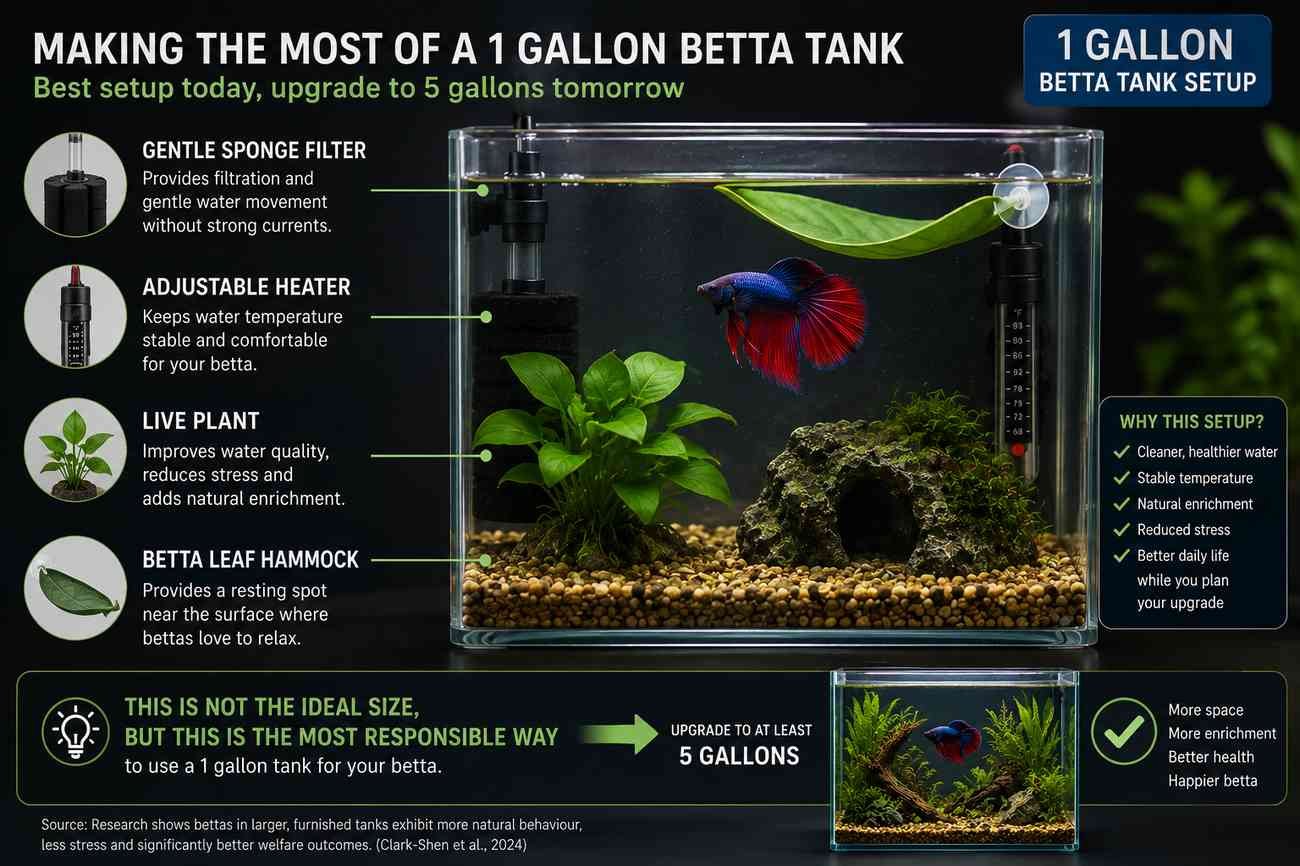
If you already own a 1-gallon betta tank and have a betta in it, the priority is to make the existing setup as good as possible while planning an upgrade to a larger tank. The following steps represent the most responsible approach to a 1-gallon betta setup:
- Add a small adjustable heater immediately if one is not present. A 15-watt or 25-watt adjustable submersible heater can maintain temperature in a 1-gallon tank but will need monitoring with a separate thermometer — the heater’s built-in dial is not a reliable temperature indicator in such a small volume.
- Add a sponge filter or reduce flow from a kit filter. An air-driven sponge filter produces the gentlest possible flow and provides better biological surface area than the small filters included in most kit tanks. If your kit filter creates visible current in the tank, baffle it with a small piece of filter sponge over the outlet.
- Add a live plant. Even one small Anubias nana or a portion of Java Moss attached to a stone provides enrichment, resting surfaces and a small contribution to biological filtration. Research confirms that plants independently improve betta welfare (Clark-Shen et al., 2024).
- Add a betta leaf hammock. A silk or plastic leaf hammock positioned 2 to 3 cm below the surface provides a resting spot near the waterline where bettas naturally spend much of their time.
- Perform water changes every 1 to 2 days. In a 1-gallon unfiltered or minimally filtered tank, ammonia accumulates fast. Change 30 to 50 percent of the water daily if unfiltered, every 2 days if filtered — always treating replacement water with a dechlorinator and matching temperature before adding.
- Plan your upgrade. The most responsible next step is a 5-gallon aquarium with a proper sponge filter and adjustable heater. The difference in maintenance ease, water stability and betta welfare between a 1-gallon and 5-gallon tank is enormous.
6. How Many Betta Fish in a 1 Gallon Tank
The answer to this question is straightforward: one betta fish, maximum, in a 1-gallon tank. In practice, even this is problematic from a welfare perspective — but keeping two or more bettas in a 1-gallon tank is not a viable option for any of the following reasons:
- Male bettas cannot be kept together — two male bettas in any shared aquarium will fight with intensity that causes serious injury and frequently death. The labyrinth organ that bettas use to breathe atmospheric air evolved partly in the context of territorial fights, and in an enclosed aquarium there is no escape (Tate et al., 2017).
- A 1-gallon tank cannot support the bioload of two fish — even two small females would produce twice the ammonia in a volume already too small for one fish.
- Female bettas can co-exist in groups (sororities) only in tanks of 20 gallons or more with dense planting and multiple hiding places — a 1-gallon tank is entirely unsuitable for this.
For a full science-backed explanation of betta compatibility, male and female housing rules and tank mate options, see our complete betta fish tank guide.
7. Can a Betta Fish Live in a 1.5 Gallon Tank
A 1.5-gallon tank holds approximately 5.7 litres of water — slightly above the 5.6-litre minimum recommended by Clark-Shen et al. (2024) for retail display of bettas, but still significantly below the recommended minimum for home keeping. The distinction matters: a 5.6-litre tank was recommended for short-term retail display situations with frequent water changes performed by trained staff — not as a permanent home for a fish that will live there for 3 to 5 years.
Interestingly, the 1.5-litre jar condition in the Clark-Shen et al. (2024) study produced the worst welfare outcomes of all conditions tested, confirming that this volume is clearly inadequate. A 1.5-gallon tank at 5.7 litres sits just above the study’s retail minimum but provides very limited space for enrichment, equipment and stable water chemistry. While marginally better than a 1-gallon tank, a 1.5-gallon setup still requires daily or every-other-day water changes without filtration and remains a challenging environment to maintain stable temperature in without a dedicated heater.
The honest answer: a betta can survive in a 1.5-gallon tank, but a 5-gallon tank with a sponge filter represents a fundamentally different and significantly better quality of life for both the fish and the keeper.
8. Is 2 Gallons Too Small for a Betta
Is 2 gallons too small for a betta? At 7.6 litres, a 2-gallon tank is better than a 1-gallon but still presents the same core challenges: limited thermal mass for temperature stability, limited dilution capacity for ammonia, and very limited space for enrichment. Water changes are still required every 2 to 3 days even with a filter, and fitting a heater, filter and meaningful plant in 7.6 litres of water leaves very little actual swimming space for the fish.
Most experienced betta keepers and aquarium science researchers place 2 gallons in the same category as 1 gallon — not recommended for long-term betta keeping. The betta fish tank welfare standard established by current research recommends 5 gallons as the practical minimum for a permanently housed betta, with 10 gallons recommended for most hobbyists for meaningfully better water stability and a lower maintenance burden.
9. Betta Tank Size Comparison Table
| Tank Size | Volume (Litres) | Welfare Rating | Water Change Frequency | Filter Viable | Heater Viable | Verdict |
|---|---|---|---|---|---|---|
| 0.5 Gallon or under | Under 2 L | Unacceptable | Daily — 50%+ | No | No | Never appropriate for any fish |
| 1 Gallon | 3.8 L | Not recommended | Daily to every 2 days | Limited | Difficult | Below welfare minimum; temporary only |
| 1.5 Gallon | 5.7 L | Poor | Every 2 days | Limited | Difficult | Meets retail minimum only; not for permanent home |
| 2 Gallon | 7.6 L | Poor to marginal | Every 2 to 3 days | Marginal | Possible | Still challenging; high maintenance burden |
| 2.5 Gallon | 9.5 L | Marginal | Every 3 days | Yes — sponge filter | Yes | Better but still below recommended minimum |
| 5 Gallon | 18.9 L | Acceptable minimum | Weekly — 20 to 25% | Yes — sponge filter | Yes | Practical minimum; suitable for most beginners |
| 10 Gallon | 37.9 L | Good | Weekly — 15 to 20% | Yes — all types | Yes | Recommended for most hobbyists; significantly more stable |
| 20 Gallon or larger | 75.7 L+ | Excellent | Weekly — 10 to 15% | Yes — all types | Yes | Ideal; community possible; easiest maintenance |
For detailed dimension and weight information across all standard tank sizes, see our fish tank dimensions in cm and inches guide. For the 20-gallon option which is frequently recommended as the best betta community tank size, our 20 gallon fish tank complete guide covers all setup and stocking considerations in detail.
10. 5 Gallon Betta Tank — Why It Makes Everything Easier
The leap from a 1-gallon to a 5 gallon betta tank is one of the most impactful improvements any betta keeper can make. Five times the water volume does not simply mean five times better — it creates qualitatively different conditions that are genuinely easier to maintain and significantly better for the fish.
Water Chemistry Stability
Ammonia, nitrite and nitrate accumulate roughly five times more slowly in a 5-gallon tank than in a 1-gallon tank, all else being equal. A 5-gallon tank with a properly cycled sponge filter can process a single betta’s waste output between weekly water changes without ammonia reaching detectable levels. This is the fundamental reason why experienced betta keepers universally recommend 5 gallons as the minimum (Watson et al., 2019).
Temperature Stability
Five gallons of water has meaningfully more thermal mass than 3.8 litres. A properly sized heater — typically 25 to 50 watts — can maintain 24 to 28°C in a 5-gallon tank reliably in most home environments, and the temperature changes more slowly in response to room temperature fluctuations (Dolan, 2015).
Environmental Enrichment
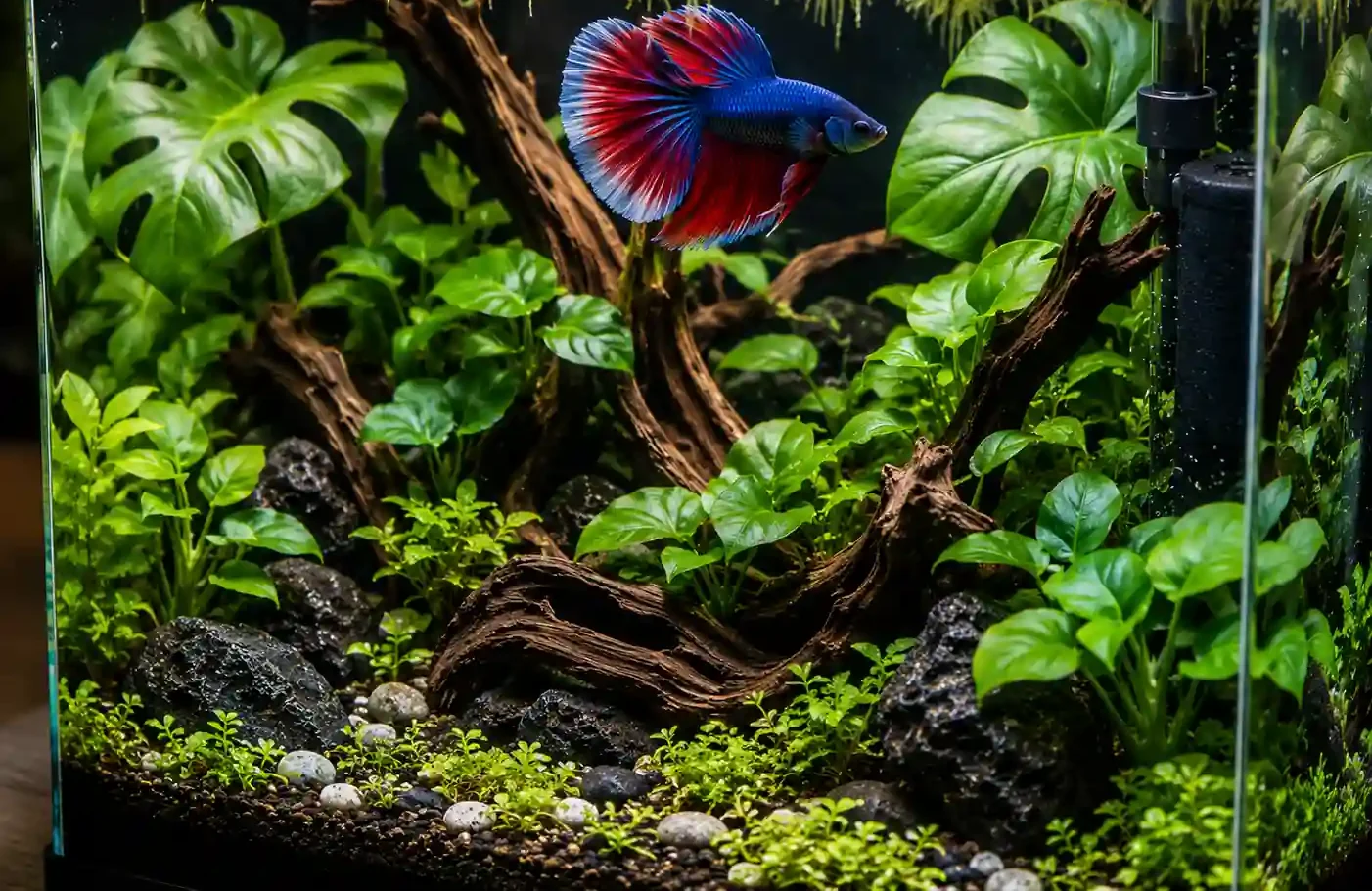
A 5-gallon tank provides genuine space for a planted aquascape — Java Fern, Anubias, floating plants, a leaf hammock and a hiding cave or piece of driftwood — without the tank feeling overcrowded. Research confirms that the combination of appropriate volume and environmental furnishings produces the best betta welfare outcomes (Clark-Shen et al., 2024).
Weekly Water Changes Instead of Daily
In a cycled 5-gallon tank with a sponge filter, weekly water changes of 20 to 25 percent are sufficient to maintain good water quality for a single betta. This is a fundamentally different maintenance burden from the daily or every-other-day changes required in a 1-gallon tank — and one that most hobbyists can actually sustain consistently over a 3 to 5 year betta lifespan.
- Betta Fish Tank Complete Guide — full guide to size, setup, water quality, filtration and care
- 20 Gallon Fish Tank Guide — the best size for a betta community tank
- Fish Tank Dimensions in cm and Inches — complete size reference for all standard tank sizes
- Fish Aquarium Problems and Solutions — troubleshooting ammonia, water quality and equipment issues
- Aquarium Air Pump Guide — selecting the right air pump for a sponge filter in a betta tank
- Soil in Fish Tank Guide — planted substrate options for a betta aquascape
- Beginner’s Complete Guide to Fish Care — start here if you are new to fishkeeping
11. 1 Gallon Betta Tank Kit — What to Look For
If you are determined to start with a 1 gallon betta tank kit, here is what to check before purchasing, and what the kit almost certainly will not include that you will need to add.
What Most 1-Gallon Kits Include
- A small plastic or glass aquarium — typically 1 US gallon (3.8 litres)
- A small LED light integrated into the lid
- Sometimes a very small internal pump filter
- Basic instructions
What Most 1-Gallon Kits Do Not Include
- A heater — most 1-gallon kits do not include a heater; you will need a small 7.5-watt to 15-watt submersible heater separately
- Adequate filtration — any pump filter included in a 1-gallon kit is typically very small and often creates excessive flow for a betta
- A thermometer — essential for verifying actual water temperature separate from any heater dial reading
- Water conditioner — necessary to dechlorinate all tap water before it is added to the tank
- Live plants or meaningful enrichment — most kits include minimal or no enrichment items
What to Check Before Buying Any Betta Tank Kit
- Is a heater included or can a small heater fit inside the tank?
- Does the filter produce adjustable or baffled flow? Bettas need calm water — strong flow from a small filter in 3.8 litres of water is stressful.
- Is the lid secure? Bettas jump — an open-top or unsecured lid will result in a dead fish.
- Is the LED lighting spectrum suitable for live plants if you intend to add them?
12. 1 Gallon Betta Fish Tank for Sale — Buyer Checklist
When searching for a 1 gallon betta fish tank for sale, the wide availability of low-cost 1-gallon kits on Amazon, at pet shops and in general retail stores means there are significant quality differences between products. The following checklist covers the most important points to verify before any purchase.
- Glass vs plastic — glass tanks are more scratch-resistant and easier to clean than acrylic or plastic; plastic yellows over time and scratches permanently from standard algae scrapers
- Lid security — confirm the lid closes securely and that any gaps for cables are too small for your betta to jump through
- Filter flow rate — if a filter is included, check whether flow is adjustable or can be baffled; a small pump in 3.8 litres of water with non-adjustable flow will create too much current for a betta
- Heater compatibility — check that a small submersible heater (7.5 to 15 watts) can fit physically inside the tank if one is not included
- Light spectrum — if you plan to keep live plants, ensure the LED produces a spectrum that includes the wavelengths needed for plant photosynthesis, not purely decorative coloured lighting
- Customer reviews — check specifically for reports of leaking, lid fit problems and pump failures in any kit product
13. Siamese Fighting Fish — Understanding the Species
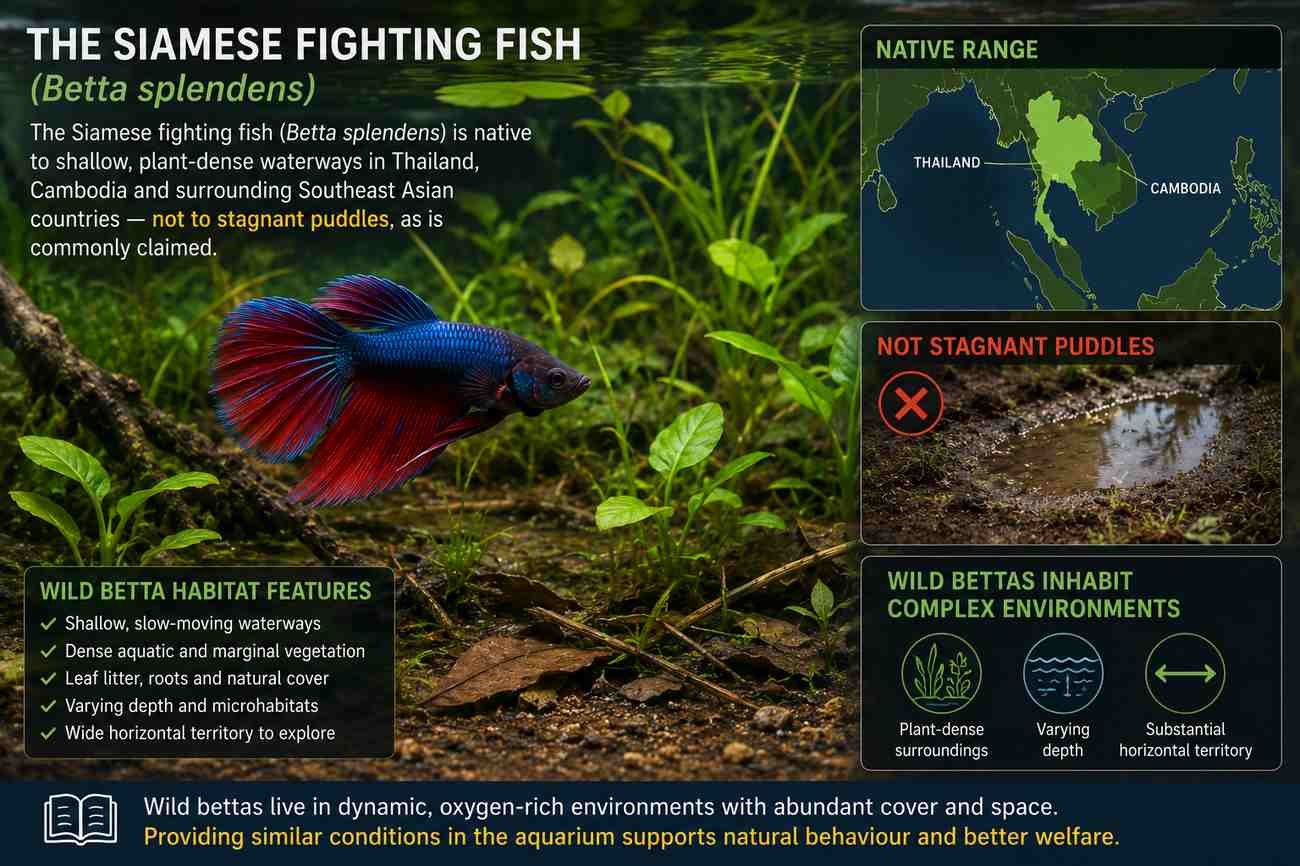
The Siamese fighting fish (Betta splendens) is one of the most widely kept ornamental fish in the world. Native to Southeast Asia — primarily Thailand, Cambodia, Vietnam and Laos — wild bettas inhabit shallow, slow-moving or still waterways including rice paddies, river margins and flooded forests (Watson et al., 2019). These habitats are not the stagnant mud puddles or tiny pools that retailers sometimes use to justify keeping bettas in tiny containers. Wild betta territories cover substantial areas with access to vegetation, varying depth and the ability to escape threatening encounters.
The labyrinth organ that makes bettas capable of breathing atmospheric air directly evolved in oxygen-depleted environments where moving between pools during the dry season was a survival mechanism — not an adaptation to permanent life in a cup of water (Tate et al., 2017). Understanding this biology is essential to understanding why small tank size is a welfare issue rather than a matter of preference. A betta in a 1-gallon tank is not comfortable in a small space because it evolved in small spaces — it is a fish in a space far smaller than its natural territory, exhibiting the stress behaviours that science has now confirmed are associated with that overcrowding.
For a complete guide to Betta splendens care including natural history, tank setup, water quality and lifespan, see our dedicated betta fish tank complete guide. For how betta care compares to other popular species, our angelfish care guide and Oranda goldfish complete care guide provide useful species-by-species comparisons.
14. Betta Tank Water Quality and Parameters
Correct and stable water parameters are more important in a small tank than in a large one — because in a smaller volume, every deviation from ideal conditions is magnified by the reduced dilution capacity. The following parameters apply regardless of tank size, but maintaining them in a 1-gallon tank requires significantly more vigilance than in a 5-gallon or larger aquarium.
| Parameter | Target Range | Why It Matters for Bettas | Testing Frequency |
|---|---|---|---|
| Temperature | 24 to 28°C (75 to 82°F) | Bettas are tropical fish; cold temperatures cause immune suppression and metabolic slowdown (Watson et al., 2019) | Daily check with thermometer |
| pH | 6.5 to 7.5 | Stable pH is more important than exact value; sudden changes cause acute stress | Weekly |
| Ammonia | 0 ppm | Any detectable ammonia causes gill damage and immune suppression (Kajimura et al., 2023); in a 1-gallon tank this threshold is crossed very rapidly | Every 2 to 3 days in small tanks; weekly in cycled tanks |
| Nitrite | 0 ppm | Should always read zero in an established cycled aquarium; interferes with blood oxygen transport | Weekly |
| Nitrate | Below 40 ppm | Accumulates between water changes; managed through regular partial water changes | Weekly |
For full water quality troubleshooting, cycling guidance and equipment failure diagnosis, see our fish aquarium problems and solutions complete guide. For aeration support in small betta tanks, our aquarium air pump guide covers how to select and size an air pump for a sponge filter in any betta tank size.
15. Maintenance Routine by Tank Size
| Tank Size | Water Change Frequency | Volume Per Change | Filter Maintenance | Overall Difficulty |
|---|---|---|---|---|
| 1 Gallon — no filter | Daily | 50%+ | N/A | Very high |
| 1 Gallon — with filter | Every 2 days | 30 to 40% | Weekly rinse in used aquarium water | High |
| 2 Gallon — with filter | Every 2 to 3 days | 25 to 30% | Every 2 weeks | High |
| 5 Gallon — sponge filter | Weekly | 20 to 25% | Monthly rinse in used aquarium water | Moderate |
| 10 Gallon — sponge filter | Weekly | 15 to 20% | Every 4 to 6 weeks | Easy to moderate |
| 20 Gallon — hang-on-back | Weekly | 10 to 15% | Every 4 to 6 weeks | Easy |
16. Common Betta Tank Mistakes
| Mistake | Why It Is a Problem | The Fix |
|---|---|---|
| Using a 1-gallon tank as a permanent home | Falls below welfare minimum; high ammonia risk; temperature instability; no enrichment space (Clark-Shen et al., 2024) | Upgrade to a minimum 5-gallon tank with a sponge filter and adjustable heater |
| No heater | Bettas require 24 to 28°C; room temperature is almost never warm enough or stable enough | Add a 25 to 50-watt adjustable submersible heater; verify temperature with a separate thermometer |
| No filter | Ammonia from a single betta reaches harmful levels within 24 to 48 hours in a small unfiltered tank | Add a sponge filter driven by a small air pump; the most gentle and effective option for bettas |
| Excessive filter flow | Bettas prefer still or very slow water; strong current causes physical fatigue and chronic stress | Use a sponge filter or baffle the outlet of a power filter; choose an air pump with adjustable output |
| Cleaning filter media in tap water | Chlorine kills nitrifying bacteria instantly, destroying the biological filter | Rinse sponge media only in used aquarium water taken from a water change |
| Bare tank — no enrichment | Lack of plants, hides and resting spots causes abnormal behaviour and chronic stress (Clark-Shen et al., 2024) | Add live plants, a leaf hammock and at least one hiding place as minimum enrichment |
| Adding betta to an uncycled tank | Ammonia and nitrite spike immediately, causing gill damage and disease susceptibility | Cycle the tank before adding the fish; use a portion of established filter sponge to speed up cycling |
| Using untreated tap water | Chlorine and chloramine kill nitrifying bacteria and directly harm fish gills | Always dechlorinate tap water before adding; match temperature to the tank |
| Overfeeding | Uneaten food decomposition drives ammonia spikes — catastrophic in a small tank | Feed only what the betta consumes in 2 to 3 minutes; remove uneaten food immediately |
| No lid | Bettas jump — an open-top tank will result in a dead fish | Always use a secure lid; check that gaps are too small for the fish to fit through |
- Fish Aquarium Problems and Solutions — troubleshooting ammonia, fin rot, ich and equipment failures
- Red Pest Disease and Fish Health — bacterial disease recognition and treatment principles for all aquarium fish
- Fish Aquarium Types and Setup Guide — overview of all tank types and correct setup procedures
- Corner Fish Tank Guide — space-efficient tank options including small corner designs suitable for bettas
- Fish Aquarium Built in a Wall — larger display options for betta enthusiasts wanting a statement installation
- 50 Gallon Fish Tank Guide — large betta sorority or community tank setup reference
17. Frequently Asked Questions
Can a betta go in a 1 gallon tank?
A betta can survive in a 1-gallon tank but cannot thrive in one. A 1-gallon tank (3.8 litres) falls below the minimum welfare threshold of 5.6 litres recommended by peer-reviewed research (Clark-Shen et al., 2024). Water chemistry is extremely difficult to stabilise, temperature control is problematic and there is almost no space for the environmental enrichment bettas need. The minimum recommended tank size for a permanently housed betta is 5 gallons (18.9 litres).
How many betta fish are in a 1 gallon tank?
One betta fish only — and even this single fish is poorly served by a 1-gallon volume. Two male bettas cannot safely share any aquarium as they will fight to injury or death. Two female bettas in a 1-gallon tank would produce twice the bioload in a volume already too small for one fish. A 1-gallon tank, if it must be used, should house only one betta with no other fish.
Is 2 gallons too small for a betta?
Yes — 2 gallons (7.6 litres) is still below the recommended welfare minimum for long-term betta keeping. A 2-gallon tank requires water changes every 2 to 3 days even with filtration, has limited thermal mass for temperature stability and provides very little space for enrichment. Most betta welfare researchers and experienced hobbyists recommend a minimum of 5 gallons for a permanently housed betta.
How big of a tank for 1 betta?
A minimum of 5 gallons (18.9 litres) for a single betta, with 10 gallons recommended for most hobbyists. The science is clear: tank size directly affects betta behaviour and welfare (Clark-Shen et al., 2024). A 5-gallon tank with a sponge filter, adjustable heater, live plants and hiding places provides the stability, enrichment and maintenance-manageable conditions that a betta needs for a healthy 3 to 5 year lifespan.
Can a betta fish live in a 1.5 gallon tank?
A 1.5-gallon tank (5.7 litres) slightly exceeds the 5.6-litre minimum recommended for retail display of bettas by Clark-Shen et al. (2024), but this retail minimum was not intended as a recommendation for long-term home keeping. A 1.5-gallon tank at home still requires frequent water changes, struggles to maintain stable temperature and provides very little enrichment space. A 5-gallon tank is significantly better for permanent home keeping.
What is the best filter for a 1 gallon betta tank?
A small air-driven sponge filter is the best filter for any betta tank including a 1-gallon setup. It produces the gentlest possible flow — bettas prefer still or very slow water — provides good biological filtration surface area and can be adjusted by controlling the air pump output. The key requirement is matching the air pump to produce gentle rather than vigorous flow in the small volume.
What fish can live in a 1 gallon tank other than betta?
Very few fish are genuinely well-served by a 1-gallon tank. Small shrimp such as cherry shrimp and snails such as nerite snails are the most appropriate inhabitants of very small tanks — they have much lower bioloads than any fish and are less affected by the limited swimming space. For any fish species, a minimum of 5 gallons is recommended, with species-specific needs varying significantly from there.
18. Conclusion
The 1 gallon betta tank question has a clear science-backed answer: a betta can survive in 1 gallon but the welfare evidence does not support it as a suitable permanent home. The 2024 study by Clark-Shen et al., published in Animal Welfare, confirmed what experienced betta keepers have argued for years — tank size and environmental enrichment have measurable, significant effects on betta behaviour and welfare, with fish in larger, furnished tanks displaying better activity levels and fewer stress indicators.
The practical minimum for responsible long-term betta keeping is 5 gallons — a size that makes water chemistry management genuinely achievable with weekly rather than daily water changes, allows a sponge filter and heater to operate correctly, and provides the space for live plants and hiding places that independently improve betta welfare. A 10-gallon tank is even better. The cost difference between a 1-gallon kit and a 5-gallon setup is smaller than most people expect, and the difference in the betta’s quality of life — and the keeper’s maintenance burden — is transformative.
Complete Betta Fish Tank Guide Aquarium Problems and Solutions 20 Gallon Fish Tank Guide Beginner Fish Care GuideReferences
- Bagchi, S., Vlaeminck, S.E., Sauder, L.A., Mosquera, M., Neufeld, J.D. and Boon, N. (2014). Temporal and spatial stability of ammonia-oxidizing archaea and bacteria in aquarium biofilters. PLOS ONE, 9(12), e113515. https://doi.org/10.1371/journal.pone.0113515
- Clark-Shen, N., Tariel-Adam, J., Gajanur, A. and Brown, C. (2024). Life beyond a jar: Effects of tank size and furnishings on the behaviour and welfare of Siamese fighting fish (Betta splendens). Animal Welfare, 33, e62. https://doi.org/10.1017/awf.2024.67
- Davis, J.C. (1975). Minimal dissolved oxygen requirements of aquatic life with emphasis on Canadian species. Journal of the Fisheries Research Board of Canada, 32(12), 2295 to 2332. https://doi.org/10.1139/f75-268
- Dolan, B. (2015). The effects of aquarium size and temperature on color vibrancy, health and welfare of Betta splendens. Undergraduate Research, Maryville College. Available at: https://www.maryvillecollege.edu/
- Kajimura, M., Takimoto, K. and Takimoto, A. (2023). Acute toxicity of ammonia and nitrite to Siamese fighting fish (Betta splendens). BMC Zoology, 8(1), 25. https://doi.org/10.1186/s40850-023-00188-3
- Pleeging, C.C.F. and Moons, C.P.H. (2017). Potential welfare issues of the Siamese fighting fish (Betta splendens) at the retailer and in the hobbyist aquarium. Vlaams Diergeneeskundig Tijdschrift, 86, 213 to 223. https://doi.org/10.21825/vdt.v86i4.16182
- Saekhow, S., Thongprajukaew, K., Phromkunthong, W. and Sae-Khoo, H. (2018). Minimal water volume for intensively producing male Siamese fighting fish (Betta splendens Regan, 1910). Fish Physiology and Biochemistry, 44, 1075 to 1085. https://doi.org/10.1007/s10695-018-0495-z
- Tate, M., McGoran, R., White, C. and Portugal, S. (2017). Life in a bubble: the role of the labyrinth organ in determining territory, mating and aggressive behaviors in anabantoids. Journal of Fish Biology, 91, 723 to 749. https://doi.org/10.1111/jfb.13357
- Walster, C., Rasidi, E., Saint-Erne, N. and Loh, R. (2015). The welfare of ornamental fish in the home aquarium. Companion Animal, 20(5), 302 to 306. https://doi.org/10.12968/coan.2015.20.5.302
- Watson, C.A., DiMaggio, M., Hill, J.E., Tuckett, Q.M. and Yanong, R.P. (2019). Evolution, culture, and care for Betta splendens. University of Florida IFAS Extension, Publication FA212. https://ask.ifas.ufl.edu/publication/FA212