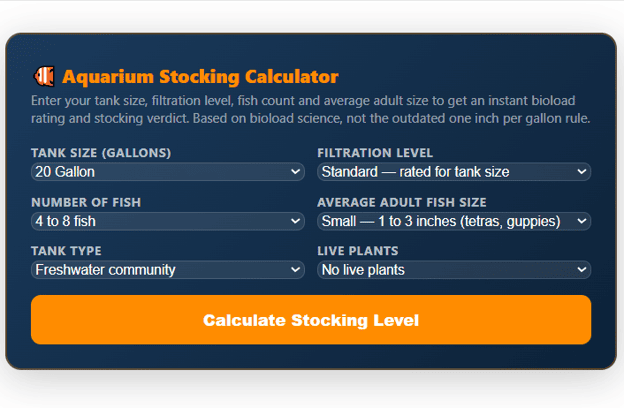
🐠 Aquarium Stocking Calculator
Enter your tank size, filtration level, fish count and average adult size to get an instant bioload rating and stocking verdict. Based on bioload science, not the outdated one inch per gallon rule.
Your Aquarium Stocking Assessment
Science note: Stocking density directly affects dissolved oxygen, total ammonia nitrogen and nitrate levels. Research confirms that high stocking density increases TAN by 25 to 80 percent and decreases dissolved oxygen by 12 to 38 percent compared to low density setups (Aquapolis, 2024; PMC, 2025). Always base stocking on adult fish size, not purchase size.
An aquarium stocking calculator is the most reliable tool for planning how many fish your tank can safely support. It replaces the outdated one inch per gallon rule with a bioload-based approach that accounts for adult fish size, filtration quality, tank type and live plants. Whether you are setting up a new community tank or checking whether your current aquarium is overstocked, understanding aquarium stocking properly protects both your fish and your water quality. Before setting up any new tank, our complete beginner’s guide to fish care covers everything you need to know first.
Why the One Inch Per Gallon Rule Fails
The one inch per gallon rule has been repeated in the aquarium hobby for decades but it is scientifically inaccurate and leads to chronic overstocking. A single 6-inch oscar produces vastly more waste than six 1-inch neon tetras. Body mass, metabolism and waste output scale exponentially as fish size increases. Research on fish stocking density confirms that high stocking levels increase total ammonia nitrogen by 25 to 80 percent and decrease dissolved oxygen by 12 to 38 percent compared to lightly stocked systems (Aquapolis, 2024). Bioload-based stocking calculation accounts for actual waste production per fish rather than simply length, producing far more accurate and safer results.
How Aquarium Stocking Capacity Is Calculated
A reliable fish tank stocking calculator uses the following variables to assess your tank’s safe carrying capacity:
- Tank volume in gallons — the starting point for all capacity calculations
- Filtration level — a canister filter rated for twice your tank volume can safely support more fish than a basic hang-on-back filter; filtration multiplies effective capacity significantly
- Adult fish size — always calculate based on what your fish will grow to, not their size at purchase; a 2-inch juvenile oscar will reach 12 to 14 inches within 18 months
- Fish species and bioload category — goldfish, oscars and large cichlids produce disproportionately high waste; nano fish produce very little; species-specific bioload must be accounted for separately
- Live plants — a heavily planted aquarium absorbs nitrates and can support 20 to 30 percent more fish than an equivalent unplanted tank with identical filtration
For tank size planning reference, our fish tank dimensions guide covers volume, footprint and equipment for all standard tank sizes.
Stocking Guide by Tank Size
| Tank Size | Max Small Fish (1 to 3 in) | Max Medium Fish (3 to 6 in) | Max Large Fish (6 to 12 in) | Weekly Water Change |
|---|---|---|---|---|
| 10 Gallon | 6 to 8 fish | 1 to 2 fish | Not suitable | 25 to 30% |
| 20 Gallon | 12 to 16 fish | 3 to 4 fish | Not suitable | 20 to 25% |
| 55 Gallon | 30 to 40 fish | 8 to 10 fish | 2 to 3 fish | 20 to 25% |
| 100 Gallon | 60 to 70 fish | 15 to 20 fish | 4 to 6 fish | 15 to 20% |
All figures above assume standard filtration and no live plants. A heavily planted tank with an excellent canister filter can support the upper end of each range. A basic filter reduces capacity by 20 to 30 percent. For the full 20-gallon setup guide including compatible species, see our 20 gallon fish tank complete guide.
Signs Your Aquarium Is Overstocked
- Ammonia or nitrite above 0 ppm in an established cycled tank — the most reliable overstocking indicator
- Nitrate rising above 20 ppm between water changes — shows the biological filter is struggling with bioload
- Fish gasping at the surface — sign of dissolved oxygen depletion caused by excess bioload
- Frequent disease outbreaks — chronic stress from overcrowding suppresses fish immune systems making them vulnerable to ich, fin rot and bacterial infections
- Aggression and territory conflicts increasing beyond normal levels
For diagnosing and fixing water quality problems caused by overstocking, see our fish aquarium problems and solutions complete guide. For aeration improvements that support higher stocking levels, our aquarium air pump and aeration guide covers all setup options.
How to Add Fish Safely
- Add 2 to 3 fish per week maximum — never add all fish at once as this crashes the nitrogen cycle
- Test ammonia and nitrite 48 hours after every new addition
- Quarantine all new fish for 2 to 4 weeks before adding to the main tank
- Always research adult size before purchasing — never stock based on juvenile size
- Upgrade filtration before reaching the capacity limit, not after problems appear
Frequently Asked Questions
How do I calculate aquarium stocking?
Use a bioload-based calculator that accounts for tank volume, filtration level, adult fish size and species type. Enter these variables into the AquariumsWorld Aquarium Stocking Calculator above to get an instant bioload rating and stocking verdict for your setup.
Is the one inch per gallon rule accurate?
No. The one inch per gallon rule ignores body mass, metabolism, waste output, filtration quality and species behaviour. A 6-inch goldfish produces dramatically more waste than six 1-inch tetras. Bioload-based calculation is the only accurate method for planning aquarium stocking.
What is bioload in an aquarium?
Bioload is the total biological waste produced by all fish in your tank — the ammonia, nitrite and nitrate they generate through respiration and excretion. High bioload overwhelms your filter’s nitrogen cycle, causing water quality problems. Bioload increases with fish size, number and species type.
What happens if you overstock an aquarium?
Overstocking raises ammonia and nitrate, depletes dissolved oxygen, increases disease susceptibility, causes aggression and can lead to fish death. Research confirms overstocked tanks show ammonia increases of 25 to 80 percent and oxygen decreases of 12 to 38 percent versus lightly stocked systems.
Can live plants increase stocking capacity?
Yes. A heavily planted aquarium absorbs nitrates continuously and can support 20 to 30 percent more fish than an identical unplanted tank with the same filtration. Plants do not remove ammonia directly — beneficial bacteria still handle that stage of the nitrogen cycle.
How many fish can I put in a 20 gallon tank?
A 20-gallon tank can support 12 to 16 small fish (1 to 3 inches adult size) with standard filtration. For medium fish (3 to 6 inches) the limit is 3 to 4 fish. Large fish are not suitable for a 20-gallon tank regardless of filtration level. Always base all calculations on adult size, not purchase size.
- Beginner’s Complete Guide to Fish Care — essential reading before stocking any aquarium
- Fish Tank Dimensions in cm and Inches — volume and footprint reference for all standard tank sizes
- 20 Gallon Fish Tank Complete Guide — stocking, setup and compatible species for the most popular starter tank size
- Fish Aquarium Problems and Solutions — diagnosing and fixing overstocking-related water quality issues
- Aquarium Air Pump and Aeration Guide — improving dissolved oxygen for higher stocking levels