<!doctype html>
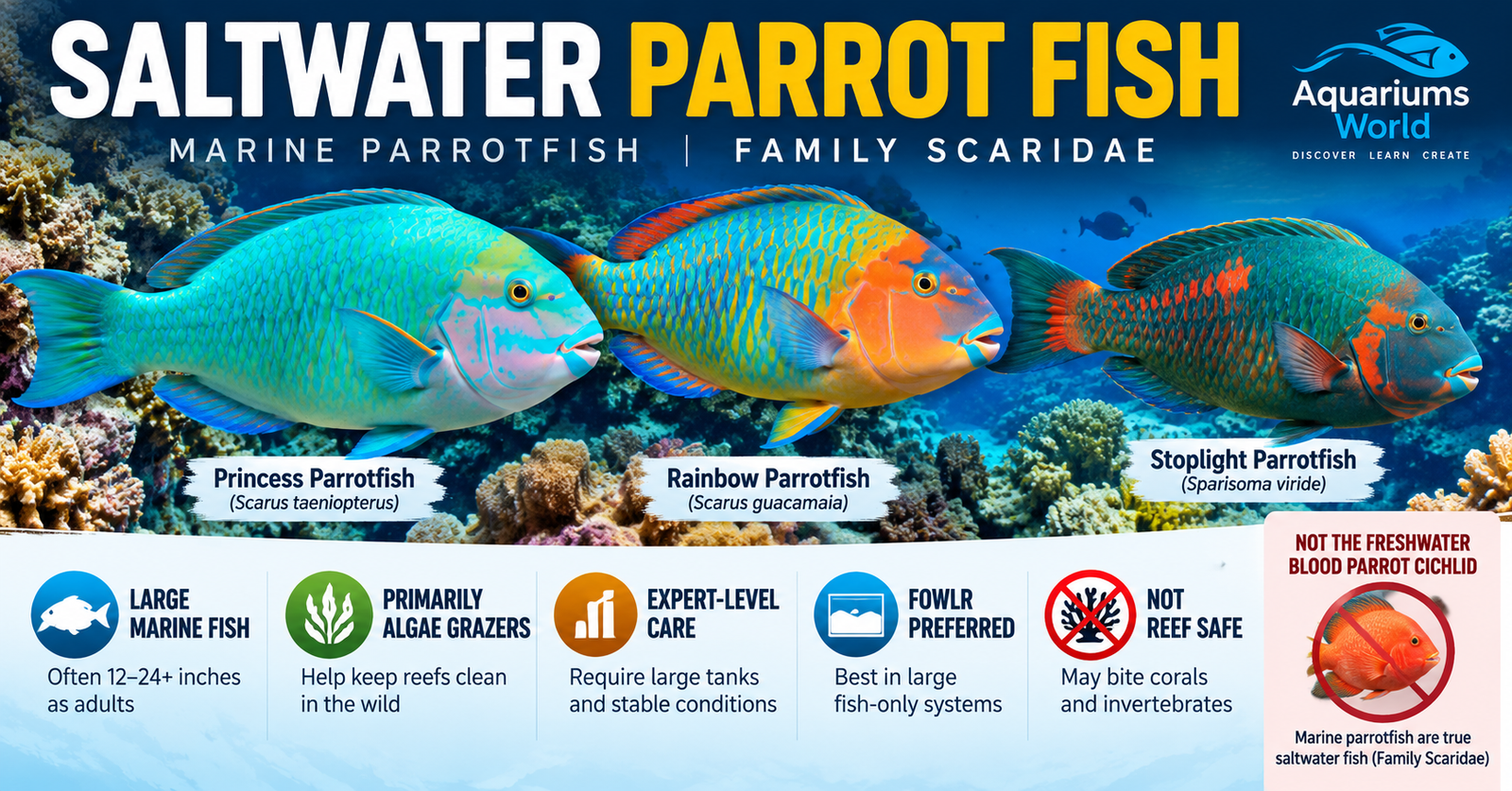
Saltwater parrot fish are among the most visually impressive marine fishes associated with tropical coral reefs. Their bright colours, fused beak-like teeth and unusual grazing behaviour make them fascinating animals, but they are very different from the freshwater fish commonly sold as blood parrot cichlids. True marine parrotfish belong to the family Scaridae and are naturally adapted to coral-reef environments.
For aquarists, the major challenge is not simply keeping the fish alive. Adult size, swimming requirements, continuous grazing behaviour, diet, waste production and reef interactions all have to be considered before purchase. Some species eventually reach well over 15 inches, making a large aquarium essential.
This guide explains saltwater parrot fish species, aquarium requirements, tank size, diet, seaweed feeding, reef compatibility, prices, tank mates, lifespan, health concerns and responsible purchasing. It also explains why a saltwater parrotfish should never be confused with a freshwater blood parrot.
What Is a Saltwater Parrot Fish?
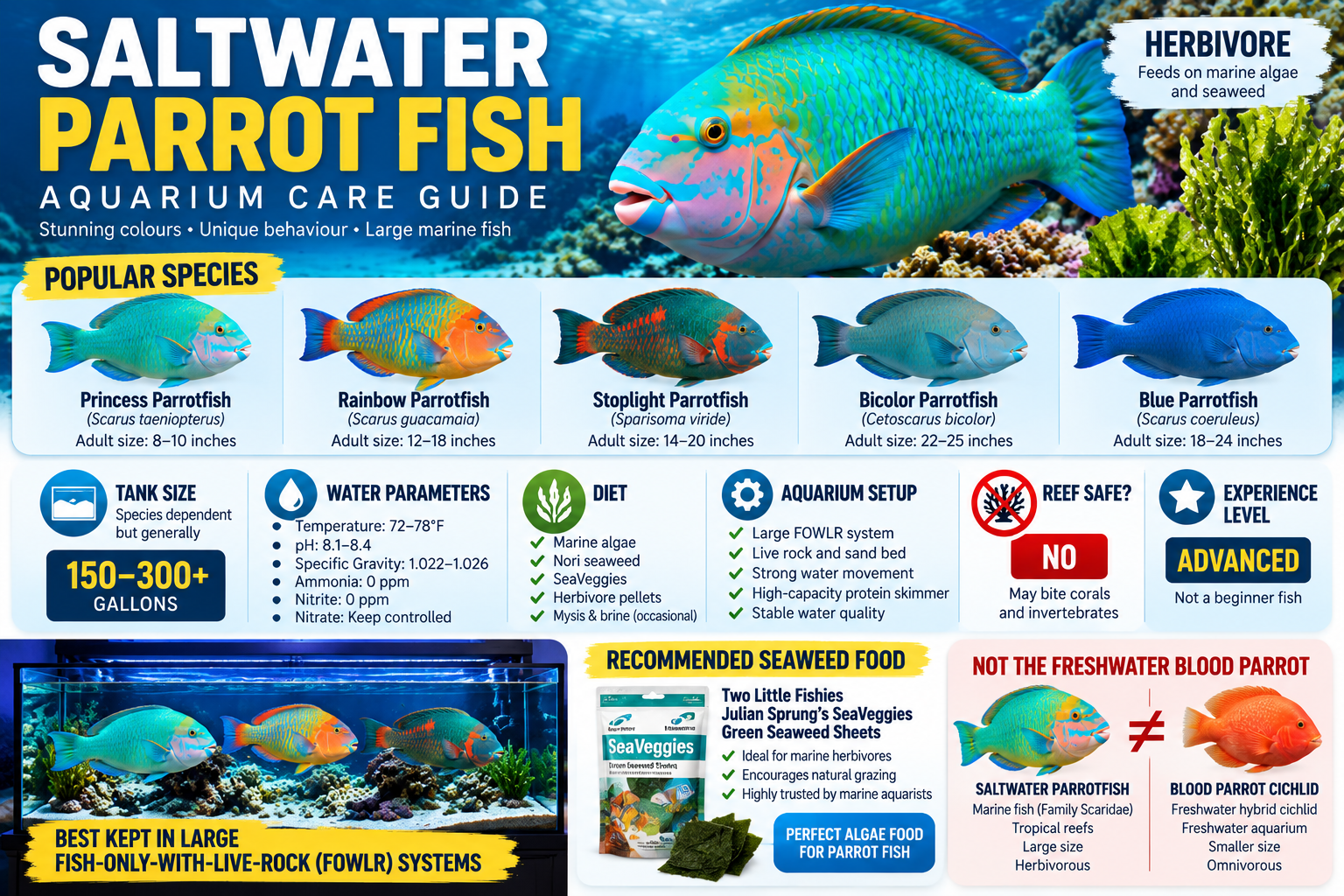
A saltwater parrot fish, more accurately called a marine parrotfish or simply parrotfish, is a marine fish belonging to the family Scaridae. These fishes occur primarily on tropical and subtropical coral reefs and associated coastal habitats. Their most recognisable feature is the fused dental structure that forms a strong beak-like mouth.
The teeth are not merely decorative. Parrotfish use them to scrape algae and other material from hard surfaces while feeding. Some species consume substantial amounts of reef-associated material as they graze, helping shape the ecological structure of coral-reef environments.
This feeding behaviour explains why aquarium care can be challenging. A parrotfish does not behave like a conventional predator that receives one or two meals each day. Many species are active grazers and require frequent access to suitable plant-based marine foods.
Their ecological importance is also significant. Parrotfish contribute to reef grazing and, depending on species and feeding behaviour, can contribute to the production of carbonate sediment. This makes them more than colourful aquarium animals; they are important components of marine ecosystems.
How Many Saltwater Parrot Fish Species Are There?
The family Scaridae contains more than 90 recognised species. They vary considerably in adult size, colour, geographical distribution and feeding behaviour. This variation is important for aquarists because the phrase “saltwater parrot fish” does not describe one aquarium-sized species.
A juvenile specimen may look manageable in a marine retailer’s holding system, while the same species can eventually become a very large fish requiring hundreds of gallons of swimming space. Consequently, selecting a parrotfish should always begin with the expected adult size rather than the juvenile size.
Species also differ in aquarium availability. Some are occasionally imported into the ornamental trade, whereas others are much less common. Availability can therefore depend on specialist marine fish suppliers and collection conditions.
Saltwater Parrot Fish vs Freshwater Blood Parrot
One of the most common sources of confusion is the word “parrot”. A saltwater parrotfish is a marine member of the Scaridae family, whereas a blood parrot is a freshwater aquarium fish associated with cichlids. The two are biologically unrelated despite the similar common name.
| Feature | Saltwater Parrotfish | Freshwater Blood Parrot |
|---|---|---|
| Scientific group | Family Scaridae | Freshwater cichlid hybrid |
| Environment | Marine | Freshwater |
| Typical adult size | Approximately 8–25+ inches depending on species | Approximately 6–8 inches |
| Diet | Primarily algae and plant-based marine foods | Omnivorous |
| Aquarium type | Large marine fish-only systems are generally more appropriate | Freshwater aquarium |
| Reef compatibility | Generally unsuitable for reef aquaria | Not applicable |
| Experience | Advanced marine aquarist | Beginner to intermediate depending on setup |
Aquarists searching for “parrot fish aquarium” should therefore check the scientific name before purchasing. If the listing refers to a blood parrot, blood parrot cichlid or a similarly named freshwater variety, it is not a marine parrotfish.
AquariumsWorld has also covered the distinction in its Tiger Parrot Fish guide, which explains why the ornamental-trade use of the word “parrot” can be confusing.
Saltwater Parrot Fish Species Guide
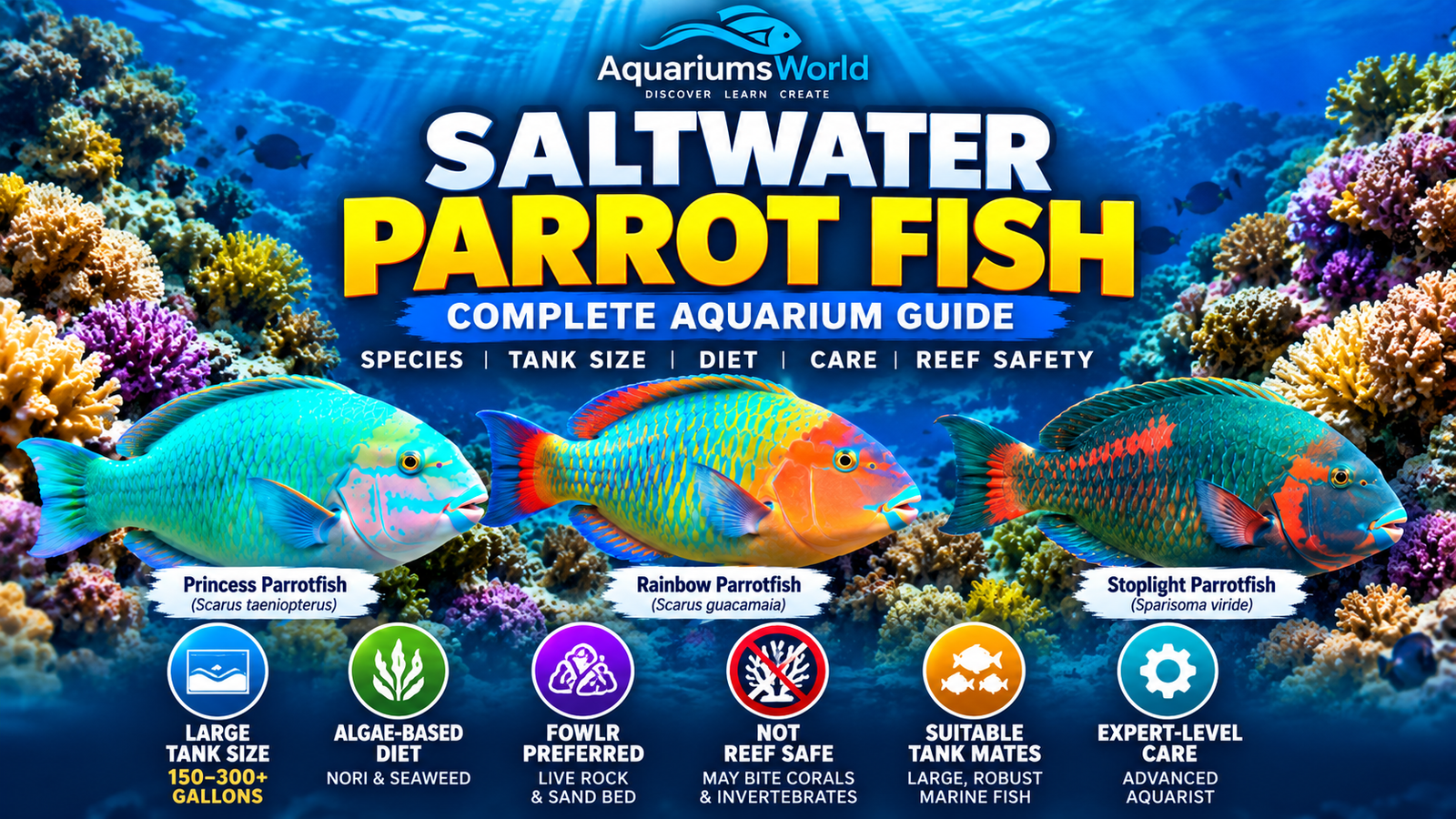
The following species are among the names aquarists may encounter when researching marine parrotfish. Their adult sizes demonstrate why species selection must precede aquarium purchase.
| Species | Scientific Name | Approx. Adult Size | Origin | Planning Aquarium | Experience |
|---|---|---|---|---|---|
| Princess Parrotfish | Scarus taeniopterus | 8–10 in | Caribbean | Large marine system | Advanced |
| Rainbow Parrotfish | Scarus guacamaia | 12–18 in | Caribbean | 200+ gallons | Expert |
| Stoplight Parrotfish | Sparisoma viride | 14–20 in | Caribbean | 200+ gallons | Expert |
| Bicolor Parrotfish | Cetoscarus bicolor | 22–25 in | Indo-Pacific | Approximately 300 gallons or larger | Expert |
| Quoys Parrotfish | Scarus quoyi | 10–15 in | Indo-Pacific | Large marine system | Expert |
| Blue Parrotfish | Scarus coeruleus | 18–24 in | Atlantic | 300+ gallons preferred | Expert |
Princess Parrotfish
The Princess Parrotfish, Scarus taeniopterus, is one of the smaller species considered in this guide, with adults commonly reaching around 8–10 inches. It occurs in the Caribbean region and can appear in the specialist marine aquarium trade.
Its smaller adult size does not make it a beginner fish. The species still requires marine water, substantial swimming space, robust filtration and an appropriate herbivorous diet.
Rainbow Parrotfish
The Rainbow Parrotfish, Scarus guacamaia, is substantially larger. Adult specimens can reach approximately 12–18 inches, making a 200-gallon-class aquarium a more realistic planning point than a conventional home marine tank.
The species requires considerable swimming space and produces a significant biological load. Filtration should therefore be designed around the adult fish rather than its juvenile form.
Stoplight Parrotfish
The Stoplight Parrotfish, Sparisoma viride, is another Caribbean species that can reach approximately 14–20 inches. Its grazing behaviour and eventual size make it more suitable for very large marine systems.
An aquarium intended for this species should provide open swimming areas alongside rock structures that allow natural grazing behaviour.
Bicolor Parrotfish
The Bicolor Parrotfish, Cetoscarus bicolor, is one of the largest species discussed here, potentially reaching around 22–25 inches. An aquarium approaching 300 gallons or more is a more appropriate planning scale for a mature specimen.
This is not a suitable fish for a typical beginner saltwater aquarium. Its eventual size alone creates substantial requirements for footprint, filtration, food supply and water-quality management.
Quoys Parrotfish
Quoys Parrotfish, Scarus quoyi, is an Indo-Pacific species that can reach approximately 10–15 inches. Adult males may require particularly substantial swimming space, and social structure can make group planning more complicated.
Specialist marine fish suppliers may occasionally offer this species, but availability and price can vary significantly.
Blue Parrotfish
The Blue Parrotfish, Scarus coeruleus, is a large Atlantic species capable of reaching approximately 18–24 inches. Its eventual size makes a very large aquarium essential.
Although juveniles may appear manageable, purchasing this species without a long-term aquarium plan can quickly create a rehoming problem.
Can You Keep a Saltwater Parrot Fish in an Aquarium?
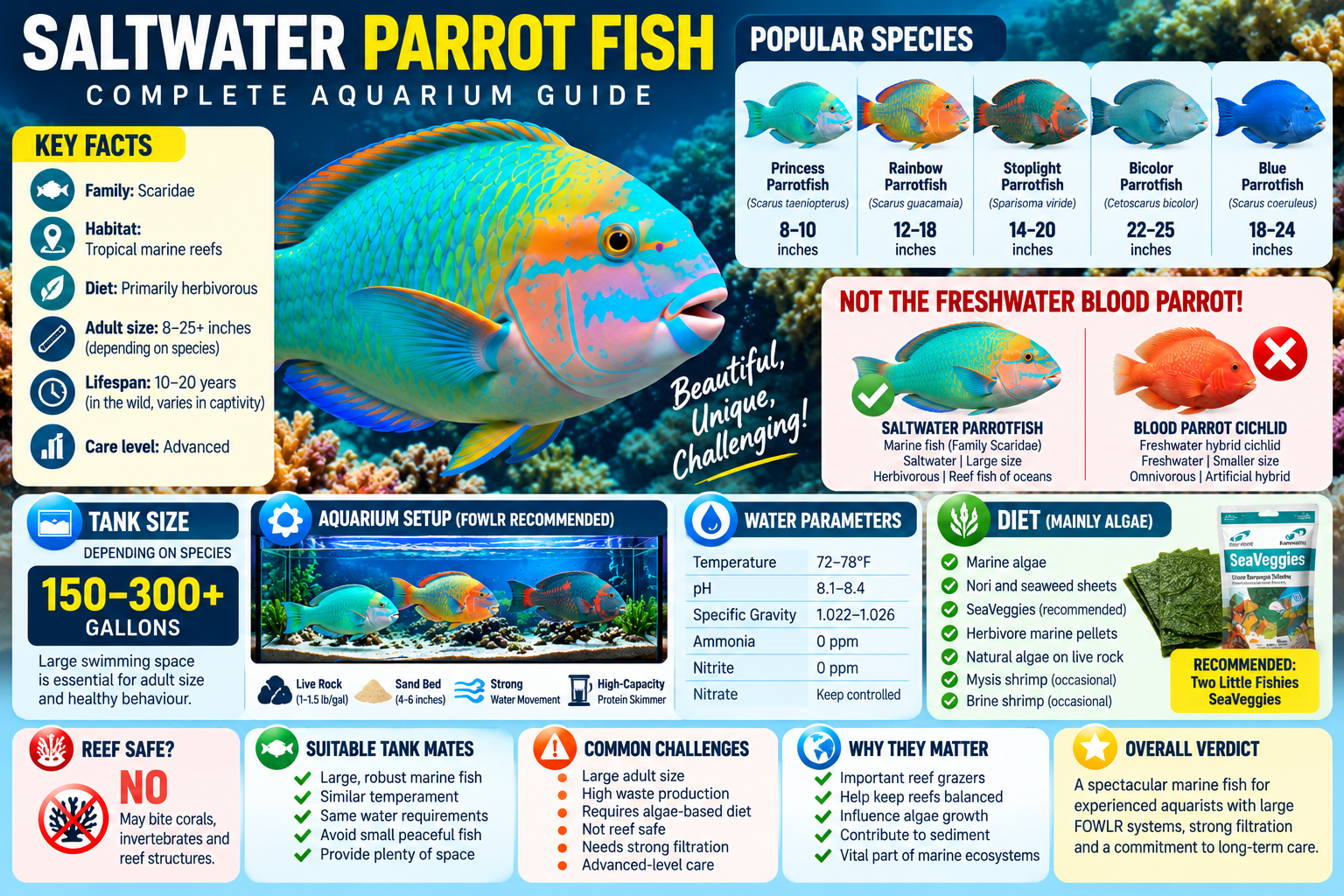
Yes, but the answer depends heavily on species and aquarium scale. Some marine parrotfish can be maintained in captivity by highly experienced aquarists, but they are not conventional community reef fish.
The primary challenges are adult size, diet, grazing behaviour, waste production and their interaction with hard aquarium surfaces. A fish that continuously grazes and grows to 15–20 inches requires a very different system from a 3-inch reef fish.
Saltwater Parrot Fish Tank Size
There is no single tank size suitable for every saltwater parrot fish. The correct aquarium depends on the species, adult size, number of fish, swimming behaviour and filtration capacity.
| Species | Minimum Planning Level | Recommended Adult-System Level |
|---|---|---|
| Princess Parrotfish | Large marine aquarium | Approximately 150 gallons or larger |
| Rainbow Parrotfish | 200 gallons | 200–300+ gallons |
| Stoplight Parrotfish | 200 gallons | 200–300+ gallons |
| Bicolor Parrotfish | 300 gallons | 300+ gallons |
| Quoys Parrotfish | Large marine aquarium | Approximately 300 gallons for larger specimens |
| Blue Parrotfish | 300 gallons | 300+ gallons preferred |
These figures should be treated as planning guidance rather than universal biological limits. A long, wide aquarium can be more useful than a tall aquarium because parrotfish need horizontal swimming space.
A 300-gallon aquarium can also have very different practical value depending on its dimensions. A long footprint provides more usable swimming room than an unusually tall system containing the same nominal volume.
For larger marine systems, sump design becomes increasingly important. Aquarists can see the AquariumsWorld reef aquarium sump design and size guide for further planning information.
Saltwater Parrot Fish Aquarium Setup
A large fish-only-with-live-rock, or FOWLR, system is generally more practical than a conventional coral reef aquarium for parrotfish. The setup should prioritise swimming space, biological filtration, oxygenation and stable water chemistry.
Live Rock
Live rock can provide grazing surfaces, shelter and biological filtration. A commonly used planning range is approximately 1–1.5 pounds of rock per gallon, although actual requirements depend on rock density, filtration technology and aquascape design.
Sand Bed
A substantial sand area can help create a natural-looking environment. A 4–6 inch bed is sometimes used in large marine systems, but depth should be selected based on the intended maintenance strategy and substrate behaviour.
Water Movement
Parrotfish are active marine fish, so circulation should provide strong but appropriately distributed flow. Multiple powerheads can prevent stagnant areas and improve oxygen distribution.
Protein Skimming
Because large parrotfish can produce considerable waste, an oversized protein skimmer is useful. A skimmer rated for substantially more water than the nominal aquarium volume provides a useful margin, although manufacturer ratings should be interpreted cautiously.
Lighting
Full-spectrum marine LED lighting can support natural-looking displays and live-rock grazing areas. Lighting should not be used as a substitute for proper nutrition.
Saltwater Parrot Fish Water Parameters
| Parameter | Practical Target |
|---|---|
| Temperature | 72–78°F |
| pH | 8.1–8.4 |
| Specific Gravity | 1.022–1.026 |
| Ammonia | Undetectable |
| Nitrite | Undetectable |
| Nitrate | Kept controlled through maintenance |
Stability matters more than chasing a particular number. Large marine fish systems should be properly cycled before livestock is introduced, with biological filtration capable of processing the expected waste load.
AquariumsWorld’s aquarium water test kit guide can help when choosing equipment for routine water monitoring.
For marine systems specifically, see the marine aquarium water test kit guide.
What Do Saltwater Parrot Fish Eat?
Diet is one of the most important aspects of saltwater parrotfish care. These fish are primarily herbivorous grazers and should receive regular access to marine algae and seaweed rather than being treated like carnivorous marine fish.
In nature, parrotfish spend substantial time grazing. Aquarium feeding should therefore provide plant-based foods frequently enough to support normal nutritional intake and body condition.
Primary Foods
- Marine algae
- Nori and seaweed sheets
- Natural algae growing on suitable live rock
- Quality herbivore marine foods
Supplementary Foods
- Mysis shrimp occasionally
- Brine shrimp occasionally
- Herbivore pellets
- Other suitable marine foods in moderation
Dried nori is particularly practical because it can be attached to a feeding clip and left available for grazing. Feeding frequency should be adjusted according to the species, size, number of fish and how quickly the food is consumed.
Suggested Feeding Pattern
| Frequency | Food | Purpose |
|---|---|---|
| Daily | Marine seaweed or nori | Main plant-based food source |
| Daily | Natural algae grazing | Supports natural feeding behaviour |
| Daily or as appropriate | Herbivore marine pellets | Supplementary nutrition |
| 2–3 times weekly | Mysis or brine shrimp | Supplementary variety |
The key is not to follow a rigid number of sheets regardless of fish size. Instead, provide enough food to support the fish while avoiding excessive uneaten material that can degrade water quality.
Best Seaweed Food for Saltwater Parrot Fish

Two Little Fishies Julian Sprung’s SeaVeggies Green Seaweed Sheets
[ BUY NOW ]
For aquarists looking for a convenient purchased algae food, Two Little Fishies Julian Sprung’s SeaVeggies Green Seaweed Sheets are a practical option for marine herbivores.
The product consists of green nori-style seaweed sheets and is designed for marine herbivorous fish. It can be used with feeding clips so fish can graze rather than consuming a large meal in one short feeding event.
It is particularly relevant to saltwater parrotfish because algae-based foods align more closely with their natural feeding behaviour than a diet dominated by animal protein.
Check SeaVeggies on AmazonWhy Seaweed Matters
A marine herbivore needs more than occasional vegetables added to an otherwise carnivorous diet. Regular access to marine algae can help make the feeding routine more consistent with the animal’s grazing biology.
SeaVeggies are available in different package sizes, including smaller packs and larger bulk formats. The appropriate quantity depends on the number and size of fish, so consumption should guide purchasing decisions.
Are Saltwater Parrot Fish Reef Safe?
Saltwater parrotfish should generally not be considered reef safe. Their natural grazing behaviour involves scraping and biting hard surfaces, and their feeding activity can damage corals or disturb reef structures.
For this reason, a large fish-only-with-live-rock (FOWLR) aquarium is normally a more practical environment than a coral-dominated reef display.
How Much Does a Saltwater Parrot Fish Cost?
Saltwater parrotfish prices vary considerably according to species, size, availability, collection location and supplier. Specialist marine fish retailers can list specimens from relatively modest prices for some species to several hundred dollars for rarer or larger fish.
| Species | Indicative Price Range | Why Price Varies |
|---|---|---|
| Princess Parrotfish | Approximately $39–$280 | Size and supplier |
| Rainbow Parrotfish | Approximately $39–$80 | Availability and specimen size |
| Stoplight Parrotfish | Approximately $39–$80+ | Availability and size |
| Bicolor Parrotfish | Approximately $88+ | Size and availability |
| Quoys Parrotfish | Approximately $200–$490 | Rarity, size and specialist sourcing |
| Blue Parrotfish | Approximately $29–$250 | Size and supplier |
These are indicative market figures rather than fixed prices. Marine livestock prices can change quickly, and shipping costs can be significant for large fish.
Where Can You Buy Saltwater Parrot Fish in the USA?
Because genuine marine parrotfish are specialist livestock, buyers should look for established marine aquarium suppliers rather than generic freshwater fish retailers.
Before purchasing, ask the supplier for the scientific name, current size, collection location, feeding history and shipping conditions. The scientific name is especially important because “parrot fish” can refer to completely different freshwater animals.
- Confirm the scientific name.
- Check the expected adult size.
- Ask whether the specimen is feeding reliably.
- Ask about quarantine and disease screening.
- Confirm the supplier’s shipping policy.
- Plan the adult aquarium before ordering.
Never purchase a large parrotfish simply because a temporary holding aquarium is available. The long-term home should already be prepared.
Saltwater Parrot Fish Tank Mates
Tank-mate selection depends on the species and aquarium size. Because parrotfish can become very large, compatibility should be considered alongside space rather than treated as a simple list of “peaceful fish”.
Potential companions in appropriately large systems can include robust marine fish with compatible water requirements and swimming behaviour. However, small peaceful fish can become vulnerable in a large predator-like fish environment even when the parrotfish is not an aggressive predator.
Better Compatibility Principles
- Choose fish capable of living in the same marine parameters.
- Avoid overcrowding.
- Provide separate territories and shelters.
- Introduce livestock carefully.
- Observe feeding competition.
- Prioritise adult size rather than juvenile size.
The most important rule is simple: do not select tank mates until the adult aquarium requirements of the parrotfish are understood.
How Long Do Saltwater Parrot Fish Live?
Lifespan varies substantially between species and depends on natural longevity, collection history, nutrition, disease exposure and aquarium conditions. There is no single lifespan figure that applies to every saltwater parrotfish.
A well-maintained aquarium should therefore be planned as a long-term commitment rather than a short-term display. Large fish can outgrow systems surprisingly quickly, and rehoming a mature specimen can be difficult.
Common Saltwater Parrot Fish Health Problems
Like other marine fishes, parrotfish can be affected by infectious diseases, parasites, nutritional problems and environmental stress. Poor water quality and inadequate nutrition can weaken fish and make disease management more difficult.
Marine Ich
Marine ich can present with white spots, scratching and behavioural changes. New fish should be quarantined rather than immediately introduced into the display aquarium.
Marine Velvet
Marine velvet can progress rapidly and may cause respiratory distress, lethargy and abnormal swimming. Prompt diagnosis and appropriate quarantine treatment are important.
Nutritional Problems
A diet lacking sufficient marine algae can be inappropriate for a specialised herbivore. Poor nutrition may contribute to weight loss, poor colour and reduced overall condition.
Stress and Water Quality
Large marine fish produce substantial biological waste. Poor filtration, overcrowding, unstable salinity and inadequate oxygenation can contribute to chronic stress.
Mucus Cocoon
Some parrotfish produce a mucus cocoon around themselves while sleeping. This is a natural behaviour and should not automatically be interpreted as disease.
Why Saltwater Parrot Fish Matter to Coral Reefs

Parrotfish have an important ecological role in tropical reef environments. Their grazing can help regulate algae on reef surfaces, while their feeding and digestive processes can contribute to sediment production in some species.
This ecological role is one reason responsible sourcing matters. Removing large numbers of herbivorous reef fishes can have consequences beyond the individual animals collected.
Aquarists should therefore consider whether the fish is genuinely appropriate for captivity before purchasing it.
Saltwater Parrot Fish Conservation and Responsible Sourcing
The ornamental aquarium trade should be approached responsibly when considering marine parrotfish. Collection pressure, habitat degradation and regional fishing practices can all influence wild populations.
A responsible buyer should favour transparent suppliers and avoid purchasing specimens when the long-term aquarium cannot accommodate their adult size.
The best conservation decision is sometimes not buying the fish. A beautiful marine animal does not automatically make a suitable aquarium animal.
Saltwater Parrot Fish FAQ
What is a saltwater parrot fish?
A saltwater parrot fish is a marine parrotfish belonging to the family Scaridae. These tropical reef fishes are recognised for their fused beak-like teeth and algae-grazing behaviour.
Are saltwater parrot fish the same as blood parrots?
No. Marine parrotfish are members of Scaridae, while blood parrots are freshwater cichlid hybrids. They require completely different aquarium environments.
Can you keep a saltwater parrot fish in an aquarium?
Yes, but only with appropriate species selection, aquarium size, filtration, nutrition and long-term planning. Many species become very large and are unsuitable for ordinary home aquariums.
What tank size does a saltwater parrot fish need?
Tank requirements depend on species and adult size. Smaller species require large marine systems, while species reaching 18–25 inches may require approximately 300 gallons or more.
What do saltwater parrot fish eat?
They primarily consume algae and other plant-based marine foods. Aquarium diets should include marine seaweed, nori and suitable herbivore foods, with other marine foods used as supplements where appropriate.
Is nori good for saltwater parrot fish?
Yes. Nori is a practical marine algae food and can be offered regularly using a feeding clip. The quantity should be adjusted according to fish size and actual consumption.
Are saltwater parrot fish reef safe?
Generally no. Their natural grazing behaviour can involve scraping hard surfaces and disturbing corals. A fish-only-with-live-rock aquarium is usually more appropriate.
How much does a saltwater parrot fish cost?
Prices vary by species, size and availability. Some specimens may cost under $100, while rare or larger specimens can cost several hundred dollars.
What is the best saltwater parrot fish for an aquarium?
There is no universally best species. The appropriate choice depends on the aquarium’s adult capacity, the fish’s expected size, availability and the aquarist’s experience.
Where can I buy saltwater parrot fish in the USA?
Look for specialist marine fish suppliers that provide scientific names, accurate adult-size information and transparent livestock policies. Always confirm that the seller is offering a genuine marine Scaridae species.
Do saltwater parrot fish eat coral?
Their feeding behaviour can involve scraping and biting reef surfaces. This is one reason they are generally unsuitable for conventional coral reef aquariums.
Can a saltwater parrot fish live with other fish?
Potentially, but compatibility depends on species, adult size, temperament and aquarium dimensions. Large systems are essential when combining substantial marine fishes.
Do saltwater parrot fish need live rock?
Live rock can provide biological filtration, shelter and natural grazing surfaces. It is especially useful in a fish-only-with-live-rock system designed around herbivorous marine fish.
Why do parrotfish scrape rocks?
Their fused teeth are adapted for grazing and scraping food from hard marine surfaces. This behaviour is part of their natural feeding ecology.
Are parrotfish beginner saltwater fish?
Generally no. Their adult size, specialised diet, filtration requirements and reef interactions make them much better suited to experienced marine aquarists.
Can I keep a parrotfish in a 55-gallon aquarium?
A 55-gallon aquarium is generally inappropriate for the adult size of the larger marine parrotfish discussed here. Even smaller species require careful long-term planning, so a 55-gallon system should not be treated as a general parrotfish tank.
What temperature should saltwater parrot fish have?
A practical marine temperature range is approximately 72–78°F, with stability being more important than repeatedly adjusting the aquarium to chase a specific value.
Do saltwater parrot fish need a protein skimmer?
A high-capacity protein skimmer is strongly useful for large marine fish systems because substantial feeding and waste production can increase the organic load.
Can saltwater parrot fish be kept as a pair?
Social behaviour varies by species, sex and life stage. Pairing or grouping should only be attempted in an aquarium large enough to accommodate the combined adult biomass and behaviour.
Why does my parrotfish have faded colours?
Colour can be affected by stress, nutrition, health, lighting and natural life-stage changes. Poor water quality or an inadequate diet should be investigated before assuming the colour change is simply cosmetic.
Example Saltwater Parrot Fish Feeding Schedule
A practical feeding routine should encourage grazing while preventing excessive organic waste. The following example can be adjusted according to species and consumption.
| Time | Food | Purpose |
|---|---|---|
| Morning | Marine seaweed or nori | Primary herbivore feeding |
| Daytime | Natural algae grazing | Natural feeding behaviour |
| Evening | Herbivore pellet or suitable marine food | Supplementary nutrition |
| 2–3 days per week | Small supplementary portion of mysis/brine | Dietary variety |
The exact quantity should be based on the fish’s body condition and how rapidly food disappears. Uneaten food should not be allowed to accumulate.
Common Saltwater Parrot Fish Care Mistakes
1. Buying a Juvenile Without Planning for Growth
A small fish can create the illusion that a relatively modest aquarium is adequate. Adult size should always determine the purchase decision.
2. Treating It as a Reef Fish
Natural grazing behaviour can conflict with coral and reef structures.
3. Feeding Too Much Animal Protein
Marine parrotfish require an appropriately algae-focused diet rather than a feeding routine designed around carnivorous fish.
4. Underestimating Filtration
Large fish produce substantial waste. Mechanical, biological and protein-skimming capacity should be designed accordingly.
5. Skipping Quarantine
Introducing an unquarantined marine fish can expose the entire display system to parasites or disease.
6. Confusing Marine Parrotfish With Blood Parrots
Always check the scientific name before purchasing a fish advertised using the word “parrot”.
Related AquariumsWorld Guides
Continue your aquarium research with these related AquariumsWorld resources:
- Reef Aquarium Sump: Design, Size and Setup
- Marine Aquarium Water Test Kits
- Test Kit for Aquarium Water
- Can You Eat Parrot Fish? Taste, Safety and Ciguatera
- Tiger Parrot Fish Guide
- MICROBE-LIFT Nite-Out II Fish Medicine and Aquarium Bacteria
- Automatic Fish Feeder for Aquarium
- Automatic Fish Feeder for Pond
- Aquarium Industry News October 2026
- Oscar Fish Tank Mates and Compatibility
- Oscar Fish 55 Gallon Tank and Filtration
- How to Get Rid of Oscar Fish Responsibly
- Best Plants for Betta Fish Tanks
- Copper Oscar Fish Guide
- Blueberry Oscar Fish Guide
- Blue Oscar Fish Guide
- White Tiger Oscar Fish Guide
- Bumblebee Oscar Fish Guide
- Fire Red Oscar Fish Guide
- Oscar Fish Plush Guide
Final Verdict: Are Saltwater Parrot Fish Suitable for Your Aquarium?
Saltwater parrot fish are spectacular marine animals, but they are not ordinary community aquarium fish. Their large adult size, continuous grazing behaviour, specialised diet and interaction with reef surfaces make them challenging long-term inhabitants.
The most important decision is made before the fish enters the aquarium. Choose a species according to its adult size, establish an appropriately large marine system, provide strong biological and mechanical filtration, maintain stable water quality and offer regular marine algae.
For most aquarists, a large FOWLR aquarium is more practical than a coral reef display. A dedicated feeding routine based around seaweed and other appropriate herbivore foods should form a central part of husbandry.
Most importantly, never confuse a genuine marine parrotfish with a freshwater blood parrot. The common name is similar, but their biology, environment and care requirements are completely different.
If you have the aquarium capacity, experience and commitment required for the species you are considering, a saltwater parrotfish can become a fascinating centrepiece. If the aquarium is too small, choosing a smaller marine species is the more responsible decision.