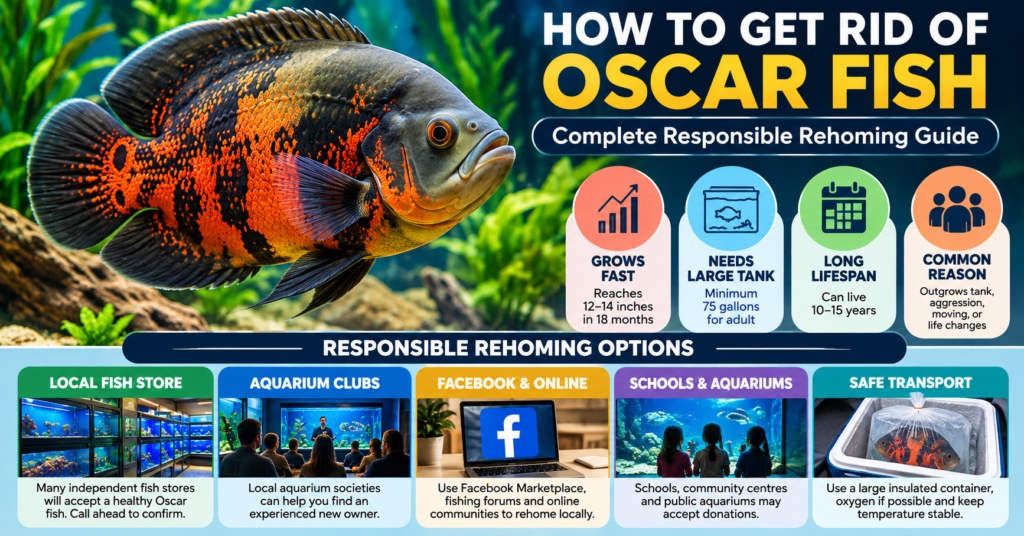
If you are searching for how to get rid of oscar fish, the safest answer is not to release the fish, abandon it or place it in an unsuitable aquarium. The responsible solution is to find another keeper, an independent fish store, an aquarium club, an educational facility or another legitimate destination that can provide appropriate long-term care.
Oscar fish are popular because they are intelligent, interactive and visually impressive, but they are also large, territorial cichlids with substantial space and filtration requirements. A juvenile Oscar may look perfectly manageable when it is purchased, while its adult size can eventually expose limitations in a small aquarium. The USGS Nonindigenous Aquatic Species database also notes that Oscar fish have been repeatedly released into natural waters and that established populations occur in Florida.
This guide explains how to rehome oscar fish, where to donate an Oscar, how to approach a local fish store, how to use aquarium clubs and online communities, how to prepare a fish for transport, and what to do if the aquarium problem can still be solved without rehoming.
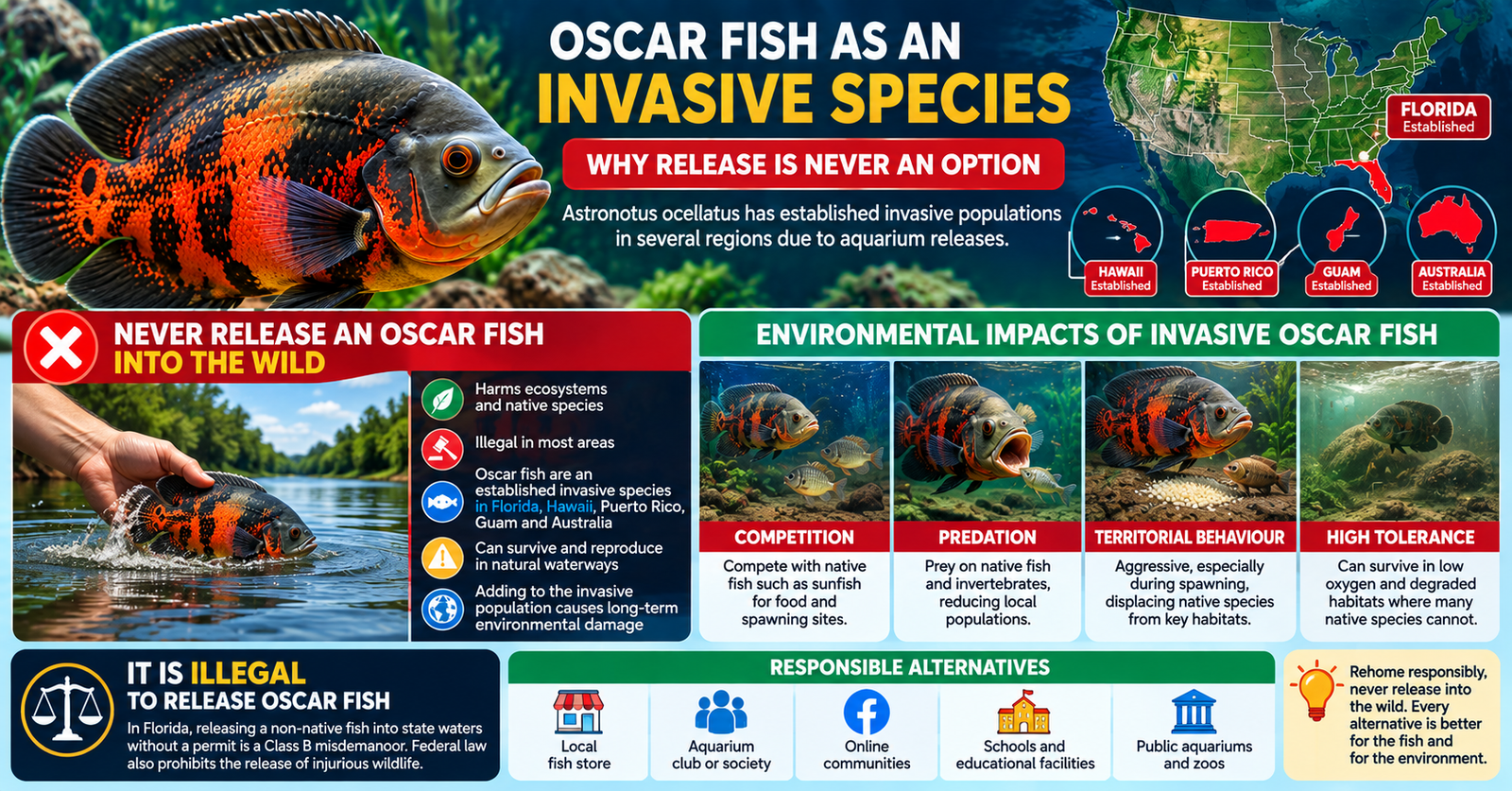
The central rule is simple: never release an aquarium Oscar into a lake, river, canal, pond or other natural waterway. In Florida, current state law makes release of nonnative animals unlawful unless authorised by the Florida Fish and Wildlife Conservation Commission.
Why Oscar Fish Need Rehoming: Understanding the Problem
Searching for oscar fish too big for tank what to do usually means that the owner has reached a practical husbandry problem. The fish may have grown, the aquarium may have become difficult to maintain, or the owner may no longer be able to provide the space and filtration required for a large cichlid.
Rehoming is not automatically a sign that someone has failed as a fish keeper. Circumstances change. People move, household finances change, aquariums break, compatible tank mates become incompatible and fish sometimes grow beyond the setup originally planned for them.
The important distinction is between responsible rehoming and simply getting rid of an unwanted animal. Responsible rehoming considers the fish’s adult size, health, temperament, transport needs and the ability of the new owner to provide appropriate long-term care.
The Growth Problem Behind Many Oscar Rehoming Cases
Oscar fish are sold at many different juvenile sizes, and this can make their eventual adult requirements easy to underestimate. A fish that looks comfortable in a shop aquarium may only be a fraction of its mature size. The USGS records a Florida Oscar measuring 32 cm total length, illustrating the substantial size these fish can reach.
This is why aquarium planning should always begin with adult size rather than purchase size. AquariumsWorld’s Aquarium Stocking Calculator also uses adult fish size and filtration rather than the outdated one-inch-per-gallon rule when discussing stocking.
If your Oscar is currently in a small aquarium and you are deciding whether to upgrade or rehome it, compare the available footprint, filtration and maintenance demands rather than looking only at the number printed on the aquarium packaging. The 100 Gallon Fish Tank Guide is useful when evaluating whether a larger setup could realistically fit into your home.
The Most Common Reasons for Oscar Fish Rehoming
- The Oscar has outgrown the current aquarium.
- The aquarium cannot be upgraded because of space limitations.
- The owner is moving house or moving to another country.
- Maintenance costs have become difficult to manage.
- The Oscar has become incompatible with existing tank mates.
- A breeding pair has become strongly territorial.
- The owner no longer wants to maintain a large aquarium.
- A health or welfare problem requires a different facility.
- A family or work situation has changed unexpectedly.
None of these situations justifies releasing the fish into the environment. The correct response is to identify the most realistic rehoming route and provide the recipient with accurate information about the Oscar.
Can I Release My Oscar Fish into a Lake or River?
The Absolute Answer: Do Not Release It
If you are asking can I release my oscar fish into the wild, the responsible answer is no. An aquarium fish should not be released into a natural waterway simply because the owner no longer wants it.
A fish that survives the release may compete with native species, consume native prey, reproduce or introduce pathogens and parasites. Even when a released fish does not establish a permanent population, the release is still an uncontrolled introduction into an ecosystem.
Do not place an Oscar in a lake, river, canal, drainage ditch, farm pond, reservoir or other natural waterway. Contact a fish store, aquarium club, experienced hobbyist, rescue organisation or relevant wildlife authority instead.
Oscar Fish as an Established Non-Native Species in Florida
The Florida example is particularly important because Oscar fish have been recorded there for decades. The USGS Nonindigenous Aquatic Species database currently lists established Oscar records across multiple Florida watersheds, including the Everglades, Big Cypress Swamp, Caloosahatchee and other southern Florida systems.
USGS reports that the first Florida records resulted from deliberate stockings associated with an aquarium fish farm in southeastern Dade County during the late 1950s. It also identifies aquarium release and human-assisted movement among the pathways associated with the species’ spread.
The same USGS profile notes that Oscars are considered potential competitors with native sunfish for food and possibly spawning areas, and that they may prey on native fishes and invertebrates. These documented observations are why aquarium owners should treat release as an environmental issue rather than as a harmless way of giving a fish freedom.
Oscar Fish Invasive Species Florida and Other Locations
Searches for oscar fish invasive Florida Hawaii often combine several different types of records. It is important not to assume that every reported observation represents an established population. The USGS database distinguishes between observations, failed introductions and established populations.
For Florida, however, the evidence for established populations is substantial. The database continues to record Oscar specimens in Florida waters, including 2026 records in areas such as Broward, Miami-Dade, Collier and Monroe counties.
The US Fish and Wildlife Service ecological risk screening also identifies the potential for impacts on native fish and invertebrates, while noting uncertainty around the magnitude of some introduction impacts. This distinction matters: a responsible article should describe documented evidence without exaggerating uncertain ecological effects.
Is It Illegal to Release Oscar Fish?
Legality depends on the jurisdiction, so there is no single worldwide rule. In Florida, current Florida Statute §379.231 states that it is unlawful to release a species of the animal kingdom that is not native to Florida unless authorised by the Florida Fish and Wildlife Conservation Commission. The statute classifies a violation under the state’s Level Three violation framework.
Therefore, an article about why is releasing oscar fish illegal should not imply that every US state uses identical legislation. The safest approach is to check the wildlife regulations for your own state or country before moving or disposing of a nonnative aquarium fish.
Will a Pet Store Take My Oscar Fish?
One of the first practical questions owners ask is will a pet store take my oscar fish. The answer is: sometimes, but acceptance depends entirely on the individual store.
Independent local fish stores are often worth contacting because they specialise in aquarium animals and may already have customers looking for large cichlids. However, there is no universal policy requiring a store to accept unwanted fish. Always call before transporting the Oscar to the shop.
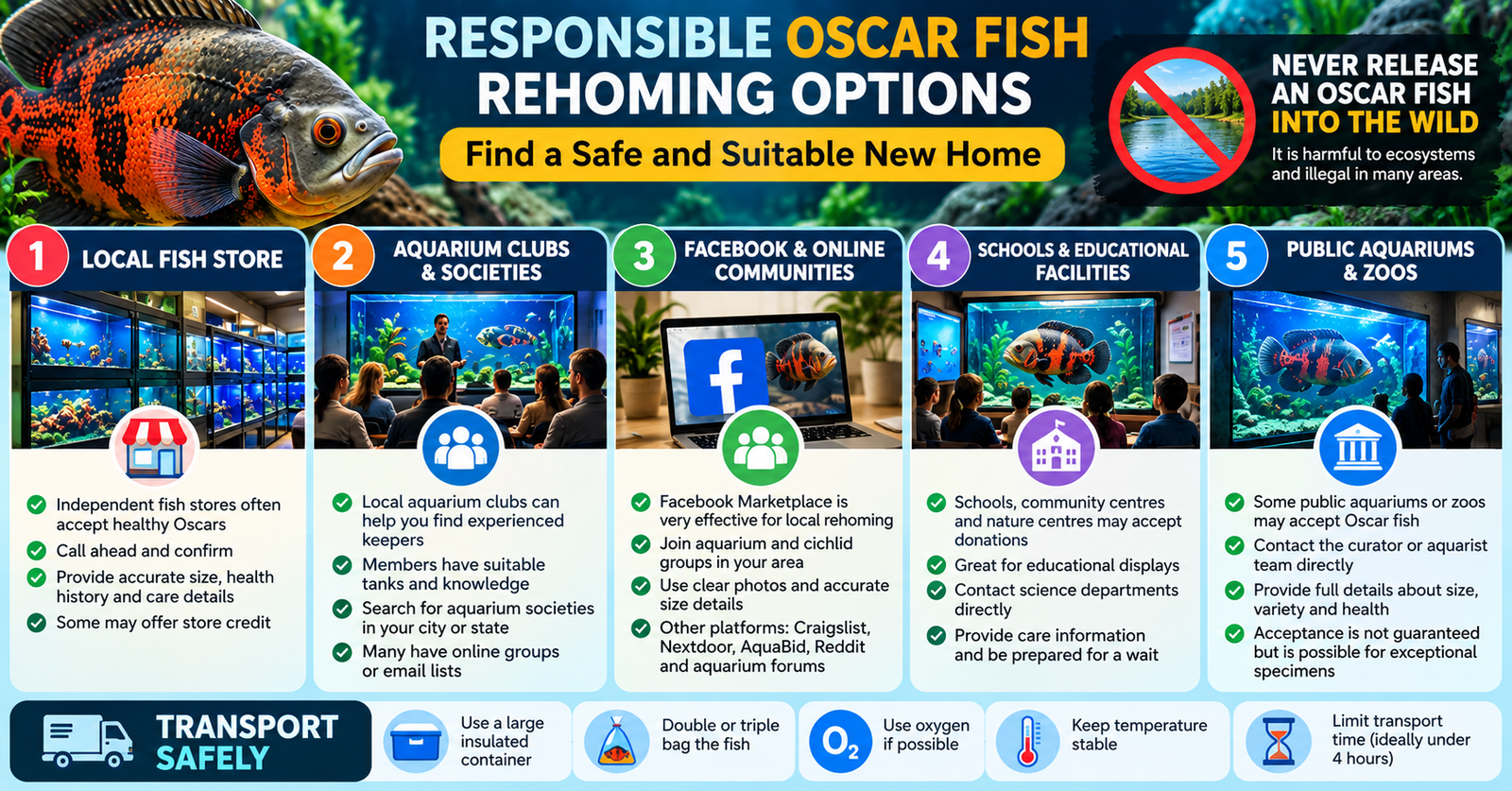
Oscar Fish Rehome Local Fish Store: How to Approach a Store
- Call before visiting. Ask whether the store accepts donated or surrendered aquarium fish.
- Describe the fish accurately. Give the approximate length, colour variety, age if known and health history.
- Explain the reason for rehoming. A straightforward explanation helps staff determine whether the fish may be suitable.
- Ask whether store credit is possible. Some stores may offer credit, while others may only accept the fish as a donation.
- Ask about transport. Confirm when the fish can be delivered and whether the store has specific bagging requirements.
Why Some Stores May Refuse an Adult Oscar
An adult Oscar takes up substantially more space than a juvenile. A store may already have large display fish, limited quarantine capacity or no suitable holding aquarium. A refusal does not mean the fish cannot be rehomed. It simply means another route should be tried.
Do not pressure a store into accepting a fish if its quarantine or holding system is unsuitable. The objective is not merely to transfer ownership. The objective is to transfer the fish into a setting where it can continue to receive appropriate care.
How to Find a New Home for Your Oscar Fish
The most useful search phrase here is how to rehome oscar fish. A good rehoming strategy uses several channels simultaneously rather than waiting for one organisation to respond.
Start locally. A recipient who lives within driving distance is usually easier to coordinate with than someone several states away. Local rehoming also reduces transport time and the associated stress on the fish.
Facebook Groups and Marketplace
Facebook can be useful for oscar fish rehome facebook marketplace searches because local aquarium communities often include experienced keepers who already maintain large tanks.
Instead of writing only “free Oscar,” create a detailed listing that answers the questions an experienced keeper will ask. Include the fish’s approximate length, location, colour variety, current diet, temperament, tank history and any known health concerns.
Use clear photographs. One photograph should show the entire fish, while another should give viewers a useful sense of its actual size. Avoid heavily edited photographs that make the fish appear different from reality.
Aquarium Hobbyist Forums
Large-fish communities can be useful for oscar fish rehome monsterfish community searches because experienced members are more likely to understand the equipment and aquarium footprint required by an adult Oscar.
Specialist communities also make it easier to identify a serious recipient. Someone who already maintains large cichlids may have the filtration, aquarium volume and feeding routine necessary for your fish.
When using any online community, follow its rules. Some forums require a minimum account age or number of posts before members can publish classified listings. Never misrepresent the fish’s health or size simply to attract a faster response.
Oscar Fish Rehome Aquarium Club
Local aquarium clubs are particularly useful because their members already participate in the hobby. Search for terms such as “aquarium society”, “cichlid club” or “aquarium association” followed by your city, county or state.
An aquarium club may not personally take the fish, but members can often connect you with another hobbyist. This network effect can be more useful than contacting a general animal shelter that does not have an aquarium specialist.
Schools, Community Centres and Educational Facilities
Some schools and educational organisations maintain large aquariums for science education. A healthy Oscar can potentially become part of an educational display, although acceptance is never guaranteed.
Contact science departments, environmental education centres, nature centres and community organisations directly. Explain the fish’s size and care requirements and ask whether the organisation has a suitable established aquarium.
How to Give Away an Oscar Fish Responsibly
Giving away an Oscar should involve the same level of honesty as selling one. “Free” does not automatically mean responsible. The recipient still needs to understand that the fish is a long-term commitment.
A good rehoming post should include:
- Current fish length.
- Approximate age if known.
- Current aquarium size.
- Filtration system.
- Current diet.
- Temperament around people.
- Temperament around other fish.
- Any known diseases or previous treatments.
- Exact general location.
- Whether transport is available.
- Whether the fish is being donated or sold.
Can I Donate My Oscar Fish to a Public Aquarium?
Public aquariums and zoos may appear to be an obvious solution when an Oscar becomes unwanted, but they are usually not the first route to rely upon.
Professional institutions plan their collections around exhibit requirements, animal welfare, available space, quarantine capacity, educational goals and species-management policies. A facility may therefore decline a perfectly healthy fish simply because it does not fit its collection plan.
How to Approach a Public Aquarium or Zoo
- Identify facilities with freshwater fish exhibits.
- Contact the appropriate animal-care, aquarist or collections department where possible.
- Provide the fish’s species, size, age and health history.
- Explain the current aquarium conditions.
- Ask whether the institution accepts privately owned aquarium fish.
- Follow its intake and quarantine instructions if the answer is yes.
Do not arrive at a public aquarium with a fish in a transport bag expecting immediate acceptance. Professional facilities require planning and quarantine procedures, and many cannot accept privately owned animals at all.
Online Classified Platforms for Oscar Fish Rehoming
Online classifieds can increase the number of potential recipients, particularly when local aquarium communities are small. The objective should be to reach an experienced keeper rather than simply the first person who responds.
Local Classifieds
Depending on your region, platforms such as Facebook Marketplace, Craigslist, Nextdoor and other local community boards may provide useful exposure. Use location-specific terms such as oscar fish rehome local fish store or oscar fish rehome aquarium club when researching additional routes.
How to Screen a Potential Recipient
Before handing over the fish, ask basic husbandry questions. You do not need to conduct a formal interview, but you should establish whether the recipient understands what an adult Oscar requires.
- What size aquarium will the Oscar live in?
- Is the aquarium already running?
- What filtration does it use?
- What other fish are currently housed there?
- Has the recipient kept large cichlids before?
- How will the fish be transported?
- Does the recipient understand the fish’s adult size?
A responsible recipient should be willing to answer these questions. If someone refuses to explain where the fish will live, consider continuing the search.
How to Transport Your Oscar Fish Safely for Rehoming
The question how to transport oscar fish for rehoming is particularly important with large specimens. Moving a large fish is different from moving a small tetra or juvenile community fish.
The transport container needs to be secure, adequately sized and insulated against rapid temperature changes. The fish should also spend as little time as reasonably possible outside its established aquarium.
Preparing the Oscar Before Transport
Avoid feeding immediately before a planned move. Reducing food intake before transport can reduce waste production in the transport water. For a longer or more complicated journey, ask an experienced aquarium professional or aquatic veterinarian about preparation.
Prepare the transport container before catching the fish. Do not catch the Oscar first and then search the house for bags, containers or towels.
Transport Equipment
- Large, heavy-duty fish transport bags or an appropriate rigid container.
- Insulated cooler or transport box.
- Clean tank water.
- Secure lid or multiple layers of bag protection.
- Appropriately sized soft aquarium net or fish-catching equipment.
- Temperature protection appropriate to the weather.
- Battery-powered aeration for situations requiring extended transport.
For longer journeys, oxygen-filled transport bags can extend transport time compared with ordinary air-filled bags, but the exact safe duration depends on fish size, water volume, temperature, oxygen availability and handling conditions. Do not use a generic “maximum hours” figure as a guarantee of safety.
Step-by-Step Transport Approach
- Prepare the transport container before catching the fish.
- Use clean water with appropriate temperature for the Oscar.
- Minimise handling time.
- Keep the fish’s body supported and avoid unnecessary physical contact.
- Secure the container against movement during transportation.
- Keep the container away from direct sunlight and extreme temperatures.
- Drive smoothly and avoid unnecessary stops.
- Transfer the fish into an established receiving aquarium as soon as practical.
Transporting a Large Oscar Safely
Large Oscars can be difficult to net because of their body size and strength. Never force a large fish through equipment that is clearly too small. If you are inexperienced with moving large fish, ask the receiving fish store, aquarium club member or experienced cichlid keeper to help.
The AquariumsWorld Fish Tank Aquarium Air Pump Guide also explains why aeration and surface gas exchange are important in aquarium systems. This is especially useful when planning temporary holding or transport support.
Oscar Fish Grew Too Big: What to Do
If your oscar fish grew too big, do not wait until the fish is visibly cramped or water quality becomes impossible to control. You have two broad options: improve the aquarium or begin responsible rehoming.
Adult size should always be considered before purchasing a juvenile fish. The same principle applies to other aquarium species. AquariumsWorld’s 20 Gallon Fish Tank Guide explains why adult size matters when deciding which fish can be housed in smaller aquariums.
When an Aquarium Upgrade May Be Better Than Rehoming
If you still enjoy keeping the Oscar and have enough space for a larger aquarium, an upgrade may solve the problem. The decision should be based on the aquarium footprint, filtration capacity, maintenance routine and your ability to manage the fish for many years.
Compare dimensions carefully rather than choosing an aquarium based only on nominal gallons. AquariumsWorld’s 50 Gallon Fish Tank Dimensions Guide and 50 Gallon Fish Tank Complete Guide demonstrate why dimensions, equipment and filled weight matter when planning a larger aquarium.
When Rehoming Is the More Practical Solution
Rehoming may be the sensible route when a larger aquarium cannot fit into the home, when maintenance has become financially difficult or when the owner no longer has the time required for large-fish care.
A smaller but appropriately managed aquarium for another species is better than keeping a large Oscar in a setup that cannot meet its needs.
Before You Rehome: Try These Solutions First
Not every search for how to get rid of oscar fish requires immediate surrender. Sometimes the underlying problem can be corrected.
Tank Upgrade
If the only problem is aquarium size and you genuinely want to keep the fish, investigate whether a larger aquarium is realistic. The 100 Gallon Fish Tank Guide provides useful information about dimensions, filled weight, equipment and setup considerations.
Rehome the Tank Mates Instead
If the Oscar itself is healthy but the problem is aggression toward another fish, the correct solution may involve changing the community rather than surrendering the Oscar.
Before deciding, research appropriate combinations carefully. AquariumsWorld’s Can Goldfish Live with Oscar Fish? guide explains why goldfish and Oscars have incompatible long-term requirements.
The broader Angelfish Complete Care Guide also illustrates why large predatory cichlids should not be treated as ordinary community fish.
Improve Water Quality and Filtration
Sometimes owners consider rehoming because the aquarium has become difficult to maintain. Before surrendering a healthy fish, test ammonia, nitrite and nitrate and inspect the filtration system.
AquariumsWorld’s Fish Aquarium Problems and Solutions Guide provides a broader troubleshooting framework covering cloudy water, ammonia, nitrite, filtration and common fish-health problems.
If aeration is inadequate, the Aquarium Air Pump Guide can help explain surface agitation, air pumps and oxygen management.
Review Temperature Requirements
Oscar fish are tropical cichlids, so stable temperature is important. Do not copy a temperature recommendation from another fish species simply because both fish are labelled “freshwater.”
The AquariumsWorld Water Temperature for Cichlids Guide explains why cichlid temperature requirements differ between species and geographic groups.
Check Whether the Aquarium Is Overstocked
Overstocking can make an Oscar aquarium difficult to maintain even when the tank itself is large. Use the Aquarium Stocking Calculator as a planning reference, while remembering that a calculator cannot replace species-specific judgement.
How to Humanely Euthanise an Oscar Fish
How to humanely euthanise an oscar fish is an important but sensitive search query. Euthanasia should not be treated as the normal solution to an unwanted pet. Rehoming should be explored first whenever the fish is healthy and a suitable placement is possible.
Humane euthanasia becomes a welfare consideration when a fish is suffering from severe, irreversible disease or injury and appropriate veterinary treatment or responsible placement is no longer realistic.
Speak With an Aquatic Veterinarian When Possible
The safest approach is to contact a veterinarian experienced with fish or aquatic animals. A veterinarian can assess whether the condition is treatable and, if euthanasia is necessary, select and administer an appropriate method.
The American Veterinary Medical Association’s euthanasia guidance discusses species-appropriate methods for aquatic animals. Owners should follow current veterinary guidance rather than relying on social-media instructions or improvised techniques.
Why Improvised Methods Should Be Avoided
Methods such as flushing a fish down a toilet, leaving a fish out of water or using household chemicals are inappropriate. They can cause prolonged distress and can also create sanitation or environmental problems.
Do not attempt improvised euthanasia simply because a rehoming attempt has been inconvenient. For a healthy unwanted Oscar, continue looking for an appropriate recipient. For a suffering fish, contact a veterinarian or qualified aquatic professional.
Oscar Fish Rehoming: Special Cases
Rehoming a Sick Oscar Fish
A sick Oscar can sometimes be rehomed to an experienced keeper, but health information must be disclosed honestly. Do not describe a fish as healthy if it has active disease.
Provide the recipient with the diagnosis if known, medications used, treatment dates and any behavioural changes. This gives the new keeper a chance to prepare a quarantine or hospital system.
AquariumsWorld’s Fish Aquarium Problems and Solutions Guide can be used as a general troubleshooting reference, but serious disease should be assessed by an aquatic veterinarian.
Rehoming a Large 10 to 14 Inch Oscar
A large Oscar may take longer to rehome because the recipient must already have a suitably large established aquarium. Target experienced cichlid keepers rather than general pet owners who may not understand the fish’s requirements.
Include a clear photograph and exact approximate length. A statement such as “large Oscar” is less useful than “approximately 12 inches long.”
Rehoming a Rare Colour Variety
Colour varieties can attract specialist hobbyists, but avoid presenting a trade name as proof of a particular genetic lineage. Terms such as Fire Red, Super Red and other Oscar colour labels can vary between sellers.
If the fish has a distinctive appearance, use photographs rather than making unsupported claims about rarity or genetics.
Rehoming an Oscar That Is Aggressive
Aggression should be disclosed. Do not describe an Oscar as peaceful simply to make it easier to place.
Explain which fish it has attacked, whether the aggression occurs during feeding, whether breeding behaviour is involved and whether the fish can be safely handled.
Preparing a Responsible Oscar Fish Rehoming Listing
A good listing reduces unnecessary messages and attracts more appropriate recipients. The title should identify the species, approximate size and location.
“Adult Oscar fish approximately 11 inches, healthy, located in Dallas, looking for experienced cichlid keeper. Current aquarium and diet information available. Recipient must have an appropriately sized established aquarium.”
Avoid sensational phrases such as “urgent free monster fish” if they obscure the actual requirements. Clear information is more useful than exaggerated language.
How to Screen the New Owner
The purpose of screening is not to make rehoming unnecessarily difficult. It is to prevent the fish from being passed from one unsuitable aquarium to another.
| Question | Why It Matters |
|---|---|
| What size aquarium do you have? | Confirms that the recipient understands the space requirements. |
| What filtration are you using? | Large Oscars produce substantial waste and require appropriate filtration. |
| What fish are already in the aquarium? | Helps identify possible aggression or predation problems. |
| Have you kept large cichlids before? | Experience can help with feeding, maintenance and behaviour management. |
| How will you transport the fish? | Reduces the chance of injury during transfer. |
What to Send With the Oscar
Whenever practical, provide the recipient with a short care sheet. This can include the fish’s normal feeding schedule, preferred foods, recent water parameters, medication history and known behavioural characteristics.
If the fish has a favourite food or established feeding routine, include that information. Sudden environmental and dietary changes can make the transition more difficult.
If the fish is currently kept with other animals, clearly explain whether it has demonstrated aggression. Do not assume the new keeper will discover this safely.
Oscar Fish Rehoming Through an Aquarium Club
Aquarium clubs can be particularly useful for oscar fish rehome aquarium club searches because the people involved often have existing tanks, filtration equipment and knowledge of large freshwater species.
Search for local aquarium societies, cichlid clubs and freshwater associations. If the organisation does not have a formal fish-rescue service, ask whether it allows members to circulate a rehoming notice.
Oscar Fish Rehome Facebook Marketplace: Practical Tips
When using Facebook Marketplace or a local community group, keep the listing factual. Mention that the fish is being rehomed rather than implying that the recipient is purchasing a small beginner fish.
Include your general location but avoid publishing unnecessary personal information. Arrange a handover in a safe and appropriate setting, and make sure the receiving person has a suitable transport container.
Oscar Fish Rehome MonsterFish Community: Finding Experienced Keepers
Large-fish communities can be especially useful for mature Oscars. Experienced keepers are more likely to understand that the fish’s needs continue after the handover.
When posting in specialist forums, follow the site’s rules. Some communities restrict sales or rehoming advertisements until an account has reached a certain level of participation.
What Happens to Your Oscar After Rehoming?
Owners sometimes feel guilty about rehoming a fish they have kept for several years. That emotional response is understandable, but the welfare question should focus on the quality of the new environment.
If an Oscar moves from an unsuitable aquarium into an established, appropriately maintained system, the change can represent an improvement in its living conditions.
Responsible rehoming therefore should not be viewed simply as abandoning an animal. When the owner can no longer provide the appropriate environment, transferring the fish to someone who can is a legitimate form of responsible animal stewardship.
Rehoming Checklist
| Task | Completed |
|---|---|
| Measure the Oscar accurately. | □ |
| Record current tank size and filtration. | □ |
| Record diet and feeding schedule. | □ |
| Record known health problems or treatment history. | □ |
| Contact local independent fish stores. | □ |
| Contact aquarium clubs and cichlid communities. | □ |
| Create an accurate online rehoming listing. | □ |
| Screen potential recipients. | □ |
| Prepare suitable transport equipment. | □ |
| Provide the new owner with care information. | □ |
| Never release the Oscar into natural water. | □ |
Frequently Asked Questions
How do I get rid of an oscar fish I no longer want?
The most responsible options are rehoming the fish with an experienced aquarist, contacting an independent local fish store, contacting an aquarium club or posting through a reputable local aquarium community. Give the recipient accurate information about the fish’s size, health, temperament and current aquarium. Never release an unwanted Oscar into natural water.
Can I release my oscar fish into a lake or river?
No. Releasing an aquarium Oscar into a lake, river, canal or pond can introduce a nonnative predator into an ecosystem. Oscar populations are established in parts of Florida, and USGS records continue to document the species there. In Florida, state law prohibits releasing nonnative animals unless authorised.
Will a pet store take my oscar fish?
Some independent aquarium stores may accept an Oscar, but there is no universal requirement for stores to accept unwanted fish. Always call first and explain the fish’s size and health condition. A store may decline if it lacks suitable quarantine or holding space.
How do I find a new home for my oscar fish?
Start with independent fish stores, local aquarium clubs, cichlid communities and experienced hobbyists. Facebook groups and local aquarium forums can also help. Use clear photographs and provide the fish’s approximate size, health history, temperament and location.
Why do oscar fish need to be rehomed?
Common reasons include aquarium size limitations, relocation, maintenance costs, aggression toward tank mates, changes in household circumstances and loss of interest in fishkeeping. Some owners also discover that an Oscar’s adult requirements are greater than expected when they originally purchased the fish as a juvenile.
Is it illegal to release oscar fish into the wild?
Laws vary by jurisdiction. In Florida, §379.231 prohibits release within the state of nonnative animals unless authorised by the Florida Fish and Wildlife Conservation Commission. Owners elsewhere should check their own state, provincial or national wildlife regulations before moving a nonnative fish.
How do I transport my oscar fish safely for rehoming?
Prepare the transport container before catching the fish, minimise handling, maintain an appropriate temperature and protect the container from movement and extreme temperatures. Large Oscars may require specialist transport equipment. For longer journeys, consult an experienced fish keeper or aquatic professional rather than relying on a generic transport-time rule.
Can I donate my oscar fish to a public aquarium?
You can contact public aquariums and zoos, but acceptance is not guaranteed. Professional institutions manage their collections according to exhibit requirements, available space, quarantine capacity and institutional policies. A local fish store or experienced hobbyist is often a more practical first contact.
What online resources can I use to rehome my oscar fish?
Depending on your region, useful channels can include local aquarium Facebook groups, community classified platforms, aquarium forums, cichlid communities and aquarium club networks. Always follow the platform’s rules and screen the recipient rather than handing the fish to the first person who responds.
How do I humanely euthanise an oscar fish if no rehoming option is available?
Humane euthanasia should be considered only when the fish is suffering and appropriate treatment or rehoming is not a realistic welfare solution. Contact an aquatic veterinarian or qualified fish professional for an appropriate method. Do not flush the fish, leave it out of water or use improvised household methods.
Additional AquariumsWorld Resources
If you are rehoming an Oscar because of aquarium limitations, the following AquariumsWorld resources can help you understand the underlying problem before deciding what to do:
- Aquarium Stocking Calculator for evaluating stocking and bioload.
- 100 Gallon Fish Tank Guide for larger aquarium planning.
- 50 Gallon Fish Tank Guide for dimensions, equipment and setup planning.
- 50 Gallon Fish Tank Dimensions for comparing aquarium footprints.
- 20 Gallon Fish Tank Guide for understanding why adult size matters.
- Fish Aquarium Problems and Solutions for water-quality troubleshooting.
- Fish Tank Aquarium Air Pump Guide for aeration and oxygen management.
- Water Temperature for Cichlids for species-specific temperature planning.
- Soil in Fish Tank Guide for substrate and aquarium setup considerations.
- Orange Plecostomus Complete Care Guide for information on large pleco considerations and community aquariums.
- Can Goldfish Live With Oscar Fish? for a detailed Oscar compatibility comparison.
- Angelfish Complete Care Guide for comparison with another commonly kept cichlid.
- African Cichlids Complete Guide for broader cichlid behaviour and aquarium planning.
- Built-In Wall Aquarium Guide for planning larger permanent aquarium installations.
- How to Take Care of a Fish for general fishkeeping fundamentals.
- Corner Fish Tank Aquarium Guide for alternative aquarium layouts.
- Fish Tank Stand and Size Guide for structural planning when upgrading to a larger aquarium.
- Aquarium Setup and Guide Archive for additional aquarium planning resources.
Conclusion
Learning how to get rid of oscar fish responsibly begins with recognising that an unwanted aquarium fish still needs an appropriate destination. The solution is not simply to remove the fish from your home. The goal is to move the animal into a suitable environment where its size, behaviour, filtration needs and long-term care requirements can be met.
Start with your local independent fish store, then contact aquarium clubs, experienced cichlid keepers and online aquarium communities. Create an honest rehoming listing that includes the fish’s size, health condition, temperament, current aquarium and location. Screening potential recipients is worthwhile because a fast placement is not necessarily a good placement.
If the problem is aquarium size, consider whether an upgrade is genuinely possible. If the problem is incompatible tank mates, investigate whether separating the community could solve the issue. If the problem is water quality, identify whether filtration, stocking or maintenance is responsible before making a final decision.
Above all, never release an Oscar fish into a lake, river, canal, pond or other natural waterway. USGS records show established Oscar populations in Florida and continued observations in multiple Florida watersheds. Florida law separately prohibits unauthorised release of nonnative animals.
Responsible rehoming may take several conversations and sometimes several days, but that process protects the fish, the receiving aquarium and the surrounding environment. A healthy Oscar with accurate documentation and a realistic description can often be matched with an experienced keeper who is prepared for the commitment.
Responsible Oscar Fish Rehoming: The Simple Rule
Rehome, do not release. Contact an independent fish store, aquarium club, experienced hobbyist, educational facility or another suitable organisation. Give complete information about the fish and make sure the receiving aquarium is appropriate before completing the handover.
Scientific and Regulatory References
- U.S. Geological Survey Nonindigenous Aquatic Species Database. Oscar (Astronotus ocellatus) Species Profile. Updated records accessed 2026. https://nas.er.usgs.gov/queries/FactSheet.aspx?speciesID=436
- U.S. Geological Survey Nonindigenous Aquatic Species Database. Astronotus ocellatus Collection Records, Florida. Current database records accessed 2026. https://nas.er.usgs.gov/queries/CollectionInfo.aspx?SpeciesID=436&State=FL
- U.S. Fish and Wildlife Service. Ecological Risk Screening Summary: Oscar, Astronotus ocellatus. U.S. Fish and Wildlife Service. https://www.fws.gov/sites/default/files/documents/Ecological-Risk-Screening-Summary-Oscar.pdf
- Florida Legislature. Florida Statutes §379.231: Regulation of nonnative animals. 2026 Florida Statutes. Florida Statutes §379.231
- American Veterinary Medical Association. AVMA Guidelines for the Euthanasia of Animals: 2020 Edition. American Veterinary Medical Association. AVMA Euthanasia Guidelines
- Madison, B.N., Tavakoli, S., Kramer, S. and Bernier, N.J. (2015). Chronic cortisol and the regulation of food intake and the endocrine growth axis in rainbow trout. Journal of Endocrinology, 226(2), pp.103–119. https://doi.org/10.1530/JOE-15-0202
- Hill, J.E. and Lawson, L.L. (2019). Ecological risk assessment approaches for nonnative aquatic species in Florida. University of Florida IFAS Extension. University of Florida IFAS Extension
- Kolarevic, J. et al. (2022). Research on environmental management, water quality and welfare considerations in captive aquatic systems. Animals. Use current publisher record when citing the specific study. MDPI Animals