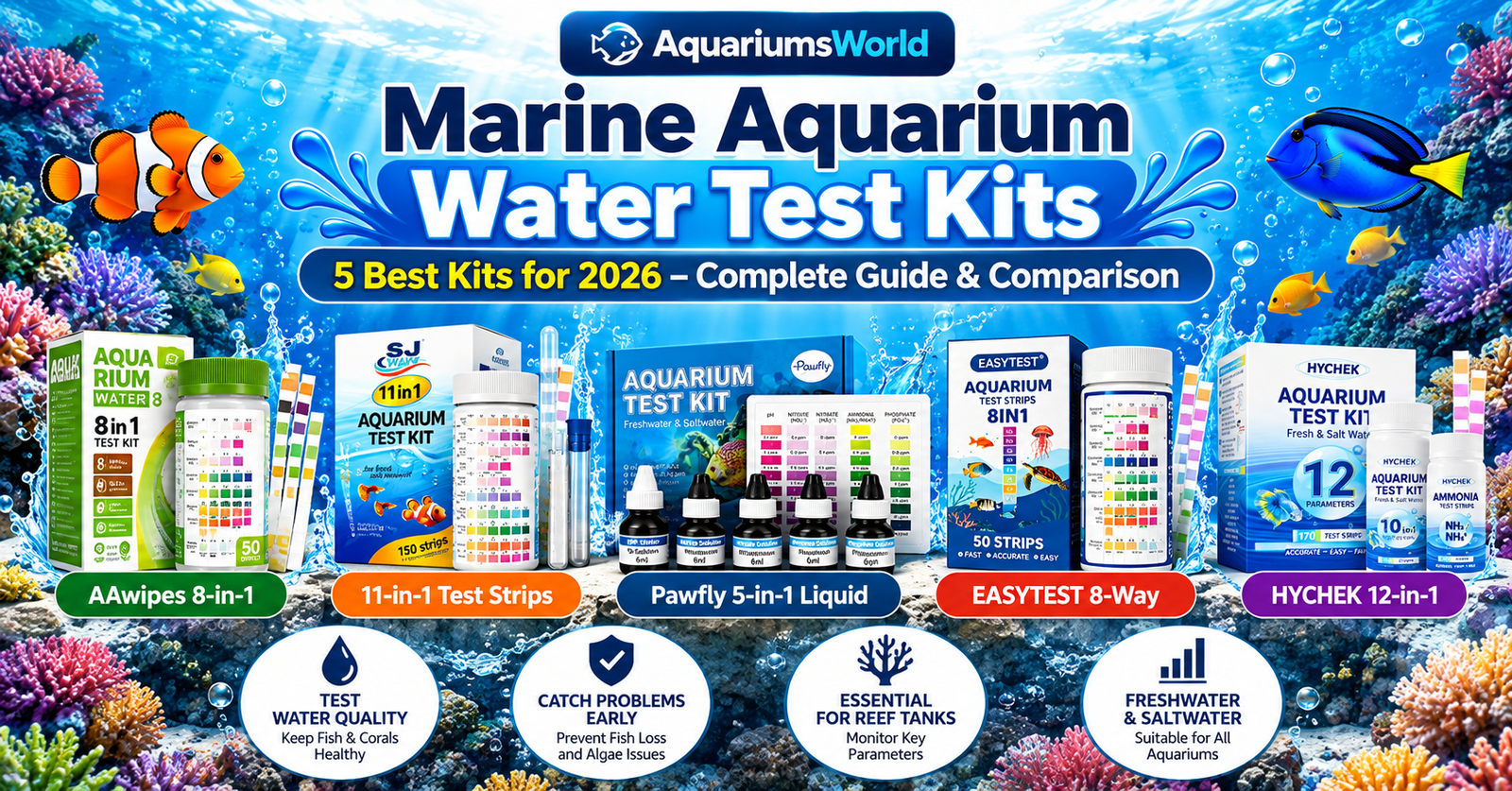
Choosing marine aquarium water test kits is about more than buying a bottle of strips. A reliable testing routine helps you detect water-quality changes early, protect fish and invertebrates, and understand whether your aquarium’s biological filtration is keeping pace with its livestock.
This guide explains essential saltwater aquarium parameters, compares test strips with liquid kits, provides a testing schedule for FOWLR and reef systems, and reviews five aquarium test kits using the product information supplied for this comparison.
Marine Aquarium Testing Schedule Calculator
Select your aquarium type, tank age and coral load to receive a practical starting schedule. This is a routine-planning aid, not a substitute for testing after livestock additions, medication, equipment failure or unusual fish behaviour.
If a test result is unexpected, repeat it with a fresh sample and a suitable method before making a major correction. Follow the livestock-specific guidance for your system.
Why Marine Aquarium Water Testing Is Non-Negotiable
A marine aquarium can look clear while its chemistry is changing. Water clarity is not a reliable indicator of ammonia, nitrite, nitrate, alkalinity or phosphate. Many important compounds are dissolved and invisible, so a keeper cannot judge their concentration by looking through the glass.
Testing provides evidence for maintenance decisions. It helps distinguish a real chemistry problem from a temporary visual change, shows whether filtration is processing waste, and makes it easier to evaluate whether water changes or equipment adjustments are having the intended effect. Without measurements, a hobbyist may respond to a problem too late or make unnecessary corrections that create additional instability.
Ammonia is particularly important in a new aquarium or after a disruption to biological filtration. Fish release nitrogenous waste, while uneaten food and decomposing organic material add further load. Beneficial microorganisms process ammonia through the nitrogen cycle, but this biological capacity takes time to establish and can be affected by medication, cleaning practices, oxygen availability, temperature and changes in livestock load.
For that reason, a newly established tank needs more frequent testing than a mature system with a stable maintenance history. A sudden increase in feeding, a dead organism hidden in the rockwork, a filter malfunction or an unusually large livestock addition can also justify event-based testing even in an established aquarium.
Marine systems add further complexity. Fish-only-with-live-rock aquariums still require stable salinity, temperature, pH and nitrogen-cycle control. Reef aquariums also need attention to alkalinity, calcium, magnesium and nutrients such as phosphate. Corals and other calcifying organisms use dissolved carbonate chemistry to build skeletal structures, so reef keepers must monitor consumption and avoid abrupt corrections.
Water testing should be part of a broader husbandry routine rather than an isolated activity. Combine it with observation, equipment checks, appropriate feeding, regular maintenance and a written log. If you are planning a new system, our fish aquarium types and setup guide explains how aquarium type affects equipment and maintenance choices.
When fish show signs of distress, begin with water quality rather than immediately adding medication. Our fish aquarium problems and solutions guide covers common water-quality and health issues. A second related resource is the Aquarium Stocking Calculator, which can help you consider whether bioload may be contributing to repeated water-quality problems.
What Parameters Matter in a Marine Aquarium?
The correct test list depends on what lives in the aquarium. Ammonia, nitrite, nitrate, pH, temperature and salinity are central to routine marine care. Reef systems need additional measurements because coral growth and nutrient management depend on chemistry beyond the nitrogen cycle.
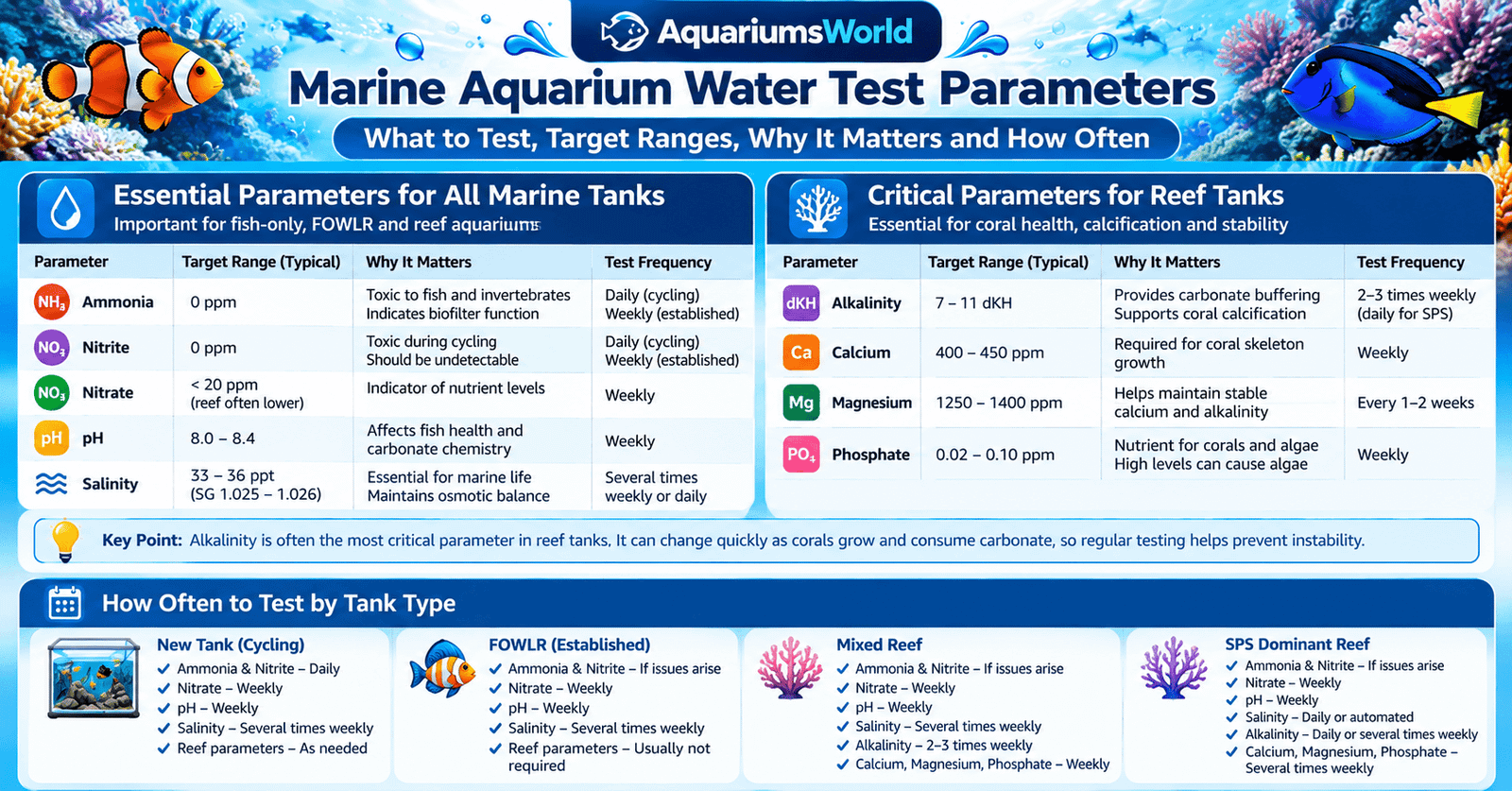
Essential Parameters for All Marine Tanks
| Parameter | Practical reference point | Why it matters | Testing guidance |
|---|---|---|---|
| Ammonia | Target: undetectable on a suitable aquarium test | Ammonia is toxic to aquatic animals. Toxicity depends on total ammonia, pH, temperature and the proportion present as un-ionised ammonia. | Daily during cycling; weekly in established tanks and after disruptions. |
| Nitrite | Target: undetectable | Nitrite indicates an incomplete or disrupted nitrogen-processing pathway. Marine chloride levels affect nitrite toxicity, but a detectable result still warrants investigation. | Frequently during cycling; periodically in mature systems. |
| Nitrate | Keep within a stable range suitable for livestock; avoid sudden swings | Nitrate is a product of biological filtration. Excess accumulation can contribute to poor conditions, while extremely low nutrients can also be undesirable in some reef systems. | Weekly initially; adjust based on trend and system response. |
| pH | Many marine systems are maintained around 7.8–8.4, with stability important | pH affects biological processes and the chemical availability of compounds in water. It also changes the toxicity of ammonia. | Weekly or more often when unstable; measure at a consistent time when comparing trends. |
| Salinity | Common reef reference: specific gravity near 1.023–1.026 at an appropriate calibration temperature | Salinity affects osmoregulation and the suitability of the environment for marine fish and invertebrates. | Use a calibrated refractometer or suitable digital instrument; monitor consistently. |
| Temperature | Set according to livestock needs; consistency is more useful than repeated adjustment | Temperature affects metabolism, oxygen demand and the rate of biological processes. | Use a reliable thermometer; verify heater performance regularly. |
These are broad reference points, not universal prescriptions for every species or system. A specialist aquarium, breeding system or species-specific setup may require a narrower target. Use the livestock supplier’s guidance and reliable husbandry references when setting your own operating range.
Critical Parameters for Reef Tanks
Reef aquariums need additional attention because stony corals and other calcifying organisms use carbonate chemistry and dissolved minerals as they grow. A general aquarium strip may measure alkalinity or carbonate hardness, but it may not provide the resolution needed for a reef dosing decision. Calcium and magnesium often require dedicated tests.
| Parameter | Common reef reference range | Role in the aquarium | Typical starting frequency |
|---|---|---|---|
| Alkalinity | Approximately 7–11 dKH; many keepers choose a stable target within this range | Represents acid-neutralising capacity and is closely linked to carbonate availability and pH stability. | Weekly for low-demand systems; two or more times weekly for growing reefs; more often when demand is high. |
| Calcium | Approximately 400–450 mg/L | Required for skeletal growth in corals and other calcifying organisms. | Weekly initially; increase frequency when dosing or coral growth changes. |
| Magnesium | Approximately 1,250–1,350 mg/L | Contributes to seawater chemistry and influences calcium-carbonate behaviour. | Weekly or every other week, depending on stability and supplementation. |
| Phosphate | Keep controlled and stable; many reef keepers monitor at low measurable concentrations rather than aiming for absolute zero | Phosphate is a nutrient, but elevated concentrations can contribute to nuisance algae and affect calcification. | Weekly while establishing a trend; more frequently during active nutrient management. |
Exact targets vary with coral species, nutrient export, feeding, lighting, water-change practices and the overall approach to reef keeping. Avoid chasing a single number through large, rapid corrections. A stable value that suits the livestock is often more useful than frequent swings caused by over-adjustment.
Why Alkalinity Deserves Particular Attention
Alkalinity is a key measurement for reef aquariums because it reflects the water’s buffering capacity and is linked to carbonate availability. Calcifying organisms consume carbonate and calcium as they build skeletons. As coral biomass grows, the aquarium’s daily demand can increase, and a dosing routine that once maintained stability may no longer be sufficient.
Alkalinity is not always the fastest-changing parameter in every aquarium. Its rate of change depends on coral growth, coralline algae, precipitation, water changes, dosing and system volume. In a heavily stocked SPS aquarium, however, consumption can be substantial enough to justify frequent testing and careful dosing calibration.
Calcium and alkalinity consumption are related through calcification, but the relationship is not a simple universal one-to-one test result. Biological communities, non-coral processes and measurement methods influence observed ratios. Therefore, use alkalinity and calcium measurements together, rather than assuming one reading can precisely predict the other.
When a reef shows tissue recession, paling or reduced growth, do not assume alkalinity is the sole cause. Check temperature, salinity, lighting, flow, nutrients, pests, recent additions and equipment performance. A measured chemistry problem should be addressed carefully, but symptoms can have multiple causes.
Types of Marine Aquarium Test Kits
Test Strips: Speed and Convenience
Aquarium test strips use reagent-treated pads that change colour after contact with a water sample. They are convenient because the procedure is usually short and several parameters may be measured on one strip. For routine screening, this format can make testing less intimidating and help keep a regular schedule.
However, strip performance depends on the product’s chemistry, storage, sample technique, timing and the user’s ability to distinguish colours. A strip’s stated parameter count does not automatically mean it measures every parameter a marine aquarium needs. For example, a kit may measure pH, hardness, nitrate and ammonia but omit salinity, calcium or magnesium.
Read the manufacturer’s chart under consistent lighting. Do not compare a wet strip with a dry chart, allow pads to touch each other, or leave the strip exposed to humidity longer than instructed. If a result appears abnormal or conflicts with fish behaviour, confirm it using a fresh sample and a suitable alternative method.
Liquid Drop Colourimetric Kits
Liquid kits use measured water samples and reagent drops or powders. The resulting colour is compared with a reference chart, or in some kits a prepared sample is read using a dedicated comparator. They generally take longer than strips, but can offer useful resolution for specific parameters and are widely used for routine aquarium chemistry.
Liquid tests are not automatically accurate simply because they use bottles and test tubes. Results still depend on reagent age, correct sample volume, drop size, mixing, reaction time and interpretation. A test kit that is poorly stored or used incorrectly can produce misleading readings regardless of format.
For cycling, a keeper may prefer a liquid test for ammonia and nitrite when a decision depends on a low or changing reading. For reef care, choose a dedicated test designed for the parameter and range of interest. Check whether the kit is intended for freshwater, saltwater or both, and follow the manufacturer’s instructions.
Digital Checkers
Digital colorimeters and electronic checkers can reduce the subjectivity of matching a colour by eye. They are useful where repeatability and small changes matter, such as alkalinity or phosphate monitoring in a reef aquarium. They still require correct sample preparation, clean cuvettes, calibration or standards where specified, and suitable reagents.
Digital instruments do not eliminate user error. Fingerprints, scratches, bubbles, dirty glassware, incorrect reagent quantities and expired reagents can affect readings. They should be treated as measurement tools that require care, not as automatic guarantees of accuracy.
ICP Laboratory Analysis
Inductively coupled plasma (ICP) analysis is a laboratory service used by some reef keepers to investigate a broad range of elements. It can be useful for troubleshooting or periodic review, particularly when a system has unexplained problems or when a hobbyist wants information beyond routine home tests.
ICP testing is not a replacement for day-to-day monitoring. It is a snapshot of a submitted sample, and results depend on sampling, shipping, laboratory methods and interpretation. It may not measure every biologically important form of a substance, and it does not remove the need to monitor ammonia, temperature, salinity and other routine parameters at home.
Are Test Strips Accurate for Marine Aquariums?
Test strips can be useful for routine screening, but their suitability depends on the parameter and the decision being made. They may help a keeper notice a broad change in pH, nitrate or alkalinity. They are less suitable when a precise result is needed to guide a sensitive adjustment, especially if the colour chart has broad intervals or the expected concentration is near the lower detection limit.
Do not assume that all strips share the same resolution. One product may have different colour increments from another, and product claims such as “high accuracy” should be interpreted in light of the test method, stated range and independent validation. A general-purpose kit may be useful for checking trends without being adequate for every reef-management decision.
Ammonia deserves special care during cycling. If a strip reads zero while the aquarium is still developing its biological filter, confirm the result with an appropriate test and continue monitoring the cycle. The presence of fish, feeding and organic waste does not guarantee that a test will detect a problem at the moment it is sampled. Repeated measurements and the overall trend are more informative than a single reading.
For reef aquariums, general strips are best considered one layer of monitoring. They do not replace a calibrated salinity instrument or dedicated calcium and magnesium tests when those parameters are relevant. Likewise, if a kit does not list phosphate, it cannot be used to infer phosphate concentration.
Test Kit for a New Saltwater Aquarium: What Should You Buy First?
During a new marine aquarium’s cycling period, the main objective is to confirm that biological filtration can process the waste load safely before livestock is introduced. Ammonia and nitrite are central indicators, while nitrate and pH provide additional context. Temperature and salinity must also be stable, although the five products reviewed here do not list salinity testing.
A new keeper may choose a multi-parameter strip kit for quick routine checks, then use a suitable liquid test to confirm results during the cycle. This combination can be practical when the keeper wants both convenience and a second measurement method for important decisions. The exact choice depends on the product’s stated parameters, test range, instructions and budget.
Do not interpret the word “saltwater” on a package as proof that the kit is a complete marine chemistry solution. Check the parameter list. A kit that measures ammonia, nitrite, nitrate and pH can support nitrogen-cycle monitoring, but it may not measure salinity, calcium, magnesium or reef-level phosphate with the required precision.
Before adding fish, verify that the cycle is complete using an appropriate testing method and a consistent procedure. Add livestock gradually, avoid overfeeding, and continue testing after each meaningful increase in bioload. If the aquarium is not yet stable, patience is safer than attempting to accelerate the process through repeated chemical adjustments.
For help planning equipment and tank capacity, see our 20-gallon aquarium guide, 100-gallon tank guide and marine fish tank stand and equipment guide. Tank volume, filtration, circulation and maintenance planning all affect how you establish a safe testing routine.
How Often Should You Test Marine Aquarium Water?
Testing frequency should reflect the tank’s age, livestock, stability, maintenance history and the consequences of a parameter changing. A cycling aquarium needs more frequent testing than a mature FOWLR system. A reef with rapidly growing SPS corals may need more frequent alkalinity checks than a lightly stocked aquarium with few calcifying organisms.
| Tank situation | Suggested starting routine | Parameters to prioritise |
|---|---|---|
| New tank / active cycling | Daily or near-daily during active cycling; follow the cycle trend | Ammonia, nitrite, nitrate, pH, temperature and salinity |
| Established FOWLR | Weekly at first; adjust after several stable weeks | Ammonia, nitrite, nitrate, pH, salinity and temperature |
| New mixed reef | Weekly nitrogen and nutrient checks; alkalinity at least twice weekly as a starting point | Ammonia, nitrite, nitrate, phosphate, alkalinity, calcium, salinity and temperature |
| Mature mixed reef | Weekly checks, with alkalinity more frequent if consumption varies | Alkalinity, calcium, magnesium, nitrate, phosphate, salinity and temperature |
| SPS-dominant reef | Alkalinity daily or every other day when demand is high; other tests several times weekly or weekly according to trend | Alkalinity, calcium, magnesium, nitrate, phosphate, salinity and temperature |
| After livestock or equipment changes | Test promptly and monitor more frequently until stable | Ammonia, nitrite, nitrate, pH, temperature and relevant reef parameters |
These frequencies are starting points rather than fixed rules. A keeper should increase testing when values move unexpectedly, when dosing is being calibrated, after a medication course, following a filter interruption or when animals show unusual behaviour. Once a tank demonstrates stable trends, some checks may be reduced without abandoning routine monitoring.
Keep a simple log with the date, time, test brand, result, recent water changes, dosing and any livestock changes. Test at approximately the same time of day when comparing pH, because photosynthesis and respiration can cause a daily cycle. Record units carefully: ppm, mg/L, dKH and specific gravity are not interchangeable labels.
Common Marine Aquarium Testing Mistakes
1. Reading Results Under Inconsistent Lighting
Coloured test pads and charts can look different under warm room lights, blue aquarium lighting or dim conditions. Compare the result in bright, neutral light and follow the manufacturer’s specified reading time. Do not use actinic aquarium lighting to interpret a colour chart unless the manufacturer explicitly recommends it.
2. Using Expired or Poorly Stored Reagents
Reagents can degrade through age, heat, moisture or exposure to air. Check expiry dates, close bottles promptly and store kits as directed. Keep test strips in their original sealed container with the lid secured. Avoid storing them directly above an aquarium where humidity is high.
3. Using the Wrong Sample Volume
Test tubes and sample lines are designed for a specified volume. Too much or too little water changes the reagent-to-sample ratio and can affect the result. Use the supplied vial or a clean measuring tool, and avoid estimating volumes by eye.
4. Ignoring Reaction Time
Some tests require immediate reading, while others need a fixed reaction period. Reading too early or too late can produce a different colour. Use a timer and follow the exact instructions for each parameter. Do not assume every pad on a multi-parameter strip has the same reading time.
5. Contaminating Samples or Test Equipment
Soap, detergent, salt residue, medication, dirty fingers or a previously used test tube can contaminate a sample. Rinse reusable equipment as instructed, avoid touching reagent pads, and use clean hands. Do not rinse test equipment with household cleaning products.
6. Treating One Reading as a Complete Diagnosis
A single result may be affected by sampling, technique or an unusual temporary condition. If a reading is unexpected, repeat the test with a fresh sample. If the result is still concerning, confirm it with another suitable method and examine the aquarium’s recent history.
7. Making Large Corrections Too Quickly
Rapidly changing pH, salinity, alkalinity or other parameters can create additional stress. Confirm the measurement, identify the cause and make controlled corrections. Do not add multiple corrective products at once unless a clear, well-supported procedure calls for it.
For troubleshooting support, revisit the AquariumsWorld aquarium problems guide. If circulation or oxygenation is part of the issue, our aquarium air pump guide explains aeration equipment and practical setup considerations.
The 5 Aquarium Water Test Kits Compared
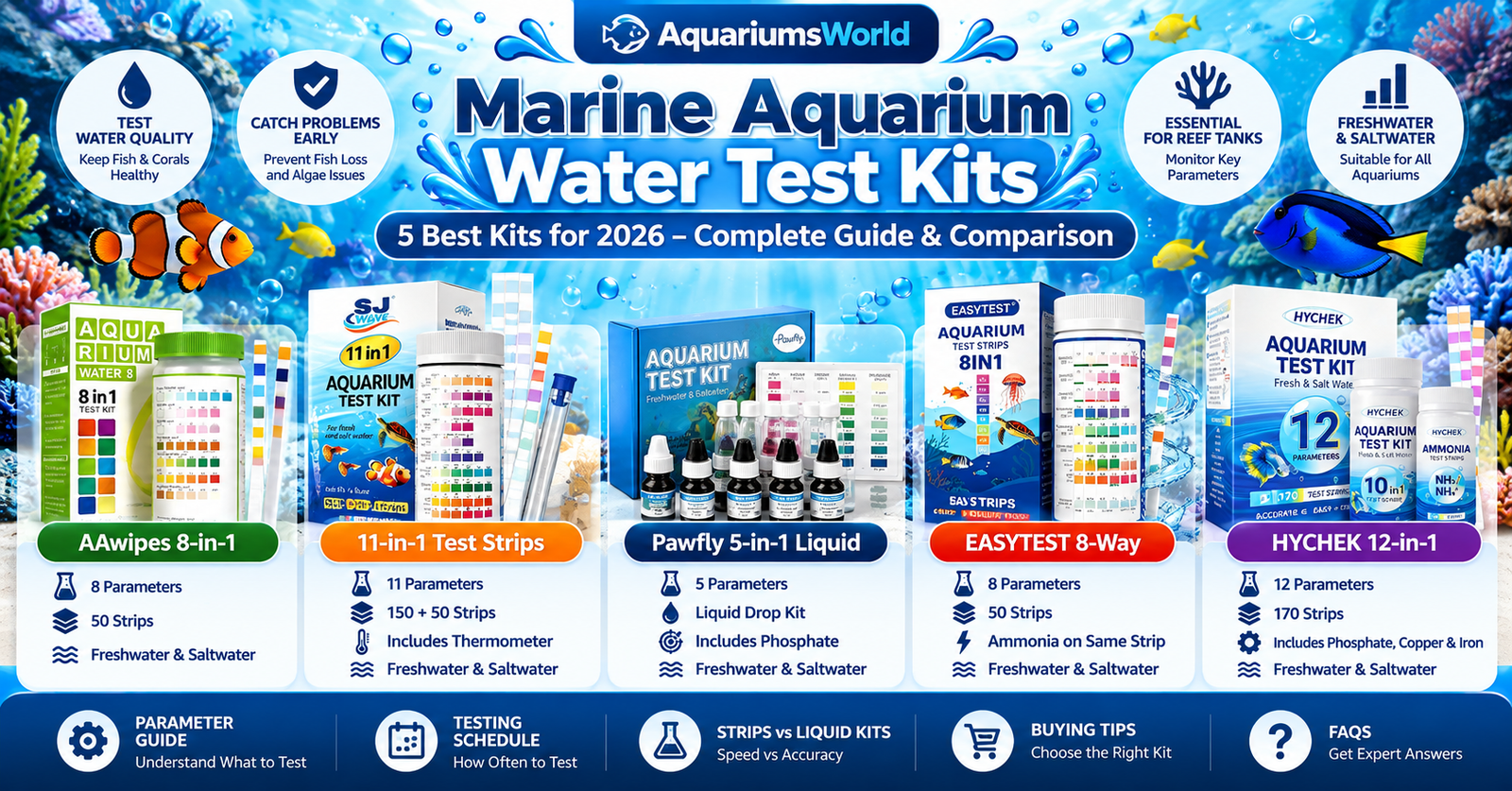
The following reviews use the product specifications and screenshots supplied for this article. They are product-information reviews, not claims of independent laboratory testing or hands-on comparative testing. Product prices, listing details, availability, packaging and seller claims can change, so confirm the live Amazon listing before purchasing.
Product 1 — AAwipes 8-in-1 Aquarium Test Kit
Best suited to: routine multi-parameter screening on a budget
AAwipes 8-in-1 aquarium test kit product screenshot. Replace this image source with the corresponding.
Buy Now
https://link.amazon/B0fIH4mWX
| Product | AAwipes 8-in-1 Aquarium Test Kit |
|---|---|
| Parameters listed | Free chlorine, nitrate, nitrite, hardness, carbonate, total alkalinity, pH and ammonia |
| Quantity | 50 strips |
| Use | Advertised for freshwater and saltwater aquariums |
| Ammonia format | Separate ammonia strip, according to the supplied product details |
| ASIN | B0D2RG3LXR |
The AAwipes 8-in-1 is a general-purpose strip kit for keepers who want several routine readings in one package. Its listed parameters include the core nitrogen-cycle measurements of ammonia, nitrite and nitrate, alongside pH, hardness, carbonate, alkalinity and free chlorine. This coverage may be useful for freshwater maintenance and basic screening in a saltwater aquarium.
Its main practical advantage is convenience. A strip format can make it easier to maintain a regular testing habit, particularly for beginners who find multi-step liquid tests time-consuming. The separate ammonia strip is an important detail, however. The keeper should expect to follow the separate procedure for ammonia rather than assuming one strip measures all eight listed parameters simultaneously.
For marine use, the product should be viewed as a supplementary screening kit rather than a complete reef chemistry solution. The supplied parameter list does not include salinity, calcium or magnesium. A reef keeper will need dedicated tests or instruments for those measurements. The listing’s stated accuracy and timing instructions should be checked directly on the package, and unexpected readings should be confirmed before making substantial changes.
Best fit: A beginner or established aquarium keeper who wants a straightforward set of general water checks and understands that specialist marine measurements require additional equipment.
Check AAwipes on AmazonProduct 2 — 11-in-1 Aquarium Test Strips with Thermometer
Best suited to: multi-parameter strip testing and bundled accessories
11-in-1 aquarium test kit screenshot showing the strip kit and included accessories. BUY NOW
| Product | 11-in-1 Aquarium Test Strips with Thermometer |
|---|---|
| Parameters listed | Ammonia, pH, iron, chlorine, GH, carbonate, nitrate, nitrite, total alkalinity and additional listed measurements |
| Quantity | 150 standard strips plus 50 separate ammonia strips |
| Extras | Thermometer and digital ebook, according to supplied details |
| Use | Advertised for freshwater and saltwater aquariums |
| ASIN | B0DBQW4J8D |
This kit combines a broad strip-based parameter list with a thermometer and digital guide. The supplied package details indicate 150 standard strips plus 50 separate ammonia strips. That is 200 physical strips in total; the number of individual parameter readings obtainable depends on how many measurements each strip provides and how the ammonia strips are used.
Iron testing can be relevant to planted freshwater aquariums, while ammonia, nitrite, nitrate and pH are useful for general water-quality screening. For saltwater keepers, the thermometer is a convenient accessory, although temperature should still be checked with a reliable instrument and compared against the needs of the livestock.
The product’s broad parameter count should not be mistaken for complete reef coverage. The supplied details do not list dedicated salinity, calcium or magnesium testing. If the aquarium contains corals, these measurements should be handled separately. The same caution applies to interpreting strip results near a critical threshold: repeat unexpected readings and use a suitable confirmatory test where the decision matters.
Best fit: A multi-tank household or beginner who values a larger supply of strips and bundled accessories for regular general testing.
Check the 11-in-1 Kit on AmazonProduct 3 — Pawfly 5-in-1 Aquarium Water Master Liquid Test Kit
Best suited to: liquid-reagent testing of core water parameters
| Product | Pawfly 5-in-1 Aquarium Water Master Test Kit |
|---|---|
| Parameters listed | pH, nitrite, nitrate, ammonia and phosphate |
| Format | Liquid drop colourimetric kit |
| Use | Advertised for freshwater and saltwater aquariums |
| ASIN | B0FWBCFY1B |
The Pawfly kit differs from the other products in this comparison because it uses liquid reagents rather than test strips. Its listed parameters cover ammonia, nitrite, nitrate and pH, with phosphate included as an additional measurement. This combination makes it relevant to keepers who want to monitor nitrogen-cycle indicators and phosphate without relying exclusively on a multi-parameter strip.
Liquid testing involves more steps. The user must measure the correct water volume, add the specified reagent quantity, mix as directed and wait for the required reaction time. The result is then compared with the supplied chart or reading system. The process takes longer than dipping a strip, but the method can be useful when a keeper wants a more controlled test procedure.
Do not interpret “liquid” as an automatic guarantee of higher accuracy. Performance depends on the kit’s detection range, reagent condition, sample technique and the user’s ability to follow the instructions. The supplied product information does not establish independent comparative accuracy against other brands, so this review does not claim that the kit is the most accurate available.
For reef use, phosphate is a useful inclusion, but the listed parameters do not include alkalinity, calcium, magnesium or salinity. A reef keeper should therefore combine this kit with dedicated marine tests where required. During cycling, use the ammonia and nitrite results as part of a repeated trend rather than relying on a single test.
Best fit: Keepers who prefer a liquid-reagent method for core nitrogen-cycle checks and want phosphate included in the same kit.
Check Pawfly on AmazonProduct 4 — EASYTEST 8-Way Aquarium Test Strips with Ammonia
Best suited to: one-strip routine screening across listed parameters
EASYTEST 8-Way aquarium test strips product screenshot. BUY NOW
| Product | EASYTEST 8-Way Aquarium Test Strips |
|---|---|
| Parameters listed | Ammonia, pH, hardness (GH), alkalinity (KH), chlorine, nitrate, nitrite and carbonate |
| Quantity | 50 strips |
| Key format detail | Ammonia is listed as integrated on the strip |
| Use | Advertised for freshwater and saltwater aquariums |
| ASIN | B0H6FPLDCQ |
The EASYTEST 8-Way kit is designed around a compact strip-based procedure. Its supplied parameter list includes ammonia, pH, hardness, alkalinity, chlorine, nitrate, nitrite and carbonate. The key practical distinction from a kit that supplies ammonia separately is that the listing describes ammonia as part of the same strip.
For a keeper who wants a fast routine check, an integrated strip can simplify the sequence. It may be convenient before a water change, after routine maintenance or when checking a tank’s general trend. The 50-strip quantity is straightforward to understand, although the value per test should be compared against the actual purchase price and how frequently the keeper plans to test.
As with other strips, the user should follow the exact dip time and individual pad reading times. Keep the bottle dry, compare colours under neutral light and repeat unexpected results. The kit does not list salinity, calcium or magnesium, so it should not be treated as a complete reef chemistry kit. A separate salinity instrument remains important for marine systems.
The product’s advertised compatibility with saltwater is useful context, but it does not establish that every listed parameter has the same resolution as a specialist marine test. For important decisions, especially during cycling or when diagnosing a problem, confirm results with an appropriate method.
Best fit: Aquarists who prioritise a simple strip routine with ammonia included on the same strip.
Check EASYTEST on AmazonProduct 5 — HYCHEK 12-in-1 Accurate Aquarium Test Kit
Best suited to: broad strip-based parameter coverage
| Product | HYCHEK 12-in-1 Accurate Aquarium Test Kit |
|---|---|
| Parameters listed | Ammonia, phosphate, pH, nitrate, nitrite, iron, copper, chlorine, carbonate, total alkalinity, hardness and additional listed measurement(s) |
| Quantity | 170 strips, according to supplied product details |
| Use | Advertised for freshwater and saltwater aquariums |
| ASIN | B0GSSQ2HR8 |
The HYCHEK kit is presented as a broad-coverage strip product. The supplied information lists ammonia, phosphate, pH, nitrate, nitrite, iron, copper, chlorine, carbonate, total alkalinity and hardness, alongside an additional measurement to reach the advertised 12-in-1 count. Confirm the complete parameter list on the live packaging before purchase, particularly if one specific test is the reason for choosing this kit.
Phosphate and copper are notable inclusions in the supplied details. Phosphate monitoring can be relevant to reef nutrient management, while copper testing may be useful when investigating possible contamination or checking a system after copper-based medication has been used in a separate treatment or quarantine environment. Copper is especially important to handle carefully around sensitive invertebrates, but a general strip result should not be treated as a definitive clearance test unless the product’s range and sensitivity are appropriate for that decision.
The 170-strip quantity may suit keepers who test regularly or maintain more than one aquarium. However, physical strip count alone does not determine value. Compare price, usable shelf life, the number of tests for each parameter, and whether the kit measures the specific compounds your aquarium requires.
The product information supplied for this article includes a laboratory-validation statement from the seller. That statement is not presented here as independent verification. For critical readings, follow the manufacturer’s method and confirm results with a suitable test. The supplied list does not include dedicated salinity, calcium or magnesium testing, so reef keepers should plan for those separately.
Best fit: Keepers who want broad strip-based screening, including listed phosphate and copper measurements, and who will verify any result that drives a significant livestock or chemistry decision.
Check HYCHEK on AmazonFull Product Comparison Table
| Product | Listed parameters | Quantity / format | Phosphate | Copper | Iron | Potential use | Amazon |
|---|---|---|---|---|---|---|---|
| AAwipes 8-in-1 | 8 | 50 strips; separate ammonia strip | Not listed | Not listed | Not listed | General routine screening | View product |
| 11-in-1 + thermometer | 11 advertised | 150 standard + 50 ammonia strips | Not listed | Not listed | Listed | General testing and bundled accessories | View product |
| Pawfly 5-in-1 | 5 | Liquid drop kit | Listed | Not listed | Not listed | Liquid testing of core parameters and phosphate | View product |
| EASYTEST 8-Way | 8 | 50 strips; ammonia integrated | Not listed | Not listed | Not listed | Quick, one-strip routine screening | View product |
| HYCHEK 12-in-1 | 12 advertised | 170 strips | Listed | Listed | Listed | Broad strip screening, including listed phosphate and copper | View product |
Important comparison limitation: The table compares supplied product specifications, not independently measured accuracy, detection limits or cost per completed test. The exact value of a kit depends on its current price, instructions, usable shelf life, test range and the parameters your aquarium actually needs.
Which Marine Aquarium Test Kit Should You Buy?
New marine tank / cycling
Prioritise ammonia, nitrite, nitrate and pH. A liquid kit such as Pawfly may suit keepers who prefer reagent-based testing. A strip kit can provide convenient supplementary checks. Confirm critical results and do not add livestock until cycling is verified.
Established FOWLR aquarium
A general strip kit may support routine screening of nitrogen-cycle parameters and pH. Monitor salinity separately with a suitable instrument. Increase testing after new livestock, feeding changes or filtration problems.
Mixed reef aquarium
Choose a general kit for routine screening, then add dedicated alkalinity, calcium, magnesium and salinity tests. A product listing phosphate may help, but confirm its range and resolution match your reef-management needs.
SPS-dominant reef
Prioritise repeatability and stable alkalinity monitoring. A multi-parameter strip should not be the only tool used to guide dosing or diagnose rapid changes in reef chemistry.
Multi-tank household
Compare total strip quantity, the number of tests available for each parameter, shelf life and price. A larger pack may be convenient, but only if the tests match the aquariums you maintain.
Need phosphate or copper screening
Pawfly lists phosphate in its liquid kit, while HYCHEK lists phosphate and copper among its strip parameters. Check test range and suitability before using a result for sensitive livestock decisions.
For most keepers, the practical choice is not necessarily one kit for every purpose. A general strip kit can support frequent screening, while dedicated tests address parameters that matter most to the particular aquarium. The best arrangement is the one you can use correctly and consistently, with clear instructions and a plan for confirming unexpected results.
When planning a marine setup, also consider circulation and equipment reliability. The marine tank stand and equipment guide discusses practical system planning, while the air pump and aeration guide provides additional equipment context. If you are comparing aquarium styles, see the aquarium types and setup resource.
Frequently Asked Questions
1. What is the best marine aquarium water test kit?
There is no single best kit for every marine aquarium. The appropriate choice depends on whether you need routine strip screening, liquid testing for nitrogen-cycle parameters, or dedicated reef measurements such as alkalinity, calcium, magnesium and phosphate. Compare the actual parameter list and test range with your aquarium’s needs rather than choosing by the number printed on the package.
2. What water parameters should I test in a saltwater aquarium?
At minimum, monitor ammonia, nitrite, nitrate, pH, salinity and temperature. Reef aquariums generally require additional monitoring of alkalinity, calcium, magnesium and phosphate. The frequency depends on tank age, livestock, coral load, dosing and how stable previous readings have been.
3. How often should I test my marine aquarium water?
During cycling, test ammonia and nitrite frequently—often daily—while tracking nitrate and pH. Established FOWLR systems may begin with weekly checks. Reef tanks need more frequent testing of alkalinity and other consumed parameters, especially when coral growth or dosing demand is changing. Test promptly after major changes or signs of distress.
4. Are aquarium test strips accurate enough for saltwater tanks?
They can be useful for routine screening, but accuracy and resolution vary by product and parameter. Follow the manufacturer’s timing and storage instructions, read colours under consistent neutral lighting, and confirm unexpected or decision-critical results with an appropriate test. Strips do not automatically replace dedicated reef tests or a calibrated salinity instrument.
5. Are liquid aquarium test kits more accurate than strips?
Liquid kits often provide a more controlled procedure for specific parameters, but format alone does not guarantee accuracy. Reagent condition, sample volume, timing, detection range and user technique all matter. Choose a test based on its stated performance and intended use, then follow the instructions precisely.
6. What test kit should I buy for a new saltwater aquarium cycle?
Prioritise ammonia, nitrite, nitrate and pH testing, plus separate temperature and salinity monitoring. A liquid kit can be useful when confirming results during cycling, while strips may offer convenient supplementary checks. Continue testing until the biological filter is established and the cycle is verified before adding livestock.
7. Do aquarium test strips measure salinity?
Not all test strips measure salinity, and none of the five product parameter lists supplied for this article identifies a dedicated salinity test. Use a suitable, calibrated refractometer or digital salinity instrument and follow its calibration instructions. Do not infer salinity from hardness, carbonate or total alkalinity readings.
8. Which test kit includes phosphate testing?
Based on the supplied product details, Pawfly’s 5-in-1 liquid kit lists phosphate, and HYCHEK’s 12-in-1 kit also lists phosphate. Check the current product packaging for the exact test range and method. A reef keeper should choose a test capable of measuring the concentrations relevant to their maintenance goals.
9. Do I need calcium and magnesium tests for a fish-only marine aquarium?
Fish-only systems generally do not consume calcium and magnesium at the same rate as coral-containing reef aquariums, but water chemistry still needs to remain suitable and stable. If you keep corals, coralline algae or other calcifying organisms, calcium and magnesium monitoring becomes more relevant. Water changes and system-specific demand influence how often these tests are needed.
10. Can I use a freshwater aquarium test kit in a saltwater aquarium?
Only if the manufacturer states that the kit is suitable for saltwater and the test’s method and range are appropriate. Some general aquarium tests are marketed for both freshwater and saltwater, but suitability can vary by parameter. Always verify the package instructions and use dedicated marine instruments for measurements such as salinity.
11. What should I do if my aquarium test result is unexpected?
Repeat the test with a fresh sample, confirm that the kit is within its expiry date, and check sample volume and reaction time. If the result remains unusual, use an appropriate confirmatory method. Observe fish and invertebrates, review recent maintenance and equipment changes, and avoid making large chemical corrections based on one uncertain reading.
12. Should I test aquarium water before every water change?
Testing before a water change can help you understand the tank’s current condition and evaluate whether the maintenance routine is working. It is particularly useful when establishing a new aquarium, managing a reef or investigating recurring problems. For stable systems, follow a consistent schedule and test more frequently when circumstances change.
13. Is phosphate always bad in a reef aquarium?
No. Phosphate is a nutrient and is present in marine ecosystems. The goal is to keep it controlled and stable for the livestock and system, not necessarily to force it to zero. Excessive phosphate can contribute to nuisance algae and affect calcification, while extremely low nutrient availability can also be problematic in some reef systems.
14. Why does alkalinity matter in a reef tank?
Alkalinity reflects the water’s buffering capacity and is linked to carbonate chemistry. Corals and other calcifying organisms use carbonate and calcium during skeletal growth, so alkalinity can decline as demand increases. Monitor it consistently and adjust dosing based on measured consumption rather than making large changes from a single reading.
15. Can a test kit tell me why my fish are sick?
A test kit can identify some water-quality problems, but it cannot diagnose every disease or injury. Begin by checking ammonia, nitrite, nitrate, pH, temperature and salinity, then review behaviour, recent additions, aggression, feeding and equipment. Persistent illness or severe symptoms may require advice from an aquatic veterinarian or qualified fish-health professional.
Conclusion: Build a Consistent Testing Routine
Marine aquarium water testing is a practical part of responsible fish and coral care. It makes invisible changes measurable, helps track biological filtration and provides evidence for maintenance decisions. A reliable routine is more useful than occasional testing performed only after a problem becomes obvious.
The five products reviewed here offer different approaches. AAwipes, the 11-in-1 kit, EASYTEST and HYCHEK use strips, while Pawfly uses liquid reagents. Their supplied parameter lists differ, so the right choice depends on which readings you need, how often you test and whether you require dedicated reef measurements.
For a new aquarium, prioritise ammonia, nitrite, nitrate and pH while monitoring salinity and temperature separately. For reef systems, add suitable tests for alkalinity, calcium, magnesium and phosphate. Confirm unexpected results, keep a log and avoid rapid corrections based on uncertain measurements.
Use the product links above to review current listing details and package instructions. For wider aquarium maintenance support, explore the AquariumsWorld blog archive, our aquarium problems and solutions guide and the Aquarium Stocking Calculator.
References
The references below are included as further reading. They are not inserted as inline citation markers in the article. Confirm bibliographic details and relevance before publication, particularly where a source is being used to support a specific numerical husbandry recommendation.
- Bahr, et al. (2025). Coral calcification and calcium-related research. ICES Journal of Marine Science. DOI: 10.1093/icesjms/fsaf050.
- Murillo, L.J.A., Jokiel, P.L. and Atkinson, M.J. (2014). Alkalinity to calcium flux ratios for corals and coral reef communities: variances between isolated and community conditions. PeerJ, 2, e249. DOI: 10.7717/peerj.249.
- Oceans (2021). Research on magnesium, calcium and carbonate ratios in marine systems. Oceans. DOI: 10.3390/oceans2010012.
- Jory (2026). Ammonia, nitrite and nitrate toxicity discussion. Global Seafood Alliance – Advocate. Website: Global Seafood Alliance Advocate.
- Bagchi, et al. (2014). Research on ammonia-oxidising bacteria. PLoS ONE. DOI: 10.1371/journal.pone.0113515.
- Preena, et al. (2021). Research on nitrification in recirculating aquaculture systems. Reviews in Aquaculture. DOI: 10.1111/raq.12558.
- Langdon, C. and Atkinson, M.J. (2005). Coral calcification and carbonate chemistry research. DOI: 10.1029/2004JC002576.
- Animals (2023). Research concerning fish welfare in captive environments. DOI: 10.3390/ani13162548.
For more aquarium care resources, visit AquariumsWorld.