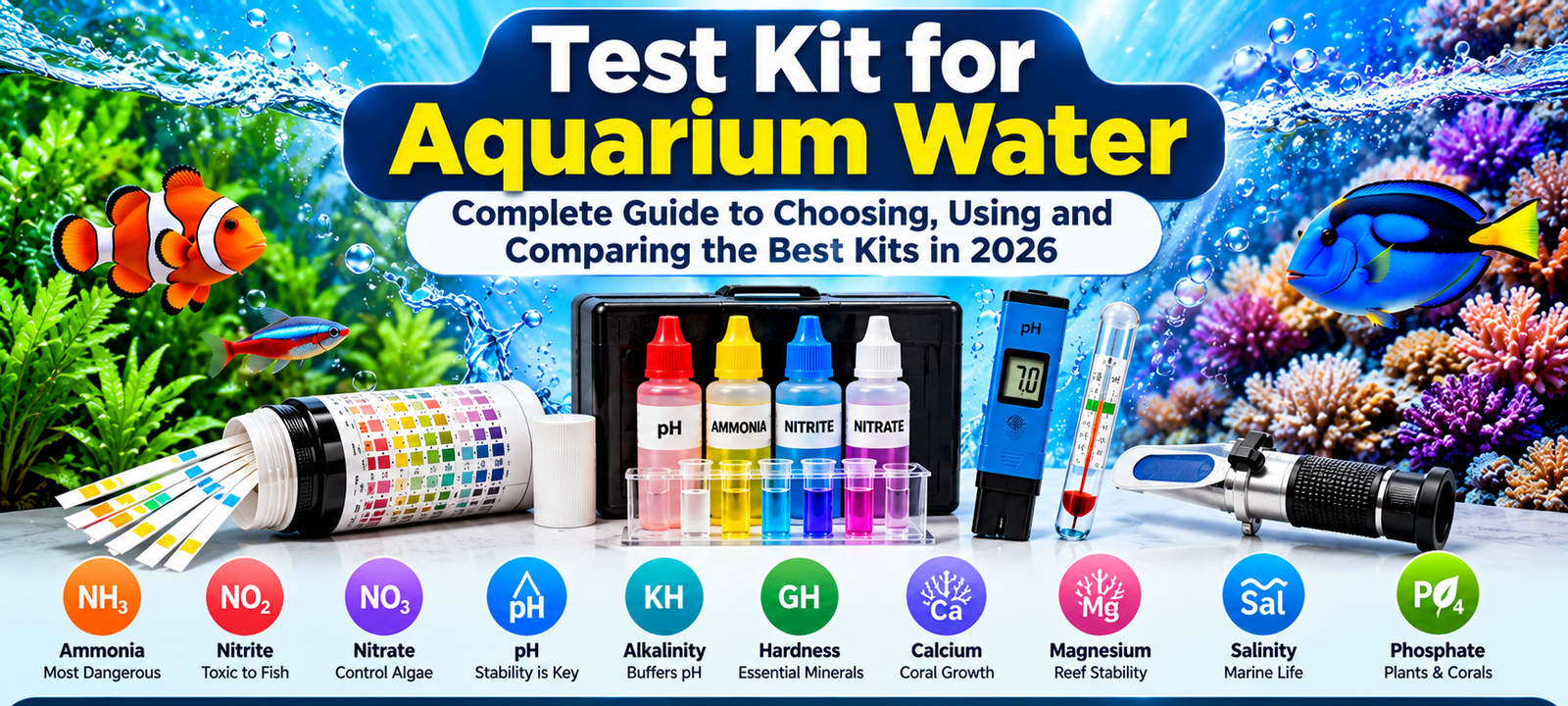
Choosing a test kit for aquarium water is one of the most practical steps you can take to protect fish, plants and corals. Clear water does not always mean safe water. Ammonia, nitrite, nitrate, pH shifts and other chemistry problems can develop before visible symptoms appear.
This guide explains which aquarium water parameters matter, how often to test, how strips compare with liquid kits, and how to interpret results. It also compares five aquarium test kits using the product specifications supplied for this review, with direct Amazon links for readers who want to check current availability.
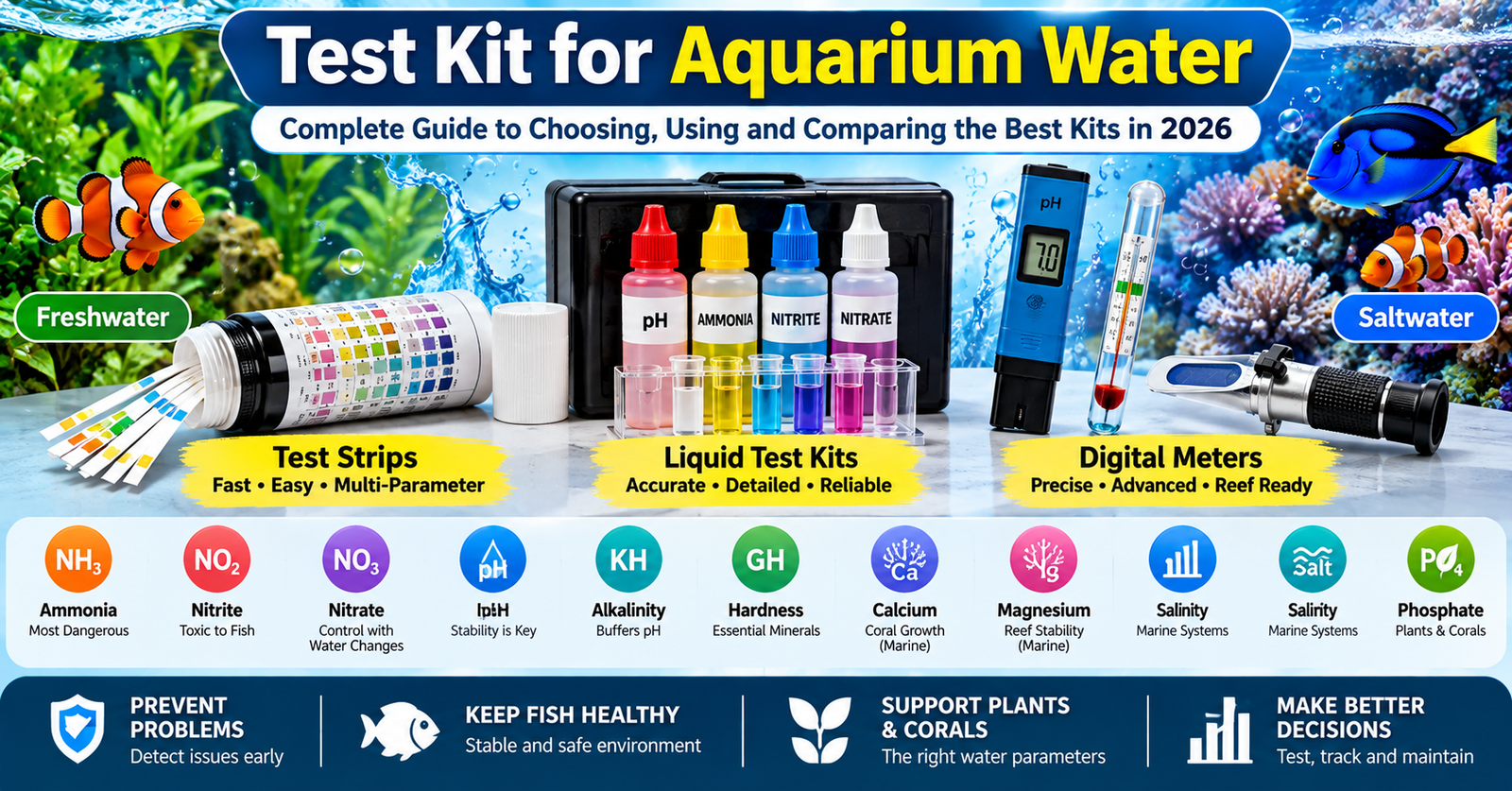
Why Testing Aquarium Water Matters
Aquarium water is a living chemical environment. Fish release waste, uneaten food decomposes, plants absorb nutrients, and microorganisms transform nitrogen compounds. These processes continue even when the water looks clean. Testing gives the aquarist information that eyesight alone cannot provide.
The most urgent reason to test is the nitrogen cycle. Fish waste and decomposing organic material can produce ammonia. Beneficial microorganisms in an established biological filter convert ammonia into nitrite and then nitrate. Ammonia and nitrite are dangerous to fish, while nitrate is generally managed through water changes, plant uptake and suitable maintenance.
A new aquarium may not yet contain a mature microbial community capable of processing the waste produced by its inhabitants. Testing during cycling helps the keeper track whether ammonia and nitrite are being processed. It also helps identify a stalled or disrupted cycle after major filter maintenance, medication, overstocking or a sudden increase in feeding.
Testing remains important after a tank is established. A mature aquarium can still experience a problem if a filter stops, a fish dies unnoticed, the aquarium is overfed, or a large amount of biological media is replaced. A water test can reveal a change before fish show obvious distress.
For additional troubleshooting, see the AquariumsWorld guide to fish aquarium problems and solutions. It discusses common concerns such as cloudy water, algae, pH imbalance and fish-health symptoms. When a problem appears, testing is a useful first step rather than guessing at a treatment.
Testing is prevention, not just diagnosis
Some aquarists only test when fish behave unusually. That approach can miss gradual changes. A simple routine creates a baseline for the aquarium, making it easier to recognise when a result differs from the tank’s normal pattern.
For example, a nitrate reading that rises gradually over several weeks may indicate that feeding, stocking, plant growth or water-change frequency needs review. A sudden ammonia reading may suggest a biological filtration problem or excess decomposing material. Neither result should be interpreted in isolation; consider livestock, recent maintenance and the trend over time.
Water testing also supports responsible stocking. Before adding more fish, use the Aquarium Stocking Calculator alongside filtration capacity, adult fish size and compatibility. A test kit can reveal water-quality stress, but it cannot make an overstocked aquarium suitable by itself.
Which Aquarium Water Parameters Should You Test?
The correct parameters depend on the aquarium type. A freshwater community aquarium, planted tank, fish-only saltwater system and coral reef aquarium do not have identical testing needs. Start with the parameters that protect the livestock and support the biological filter, then add specialised tests where the setup requires them.
Essential parameters for most freshwater aquariums
| Parameter | Why it matters | General testing priority | Important note |
|---|---|---|---|
| Ammonia (NH₃/NH₄⁺) | Indicates waste accumulation or insufficient biological processing. | Very high during cycling; test immediately if fish show distress. | Interpretation depends on pH, temperature and the test method. |
| Nitrite (NO₂⁻) | Tracks the intermediate stage of the nitrogen cycle. | Very high during cycling; monitor after filter disruption. | Detectable nitrite in an occupied aquarium warrants investigation. |
| Nitrate (NO₃⁻) | Helps assess nutrient accumulation and maintenance effectiveness. | Weekly or according to stocking and water-change routine. | Appropriate levels vary by livestock and planted-tank goals. |
| pH | Measures acidity or alkalinity and influences biological processes. | Weekly during routine care; more often when unstable. | Stability and species requirements matter more than chasing a universal number. |
| General hardness (GH) | Indicates dissolved mineral content, especially calcium and magnesium. | When setting up a tank or keeping species with specific mineral needs. | Useful for matching water to livestock and understanding mineral conditions. |
| Carbonate hardness / alkalinity (KH) | Provides buffering capacity that helps resist rapid pH changes. | Periodically; more often where pH stability is a concern. | KH and pH are related but are not interchangeable measurements. |
Additional parameters for planted aquariums
Planted aquariums may require additional attention to nitrate, phosphate, iron and other nutrients, particularly when plant growth is poor or algae is persistent. A nutrient test can help distinguish between a suspected deficiency and a different problem such as inadequate light, unstable carbon dioxide supply or unsuitable substrate conditions.
Do not automatically add fertiliser because a single test result is low. Test kits vary in resolution, and nutrient availability depends on the whole system. Consider plant growth, lighting duration, livestock load, fertiliser schedule and recent water changes together.
For larger or planted systems, the AquariumsWorld guides to 20-gallon aquarium setup and 50-gallon aquarium equipment provide further context for choosing equipment and planning maintenance.
Additional parameters for saltwater and reef aquariums
Marine aquariums have additional chemistry considerations. Salinity is commonly monitored using a refractometer or a suitable salinity meter rather than relying on a general multi-parameter strip. Reef aquariums also commonly monitor alkalinity, calcium, magnesium and phosphate because these parameters influence coral growth, nutrient balance and overall stability.
| Marine parameter | Why reef keepers monitor it | Testing approach |
|---|---|---|
| Salinity / specific gravity | Maintains the appropriate dissolved-salt environment for marine livestock. | Use a calibrated refractometer or reliable salinity instrument. |
| Alkalinity | Supports carbonate chemistry and helps track consumption in coral systems. | Use a reef-appropriate test with suitable resolution; test more frequently when consumption is high. |
| Calcium | Important for calcifying organisms, including many stony corals. | Monitor alongside alkalinity rather than adjusting one parameter blindly. |
| Magnesium | Contributes to seawater chemistry and helps maintain a stable ionic balance. | Test periodically and when calcium or alkalinity behaves unexpectedly. |
| Phosphate | Part of nutrient management; elevated levels can contribute to unwanted algae and affect reef conditions. | Use a method with resolution appropriate to reef-keeping goals. |
For marine setup context, read the 30-gallon marine aquarium guide and the marine fish tank stand and size guide. The latter is useful when planning a system’s physical setup, while water testing remains a separate part of ongoing care.
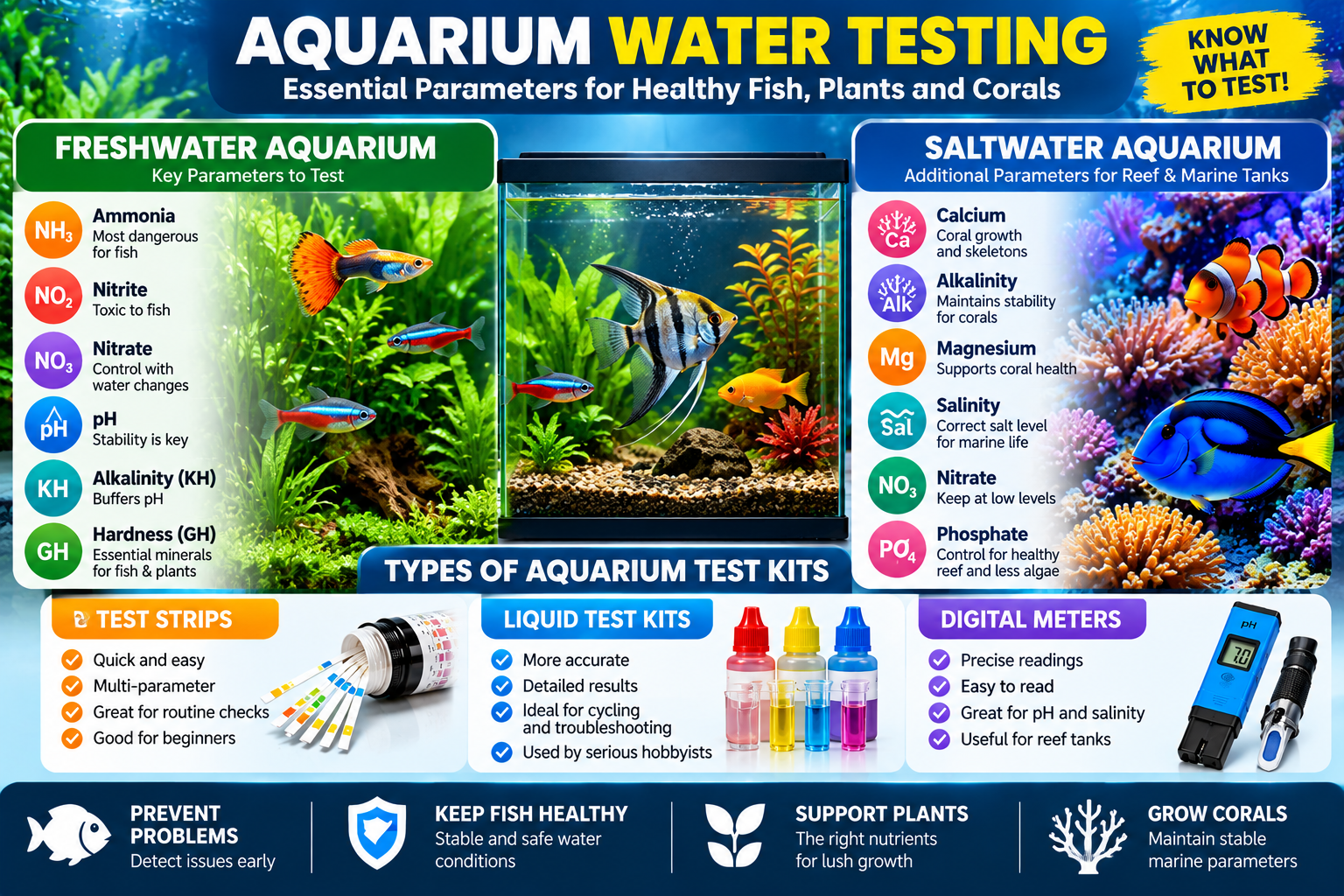
Types of Test Kit for Aquarium Water
Aquarium test kits generally use test strips, liquid reagents, electronic meters or laboratory analysis. Each method has a different balance of speed, cost, resolution and convenience. No single format is automatically the right choice for every parameter or aquarium.
1. Aquarium test strips
Test strips use reagent pads that change colour when exposed to a water sample. They are convenient for routine screening because the procedure is usually quick and requires little equipment. Multi-parameter strips can test several readings from one sample, depending on the product design.
Strips are particularly useful for hobbyists who want a quick overview, maintain several aquariums or prefer a compact kit. They can also encourage consistent testing because the process is simple enough to fit into a regular maintenance routine.
The main limitation is that colour matching can be subjective. Lighting, timing, strip storage and the spacing between colour-chart values can affect interpretation. A strip may be suitable for a broad screening check but not provide the resolution required for a sensitive diagnostic decision.
2. Liquid reagent kits
Liquid kits typically require a measured water sample and a specified number of reagent drops. After mixing and waiting for the stated reaction time, the user compares the sample with a colour chart or reads it using a supplied comparator.
Liquid kits often provide more detailed colour scales for selected parameters than broad multi-parameter strips. They are commonly used for cycling and troubleshooting because ammonia, nitrite and nitrate readings are especially important when a tank is new or its biological filter may be compromised.
They do require more time, careful measurement and reagent storage. The user must follow the test sequence precisely and avoid cross-contamination between bottles, caps and sample tubes.
3. Digital meters and checkers
Digital instruments can reduce subjective colour matching for the parameter they measure. Examples include pH meters, conductivity or salinity instruments, and dedicated photometers or checkers for selected water-chemistry tests.
Digital equipment is not automatically maintenance-free. Instruments may require calibration, clean probes, fresh batteries, suitable storage and periodic verification. A poorly maintained meter can provide a precise-looking but inaccurate reading.
4. Laboratory water analysis
Some advanced aquarists use laboratory analysis to investigate a broader range of dissolved elements or confirm unusual results. Laboratory testing can be useful for complex reef systems or persistent problems that routine hobby kits do not explain.
It is usually not a replacement for routine home testing. Samples take time to prepare and send, and results describe the sample at the time it was collected. A home kit remains useful for tracking rapid changes between laboratory tests.
Test Strips vs Liquid Aquarium Test Kits: Which Is Better?
The best choice depends on the purpose of the test. Strips offer speed and convenience, while liquid kits can offer more detailed readings for selected parameters. A practical aquarium may use both: strips for a quick screening routine and liquid tests when a result needs closer investigation.
| Consideration | Test strips | Liquid reagent kits |
|---|---|---|
| Speed | Usually faster and simpler. | Usually takes longer due to measuring, adding reagents and waiting. |
| Convenience | Compact and easy to store. | Requires bottles, tubes and careful handling. |
| Reading method | Compare multiple reagent pads with a chart. | Compare a reacted sample with a chart or comparator. |
| Best use | Routine screening and quick checks. | Cycle monitoring, troubleshooting and more detailed testing. |
| Common limitation | Colour interpretation and chart resolution. | Timing, sample measurement and reagent handling. |
Do not assume that a kit is accurate simply because it tests many parameters. Check whether the product includes the parameters your aquarium needs, whether the instructions are clear, and whether the scale has useful increments for your purpose.
How Often Should You Test Aquarium Water?
Testing frequency should reflect aquarium maturity, stocking, feeding, maintenance history and livestock sensitivity. A newly cycling aquarium needs more frequent monitoring than a stable, lightly stocked tank. A reef aquarium with rapidly growing corals may also need more frequent testing of consumed parameters than a fish-only marine setup.
| Aquarium situation | Suggested monitoring approach | Parameters to prioritise |
|---|---|---|
| New tank during cycling | Test frequently, often daily or according to the cycling method and livestock situation. | Ammonia, nitrite, nitrate and pH. |
| Newly stocked aquarium | Monitor closely during the first weeks and after each significant livestock addition. | Ammonia, nitrite and nitrate. |
| Established freshwater community | Weekly testing is a practical routine; adjust based on results and tank stability. | Ammonia, nitrite, nitrate and pH; GH/KH where relevant. |
| Planted aquarium | Weekly or aligned with fertiliser and water-change schedules. | Nitrate, phosphate and selected nutrients when needed. |
| Fish-only marine aquarium | Routine weekly checks, with additional testing after changes or livestock stress. | Ammonia, nitrite, nitrate, pH and salinity. |
| Mixed reef aquarium | Test core parameters weekly; increase frequency when dosing or consumption changes. | Salinity, alkalinity, calcium, magnesium, nitrate and phosphate. |
| SPS-dominant reef | Frequent alkalinity monitoring may be needed, especially with active dosing. | Alkalinity, calcium, magnesium, salinity and nutrients. |
| After a filter interruption or major cleaning | Test promptly and continue monitoring until readings stabilise. | Ammonia and nitrite first; nitrate and pH as supporting checks. |
These are starting points, not fixed rules for every aquarium. If fish show rapid breathing, unusual lethargy, loss of appetite or abnormal swimming, test immediately and investigate other possible causes. Do not wait for the next scheduled test.
How to Use a Test Kit for Aquarium Water Correctly
Correct technique is essential. A well-designed kit can still produce misleading results if the sample is contaminated, the reagent is expired or the colour is read outside the specified time window.
Step 1: Read the instructions before collecting the sample
Different products use different sample volumes, dip times, shaking procedures and reaction windows. Read the instructions before starting. Keep the colour chart nearby and confirm whether the kit requires the strip to be shaken, held horizontally or read after a specific number of seconds.
Step 2: Use a clean sample container
Use a container reserved for aquarium testing. Soap, detergent, hand cream or residue from another chemical can interfere with a test. Rinse the container with aquarium water before collecting the final sample, unless the kit instructions specify another method.
Step 3: Collect a representative sample
Take water from the aquarium rather than from a filter chamber containing unusual deposits or from a container that has been standing for an extended period. Avoid disturbing substrate or collecting debris unless you are intentionally testing a particular location.
Step 4: Follow the exact measurement and timing procedure
For strips, dip for the instructed duration, remove excess water as directed and compare the pads at the correct time. For liquid tests, use the stated sample volume and reagent count. Close bottles promptly and avoid touching reagent tips to the sample water.
Step 5: Read the result in suitable light
Use bright, neutral lighting where possible. Coloured aquarium lights can distort the appearance of test pads and liquid samples. Compare the result directly with the manufacturer’s chart rather than relying on memory.
Step 6: Record the reading
Keep a simple log containing the date, parameter, result, recent maintenance and any unusual fish behaviour. Trends are often more informative than a single number. If a result changes sharply, repeat the test with a fresh sample and verify it using another suitable method when practical.
Step 7: Respond to results carefully
Do not make large chemistry adjustments based on one uncertain result. Confirm unexpected readings, consider the aquarium’s livestock and follow appropriate care guidance. For urgent ammonia or nitrite concerns, prioritise fish safety, assess filtration and waste sources, and use properly conditioned water for any necessary water change.
Common Aquarium Water Testing Mistakes
Testing under coloured aquarium lighting
Blue, red or heavily tinted aquarium lighting can make colour matching difficult. Move the test card and sample to a neutral light source when reading results.
Using expired or poorly stored reagents
Reagents can deteriorate with age, heat, moisture or contamination. Check expiry information and storage directions. Keep bottles closed and store strips in their original sealed container with the cap secured.
Reading a test too early or too late
Colour reactions may continue developing after the sample is prepared. A reading outside the specified time window may not match the chart. Use a timer if the instructions require a precise wait.
Assuming every test kit measures the same parameters
“8-in-1” or “12-in-1” describes a count, not a universal standard. Compare the actual parameter list. Some kits include hardness or chlorine, while others include phosphate, iron or copper. A high parameter count does not guarantee that the kit includes the specific test your aquarium needs.
Confusing GH, KH and pH
These readings describe different aspects of water chemistry. pH measures acidity or alkalinity, GH relates to general mineral hardness, and KH describes carbonate hardness or alkalinity in common aquarium testing terminology. One cannot be substituted for another.
Ignoring test limitations
Some strips provide broad colour ranges, and some liquid kits have limited resolution at low concentrations. If a reading is critical or unexpected, confirm it using a method designed for that parameter and concentration range.
Changing several things at once
When troubleshooting, making many simultaneous changes can make it difficult to identify the cause of improvement or deterioration. Prioritise immediate animal welfare, document actions and retest to evaluate the result.
For equipment and setup planning, the 100-gallon fish tank guide explains equipment considerations for a larger aquarium. The 20-gallon setup guide provides a smaller-system comparison. Both reinforce that maintenance and testing should be matched to the system rather than selected by tank volume alone.
Five Aquarium Water Test Kits Compared
The following products are compared using the specifications supplied for this article. The comparison focuses on format, listed parameters, included quantity and potential use cases. It does not claim independent laboratory validation or guarantee that any kit will produce identical readings to another brand.
1. AAwipes 8-in-1 Aquarium Test Kit

For budget-conscious routine screening BUY NOW
AAwipes 8-in-1 Aquarium Test Kit — 50 Strips
ASIN: B0D2RG3LXR
Listed parameters: Free chlorine, nitrate, nitrite, hardness, carbonate, total alkalinity, pH and ammonia.
Quantity: 50 strips. The supplied product information indicates a separate ammonia strip and different reading times for selected parameters.
The AAwipes kit is a multi-parameter strip option for aquarists who want a compact routine screening tool. Its listed coverage includes several common freshwater measurements and ammonia. The separate ammonia strip is worth noting because it means the complete testing process may involve more than one strip.
For an established aquarium, a strip kit can help make routine checks convenient. However, during a new tank cycle or when an unexpected result appears, a strip reading should be interpreted within the limits of its chart and instructions. Consider confirming a critical ammonia or nitrite result with a suitable liquid test.
Potential fit: Beginners and established-tank keepers who prefer a quick multi-parameter screening routine. Confirm the product’s current instructions and parameter coverage before use in a specific marine or freshwater system.
2. 11-in-1 Aquarium Test Strips with Thermometer

For broader strip coverage and larger quantity BUY NOW
11-in-1 Aquarium Test Strips + Thermometer
ASIN: B0DBQW4J8D
Listed inclusions: Multi-parameter strips, separate ammonia strips, thermometer and digital ebook.
Quantity supplied: 150 standard strips plus 50 ammonia strips, according to the provided product details.
This kit combines a broad set of strip tests with a thermometer and a digital guide. The supplied parameter list includes ammonia, pH, iron, chlorine, general hardness, carbonate, nitrate, nitrite and total alkalinity, alongside the product’s stated additional coverage.
The separate ammonia strips should be counted independently from the standard strips when estimating how many complete tests the kit can provide. The product listing’s advertised total-test capacity may depend on which parameters are tested and how frequently each is used; readers should verify the manufacturer’s calculation before relying on it.
The included thermometer can be useful as a basic temperature-checking accessory, although users should compare it with a reliable aquarium thermometer if temperature accuracy is important. The ebook may help new hobbyists, but it does not replace the kit’s test instructions or species-specific care guidance.
Potential fit: Multi-tank households or hobbyists who want a large supply of strips and several routine readings in one package.
3. Pawfly 5-in-1 Aquarium Water Master Liquid Test Kit

Liquid testing for core water readings BUY NOW
Pawfly 5-in-1 Aquarium Water Master Test Kit
ASIN: B0FWBCFY1B
Listed parameters: pH, nitrite, nitrate, ammonia and phosphate.
Format: Liquid drop colourimetric kit.
The Pawfly kit differs from the other products in this comparison because it uses liquid reagents rather than dip strips. Its five listed parameters cover core nitrogen-cycle measurements and phosphate, making the parameter list relevant to both routine freshwater monitoring and selected marine or reef checks.
Liquid testing involves measuring a sample, adding the specified reagents and comparing the resulting colour with the supplied chart. This takes more time than a strip test, but the process may be useful when the aquarist wants a dedicated test for a particular reading. Accuracy still depends on correct sample volume, reagent condition, timing and colour interpretation.
Phosphate is a useful parameter for many planted and reef systems, but its interpretation depends on the aquarium’s livestock and nutrient-management approach. This kit does not replace dedicated salinity testing or a full reef chemistry set.
Potential fit: Aquarists who prefer liquid testing for ammonia, nitrite, nitrate and pH, and who also want a phosphate test included.
4. EASYTEST 8-Way Aquarium Test Strips with Ammonia

For an integrated multi-parameter strip BUY NOW
EASYTEST 8-Way Aquarium Test Strips
ASIN: B0H6FPLDCQ
Listed parameters: Ammonia, pH, hardness, alkalinity, chlorine, nitrate, nitrite and carbonate.
Quantity: 50 strips.
The EASYTEST 8-Way product is described as including ammonia on the same strip as its other listed measurements. That arrangement can simplify a routine check because the user does not need to use a separate ammonia strip for the advertised set of parameters.
Its parameter list overlaps with the AAwipes kit, so the decision between them should be based on the current instructions, strip design, price, storage requirements and the user’s preferred testing routine. A single-dip format may be convenient, but it does not automatically establish higher accuracy or better resolution.
As with all multi-parameter strips, follow the product’s exact timing and chart instructions. For a new aquarium cycle or a concerning result, consider confirmation with a dedicated liquid test where appropriate.
Potential fit: Hobbyists who want a straightforward strip-based routine and prefer ammonia to be included on the same strip.
5. HYCHEK 12-in-1 Accurate Aquarium Test Kit

For broad listed parameter coverage BUY NOW
HYCHEK 12-in-1 Aquarium Test Kit
ASIN: B0GSSQ2HR8
Listed parameters include: Ammonia, phosphate, pH, nitrate, nitrite, iron, copper, chlorine, carbonate, alkalinity and hardness, plus the product’s additional listed parameter.
Quantity: 170 strips.
The HYCHEK kit has the broadest stated parameter count among these five products. Its listed inclusion of phosphate, copper and iron may appeal to hobbyists who want a wider screening range from a strip-based kit. Copper testing can be particularly relevant when investigating possible contamination or managing equipment and treatment practices around sensitive invertebrates.
However, a copper strip result should not be treated as a substitute for a dedicated, appropriately sensitive copper test when a precise concentration is required. The same principle applies to phosphate and other parameters: check the chart’s increments and confirm that the method is suitable for the aquarium’s intended use.
The 170-strip quantity may be convenient for frequent testing, but actual cost per test depends on how many strips are used for each testing session and the current purchase price. Check the listing for the exact included items and current directions.
Potential fit: Aquarists who value broad listed coverage and want a strip kit that includes phosphate, iron and copper testing.
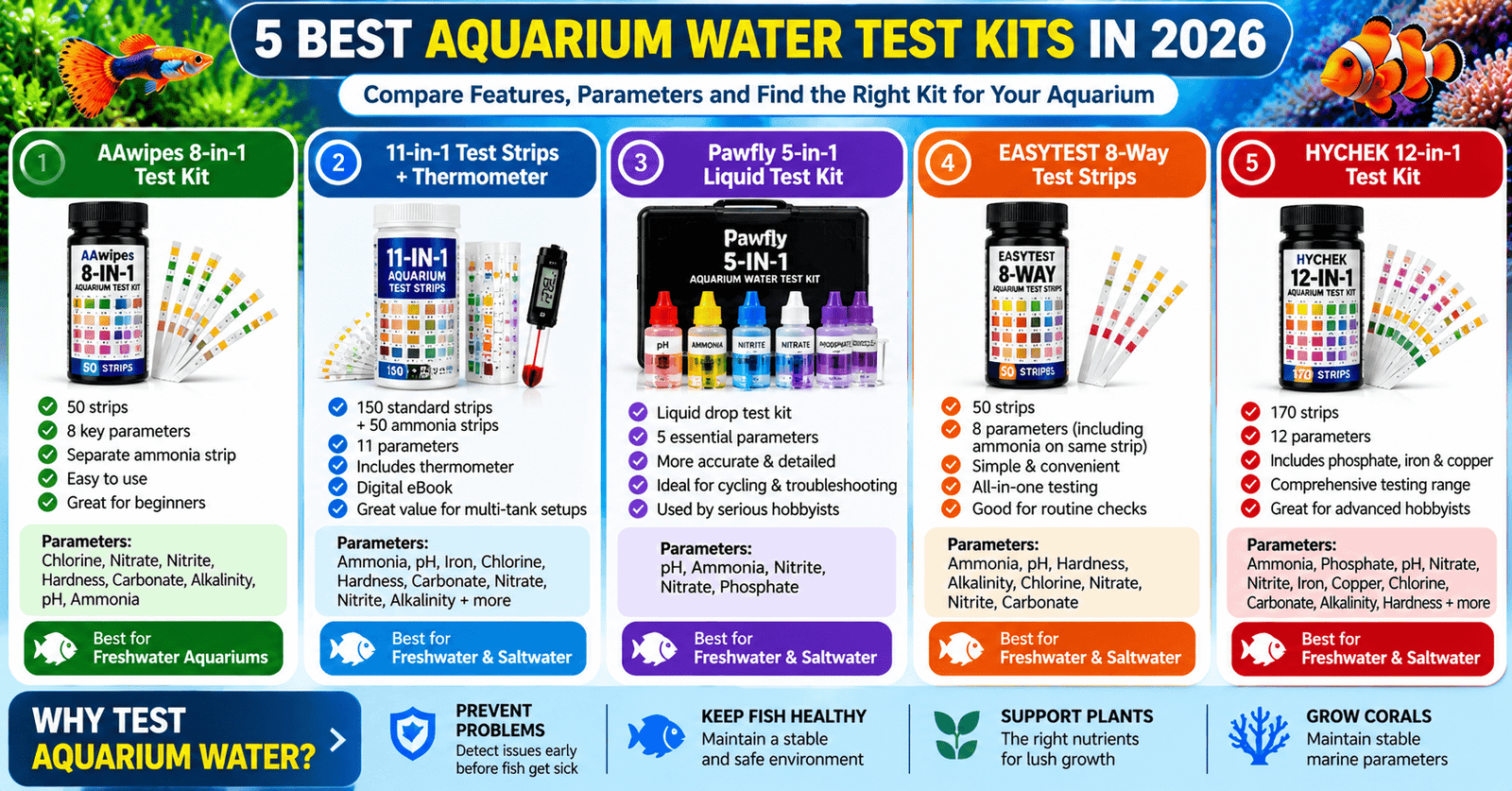
Full Aquarium Water Test Kit Comparison Table
| Product | Format | Listed coverage | Quantity | Potential use | Amazon |
|---|---|---|---|---|---|
| AAwipes 8-in-1 | Strips | Chlorine, nitrate, nitrite, hardness, carbonate, alkalinity, pH, ammonia | 50 strips | Routine multi-parameter screening | View product |
| 11-in-1 + thermometer | Strips plus accessory | Ammonia, pH, iron, chlorine, GH, carbonate, nitrate, nitrite, alkalinity and additional listed readings | 150 standard + 50 ammonia strips | Higher strip quantity and broad routine checks | View product |
| Pawfly 5-in-1 | Liquid drops | pH, nitrite, nitrate, ammonia, phosphate | Liquid reagent kit | Liquid testing for core readings and phosphate | View product |
| EASYTEST 8-Way | Strips | Ammonia, pH, hardness, alkalinity, chlorine, nitrate, nitrite, carbonate | 50 strips | Integrated multi-parameter strip testing | View product |
| HYCHEK 12-in-1 | Strips | Ammonia, phosphate, pH, nitrate, nitrite, iron, copper, chlorine, carbonate, alkalinity, hardness and additional listed reading | 170 strips | Broad listed parameter screening | View product |
Comparison note: The product descriptions above reflect the information supplied for this article. “Works for freshwater and saltwater” should not be interpreted as proof that every listed parameter is equally suitable for every marine or reef application. Confirm each test’s intended range, sensitivity and instructions before relying on it for livestock-critical decisions.
Which Test Kit for Aquarium Water Should You Choose?
Instead of selecting a kit only by its parameter count or advertised number of tests, begin with the aquarium you maintain and the readings you actually need.
If you are cycling a new aquarium
Prioritise ammonia and nitrite monitoring, with nitrate and pH as useful supporting measurements. A multi-parameter strip kit can provide a quick overview, while a dedicated liquid kit may be helpful when a critical reading needs closer confirmation. Follow a cycling method appropriate to your aquarium and do not add livestock until the system is ready.
If you maintain an established freshwater community
A straightforward strip kit may suit routine checks if its parameter list matches your needs. Consider whether you need hardness and alkalinity readings for your fish species or local water supply. Keep a log and test more often after stocking changes, filter interruptions or unusual fish behaviour.
If you keep a planted aquarium
Look for tests that support your nutrient-management approach. Nitrate and phosphate may be useful, while iron testing can be relevant for some fertilisation routines. Do not use a nutrient reading as the sole basis for changing light, carbon dioxide or fertiliser settings.
If you maintain a fish-only marine aquarium
Monitor ammonia, nitrite, nitrate, pH and salinity. Salinity normally requires a dedicated instrument, so a multi-parameter strip kit should not be assumed to cover every important marine measurement.
If you keep a reef aquarium
Consider a combination of tools rather than expecting one general-purpose kit to do everything. Routine nitrogen-cycle tests remain useful, while alkalinity, calcium, magnesium, phosphate and salinity may require reef-specific tests or instruments with suitable resolution.
If you keep multiple tanks
A larger strip quantity may be convenient, but calculate the practical cost per testing session. A kit with many strips is not necessarily economical if you need to use several separate strips for each complete check or if some included parameters are irrelevant to your aquariums.
Frequently Asked Questions About Aquarium Water Test Kits
1. What is the best test kit for aquarium water?
The best kit depends on the aquarium and the parameters you need to monitor. A multi-parameter strip kit may be convenient for routine screening, while a liquid kit can be useful for selected readings during cycling or troubleshooting. Reef aquariums may require additional dedicated tests for salinity, alkalinity, calcium, magnesium and phosphate.
2. Are aquarium test strips accurate?
Test strips can be useful for routine screening when stored and used correctly. Their usefulness depends on the parameter, chart resolution, reaction timing and the user’s colour interpretation. If a result is unexpected or important for an immediate care decision, repeat it and consider confirmation with a suitable alternative method.
3. Are liquid aquarium test kits better than strips?
Liquid kits often provide more detailed testing for selected parameters, but they take longer and require careful measuring and reagent handling. Strips are usually faster and simpler. Neither format is automatically superior for every test; compare the method and resolution with the intended use.
4. What should I test in a new aquarium?
During cycling, monitor ammonia and nitrite closely, with nitrate and pH as supporting readings. Test frequency depends on the cycling method and whether livestock is present. Do not assume a tank is cycled simply because the water looks clear.
5. How often should I test my fish tank?
Weekly testing is a practical starting routine for many established aquariums. New tanks, recently stocked systems, tanks after filter disruption and sensitive reef aquariums may need more frequent checks. Increase testing when results become unstable or fish show signs of stress.
6. Do aquarium test kits measure chlorine?
Some multi-parameter kits include a chlorine test, while others do not. Check the exact product parameter list. If your water supply is treated with chlorine or chloramine, use an appropriate water conditioner and follow local water-treatment guidance.
7. Can one aquarium test kit be used for freshwater and saltwater?
Some products are marketed for both freshwater and saltwater, but suitability can vary by parameter and measurement range. Confirm that the specific test is designed for your water type and livestock. Marine systems also need salinity measurement, which is commonly handled with a dedicated instrument.
8. Do I need a phosphate test for a freshwater aquarium?
Not every freshwater aquarium needs routine phosphate testing. It can be useful in planted tanks, systems with persistent algae concerns or situations where nutrient management is being investigated. Interpret phosphate alongside lighting, feeding, plant growth and maintenance rather than treating one reading in isolation.
9. What should I do if my test kit shows ammonia?
Repeat the test with a fresh sample and confirm that the kit is within its expiry date and was used correctly. Check the filter, recent maintenance, feeding, stocking and any decaying material. If fish are present and ammonia is confirmed, prioritise their welfare and use appropriate aquarium-care measures, including properly conditioned water changes when indicated.
10. How should aquarium test strips be stored?
Follow the manufacturer’s storage instructions. In general, keep strips in their original container, close the cap promptly and protect them from moisture, heat and contamination. Do not touch the reagent pads unnecessarily, and discard strips that are expired or visibly damaged.
11. Can I test aquarium water with a pool test kit?
A pool kit may measure some overlapping parameters, but its ranges and intended applications may differ from aquarium requirements. Do not assume it is suitable for fish or reef care. Use a test method designed for the parameter range and aquarium type you are managing.
12. Do I need a separate test kit for a reef aquarium?
Many reef keepers use dedicated tests or instruments for salinity, alkalinity, calcium, magnesium and phosphate, in addition to nitrogen-cycle testing. The required combination depends on the corals, dosing routine and system stability. A general-purpose multi-parameter kit may be useful for screening but may not cover all reef requirements.
Final Thoughts: Make Water Testing Part of Your Aquarium Routine
A suitable test kit for aquarium water helps turn invisible chemistry into useful information. It supports cycling, routine maintenance, troubleshooting and responsible decisions about stocking and livestock care. The most useful kit is not necessarily the one with the largest number printed on the package; it is the one that measures the parameters your aquarium needs, with instructions and resolution appropriate to the task.
For many hobbyists, a practical approach combines regular screening with more detailed testing when results are unusual or when the aquarium has specialised requirements. Record readings, follow the manufacturer’s instructions, and avoid making major adjustments based on an unconfirmed result.
Explore more AquariumsWorld resources, including the AquariumsWorld blog archive, the fish aquarium problems guide, the marine aquarium setup guide and the stocking calculator. Together, these resources can help you plan a stable aquarium and maintain a consistent care routine.