Parrotfish are eaten in several coastal regions, but whether they are a sensible choice depends on where they were caught, local fishing rules, food-safety advice and the condition of the reef population.
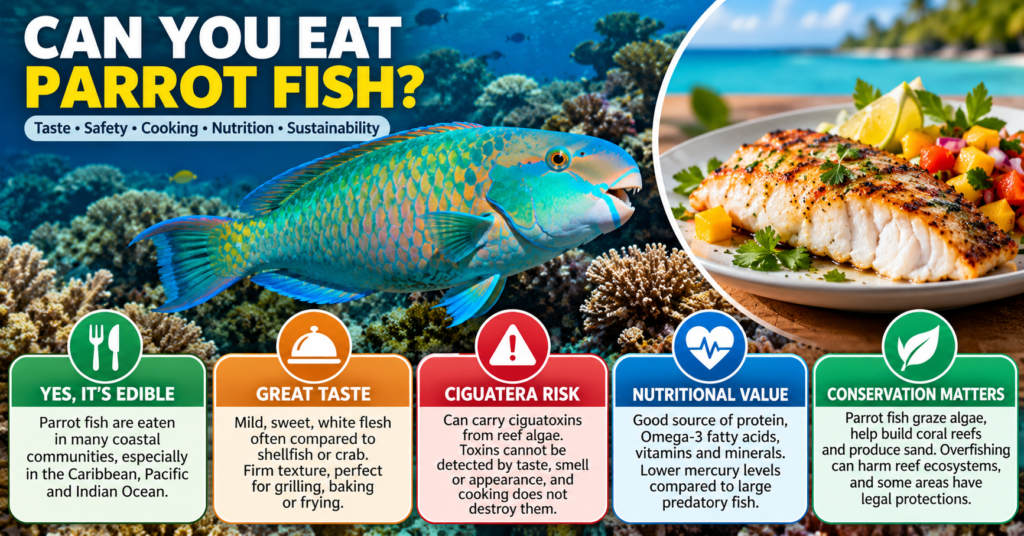
People searching parrot fish can you eat are usually asking three different questions: does the fish taste good, is it safe to consume, and is harvesting it environmentally responsible? These questions need separate answers. A fish may be traditionally eaten yet still be subject to local restrictions or carry a food-safety hazard.
This guide focuses on wild marine parrotfish, members of the family Scaridae. It does not refer to the freshwater aquarium fish commonly sold as blood parrot cichlids. If you are researching aquarium fish care rather than seafood, start with our aquarium setup and guide and AquariumsWorld blog archive.
Can You Eat Parrot Fish? The Direct Answer
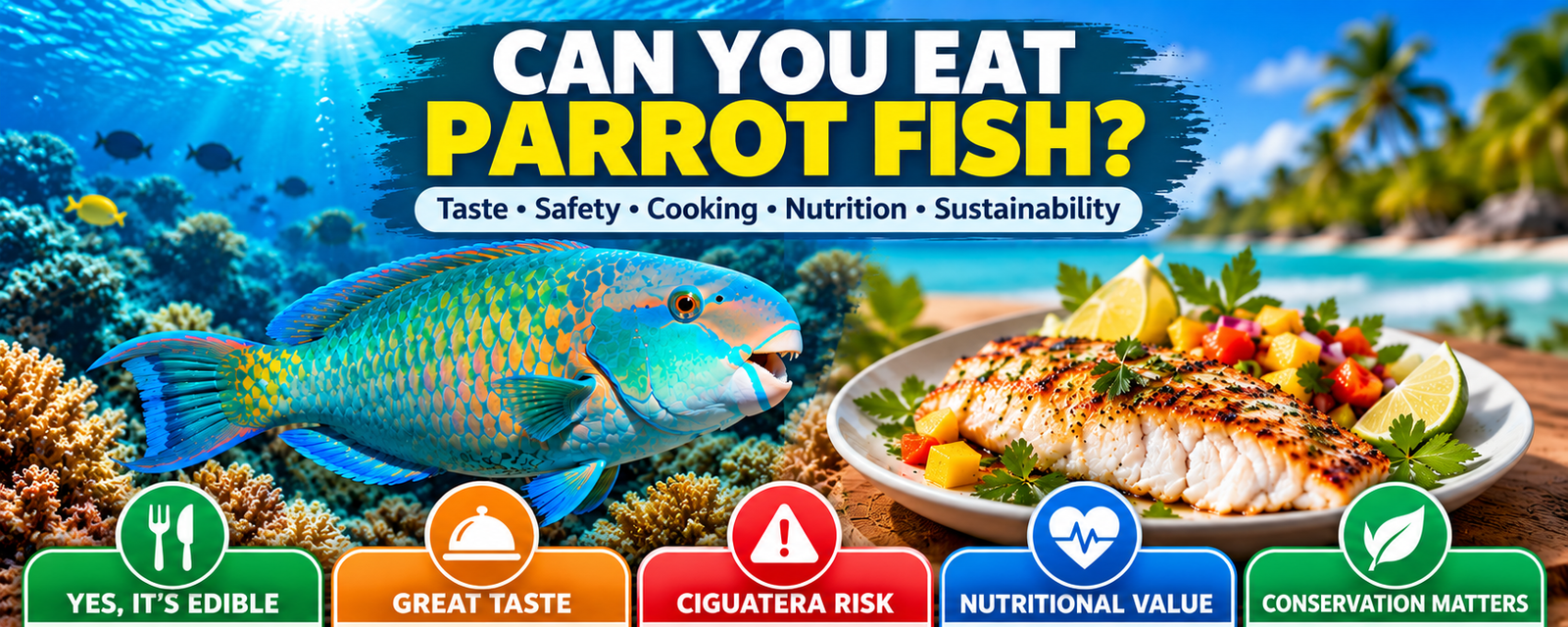
Yes. Parrotfish are consumed in some coastal communities and are prepared in different ways, including grilling, baking, frying and traditional raw-fish dishes. Their flesh is commonly described as mild and relatively sweet. However, “edible” does not mean every species, fish, location or season is equally suitable for consumption.
There are four practical checks to make before considering wild parrotfish as food:
- Identify the fish. Common names can refer to different species, and the name used in a market may not provide enough information to establish species or origin.
- Check the catch location. Ciguatera risk is geographically variable. Ask the supplier for the harvest area and consult local advisories.
- Check the law. Parrotfish protections differ between countries, states, territories, marine reserves and individual species.
- Consider reef impacts. Parrotfish graze algae and contribute to bioerosion and sediment production. Their ecological role is part of the sustainability question.
For aquarium keepers, this distinction is also useful: a wild marine parrotfish is not the same animal as a freshwater blood parrot cichlid. The latter is an aquarium hybrid and is not the subject of seafood advice.
At a glance
| Question | Practical answer |
|---|---|
| Are parrotfish edible? | Some species are eaten in coastal cuisines, subject to local rules and food-safety considerations. |
| Do they taste fishy? | Descriptions commonly emphasize mild, sweet, firm white flesh, although taste varies by species and preparation. |
| Does cooking remove ciguatoxin? | No. Normal cooking does not reliably destroy ciguatoxins. |
| Are all parrotfish protected? | No single global rule applies. Regulations vary by jurisdiction and species. |
| Are they important to reefs? | Yes. Many parrotfish graze algae and contribute to reef bioerosion and sediment processes. |
What Does Parrot Fish Taste Like?
Parrotfish are often described as having mild, sweet-tasting white flesh. Some diners compare the flavour to shellfish, crab or other delicate reef fish. These are subjective comparisons rather than a fixed flavour profile: species, size, diet, freshness, handling and cooking method all influence the final taste.
Flavour and texture
When properly handled and cooked, the flesh is generally described as firm and flaky. That texture can suit grilling or baking because the fish may hold its shape better than a very delicate fillet. Light seasoning is often used to avoid overwhelming the fish’s mild flavour.
It is not scientifically sound to assume that an algae-based diet guarantees a particular flavour or makes a fish safer to eat. Taste is not a dependable way to identify ciguatoxin, and a pleasant-smelling fish can still present a toxin risk.
Does size change the taste?
Size can influence texture and the amount of usable flesh, but there is no universal size rule that predicts flavour or safety across all parrotfish species and locations. Larger reef fish may be subject to different local regulations, and fish size alone cannot establish whether ciguatoxin is present.
For a food-safety decision, rely on the harvest location, current advisories and a reputable source rather than choosing a fish based on an assumed “safe” weight.
Is Parrot Fish Safe to Eat? Understanding Ciguatera Risk
Ciguatera fish poisoning is a foodborne illness associated with ciguatoxins in certain tropical and subtropical reef fish. The toxins originate in marine microalgae and can move through the food web. People become exposed when they eat contaminated fish.
Public-health guidance identifies ciguatera as a concern with some reef fish. Risk is not uniform: it varies by geographic area, local marine conditions, species and individual fish. A market label or a general statement that a species is “usually eaten” cannot guarantee that a particular fish is toxin-free.
Why ciguatoxin is difficult to detect
- It may not change the fish’s appearance.
- It may not produce a recognizable smell or taste.
- Cooking, freezing, smoking, salting or marinating does not reliably eliminate the toxin.
- There is no dependable home kitchen test that establishes a fish is safe from ciguatoxin.
Because the hazard cannot be reliably removed through ordinary preparation, prevention depends heavily on avoiding fish from areas with known or suspected ciguatera risk and following local advisories.
Possible symptoms of ciguatera poisoning
Symptoms can include nausea, vomiting, abdominal cramps and diarrhoea. Neurological symptoms may include tingling, itching, unusual sensations, muscle aches, weakness or an altered perception of hot and cold. Some people experience cardiovascular symptoms such as a slow heart rate or low blood pressure. Symptom timing and severity vary.
Anyone who becomes unwell after eating reef fish should seek medical advice promptly and explain what was eaten, where it was caught if known, and when symptoms began. Severe symptoms, fainting, breathing difficulty, chest pain or marked weakness require urgent medical assessment.
How to reduce avoidable risk
- Follow current local fish-consumption advisories and closures.
- Ask a reputable seller for the fish’s species and catch area.
- Avoid reef fish from locations known to have ciguatera advisories.
- Do not rely on cooking, freezing, smell, taste or visual inspection to remove or detect ciguatoxin.
- Do not assume that a smaller fish, a particular body part or an occasional serving is automatically safe.
Parrotfish Catch and Safety Guidance Checker
Use this to identify what information you still need before making a decision. It does not test fish or diagnose ciguatera.
Important: cooking may reduce some ordinary foodborne risks when done correctly, but it does not reliably destroy ciguatoxins. Raw fish also carries additional food-safety risks.
Is Parrot Fish Poisonous?
Parrotfish are not generally described as fish that manufacture ciguatoxin themselves. Ciguatera occurs when toxins produced by certain microscopic organisms enter the marine food web and accumulate in fish. A fish can therefore be contaminated without looking sick or appearing spoiled.
It is misleading to say that all parrotfish are poisonous, just as it is misleading to say that all parrotfish are safe. The relevant issue is whether a particular fish has accumulated ciguatoxin, which depends on environmental and food-web conditions. Because the toxin cannot be identified reliably by sight, smell or taste, use location-specific guidance rather than assumptions about the species as a whole.
Do not eat a fish that is subject to a local consumption warning or fishing closure. If the catch location is unknown, the uncertainty itself is a reason to avoid treating the fish as safe.
Can You Eat Parrot Fish Raw?
Parrotfish may be served raw in some culinary traditions, but raw preparation does not remove ciguatera risk. Ciguatoxins are not neutralized by citrus juice, vinegar, freezing or ordinary cooking. Ceviche changes the texture of fish through acid exposure; it does not make a ciguatoxin-contaminated fish safe.
Raw seafood also has food-safety considerations separate from ciguatera, including parasites and bacteria. The suitability of a fish for raw consumption depends on species, handling, temperature control, sourcing and local food-safety standards. A fish intended for cooking should not automatically be treated as suitable for sashimi or ceviche.
If you are not certain of the species, catch area and handling history, do not serve it raw. Follow local public-health advice and the supplier’s guidance for raw seafood.
How to Cook Parrot Fish
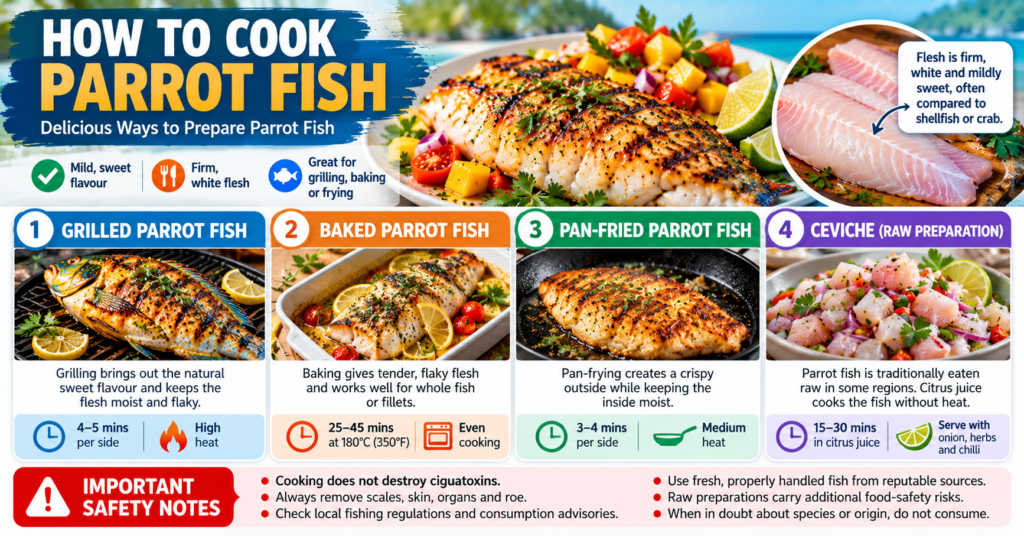
Where local regulations and food-safety guidance permit consumption, parrotfish can be prepared using methods commonly used for mild white fish. The following are general culinary approaches, not ways to neutralize ciguatoxin. If a fish may be contaminated, do not attempt to make it safe by cooking.
Preparation basics
Use clean equipment and keep raw fish chilled until preparation. Prevent raw seafood from contacting ready-to-eat foods. Follow local guidance for cleaning, scaling and handling the particular species. Discard fish that has been stored improperly or shows signs of spoilage; remember, however, that normal appearance and smell do not rule out ciguatera.
Grilling
For an approved fish intended for cooking, grilling can provide a lightly browned exterior and moist interior. A simple seasoning of citrus, herbs, garlic and a small amount of oil complements mild white fish. Use a clean, adequately heated grill and cook the fish to a safe internal temperature recommended by your local food-safety authority.
Baking
Baking is useful for whole fish or fillets because heat can be applied evenly. Place the fish in a suitable baking dish, season lightly and cook until the flesh is opaque and separates easily with a fork, while confirming the recommended internal temperature with a food thermometer.
Pan-frying
Pan-frying can create a crisp surface. Pat the fish dry, season, and cook in a clean pan with an appropriate amount of oil. Avoid cross-contamination between raw fish, utensils and cooked food.
Ceviche and raw preparations
Ceviche is made by marinating raw fish in an acidic mixture, often with citrus, onion, herbs and chilli. Acid changes the texture and appearance of the fish but does not provide the same pathogen control as cooking and does not destroy ciguatoxin. Use only seafood that is specifically suitable for raw consumption under applicable food-safety guidance.
Parrot Fish Nutrition and Potential Health Benefits
Fish can contribute protein and several micronutrients to a balanced diet. However, exact nutrient values for parrotfish depend on species, size, edible portion and preparation method. Without a verified species-specific nutrition analysis, it would be misleading to assign a precise calorie, protein or omega-3 value to “parrot fish” as a whole.
Protein and micronutrients
Many edible fish provide high-quality protein and may contribute nutrients such as vitamin B12, selenium and other minerals. The amount varies between species and servings. Fried preparations also differ nutritionally from grilled or baked fish because added oil and coatings change the overall meal composition.
Omega-3 fats
Omega-3 content varies substantially among fish species. Do not assume parrotfish provide the same EPA and DHA amounts as oily fish such as salmon, sardines or mackerel. If omega-3 intake is the primary nutritional goal, use reliable food-composition data for the species being purchased.
Mercury and other contaminants
Mercury advice is species- and location-specific. A fish’s diet alone is not enough to establish that it is low in mercury, and mercury is separate from ciguatoxin. Follow official local seafood advisories, especially for children, pregnant people and those who may be more vulnerable to foodborne illness or contaminants.
For broader aquarium water-quality and fish-care information, see our marine aquarium water test kit comparison. It covers aquarium testing rather than seafood safety, but illustrates why measured parameters and product scope should not be assumed from a label alone.
Is Parrot Fish a Protected Species? Legal and Fishing Rules
There is no single worldwide legal status for all parrotfish. Fishing rules may differ by country, state, island, marine protected area, species, fishing method and season. Some places restrict harvest or protect particular species; others permit fishing under specific rules.
Before catching, buying or transporting parrotfish, check the current regulations from the relevant fisheries or wildlife authority. Confirm whether the fish is covered by a no-take rule, size limit, bag limit, seasonal closure, gear restriction or protected-area boundary. Do not rely on a general online summary when local rules may have changed.
What to verify locally
- Whether the species may legally be caught or sold.
- Whether the catch location falls inside a marine protected area or no-take zone.
- Whether minimum or maximum size limits apply.
- Whether spearfishing, nets or other methods are restricted.
- Whether current ciguatera or seafood-consumption advisories apply.
For example, fishery protections in the Caribbean are not uniform across all islands or jurisdictions. Likewise, rules in US waters may be set by federal, state or territorial authorities and can differ by species and location. Verify the exact local rule before acting.
Responsible aquarium keeping also involves understanding local wildlife rules. Our guides to aquarium setup, responsible aquarium stocking and fish-care articles focus on captive aquarium management, which is separate from wild harvest regulations.
Why Should You Not Eat Parrot Fish? The Coral Reef Argument
One reason parrotfish are central to conservation discussions is their ecological function. Many species graze algae from reef surfaces, and some also scrape or excavate carbonate material while feeding. These activities influence competition between algae and corals, the availability of settlement surfaces and the movement of sediment through reef systems.
Algae grazing and coral competition
Algae can compete with corals for space and resources. Herbivorous reef fishes, including many parrotfish, help keep some algal growth in check. The effect depends on which parrotfish species are present, their size structure, feeding behaviour, reef habitat and the wider ecological community.
It is too simple to claim that parrotfish alone determine whether a reef is healthy. Coral condition is also affected by warming, disease, storms, pollution, water quality, habitat structure, other herbivores and local management. Nevertheless, research identifies parrotfish as important functional members of many tropical reef ecosystems.
Bioerosion and sediment production
Some parrotfish scrape or excavate reef material as they feed. This process, known as bioerosion, contributes to the breakdown and redistribution of carbonate material. The resulting sediment can become part of reef-associated sand systems. The contribution varies by species, fish size, reef conditions and the amount of carbonate material consumed.
Parrotfish are therefore sometimes described as “ecosystem engineers.” That phrase refers to their ability to modify habitat through feeding and sediment production. It does not mean every individual has the same effect or that a single universal sand-production figure applies to all species.
Why population structure matters
Fishing can change not only the number of fish in a population but also its size distribution. If larger individuals contribute disproportionately to certain ecological functions, removing them can alter the function of the remaining community. This is one reason researchers examine size limits, species-specific harvest rules and the protection of important reef habitats.
Is eating parrotfish sustainable?
There is no universal sustainability verdict for every parrotfish fishery. A responsible assessment needs to consider the species, population status, fishing pressure, local management, habitat condition and enforcement. A fishery operating under effective science-based management is not equivalent to an unregulated harvest from a depleted reef.
Consumers who want to reduce uncertainty can ask sellers for species and catch-area information, check local seafood guidance, and choose alternatives supported by credible sustainability advice. Where species identification or origin is unclear, it is difficult to make a confident sustainability assessment..
Where in the World Do People Eat Parrot Fish?
Parrotfish are eaten in some coastal communities across tropical and subtropical regions. Culinary practices differ between islands and countries, and local names may refer to different species. Traditional consumption should not be taken as proof that every catch is safe, legal or sustainable today.
| Region | Examples of preparation or context | What consumers should check |
|---|---|---|
| Caribbean | Local fish dishes may include grilled, baked or fried reef fish. | Local catch rules, species identification and ciguatera advisories. |
| Hawaii and the wider Pacific | Some parrotfish are known by local names and may be part of regional food traditions. | State or local fishing regulations and area-specific public-health guidance. |
| Indian Ocean islands | Reef fish may be prepared grilled, baked or in curries, depending on local cuisine. | Species, catch origin, local management and consumption advisories. |
| Southeast Asia | Reef fish may be steamed, grilled or included in regional dishes. | Accurate identification and food-safety handling, especially for raw dishes. |
Because regulations and toxin risk are local, a dish being available in a restaurant does not establish that a fish caught elsewhere is suitable to eat. Ask questions about the specific catch rather than relying on a region-wide assumption.
Parrot Fish vs Other Reef Fish to Eat
Comparing fish by taste alone leaves out important factors. Food safety, conservation status, catch method, species identification and local advisories all matter. The table below is a general decision framework, not a safety ranking or a claim that one fish is universally sustainable.
| Fish group | Common culinary description | Safety and sourcing considerations |
|---|---|---|
| Parrotfish | Often described as mild, sweet and firm. | Check ciguatera advisories, species, catch area and local harvest rules. |
| Snapper | Usually described as mild, flaky white fish. | Risk and sustainability depend on species, size, origin and fishery. |
| Grouper | Firm, mild flesh commonly used in many dishes. | Some reef species may carry ciguatera risk; check local advisories and regulations. |
| Mahi-mahi | Often described as moderately firm with a fuller flavour. | Check species identification, handling and credible sourcing information. |
| Hogfish | Often described as delicate and mildly sweet. | Local harvest limits and sourcing rules still apply; do not assume risk is zero. |
If your priority is a mild white fish, ask a reputable seller for species-level identification and consult a current seafood guide for the exact source. A general name such as “reef fish” is not specific enough for a reliable safety or sustainability assessment.
Frequently Asked Questions About Eating Parrot Fish
Can you eat parrot fish?
Yes, some parrotfish species are eaten in coastal cuisines. Whether a particular fish should be eaten depends on its species, catch location, local regulations and current food-safety advisories. Ciguatera risk is an important consideration for tropical reef fish.
What does parrot fish taste like?
Parrotfish is often described as mild, sweet and firm, with white flesh. Taste varies by species, freshness, handling and cooking method. Taste and smell cannot establish whether a fish contains ciguatoxin.
Is parrot fish safe to eat?
There is no universal answer for every species and location. Check local fish-consumption advisories and the exact catch area. Cooking does not reliably destroy ciguatoxins, so an unsafe fish cannot be made safe through ordinary preparation.
Is parrot fish poisonous?
Not every parrotfish is poisonous. Ciguatera occurs when toxins from marine microorganisms accumulate in certain fish. Contamination cannot be reliably detected by appearance, smell or taste.
Can you eat parrot fish raw?
Raw parrotfish may be served in some traditions, but raw preparation does not remove ciguatera risk and carries additional raw-seafood food-safety concerns. Follow local guidance and use only seafood appropriately sourced and handled for raw consumption.
How do you cook parrot fish?
Where consumption is permitted and the fish is from an appropriate source, it may be grilled, baked or pan-fried like other mild white fish. Cook to the food-safe temperature recommended by your local authority. Cooking does not neutralize ciguatoxin.
Is parrot fish a protected species?
Rules vary by country, state, island, species and fishing area. Some jurisdictions restrict harvest or protect particular species, while others allow fishing under specific limits. Check the current fisheries authority rules for the exact location.
Why should you not eat parrot fish?
Reasons for caution include ciguatera risk, local harvest restrictions and the ecological role of parrotfish in reef systems. Many species graze algae, and some contribute to bioerosion and sediment production. Sustainability depends on the specific fishery and population.
What are the health benefits of eating parrot fish?
Fish can provide protein and micronutrients, but exact nutrient levels vary by species and serving. Do not assume a specific omega-3 or mercury profile without reliable species-specific data. Follow local seafood advisories.
Where in the world do people eat parrot fish?
Parrotfish are eaten in some coastal communities across the Caribbean, Pacific, Indian Ocean and Southeast Asia. Culinary traditions and local regulations differ, and traditional consumption does not guarantee that every catch is safe or sustainable.
Can cooking or freezing remove ciguatera toxin?
No. Ordinary cooking and freezing do not reliably destroy ciguatoxins. Avoid fish from areas subject to relevant advisories rather than relying on preparation to remove the hazard.
Are parrotfish and blood parrot cichlids the same fish?
No. Marine parrotfish belong to the family Scaridae and live on reefs. Blood parrot cichlids are freshwater aquarium fish. This article concerns wild marine parrotfish.
Conclusion: Is Eating Parrot Fish a Good Idea?
Parrotfish are edible and appear in several coastal food traditions, with flesh often described as mild, sweet and firm. But a simple yes-or-no answer leaves out the most important considerations. Ciguatera risk depends on the fish and its origin, cooking does not remove the toxin, and local fishing rules may restrict harvest.
Parrotfish also contribute to reef ecology through algae grazing and, in some species, bioerosion and sediment production. Their ecological role makes population health and fishery management relevant to sustainability decisions. The responsible approach is to verify species and catch location, follow current public-health and fisheries guidance, and avoid treating tradition, taste or market availability as proof of safety.
References and Further Reading
The following sources provide public-health and scientific background. Check current local advisories and regulations before making a consumption or fishing decision.
- Centers for Disease Control and Prevention (CDC). Food Poisoning from Marine Toxins, including ciguatera information in the CDC Yellow Book. CDC guidance.
- Bonaldo, R.M., Hoey, A.S. and Bellwood, D.R. (2014). “The ecosystem roles of parrotfishes on tropical reefs.” Oceanography and Marine Biology: An Annual Review, 52, 393–444. Research record.
- Morgan, K.M. and Kench, P.S. (2016). “Parrotfish erosion underpins reef growth, sand talus development and island-building in the Maldives.” Coral Reefs, 35, 1327–1337. https://doi.org/10.1007/s00338-016-1457-7.
- Molina-Hernández, A.L. and Alvarez-Filip, L. (2024). “Incorporating parrotfish bioerosion into the herbivory paradigm of coral reef resilience.” Conservation Letters, 17(6), e13058. https://doi.org/10.1111/conl.13058.
- Ong, L. and Holland, K.N. (2010). “Bioerosion of coral reefs by two Hawaiian parrotfishes: species, size differences and fishery implications.” Marine Biology, 157, 1653–1664. https://doi.org/10.1007/s00227-010-1411-y.
- NOAA Fisheries. Consult current regional fishery management and protected-species information for the relevant US waters. NOAA Fisheries.