What is a tiger parrot fish? In aquarium shops, “tiger parrot fish” generally describes a freshwater parrot cichlid with dark vertical markings over a brighter body colour. It is a trade name rather than a consistently documented scientific species, so exact parentage, colour genetics and adult size can vary between breeders and sellers. This guide explains how to assess the fish, plan a suitable aquarium, choose food and tank mates, and buy responsibly.
Most care advice for tiger-patterned parrots is adapted from established husbandry for blood parrot cichlids: spacious freshwater housing, stable warm conditions, strong biological filtration, food the fish can comfortably swallow, and careful observation of social behaviour. A single adult should be planned for a large aquarium, not a small starter tank. A 55-US-gallon aquarium is a common minimum reference for blood parrot cichlids; a larger footprint gives more room for turning, retreating and arranging territories. See our large-cichlid tank-mate guide for adult-size-first planning.
Tiger Parrot Fish Tank Size Calculator
Use this as a conservative planning prompt, not a stocking guarantee. Footprint, filtration, adult size, décor, individual aggression and maintenance all affect suitability. When uncertain, choose the larger aquarium and keep a separation plan ready.
This is a cautious editorial planning estimate, not a validated species-specific formula or a guarantee of compatibility. It cannot replace observing the fish or getting experienced husbandry advice.
What Is a Tiger Parrot Fish?
“Tiger parrot fish” is used in the ornamental trade for a patterned parrot cichlid, usually recognized by a rounded body, short face and contrasting dark bars or blotches. The word “parrot” can cause confusion: this is a freshwater cichlid, not a marine parrotfish from the family Scaridae. It is also not a naturally occurring wild species identified by a universally accepted scientific name.
Blood parrot cichlids are man-made hybrids developed in the ornamental trade in Taiwan. Aquarium references discuss possible Central American cichlid parentage, but the exact lineage is debated and not every breeder documents it. Aquarium Co-Op describes blood parrots as freshwater hybrids and notes uncertainty about the precise parent species. Because “tiger” is an additional market label, do not present one specific cross as established for every tiger-pattern fish.
The defining visual feature is the tiger-like pattern: dark vertical bars or irregular bands over red, orange, yellow, blue-toned or mixed coloration. Markings may be sharp in one fish and broken or faint in another. Pattern intensity can change with stress, background, lighting, health and age. A fish that looks strongly striped in a shop may display differently after settling into a home aquarium.
What does the name mean?
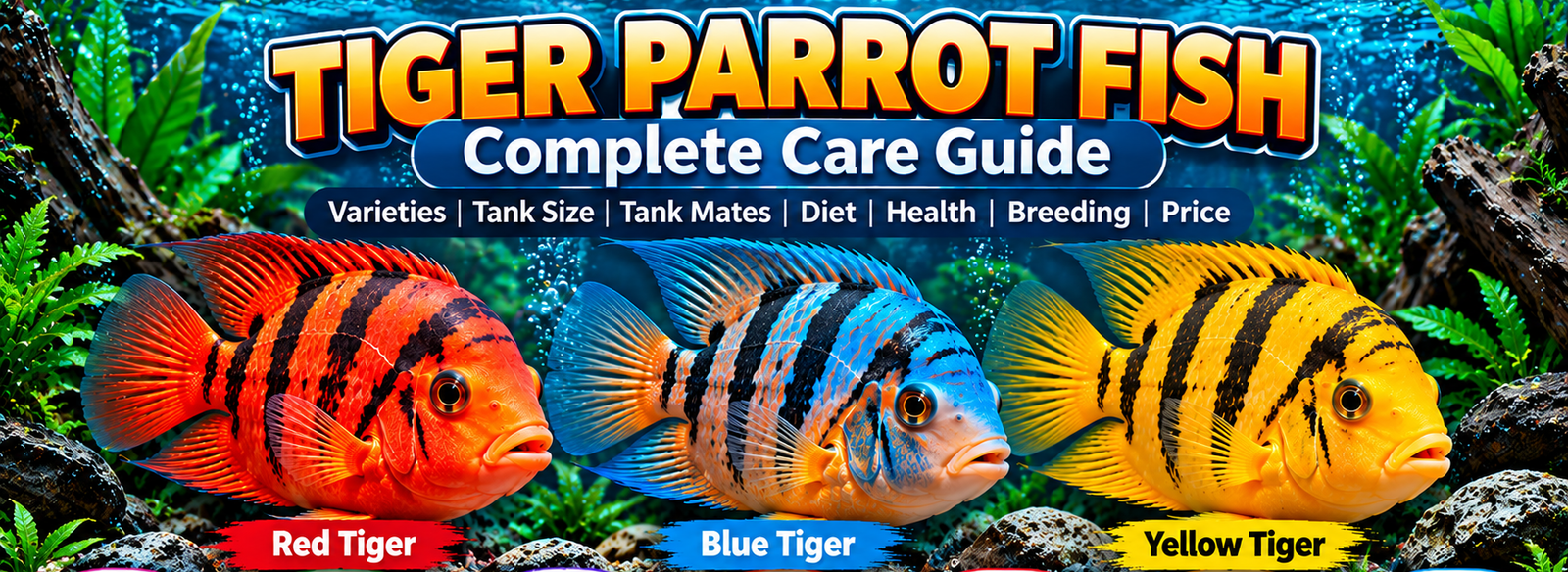
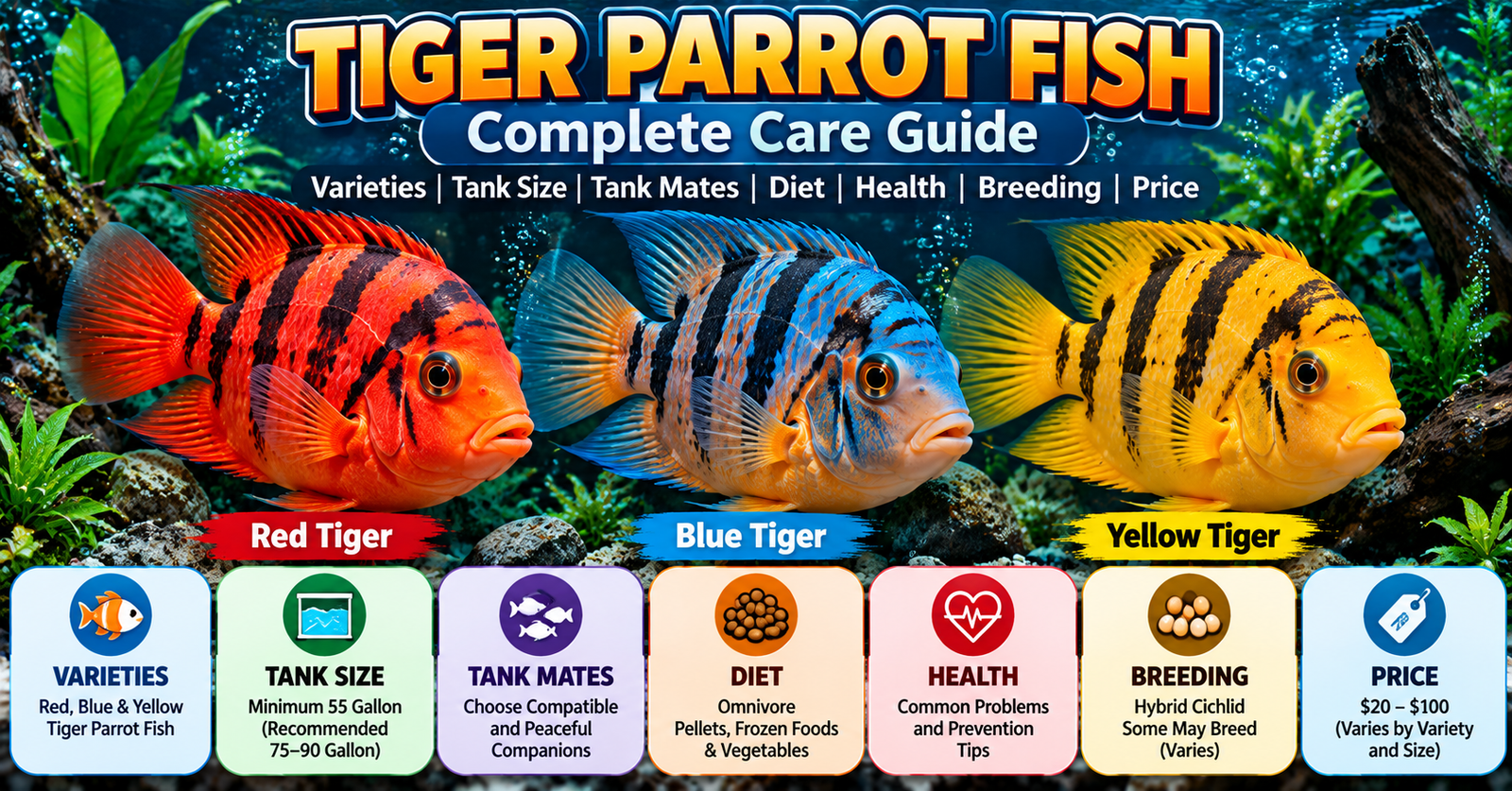
Retailers may use “red tiger,” “blue tiger” and “yellow tiger” to describe base colour or overall appearance. These names are useful for shopping but are not proof of a stable genetic line. Ask whether the fish is naturally coloured, selectively bred, dyed, injected or simply photographed under particular lighting. If a seller cannot answer, treat the description as uncertain.
When comparing listings, look for clear side-view photographs, actual fish length, a description of the current diet and a video showing normal swimming and feeding. The label alone cannot establish health or suitability.
Tiger Parrot Fish Varieties: Red, Blue and Yellow
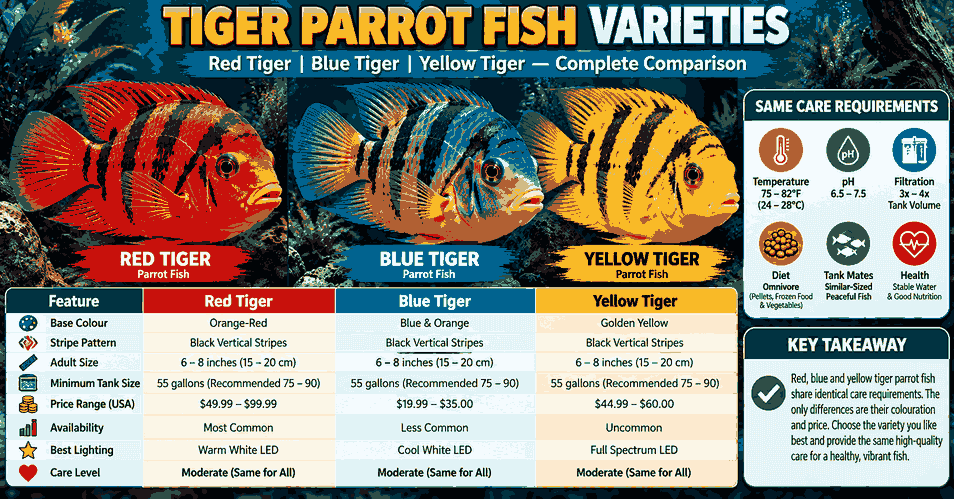
Colour names help aquarists compare fish in stores, but there is no single standardized variety register for all tiger parrots. The table describes common trade appearances rather than guaranteed genetic categories. Colours vary with individual fish, lighting, camera settings, age, stress and seller terminology.
Red Tiger Parrot Fish
A red tiger parrot is usually marketed as an orange, rust-red or red-orange fish with dark vertical bars. The warm body colour can contrast strongly against a dark background, although shade is not a reliable indicator of lineage. Check that the fish’s fins are intact, eyes clear, breathing steady and feeding response normal. Do not buy solely because a photograph shows unusually intense colour; saturation and lighting can exaggerate appearance.
Use the same conservative aquarium planning as for other parrot cichlids. The red label does not justify a smaller tank, a different temperature or special medication. If the fish has a short or unusually shaped mouth, choose soft, appropriately sized foods and observe whether it can take them without repeated struggling.
Blue Tiger Parrot Fish
“Blue tiger” may describe blue or blue-grey iridescence, a blue-orange pattern, or a fish whose appearance shifts under cool lighting. Blue coloration in fish can involve structural reflection as well as pigments, but the mechanism in a particular trade hybrid cannot be inferred from its name or photograph. Do not claim that every blue tiger parrot is produced by one known genetic process unless the breeder provides verifiable lineage information.
Ask direct questions about artificial colour treatment. A reputable seller should disclose dyeing or injection. Such procedures can injure fish and raise welfare concerns. If the seller avoids the question or provides no health information, choose another source. Blue fish need the same water quality, space and nutrition as red or yellow individuals.
Yellow Tiger Parrot Fish
Yellow tiger parrots are commonly advertised with golden, lemon or yellow-orange body colour and darker bars. Appearance may vary from pale cream to saturated gold. Colour alone does not establish health. Look for steady swimming, balanced posture, unfrayed fins, normal breathing and willingness to eat. A fish that remains unusually dark, hides constantly or refuses food may be stressed or unwell, although no single behaviour is a diagnosis.
| Trade name | Common appearance | What to verify | Care difference? |
|---|---|---|---|
| Red tiger | Orange-red or rust base with dark bars | Size, feeding response, colour-treatment history | No established difference based on colour alone |
| Blue tiger | Blue, blue-grey or mixed blue-orange tones | Natural, selectively bred or artificially altered colour | No established difference based on colour alone |
| Yellow tiger | Golden or yellow-orange base with dark bars | Seller identification and condition under neutral light | No established difference based on colour alone |
Lighting should support normal behaviour and a consistent day-night cycle rather than force a particular colour. A neutral white aquarium LED makes it easier to observe condition. Avoid intense lighting for long periods and provide shaded retreats.
Tiger Parrot Fish vs Blood Parrot Fish
The simplest distinction is visual: a tiger parrot is generally sold for dark tiger-like markings, while a conventional blood parrot is often recognized by a more uniform orange, red or yellow-orange appearance. Both names can be used inconsistently in retail listings, and “tiger” may be applied without documented breeding history.
| Feature | Tiger parrot (trade label) | Blood parrot cichlid |
|---|---|---|
| Identity | Market name for patterned parrot cichlid; line may vary | Common name for a man-made hybrid cichlid |
| Appearance | Dark vertical bars over brighter body colour | Often mostly orange, red or yellow-orange; forms vary |
| Parentage | Confirm with breeder; not standardized by trade label | Exact parentage debated in hobby references |
| Care planning | Use size, body shape, behaviour and seller guidance | Use blood-parrot husbandry guidance |
| Feeding | Check mouth structure and observed feeding ability | Some have restricted mouths requiring suitable food size |
| Price | Varies by seller, size, pattern and availability | Varies by size, form, region and retailer |
Do not assume tiger parrots are always larger, rarer, more aggressive or more expensive than blood parrots. These are market generalizations, not biological rules. Compare actual specimens and documented details. Condition and suitability should matter more than a premium colour label.
How Big Does a Tiger Parrot Fish Get?
Many blood parrot cichlids are reported around 6–8 inches (15–20 cm) as adults, with related trade forms differing. A tiger-pattern fish may fall in a similar range, but request the expected adult size for the specific line. Plan the aquarium around the adult fish, not the small juvenile offered for sale.
Growth is affected by genetics, nutrition, water quality, temperature, disease history and welfare. A juvenile growing slowly should not automatically receive more food. First assess whether it eats comfortably, whether tank mates outcompete it, and whether water parameters are stable. Overfeeding increases waste without correcting underlying problems.
| Life stage | Monitor | Planning implication |
|---|---|---|
| New juvenile | Length, feeding response, breathing and acclimation | Use a cycled tank; avoid temporary housing that will soon be inadequate |
| Growing fish | Body condition, growth, social behaviour and water quality | Reassess space as the fish matures |
| Adult | Turning room, retreats, stable water and appetite | Maintain adult-sized housing and filtration |
There is no universal month-by-month growth chart for every fish sold under this label. Keep records of length, body condition, food intake and test results every few weeks. These notes can help an experienced aquarist or aquatic veterinarian identify changes.
Tiger Parrot Fish Tank Size and Setup
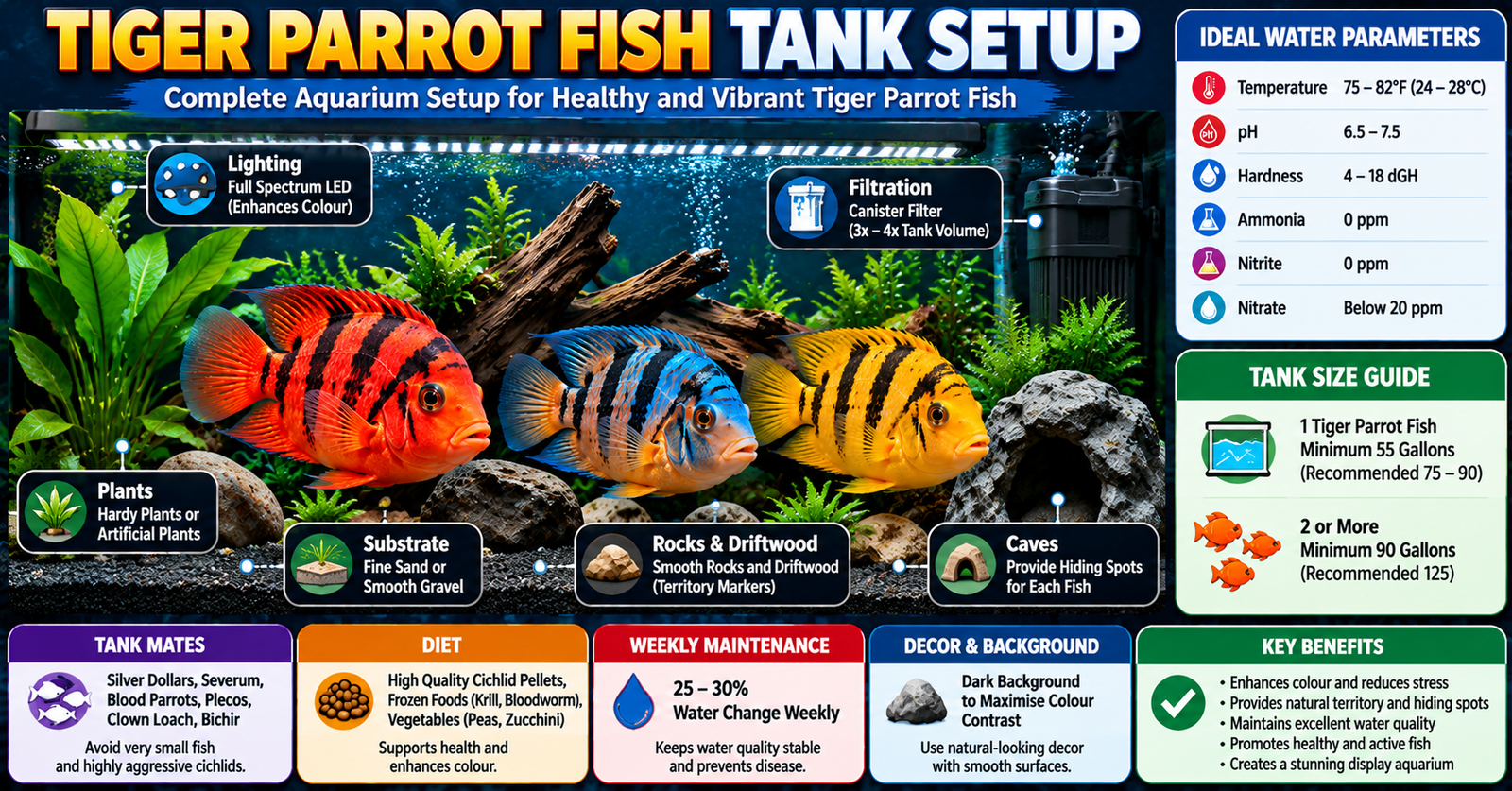
A large aquarium matters because parrot cichlids need room to swim, turn, feed and establish space. A 55-US-gallon tank is a common minimum reference for one blood parrot cichlid, but larger aquariums are preferable when practical. A 75–90 gallon system can offer more footprint and water volume, particularly for a large adult or a setup with additional fish. Do not treat the calculator as permission to stock to its upper estimate.
For two or more parrot cichlids, use a larger aquarium, but remember that volume alone cannot guarantee compatibility. A long footprint, visual barriers and multiple retreats may be more useful than a tall tank with the same gallons. If one fish traps another, prevents feeding or repeatedly chases it, the arrangement is not working even if water tests are normal.
Substrate and décor
Choose smooth sand or rounded fine gravel. Avoid sharp pieces that can abrade the fish as it investigates or moves substrate. Place heavy rocks on a stable base or support rather than loose substrate where digging could undermine them. Secure décor against tipping. Leave open swimming lanes and avoid filling every area with ornaments.
Caves, broad shelters and driftwood create visual breaks and resting areas. Provide more than one route through the layout so a subordinate fish is not trapped behind a single decoration. If a fish claims a cave and attacks every approaching tank mate, rearrange the layout or separate the animals; a cave alone will not solve persistent aggression.
Plants and background
Some large cichlids disturb rooted plants, so hardy plants attached to wood or rock may be easier than delicate carpeting species. Artificial plants can provide structure if edges are smooth and swimming is not restricted. A dark background may make the pattern stand out, but safe décor, stable lighting and normal behaviour come first.
For a broader equipment checklist, see our fish aquarium setup guide. Our 20-gallon tank guide explains nominal volume and usable space; the 100-gallon aquarium guide covers large-system planning.
Water Parameters and Filtration
Blood-parrot-type cichlids are commonly kept in warm, stable freshwater around 75–82°F (24–28°C) and pH near 6.5–7.5. Treat these as practical starting ranges, not a substitute for breeder information or gradual acclimation. Stability is more important than chasing a target number. Avoid sudden temperature or pH changes, and do not add adjusting chemicals without understanding the cause and measuring the result.
| Parameter | Starting guidance | Good practice |
|---|---|---|
| Temperature | About 75–82°F (24–28°C) | Use heater and thermometer; prevent rapid swings |
| pH | Often around 6.5–7.5 | Measure source and tank water; avoid abrupt correction |
| Ammonia | 0 ppm in established aquarium | Detectable ammonia needs prompt investigation |
| Nitrite | 0 ppm in established aquarium | Test after filter disruption or unexplained distress |
| Nitrate | Control through maintenance; lower is generally preferable | Track trends between water changes |
| Oxygen and flow | Good surface movement without exhausting fish | Maintain circulation and avoid dead zones |
Use a mature biological filter sized for the aquarium and actual livestock load. A canister filter or combination of units can provide mechanical and biological capacity, but advertised flow is not the same as real flow after media and tubing. Clean mechanical media when flow falls while preserving biological media; do not replace all media at once or wash it in untreated tap water.
Regular partial water changes should be adjusted according to nitrate, feeding load and test results. A weekly 25–30% change is a reasonable starting routine for many large-cichlid systems, not a universal rule. Use dechlorinator where needed and match replacement-water temperature reasonably closely. Large volume improves stability but does not replace maintenance.
Testing should be routine, not emergency-only. Our aquarium water test kit comparison discusses testing formats; for freshwater, choose a kit that measures ammonia, nitrite, nitrate and pH. The fish aquarium problems guide organizes troubleshooting when readings or behaviour change.
Are Tiger Parrot Fish Aggressive?
Parrot cichlids are often called semi-aggressive, but temperament varies with individual, maturity, social history and layout. Some are calm around similarly sized fish; others chase, guard an area or compete strongly at feeding. A brief shop observation cannot predict every interaction at home.
Common triggers include limited space, a narrow passage, too few retreats, abrupt introduction, breeding-related behaviour and food competition. Stress may appear as hiding, rapid breathing, loss of appetite, colour change or persistent avoidance. These signs are not proof of aggression by themselves; observe the full situation and test water before assigning a cause.
Reducing conflict
- Choose an aquarium with a generous footprint and plan for adult size.
- Break direct lines of sight while preserving open swimming space.
- Introduce fish carefully and monitor closely during the first days and weeks.
- Feed at more than one location if competition occurs.
- Keep a divider or separate cycled aquarium available if a fish is injured or blocked from food.
- Do not add fish merely to “spread aggression” unless space and social needs are understood.
Never leave fish together when one is cornered, bitten, unable to feed or repeatedly injured. Separate first, then reassess. A community tank succeeds only when every fish can feed, rest and move without sustained harassment.
What Do Tiger Parrot Fish Eat?
Parrot cichlids are omnivorous. A quality, appropriately sized cichlid pellet or soft sinking food can form the dietary base, supplemented with suitable frozen foods and plant-based ingredients. The best food is one the individual can take and swallow. Some blood-parrot-type fish have a restricted or unusually shaped mouth, so large hard pellets may be difficult to manage.
Start with small portions and observe feeding. If a fish spits food repeatedly, try a smaller or softer formulation rather than adding more. Handle thawed frozen foods hygienically and offer modest amounts. Remove uneaten food promptly. Variety is useful, but it does not mean rich treats at every meal.
Example weekly feeding rotation
| Day | Food idea | Purpose / observation |
|---|---|---|
| Monday | Soft complete cichlid pellet | Staple; confirm comfortable swallowing |
| Tuesday | Small portion of thawed brine shrimp or similar frozen food | Variety; remove leftovers |
| Wednesday | Complete pellet or gel food | Balanced base diet |
| Thursday | Complete food with suitable vegetable component | Variety; avoid large pieces |
| Friday | Small portion of suitable frozen food | Supplement, not replacement |
| Saturday | Complete pellet or gel food | Observe appetite and body condition |
| Sunday | Light feeding or rest day if appropriate | Adjust to age, health and professional advice |
This is an example, not a rigid prescription. Juveniles, adults, recovering fish and breeding fish may need different frequency and portions. Overfeeding increases waste. A rounded body is part of the fish’s shape, but a swollen abdomen, buoyancy change or sudden weight gain should not be dismissed as normal.
Does diet enhance colour?
Some fish pigments depend partly on dietary nutrients, and complete ornamental foods may include carotenoid ingredients. However, the response of a particular tiger-pattern hybrid is not established by its trade name. Do not promise that krill, spirulina or a supplement will create a specific pattern. A balanced diet supports condition; water quality, genetics, lighting and stress also influence appearance.
Be cautious with colour-enhancing products that make dramatic claims. Read ingredients, use complete food as the foundation and avoid excessive supplementation. Artificial dyeing or injection is not a substitute for nutrition and raises welfare concerns. Ask about colour treatment before purchase.
Best Tank Mates for Tiger Parrot Fish
There is no universally safe tank-mate list for every fish sold as tiger parrot. Match adult size, temperament, water conditions, swimming level and feeding ability, then monitor actual behaviour. A peaceful fish small enough to be swallowed is unsuitable. A large, highly territorial fish may be unsuitable too.
Potential companions sometimes considered for blood-parrot-type cichlids include similarly sized, robust fish such as selected severums, silver dollars in an appropriate group, or compatible large bottom-dwelling species. These are possibilities to assess, not guarantees. Tank size must account for every species’ adult needs. See our Oscar tank-mate guide for general large-cichlid compatibility principles.
| Potential companion | Why considered | Cautions |
|---|---|---|
| Severum | Can be similar in size and warm-water needs | Territorial behaviour; substantial space required |
| Silver dollars | Active schooling fish, not tiny when mature | Maintain suitable group and open swimming room |
| Large plecostomus | Different feeding niche; often robust | Species vary greatly in adult size; ensure food and space |
| Another parrot cichlid | Similar general husbandry | Chasing, dominance or breeding aggression may occur |
| Other large cichlids | Possible in carefully designed large systems | Species-specific aggression and water needs; backup plan essential |
Avoid very small community fish, delicate slow swimmers, fin-nippers and species with incompatible temperature or water-chemistry needs. Goldfish are not appropriate companions for warm-water parrot cichlids. Our goldfish and Oscar compatibility article explains why size, temperature and behaviour must be considered together.
Do not add a fish just because a store says it “usually works.” Check adult size and tank needs, quarantine new arrivals where practical, observe feeding after introduction, and separate fish if aggression persists. Plan for the least tolerant individual, not only the dominant one.
Tiger Parrot Fish Price in the USA and Where to Buy
Price varies with actual size, pattern, seller, shipping, season, availability and whether the fish belongs to a documented selectively bred line. Since “tiger parrot” is not standardized, online prices can be difficult to compare. A small juvenile is not comparable to a larger specimen, and a high price does not prove health or verified genetics.
Retail listings supplied for this article’s planning brief ranged roughly from $20 to $100 depending on advertised colour, size and seller. Treat that as an indicative snapshot, not a verified current market survey. Confirm checkout price, shipping charges, delivery schedule, live-arrival terms and the exact fish being sold. Prices and availability can change without notice.
Buying checklist
- Ask for current length and a recent photo or video.
- Confirm whether the fish is captive-bred and whether its line is documented.
- Ask whether colour was altered by dyeing or injection.
- Ask what food it currently eats and whether it feeds reliably.
- Check shipping temperature policy, delivery schedule and live-arrival guarantee.
- Read return and health terms before paying.
- Prepare a cycled aquarium and quarantine arrangement before arrival.
Buy from a seller who answers husbandry questions clearly and does not pressure you to place a fish in an unsuitable tank. If a listing says “rare,” “premium” or “exclusive,” ask what that means in measurable terms. A clear description and healthy specimen are more useful than promotional wording.
Can Tiger Parrot Fish Breed?
Breeding claims require caution because tiger parrot is a variable trade name and fish may have different hybrid backgrounds. Some blood-parrot-type hybrids form pairs and display spawning behaviour; fertility varies, and not every pair produces viable offspring. It is inaccurate to promise that all males are sterile or all females can reproduce. Outcomes depend on the individual fish and lineage.
Spawning behaviour may include cleaning a flat surface, guarding a site, chasing tank mates or becoming more territorial. These behaviours do not prove eggs will be fertile. If eggs appear, avoid unnecessary disturbance but prioritize safety. If aggression escalates, separate animals rather than allowing injury in the hope of raising fry.
Do not attempt breeding unless you can house adults safely, manage aggression and responsibly place offspring. A breeding setup requires space, filtration, stable water and a fry-care plan. Never release unwanted fish into ponds, streams or storm drains. Rehoming through an aquarium store, fishkeeping club or experienced keeper is safer.
Tiger Parrot Fish Health and Common Problems
Health assessment begins with observation and water testing. Watch breathing, swimming balance, appetite, body condition, fin edges, skin and interactions. Colour change may accompany stress, but colour alone cannot diagnose disease. Test ammonia, nitrite, nitrate, temperature and pH before medication, and check filter operation.
Mouth shape and feeding difficulty
Some blood-parrot-type fish have a short, beak-like mouth that may not close normally. This can affect food capture. Offer small soft foods and observe meals. If a fish repeatedly misses food, loses weight or seems unable to swallow, consult an aquatic veterinarian or experienced fish-health professional. Do not assume every abnormality is harmless because the fish is a hybrid.
White spots, flashing or rubbing
White spots, rubbing, clamped fins or rapid breathing can have several causes, including parasites, irritation and water-quality problems. Do not automatically raise temperature or add salt without identifying the likely cause and considering all tank inhabitants. Some treatments are unsuitable for certain species. Quarantine new fish where practical and seek professional guidance if symptoms worsen.
Holes, sores or damaged fins
Open lesions, progressive tissue damage, swelling or persistent fin deterioration need prompt attention. Poor water quality can worsen many problems but may not be the only cause. Test water, remove hazards, reduce stress and seek diagnosis. Avoid combining medications without guidance; this can create stress and obscure what is helping.
Colour fading or appetite loss
Check whether the fish is newly introduced, bullied, exposed to bright light without shelter or receiving unsuitable food size. Review water tests and maintenance history. Prolonged appetite loss, weight loss, gasping or balance problems require prompt assessment. Do not try to solve every symptom with a colour booster.
For water-quality diagnosis, use our fish aquarium problems guide, which covers cloudy water, cycling, algae, common disease signs and troubleshooting.
Maintenance Routine
A predictable routine makes small changes easier to notice. Record water tests, water changes, filter cleaning, food offered and unusual behaviour. Consistency matters more than a complicated schedule that cannot be sustained.
| Frequency | Task | Check |
|---|---|---|
| Daily | Observe fish and feeding; remove leftovers | Appetite, breathing, posture, aggression, temperature and filter flow |
| Weekly | Test water and perform partial change as needed | Ammonia, nitrite, nitrate, pH trend and debris |
| As needed | Rinse mechanical media in removed aquarium water | Flow and debris; preserve biological media |
| Monthly / manufacturer schedule | Inspect heater, intake, tubing, seals and décor | Leaks, blockage, loose rocks and equipment wear |
| When adding fish | Quarantine and acclimate carefully | Health, feeding, compatibility and biosecurity |
Do not aggressively clean every filter component at once. Biological filtration depends on established microbes, and disruption can destabilize water quality. If a filter stops, restore circulation promptly and test more frequently while the system stabilizes. Keep backup aeration available for large aquariums.
Stocking should be evaluated by adult size and waste output, not a simple one-inch-per-gallon formula. Our aquarium stocking calculator considers tank volume, filtration, adult size and bioload. It is a planning aid, not a species-specific compatibility guarantee.
Responsible Keeping and Hybrid Fish Welfare
Hybrid ornamental fish raise questions about selective breeding, body structure, colour manipulation and retailer responsibility. Attractive appearance should not distract from whether a fish can swim, breathe, feed and interact normally. Assess the individual rather than assuming every hybrid has the same health profile.
Prefer fish with clear eyes, intact fins, normal balance, steady breathing and observable feeding response. Ask whether the fish has been dyed or injected; avoid supporting procedures that alter appearance at the expense of welfare. If a fish has a significant anatomical limitation, provide food and habitat suited to it and seek veterinary advice when needed.
Never release aquarium fish into natural waterways. Releases can spread pathogens, introduce non-native species or harm local ecosystems. If you can no longer keep the fish, contact a reputable store, rescue, club or experienced aquarist. Responsible ownership means planning for the full adult life, not only the purchase.
Frequently Asked Questions
What is a tiger parrot fish?
A trade name for a patterned freshwater parrot cichlid with dark tiger-like bars over a brighter body. The name is not a standardized scientific species designation, so lineage and appearance can vary. Confirm identity and care information with the breeder or retailer.
How big do tiger parrot fish get?
Many blood-parrot-type cichlids are reported around 6–8 inches (15–20 cm), although individual size varies. Ask the seller about the specific fish and plan for its adult size.
What size tank does a tiger parrot fish need?
A 55-US-gallon aquarium is a common minimum reference for one blood-parrot-type cichlid. A larger tank with a generous footprint is preferable when possible, especially for larger adults or community setups.
Are tiger parrot fish aggressive?
Temperament varies. Some individuals tolerate similarly sized companions, while others chase or defend territory. Provide adequate space, visual barriers and a separation plan, and do not leave fish together if harassment or injury occurs.
What do tiger parrot fish eat?
Use a complete, appropriately sized cichlid pellet or soft food as the dietary base, with suitable frozen foods and other balanced additions. Check that the individual can comfortably capture and swallow each food.
What are suitable tank mates?
Potential companions may include similarly sized fish with compatible water and temperament needs, such as selected severums or silver dollars in a sufficiently large aquarium. No combination is guaranteed; avoid tiny fish and incompatible species.
How much does a tiger parrot fish cost in the USA?
Price varies by size, seller, shipping, availability and the exact fish advertised. Treat online prices as snapshots, confirm total checkout cost and live-arrival terms, and do not assume a premium price proves health or lineage.
Can tiger parrot fish breed?
Some parrot cichlids form pairs and spawn, but fertility varies among hybrids and cannot be predicted from the trade name. Breeding can increase territorial behaviour, so plan for safety and any offspring before attempting it.
Do red, blue and yellow fish need different care?
No reliable care difference is established by colour label alone. Use actual size, mouth structure, behaviour, breeder information and health to plan housing and feeding.
Can one live in a 40-gallon aquarium?
A 40-gallon tank is generally not a good long-term plan for a full-grown blood-parrot-type cichlid. A larger aquarium provides more space and water volume; 55 gallons is a common minimum reference for one fish.
Do they need a heater?
Most homes benefit from a reliable adjustable heater and thermometer to maintain a stable warm-water environment. Follow documented care ranges and avoid abrupt changes.
Do they need live plants?
No. Plants are optional. Hardy plants attached to hardscape or safe artificial plants may be easier if fish disturb rooted plants. Prioritize safe décor and swimming space.
How often should I change the water?
Many keepers start with a weekly partial change around 25–30%, then adjust to nitrate trends, feeding, stocking and test results. Use dechlorinated water and avoid abrupt temperature changes.
Acclimation, Quarantine and the First Month
Prepare the aquarium before bringing a tiger parrot cichlid home. The tank should be fully cycled, heated, filtered and tested, with a secure lid and stable décor. Confirm that the filter is running and that ammonia and nitrite are undetectable before the fish arrives. Keep lights subdued during transport and acclimation, and avoid placing the bag near direct sunlight or a heater outlet.
Follow the seller’s acclimation instructions while avoiding prolonged exposure to shipping water. Temperature matching is important, but long open-bag acclimation can allow waste products and pH conditions to change. When possible, use a separate, cycled quarantine aquarium with simple décor and dedicated equipment. Quarantine gives the keeper time to observe appetite, breathing, skin and waste before introducing the fish to an established community. It also reduces the chance of transferring parasites or pathogens to resident fish.
During the first several days, offer a small amount of the food the fish already recognizes. Do not immediately change every part of its diet, rearrange the aquarium repeatedly or add new tank mates. Some hiding or reduced appetite can occur after transport, but the fish should remain upright, breathe normally and gradually show interest in food. Test water if it becomes lethargic, gasps, rubs against objects or refuses food for an extended period. Avoid prophylactic medication unless recommended by a qualified professional or supported by a clear quarantine protocol.
Keep a short arrival record: date received, seller, stated size, food offered, water readings and observed behaviour. Photographing the fish under consistent lighting can help you distinguish a genuine colour change from camera or lighting differences. If the fish has difficulty swallowing, ask the seller what food texture it previously accepted and seek aquatic veterinary advice if the problem continues. A calm, predictable first month supports acclimation and gives you a baseline for future health checks.
Review stocking plans whenever adult growth, health or social behaviour changes noticeably.
Conclusion
Tiger parrot fish can be striking freshwater display fish, but the name describes a trade appearance rather than a standardized species. Red, blue and yellow labels describe colour; they do not prove a genetic line or justify different care. Begin with the individual fish’s condition, mouth structure, adult-size expectation and documented feeding response.
Plan a spacious aquarium with stable warm water, mature biological filtration, smooth décor, open swimming room and suitable food. Choose tank mates only after comparing adult size, temperament and environmental needs, and separate fish if aggression develops. Buy from sellers who disclose colour treatment and provide clear health and shipping information. Responsible care is built around welfare throughout the fish’s adult life, not just the novelty of its pattern.
Related AquariumsWorld Guides
These internal resources cover broader aquarium setup, filtration, water quality and compatibility. They do not establish the exact lineage or special care needs of every fish sold as tiger parrot.
- AquariumsWorld home — freshwater and aquarium care resources.
- AquariumsWorld blog archive — published guides.
- Aquarium stocking calculator — adult size and bioload.
- Oscar fish tank mates — large-cichlid compatibility.
- Oscar 55-gallon tank and filtration — filtration and adult-size planning.
- Blue Oscar varieties and genetics — evaluating colour claims.
- Bumblebee Oscar guide — identification and care.
- Water temperature for cichlids — stable temperature planning.
- Fish aquarium problems — water-quality troubleshooting.
- Angelfish tank size and care — another cichlid’s needs.
- Orange plecostomus care — adult size and bottom-dweller needs.
- 100-gallon fish tank — large aquarium planning.
- 20-gallon fish tank — volume and footprint.
- Aquarium water test kit comparison — testing formats.
- Fish aquarium setup guide — equipment fundamentals.
- Goldfish and Oscar compatibility — temperature and size mismatch.
- Fire red Oscar colour and diet — colour and husbandry context.
- Blueberry Oscar colour guide — colour claims and care.
Further Reading
- Aquarium Co-Op: Blood Parrot Cichlid Care Guide — hybrid identity, feeding and general care background.
- Fishkeeping: Blood Parrot care sheet — husbandry notes for the hybrid.