Home → Aquarium Info → Saltwater Aquarium → Rose Bubble Anemone
Amazon Affiliate Disclosure: AquariumsWorld.com is a participant in the Amazon Services LLC Associates Program. As an Amazon Associate we earn from qualifying purchases at no additional cost to you.
Table of Contents
- What Is a Rose Bubble Tip Anemone?
- Rose BTA Colour Morphs
- Rose Bubble Anemone Tank Size and Setup
- Rose Bubble Anemone Lighting and PAR Requirements
- How to Place a Rose Bubble Anemone
- Rose Bubble Anemone Clownfish Hosting
- What to Feed a Rose Bubble Anemone
- Rose Bubble Anemone Water Parameters
- Why Is My Rose Bubble Anemone Bleaching?
- How Rose Bubble Anemones Split
- Is a Rose Bubble Anemone Reef Safe?
- Rose Bubble Anemone Lifespan
- Rose Bubble Anemone Price and Where to Buy
- Best Foods and Products for Rose Bubble Anemones
- Frequently Asked Questions
- Scientific References
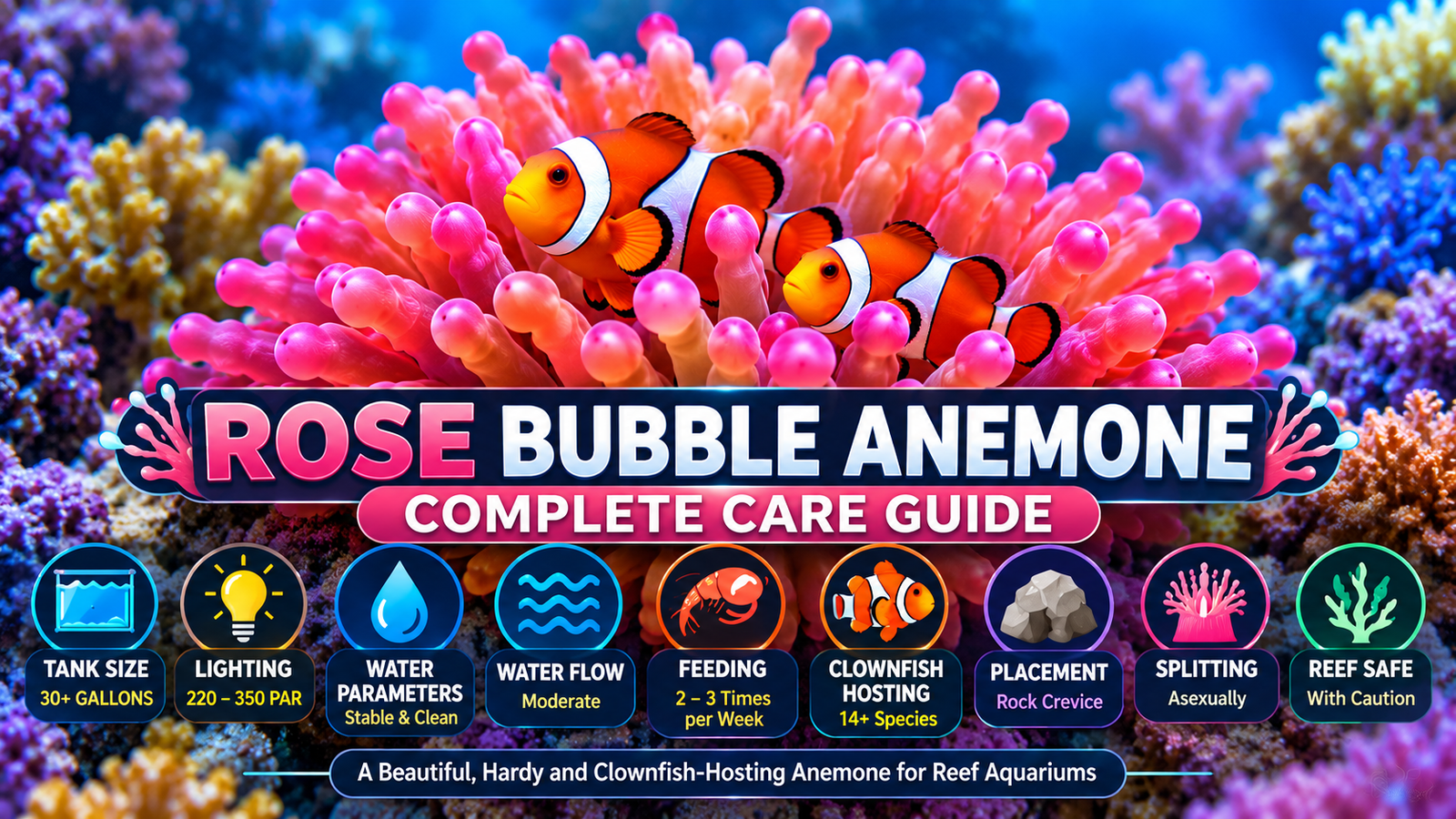
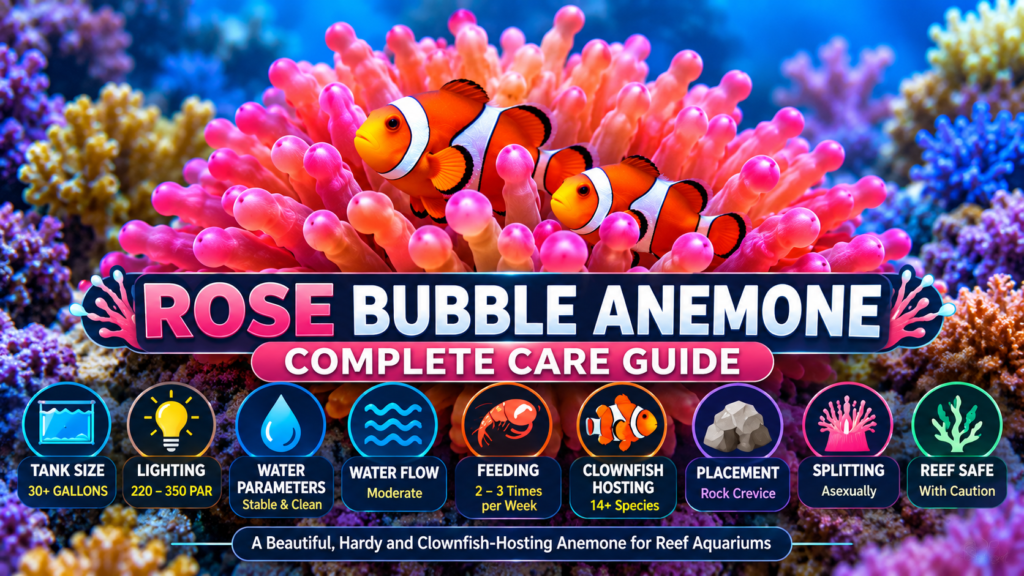
The rose bubble anemone, commonly called the rose bubble tip anemone or rose BTA, is one of the most popular host anemones kept by marine aquarium hobbyists. Its vivid pink to rose-red colouration, flowing tentacles and ability to form a natural relationship with clownfish make it an especially attractive addition to an established reef.
The species behind the rose colour morph is Entacmaea quadricolor, a bubble tip anemone from the Indo-Pacific. Although this species is often described as one of the easier anemones for aquarium keeping, that description needs context. A rose BTA may be more forgiving than some other host anemones, but it still requires stable water, suitable reef lighting, protected equipment and an established aquarium.
Successful rose bubble tip anemone care is therefore less about performing complicated daily maintenance and more about creating the correct environment before the animal enters the aquarium. A mature biological system, stable salinity, appropriate PAR, moderate indirect flow and safe rockwork all contribute to long-term success.
This guide covers the complete process, including Entacmaea quadricolor identification, tank size, lighting, PAR requirements, placement, clownfish hosting, feeding, water parameters, bleaching, splitting, reef safety, lifespan and buying considerations.
30 gal+Minimum planning size
220–350Target PAR range
72–80°FTemperature range
6+ monthsPreferred tank maturity
What Is a Rose Bubble Tip Anemone?
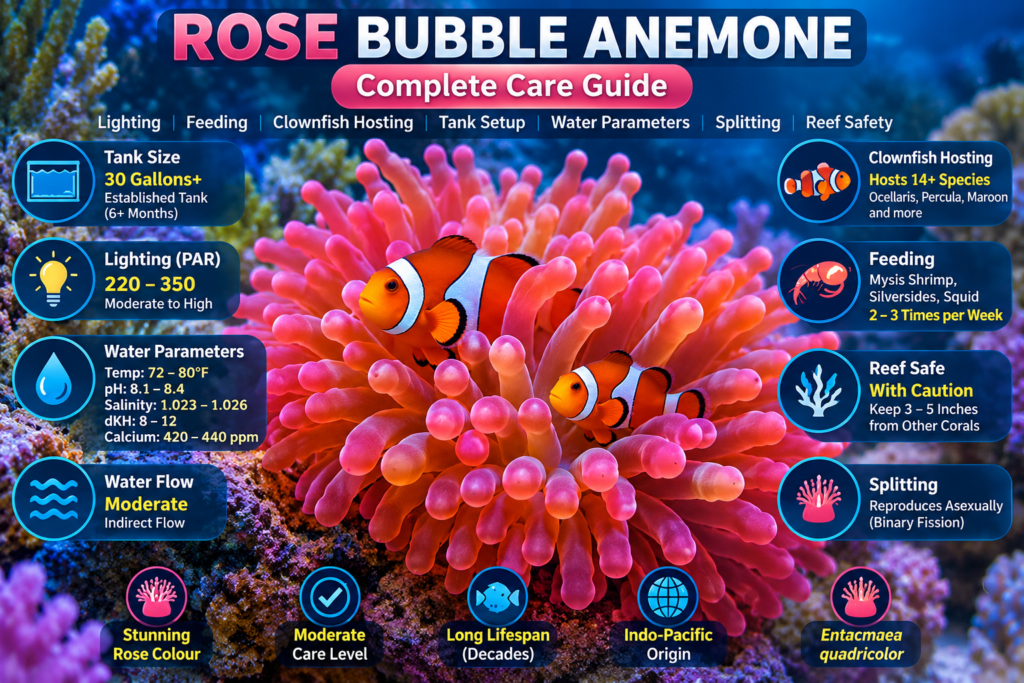
Short answer: A rose bubble tip anemone is a rose or pink colour morph of Entacmaea quadricolor. It is a photosynthetic marine anemone in the family Actiniidae that can host clownfish and naturally attaches its foot to suitable reef rock.
The scientific name is Entacmaea quadricolor. The term “rose” describes the colour morph rather than a separate species. This distinction matters because aquarists may encounter green, orange, brown, rainbow, rose and other bubble tip colour variations that share broadly similar husbandry needs.
In nature, bubble tip anemones inhabit shallow tropical reef environments where light, water movement and stable marine chemistry support their relationship with microscopic photosynthetic organisms living within their tissues. In an aquarium, the same biological relationship means that lighting is not simply decorative. It is one of the foundations of the animal’s nutrition.
A healthy rose BTA may expand substantially during the day and contract at other times. Bubble-shaped tentacle tips may also change appearance. Aquarists sometimes assume that every change in tentacle shape indicates a problem, but bubble formation can vary according to lighting, flow, feeding and individual behaviour.
The species is also famous for hosting clownfish. That relationship is one of the biggest reasons hobbyists choose a rose bubble anemone. A reef aquarium containing a settled BTA and a compatible clownfish pair can become a particularly dynamic display.
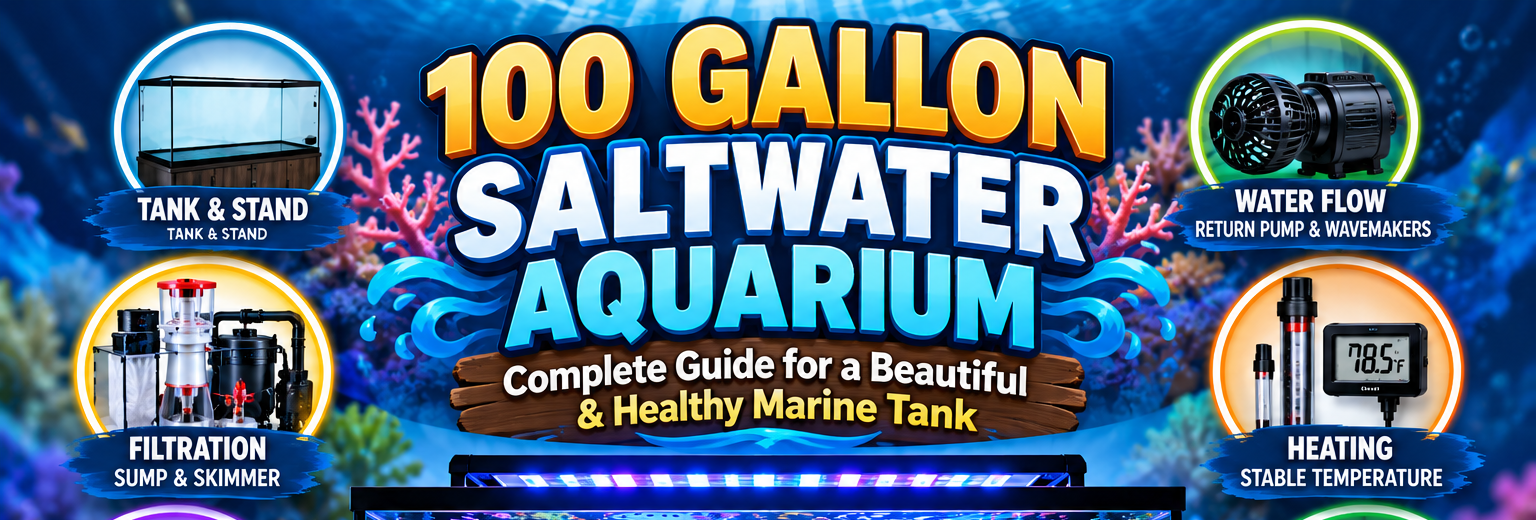
For broader marine aquarium planning, AquariumsWorld’s 100 Gallon Saltwater Aquarium Setup and Equipment Guide provides useful background when planning a larger marine system. A rose BTA does not require a 100-gallon aquarium by itself, but larger systems generally provide more stability and more placement options.
Rose BTA vs Green and Other Bubble Tip Anemone Colour Morphs
The rose bubble anemone is one colour expression of Entacmaea quadricolor. Colour morphs can differ dramatically in appearance and price while retaining similar fundamental husbandry requirements. This means beginners should avoid assuming that a more expensive colour morph automatically requires completely different care.
| Colour Morph | Typical Appearance | Availability | General Care |
|---|---|---|---|
| Green | Green body and tentacles | Common | Similar BTA requirements |
| Rose | Pink to deep rose-red | Common to uncommon | Similar BTA requirements |
| Orange | Orange or peach tones | Uncommon | Similar BTA requirements |
| Rainbow | Multiple contrasting colours | Uncommon | Similar BTA requirements |
| Sunburst | Yellow, orange and pink combinations | Rare | Similar BTA requirements |
When comparing a rose bubble anemone with a green bubble anemone, focus on the condition of the individual animal rather than colour alone. A healthy specimen should have good tissue expansion, an intact oral disc, a firmly attached foot and appropriate responsiveness. Colour should not be used as the only measure of health.
Rose Bubble Anemone Tank Size and Setup
Recommended starting point: The source brief specifies a minimum of approximately 30 gallons for a single rose BTA, with a mature aquarium preferred. A larger 40–60 gallon reef often provides greater water stability and more room for the animal to settle without immediately contacting nearby corals.
Why Tank Maturity Matters
Tank age can be more important than simply looking at the number printed on the aquarium. A large but immature system can still experience unstable alkalinity, salinity, nutrient levels and biological filtration. An established reef gives the anemone a more predictable environment.
For this reason, the practical target in the source brief is an aquarium that has been operating for at least six months. This is not a magic biological deadline; rather, it is a conservative planning benchmark that encourages aquarists to wait until the system demonstrates stable chemistry and reliable biological filtration.
Essential Rose BTA Equipment
| Equipment | Requirement | Why It Matters |
|---|---|---|
| Reef LED lighting | PAR appropriate for placement | Supports photosynthetic nutrition |
| Powerhead protection | Foam guards or protected intakes | Prevents wandering anemone from entering the pump |
| Protein skimmer | Appropriately sized | Supports stable water quality |
| Live rock | Abundant secure structure | Provides attachment locations |
| Stable heater | Reliable temperature control | Reduces temperature fluctuations |
| Reef test equipment | Regular parameter monitoring | Detects instability before it becomes severe |
If you are building or upgrading a larger marine aquarium, the AquariumsWorld guide to reef aquarium sump design, size and setup can help with filtration planning. A sump can increase total system volume and provide space for equipment, although a sump is not an absolute requirement for keeping a rose BTA.
Structural planning also becomes increasingly important as aquarium size increases. AquariumsWorld’s aquarium blog archive contains additional aquarium planning resources that can be useful when designing a complete marine setup rather than adding an anemone as an isolated purchase.
Powerhead warning: Cover every exposed powerhead or wavemaker intake before introducing the anemone. Bubble tip anemones can move through the aquarium while searching for suitable conditions. An uncovered intake can cause catastrophic tissue damage.
Rose Bubble Anemone Lighting and PAR Requirements
Lighting is one of the most important parts of rose bubble anemone care. The animal hosts photosynthetic symbionts within its tissues, allowing light energy to contribute substantially to its nutritional needs. A healthy BTA therefore needs more than an aquarium light that merely makes the tank look bright.
What PAR Does a Rose Bubble Anemone Need?
The source brief identifies approximately 220 to 350 PAR as the preferred planning range for a rose BTA at its position. PAR should be measured at the actual location of the animal rather than relying on the manufacturer’s maximum output rating.
| PAR at Anemone | Planning Interpretation |
|---|---|
| Below 100 | Generally inadequate for long-term thriving |
| 100–150 | Low and potentially suboptimal |
| 150–220 | Potentially workable depending on acclimation and individual response |
| 220–350 | Preferred planning range from the supplied care brief |
| Above 350 | Requires careful acclimation and observation |
Do Not Move a New Anemone Directly Into Maximum Light
A newly purchased anemone has already experienced transport stress. It may also have been kept under different lighting intensity before arrival. Moving it directly into a much brighter environment can add another source of stress.
A better approach is to establish the intended placement, measure PAR and allow the animal to acclimate gradually. Observe expansion, attachment, movement and colour rather than changing lighting every few hours.
The goal is not to chase a specific number at all costs. PAR is a useful measurement, but stability, acclimation, spectrum, flow and the animal’s response all matter.
Why Bubble Tips Can Change
The distinctive bubble-shaped tips are not a fixed physical feature that must look identical every day. A rose BTA can develop longer or shorter tentacles and its bubbles can become more or less pronounced depending on conditions.
Therefore, do not diagnose an anemone solely from whether its tentacles are round, elongated or stringy on a particular day. Look at the complete picture: attachment, tissue condition, colour, feeding response, mouth appearance, movement and water stability.
How to Place a Rose Bubble Anemone in Your Tank
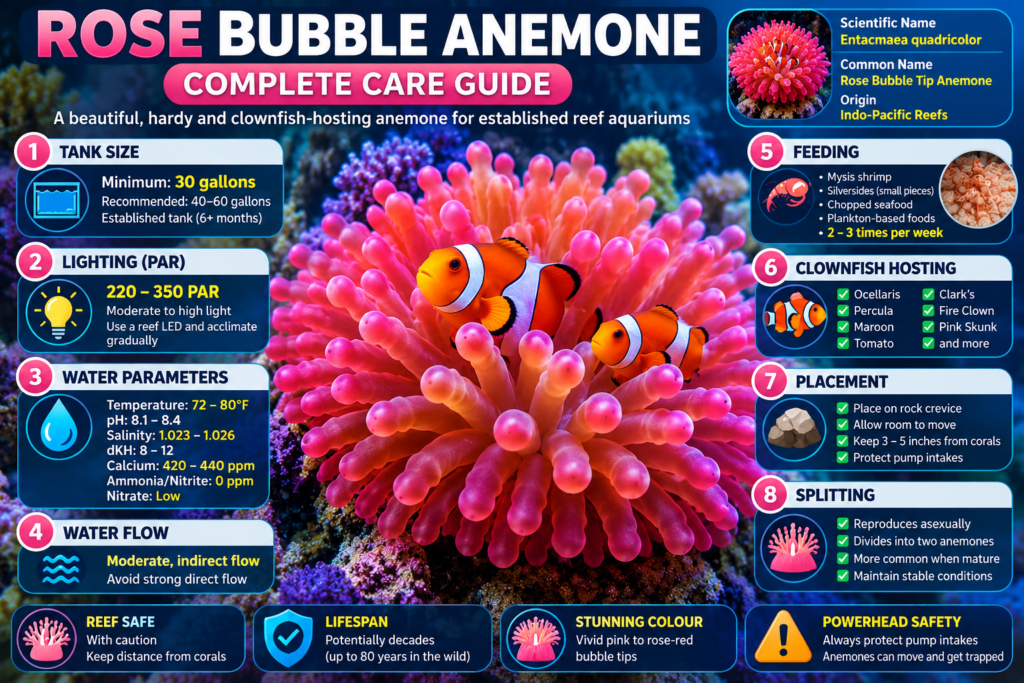
Placement is one of the most important practical decisions after purchase. Unlike a coral that can be glued permanently into one location, a rose bubble anemone can move until it finds a combination of light, flow and rock structure that it prefers.
Initial Placement Method
- Reduce or temporarily stop strong pump flow.
- Protect all pump and wavemaker intakes.
- Wear aquarium-safe gloves when handling the animal.
- Support the anemone carefully without squeezing the body.
- Place the foot into a natural rock crevice.
- Choose an area with suitable PAR and indirect flow.
- Allow the anemone time to attach naturally.
- Restore flow gradually after attachment.
Do not use tongs or tweezers to grab the anemone’s body or tentacles. The foot is particularly important because the animal uses it to secure itself to rock.
Leave space around the anemone. The source brief recommends approximately 3 to 5 inches of separation from nearby corals because the BTA can sting neighbouring animals.
What If the Rose BTA Keeps Moving?
Wandering does not automatically mean that the anemone is dying. It may simply be searching for a location with a better combination of light and water movement. However, repeated movement should prompt you to inspect the aquarium.
- Measure PAR at the animal’s current position.
- Check whether flow is too strong or too weak.
- Look for a secure rock crevice.
- Check temperature and salinity stability.
- Ensure pumps are protected.
- Maintain a clear area away from aggressive corals.
Never leave exposed pump intakes in a BTA aquarium. A wandering anemone can contact an intake unexpectedly. Pump protection should be installed before the anemone is introduced, not after it begins moving.
Rose Bubble Anemone Clownfish Hosting: Which Clownfish Work?
One of the biggest attractions of the rose bubble anemone is its relationship with clownfish. Entacmaea quadricolor is recognised as a host for numerous anemonefish species, giving aquarists many possible combinations.
| Clownfish | Hosting Tendency | Practical Note |
|---|---|---|
| Ocellaris Clownfish | High | One of the most popular aquarium pairings |
| Percula Clownfish | High | Natural-looking pairing with a rose BTA |
| Maroon Clownfish | Very high | Strong hosting behaviour but can be highly territorial |
| Tomato Clownfish | High | Often adapts readily to host anemones |
| Clark’s Clownfish | High | Adaptable host-seeking species |
| Fire Clownfish | Moderate | May host depending on individual behaviour |
| Pink Skunk Clownfish | Moderate | Can host but individual response varies |
Will Captive-Bred Clownfish Host a Rose BTA?
They may, but there is no guarantee that a clownfish will immediately recognise an aquarium anemone. Captive-bred fish may have little previous experience with a host anemone. Some begin hosting quickly, while others take weeks or months.
Patience is usually more useful than forcing the interaction. Place the anemone in a location that provides appropriate light and flow and allow the clownfish to make the choice.
The classic combination of an Ocellaris clownfish pair with a rose bubble anemone remains particularly attractive because the orange, white and black fish contrast strongly with the pink-red anemone.
What Do You Feed a Rose Bubble Anemone?
Best answer: Rose bubble tip anemones benefit from photosynthetic nutrition but can also consume meaty foods such as mysis shrimp, suitably sized seafood and specialised reef foods. The supplied care brief recommends feeding approximately two to three times per week.
A rose BTA is not simply a passive ornament. Its tentacles contain specialised structures that capture food. In addition to energy received from its photosynthetic symbionts, it can consume animal-based foods.
Best Foods
- Frozen or rehydrated mysis shrimp
- Small pieces of silverside for larger specimens
- Chopped shrimp
- Small pieces of squid
- Appropriate plankton-based reef foods
How to Target Feed a Rose BTA
- Turn down or temporarily stop strong flow.
- Prepare a small portion of appropriately sized food.
- Rehydrate freeze-dried food in aquarium water when necessary.
- Use a feeding stick or suitable aquarium feeding tool.
- Touch food gently to the tentacles rather than pushing it into the mouth.
- Allow the anemone to grasp and move the food toward its oral disc.
- Restore flow after feeding once the animal has had sufficient time to capture the food.
Avoid oversized pieces. A food item that is too large can be difficult for the anemone to process and may remain uneaten. Smaller portions are generally easier to manage and reduce unnecessary organic waste.
Aquarists who also keep other fish may find an automatic feeding system useful for maintaining consistent fish feeding schedules. AquariumsWorld’s automatic fish feeder guide explains the broader aquarium feeding concept. An automatic feeder should not, however, be treated as a substitute for deliberate BTA target feeding.
For outdoor systems and ponds, AquariumsWorld also covers automatic fish feeders for pond feeding . That guide is not a rose BTA care resource, but it is relevant when comparing different approaches to consistent aquatic feeding.
Rose Bubble Anemone Water Parameters
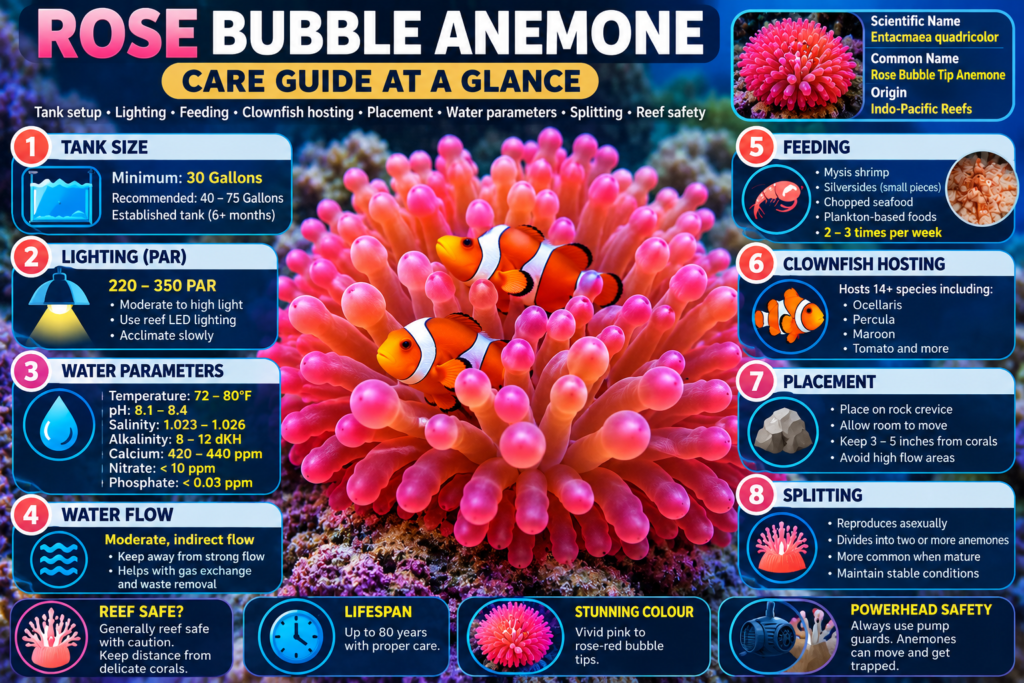
Stable marine chemistry is essential. A rose bubble anemone may tolerate a range of values, but rapid changes can be much more problematic than a stable value that is slightly away from an arbitrary target.
| Parameter | Planning Range | Important Consideration |
|---|---|---|
| Temperature | 72–80°F | Avoid rapid temperature swings |
| pH | 8.1–8.4 | Stability matters |
| Salinity | 1.023–1.026 SG | Keep changes gradual |
| dKH | 8–12 | Stable alkalinity is important |
| Calcium | 420–440 ppm | Maintain consistency |
| Ammonia | 0 ppm | Detectable ammonia indicates a problem |
| Nitrite | 0 ppm | Should not be present in a mature reef |
| Nitrate | Preferably low | Avoid sudden nutrient changes |
Before purchasing an anemone, test the aquarium rather than relying on memory or assumptions. AquariumsWorld’s marine aquarium water test kit guide provides a useful starting point for understanding why regular marine testing is important.
You can also compare broader aquarium testing approaches using the aquarium water test kit comparison guide . Although that article is broader than rose BTA care, the principle remains the same: measure the system rather than guessing its condition.
Why Is My Rose Bubble Anemone Bleaching?
Short answer: Bleaching occurs when the anemone loses or expels much of its photosynthetic symbiont population. It can be associated with stress from unsuitable light, temperature changes, salinity instability, poor conditions or other environmental pressure.
A bleaching rose BTA may become noticeably pale or white. Because photosynthetic symbionts contribute substantially to its nutritional economy, severe bleaching can become a serious health problem rather than simply a cosmetic colour change.
Common Causes of Rose BTA Bleaching
| Potential Cause | Possible Signs | Priority Action |
|---|---|---|
| Insufficient light | Paling and movement toward brighter areas | Check PAR and acclimate carefully |
| Excessive light or rapid lighting change | Contraction and bleaching after lighting change | Reduce intensity gradually and stabilise |
| Temperature spike | Rapid stress and tissue contraction | Restore stable temperature |
| Salinity fluctuation | Withdrawal and poor expansion | Correct salinity gradually |
| General parameter instability | Wandering, contraction and colour loss | Test the entire system |
| New or immature aquarium | Stress shortly after introduction | Improve system maturity and stability |
| Insufficient nutrition | Poor growth and weak expansion | Review feeding and lighting |
What Should You Do When a Rose BTA Bleaches?
- Test temperature, salinity, pH and other major parameters.
- Check the actual PAR at the anemone’s position.
- Review recent changes to lighting or flow.
- Ensure the anemone cannot contact a pump.
- Maintain stable conditions rather than making multiple drastic changes.
- Offer appropriately sized food if the animal is still feeding.
- Observe tissue integrity and mouth condition daily.
If the anemone is deteriorating rapidly, the safest course is to obtain advice from an experienced marine aquarist or aquatic veterinarian rather than attempting multiple untested treatments at once.
AquariumsWorld also publishes general fish health information, including the red pest disease and aquarium fish treatment guide . Red pest disease is not the same condition as rose BTA bleaching, but the guide reinforces an important aquarium-health principle: distinguish visual symptoms carefully before choosing treatment.
How Do Rose Bubble Tip Anemones Split?
One of the most interesting features of Entacmaea quadricolor is its ability to reproduce asexually through splitting, also known as binary fission. A mature anemone can divide into two portions that develop into independent individuals.
What Does Splitting Look Like?
The anemone may begin stretching or elongating. A constriction can develop through the middle of the body, eventually producing two sections. Each section must retain the necessary tissue structures required for recovery.
Natural splitting is generally preferable to manual intervention. Aquarists should not deliberately cut an otherwise healthy anemone simply because they want more specimens unless they understand the risks and have appropriate experience.
Why Do Rose BTAs Split?
The exact trigger can vary. Natural size, feeding history, environmental conditions and stress may all influence reproduction. The supplied brief identifies reaching a substantial size and stable conditions as common factors, while also noting that stress-related splitting can produce weaker outcomes.
After a split, both sections may contract, change colour temporarily or move to another position. Maintain stable conditions and avoid repeatedly moving or manipulating the animals.
Is a Rose Bubble Anemone Reef Safe?
Yes, with caution. A rose bubble tip anemone can be kept in a reef aquarium, but it is not harmless to every neighbouring coral. Its tentacles contain stinging cells, and it can damage corals that grow or are positioned within its reach.
The phrase “reef safe” should therefore be understood as “compatible with a reef aquarium under appropriate management,” rather than “will never affect other reef inhabitants.”
Leave approximately 3 to 5 inches or more between the anemone and nearby corals, while remembering that the actual reach can increase when the animal expands. Because the anemone can move, the initial distance should not be the only safety consideration.
Reef Safety Checklist
- Provide protected pump intakes.
- Leave clear space around the anemone.
- Monitor wandering during the first weeks.
- Avoid placing incompatible aggressive organisms immediately beside it.
- Do not keep different anemone species in direct contact.
- Maintain stable reef chemistry.
Marine aquarium stocking should always consider the behaviour of the whole community. AquariumsWorld’s aquarium fish compatibility guide discusses the wider principle of selecting tank mates based on behaviour, territory and adult requirements. The examples concern different fish, but the same planning principle applies to reef invertebrates.
How Long Do Rose Bubble Tip Anemones Live?
Bubble tip anemones can be long-lived marine animals. The supplied research brief cites potential wild longevity measured in decades, with some estimates reaching approximately 80 years. Aquarium lifespan is more difficult to standardise because it depends on environmental stability, disease, nutrition, lighting and overall husbandry.
This is why purchasing an anemone should be treated as a long-term commitment. A healthy rose BTA can remain part of a reef system for many years, potentially through several aquarium upgrades.
Rose Bubble Anemone Price and Where to Buy
The price of a rose bubble anemone varies according to colour intensity, size, lineage, aquaculture status and retailer. The source brief gives a broad USA planning range from approximately $15–$20 for hobbyist splits through higher-priced specimens approaching or exceeding $80.
| Source Type | Indicative Range | What to Consider |
|---|---|---|
| Local fish store | $25–$60 | Inspect health personally |
| Online specialist retailer | $30–$90+ | Shipping and specimen grade matter |
| Hobbyist split | $15–$50+ | Ask about lineage and parent condition |
| Premium colour morph | Higher | Price can reflect rarity rather than care difference |
Aquacultured specimens can be particularly attractive to responsible reef keepers because they are produced within aquarium systems and may already be accustomed to captive conditions. Regardless of source, inspect the individual animal rather than purchasing solely because the colour looks attractive.
The 3 Best Feeding Products for Rose Bubble Anemones
Feeding should complement, rather than replace, good lighting and stable water quality. The three products below are based on the product recommendations in the supplied Rose Bubble Anemone brief and are intended to cover different feeding situations, from regular meaty food to smaller particulate nutrition.
Product 1 — San Francisco Bay Brand Freeze-Dried Mysis Shrimp [ BUY NOW ]

Best for: Regular meaty feeding of established rose BTAs.
| ASIN | B000UZJSC6 |
| Form | Freeze-dried mysis shrimp |
| Suitability | 10/10 |
| Use | Rehydrate before target feeding |
Mysis shrimp is a practical food because the pieces can be sized according to the animal. Rehydrating freeze-dried food before feeding can make the food easier for the anemone to capture and process.
Feed only a modest amount. The goal is to provide useful nutrition without creating unnecessary organic waste. A rose BTA that is already well established and receiving strong photosynthetic nutrition does not need to be stuffed with food at every opportunity.Check Price on Amazon
Product 2 — Reef Roids Coral and Anemone Food [ BUY NOW ]

Best for: Smaller rose BTAs and fine particulate supplemental feeding in a mixed reef aquarium.
| ASIN | B01G76ZMXY |
| Form | Fine nano plankton powder |
| Suitability | 10/10 |
| Use | Mix with aquarium water and feed carefully |
Fine particulate foods can be useful when a small anemone is not yet comfortable taking larger pieces. They can also fit into a broader reef feeding routine where corals and filter-feeding organisms receive nutrition during the same feeding session.
Use a small amount and avoid turning every feeding into a heavy nutrient event. If the product is dispersed through the aquarium, filtration and circulation should be managed appropriately so the food is not simply wasted.Check Price on Amazon
Product 3 —Aqueon Shrimp Pellets Sinking Food, 3.25 oz [ BUY NOW ]

Best for: Aquarists who want a combination of small particulate and larger meaty food in one product.
| ASIN | B0C5TN9BWW |
| Form | Freeze-dried plankton and mysis combination |
| Suitability | 9/10 |
| Target | Marine fish, corals and anemones |
A combination product can be convenient when an aquarium contains anemones and other reef organisms with different feeding responses. The smaller particles can provide fine particulate nutrition while larger pieces offer a more obvious food source for an adult BTA.
As with all prepared foods, start conservatively. Observe whether the anemone actually captures and consumes the food before increasing the quantity.Check Price on Amazon
Rose Bubble Anemone Food Comparison
| Product | ASIN | Form | Best Use | Suitability |
|---|---|---|---|---|
| San Francisco Bay Brand Mysis | B000UZJSC6 | Freeze-dried mysis | Primary meaty food | 10/10 |
| Reef Roids | B01G76ZMXY | Nano plankton powder | Small BTAs and reef feeding | 10/10 |
| Aquatic Foods Plankton + Mysis | B0C5TN9BWW | Combination food | All-size versatility | 9/10 |
Related AquariumsWorld Aquarium Guides
The following AquariumsWorld resources cover broader aquarium topics including filtration, testing, feeding, compatibility, aquarium equipment and aquatic health. Some articles focus on freshwater or fish species rather than reef anemones, but they are included as related resources for aquarists building a complete aquarium knowledge base.
- Reef Aquarium Sump Design, Size and Setup — useful when planning filtration and additional water volume for a larger reef.
- Best Plants for Betta Fish Tanks — a freshwater-focused guide that demonstrates broader aquarium habitat planning.
- Oscar Fish Tank Mates and Compatibility Guide — useful for understanding the broader principles of aquarium compatibility.
- Copper Oscar Fish Colours, Tank Size, Diet and Mates — another species-care example covering adult requirements and feeding.
- Blueberry Oscar Fish: Truth About Colours and Size — useful for understanding aquarium colour terminology and responsible fish selection.
- Oscar Fish Blue Varieties, Care and Genetics — demonstrates why appearance should be considered alongside biological requirements.
- Oscar Fish 55 Gallon Tank and Filtration — broader information about aquarium volume and filtration planning.
- White Tiger Oscar Fish Colour, Diet and Lighting — a useful comparison for understanding the relationship between aquarium lighting and appearance.
- Bumblebee Oscar Fish Species Guide — another example of species identification and responsible aquarium planning.
- Marine Aquarium Water Test Kits — particularly relevant when checking reef water before introducing a rose BTA.
- Fire Red Oscar Fish Colour, Diet and Tank Size — a broader example of species-specific aquarium care.
- How to Rehome an Oscar Fish — useful broader guidance on responsible long-term aquarium ownership.
- Aquarium Water Test Kit Comparison — useful when selecting testing equipment for a reef system.
- Oscar Fish Plush and Stuffed Animals — a lighter aquarium-related resource within the wider AquariumsWorld archive.
- Can You Eat Parrot Fish? Taste, Safety and Ciguatera — a marine fish information resource from the AquariumsWorld archive.
- Tiger Parrot Fish Varieties and Tank Size — broader information on aquatic species and aquarium planning.
- Automatic Fish Feeder: A Convenient Aquarium Feeding Solution — relevant to consistent aquarium feeding routines.
- Automatic Fish Feeder for Pond Feeding — a broader feeding equipment resource.
- Aquarium Industry News October 2026 — useful for keeping up with wider developments in the aquarium hobby.
- Microbe-Lift Nite-Out II Aquarium Guide — useful background on biological filtration and aquarium cycling.
- Saltwater Parrot Fish Species, Tank Size and Diet — another marine aquarium species resource.
- Parrot Fish Food and Best Feeding Practices — broader aquarium feeding information.
- Microbe-Lift Nite-Out II and Aquarium Biological Support — included as an additional internal reference for biological filtration planning.
- AquariumsWorld Aquarium Industry News — useful for broader aquarium industry updates.
- Automatic Fish Feeder for Pond Feeding Solution — additional feeding equipment resource.
- Automatic Fish Feeder for Aquarium Feeding — additional information on maintaining consistent feeding schedules.
- 100 Gallon Saltwater Aquarium Setup and Equipment — particularly useful for aquarists considering a larger and more stable reef system.
- Red Pest Disease and Aquarium Fish Treatment — broader aquarium health information and symptom awareness.
Rose Bubble Anemone Pre-Purchase Checklist
- My aquarium is established and biologically stable.
- The tank has been operating for approximately six months or longer.
- Salinity is stable and appropriate for a reef aquarium.
- Temperature remains within the desired marine range.
- Ammonia and nitrite are undetectable.
- Alkalinity and calcium are stable.
- I have measured PAR rather than guessing lighting intensity.
- The planned placement provides appropriate light.
- Flow is moderate and indirect at the intended position.
- All pump and wavemaker intakes are protected.
- There is sufficient open space around the anemone.
- Nearby corals cannot immediately contact it.
- I have appropriate food available.
- I understand that the animal may move after introduction.
- I am prepared for a long-term aquarium commitment.
Frequently Asked Questions About Rose Bubble Anemones
What is a rose bubble tip anemone?
A rose bubble tip anemone is a rose or pink colour morph of Entacmaea quadricolor. It is a photosynthetic marine anemone known for its bubble-shaped tentacles and ability to host several clownfish species. It is commonly kept in established reef aquariums.
What clownfish are compatible with a rose bubble tip anemone?
Ocellaris, Percula, Maroon, Tomato, Clark’s and several other clownfish can form hosting relationships with bubble tip anemones. However, compatibility does not guarantee immediate hosting. Captive-bred clownfish may take weeks or months to recognise and settle into an anemone.
How much light does a rose bubble tip anemone need?
The supplied care brief identifies approximately 220–350 PAR as a preferred planning range. The actual requirement depends on acclimation, aquarium depth, lighting spectrum, individual condition and placement. Use a PAR meter where possible rather than estimating intensity from visual brightness.
Why is my rose bubble tip anemone bleaching?
Bleaching can occur when an anemone loses or expels photosynthetic symbionts. Potential triggers include unsuitable or rapidly changing light, temperature stress, salinity instability, poor water quality and other environmental stress. Test the aquarium and stabilise conditions before making multiple additional changes.
What do you feed a rose bubble tip anemone?
Appropriate foods include mysis shrimp, suitably sized seafood and specialised plankton-based reef foods. The supplied care plan recommends approximately two to three feedings per week, although feeding should be adjusted according to the individual animal, its size and its overall nutritional condition.
How do rose bubble tip anemones split?
Rose bubble tip anemones can reproduce through asexual division or binary fission. The animal gradually constricts and separates into two portions. Natural splitting is generally preferable to manual cutting because deliberate propagation creates additional handling and injury risks.
Is a rose bubble tip anemone reef safe?
Yes, with caution. Rose BTAs are commonly maintained in reef aquariums, but they possess stinging cells and can damage corals that contact their tentacles. Provide adequate separation, monitor movement and protect all pump intakes.
What tank size does a rose bubble tip anemone need?
The supplied brief identifies 30 gallons as the minimum for a single rose BTA, provided the aquarium is established. A 40–60 gallon system can provide greater stability and more placement flexibility. Larger aquariums may be preferable when keeping multiple reef inhabitants.
How do I place a rose bubble tip anemone in my tank?
Reduce strong flow, protect pump intakes and place the anemone’s foot into a suitable rock crevice at an appropriate light level. Do not force the animal into a permanent position. Allow it to attach and move naturally while monitoring its surroundings.
How long do rose bubble tip anemones live?
Bubble tip anemones can be extremely long-lived marine animals. The supplied brief cites potential wild longevity of several decades and up to approximately 80 years. Aquarium longevity varies considerably according to husbandry, stability, health and environmental conditions.
Conclusion: Is a Rose Bubble Anemone Right for Your Reef?
The rose bubble anemone is one of the most rewarding host anemones available to marine aquarists. Its vivid rose colour, flowing tentacles and potential relationship with clownfish make it a natural centrepiece for an established reef aquarium.
The key to successful rose bubble anemone care is preparation. Do not buy the animal first and attempt to create the correct environment later. Establish the aquarium, confirm stable water chemistry, measure PAR, protect every pump intake and create a suitable rock structure before introduction.
Lighting deserves particular attention because the animal depends heavily on its photosynthetic relationship with symbiotic organisms. The supplied care brief identifies 220–350 PAR as the preferred planning range, but gradual acclimation and observation remain important.
Feeding provides another useful source of nutrition. Mysis shrimp, suitable meaty foods and specialised particulate reef foods can complement photosynthesis. Feed sensibly rather than assuming that more food automatically means better growth.
Finally, remember that a rose BTA is a living reef animal capable of moving, stinging nearby organisms and reproducing by splitting. It is therefore not simply another decoration to place wherever there is empty space. Give it room, protect it from pumps, monitor its health and allow it to establish naturally.
When these fundamentals are in place, a healthy rose bubble tip anemone can become one of the most visually impressive and biologically interesting inhabitants in a home marine aquarium.
Scientific References
- Yanagi, K., Kobayashi, G. and Izumi, T. (2020). Molecular phylogeny and systematic revision of the family Actiniidae. Zoological Letters, 6(1), 1–24.
DOI: https://doi.org/10.1186/s40851-019-0143-z
PMC: https://pmc.ncbi.nlm.nih.gov/articles/PMC6940218/ - Scott, A. and Stampar, S.N. (2019). Mutualistic relationships between anemonefish and their host anemones. Journal of the Marine Biological Association of the United Kingdom.
DOI: https://doi.org/10.1017/S002531541900033X - Muller-Parker, G. and Davy, S.K. (2008). Symbiotic and free-living dinoflagellates of the genus Symbiodinium in reef organisms. Coral Reefs, 27(1), 43–55.
DOI: https://doi.org/10.1007/s00338-007-0339-5 - Hoegh-Guldberg, O. and Smith, G.J. (2006). The effect of sudden changes in temperature, light and salinity on the population density and export of zooxanthellae from reef organisms. Journal of Experimental Marine Biology and Ecology.
DOI: https://doi.org/10.1016/0022-0981(89)90089-6 - Geller, J.B., Fitzgerald, L.J. and King, C.E. (2003). Fission in sea anemones: Integrative studies of life cycle evolution. Integrative and Comparative Biology, 43(1), 58–64.
DOI: https://doi.org/10.1093/icb/43.1.58 - Frazão, B., Rodriguez, V., Dinis, M.T. and Vasconcelos, V. (2012). Sea anemone (Actiniaria) toxins: An overview. Marine Drugs, 10(8), 1812–1851.
DOI: https://doi.org/10.3390/md10081812
PMC: https://www.ncbi.nlm.nih.gov/pmc/articles/PMC3497005/ - Hume, B., D’Angelo, C., Burt, J., Baker, A.C., Riegl, B. and Wiedenmann, J. (2010). Coral thermal tolerance and photoacclimation in anemones. Journal of Experimental Marine Biology and Ecology, 386(1–2), 1–6.
DOI: https://doi.org/10.1016/j.jembe.2010.01.001 - Various Authors (2023). Fish welfare in public aquariums and zoological collections. Animals, 13(16), 2548.
DOI: https://doi.org/10.3390/ani13162548
SEO Targeting:
Primary Keyword: rose bubble anemone
Related Keywords: rose bubble tip anemone care, Entacmaea quadricolor rose, rose bubble anemone clownfish, rose bubble anemone lighting PAR, rose bubble anemone splitting, rose bubble anemone bleaching, rose bubble anemone feeding, rose bubble anemone tank size, rose bubble anemone placement, rose bubble anemone price
Suggested Meta Title: Rose Bubble Anemone | Complete Care Guide to Lighting Feeding Clownfish Hosting Splitting and Where to Buy 2026 | AquariumsWorld
Suggested Meta Description: Complete rose bubble tip anemone care guide covering PAR lighting requirements, clownfish hosting, feeding, placement, bleaching causes, splitting propagation and where to buy in the USA 2026.
Suggested Slug: rose-bubble-anemone