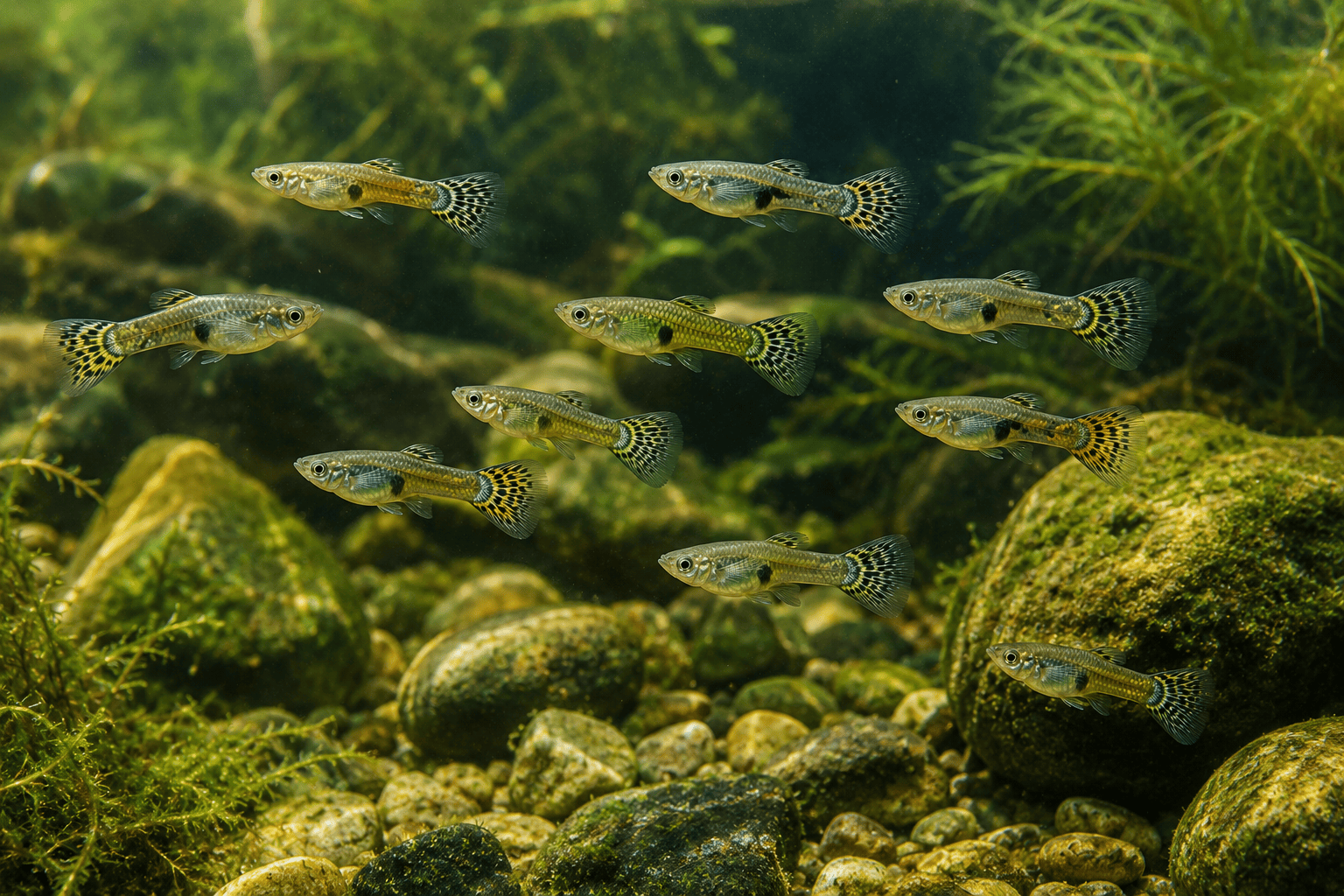
Guppies are social shoaling fish that can also display schooling behaviour, particularly when responding to predators or environmental threats. They do not behave like permanently synchronized schooling species, but they naturally form social groups and often swim together in aquariums. Understanding guppy shoaling behaviour, whether guppies need to be in groups, how many guppies should be kept together and which guppy tank mates are suitable can make a significant difference to aquarium welfare.
The distinction between guppy schooling vs shoaling is important because the two terms describe different levels of group coordination. Guppies are social fish, and their behaviour is influenced by group composition, environmental conditions, predation history and early social experience. Research has demonstrated that guppy populations differ in shoaling cohesion and that both genetic and environmental factors influence this behaviour [1][2].
For most home aquariums, keeping a compatible group rather than a single guppy provides a better opportunity for natural social behaviour. A carefully planned group, appropriate male to female ratio, suitable tank size and peaceful community environment are therefore central to responsible guppy keeping.
Are Guppies Schooling Fish? Direct Answer
Guppies are primarily social shoaling fish, but they can also school when environmental conditions encourage coordinated movement. They commonly remain together because of social attraction and safety benefits, while stronger schooling behaviour can occur when guppies perceive a predator or other threat.
This distinction explains why guppies sometimes appear to school tightly in an aquarium but spread throughout the tank at other times. Their group structure is flexible rather than permanently synchronized.
What Is the Difference Between Schooling and Shoaling?
Shoaling describes fish that remain in a group for social, feeding or protective reasons. Members can move in different directions and do not necessarily maintain close alignment.
Schooling is more coordinated. Fish generally swim in similar directions, maintain greater alignment and respond collectively to movement within the group. Scientific research on guppies has specifically measured schooling behaviour through group polarization and coordination [3].
Are Guppies Schooling or Shoaling Fish?
The most accurate answer is that guppies are shoaling fish with the capacity for schooling behaviour. Their social grouping is not simply a fixed instinct. It changes according to environmental conditions, social experience, predation pressure and population history.
Research on Trinidadian guppies found that populations exposed to higher predation pressure developed more cohesive shoaling behaviour, demonstrating that group behaviour can be shaped by natural selection [1][2].
Guppy Social Behaviour in the Wild
Wild guppies inhabit freshwater streams and pools where they encounter predators, competitors and changing environmental conditions. Remaining close to other individuals can provide access to social information and may reduce the risk associated with being alone.
However, guppy groups are not static. Individuals can join or leave groups, while the size and cohesion of the group can change according to circumstances. This flexible structure is one reason the term shoaling is generally more useful when describing everyday guppy social behaviour.
How Predation Shapes Guppy Group Behaviour
Predation has played an important role in the evolution of guppy behaviour. Seghers’ classic study demonstrated geographic variation in guppy schooling behaviour and interpreted this variation as an evolutionary response to predation [1].
Later research strengthened this interpretation by comparing populations from high and low predation environments. High predation guppies formed more cohesive shoals under controlled conditions, while both populations increased cohesion when exposed to predator-associated chemical cues [2].
More recent research also demonstrates that predation history affects how guppies use social information, although the relationship is more complex than simply assuming that more predators always produce more social learning [5].
Why Guppies Form Groups in the Aquarium
Aquarium guppies retain many of the behavioural tendencies associated with their natural social ecology. A group can provide social stimulation, opportunities for interaction and a more natural behavioural environment.
However, group living does not mean every guppy must remain in a tight cluster continuously. Healthy guppies may spread throughout the aquarium while feeding, exploring plants or resting and then regroup during movement or perceived threats.
Do Guppies Need to Be in Groups?
Guppies are social fish, so keeping them in compatible groups is generally preferable to keeping a single individual when the aquarium can support the additional bioload.
A group also changes the social environment. Research has shown that early social conditions can influence later shoaling behaviour and social learning ability in guppies [3]. This supports the broader view that social experience matters to guppy behaviour.
Do Guppies Get Lonely on Their Own?
It is better to avoid describing fish loneliness using the same emotional framework applied to humans. However, guppies clearly respond to the presence and behaviour of other guppies, and their natural biology includes social grouping.
A solitary guppy may survive, but survival alone does not necessarily represent the best welfare outcome. If the aquarium is suitable, a compatible group provides greater opportunity for normal social behaviour.
Can Guppies Live Alone?
Yes, a guppy can technically survive alone, particularly when water quality, feeding and environmental conditions are appropriate. However, solitary housing removes opportunities for normal interaction with conspecifics.
For this reason, a properly stocked group is generally preferable to deliberately maintaining one guppy without social companions.
How Many Guppies Should You Keep Together?
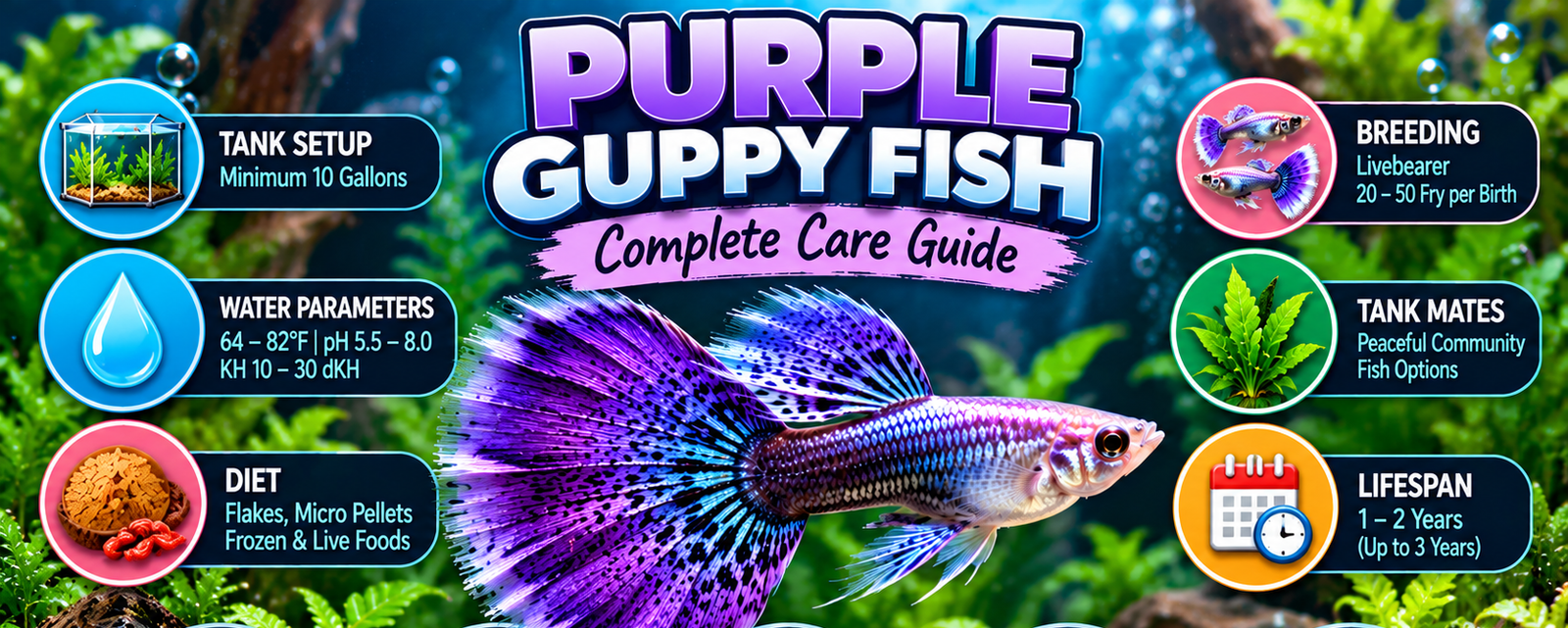
There is no single number that works for every aquarium because stocking depends on tank volume, filtration, adult fish size, sex ratio, plant density and maintenance. For a typical community aquarium, six guppies is a practical starting group when the aquarium is appropriately sized and filtered.
Minimum Group Size for Guppies
Three guppies can provide a basic social group, but larger groups generally offer more opportunities for natural interaction. Six or more compatible guppies can create a more stable social environment when the aquarium has sufficient capacity.
Stocking should never be based on group size alone. Water volume and filtration must always be considered together with the number of fish.
How Many Guppies in a 10 Gallon Tank?
A 10 gallon aquarium can work as a starter aquarium for a small guppy group, but the final number should account for adult size, filtration and maintenance rather than relying on a rigid inch-per-gallon rule.
For a responsible setup, approximately five to six small adult guppies can be considered a practical range in a well-filtered 10 gallon aquarium, provided the tank is mature and maintained consistently.
For larger groups or a community aquarium, a 20 gallon aquarium provides considerably more swimming space and greater water volume. See the AquariumsWorld fish tank dimensions guide when comparing available aquarium footprints.
What Is the Ideal Male to Female Guppy Ratio?
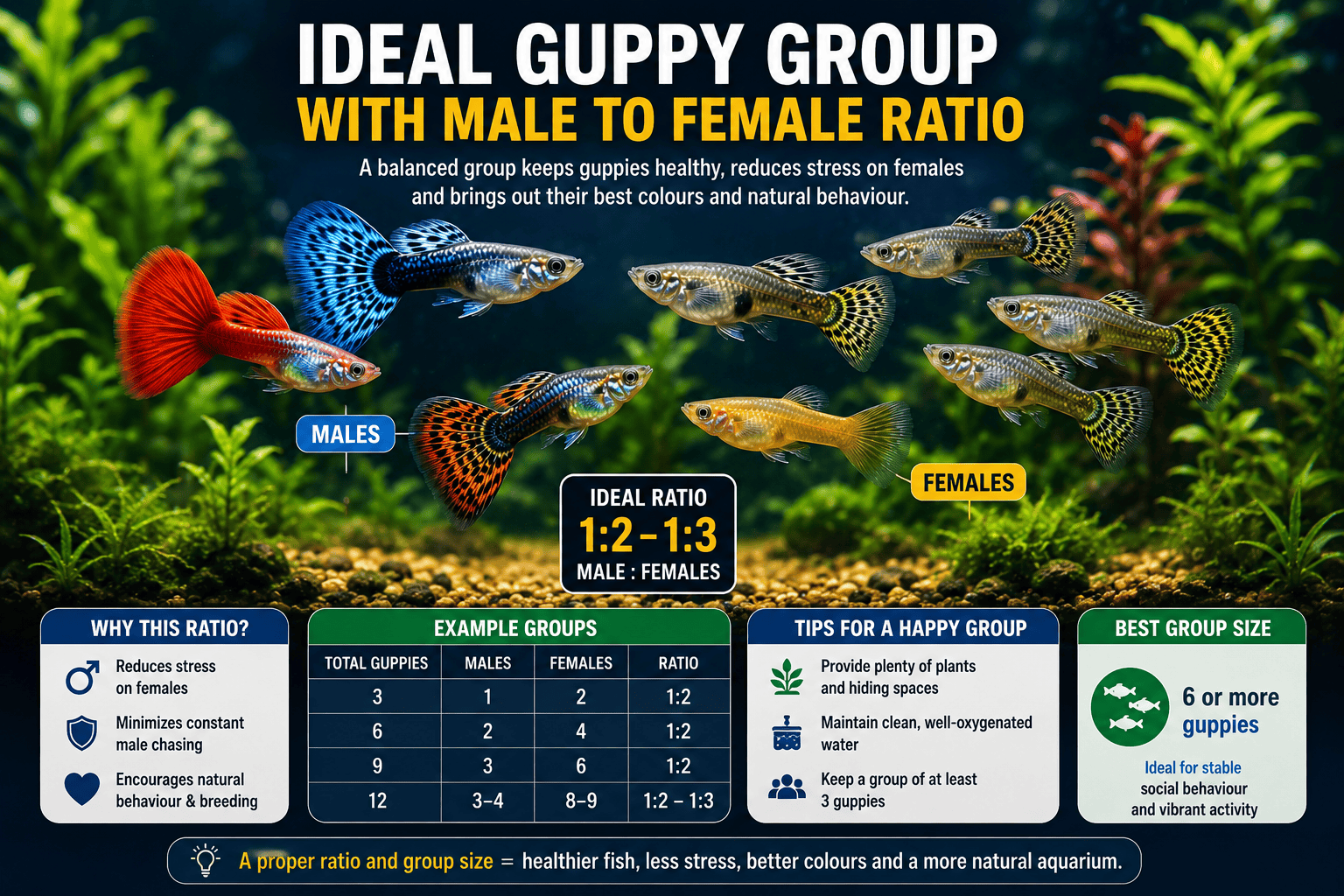
A commonly recommended mixed-sex ratio is one male for every two or three females. The purpose is to reduce persistent male attention toward individual females rather than to create a rigid biological requirement.
| Group Size | Males | Females | Recommended Ratio |
|---|---|---|---|
| 3 guppies | 1 | 2 | 1:2 |
| 6 guppies | 2 | 4 | 1:2 |
| 9 guppies | 3 | 6 | 1:2 |
| 12 guppies | 4 | 8 | 1:2 |
Remember that mixed-sex guppy groups can reproduce rapidly. Anyone who does not want frequent fry should consider an all-male or all-female group instead.
Are Male Guppies Aggressive With Each Other?
Male guppies can compete socially and reproductively, but they are not normally considered highly aggressive aquarium fish. The intensity of interactions depends on space, group composition, environmental structure and the presence of females.
Providing plants and visual breaks can reduce constant contact between individuals. A heavily decorated aquarium also gives less dominant fish opportunities to move away from persistent attention.
Can You Keep Only Male Guppies Together?
Yes. An all-male guppy aquarium can be an attractive and practical option because it prevents reproduction. Males are often particularly colourful, making an all-male display visually impressive.
Choose healthy males of similar size and provide adequate swimming space, filtration and plant cover. Avoid overcrowding simply because the fish are small.
Can You Keep Only Female Guppies Together?
Yes. An all-female group can also work well and eliminates the continuous mating pressure associated with mixed-sex groups. However, females purchased from mixed-sex tanks may already be carrying sperm and can potentially produce fry after purchase.
Do Guppies School With Other Fish?
Guppies may sometimes swim alongside other peaceful fish, but this does not necessarily mean they are forming a true mixed-species school. Their strongest social association remains with other guppies.
Do Guppies School With Neon Tetras?
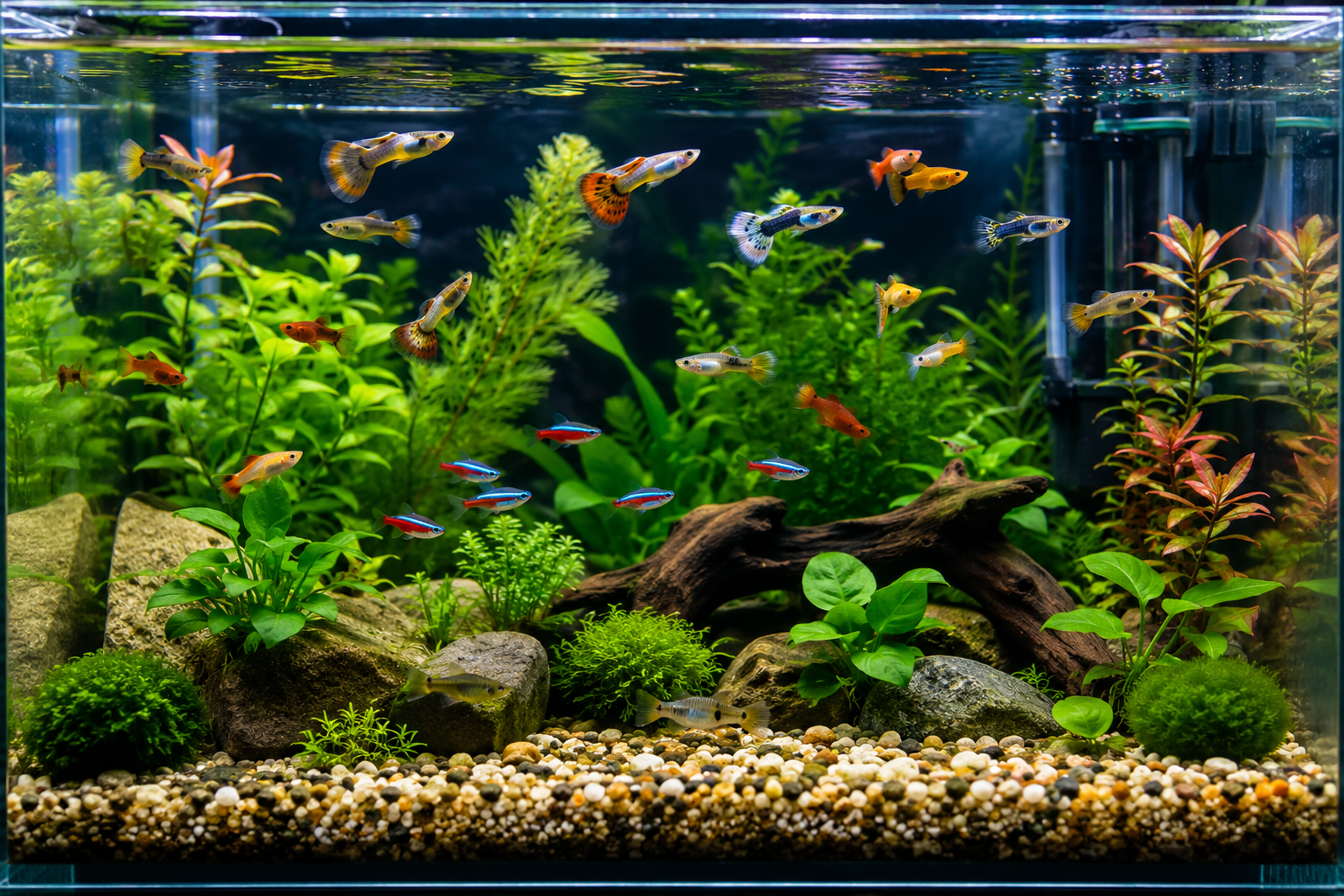
Guppies and neon tetras can sometimes occupy similar parts of the aquarium and may appear to move together, especially in open swimming areas. However, they generally retain their own species-specific social behaviour.
Both species can work in a peaceful community aquarium when temperature, water chemistry, group size and tank dimensions are appropriate. A larger aquarium provides more room for each species to express its normal behaviour.
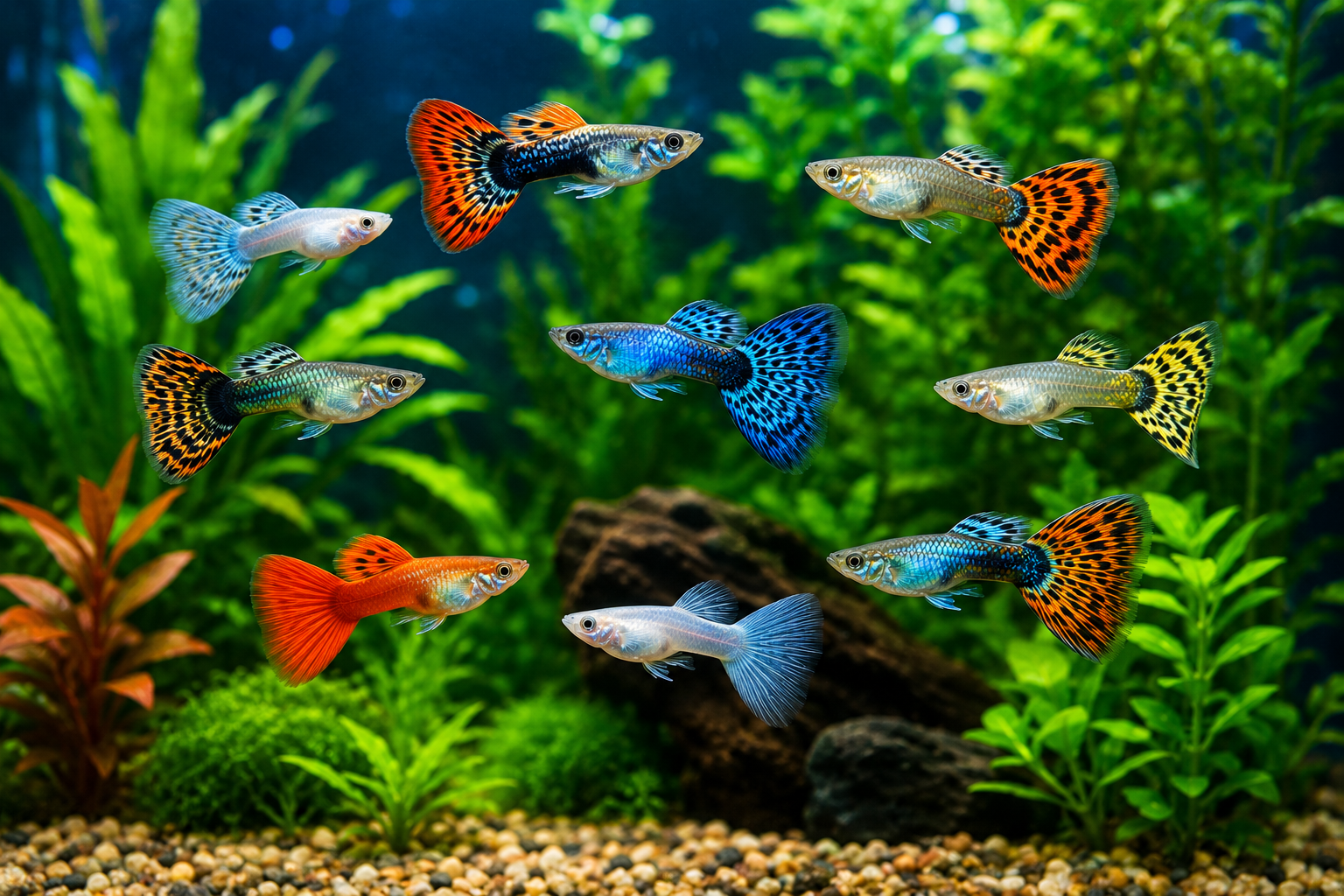
Can Fancy Guppies School Together?
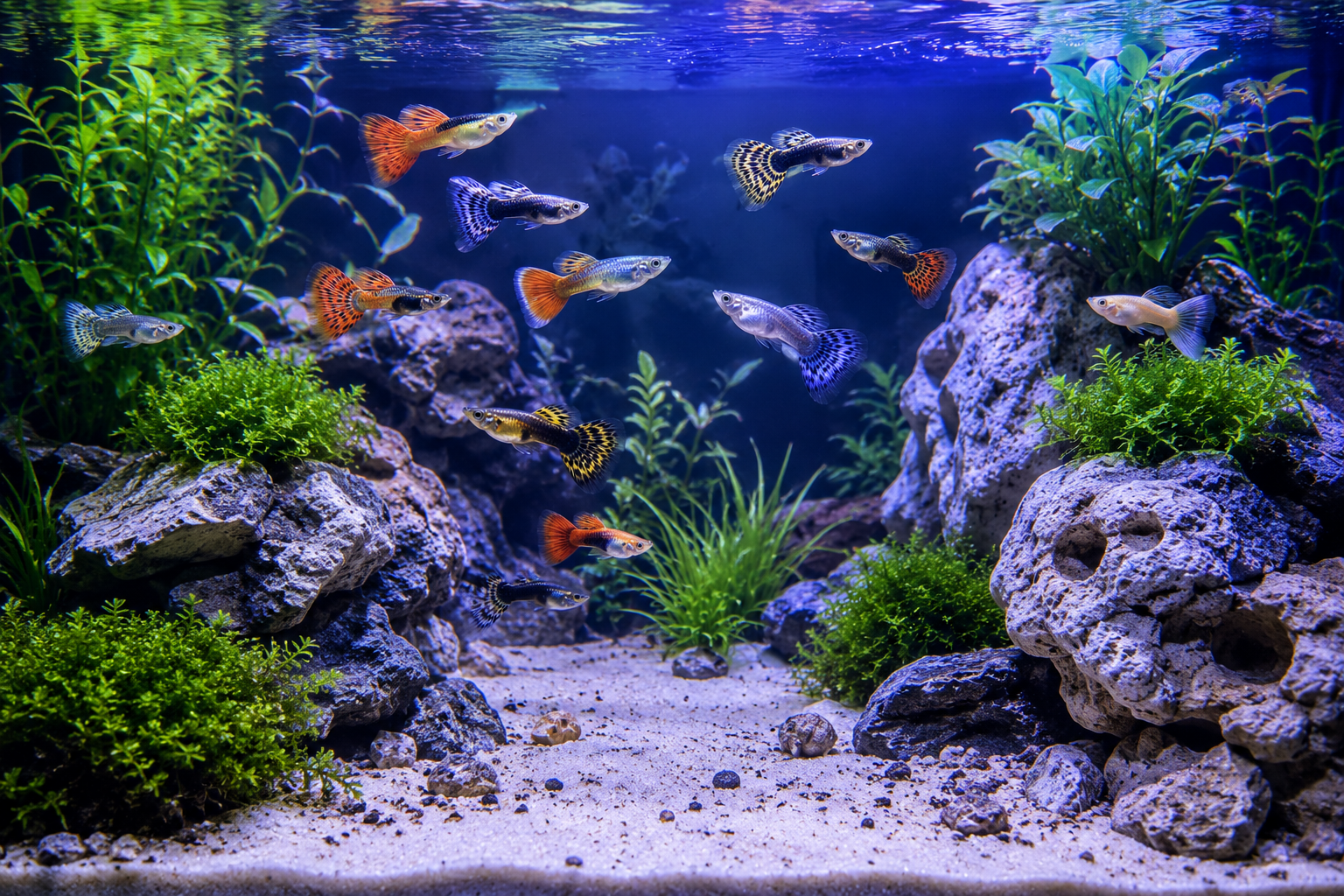
Yes. Fancy guppies are domesticated varieties of Poecilia reticulata, so different colour and fin varieties can interact and shoal together.
There is no requirement to keep the same colour strain together for social reasons. In fact, combining different healthy varieties can create an attractive mixed guppy display.
Best Tank Mates for Guppies
Good guppy tank mates should be peaceful, relatively small and comfortable with similar environmental conditions. The best community fish also need enough swimming space and should not be known for persistent fin nipping or predation.
Best Community Fish to Keep With Guppies
| Species | Compatibility | Important Consideration |
|---|---|---|
| Harlequin Rasbora | Excellent | Peaceful schooling fish that works well in community aquariums. |
| Corydoras | Excellent | Bottom-dwelling behaviour creates useful separation in the aquarium. |
| Platies | Very Good | Peaceful livebearers with similar general community requirements. |
| Small peaceful tetras | Very Good | Use suitable species and provide adequate group sizes. |
| Small peaceful rasboras | Very Good | Best in planted community aquariums with open swimming areas. |
Fish to Avoid Keeping With Guppies
- Goldfish: Their temperature requirements and adult size make them unsuitable companions for normal tropical guppy aquariums.
- Bettas: Individual temperament varies, and fin aggression can create serious compatibility problems.
- Large cichlids: Large predatory or territorial cichlids may injure or eat guppies.
- Tiger barbs: Their fin-nipping behaviour can create problems for long-finned fancy guppies.
Do not choose tank mates based only on similar size. Temperature, behaviour, adult size, feeding competition and territorial tendencies all need to be considered.
How Guppy Social Behaviour Develops
Guppy social behaviour is influenced by both inherited characteristics and environmental experience. Huizinga, Ghalambor and Reznick found persistent differences in shoaling cohesion between guppy populations from different predation environments, supporting a genetic contribution to behavioural differences [2].
Chapman and colleagues also demonstrated that early social environment can influence later shoaling tendency and social learning ability. Guppies raised at lower densities showed stronger shoaling tendencies than fish raised at higher densities in their experiment [3].
More recent work has examined the genomic and transcriptomic architecture associated with schooling behaviour. Corral-Lopez and colleagues found functional convergence involving genomic and transcriptomic patterns in guppy lines selected for schooling propensity [4].
These findings demonstrate why guppy behaviour should not be reduced to a simple statement that all individuals behave identically. Social behaviour has genetic, developmental and environmental components.
Guppy Tank Setup for a Social Group
Minimum Tank Size for a Guppy Group
A small guppy group can be maintained in a properly established aquarium, but larger tanks provide more stable water conditions and more room for natural movement.
A 10 gallon aquarium is a reasonable starting point for a small group, while a 20 gallon aquarium is more versatile for a larger guppy group or a community aquarium.
When selecting a tank, footprint matters as well as volume. Longer aquariums provide more horizontal swimming space, which is particularly useful for active livebearers such as guppies.
For help comparing aquarium dimensions and physical footprints, use the AquariumsWorld Fish Tank Dimensions Guide.
Planting and Decoration for Guppy Social Wellbeing
Plants can create visual barriers and reduce uninterrupted lines of sight. This is particularly useful when males are persistently following females or when some individuals are less dominant than others.
Floating plants can also provide shaded areas and cover for fry. Dense vegetation should not completely eliminate open swimming space because guppies remain active throughout the aquarium.
Substrate choice also matters in planted systems. If you are designing a planted guppy aquarium, the AquariumsWorld blog contains additional aquarium substrate and setup resources.
Filtration and Water Quality for Guppy Groups
More fish produce more waste, so filtration must increase with stocking density. A suitable filter should provide biological filtration and enough circulation to keep water oxygenated without creating excessive current.
Regular water testing is equally important. Ammonia and nitrite should remain at zero in a properly cycled aquarium, while nitrate should be controlled through maintenance and appropriate stocking.
Good filtration cannot compensate for chronic overstocking. If water quality repeatedly deteriorates, reducing the biological load is often more effective than simply adding equipment.
Signs Your Guppy Group Is Healthy vs Stressed
| Healthy Behaviour | Potential Stress Sign |
|---|---|
| Active exploration | Persistent hiding |
| Strong feeding response | Loss of appetite |
| Normal fin position | Clamped fins |
| Normal colouration | Sudden colour fading |
| Regular swimming throughout the tank | Persistent surface hanging or unusual inactivity |
| Normal interaction with other guppies | Continuous chasing or avoidance |
A single behaviour does not automatically prove that a guppy is stressed. Water quality, temperature, disease, feeding, tank mates and environmental changes should all be assessed together.
Frequently Asked Questions
Are guppies schooling or shoaling fish?
Guppies are primarily shoaling fish, but they can display schooling behaviour under certain conditions. Schooling involves stronger coordination and directional alignment, while shoaling is a broader social grouping behaviour. Research shows that guppy schooling and shoaling can vary according to predation history and social conditions [1][2][4].
Do guppies need to be in groups?
Guppies are social fish and generally benefit from compatible conspecific groups. A group provides opportunities for natural interaction and social behaviour. When aquarium capacity allows, keeping several guppies is preferable to deliberately keeping one fish alone.
How many guppies should you keep together?
Three guppies can form a basic group, while six is a practical target for many suitable aquariums. The actual number must depend on aquarium volume, filtration, maintenance and whether other fish are present. Larger groups require proportionally more biological capacity.
Can guppies live alone?
Yes, a guppy can survive alone, but solitary housing does not provide the same social opportunities as group housing. Because guppies naturally interact with conspecifics, a compatible group is generally preferable when the aquarium can support it.
Do guppies school with other fish?
Guppies may swim alongside other peaceful community fish, but they do not necessarily form a true mixed-species school. Their strongest social association is usually with other guppies. Other species may occupy the same swimming area without sharing identical social behaviour.
Do guppies school with neon tetras?
Guppies and neon tetras may occasionally move in the same direction, especially in an open aquarium. However, they generally maintain species-specific social groups. They can still be compatible community fish when their environmental requirements and group sizes are properly managed.
Are male guppies aggressive with each other?
Male guppies can compete and display chasing behaviour, particularly around females. They are generally not highly aggressive fish, but overcrowding and an unsuitable sex ratio can increase social pressure. Providing adequate space and cover helps reduce persistent conflict.
What is the ideal male to female guppy ratio?
A commonly used ratio is one male to two or three females. This spreads male reproductive attention across several females. All-male or all-female groups can also be practical options when breeding is not desired.
Can fancy guppies school together?
Yes. Fancy guppies are varieties of Poecilia reticulata and can naturally associate with other guppy varieties. Colour pattern and fin shape do not prevent them from forming social groups.
Do guppies get lonely on their own?
Loneliness is a human emotional concept, so it is better to discuss guppy welfare in terms of social behaviour and environmental needs. Guppies are social fish that naturally associate with other guppies. A compatible group therefore provides more opportunities for normal social interaction.
What Science Says About Guppy Schooling Behaviour
The scientific literature provides stronger evidence for guppy social grouping than the simple claim that guppies always school. Seghers demonstrated an evolutionary relationship between guppy schooling behaviour and predation pressure [1].
Huizinga and colleagues subsequently demonstrated genetic and plastic components of adaptive differences in guppy shoaling behaviour [2]. Their work found that high-predation populations formed more cohesive shoals and responded to predator cues by increasing cohesion.
Chapman and colleagues showed that early social conditions can influence later shoaling and social learning [3]. This finding is especially relevant to captive populations because developmental environment can influence later behaviour.
Artificial selection experiments have also demonstrated that schooling propensity can be experimentally altered, confirming that coordinated collective behaviour has an important biological basis [7].
The 2024 genomic study by Corral-Lopez and colleagues provides further evidence by identifying genomic and transcriptomic architecture associated with schooling behaviour in guppies [4].
Recent research published in Behavioral Ecology in 2026 adds another layer of complexity. Vila-Pouca and colleagues found that predation-selected guppies did not simply rely more heavily on social information. Instead, their experimental results suggested that high-predation history can favour greater reliance on individual information under some conditions [5].
Therefore, the best scientific description is not that guppies are either completely schooling fish or completely non-schooling fish. Their collective behaviour is flexible, context dependent and influenced by evolutionary and developmental history.
Conclusion
So, are guppies schooling fish? The most accurate answer is that guppies are social shoaling fish capable of schooling behaviour. Their groups are flexible rather than permanently synchronized, and their behaviour changes according to social environment, predation history and developmental experience.
For aquarium keepers, the practical lesson is simple. Avoid deliberately keeping a single guppy when a suitable group is possible. A group of around six guppies can provide a useful social structure in an appropriately sized aquarium, while a one-male-to-two-or-three-female ratio can reduce persistent male attention in mixed-sex groups.
Tank mates should be peaceful, appropriately sized and compatible with guppy environmental requirements. Plants, visual barriers, effective filtration and stable water quality can further support natural behaviour.
If you are building a community aquarium, start by choosing the aquarium footprint and filtration capacity before selecting the final stocking list. The AquariumsWorld aquarium setup guide can help you compare different aquarium styles, while the fish tank dimensions guide can help you select an appropriate physical tank size.
For more aquarium care information, explore the AquariumsWorld blog.
References
[1] Seghers, B.H. (1974). Schooling behavior in the guppy (Poecilia reticulata): an evolutionary response to predation. Evolution, 28(3), 486 to 489. DOI: 10.1111/j.1558-5646.1974.tb00774.x
[2] Huizinga, M., Ghalambor, C.K. and Reznick, D.N. (2009). The genetic and environmental basis of adaptive differences in shoaling behaviour among populations of Trinidadian guppies, Poecilia reticulata. Journal of Evolutionary Biology, 22(9), 1860 to 1866. DOI: 10.1111/j.1420-9101.2009.01799.x
[3] Chapman, B.B., Morrell, L.J., Benton, T.G. and Krause, J. (2008). Schooling and learning: early social environment predicts social learning ability in the guppy, Poecilia reticulata. Animal Behaviour, 76(3), 923 to 929. DOI: 10.1016/j.anbehav.2008.03.022
[4] Corral-Lopez, A., Bloch, N.I., van der Bijl, W. et al. (2024). Functional convergence of genomic and transcriptomic architecture underlies schooling behaviour in a live-bearing fish. Nature Ecology & Evolution, 8, 98 to 110. DOI: 10.1038/s41559-023-02249-9
[5] Vila-Pouca, C., De Waele, H., Nijhuis, L., Vega-Trejo, R., Naguib, M. and Kotrschal, A. (2026). Predation selection impacts social information use in guppies (Poecilia reticulata). Behavioral Ecology, 37(3), arag036. DOI: 10.1093/beheco/arag036
[6] Earl, S.R., Johnson, L.E., Grant, E., Kasubhai, A., López-Sepulcre, A., Yang, Y. and Gordon, S. (2024). Disentangling genetic, plastic and social learning drivers of sex-specific foraging behaviour in Trinidadian guppies (Poecilia reticulata). Proceedings of the Royal Society B: Biological Sciences, 291(2018), 20232950. DOI: 10.1098/rspb.2023.2950
[7] Vega-Trejo, R., Boussard, A., Wallander, L., Estival, E., Buechel, S.D., Kotrschal, A. and Kolm, N. (2020). Artificial selection for schooling behaviour and its effects on associative learning abilities. Journal of Experimental Biology, 223, jeb235093. DOI: 10.1242/jeb.235093
[8] PetMD. Guppy Care: Tank Setup, Feeding, and Health Guide. Veterinary care resource for Poecilia reticulata. PetMD Guppy Care Guide