Learn the ideal water temperature for African and South American cichlids, including Lake Malawi, Lake Tanganyika, Lake Victoria, discus and dwarf cichlids, with practical heater and temperature stability guidance.
The ideal water temperature for cichlids depends on the species, geographical origin and aquarium conditions. African cichlids from Lake Malawi, Lake Tanganyika and Lake Victoria have different natural environments, while South American cichlids and dwarf cichlids can require different temperature ranges again. Understanding the cichlid water parameters, including temperature, pH and hardness, is therefore essential before choosing a heater or mixing species.
For aquarists researching African cichlid ideal temperature, the most useful approach is to start with the requirements of the actual species rather than applying one temperature to every cichlid. Temperature influences metabolism, oxygen demand, immune function and other physiological processes in fish. Research on teleosts shows that both temperature extremes and rapid temperature changes can affect immune performance and physiological stability.
This guide explains Malawi cichlid temperature, Tanganyika and Victoria requirements, South American cichlid temperature, dwarf cichlid temperature, heater sizing, summer cooling, water parameters and practical methods for maintaining a stable aquarium.
What Is the Ideal Water Temperature for Cichlids
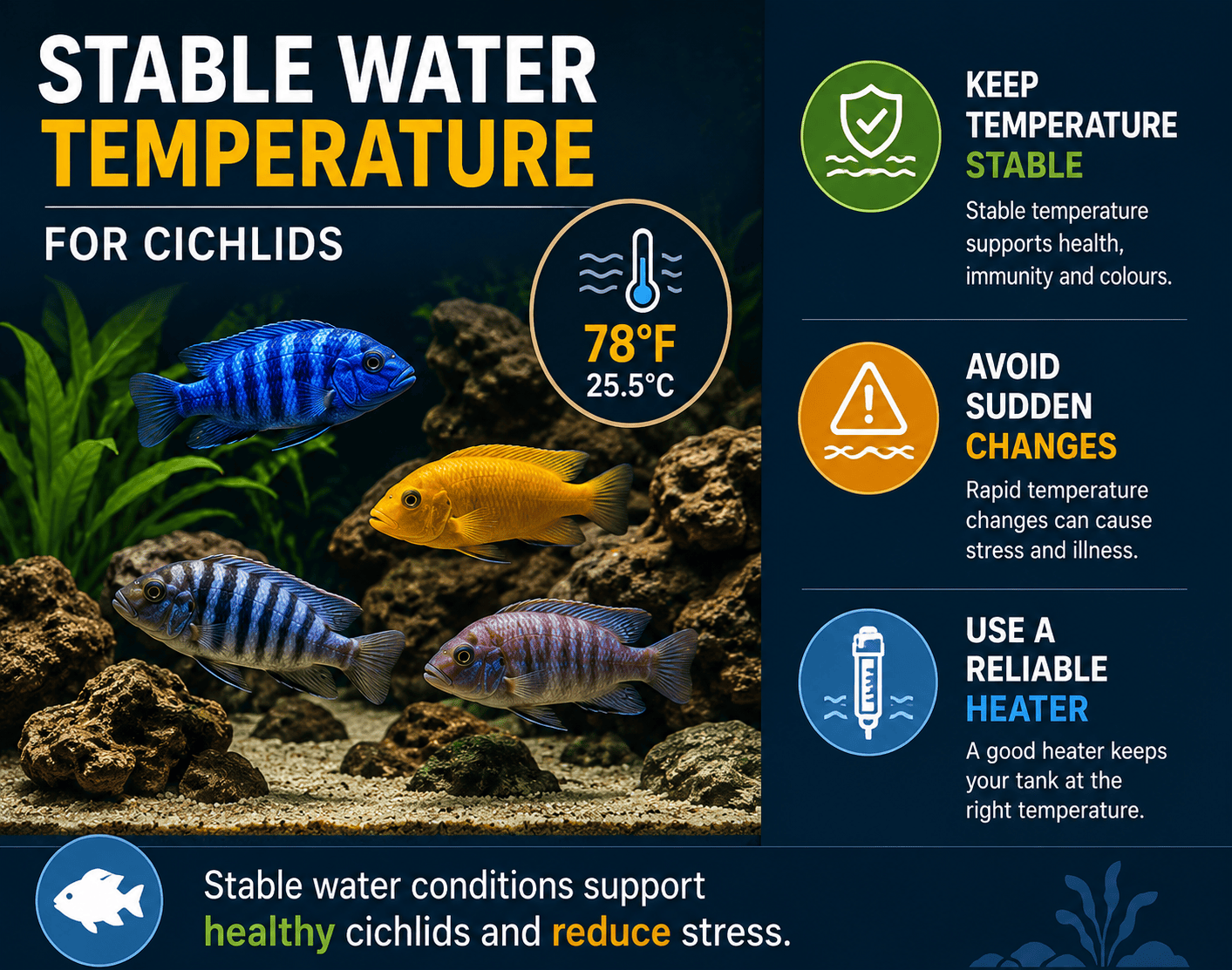
The ideal water temperature for cichlids varies by species, but many tropical cichlids are maintained in warm freshwater conditions. Instead of relying on a universal number, identify the species first and then select a stable temperature within its documented preferred range.
This distinction matters because cichlids occupy habitats across Africa and the Americas. Even within African lakes, individual species can occupy different habitats and have different environmental records. For example, FishBase records temperatures of approximately 22 to 26°C for Pseudotropheus livingstonii and 24 to 26°C for Pseudotropheus williamsi, illustrating why species-level information can be more useful than an overly broad lake-wide rule.
Why Temperature Controls Everything for Cichlids
Cichlids are ectothermic animals, meaning their physiological processes are strongly influenced by environmental temperature. Temperature affects metabolic activity, oxygen demand, digestion, movement and immune responses.
A major review in the Journal of Fish Biology explains that temperature is an important environmental regulator of teleost immunity. At lower temperatures, acquired immune responses can become less active, while temperatures approaching the upper permissive range can also compromise immune function. Rapid temperature shifts can create additional physiological stress.
African Cichlid Water Temperature by Lake
African cichlids are commonly associated with Lake Malawi, Lake Tanganyika and Lake Victoria, but these lakes should not be treated as if every fish within them has identical environmental requirements.
Lake Malawi Water Temperature and Parameters
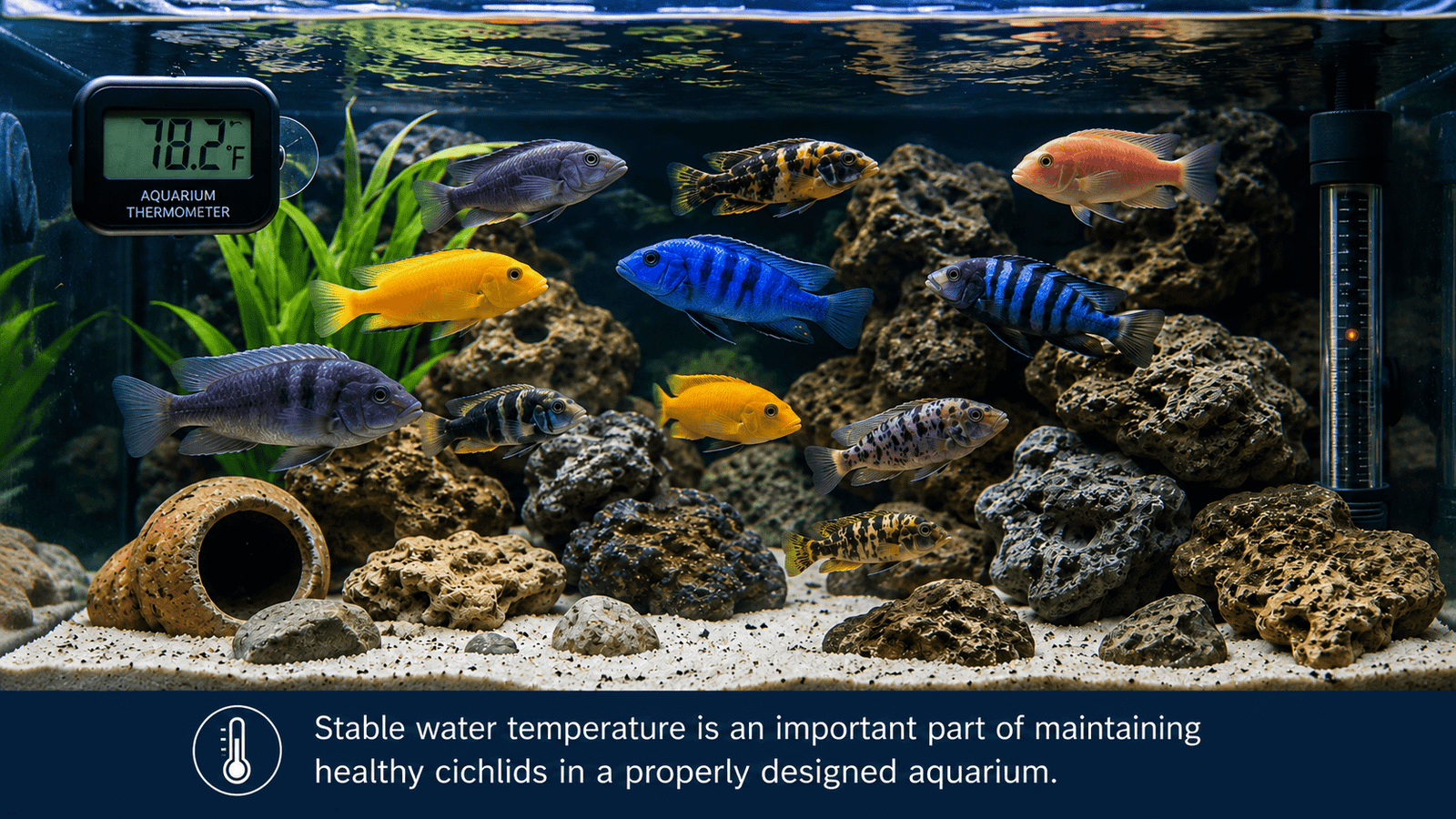
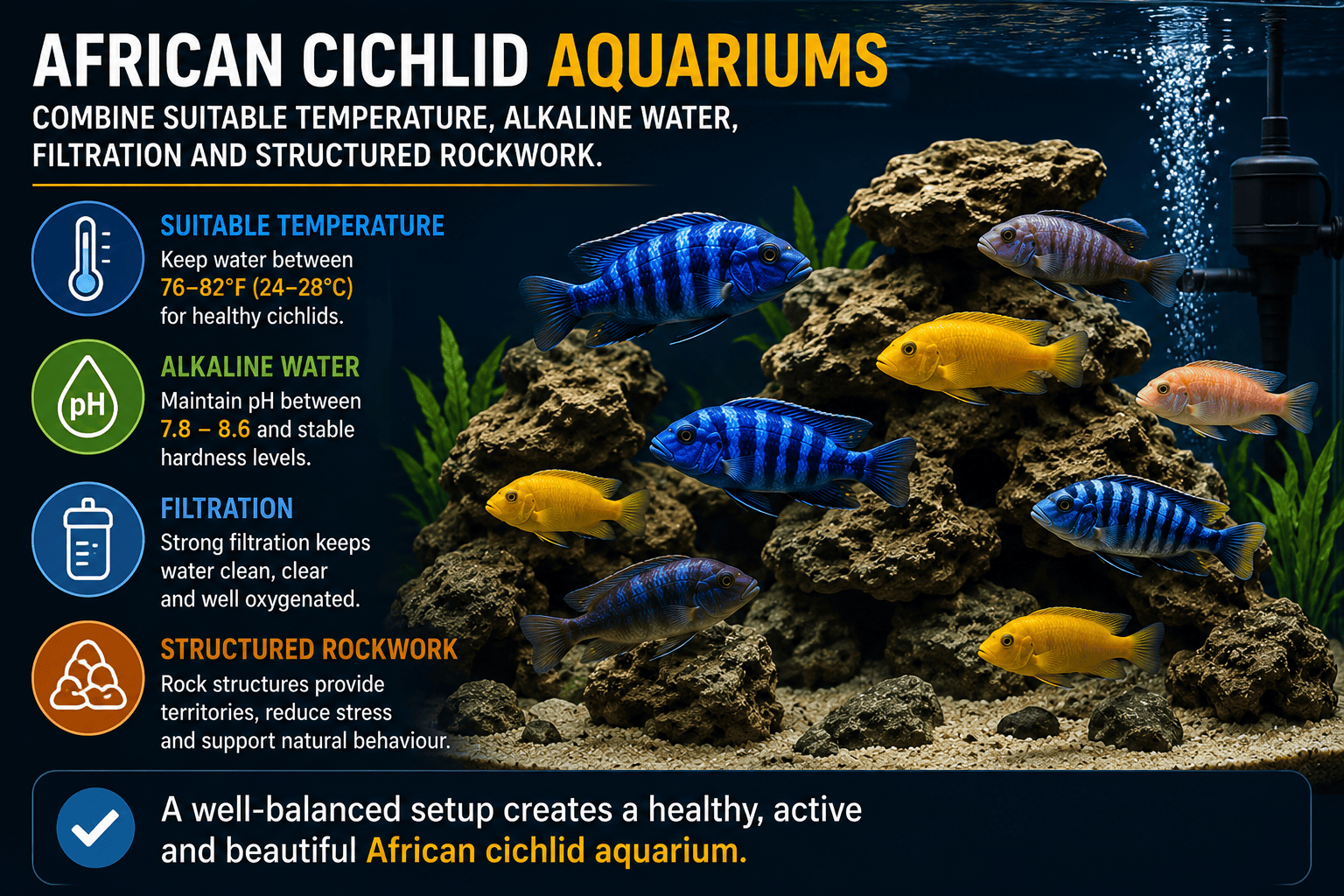
Lake Malawi cichlids are tropical freshwater fish and are commonly maintained in warm, alkaline and relatively hard aquarium water. A practical aquarium target for many commonly kept Malawi species is around 24 to 27°C, or 75 to 81°F, provided the individual species is comfortable within that range.
Species-level records reinforce the importance of checking individual requirements. FishBase lists Pseudotropheus livingstonii at approximately 22 to 26°C and Pseudotropheus williamsi at approximately 24 to 26°C.
For hobbyists keeping multiple Malawi species, a stable temperature around the middle of their overlapping suitable ranges is usually more sensible than repeatedly adjusting the heater.
Lake Tanganyika Water Temperature and Parameters
Lake Tanganyika cichlids also require warm freshwater conditions, with alkaline water and species-specific environmental requirements. A commonly used aquarium target is around 25 to 28°C, or 77 to 82°F, although the precise target should be adjusted for the species being kept.
Shell dwellers, Frontosa and other Tanganyikan cichlids occupy different habitats, so tank design and environmental conditions should reflect the biology of the chosen fish. Avoid selecting a temperature solely because it is labelled as the universal Tanganyika temperature.
Lake Victoria Water Temperature and Parameters
Lake Victoria cichlids are generally maintained in warm tropical freshwater conditions, but species-specific research is particularly important because temperature tolerance can vary between populations and species.
Experimental work on the African cichlid Pseudocrenilabrus multicolor victoriae examined temperatures from 24 to 34°C and found that metabolic and swimming responses changed across the experimental range. Performance was generally stronger at intermediate temperatures than at the highest treatment, illustrating why pushing tropical cichlids toward extreme heat is not a sensible aquarium strategy.
| Group | Practical Aquarium Range | Approximate Celsius | Important Consideration |
|---|---|---|---|
| Many Malawi cichlids | 75 to 81°F | 24 to 27°C | Confirm the range for the individual species. |
| Many Tanganyika cichlids | 77 to 82°F | 25 to 28°C | Species and habitat can influence the preferred range. |
| Many Victoria cichlids | 75 to 80°F | 24 to 27°C | Use species-specific information when available. |
For a broader look at the different African groups, see our complete guide to breeds of African cichlids, which covers Malawi, Tanganyika and Victoria types in greater detail.
South American Cichlid Water Temperature
South American cichlids should not automatically be given the same water conditions as Rift Lake African cichlids. Oscars, angelfish, severums, firemouths and other New World cichlids come from different environments and should be maintained according to species-specific requirements.
For many commonly kept South American cichlids, a practical aquarium range is around 75 to 82°F, or 24 to 28°C. The correct temperature depends on species, life stage and the conditions under which the fish has been acclimated.
Discus Fish Temperature
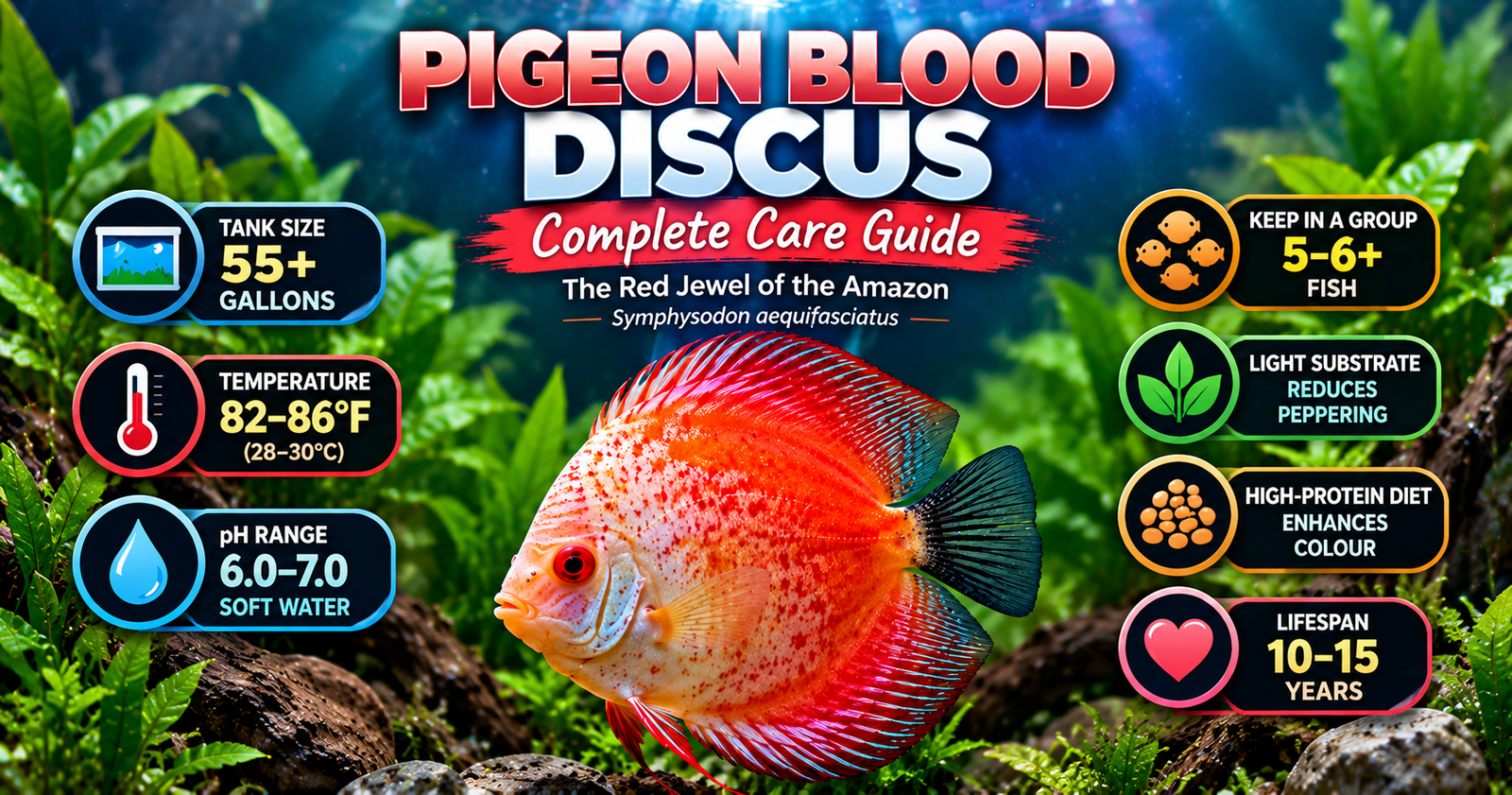
Discus are a special case because they are commonly maintained at warmer temperatures than many general community cichlids. A frequently used range is approximately 82 to 86°F, or 28 to 30°C, depending on species, strain, life stage and husbandry approach.
Because discus require warmer water, they are not automatically suitable tank mates for every other cichlid. Temperature compatibility must be considered alongside adult size, aggression, water chemistry and feeding behaviour.
Dwarf Cichlid Temperature
Dwarf cichlids such as Apistogramma species and German blue rams can have relatively warm temperature requirements. Many aquarists maintain them around 78 to 84°F, or 26 to 29°C, but the correct range varies by species.
When selecting dwarf cichlids, avoid using temperature as the only compatibility criterion. Water chemistry, tank footprint, territorial structure and breeding behaviour can be equally important.
If you are particularly interested in angelfish, visit the AquariumsWorld angelfish complete care guide for species-specific tank, diet and water information.
Do All Cichlids Need the Same Temperature
No. Cichlids are a large and diverse fish family, so their temperature requirements cannot be reduced to one universal number.
Even within the same geographic region, individual species may occupy different habitats. FishBase records for Malawi cichlids demonstrate that documented environmental temperatures can differ between species.
| Cichlid Group | Common Aquarium Target | Species Check Needed? |
|---|---|---|
| Malawi cichlids | 75 to 81°F | Yes |
| Tanganyika cichlids | 77 to 82°F | Yes |
| Victoria cichlids | 75 to 80°F | Yes |
| South American cichlids | 75 to 82°F | Yes |
| Discus | 82 to 86°F | Essential |
| Dwarf cichlids | 78 to 84°F | Essential |
What Happens If Cichlid Water Is Too Cold
When aquarium temperature falls below a species’ suitable range, physiological processes can slow. Fish may become less active and feeding behaviour can change. More importantly, temperature influences immune function, meaning prolonged exposure outside the suitable range can create physiological challenges.
Research reviewed in the Journal of Fish Biology shows that immune activity in teleost fish is temperature-dependent. At low temperatures, acquired immunity can be down-regulated, while rapid temperature changes can also produce negative immune effects.
Minimum Safe Temperature for African Cichlids
There is no scientifically defensible single minimum temperature that applies to every African cichlid. Species differ, and short-term tolerance is not the same thing as a healthy long-term husbandry target.
For that reason, avoid treating numbers such as 68°F or 72°F as universal safety thresholds. If the aquarium drops unexpectedly, focus first on restoring the species’ normal target gradually and preventing further temperature swings.
What Temperature Is Too Hot for Cichlids
Excessive heat is also a concern because warmer water can increase metabolic demand while reducing the amount of dissolved oxygen water can hold. The combination can become especially problematic in heavily stocked aquariums or tanks with poor surface agitation.
Research on an African cichlid found that elevated temperature affected resting metabolism, hypoxia tolerance and thermal performance. Another study on a tropical cichlid found that metabolic and swimming responses changed across temperatures and that performance costs appeared at the highest experimental temperature.
Rather than defining one temperature as universally fatal, treat sustained temperatures above the species’ suitable range as a warning condition. The correct upper limit depends on species, acclimation history, oxygen availability and exposure duration.
How to Lower Cichlid Tank Temperature in Summer
If your aquarium becomes too warm during summer, use controlled cooling methods rather than sudden temperature changes.
- Increase surface agitation to improve gas exchange.
- Use a small fan across the water surface to promote evaporative cooling.
- Keep the aquarium away from direct sunlight.
- Reduce unnecessary aquarium lighting during extreme heat.
- Use air conditioning when room temperature is the primary cause.
- For persistent high temperatures, consider an appropriately sized aquarium chiller.
- Monitor temperature with an independent thermometer rather than relying only on the heater display.
Do African Cichlids Need a Heater
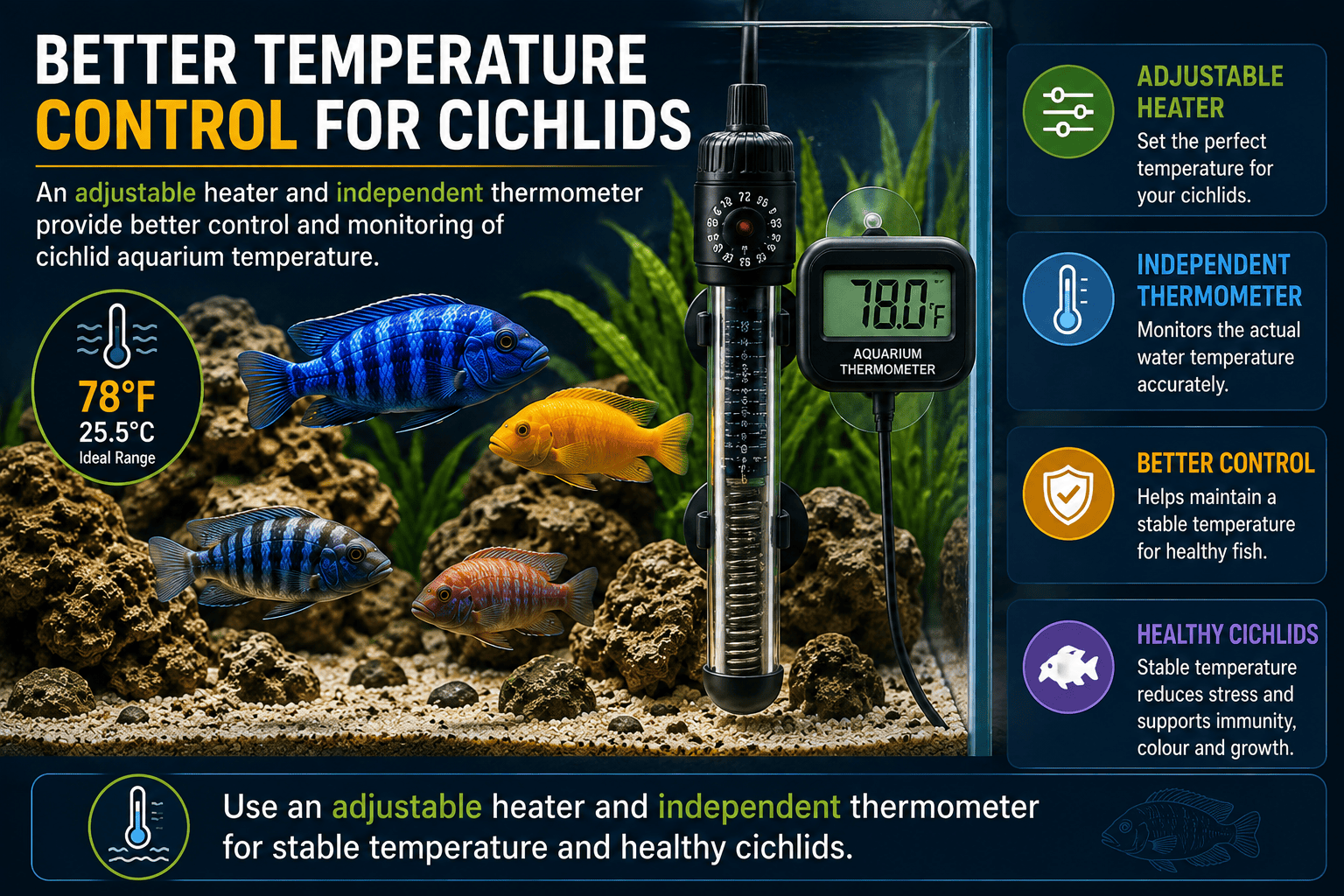
Most African cichlid aquariums benefit from a reliable adjustable heater, particularly when room temperature can fall below the desired aquarium temperature. The purpose of the heater is not to make the water excessively warm. It is to maintain a stable target temperature appropriate for the fish.
Room temperature can fluctuate substantially between day and night and across seasons. A heater with an independent thermometer allows the aquarist to detect these changes before they become significant.
Heater Size Guide for Cichlid Aquariums
Heater wattage should be selected according to tank volume, room temperature and the temperature increase required. The table below is a practical starting point rather than a universal formula.
| Tank Size | Typical Heater Range | Notes |
|---|---|---|
| 20 gallon | 75 to 100W | Suitable starting range for a moderately warm room. |
| 40 gallon | 100 to 150W | Choose according to room temperature and required temperature rise. |
| 55 gallon | 150 to 200W | Large tanks may benefit from additional redundancy. |
| 75 gallon | 200 to 250W | Consider room temperature and aquarium placement. |
| 100 gallon | 250 to 300W | Large systems should prioritise reliable temperature control. |
Best Heater Type for a Cichlid Tank
An adjustable submersible heater with a reliable thermostat is generally the most practical choice for a freshwater cichlid aquarium. Place it where water movement distributes heat throughout the aquarium rather than leaving one area significantly warmer than another.
For larger aquariums, two heaters with appropriate individual wattage can provide redundancy. If one heater fails, the second can reduce the rate of temperature change while the problem is corrected.
For larger aquarium planning, our 100 gallon fish tank guide provides additional information about large aquarium dimensions, equipment and setup considerations.
Water Temperature Stability for Cichlids
Temperature stability is often more useful than obsessing over a single exact decimal reading. Fish are adapted to the thermal conditions of their natural habitats, and abrupt temperature changes can create physiological challenges.
The teleost immunity review by Scharsack and Franke explains that rapid temperature shifts can negatively affect immune function, particularly when the amplitude and speed of the change are substantial.
How to Maintain Stable Cichlid Tank Temperature
- Position the aquarium away from direct sunlight.
- Keep the aquarium away from strong heating and cooling vents.
- Use a quality adjustable heater.
- Check temperature using an independent digital thermometer.
- Match new water to the aquarium temperature during water changes.
- Monitor the aquarium more frequently during seasonal temperature changes.
- Maintain adequate surface movement and aeration.
Temperature should also be considered alongside filtration and water quality. If you are troubleshooting cloudy water, ammonia, nitrate, algae or other aquarium problems, use the AquariumsWorld fish aquarium problems and solutions guide.
Cichlid Breeding Temperature
Temperature can influence reproduction in fish, but there is no universal rule that raising every cichlid aquarium by exactly 2 or 3°F will trigger breeding. Reproductive responses depend on species, maturity, water chemistry, social conditions, nutrition and environmental history.
Instead of deliberately raising temperature without a species-specific reason, prioritise excellent water quality, appropriate nutrition, suitable territory and stable environmental conditions. If a breeding guide for the exact species recommends a temperature adjustment, follow that documented species-specific protocol.
Mixed African Cichlid Tank Temperature
A mixed African cichlid aquarium should be designed around species with overlapping environmental requirements. A compromise temperature can work when all selected species tolerate the same range, but temperature should never be the only compatibility test.
Before mixing fish, compare their temperature, pH, hardness, adult size, aggression level, diet and habitat requirements. If two species require substantially different conditions, the correct solution is usually to separate them rather than force a compromise.
For readers building an African cichlid community, our African cichlid breeds guide can help with species selection and group differences.
African Cichlid Full Water Parameter Guide
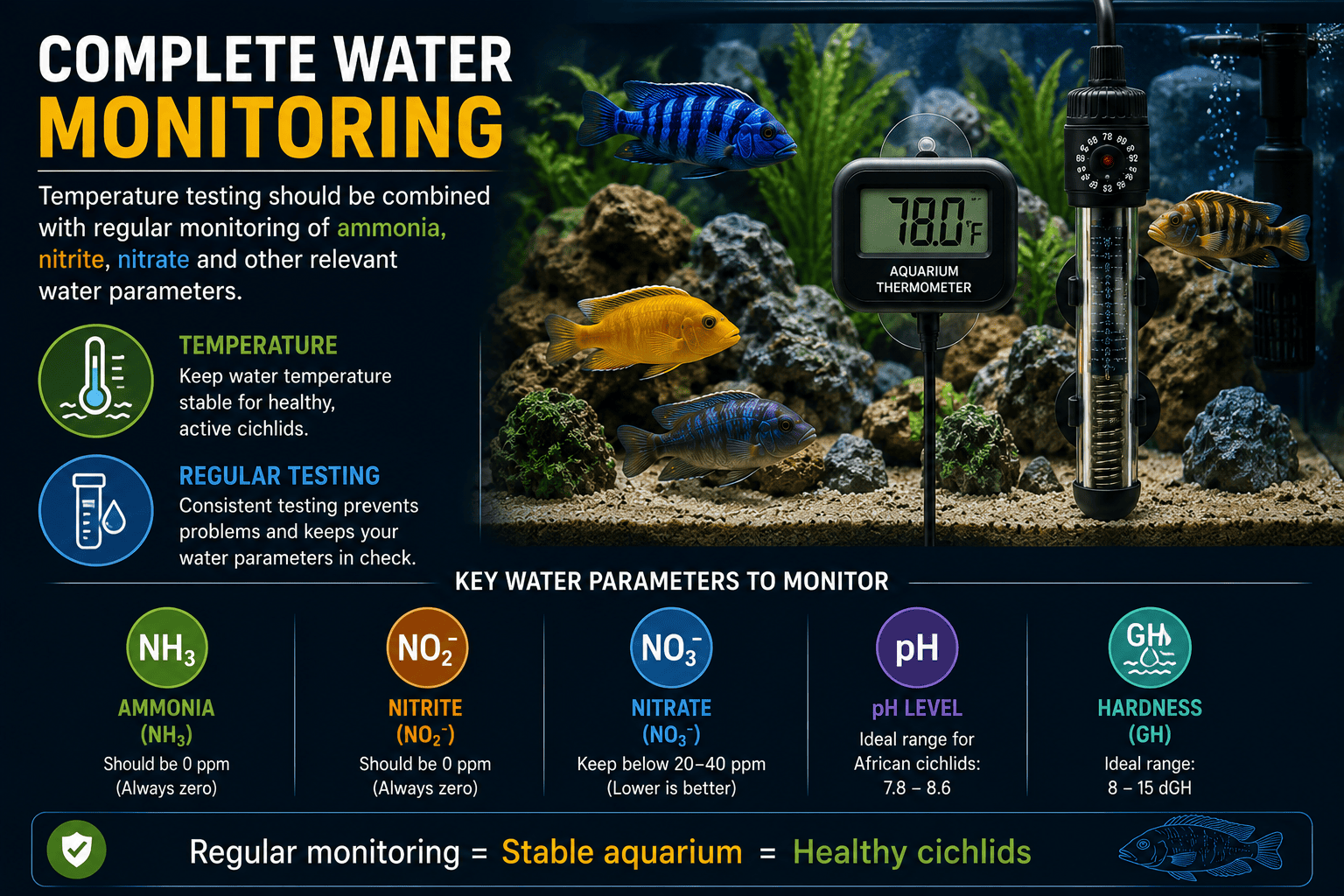
Temperature is only one part of a successful cichlid aquarium. African Rift Lake cichlids are also strongly associated with alkaline water and species-appropriate hardness. Ammonia and nitrite should remain at zero in a properly cycled aquarium.
| Parameter | Malawi | Tanganyika | Victoria |
|---|---|---|---|
| Temperature | 75 to 81°F 24 to 27°C |
77 to 82°F 25 to 28°C |
75 to 80°F 24 to 27°C |
| pH | Alkaline | Alkaline | Alkaline |
| Ammonia | 0 ppm | 0 ppm | 0 ppm |
| Nitrite | 0 ppm | 0 ppm | 0 ppm |
| Nitrate | Keep low through maintenance | Keep low through maintenance | Keep low through maintenance |
Do not chase pH or hardness with large chemical corrections unless you understand the underlying water chemistry. Stability is generally preferable to repeated fluctuations.
If you are planning a larger cichlid aquarium, our 20 gallon fish tank guide is useful for smaller systems, while our 100 gallon aquarium guide covers large aquarium planning.
Good circulation and oxygen exchange are also important. Read our fish tank aquarium air pump guide to understand aeration and air pump selection.
How Aquarium Setup Influences Cichlid Temperature
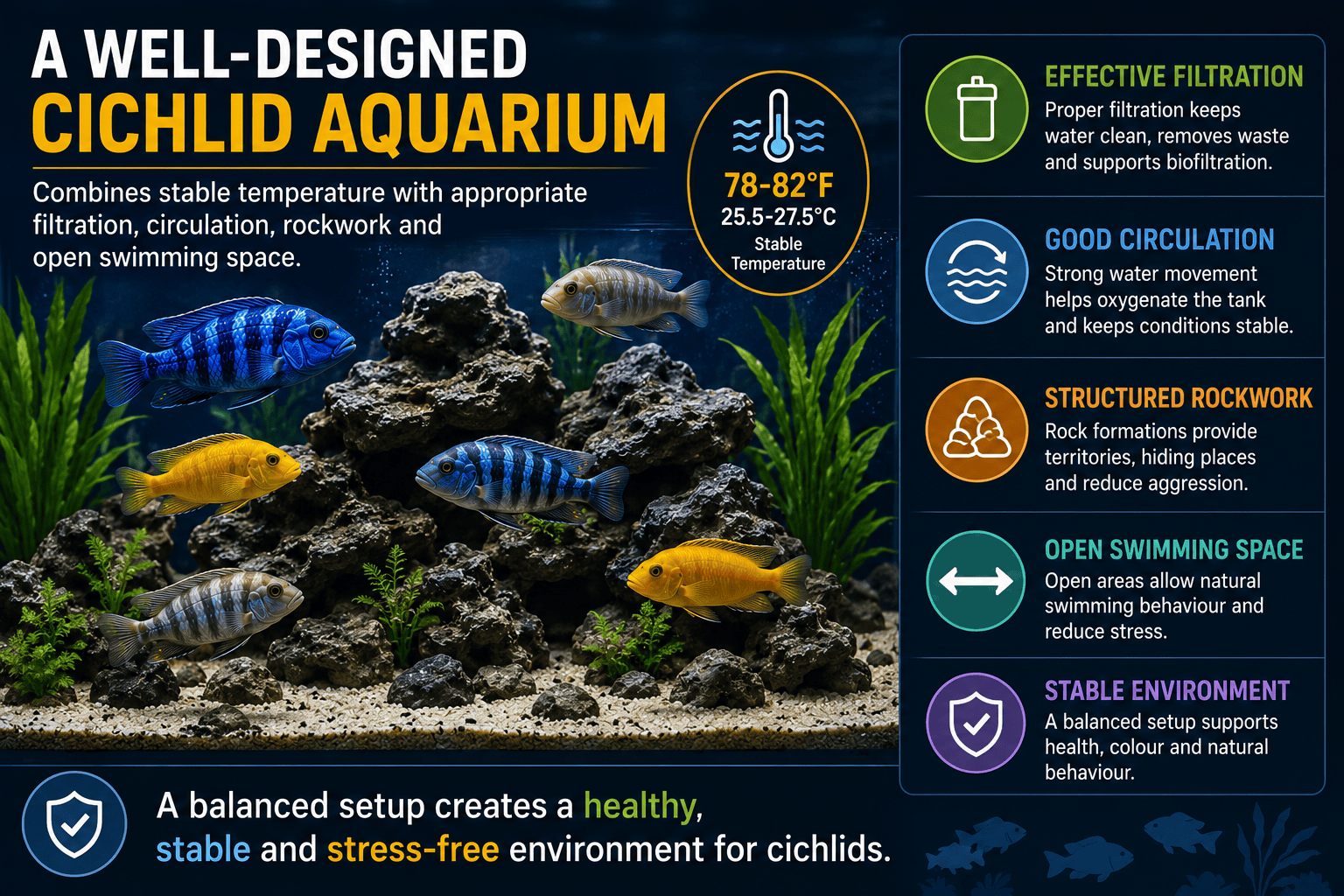
The physical design of the aquarium can influence how evenly heat is distributed. Strong water movement helps prevent warm and cool pockets, while an appropriately positioned heater allows heated water to circulate through the aquarium.
Rockwork and substrate also influence aquarium design. Cichlids often use caves, territories and visual barriers, so the hardscape should provide structure without blocking circulation or making maintenance difficult.
If you are designing a planted or substrate-based aquarium, our guide to soil in a fish tank explains how substrate choices affect aquarium setup and water management.
For a broader overview of freshwater, marine, planted and other aquarium systems, visit the AquariumsWorld fish aquarium types and setup guide.
Signs Your Cichlid Temperature May Be Incorrect
Temperature problems should be considered alongside other possible causes of abnormal behaviour. A fish that becomes lethargic, stops eating or behaves unusually may have a temperature issue, but poor water quality, disease, aggression or environmental stress can produce similar signs.
Possible Signs of Excessive Cold
- Reduced activity
- Reduced appetite
- Slower movement
- Reduced normal interaction
- Greater vulnerability to other stressors
Possible Signs of Excessive Heat
- Rapid breathing or increased gill movement
- Unusual surface behaviour
- Reduced appetite
- Abnormal swimming
- Increased stress during poor oxygen conditions
Frequently Asked Questions
What is the ideal water temperature for cichlids?
The ideal temperature depends on the cichlid species. Many tropical cichlids are maintained in the mid to upper 70s Fahrenheit, while warmer species such as discus are commonly kept at higher temperatures. Always confirm the recommended range for the exact species you keep.
What temperature do African cichlids need?
Many commonly kept African cichlids are maintained around 75 to 82°F, depending on their lake and species. Malawi, Tanganyika and Victoria cichlids should not automatically be treated as having identical requirements. Species-specific information should take priority.
Can cichlids live in cold water?
Some cichlids tolerate temperatures below their normal aquarium target for short periods, but that does not mean cold water is appropriate for long-term care. Lower temperatures can affect metabolism and immune function. Maintain the temperature within the suitable range for the individual species.
What pH do cichlids need?
pH requirements depend on the cichlid group. African Rift Lake cichlids generally prefer alkaline water, while many South American cichlids come from softer and more acidic environments. Research the exact species rather than applying one pH to every cichlid.
What water conditions do cichlids need?
Cichlids need stable, clean and species-appropriate water conditions. Temperature, pH, hardness, ammonia, nitrite and nitrate should all be considered. African Rift Lake species generally require different chemistry from many South American species.
Do all cichlids need the same temperature?
No. Cichlids occupy a wide range of habitats and include species with different thermal requirements. Discus, dwarf cichlids, Malawi cichlids and other groups should be managed according to their own documented requirements.
What happens if cichlid water is too cold?
Cold water can slow physiological processes and may affect feeding and activity. Temperature also influences teleost immune function, with low temperatures associated with reduced activity of some immune responses. Correct the temperature gradually rather than making a sudden large adjustment.
Do African cichlids need a heater?
Most indoor African cichlid aquariums benefit from a reliable adjustable heater when room temperature cannot consistently maintain the desired range. An independent thermometer should be used to verify the actual aquarium temperature. Larger aquariums may benefit from heater redundancy.
What is the best temperature for Lake Malawi cichlids?
Many commonly kept Malawi cichlids can be maintained around 75 to 81°F, or 24 to 27°C, but the exact species should determine the final target. FishBase records show species-specific temperature ranges within Lake Malawi, reinforcing the importance of checking individual requirements.
What temperature is too hot for cichlids?
There is no universal upper temperature that is dangerous for every cichlid because thermal tolerance varies by species and acclimation history. Sustained temperatures above the species’ suitable range can increase physiological stress and oxygen demand. During heat events, monitor both temperature and oxygen conditions.
References and Scientific Sources
This article uses peer-reviewed research and recognised fish databases to explain the relationship between temperature, metabolism, immune function and species-specific environmental requirements.
Conclusion
Getting the water temperature for cichlids right is not simply a matter of selecting one number from a generic chart. Cichlids come from diverse environments, and species can differ in their preferred and tolerated temperatures.
For African cichlids, start with the individual species and then consider its lake of origin, water chemistry, tank mates and aquarium design. A stable adjustable heater, independent thermometer and good water circulation provide the foundation for reliable temperature management.
Most importantly, avoid sudden temperature changes and avoid deliberately pushing fish toward extreme temperatures. Research shows that temperature affects fish metabolism, oxygen relationships and immune function, making temperature management a core part of responsible aquarium care.
For more species-selection information, continue with our African cichlid breeds guide or explore the wider AquariumsWorld aquarium guide collection.