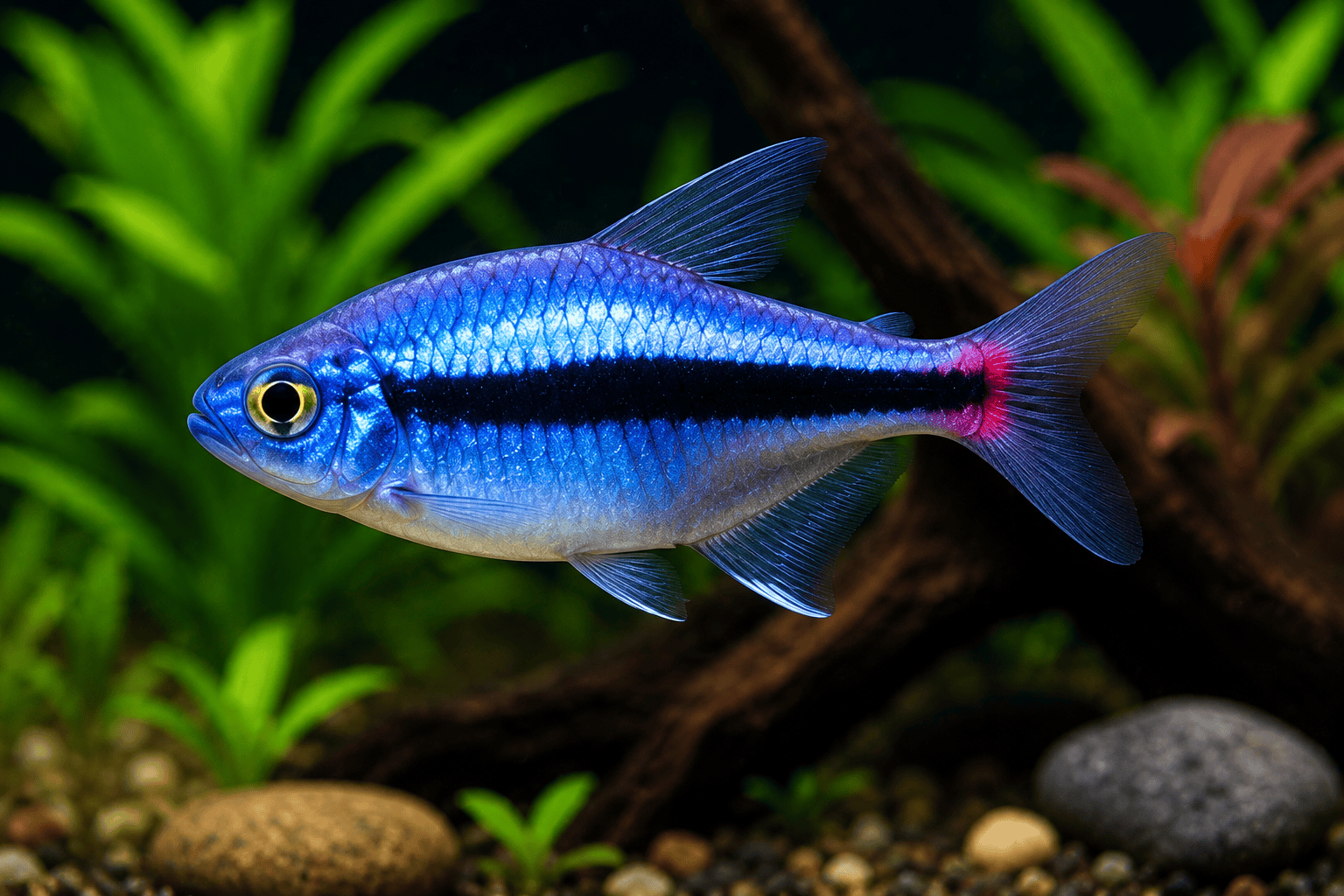
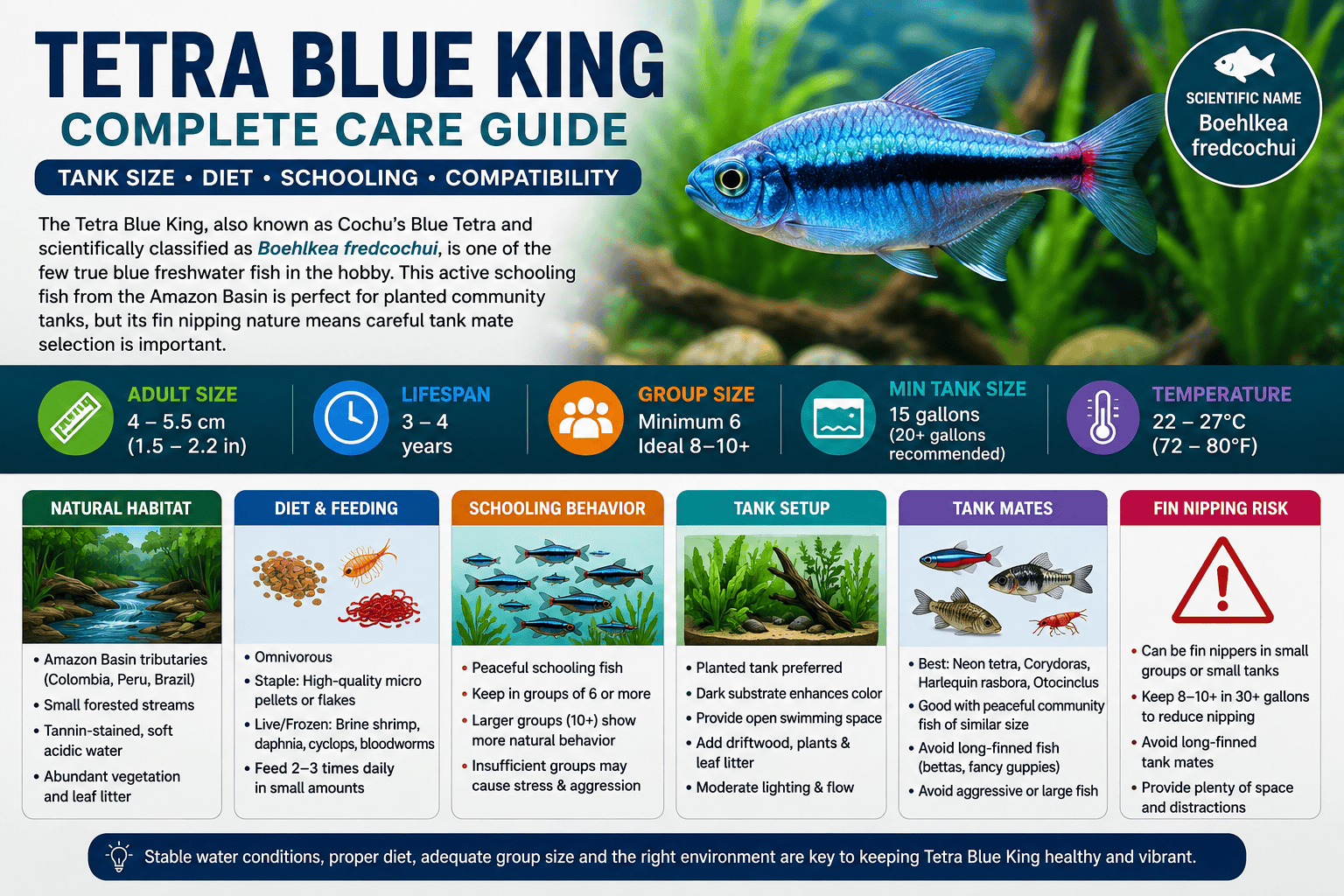
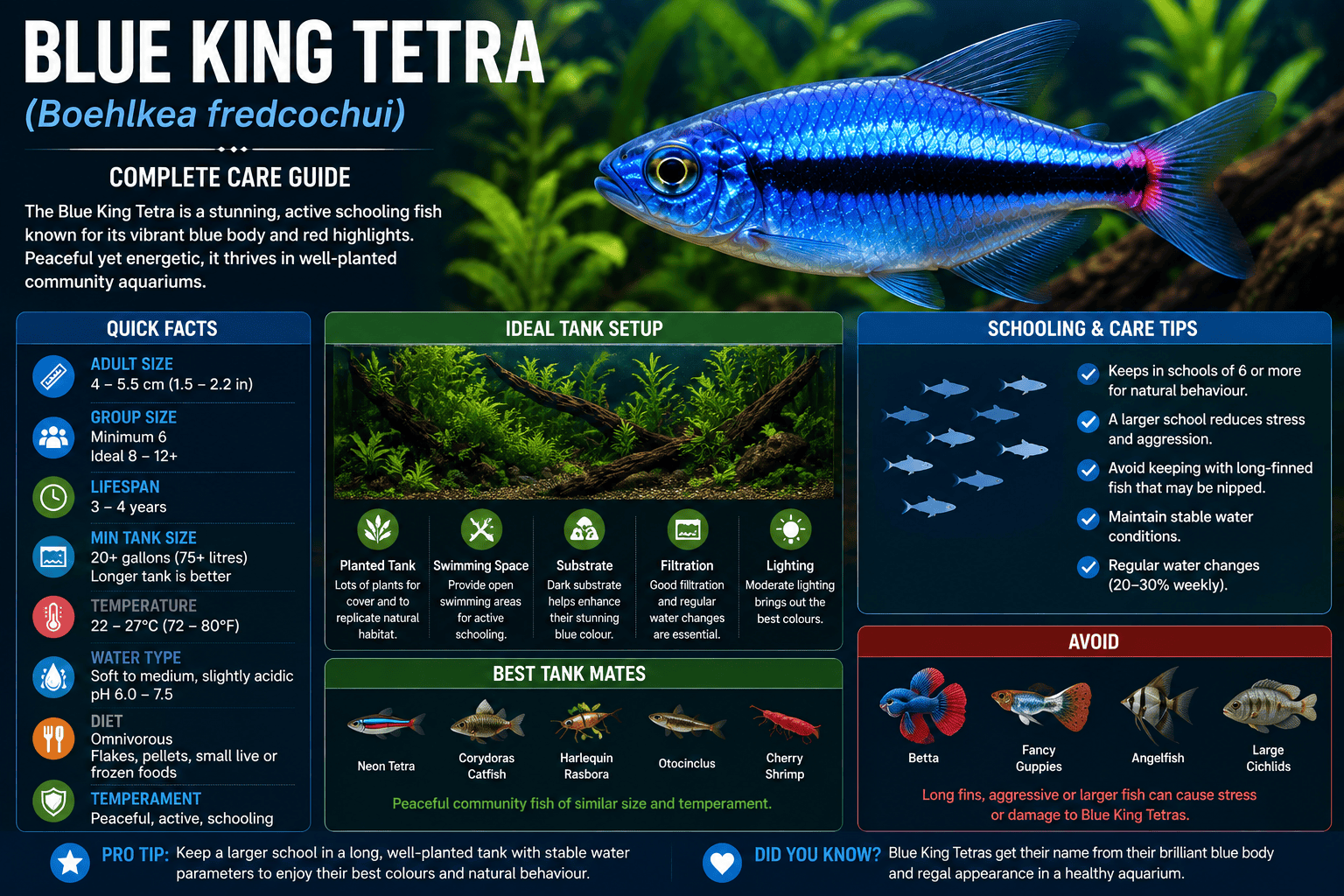
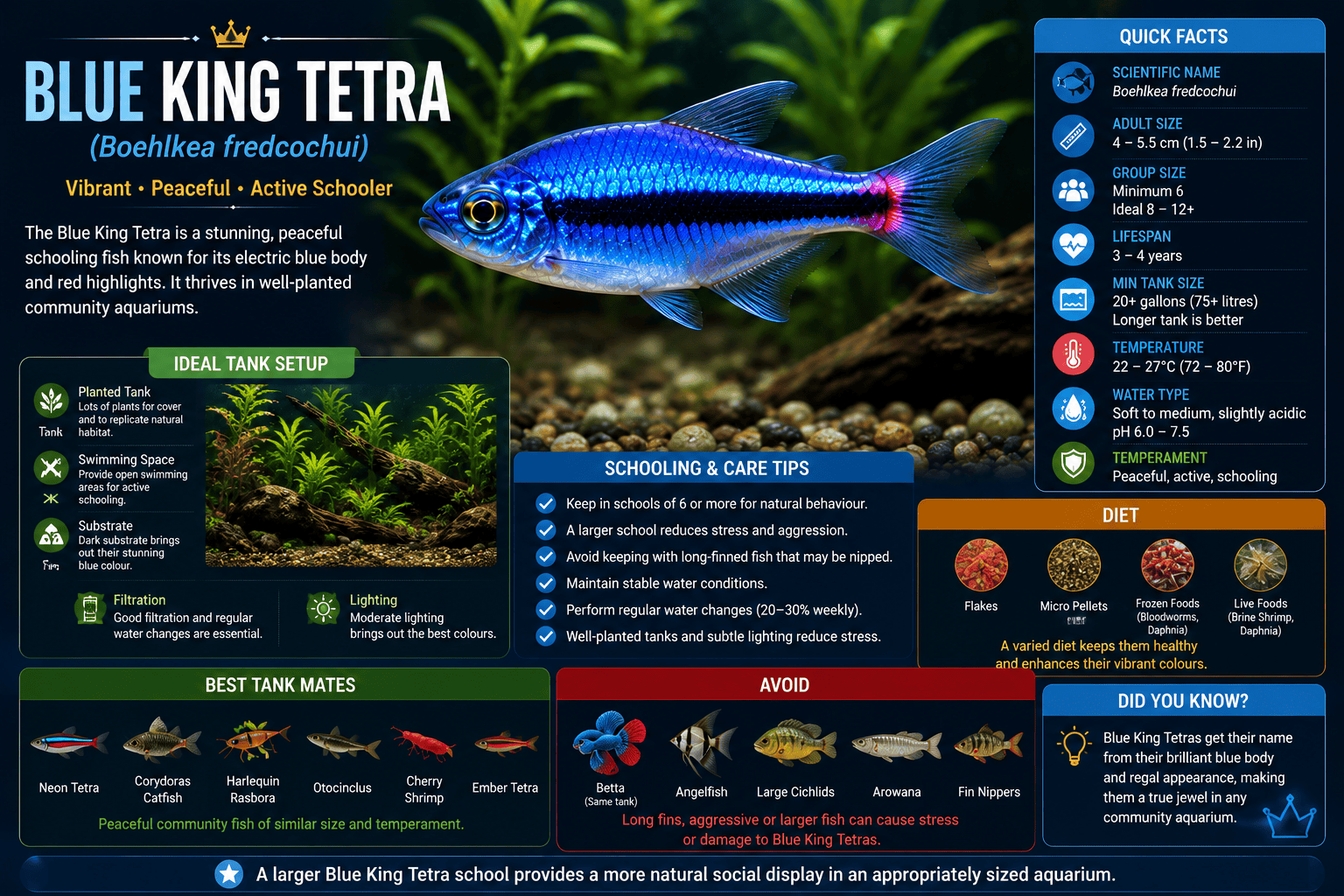
The tetra blue king, also known as Cochu’s Blue Tetra or Blue King Tetra, is a striking freshwater schooling fish scientifically classified as Boehlkea fredcochui. It is one of the more distinctive blue freshwater fish available to aquarium keepers and is particularly attractive in a planted community aquarium.
For aquarists researching blue king tetra care, the most important considerations are group size, aquarium dimensions, stable water parameters, appropriate food and carefully selected tank mates. This active species is a social mid-water swimmer and generally displays its most natural behaviour when maintained with other Blue King Tetras rather than alone. The species is also commonly called the cochus blue tetra or Cochu’s Blue Tetra. Although relatively small, it can become active and occasionally fin-nippy when kept in an undersized group or aquarium. A properly planned blue king tetra tank therefore needs sufficient swimming space, vegetation, filtration and compatible community fish. If you are new to aquariums, begin with our complete beginner’s fish care guide and consider a 20 gallon fish tank as a useful starting point for a community setup.
- What Is the Blue King Tetra?
- Natural Habitat and Origin
- Size and Lifespan
- Tank Size Requirements
- Water Parameters
- Schooling Behaviour and Group Size
- Diet and Feeding
- Fin Nipping Behaviour
- Best Tank Mates
- Planted Tank Setup
- Are Blue King Tetras Easy to Keep?
- Breeding Guide
- Health and Common Problems
- Frequently Asked Questions
- References
- Conclusion
What Is the Blue King Tetra?
The Blue King Tetra is Boehlkea fredcochui, a small freshwater characiform commonly sold as Cochu’s Blue Tetra, Blue Tetra or Blue King Tetra. It is a social schooling species from South America that is best maintained in an appropriately sized group. The Blue King Tetra has become popular because of its intense blue coloration, active swimming behaviour and relatively peaceful nature. Unlike many artificially coloured aquarium fish, its blue appearance is a natural characteristic of the species.
Blue King Tetra vs Cochu’s Blue Tetra: Same Fish or Different?
Yes. Blue King Tetra and Cochu’s Blue Tetra refer to the same species, Boehlkea fredcochui. The aquarium trade uses several common names, which can create confusion when researching the species. The scientific name provides the clearest way to distinguish this fish from other small blue tetras. Taxonomic research places the species within the broader characiform lineage, while modern molecular studies have helped clarify relationships within the relevant characid groups.
Blue King Tetra Scientific Classification
| Classification | Detail |
|---|---|
| Common Names | Blue King Tetra, Cochu’s Blue Tetra, Blue Tetra |
| Scientific Name | Boehlkea fredcochui |
| Family | Stevardiidae |
| Order | Characiformes |
| Origin | Amazon Basin, South America |
| Described | Géry, 1966 |
Blue King Tetra Natural Habitat and Origin
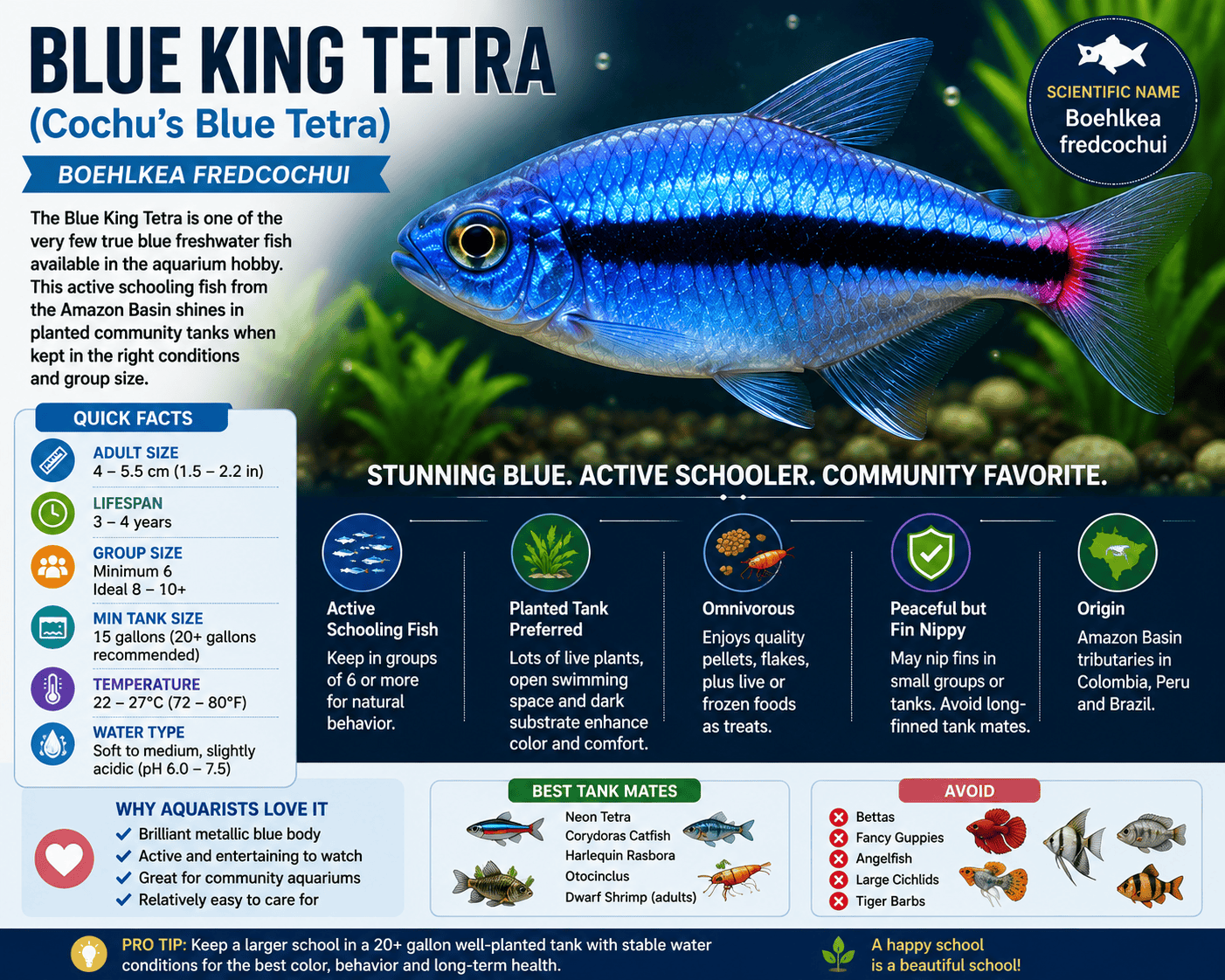
The Blue King Tetra originates from South America and is associated with Amazonian freshwater environments. Natural habitats can include smaller tributaries and forest-influenced waterways where vegetation, leaf litter and submerged structures provide cover. These environmental characteristics help explain why a planted aquarium with shaded areas, moderate circulation and open swimming space can work particularly well for the species.
Blue King Tetra in the Wild
The species is a small benthopelagic fish that uses different levels of the water column. In an aquarium, it normally spends considerable time swimming through the middle and upper portions of the tank. Its natural environment also provides useful clues for aquarium design. Rather than creating an entirely bare aquarium, combine vegetation and structured décor with enough unobstructed space for the school to move naturally.
Blue King Tetra Size and Lifespan
Blue King Tetras remain relatively small, making them suitable for carefully planned community aquariums. However, their active schooling behaviour means physical size alone should not be used to determine aquarium requirements.
| Feature | Typical Information |
|---|---|
| Maximum adult size | Approximately 5.4 to 5.5 cm |
| Typical aquarium size | Approximately 4 to 5 cm |
| Lifespan | Approximately 3 to 4 years with appropriate care |
| Sexual maturity | Approximately 6 to 12 months |
| Purchase size | Often around 1 to 2 cm |
Male vs Female Blue King Tetra
Sexing young Blue King Tetras can be difficult. Mature males are generally slimmer, while females tend to have a fuller body, particularly when carrying eggs. Colour intensity can vary according to condition, lighting, stress and social environment, so body shape is generally more useful than colour alone.
Blue King Tetra Tank Size Requirements
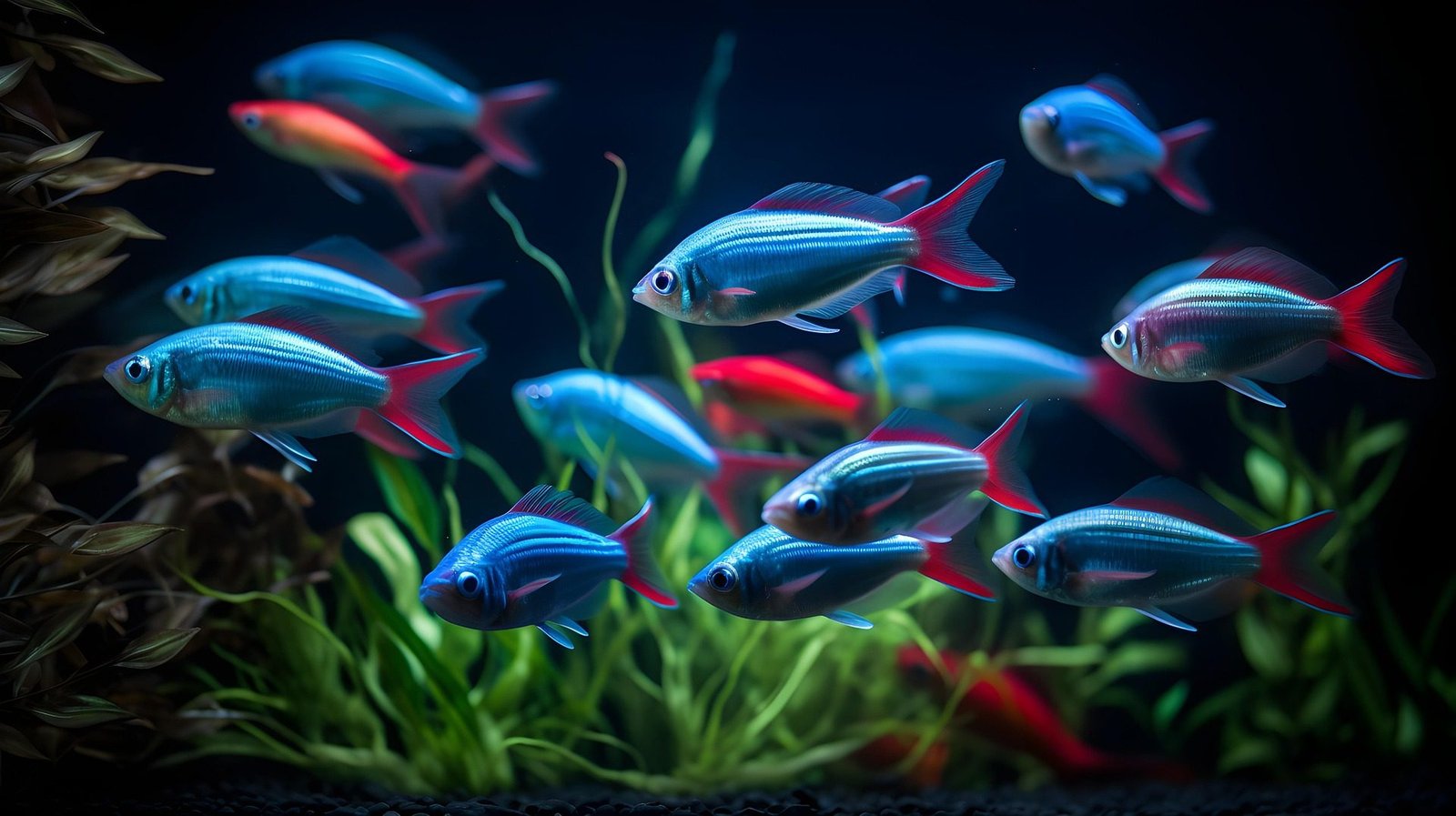
Aquarium size is one of the most important factors in successful blue king tetra care. Although these fish are small, they are active schooling fish and need horizontal swimming space rather than simply a tall aquarium.
Minimum recommendation: around 15 gallons for a small group. A 20 gallon aquarium is a more practical starting point, while 30 gallons or more provides additional swimming room and makes community stocking easier.
For a properly designed community aquarium, a 20 gallon fish tank provides considerably more flexibility than a very small aquarium. You can also review our aquarium sizing resources before purchasing a tank so that the footprint, equipment and stocking plan work together.
Why Tank Size Affects Blue King Tetra Behaviour
Blue King Tetras are active fish. When their swimming area is restricted, behavioural problems can become more noticeable, particularly when the group is too small or the aquarium contains too many competing fish. A longer aquarium is generally preferable to an unusually tall aquarium of the same volume because it gives a schooling fish greater horizontal swimming distance.
Blue King Tetra Water Parameters
Stable water quality is more important than attempting to maintain one perfectly precise number. Sudden changes in temperature, pH or nitrogen compounds can create unnecessary physiological stress.
| Parameter | Recommended Range |
|---|---|
| Temperature | 22 to 27°C (72 to 80°F) |
| pH | 6.0 to 7.5 |
| Hardness | Approximately 5 to 12 dGH |
| Ammonia | 0 ppm |
| Nitrite | 0 ppm |
| Nitrate | Preferably below 20 ppm |
| Water flow | Moderate |
If you experience cloudy water, ammonia problems or other parameter instability, use our fish aquarium problems and solutions guide for troubleshooting and maintenance guidance.
Blue King Tetra Schooling Behaviour
Blue King Tetras are social schooling fish and should not be maintained as isolated individuals. A group provides opportunities for normal social interaction and allows the fish to express more natural swimming behaviour.
Blue King Tetra Schooling vs Shoaling
Schooling and shoaling are related but not identical concepts. Schooling generally describes coordinated group movement, while shoaling can describe broader social grouping where individuals remain together without continuously moving in precise synchrony. Blue King Tetras commonly move together through open water but their formation can loosen when they explore vegetation, feed or respond to activity elsewhere in the aquarium.
How Many Blue King Tetras Should You Keep Together?
| Tank Size | Minimum Group | Practical Group |
|---|---|---|
| 15 gallons | 6 | 6 to 8 |
| 20 gallons | 6 | 8 to 10 |
| 30 gallons | 8 | 10 to 12 |
| 55 gallons | 10 | 15 or more |
What Do Blue King Tetras Eat?
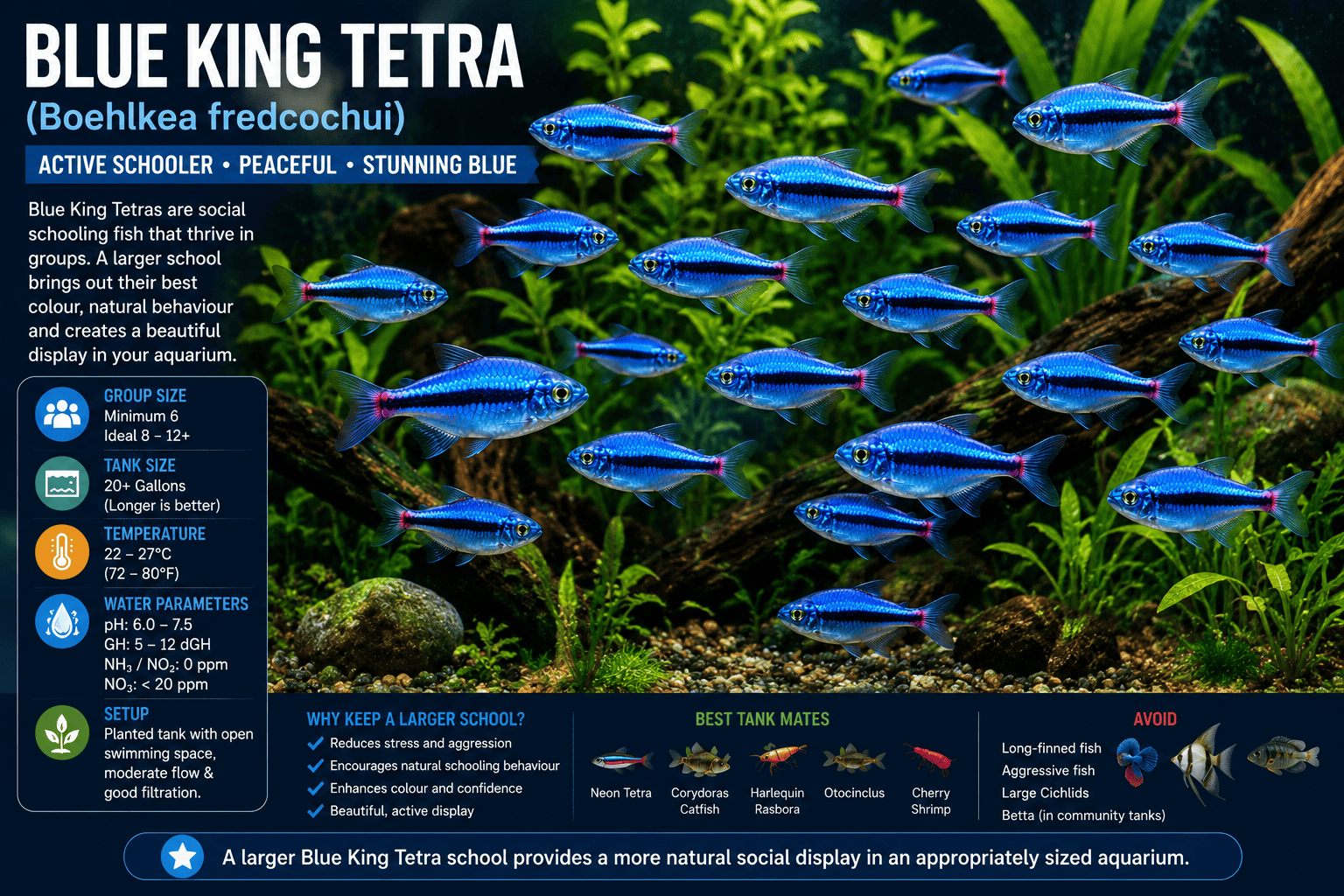
Blue King Tetras are omnivorous and benefit from a varied diet containing appropriately sized commercial foods together with occasional live or frozen foods.
Best Commercial Food for Blue King Tetras
A quality micro pellet or finely sized tropical flake can form the staple diet. Because these tetras have small mouths, large pellets should be avoided or crushed before feeding. Feed small portions rather than allowing large quantities of food to remain in the aquarium. Uneaten food can rapidly contribute to declining water quality.
Live and Frozen Food for Blue King Tetras
Brine shrimp, daphnia, cyclops and appropriately sized frozen foods can be offered as dietary supplements. These foods add variety and can encourage strong feeding behaviour.
Blue King Tetra Feeding Schedule
| Day | Food |
|---|---|
| Monday | Micro pellets or quality flakes |
| Tuesday | Micro pellets or quality flakes |
| Wednesday | Frozen or live protein food |
| Thursday | Micro pellets or quality flakes |
| Friday | Micro pellets or quality flakes |
| Saturday | Frozen or live protein food |
| Sunday | Light feeding or normal staple food |
For comparison, see our detailed guppy diet and feeding guide for another small livebearer with similar requirements for dietary variety.
Are Blue King Tetras Fin Nippers?
Yes, Blue King Tetras can become fin nippers. The behaviour is more likely to become problematic when the fish are kept in an undersized group, crowded aquarium or with long-finned tank mates.This does not mean every Blue King Tetra will aggressively attack community fish. Behaviour varies with group size, aquarium space, social dynamics and available environmental enrichment.
How to Reduce Blue King Tetra Fin Nipping
- Keep a social group of at least 6 fish.
- Prefer 8 to 10 or more when aquarium size permits.
- Provide adequate horizontal swimming space.
- Avoid overcrowding.
- Use plants and décor to break up direct lines of sight.
- Avoid highly vulnerable long-finned tank mates.
- Maintain excellent water quality and a varied diet.
Blue King Tetra Tank Mates
Choosing appropriate blue king tetra tank mates is particularly important because the species is active and may nip slow-moving or long-finned fish.
Best Tank Mates for Blue King Tetras
| Tank Mate | Adult Size | Compatibility | Why It Can Work |
|---|---|---|---|
| Neon Tetra | 3 to 4 cm | Excellent | Peaceful small schooling fish with broadly compatible conditions. |
| Ember Tetra | About 2 cm | Good | Peaceful and occupies similar community environments. |
| Corydoras Catfish | 5 to 7 cm | Excellent | Primarily bottom dwelling and unlikely to compete directly for swimming space. |
| Harlequin Rasbora | 4 to 5 cm | Good | Peaceful community fish with similar environmental preferences. |
| Otocinclus | 4 to 5 cm | Good | Peaceful algae-grazing bottom and surface-oriented companion. |
| Adult Dwarf Shrimp | 2 to 3 cm | Caution | Adult shrimp may be tolerated, but very small shrimplets can be vulnerable. |
Fish to Avoid Keeping with Blue King Tetras
Bettas
Long fins can make bettas vulnerable to fin nipping, while individual betta temperament also varies considerably.
Fancy Guppies
Their long flowing fins can make selectively bred fancy guppies an unnecessary target for fin-nipping behaviour.
Angelfish
Long fins may be nipped, while mature angelfish can also create a predation risk for smaller fish.
Large Cichlids
Size difference, territorial behaviour and predation risk make large cichlids unsuitable companions. If you are considering a betta as a community fish, review our Betta fish tank guide before mixing species.
Blue King Tetra Planted Tank Setup
A planted aquarium can be an excellent environment for Blue King Tetras because plants provide visual cover while leaving open areas for schooling. The goal is not to fill every part of the aquarium with vegetation.
Recommended Plants
- Java moss
- Amazon sword
- Vallisneria
- Floating plants
- Other hardy community aquarium plants
Substrate and Decoration
Darker substrates can visually enhance blue coloration, while driftwood, rocks and plants create a more structured environment. Leave a central or front section open so the school can move freely. If you are building a planted aquarium, see our complete guide to soil in fish tanks for information about substrate selection.
Lighting
Moderate lighting combined with plant cover can produce a more comfortable environment. Extremely bright lighting without shaded areas may make some fish appear less confident.
Filtration and Water Movement
Use filtration capable of processing the aquarium’s biological load without creating excessive turbulence. Moderate circulation is generally preferable to extremely strong currents. For additional aeration and circulation information, read our fish tank air pump guide.
Are Blue King Tetras Easy to Keep?
Yes, Blue King Tetras can be beginner-friendly when their basic social and environmental requirements are met. The most important requirements are an appropriately sized group, stable water conditions, suitable food and peaceful tank mates.
The species is not difficult simply because it is a tetra. However, keeping a single fish in a small aquarium ignores its social behaviour and can create avoidable problems.
Best Beginner Setup
- 20 gallon or larger aquarium.
- At least 6 Blue King Tetras.
- 8 to 10 or more where aquarium capacity allows.
- Stable temperature and water chemistry.
- Reliable biological filtration.
- Open swimming space.
- Live plants or other cover.
- Peaceful community tank mates.
- Small varied meals.
Beginners should also cycle the aquarium properly before introducing fish. Our beginner fish care guide explains the broader principles of aquarium setup and maintenance.
Blue King Tetra Breeding Guide
Blue King Tetras are egg scatterers. Successful breeding in a home aquarium generally requires more controlled conditions than routine community maintenance.
How to Breed Blue King Tetras
- Prepare a separate spawning aquarium.
- Use soft, clean water with suitable chemistry.
- Provide fine-leaved plants or spawning material.
- Condition adults using high-quality foods.
- Introduce selected adults to the spawning environment.
- Remove adults after spawning because eggs may be eaten.
- Monitor the eggs during incubation.
- Begin feeding fry with appropriately microscopic food.
- Introduce newly hatched baby brine shrimp when fry are large enough to consume them.
A separate breeding tank gives the eggs and fry better protection than attempting to raise them in a heavily stocked community aquarium.
Blue King Tetra Health and Common Problems
Good health begins with prevention. Stable water chemistry, appropriate stocking, adequate filtration, a varied diet and low environmental stress are more important than attempting to treat problems after they appear.
Common Health Issues
| Problem | Possible Risk Factors | Prevention |
|---|---|---|
| Ich | Stress, unstable conditions or introduction of infected fish | Quarantine, stable water and good maintenance |
| Fin damage | Fin nipping, injury or poor water quality | Compatible stocking and excellent water quality |
| Fin rot | Chronic poor water quality or damaged tissue | Clean water and rapid attention to injuries |
| Loss of colour | Stress, poor condition or unsuitable environment | Correct group size, stable water and varied food |
| Loss of appetite | Stress, disease or unsuitable food | Monitor behaviour and water parameters |
For broader troubleshooting, consult our Fish Aquarium Problems and Solutions guide.
Frequently Asked Questions
What is the Blue King Tetra?
The Blue King Tetra is the common aquarium name for Boehlkea fredcochui, a small freshwater characiform from South America. It is also commonly called Cochu’s Blue Tetra or Blue Tetra. The species is valued for its blue coloration and active schooling behaviour.
Is the Blue King Tetra the same as Cochu’s Blue Tetra?
Yes. Blue King Tetra and Cochu’s Blue Tetra are common names used for the same species, Boehlkea fredcochui. Different aquarium retailers may use different names, which can make searches confusing. The scientific name is the most reliable identifier.
How big do Blue King Tetras get?
Blue King Tetras generally remain around 4 to 5 cm in aquarium conditions, with reported maximum lengths around 5.4 to 5.5 cm. Their small adult size makes them suitable for community aquariums when their schooling needs are considered. Aquarium footprint remains important because they are active swimmers.
What do Blue King Tetras eat?
Blue King Tetras are omnivores. A quality micro pellet or appropriately sized flake can form the staple diet, supplemented with foods such as brine shrimp, daphnia or cyclops. Small portions and dietary variety are preferable to large infrequent meals.
How many Blue King Tetras should be kept together?
Keep at least 6 Blue King Tetras together. A group of 8 to 10 or more is preferable when aquarium size allows because it provides a stronger social group and more natural schooling display. Larger groups require proportionally more swimming space and filtration.
What fish can live with Blue King Tetras?
Suitable companions can include peaceful small community species such as neon tetras, some rasboras, Corydoras and Otocinclus. Avoid aggressive, predatory or highly territorial fish. Long-finned species can also be vulnerable if the Blue King Tetras develop fin-nipping behaviour.
What temperature do Blue King Tetras need?
A practical temperature range is approximately 22 to 27°C (72 to 80°F). Stability is important, so avoid rapid temperature changes. Use a reliable aquarium heater and thermometer where necessary.
Are Blue King Tetras fin nippers?
Blue King Tetras can become fin nippers, particularly when kept in small groups, crowded aquariums or with vulnerable long-finned fish. Keeping an adequate group and providing sufficient swimming space can help reduce problematic interactions. Tank mate selection is therefore important.
Are Blue King Tetras easy to keep?
Yes, they can be relatively easy for beginners when their basic requirements are met. A properly cycled aquarium, stable water quality, adequate group size and peaceful tank mates are essential. A 20 gallon or larger aquarium provides a practical starting point for a small community setup.
Can Blue King Tetras breed in a home aquarium?
Yes, breeding is possible in controlled aquarium conditions. They are egg scatterers, so a separate spawning aquarium with suitable spawning material can improve the survival of eggs and fry. Adults should generally be separated from eggs because they may consume them.
References
Froese, R. and Pauly, D. (Eds.) (2024). Boehlkea fredcochui species profile. FishBase. World Wide Web electronic publication.
Thomaz, A.T., Arcila, D., Ortí, G. and Malabarba, L.R. (2015). Molecular phylogeny of the subfamily Stevardiinae Gill, 1858 (Characiformes: Characidae): classification and the evolution of reproductive traits. BMC Evolutionary Biology, 15(1), 146.
Wikipedia (2026). Cochu’s blue tetra: Boehlkea fredcochui. Wikimedia Foundation.
Quality Marine (n.d.). Blue Tetra (Boehlkea fredcochui). Species profile and aquarium information.
Aquarium Store Depot (2026). Blue Tetra Care Guide: Tank Setup, Diet, Tank Mates and More.
Aquatic Arts (n.d.). Cochu’s Blue Tetra aka Blue King Tetra (Boehlkea fredcochui), Tank-Bred.
FishLore (2019). Blue Tetra (Boehlkea fredcochui) Care Sheet.
PetMD (2026). Tetra Fish Care Guide: Tank Size, Diet and Setup.
Conclusion
The tetra blue king, or Boehlkea fredcochui, is a visually striking freshwater schooling fish that can make an excellent addition to a peaceful community aquarium. Its strongest appeal comes from its metallic blue coloration, active group behaviour and relatively manageable adult size.
The key to successful blue king tetra care is not simply providing enough water volume. Keep a social group of at least 6, with 8 to 10 or more preferable where space permits. A 20 gallon aquarium is a practical starting point, while larger tanks provide more swimming room and greater flexibility for compatible tank mates.
Stable water parameters, appropriate filtration, varied food and planted cover all contribute to a healthier environment. Because the species can become fin-nippy, avoid vulnerable long-finned fish and do not overcrowd the aquarium.
For your next step, explore our 20 gallon fish tank guide, our beginner fish care guide and our fish aquarium problems and solutions guide to build a more complete aquarium care routine.