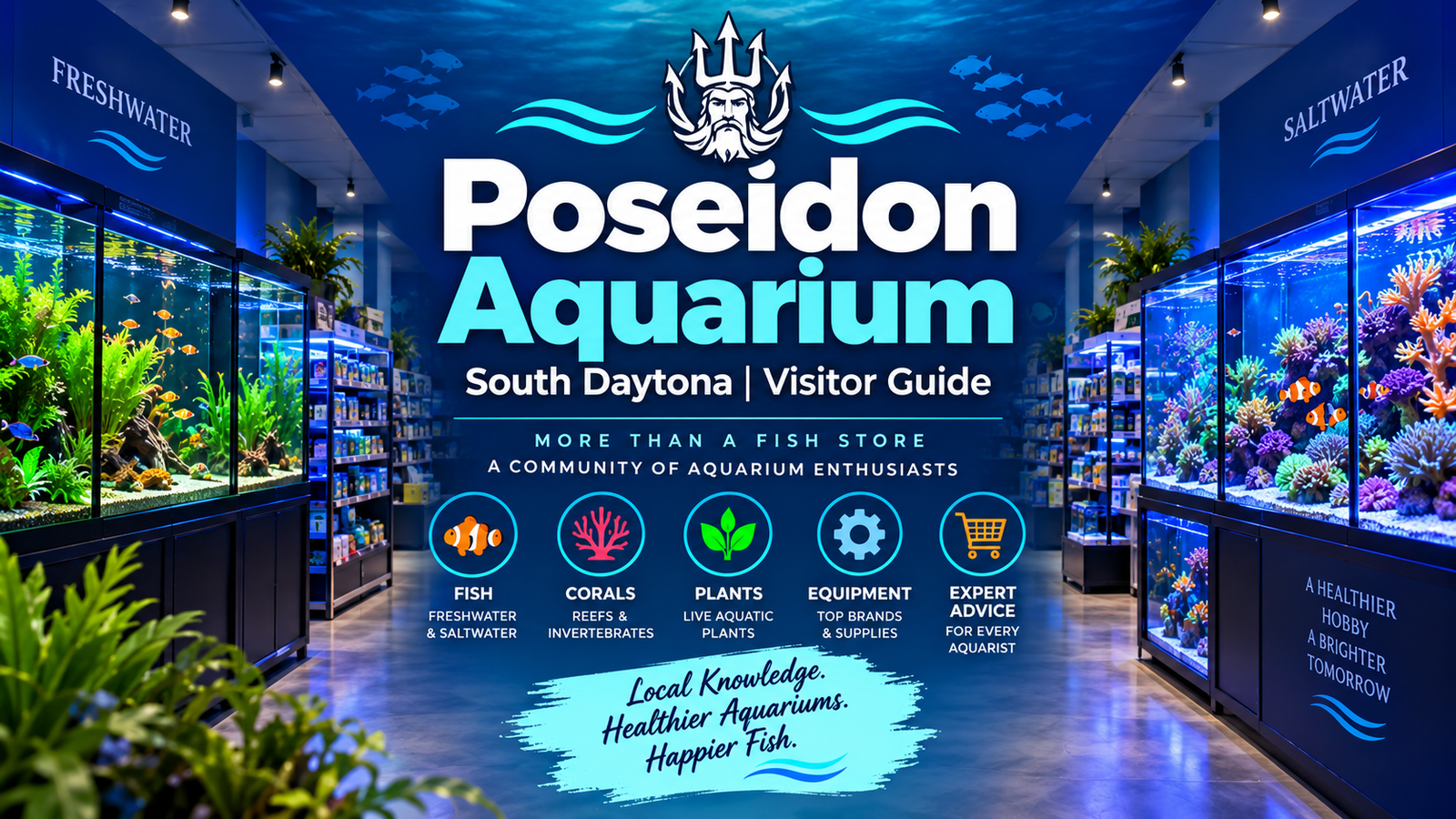
Planning a visit to Poseidon Aquarium in South Daytona, Florida? Use this guide to prepare for your trip, ask better questions about livestock and equipment, and make safer choices for your aquarium.
Poseidon Aquarium is listed as an aquarium specialty store in South Daytona, Florida. Third-party business descriptions associate the store with freshwater and saltwater aquarium livestock, equipment and supplies.
Store details and livestock availability can change. Directory listings may also use different address formats. Confirm the current address, opening hours and availability directly with the store before travelling.
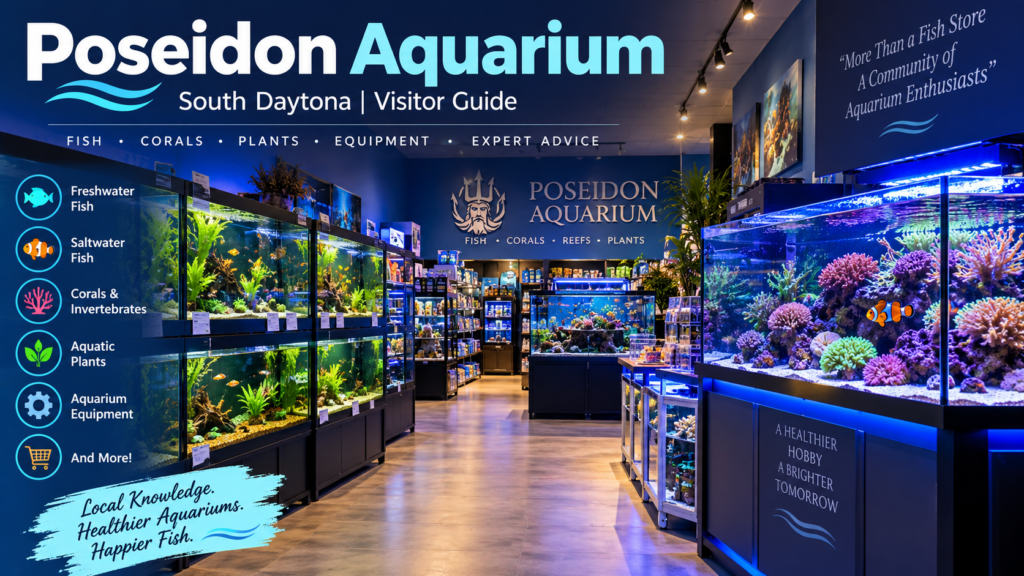
Poseidon Aquarium at a Glance
Poseidon Aquarium is listed as a specialty aquarium retailer in South Daytona. A specialty store can be useful for hobbyists who want to compare aquarium products in person, ask questions before buying livestock or seek advice about a particular setup.
The information below is drawn from third-party business listings. It should be treated as a planning reference, not a guarantee that the details remain unchanged.
| Detail | Listed information |
|---|---|
| Business name | Poseidon Aquarium |
| Location | 1801 S Nova Road, South Daytona, Florida 32119 |
| Phone | (386) 255-3474 |
| Monday to Saturday | 11:00 a.m. to 7:00 p.m. |
| Sunday | 12:00 p.m. to 5:00 p.m. |
Some directories use different suite or address formatting. If you are travelling from outside South Daytona, confirm the destination by phone before setting out. This is particularly important if you are collecting a large aquarium, stand or other bulky equipment.
What to Expect from an Aquarium Specialty Store
Aquarium specialty stores focus on aquatic environments rather than general pet supplies. Depending on current stock, a store may offer freshwater fish, marine fish, invertebrates, aquatic plants, fish food, filtration equipment, lighting, water conditioners, substrates and aquarium décor.
Third-party descriptions and customer reports associated with Poseidon Aquarium mention freshwater and saltwater products. They also refer to a range of livestock and aquarium supplies. These reports are useful as examples of what shoppers may ask about, but they do not confirm what is available today.
A productive visit is not simply a search for the lowest price. It is an opportunity to inspect livestock, compare equipment, learn how an animal is being kept and check whether it suits your aquarium.
Questions to ask before buying
- What is the exact species name?
- How long has the animal been at the store?
- What food is it currently eating?
- What adult size should I plan for?
- Does it need a group, special water conditions or a particular tank layout?
- Has it been observed for signs of illness?
- What acclimation method is suitable for this animal?
- What is the store’s policy if a problem appears after purchase?
These questions are especially important for marine livestock, unusual freshwater fish and species with specialised care requirements. If the answers are unclear, research the species before purchasing. Waiting is better than bringing home an animal your aquarium cannot support.
Fish and Aquatic Livestock: What to Ask
Retail livestock is not a fixed catalogue. Fish may arrive in shipments, sell quickly or be held for observation. Corals, plants and invertebrates can also vary with supplier availability and the store’s current purchasing choices.
Customer reports and third-party listings mention common freshwater fish, marine fish, plants, corals and invertebrates in connection with the store. Such reports do not establish current inventory, health status or suitability for a particular aquarium.
Confirm the species identification
Common names can refer to more than one species. Fish that look similar may have different adult sizes, diets and social needs. Ask for the exact species name whenever possible, then verify its adult size and care requirements using a reliable aquarium reference.
Ask about feeding
Feeding information helps you assess whether a fish is eating and whether you can provide an appropriate diet at home. Ask what it has been eating, how often it is fed and whether it accepts prepared foods. Do not assume that a fish will readily accept the food you already use.
Check compatibility
Compatibility depends on adult size, territorial behaviour, swimming level, group size, feeding competition and water conditions. A small juvenile may later become a predator or a territorial adult. Before adding an animal, compare its requirements with every species already in your aquarium.
Freshwater Fish Shopping Guide
Freshwater aquariums range from small species tanks to large community setups. The right livestock depends on actual water volume, aquarium dimensions, filtration, temperature, water chemistry and maintenance. “Freshwater fish” is not one care category: tropical community fish, cold-water fish, dwarf cichlids and large predatory species may have very different needs.
Start with the aquarium you own
Before visiting the store, record your aquarium’s dimensions and approximate water volume. Note the temperature, pH if measured, ammonia, nitrite and nitrate readings, filtration type and current inhabitants. These details help prevent purchases based on an incomplete picture.
Tank volume alone is not enough. A long aquarium may provide more swimming space than a tall aquarium of the same volume. Bottom-dwelling fish need suitable floor area and shelter, while active swimmers need open swimming room. Fish that grow large may require a much larger footprint than their juvenile size suggests.
Community fish
Community aquariums often include small schooling fish, livebearers and other species selected for compatible adult size and temperament. Check recommended group sizes and whether the fish prefer open water, dense planting, gentle flow or sheltered areas.
Do not assume that fish displayed together are suitable long-term tankmates. A store display may be temporary, and its inhabitants may not share the same adult size, temperature or water-chemistry requirements.
Bottom-dwelling fish
Bottom-dwelling fish still need species-appropriate care. Some need smooth substrate, caves or shaded areas, while others should be kept in groups. Do not treat any fish as a “clean-up crew” that replaces regular maintenance. Bottom-dwellers need suitable food and clean water like other aquarium inhabitants.
Cichlids and territorial species
Cichlids and other territorial fish may need careful planning around aquarium size, rockwork, line-of-sight barriers and social structure. Temperament can change as fish mature or form breeding territories. Ask about adult size, aggression, group composition and the store’s experience with the species.
Unusual freshwater fish
Unusual fish can be rewarding, but they often require more research than common community species. Some have specialised diets, narrow temperature preferences, nocturnal habits or unusual habitat requirements. Confirm identification, adult size, diet and lifespan before purchasing.
Avoid adding too many fish at once
A new aquarium can look bare, but adding too many fish too quickly can overwhelm its biological filtration. Add livestock gradually, monitor water quality and avoid treating a filter’s advertised capacity as a guarantee that any stocking level will be safe.
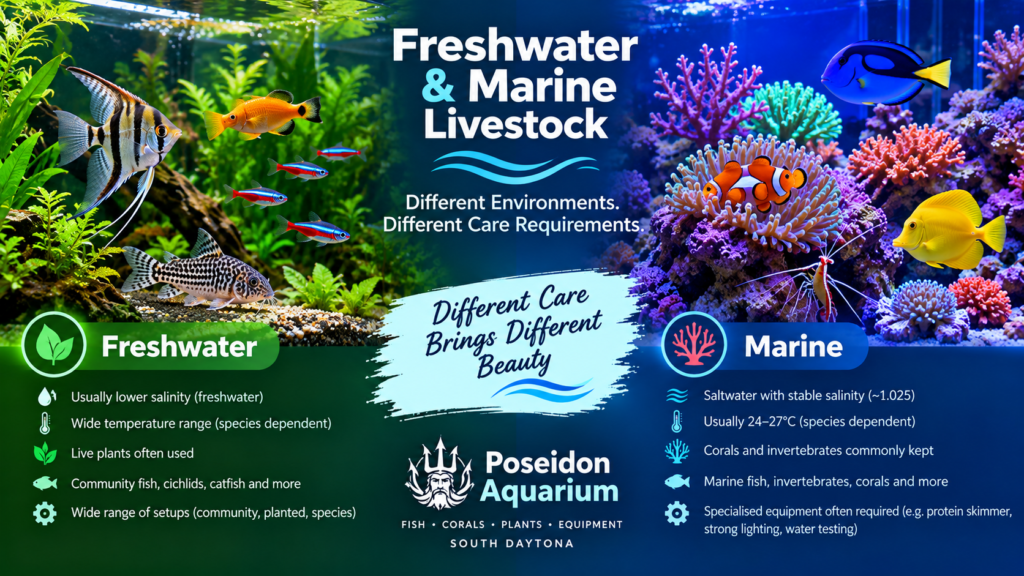
Saltwater Fish and Reef Shopping Guide
Marine aquariums can be beautiful and complex. Saltwater fish, corals and invertebrates may require stable salinity, suitable temperature, mature biological filtration and careful nutrient control. Reef aquariums add further considerations because corals respond to lighting, flow, alkalinity, calcium and other water parameters.
Marine fish
Consider adult size, swimming behaviour, feeding needs and compatibility. Some marine fish are active swimmers that need long tanks. Others are territorial or may feed on small invertebrates. Ask whether the fish is eating prepared food and what it has been offered recently.
Corals
Corals are living animals, not decorative objects. Different groups vary in light requirements, water-flow preferences, placement and sensitivity to changing conditions. Ask what lighting and flow the coral has been kept under, how it is attached, whether it has been checked for pests and what placement is recommended.
Avoid moving a coral directly from a shop’s lighting to a much stronger home light without a suitable acclimation plan.
Marine invertebrates
Snails, shrimp, crabs and other invertebrates may have specific dietary, salinity and compatibility requirements. Some are sensitive to rapid salinity changes or copper-based medications. Confirm what the animal eats and whether it is compatible with your fish and reef inhabitants.
Reef equipment and water stability
Marine aquariums may use protein skimmers, circulation pumps, heaters, lighting, test kits and filtration media. The correct combination depends on tank size, livestock, feeding and maintenance. Ask for advice about your particular system rather than buying equipment solely because it is popular or marketed for a certain tank volume.
Measure salinity with a reliable instrument, keep temperature stable and use appropriate tests for your livestock. Make changes deliberately, and avoid adding several animals or changing multiple pieces of equipment at once.
Aquatic Plants and Invertebrates
Live plants can provide cover, visual structure and surfaces for biofilm. Their requirements vary considerably. Some are adaptable and grow under modest lighting, while others need stronger light, nutrients or supplemental carbon dioxide.
Inspect plants before buying
Look for healthy leaves and stems, but remember that a few damaged leaves do not automatically mean a plant is beyond recovery. Check for extensive decay, algae and unwanted hitchhikers. Ask whether the plant was grown submerged or emersed, because some plants shed older leaves while adapting to submerged growth.
Rinse and inspect new plants before adding them. If you keep shrimp or other sensitive invertebrates, ask about possible pesticide exposure and use an appropriate preparation or quarantine process when needed.
Shrimp and snails
Freshwater shrimp and snails need suitable water conditions and food. Some shrimp are sensitive to sudden changes in temperature or water chemistry. Some snails reproduce readily when food is abundant, while others have different dietary or breeding requirements.
Do not add invertebrates to a tank recently treated with medication unless you have confirmed that the treatment is safe for them and that any required removal or water changes have been completed.
Aquarium Equipment and Supplies
Buying equipment in person can help you compare size, fittings and practical features. A product is appropriate only if it suits your aquarium and livestock. Before purchasing, identify the problem you are trying to solve. Cloudy water, poor circulation, algae and unstable temperature have different causes.
Filtration
A filter provides water movement and surfaces for biological filtration, while mechanical media captures suspended debris. Some systems also use chemical media for specific purposes. Choose a filter based on aquarium volume, livestock, feeding level, maintenance needs and desired flow.
Ask how often the filter requires cleaning, which replacement media are available and whether it can be serviced without replacing all biological media at once. Avoid aggressively cleaning all biological media at the same time, as this can disrupt waste processing.
Heaters and thermometers
Check that a heater suits the aquarium’s volume and room conditions. Use a separate thermometer to confirm the actual water temperature rather than relying only on the heater’s dial or display. Follow the equipment instructions and use a heater guard where appropriate.
Lighting
Lighting should match the needs of the animals and plants. A fish-only aquarium may have different requirements from a densely planted aquarium or reef system. Consider intensity, spectrum, mounting height, photoperiod and whether the light can be adjusted. Longer lighting periods do not automatically improve plant growth and may encourage algae.
Air pumps and circulation
Air pumps can operate air stones, sponge filters and other equipment. Surface movement and circulation support gas exchange, but the required flow depends on the tank and its inhabitants. Choose equipment that provides suitable circulation without making the aquarium difficult for fish to use.
Water testing and conditioning
Test kits help you make decisions based on measured conditions. In a newly established freshwater aquarium, ammonia and nitrite are particularly important during cycling and after stocking changes. Nitrate, pH and hardness may also matter depending on the species. Marine aquariums may require additional tests, especially when keeping corals.
Use water conditioner according to its label and the source water being treated. Do not assume that conditioner makes every water-quality problem safe. Test the water, identify the cause and follow the product instructions.
Substrate and décor
Choose substrate and décor for the species and maintenance routine. Sharp edges may injure some fish, while certain bottom-dwellers need smooth surfaces. Rocks and wood should be aquarium-safe and arranged securely. Leave enough open space for swimming, cleaning and equipment access.
How to Choose Healthy Fish
Fish selection should begin with observation, not impulse. Spend a few minutes watching the animal and, where possible, the other fish in the same system. A brief inspection cannot guarantee that a fish is disease-free, but it can help identify visible warning signs and prompt useful questions.
Observe behaviour
Look for swimming and breathing that appear normal for the species. Be cautious if a fish repeatedly gasps at the surface, lies on its side, struggles to remain upright, rubs against objects or appears unable to swim normally. Some species naturally rest or occupy unusual positions, so consider the species’ normal behaviour.
Look at the body and fins
Check for visible wounds, extensive fin damage, unusual swelling, cloudy eyes, abnormal spots or fuzzy growths. Some fish naturally have spots, patterns or transparent fins, so identify the species before interpreting a feature as a symptom.
Check the display system
Look at the general condition of the aquarium. Are the fish breathing and swimming normally? Are there animals that appear severely distressed or dead in the system? A single observation cannot establish the cause of a problem, but visible concerns are a reason to ask questions and exercise caution.
If a fish in the same system has died, ask staff whether water quality was checked and whether the remaining livestock has been observed. The cause may be unrelated to infectious disease, but if you are not satisfied with the explanation, postpone the purchase.
Ask whether the fish is eating
Feeding is one useful part of a health assessment, though it is not a guarantee. Ask what the fish eats and whether it has accepted food recently. Some fish may not feed during normal store hours or may need a particular food.
Buy only when your tank is ready
Confirm that your aquarium is cycled, stable and compatible with the new animal. Have a suitable transport container, quarantine tank and acclimation plan ready. Do not buy a fish simply because it is the last one available if you have not researched its care or prepared the aquarium.
Quarantine and Acclimation
Quarantine gives new fish a separate place for observation before they join an established aquarium. It can reduce the risk of introducing some diseases and parasites, and it makes it easier to monitor feeding and behaviour. Quarantine is not a guarantee against illness; its effectiveness depends on suitable equipment and careful observation.
Prepare a quarantine tank
A quarantine setup should suit the size and needs of the fish. It commonly includes an appropriate filter, heater where required, thermometer, cleanable hiding places and a secure cover for species that jump. Keep equipment separate from the main aquarium where practical.
Around two to four weeks is a common hobbyist observation period, but the appropriate duration depends on species, source, symptoms, treatment history and risk tolerance. Extend observation if signs of illness appear, and seek species-specific guidance for known parasites or diseases.
Transport the fish safely
Keep the transport container stable and away from direct sunlight, extreme temperatures and unnecessary movement. Minimise the time between purchase and arrival at home. If you have a long journey, ask the store how the fish will be packed and whether special transport considerations apply.
Acclimate according to the animal
Acclimation is not identical for every fish or invertebrate. Temperature matching matters, but the appropriate method also depends on the difference between transport water and aquarium water, the journey length and the animal’s sensitivity. Ask the store for a method appropriate to the livestock you are buying.
Do not leave a fish in an opened transport bag for an unnecessarily long period. Follow a reliable, species-appropriate procedure and avoid pouring store water into the display aquarium when reasonably possible.
Observe after introduction
Watch the fish closely after transfer. Confirm that it can swim normally, find shelter and access food. Test water quality if behaviour changes, especially in a new or heavily stocked aquarium. If symptoms develop, keep the fish separate where possible and seek appropriate guidance rather than adding unverified treatments to the main tank.
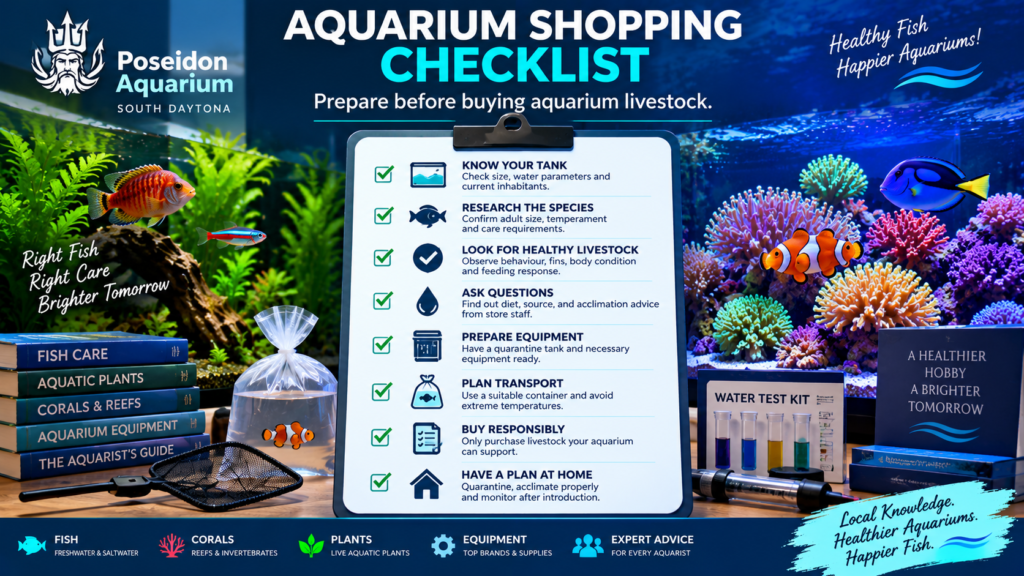
Plan Your Poseidon Aquarium Visit
A little preparation can make a store visit more useful and help prevent unsuitable purchases. Write down what you need and what your aquarium can support. If you are shopping for livestock, record the tank’s dimensions, water parameters and current inhabitants.
Before you leave home
- Confirm the current address, opening hours and phone number.
- Call ahead about the specific fish, plant, coral or equipment you want.
- Write down your aquarium’s dimensions and approximate water volume.
- Record current livestock and water-test results.
- Check adult size, diet, temperament and water requirements.
- Make sure the aquarium is cycled and ready for new livestock.
- Prepare a quarantine setup before bringing home fish.
- Bring equipment model numbers or measurements for replacement parts.
At the store
- Observe livestock before asking for it to be packed.
- Confirm the exact species name and adult size.
- Ask what the animal is eating and how it has been kept.
- Check compatibility with your current aquarium inhabitants.
- Ask about care requirements, acclimation and special considerations.
- Inspect equipment labels, dimensions, fittings and replacement-media availability.
- Keep a record of purchases and care instructions.
After the visit
Bring livestock home promptly and follow a suitable acclimation and quarantine plan. Store food and water treatments according to their labels. Keep receipts and product packaging until you have confirmed that equipment works as intended. Verify any unclear care information before introducing an animal to your main aquarium.
Frequently Asked Questions
Where is Poseidon Aquarium?
Business listings identify Poseidon Aquarium at 1801 S Nova Road in South Daytona, Florida 32119. Address formatting varies across directories, so confirm the exact destination by phone before travelling.
What is the phone number for Poseidon Aquarium?
The listed phone number is (386) 255-3474. Contact the store to confirm current hours, address details, livestock availability and service information.
What are Poseidon Aquarium’s opening hours?
Listings show Monday to Saturday, 11:00 a.m. to 7:00 p.m., and Sunday, 12:00 p.m. to 5:00 p.m. Hours can change, so call before visiting.
Does Poseidon Aquarium sell freshwater and saltwater fish?
Third-party business descriptions associate the store with both freshwater and saltwater aquarium livestock and supplies. Specific species and quantities change, so ask the store directly about current stock.
Can I buy coral or reef supplies there?
Third-party listings and customer reports mention marine and reef-related livestock or supplies. They do not confirm that a particular coral, invertebrate or product is available today. Call ahead with the exact item you want.
Does the store have aquatic plants?
Customer reports mention aquatic plants, but availability can change. Ask about the plant species, whether it is grown submerged or emersed, and whether special preparation is recommended.
Should I buy fish on the same day I set up an aquarium?
Do not add fish until the aquarium has an established biological filtration system and stable water conditions. A newly filled tank is not automatically ready for livestock.
How can I tell whether a fish is healthy?
Observe its swimming, breathing, body condition, fins and response to its surroundings. Ask whether it is eating and how long it has been at the store. Visual inspection cannot guarantee that a fish is disease-free, so quarantine and continued observation are important.
Should I quarantine new fish?
Quarantine is a useful risk-reduction practice because it allows you to observe new fish separately before adding them to an established aquarium. Around two to four weeks is a common hobbyist baseline, not a guarantee that all health risks have been eliminated.
Can I rely on online reviews to decide whether to visit?
Reviews can offer personal experiences, but they are subjective and may describe different dates, staff, products or expectations. Review counts and ratings also change and can differ between platforms. Confirm practical details directly with the store.
Is every fish displayed together compatible?
No. Store displays may be temporary and do not necessarily represent a suitable long-term community. Check adult size, temperament, group needs, diet, water requirements and aquarium dimensions.
What should I bring when asking for stocking advice?
Bring the aquarium’s dimensions, approximate water volume, temperature, water-test results and a complete list of current inhabitants. A clear photo of the tank can also help explain its layout and available swimming space.
Final Thoughts
Poseidon Aquarium is listed as a specialty aquarium retailer in South Daytona, with third-party business information associating it with freshwater and saltwater livestock and aquarium supplies. Confirm current details before travelling and treat online inventory descriptions as a starting point rather than a guarantee.
The most important part of buying aquarium livestock is matching the animal to a prepared, compatible environment. Identify the species, learn its adult size and care requirements, inspect it carefully, ask about feeding and health, and prepare quarantine and acclimation before bringing it home.
Sources and Further Verification
The business details in this guide are based on third-party business listings and retailer-related directory information. Listings may differ or become outdated. Confirm current details directly with the store.
- Seachem Dealer Locator – dealer listing and contact details.
- FishStores.org – third-party aquarium-store listing and customer reports.
- Yellow Pages – third-party business directory.
Editorial note: Current inventory, services, address formatting and hours should be verified before publication or before a visit. Customer reports are not treated as confirmation of current stock.