AquariumsWorld · Nano Aquarium Guide
ADA Cube Garden 30W Rimless Aquarium
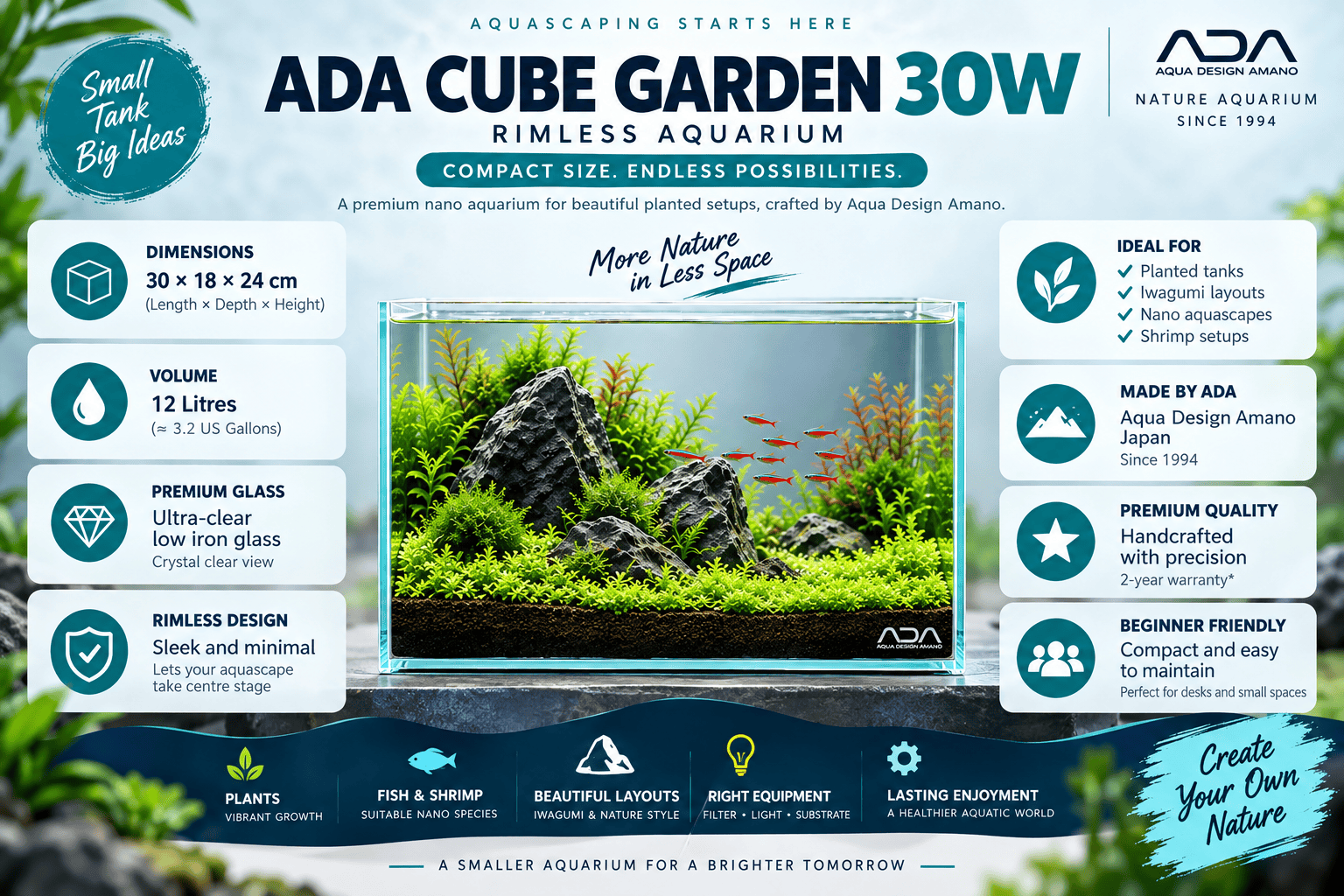
A practical guide to planning a small planted aquarium, choosing compatible equipment, understanding low-iron glass, and setting realistic expectations for livestock in a compact tank.
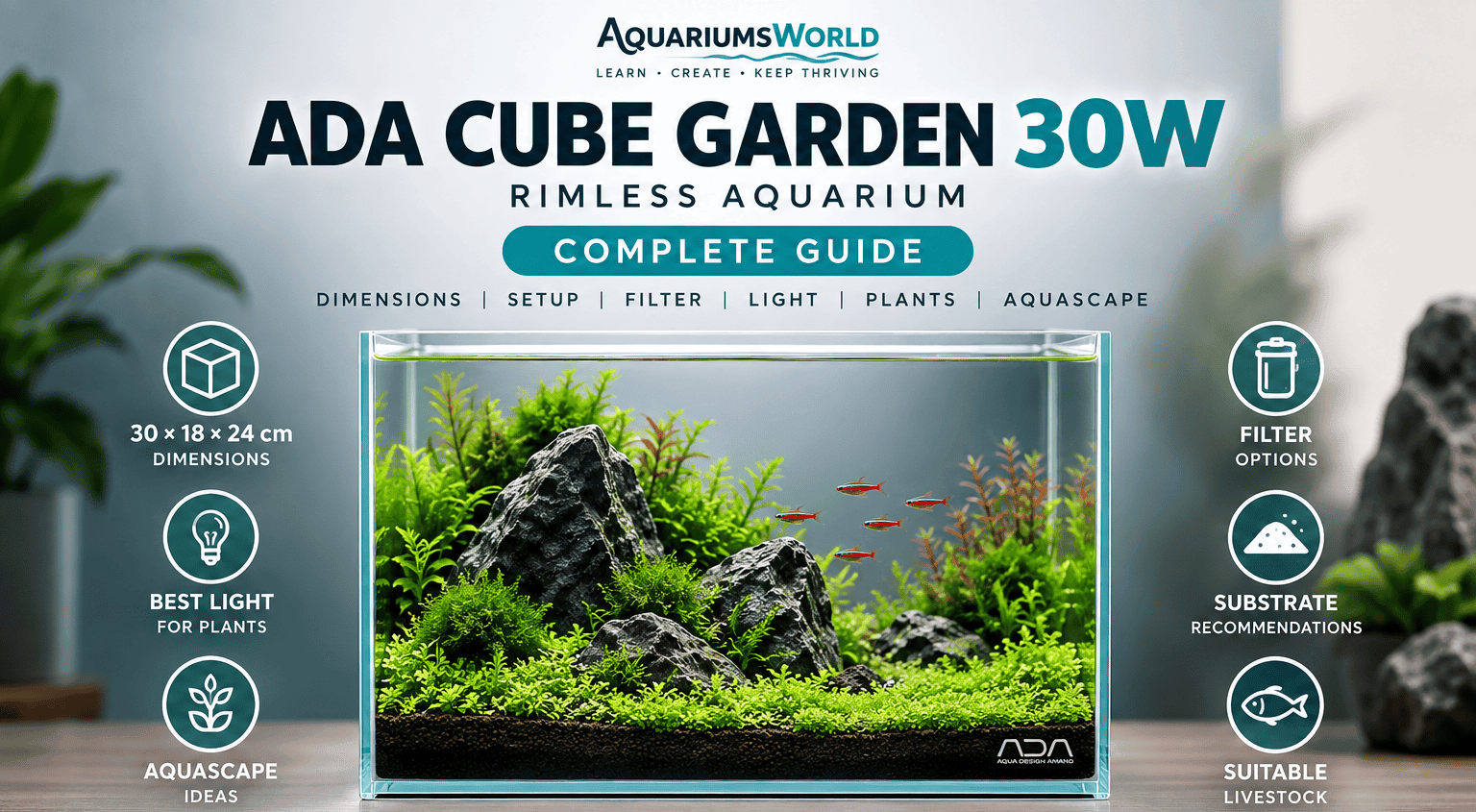
The ADA Cube Garden 30W rimless aquarium is a small-format glass tank associated with the Nature Aquarium approach developed by Aqua Design Amano. The model is commonly listed at approximately 30 × 18 × 24 cm, with a nominal capacity close to 12 litres. Its rectangular footprint gives aquascapers more horizontal room than a cube-shaped tank of similar height, making it useful for compact landscapes, planted displays, and carefully composed stone or driftwood layouts.
Searches for ADA Cube Garden 30W dimensions, volume in litres, price, setup, filter, light, and aquascape often reflect the same practical question: how do you create a stable, attractive aquarium in such a small space? The answer is to plan the whole system together. Tank size, substrate, light, filtration, plant choice, maintenance, and livestock all affect one another.
This guide explains the main considerations without treating retailer specifications or general aquarium advice as guarantees. Product dimensions, included accessories, warranty terms, availability, and pricing can vary by market and production batch. Confirm those details with the seller before ordering. For background on substrate choices, see the AquariumsWorld guide to soil in fish tanks. For a larger-volume comparison, read the 20-gallon aquarium guide.
1. ADA Cube Garden 30W Specifications and Dimensions
The 30W is generally described as a wide, shallow rectangular tank. Its outside dimensions are commonly stated as 30 cm long, 18 cm deep, and 24 cm high. Those measurements are useful for planning a cabinet, light, and aquascape, but they do not mean the aquarium will hold exactly 12 litres of water once it is running.
| Specification | Commonly listed information | What to check |
|---|---|---|
| Model | ADA Cube Garden 30W | Confirm the model code on the retailer’s product page. |
| Dimensions | Approximately 30 × 18 × 24 cm | Check whether the seller lists external or internal measurements. |
| Nominal volume | Approximately 12 litres | Actual operating water volume is lower after substrate and décor. |
| Shape | Rectangular, wide format | Useful for horizontal compositions and compact foreground-to-background layouts. |
| Glass | Low-iron, high-clarity glass is commonly associated with the range | Verify the exact specification for the particular model and market. |
| Glass thickness | Often listed as 5 mm for this size | Confirm with the seller; do not infer thickness from photographs. |
| Silicone | Clear seams are part of the minimalist appearance | Inspect seams and edges for damage before accepting delivery. |
| Accessories | Some listings mention stainless-steel cover hooks | Check what is actually included; a lid may be sold separately. |
| Warranty | Terms depend on the seller and market | Get the warranty duration, exclusions, and proof-of-purchase requirements in writing. |
Nominal volume versus usable water volume
Multiplying the stated dimensions gives a geometric volume of 12,960 cubic centimetres, or 12.96 litres, before accounting for glass thickness and the difference between external and internal measurements. Product listings may round, use internal dimensions, or state a nominal capacity that differs from a simple external calculation. This is why it is sensible to describe the 30W as approximately 12 litres rather than promise an exact fill volume.
Substrate, stones, driftwood, equipment, and the space left above the waterline further reduce the amount of water in the operating aquarium. That matters because small tanks have limited room for error. A small amount of uneaten food, decaying plant matter, or an unsuitable livestock addition can have a greater effect in a compact volume than in a much larger aquarium.
2. What Is the ADA Cube Garden?
ADA stands for Aqua Design Amano, the Japanese aquascaping company associated with the work of Takashi Amano and the Nature Aquarium style. The company’s aquariums are designed around the idea that the tank should frame the underwater landscape rather than visually compete with it. Rimless construction, clear glass, and restrained equipment placement support that presentation.
The Nature Aquarium approach treats an aquarium as a composed landscape. Plants, stones, driftwood, open space, and perspective are arranged to create a sense of depth and balance. A small tank can use the same principles, but the limited footprint requires restraint. A few carefully chosen materials usually look more coherent than a large collection of unrelated decorations.
The Cube Garden name covers multiple tank sizes and shapes. The “30W” label is commonly used for a 30 cm wide-format aquarium, while “30C” refers to a cube-style format. Product names and dimensions should always be checked against the current manufacturer or authorised retailer listing, especially when buying from a marketplace where model descriptions may be incomplete.
For a beginner, the important point is that an ADA tank is only one part of the aquarium system. It does not automatically provide filtration, lighting, heating, substrate, plants, water testing, or livestock. The owner still needs to select equipment and establish the aquarium before adding animals. New fishkeepers can review the beginner’s fish-care guide before making stocking decisions.
3. ADA Cube Garden 30W vs 30C: What Is the Difference?
The 30W and 30C are often compared because both are compact rimless aquariums, but their footprints lead to different design possibilities. The 30W is rectangular and provides a longer horizontal view. The 30C is a cube, offering a more equal footprint in each direction. The larger nominal capacity often associated with the 30C also means it can provide more water volume, although its actual usable capacity depends on the setup.
| Feature | Cube Garden 30W | Cube Garden 30C |
|---|---|---|
| Commonly listed dimensions | 30 × 18 × 24 cm | 30 × 30 × 30 cm |
| Nominal volume | Approximately 12 litres | Often listed around 25–27 litres; verify the exact listing |
| Footprint | Rectangular and relatively shallow | Square footprint |
| Composition | Supports horizontal, landscape-style layouts | Supports compact, central, or multi-angle compositions |
| Placement | May fit a narrow shelf or desk, if structurally suitable | Needs more depth on the support surface |
| Water volume | Less water and less buffering capacity | More water volume, but still a nano aquarium |
Choose the 30W when the available space is narrow and you want a horizontal aquascape. Choose the 30C when the square footprint suits your room and you want to compose a scene that can be viewed from several angles. Neither shape removes the need for cycling, regular maintenance, or conservative livestock planning.
Do not select a model solely because a seller describes it as “better for beginners.” A larger water volume can make some water-quality changes less abrupt, but it does not compensate for poor maintenance or incompatible animals. A beginner should choose the tank that fits the intended layout, available space, budget, and maintenance routine.
4. What Is Low-Iron Glass and Why Does It Matter?
Ordinary glass can have a subtle green tint, especially when viewed through its edge. Iron compounds in the glass contribute to that colour. Low-iron glass uses a reduced iron content to improve visual clarity, so the glass can appear less green and the contents may be seen with less colour distortion.
In aquascaping, visual clarity is part of the design. A green cast can affect how pale sand, light-coloured stone, plant leaves, and fish colours appear through the glass. Low-iron glass can make the viewing experience feel more direct, particularly in a small aquarium where the viewer is close to the display.
Low-iron glass does not make an aquarium maintenance-free, stronger by definition, or immune to scratches. The tank still needs a suitable stand, careful handling, and safe cleaning tools. Avoid scraping grit across the glass, placing hard décor against the pane, or moving a filled aquarium. A small scratch can be especially noticeable in a minimalist display.
What low-iron glass does not guarantee
- It does not guarantee that every panel or seam is completely invisible.
- It does not guarantee a particular light-transmission percentage unless the manufacturer provides that specification.
- It does not replace inspection of glass edges, silicone seams, and packaging on delivery.
- It does not determine whether the aquarium is suitable for a particular fish species.
When comparing ADA with another rimless aquarium, look at the actual glass specification, construction quality, dimensions, warranty, and local support. Photographs can help assess appearance, but they cannot establish glass thickness, seam quality, or warranty coverage.
5. ADA Cube Garden Sizes: Where the 30W Fits
The Cube Garden range includes several footprints, from very small desktop tanks to larger aquascaping displays. Exact model names, dimensions, glass thicknesses, and availability can vary across product generations and markets. Treat the table below as a broad orientation, not a substitute for a current manufacturer specification sheet.
| Model often listed | Approximate dimensions | General format |
|---|---|---|
| 15C | 15 × 15 × 22 cm | Very small cube-style display |
| 20C | 20 × 20 × 20 cm | Small cube-style display |
| 30W | 30 × 18 × 24 cm | Compact wide-format aquarium |
| 30C | 30 × 30 × 30 cm | Cube-style aquarium |
| Mini M | Often listed around 36 × 22 × 26 cm | Small rectangular display |
| 45P | Often listed around 45 × 27 × 30 cm | Small-to-medium aquascaping footprint |
| 60P | Often listed around 60 × 30 × 36 cm | Common medium aquascaping format |
| 90P | Often listed around 90 × 45 × 45 cm | Large landscape display |
| 120P | Often listed around 120 × 50 × 50 cm | Large aquascaping display |
The range illustrates why a model code should not be used as the only planning measurement. A “30” model can describe different shapes and capacities. Before ordering, compare the complete length, depth, height, nominal capacity, glass thickness, and any included accessories. Also check that your chosen light can cover the footprint and that the filter’s flow can be adjusted for the tank.
If your goal is to keep fish rather than create a small aquascape, consider whether a larger aquarium would provide a more appropriate environment. A 20-gallon tank, for example, offers substantially more water volume and room for species-appropriate swimming space than a 12-litre display. Read the aquarium dimensions and weight guide when comparing placement and support requirements.
6. Choosing the Best Filter for the ADA Cube Garden 30W
A filter supports biological filtration by providing a surface where beneficial microorganisms can process waste compounds. It may also remove suspended particles through mechanical filtration. The appropriate filter depends on the planned livestock, plant density, available space, and the desired appearance. In a small tank, excessive current can disturb plants or make it difficult for small animals to rest, while insufficient filtration and maintenance can contribute to poor water quality.
External canister filter
A small external canister keeps most of the equipment outside the aquarium. This can create a clean aquascape, particularly when paired with suitable glass or discreet inlet and outlet pipes. Before buying, verify that the filter is rated for a small aquarium and that its flow can be controlled. A filter designed for a much larger tank may create excessive current even if its flow rate looks impressive on paper.
External filters need space beside or below the aquarium, secure hoses, and careful setup. Check the manufacturer’s minimum operating volume and maintenance instructions. Do not allow the filter to run dry, and inspect all connections for leaks after installation.
Compact internal filter
An internal filter is often simpler to install and may be a practical option for a first aquarium. It sits inside the tank, so it is visible and occupies some swimming or aquascaping space. Position it where it can circulate water without blasting a delicate carpet plant or creating a strong current in every part of the tank.
Check whether the filter includes biological media and whether replacement cartridges are readily available. If the design relies on disposable cartridges, understand how replacing them affects the biological media. Avoid replacing all established filter media at once unless the manufacturer’s instructions and aquarium conditions support that change.
Hang-on-back filter
A hang-on-back filter can be convenient when the tank’s rimless design and rear clearance allow it. It keeps the main filter body outside the display, although the intake and outflow remain visible. Check the tank’s glass dimensions and the filter’s mounting requirements; do not assume a product designed for framed aquariums will fit a rimless tank safely.
Sponge filter
A sponge filter provides a large surface for biological filtration and uses air-driven movement. It can be useful in a shrimp-focused or breeding setup, although it is visible and requires an air pump, airline tubing, and a suitable non-return valve where recommended. The sponge should be cleaned gently in removed aquarium water rather than sterilised, because its established microbial community is part of the filtration system.
| Filter type | Potential fit | Trade-offs to consider |
|---|---|---|
| External canister | Minimal-equipment planted display | Higher cost, hoses and cabinet space, flow must suit the tank. |
| Compact internal | Simple beginner setup | Visible in the aquarium and takes up internal space. |
| Hang-on-back | Easy access to media | Must fit the rimless glass and available rear clearance. |
| Sponge filter | Shrimp-focused or simple low-tech setup | Visible equipment and an air pump are required. |
There is no single filter that is automatically “best” for every ADA 30W. Choose a unit that can be safely installed, provides appropriate filtration for the planned inhabitants, and can be maintained consistently. For more information about air-driven systems, see the aquarium air pump guide.
7. Choosing the Best Light for the ADA Cube Garden 30W
The tank’s compact footprint means the light should cover roughly 30 cm of length and 18 cm of depth, while providing an intensity appropriate for the plants you intend to grow. Light selection is not simply a matter of choosing the brightest lamp. Plant species, water depth, nutrient availability, carbon supply, photoperiod, and maintenance all affect the result.
ADA Aquasky models
ADA’s Aquasky range is designed for planted aquariums and is often considered by aquascapers who want equipment from the same ecosystem as the tank. Check the exact model’s supported aquarium width, mounting arrangement, spectrum, power requirements, and current availability. A model number that appears similar may be intended for a different footprint.
Twinstar lighting
Twinstar offers aquarium lights used in planted layouts. When evaluating a fixture, compare its dimensions, intensity control, spectrum information, mounting method, and warranty. Do not assume that a light will produce the same plant growth in every aquarium simply because it is used by aquascapers in photographs or videos.
Chihiros lighting
Chihiros offers a range of aquarium lights, including fixtures with adjustable output and app-based controls on some models. These features can be useful, but the correct product still depends on the tank’s footprint and plant requirements. Check whether the fixture needs a separate controller and whether the mounting hardware is compatible with the glass aquarium.
How much light is enough?
For a low-tech aquarium with undemanding plants, moderate lighting and a conservative photoperiod may be easier to manage. More demanding carpet plants may require stronger light and a more consistent supply of carbon and nutrients. Increasing light without addressing the rest of the system can encourage algae rather than produce healthy plant growth.
Photosynthetic photon flux density, often abbreviated PPFD, describes the amount of photosynthetically active light reaching a surface. A PAR meter can help measure light at the substrate, but manufacturer wattage alone cannot tell you the PPFD at every point in the aquarium. Light spread, mounting height, lens design, and water depth affect the result.
Park and Runkle (2018) studied how different LED spectra affected the growth and visual quality of several ornamental seedlings. Their research is useful background for understanding that spectrum can affect plant responses, but it was not an aquarium experiment and does not prove that a particular aquarium light brand is superior. The study should not be used to claim that all full-spectrum or red-blue aquarium fixtures outperform every white LED.
For broader lighting concepts, use the AquariumsWorld aquarium setup and guide category to locate related setup information. Always follow the light manufacturer’s safety instructions around water, cables, and power connections.
8. Best Substrate for the ADA Cube Garden 30W
Substrate affects the appearance of the aquascape, the way plants are anchored, and the availability of nutrients near plant roots. It should be selected according to the plants and layout rather than by brand name alone. A nutrient-rich active substrate can support certain planted layouts, while inert sand or gravel can suit other designs. Neither type eliminates the need to understand plant nutrition and water quality.
ADA Aqua Soil Amazonia
ADA Aqua Soil Amazonia is commonly used in planted aquascapes. Active soils can influence water chemistry and provide nutrients, but the precise effect depends on the product version, source water, maintenance, and livestock. Follow the manufacturer’s directions for the exact product you purchase. New active soil may release nutrients or affect water parameters, so testing and water changes may be important during establishment.
Some substrates are sold in different grain sizes, including finer grades intended for foreground planting. Fine substrate can help create a smooth appearance, but it may compact or be displaced by water flow if used incorrectly. Select a grain size that suits the plants and layout, and avoid burying plant crowns or rhizomes that should remain above the substrate.
Sand for contrast and Iwagumi layouts
Light-coloured sand can create contrast beside dark stone and green plants. Sand is generally not a nutrient-rich planting medium, so rooted plants may need nutrients supplied through other appropriate methods. Keep sand clean and avoid allowing organic debris to accumulate in thick, undisturbed layers.
Inert alternatives
Other aquarium substrates may be suitable if their properties match the intended setup. Compare grain size, whether the product is inert or active, how it affects water chemistry, whether it needs rinsing, and the manufacturer’s guidance. For a broader comparison of substrate types and their possible issues, read the soil in fish tank guide.
How much substrate is needed?
The amount depends on the footprint and desired depth. A flat layer needs less material than a sloped composition with a raised rear section. The 30W’s footprint is small, so a modest difference in depth can noticeably change the quantity required.
A useful estimate is to calculate the footprint area in square centimetres, multiply by the desired average depth in centimetres, and divide by 1,000 to convert cubic centimetres to litres. This gives a rough geometric volume. The actual amount required may differ because substrate settles, slopes are uneven, and bags are sold by volume or mass.
Research by Gettys, Haller and Mudge (2018) examined substrate nutrient effects on the growth of three submersed aquatic plant species. It provides relevant scientific context for considering nutrient availability, but it does not establish that one commercial aquarium soil is always superior to inert substrate. Plant species and experimental conditions matter, so apply the findings cautiously to a home aquarium.
9. CO2 and Plant Growth in a Nano Aquarium
Plants need light, carbon, and mineral nutrients to grow. In a planted aquarium, carbon may be available from dissolved carbon dioxide and other dissolved inorganic carbon forms, depending on water chemistry and the plant species. Carbon supply can become a limiting factor in some high-light planted layouts, but not every aquarium needs injected CO2.
Pedersen, Colmer and Sand-Jensen (2013) reviewed underwater photosynthesis and explained how gas diffusion, light penetration, and inorganic carbon availability influence submerged plants. Their review supports the general point that underwater plant growth operates under conditions different from growth in air. It does not provide a universal bubble rate for every aquarium, and it should not be interpreted as a direct setup prescription for the ADA 30W.
Low-tech planted setup
A low-tech setup uses plants that can grow under moderate light and without injected CO2. It can be easier to maintain because it has fewer pieces of equipment and fewer variables to adjust. Plant selection is important: choose species whose growth requirements match the light, substrate, and maintenance time available.
CO2-injected setup
Injected CO2 can support faster growth in a carefully balanced planted aquarium, but it adds equipment and requires monitoring. In a very small aquarium, changes in gas delivery can have a proportionally large effect. Do not copy a bubble rate from another tank: bubble size, diffuser, pressure, water circulation, and gas concentration vary.
Use a reliable approach to monitor the system and watch the animals closely. Fish and invertebrates should never be exposed to unsafe CO2 levels for the sake of plant growth. Ensure the aquarium has appropriate circulation and that the equipment is installed according to the manufacturer’s instructions. If you are new to planted aquariums, begin with a simpler layout and learn how the plants respond before adding complexity.
10. Best Fish and Livestock for the ADA Cube Garden 30W
This is the most important section for anyone considering animals. The 30W is a very small aquarium. Its nominal volume is around 12 litres, and the actual water volume after substrate and décor will be lower. Many fish sold as “nano fish” still need more swimming space, stable social groups, or more water volume than this tank can provide.
There is no universally reliable stocking formula that turns a tank’s litre capacity into a safe number of fish. Adult size, activity, social behaviour, water chemistry, temperature, filtration, feeding, and the aquarium’s maturity all matter. A small tank also offers less room to recover from a mistake. Avoid treating a list of species or a numerical stocking suggestion as a guarantee of welfare.
Consider an invertebrate-focused display
A planted aquarium designed around suitable freshwater shrimp or other compatible invertebrates may be a more realistic use of a 30W than a community of fish. Even then, species requirements differ. Research the adult size, temperature range, water hardness, pH needs, feeding requirements, and compatibility of the exact species before buying.
Neocaridina shrimp are often kept in planted aquariums, but they still need stable water conditions, appropriate food, and protection from copper-containing products or other unsuitable treatments. Caridina shrimp can have more specialised water requirements, depending on the variety. Do not mix species simply because they are small or attractive.
Why fish stocking needs extra caution
Small schooling fish are sometimes suggested for nano tanks, but schooling behaviour and adult swimming needs cannot be assessed from body length alone. A group that appears physically small may still need a longer aquarium and a larger volume to support normal behaviour. The 30W’s compact footprint limits both horizontal swimming room and the stability that comes with more water.
For that reason, this guide does not recommend a fixed number of chili rasboras, ember tetras, celestial pearl danios, pygmy corydoras, or other fish for the 30W. Their suitability depends on species-specific requirements and the complete setup, and a 12-litre aquarium is not a responsible default recommendation for these fish. Goldfish, larger community fish, and species with substantial adult size or activity requirements should not be placed in this tank.
What does the scientific literature say?
Andersson and colleagues’ 2022 study examined laboratory zebrafish held at different densities over nine weeks. The researchers reported increased stress-related indicators and aggression in the lowest-density treatment in their experimental conditions. This is a useful reminder that density alone does not describe welfare: social species can respond to their group and environment in complex ways.
However, that study involved laboratory zebrafish and controlled experimental conditions. It does not establish a stocking limit for the ADA Cube Garden 30W, nor does it show that low density is generally harmful in all aquarium species. It would be misleading to use it to calculate how many fish belong in a home nano tank. Species-specific husbandry guidance and the animal’s needs remain essential.
Before buying any livestock, cycle the aquarium, test the water, and confirm that temperature and water chemistry are appropriate. A newly filled tank is not automatically ready for animals. Read the fish aquarium problems and solutions guide for more on water-quality issues and prevention.
11. ADA Cube Garden 30W Aquascape Ideas
The 30W’s wide footprint lends itself to compact landscape compositions. A successful aquascape does not need many plants or hardscape pieces. It needs a clear focal point, a deliberate arrangement, and enough open space for the viewer to understand the design.
Iwagumi-inspired layout
Iwagumi layouts use stone as the main structural element, often with a restrained plant palette. The 30W can support a miniature interpretation using a few stones of related texture and colour. Place the largest stone off-centre rather than directly in the middle, then use smaller stones to create visual direction. Avoid arranging every stone at equal intervals, which can make the layout look artificial.
Carpet plants are sometimes used in Iwagumi compositions, but many carpeting species require stronger light, careful nutrient management, and often additional carbon. If you are new to aquascaping, consider a less demanding foreground plant or a simpler stone arrangement before attempting a high-energy carpet.
Nature Aquarium-inspired layout
A Nature Aquarium-inspired layout can combine driftwood, stones, and several plant forms. Use the foreground for low plants or open substrate, the middle for small-leaved plants or attached epiphytes, and the rear for taller growth. The shallow depth of the 30W makes scale important: large leaves and oversized hardscape can quickly dominate the entire view.
Attach suitable epiphytic plants to hardscape rather than burying their rhizomes. Trim plants to preserve the intended shape, and leave enough space around the filter inlet and outlet for circulation and maintenance. A beautiful layout that is difficult to clean can become frustrating over time.
Minimalist planted display
A minimalist design can be particularly effective in a small rimless aquarium. One piece of driftwood, a small stone group, and a limited plant palette can create a strong focal point. Keep the hardscape stable and make sure it cannot shift against the glass. Leave accessible space for siphoning debris and trimming plants.
Wabi-kusa or emersed-style composition
A Wabi-kusa-inspired display may use plants growing partly above the waterline. Before creating a paludarium-like arrangement, check whether the tank and any cover or lighting arrangement are appropriate for the intended humidity and moisture. Keep electrical equipment safely away from splashes and condensation. Do not assume that every aquarium light or accessory is rated for a humid, partially open setup.
12. Step-by-Step ADA Cube Garden 30W Setup
Planning the aquarium before filling it makes the process more predictable. Prepare the tank, support surface, equipment, substrate, hardscape, and plants before adding water. Avoid buying animals as the first step.
Step 1: Inspect the aquarium and support
Unpack the tank on a clean, stable surface. Check the glass edges, corners, and silicone seams under good lighting. If you notice a crack, chip, damaged seam, or other concern, contact the seller before filling it. Place the aquarium on a level support surface intended for its full filled weight.
Step 2: Plan equipment placement
Decide where the filter, light, heater if required, and any CO2 equipment will sit. Make sure cords and hoses can be routed safely. Check that the filter can be removed for maintenance without dismantling the aquascape. Leave enough room to reach the aquarium for water changes and cleaning.
Step 3: Add substrate and hardscape
Prepare the substrate according to its product instructions. Rinse only when the manufacturer recommends it; some active soils are not intended to be rinsed. Place stones and driftwood securely, checking that they cannot topple. Avoid wedging hardscape tightly against the glass.
Step 4: Plant the aquarium
Use healthy plants from a reputable source. Remove damaged leaves and any packaging material. Plant species at the correct depth and keep rhizomes exposed where required. Begin with a manageable number of plant types rather than filling the small tank with many species that have different care needs.
Step 5: Fill slowly
Pour water gently over a dish, plastic sheet, or other clean surface to reduce disturbance to the substrate. Use water treated appropriately for the local supply and the intended livestock. Fill to a suitable level while leaving room for equipment and any cover.
Step 6: Start the filter and light
Follow the filter’s priming and startup instructions. Confirm that water is circulating and that there are no leaks. Set the light to a conservative initial schedule. If using a heater, verify that it is appropriate for the tank volume and follow its safety instructions.
Step 7: Cycle and test the aquarium
Establish biological filtration before introducing livestock. Use a suitable cycling method and test the water as the process progresses. Do not rely on water clarity, elapsed days, or the presence of plants as proof that the aquarium is ready. Follow a reliable aquarium cycling guide and confirm that water parameters are appropriate for the species you intend to keep.
Step 8: Add livestock only after preparation
When the aquarium is established and the water is suitable, introduce only livestock that can be properly housed in the available space. Acclimate animals according to the needs of the species and the advice of a qualified aquatic specialist. Avoid adding several new animals at once to a small, newly established system.
- Tank inspected and placed on a stable, level support.
- Filter, light, and any other equipment selected for the actual footprint.
- Substrate and hardscape arranged securely.
- Plants selected for the available light and maintenance routine.
- Water treated appropriately and aquarium filled carefully.
- Filter running without leaks or excessive current.
- Water tested and biological filtration established.
- Livestock requirements checked before purchase.
13. Maintenance and Troubleshooting
A small aquarium can be quick to clean, but it is not necessarily low-maintenance. Its limited water volume means that feeding, evaporation, plant decay, and missed maintenance can have noticeable effects. Build a routine that is realistic for your schedule.
Regular water changes
Use a consistent water-change routine appropriate to the livestock, plant growth, substrate, and measured water conditions. There is no single percentage that is correct for every 30W setup. Match replacement water to the aquarium’s needs and avoid sudden changes in temperature or chemistry. Remove debris gently without disturbing plant roots unnecessarily.
Filter maintenance
Check the filter regularly for reduced flow, trapped debris, and unusual noise. Clean mechanical media when needed, while preserving established biological media. Follow the filter manufacturer’s cleaning directions. Do not clean all filter media and substrate aggressively at the same time, particularly in a small aquarium with limited biological capacity.
Plant trimming
Remove decaying leaves and trim fast-growing plants before they shade the rest of the aquascape. Use clean tools and avoid allowing large amounts of cut plant material to remain in the water. If plant growth declines, assess light, nutrients, carbon availability, and water conditions rather than increasing fertiliser or light automatically.
Algae
Algae can appear in new and established aquariums. Its presence does not always mean that one specific parameter is wrong. Review the lighting schedule, plant health, feeding, water changes, and maintenance. Make changes gradually and keep notes so you can identify which adjustment helped.
Evaporation and water level
Small open-top aquariums can lose water through evaporation. Top up with appropriately prepared water, but remember that evaporation removes water while leaving most dissolved substances behind. Topping up is not a substitute for water changes. If the aquarium is covered, inspect the cover and its supports regularly.
Common warning signs
- Livestock gasping, lethargy, loss of balance, or unusual hiding.
- Sudden cloudiness, unusual odour, or a rapid change in water parameters.
- Filter flow stopping or becoming markedly weaker.
- Plants melting extensively or decaying material accumulating.
- Visible leaks, damaged glass, or movement in the hardscape.
If animals show distress, check water quality and equipment promptly and seek species-specific advice. Do not add random treatments to a small aquarium without confirming that they are safe for the inhabitants and any invertebrates present.
14. ADA Cube Garden 30W Price and Where to Buy
The price of the ADA Cube Garden 30W can vary by country, retailer, stock status, shipping method, taxes, and the accessories included in a bundle. Because prices and availability change, this guide does not present an unverified current price as a guaranteed market rate. Check current listings from authorised or reputable aquarium retailers and compare the full delivered cost.
When comparing offers, check whether the price includes only the glass tank or also includes a light, substrate, cover, filter, or other accessories. A bundle may appear less expensive but contain equipment that does not suit your intended layout. Conversely, a tank-only listing may require additional purchases before it can be used.
Buying checklist
- Confirm the exact model and dimensions.
- Ask whether the aquarium is new, used, or open-box.
- Confirm glass thickness and included accessories from the listing.
- Check shipping protection and the process for reporting damage.
- Read the warranty terms, exclusions, and claim requirements.
- Compare the final price after shipping, taxes, and required equipment.
- Confirm local availability of compatible replacement parts and supplies.
Do not assume that a warranty covers every kind of damage or that buying from any marketplace seller preserves manufacturer support. Ask the seller to explain the warranty and retain the invoice, packaging details, and product documentation.
15. ADA Cube Garden 30W vs Other Nano Rimless Aquariums
ADA is not the only manufacturer offering compact rimless aquariums. When comparing brands, focus on the details that affect your actual use: internal dimensions, glass type, seam quality, available accessories, warranty, delivery protection, and the seller’s ability to support you after purchase.
Some competing tanks may share a similar footprint, while others offer more depth or a different shape. A tank with a similar external measurement may have a different internal volume because of glass thickness or design. Compare the full specification rather than relying on a short product title.
| Comparison point | Questions to ask |
|---|---|
| Dimensions | Are the internal and external measurements stated clearly? |
| Glass | Is the glass type and thickness documented? |
| Construction | Are seams neat, consistent, and supported by a clear warranty? |
| Accessories | Does the tank include a lid, hooks, mat, or other parts? |
| Compatibility | Will the chosen light and filter fit safely? |
| After-sales support | Can the seller explain returns, damage claims, and warranty terms? |
| Total cost | What is the price after shipping and essential equipment? |
The ADA name may appeal to aquascapers who value its design heritage and the visual presentation of its tanks. That preference is separate from the question of whether the aquarium is appropriate for a particular animal. A premium rimless tank still needs sound husbandry, suitable equipment, and realistic livestock choices.
16. Frequently Asked Questions
What are the dimensions of the ADA Cube Garden 30W?
The model is commonly listed at approximately 30 × 18 × 24 cm. Confirm the exact dimensions with the retailer, including whether the measurements are internal or external.
How many litres is the ADA Cube Garden 30W?
It is commonly described as approximately 12 litres. The operating water volume is lower after adding substrate, stones, driftwood, and equipment.
What is the difference between ADA Cube Garden 30W and 30C?
The 30W is a rectangular wide-format aquarium, while the 30C is cube-shaped. The 30C has a deeper, squarer footprint and is commonly listed with a larger nominal volume. Verify the current specifications before buying.
What filter should I use for the ADA Cube Garden 30W?
Choose a filter that fits the tank, provides suitable biological filtration, and allows you to control water flow. A compact internal filter, small external canister, hang-on-back filter, or sponge filter may suit different setups. No single type is best for every layout.
What light should I use for the ADA Cube Garden 30W?
Choose a light that covers the 30 × 18 cm footprint and provides an intensity appropriate for your plants. Compare the supported tank width, mounting method, controllability, and manufacturer guidance. Start with a conservative photoperiod and adjust gradually.
What substrate should I use in the ADA Cube Garden 30W?
Use a substrate suited to your plants and aquascape. Active planted-tank soil may provide nutrients and influence water chemistry, while inert sand or gravel can suit other designs. Follow the exact product instructions and test water as needed.
Is the ADA Cube Garden 30W good for beginners?
It can be a manageable planted display for someone willing to learn and maintain it, but its small water volume leaves less room for error. Beginners should plan a simple setup, establish filtration before adding animals, and avoid unsuitable fish.
Where can I buy the ADA Cube Garden 30W?
Look for current listings from reputable aquarium retailers and confirm the exact model, condition, warranty, shipping protection, and included accessories. Availability varies by region.
How much does the ADA Cube Garden 30W cost?
Prices vary by retailer, location, stock, shipping, and bundle contents. Check current listings and compare the total cost rather than relying on an old or unverified price estimate.
What is low-iron glass and why does it matter for aquariums?
Low-iron glass contains less iron-related tint than ordinary glass and can provide a clearer view of the aquarium. It improves visual presentation but does not remove the need for careful handling, proper support, or maintenance.
Can I keep fish in a 12-litre ADA Cube Garden 30W?
Do not assume that a fish is suitable because it is small or marketed as a nano species. Many fish need more swimming space, social grouping, or water volume than this tank provides. Research species-specific requirements and consider an invertebrate-focused display or a larger aquarium.
How much substrate should I buy?
Estimate the footprint area multiplied by the desired average depth, then convert cubic centimetres to litres. Add allowance for slopes and settling, and follow the substrate manufacturer’s directions. The required quantity depends on the layout.
17. Conclusion
The ADA Cube Garden 30W is a compact rimless aquarium designed to put the aquascape at the centre of attention. Its commonly listed 30 × 18 × 24 cm dimensions and approximately 12-litre nominal capacity make it suited to small, carefully planned displays. The wide footprint supports horizontal compositions, while the clear-glass presentation helps keep attention on plants, stone, and driftwood.
The tank’s small size also demands realistic expectations. Choose a filter that provides suitable biological filtration without excessive current, a light matched to the plants, and a substrate appropriate for the intended layout. Add CO2 only if the setup and your experience justify it. Establish the aquarium and test the water before introducing livestock.
Most importantly, do not select animals by appearance or body length alone. A small aquarium is not automatically suitable for every small fish. Research adult size, social behaviour, water parameters, and minimum space requirements, and choose a larger tank whenever the species needs more room. A thoughtful, stable aquascape is more rewarding than an overcrowded display.
For related setup advice, explore the AquariumsWorld aquarium setup guides, the substrate guide, and the aquarium problems and solutions guide.
Scientific References
The studies below provide scientific context for plant nutrition, underwater photosynthesis, LED lighting, and fish welfare. They are not product tests of the ADA Cube Garden 30W, and their findings should not be presented as direct proof of a specific aquarium brand, filter, light, substrate, or stocking limit.
- Gettys, L.A., Haller, W.T. and Mudge, C.R. (2018) ‘Effects of substrate nutrients on growth of three submersed aquatic plant species’, Journal of Aquatic Plant Management, 56, pp. 1–8.
Full text PDF.
Relevance: substrate nutrient availability and submerged plant growth. Do not infer that the paper proves one commercial aquarium soil is universally best. - Sakdasri, W. et al. (2019) ‘Synergistic Combination of Plants and Microbial-Rich Substrates for Nutrient Removal and Growth in Aquatic Tank Systems’.
Verification note: the supplied citation names “Semantics Scholar” as the publication source, which is not a journal title. Verify the original authors, journal, publication details, and paper title before citing this item in a published article. It is not used here to support a specific factual claim.
Supplied PDF link. - Pedersen, O., Colmer, T.D. and Sand-Jensen, K. (2013) ‘Underwater photosynthesis of submerged plants – recent advances and methods’, Frontiers in Plant Science, 4, article 140.
https://doi.org/10.3389/fpls.2013.00140.
Relevance: underwater photosynthesis, carbon availability, and light penetration. - Park, Y. and Runkle, E.S. (2018) ‘Spectral effects of light-emitting diodes on plant growth, visual color quality, and photosynthetic photon efficacy: White versus blue plus red radiation’, PLoS ONE, 13(8), e0202386.
https://doi.org/10.1371/journal.pone.0202386.
Relevance: LED spectrum and plant responses. The experiment used ornamental seedlings, not submerged aquarium plants. - Andersson, M. et al. (2022) ‘Low Holding Densities Increase Stress Response and Aggression in Zebrafish’, Biology, 11(5), article 725.
https://doi.org/10.3390/biology11050725.
Relevance: laboratory zebrafish welfare under experimental holding densities. The study does not establish a stocking limit for the ADA Cube Garden 30W or other home aquariums.
.