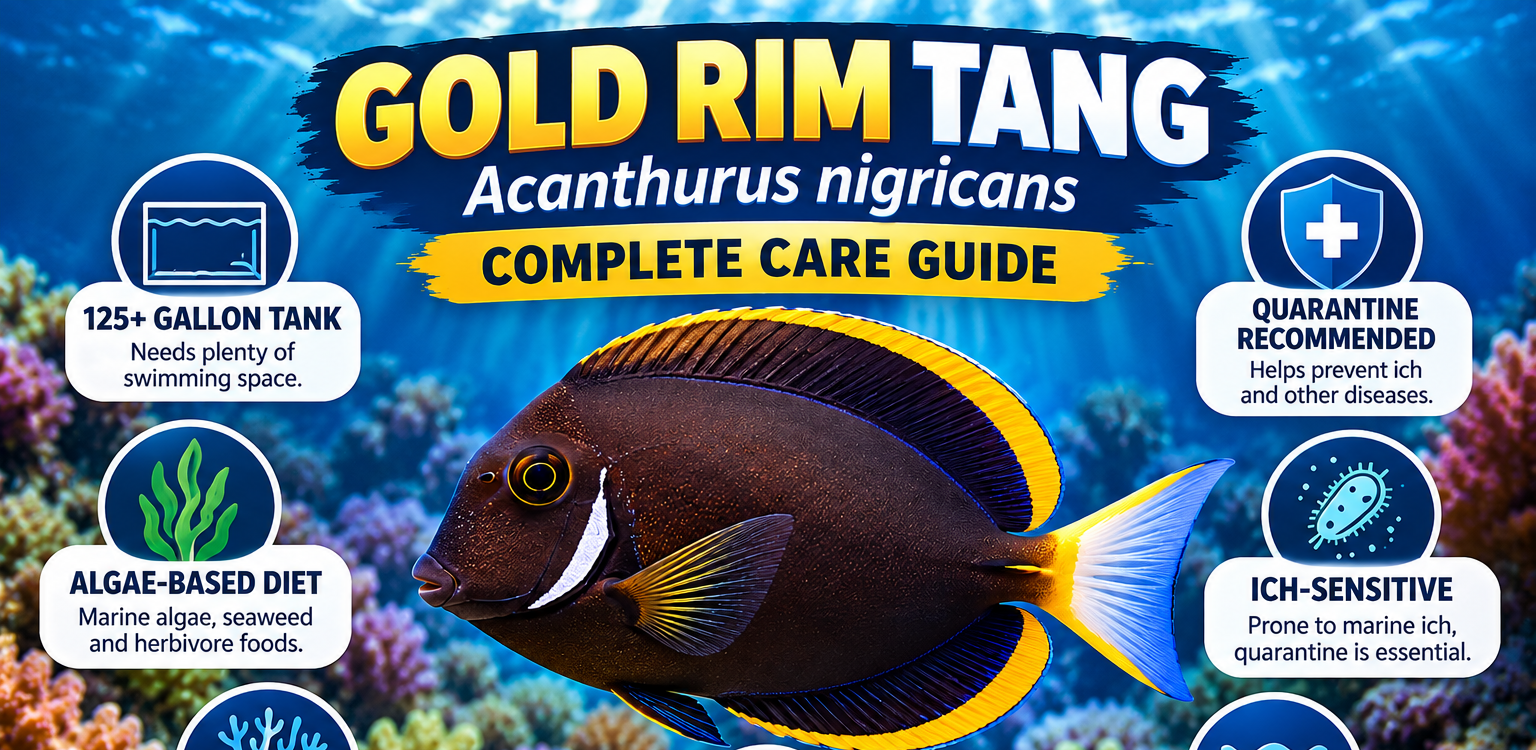

The gold rim tang is one of the most visually distinctive surgeonfish available to marine aquarists. Its dark body, bright gold edging and white facial marking give it a dramatic appearance, but its appeal comes with a responsibility: this is not a fish that should be selected simply because it looks impressive in a dealer’s aquarium.
The scientific name most commonly used for the species is Acanthurus nigricans. In the aquarium trade it may also be sold as a Whitecheek Tang, Gold-Rimmed Surgeonfish, White Cheek Tang, Powder Grey Tang or Velvet Surgeon. One reason buying can become confusing is that common names overlap with closely related Acanthurus species, especially the Powder Brown Tang.
This guide explains gold rim tang care from species identification through tank size, aquascaping, reef compatibility, feeding, quarantine, marine ich, aggression, tank mates, HLLE prevention, price and responsible buying. The focus is practical: what should an aquarist prepare before bringing the fish home, and what conditions give it the best chance of thriving long term?
What Is a Gold Rim Tang?
The gold rim tang belongs to the family Acanthuridae, the surgeonfish family. Members of this group are generally active swimmers with laterally compressed bodies, specialised grazing behaviour and a defensive caudal spine. The spine is the reason surgeonfish are sometimes called tangs or surgeonfish in the aquarium trade.
The species occurs across the Indo-Pacific, with records associated with areas including Hawaii, Indonesia, Fiji and the broader central and western Pacific. In nature it occupies reef environments where algae-covered surfaces provide an important food resource. That ecological background matters in captivity because a gold rim tang should not be treated like a typical carnivorous community fish.
The fish’s body is usually deep brown, chocolate-brown or almost black depending on lighting and individual condition. The dorsal and anal fins are bordered by a strong yellow or gold line. A white cheek patch sits beneath the eye. The tail and fin margins can show blue or yellow accents, making the fish particularly striking under full-spectrum reef lighting.
One of the most useful identification lessons for a new keeper is to avoid choosing a fish solely from a store label. Gold rim, white cheek and powder brown names are sometimes used inconsistently. If the scientific name matters for your stocking plan, verify the species before purchase.
Gold Rim Tang Scientific Name and Taxonomy
The accepted scientific name used for this species is Acanthurus nigricans. Some aquarium retailers and older hobby references may display other names or synonyms. This can create confusion when comparing online listings.
For practical aquarium planning, the most useful habit is to check the scientific name rather than relying only on the common name. The name Acanthurus nigricans provides a much more reliable basis for researching adult size, compatibility, feeding behaviour and disease susceptibility.
This is particularly important because several Acanthurus species have broadly similar body shapes. A fish described casually as a “white face,” “gold rim” or “powder brown” should be checked carefully before purchase.
Gold Rim Tang vs Powder Brown Tang
The gold rim tang vs powder brown tang comparison is one of the most important identification topics for prospective buyers. These fish are often confused because they share a similar oval body profile, similar colour families and overlapping trade names.
| Feature | Gold Rim Tang | Powder Brown Tang |
|---|---|---|
| Scientific name | Acanthurus nigricans | Acanthurus japonicus |
| Body appearance | Dark brown to almost black | Lighter brown with a powder-dusted appearance |
| Cheek marking | Smaller white patch beneath the eye | More extensive white facial marking |
| Gold/yellow trim | Strong gold edging around fins | Yellow and blue facial/body accents vary |
| Care | Intermediate to advanced | Intermediate to advanced |
| Compatibility | Potentially territorial toward similar tangs | Can also be territorial toward tangs |
Hobbyist discussions also show why this identification issue persists: experienced aquarists have repeatedly reported confusion between these two species, especially when store labels use overlapping common names. The safest approach is to confirm the scientific name and inspect the cheek marking rather than relying on a common name alone.

Gold Rim Tang Tank Size and Setup Requirements
Gold rim tang tank size is one of the first questions to answer before buying the fish. Retail recommendations vary, but a conservative adult setup should prioritise horizontal swimming space, established biological filtration and enough rockwork to provide grazing surfaces and shelter.
A practical target is 125 gallons or larger for an adult specimen, especially when the aquarium will contain other surgeonfish. Some retailers list smaller minimums for juveniles, but a juvenile-sized recommendation should not be interpreted as a long-term adult housing plan.
The more important point is that gallons alone do not determine suitability. A tall, narrow aquarium may provide the same nominal volume as a longer aquarium but offer less useful swimming space. Gold rim tangs are active fish, so length and front-to-back swimming room should be considered alongside total volume.
For a large marine installation, also consider the stand, floor support, electrical access, plumbing and equipment clearance before filling the tank. Our 100 Gallon Saltwater Aquarium setup and equipment guide provides a useful reference for the weight, equipment and planning considerations associated with a large marine aquarium.
Recommended Gold Rim Tang Tank Setup
| Element | Planning Target | Why It Matters |
|---|---|---|
| Tank size | 125 gallons or larger for an adult | Provides greater swimming space and territory separation |
| Live rock | Abundant, open aquascape | Creates grazing surfaces, shelter and territorial boundaries |
| Swimming lanes | Open central and front areas | Supports active swimming behaviour |
| Flow | Moderate to strong, variable circulation | Supports oxygenation and natural reef movement |
| Protein skimmer | Appropriately sized with capacity | Supports dissolved-organic waste export |
| Lighting | Marine-capable full-spectrum LED | Supports reef appearance and algae growth on rock |
| Hiding places | Caves and rock crevices | Provides security and reduces stress |
| Temperature | Approximately 72–78°F | Stable tropical marine conditions |
| pH | Approximately 8.1–8.4 | Appropriate marine environment |
| Salinity | Approximately 1.020–1.025 SG | Stable marine osmotic environment |
Live Rock and Aquascaping
Live rock is useful for more than decoration. For a grazing surgeonfish, the rock surface can become part of the daily feeding environment. Algae growth gives the fish opportunities to browse naturally between prepared feedings.
Avoid building a solid wall that removes swimming space. Instead, create a strong structural backdrop with caves, passages and open areas around it. The fish should be able to move rapidly from one side of the aquarium to the other without repeatedly turning around in a confined space.
Rockwork also matters for aggression. Multiple caves and visual barriers can allow fish to establish separate areas instead of forcing every fish to share one exposed territory.
If the aquarium uses a sump, equipment can be moved away from the display and the aquascape can remain cleaner. Our detailed reef aquarium sump design and sizing guide explains sump operating volume, drain-back capacity, equipment chambers and return pump planning.
Is the Gold Rim Tang Reef Safe?
Its reef-safety advantage is particularly useful in mature systems where algae grows on rock and other hard surfaces. A healthy tang can spend much of the day browsing these surfaces, making its natural behaviour compatible with many reef displays.
Reef safe does not mean maintenance free. The aquarium still needs adequate space, flow, filtration, water testing and a carefully planned feeding routine. A fish can be reef compatible while still being unsuitable for a particular aquarium because of size, aggression or disease risk.
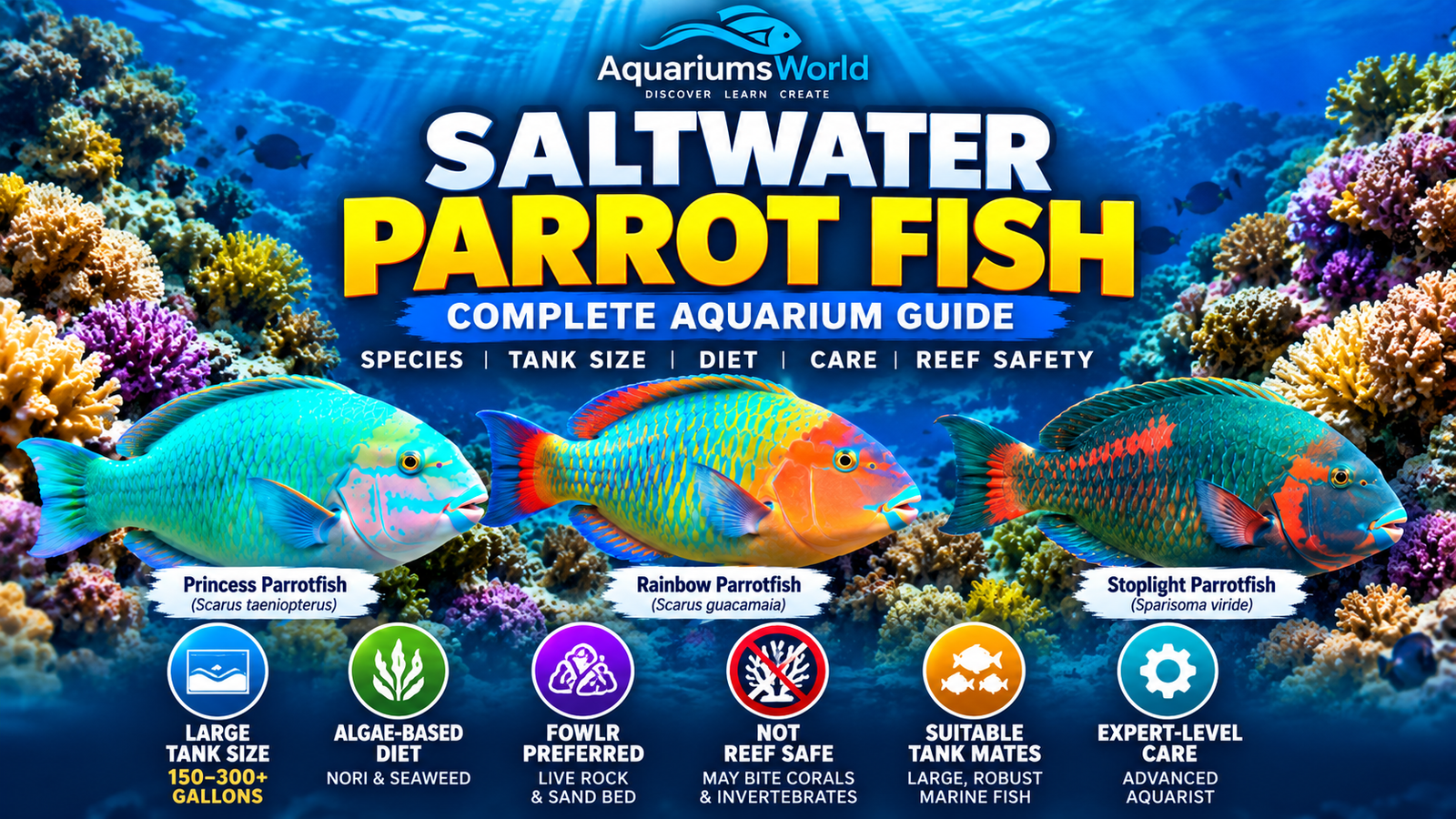
If you are comparing larger marine herbivores, our guide to saltwater parrot fish species, tank size and diet provides a useful comparison point. Marine parrotfish and surgeonfish occupy different ecological niches, so their aquarium requirements should not be treated as interchangeable.
Is the Gold Rim Tang Hard to Keep?
The gold rim tang is best described as an intermediate to advanced marine fish. The difficulty is not caused by one single requirement. Instead, several challenges overlap: parasite susceptibility, feeding consistency, water quality and tang-to-tang aggression.
An experienced aquarist with an established aquarium can manage these issues through preparation. A new hobbyist with a newly cycled aquarium may find the same fish much more demanding because there is less margin for error.
- Marine ich and parasite susceptibility: quarantine and observation are essential.
- Diet: the fish needs regular access to marine algae and seaweed.
- Aggression: compatibility with other tangs must be planned before stocking.
The fish should therefore be considered a planned addition to an established marine ecosystem rather than an impulse purchase.
Why Is the Gold Rim Tang Prone to Ich?
Gold rim tang ich concerns are common among marine aquarists because Acanthurus tangs are widely regarded as fish that require careful disease prevention. Stress, transport, poor water quality and introduction of an infected fish can all contribute to disease problems.
Marine ich, caused by Cryptocaryon irritans, is a parasite rather than a bacterial infection. The visible white spots are only one part of its life cycle, which is why simply waiting for visible spots to disappear does not necessarily mean the parasite has been eliminated from a system.
Community experience also reinforces the need for quarantine with Acanthurus species. Reef hobbyists frequently describe these tangs as challenging around marine ich, while specialist retailers commonly recommend quarantine before display introduction. The practical lesson is simple: prevention is much easier than trying to remove a parasite from a fully stocked reef aquarium.
Gold Rim Tang Quarantine Protocol
A quarantine period of approximately 4–6 weeks provides a useful planning window for observation and disease management. The exact protocol should depend on the fish’s condition, the aquarist’s disease-control system and the medication instructions being followed.
| Step | Action | Planning Point |
|---|---|---|
| 1 | Prepare quarantine tank | Use appropriate filtration, heating, aeration and simple furnishings |
| 2 | Introduce the fish carefully | Minimise handling and transport stress |
| 3 | Observe appetite and behaviour | Monitor breathing, swimming, appetite and visible lesions |
| 4 | Provide algae-rich food | Encourage eating immediately after acclimation |
| 5 | Monitor for parasites | Look for spots, flashing, rapid breathing and abnormal behaviour |
| 6 | Treat if required | Use an evidence-based treatment protocol appropriate to the diagnosis |
| 7 | Complete observation | Do not rush the transfer to the display aquarium |
HLLE and Head and Lateral Line Erosion
Another concern frequently discussed with tangs is Head and Lateral Line Erosion (HLLE). The condition can appear as pitting or erosion around the head and lateral-line region.
HLLE should not be treated as a single-cause disease with one universal cure. Nutrition, water quality, environmental conditions and husbandry all deserve attention. A varied, vitamin-supported diet and stable aquarium conditions are sensible parts of prevention.
Rather than feeding only one commercial product, build a varied marine-herbivore diet. Seaweed sheets, an appropriate herbivore pellet and a nutritionally complete supplemental food can work together more effectively than relying on a single food.
What Do Gold Rim Tangs Eat?
Gold rim tang diet is one of the most important long-term care subjects. In the wild, surgeonfish spend substantial amounts of time browsing and grazing. Captive feeding should therefore provide more than one large meal each day.
A practical approach is to provide a marine herbivore pellet as one component, offer dried seaweed through a veggie clip and rotate suitable supplemental foods. The objective is not simply to make the fish full. The objective is to provide appropriate nutrition while allowing natural grazing behaviour.
AquariumsWorld’s article on parrot fish food and feeding is written primarily around freshwater blood parrot cichlids, so it should not be used as a direct diet plan for a marine tang. However, it is useful as a reminder that “parrot” and “tang” common names can create confusion across aquarium categories.
Gold Rim Tang Daily Feeding Schedule
| Time | Food | Purpose |
|---|---|---|
| Morning | Marine herbivore pellet | Prepared nutritional staple |
| Midday | Green nori / seaweed sheet | Natural grazing behaviour |
| Evening | Vitamin-enriched supplemental marine food | Dietary variety |
| Throughout the day | Seaweed available as appropriate | Allows browsing between meals |
Continuous or repeated access to seaweed is especially useful for active grazing fish. However, avoid allowing uneaten food to decay in the aquarium. Replace seaweed when it becomes fouled, remove leftovers and adjust portions according to consumption.
The 3 Best Amazon Products for Gold Rim Tang Keepers
A gold rim tang does not need a huge collection of specialised foods. A small, carefully selected feeding system is more useful: one algae-rich prepared food, one high-quality seaweed sheet and one suitable supplemental marine food.
Product 1 Hikari Seaweed Extreme Floating Pellets [ BUY NOW ]

Hikari Seaweed Extreme is designed around marine herbivores and is therefore a logical prepared-food option for tang keepers. Floating pellets can encourage active mid-water feeding and make portion control relatively straightforward.
| Feature | Detail |
|---|---|
| Product | Hikari Seaweed Extreme Floating Pellets |
| ASIN | B006JG2SKE |
| Form | Floating seaweed-rich pellets |
| Target use | Marine herbivorous fish including tangs |
| Best role | Prepared daily herbivore food |
The key advantage is convenience without abandoning the herbivorous dietary requirement. Pellets should complement rather than replace fresh or dried marine algae. A tang that receives only pellets may miss the behavioural and nutritional benefits of regular grazing.
Check Price on AmazonProduct 2 — Two Little Fishies SeaVeggies Green Seaweed Sheets [ BUY NOW ]

Dried green seaweed sheets are one of the most practical foods for a grazing tang. A sheet can be attached to a veggie clip so the fish can browse repeatedly rather than consuming its entire meal within seconds.
| Feature | Detail |
|---|---|
| Product | Two Little Fishies Julian Sprung’s SeaVeggies Green Seaweed Sheets |
| ASIN | B0002JEMIU |
| Form | Green nori seaweed sheets |
| Target use | Marine herbivores and grazing fish |
| Best role | Regular grazing food |
Seaweed should be offered in an amount that the fish can consume without creating unnecessary waste. If a sheet is repeatedly ignored, reduce the portion and check whether another health or acclimation problem is affecting appetite.
Check Price on AmazonProduct 3 — Ocean Nutrition Formula Two Flakes [ BUY NOW ]

Ocean Nutrition Formula Two provides another prepared-food option for herbivorous and omnivorous marine fish. Its role in the feeding plan is variety rather than replacing the seaweed component.
| Feature | Detail |
|---|---|
| Product | Ocean Nutrition Formula Two Flakes |
| ASIN | B0002APQKI |
| Form | Marine herbivore flakes |
| Target use | Herbivorous and omnivorous marine fish |
| Best role | Supplemental prepared food |
Rotating prepared foods can help prevent an overly narrow diet. Feed small portions and observe the fish rather than automatically increasing food because the fish appears eager to eat.
Check Price on Amazon
Full Gold Rim Tang Food Comparison
| Product | ASIN | Form | Best Use | Suitability |
|---|---|---|---|---|
| Hikari Seaweed Extreme | B006JG2SKE | Floating pellet | Daily herbivore staple | 10/10 |
| Two Little Fishies SeaVeggies | B0002JEMIU | Seaweed sheet | Grazing access | 10/10 |
| Ocean Nutrition Formula Two | B0002APQKI | Flakes | Supplemental variety | 9/10 |
Is the Gold Rim Tang Aggressive?
Aggression is often less about whether the fish is “aggressive” in isolation and more about territory. A tang entering an established aquarium may perceive existing rock surfaces as feeding and resting territory. Adding another surgeonfish later can therefore trigger chasing and repeated confrontation.
The best approach is to plan the complete tang community before purchasing the first specimen. If multiple surgeonfish are intended, consider differences in body shape, genus, adult size and feeding zones. A larger aquarium also provides more opportunity to create visual breaks and separate territories.
Strategies for Reducing Tang Aggression
- Plan all tang additions before establishing territories.
- Provide abundant rockwork without eliminating swimming lanes.
- Maintain multiple caves and visual barriers.
- Keep algae and seaweed feeding consistent.
- Avoid overcrowding the aquarium.
- Monitor chasing closely after each introduction.
- Use acclimation boxes when appropriate for difficult introductions.
- Avoid combining several closely related Acanthurus species in modest systems.
Gold Rim Tang Compatible Tank Mates
Gold rim tang compatible tank mates should be selected according to adult size, temperament and feeding behaviour. The fish generally works better with peaceful marine community fish than with another similarly shaped territorial surgeonfish.
| Tank Mate Category | Examples | Planning Assessment |
|---|---|---|
| Clownfish | Amphiprion species | Generally compatible |
| Wrasses | Appropriate reef-safe species | Generally compatible in suitable systems |
| Anthias | Peaceful reef species | Potentially excellent with adequate space |
| Gobies and blennies | Peaceful smaller reef fish | Often suitable if feeding needs are met |
| Other tangs | Yellow, Kole, Sailfin and others | Requires careful planning and observation |
| Other Acanthurus | Powder Brown, Achilles and similar species | Higher territorial risk |
| Highly aggressive fish | Aggressive triggers and territorial predators | Potential harassment risk |
For a broader freshwater compatibility comparison, see our Oscar fish tank mates compatibility guide . The species are completely different, but the underlying lesson is useful: compatibility should be evaluated by adult size, temperament, territory and water requirements rather than by appearance alone.
Gold Rim Tang Water Parameters
Stable water quality is a major part of successful gold rim tang care. The fish may tolerate short-term variation during normal aquarium events, but chronic instability, poor oxygenation, accumulated waste and neglected maintenance increase stress and can undermine disease resistance.
| Parameter | Practical Planning Range | Management Priority |
|---|---|---|
| Temperature | 72–78°F | Keep stable and avoid sudden swings |
| pH | 8.1–8.4 | Stability matters more than chasing tiny changes |
| Salinity | 1.020–1.025 SG | Measure consistently using a reliable instrument |
| Ammonia | 0 ppm | Critical |
| Nitrite | 0 ppm | Critical |
| Nitrate | Keep controlled according to system type | Monitor trends rather than one isolated result |
| Alkalinity | Approximately 8–12 dKH | Particularly relevant to reef systems |
Why Water Testing Matters
A marine aquarium can look perfectly clear while ammonia, nitrite, nitrate, alkalinity or phosphate changes. Visual inspection is therefore not a substitute for measurement.
AquariumsWorld’s marine aquarium water test kit guide explains why marine systems require deliberate testing routines and why dedicated tests may be needed for salinity, calcium and magnesium in reef systems.
The broader aquarium water test kit comparison is also useful when choosing between strips and liquid testing methods.
For a gold rim tang, routine testing becomes particularly important after major livestock additions, equipment failures, heavy feeding, disease treatment or unusually large water changes.
Filtration for a Gold Rim Tang Aquarium
Filtration should be selected according to the complete biological load rather than the fish’s nominal tank-size label. A 125-gallon aquarium with one tang and several small fish has different requirements from a heavily stocked reef with multiple large fish.
Mechanical filtration captures suspended waste. Biological filtration supports microbial processing of nitrogenous waste. Protein skimming can help export dissolved organic compounds. Water movement provides oxygenation and keeps waste moving toward filtration equipment.
If using a sump, plan enough freeboard for water that drains back when the return pump stops. Our reef aquarium sump design guide covers operating volume, drain-back capacity, chambers, skimmer placement and return-pump planning in more detail.
Biological-support products can also be useful during new-system establishment. AquariumsWorld’s guide to MICROBE-LIFT Nite-Out II and beneficial aquarium bacteria explains the product’s role in supporting biological filtration and managing ammonia and nitrite during aquarium setup and maintenance.
Gold Rim Tang Flow and Oxygenation
Gold rim tangs are active swimmers and benefit from good circulation and oxygenation. Flow should not be thought of only as a number on a pump box. Aquascape, nozzle direction, wavemaker position and surface agitation all change the actual environment experienced by the fish.
Aim for broad, varied movement rather than one powerful stream directed permanently at the fish. The aquarium should contain areas of stronger circulation and calmer zones where the fish can rest.
Check the fish’s behaviour. A tang constantly fighting a current, repeatedly pacing against the glass or avoiding one area may indicate that flow or aquascape needs adjustment.
Gold Rim Tang Tank Maintenance Schedule
| Frequency | Task | Purpose |
|---|---|---|
| Daily | Observe appetite, breathing, swimming and skin | Early problem detection |
| Daily | Check temperature and equipment operation | Prevent sudden equipment failures |
| Several times weekly | Inspect algae and seaweed consumption | Maintain appropriate grazing nutrition |
| Weekly | Check core water parameters | Identify trends before they become serious |
| Weekly | Clean mechanical filtration | Prevent accumulated waste from degrading water quality |
| Regularly | Clean skimmer and inspect pump | Maintain equipment performance |
| As required | Water change | Manage nutrients and restore water chemistry |
Feeding Consistency and Automatic Feeders
An automatic feeder can help with consistency, but it should not replace the herbivorous feeding routine of a gold rim tang. Dry pellets can often be portioned automatically, while seaweed still needs to be supplied manually.
Our guide to the automatic fish feeder explains programming, portion control and practical aquarium-feeding considerations.
If you also maintain ponds, the automatic fish feeder for ponds guide covers outdoor feeding considerations. It is not a direct gold rim tang feeding guide, but it illustrates why feeder selection should be based on food type, portion size and environmental conditions.
Gold Rim Tang Price and Where to Buy
Gold rim tang price varies considerably according to specimen size, condition, availability, quarantine status, retailer and shipping region. A small fish may cost substantially less than a large, established or pre-quarantined specimen.
Current online listings demonstrate substantial variation. For example, one specialist retailer currently lists Gold Rim Tang specimens around the $200–$280 range, while another current listing shows smaller specimens below $100. These differences illustrate why a single “average price” can be misleading.
When comparing offers, do not evaluate price alone. Ask whether the fish has been quarantined, whether it is actively eating, how long it has been held, what food it accepts and whether the seller provides a live-arrival or health guarantee.
How to Choose a Healthy Gold Rim Tang
- Choose a fish with a strong feeding response.
- Look for normal swimming and active exploration.
- Avoid fish with obvious white spots or persistent flashing.
- Check breathing rate and avoid fish that are constantly gasping.
- Inspect the fins for damage and signs of deterioration.
- Look for a healthy body profile without extreme emaciation.
- Ask the seller how long the fish has been eating prepared food.
- Ask whether the specimen has completed quarantine.
- Confirm the scientific name before purchase.

Gold Rim Tang Handling Safety
Surgeonfish have a sharp caudal spine that can cause injury when the fish is frightened or restrained. Never attempt to grab a tang casually with bare hands. Use appropriate aquarium nets and containers and avoid forcing the fish through tight openings.
Handling should be especially calm during quarantine transfers. Excessive chasing can damage the fish’s skin and increase stress at exactly the time when it needs to settle and begin feeding.
Common Gold Rim Tang Care Mistakes
1. Buying the Fish Before Preparing the Aquarium
A gold rim tang should be the result of aquarium planning, not the reason to start planning. The quarantine tank, display aquarium, food, filtration and water-testing routine should already be ready.
2. Choosing a Tank Based Only on Gallons
Nominal volume does not describe swimming length, width, rockwork or territory. Always evaluate dimensions and aquascaping space.
3. Feeding Only Once a Day
A grazing herbivore benefits from repeated access to appropriate algae-based food. One large feeding does not necessarily reproduce the behavioural pattern of a continuous grazer.
4. Adding Multiple Acanthurus Tangs Without a Plan
Closely related surgeonfish may compete intensely for territory. Compatibility should be planned before the first fish is introduced.
5. Skipping Quarantine
Marine ich can turn a healthy display aquarium into a disease-management project. Quarantine is one of the most important risk-reduction steps available to a marine aquarist.
6. Ignoring Water Testing
Clear water can still contain dangerous chemistry. Test regularly and investigate unusual results rather than guessing.
7. Overstocking Because the Tank Looks Large
A large aquarium gives more flexibility, but it does not eliminate biological limits. Every additional fish increases waste production, feeding demand and compatibility considerations.
Gold Rim Tang vs Other Aquarium Fish: Why Species-Specific Research Matters
AquariumsWorld covers many fish species, but each guide has to be interpreted within the biological requirements of the species involved. An Oscar, for example, has very different freshwater filtration and compatibility requirements from a marine tang.
Our guides to the Copper Oscar fish , Blueberry Oscar fish , Blue Oscar varieties and Fire Red Oscar fish demonstrate how colour, genetics, adult size and diet interact differently in freshwater cichlids.
Similarly, the White Tiger Oscar guide and Bumblebee Oscar guide explore species and colour-form differences that should not be transferred directly to marine fish.
The Oscar 55 gallon filtration guide is another example of species-specific planning. The principle is the same for a gold rim tang: filtration should be designed around the actual animal’s behaviour, adult size and biological load rather than a generic tank-size label.
Responsible Stocking and Rehoming
Responsible aquarium keeping includes planning for the entire life of a fish. A gold rim tang should not be purchased with the assumption that it can simply be returned if the aquarium becomes unsuitable.
For freshwater fish, AquariumsWorld’s responsible Oscar fish rehoming guide explains why rehoming through appropriate aquarium stores, clubs or experienced keepers is preferable to releasing aquarium fish into natural waterways.
The same ethical principle applies to marine fish. Never release an unwanted aquarium fish into the ocean, a local waterway or another natural environment. Contact reputable marine-aquarium stores, clubs or experienced aquarists if a legitimate rehoming situation arises.
Gold Rim Tang and Responsible Aquarium Hobby
Responsible fishkeeping also means considering where animals come from. Captive breeding, collection practices, transport, quarantine and retailer transparency are increasingly important subjects in the aquarium industry.
AquariumsWorld’s October 2026 aquarium industry news covers developments involving marine fish breeding, trade transparency, wildlife rescue and aquarium-fishing regulations.
Buyers can contribute to better aquarium practices by asking questions, choosing reputable sellers, supporting responsible collection and avoiding fish that appear unhealthy simply because they are cheaper.
Frequently Asked Questions About Gold Rim Tang
What is a gold rim tang?
A gold rim tang is the surgeonfish Acanthurus nigricans, an Indo-Pacific marine herbivore commonly recognised by its dark body, gold-yellow fin edging and white cheek patch. It is also called the Whitecheek Tang or Gold-Rimmed Surgeonfish.
Is the gold rim tang reef safe?
Yes. Gold rim tangs are generally considered reef safe and are commonly kept with corals and marine invertebrates. Their natural grazing behaviour can also help control algae on rock and other hard surfaces.
How big does a gold rim tang get?
An adult gold rim tang can reach approximately 8 inches, with some references reporting larger individuals. Aquarium planning should therefore account for adult size rather than the juvenile size seen in a retailer’s tank.
What tank size does a gold rim tang need?
A practical adult target is 125 gallons or larger, with emphasis on horizontal swimming space, established filtration and suitable aquascaping. Larger systems are preferable when keeping multiple tangs.
Is the gold rim tang hard to keep?
It is better suited to intermediate and advanced aquarists. The main challenges are marine ich susceptibility, consistent herbivorous feeding, water-quality stability and potential aggression toward other tangs.
Why is the gold rim tang prone to ich?
Acanthurus tangs are widely regarded as susceptible to marine ich and stress-related disease. Transport, poor water quality, inadequate acclimation and exposure to an infected system can increase risk, making quarantine an important preventive step.
What do gold rim tangs eat?
Gold rim tangs are primarily herbivorous. Their diet should include marine algae, dried seaweed sheets and suitable algae-rich prepared foods, with supplemental marine foods used for variety.
Is the gold rim tang aggressive?
It can be territorial toward other tangs, particularly similarly shaped Acanthurus species. It is generally more peaceful toward unrelated community fish, although every individual fish can behave differently.
How much does a gold rim tang cost?
Price varies according to specimen size, retailer, quarantine status, availability and shipping. Current online listings show that prices can range from under $100 for smaller specimens to several hundred dollars for larger or specialised fish.
What is the difference between a gold rim tang and a powder brown tang?
The species are closely related but are different fish. The gold rim tang is Acanthurus nigricans, while the Powder Brown Tang is Acanthurus japonicus. Common trade names can overlap, so checking the scientific name is the safest identification method.
Related AquariumsWorld Guides
The following AquariumsWorld resources can provide additional context for aquarium planning, feeding, water quality, species identification and responsible fishkeeping. Some cover freshwater species or broader aquarium subjects, so use them as related references rather than direct substitutes for gold rim tang care.
Final Gold Rim Tang Care Checklist
- Choose a correctly identified Acanthurus nigricans.
- Plan for an adult-sized aquarium rather than the juvenile fish you see in stores.
- Prefer a spacious system with strong horizontal swimming room.
- Create open swimming lanes through the aquascape.
- Provide abundant grazing surfaces.
- Maintain stable temperature and salinity.
- Test ammonia and nitrite regularly, especially after system disruptions.
- Use appropriate filtration and oxygenation.
- Provide marine algae and seaweed regularly.
- Use prepared herbivore food as part of a varied diet.
- Quarantine new specimens before display introduction.
- Watch closely for marine ich and abnormal breathing.
- Plan compatibility before adding additional tangs.
- Avoid several closely related Acanthurus species in undersized systems.
- Buy from reputable sellers with healthy, eating specimens.
- Never release unwanted aquarium fish into natural waterways.
Final Verdict: Is the Gold Rim Tang Worth Keeping?
The gold rim tang is an exceptionally attractive marine fish, but its visual appeal should never be separated from its husbandry requirements. Acanthurus nigricans can become a spectacular centrepiece in a mature reef or fish-only marine system when the aquarium provides enough swimming space, stable water quality, suitable flow, abundant grazing opportunities and carefully planned compatibility.
The biggest mistake is to view this fish as simply another colourful tang. It is an active herbivore with a strong grazing instinct and a reputation for sensitivity to stress and marine parasites. Quarantine is therefore not an optional luxury for the serious keeper. It is part of the preparation.
Feeding is equally important. A combination of algae-rich prepared food, regular seaweed and suitable supplemental marine food creates a more complete feeding routine than relying on one product. Observe how much the fish actually eats and adjust portions to avoid unnecessary nutrient accumulation.
Compatibility deserves equal attention. The gold rim tang can be peaceful toward many unrelated fish but may become territorial toward other surgeonfish, particularly similar Acanthurus species. The complete stocking plan should be considered before adding the first tang.
Finally, buy the fish rather than buying the photograph. A healthy, actively feeding and properly quarantined specimen from a responsible seller is a far better investment than a stressed bargain fish. With the right preparation, the gold rim tang can become one of the most visually rewarding inhabitants of a large marine aquarium.