Pigeon Blood Discus | Tank Setup Water Parameters Peppering Breeding
AquariumsWorld • Freshwater Discus Care
Amazon Affiliate Disclosure: AquariumsWorld.com is a participant in the Amazon Services LLC Associates Program. As an Amazon Associate we earn from qualifying purchases at no additional cost to you.
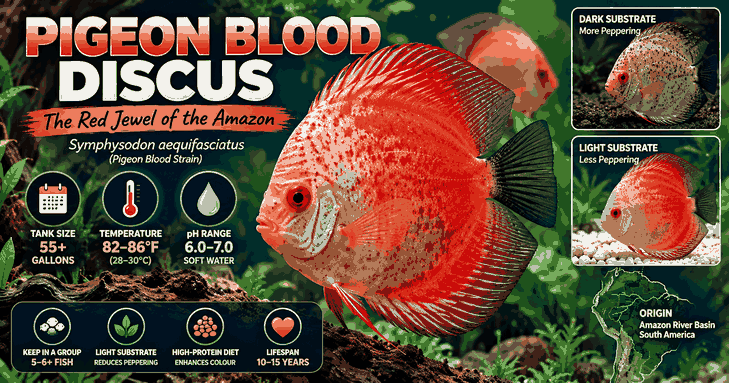
Table of Contents
- What Is a Pigeon Blood Discus?
- History and Origin: Kitti Phanaitthi and 1991
- Appearance and Identification
- Tank Size and Setup
- Water Parameters
- Black Spots and Peppering
- Food and Feeding
- Tank Mates
- Quarantine and Disease Prevention
- Breeding
- Price and Where to Buy
- Pigeon Blood vs Red Turquoise
- Lifespan
- 3 Recommended Amazon Foods
- Frequently Asked Questions
- Scientific References
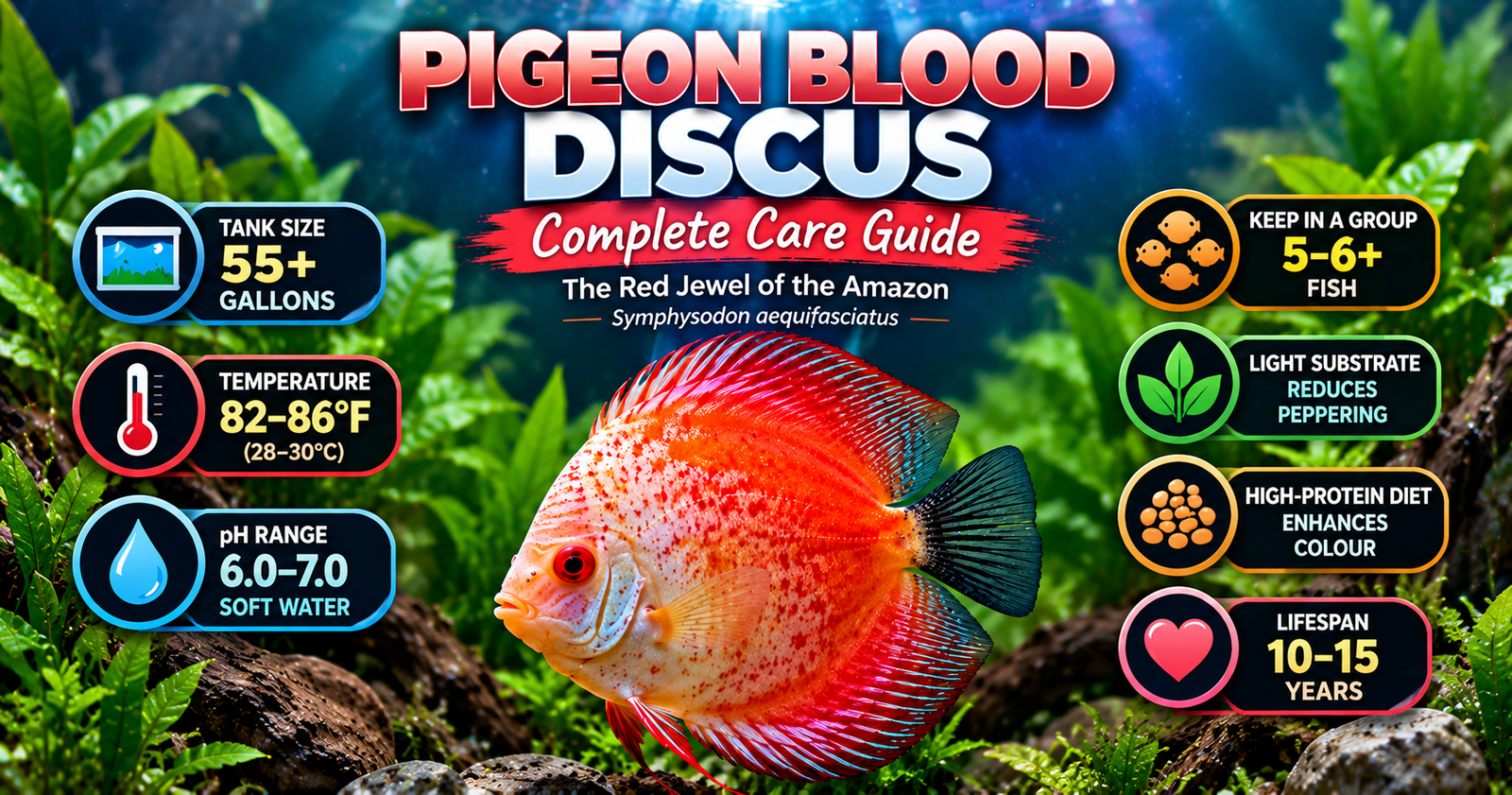
6–8 inAdult planning size
55 gal+Minimum planning point
82–86°FTemperature range
5–6+Social group target
What Is a Pigeon Blood Discus?
A Pigeon Blood Discus is a selectively bred colour strain within the discus group rather than a separate aquarium species. The supplied brief identifies the fish as Symphysodon aequifasciatus, family Cichlidae. Modern discus taxonomy has been debated, so the most useful aquarium description is “pigeon blood strain of Symphysodon” rather than treating the trade name as a formal species.
The defining appearance is a relatively clean yellow-orange to red-orange body, bright red eyes, a dark tail and reduced or absent vertical stress bars. Black peppering can occur across the body and fins, especially in some lines and under certain environmental conditions. That peppering is an important part of the strain’s appearance but should not be confused automatically with a disease.
Species identity and why it matters
Knowing the species background matters because trade names can distract from husbandry. A pigeon blood discus still has the basic needs of discus: warm water, high water quality, social contact, adequate space and a varied diet. Colour names can change from seller to seller, but those biological requirements remain the foundation of care.
The fish is a South American cichlid associated with the Amazon basin through its parent species and lineages. It has a laterally compressed body, a high dorsal profile and a calm appearance that can be misleading when the aquarium is overcrowded or water quality deteriorates.
What makes the strain visually different?
Wild-type discus commonly show vertical body bars. Pigeon blood fish are selected for a different pigmentation pattern in which those bars are greatly reduced, while the body develops a cleaner warm colour. The result is the high-contrast appearance that made the strain so influential in the discus hobby.
History and Origin: Kitti Phanaitthi and the 1991 Pigeon Blood Discus
The supplied research brief places the creation of the pigeon blood discus in Thailand in 1991 and credits breeder Kitti Phanaitthi. It describes the early breeding work as involving Schmidt-Focke lineage discus and crossing fish with turquoise, golden, black-speckled and red characteristics. The resulting offspring were visually unusual because they could show a pale yellow to orange-red base with much less of the traditional vertical barring.
The name is associated in the supplied account with the ruby-red colour of stones from the Mogok or Mokok region of Myanmar. The historical story is useful because it shows that the pigeon blood name was tied to a visual phenotype rather than to a new wild species.
Selective breeding continued after the original introduction. Breeders selected toward cleaner bodies, stronger red-orange colour and different levels of black peppering. Modern trade names such as red melon, marlboro red and red passion are sometimes discussed as descendants or derivatives of pigeon blood lines, although commercial pedigrees are not always documented well enough to treat every seller’s lineage statement as proven.
The broader lesson for a hobbyist is that selective breeding can change colour and pattern without changing the need for species-appropriate care. A spectacularly coloured discus still needs the same attention to warm water, filtration, group dynamics and feeding as other discus strains.
When buying a fish advertised as a historical or “pure” line, ask for pedigree information rather than relying on the name alone. Good breeders should be able to explain parentage, age, feeding history and current water conditions. This is particularly useful when comparing visually similar red discus.
Pigeon Blood Discus Appearance and Identification
A healthy adult pigeon blood discus should have a full, rounded body, intact fins, clear eyes and controlled swimming. Adults are commonly planned around 6–8 inches, although final size depends on genetics, nutrition, water quality and growing conditions.
Bright red eyes are a strong visual feature, but eye colour alone does not authenticate a fish. Body colour can range from creamy yellow and orange to deep red-orange. The tail is frequently dark, while black peppering can vary greatly between individuals.
Peppering is usually integrated into the normal pigmentation pattern. By contrast, a new lesion, ulcer, fuzzy growth, wound or inflamed patch should be investigated separately. If dark marks appear together with rapid breathing, clamped fins, loss of appetite or unusual behaviour, do not assume that the cause is simply the pigeon blood gene.
Before purchase, watch the fish eat if possible. Feeding response is one of the most useful practical indicators of condition. Also examine posture, respiration, fin condition, body symmetry and interactions with other discus. A beautiful fish that is chronically stressed is not a better purchase than a slightly less colourful fish in excellent condition.
Pigeon Blood Discus Tank Size and Setup
The supplied brief gives 55 gallons as a minimum and approximately 75 gallons as a recommended target for six adults. Treat these as practical planning benchmarks rather than a universal biological law. A long, wide aquarium with efficient filtration can be more useful than a tall tank with the same nominal volume.
Why a group matters
Discus are social cichlids. Keeping an appropriate group helps distribute social pressure and allows normal interactions. The brief recommends a minimum of five to six fish. If you intend to keep six adults, plan the aquarium around their adult size rather than the size at purchase.
Recommended setup
| Element | Recommendation | Why it matters |
|---|---|---|
| Tank | 55 gal minimum; 75 gal preferred for six adults | Adult size and social group need space |
| Substrate | Fine white sand or light smooth gravel | Supports a clean visual presentation and peppering management |
| Background | Light blue or white | Can reduce the visual prominence of dark pigmentation |
| Plants | Amazon swords, Java fern and broad-leaf plants | Cover and natural structure |
| Driftwood | Stable branch or root forms | Creates shelter and visual depth |
| Filtration | Canister or sump-based system sized for actual bioload | Discus produce substantial waste |
| Flow | Gentle, broad circulation | Avoids forcing fish to fight a strong jet |
| Heater | Reliable thermostat around the target range | Warm-water stability is essential |
An Amazon-planted setup can look exceptional, but plants should not remove all open swimming space. Arrange wood and plants around the perimeter or in islands, leaving a central area where the group can move together.
For broader filtration architecture, our reef aquarium sump design and setup guide explains chamber planning, equipment placement and return-pump considerations. Although the article focuses on marine systems, the physical design principles are useful when planning a sump for a large freshwater aquarium.
For plant selection ideas, the best aquarium plants for betta tanks guide offers additional discussion of live-plant placement and how vegetation can create cover without overwhelming a fish’s usable swimming area.
Pigeon Blood Discus Water Parameters
Stable water is the core of successful discus keeping. The supplied care brief recommends 82–86°F (28–30°C), pH 6.0–7.0, GH 1–8 dGH and dKH 3–8. Ammonia and nitrite should remain at zero, while nitrate should be kept low.
| Parameter | Planning range | Key point |
|---|---|---|
| Temperature | 82–86°F / 28–30°C | Warm and stable |
| pH | 6.0–7.0 | Acidic to near-neutral |
| GH | 1–8 dGH | Soft water preferred |
| dKH | 3–8 | Keep stable |
| Ammonia | 0 ppm | Undetectable in a mature system |
| Nitrite | 0 ppm | Undetectable |
| Nitrate | Preferably below 10 ppm | Keep accumulation controlled |
| Water changes | 25–50% weekly | Adjust to stocking and test results |
Temperature is one of the most important constraints because 82–86°F is warmer than many ordinary tropical community fish require. The scientific literature confirms that temperature is a major regulator of teleost immune function and that rapid temperature changes can be stressful. For discus, the practical implication is to avoid sudden heater failures, cold water changes and uncontrolled fluctuations.
Do not attempt to “fix” pH with repeated rapid chemical corrections. A stable aquarium is usually easier for fish to tolerate than one that moves sharply between target numbers. If your source water is hard, establish a consistent water-preparation method and use it for every change.
Weekly water changes are a starting point rather than a ceiling. Juveniles fed several times per day can require more intensive maintenance. Test before and after changes and track trends. If nitrate rises rapidly, investigate stocking, feeding and filtration instead of simply increasing chemical additives.
Our marine aquarium water test kits guide explains why clear-looking water can still contain undesirable dissolved parameters. For a freshwater discus keeper, the same principle applies: use suitable tests and record the results rather than judging water quality by appearance.
You can also compare testing approaches in our aquarium water test kit comparison. The goal is not to own every test available; it is to have reliable tests for the parameters that influence your fish.
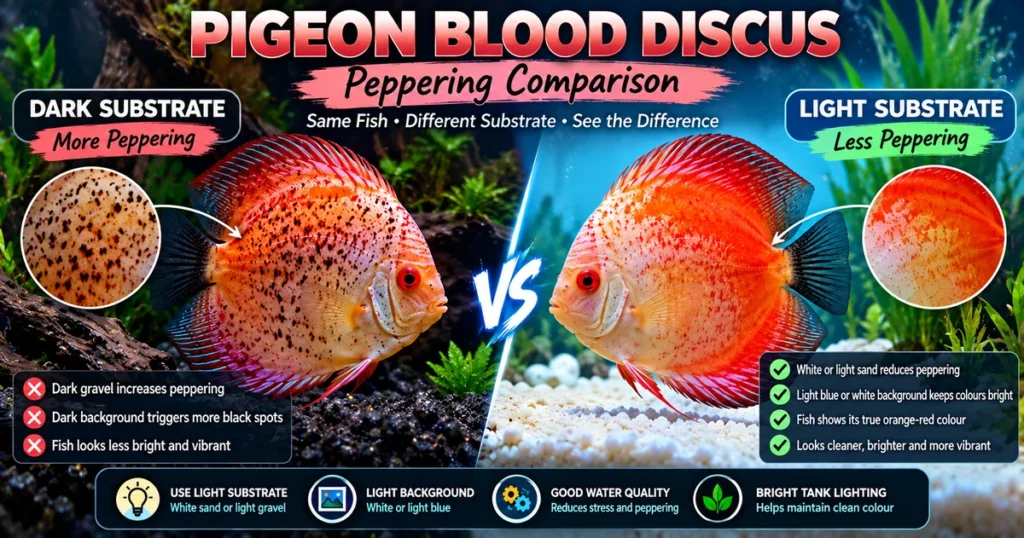
Why Does My Pigeon Blood Discus Have Black Spots? Peppering Explained
Pigeon blood discus peppering refers to black speckling on the body and fins. In this strain, peppering can be part of normal inherited pigmentation and should not automatically be interpreted as a disease. This is one reason the search phrase “pigeon blood discus black spots” needs context.
What makes peppering different from disease?
Genetic peppering generally appears as pigment integrated into the fish’s normal colour pattern. A disease lesion is more likely to be irregular, raised, eroded, inflamed, fuzzy or associated with other symptoms. If a dark mark appears suddenly with appetite loss or abnormal behaviour, investigate the whole fish and water chemistry.
Factors that can make peppering more visible
| Factor | Possible effect | Practical response |
|---|---|---|
| Dark substrate | Can increase visible dark pigmentation | Use light sand or gravel |
| Dark background | Can increase visual contrast of peppering | Use white or light blue |
| Stress | Can alter pigmentation and behaviour | Check crowding, tank mates and water |
| Poor water quality | Creates chronic physiological pressure | Test and correct the underlying issue |
| Breeding activity | Colour can change with behaviour | Observe rather than overreact |
The supplied brief identifies light substrate as the main practical peppering-management strategy. White sand or light gravel combined with a light blue background can make the red-orange base colour appear cleaner. This does not remove genetic pigmentation, and it should not be marketed as a guaranteed cure.
Research on cichlid pigmentation supports the broader idea that background environment can influence stress and colour expression, although evidence from Oscar fish should not be presented as a direct experiment on pigeon blood discus. The safest interpretation is that environment matters, but genetics remains fundamental.
Do not change substrate, background, lighting, water chemistry and diet all at once. Make one or two sensible changes, then observe the fish for several weeks. This produces a clearer picture of what actually helped.
What Is the Best Food for Pigeon Blood Discus?
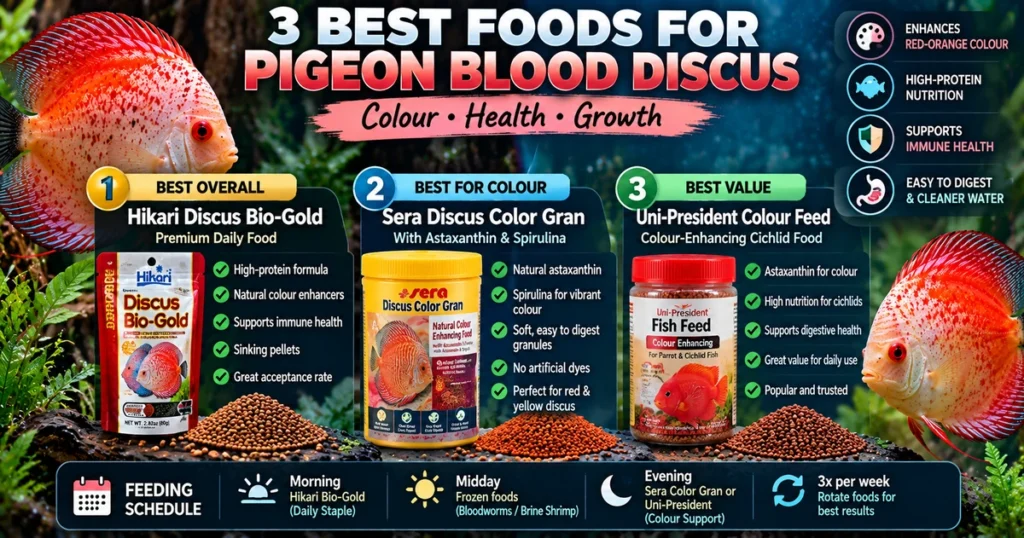
Pigeon blood discus benefit from a varied, protein-rich diet. The supplied brief lists bloodworms, blackworms, brine shrimp and high-protein discus pellets. Adults can be fed approximately two to three times per day, while juveniles may need three to five smaller meals.
Practical feeding schedule
| Time | Food type | Purpose |
|---|---|---|
| Morning | Quality discus pellet | Complete staple nutrition |
| Midday | Thawed frozen bloodworm or brine shrimp | Variety and palatability |
| Evening | Discus colour-support food | Nutrition plus carotenoid support |
| Several times weekly | Blackworms or other suitable high-protein food | Variety |
Feed only what the group can consume promptly. Uneaten food decomposes and contributes to deteriorating water quality. The more often you feed, the more carefully filtration and water changes need to be managed.
Why colour-enhancing foods matter
Fish pigmentation is influenced by different chromatophores and dietary pigments. Peer-reviewed research reviews the molecular and cellular basis of fish colour and the role of dietary carotenoids. This supports using carotenoid-containing foods as part of a colour-supporting diet, but not as a substitute for good genetics or good husbandry.
Astaxanthin can support red and orange pigmentation, yet it cannot turn a non-red strain into a pigeon blood discus. If a fish becomes pale because of stress, illness or poor water quality, fix the cause first. Food is only one part of colour management.
For consistency during holidays, an automatic feeder can be useful for pellet portions, but it should be tested before relying on it. Our automatic fish feeder aquarium guide discusses portion testing and why a feeder should support, not replace, aquarium maintenance. The related automatic pond feeding guide provides broader feeder-planning ideas, although discus require aquarium-specific portion control.
Pigeon Blood Discus Tank Mates
Tank mates must tolerate the same warm water and peaceful social environment. The 82–86°F target immediately removes many common community fish from consideration.
| Tank mate | Why it may work | Caution |
|---|---|---|
| Cardinal tetra | Warm-water schooling fish | Use a substantial school and appropriately sized fish |
| Rummynose tetra | Peaceful schooling behaviour | Choose warm-water-tolerant stock |
| Sterbai Corydoras | More heat-tolerant Corydoras | Maintain excellent bottom-water quality |
| German blue ram | Compatible warm-water profile | Breeding pairs can become territorial |
| Apistogramma | South American dwarf cichlid | Watch territory and feeding competition |
| Other discus | Same broad husbandry needs | Quarantine new fish carefully |
Angelfish require caution because shared geography does not guarantee compatibility. They may compete for food or introduce disease concerns. Goldfish are unsuitable because their temperature requirements are different. Small fish should not be added simply because they are peaceful; they must also tolerate the heat and feeding environment.
Our Oscar fish tank mates guide discusses a similar principle: compatibility depends on adult size, temperament, water conditions and space rather than on whether two fish look peaceful in a shop. The same principle applies to discus.
Colour varieties do not automatically change temperament. Our guides to Copper Oscars, Blueberry Oscars, Blue Oscar varieties, White Tiger Oscars, Bumblebee Oscars and Fire Red Oscars similarly emphasise species-level planning over colour names.
Pigeon Blood Discus Quarantine and Disease Prevention
Quarantine is one of the smartest investments a discus keeper can make. A separate tank allows you to observe feeding, respiration, faeces, body condition and behaviour without risking the established display group.
Discus are often expensive, and adding a single apparently healthy fish can introduce pathogens. Keep new fish separate long enough to observe them properly. Avoid unnecessary medication, but be prepared to treat a confirmed problem with an appropriate product and professional guidance where necessary.
Water quality is part of disease prevention. A biological filter must be established and maintained, while ammonia and nitrite should remain undetectable. The scientific literature on aquarium biofilters demonstrates the importance of nitrifying microbial communities in nitrogen processing.
AquariumsWorld’s MICROBE-LIFT Nite-Out II guide explains how a nitrifying bacterial product can support biological filtration. It should be viewed as one tool in a broader plan rather than a replacement for testing, filtration, water changes and quarantine.
Do not interpret every dark spot as a disease. If the concern is red streaking, sores, ulcers or systemic deterioration, compare symptoms carefully with a dedicated fish-health resource. Our red pest disease guide demonstrates why abnormal colour changes should be assessed alongside behaviour and water quality rather than diagnosed from colour alone.
How to Breed Pigeon Blood Discus
Discus breeding is an advanced project because it combines water quality, pair behaviour, fry care and genetics. The supplied brief describes spawning on vertical slate, a ceramic cone or another smooth surface.
Breeding setup
A separate breeding aquarium with a bare bottom can simplify cleaning. The supplied brief lists 20 gallons as a minimum planning point, though more room can make maintenance easier. Provide a vertical spawning surface, stable warm water and excellent filtration.
The brief gives approximately 82–86°F and pH 5.5–6.5 as a breeding target, with substantial water changes used to maintain quality. These are demanding conditions and should be approached gradually rather than created through sudden chemistry changes.
Spawning behaviour
The pair may repeatedly clean the spawning surface before the female deposits eggs. The male follows to fertilise them. Both parents can fan and guard the eggs. Successful fry then experience one of the most fascinating behaviours associated with discus: early young feed from parental mucus before they are gradually introduced to suitable fry foods.
Fry can later be offered baby brine shrimp nauplii and other appropriately sized foods. Feeding must be frequent enough for growth while keeping the breeding system clean.
Pigeon blood genetics
Breeding two strongly coloured fish does not guarantee identical offspring. Inherited pigmentation traits can recombine, and commercial pedigrees may contain multiple colour genes. Serious breeders should record parentage, phenotype and growth rather than relying on trade names.
Pigeon Blood Discus Price and Where to Buy in the USA
The supplied 2026 price table gives a wide range because size and seller type vary. Examples include approximately $39.99 for smaller fish from Imperial Tropicals, $69.99 from Aquatics Unlimited, $40–$85 from Pet Zone SD, $89.99–$129.99 from LiveAquaria, $109.99 from Absolutely Fish, $63–$193 from Discus.com and $280 for a five-pack from Austin Texas Discus.
These figures are a research snapshot rather than permanent prices. Live inventory, size, lineage, shipping and promotions can change. Always verify the current listing before purchasing.
| Seller in supplied brief | Indicative price | Size or package | Planning note |
|---|---|---|---|
| Imperial Tropicals | $39.99 | 2–3 inch | Direct breeder example |
| Aquatics Unlimited | $69.99 | Standard | Advanced-care listing |
| Pet Zone SD | $40–$85 | Medium–XL | Multiple varieties |
| LiveAquaria | $89.99–$129.99 | S–M | Retail reference |
| Absolutely Fish | $109.99 | Standard | Expert-oriented seller |
| Discus.com | $63–$193 | Multiple sizes | Multiple colour lines |
| Austin Texas Discus | $280 | Five fish | Group/pre-breeding package |
When buying online, ask for recent video of the exact fish, current feeding behaviour, water temperature, quarantine history and live-arrival policy. A healthy fish that feeds well is usually a better investment than a cheaper fish chosen only for colour intensity.
Our October 2026 aquarium industry news page can also be useful for readers who want broader context on current aquarium trends and products. If you are moving from a smaller fish to a large cichlid system, our Oscar 55-gallon tank and filtration guide provides another example of why adult size should drive equipment planning.
Pigeon Blood Discus vs Red Turquoise Discus
Pigeon blood and red turquoise are both familiar discus colour strains, but they create different visual effects. Pigeon blood is associated with a cleaner yellow-orange to red-orange base, bright eyes, reduced vertical bars and possible black peppering. Red turquoise typically shows more turquoise patterning and contrasting body markings.
| Feature | Pigeon Blood | Red Turquoise |
|---|---|---|
| Base appearance | Yellow-orange to red-orange | Red with turquoise patterning |
| Vertical bars | Reduced or absent | Pattern can be more visible |
| Eyes | Often bright red | Varies by line |
| Peppering | Can be prominent in some lines | Different pattern expression |
| Care | Discus-level care | Discus-level care |
The important point is that both are still discus. Do not choose one because you assume its colour makes it easier to keep. Water quality, temperature, group size and nutrition remain the major husbandry variables.
How Long Do Pigeon Blood Discus Live?
The supplied brief gives a potential lifespan of approximately 10–15 years with proper care. Actual lifespan varies with genetics, nutrition, disease exposure, water quality and long-term maintenance.
Longevity is strongly influenced by avoiding repeated stress. Stable warm water, good filtration, consistent water changes, a suitable group and a varied diet all matter. A fish that survives in poor conditions is not necessarily a fish that is thriving.
Fish-welfare literature supports the broader principle that captive environments should allow species-appropriate behaviour and provide suitable husbandry and social conditions. For discus, that means enough space, stable water and appropriate social interaction rather than simply keeping the fish alive.
Pigeon Blood Discus Tank Size Calculator
Use the calculator below as a planning tool before purchasing. It asks for the number of adult discus, expected adult size and whether the aquarium will be planted or bare bottom. The calculation starts from the supplied 55-gallon minimum planning point and increases the recommended volume when group size or adult size increases.
The calculator also provides a filtration planning rating, an estimated weekly water-change volume and a feeding-frequency starting point. These are not manufacturer specifications or biological guarantees. They are practical planning outputs designed to help a buyer think about adult capacity before purchasing juveniles.
Frequently Asked Questions
What is a pigeon blood discus?
A pigeon blood discus is a selectively bred colour strain of discus associated with a clean yellow-orange to red-orange body, bright eyes, reduced vertical bars and possible black peppering. The trade name describes a strain or phenotype rather than a separate species.
How did the pigeon blood discus get its name?
The supplied historical account links the name to the blood-red colour of rubies associated with Myanmar’s Mogok or Mokok region. The strain was introduced in Thailand in 1991 and became famous for its unusual red-orange appearance.
What tank size do pigeon blood discus need?
The supplied brief uses 55 gallons as a minimum planning point and 75 gallons as a preferred target for a group of six adults. Larger systems provide more flexibility, especially when additional tank mates or heavy planting are planned.
What are the water parameters for pigeon blood discus?
The supplied planning range is 82–86°F, pH 6.0–7.0, GH 1–8 dGH and dKH 3–8. Ammonia and nitrite should be zero, nitrate should remain low and 25–50 percent weekly water changes are the basic maintenance starting point.
Why does my pigeon blood discus have black spots?
Black speckling can be normal genetic peppering in pigeon blood discus. Dark backgrounds, dark substrate and stress can make pigmentation more visible. New lesions, ulcers or marks accompanied by illness should be investigated separately.
What is the best food for pigeon blood discus?
A varied diet built around a quality discus staple, suitable frozen foods and optional carotenoid-rich colour-support foods is a strong approach. Feed juveniles more frequently than adults and remove uneaten food promptly.
What are the best tank mates for pigeon blood discus?
Potential companions include cardinal tetras, warm-tolerant rummynose tetras, Sterbai Corydoras, selected dwarf cichlids and other discus. Every tank mate must tolerate the warm discus temperature and the same water-quality standards.
How do you breed pigeon blood discus?
Pairs can spawn on vertical slate or a ceramic cone. Both parents guard and fan the eggs, and young discus can initially feed from parental mucus. Breeding requires excellent water quality, careful observation and appropriate fry nutrition.
How much does a pigeon blood discus cost?
The supplied 2026 USA examples range from around $39.99 for small fish to more than $190 for larger or premium specimens, with group packages reaching about $280. Prices change with size, lineage, availability and seller.
What is the difference between pigeon blood and red turquoise discus?
Pigeon blood is associated with a cleaner red-orange body and reduced vertical bars, while red turquoise typically retains stronger turquoise patterning. Both remain discus and require essentially the same core husbandry approach.
One final planning principle is easy to overlook: the aquarium should be designed around maintenance as well as display. Leave enough room to siphon the substrate, clean mechanical media, inspect heaters and reach the back of the tank without dismantling the aquascape. Discus produce regular waste and receive frequent meals, so accessibility directly affects whether routine maintenance remains consistent. A beautiful aquarium that is difficult to service can become harder to maintain over time. Build the system so testing, feeding, cleaning and water changes are simple and consistent enough to become habits.
Conclusion
The Pigeon Blood Discus is a remarkable example of selective breeding reshaping the appearance of a freshwater fish while retaining the demanding husbandry requirements of discus. Its orange-red body, bright eyes, reduced bars and possible peppering make it immediately recognisable, but successful care depends on far more than colour.
Plan around adult size rather than juvenile size. Use the supplied 55-gallon minimum only as a starting point and consider 75 gallons or more for a group of six adults. Maintain 82–86°F water consistently, keep ammonia and nitrite at zero, control nitrate, perform regular water changes and provide a varied high-quality diet.
For peppering, use light substrate and a light background if a cleaner appearance is important, while remembering that genetics remain fundamental. For colour, use carotenoid-supporting foods as part of a complete diet rather than treating them as a cosmetic cure.
Most importantly, buy healthy fish from a seller who can explain feeding, quarantine and water history. A well-kept group of pigeon blood discus can become one of the most impressive freshwater displays in the hobby because the fish are not merely colourful; they are active, social and biologically fascinating.
The 3 Best Amazon Foods for Pigeon Blood Discus
The supplied product brief identifies three Amazon options for this colour strain. Product prices, ratings, rankings and availability can change, so check the live listing before purchasing. These are editorial recommendations based on the supplied brief, not independent laboratory tests.
1. Hikari Tropical Discus Bio-Gold Fish Food — 2.82 oz [ BUY NOW ]

| ASIN | B00025JZBS |
|---|---|
| Format | Sinking discus food |
| Supplied rating | 4.5 stars |
| Suitability | 10/10 |
| Best use | Primary staple food |
Hikari Discus Bio-Gold is the most directly species-focused option in the supplied list. A sinking discus formula is convenient for fish that feed through the middle and lower water column. For pigeon blood discus, it can provide a consistent staple while other foods add variety. The most important test is whether your own fish accept the food and whether it can be fed without creating excess waste.
Who should buy it: Keepers looking for a dedicated discus staple.Check Price on Amazon
2. Sera Discus Color Gran — Premium Colour Food [ BUY NOW ]

| ASIN | B0010RN3OW |
|---|---|
| Format | Soft granules |
| Key colour ingredients | Natural astaxanthin and spirulina according to the supplied brief |
| Suitability | 10/10 |
| Best use | Colour-supporting rotation food |
Sera Discus Color Gran is positioned in the supplied brief as the premium colour-supporting option for red and yellow discus. That makes it especially relevant to pigeon blood keepers who want to support red-orange pigmentation through dietary carotenoids. Use it as part of a varied feeding programme rather than as the only food.
Who should buy it: Keepers focused on colour support while maintaining a varied diet.Check Price on Amazon
3. Uni-President Fish Colour Enhancing Red Parrot and Cichlid Fish Feed — 388 g [ BUY NOW ]

| ASIN | B0169E5TR4 |
|---|---|
| Format | Cichlid colour-enhancing food |
| Key ingredient | Astaxanthin according to the supplied brief |
| Suitability | 9/10 |
| Best use | Budget rotation option |
This product is marketed for red parrot and cichlid fish rather than specifically for discus. The supplied brief includes it because discus are cichlids and because the formula is positioned around colour support. It should therefore be treated as a rotation food, not automatically as a superior replacement for a dedicated discus formula.
Who should buy it: Budget-conscious keepers wanting an additional colour-supporting cichlid food.Check Price on Amazon
| Product | ASIN | Suitability | Primary purpose |
|---|---|---|---|
| Hikari Discus Bio-Gold | B00025JZBS | 10/10 | Dedicated discus staple |
| Sera Discus Color Gran | B0010RN3OW | 10/10 | Colour-supporting rotation |
| Uni-President Cichlid Colour | B0169E5TR4 | 9/10 | Budget cichlid rotation |
More AquariumsWorld Guides
Continue your aquarium research with these related AquariumsWorld guides. They cover filtration, plants, fish compatibility, feeding, water testing, disease prevention, marine systems and aquarium equipment.
Reef aquarium sump design and setup guideBest plants for betta fish tanks guideRose Bubble Anemone complete care guideCopper Oscar Fish care guideBlueberry Oscar Fish truth and care guideBlue Oscar varieties, care and geneticsOscar Fish 55 gallon tank and filtration guideWhite Tiger Oscar Fish care guideBumblebee Oscar Fish guideMarine aquarium water test kits guideFire Red Oscar Fish guideOscar Fish rehoming guideAquarium water test kit comparisonOscar Fish plush guideParrot fish food safety guideTiger Parrot Fish varieties guideAutomatic fish feeder aquarium guideAutomatic pond feeder guideAquarium industry news October 2026MICROBE-LIFT Nite-Out II guideSaltwater parrot fish guideParrot fish food guide for cichlids100 gallon saltwater aquarium setup guideRed pest disease in goldfish guideMICROBE-LIFT Nite-Out II — repeat referenceAquarium Industry News — repeat referenceAutomatic Pond Feeder — repeat referenceAutomatic Aquarium Feeder — repeat reference
Scientific References
- Farias, I.P. and Hrbek, T. (2008). Patterns of diversification in the discus fishes (Symphysodon spp., Cichlidae) of the Amazon basin. Molecular Phylogenetics and Evolution. This work provides peer-reviewed context for the evolutionary diversity and taxonomy of discus fishes.
- Luo, M., Lu, G., Yin, H., Wang, L., Atuganile, M. and Dong, Z. (2021). Fish pigmentation and coloration: Molecular mechanisms and aquaculture perspectives. Reviews in Aquaculture, 13(4), 2395–2440. DOI: 10.1111/raq.12583.
- Dopeikar, H., Khoshkholgh, M., Ghasemi, S.A. and Morshedi, V. (2024). Effects of background color on growth, stress, biochemical, hematological, and immunological responses, and expression of growth-related genes in Oscar fish. Aquaculture Research, 2024, 6957201. DOI: 10.1155/2024/6957201. This is cichlid evidence used cautiously as supporting context, not as direct pigeon blood discus evidence.
- Bagchi, S., Vlaeminck, S.E., Sauder, L.A., Mosquera, M., Neufeld, J.D. and Boon, N. (2014). Temporal and spatial stability of ammonia-oxidizing archaea and bacteria in aquarium biofilters. PLoS ONE, 9(12), e113515. DOI: 10.1371/journal.pone.0113515.
- Scharsack, J.P. and Franke, F. (2022). Temperature effects on teleost immunity in the light of climate change. Journal of Fish Biology, 101(4), 780–796. DOI: 10.1111/jfb.15163.
- Smith, S.A. (2023). Fish welfare in public aquariums and zoological collections. Animals, 13(16), 2548. DOI: 10.3390/ani13162548.
- Taborsky, B. and Oliveira, R.F. (2012). Social competence: an evolutionary approach. Trends in Ecology & Evolution, 27, 679–688. DOI: 10.1016/j.tree.2012.09.003. Used for the broader principle that social environment can influence fish behaviour; it is not presented as a direct experiment on pigeon blood discus.
- Scott, A. and Stampar, S.N. (2019). Mutualistic relationships between anemonefish and their host anemones. Journal of the Marine Biological Association of the United Kingdom. Included in AquariumsWorld’s wider marine research library; it is not a primary source for pigeon blood discus care.
Reference note: The article uses the supplied research brief as the primary content basis and uses peer-reviewed literature to support broader biological principles. Historical strain claims, retail prices, product ratings and trade-line descriptions should be treated as hobby-trade information and verified against current seller or manufacturer information before publication updates.