Marine fish buying guide · USA · October 2026
Queen Angelfish for Sale: Price, Care, Tank Size, Diet and Trusted USA Retailers
Looking for queen angelfish for sale? The queen angelfish (Holacanthus ciliaris) is a spectacular western Atlantic marine fish with an iridescent blue-green body, bright yellow fins and a distinctive blue-ringed crown marking. It can approach 18 inches, becomes territorial as it matures and needs a large, established saltwater aquarium. This guide helps you compare US listings, understand juvenile and adult coloration, assess seller quality, prepare a tank and build an appropriate feeding plan before you order.
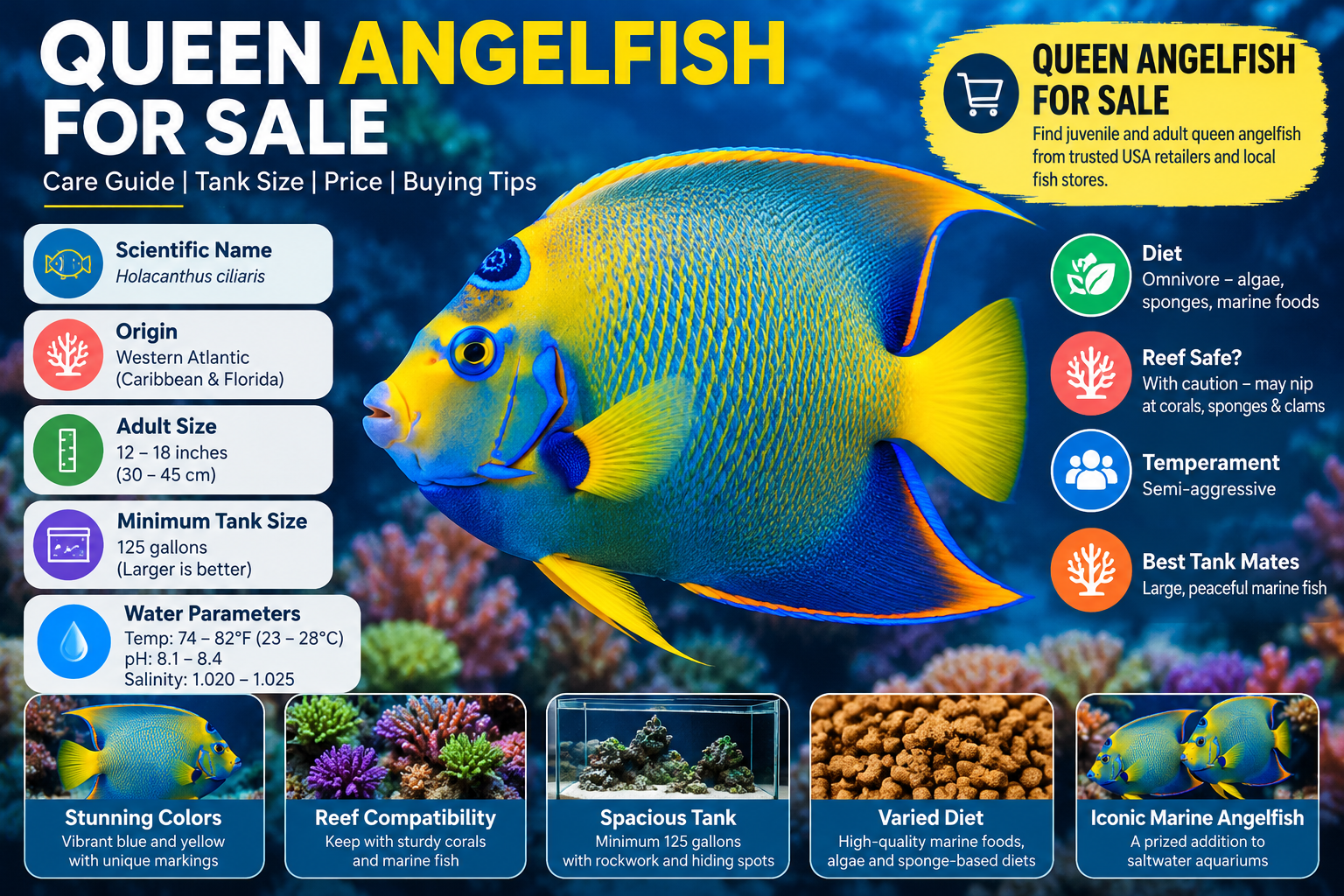
Affiliate disclosure: AquariumsWorld may earn a commission from qualifying purchases through affiliate links, at no additional cost to you. Prices, stock and shipping policies change; verify current details with sellers before ordering.
Queen Angelfish for Sale: Quick Answer
Specialist marine retailers sell queen angelfish in different size classes, but availability changes frequently. The supplied SERP research recorded examples from approximately $149 to $465 for many listings and sizes; extra-large or show-size specimens may cost more. One retailer page checked during preparation displayed a juvenile at about $149.98, while other retailers list larger fish for several hundred dollars. These are price snapshots, not a guaranteed market-wide range.
The most important decision is not the price alone. Queen angelfish can grow to about 18 inches, are semi-aggressive and are not reliably reef safe. They need stable marine water chemistry, a varied diet that includes sponge-containing angelfish food, mature biological filtration and a keeper prepared for a long-term commitment. If adult housing depends on a future upgrade that is uncertain, postpone the purchase.
Where to Buy a Queen Angelfish in the USA
Begin with specialist marine retailers that identify the scientific name, show the size being sold, disclose shipping terms and publish a clear livestock guarantee. Search phrases such as queen angelfish for sale online USA, queen angelfish juvenile for sale, adult queen angelfish for sale and Holacanthus ciliaris for sale can uncover listings, but search rank is not proof of livestock quality. Ask for information about the individual fish rather than relying on a generic stock photograph.
Retailers found during research include KP Aquatics, Dr. Reef’s Quarantined Fish, Top Shelf Aquatics, FreshMarine, LiveAquaria, Blue Zoo Aquatics and STL Marine Solutions. Their stock changes. Some offer several size classes; others may mark the species sold out or temporarily unavailable. Check the live product page immediately before purchase, and do not rely on old screenshots, snippets or copied prices.
FreshMarine’s product page displayed a juvenile queen angel at about $149.98 when checked. LiveAquaria showed a listing around $397.99, while Blue Zoo Aquatics listed several size tiers, from around $199.99 for a medium fish to higher amounts for larger specimens. These examples demonstrate why there is no single fixed queen angelfish price. Size, condition, shipping, quarantine, source and seller policy all influence the final cost.
Dr. Reef’s quarantined livestock model may appeal to buyers who want more information about pre-sale conditioning. Quarantine can be valuable, but the label itself is not proof that a fish is disease-proof. Ask how long the fish was observed, which treatments were used if any, whether it is eating prepared foods and what the guarantee covers. Request a written explanation instead of assuming all retailers use the same process.
Retailer comparison: what to verify
| Retailer/source | Research snapshot | What to confirm |
|---|---|---|
| KP Aquatics | Brief reported size-dependent listings around $149–$329. | Current sizes, availability, shipping date and live-arrival terms. |
| Dr. Reef’s Quarantined Fish | Brief reported a juvenile around $299.99 and an adult around $399.99. | Quarantine details, feeding response and guarantee exclusions. |
| Top Shelf Aquatics | Brief reported listings around $239.99–$464.99 across sizes. | Exact size, actual-specimen photo and current stock. |
| FreshMarine | Page checked showed a juvenile around $149.98. | Current price, shipping and adult tank recommendation. |
| LiveAquaria | Page checked displayed a listing around $397.99. | Availability, size options and livestock guarantee. |
| Blue Zoo Aquatics | Multiple size tiers with different prices. | Exact size, source, delivered price and policy. |
| STL Marine Solutions | Listing offered several sizes; one example was around $200. | Which size the displayed price applies to. |
These prices are snapshots from the supplied research and pages checked during preparation, not guarantees. Confirm all live prices, stock and terms directly with the seller.
Queen Angelfish Price: Juvenile vs Adult
The keyword queen angelfish price covers very different purchases. A small juvenile often costs less than a large adult, but the lowest listing is not automatically the best value. A specimen that has been eating consistently, has good body condition and has been carefully conditioned may justify a premium. A high price, however, does not automatically prove health or responsible handling.
Juvenile queen angelfish price
Research examples placed many juvenile listings around $149–$300 depending on size and retailer. Juveniles have a dark blue body with curved pale-blue bars and yellow markings. Some adapt to captive foods more readily than larger adults, but individual results vary. Ask the seller for a recent feeding report and confirm that the fish accepts an appropriate variety, not merely one favourite food.
Do not buy a juvenile for a small aquarium because it is small today. Growth is part of the commitment. The system must support the fish throughout its life, or an upgrade must already be realistic, budgeted and feasible. Large marine fish can be difficult to rehome when they outgrow a tank or become territorial. A plan that depends on finding a buyer later is not a reliable housing strategy.
Adult queen angelfish price
Adult and larger transitional specimens commonly cost more, with researched examples around $200–$465 for many sizes and higher prices possible for extra-large or show-size fish. Adults display mature blue-green and yellow coloration immediately, but may take longer to accept prepared foods if their previous diet was narrow. Ask whether the fish is eating sponge-containing angelfish formula, marine algae and appropriate meaty foods.
Why quarantine can affect the price
Pre-sale observation, quarantine space, labour and conditioning have costs. Compare what the seller actually provides: observation period, feeding confirmation, health disclosure, parasite management, arrival guarantee, claim deadline and after-sale support. A more expensive fish is not automatically safer, but a seller that communicates clearly and documents its process may offer meaningful value.
Calculate delivered cost before choosing. Include the fish, overnight shipping, insulated packaging, weather delays, acclimation supplies, quarantine equipment and possible treatment costs. A listing advertised for $180 may cost substantially more after delivery. Do not skip quarantine or compromise on the aquarium because the animal consumed the budget.
How to Choose a Reliable Seller
Use the checklist below before paying. A responsible seller should answer questions about care and compatibility without pressuring you into an immediate decision. A photograph cannot prove that a fish is eating, parasite-free or appropriate for your aquarium. If details are missing, ask for clarification or wait for another specimen.
- Confirm the scientific name is Holacanthus ciliaris.
- Ask for the fish’s approximate length and whether the image shows the actual specimen.
- Request a recent photo or video showing normal swimming and breathing.
- Ask which foods the fish has accepted over the last several days.
- Ask about quarantine duration and procedures, not just whether it is “quarantined.”
- Read the live-arrival guarantee, reporting window, evidence requirements and exclusions.
- Confirm carrier, delivery window, shipping day and weather-delay policy.
- Check that the seller provides a contact route for post-delivery livestock questions.
- Have a cycled display and quarantine aquarium ready before ordering.
- Check applicable state and local rules for marine livestock.
Ask the seller to disclose any visible lesions, frayed fins, sunken belly, cloudy eyes, heavy breathing or unusual behaviour. A clear, honest answer is more useful than a promise that every fish is perfect. If the seller cannot explain feeding history or guarantee terms, the safest decision is to wait.
Juvenile, Transitional and Adult Coloration
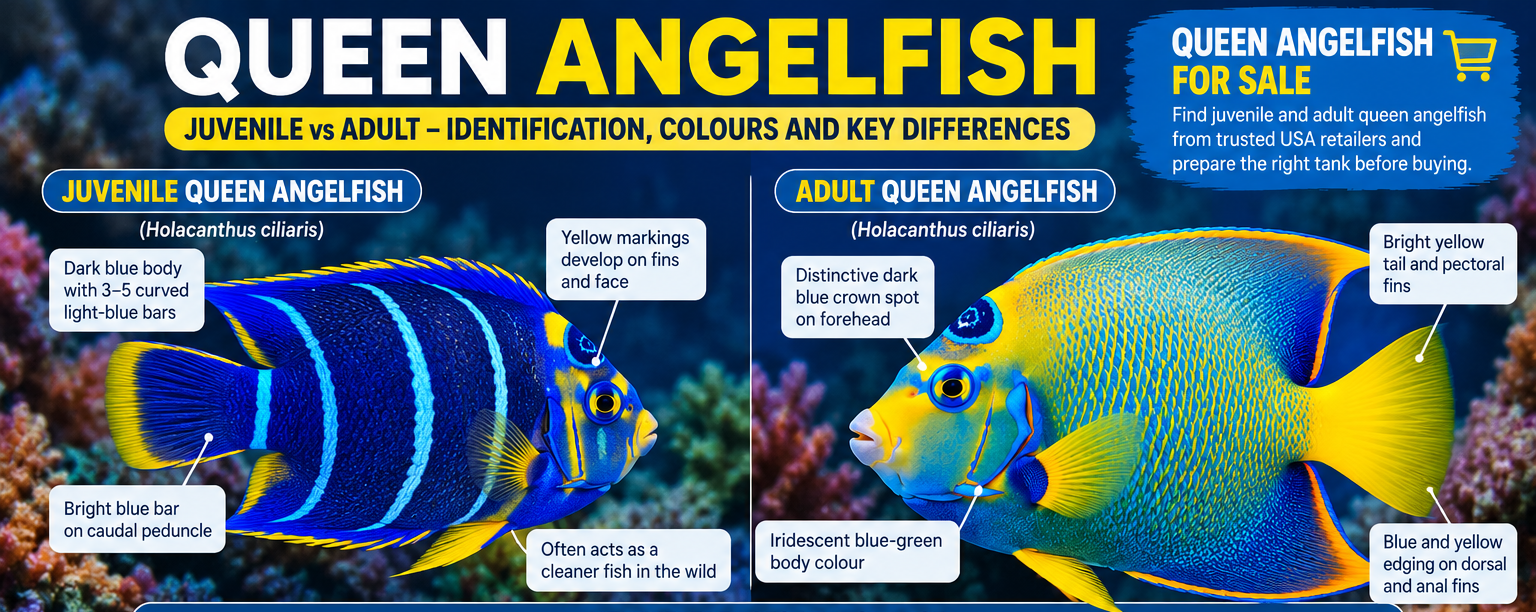
Queen angelfish have a dramatic change in appearance as they mature. Juveniles usually show a dark blue body with curved pale-blue or bluish-white vertical bars and yellow markings. Adults develop a more continuous iridescent blue-green body, bright yellow tail and yellow fin accents. The characteristic adult crown mark is a dark spot on the forehead surrounded by a bright blue ring. Buyers should not mistake juvenile bars for damage or assume that a young fish is a different species.
Juvenile coloration
The barred pattern is associated with the juvenile stage. Juvenile queen angelfish can act as cleaner fish in the wild, removing parasites from larger reef fish at cleaning stations. Exact bar count and contrast vary with individual development, so use the whole pattern, body shape and seller’s identification rather than one mark alone.
Transitional coloration
As the fish grows, juvenile bars fade and adult colour becomes more prominent. Transitional fish can show both patterns. The change is gradual and does not occur at one exact size in every specimen. Retailers may label fish juvenile, sub-adult, medium or transitional without using standardized measurements. Ask for the actual length and a current photograph before comparing prices.
Adult coloration and the crown spot
Adults have the blue-green and yellow pattern that makes the species famous. Lighting, stress, viewing angle and camera settings influence how vivid the colours look in a photograph. Colour alone cannot establish health: a bright fish may still be underweight or refusing food. Look at body condition, fins, breathing and feeding response as well as colour.
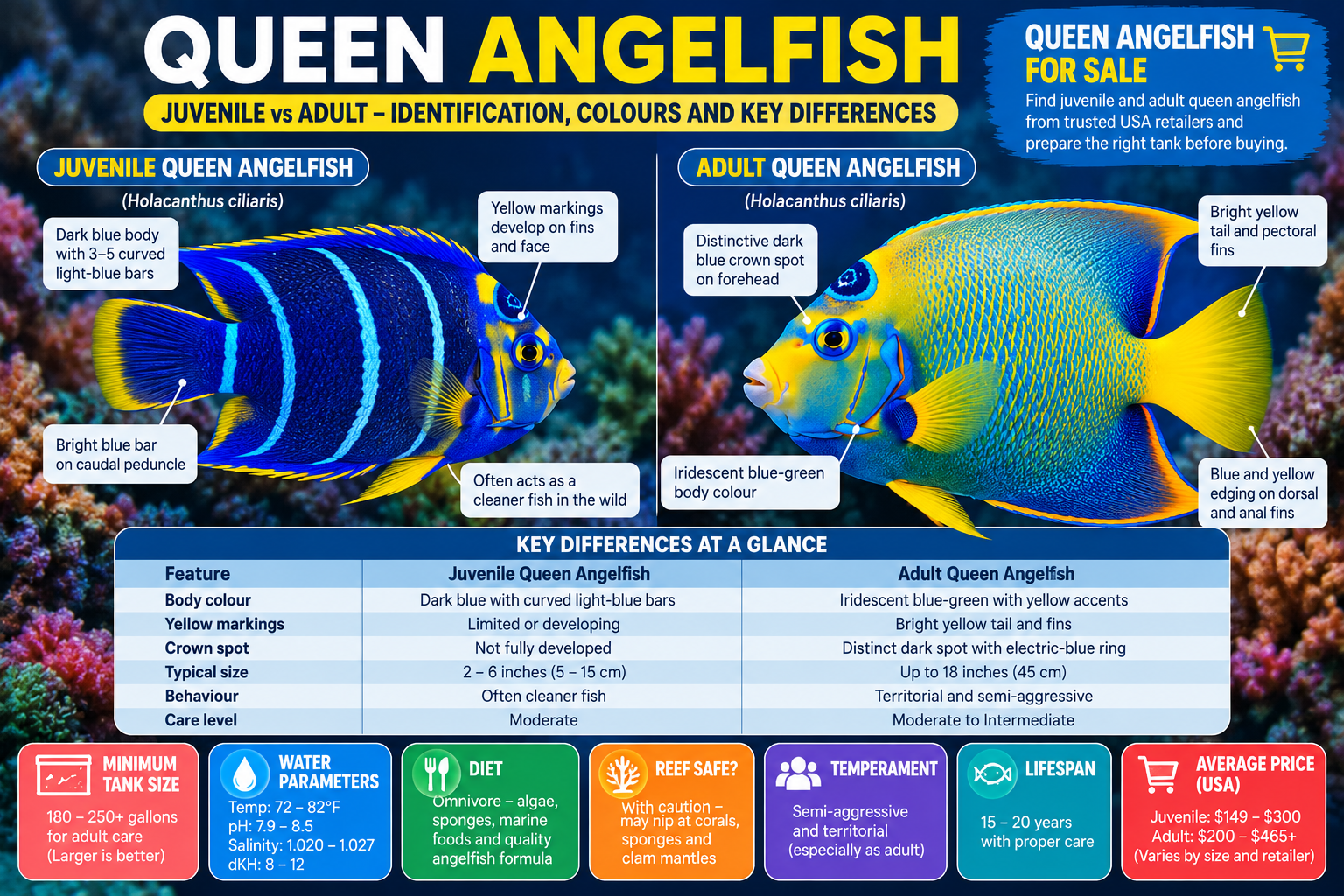
| Feature | Juvenile | Transitional | Adult |
|---|---|---|---|
| Body pattern | Curved pale-blue bars | Bars fade | Mostly continuous blue-green pattern |
| Yellow markings | Limited or developing | Become more extensive | Bright yellow tail and fin accents |
| Crown spot | Not fully developed | May be emerging | Distinctive dark mark with blue ring |
| Buyer priority | Feeding and future housing | Confirm size and identity | Condition, feeding and shipping tolerance |
Species Facts and Natural Range
The accepted scientific name is Holacanthus ciliaris, in the marine angelfish family Pomacanthidae. The species occurs in the western Atlantic, including the Caribbean and waters extending from Florida toward Brazil. It lives around coral reefs and rocky reef habitat, where it feeds on sponges and other available material. Its ecology helps explain why captive care cannot be reduced to generic flakes and decorative rock.
Wild habitat provides extensive grazing surfaces, shelter and room to move. A home aquarium should reproduce these functions rather than merely imitate the colours of a reef. Live rock offers grazing surfaces and shelter while contributing to biological filtration. Open swimming space lets the fish move without repeatedly turning in a narrow footprint. Stable salinity, oxygenation and waste export are equally important.
Queen angelfish can become territorial as they mature. Their size and feeding behaviour make them unsuitable for many community aquariums. They may bully smaller or similarly shaped fish and nip at corals or other sessile invertebrates. A species-specific plan is more important than trying to fit a fish into an existing setup simply because it is available for sale.
Tank Size and Aquarium Setup
Tank size is one of the most important decisions in a queen angelfish purchase. Retailer recommendations differ, with some listing smaller minimums and others recommending 200–250 gallons. Because adults can approach 18 inches and need room to swim, graze and establish territory, a conservative long-term plan is roughly 200–250 gallons or more, with dimensions that provide meaningful length and width. Volume alone is not enough: a tall, narrow aquarium may provide less useful swimming space than a broad tank of the same capacity.
A small juvenile may temporarily fit in a smaller system, but buying it should not be permission to delay an upgrade indefinitely. The final aquarium must be realistic, affordable and available before the fish outgrows its current home. If you cannot provide suitable adult housing, wait until you can.
FOWLR is usually the practical choice
A fish-only-with-live-rock aquarium is generally a better fit than a coral reef because queen angelfish may nip at soft and stony coral polyps, clam mantles and other sessile invertebrates. Live rock provides shelter and grazing surfaces while the system focuses on fish welfare rather than protecting expensive coral colonies from unpredictable feeding behaviour.
Filtration and oxygenation
Queen angelfish are large, active fish with a substantial waste load. Use mature biological filtration, effective mechanical filtration, good gas exchange and a protein skimmer suited to the real bioload. An oversized skimmer can provide headroom, but its advertised rating does not replace testing and maintenance. Avoid stagnant areas where detritus collects, and arrange flow so that the fish can rest without constantly fighting a direct current.
Rockwork and swimming space
Secure rockwork creates retreats and breaks lines of sight, which can reduce conflict. Build it so that rocks cannot topple if a large fish brushes against them. Leave a clear swimming route and avoid filling every inch with décor. Multiple shelters can help when tank mates are present, but caves cannot compensate for an undersized aquarium.
| Component | Planning guidance | Purpose |
|---|---|---|
| Tank volume | Plan around 200–250+ gallons for adult care | Space for growth and swimming |
| System maturity | Established, cycled and biologically stable | Stable filtration matters more than calendar age alone |
| Live rock | Abundant, secure and arranged safely | Grazing, shelter and biological filtration |
| Skimmer | Appropriately sized for the actual bioload | Organic waste export and gas exchange |
| Water movement | Strong, distributed flow with calmer zones | Oxygenation and fewer detritus pockets |
| Quarantine | Separate, cycled and ready before arrival | Observation and disease-risk management |
| Food | Several suitable foods stocked in advance | Avoids arrival before the feeding plan is ready |
Queen Angelfish Tank Readiness Calculator
This screening tool is a planning aid, not a guarantee of suitability. It checks conservative adult capacity, system maturity, filtration, reef risk and recent test results. If it returns “not ready,” address the listed gaps before ordering.
3. San Francisco Bay Brand Freeze-Dried Mysis Shrimp
Mysis can add a meaty food option. Rehydrate freeze-dried food as directed and offer modest portions. Watch the fish so food does not rift into rockwork and decay. Mysis is a supplement, not a substitute for sponge-based nutrition and marine algae.
Seaweed sheets, suitable pellets and mysis can contribute variety. Include a quality sponge-containing angelfish formula for a more complete diet.
| Food type | Role | Limitation |
|---|---|---|
| Seaweed sheets | Marine algae and grazing | Not complete alone. |
| Seaweed-rich pellets | Convenient prepared food | Confirm acceptance; use with other foods. |
| Mysis shrimp | Meaty food variety | Does not replace sponge-based nutrition. |
| Sponge-containing angelfish formula | Important dietary component | Confirm the fish eats it and follow directions. |
Sample daily feeding schedule
| Time | Example offer | Observe |
|---|---|---|
| Morning | Small amount of seaweed plus suitable prepared food | Does the fish graze normally? |
| Midday | Small portion of pellet or sponge-containing formula | Does it swallow or repeatedly spit food out? |
| Evening | Small portion of mysis or another appropriate marine food | Is appetite consistent and is food left uneaten? |
| Several times weekly | Offer varied sponge-containing and enriched foods per label | Keep variety without overfeeding. |
Automatic feeders may help dispense suitable dry food while you are away, but they cannot reliably deliver every frozen or sponge-based food, inspect the fish or remove uneaten food. Our automatic aquarium feeder guide and automatic pond feeding guide cover general equipment considerations. A feeder is an aid, not a substitute for daily welfare checks.
Quarantine, Acclimation and Shipping
Shipping a marine fish creates stress from handling, temperature shifts, low oxygen and waste accumulation. Schedule delivery when you can receive the package promptly. Avoid ordering during severe weather if the seller cannot provide a safe shipping window. Prepare a cycled quarantine aquarium with a secure cover, filtration, stable salinity, temperature control, shelter and reliable test equipment before the fish leaves the retailer.
Before shipping
Ask the seller for its acclimation method and the shipping-water salinity if available. Have replacement saltwater prepared, check equipment, and ensure that quarantine is biologically stable. Do not wait until delivery day to discover that the heater, pump or test kit is missing. A plan written in advance helps avoid hurried decisions while the fish is still in its shipping bag.
On arrival
Inspect the package for damage and the fish for obvious distress before opening it. Follow the seller’s instructions and avoid leaving the fish in shipping water longer than necessary. Temperature equalization and salinity acclimation depend on the difference between shipping and quarantine water; one method is not right for every shipment. Never pour shipping water into the display aquarium.
Use dedicated equipment for quarantine and record the arrival date, behaviour, appetite and any treatment. If the fish arrives dead or severely compromised, follow the seller’s claim procedure exactly, including required photographs and contact deadlines. Keep order details and packaging until the guarantee period ends.
Quarantine before display introduction
Quarantine allows observation and disease-risk management without exposing established livestock. It is not merely a few days in a spare tank. The appropriate duration and any treatment protocol depend on the fish, source, symptoms and professional advice. Avoid combining medications casually or using a product unless it is appropriate and used according to its label. Before transfer, confirm the fish is eating, systems have compatible parameters and the display has enough space for the new arrival.
Health, HLLE and Prevention
Head and lateral line erosion (HLLE) is associated with pitting or erosion around the head and lateral line in some marine fish, including large angelfish. Its causes can be multifactorial; it is inaccurate to promise that one food, filter medium or supplement will definitely prevent or cure it. Diet quality, water conditions, equipment and other environmental factors all deserve review when lesions appear.
Warning signs
Watch for pits or erosion around the head, changes along the lateral line, reduced appetite, weight loss, unusual swimming, heavy breathing or secondary infection. Photograph changes and note when they began. Do not wait until lesions are severe before testing water and reviewing diet. If signs progress, consult an aquatic veterinarian or experienced marine fish health professional.
Prevention-focused husbandry
- Offer a varied diet that includes sponge-containing angelfish food and marine algae.
- Maintain stable temperature, salinity, alkalinity and pH.
- Keep ammonia and nitrite undetectable and manage nitrate appropriately.
- Use filtration and circulation suited to the real bioload.
- Inspect equipment and wiring regularly and investigate electrical concerns safely.
- Avoid unnecessary medication, sudden parameter changes and unverified cures.
- Record appetite, body condition and visible changes.
Activated carbon is sometimes discussed in hobbyist conversations about HLLE, but the evidence and circumstances are complex. Do not make drastic filtration changes based on one online claim. Review diet, source water, maintenance, equipment and carbon use with a qualified professional. The same careful approach applies to other fish health problems; our goldfish disease troubleshooting guide discusses observation and diagnosis, although goldfish-specific treatment advice should not be transferred directly to marine angelfish.
Best Tank Mates for Queen Angelfish
Queen angelfish are semi-aggressive and may become territorial. Choose tank mates according to adult size, temperament, diet, swimming zone, water requirements and the dimensions of the aquarium. A label saying “compatible” does not guarantee that a combination will work in every setup. A pairing that succeeds in a very large aquarium may fail in a smaller system or one with limited shelter.
Potential companions should be robust marine fish that tolerate similar water conditions and are not easily intimidated or outcompeted for food. Avoid highly aggressive species, delicate feeders that cannot compete, and animals with incompatible environmental needs. Introduce livestock thoughtfully and have a practical plan for separating fish if aggression develops.
Reduce conflict
Secure rockwork and sight breaks can help, but cannot make an overcrowded aquarium safe. Watch for persistent chasing, fin damage, hiding, rapid breathing or one fish being prevented from feeding. Separate animals if aggression becomes sustained. Do not add multiple fish at once just to dilute aggression; sudden additions can overload filtration and make illness harder to identify. Quarantine new livestock separately and plan stocking order carefully.
For general compatibility principles, our guides to copper Oscar tank mates, large-fish filtration and tiger parrot fish tank needs explain why adult size and behaviour matter. These freshwater species are not recommended queen angelfish companions; the links illustrate general planning principles only.
Queen Angelfish vs Blue Angelfish
The queen angelfish is often confused with the Bermuda blue angelfish (Holacanthus bermudensis). Both are large western Atlantic marine angelfishes with blue and yellow tones. Natural hybridization can occur where their ranges overlap, making identification more nuanced than a simple colour chart. If identity matters for a high-priced purchase, request the scientific name and ask the seller to explain the identifying features.
| Feature | Queen angelfish | Bermuda blue angelfish |
|---|---|---|
| Scientific name | Holacanthus ciliaris | Holacanthus bermudensis |
| Adult crown mark | Usually a conspicuous dark spot with blue ring | May be less conspicuous or differently expressed |
| Juvenile pattern | Curved pale-blue bars can be useful | Bars may appear straighter; variation exists |
| Range | Western Atlantic and Caribbean | Associated especially with Bermuda and nearby waters |
| Buying advice | Confirm identity and source | Do not rely on common name alone |
Photographs can be affected by lighting, angle and editing. Request a side profile and a clear view of the forehead. A seller should not guarantee identity from a heavily filtered image alone. Use a reputable source when identification affects the purchase decision.
Adult Size and Lifespan
Queen angelfish can reach about 18 inches (45 cm). Many aquarium specimens remain smaller, but buyers should plan around adult size rather than assuming their individual will stay small. Growth depends on age, nutrition, health and environment. A juvenile may look comfortable in a modest aquarium today and still outgrow it in time.
A lifespan of 15–20 years is a reasonable planning assumption often cited for well-kept individuals, though actual lifespan varies. This is a substantial commitment involving tank space, maintenance, feeding and future care. Calculate total ownership costs before ordering: aquarium and stand, salt mix, test kits, skimmer, pumps, heating or cooling, quarantine equipment, food, electricity and replacement parts. The fish itself may be only a portion of the lifetime expense.
If the setup is not affordable now, delaying the purchase is better for the animal and the keeper. Responsible planning includes considering what will happen if you move, travel, lose access to the aquarium room or cannot maintain the system. Have a credible contingency plan before bringing home a large, long-lived fish.
Queen Angelfish Maintenance Checklist
Daily
- Observe breathing, swimming, body condition and tank-mate interactions.
- Confirm that the fish eats the foods offered, including sponge-containing formula.
- Remove uneaten food and check seaweed clips and feeding tools.
- Check temperature and equipment operation.
- Inspect for new spots, lesions, fin damage or unusual hiding.
Weekly
- Test key parameters, especially after stocking or system changes.
- Perform a partial water change based on nutrient trends and stability.
- Clean mechanical filtration as needed without disrupting biological media unnecessarily.
- Check skimmer performance, pump intakes, flow and oxygenation.
- Record appetite, behaviour, maintenance and treatments.
Monthly and periodically
- Inspect pumps, heaters, wiring, tubing and backup equipment.
- Verify testing instruments and replace expired reagents.
- Review stocking and aggression as the fish grows.
- Confirm that the aquarium still offers adequate swimming space and shelter.
- Check food freshness and storage.
Consistency is more valuable than dramatic intervention. Investigate the cause of water chemistry changes before adding corrective chemicals. If a fish develops symptoms, avoid diagnosing from one photograph or administering multiple medications without a plan. A maintenance record helps a professional assess what has changed.
Common Buying Mistakes to Avoid
Choosing the lowest price without checking the specimen
Compare price with size, condition, quarantine, feeding response and delivery terms. A cheap fish that arrives compromised can create financial loss and welfare problems. A more expensive fish is not automatically better, so ask specific questions and compare evidence.
Buying before the aquarium is ready
Do not order first and cycle the tank afterward. Queen angelfish need stable water and a prepared quarantine plan. If ammonia or nitrite is detectable, the system is not ready for a new large fish. Wait until testing confirms stability.
Assuming every food is complete
Generic marine pellets and frozen foods can be useful, but queen angelfish need a thoughtful variety that includes sponge-based nutrition. Read ingredient labels and observe actual feeding. Do not rely on seaweed alone or assume that eating one food proves the diet is complete.
Ignoring reef risk
“With caution” is not a guarantee. If coral loss would be unacceptable, choose a different fish or a FOWLR setup. Do not expect an individual queen angelfish to behave like a reliably reef-safe species forever.
Ignoring guarantee details
Live-arrival policies may require immediate inspection, photographs and contact within a short window. Understand the process before shipping day and keep order details until the guarantee period ends.
Failing to plan for adult size
A juvenile is not a temporary ornament. It is a growing animal that may remain with you for many years. Confirm that the final aquarium, filtration and ongoing costs are realistic. If rehoming might become necessary, plan responsibly before buying, not after the fish outgrows the system.
Frequently Asked Questions
Where can I buy a queen angelfish?
Look for specialist US marine retailers that identify Holacanthus ciliaris, show the size and publish clear livestock policies. Research examples include KP Aquatics, Dr. Reef’s Quarantined Fish, FreshMarine, LiveAquaria, Blue Zoo Aquatics, Top Shelf Aquatics and STL Marine Solutions. Verify current stock directly.
How much does a queen angelfish cost?
Research snapshots showed many listings around $149–$465, with higher prices possible for larger specimens. Juveniles may cost less than adults, while quarantine and conditioning can affect price. Include shipping and setup costs in your budget.
Is the queen angelfish reef safe?
It is not reliably reef safe. Queen angelfish may nip at corals, clam mantles and other sessile invertebrates. A fish-only-with-live-rock aquarium is usually the safer choice.
What tank size does a queen angelfish need?
Recommendations vary, but an adult can approach 18 inches. A conservative long-term plan is around 200–250 gallons or more, with suitable dimensions, filtration and open swimming space. Plan for adult housing before buying a juvenile.
What does a queen angelfish eat?
Offer a varied marine diet including sponge-containing angelfish formula, marine algae or seaweed and appropriate meaty foods such as mysis. Observe what the fish eats and remove leftovers. Generic flakes or a single food should not be the whole diet.
How do juveniles and adults look different?
Juveniles have a dark blue body with curved pale-blue bars and yellow markings. Adults develop a blue-green body, bright yellow tail and a distinctive dark forehead spot surrounded by blue. Transitional fish can show both patterns.
How big does a queen angelfish get?
The species can reach about 18 inches (45 cm). Growth varies with age, nutrition and environment, so plan around adult size rather than the listing photo.
How long does a queen angelfish live?
Fifteen to twenty years is a reasonable planning assumption often cited for well-kept fish, though lifespan varies. This long commitment requires reliable equipment, suitable housing and consistent care.
Is a queen angelfish hard to keep?
It is best suited to experienced marine aquarists. Its size, territorial behaviour, specialized diet and sensitivity to poor husbandry make it more demanding than many beginner fish.
What is the difference between a queen angelfish and a blue angelfish?
The queen is Holacanthus ciliaris; the Bermuda blue angelfish is Holacanthus bermudensis. Their patterns can overlap, and natural hybrids are known. Confirm the scientific name with the seller.
Should I buy a juvenile or adult?
A healthy feeding juvenile may adapt to prepared foods more readily in some cases, while an adult offers mature coloration immediately. Neither size guarantees success. Prioritize feeding, body condition, reliable sourcing and a suitable tank.
Do I need a quarantine tank?
A separate quarantine system is strongly recommended for observation and disease-risk management. It should be ready before the fish arrives. Use an appropriate protocol and avoid unplanned medication combinations.
Can I keep two queen angelfish together?
Do not assume a pair will coexist peacefully. The result depends on tank size, temperament, size differences and introduction strategy. For many home aquarists, one queen angelfish is the simpler choice.
What if the fish stops eating?
Check water quality, temperature, breathing, aggression and other symptoms. Review food freshness and recent stress. Persistent refusal, weight loss or visible lesions warrant advice from an experienced marine fish health professional or aquatic veterinarian.
Final Buying Advice
The queen angelfish is an exceptional marine fish, but it should be purchased as a long-term husbandry commitment rather than an impulse buy. Research snapshots showed prices from about $149 for some juvenile offerings to several hundred dollars for larger or conditioned specimens. That investment makes sense only when the fish is correctly identified, feeding well, shipped under clear terms and destined for a suitable mature aquarium.
Before ordering, verify the live price and availability, ask about the individual fish’s feeding history, read the guarantee and prepare a separate quarantine system. Plan for an adult approaching 18 inches, a large FOWLR aquarium, stable marine water chemistry, suitable filtration and a varied diet that includes sponge-containing angelfish food. If your aquarium is a coral reef, the risk of nipping is significant enough that another species may be a better choice.
When the right fish meets the right setup, the queen angelfish can become a remarkable centrepiece for many years. The best purchase protects animal welfare as carefully as it protects your investment.
References and Further Reading
These sources support species identification, retailer examples and general husbandry context. Retail prices and availability are dynamic. Commercial product pages can confirm listing details but should not be treated as independent scientific evidence.
- Froese, R. and Pauly, D. (eds.). FishBase: Holacanthus ciliaris. Species summary.
- FreshMarine. Queen Angel, Holacanthus ciliaris. Retail listing and care information.
- LiveAquaria. Queen Angelfish. Retail listing, size options and care notes.
- Blue Zoo Aquatics. Queen Angelfish, Holacanthus ciliaris. Retail listing.
- STL Marine Solutions. Queen Angel Adult. Retail listing and care notes.
- Fast Aquatics. Queen Angelfish care guide. Species guide.
- Two Little Fishies. SeaVeggies Green Seaweed Sheets. Product listing.
- Hikari. Seaweed Extreme Floating Pellets. Product listing.
- San Francisco Bay Brand. Freeze-Dried Mysis Shrimp. Product listing.
More AquariumsWorld Guides
Explore related content on water quality, feeding, equipment, fish health and responsible aquarium planning:
- Pigeon Blood Discus: Parameters and Breeding
- Best Plants for Betta Tanks
- Rose Bubble Anemone Care
- Copper Oscar Fish Guide
- Blueberry Oscar Fish and Colour
- Blue Oscar Varieties
- Oscar Filtration
- White Tiger Oscar Fish
- Bumblebee Oscar Fish
- Marine Water Test Kits
- Fire Red Oscar Fish
- Rehoming an Oscar Fish
- Aquarium Test Kits Compared
- Oscar Fish Plush
- Parrot Fish Safety
- Tiger Parrot Fish
- Automatic Aquarium Feeder
- Automatic Pond Feeder
- Aquarium Industry News
- MICROBE-LIFT Nite-Out II
- Saltwater Parrot Fish
- Parrot Cichlid Food
- MICROBE-LIFT Nite-Out II guide
- Marine Hobby News
- Pond Feeding Solutions
- Automatic Aquarium Feeding
- 100-Gallon Saltwater Aquarium Setup
- Goldfish Disease Troubleshooting
Browse the AquariumsWorld blog archive for more aquarium guides.