Red Turquoise Discus Fish: Complete Care, History, Tank Size, Breeding and Buying Guide
Primary keyword: red turquoise discus fish | Audience: United States freshwater aquarium keepers | Updated: October 2026

Introduction: Red Turquoise Discus Fish at a Glance
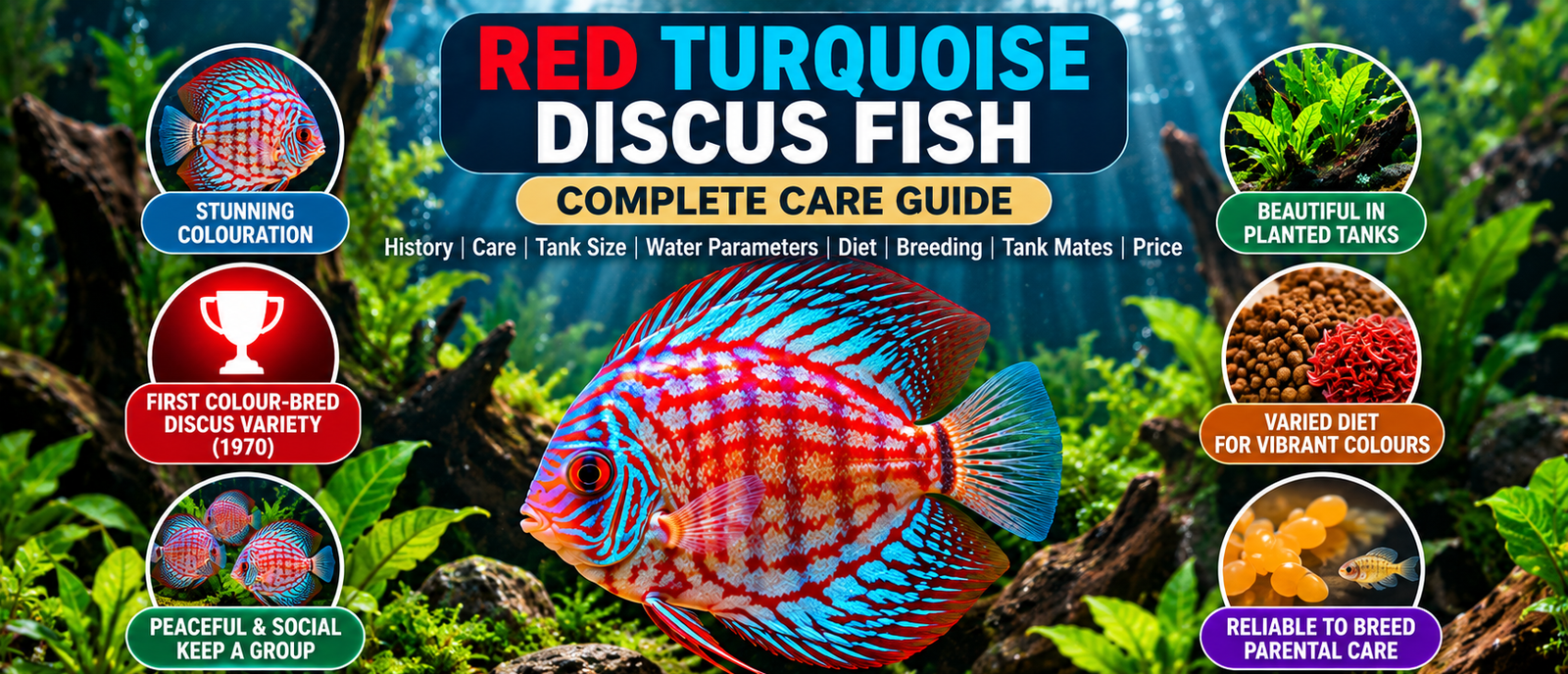
The red turquoise discus fish is a selectively bred discus colour variety known for turquoise-blue striations across a red, orange-red or blue-green body. Its distinctive pattern, rounded shape and calm movement have made it a familiar choice among experienced freshwater aquarists. The strain also has an important place in the history of ornamental discus breeding, especially through early European and American breeding lines.
Discus are not a casual impulse purchase. They need warm, stable water, strong biological filtration, consistent maintenance and a feeding plan that supplies complete nutrition without polluting the aquarium. They are social fish, so plan for a suitable group and an adult-sized tank rather than buying one fish for a small community aquarium. A common maintenance temperature is 82–86°F (28–30°C), but acclimation should begin with the conditions the fish currently experience.
This guide covers red turquoise discus care, history, blue-base versus red-base patterns, tank size, water parameters, feeding, tank mates, breeding, health, buying advice and common questions. It also reviews three prepared-food options that may fit into a varied diet. Prices and product availability change, so verify current listings and packaging before ordering.
Quick answer: plan for a group aquarium, keep ammonia and nitrite at zero, maintain a stable warm temperature, and provide frequent water-quality checks. Although some listings quote a 50- or 55-gallon minimum, a 75-gallon aquarium or larger is a more comfortable planning target for a group of adult discus. Actual stocking depends on the tank footprint, fish size, filtration and the keeper’s ability to maintain water quality.
What Is a Red Turquoise Discus Fish?
“Red turquoise” is a trade name for a captive-bred colour pattern within the discus group, genus Symphysodon. Retailers may use Symphysodon aequifasciatus, Symphysodon spp. or related names, reflecting the complex taxonomy and selective-breeding history of discus. It is more accurate to treat red turquoise as an ornamental strain or pattern than as a separate wild species.
The most recognisable feature is the contrast between metallic turquoise lines and red body markings. Some fish show a blue-green ground with fine red striations; others have a warmer red base with turquoise lines. Pattern and colour vary between individual fish, breeding lines, age classes and lighting conditions. Mood, stress and general health can also affect colour intensity, so a pale or darkened fish should be assessed alongside its behaviour, breathing and appetite.
Discus have laterally compressed, round bodies and use their fins to move deliberately through the water. Although they are cichlids, they differ from many hard-water cichlids in their preference for warm conditions and relatively peaceful social behaviour. They still establish a hierarchy and may chase weaker fish. Enough swimming room, visual barriers and multiple feeding locations can reduce repeated exclusion.
Wild discus originate in the Amazon basin of South America, while the red turquoise pattern was developed through captive selection. Ask a seller about the fish’s origin, current food, water conditions and whether it is eating prepared diets. These details are often more useful than a colour label alone.
History: Schmidt-Focke and Early Discus Colour Breeding
The red turquoise discus is closely associated with the early development of modern selectively bred discus. Eduard Schmidt-Focke was one of the influential European breeders associated with a classic red turquoise strain around 1970. Accounts of the first turquoise discus lines differ: some hobby histories also emphasise earlier turquoise breeding associated with Jack Wattley. It is therefore safer to describe red turquoise as part of a pioneering period of selective breeding rather than crediting one person with every turquoise strain.
Early breeders selected offspring for colour, stripe definition, body shape and repeatability. The process involved repeated breeding and selection over generations. These efforts helped establish the idea that discus could be bred for stable ornamental traits, and later varieties were developed through further selection and crossing. Trade names do not always reveal a fish’s precise genetic background, so claims about exact ancestry should be supported by breeder records.
The red turquoise remains popular because its pattern looks like the classic discus many hobbyists first encountered in specialist shops. Two fish sold under the same name can still differ in red coverage, stripe thickness and fin colour. Anyone hoping to breed a particular appearance should choose a breeder who can explain parentage and show mature fish from the same line.
Historical importance does not automatically mean better health or easier care. The practical buying criteria remain clear eyes, intact fins, normal breathing, active behaviour, reliable feeding and transparent seller policies. Terms such as “rare,” “show grade” or “premium” are not universal quality standards.
Blue Base vs Red Base Red Turquoise Discus
Breeders and retailers often describe red turquoise discus as blue base or red base. These terms describe the dominant visual impression, not separate species. A blue-base fish often has a metallic turquoise or blue-green ground with red lines crossing the flanks. A red-base fish may look predominantly red or orange-red, with turquoise striations providing contrast.
| Feature | Blue base | Red base |
|---|---|---|
| Overall appearance | Cool turquoise-blue background | Warmer red body colour |
| Pattern emphasis | Red lines stand out against blue-green | Turquoise lines contrast with red |
| Care needs | Same core discus husbandry | Same core discus husbandry |
| Selection | Check stripe definition and body condition | Check colour distribution and body condition |
Photographs can exaggerate differences because white balance, saturation, aquarium lighting and editing vary. Ask for a recent video under neutral lighting. Juveniles can change as they mature, and neither base colour automatically indicates superior health, hardiness or breeding value. For another selectively bred discus pattern, see our pigeon blood discus water parameters and breeding guide.

Red Turquoise Discus vs Pigeon Blood Discus
Red turquoise and pigeon blood discus may both show strong red colour, but their patterns are usually different. Red turquoise typically retains visible turquoise striations across red or blue-green areas. Pigeon blood forms are often selected for a more solid red-orange or cream-and-red appearance, and some show dark peppering. Individual fish vary, so compare mature specimens under similar lighting.
| Feature | Red turquoise | Pigeon blood |
|---|---|---|
| Typical pattern | Turquoise stripes with red markings | Often more solid red/orange or cream-and-red |
| Variation | Blue-base and red-base forms | Multiple line-specific patterns |
| Care level | Warm, stable water and high maintenance | Similar core demands |
| Breeding outcomes | Depend on parent line and selection | Depend on genetics and line |
Claims that one variety is always hardier or easier to breed should be treated cautiously. Stock quality, disease history, transport, acclimation and husbandry can matter more than the trade name. See our pigeon blood discus guide for a related comparison.
Tank Size and Aquarium Setup
Tank size is a central decision in red turquoise discus care. Some retail care sheets quote 50 or 55 gallons as a minimum, but a minimum listing is not necessarily a comfortable long-term recommendation. For a group of adult discus, 75 gallons or larger is a more prudent starting point. Larger groups, mixed communities and heavy feeding may require considerably more volume. A long tank gives useful horizontal swimming space, while adequate height accommodates the fish’s body shape.
Discus are social and are often kept in groups. Five or six is a commonly used starting group size, but no number is safe independent of aquarium volume and maintenance. Do not add fish simply because a rule of thumb says the tank can hold them. Consider adult size, footprint, filtration capacity, water-change routine and whether weaker fish can feed without constant harassment.
Equipment and layout
- Heater: use a reliable adjustable heater and independent thermometer. Large tanks may benefit from two appropriately sized heaters for redundancy.
- Filter: choose dependable biological filtration with enough media capacity for the stock and feeding rate.
- Flow: provide circulation without forcing fish to fight a strong current continuously.
- Cover: use a secure lid to reduce evaporation and jumping risk.
- Decor: smooth driftwood, broad-leaved plants and visual barriers can provide shelter; avoid sharp edges.
- Substrate: bare-bottom tanks simplify waste removal; planted displays can work if maintenance remains consistent.
- Lighting: moderate lighting and shaded areas help avoid sudden exposure to intense light.
Plants must tolerate the warm temperature. Our plant guide for betta tanks is a separate setup resource; check each plant’s temperature range before applying it to discus. Cycle the aquarium before adding fish. A mature biological filter should process waste without measurable ammonia or nitrite. Bottled bacteria alone do not prove a tank is ready; test and verify the system.
For water-quality equipment, review our aquarium water test kit comparison and marine test kit guide. The latter focuses on marine aquariums, so choose freshwater tests suited to discus rather than assuming every marine test is appropriate.
Red Turquoise Discus Water Parameters
A stable warm temperature is central to discus health. A common maintenance range is 82–86°F (28–30°C), with 84°F often used as a practical target. Acclimate fish to the seller’s established temperature and avoid abrupt adjustments. The appropriate value can vary with stock history, tank mates and whether fish are being maintained or conditioned for breeding.
| Parameter | Practical target | Management note |
|---|---|---|
| Temperature | 82–86°F (28–30°C) | Keep stable; avoid rapid swings. |
| pH | Often 6.0–7.5 for captive-bred fish | Stability and source water matter more than chasing a number. |
| GH | Soft to moderately soft | Confirm the breeder’s range and avoid sudden mineral changes. |
| KH | Low to moderate, depending on source water | Low KH can permit pH shifts; monitor carefully. |
| Ammonia | 0 ppm | Investigate any detectable reading promptly. |
| Nitrite | 0 ppm | Any detectable reading is a warning. |
| Nitrate | Keep low; below 20 ppm is a useful management goal | Lower is preferable when achievable without instability. |
Care sheets sometimes provide narrower pH and hardness ranges because they describe breeding conditions or wild-type fish. Captive-bred discus may adapt to a broader range if the water is stable and matches their previous conditions. Do not use acids, buffers or reverse-osmosis water to force a target without understanding alkalinity and remineralisation. Sudden changes can be more harmful than a stable reading slightly outside a preferred range.
Water changes and testing
Regular water changes remove dissolved waste and replenish minerals. Many keepers change roughly 25–50% weekly; high feeding rates, juvenile grow-out tanks or heavy stocking may require smaller, more frequent changes. Match replacement water for temperature and treat it for chlorine or chloramine. Base the schedule on test results and fish condition rather than a rigid calendar alone.
Test ammonia and nitrite after adding fish, cleaning filter media, changing feeding rates or treating disease. Track pH, temperature and nitrate, and test hardness when it is relevant to the source water. Keep a written log so gradual trends are easier to detect. Our Microbe-Lift Nite-Out II overview discusses a biological product, but products are not a substitute for cycling, testing and correcting the cause of poor water quality.
What Do Red Turquoise Discus Eat?
Red turquoise discus benefit from a varied, high-quality diet. A complete discus granule or pellet can form the staple, supported by suitable frozen or freeze-dried foods. Although discus are often described as carnivorous, commercial formulas may combine animal and plant ingredients to provide balanced nutrition. Choose a product suitable for the fish’s size and read the ingredient list.
Juveniles are commonly fed several small meals daily to support growth, while adults may receive two or three modest meals depending on condition and water-quality capacity. Remove uneaten food promptly. Overfeeding can quickly increase organic waste, especially in warm water. A varied menu is more useful than relying on a single product marketed as a colour enhancer.
| Food type | Role | Use |
|---|---|---|
| Complete discus staple | Daily balanced nutrition | Follow label directions and portion size. |
| Colour-oriented granules | May support pigmentation as part of a balanced diet | Rotate with the staple. |
| Frozen bloodworms or similar foods | Palatability and variety | Use as a supplement and handle hygienically. |
| Brine shrimp or other suitable frozen foods | Dietary variety | Feed portions that are eaten promptly. |
Carotenoids such as astaxanthin contribute to red and orange pigmentation in many fish, but genetics, health, stress, age and lighting also affect colour. No food can turn every fish into a show specimen or compensate for poor water quality. Introduce new foods gradually and confirm that subordinate fish are eating.
Product 1: Hikari Tropical Discus Bio-Gold
Potential daily staple in a varied diet. Hikari Tropical Discus Bio-Gold is a discus-focused prepared food marketed with colour-supporting ingredients and vitamin C. Its sinking format may suit fish feeding below the surface. Check the current package for formulation, size and directions because products can change.
Consider it if your discus accept prepared food and you want a convenient staple. Feed small portions and remove leftovers. Marketplace rankings, ratings and monthly sales figures fluctuate and are not independent nutritional trials.
Check Hikari Discus Bio-Gold on Amazon
Product 2: Sera Discus Color Gran
Colour-oriented rotation option. Sera discus colour foods are marketed for pigmentation support and may use algae-derived pigments. Verify the exact product name and current label before purchasing, because similar names can refer to different formulations or markets. Use a colour food as one part of a balanced rotation, not as a guarantee of deeper red markings.
If a fish is pale, darkened or refusing food, first assess water quality, social stress, disease signs and recent transport. Colour food cannot correct an underlying health problem.
Check the Sera colour-food listing on Amazon
Product 3: Hikari Bio-Pure Freeze-Dried Blood Worms
Occasional supplement, not a complete diet. Freeze-dried bloodworms can encourage feeding and add variety, but should not replace a complete discus food. Follow the package directions and consider rehydrating a portion in aquarium-safe water. Store the container correctly and avoid contamination; no processing method makes careless handling risk-free.
Check Hikari Bio-Pure Freeze-Dried Blood Worms on Amazon

Affiliate disclosure: AquariumsWorld.com may earn a commission from qualifying purchases through affiliate links, at no additional cost to the buyer. Verify product identity, package size, seller and current terms before ordering.
Best Tank Mates for Red Turquoise Discus
Tank mates should tolerate warm water, remain peaceful and avoid outcompeting discus at feeding time. Possible choices include cardinal tetras, rummynose tetras, emperor tetras, Sterbai corydoras and selected warm-water dwarf cichlids. Compatibility is never guaranteed by a species list: individual fish differ and new additions should be quarantined and observed.
| Possible tank mate | Potential benefit | Caution |
|---|---|---|
| Cardinal tetra | Peaceful schooling fish; can tolerate warm water when acclimated | Keep a suitable group and monitor feeding competition. |
| Rummynose tetra | Schooling behaviour and compatible temperature preferences | Needs stable water and a proper group. |
| Emperor tetra | May suit a spacious aquarium | Observe fin-nipping and fast feeding. |
| Sterbai corydoras | Relatively heat-tolerant commonly kept corydoras | Provide a group and smooth substrate. |
| German blue ram | Warm-water dwarf cichlid | Can become territorial, particularly when spawning. |
A dedicated discus aquarium is often easier to manage because temperature, feeding and quarantine can be planned around one main species. Avoid goldfish, cool-water species, aggressive cichlids and persistent fin-nippers. Very small fish may be stressed or eaten as discus grow, while fast feeders can leave discus undernourished.
Do not mix marine fish or invertebrates into a freshwater discus tank. Our articles on saltwater parrot fish, tiger parrot fish varieties and rose bubble anemone care describe different systems. Likewise, the food in our parrot cichlid food guide should not be copied directly for discus.
Acclimation: Bringing New Discus Home Safely
Preparation should begin before the shipping box arrives. Confirm that the aquarium is cycled, the heater is stable, the filter is running quietly and the lights can be dimmed. Avoid scheduling delivery for a day when you cannot observe the fish. If possible, ask the seller to confirm the temperature, pH and hardness of the water in which the fish were held, as well as the food they have been eating. Matching familiar conditions at first can make the transition less stressful.
When the package arrives, inspect the outside for leaks or damage and follow the seller’s written acclimation instructions. Do not leave a shipping bag open for an extended period while deciding what to do. Shipping water can accumulate waste and carbon dioxide, and water chemistry can change when the bag is opened. Temperature matching and chemistry acclimation are different processes; a long drip acclimation is not automatically safer for every shipment. If the seller’s directions are unclear, ask before dispatch rather than improvising after arrival.
Keep the aquarium lights dim and avoid immediately feeding a large meal. Observe each fish for steady breathing, balance, fin position and interest in the surroundings. Some hesitation after transport is possible, but severe respiratory distress, loss of balance or rapidly worsening condition needs prompt action. Do not automatically add medication to the display aquarium. If a quarantine tank is available, it allows closer observation and reduces the chance of introducing pathogens to established fish.
During quarantine, use dedicated nets and siphons, test water frequently and keep a simple daily log. Record appetite, faeces, breathing, body condition and any unusual marks. Avoid changing several variables at once because it becomes difficult to identify the cause of improvement or deterioration. When the fish is eating consistently and behaving normally, consider a gradual introduction to the display group while watching for chasing and feeding competition.
First-week checklist
- Confirm temperature with a separate thermometer.
- Test ammonia and nitrite and verify that both remain at zero.
- Offer a small amount of familiar food and remove uneaten portions.
- Check that every fish gets an opportunity to feed.
- Watch for rapid breathing, clamped fins, abnormal swimming or persistent hiding.
- Keep maintenance tools separate between quarantine and display tanks.
How to Maintain Red Turquoise Colour Without Chasing Quick Fixes
Red turquoise discus are selected for their appearance, but colour is not controlled by food alone. Genetic background sets the basic pattern and potential intensity. Age, stress, social position, nutrition, health and lighting affect how that potential appears in the aquarium. A fish that looks dull after shipping may regain colour as it settles, while a fish under chronic pressure may remain dark despite receiving an expensive colour food.
Start with a calm environment and a complete diet. Use an aquarium light that renders colour naturally, and provide shaded areas rather than relying on very intense lighting to make the fish look brighter. A dark background may make turquoise and red patterns stand out to the human eye, but it should not be treated as a guaranteed stress treatment for every fish. Behaviour and water results are better welfare indicators than visual contrast alone.
Carotenoids such as astaxanthin are involved in red and orange pigmentation in many fish. Fish obtain these pigments through their diet, and commercial colour foods may include algae-derived ingredients. However, a product label does not prove that every fish will develop the same shade. Follow feeding directions, rotate appropriate foods and avoid excessive portions. If colour changes suddenly, investigate water quality, aggression, illness or recent changes to the tank before increasing supplements.
Take photographs under similar lighting if you want to monitor gradual changes. Keep camera settings consistent and avoid comparing a saturated online product photo with a phone picture taken under blue aquarium LEDs. Compare the fish’s shape, breathing, fin condition and feeding response alongside colour. The objective is a healthy fish with its natural strain pattern, not an artificially vivid appearance achieved at the expense of welfare.
Red Turquoise Discus Buying Checklist
A reliable seller should be willing to answer basic husbandry questions. Ask for the approximate size of the fish, the water conditions at the facility, current diet, source and shipping schedule. Request recent images or video of the actual stock where possible. A listing photograph may be representative rather than the exact fish shipped, so clarify this before paying a premium for a particular pattern.
Assess the fish as a whole. The body should not look severely pinched, the eyes should be clear, and the fins should not show extensive damage. Breathing should appear controlled rather than persistently rapid. The fish should be able to maintain position and respond to its surroundings. A fish hiding briefly is not necessarily ill, but several warning signs together deserve caution. Do not buy a fish simply because it is discounted if the seller cannot explain its condition.
Compare the delivered cost rather than the headline price. Live-fish shipping may involve insulated packaging, overnight delivery and weather-related surcharges. Confirm whether the seller requires someone to be present for delivery and what evidence is needed to report an arrival issue. Read the live-arrival policy before ordering; a verbal assurance is not a substitute for written terms.
Finally, check whether your existing aquarium can handle the new fish. A quarantine tank, spare heater, test kits and sufficient filter capacity are part of the real purchase cost. If you cannot house a group responsibly, postpone buying rather than relying on an undersized tank and hoping to upgrade later. Long-term planning is particularly important for fish that can live for many years under suitable conditions.
How to Breed Red Turquoise Discus
Breeding discus is more demanding than maintaining a healthy display group. A compatible pair may form naturally from a group, and courtship includes cleaning a vertical surface, guarding a site and sometimes chasing other fish. A dedicated breeding aquarium makes it easier to monitor eggs, remove waste and control feeding.
Breeding setup
A bare-bottom tank with stable warm water, gentle filtration and a clean vertical surface is often used. A spawning cone, slate tile or aquarium glass can serve as the surface. Exact breeding parameters vary by strain and breeder. Start with the conditions in which the pair has been thriving, and make changes only with a clear reason; abrupt pH or hardness changes can be harmful.
Condition adults with a varied diet and maintain excellent water quality. The pair may clean the spawning surface repeatedly before the female lays eggs and the male fertilises them. Both parents may fan and guard the eggs. Infertile or fungused eggs occur, especially with inexperienced pairs, and not every spawning produces viable fry.
Fry and parental mucus feeding
Discus are notable for parental care. After becoming free-swimming, fry feed from a nutritious mucus layer on the parents’ skin. This is a distinctive feature of discus reproduction and a reason not to remove the parents automatically when fry begin swimming. The duration of this stage varies, so breeders monitor the pair and fry closely rather than relying on one fixed day count.
Keep disturbance low, maintain stable water and avoid sudden cleaning or lighting changes near the spawn. If a pair eats eggs or repeatedly fails, consider age, stress, water stability, nutrition and compatibility. Fry rearing needs a separate feeding plan as the fish grow, and overcrowding can compromise water quality quickly. Anyone breeding for sale should plan housing and responsible placement before spawning.
Claims that red turquoise discus are universally easier to breed than pigeon blood or other strains are not reliable rules. Results depend on parent line, experience and conditions. Keep records of pair identity, water parameters, hatch rates, feeding response and growth.
Red Turquoise Discus Price in the USA: Where to Buy
Prices vary with size, pattern, breeder reputation, shipping method and availability. Some US listings for smaller or standard specimens fall around $40–$80, while selected sizes and lines can cost roughly $90–$160 or more. These are indicative market examples, not guaranteed current prices. Insulated shipping, weather packs and minimum-order requirements may add substantially to the total.
| Seller/listing | Price context observed | What to confirm |
|---|---|---|
| Discus.com — German Red Turquoise | Displayed range about $44–$159 | Size, base variety, stock and shipping. |
| LiveAquaria — Red Turquoise Discus | Displayed price about $89.99 when checked; availability may change | Stock status, size and delivery window. |
| Other specialist breeders | Varies by size and line | Recent photos, feeding history and arrival policy. |
Ask whether the fish is captive-bred, what it eats, the water conditions at the facility, its actual size and how the seller handles shipping delays or arrival issues. Look for clear policies and responsive support. Avoid sellers who cannot explain their livestock source or provide written terms.
When a fish arrives, dim the lights and follow the seller’s acclimation guidance while avoiding unnecessary prolonged exposure to shipping water. Match temperature carefully and consider the chemistry of the shipping and aquarium water; one acclimation procedure is not ideal for every shipment. Quarantine new fish in a separate, cycled tank when possible. Observe breathing, balance, body condition and appetite before introducing them to an established group.
Health, Quarantine and Common Problems
Healthy discus are alert, breathe steadily, hold their fins naturally and respond to food. Warning signs include rapid breathing, clamped fins, persistent hiding, unusual darkening, white patches, lesions, abnormal faeces or refusal to eat. These signs are not diagnoses. Similar symptoms can result from water-quality problems, transport stress, parasites, bacterial disease or social aggression.
Test water before reaching for medication. Confirm temperature, ammonia, nitrite and nitrate, and check whether a heater or filter has failed. Observe whether one fish is being bullied or prevented from feeding. If symptoms persist, isolate the fish when appropriate and consult an aquatic veterinarian or experienced fish-health professional. Avoid mixing medications without understanding possible interactions, and do not medicate a display tank solely because one fish looks unwell.
Quarantine reduces the risk of introducing pathogens to an established aquarium. Use separate nets and equipment where possible, keep observation records and avoid sharing water between quarantine and display systems. A new fish may stop eating temporarily after shipping, but persistent refusal, respiratory distress or deterioration needs prompt attention.
Biological products may support aquarium management, but they do not replace diagnosis or sound husbandry. Our Microbe-Lift Nite-Out II overview is a product-specific reference, not a recommendation to use it as a cure-all. For broader aquarium news and equipment context, visit our October 2026 aquarium industry news update.
Red Turquoise Discus Tank Size Calculator
Use this planning calculator for a conservative starting estimate. It is not a stocking guarantee: tank footprint, fish size, filtration, maintenance and experience matter. For adult discus, consider 75 gallons or more and increase volume for larger groups or mixed communities.
Red Turquoise Discus Tank Planner
This tool estimates a planning range only and does not replace expert stocking advice.
Frequently Asked Questions
What is a red turquoise discus fish?
It is a selectively bred discus colour variety with turquoise striations and red markings. It is a trade strain within the discus group rather than a separate wild species.
What is the history of the red turquoise discus?
The variety is associated with early modern discus colour breeding. Eduard Schmidt-Focke is closely linked with a classic red turquoise strain around 1970, while earlier turquoise lines are also part of the history. Hobby accounts differ in how they describe the first strain.
What is the difference between red turquoise and pigeon blood discus?
Red turquoise usually shows prominent turquoise striping across red or blue-green areas. Pigeon blood forms are often selected for a more solid red-orange appearance, and some show dark peppering. Both need stable warm water and careful maintenance.
What tank size does red turquoise discus need?
Published minimums vary, but 75 gallons or larger is a prudent planning target for a group of adults. Larger groups and mixed communities may need more space. Tank footprint and filtration matter alongside nominal volume.
What are the water parameters for red turquoise discus?
A common maintenance temperature is 82–86°F (28–30°C). Many captive-bred fish adapt to stable pH around 6.0–7.5, but the breeder’s water is a useful starting point. Ammonia and nitrite should remain at zero.
What do red turquoise discus eat?
Feed a varied diet centred on complete discus pellets or granules, supplemented with suitable frozen or freeze-dried foods. Colour-oriented foods may support pigmentation but cannot compensate for poor water quality or genetics.
How do you breed red turquoise discus?
Allow a compatible pair to form, provide stable warm water and a clean vertical spawning surface, and maintain excellent water quality. Parents guard eggs and free-swimming fry feed on parental skin mucus.
What are the best tank mates for red turquoise discus?
Possible tank mates include cardinal tetras, rummynose tetras, Sterbai corydoras and selected warm-water dwarf cichlids. Quarantine additions and monitor aggression or feeding competition. A dedicated discus tank is often easiest to manage.
How much does red turquoise discus cost in the USA?
Some listings fall around $40–$80 for smaller or standard fish, while selected sizes and lines may cost $90–$160 or more. Prices and availability change, and shipping may add substantially to the final cost.
Is red turquoise discus harder to keep than other discus?
Difficulty depends more on stock quality, acclimation, water stability and keeper experience than on the colour label. Discus require warm, clean water and consistent feeding, so they are best suited to prepared keepers.
Conclusion: Is Red Turquoise Discus Right for You?
Red turquoise discus combines a classic selectively bred pattern with the behaviour and husbandry needs of discus. Its red markings and turquoise striations make it a striking centrepiece, while its history connects it to the early development of modern ornamental discus strains. Successful keepers look beyond appearance and plan for adult size, group behaviour, warm water, effective filtration and regular maintenance.
Before buying, prepare a fully cycled aquarium, confirm the fish’s current diet and water conditions, and reserve enough space for a suitable group. Maintain a stable temperature around 82–86°F, test ammonia and nitrite, perform water changes based on measured conditions, and offer varied nutrition. Choose tank mates carefully or maintain a dedicated discus aquarium. For further reading, see our pigeon blood discus guide, aquarium test kit comparison and responsible fish rehoming guide.
Buy from a transparent seller, verify shipping terms and quarantine new fish. A healthy, well-acclimated discus in stable conditions is a better investment than a visually impressive fish added to an unprepared tank.
References and Further Reading
Scientific research, specialist care sheets, breeder listings and manufacturer information are included below. Retail listings provide price context but are not peer-reviewed evidence. Verify all prices and stock before publishing.
- Ready, J.S. et al. (2012). Research on molecular phylogeny and divergence of Amazonian discus fishes. Molecular Phylogenetics and Evolution. https://doi.org/10.1016/j.ympev.2011.09.012
- LiveAquaria. “Red Turquoise Discus: Freshwater Aquarium Fish.” Retail care information and listing; prices and availability change. Product page
- Discus.com. “German Red Turquoise Discus, Blue Base.” Specialist breeder listing; verify current availability and price. Product page
- Lowing Yat World Fish Farm. “Discus Hybridization 1: Red Strains.” Hobby-history discussion of early red turquoise strains. Article
- Fast Aquatics (2026). “Red Turquoise Discus care guide.” Secondary husbandry reference; compare advice with the breeder’s guidance. Care guide
- Hikari. Product information for discus foods and freeze-dried bloodworms. Check current labels and feeding directions. Manufacturer website
- Sera. Product information for discus foods. Confirm exact formulation and label before use. Manufacturer website
- AquariumsWorld. “Pigeon Blood Discus: Water Parameters and Breeding.” Related guide
- AquariumsWorld. “Test Kit for Aquarium Water: Comparing Best Kits.” Related guide
Editorial note: This article is educational and does not replace advice from an aquatic veterinarian or experienced discus breeder. Use measured water results and the history of your own fish to guide care.