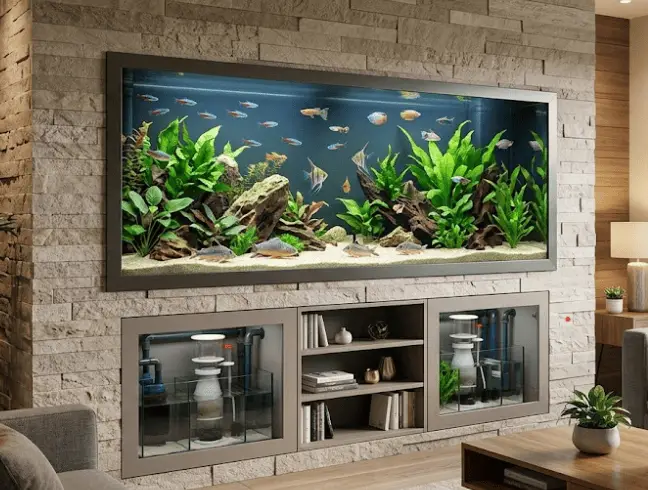
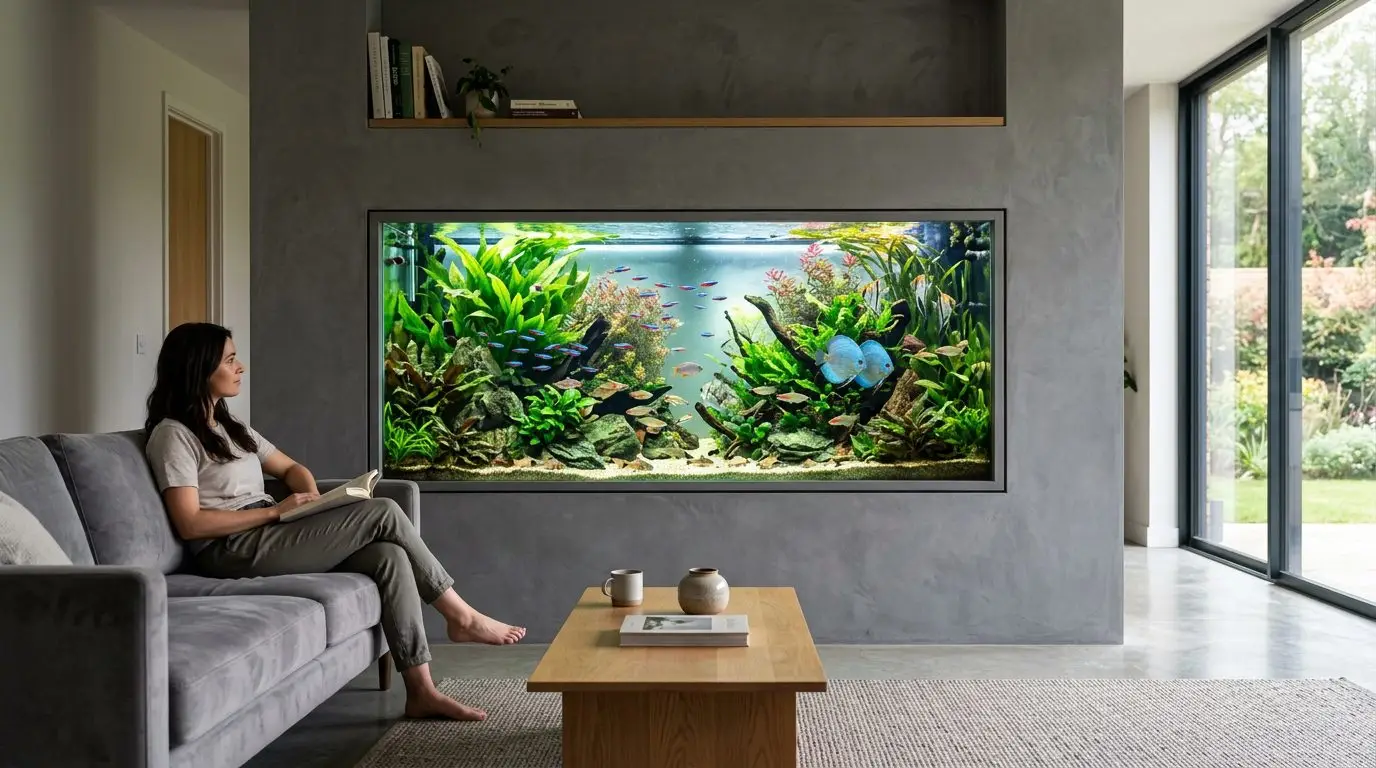
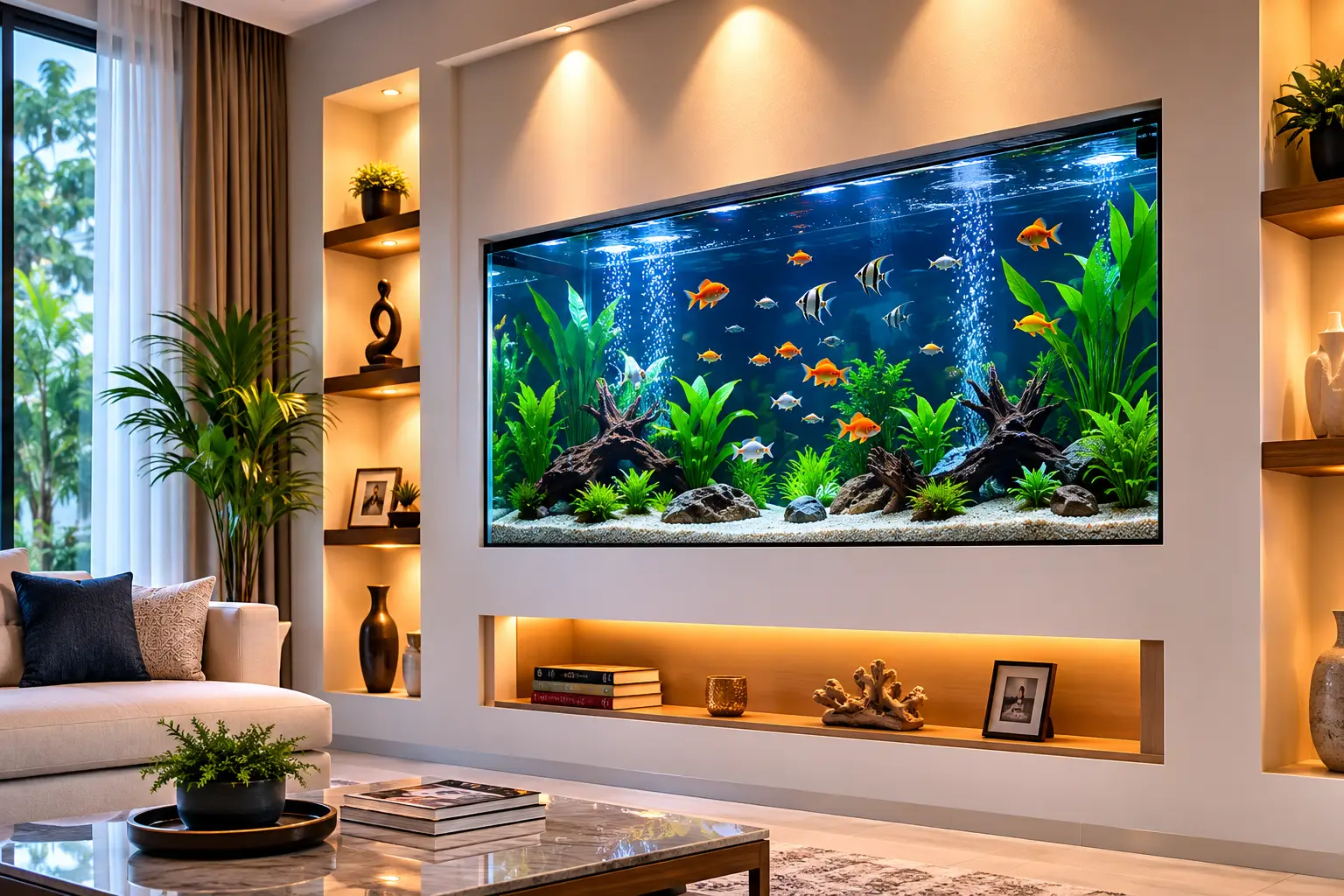
A fish aquarium built in a wall turns a plain surface into a living, glowing centrepiece that sits flush with the room rather than occupying floor space on a stand. Homeowners choose this style for living rooms, hallways, home offices and dividing walls between two rooms, because a recessed aquarium reads as architecture rather than furniture. But an in-wall aquarium is not simply a standard fish tank pushed into a hole it is a structural, plumbing and electrical project first, and a fishkeeping project second.
Skipping the planning stage is where almost every problem story about a built-in aquarium begins: cracked joists, hidden water damage inside a wall cavity, or a beautiful display that nobody can actually reach to maintain. This guide walks through what a wall-built aquarium actually is, the design options available, realistic size and cost considerations, structural and electrical safety, how the installation process generally works, filtration, heating and lighting requirements, suitable fish, maintenance and the key trade-offs compared with a freestanding tank. If you are new to the aquarium hobby altogether, start with our complete beginner’s guide to fish care before committing to a built-in installation.
- What Is a Fish Aquarium Built in a Wall
- Why Choose a Built-In Fish Aquarium
- Design Ideas for a Wall-Built Aquarium
- What Size Aquarium Is Best for a Wall
- How Much Does a Fish Aquarium Built in a Wall Cost
- Can You Build a Fish Tank Into Any Wall
- Electrical Safety Near a Wall-Built Aquarium
- How to Build a Fish Aquarium in a Wall
- Fish Tank in Wall Between Two Rooms
- Cabinet Design and Equipment Access
- Filtration for a Wall-Built Aquarium
- Lighting, Heating and Aeration
- Best Fish for a Built-In Aquarium
- Maintenance When the Tank Is Built Into a Wall
- Advantages and Disadvantages
- Built-In vs Freestanding Aquarium Comparison
- Common Mistakes to Avoid
- Frequently Asked Questions
- References
1. What Is a Fish Aquarium Built in a Wall
A fish aquarium built in a wall is a tank installed so that it sits within, behind, or flush against a wall structure rather than standing freely on a cabinet in the middle of a room. In practice, the term covers several related but distinct approaches:
- Recessed or in-wall aquarium — the tank sits inside a wall cavity or a purpose-built stud frame, with only the front glass visible from the room.
- Built-in aquarium with cabinetry — a freestanding or semi-recessed tank is boxed in with custom joinery so it appears to be part of the wall, even though the structural load is not carried by the wall itself.
- Wall-dividing aquarium — the tank physically replaces a section of wall between two rooms, viewable from both sides simultaneously.
- Aquarium between two rooms — similar to the dividing aquarium, built into a partition separating two functional spaces such as a living room and dining room.
It is worth being clear about the difference between an in-wall aquarium and a simple wall-mounted aquarium. A wall-mounted unit is usually a slim, self-contained display that hangs on a bracket like a picture frame the wall carries very little of its weight and no structural cavity is involved. A true built-in aquarium, by contrast, either sits inside the wall’s framing or is boxed into cabinetry fixed to the floor and studs, and the wall or the floor beneath it has to be engineered to carry the tank’s full weight. This distinction matters enormously for planning, because a small wall-mounted nano display and a 200-litre in-wall exhibit are completely different projects in terms of structure, plumbing and cost. Understanding standard fish tank dimensions in cm and inches is a useful starting point when determining what size recess your wall can realistically accommodate.
2. Why Choose a Built-In Fish Aquarium
The appeal is almost entirely about how the aquarium sits in the room. A built-in tank becomes part of the architecture rather than a large piece of furniture competing for floor space a significant advantage in smaller living rooms, apartments, offices and reception areas where every square metre matters. Because the equipment, plumbing and stand are hidden inside the wall cavity or cabinetry, the visible result is much cleaner: just glass, water and fish, without the visual clutter of external filters, heaters and cables running across a wall.
A built-in aquarium can also function as a room divider, allowing light and movement to pass between two adjoining spaces without a solid wall blocking the connection. In commercial and office settings, a wall aquarium creates a calming focal point for visitors without occupying usable floor area. Double-sided designs allow viewing from two rooms simultaneously something a single-sided freestanding tank cannot offer.
Against these benefits sit real limitations. Built-in aquariums are considerably harder to relocate, repair or upgrade than a freestanding tank, since the surrounding wall and cabinetry usually have to be at least partially opened to access plumbing or replace the tank itself. Planning also has to happen before construction, which removes the flexibility of simply buying a larger tank later as your fishkeeping interests grow. For a rental property, or if you expect to move within a few years, a built-in aquarium is rarely the right choice. For a broader overview of all aquarium styles and which suits different households, see our guide to fish aquarium types and setup.
3. Design Ideas for a Wall-Built Aquarium
There is no single correct design for a wall-built aquarium — the right approach depends on the room, the structure available, and how much of the tank you want visible. The following configurations come up most frequently among hobbyists and interior designers researching fish aquarium built in wall ideas.
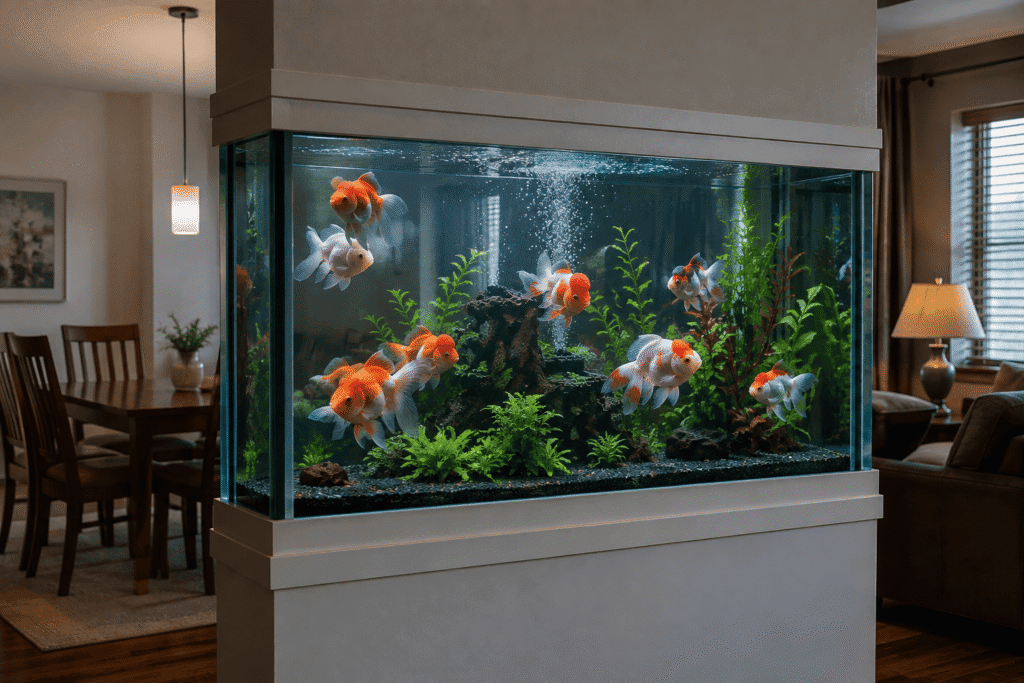
- Living room feature-wall aquarium — a single-sided display recessed into a feature wall, positioned opposite the main seating area. Maintenance access must come from the back, usually via an adjoining room, hallway, or closet.
- Aquarium between living room and dining room — a double-sided tank viewable from both adjoining rooms. Equipment access typically comes from a service panel on one side of the divide.
- Recessed aquarium with cabinet below — the tank sits in a wall recess with a matching cabinet underneath housing the sump, canister filter and electrical connections. One of the more practical designs because equipment stays reachable without opening the wall.
- Floor-to-ceiling aquarium — a tall, narrow design using vertical space. Visually dramatic, but places significant load on a small floor footprint and usually requires bespoke glass or acrylic panels.
- Small built-in aquarium — a modest nano or small community tank set into a hallway or study wall. Lower structural risk and lower cost, but still needs the same planning around access and plumbing.
- Large statement aquarium — a high-volume display intended as the centrepiece of an open living space. This is where structural assessment becomes essential rather than optional.
- Modern minimalist aquarium — a frameless or thin-bordered recessed tank with concealed lighting, designed to look like a piece of glass art rather than a fish tank. Usually paired with restrained aquascaping and a limited number of fish.
- Built-in aquarium with wooden cabinetry — the tank is framed in matching wood joinery that blends with existing furniture, useful when you want the display to look custom without altering the wall’s actual structure.
- Office or reception aquarium — built into a reception desk wall or feature wall in a commercial space, typically specified with lower-maintenance stocking and robust filtration because day-to-day care may fall to non-specialist staff.
- Aquarium under stairs — possible where the understair space is structurally suitable and not load-bearing, though headroom, access and moisture control near a staircase all need careful thought.
For every one of these configurations, three questions always apply: can the wall and floor support the finished weight, where will equipment access live, and who will carry out routine maintenance once installation day is over?
4. What Size Aquarium Is Best for a Wall
There is no universally best size the right volume depends on the wall’s structural capacity, the floor beneath it, the fish species you intend to keep and how much maintenance you can realistically commit to. What size does affect is everything downstream: a larger water volume means more structural load, bigger filtration and heating requirements, stronger lighting, more frequent water changes and a higher total installation cost.
Smaller built-in displays around the 20-gallon mark are the easiest entry point into a wall-built design the structural load is modest, the equipment footprint is small, and they suit narrower recesses such as hallways or compact feature walls. Mid-sized tanks in the 50-gallon range are a common sweet spot for living-room feature walls, large enough to feel like a genuine display piece without demanding the structural intervention that a truly large statement tank requires. For a detailed breakdown of 50-gallon tank configurations specifically, our 50 gallon fish tank dimensions guide covers exact measurements across all standard and long-profile formats. At the upper end, a 100-gallon aquarium or larger custom build genuinely changes the nature of the project professional structural assessment stops being optional, and the plumbing, filtration and lighting all need to be specified at a commercial rather than hobbyist scale.
A corner aquarium can make efficient use of an internal corner where two walls meet, which is a useful option when a straight wall recess is not available. Whatever the footprint, the honest answer to “what size is best” is: the largest size your wall, floor and maintenance routine can genuinely support not simply the largest size that fits the physical gap.
- 20 Gallon Fish Tank Guide — exact dimensions, weight, stocking and equipment for a smaller built-in display
- 50 Gallon Fish Tank Guide — the popular mid-size choice for living-room feature walls
- 50 Gallon Fish Tank Dimensions — detailed size comparison across all 50-gallon configurations
- 100 Gallon Fish Tank Guide — equipment sizing and floor loading for large statement builds
- Corner Fish Tank Aquarium Guide — making efficient use of corner wall space
- Fish Tank Dimensions in cm, Inches and Weight — full reference chart for all standard aquarium sizes
5. How Much Does a Fish Aquarium Built in a Wall Cost
Cost is one of the most-searched questions around in-wall aquariums, and also the hardest to answer with a single number, because a built-in aquarium is several separate projects bundled together: the tank itself, structural and framing work, cabinetry, plumbing and electrical work, filtration and life-support equipment, and finally livestock and aquascaping. Each varies enormously by country, supplier, tank material and how much of the work is DIY versus contracted to tradespeople.
Cost Factors to Budget Separately
| Cost Component | What Affects the Price | DIY Possible |
|---|---|---|
| The aquarium itself | Glass vs acrylic, custom vs standard dimensions, rimmed vs rimless, volume | Purchase only |
| Structural and framing work | Wall type (load-bearing vs partition), floor structure, storey level, reinforcement required | Professional required |
| Cabinetry and finishing | Custom joinery, trim matching, quality of finish, hidden vs visible equipment | Skilled DIY possible |
| Plumbing and waterproofing | Sump runs, overflow plumbing, cavity waterproofing, access panels | Professional usually needed |
| Electrical work | Dedicated GFCI circuits, socket placement, lighting transformer housing | Licensed electrician required |
| Filtration and equipment | Sump vs canister, heater wattage, lighting type and intensity | DIY installation |
| Substrate, décor, livestock | Aquasoil, hardscape, plants, fish species chosen | DIY |
Because pricing depends so heavily on country, supplier, tank material and the complexity of structural work involved, no single reliable price can be stated here without being misleading a small in-wall nano display in a non-structural stud wall on a ground-floor slab is a fundamentally different budget to a 100-gallon statement tank cut into a load-bearing wall on an upper floor. The most useful approach is to get itemised quotes for each component separately, since bundling them into a single “aquarium installation” quote makes it much harder to understand where the money is actually going.
6. Can You Build a Fish Tank Into Any Wall
No, and this is the single most important safety question in the entire project. Walls in a home generally fall into two categories:
- Load-bearing walls — carry structural weight from the floors or roof above down to the foundation. Cutting into, removing material from, or adding significant point-loads to a load-bearing wall without proper engineering can compromise the structural integrity of the building.
- Non-load-bearing (partition) walls — divide space and carry only their own weight. These are generally the safer option for recessed aquariums, but must still be inspected for hidden plumbing, wiring and ductwork.
Floor loading matters just as much as the wall itself, since the aquarium’s weight ultimately transfers down to the floor structure beneath it. Residential floors are typically designed to a minimum uniformly distributed live load specified in national building codes in the United States, the International Residential Code Table R301.5 sets these minimums, and a concentrated load from a large aquarium and stand can exceed what a section of ordinary residential floor framing was designed to carry, particularly on upper storeys (International Code Council, 2021). Our fish tank dimensions and weight comparison guide includes filled-weight data for all standard tank sizes that is useful when preparing information for a structural engineer.
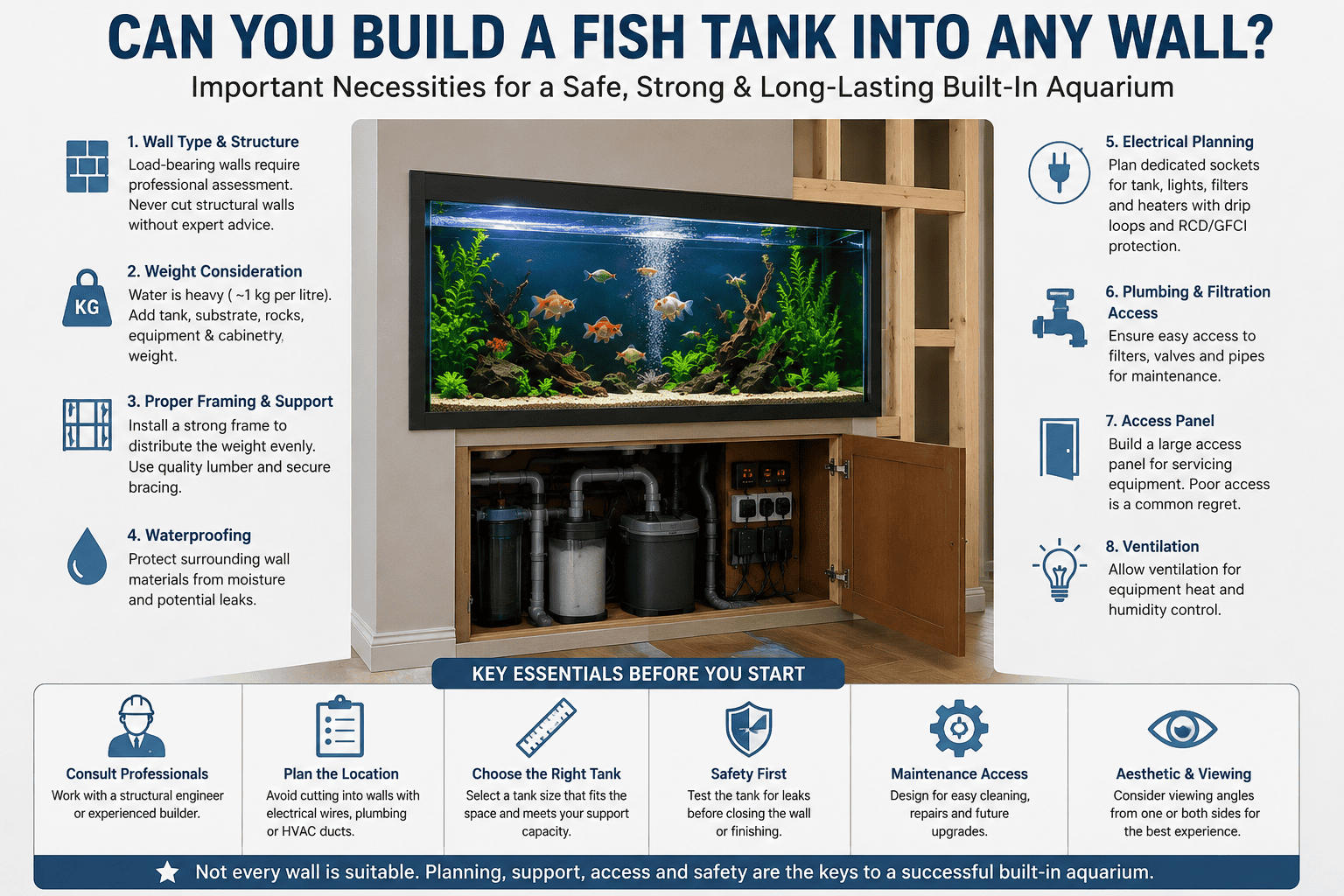
Beyond the structural question, a wall cavity may also contain plumbing, electrical wiring or HVAC ductwork that must be identified, rerouted or protected before any recess is cut. Moisture is another major consideration: an aquarium built into a wall introduces a permanent source of humidity and, in the event of a leak, standing water directly inside a wall cavity the environment that promotes mould and structural rot if not properly waterproofed.
7. Electrical Safety Near a Wall-Built Aquarium
Electrical safety near water is governed by specific requirements in most countries’ building codes, and these apply to in-wall aquariums just as much as to any other wet area of a home. In the United States, the National Electrical Code requires ground-fault circuit interrupter (GFCI) protection for receptacles installed in locations near water, which applies to any electrical outlets used with aquarium equipment (NEC 210.8). This means all sockets powering filters, heaters, lighting transformers, air pumps and other aquarium equipment should be protected by GFCI devices.
Ventilation of the equipment cabinet matters for electrical safety as well as equipment longevity. Heaters, pump motors and lighting transformers all generate heat, and a sealed, unventilated cabinet can create a humid, heat-saturated environment that shortens equipment lifespan and, in extreme cases, becomes a fire or electrical safety risk.
8. How to Build a Fish Aquarium in a Wall
The exact sequence varies by project, but at a high level a built-in fish aquarium generally follows this process. This is a planning overview, not a substitute for advice from a structural engineer, a licensed electrician and, where regulations require it, a plumber.
- Select the aquarium. Decide on material (glass or acrylic), shape and approximate volume based on the space structurally available and the fish species you plan to keep. Use our aquarium dimensions and weight reference to understand the footprint and weight implications of different standard tank sizes.
- Assess the intended wall. Identify whether it is load-bearing and what services — plumbing, wiring, ductwork — run through it. This requires professional inspection.
- Commission structural assessment. Engage a structural engineer to confirm the wall and floor can support the finished, filled weight of the complete system.
- Finalise tank dimensions. Confirm exact measurements based on the structural allowance and the confirmed recess dimensions.
- Plan plumbing and electrical access. Route water supply and drain lines plus dedicated GFCI-protected electrical circuits before any framing is closed up.
- Design filtration and equipment access. Decide where the sump or canister filter will sit and how it will be reached for routine maintenance.
- Build the supporting structure. Construct the framing, reinforcement and waterproofed base that will carry the tank’s weight.
- Install the aquarium. Position the tank within the prepared recess or cabinetry, following the manufacturer’s placement guidance.
- Seal and finish. Waterproof the cavity edges and complete cabinetry, trim or drywall finishing around the tank.
- Install equipment. Fit filtration, heating, lighting and any plumbing connections.
- Test for leaks. Fill the tank and monitor closely over several days before permanently finishing the surrounding structure.
- Cycle the aquarium. Establish the biological filter (see Section 11) before introducing any livestock.
- Stock gradually. Introduce fish in stages so biological filtration can keep pace with the bioload rather than being overwhelmed at once.
9. Fish Tank in Wall Between Two Rooms
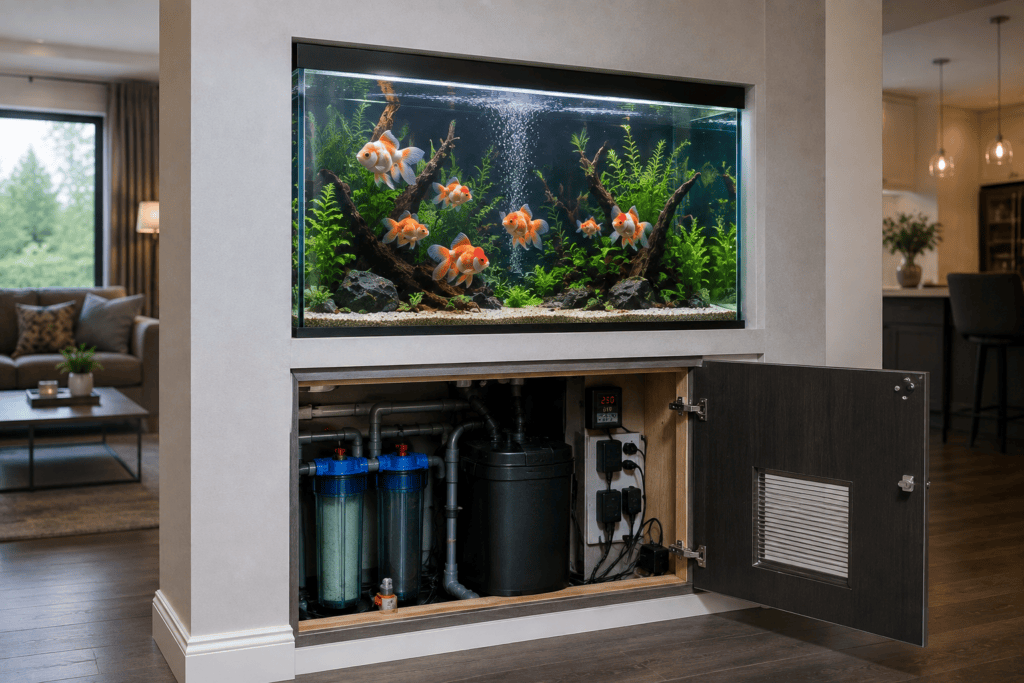
A double-sided aquarium between two rooms is one of the most requested built-in designs, because a single tank can serve simultaneously as a display and a room divider. The main design decisions revolve around visibility and access rather than the aquarium itself: will both sides show the full tank, how will lighting look from each room given that the two spaces may have different ambient light levels, and critically, which side will house the maintenance access panel.
Noise is a genuine consideration in a dividing aquarium, since pumps, air stones and overflow systems sit inside a shared wall cavity between two living spaces. Quieter equipment, or additional sound insulation around the equipment housing, is worth planning for if the tank divides two rooms people regularly spend time in — such as a living room and a home office. For a thorough guide to selecting and positioning quiet air pump and filtration equipment, see our complete guide to aquarium air pumps, aeration, setup and silent operation. Electrical safety requirements apply equally on both faces of the divide, since any receptacles near either side fall under the same near-water wiring rules described in Section 7.
10. Cabinet Design and Equipment Access
Whatever the exterior design, the equipment that keeps the aquarium alive sump, canister filter, air pump, heater, lighting transformer and electrical connections must live somewhere physically reachable. This is the part of the design that is easiest to overlook when the focus is on how the finished display will look.
A well-designed cabinet or equipment bay includes a removable panel or maintenance door sized generously enough to actually pull a canister filter or heater out for servicing, not merely to look at it. Ventilation matters too heaters, pumps and lighting transformers generate heat, and a sealed cabinet with no airflow can shorten equipment lifespan significantly and create a humid, corrosion-prone environment. Electrical sockets inside the equipment housing should be positioned above likely water levels and protected as described in Section 7.
11. Filtration for a Wall-Built Aquarium
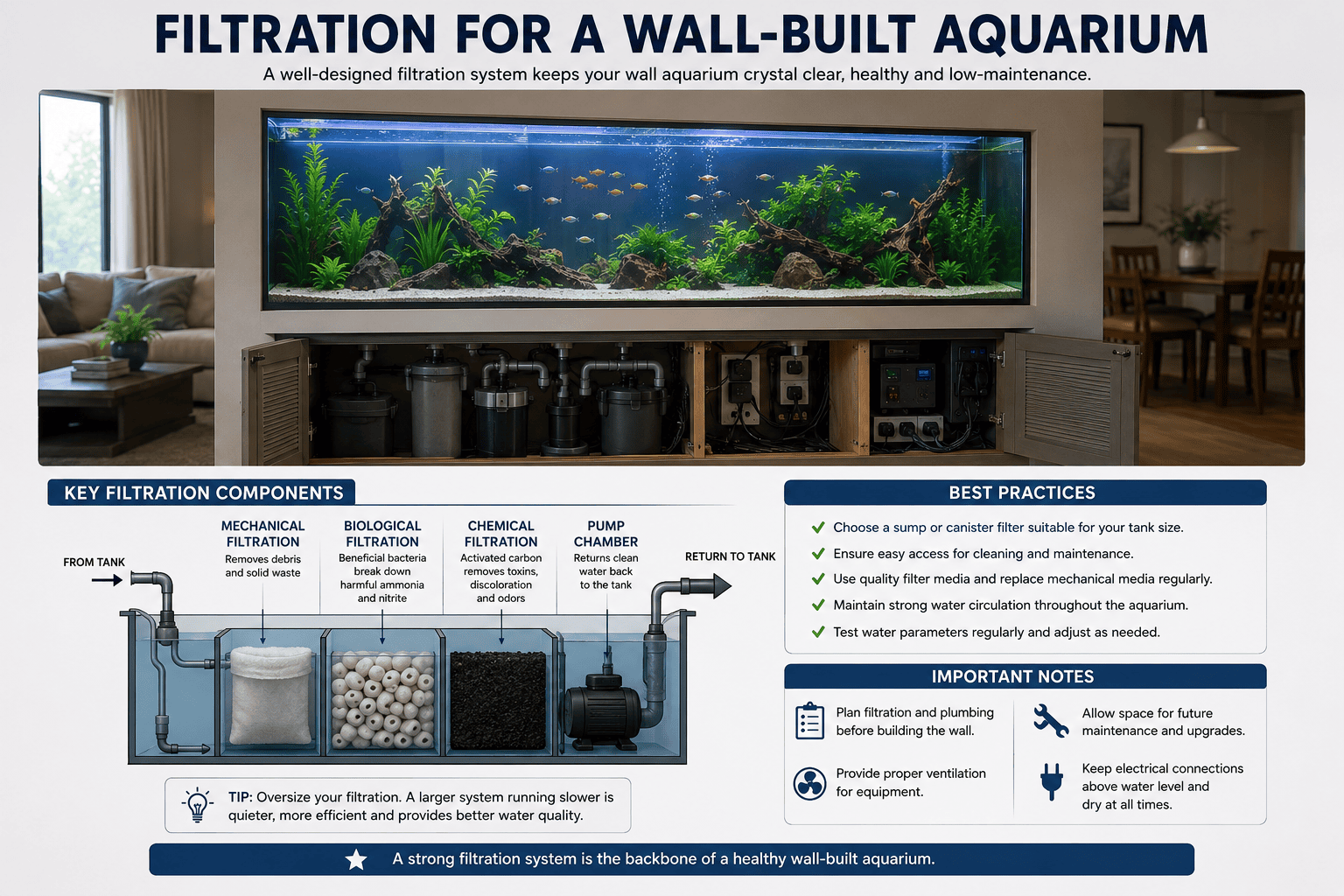
Filtration in a built-in aquarium works on the same biological principles as any other tank, but the physical setup often looks different because equipment is hidden rather than visible on the back of the tank. Three types of filtration work together in a healthy aquarium:
- Mechanical filtration — removes solid debris, uneaten food and fish waste before it decomposes and contributes to ammonia levels.
- Chemical filtration — typically activated carbon or similar media, removes dissolved impurities and odours from the water column.
- Biological filtration — the most critical element long-term, converting toxic ammonia produced by fish and decaying organic matter into nitrite via ammonia-oxidising bacteria, and then into far less toxic nitrate via a second bacterial group. This process — the nitrogen cycle — is the biological basis for all healthy aquarium maintenance (University of Florida IFAS Extension, 2023; Oklahoma State University Extension, 2021).
Research into aquarium biofilters confirms that nitrifying communities which can include both ammonia-oxidising bacteria and ammonia-oxidising archaea account for the large majority of nitrogen conversion in a typical aquarium system (Bagchi et al., 2014). In practical terms, this means a new built-in aquarium needs to be cycled running filtration with a source of ammonia for several weeks before fish are introduced rather than stocked immediately after installation. For full guidance on aeration and how it supports both fish and the nitrifying bacteria responsible for biological filtration, see our complete guide to aquarium air pumps and aeration.
Sump systems and canister filters are the most common choices for built-in displays, because they can be hidden entirely within cabinetry or a wall recess, connected to the display tank by plumbing rather than sitting visibly on the back glass. Internal filters are appropriate for smaller built-in displays where a full plumbed sump is not practical. Whichever system is chosen, it should be sized to the tank’s actual water volume and intended bioload not simply the largest unit that fits in the available cabinet space. If you are planning a planted display inside a wall-built aquarium, understanding soil and substrate requirements is also important before finalising the filtration design our soil in fish tank guide covers all substrate types, their effect on water chemistry and how to choose the right option for your planted built-in aquascape.
12. Lighting, Heating and Aeration
Lighting
Because a built-in aquarium is a permanent architectural feature, lighting is often specified more deliberately than on a standard freestanding tank full-spectrum LED fixtures to support live plants, dimmable units to match the room’s ambient light through the day, or accent lighting integrated into the surrounding cabinetry. The right specification depends entirely on what is inside the tank: a planted aquascape needs considerably more intensity and a specific light spectrum than a lightly planted community tank, and a marine reef system has its own, generally more demanding, requirements again.
| Setup Type | Lighting Requirement | Photoperiod |
|---|---|---|
| Low-light community tank | Moderate output LED; natural spectrum | 8 to 10 hours daily |
| Planted aquascape | Higher output LED; blue and red spectrum peaks for photosynthesis | 8 to 10 hours with a noon peak ramp |
| Marine fish-only | Moderate output LED; daylight spectrum | 8 to 12 hours daily |
| Reef aquarium | High output LED or T5; blue-heavy spectrum for coral | 8 to 12 hours with gradual ramp and blue dawn/dusk |
Heating
Heater sizing follows the same principle as any tropical aquarium — matched to the water volume and the temperature difference between the tank and the room — but placement needs extra thought in a built-in system, since the heater usually sits out of sight inside cabinetry or a plumbing run. For larger tanks, two heaters set to the same target temperature are often recommended: if one fails, the other provides redundancy, preventing a catastrophic temperature drop. Heat management inside sealed cabinetry deserves particular attention — heaters, pump motors and lighting transformers all generate warmth, and a poorly ventilated equipment bay can push ambient temperatures higher than intended, affecting both equipment lifespan and water temperature stability.
Aeration
Aeration, whether from an air pump and airstone or from surface agitation created by the filter return, supports both dissolved oxygen levels for the fish and the oxygen-dependent nitrifying bacteria responsible for biological filtration (Oklahoma State University Extension, 2021). In a built-in aquarium where the equipment bay is hidden, the air pump can be located inside the cabinet and connected to the tank via flexible airline tubing routed discreetly through the cabinetry. Our dedicated guide to aquarium air pumps and silent operation covers how to select the right pump size for your tank volume and how to minimise noise in a built-in installation where the pump is hidden near living spaces.
13. Best Fish for a Built-In Aquarium
Fish selection for a built-in aquarium should follow exactly the same principles as for any other tank the display format does not change a fish’s need for appropriate space, water parameters and compatible tankmates. The following categories work well in appropriately sized built-in displays.
| Fish Category | Suitable Species Examples | Why They Work Well | Min Tank Size |
|---|---|---|---|
| Small schooling fish | Neon tetras, ember tetras, harlequin rasboras, cardinal tetras | Peaceful, colourful schools create excellent visual movement across the display; low bioload | 20 gallon+ |
| Livebearers | Guppies, platies, swordtails, mollies | Hardy, colourful, adaptable to a range of tank sizes; active throughout the water column | 20 gallon+ |
| Gouramis | Dwarf gourami, honey gourami, pearl gourami | Striking centrepiece fish; generally peaceful in community setups; upper water swimmers | 20 gallon+ |
| Angelfish | Common angelfish varieties | Tall body profile displays beautifully in taller built-in tanks with vertical water depth | 30 gallon+; tall configuration preferred |
| Bottom dwellers | Corydoras catfish, otocinclus, bristlenose pleco | Occupy the substrate level independently; useful for algae and waste control | 20 gallon+ |
| Betta fish | Single male Betta splendens | Striking single-fish centrepiece for smaller built-in displays; needs gentle filtration and appropriate volume | See full Betta Fish Tank Guide |
| Goldfish and Oranda | Fancy goldfish varieties including Oranda | Only appropriate in tanks sized generously for their needs; high bioload; susceptible to specific diseases such as red pest disease | 50 gallon+; see Oranda Goldfish Guide |
| Marine fish | Clownfish, small reef-safe species | Only suitable where the entire system is designed as a saltwater setup from the outset | 30 gallon minimum marine setup |
Goldfish kept in a built-in aquarium require particular attention to water quality and health monitoring. Fancy varieties including Oranda are susceptible to bacterial conditions such as red pest disease in goldfish a condition that is harder to manage and treat in a built-in aquarium where access for quarantine and treatment is more limited than in a standard freestanding setup. If you plan to keep goldfish in a built-in display, build a quarantine tank capability into your planning from the outset. For comprehensive species care, our Oranda goldfish complete care guide covers tank size requirements, lifespan, health and compatible setups in detail.
For betta fish, the built-in format can be particularly striking for a solo display, but the species-specific requirements around gentle water flow, temperature stability and tank size must be met regardless of the tank’s architectural presentation — our complete betta fish tank guide covers every aspect of size, setup and water quality for this species.
14. Maintenance When the Tank Is Built Into a Wall
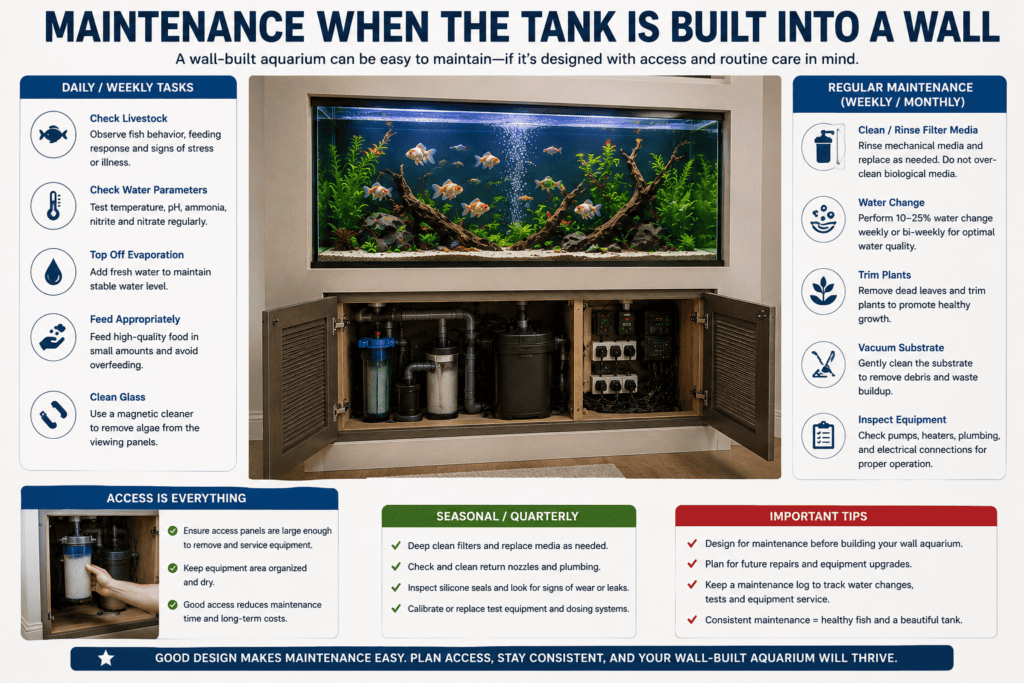
Maintenance is where the long-term success of a built-in aquarium is really decided, and it is the aspect of planning most likely to be underestimated during the design phase, when the focus is naturally on how the finished display will look rather than on the weekly reality of caring for it.
The core maintenance tasks are the same as for any aquarium: partial water changes, glass cleaning, algae control, filter servicing, feeding, routine water testing and periodic equipment inspection. The Ornamental Aquatic Trade Association recommends regular water quality testing as standard aquarium practice, since problems such as rising ammonia or nitrite are frequently invisible to the eye until fish are already showing signs of stress (OATA, n.d.a). What changes with a built-in design is not the task list but how easily each task can actually be carried out reaching the back glass of a deep recessed display, accessing a sump hidden in cabinetry, or servicing plumbing connections inside a wall cavity can all be considerably harder than on a freestanding tank if access was not properly planned from the start.
Leak Detection and Emergency Planning
Leak inspection deserves particular attention in a wall-built system, because a leak here is not just a wet floor it is water inside a wall cavity, with potential to affect flooring, wall framing and, over time, mould growth if not caught quickly. An emergency access plan knowing how to isolate the water supply and cut power to the tank quickly should be established before the aquarium is ever filled, not worked out for the first time during an actual leak event. For a thorough guide to diagnosing and resolving the full range of common aquarium problems, including water quality failures and equipment faults, see our fish aquarium problems and solutions complete guide.
15. Advantages and Disadvantages of a Built-In Fish Aquarium
Advantages
- Creates a striking architectural focal point rather than a standalone piece of furniture
- Saves floor space, valuable in smaller rooms, apartments and commercial settings
- Can be fully customised to match existing interior design and cabinetry
- Functions as a room divider between two adjoining spaces
- Offers double-sided viewing options not available with a standard freestanding tank
- Hides equipment for a cleaner, uncluttered visual result
- Integrates naturally into modern and minimalist home design
Disadvantages
- Higher installation cost than an equivalent freestanding aquarium, due to structural, plumbing and electrical work
- Requires professional structural assessment for anything beyond a small, lightweight display
- Repairs are more complex and often require opening surrounding cabinetry or wall finishes
- Maintenance access can be genuinely difficult if not planned properly from the start
- A leak affects the wall cavity directly, with a higher risk of hidden water damage compared to a freestanding tank
- Relocating or removing the tank later is far more involved than with a freestanding setup
- Requires considerably more upfront planning time before any construction can begin
16. Built-In vs Freestanding Aquarium Comparison
| Factor | Built-In Aquarium | Freestanding Aquarium |
|---|---|---|
| Installation | Structural, plumbing and electrical work required | Place on a rated stand; minimal construction needed |
| Cost | Higher, due to construction and custom work | Lower — tank, stand and equipment only |
| Flexibility | Fixed once installed; hard to change size later | Can be resized, replaced or upgraded relatively easily |
| Maintenance access | Depends entirely on planned access; can be harder | Generally straightforward, full access on all sides |
| Structural requirements | Wall and floor structural assessment usually required | Floor loading still matters, but no wall modification needed |
| Equipment access | Must be deliberately designed into cabinetry | Typically accessible from behind or above the tank |
| Aesthetics | Architectural — blends into the room as a feature | Reads as a piece of furniture or display item |
| Relocation | Difficult; involves construction work | Possible with appropriate care and equipment |
| Repair | More complex; may require opening surrounding finishes | Generally simpler to access and repair |
| Viewing options | Can offer double-sided or multi-room viewing | Typically single-side or limited multi-side viewing |
| Suitability for renters | Not recommended — permanent modification to the property | Fully suitable — no permanent modification required |
17. Common Mistakes to Avoid
- Ignoring structural load — proceeding without confirming the wall and floor can actually carry the finished, filled weight of the entire system.
- Cutting into a wall without professional assessment — especially dangerous with load-bearing walls where structural integrity is at stake.
- Not planning equipment access — designing a beautiful exterior without a practical way to reach filters, heaters or wiring.
- Choosing the tank before confirming the wall — ordering or buying a tank before the structural recess and allowance have been confirmed by a professional.
- Underestimating total weight — forgetting that substrate, rockwork, décor and equipment add substantially to water weight alone. Review our fish tank dimensions and weight comparison chart to understand fully loaded weights for your planned tank size.
- Sizing filtration to cabinet space rather than tank bioload — choosing a filter based on what fits rather than what the planned fish population actually requires.
- No emergency access or shutdown plan — having no quick way to isolate water supply and power in the event of a leak.
- Poor electrical planning — failing to install dedicated, GFCI-protected circuits before finishing the surrounding structure.
- Insufficient cabinet ventilation — sealing equipment into cabinetry with no airflow, shortening equipment life and raising humidity.
- Choosing fish based only on appearance — selecting species without considering adult size, territorial behaviour, schooling requirements or bioload. New hobbyists should read our beginner’s guide to fish care before finalising any stocking plan.
- Ignoring maintenance space — not leaving enough physical room to comfortably perform routine maintenance tasks.
- Skipping the leak test and cycling stages — adding fish before the system has been tested for leaks and the nitrogen cycle has been established.
- Fish Aquarium Types and Setup Guide — overview of all aquarium styles and how to choose the right one
- How to Take Care of a Fish — Beginner’s Complete Guide — essential reading before any aquarium installation
- Fish Aquarium Problems and Solutions — troubleshooting water quality, filtration and equipment failures
- Aquarium Air Pump Guide — aeration, filtration support and silent pump options for built-in displays
- Soil in Fish Tank Guide — planted substrate types, problems and plant growth for built-in aquascapes
- Fish Tank Dimensions in cm, Inches and Weight — full reference chart for standard tank sizes and filled weights
- 20 Gallon Fish Tank Guide — ideal for smaller built-in wall displays and hallway recesses
- 50 Gallon Fish Tank Guide — the most popular size for living-room feature-wall installations
- 50 Gallon Fish Tank Dimensions — detailed configuration comparison for 50-gallon tank formats
- 100 Gallon Fish Tank Guide — large statement wall aquarium planning and equipment
- Corner Fish Tank Aquarium Guide — using corner wall space for a built-in display
- Betta Fish Tank Guide — complete care guide if a betta is your chosen centrepiece fish
- Oranda Goldfish Complete Care Guide — tank size, lifespan and setup for fancy goldfish in a built-in display
- Red Pest Disease in Goldfish — health issue to plan for if keeping goldfish in a built-in aquarium
18. Frequently Asked Questions
How much does an in-wall fish tank cost?
Costs vary significantly by country, tank material, size and how much structural, plumbing and electrical work is required. There is no single reliable figure — get itemised quotes for the tank, structural work, cabinetry and equipment separately rather than a single bundled estimate.
Are wall-mounted fish tanks good?
Slim wall-mounted units can work well for small displays, but they are a different category from a true built-in aquarium, since the wall carries very little structural load. For larger volumes, a genuine built-in design with proper structural support is a more realistic approach.
How can I build a fish tank in a wall?
Select the aquarium, commission a structural assessment, plan plumbing and electrical access, build the supporting structure, install the tank, test thoroughly for leaks, cycle the aquarium, then stock it gradually. See the full step-by-step guide in Section 8 above. If you are new to fishkeeping, read our beginner’s guide to fish care before beginning the project.
What should be considered before installing an aquarium in a wall?
Whether the wall is load-bearing, whether the floor can support the finished weight, where plumbing and electrical services run, how equipment will be accessed for maintenance, and how a leak would be detected and managed quickly. Our fish tank dimensions and weight guide is useful for calculating the structural load of your planned tank size before engaging a structural engineer.
How much does a built-in aquarium weigh?
Total weight includes the empty tank, the water itself, substrate, rockwork, décor and all equipment. A structural engineer will calculate the site-specific figure. As a general reference, freshwater weighs approximately 8.34 lbs (3.78 kg) per US gallon — so a 50-gallon tank’s water alone weighs around 417 lbs (189 kg) before substrate, décor and equipment are added.
Does an in-wall aquarium need structural support?
In almost all cases beyond a very small, lightweight display, yes. Both the wall and the floor beneath the installation need to be assessed against the finished, fully loaded weight by a qualified structural engineer.
How do you maintain a fish tank built into a wall?
The same core tasks as any aquarium water changes, testing, filter servicing, glass cleaning, algae control but access to perform them must be designed into the project from the start. For a full maintenance and troubleshooting reference, see our fish aquarium problems and solutions guide.
Can an aquarium be installed between two rooms?
Yes, a double-sided dividing aquarium is one of the most popular built-in designs. It requires careful planning around which side houses the maintenance access panel, how equipment noise is managed in both rooms, and how electrical safety is maintained on both faces of the divide.
What size aquarium is best for a built-in wall?
There is no universally best size. The right size is the largest your structure and maintenance routine can genuinely support. Common choices are a 20-gallon tank for hallways and compact feature walls, a 50-gallon tank for living-room feature walls, and a 100-gallon or larger for statement installations requiring professional-level planning.
Is a built-in aquarium difficult to repair?
Generally yes, compared with a freestanding tank, because repairs often require opening surrounding cabinetry or wall finishes to reach plumbing, wiring or the tank itself. This is one of the most important reasons to use quality equipment and test thoroughly before finishing the surrounding structure.
Is DIY installation safe for a large built-in aquarium?
Structural, electrical and plumbing work for anything beyond a small display should involve qualified professionals a structural engineer for load assessment and a licensed electrician for all wiring near water. DIY installation of large built-in aquariums carries genuine safety risks related to structural failure, electrical hazards and water damage.
Final Thoughts
A fish aquarium built in a wall can genuinely transform a room turning a plain surface into a living centrepiece that no freestanding tank on a stand can quite replicate. But the appeal of the finished display should not overshadow the fact that this is fundamentally a construction project, one where structural load, electrical safety, filtration capacity and long-term maintenance access all have to be planned together before any wall is opened up.
Tank size, structure, equipment and livestock are not separate decisions to be made one after another: they all depend on each other, and changing one usually means reconsidering the others. Where the tank volume is anything beyond modest, a qualified structural professional should assess the installation before work begins — this is non-negotiable regardless of budget. Beyond that, the best built-in aquarium design is not necessarily the most dramatic one; it is the one that remains practical to maintain, five years after the excitement of installation day has faded into a routine. Use the full resource library below to research every aspect of your planned build before committing to a design.
Aquarium Types and Setup Guide Aquarium Problems and Solutions Air Pump and Filtration Guide Planted Tank Substrate Guide Beginner Fish Care GuideReferences
- Bagchi, S., Vlaeminck, S.E., Sauder, L.A., Mosquera, M., Neufeld, J.D. and Boon, N. (2014). Temporal and spatial stability of ammonia-oxidizing archaea and bacteria in aquarium biofilters. PLOS ONE. https://doi.org/10.1371/journal.pone.0113515
- International Code Council (2021). 2021 International Residential Code (IRC) — Table R301.5: Minimum Uniformly Distributed Live Loads. https://codes.iccsafe.org/s/IRC2021P2
- Oklahoma State University Extension (2021). Nitrification and Maintenance in Media Bed Aquaponics. https://extension.okstate.edu/fact-sheets/nitrification-and-maintenance-in-media-bed-aquaponics.html
- Ornamental Aquatic Trade Association (OATA) (n.d.a). How to Test Water Quality in Your Freshwater Tank. https://ornamentalfish.org/
- Ornamental Aquatic Trade Association (OATA) (n.d.b). Water Quality. https://ornamentalfish.org/what-we-do/set-standards/water-quality/
- RSPCA (n.d.a). Choosing an Aquarium for Pet Fish. https://www.rspca.org.uk/adviceandwelfare/pets/fish/environment
- RSPCA (n.d.b). Understanding Pet Fish Behaviour and Needs. https://www.rspca.org.uk/adviceandwelfare/pets/fish/behaviour
- RSPCA (n.d.c). Keeping Fish as Pets. https://www.rspca.org.uk/adviceandwelfare/pets/fish
- University of Florida IFAS Extension (2023). Ammonia in Aquatic Systems (FA031). https://ask.ifas.ufl.edu/publication/FA031
- Walstad, D.L. (1999). Ecology of the Planted Aquarium. Echinodorus Publishing, Chapel Hill, NC.