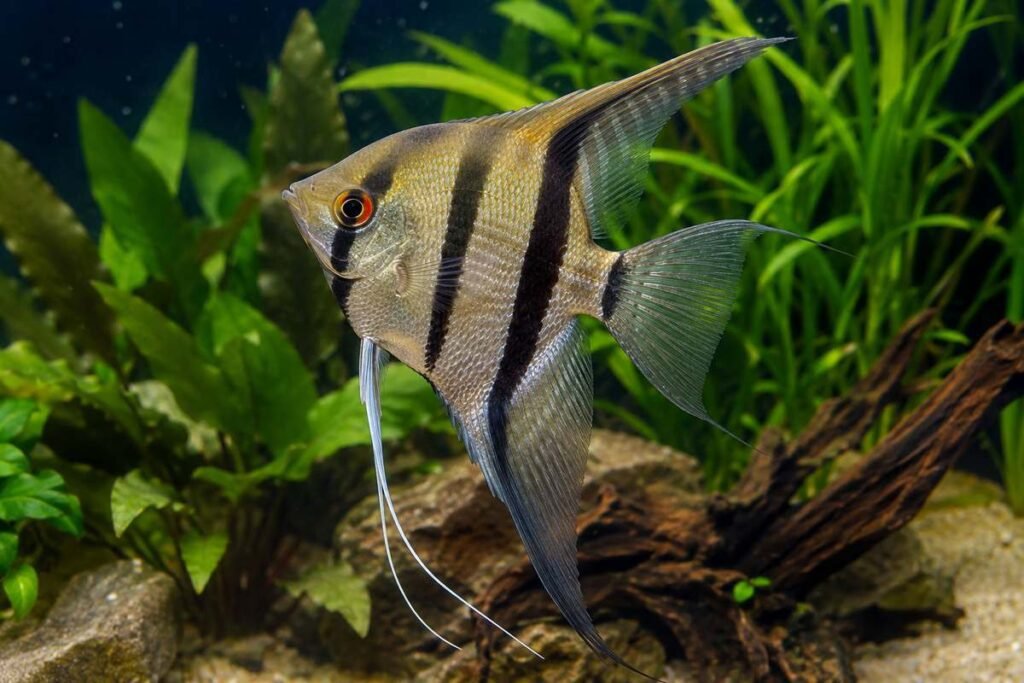
Angelfish are one of the most popular and instantly recognisable fish in the freshwater aquarium hobby. Their distinctive triangular body profile, long flowing fins and calm, intelligent behaviour have made Pterophyllum scalare a staple of the hobby for more than a century. Native to the slow-moving rivers and flooded forests of the Amazon Basin in South America, wild angelfish live among dense aquatic vegetation, submerged roots and driftwood — and providing something close to that environment in captivity is the key to keeping them healthy and thriving for their full 10 to 12 year lifespan.
This guide covers everything you need to know about angel fish care — from tank size, water parameters and compatible tank mates to diet, breeding, common health problems, colour varieties including black angelfish, the difference between freshwater and saltwater angelfish, and realistic price expectations. If you are new to the hobby, start with our complete beginner’s guide to fish care before taking on angelfish, as they are best suited to aquarists with some prior experience of maintaining stable freshwater water quality.
- What Is an Angelfish
- Angelfish Size — How Big Do They Get
- Angelfish Lifespan
- Types and Colour Varieties of Angelfish
- Saltwater Angelfish vs Freshwater Angelfish
- Angelfish Tank Size and Setup
- Angelfish Water Parameters
- Angelfish Tank Mates — What Fish Work Well
- What Fish to Avoid with Angelfish
- Angelfish Diet — What Do They Eat
- Are Angelfish Hard to Keep
- Angelfish Health Problems
- Breeding Angelfish
- Angelfish Price
- Angelfish for Sale — What to Check Before Buying
- Frequently Asked Questions
- Conclusion
- References
1. What Is an Angelfish
Angelfish is a term that covers two entirely different groups of fish depending on the context. In the freshwater aquarium hobby, angelfish refers to Pterophyllum scalare and its two close relatives — P. altum (the tall wild angelfish) and P. leopoldi (the rare dwarf species) — members of the family Cichlidae native to South America. In the marine aquarium hobby, the word angelfish refers to the family Pomacanthidae, a completely separate group of saltwater fish that share only the name. This guide focuses primarily on freshwater angelfish (Pterophyllum scalare), which is by far the most commonly kept species.
Pterophyllum scalare is native to the Amazon River basin in Peru, Colombia and Brazil, where it inhabits slow-moving blackwater streams, flooded forest margins and shallow lake edges rich in submerged vegetation and roots (Froese and Pauly, 2024). In the wild, angelfish use their tall, laterally compressed body shape to camouflage between vertical plant stems and roots — a body plan that also explains why they require tall tanks rather than long, shallow ones in captivity.
A common question is whether angelfish are poisonous. Freshwater angelfish (Pterophyllum scalare) are not poisonous or toxic in any way. They are completely safe to keep, handle during tank maintenance and pose no toxicity risk to other fish or to humans. Marine angelfish from tropical reef environments can accumulate ciguatoxins if consumed, but this is irrelevant in the context of aquarium keeping.
- Beginner’s Complete Guide to Fish Care — essential reading before setting up any cichlid aquarium
- Fish Aquarium Types and Setup Guide — choosing the right tank type and shape for angelfish
- Fish Aquarium Problems and Solutions — troubleshooting water quality issues that affect angelfish health
2. Angelfish Size — How Big Do They Get
Adult angelfish size is one of the most underestimated aspects of keeping this species. Pterophyllum scalare reaches a body length of approximately 15 cm (6 inches) from nose to tail in captivity, but the overall height including the dorsal and ventral fins can reach 20 to 25 cm (8 to 10 inches) in well-maintained aquariums (Froese and Pauly, 2024). This vertical dimension is the critical measurement for tank planning — a tank that is only 30 cm (12 inches) high will not allow an adult angelfish to fully extend its fins, causing chronic stress and fin damage.
| Species | Body Length | Full Height (inc. fins) | Min Tank Height | Availability |
|---|---|---|---|---|
| P. scalare (Common) | Up to 15 cm (6 in) | 20 to 25 cm (8 to 10 in) | 40 cm (16 in) | Widely available |
| P. altum (Altum) | Up to 18 cm (7 in) | 25 to 33 cm (10 to 13 in) | 50 cm (20 in) | Specialist only |
| P. leopoldi (Dwarf) | Up to 10 cm (4 in) | 14 to 17 cm (5 to 7 in) | 35 cm (14 in) | Rarely available |
Angelfish reach their adult size between 12 and 18 months of age under good conditions (Kasiri et al., 2012). Fish purchased as juveniles at 3 to 4 cm in length will grow significantly over their first year, which means planning the aquarium for adult dimensions from the start rather than upgrading later.
3. Angelfish Lifespan
The angel fish lifespan in a well-maintained freshwater aquarium is typically 10 to 12 years, with some individuals reaching 15 years under exceptional care (Walster et al., 2015). This places angelfish among the longer-lived commonly kept freshwater aquarium fish, which is an important consideration for potential keepers — a healthy angelfish is a decade-long commitment, not a short-term display fish.
The primary factors that determine whether an angelfish reaches its full potential lifespan are water quality consistency, diet quality, stress from incompatible tank mates and the presence of undiagnosed or untreated health conditions. Angelfish are sensitive to ammonia and nitrite spikes that a more tolerant species might survive without lasting damage (Santos et al., 2024). Regular weekly water changes of 25 percent and consistent biological filtration are the single most important habits for maximising angelfish longevity.
4. Types and Colour Varieties of Angelfish
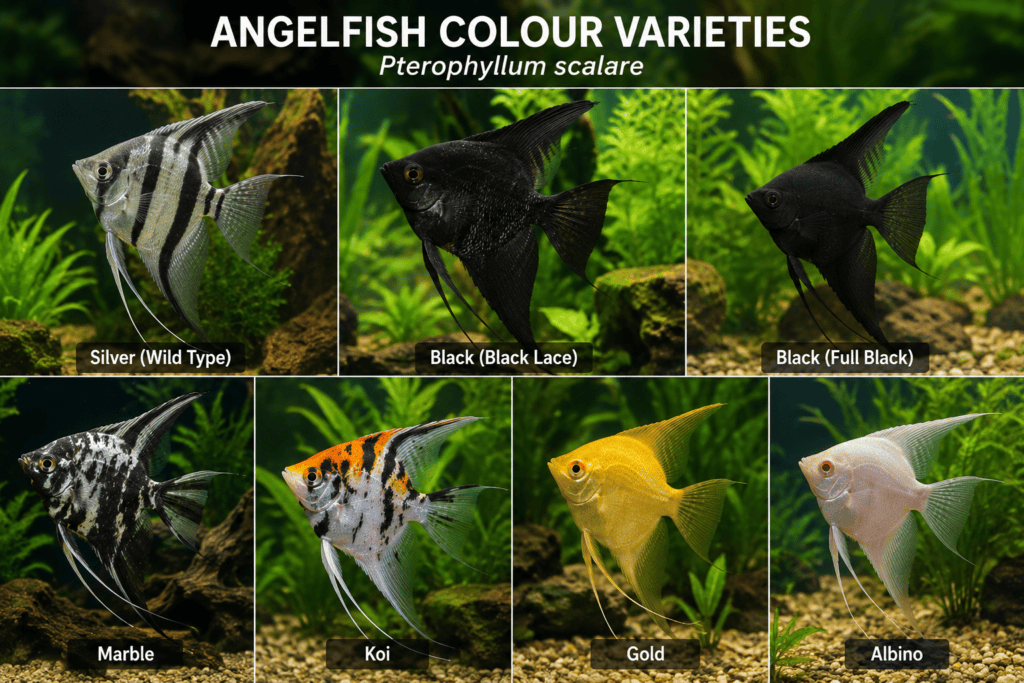
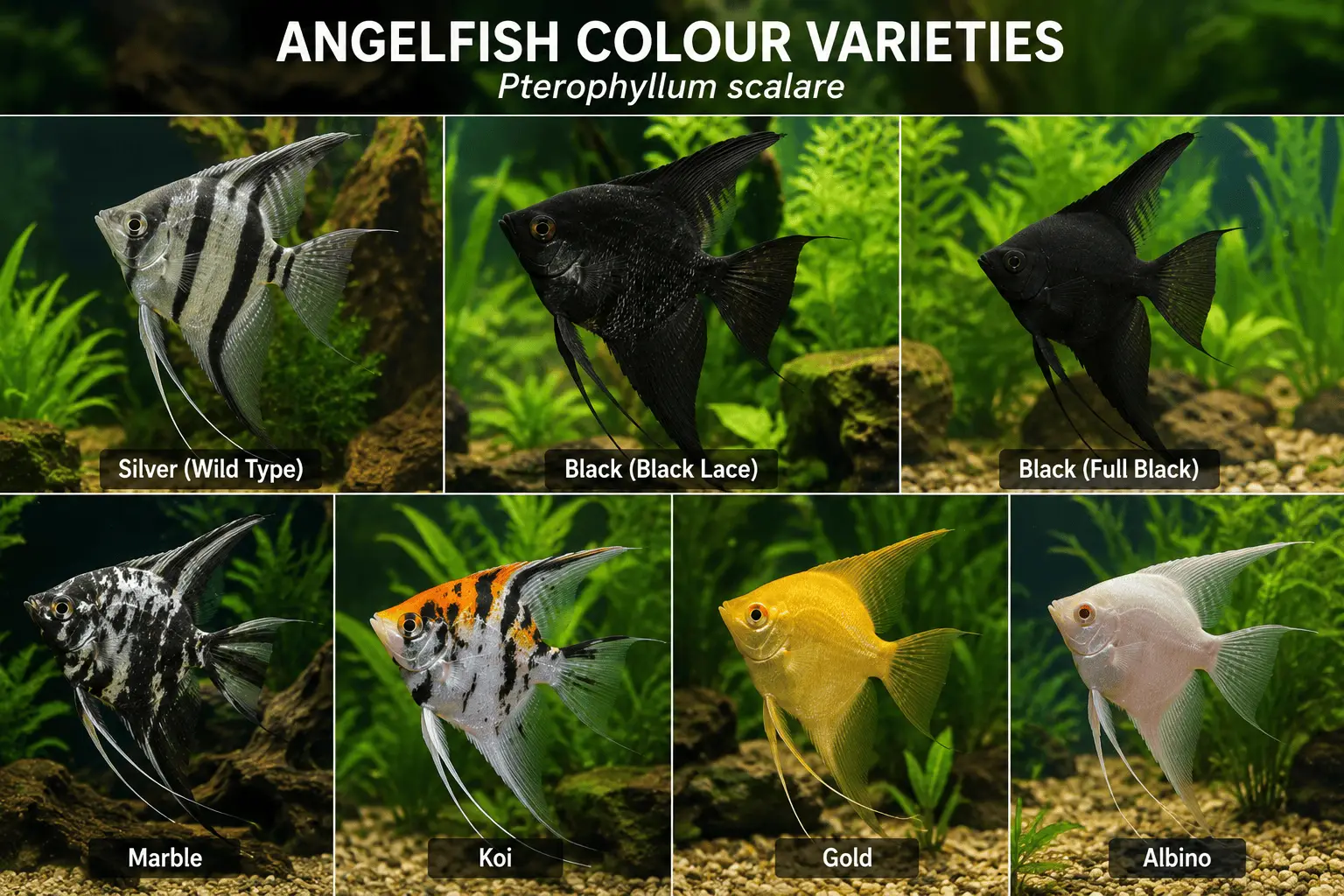
Through decades of selective breeding in the ornamental fish trade, Pterophyllum scalare is now available in a wide range of colour varieties and fin types. The US Geological Survey records numerous colour variant synonyms for the species including veil angelfish, black angelfish, longfin angelfish and marble angelfish (USGS, 2024). The most popular varieties include:
Freshwater Angelfish Varieties
| Variety | Appearance | Difficulty | Notes |
|---|---|---|---|
| Silver (Wild Type) | Silver body with dark vertical stripes | Easy | Closest to wild P. scalare; hardy and widely available |
| Black Angelfish | Fully black or very dark grey body and fins | Moderate | Includes Black Lace, Black Veil and full black varieties; striking display fish |
| Marble | Black and silver irregular marbled pattern | Easy | Popular and hardy; good beginner angelfish variety |
| Koi Angelfish | Orange, white and black patches resembling koi | Moderate | Visually striking; colour intensity varies between individuals |
| Gold Angelfish | Pale gold to yellow body without stripes | Moderate | Less commonly available; requires good water quality to maintain colour |
| Albino Angelfish | White to pale pink body with red eyes | Moderate | Sensitive to bright lighting; provide shaded areas |
| Veil (Longfin) | Any colour with greatly extended flowing fins | Requires care | Beautiful but fins are more prone to damage; avoid fin-nipping tank mates |
| GloFish Angelfish | Fluorescent green or red under blue LED lighting | Moderate | Genetically modified variety; same care requirements as standard P. scalare |
5. Saltwater Angelfish vs Freshwater Angelfish
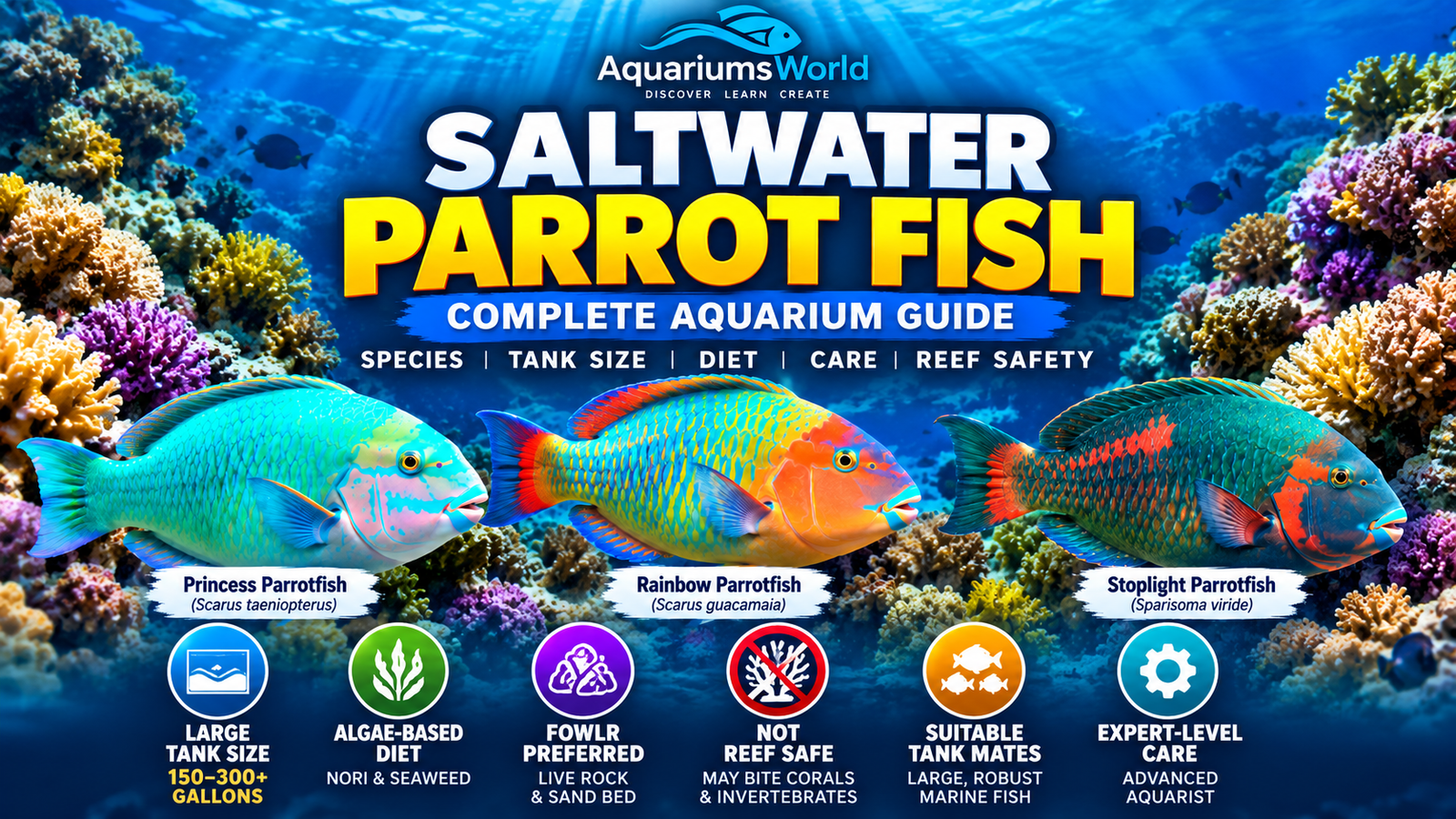
Saltwater angelfish belong to the family Pomacanthidae and are a completely separate group of marine reef fish that share only the common name with freshwater Pterophyllum. The confusion between the two is extremely common among new hobbyists, particularly because both groups are sold in the same aquarium shops. The care requirements, tank setup, filtration, water chemistry and compatible species are entirely different between freshwater and saltwater angelfish.
| Feature | Freshwater Angelfish (Pterophyllum) | Saltwater Angelfish (Pomacanthidae) |
|---|---|---|
| Family | Cichlidae | Pomacanthidae |
| Origin | Amazon Basin, South America | Tropical coral reefs worldwide |
| Water type | Freshwater; pH 6.5 to 7.5 | Saltwater; specific gravity 1.020 to 1.025 |
| Min tank size | 29 gallon for a pair; 55 gallon recommended | 70 to 100 gallon minimum depending on species |
| Difficulty | Intermediate | Intermediate to advanced |
| Popular species | P. scalare, P. altum, P. leopoldi | Emperor, French, Flame, Pygmy/Dwarf angelfish |
| Price range | USD 5 to 40 for freshwater varieties | USD 30 to 200+ depending on species and size |
| Reef safe | Not applicable — freshwater only | Varies by species; many are not reef safe |
For a comprehensive overview of the different aquarium types required for freshwater versus saltwater setups, see our fish aquarium types and setup guide which covers both freshwater community and marine system requirements in detail.
6. Angelfish Tank Size and Setup
Getting the tank size right is the single most important decision in angelfish keeping. Angelfish are frequently kept in tanks that are too small — a common issue noted even in specialist aquarium literature (TFH Magazine, n.d.). A 20-gallon high aquarium represents the absolute minimum for a single adult, but a 29-gallon tall tank is the practical starting point for a pair, and a 55-gallon or larger aquarium is strongly recommended for any community setup with angelfish.
Height is as important as volume. Because of their tall vertical body profile, angelfish require a tank with a water depth of at least 40 cm (16 inches) to fully extend their dorsal and ventral fins without touching the substrate or the surface simultaneously. A long, shallow aquarium of equivalent volume is far less suitable than a tall standard configuration. Our fish tank dimensions guide in cm and inches can help you compare exact measurements across standard tank sizes before purchasing.
| Tank Size | Suitable For | Height Adequate | Recommended |
|---|---|---|---|
| 10 Gallon | Not suitable for adult angelfish | No — 12 in too shallow | Avoid |
| 20 Gallon High | Single juvenile angel only; temporary | Marginal — 16 in minimum | Upgrade needed |
| 29 Gallon | Bonded pair — species only tank | Yes — 18 in height | Minimum for a pair |
| 55 Gallon | Community tank with 2 to 4 angelfish plus companions | Yes — 21 in height | Recommended |
| 75 Gallon+ | Community of 4 to 6 angelfish; breeding pairs | Yes — 20 in height | Ideal |
For context on how a 20-gallon aquarium compares to larger sizes in terms of water stability and stocking capacity, see our 20 gallon fish tank complete guide. For large angelfish community setups, our 100 gallon fish tank guide and 50 gallon fish tank guide cover the equipment, weight and setup requirements at those volumes.
Tank Decoration and Aquascape
Angelfish thrive in a planted aquarium that replicates their natural Amazon habitat. Tall background plants such as Vallisneria, Amazon Sword and tall stem plants provide vertical structure that angelfish naturally orient toward. Java Fern and Anubias attached to driftwood pieces create midground structure and shade. Broad flat leaves positioned in the midground serve as natural resting spots and potential spawning surfaces. For substrate and planted tank setup guidance, our soil in fish tank guide covers all substrate options that work well in a planted angelfish aquascape.
7. Angelfish Water Parameters
Consistency in water quality is more important for angelfish than achieving an exact value within a range. Sudden changes in temperature, pH or hardness cause acute stress responses in Pterophyllum scalare that suppress immune function and make fish susceptible to opportunistic infections (Davis, 1975; Santos et al., 2024).
| Parameter | Recommended Range | Notes |
|---|---|---|
| Temperature | 24 to 28°C (75 to 82°F) | Stable temperature is more important than the exact value; use a thermostat-controlled heater |
| pH | 6.5 to 7.5 | Slightly acidic to neutral; reflects natural Amazon tributary conditions (Fishbase, 2024) |
| Water hardness | 3 to 10 dGH | Soft to moderately hard; very hard water above 15 dGH reduces breeding success |
| Ammonia | 0 ppm | Any detectable ammonia indicates an uncycled or overstocked tank — angelfish are intolerant of ammonia exposure |
| Nitrite | 0 ppm | Should always read zero in an established, cycled aquarium |
| Nitrate | Below 40 ppm | Weekly 25 percent water changes and live plants both reduce nitrate accumulation |
For aeration and filtration to support stable water quality, see our complete guide to aquarium air pumps and aeration. For troubleshooting ammonia, nitrite and nitrate problems, our fish aquarium problems and solutions guide covers every common water quality failure and how to correct it.
8. Angelfish Tank Mates — What Fish Work Well
Choosing compatible angelfish tank mates requires balancing two risks: fish that are small enough to be eaten by adult angelfish, and fish that are aggressive or nippy enough to damage angelfish fins. The ideal tank mate is peaceful, medium-sized and occupies a different water level from the angelfish’s preferred mid-water zone (Fishmetry, 2025).
| Species | Adult Size | Compatibility | Notes |
|---|---|---|---|
| Black Skirt Tetra | 5 to 6 cm | Good | Large enough not to be eaten; peaceful in groups of 6 or more |
| Bleeding Heart Tetra | 6 to 7 cm | Good | Colourful mid-water schooler; peaceful and compatible with angelfish |
| Corydoras catfish | 3 to 7 cm | Excellent | Bottom dwellers; occupy a different zone; completely ignored by angelfish |
| Dwarf Gourami | 5 to 7 cm | With care | Peaceful but both species prefer mid-water; monitor for territorial behaviour |
| Boesemani Rainbowfish | 8 to 10 cm | With care | Active swimmers that need horizontal space; better in 55 gallon or larger |
| Harlequin Rasbora | 4 to 5 cm | With care | May be eaten by large adult angelfish; safer with juvenile angelfish only |
| Bristlenose Pleco | 10 to 12 cm | Good | Useful algae eater; stays near substrate; no conflict with angelfish |
| Otocinclus catfish | 3 to 5 cm | With care | Peaceful algae eater; small size means risk from large adult angelfish |
For larger angelfish community setups where a corner aquarium configuration can help with territory separation, see our corner fish tank aquarium guide. Comparing angelfish tank mate needs with betta fish requirements — another popular cichlid-adjacent species — is covered in our betta fish tank guide. The two species should never be kept together.
9. What Fish to Avoid with Angelfish
Directly answering the most searched People Also Ask question: what fish to avoid with angelfish falls into two clear categories — fish that will injure angelfish, and fish that angelfish will eat.
- Tiger barbs — persistent, aggressive fin-nippers that will relentlessly shred the long fins of angelfish, causing fin rot and chronic stress. Never keep with angelfish under any circumstances.
- Serpae tetras — similarly aggressive fin-nippers; unsuitable tank mates for any long-finned species including angelfish and veil varieties especially.
- Neon tetras and small nano fish — neon tetras at 3 to 4 cm are within the prey size range of adult Pterophyllum scalare. Young guppies, chili rasboras and other nano species will be actively hunted and consumed by adult angelfish (Aqueon, n.d.).
- Large aggressive cichlids — convict cichlids, Jack Dempseys, green terror and Oscar fish are all incompatible. They either outcompete or injure angelfish in territorial disputes.
- Oscar fish — will eat or injure any angelfish sharing their space. Oscars require significantly larger aquariums — our 100 gallon fish tank guide explains the minimum setup for Oscars.
- Goldfish and Oranda — completely incompatible with angelfish due to very different temperature requirements. Goldfish prefer 18 to 22°C while angelfish require 24 to 28°C. Combining them causes one or both species to be chronically stressed. For goldfish care see our Oranda goldfish complete care guide.
10. Angelfish Diet — What Do They Eat
Angelfish are omnivores with a strong carnivorous preference in the wild, where they feed primarily on small invertebrates, insect larvae and small fish (Kasiri et al., 2012). In captivity, a varied diet that reflects this natural feeding behaviour produces the best growth, colour and reproductive performance.
Recommended Diet
- High-quality cichlid pellets or flake food — the dietary staple for captive angelfish; choose a protein-rich formula with the first ingredient being fish or shrimp meal
- Frozen bloodworm — an excellent protein-rich supplement that replicates natural prey; feed 2 to 3 times per week
- Frozen or live brine shrimp — high in protein and stimulates natural hunting behaviour; particularly useful for conditioning breeding pairs
- Daphnia — live or frozen; useful as a digestive aid and natural food source
- Earthworm — research by Kasiri et al. (2012) found that live earthworm produced the highest gonadosomatic index, fecundity and hatchability in breeding angelfish, making it the most effective live food for conditioning breeding pairs
- Blanched vegetables — small amounts of blanched spinach or zucchini provide plant matter that supplements the primarily protein-based diet
Feed adult angelfish once or twice daily, offering only what can be consumed within 2 to 3 minutes. Remove any uneaten food immediately to prevent ammonia spikes. Overfeeding is one of the most common causes of water quality failure in angelfish tanks.
11. Are Angelfish Hard to Keep
Directly answering the PAA question: are angel fish hard to keep? Angelfish are classified as intermediate-level care, not beginner-friendly. They are more demanding than most tetras, livebearers or Corydoras catfish, but less demanding than discus fish or saltwater reef species. The main challenges are:
- Water quality sensitivity — angelfish are intolerant of ammonia and nitrite, and react poorly to sudden parameter changes. A fully cycled, well-filtered aquarium is a hard requirement, not an optional upgrade (Bagchi et al., 2014).
- Tank size requirements — the combination of tall tank height, minimum volume and the need for compatible tank mates rules out many beginner aquarium configurations
- Territorial behaviour during breeding — a bonded pair of angelfish will vigorously defend their spawning area, requiring either a species-only setup or a large enough tank with visual barriers to allow other fish to avoid the territory
- Long-term commitment — a 10 to 12 year lifespan means angelfish are not a fish you buy casually and replace after a year
For those new to fishkeeping who are drawn to angelfish, building experience first with a simpler freshwater community — tetras, Corydoras and a planted tank — is the most reliable path to success with angelfish later. Our beginner’s guide to fish care and our fish aquarium problems and solutions guide are both essential reading before attempting an angelfish setup.
12. Angelfish Health Problems
Like all cichlids, angelfish are susceptible to a range of diseases, most of which are triggered or exacerbated by poor water quality, stress from incompatible tank mates or improper diet. The most common health conditions are:
Ich (White Spot Disease)
Ich, caused by the protozoan parasite Ichthyophthirius multifiliis, appears as small white spots across the body and fins resembling grains of salt. It is one of the most common diseases in freshwater aquariums and spreads rapidly between fish. Treatment involves raising the water temperature to 28 to 30°C to accelerate the parasite’s life cycle and using a proprietary ich treatment medication. Catch and treat early — advanced ich causes respiratory distress and fin damage.
Hole-in-the-Head Disease (HITH)
Hole-in-the-head disease presents as small pits or erosions on the head and lateral line of the fish. In angelfish it is associated with poor water quality, specifically elevated nitrate levels above 40 ppm and nutritional deficiencies. Improving water quality through more frequent water changes and supplementing the diet with varied live and frozen foods is the primary treatment approach (Boyd and Tucker, 1998).
Fin Rot
Fin rot is a bacterial infection typically caused by Aeromonas or Pseudomonas species and appears as ragged, receding fin edges that may become discoloured. It is almost always secondary to physical fin damage from fin-nipping tank mates or from chronic poor water quality. Treatment involves improving water quality, removing the cause of fin damage, and where infection is advanced, using a proprietary antibacterial medication.
Parasitic Infections
Research on Pterophyllum scalare at high stocking densities found significant infestation with the internal nematode parasite Capillaria pterophylli, particularly in ceramic aquariums at high density (Santos et al., 2024). In home aquariums, internal parasites are typically introduced with live food or new fish. Quarantining all new additions for 2 to 4 weeks in a separate tank before introducing them to the main aquarium is the most effective prevention strategy. For broader treatment guidance, see our guide to bacterial and parasitic diseases in aquarium fish.
13. Breeding Angelfish
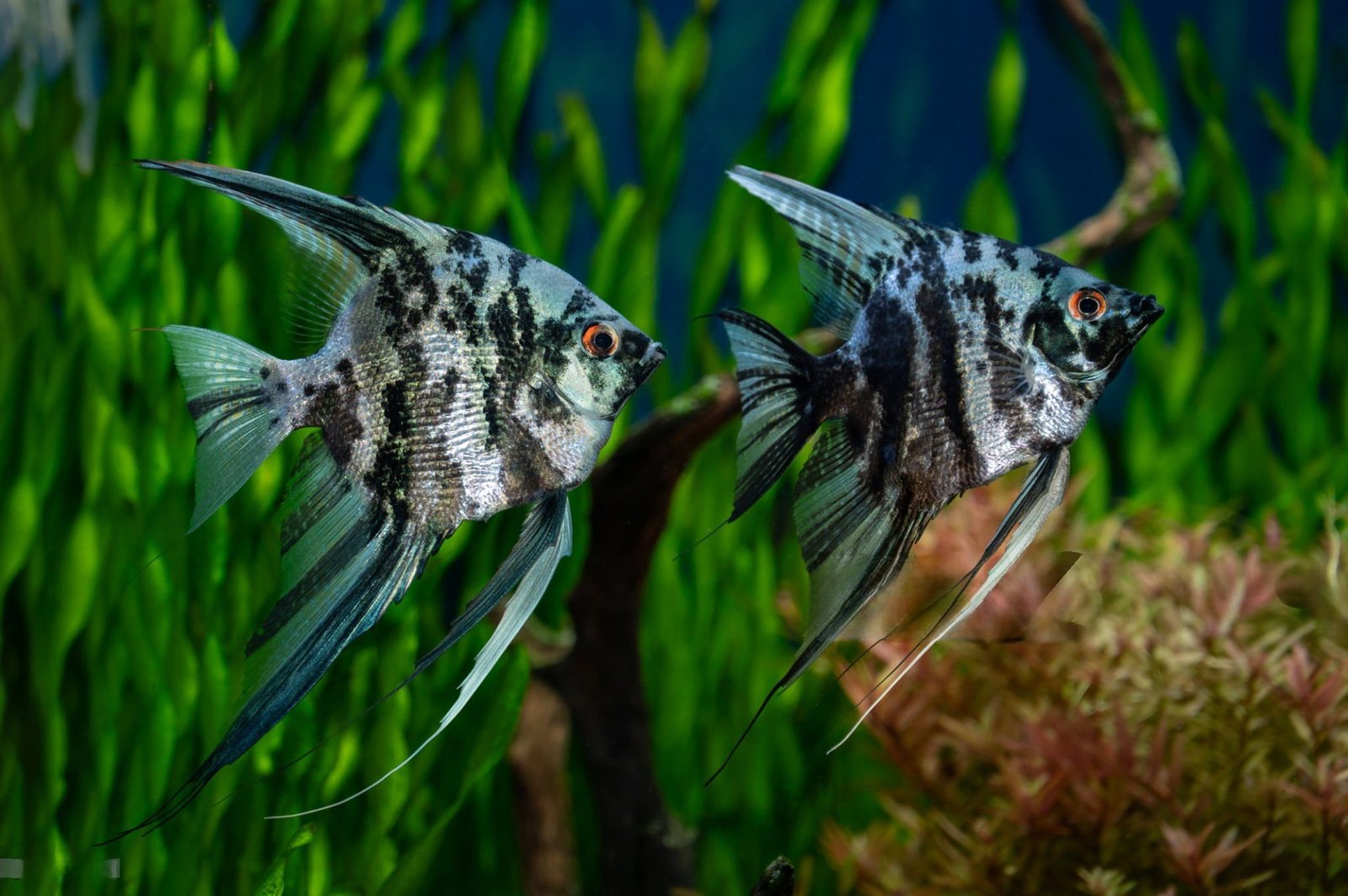
Angelfish breeding is one of the most rewarding experiences in freshwater fishkeeping, showcasing the complex parental behaviour typical of cichlids. Angelfish form monogamous pairs that bond gradually from a group — typically by observing 4 to 6 juveniles together in a large tank and allowing them to naturally pair up as they mature.
How Breeding Occurs
A bonded pair will choose a spawning site — typically a broad flat leaf, a length of vertical PVC pipe, a smooth piece of slate or a broad-leaved plant — and meticulously clean it before egg-laying. The female deposits eggs in neat rows across the surface while the male follows immediately behind to fertilise them. A typical spawning produces 100 to 500 eggs depending on the age and condition of the female (Hurtado-Alvarado et al., 2009). Both parents fan the eggs with their fins to oxygenate them and remove any unfertilised or fungused eggs from the clutch.
Breeding success is strongly influenced by diet. Research confirmed that live earthworm produced the highest fecundity and hatchability in Pterophyllum scalare breeding pairs, while prepared granulated food produced the best larval growth length (Kasiri et al., 2012). Conditioning breeding pairs on a varied diet including live or frozen earthworm, bloodworm and brine shrimp in the weeks before expected spawning significantly improves egg quality and hatch rates.
Hatching and Fry Care
Eggs hatch within 36 to 48 hours at 28°C, with a positive correlation between temperature and hatching rate (Prity et al., 2024). Newly hatched larvae are often moved by the parents to pre-cleaned pits in the substrate where they remain for several days before becoming free-swimming. At the free-swimming stage, fry can be fed newly hatched brine shrimp nauplii or commercial liquid fry food. For a planted breeding tank substrate that supports fry survival, see our soil in fish tank guide.
14. Angelfish Price
The angel fish price varies considerably depending on the colour variety, fin type, size at purchase and retailer. The following price ranges reflect typical US retail prices at aquarium shops and online sellers and are subject to change by retailer and region.
| Variety | Approx Price (USD) | Availability |
|---|---|---|
| Standard Silver (juvenile) | USD 4 to 10 | Widely available |
| Marble or Koi Angelfish | USD 8 to 18 | Widely available |
| Black Angelfish | USD 10 to 25 | Commonly available |
| Veil or Longfin variety | USD 12 to 30 | Commonly available |
| Gold or Albino | USD 15 to 35 | Less common |
| GloFish Angelfish | USD 31 to 143 | Specialist retailers |
| P. altum (Altum Angel) | USD 40 to 120 | Specialist only |
| Saltwater Angelfish (marine) | USD 30 to 200+ | Marine fish stores |
Budget for the full setup cost beyond the fish themselves — a 55-gallon aquarium with stand, filtration, lighting, heater and substrate represents the core investment for a proper angelfish community setup. Our 50 gallon fish tank guide and 50 gallon fish tank dimensions guide cover equipment costs and setup requirements at the volume most commonly used for angelfish communities.
15. Angelfish for Sale — What to Check Before Buying
When searching for angel fish for sale, the condition of the fish in the shop tank is the most reliable indicator of its health and likely lifespan in your aquarium. Signs of a healthy angelfish to buy:
- Erect, undamaged fins with no ragged edges or missing sections
- Clear eyes without cloudiness or swelling
- Active swimming behaviour — not hanging near the surface or resting on the bottom
- Full, rounded belly — not hollow or sunken which indicates starvation or internal parasites
- No white spots, cottony growths, patches of discolouration or visible wounds
- Responsive to movement near the tank — healthy angelfish are curious and alert
Signs to avoid when purchasing:
- Clamped fins held tight against the body — a common sign of stress, disease or poor water quality in the shop tank
- White spots or salt-grain-like particles on the body or fins — indicates active ich infection
- Other fish in the same shop tank that are dead or visibly sick — disease spreads quickly in a shared system
- Very thin, narrow body profile — may indicate internal parasites or chronic malnutrition
Always quarantine new angelfish in a separate tank for 2 to 4 weeks before introducing them to an established aquarium. This prevents introducing disease to resident fish and allows new arrivals to recover from the stress of transport.
16. Frequently Asked Questions
What fish to avoid with angelfish?
Avoid tiger barbs and serpae tetras — both are aggressive fin-nippers that will damage angelfish fins. Avoid small nano fish such as neon tetras, young guppies and chili rasboras that will be eaten by adult angelfish. Avoid large aggressive cichlids including Oscars, Jack Dempseys and convict cichlids. Never keep angelfish with goldfish as the temperature requirements are incompatible.
Are angel fish hard to keep?
Angelfish are intermediate-level care. They require a fully cycled aquarium, stable water parameters, a tall tank of at least 29 gallons for a pair, compatible tank mates and a varied diet. They are more demanding than tetras or livebearers but less demanding than discus or saltwater species. New aquarists should build experience with simpler species before attempting angelfish.
Are angelfish poisonous?
No. Freshwater angelfish (Pterophyllum scalare) are completely non-toxic and pose no danger to other fish or to humans. They are safe to keep and handle during routine aquarium maintenance.
How big do angelfish get?
Adult Pterophyllum scalare reach approximately 15 cm (6 inches) in body length and up to 25 cm (10 inches) in total height including fins. They reach adult size between 12 and 18 months of age.
How long do angelfish live?
Angelfish have a lifespan of 10 to 12 years in a well-maintained freshwater aquarium. Some individuals reach 15 years with exceptional care. Stable water quality, a varied diet and compatible tank mates are the key factors determining longevity.
Can angelfish live with neon tetras?
Not safely in the long term. Neon tetras at 3 to 4 cm are within the prey size range of adult angelfish. Juvenile angelfish may coexist peacefully with neon tetras, but as the angelfish grows it will hunt and consume them. Larger tetras such as black skirt tetras or bleeding heart tetras are safer companions.
What is the difference between freshwater and saltwater angelfish?
Freshwater angelfish (Pterophyllum) are South American cichlids requiring freshwater at pH 6.5 to 7.5. Saltwater angelfish (Pomacanthidae) are marine reef fish requiring specific gravity of 1.020 to 1.025. They share only the common name and require completely different setups, equipment and water chemistry. They cannot be kept together under any circumstances.
What is the best tank size for angelfish?
A 29-gallon tall aquarium is the minimum for a bonded pair in a species-only setup. A 55-gallon tall aquarium is the recommended size for an angelfish community tank. The tank must have a height of at least 40 cm (16 inches) to allow adult angelfish to fully extend their fins.
17. Conclusion
Angelfish reward the intermediate aquarist with extraordinary grace, intelligent behaviour, striking colour variety and a lifespan of up to 12 years that makes them one of the most long-term rewarding freshwater species available in the hobby. Getting the fundamentals right — a tall 55-gallon aquarium, stable water at 24 to 28°C and pH 6.5 to 7.5, a fully cycled biological filter, compatible tank mates and a varied protein-rich diet — is what separates a thriving angelfish community from a frustrating series of health problems.
Whether you are drawn to the classic silver wild type, the dramatic black angelfish varieties, the striking marble or koi colour morphs, or the extraordinary elegance of veil longfin specimens, the investment in planning the right setup before purchasing your first fish is the best decision you can make. Use the resources linked throughout this guide to research every aspect of your planned tank before committing.
Aquarium Types and Setup Guide Aquarium Problems and Solutions Beginner Fish Care Guide Planted Tank Substrate GuideReferences
- Aqueon (n.d.). Angelfish Care Guide. Aqueon Aquarium Products. Available at: https://www.aqueon.com/resources/care-guides/angelfish
- Bagchi, S., Vlaeminck, S.E., Sauder, L.A., Mosquera, M., Neufeld, J.D. and Boon, N. (2014). Temporal and spatial stability of ammonia-oxidizing archaea and bacteria in aquarium biofilters. PLOS ONE, 9(12), e113515. https://doi.org/10.1371/journal.pone.0113515
- Boyd, C.E. and Tucker, C.S. (1998). Pond Aquaculture Water Quality Management. Kluwer Academic Publishers, Boston. https://doi.org/10.1007/978-1-4615-5407-3
- Davis, J.C. (1975). Minimal dissolved oxygen requirements of aquatic life with emphasis on Canadian species. Journal of the Fisheries Research Board of Canada, 32(12), 2295 to 2332. https://doi.org/10.1139/f75-268
- Fishbase (2024). Pterophyllum scalare (Schultze, 1823) — Freshwater Angelfish. Available at: https://fishbase.se/summary/4717
- Fishmetry (2025). Angelfish Pterophyllum scalare — Species Profile and Tank Mate Guide. Available at: https://fishmetry.com/fish/pterophyllum-scalare
- Froese, R. and Pauly, D. (Eds.) (2024). FishBase. Pterophyllum scalare. World Wide Web electronic publication. Available at: https://www.fishbase.org/summary/4717
- Hurtado-Alvarado, G., Valtierra-de-Real, B., Cibrián-Llanderal, V.H., Domínguez-Salazar, E. and Paredes-Guerrero, J. (2009). Fecundity, growth, and survival of the angelfish Pterophyllum scalare (Perciformes: Cichlidae) under laboratory conditions. Revista de Biología Tropical, 57(3). https://www.scielo.sa.cr/scielo.php?script=sci_arttext&pid=S0034-77442009000300022
- Kasiri, M., Farahi, A. and Sudagar, M. (2012). Growth and reproductive performance by different feed types in fresh water angelfish (Pterophyllum scalare Schultze, 1823). Journal of Veterinary Research, 67(3). Available at: https://www.ncbi.nlm.nih.gov/pmc/articles/PMC4299979/
- Kingston, S.D., Sophia, J.M. and Viji, V. (2014). Angel fish (Pterophyllum scalare) — stunted growth and swimming abnormalities — a report. Indian Journal of Veterinary and Animal Sciences Research, 43(1), 61 to 64.
- Pleeging, C.C.F. and Moons, C.P.H. (2017). Potential welfare issues of the Siamese fighting fish (Betta splendens) at the retailer and in the hobbyist aquarium. Vlaams Diergeneeskundig Tijdschrift, 86, 213 to 223. https://doi.org/10.21825/vdt.v86i4.16182
- Prity, S., Biswal, B., Panda, R. and Mishra, M. (2024). Study on breeding behaviour of freshwater angelfish (Pterophyllum scalare). SATSA Mukhapatra — Annual Technical Issue, 28. Available at: https://www.researchgate.net/publication/378129956
- Santos, R.F.B., Zanella, J., Ferreira, A.C.V., Couto, M.V., Dias, H.M., Abe, H.A., Ramos, F.M., Paixão, P.E.G., Martins, M.L., Fujimoto, R.Y. and Honorato, C.A. (2024). Growth performance and parasite load of angelfish juveniles Pterophyllum scalare kept at different stocking densities in two rearing systems. Brazilian Journal of Biology, 84. https://doi.org/10.1590/1519-6984.280128
- TFH Magazine (n.d.). Pterophyllum scalare Care. Tropical Fish Hobbyist Magazine. Available at: https://www.tfhmagazine.com/articles/freshwater/pterophyllum-scalare
- USGS (2024). Freshwater angelfish (Pterophyllum scalare) — Species Profile. US Geological Survey Nonindigenous Aquatic Species Database. Available at: https://nas.er.usgs.gov/queries/factsheet.aspx?SpeciesID=475
- Walster, C., Rasidi, E., Saint-Erne, N. and Loh, R. (2015). The welfare of ornamental fish in the home aquarium. Companion Animal, 20(5), 302 to 306. https://doi.org/10.12968/coan.2015.20.5.302