Copper Oscar Fish
Select your Oscar setup, diet quality and lighting quality to get a practical tank-size, water-change and colour-support estimate.
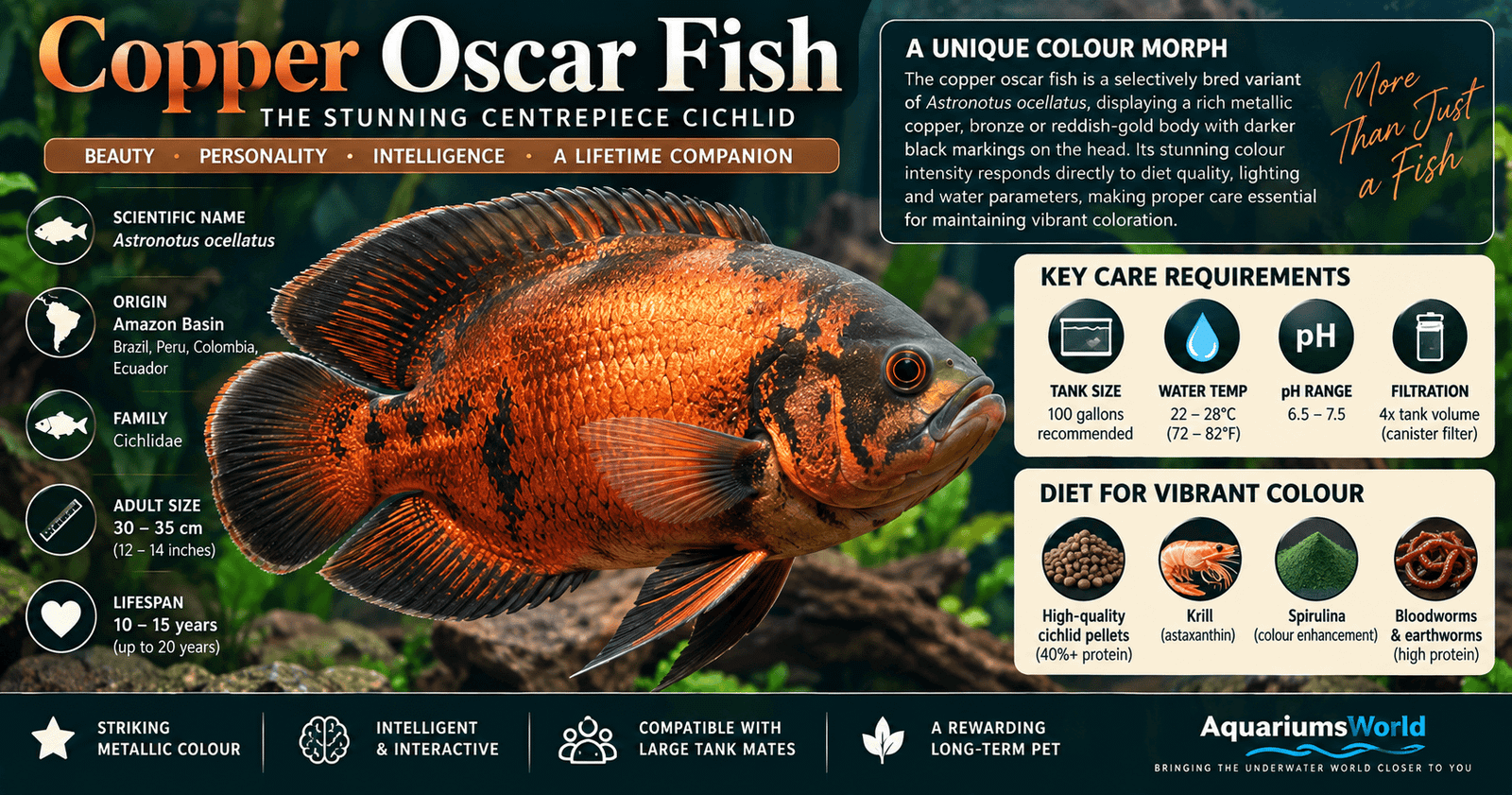
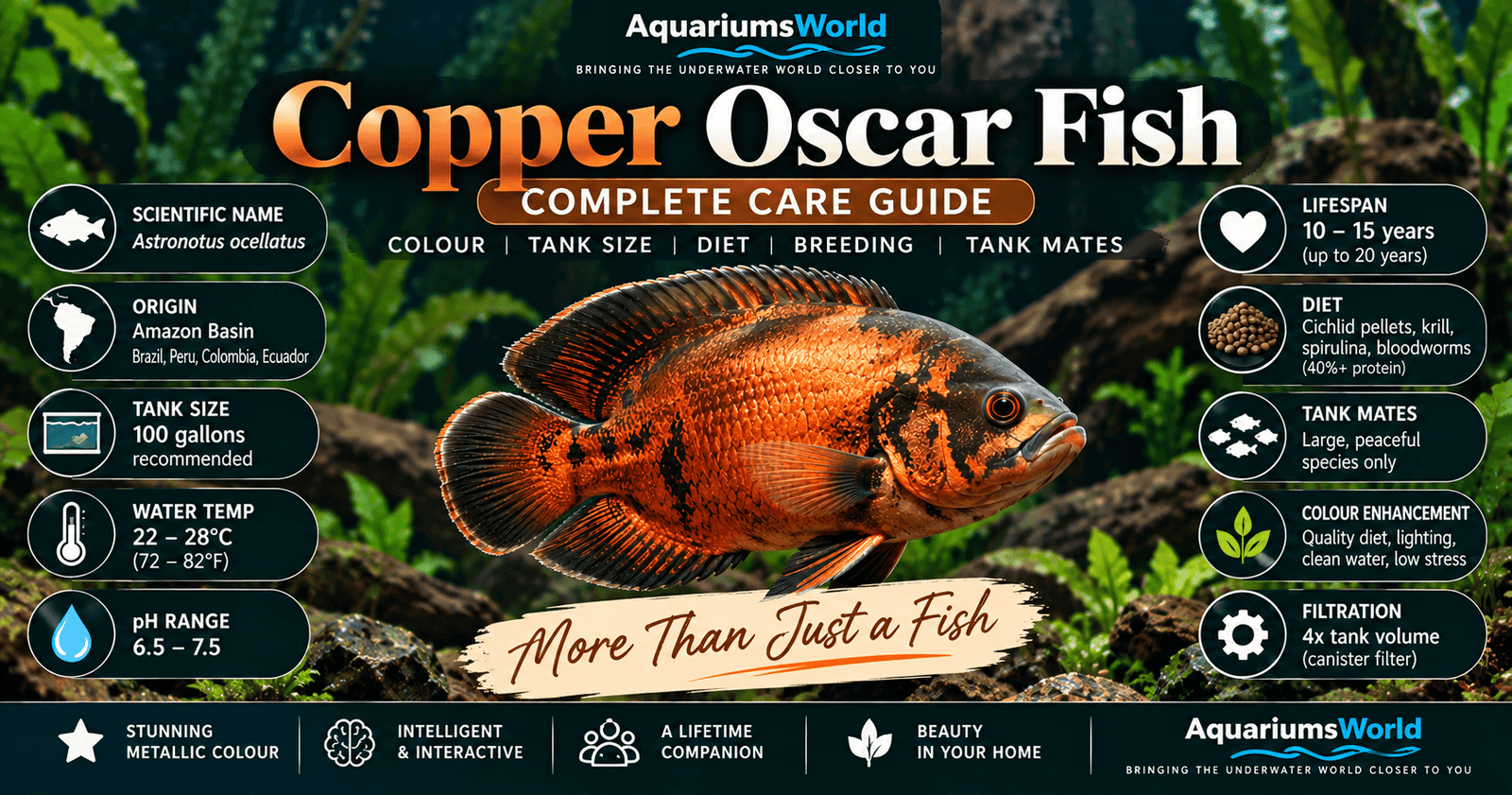
The copper oscar fish is one of the most distinctive colour forms seen in the Oscar hobby. Its warm bronze, copper and reddish tones can look almost metallic when the fish turns under aquarium lighting, which is why the variety attracts aquarists looking for a dramatic freshwater centrepiece. The important point is that a copper Oscar is not a separate species. It is a colour form of Astronotus ocellatus, so its adult size, temperament, feeding behaviour, water requirements and long-term care are fundamentally the same as those of other Oscars.
This copper oscar fish care guide explains how the colour form fits into the biology of Astronotus ocellatus, how large it can become, what copper oscar fish tank size is appropriate, how diet and environmental conditions influence appearance, how breeding works, and which copper oscar fish tank mates can be considered. It also separates established species information from hobby claims about colour enhancement, because a brighter fish is not automatically a healthier fish.
If you are planning your first large cichlid aquarium, read our complete beginner’s guide to fish care before purchasing livestock. For community planning, our Oscar fish compatibility resources are also useful because the same adult-size and temperament principles apply to copper, red, tiger and albino Oscars.
Copper Oscar Fish Care Complete Guide
Good copper oscar fish care is built around consistency rather than a single colour-enhancing product. Start with a fully cycled aquarium, stable temperature and reliable filtration. Test ammonia, nitrite and nitrate regularly, particularly after changes to stocking, feeding or filter media. Feed a complete large-cichlid diet and remove leftovers before they break down into additional waste.
Observe behaviour every day. A healthy Oscar should remain responsive, swim normally and show interest in food. Occasional hiding is not automatically abnormal, especially when the aquarium has strong lighting or activity around it. Persistent hiding, rapid breathing, loss of appetite, repeated surface gasping or continuous aggression should trigger a water test and a review of the aquarium environment.
Keep decor secure because Oscars can dig and move objects. Provide open swimming space rather than filling the entire aquarium with ornaments. If tank mates are added, introduce them only after considering their adult size and behaviour, and have a separation plan ready.
Finally, treat copper colour as a feature to preserve, not a target that justifies stressful conditions. Good husbandry, suitable nutrition and a calm environment give the fish the best opportunity to express its inherited colour naturally. Never increase feeding, lighting or supplements simply to chase colour if the fish shows signs of stress or poor health.
What Is a Copper Oscar Fish
A copper oscar fish is an aquarium colour form of Astronotus ocellatus, the Oscar cichlid. It belongs to the family Cichlidae and is native to freshwater systems in South America, particularly the western Amazon and Orinoco regions. FishBase records the species from the western Amazon and Orinoco basins and lists a maximum published length of 45.7 cm and a maximum published weight of about 1.6 kg. That biological scale matters when a buyer sees a copper Oscar only a few inches long in a store.
The copper oscar fish is usually described in the aquarium trade by its warm copper, bronze, reddish-brown or burnt-orange appearance. Individuals vary considerably. Some have a darker head, strong red patches or black markings, while others show a more even bronze body. Lighting angle also changes the appearance because reflective structures in fish skin interact with pigment cells and incident light.
Scientific studies do not establish copper Oscar as a separate taxonomic species. Research on Oscar skin has shown that colour differences among varieties can be associated with changes in chromatophore number, morphology, pigment deposition and gene expression. Wang and colleagues found substantial differences between wild and albino Oscars, including differences in melanophore structure and melanin deposition. Broader fish pigmentation research identifies melanophores, erythrophores, xanthophores and iridophores as important cell types involved in black, red-orange, yellow-orange and reflective coloration.
That gives a useful framework for understanding the copper appearance. The warm visible colour is produced by pigment systems, while reflective cells can contribute to a metallic or iridescent visual effect. However, it would be too strong to claim that one exact chromatophore ratio uniquely defines every fish sold as a copper Oscar. Aquarium colour strains are breeding populations rather than laboratory-standardised genetic categories.
Copper Oscar Fish Selective Breeding History
Copper Oscar breeding history is part of the broader development of ornamental Oscar colour strains. Wild Astronotus ocellatus has a darker base with orange-red areas and characteristic ocelli, while captive selection has produced tiger, red, albino and other commercial forms.
Selective breeding increases the frequency of desirable traits by repeatedly choosing parents that express them. Modern pigmentation research shows that fish colour is influenced by genetic mechanisms as well as environmental conditions, so offspring from similar parents can still vary.
The term copper is therefore best treated as an aquarium variety name rather than a formal scientific classification. Breeders may use copper, bronze or copper-red for overlapping appearances. Buyers should ask about parent fish and mature colour instead of assuming a juvenile will retain exactly the same pattern.
Copper Oscar vs Golden Oscar: Key Differences
Copper and golden Oscars can overlap visually because both may show yellow, orange or bronze tones. Copper forms are generally described as deeper bronze or reddish-brown, while golden forms are usually brighter yellow-gold.
Fish pigmentation depends on several chromatophore types and reflective structures. Luo and colleagues explain how pigment cells and structural components combine to produce different fish colours.
There is no meaningful care difference. Both are Astronotus ocellatus and require the same adult tank planning, filtration, water quality, feeding and behavioural management.
Copper Oscar vs Red Oscar: Key Differences
The copper oscar fish vs red oscar fish comparison is mainly visual. Red Oscars are generally selected for stronger orange-red coverage, while copper forms tend to retain more bronze, brown or reflective qualities. Some copper-red fish sit between these descriptions.
Colour should not be used as a diagnosis. Oscars can change pattern during social interactions and stress. Beeching’s study showed that Oscar colour pattern participates in social signalling, including a dark-and-banded pattern displayed by defeated fish.
If a copper Oscar becomes consistently dull while also hiding, breathing rapidly or refusing food, check water quality and behaviour rather than trying to correct colour alone.
Copper Oscar Fish Classification and Natural Habitat
The scientific name of the Oscar is Astronotus ocellatus Agassiz, 1831, in the family Cichlidae. FishBase records the species from the western Amazon and Orinoco basins and describes it as a freshwater, benthopelagic fish associated with tropical conditions.
Wild Oscars occur in quieter shallow waters, including muddy or sandy-bottomed canals and ponds, with submerged structure and cover. An aquarium does not need to reproduce the whole Amazon ecosystem. It needs adequate swimming space, stable water chemistry, secure decor and environmental complexity.
The wild form is not copper in the selective-breeding sense. Copper is an aquarium-trade phenotype developed through captive selection. FishBase also records a diet including small fish, crayfish, worms and insect larvae, supporting the Oscar’s broad opportunistic feeding ecology.
How Big Does a Copper Oscar Fish Get
The adult size of a copper oscar fish is one of the most important facts to understand before purchase. The colour variety does not change the underlying species biology. FishBase records a maximum published length of 45.7 cm total length and a maximum published weight of 1.6 kg for Astronotus ocellatus. Many aquarium specimens are smaller, but a responsible keeper should plan around the possibility of a large adult rather than assuming that a juvenile size is permanent.
A commonly encountered adult aquarium range is around 30 to 35 cm, or approximately 12 to 14 inches, although individual fish can exceed that range. Growth is often rapid during the juvenile stage when nutrition and water quality are good. The exact monthly growth rate varies with genetics, feeding, temperature, starting size and husbandry, so fixed claims such as every juvenile gaining exactly three centimetres per month should not be treated as a biological rule.
A copper Oscar sold at 5 to 8 cm may look comfortable in a medium aquarium. Within a relatively short period, however, its body mass and waste production can change dramatically. Planning the adult tank from the beginning avoids repeated upgrades and reduces the temptation to keep a large cichlid in an undersized temporary system.
Copper Oscar Fish Full Grown Size Timeline
| Age or Stage | Approximate Size | Planning Point |
|---|---|---|
| Juvenile purchase | 5 to 8 cm | Temporary grow-out only if the adult aquarium is already planned |
| Around 6 months | 15 to 20 cm | Adult-size planning becomes urgent |
| Around 12 months | 25 to 30 cm | Large filtration and swimming space are essential |
| Around 18 months | 30 to 35 cm | Treat the fish as a large adult |
| Mature adult | 30 to 35 cm commonly, potentially larger | Plan around adult body size and bioload |
For exact aquarium dimensions and filled weight, use our fish tank dimensions and weight comparison guide . If you are considering a 100-gallon setup, our 100 gallon fish tank guide gives additional information on footprint, equipment and stocking.
Copper Oscar Fish Tank Size Requirements
The copper oscar fish tank size should be selected according to adult body size, swimming behaviour, bioload, aquarium footprint, filtration and whether tank mates are included. A single adult Oscar is commonly planned for at least a 75-gallon aquarium, while a 100-gallon aquarium gives a substantially more practical long-term footprint for one large fish.
A 55-gallon tank is frequently mentioned in aquarium shops and online care pages as a minimum for a single Oscar. It can be useful as a temporary juvenile or grow-out aquarium, but it leaves little margin once the fish reaches adult size. For long-term care, a 75-gallon aquarium is a more realistic lower planning point, with 100 gallons preferable when space and budget allow.
For two adult Oscars, 125 to 150 gallons is a more appropriate planning range, with additional volume needed if other large fish are included. The important issue is not simply total gallons. Length and front-to-back depth determine how much usable swimming and territorial space the fish actually receives.
| Setup | Planning Minimum | More Comfortable Target |
|---|---|---|
| One copper Oscar alone | 75 gallons | 100 gallons |
| One Oscar plus large pleco | 100 gallons | 125 gallons |
| One Oscar plus four silver dollars | 100 gallons | 125 gallons |
| One Oscar plus severum | 100 gallons | 125 gallons |
| One Oscar plus Jack Dempsey | 125 gallons | 150 gallons |
| Two Oscars with additional large tank mates | 150 gallons | 180 gallons or larger |
Use the AquariumsWorld aquarium stocking calculator as another planning reference, but do not apply a simple one-inch-per-gallon rule to a large cichlid. Adult biomass, waste output, behaviour and filtration capacity are much more informative than a basic length calculation.
Copper Oscar Fish Tank Setup
A successful copper oscar fish tank setup starts with footprint. A long, wide 100-gallon aquarium provides more useful horizontal space than a tall tank with the same volume.
Substrate should be smooth sand or rounded fine gravel. Oscars investigate the bottom with their mouths and can move substrate during digging. Avoid sharp materials that could cause abrasions. The aquarium should also have secure decor because Oscars are powerful fish that can rearrange light objects.
Driftwood, large smooth rocks and robust shelters can create visual boundaries. Avoid unstable piles that could collapse when the fish excavates beneath them. Heavy decor should be placed securely before adding substrate around its base.
Plants are optional rather than essential. Many Oscars uproot or damage delicate plants. If you want greenery, attach robust rhizome plants to rocks or wood, or use aquarium-safe artificial plants that cannot be swallowed or broken into sharp pieces.
Filtration is especially important because adult Oscars eat heavily and produce substantial waste. Instead of relying on an arbitrary multiplier, select filtration according to the aquarium’s actual turnover, media capacity, flow pattern and maintenance routine. A canister or sump system with substantial biological media is often practical for a 100-gallon Oscar aquarium.
For oxygenation, read our aquarium air pump and aeration guide . An air pump is not a substitute for biological filtration, but surface agitation can support gas exchange, particularly in heavily stocked systems or during warm weather.
Copper Oscar Fish Water Parameters
Stable water is more important than chasing one perfect number. A practical aquarium target is around 24 to 27°C, with pH around 6.5 to 7.5 in many established systems, ammonia at 0 ppm, nitrite at 0 ppm and nitrate kept low. A 25 to 30 percent weekly water change is a useful starting point, adjusted to testing and stocking.
Controlled research on juvenile Oscars found that very high and very low temperatures reduced growth and survival, supporting the principle of avoiding thermal extremes. FishBase also records tropical freshwater conditions for the species.
| Parameter | Practical Target |
|---|---|
| Temperature | 24 to 27°C |
| pH | About 6.5 to 7.5 in many established systems |
| Ammonia | 0 ppm |
| Nitrite | 0 ppm |
| Nitrate | Keep low, with below 20 ppm as a useful maintenance target |
| Water changes | Often 25 to 30 percent weekly, adjusted to testing and stocking |
Do not interpret these targets as a licence to ignore test results. A stable aquarium with slightly different chemistry can be healthier than a tank that is repeatedly forced toward a target number. If your pH, ammonia, nitrite or nitrate readings are changing unexpectedly, use the Fish Aquarium Problems and Solutions guide before adding more livestock.
The aquarium should be fully cycled before introducing a copper Oscar. Ammonia and nitrite should remain at zero in an established system. The nitrogen cycle is particularly important with Oscars because their adult waste production can be substantial.
If you are building a new aquarium, our Fish Aquarium Types and Setup Guide explains the relationship between tank type, equipment, stocking and water quality. For larger builds, also review the 50 gallon fish tank guide and the 100 gallon guide before purchasing a stand.
Copper Oscar Fish Lighting for Colour
Lighting can influence how the copper colour is perceived, but lighting cannot manufacture pigment that the fish does not genetically express. A copper Oscar can appear more bronze, orange or reflective under different colour temperatures because human perception changes with the spectrum and intensity of illumination.
Moderate lighting is generally easier to manage than extremely bright illumination. A warm or neutral full-spectrum light can make bronze and orange tones visually prominent, while excessive brightness may create glare and make a fish hide. The correct lighting schedule should also give the fish a consistent day and night cycle.
Research on aquarium background colour has shown that the visual environment can affect Oscar physiology. In one controlled study, juvenile Oscars kept in red, yellow, white and blue tanks showed measurable differences in growth, stress-related biochemical markers and immune responses. The study found that the blue treatment was associated with higher stress indicators, while red tanks produced stronger performance measures. This evidence should not be stretched into a claim that one aquarium colour will make every copper Oscar more colourful, but it does show that environmental colour is biologically relevant.
For lighting, focus first on fish behaviour. If the Oscar spends most of the day hiding after a lighting change, reduce intensity, provide shaded areas and reassess the schedule. A healthy colour display is secondary to a stable environment.
For additional aquarium lighting information, see the AquariumsWorld aquarium lighting guide .
What Do Copper Oscar Fish Eat
Copper Oscars are opportunistic omnivores. A complete large-cichlid pellet or stick should form the foundation of the diet, with controlled supplemental foods such as krill, earthworms and appropriate frozen foods.
Overfeeding increases waste and nitrate, so feed portions that the fish can consume promptly. Feeder fish are not necessary and should not be the main diet because of disease and nutritional concerns.
Use body condition, growth, waste and appetite to adjust feeding rather than assuming a large Oscar should always receive more food.
Copper Oscar Fish Diet and Colour Enhancement
Diet is one area where direct evidence supports cautious colour-enhancement advice. Carotenoids contribute to fish pigmentation, and a controlled study on Astronotus ocellatus found that spirulina supplementation increased total skin carotenoid content at the highest tested inclusion level.
Mohammadiazarm and colleagues tested diets containing 0, 13.75, 27.5 and 55 g/kg spirulina for eight weeks. The highest treatment produced significantly higher skin carotenoid content along with other physiological differences. This shows that diet can influence Oscar pigmentation, but it does not prove that every copper Oscar will develop the same visible response.
Krill can be used as a supplemental carotenoid-rich food, while a complete cichlid food should remain the nutritional foundation. A practical rotation can include pellets as the daily staple, krill once or twice weekly, a suitable frozen food occasionally, and spirulina-containing complete food as part of the weekly diet.
A fasting or reduced-feeding day can be useful for some adult fish but is not mandatory for every Oscar. Juveniles and breeding fish may need different feeding schedules. Monitor body condition rather than following a rigid calendar.
Copper Oscar Fish Colour Enhancement: Complete Guide
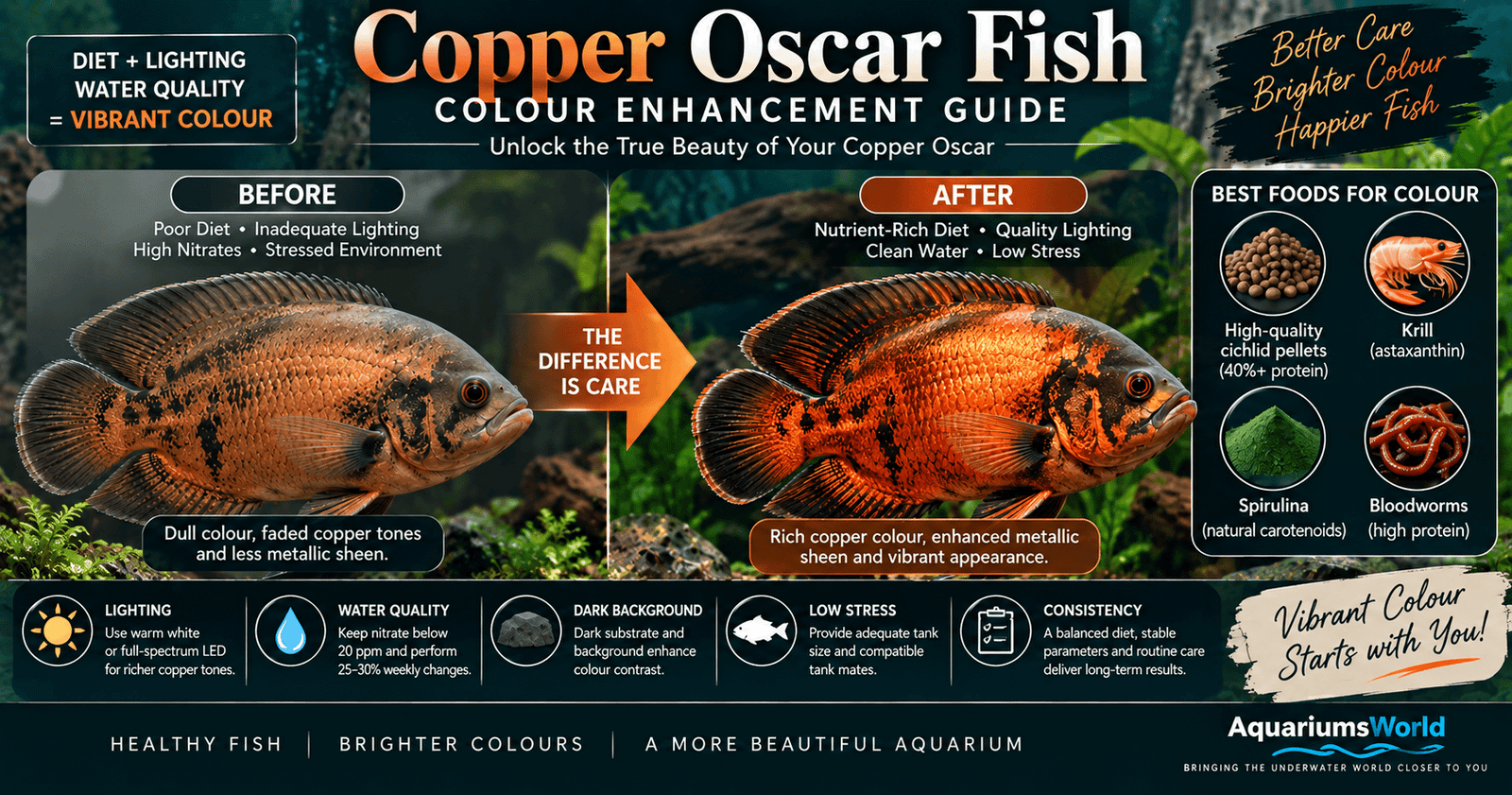
Five factors influence how copper colour is expressed and perceived. Nutrition provides carotenoid sources and complete nutrients. Lighting determines how existing colour appears but cannot create inherited pigmentation. Background and decor alter visual contrast and can also influence fish physiology.
Water quality is essential because chronic environmental stress can alter normal behaviour and feeding. Keep ammonia and nitrite at zero and nitrate low through appropriate stocking, filtration and water changes.
Social stress is also important. A copper Oscar that is repeatedly chased may hide or change colour. Beeching’s work demonstrates that colour pattern has a social role, so colour should be assessed alongside behaviour rather than treated as a cosmetic score.
The practical checklist is complete food, suitable supplemental carotenoids, stable water, moderate lighting, secure decor, adequate space and compatible tank mates. There is no reliable shortcut that can turn a genetically different fish into a true copper strain.
Are Copper Oscar Fish Rare
Copper Oscars are better described as less commonly encountered than the most familiar red or tiger forms rather than automatically being considered extremely rare. Availability changes between breeders, wholesalers, local fish stores and online retailers, and the name may be used inconsistently.
In the United States, specialist cichlid sellers and independent breeders may list copper or copper-red Oscars. Prices also vary according to size, appearance, breeder reputation and availability. Because online listings change quickly, a fixed national price should not be treated as a permanent market value.
When buying a copper Oscar, focus on health and provenance rather than colour intensity alone. Look for clear eyes, intact fins, normal posture, active swimming and a strong feeding response. Ask the seller whether the fish is captive-bred, what the parent fish looked like, and whether photographs show the same individual or a representative fish.
A very bright juvenile can change significantly as it grows. If you want a predictable colour project, buying from a breeder who can show mature parents is more informative than relying on a small retail photograph.
Copper Oscar Fish for Sale USA
Copper oscar fish for sale USA searches can produce specialist breeders, online retailers and marketplace listings. Availability and pricing change, so current listings should be compared rather than relying on an old national price range.
Before buying, ask the current size, expected adult size, parent colour, diet, quarantine history and live-arrival policy. Health should come before colour intensity. Clear eyes, intact fins, normal posture, active swimming and a strong feeding response are useful signs when evaluating a fish.
A very bright juvenile can change as it matures. If predictable colour is important, photographs of mature parent fish and information about the breeding line are more useful than a small retail photograph.
Copper Oscar Fish Breeding Guide
Copper Oscar breeding follows the reproductive biology of Astronotus ocellatus. A compatible adult pair may choose a flat surface such as a rock or other solid structure, clean the area and spawn on it. Both parents can participate in guarding eggs and fry.
FishBase reports that Oscars in captivity clean suitable spawning sites and that eggs are usually deposited in large numbers and guarded by both parents. This parental care is typical of the species and becomes particularly important when a pair is breeding in a community aquarium.
Sexing young Oscars is difficult. External appearance is not a dependable method for determining sex in juveniles, and many aquarists identify a pair only when reproductive behaviour occurs or breeding structures become visible.
A breeding setup should provide a large aquarium, strong filtration, a stable temperature and a secure spawning surface. If a pair becomes territorial, other fish may be attacked. The keeper should therefore have a plan for separating tank mates before spawning begins.
Copper Oscar Fish Breeding Guide: Spawning and Fry
A pair may clean a flat rock, slate or another firm surface before spawning. The female deposits eggs and the male fertilises them. Both parents may then guard the clutch and repel other fish.
FishBase reports that Oscar eggs can hatch within several days and that parents move young fry to a shallow pit where they remain under parental protection for additional days. Exact timing varies with temperature and development.
Once fry become free swimming, they need appropriately sized food and excellent water quality. Newly hatched live foods such as baby brine shrimp can be used by experienced breeders, while specialist fry foods can provide an alternative.
The main challenge is not getting two Oscars to spawn. The challenge is managing the resulting number of young fish. A successful pair can produce more fry than a home aquarist can reasonably house. Breeding should therefore be planned around available tanks, filtration, grow-out space and responsible placement of offspring.
Can Copper Oscar Fish Breed with Other Oscar Varieties
Yes. Copper, red, tiger and albino Oscars are colour forms within the same species, Astronotus ocellatus, so they can potentially breed with one another. The appearance of offspring is less predictable than the appearance of a purchased adult because colour traits are influenced by multiple genetic and cellular mechanisms.
If a copper Oscar is crossed with a red Oscar, for example, the offspring should not be expected to be uniformly copper or uniformly red. Some young may show mixed patterns, darker bodies or different proportions of orange, red and reflective appearance.
Selective breeding requires records. Breeders who want to develop a consistent line should document parentage, mature colour, growth and offspring appearance over several generations. Casual pairing can produce attractive fish, but it does not guarantee a stable commercial strain.
Copper Oscar Fish Tank Mates
Copper Oscar fish tank mates must meet the same compatibility principles as tank mates for any Oscar. The colour morph does not make the fish smaller or more peaceful. Suitable companions need adequate adult size, robust temperament, compatible water conditions and enough space for territories.
Silver dollars are often considered because they are active schooling fish and are generally less vulnerable to predation when kept at appropriate adult size. Large plecos can sometimes work because they are armoured and bottom-oriented, although species identification matters because some plecos become very large. Our orange plecostomus guide explains the importance of adult size and shelter.
Severums can coexist in large systems when individual temperaments are compatible. Jack Dempseys are more assertive and require more territory. Bichirs are another option in large predator-style systems but have their own feeding and escape-prevention requirements. Blood parrots may work in some large aquariums, but body shape and temperament vary.
| Potential Tank Mate | Why It May Work | Planning Aquarium |
|---|---|---|
| Silver dollar group | Active schooling fish with suitable adult size | 100 to 125 gallons |
| Large plecostomus | Armoured and mainly bottom-oriented | 100 to 125 gallons |
| Severum | Similar general water conditions and substantial body size | 100 to 125 gallons |
| Jack Dempsey | Robust but more assertive, requiring more territory | 125 to 150 gallons |
| Bichir | Large bottom-oriented fish | 100 to 125+ gallons |
| Blood parrot | Bulky body and generally moderate activity | 100 to 125+ gallons |
These are planning ranges, not compatibility guarantees. Before adding any fish, consider the adult size of every species, the aquarium footprint, territorial structure, filtration and the behaviour of the actual individuals.
Copper Oscar Fish Tank Mates Compatible Species: Practical Checklist
Before adding any companion, ask six questions. Is it too small to be swallowed? Is it robust enough for an assertive cichlid? Does it require very different temperature or water chemistry? Does it compete for the same territory? Is the aquarium large enough for adult size? Can the fish be separated if compatibility fails?
This checklist is more reliable than a guaranteed tank-mate list. Quarantine new fish where possible, introduce changes carefully and provide visual barriers. If chasing becomes continuous or one fish cannot feed or shelter normally, separate them.
A successful community aquarium is one in which every fish can feed, rest and move normally, not simply one in which the species can technically share the same water.
Copper Oscar Fish Tank Mates to Avoid
Avoid fish that are small enough to be swallowed. Adult Oscars have large mouths and can treat smaller fish as prey. The same concern applies to shrimp and many nano community species.
Goldfish are generally unsuitable because their temperature and husbandry requirements differ. Our Can Goldfish Live with Oscar Fish guide covers this comparison in more detail.
Very aggressive cichlids can create repeated territorial conflict, while long-finned or slow-moving fish can be vulnerable to harassment. African cichlids should not be selected simply because they are colourful or robust. Rift Lake species often require different water chemistry and social structures. Our African cichlid guide explains why compatibility must consider habitat, aggression, diet and water chemistry together.
Angelfish should also not be selected simply because they are another South American cichlid. Adult Oscars can injure or consume smaller fish, while territorial differences can make the combination risky. Our angelfish care guide provides additional compatibility information.
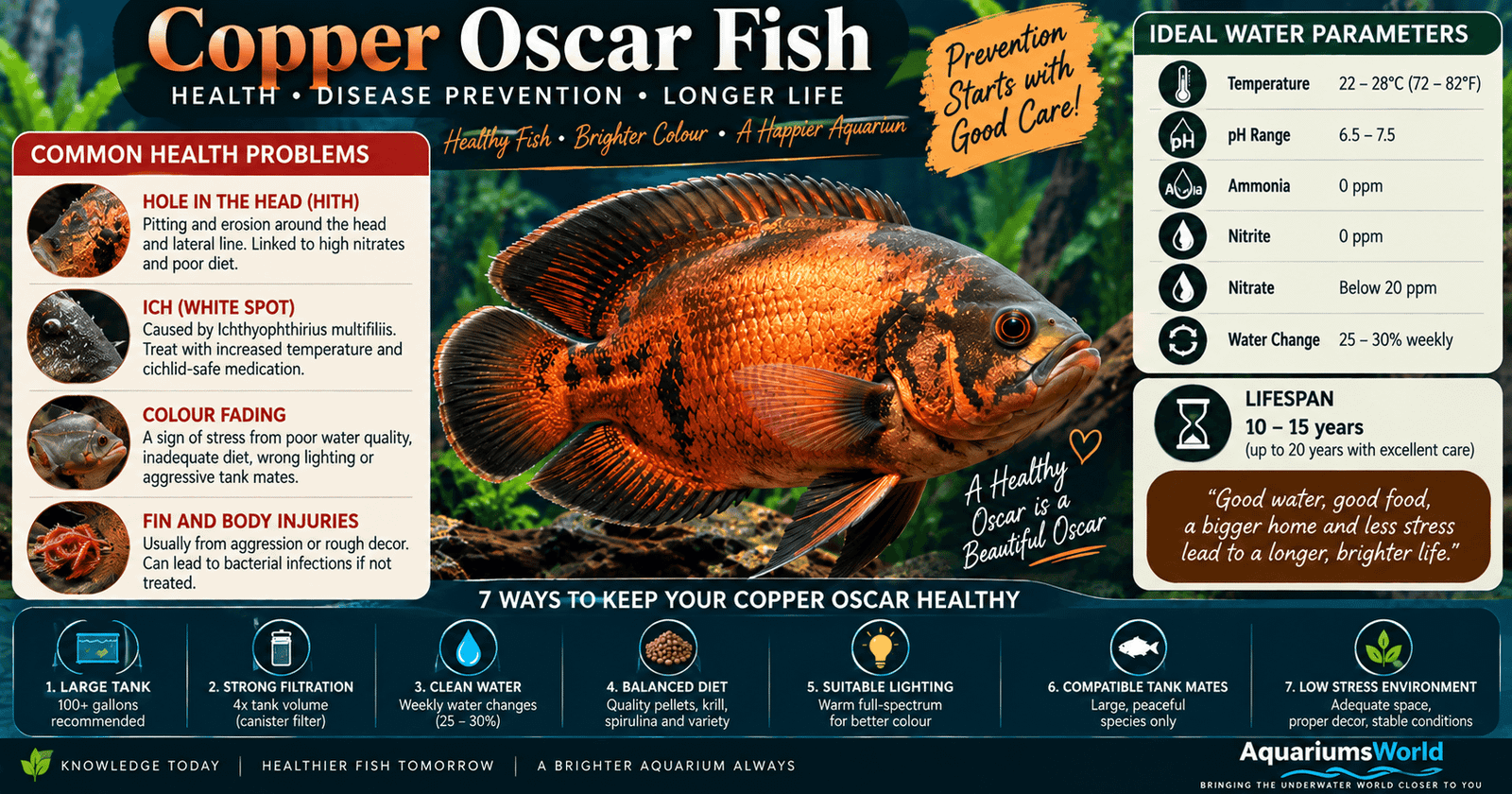
Copper Oscar Fish Health and Common Problems
Copper Oscar Fish Hole in the Head Disease
Hole in the Head disease, often discussed alongside Head and Lateral Line Erosion, is one of the health problems associated with Oscars and other large cichlids. The condition can appear as pits or erosions around the head and lateral line.
It is not scientifically responsible to describe HITH as being caused by one simple factor such as nitrate alone. Current aquarium-health discussions recognise a multifactorial picture involving water quality, nutrition, stress and possible infectious or parasitic contributions. The practical prevention strategy is therefore broader than one medication.
Start with water quality. Keep ammonia and nitrite at zero and prevent nitrate from accumulating through appropriate stocking, feeding, filtration and water changes. Feed a complete diet rather than relying on one food type. Reduce chronic aggression and provide enough space for normal behaviour.
If pitting or erosion appears, do not treat the symptom without checking the system. Test water, inspect filtration, review feeding and examine tank mates. A fish-health problem often exposes a husbandry weakness that needs to be corrected at the same time.
Copper Oscar Fish Health and Common Problems
Ich can produce white spots and irritation, while fin damage may result from aggression or sharp decor. Secondary bacterial problems can follow physical injury or poor water quality.
The best health routine is preventive: observe the fish daily, test water, remove uneaten food, maintain filtration and quarantine new arrivals where possible.
If the copper colour suddenly becomes dull, check water, temperature, feeding, tank mates, lighting and recent changes. Colour fading is an observation, not a diagnosis.
The AquariumsWorld Fish Aquarium Problems and Solutions guide covers ammonia, nitrite, nitrate, cloudy water, algae, disease and filtration problems.
Fin and Body Injuries
Oscar fish can injure themselves while digging or moving decor and can injure tank mates during territorial disputes. Smooth substrate and secure hardscape reduce preventable injuries.
If a fish has torn fins, remove the source of injury first. Separate an aggressive tank mate or replace sharp decor, then maintain clean water and good nutrition. Mild mechanical injuries can improve after the cause is corrected, while worsening redness, swelling or tissue loss warrants specialist aquatic-health advice.
Copper Oscar Fish Lifespan
A well-maintained Oscar is a long-term aquarium commitment. Hobby care sources commonly report around 10 to 15 years in captivity, although lifespan varies with genetics, disease exposure and husbandry.
Consistent water quality, appropriate nutrition, adequate space and low stress are central to longevity. Before buying a juvenile copper Oscar, consider whether you can maintain a large aquarium and its equipment for many years.
Copper Oscar Fish Colour Changes and Stress
Oscar colour can change naturally. Social status, defensive behaviour, lighting, background, activity and stress can influence visible appearance. Beeching’s research demonstrated that colour pattern can function in social interactions, so a colour change should not automatically be interpreted as disease.
However, persistent colour loss accompanied by behavioural changes deserves attention. Start with the basics: water tests, temperature, feeding, aggression and equipment.
If nitrate is elevated, correct the underlying maintenance problem. If a tank mate is constantly chasing the Oscar, provide separation rather than attempting to mask the stress with stronger lighting.
If the fish has stopped eating, is breathing rapidly or has visible lesions, treat the health issue as the priority. Colour enhancement should never come before welfare.
Copper Oscar Fish and Aquarium Footprint
Gallons alone do not describe the quality of an Oscar aquarium. Two tanks can hold the same volume but provide different amounts of horizontal swimming space. For an active, deep-bodied cichlid, a long aquarium with useful front-to-back depth is generally more practical than a tall, narrow design.
A 100-gallon aquarium is often around 60 inches long, although exact dimensions vary by manufacturer. A 125-gallon tank may offer a longer footprint and additional water volume. Before purchase, compare length, width, height, stand requirements and filled weight.
Our fish tank dimensions comparison can help you understand how nominal volume relates to physical footprint. For larger builds, our aquarium stand and size guide also explains why structural support matters when planning a heavily loaded aquarium.
Copper Oscar Fish and Water Changes
Water changes remove dissolved waste and help keep nitrate under control. They also allow the keeper to correct gradual changes in water chemistry.
The correct percentage depends on the system. A lightly stocked mature aquarium may need less intervention than a heavily fed Oscar community. The most useful approach is to combine routine maintenance with test results.
During a water change, match the new water temperature reasonably closely to the aquarium. Use a suitable dechlorinator when tap water contains chlorine or chloramine. Avoid dramatic chemistry changes unless there is a specific emergency reason and the change is being managed deliberately.
Copper Oscar Fish Behaviour and Personality
One reason Oscars remain popular is their interactive behaviour. Individual fish often learn feeding routines and may follow movement outside the aquarium. Their intelligence and curiosity can make them engaging centrepiece fish.
They are not passive community fish. An Oscar may move decor, dig substrate, claim an area and challenge another fish. Individual temperament varies, so a species compatibility table can never guarantee what two particular fish will do together.
During breeding, territorial behaviour can increase dramatically. Even fish that coexisted peacefully for months may begin chasing or biting tank mates once a pair forms.
Copper Oscar Fish Lighting and Background Setup
A dark background can provide strong visual contrast against copper, bronze and orange tones. The choice should also provide areas of shade so the fish can move away from direct illumination.
Avoid making the aquarium extremely bright simply because a retailer photograph showed the fish under intense lights. Photography can involve colour correction, camera exposure and post-processing. What looks spectacular in a product photograph may be uncomfortable as a permanent aquarium environment.
A consistent photoperiod is more useful than continuously changing the spectrum. Around 8 to 10 hours of display lighting is a practical starting point for many aquariums, adjusted for room light, plants and fish behaviour.
Copper Oscar Fish and Live Plants
Live plants are possible, but many Oscar keepers find them difficult because the fish can dig, move substrate and uproot plants. Plants attached firmly to hardscape have a better chance than delicate rooted plants.
Anubias and similar rhizome plants can be attached to rocks or driftwood rather than planted deeply in the substrate. However, no plant is completely Oscar-proof. The fish may still damage leaves or dislodge the hardscape.
If plants repeatedly become uprooted, use robust artificial plants or focus on wood, rocks and open swimming space. The aquarium does not need to be heavily planted to be attractive or healthy.
Frequently Asked Questions
What is a copper oscar fish?
A copper oscar fish is an aquarium colour form of Astronotus ocellatus, the Oscar cichlid. It is not a separate species. The copper label generally refers to warm bronze, copper, reddish-brown or metallic-looking coloration produced through selective breeding and pigment expression. Because breeding lines vary, the exact shade and pattern can differ considerably between individuals.
How big does a copper oscar fish get?
A copper Oscar can reach a large adult size because it is the same species as other Oscars. FishBase records a maximum published length of 45.7 cm and a maximum published weight of about 1.6 kg for Astronotus ocellatus. Many aquarium specimens are around 30 to 35 cm as adults, but owners should plan for the possibility of a larger fish rather than choosing a tank around the juvenile purchase size.
What is the difference between a copper oscar and a red oscar?
The difference is primarily visual and relates to breeding line and colour expression. Red Oscars are generally selected for stronger orange-red coloration, while copper Oscars are usually described as having bronze, copper, reddish-brown and reflective tones. Some individuals overlap these descriptions, so the names are not precise laboratory colour categories. Both are Astronotus ocellatus and have the same fundamental care requirements.
What do copper oscar fish eat?
Copper Oscars are opportunistic omnivores. A complete large-cichlid pellet or stick should form the main diet, with controlled supplemental foods such as krill, earthworms and appropriate frozen foods. Spirulina can be useful as part of a varied diet because an Oscar-specific study found increased skin carotenoid content in fish receiving spirulina supplementation. Avoid relying on feeder fish as a staple.
What tank size does a copper oscar fish need?
A single adult copper Oscar should be planned for at least a 75-gallon aquarium, with 100 gallons providing a more practical long-term target for many keepers. A pair or a community containing other large fish needs considerably more space. The aquarium footprint matters as much as nominal volume because Oscars benefit from horizontal swimming and territorial space.
Are copper oscar fish rare?
Copper Oscars are less commonly encountered than some mainstream Oscar colour forms, but the term rare should be used cautiously because availability changes between breeders and regions. Specialist breeders and fish stores may carry copper or copper-red forms. When buying, confirm the breeder’s terminology, ask for mature parent photographs and assess fish health rather than paying a premium solely for an attractive colour label.
How do I enhance the colour of my copper oscar fish?
Start with a complete diet and provide carotenoid-containing foods as appropriate. Spirulina has direct experimental evidence in Astronotus ocellatus for increasing total skin carotenoid content at the highest tested inclusion level. Good water quality, stable temperature, appropriate lighting, suitable background contrast and low social stress also support normal colour expression. Do not use colour-enhancing foods as a replacement for correct husbandry.
Can copper oscar fish breed with other oscar varieties?
Yes. Copper, red, tiger and albino Oscars are colour forms of Astronotus ocellatus and can potentially breed with each other. The resulting fry can show variable colour patterns because pigmentation is influenced by multiple genetic and environmental factors. If you are breeding for a specific colour line, keep detailed parentage and offspring records across generations.
What tank mates are suitable for copper oscar fish?
Potential tank mates include appropriately sized silver dollars, large plecos, severums, bichirs and selected robust cichlids. Compatibility depends on adult size, temperament, water conditions, aquarium footprint and feeding behaviour. There is no guaranteed tank mate because individual Oscars vary. Any fish small enough to be swallowed should be excluded, and every new fish should be monitored closely after introduction.
How long does a copper oscar fish live?
A well-kept Oscar can live for many years, and hobby care sources commonly report a lifespan around 10 to 15 years in captivity. Longevity depends on genetics, nutrition, water quality, disease prevention, tank size and stress management. Buying a juvenile therefore represents a long-term commitment to maintaining a large aquarium and its associated equipment.
Related AquariumsWorld Aquarium Guides
For broader aquarium planning, these AquariumsWorld resources provide additional information that complements copper Oscar care:
- 100 Gallon Fish Tank Complete Guide for large Oscar aquarium dimensions and setup planning.
- Fish Tank Dimensions in CM, Inches and Weight for comparing aquarium footprints.
- Aquarium Stocking Calculator for broader bioload planning.
- Aquarium Air Pump and Aeration Guide for oxygenation and surface agitation.
- Fish Aquarium Problems and Solutions for water-quality and disease troubleshooting.
- Fish Aquarium Types and Setup Guide for complete aquarium planning.
- 50 Gallon Fish Tank Guide for understanding tank dimensions and footprint.
- Aquarium Stand and Size Guide for structural planning principles.
- Aquarium Lighting Guide for aquarium light selection and spectrum.
- Orange Plecostomus Care Guide for pleco size, behaviour and tank-mate planning.
- Can Goldfish Live With Oscar Fish for a detailed Oscar and goldfish compatibility comparison.
- African Cichlid Guide for African cichlid water and compatibility differences.
- Angelfish Care Guide for comparison with another South American cichlid.
- Soil in Fish Tank Guide for substrate and planted aquarium planning.
- Corner Fish Tank Aquarium Guide for alternative aquarium footprints.
- Water Temperature for Cichlids for broader cichlid temperature guidance.
- AquariumsWorld Blog for the complete aquarium article library.
- Complete Beginner’s Fish Care Guide for foundational fishkeeping practices.
Conclusion
The copper oscar fish is a selectively bred colour form of Astronotus ocellatus, not a separate species. Its warm copper, bronze and reddish appearance comes from complex interactions among pigment cells, reflective structures, genetics and environmental conditions.
Plan around adult size rather than purchase size. A 75-gallon aquarium is a sensible lower planning point for one adult, while 100 gallons offers more useful long-term space. Pairs and community systems need substantially more room, filtration and territory.
Diet can support colour expression, but colour should never take priority over nutrition and welfare. Complete cichlid food, suitable supplemental foods, stable water, moderate lighting and low social stress provide a sound foundation. Direct Oscar research supports an effect of spirulina supplementation on skin carotenoids, while broader pigmentation research explains the interaction of genetics, pigment cells and environment.
For copper oscar fish tank mates, select large, robust species only after considering adult size, temperament, water chemistry and available territory. Silver dollars, large plecos, severums and bichirs can be considered in suitably large aquariums, but no combination is guaranteed. Monitor every introduction and be prepared to separate fish if aggression becomes persistent.
Use this guide with the AquariumsWorld 100 gallon tank guide, stocking calculator, air pump guide, fish aquarium problems guide and Oscar compatibility resources. The goal is not simply the brightest copper fish. It is a stable aquarium in which the fish can grow, feed, behave normally and maintain its natural colour over many years.
Scientific References
- Wang, Q., Zhang, Y.S., Peng, Q.L., Wen, B., Gao, J.Z. and Chen, Z.Z. (2022). Distinct skin morphological and transcriptomic profiles between wild and albino Oscar Astronotus ocellatus. Comparative Biochemistry and Physiology Part D: Genomics and Proteomics. DOI: 10.1016/j.cbd.2021.100944 .
- Luo, M., Lu, G., Yin, H., Wang, L., Atuganile, M. and Dong, Z. (2021). Fish pigmentation and coloration: Molecular mechanisms and aquaculture perspectives. Reviews in Aquaculture, 13(4), pp. 2395 to 2412. DOI: 10.1111/raq.12583 .
- Li, X. et al. (2024). Harnessing Hue: Advances and Applications of Fish Skin Pigmentation Genetics in Aquaculture. Fishes, 9(6), 220. DOI: 10.3390/fishes9060220 .
- Mohammadiazarm, H., Maniat, M., Ghorbanijezeh, K. and Ghotbeddin, N. (2021). Effects of spirulina powder (Spirulina platensis) as a dietary additive on Oscar fish, Astronotus ocellatus: Assessing growth performance, body composition, digestive enzyme activity, immune-biochemical parameters, blood indices and total pigmentation. Aquaculture Nutrition, 27(1), pp. 252 to 260. DOI: 10.1111/anu.13182 .
- Dopeikar, H. et al. (2024). Effects of background color on growth, stress, biochemical, hematological, and immunological responses, and expression of growth-related genes in Oscar fish (Astronotus ocellatus). Aquaculture Research. DOI: 10.1155/2024/6957201 .
- Lau, C.C., Mohd Nor, S.A., Tan, M.P., Yeong, Y.S., Wong, L.L., Van de Peer, Y., Sorgeloos, P. and Danish-Daniel, M. (2023). Pigmentation enhancement techniques during ornamental fish production. Reviews in Fish Biology and Fisheries, 33(4), pp. 1027 to 1048. DOI: 10.1007/s11160-023-09777-4 .
- Esmaeili, N., Zare, M., Choupani, S.M.H., Kazempour, M., Hosseini, H., Akhavan, S.R. and Salini, M. (2025). Responses of Oscar (Astronotus ocellatus) to different temperatures and its interaction with early mild stress. Aquaculture, 594, 741454. DOI: 10.1016/j.aquaculture.2024.741454 .
- Beeching, S.C. (1995). Colour pattern and inhibition of aggression in the cichlid fish Astronotus ocellatus. Journal of Fish Biology, 47(1), pp. 50 to 58. DOI: 10.1111/j.1095-8649.1995.tb01872.x .
- FishBase. Astronotus ocellatus species summary. Includes distribution, environmental information, maximum recorded length, maximum published weight, habitat and reproduction information. FishBase species summary .