AquariumsWorld Freshwater Fish Guide
Purple Guppy Fish | Complete Guide to All Varieties, Care, Breeding, Tank Mates and Where to Buy
Primary keyword: purple guppy fish
Focus keywords: purple guppy fish, purple Moscow guppy, purple guppy fish care, purple guppy fish varieties, purple guppy fish breeding
Affiliate disclosure: Some product links in this guide are Amazon affiliate links. If you purchase through a qualifying link, AquariumsWorld may earn a commission at no additional cost to you. Product availability, prices, ratings and sales indicators can change.
Table of Contents
- What Is a Purple Guppy Fish?
- Why Purple Guppies Look Different Under Different Lighting
- Purple Guppy Fish Varieties
- Purple Guppy Fish Care Guide
- Purple Guppy Tank Size Calculator
- What Do Purple Guppy Fish Eat?
- Best Foods for Purple Guppy Fish
- Purple Guppy Fish Breeding
- Best Tank Mates for Purple Guppy Fish
- Why Is My Purple Guppy Losing Colour?
- Purple Guppy Fish Lifespan and Maintenance
- Purple Guppy Fish Price and Where to Buy
- Which Purple Guppy Is Right for You?
- Weekly Purple Guppy Maintenance Routine
- Purple Guppy Fish Troubleshooting Guide
- Frequently Asked Questions
- Scientific References and Further Reading
- More AquariumsWorld Guides
What Is a Purple Guppy Fish?
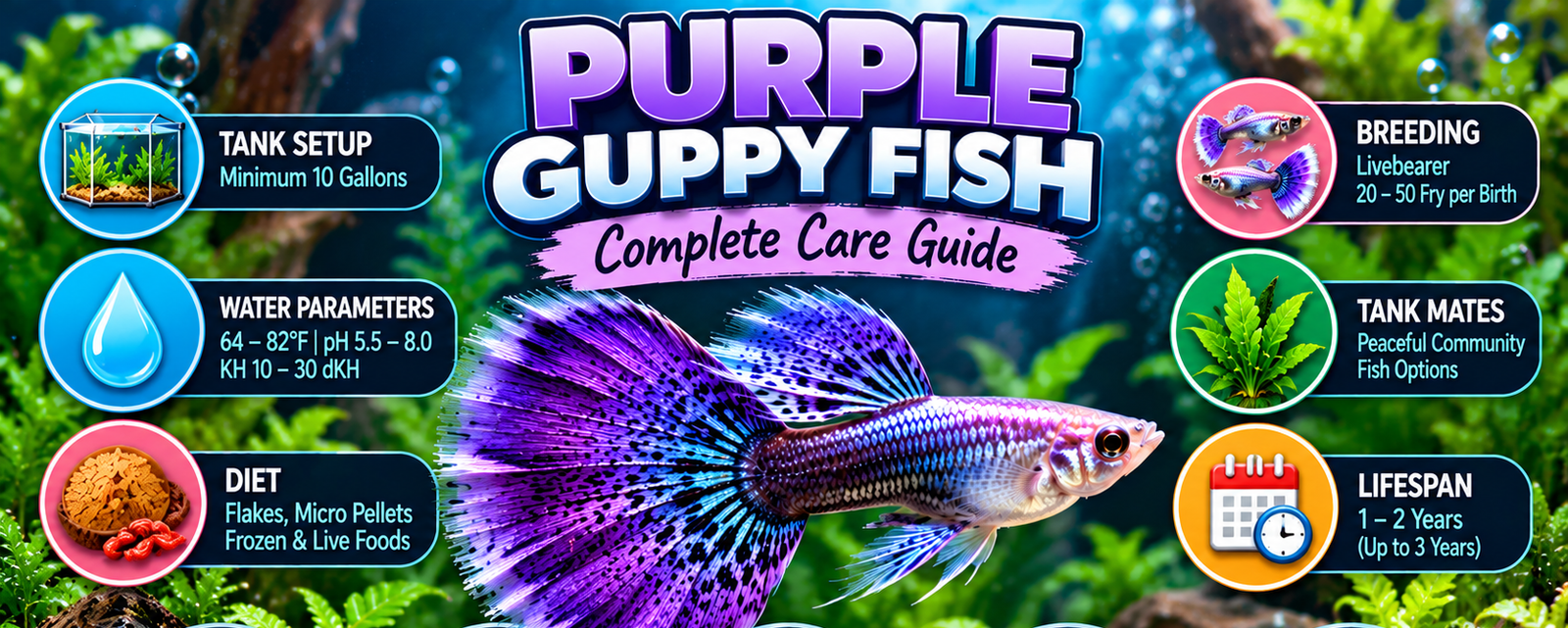
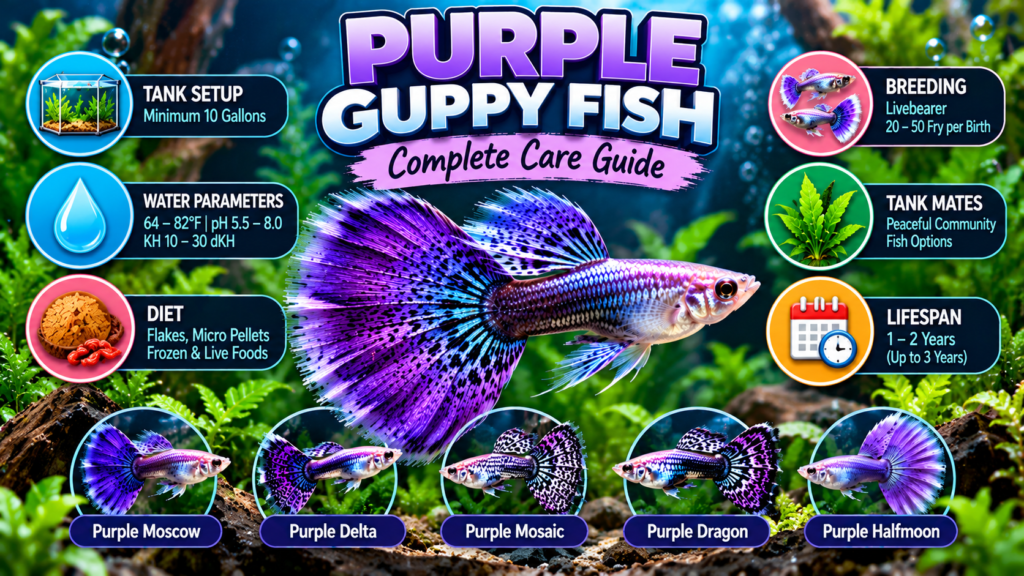
The term purple guppy fish normally refers to selectively bred Poecilia reticulata with purple, violet, lavender, blue-purple or plum-toned colour expression. It is not a separate species. Instead, purple is a hobby and trade description applied to several fancy guppy lines, including Moscow, Delta, Mosaic, Dragon and other strains.
That distinction matters when buying fish. Two sellers may use the words “purple guppy” for fish that have noticeably different body patterns, tail shapes or breeding histories. A Purple Moscow guppy, for example, is associated with extensive colour across the body and fins, while a Purple Mosaic is normally identified by patterned finnage. The colour word alone does not establish the genetic line.
Wild guppies are native to northern South America and nearby Caribbean regions. The purple varieties found in aquariums are captive-bred forms developed through selective breeding. Over many generations, breeders choose fish with desirable colour, pattern, body shape and fin development and then breed those fish to reinforce the desired traits.
Male guppies usually provide the strongest visual display. They are smaller than females but often develop more intense coloration and elaborate tails and dorsal fins. Females grow larger and fuller-bodied and commonly show less intense coloration. This difference is normal and should not be mistaken for poor health.
Guppies are livebearers. Instead of laying eggs, a female gives birth to free-swimming fry. This makes purple guppies particularly attractive to aquarists who want to observe breeding behaviour, raise young fish and develop a line over successive generations. It also means a small aquarium can become heavily stocked surprisingly quickly.
Key point: “Purple guppy” describes appearance or a breeding line, not a separate species. Always ask the seller for the exact strain name when colour genetics matter to you.
For general guppy feeding principles, see the AquariumsWorld guide What Do Guppy Fish Eat? Complete Feeding Guide. It is useful alongside this strain-specific guide because purple coloration does not change the fundamental nutritional needs of the species.
Why Purple Guppies Look Different Under Different Lighting
Purple is one of the most visually changeable guppy colours. A fish that looks deep violet in one aquarium can look blue, lavender, magenta or almost black in another. The difference does not necessarily mean the fish has changed genetically. Light spectrum, brightness, viewing angle, background colour, water clarity and the reflective properties of the fish can all change what the human eye sees.
Fish colour is produced through interacting pigment and reflective cells. Iridophores can reflect and scatter light, while melanophores and other chromatophores contribute darker and warmer tones. The final appearance is therefore a combination of inherited traits and the way available light interacts with the fish’s body and fins.
This is why a “colour-enhancing” food should not be treated as a magic solution. Nutrition can support normal development, immune function, body condition and the expression of existing colour potential, but food cannot create a purple genetic pattern that the fish does not possess.
For display tanks, use consistent aquarium lighting rather than repeatedly changing the spectrum to chase a particular shade. Neutral or cool-white lighting, healthy plants and a clean water column often provide attractive contrast. A darker background can also make violet and purple tones appear more defined without requiring extreme brightness.
Stress can temporarily reduce how vivid a guppy looks. Recent transport, aggressive tank mates, poor water quality, insufficient cover and reproductive pressure can all influence behaviour and appearance. If a purple guppy suddenly looks dull, investigate the aquarium before assuming the colour gene has disappeared.
Purple Guppy Fish Varieties
There is no single universal registry that makes every commercial “purple” name identical across breeders. The safest approach is to understand the common strain labels while evaluating the actual fish or breeder line. The following categories are useful for shopping and planning an aquarium.
Purple Moscow Guppy
The Purple Moscow guppy is one of the most recognizable purple fancy guppies. Moscow-type guppies are associated with extensive coloration over the body and fins rather than relying only on a patterned tail. Males can develop a deep purple, violet or blue-purple appearance, especially when mature and viewed under suitable lighting.
Purple Moscow is particularly attractive for a single-colour male display or a controlled breeding project. Because females may be less colourful, beginners sometimes buy only the most impressive male and later discover that maintaining the strain requires carefully selected females as well. If breeding is the goal, ask the seller whether the females come from the same line.
Current specialist care information for Purple Moscow guppies supports a minimum aquarium of about 10 gallons and emphasizes stable, mineral-rich water, peaceful tank mates and varied nutrition. Exact water targets should be treated as a practical range rather than numbers to chase obsessively.
Purple Delta Guppy
A Purple Delta guppy is generally recognized by its broad, triangular caudal fin combined with purple or purple-blue coloration. The Delta tail is the major visual feature. When the tail is fully developed, the fish can look almost like a small moving fan of violet colour.
Delta guppies need enough open swimming space for their finnage to display properly. Avoid persistent fin-nipping species, rough decorations and strong directional flow that forces the fish to fight the current continuously. Plants around the sides and back work well while keeping the central swimming area open.
Purple Mosaic Guppy
Purple Mosaic guppies combine purple or violet colour with the patterned finnage associated with Mosaic strains. The tail may contain repeated spots, patches or net-like visual details rather than one uninterrupted block of colour. Individual fish can therefore look dramatically different even when they share the same broad strain label.
When selecting a Purple Mosaic, examine the tail pattern, body colour and fin symmetry together. A large tail is attractive, but a balanced fish with clean fin edges and good body condition is a better long-term choice than a fish selected only for maximum tail size.
Purple Dragon Mosaic Guppy
Purple Dragon Mosaic guppies combine a Dragon-style body or scale appearance with Mosaic-type patterning and purple colour expression. Retail names vary considerably, so ask the seller which traits are being used to define the line. The name can be more informative when accompanied by a clear photo of the breeding stock and a description of the line.
These guppies are particularly suited to hobbyists interested in pattern development. If you breed them, keep detailed notes about parentage and offspring appearance rather than expecting every fry to reproduce the exact visual pattern of the parents.
Purple Batik Guppy
Purple Batik is another trade and breeding-line description that can combine purple body colour with intricate patterning. Batik-type guppies are often purchased because the pattern has a hand-painted or irregular visual quality. As with other fancy strains, the quality of the line is more important than the label alone.
Before buying, ask for current photographs rather than relying on an old catalogue image. Guppy coloration changes with age, maturity, lighting and condition, and online photographs can exaggerate saturation.
Purple Halfmoon Guppy
Halfmoon guppies are selected for a very broad, rounded tail spread. A purple Halfmoon therefore combines the dramatic tail silhouette with violet or purple colour. These fish are especially attractive in planted display aquariums where the tail can be seen clearly against open water.
Large-finned fish require calm community planning. Strong fin-nippers can turn an attractive Halfmoon into a stressed fish with damaged fins. Gentle filtration and good water movement are preferable to a powerful jet aimed directly at the fish.
Other Purple and Purple-Adjacent Lines
Breeders and retailers may also use names such as Purple Ivory, Purple Arctic, Purple Luminous, Full Purple, Purple Big Ear or other regional line names. These names should be treated as breeder or trade descriptors unless a recognized breeding standard is explicitly provided.
When two fish look similar but have different names, compare the body pattern, tail type, dorsal shape, breeder history and parentage. This is more reliable than assuming every purple fish belongs to one universal “purple gene.”
| Variety | Main visual feature | Best for | Buying tip |
|---|---|---|---|
| Purple Moscow | Extensive purple body and fin colour | Colour-focused displays and line breeding | Ask about same-line females if breeding |
| Purple Delta | Broad triangular tail | Classic fancy-guppy displays | Check tail symmetry and fin condition |
| Purple Mosaic | Patterned purple/violet finnage | Pattern enthusiasts | Compare current tail pattern photos |
| Purple Dragon Mosaic | Dragon-style colour with Mosaic patterning | Selective breeding projects | Ask seller how the line is defined |
| Purple Batik | Intricate irregular patterning | Unique display fish | Buy from breeders with clear line history |
| Purple Halfmoon | Large rounded tail spread | Show-style display aquariums | Avoid fin-nipping tank mates |
| Purple Arctic/Luminous/Ivory | Specialized breeder colour labels | Collectors and line breeders | Confirm exact parentage and strain meaning |
Purple Guppy Fish Care Guide
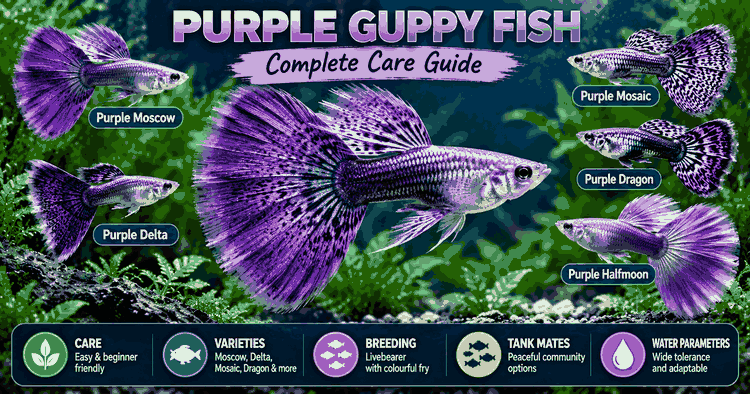
Purple guppy fish care is straightforward when the aquarium is cycled, stable and appropriately stocked. The biggest beginner mistake is to focus on colour while overlooking water quality. Fancy guppies may be adaptable, but adaptability does not mean they tolerate ammonia, nitrite, chronic overstocking or unstable conditions.
Tank Size
A 10-gallon aquarium is a practical minimum for a small group of guppies. A 20-gallon aquarium is often a better choice because it provides greater water stability, more swimming room and more flexibility if breeding occurs. Larger groups, mixed communities or breeding colonies should be given additional volume.
A long 20-gallon aquarium can be particularly useful because guppies spend much of their time in the upper and middle water column. Horizontal swimming space is valuable, especially for males with large tails.
Water Parameters
| Parameter | Practical target | Why it matters |
|---|---|---|
| Temperature | 72–82°F (22–28°C) | Supports normal activity and metabolism; stability matters. |
| pH | About 7.0–8.2 is a useful domestic-guppy target | Avoid sudden changes; test the source water first. |
| GH | Moderately hard to hard; roughly 8–18 dGH is suitable for many lines | Minerals support normal physiological function. |
| KH | Moderate buffering, commonly around 4–12 dKH | Helps reduce abrupt pH movement. |
| Ammonia | 0 ppm | Any detectable ammonia requires investigation. |
| Nitrite | 0 ppm | Nitrite should not accumulate in a mature aquarium. |
| Nitrate | Preferably kept below 20 ppm | Regular maintenance helps control chronic accumulation. |
Some retail care sheets provide wider pH and hardness ranges. That does not mean you should repeatedly adjust the aquarium to hit every published number. Stable water within a suitable range is usually preferable to constant chemical correction.
Filtration and Oxygenation
Use a filter sized for the aquarium and choose flow that produces circulation without constantly pushing guppies around. Sponge filters are excellent for breeding aquariums because they provide biological filtration while reducing the chance of fry being drawn into a strong intake. A hang-on-back filter can also work well when its intake is protected.
Surface movement should be sufficient for gas exchange. If the aquarium is heavily planted, heavily stocked or warm, additional aeration can be useful. Airstones are especially practical in fry systems.
Plants and Aquascaping
Plants provide shade, grazing surfaces and refuge. Java moss, guppy grass, Water Sprite, Vallisneria, Anubias, Java Fern and floating plants can all work well. Fine-leaved plants are particularly valuable when breeding because newborn fry can hide among them.
For a broader planted-aquarium perspective, the AquariumsWorld guide to best plants for Betta fish tanks includes useful principles about plant selection and aquarium structure even though the fish species differ.
Use smooth decorations and avoid sharp edges around long-finned guppies. Leave an open central area for swimming and place taller plants around the rear and sides.
Lighting
Moderate aquarium lighting is usually enough. The objective is healthy plant growth and clear viewing rather than maximum brightness. A consistent daily schedule is better than frequently changing the light intensity or colour.
Because purple coloration is reflective, the same fish can appear more blue or more violet under different lamps. Photographing the fish under consistent lighting is therefore useful when comparing colour development over time.
Acclimation and Quarantine
When new guppies arrive, avoid immediately adding them to the display tank without considering quarantine. A separate observation aquarium can reveal parasites, bacterial disease, poor condition or unexpected pregnancy before the fish enters the established community.
Acclimate gradually according to the differences between shipping water and aquarium water. Avoid prolonged exposure to dirty transport water. After transfer, keep lighting subdued for a short period and provide cover so the fish can settle.
What Do Purple Guppy Fish Eat?
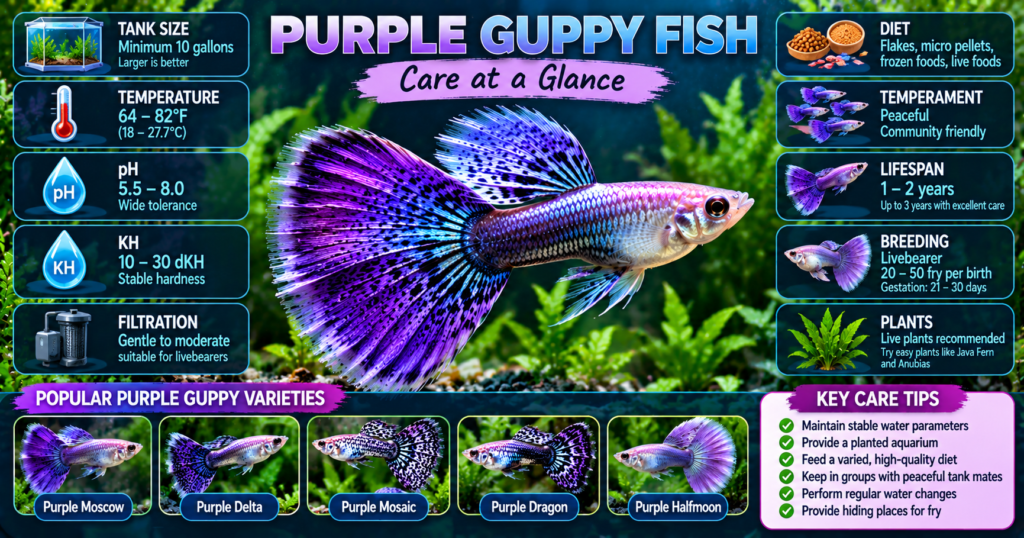
Purple guppy fish are omnivores. Their diet should combine a nutritionally complete prepared food with occasional appropriately sized live or frozen foods. A varied diet is useful for body condition, growth, reproductive performance and overall health.
A high-quality micro pellet or tropical flake can form the daily foundation. Supplement with foods such as baby brine shrimp, Daphnia, Moina, Cyclops or other suitable small foods. Plant-containing formulas can complement the diet because guppies naturally graze on algae and biofilm.
Feed small portions rather than one oversized meal. A useful practical rule is to provide only what the fish can consume promptly, normally within a few minutes. Excess food decomposes and contributes to poor water quality.
Adults can generally be fed once or twice daily. Fry benefit from smaller, more frequent meals because they are growing rapidly. However, increased feeding must be matched with stronger maintenance. A fry tank that receives multiple daily feedings can accumulate waste quickly.
Do not assume that a product marketed for “colour enhancement” will turn an ordinary guppy purple. Pigments and carotenoids can influence some colour characteristics, but the underlying purple expression depends on genetics and the fish’s physiological condition. The best strategy is a complete diet rather than a single colour product.
For aquarium feeding logistics, an automatic fish feeder guide can help when feeding must be scheduled consistently. For outdoor or pond use, see the separate automatic pond feeder guide.
Best Foods for Purple Guppy Fish
The following products were included in the supplied USA shopping research for this guide. They should be viewed as practical options rather than mandatory foods. Rotate quality foods and choose particle sizes that guppies can eat easily.
Hikari Tropical Fancy Guppy Fish Food
A dedicated guppy formula with a very small particle size makes this a convenient staple for adult guppies and smaller fish. The supplied shopping data lists it as a strong seller in the aquarium fish-food category.
Supplied score: 10/10Check Hikari on Amazon
TetraMin Tropical Flakes
TetraMin is a general tropical flake rather than a purple-guppy-specific food. It can work as part of a rotation when the flakes are crushed to a suitable size for smaller guppies.
Supplied score: 9/10Check TetraMin on Amazon
Fluval Bug Bites Color Enhancing Tropical Fish Food
This formula can be used as part of a varied feeding plan. Its colour-enhancing positioning should be interpreted as nutritional support for natural colour expression, not as a way to create purple genetics.
Supplied score: 9/10Check Fluval on Amazon
| Food | Best use | Supplied shopping signal | Rating in supplied brief |
|---|---|---|---|
| Hikari Tropical Fancy Guppy Fish Food | Dedicated guppy staple | 700+ bought/month; strong category position | 10/10 |
| TetraMin Tropical Flakes | General tropical rotation | Best Seller; 500+/week | 9/10 |
| Fluval Bug Bites Color Enhancing Tropical Fish Food | Rotation and colour-support nutrition | 4K+ bought/month | 9/10 |
Feeding Schedule Example
| Fish stage | Frequency | Food approach | Maintenance priority |
|---|---|---|---|
| Adult display fish | 1–2 small meals/day | Quality micro pellets or flakes plus occasional frozen/live foods | Prevent overfeeding |
| Pregnant female | Small regular meals | Complete diet with protein variety | Maintain water quality |
| Fry | Several very small meals/day | Fry food, crushed foods and suitable live foods | Frequent observation and cleaning |
| Growing juveniles | 2–3 small meals/day | Small high-quality foods with variety | Balance growth feeding with filtration |
Purple Guppy Fish Breeding
Purple guppy fish breeding is easy to start but harder to control. Guppies reproduce readily, while maintaining a specific colour or pattern over multiple generations requires selection, record keeping and separation of breeding lines.
Male-to-Female Ratio
For mixed groups, approximately one male to two or three females is a practical starting point. Males may court females frequently, so keeping several females per male helps distribute attention. A male-only display is another option when breeding is not wanted.
Gestation and Birth
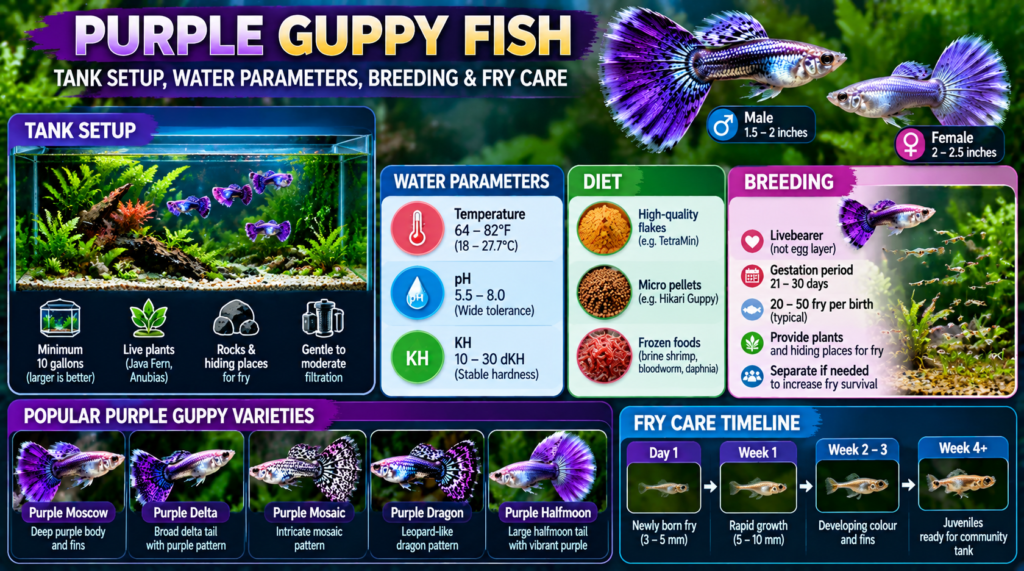
Gestation commonly lasts around three to four weeks, although the exact interval varies with temperature, age, health and individual biology. Females can store sperm, which means a newly purchased female may produce fry after she has been separated from a male.
Signs of an advanced pregnancy can include an enlarged abdomen and a more pronounced gravid area. Avoid excessive handling of pregnant females. Dense plants provide a safer environment and allow the female to give birth without constant disturbance.
Fry Care
Newborn fry are tiny but immediately free-swimming. Adult guppies may eat them, so survival is higher when the aquarium contains dense Java moss, guppy grass, floating roots or other fine shelter. Breeders who want maximum survival can raise fry in a separate nursery system.
Fry need small food particles. Newly hatched baby brine shrimp, microworms, finely crushed flakes and appropriate commercial fry foods can be used. Several small feedings can support growth, but uneaten food must not be allowed to accumulate.
Breeding for Purple Colour
Do not assume that two purple-looking parents will produce identical purple offspring. Fancy guppy colour is genetically complex and multiple traits can interact. Some fry may show different shades, patterns, tail forms or levels of colour intensity.
If the goal is to establish a consistent Purple Moscow, Purple Mosaic or other line, record each generation and retain only fish that meet your breeding objective. Avoid mixing unrelated guppy strains unless introducing new traits is intentional.
Keep separate breeding groups when line purity matters. Endler’s livebearers can also hybridize with guppies, so they should not be mixed into a controlled guppy breeding project unless hybridization is deliberate.
Best Tank Mates for Purple Guppy Fish
Purple guppies are peaceful community fish, but their tank mates should be selected around temperament and water preferences rather than appearance alone. Long-finned males are particularly vulnerable to persistent fin nipping.
| Tank mate | Compatibility | Important consideration |
|---|---|---|
| Platies | Good | Peaceful and generally compatible with harder water |
| Endler’s livebearers | Care compatible but breeding conflict | Can hybridize with guppies |
| Adult Neocaridina shrimp | Generally good | Guppies may eat shrimplets |
| Amano shrimp | Good | Adult shrimp are usually robust community members |
| Corydoras | Potentially good | Choose compatible temperature and water conditions |
| Small peaceful rasboras | Potentially good | Check hardness and temperature compatibility |
| Tiger barbs | Poor choice | Fin nipping can damage fancy guppies |
| Large aggressive cichlids | Poor choice | Predation and stress risk |
When building a community, think about the complete environment. A fish can be peaceful but still unsuitable because it needs very different water chemistry, much cooler water or substantially more swimming space.
For specialist aquarium equipment and water testing, AquariumsWorld also covers aquarium water test kits and marine aquarium test kits. The marine guide is not a guppy care guide, but the general principle of testing rather than guessing is equally important.
Why Is My Purple Guppy Losing Colour?
Colour loss can be caused by normal maturation, lighting changes, stress, poor condition or disease. It should be investigated systematically rather than treated with a single colour-enhancing product.
1. Check Water Quality
Test ammonia, nitrite, nitrate, pH and temperature. If several fish become dull at the same time, water quality or environmental stress becomes a higher priority than genetics.
2. Check Stress and Tank Mates
Persistent chasing, fin nipping, overcrowding or lack of shelter can reduce normal display behaviour. A male may look less impressive when constantly hiding from an aggressive fish.
3. Check Lighting
A new aquarium lamp can change perceived colour immediately. Compare the fish under the same lighting conditions before deciding that its actual pigmentation has changed.
4. Check Diet
A monotonous or nutritionally poor diet can contribute to poor condition. Provide a complete staple food and rotate suitable protein and plant-containing foods.
5. Consider Illness
If colour loss is accompanied by clamped fins, rapid breathing, unusual swimming, sores, wasting, flashing or loss of appetite, treat the behavioural change as a possible health problem. Test water before randomly adding medication. AquariumsWorld’s fish medicine and aquarium bacteria guide can provide broader background on aquarium treatment products, while the fish disease treatment guide explains why diagnosis should come before medication.
Purple Guppy Fish Lifespan and Long-Term Maintenance
A well-kept purple guppy can commonly live around one to three years, with roughly two years being a realistic planning expectation for many aquarium fish. Some individuals live longer under excellent conditions, while genetics, temperature, disease, repeated breeding and poor water quality can shorten lifespan.
Temperature deserves particular attention because higher temperatures can increase metabolic demand. Keeping fish at the upper end of their acceptable range continuously is not automatically better. A stable, appropriate temperature is more important than trying to accelerate growth or breeding.
Weekly maintenance should include checking equipment, observing behaviour, testing water when needed and removing obvious waste. Partial water changes should be based on stocking, feeding and test results rather than a rigid rule that ignores the aquarium’s actual biology.
If a tank develops recurring health problems, look at the system rather than repeatedly treating individual fish. Check stocking density, filtration, feeding, source water, quarantine practices and the age of the aquarium.
Purple Guppy Fish Price and Where to Buy in the USA
Purple guppy prices vary substantially according to strain quality, sex, breeder reputation, tail development, rarity within a specific line and whether the fish is sold as an individual, pair or group. The supplied USA shopping research includes examples from specialist retailers and marketplaces, but prices should be checked at the time of purchase.
| Seller/source in supplied research | Example variety | Supplied example price |
|---|---|---|
| Aquatic Arts | Purple Moscow male | $16.99 |
| Aquatic Arts | Purple Moscow pair | $23.99–$29.99 |
| Imperial Tropicals | Purple Moscow trio | $24.99 |
| Houston Aqua | Purple Ivory Halfmoon | $18 |
| MorphMarket | Purple Moscow pair | $20 |
| Coast Gem USA | Purple Mosaic Big Ear | $15 |
| LiveAquaria | Purple Delta male | Standard listing pricing in supplied research |
| LiveAquaria | Purple Batik male | Standard listing pricing; 6/12-pack options noted |
Online prices should never be treated as permanent. Stock can sell out, shipping charges can change and premium breeder lines may cost more than generic purple-coloured guppies.
What to Check Before Buying
-
- Ask for a current photograph of the actual fish or current breeding line.
-
- Confirm the scientific species is Poecilia reticulata.
-
- Ask whether the fish is tank bred, imported or locally bred.
-
- For breeding, confirm whether male and female fish are from the same line.
-
- Check for intact fins, normal swimming and a healthy body profile.
-
- Ask about quarantine practices and shipping guarantees.
-
- Do not choose a fish only because a listing uses the word “rare.”
If you are researching broader aquarium purchasing decisions, the AquariumsWorld blog archive provides additional freshwater, marine, equipment and fish-care resources.
Which Purple Guppy Is Right for You?
| Your goal | Good starting choice | Why |
|---|---|---|
| Strong overall purple colour | Purple Moscow | Extensive body and fin colour is the defining appeal. |
| Large triangular tail | Purple Delta | Delta finnage creates a classic broad-tail silhouette. |
| Intricate patterned tail | Purple Mosaic | Mosaic patterning adds visual detail. |
| Pattern-focused breeding | Purple Dragon Mosaic | Combines multiple selective traits. |
| Unusual patterned appearance | Purple Batik | Often selected for irregular decorative patterning. |
| Very broad rounded tail | Purple Halfmoon | Tail shape is the main display feature. |
| Easy male-only display | Male Purple Moscow or Delta | No female pregnancy and simpler population control. |
| Breeding project | Same-line male and females | Better starting point for maintaining a defined strain. |
Purple Guppy Fish vs Blue Guppy Fish
Purple and blue guppies can be difficult to distinguish under some aquarium lights. Blue may dominate when reflective cells return shorter-wavelength light, while purple can contain a mixture of blue, red and darker visual components. Photography and lighting can therefore blur the distinction.
When buying a named strain, use the breeder’s line description, parentage and current photographs rather than trying to infer genetics from one image. If your goal is breeding, documented lineage is much more valuable than a single saturated photograph.
Purple Guppies vs Other Fancy Fish
Guppies are attractive because they combine colour, movement and reproduction in a small body. They require much less space than large species such as Oscars, but they should not be compared purely by tank volume. An Oscar aquarium, for example, has completely different filtration and stocking demands. AquariumsWorld’s guides to Copper Oscar fish, Blueberry Oscar fish, blue Oscar varieties, Oscar filtration, White Tiger Oscars, Bumblebee Oscars and Fire Red Oscars illustrate how species-specific care becomes as important as colour.
Simple Weekly Purple Guppy Maintenance Routine
A routine makes guppy care easier than reacting to problems after they become visible. Start by observing the fish before feeding. Look for changes in swimming, appetite, fin condition, body shape and interaction. Then inspect the filter, heater, thermometer and surface movement.
Test water when the aquarium is new, heavily stocked, recently disturbed or showing unusual behaviour. In a mature stable aquarium, testing can be scheduled around the system’s history, but ammonia and nitrite should remain at zero. Nitrate trends are useful because they show whether waste production is outpacing maintenance.
Perform an appropriate partial water change and clean only the components that need cleaning. Avoid replacing all biological media at once because beneficial bacteria live on filter surfaces. When cleaning sponge or biological media, use removed aquarium water rather than chlorinated tap water.
Remove uneaten food and dead plant material. Trim plants so swimming areas remain open. Check that floating plants are not covering the entire surface and reducing gas exchange.
For larger aquarium systems, the same principle applies but equipment maintenance becomes more important. AquariumsWorld’s 100-gallon aquarium equipment guide is saltwater-focused, yet it demonstrates the broader principle that filtration, circulation and maintenance should be designed around system volume rather than purchased as isolated accessories.
Purple Guppy Fish Troubleshooting Guide
| Problem | Possible cause | First action |
|---|---|---|
| Sudden colour loss | Stress, lighting change or water issue | Test water and inspect tank mates. |
| Clamped fins | Stress, poor water quality or illness | Check ammonia, nitrite, temperature and behaviour. |
| Gasping | Low oxygen, high temperature or water-quality problem | Increase surface movement and test water immediately. |
| Fry disappearing | Adult predation | Add dense plants or separate fry. |
| Frayed tail | Fin nipping or injury | Remove aggressors and check water quality. |
| Constant chasing | Male courtship pressure or aggression | Review sex ratio and tank space. |
| Overcrowding | Unexpected breeding success | Separate sexes, rehome juveniles or increase capacity. |
| Cloudy water | New-tank bloom, overfeeding or waste | Test parameters and reduce excess organic load. |
Frequently Asked Questions About Purple Guppy Fish
1. What is a purple guppy fish?
A purple guppy fish is a selectively bred Poecilia reticulata showing purple, violet, lavender or blue-purple coloration. It is not a separate species. The term may describe several different breeding lines, so the exact strain should be confirmed with the seller.
2. What are the different varieties of purple guppy fish?
Commonly marketed varieties include Purple Moscow, Purple Delta, Purple Mosaic, Purple Dragon Mosaic, Purple Batik and Purple Halfmoon. Other breeder names include Purple Arctic, Purple Luminous and Purple Ivory. Naming is not completely standardized, so compare the actual fish and breeding line.
3. How do you care for a purple guppy fish?
Provide a fully cycled aquarium, stable temperature, mineral-rich water, gentle but effective filtration, plants or cover, a varied omnivore diet and peaceful tank mates. A 10-gallon aquarium is a practical minimum for a small group, while 20 gallons gives more stability and flexibility.
4. What tank size does a purple guppy fish need?
A small group can be maintained in about 10 gallons, but a 20-gallon aquarium is often a better practical choice. Larger groups, community aquariums and breeding colonies need additional volume. Use the calculator above as a starting point rather than a substitute for biological filtration and observation.
5. What do purple guppy fish eat?
They are omnivores. Use a quality micro pellet or flake as the staple and rotate suitable foods such as baby brine shrimp, Daphnia, Moina or other appropriately sized live or frozen foods. Plant-containing foods can complement the diet.
6. How do you breed purple guppy fish?
Keep mature males and females together in stable conditions, preferably with about one male for two or three females. Females give birth to free-swimming fry after roughly three to four weeks. Dense plants or a separate nursery can protect fry from adults.
7. What are the best tank mates for purple guppy fish?
Peaceful community species with compatible water requirements are best. Platies, suitable small schooling fish, adult shrimp and some Corydoras can work depending on the aquarium. Avoid persistent fin-nippers and large predatory fish.
8. How much does a purple guppy fish cost?
Prices vary by strain, sex, breeder and quality. The supplied USA research included examples around $15–$18 for some individual specialty fish and approximately $17 for a Purple Moscow male, with pairs and trios costing more. Always check current stock and shipping costs.
9. Why is my purple guppy losing colour?
Check water quality, stress, lighting, nutrition and disease signs. A new light can change colour perception immediately. If dullness is accompanied by abnormal behaviour, appetite loss, clamped fins or rapid breathing, investigate aquarium conditions rather than simply adding a colour-enhancing food.
10. How long do purple guppy fish live?
Many aquarium guppies live roughly one to three years, with around two years being a useful planning expectation. Genetics, temperature, nutrition, reproductive demands, disease and water quality can all change individual lifespan.
Scientific References and Further Reading
The following references were supplied as the academic source pool for this guide. They provide background on guppy colour, pigmentation, ecology, nutrition, immunity and ornamental fish welfare.
-
- Willing, E.M. et al. (2010). Molecular Ecology, 19(5), 968–984. DOI: 10.1111/j.1365-294X.2009.04527.x.
-
- Gur, D. et al. (2014). Acta Biomaterialia, 10(9), 3918–3927. DOI: 10.1016/j.actbio.2014.04.035.
-
- Endler, J.A. (1982). Studies of guppy colour patterns, sexual selection and ecological variation. Evolution.
-
- Corbet, P.S. and Griffith, A.D. (1961). Research on mosquito predation and guppy ecology.
-
- Mandal, B. (2010). Research concerning guppy nutrition and dietary requirements.
-
- Vedhavarshini, V. et al. (2024). Research on ornamental fish diets and nutritional management.
-
- Scharsack, J.P. and Franke, F. (2022). Journal of Fish Biology. Research on teleost immunity and health.
-
- Smith, L. (2023). Animals, 13(16), 2548. DOI: 10.3390/ani13162548.
Scientific references are included for background. Commercial strain names such as Purple Moscow, Purple Delta and Purple Batik are hobby breeding labels and should not be interpreted as formal taxonomic species names.
More AquariumsWorld Guides
Continue your aquarium research with related AquariumsWorld resources. These links cover freshwater, marine, disease, equipment, fish colours and aquarium management:
Conclusion
Purple guppy fish are among the most versatile choices for aquarists who want colour, movement and the possibility of breeding in a relatively small freshwater aquarium. Their appeal comes from selective breeding rather than a separate purple species, which means the exact appearance can differ greatly between Moscow, Delta, Mosaic, Dragon, Batik, Halfmoon and other lines.
The most important care principle is stability. Start with a fully cycled aquarium, maintain suitable mineral-rich water, avoid sudden chemistry changes, provide efficient filtration and keep stocking under control. Plants improve the aquarium by offering cover, grazing surfaces and fry refuge, while peaceful tank mates protect the long finnage that makes many fancy guppies attractive.
Colour should be treated as the result of genetics interacting with health, environment and lighting. A good diet supports natural expression, but no food can manufacture a purple gene. Likewise, a dramatic photograph is not proof of a particular breeding line. When buying, ask about parentage, sex, current condition and the breeder’s definition of the strain.
For beginners, a small male-only display can be the simplest introduction. For breeders, a same-line male and female group in a planted aquarium provides the foundation for controlled reproduction. Whichever route you choose, the goal should be healthy fish first and colour second.