Gravel Calculator Fish Tank: How Much Substrate You Need
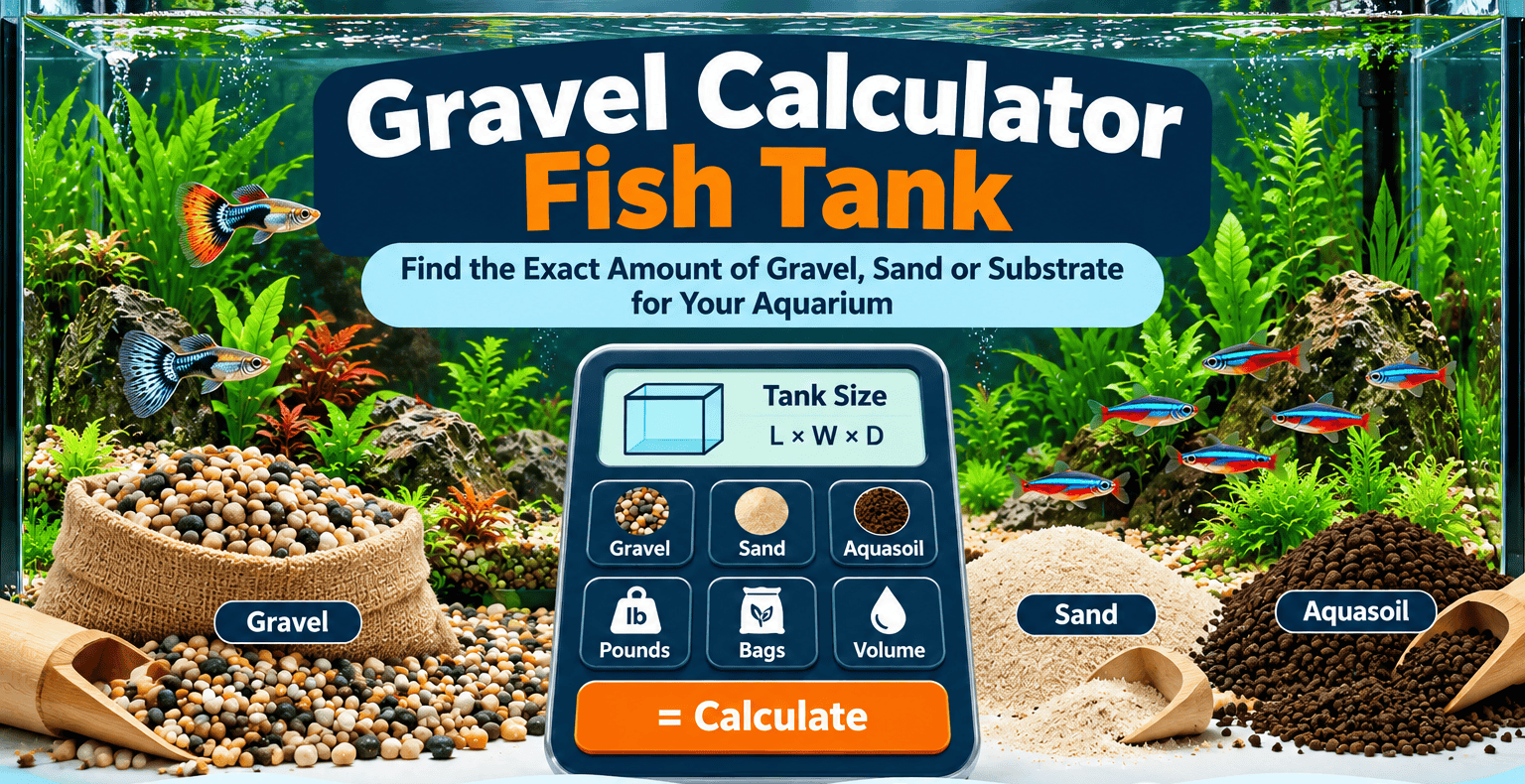
Wondering how much gravel your fish tank needs? A gravel calculator fish tank tool helps estimate the weight, volume and number of bags required to create the substrate bed you want. Enter your aquarium’s length and width, select the substrate material, and choose a target depth to calculate a practical shopping estimate.
The amount required depends mainly on the aquarium’s footprint, the planned substrate depth and the material’s bulk density. Two aquariums advertised as 20 gallons can need different quantities because one may have a longer base than the other. Tank capacity alone is not enough to calculate substrate accurately.
This guide explains how to calculate aquarium gravel, sand and aquasoil, compares popular tank sizes, discusses substrate depth and maintenance, and answers common questions from fishkeepers in the United States.
Fish Tank Gravel and Substrate Calculator
Calculate an approximate substrate weight, volume, bag count and water displacement. Measurements should describe the area that will actually receive substrate. For the most accurate estimate, measure the tank internally.
Actual bulk density varies by product, grain size, moisture and packing.
Your estimated substrate requirements
Choose your dimensions and select Calculate Substrate to see the estimate.
This is a planning calculator, not a substitute for the product’s stated coverage or weight. For irregular tank bases, large hardscape, sloped aquascapes and layered substrates, use the result as a starting estimate and check the manufacturer’s instructions.
How the Fish Tank Gravel Calculator Works
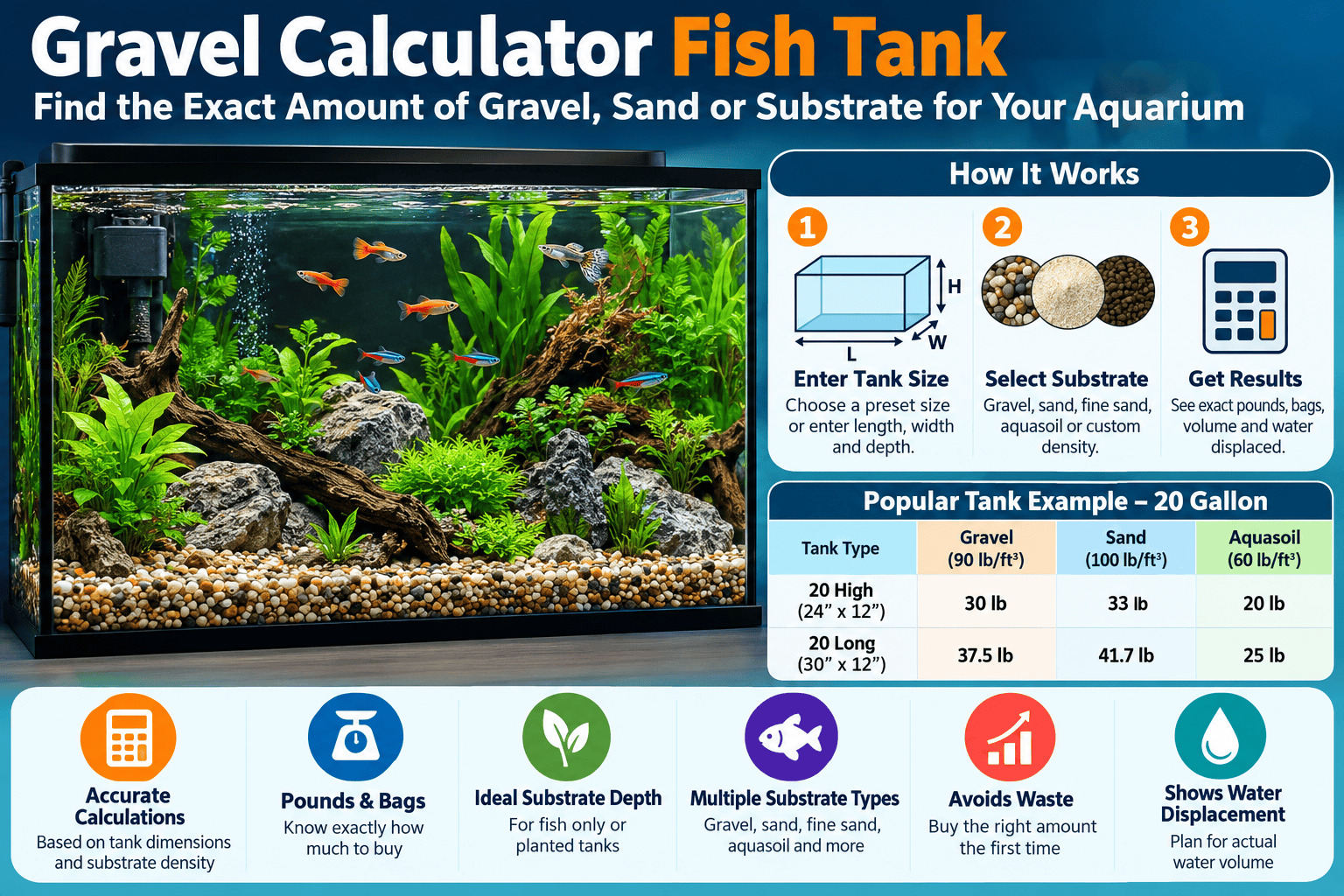
A fish tank gravel calculator estimates the amount of material needed to cover the aquarium floor to a selected depth. It uses three principal inputs: length, width and depth. The material density converts the calculated volume into an approximate weight, while the selected bag size helps estimate how many packages to buy.
The calculator separates the physical amount needed from the purchasing amount. The first result estimates the substrate required to fill the planned bed. The second adds the buffer you select. That extra material can be useful when the substrate settles, the aquascape slopes upward, or a small quantity is lost during washing and placement.
What should you measure?
Measure the internal length and width of the aquarium base rather than relying solely on the advertised gallon rating. Nominal capacity describes water volume, whereas substrate covers the floor. A tall aquarium and a long aquarium can have the same capacity but different base areas.
If your aquarium contains a large rock structure, a background wall or a substantial raised platform, the full base area may overstate the substrate requirement. You can account for this by measuring only the area that will receive substrate, or by treating the result as a conservative estimate.
For more setup calculations, see the AquariumsWorld blog archive, including guides on 20 gallon fish tank setup, 50 gallon fish tank planning and soil in a fish tank.
Aquarium Gravel Formula
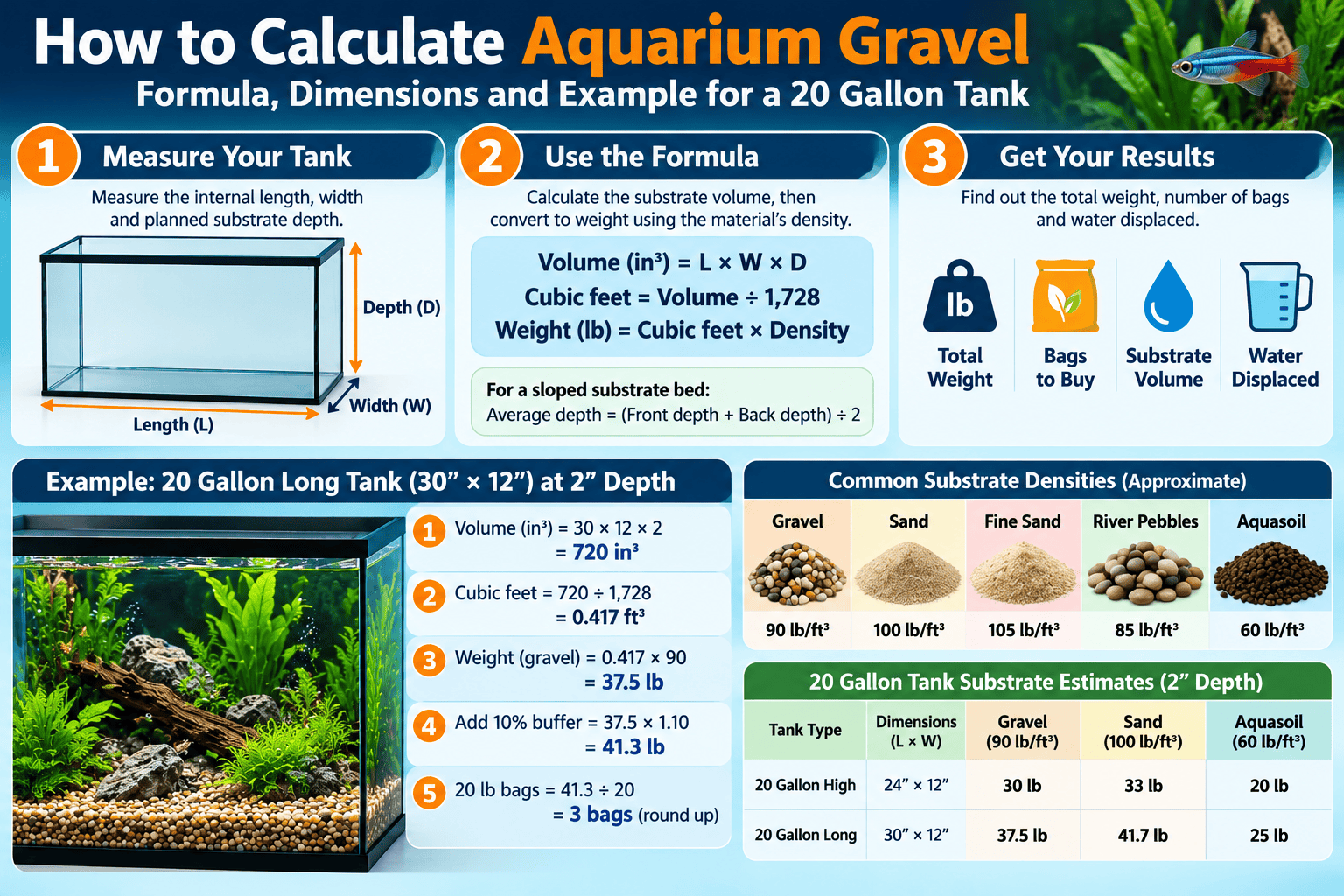
For measurements in inches, first calculate the substrate-bed volume in cubic inches:
Volume in cubic inches = length × width × average depth
Convert cubic inches to cubic feet by dividing by 1,728. Then multiply the cubic-foot result by the estimated bulk density of the chosen material.
Substrate weight in pounds = (length × width × average depth ÷ 1,728) × density
For a metric calculation, multiply the length, width and average depth in centimetres to obtain cubic centimetres. Divide by 1,000 to convert that volume into litres. To estimate weight, use a density expressed in kilograms per litre, or convert the imperial density consistently before calculating.
Worked example: a 20 gallon long aquarium
Consider a 30 × 12 inch base with a flat, 2-inch gravel bed. The estimated volume is 30 × 12 × 2, or 720 cubic inches. Dividing 720 by 1,728 gives approximately 0.417 cubic feet. At the planning density of 90 pounds per cubic foot, the estimated gravel weight is 37.5 pounds.
With a 10% purchasing buffer, the target becomes 41.25 pounds. If the available bags contain 20 pounds each, divide 41.25 by 20 and round upward. The practical shopping estimate is three bags, or 60 pounds in total. The unused material can be kept dry for later top-ups, provided the product is stored safely.
This calculation assumes a level bed and a density of 90 pounds per cubic foot. A real gravel product may have a different stated coverage or bulk density. Use the manufacturer’s coverage information whenever it is available.
Aquarium Substrate Density
Density explains why equal volumes of different materials do not necessarily weigh the same. Grain shape, particle size, mineral composition, moisture and how tightly the material packs can all change the result. The following values are approximate planning assumptions for this calculator, not universal specifications for every product.
| Substrate | Planning density | Typical use | Important consideration |
|---|---|---|---|
| Aquarium gravel | 90 lb/ft³ | General freshwater setups | Check grain size and whether the product is aquarium-safe. |
| Aquarium sand | 100 lb/ft³ | Fine-bed layouts and some bottom-dwelling fish | Particle size and compaction affect how it behaves. |
| Fine sand | 105 lb/ft³ | Fine substrate designs | Avoid assuming all fine sands have identical density. |
| River pebbles | 85 lb/ft³ | Coarser decorative layouts | Large gaps change packing and debris retention. |
| Aquasoil | 60 lb/ft³ | Planted aquariums | Commercial granules vary considerably by brand. |
These density values are useful for comparing estimates, but they should not be treated as laboratory measurements of a specific bag. A bag label may state its weight and coverage area directly. When those details are available, use them to refine the result before purchasing.
How Much Gravel for a 20 Gallon Tank?
The answer depends on the base dimensions, desired depth and type of substrate. A useful starting point for many general-purpose aquariums is a relatively shallow bed, while planted layouts may need more depth in selected areas. The correct amount is not determined by gallons alone.
For the examples below, the 20 gallon high tank is assumed to have a 24 × 12 inch footprint, and the 20 gallon long tank a 30 × 12 inch footprint. These are common nominal dimensions, but manufacturers differ. Check the actual dimensions of your aquarium before buying substrate.
| Tank example | Footprint | Depth | Gravel estimate | Sand estimate | Aquasoil estimate |
|---|---|---|---|---|---|
| 20 gallon High | 24 × 12 in | 2 in | 30 lb | 33 lb | 20 lb |
| 20 gallon Long | 30 × 12 in | 2 in | 37.5 lb | 41.7 lb | 25 lb |
These figures use the density assumptions in the calculator. They are not product-specific bag recommendations. The difference between the two examples illustrates why a substrate calculator should use the tank footprint rather than only its advertised volume.
20 Gallon Long vs 20 Gallon High
The 20 gallon long aquarium has a larger floor area in this example. At the same substrate depth, it therefore needs more material than the 20 gallon high. The tall tank has more vertical water space, but that extra height does not increase the amount needed to cover its floor.
The difference becomes more noticeable as the target depth increases. A 3-inch bed requires 50% more material than a 2-inch bed over the same footprint. This relationship makes it useful to settle on the intended depth before ordering several bags.
If you are still planning your aquarium, compare the footprint with the intended aquascape and the adult needs of the fish. The site’s 20 gallon aquarium guide can help with broader setup planning, while the 50 gallon tank dimensions guide discusses physical size and capacity.
How Many Bags of Gravel for a 20 Gallon Tank?
Bag count is calculated by dividing the total purchasing weight by the weight of one bag and rounding upward. For example, if the calculated requirement plus buffer is 41.25 pounds, 20-pound bags require three purchases. Two bags would supply only 40 pounds, which is below the estimate.
Do not confuse the total bag weight with the quantity that must be placed in the aquarium. You may have material left over after creating a slope or accounting for hardscape. Keeping some unused substrate can be helpful for future maintenance, but store it away from moisture and contamination.
Product option: aquarium sand in a 20-pound bag
A packaged aquarium sand product can make the purchase calculation easier because the bag weight is clearly stated. Check whether it is suitable for your fish, whether rinsing is recommended and how much area the manufacturer says it covers.
Affiliate disclosure: This is a product-search link, not a confirmed Amazon Associates affiliate link. Replace it with your approved tagged product URL if you participate in the Amazon Associates programme.
How Deep Should Aquarium Substrate Be?
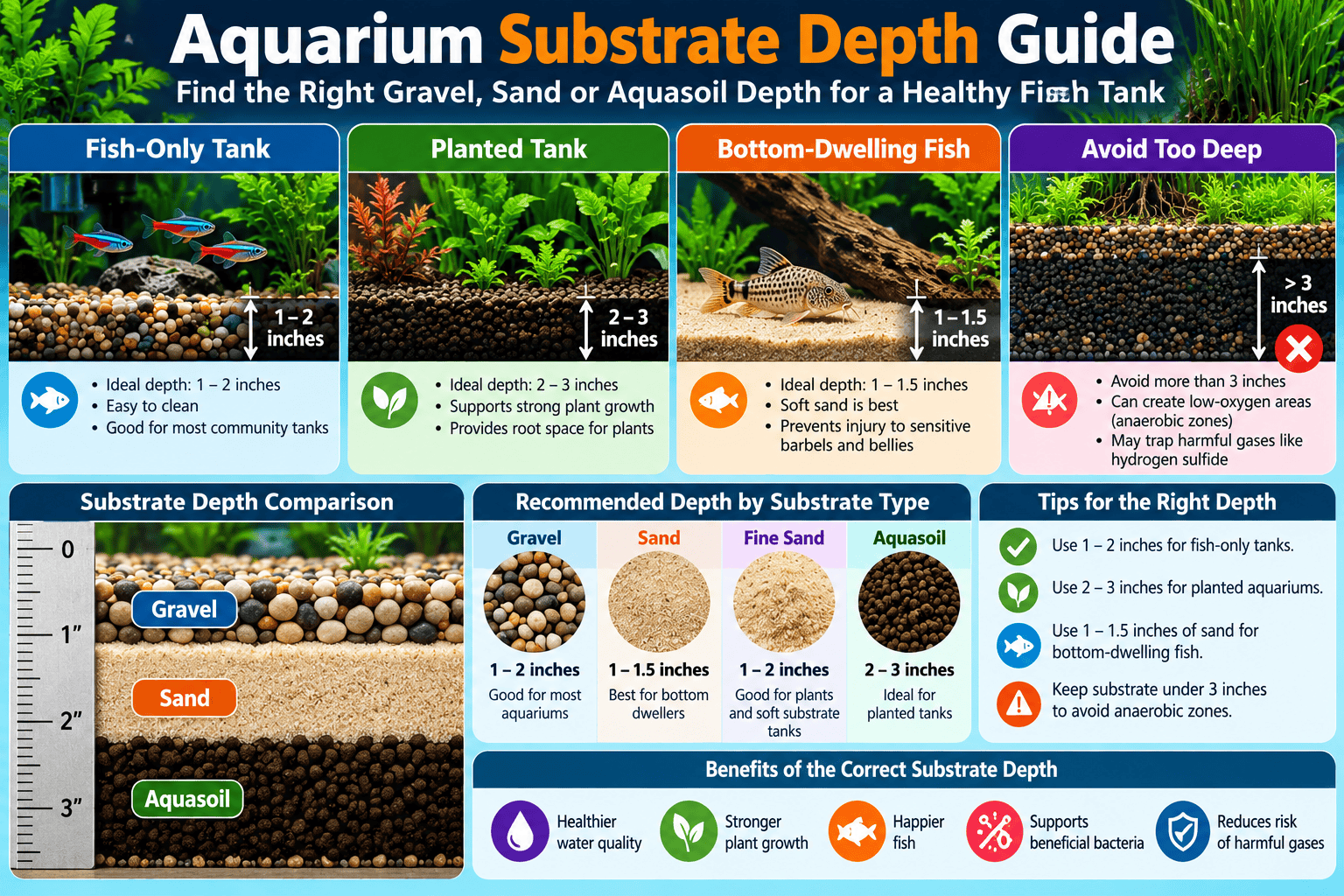
There is no single ideal substrate depth for every aquarium. The appropriate depth depends on whether the tank is fish-only, planted, designed for bottom-dwelling species or built around a particular aquascape. A shallow bed is often easier to maintain, while deeper areas can support plant roots or create visual height.
For many general fish-only aquariums, approximately 1 to 2 inches can be a practical starting point. Many planted layouts use around 2 to 3 inches in areas where roots need room, although plant species and substrate design can change that requirement. These are guidelines, not mandatory values for every aquarium.
Deeper substrate increases material cost and can make debris management more complicated. It can also create zones with different oxygen conditions. That is not automatically harmful, but the substrate should be selected and maintained with its structure and purpose in mind.
Gravel Depth for a Planted Aquarium
Planted aquariums need a substrate plan that matches the plants being grown. Small-rooted plants may establish in a relatively shallow bed, while larger rooted plants may need more space. A sloping aquascape can use a deeper layer at the rear to create perspective without making the entire aquarium unnecessarily deep.
Gravel can support roots and provide surfaces for microbial communities, but plain gravel may contain fewer nutrients than a purpose-made planted substrate. Root-feeding plants may benefit from suitable root fertilisers or a nutrient-rich substrate. Water-column fertilisation can also be useful depending on plant species, lighting and carbon availability.
Barko and Smart (1986) examined sediment-related limitations on submerged aquatic plant growth. Their work supports the broader point that sediment properties and plant access to nutrients matter. It should not be interpreted as establishing one universal depth for all aquarium plants.
For a planted aquarium, decide whether the layout will use plain gravel, aquasoil or a layered system before calculating the amount. Each layer has its own depth and material requirements. If the design uses a cap over a nutrient-rich base, calculate the two layers separately instead of applying one density to the total bed.
Explore the site’s guide to plants for betta fish tanks for ideas about selecting vegetation for a specific aquarium environment.
Aquarium Sand Bed Depth
Sand can create a smooth appearance and suit some bottom-dwelling fish, but the grain size and maintenance routine matter. A relatively shallow bed, often around 1 to 1.5 inches for simple layouts, may be adequate for many fish-only tanks. Rooted plants may need a different arrangement or additional support.
Deeper sand beds require attention to trapped organic material and local oxygen conditions. Fine particles can compact, and areas beneath decorations may receive little water movement. These conditions are not proof that every deeper sand bed will become dangerous, but they make appropriate design and maintenance important.
Do not stir a mature substrate aggressively without understanding the system. If you discover a foul smell, unusual dark patches or a sudden water-quality problem, investigate carefully and avoid releasing large amounts of trapped material into the aquarium. Test water parameters and seek reliable species-specific advice when necessary.
Why the 1 Pound per Gallon Rule Falls Short
The rule of buying one pound of gravel per gallon is easy to remember, but it does not calculate the actual substrate bed. Gallons measure volume, while the substrate requirement depends on the aquarium’s floor area, depth and material density. A tank’s vertical dimensions can increase water capacity without increasing the amount of substrate required to cover its base.
For example, two tanks may both hold approximately 20 gallons but have different lengths and widths. If one has a larger footprint, it needs more gravel to achieve the same depth. If one tank is taller but has a smaller base, it may need less substrate despite having the same nominal capacity.
The rule also ignores material differences. A given volume of gravel, sand and aquasoil can have different weights. It also fails to account for slopes, rockwork, raised planters or a layered aquascape. The calculator is more useful because it uses the actual dimensions and an explicit density assumption.
Use the one-pound rule only as a rough purchasing shortcut when no better information is available. For a planned setup, calculate the bed volume and compare the result with the product’s coverage guidance.
Choosing the Right Substrate for Your Tank
The best substrate is not simply the material that looks attractive or costs the least per bag. It should be appropriate for the fish, plants and maintenance routine. Particle size, composition, water-chemistry effects and ease of cleaning can all influence the choice.
Best Substrate for a Planted Aquarium
Commercial aquasoil is designed for planted layouts and is sold in a range of granule sizes and formulations. It can provide a plant-oriented growing medium, but its effects on water chemistry differ between products. Follow the manufacturer’s instructions and check whether the substrate may initially affect pH, hardness or nutrient levels.
Plain gravel offers a different approach. It is often durable and easy to vacuum, but it may not supply enough nutrients for demanding root-feeding plants. Root tabs or a separate nutrient layer may be appropriate, depending on the setup. Do not assume that every plant requires expensive aquasoil or that all plants will thrive in plain gravel.
Calculate layered beds independently. If a layout uses one inch of aquasoil under one inch of gravel, calculate each layer’s volume separately and apply the appropriate estimated density. This avoids treating two different materials as though they had identical weight.
Product option: planted aquarium substrate
Fluval Plant and Shrimp Stratum is one option to research for planted and shrimp aquarium layouts. Confirm the product’s current package size, suitability for your intended livestock and manufacturer’s instructions before purchasing.
Affiliate disclosure: The link above is a search link, not a confirmed Associates-tagged product listing. Insert your approved affiliate URL before publication if applicable.
Aquarium Sand vs Gravel
Sand and gravel can both work in freshwater aquariums, but their properties differ. Gravel has larger spaces between particles, which can allow water to move through the bed. Those spaces may also trap waste. Sand has smaller particles and a smoother appearance, but fine material can compact and may require a different cleaning technique.
Fish behaviour should influence the decision. Some bottom-dwelling fish sift or forage through fine substrate, while others need different surfaces or hiding places. Research the requirements of the specific species rather than assuming one material is suitable for every fish.
For example, the needs of a halfmoon betta aquarium differ from those of a large cichlid setup. AquariumsWorld’s guides to halfmoon betta care and copper Oscar fish provide species-specific context for planning an appropriate environment.
Whatever material you select, choose a product intended for aquarium use or verify that it is safe for aquatic life. Decorative stones, construction materials and garden products may contain unsuitable coatings, contaminants or minerals that affect water chemistry.
How Substrate Affects Biofilm and Water Quality
Substrate provides surfaces where microorganisms can establish, but a gravel bed should not be confused with a properly designed biological filter. The aquarium’s nitrogen cycle depends on microbial communities that transform toxic ammonia into nitrite and then nitrate. The filter, substrate, decorations and other wet surfaces can all support microbial growth, with the overall system determining how effectively waste is processed.
Research on aquaculture biofilters shows that operating conditions influence microbial communities and nitrification. Bartelme, McLellan and Newton (2017), for example, investigated bacterial community shifts in freshwater recirculating aquaculture systems. Their study is relevant to the general role of biofilters, although a commercial aquaculture system is not identical to a home aquarium.
Gutierrez-Wing and Malone (2006) reviewed biological filters used in freshwater and marine aquaculture. Rurangwa and Verdegem (2015) discussed microorganisms in recirculating aquaculture systems and their management. Together, these sources support a careful distinction between providing microbial surfaces and relying on a complete, functioning filtration system.
Substrate can collect uneaten food, fish waste and decaying plant material. As that organic material decomposes, it contributes to the system’s nitrogen load. Poor maintenance, overfeeding and inadequate filtration can therefore cause water-quality problems regardless of whether the tank uses sand or gravel.
Ammonia, nitrite and nitrate
Ammonia and nitrite should be monitored during aquarium cycling and when the system experiences a disruption. In an established, healthy freshwater aquarium, detectable ammonia or nitrite generally signals a problem that needs investigation. Nitrate can accumulate over time and is usually managed through a combination of water changes, plant uptake and appropriate husbandry.
Camargo and Alonso (2006) reviewed the ecological and toxicological effects of inorganic nitrogen pollution in aquatic ecosystems. Randall and Tsui (2002) reviewed ammonia toxicity in fish. These studies underline why nitrogen management matters, but a substrate calculator cannot predict the water chemistry of a particular aquarium.
Choose a suitable test kit and follow its instructions carefully. AquariumsWorld’s guides to aquarium water test kits and marine aquarium water testing discuss testing equipment for different systems. Marine test kits and freshwater test kits are not automatically interchangeable for every parameter or product, so check compatibility.
Adding extra gravel does not compensate for an undersized or poorly maintained filter. Nor does a thick substrate bed automatically create a healthy aquarium. The entire system needs an appropriate balance of stocking, feeding, filtration, oxygen exchange and routine maintenance.
Can a substrate bed become anaerobic?
Oxygen availability changes within a substrate bed. Organic matter, particle size, water movement and bed depth influence the conditions below the surface. Low-oxygen zones can occur in aquatic sediments, but their presence alone does not establish that a substrate is harmful. The important question is whether the substrate design and maintenance are appropriate for the aquarium.
Do not apply a universal depth threshold to every material. Fine sand, coarse gravel, aquasoil and layered substrates have different structures. Use a sensible depth, avoid unnecessary accumulation of organic waste and monitor the aquarium rather than assuming a single measurement guarantees safety.
How to Add and Maintain Aquarium Gravel
Before adding substrate, check that the aquarium is stable, clean and positioned on an appropriate stand. If you are rebuilding an established aquarium, plan how to protect fish, preserve biological filtration and avoid sudden changes to water chemistry. Large changes to the substrate can disturb accumulated waste and should not be rushed.
Step 1: Confirm the quantity
Measure the internal footprint and decide whether the bed will be flat or sloped. Calculate the material needed for each layer separately. Check the packaging for coverage and preparation instructions, and buy enough material to complete the planned layout without assuming that every product has the same density.
Step 2: Prepare the material
Follow the manufacturer’s directions about rinsing. Many gravel and sand products benefit from rinsing to remove dust, while some specialised substrates are designed to be used with minimal disturbance. Do not wash a product if its instructions specifically advise against it.
Never use household detergents or cleaning chemicals on aquarium substrate. Residues can be harmful to fish and other aquatic animals. Use clean equipment reserved for aquarium use, and prevent prepared substrate from contacting soil, oils or other contaminants.
Step 3: Add the substrate gradually
Spread the material carefully across the base. If creating a slope, add more depth where it is needed rather than making the entire bed unnecessarily deep. Place heavy rocks and structures securely, following safe aquascaping practices so that they cannot shift or collapse onto the glass or livestock.
Step 4: Fill the aquarium carefully
Pouring water directly onto loose substrate can create a cloud of particles and disturb the layout. Use a clean plate, bag or other suitable diffuser to reduce the force of incoming water. Allow suspended particles to settle and use filtration appropriate to the substrate and aquarium design.
Step 5: Monitor the aquarium
After setting up a new tank, allow the biological filtration to establish before adding livestock. Monitor water parameters and follow a responsible cycling process. Do not assume that clear water means the aquarium is biologically ready for fish.
For more equipment planning, browse AquariumsWorld’s automatic aquarium fish feeder guide and automatic pond feeder guide. Feeding equipment can support consistent routines, but it does not replace observation or water testing.
How to Clean Aquarium Gravel
Use an aquarium gravel vacuum to remove accumulated debris from the accessible surface and upper substrate. Work methodically, especially in a mature aquarium where the substrate and filter support established microbial communities. The goal is to remove waste without unnecessarily disturbing the whole bed during every maintenance session.
Cleaning frequency depends on stocking, feeding, plant growth, substrate depth and filtration. A lightly stocked planted tank may need a different approach from a heavily stocked fish-only aquarium. Observe the amount of debris and adjust the routine to the system rather than following a rigid schedule that ignores actual conditions.
When cleaning sand, choose a technique that removes waste without extracting excessive substrate. Coarse gravel and fine sand behave differently under suction. If the tank contains delicate plants, avoid damaging roots or uprooting plants while vacuuming.
Product option: aquarium gravel-cleaning equipment
A gravel vacuum can make routine substrate maintenance easier. Compare hose length, priming method, aquarium size compatibility and whether the design allows water changes without excessive disturbance.
Affiliate disclosure: This is a search link and has not been confirmed as an Associates-tagged listing. Replace it with your exact approved product URL where applicable.
Frequently Asked Questions
How much gravel do I need for a 20 gallon fish tank?
It depends on the tank’s base dimensions and the planned depth. For the example 20 gallon high tank measuring 24 × 12 inches, a 2-inch bed requires approximately 30 pounds of gravel using the calculator’s 90 lb/ft³ density assumption. A 20 gallon long tank with a 30 × 12 inch base requires about 37.5 pounds at the same depth. Check your actual dimensions and product coverage.
How deep should gravel be in a fish tank?
Around 1 to 2 inches is a practical starting point for many general fish-only setups, while many planted aquariums use 2 to 3 inches in areas where plants need root space. The right depth depends on plant species, fish behaviour, substrate type and aquascape design. These ranges are guidelines, not universal rules.
How many bags of gravel do I need for a 20 gallon tank?
Calculate the weight required for your footprint and depth, add your chosen buffer, then divide by the weight of one bag and round upward. For example, 41.25 pounds of required material needs three 20-pound bags. The exact quantity varies with the tank’s dimensions, depth and substrate density.
How do I calculate how much substrate I need?
Multiply the aquarium’s internal length by its internal width and average substrate depth to calculate bed volume. For inches, divide cubic inches by 1,728 to obtain cubic feet. Multiply by the material’s estimated density to calculate pounds, add a purchasing buffer if needed, and divide by the bag size to estimate the number of bags.
Is sand or gravel better for a fish tank?
Neither is best for every aquarium. Gravel is available in many sizes and can be relatively easy to vacuum, but debris can collect between larger particles. Sand creates a finer bed and suits some fish and layouts, but it may compact and requires appropriate maintenance. Select substrate according to the needs of your livestock and plants.
Is 1 inch of gravel enough for a fish tank?
One inch may be sufficient for some fish-only aquariums or minimalist layouts, but it may not provide enough depth for every rooted plant or aquascape. Consider the intended plants, substrate design and fish species before deciding. A shallow bed can be easier to clean, but the appropriate depth depends on the aquarium’s purpose.
Conclusion: Calculate Your Aquarium Substrate Before You Buy
A reliable gravel calculator fish tank tool helps turn a rough guess into a practical estimate. Measure the actual footprint, choose a suitable depth, select the correct material and use its approximate density to calculate weight and bag count. Add a modest buffer if you expect settling, shaping or minor measurement differences.
For a 20 gallon aquarium, the difference between a high and long footprint can change the required quantity significantly. Sand, gravel and aquasoil also differ in weight and purpose, so do not rely on a universal pounds-per-gallon shortcut.
Use the calculator above before placing your order. Then check the manufacturer’s coverage guidance, prepare the substrate according to its instructions and maintain the aquarium through suitable filtration, water testing and routine cleaning.
For more aquarium planning tools and species-specific advice, visit the AquariumsWorld blog archive.
References
- Barko, J.W. and Smart, R.M. (1986) ‘Sediment-related mechanisms of growth limitation in submersed macrophytes’, Ecology, 67(5), pp. 1328–1340. doi: 10.2307/1938689.
- Bartelme, R.P., McLellan, S.L. and Newton, R.J. (2017) ‘Freshwater recirculating aquaculture system operations drive biofilter bacterial community shifts around a stable nitrifying consortium of ammonia-oxidizing archaea and comammox Nitrospira’, Frontiers in Microbiology, 8, 101. doi: 10.3389/fmicb.2017.00101.
- Camargo, J.A. and Alonso, A. (2006) ‘Ecological and toxicological effects of inorganic nitrogen pollution in aquatic ecosystems: a global assessment’, Environment International, 32(6), pp. 831–849. doi: 10.1016/j.envint.2006.05.002.
- Gutierrez-Wing, M.T. and Malone, R.F. (2006) ‘Biological filters in aquaculture: trends and research directions for freshwater and marine applications’, Aquacultural Engineering, 34(3), pp. 163–171. doi: 10.1016/j.aquaeng.2005.08.003.
- Hargreaves, J.A. (1998) ‘Nitrogen biogeochemistry of aquaculture ponds’, Aquaculture, 166(3–4), pp. 181–212. doi: 10.1016/S0044-8486(98)00298-1.
- Naslund, J. and Johnsson, J.I. (2016) ‘Environmental enrichment for fish in captive environments: effects of physical structures and substrates’, Fish and Fisheries, 17(1), pp. 1–30. doi: 10.1111/faf.12088.
- Randall, D.J. and Tsui, T.K.N. (2002) ‘Ammonia toxicity in fish’, Marine Pollution Bulletin, 45(1–12), pp. 17–23. doi: 10.1016/S0025-326X(02)00227-8.
- Rurangwa, E. and Verdegem, M.C.J. (2015) ‘Microorganisms in recirculating aquaculture systems and their management’, Reviews in Aquaculture, 7(2), pp. 117–130. doi: 10.1111/raq.12057.
The cited studies provide background on aquatic sediments, plant growth, nitrogen pollution and biological filtration. They do not validate the calculator’s assumed bulk densities. For exact product coverage, use the substrate manufacturer’s specifications.
“`