Fish Care | Pond Compatibility | Beginner’s Guide
Will Koi Fish Eat Goldfish? Compatibility, Risks and Pond Care
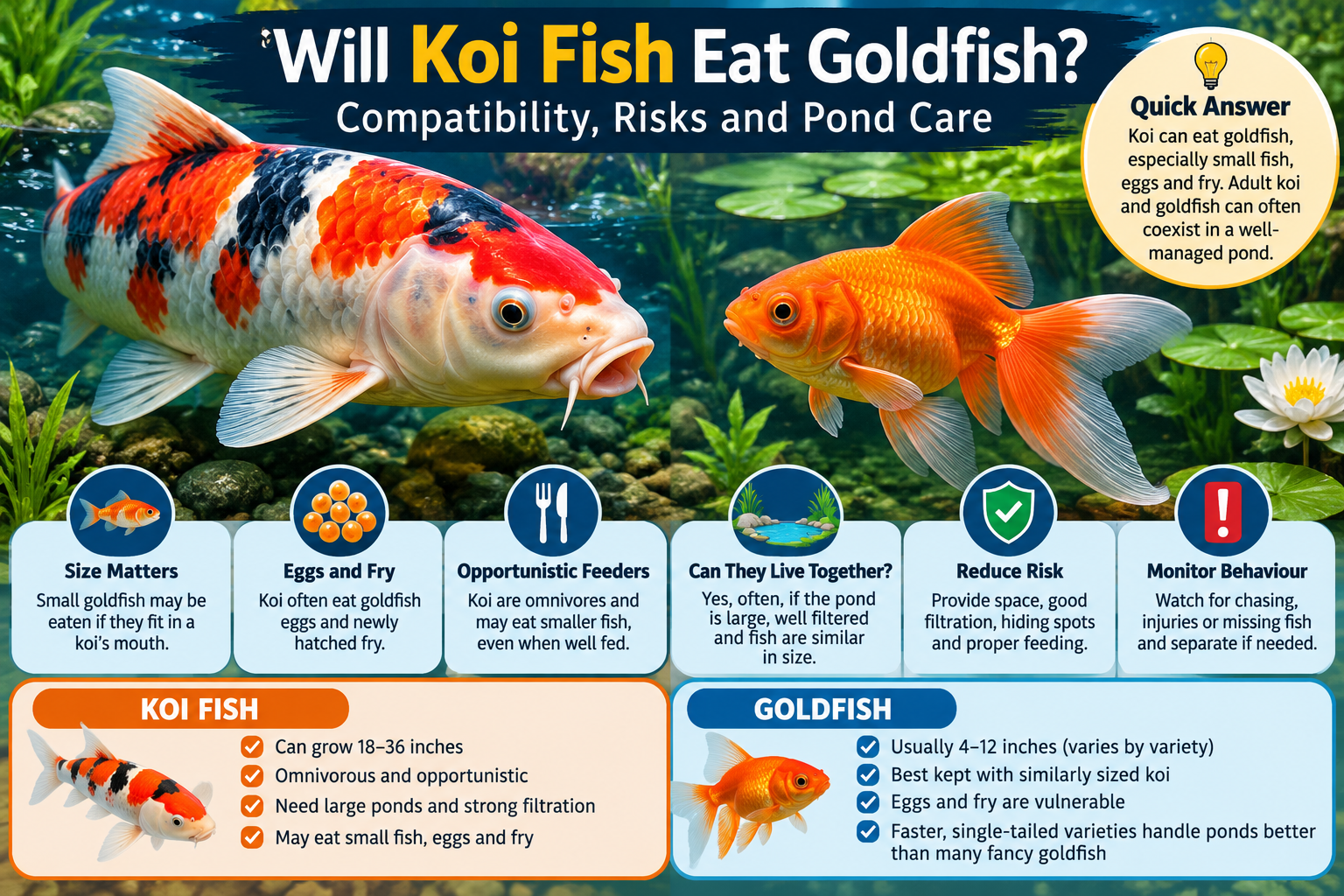
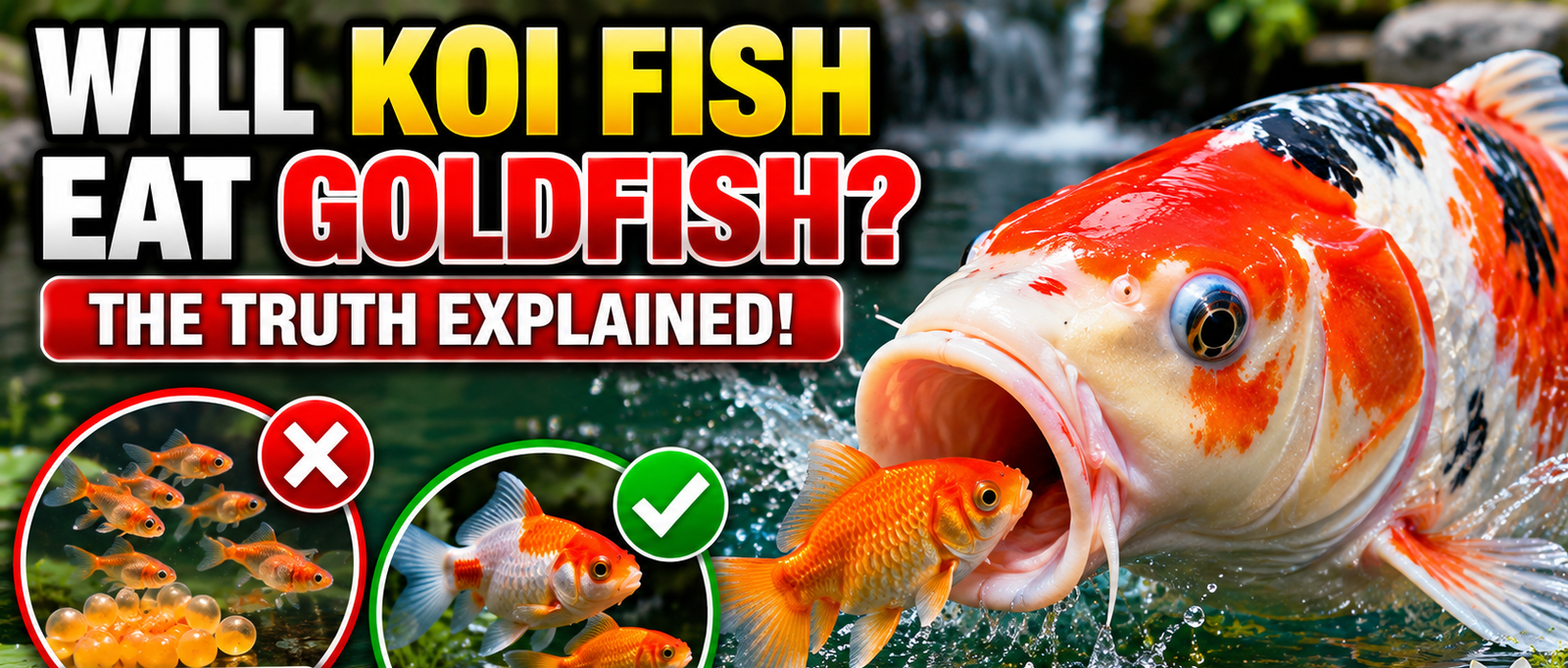
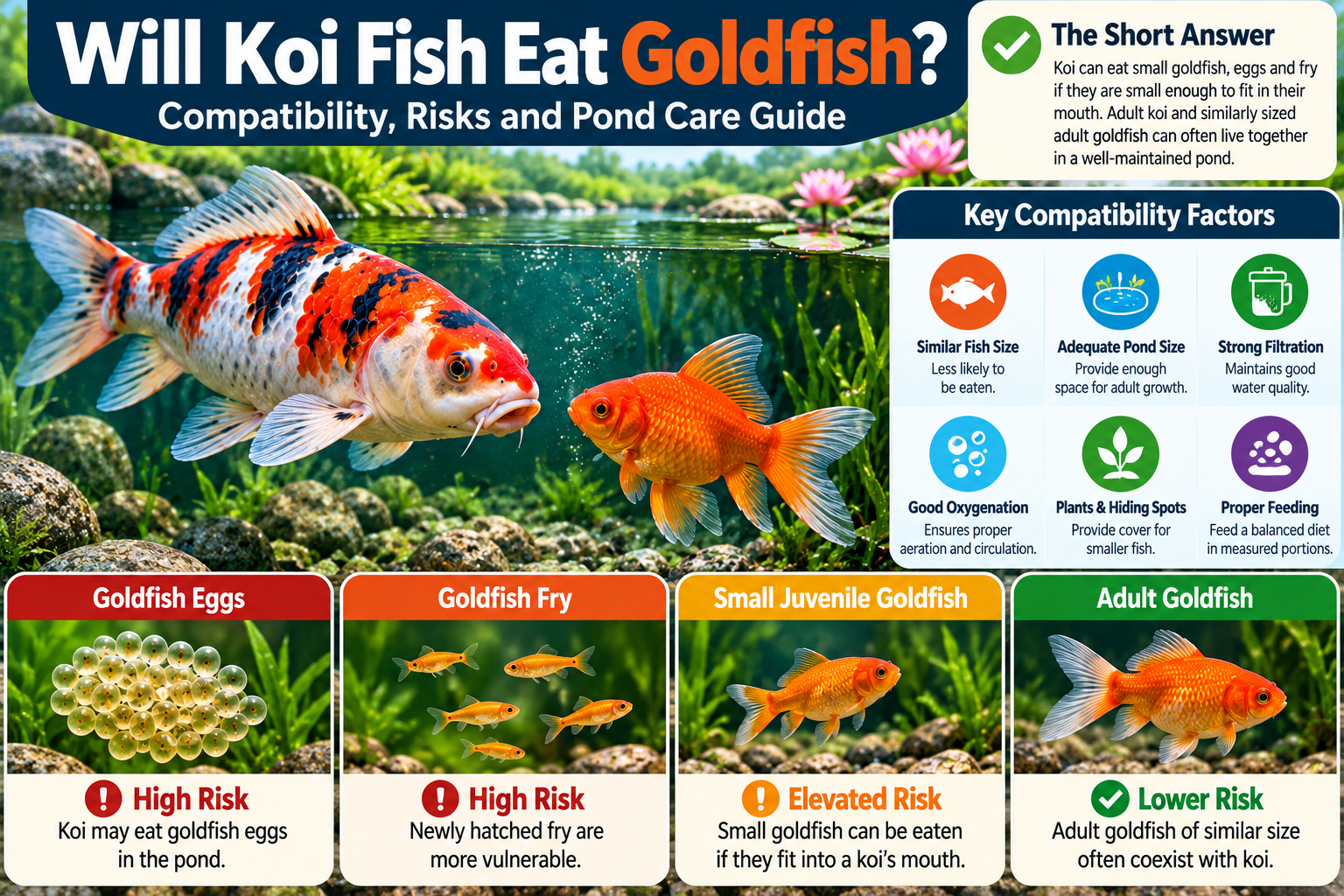
Will koi fish eat goldfish? Yes, koi may eat goldfish that are small enough to fit into their mouths, particularly young fish, eggs and newly hatched fry. However, koi do not automatically eat every goldfish in a shared pond. Adult koi and similarly sized adult goldfish can often coexist when the pond provides enough space, suitable filtration, good oxygenation and stable water quality.
The most important factors are the difference in fish size, feeding competition, pond capacity and individual behaviour. A pond that works for two similarly sized adult fish may be unsuitable for a large koi and tiny goldfish fry. This guide explains when koi may eat goldfish, how to manage a mixed pond, what to feed both species and how to assess compatibility before introducing new fish.
1. Why Would Koi Eat Smaller Goldfish?
Koi are domesticated carp and are generally classified as omnivorous, opportunistic feeders. Their natural diet can include insects, small aquatic animals, crustaceans, plant material and other food items. Commercial koi pellets provide a controlled diet, but they do not eliminate the possibility of koi swallowing small fish encountered in the pond.
Size and mouth capacity
The difference between the two fish is often more important than their names. A large koi has a greater capacity to ingest food than a small juvenile goldfish. If a goldfish is small enough to be swallowed, it may be taken during ordinary feeding or while the koi explores the pond bottom. Eggs and newly hatched fry are particularly vulnerable because they cannot escape larger fish effectively.
There is no universal body-length threshold that makes every goldfish safe. Koi differ in size, mouth capacity and behaviour, while goldfish vary in body shape and swimming ability. Keepers should assess the actual fish rather than applying a single size rule to every pond.
Does hunger cause koi to eat goldfish?
Underfeeding can affect fish health, but adequate feeding cannot guarantee that koi will leave small fish alone. Opportunistic feeding is not limited to periods of hunger. Increasing food beyond appropriate portions is therefore not a reliable prevention method.
Excess food decomposes and can increase the biological load on the pond. This may contribute to deteriorating water quality and place additional pressure on filtration. The better approach is to provide a suitable diet, use measured portions, monitor the fish and separate vulnerable goldfish when the size difference creates an unacceptable risk.
Individual behaviour also matters. One koi may ignore small pondmates, while another may investigate or swallow them. A peaceful period does not guarantee future safety as the koi grows. For comparison, read AquariumsWorld’s guides to Copper Oscar fish care, Blueberry Oscar fish size and colour and Oscar fish varieties and genetics. These are different fish, but their care requirements also demonstrate why compatibility depends on species and circumstances.
2. Can Koi and Goldfish Live Together in a Pond?
Yes, koi and goldfish can often share a properly maintained pond. Both are freshwater fish suited to temperate conditions, and similarly sized adults may coexist without persistent aggression. However, compatibility depends on more than whether the two species tolerate similar water conditions.
The pond must accommodate the adult size of every fish, provide adequate swimming space, support the combined waste load and maintain appropriate oxygen levels. Smaller goldfish must also have a reasonable chance of avoiding larger pondmates and accessing food.
Conditions that support successful coexistence
- The pond has enough volume, depth and swimming space for the adult fish.
- Biological filtration is mature and appropriate for the actual fish load.
- Water circulation and aeration are sufficient for the pond and its climate.
- The goldfish are not dramatically smaller than the koi.
- All fish can reach food and maintain good body condition.
- The keeper can separate fish if predation, injury or persistent chasing develops.
Consider the goldfish variety
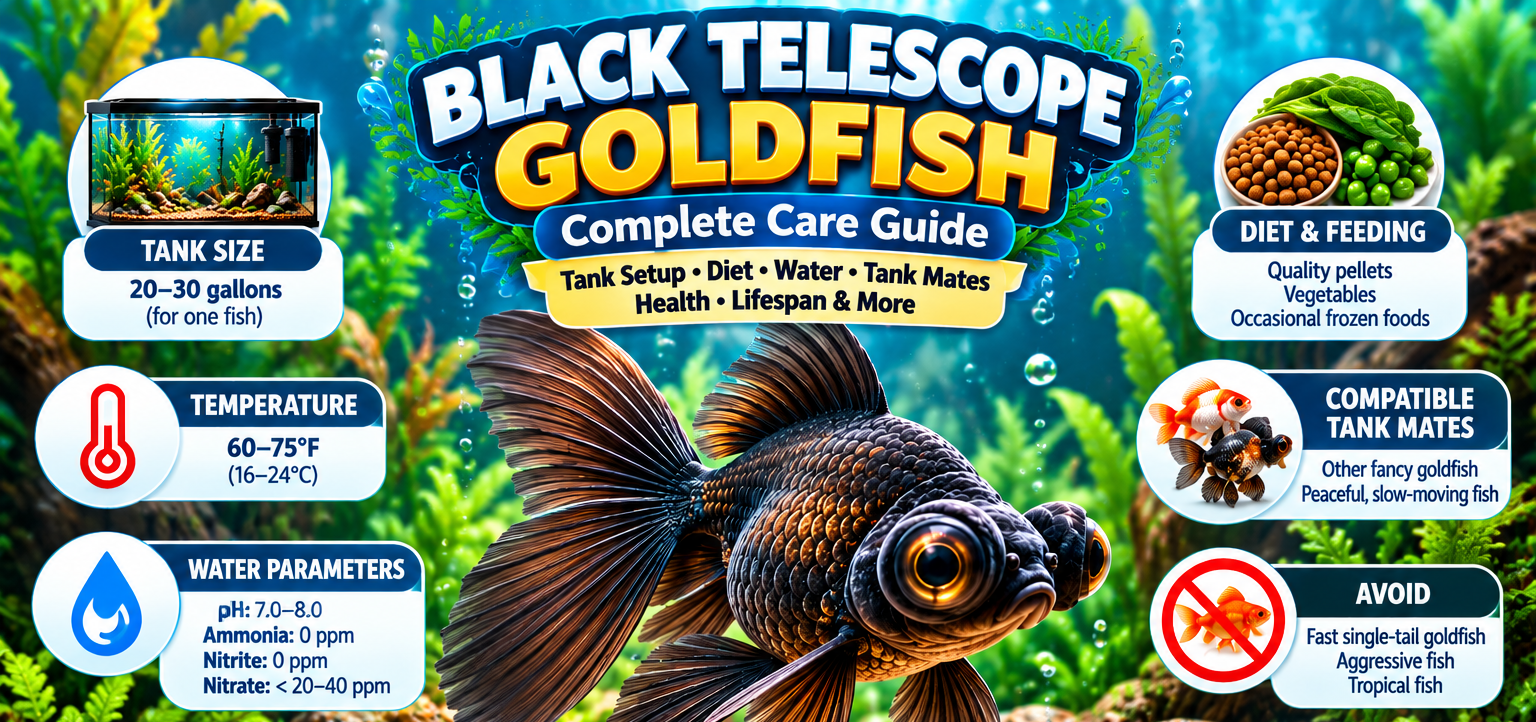
Single-tailed goldfish are generally more streamlined and active swimmers than many fancy goldfish. Round-bodied varieties with double tails, protruding eyes or reduced swimming ability may struggle to compete with large koi. Telescope-eye goldfish, including black moors, need particular care because their protruding eyes are vulnerable to injury.
Read our Black Telescope Goldfish care guide before considering a mixed pond for this variety. A dedicated goldfish pond may be a better choice for delicate fancy varieties.
Observe the group over time rather than assuming a calm first day proves compatibility. Persistent hiding, damaged fins, missing fish, loss of body condition or repeated chasing should prompt a review of the setup. Separation is preferable to repeatedly exposing vulnerable fish to a known risk.
3. Will Koi Eat Goldfish Eggs, Fry or Baby Goldfish?
Yes, koi may consume goldfish eggs, newly hatched fry and small juvenile fish. Goldfish scatter adhesive eggs over aquatic plants and other surfaces. In a mixed pond, these eggs may be accessible to koi and adult goldfish. Even when adult fish appear to coexist peacefully, the pond may not support the survival of many goldfish offspring.
How to protect goldfish fry
If breeding goldfish is your goal, use a separate breeding or rearing system. Move suitable spawning material to a carefully prepared environment and keep fry away from adult fish until they are less vulnerable. Provide suitable small food, stable water conditions and filtration appropriate for the rearing system.
A dense mass of aquatic plants may offer cover, but it is not a guaranteed barrier. Plants should not prevent adequate circulation, oxygenation or routine maintenance. Monitor water quality because small rearing systems can change quickly when food and waste accumulate.
Do not move eggs or fry between ponds without considering temperature, water chemistry and disease risks. Clean equipment appropriately between systems and quarantine new fish. If you do not intend to breed goldfish, understand that eggs or fry may appear seasonally but may not survive in a pond containing adult fish.
4. How Does Goldfish Size Affect Compatibility?
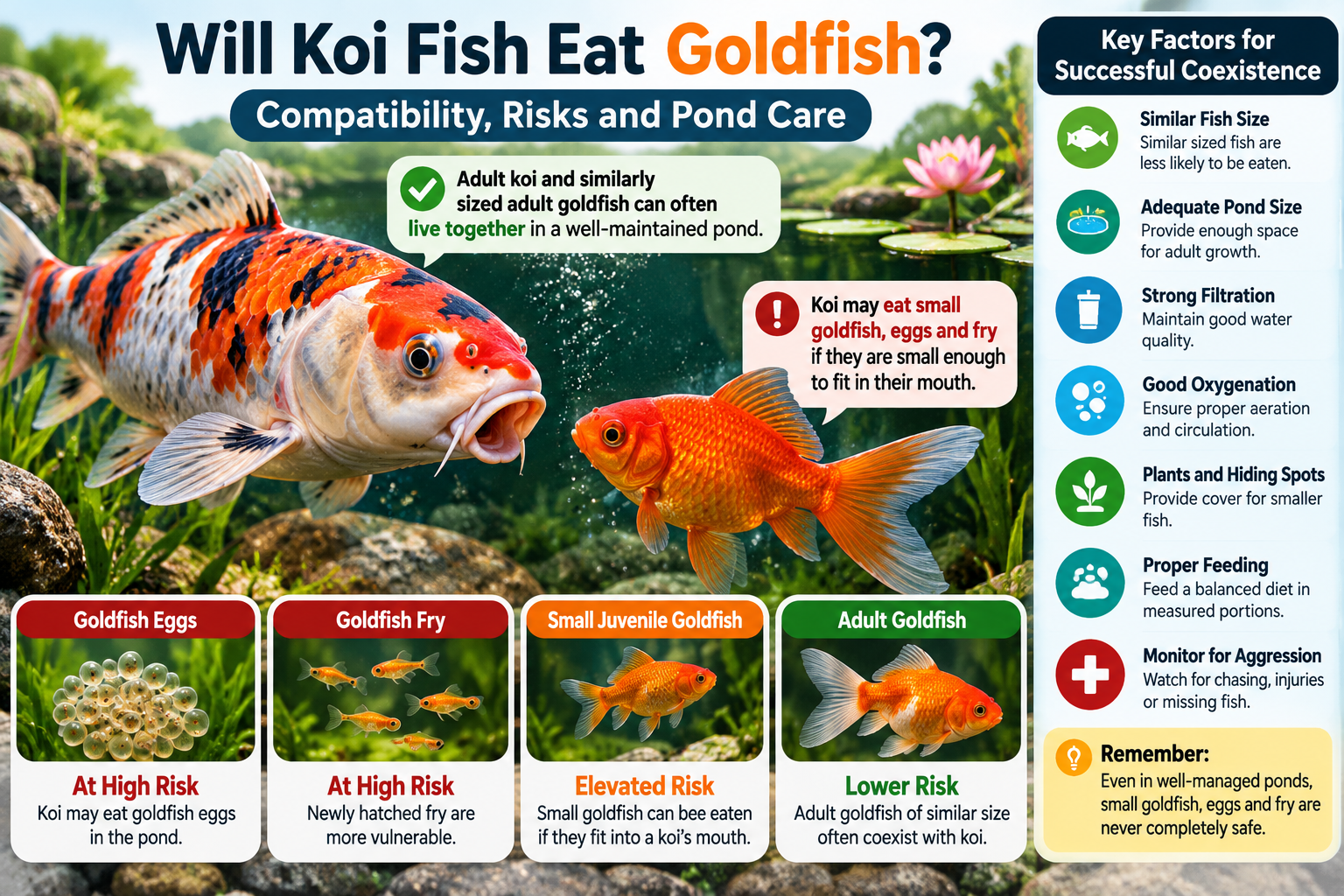
Size difference is one of the most useful practical indicators of predation risk. A tiny juvenile goldfish alongside a large adult koi is more vulnerable than a mature goldfish of comparable bulk. However, there is no universal safe-size rule because koi, goldfish and their individual behaviours vary.
| Fish combination | Potential concern | Recommended action |
|---|---|---|
| Large koi and tiny fry | High predation concern | Rear fry separately. |
| Large koi and much smaller juvenile goldfish | Elevated predation concern | Consider separation and monitor closely. |
| Koi and similarly sized adult goldfish | Often more manageable, but not risk-free | Check pond capacity and observe behaviour. |
| Large koi and delicate fancy goldfish | Competition and injury concerns | Consider a dedicated goldfish pond. |
Size alone cannot establish compatibility. Fish must have access to food, room to swim and suitable water conditions. If one fish consistently reaches food first, the others may lose condition even when predation does not occur. Reassess the group as koi grow, because a combination that initially appears manageable can become less suitable over time.
5. Can Koi and Goldfish Live Together in an Aquarium?
A typical home aquarium is generally unsuitable for keeping adult koi long-term. Koi can grow large, need extensive swimming space and produce considerable waste. A tank that appears adequate for juveniles may become unsuitable as they mature. Goldfish also need generous water volume and strong biological filtration, so adding koi increases the combined load.
Choose an aquatic environment based on adult size rather than the current size of the fish. Our guides to tank size and filtration, aquarium water test kits and water-testing equipment discuss broader fishkeeping principles. Although the species covered in those articles differ, the importance of matching filtration and capacity to the fish remains relevant.
A purpose-built pond is generally more practical for mixed koi and goldfish. If temporary indoor housing is necessary, use an appropriate, cycled system, avoid crowding, monitor water frequently and plan suitable permanent housing.
6. Feeding Koi and Goldfish Together
Can koi fish eat goldfish food?
Koi may eat many commercial goldfish foods, but the best long-term diet depends on the formulation, fish size, season and water temperature. A quality food designed for koi or pond fish is a sensible starting point. Follow the manufacturer’s feeding instructions and avoid assuming that every food is nutritionally complete for every fish.
Can goldfish eat koi food?
Goldfish may consume suitable koi pellets, but pellet size and formulation matter. Small goldfish may struggle with large pellets, while slower fancy goldfish may lose access to food when faster koi feed aggressively. Select food that the fish can eat comfortably and observe whether all individuals receive a fair opportunity.
How to reduce feeding competition
- Offer measured portions instead of dumping large amounts of food into the pond.
- Distribute food over more than one area to reduce monopolisation.
- Observe individual fish and remove uneaten food.
- Adjust feeding to temperature and seasonal activity.
- Do not use excessive feeding to try to stop koi eating small fish.
An automatic feeder may help maintain consistent feeding when the keeper is away, but it does not replace observation. Compare our guides to the automatic pond fish feeder and automatic aquarium feeder. Test any feeder before relying on it and make sure food remains dry and is dispensed correctly.
7. Pond Size, Filtration and Water Quality
A mixed pond should be planned around the adult size of its residents, not just the number of fish currently present. Koi can grow substantially and produce considerable waste. Goldfish also add to the biological load, and a larger population may overwhelm a filter that previously kept the pond clear.
Pond volume and swimming space
There is no single pond-volume formula that guarantees compatibility. Pond shape, depth, surface area, fish size, climate, feeding rate and filtration all influence practical capacity. A pond must allow normal swimming and provide enough water volume to help maintain stable conditions.
A simple gallons-per-fish rule cannot account for all these factors. Avoid adding fish merely because a rough calculation suggests that the pond has spare capacity. Consider the adult size of the koi, the goldfish varieties and the filter’s ability to process waste.
Biological filtration and oxygen
Biological filtration supports beneficial microorganisms that process toxic ammonia into nitrite and then less toxic nitrate. A new or disrupted filter may not have sufficient established bacteria to process additional waste. Aeration is also important, especially in hot weather when oxygen availability may fall while fish and microorganisms continue consuming oxygen.
Maintain pumps and filters, check circulation and avoid areas where fish struggle. A filter’s advertised capacity may assume lighter stocking than your pond actually has, so consider the real fish load rather than relying solely on packaging claims.
Products that support biological filtration are not substitutes for a properly cycled system or regular testing. Our article about MICROBE-LIFT Nite-Out II provides further context about bacterial products. Follow product labels and do not add treatments blindly when the cause of a problem is unknown.
Test water instead of guessing
Test ammonia and nitrite and monitor nitrate, pH and temperature according to your pond’s needs. Ammonia and nitrite should remain at undetectable levels in a healthy, established system. If either is elevated, reduce feeding, increase aeration, inspect filtration and perform an appropriately conditioned partial water change based on test results.
Avoid sudden, large changes in temperature or water chemistry. Use a suitable freshwater pond test kit; a marine-only test kit may not be the most convenient option for a freshwater pond. Our aquarium water test kit comparison explains what to consider when choosing testing equipment.
Good water quality supports fish health, but it cannot remove the physical risk of a large koi swallowing a small goldfish. Both water management and size compatibility need attention.
8. How to Introduce Goldfish to a Koi Pond Safely
- Check capacity first. Confirm that the pond, filter and aeration can handle the additional fish at adult size.
- Quarantine new fish. Use a separate, suitable quarantine system and observe for illness before mixing fish.
- Acclimate carefully. Avoid sudden temperature shifts and follow a suitable acclimation process for the source water and fish condition.
- Inspect fish before release. Look for sores, damaged fins, abnormal swimming or laboured breathing. Do not introduce visibly ill fish.
- Observe feeding. Check that all fish can reach food and that smaller fish are not repeatedly pursued.
- Keep a separation plan ready. Prepare suitable alternate housing if the mix proves incompatible.
Do not pour transport water into the pond unless your fish-care protocol specifically requires it. Clean equipment appropriately between systems because pathogens can move between fish groups. Explore the AquariumsWorld blog archive for more fishkeeping guides.
9. What to Do If Koi Chase or Injure Goldfish
Brief interest around feeding time does not always indicate persistent aggression. However, repeated chasing, missing fish, damaged scales, torn fins, eye injuries, hiding or loss of body condition should prompt action. Do not wait for severe injury before separating fish when a clear size mismatch or repeated predatory attempt is present.
- Separate vulnerable fish. Move them to suitable, cycled housing with compatible water conditions.
- Check water immediately. Test ammonia and nitrite, check temperature and inspect filtration and aeration.
- Review feeding access. Observe whether every fish can eat without being pushed away.
- Assess injuries. Seek aquatic-veterinary advice for significant wounds, eye damage, bleeding or worsening symptoms.
- Reconsider the combination. If predation or injury recurs, use separate housing instead of repeatedly reintroducing vulnerable fish.
Do not medicate the entire pond automatically after an injury. Treatments can affect biological filtration and may be inappropriate without a diagnosis. Our responsible fish rehoming guide discusses the importance of finding suitable housing when a fish’s needs cannot be met in its current setup.
10. Koi and Goldfish Pond Compatibility Calculator
Use this simple planner to highlight factors that deserve review before mixing fish. It is not a validated stocking formula and cannot predict an individual koi’s behaviour. Use it to assess pond volume, fish size and filtration, then verify that the pond is appropriate for the adult fish.
Koi and Goldfish Pond Planner
This is an educational screening tool, not a validated stocking-density calculator. It does not certify that a pond is safe.
11. Recommended Products for Koi and Goldfish Ponds
Affiliate disclosure: AquariumsWorld may earn a commission from qualifying purchases through affiliate links, at no additional cost to you. Confirm the exact product, compatibility and current listing details before purchasing.
1. Hikari Gold Koi Food
A quality koi food supports a consistent feeding routine. Select a formulation and pellet size suited to the fish and seasonal conditions. Appropriate feeding does not guarantee that koi will leave smaller fish alone.
2. API Pond Master Test Kit
A suitable pond test kit helps you monitor water parameters such as ammonia and nitrite. Choose tests intended for freshwater pond use and follow the manufacturer’s instructions carefully.
3. Biological Pond Filter
Choose a filtration system rated for your actual pond volume and fish load. Account for adult koi growth, feeding, climate and maintenance rather than relying only on the advertised maximum capacity.
12. Frequently Asked Questions
Will koi fish eat goldfish in a pond?
They may eat small goldfish that fit in their mouths, especially fry and juveniles. Adult goldfish of similar size may coexist with koi, but the risk is not zero.
Can koi and goldfish live together?
Often, yes, in a spacious, well-filtered pond with appropriate oxygen and water quality. Fish size, variety, stocking and individual behaviour determine whether a particular combination is suitable.
Will koi eat baby goldfish?
They may. Eggs and newly hatched fry are particularly vulnerable to adult pond fish. Rear fry separately if protecting them is important.
Can koi and goldfish breed together?
Koi and goldfish are closely related but distinct domesticated forms. Do not assume that sharing a pond will produce viable hybrids. Unusual offspring require careful identification and evidence before parentage can be established.
Can koi eat goldfish food?
Koi may eat suitable goldfish food, but their long-term diet should be appropriate to their needs. Select suitable pellet sizes and avoid overfeeding.
What fish can live safely with koi?
There is no universal list of safe tankmates. Consider adult size, water requirements, temperament, disease risks and whether smaller fish could be swallowed. Do not choose a species solely because it is described as peaceful.
What is poisonous to koi fish?
Potential hazards include pesticides, untreated chemicals, some cleaning products, contaminated runoff and inappropriate medication. Keep chemicals away from ponds and investigate sudden illness promptly.
What is a koi fish’s favourite food?
Koi commonly accept prepared pellets formulated for pond carp. They may also forage on suitable natural food, but a balanced commercial diet and controlled portions make feeding easier to manage.
13. Related AquariumsWorld Guides
Explore these related articles for additional fish-care information. These links use the URLs supplied for this article; verify that each destination remains live before publication.
- Are Guppies Schooling Fish? Shoaling Behaviour
- Pigeon Blood Discus Water Parameters and Breeding
- Best Plants for Betta Fish Tanks
- Rose Bubble Anemone Care
- Copper Oscar Fish Care
- Blueberry Oscar Fish Colours and Size
- Oscar Fish Blue Varieties and Genetics
- Oscar Fish Tank Size and Filtration
- White Tiger Oscar Fish Care
- Bumblebee Oscar Fish Guide
- Marine Aquarium Water Test Kits
- Halfmoon Betta Care Guide
- How to Rehome Oscar Fish Responsibly
- Aquarium Water Test Kit Comparison
- Oscar Fish Plush Guide
- Can You Eat Parrot Fish?
- Tiger Parrot Fish Varieties
- Automatic Aquarium Fish Feeder Guide
- Automatic Pond Fish Feeder Guide
- Aquarium Industry News: October 2026
- MICROBE-LIFT Nite-Out II Guide
- Saltwater Parrot Fish Guide
- Parrot Fish Food Guide
- Black Telescope Goldfish Care Guide
- Purple Guppy Fish Varieties and Care
- Queen Angelfish Care and Tank Size
- AquariumsWorld Blog Archive
14. References and Further Reading
Use authoritative sources to verify husbandry claims before publication. Check the current page titles and dates when preparing a formal reference list.
- Merck Veterinary Manual. Fish health and management resources. https://www.merckvetmanual.com/
- American Veterinary Medical Association. Aquatic animal health and veterinary resources. https://www.avma.org/
- U.S. Geological Survey. Nonindigenous Aquatic Species database. https://nas.er.usgs.gov/
- University of Florida IFAS Extension. Aquaculture and pond management resources. https://edis.ifas.ufl.edu/
- RSPCA. Animal welfare and fish-care resources. https://www.rspca.org.uk/
- AquariumsWorld. Blog archive and fishkeeping guides. https://aquariumsworld.com/aquariumsworld-blog/
Conclusion
Koi can eat goldfish when the smaller fish is small enough to swallow, and eggs or fry are particularly vulnerable. That does not mean koi inevitably eat every goldfish in a shared pond. Adult fish of comparable size can often coexist when the pond is appropriately designed, filtered and maintained. Before mixing them, consider adult size, goldfish variety, oxygen, water quality, feeding access and a plan for separating fish if problems arise. If breeding goldfish is your goal, use a separate rearing system. Monitor the actual fish rather than relying on a general compatibility rule.