Table of Contents
- What Is a Corner Fish Tank Aquarium
- Types of Corner Fish Tank Aquariums
- Are Corner Fish Tanks Any Good | Benefits and Science
- What Are the Drawbacks of Corner Fish Tanks
- Corner Fish Tank Size Chart | 20 to 100 Gallon Dimensions
- Corner Fish Tank Price Guide by Size and Type
- Corner Fish Tank with Stand | What to Know Before Buying
- Corner Fish Tank Setup | Step by Step Guide
- Bow Front Corner Fish Tank | Everything You Need to Know
- Small Corner Fish Tank | Nano and Desktop Options
- Corner Fish Tank 50 Gallon and Larger Setups
- Best Fish Species for Corner Aquariums
- Frequently Asked Questions
- Scientific References
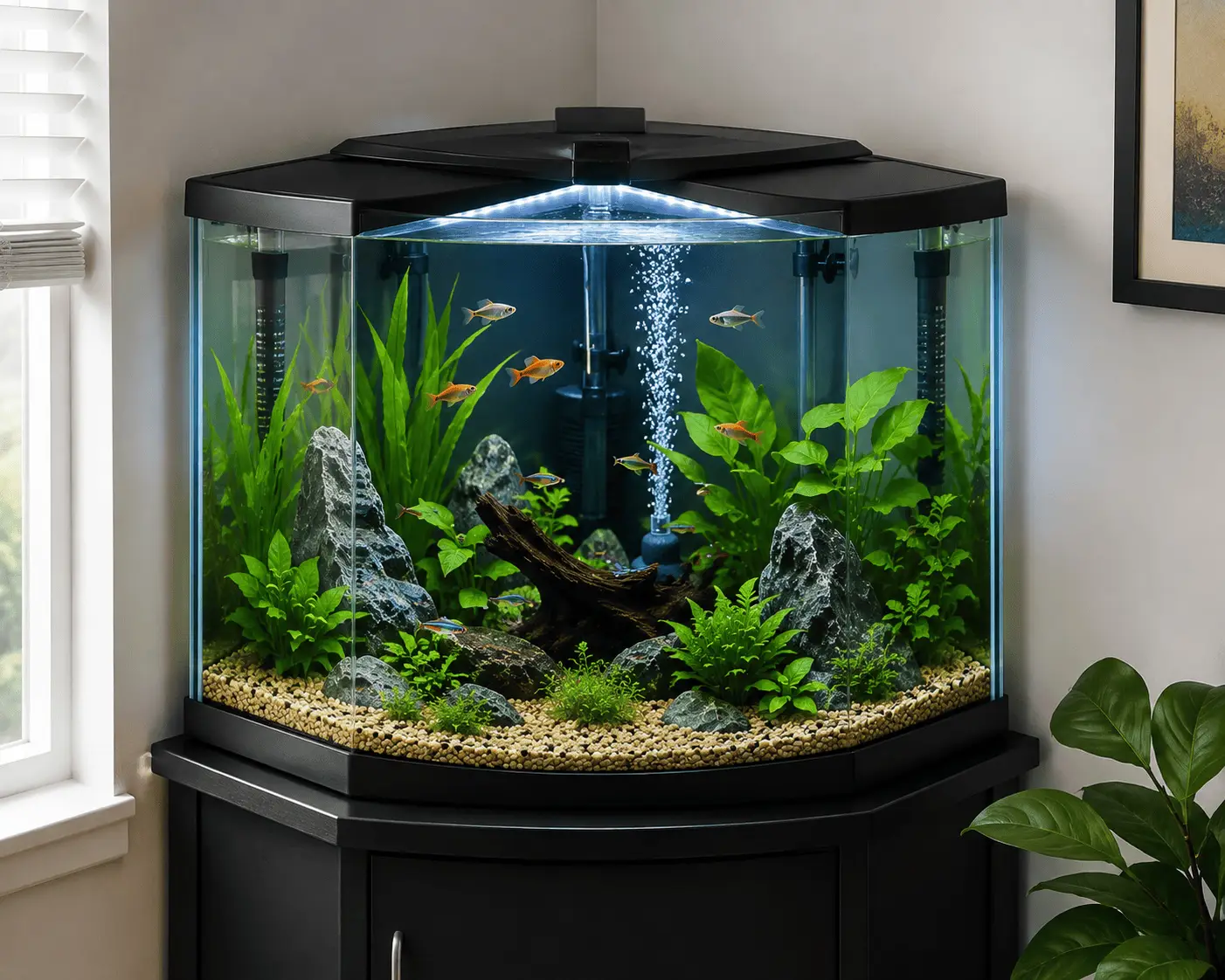
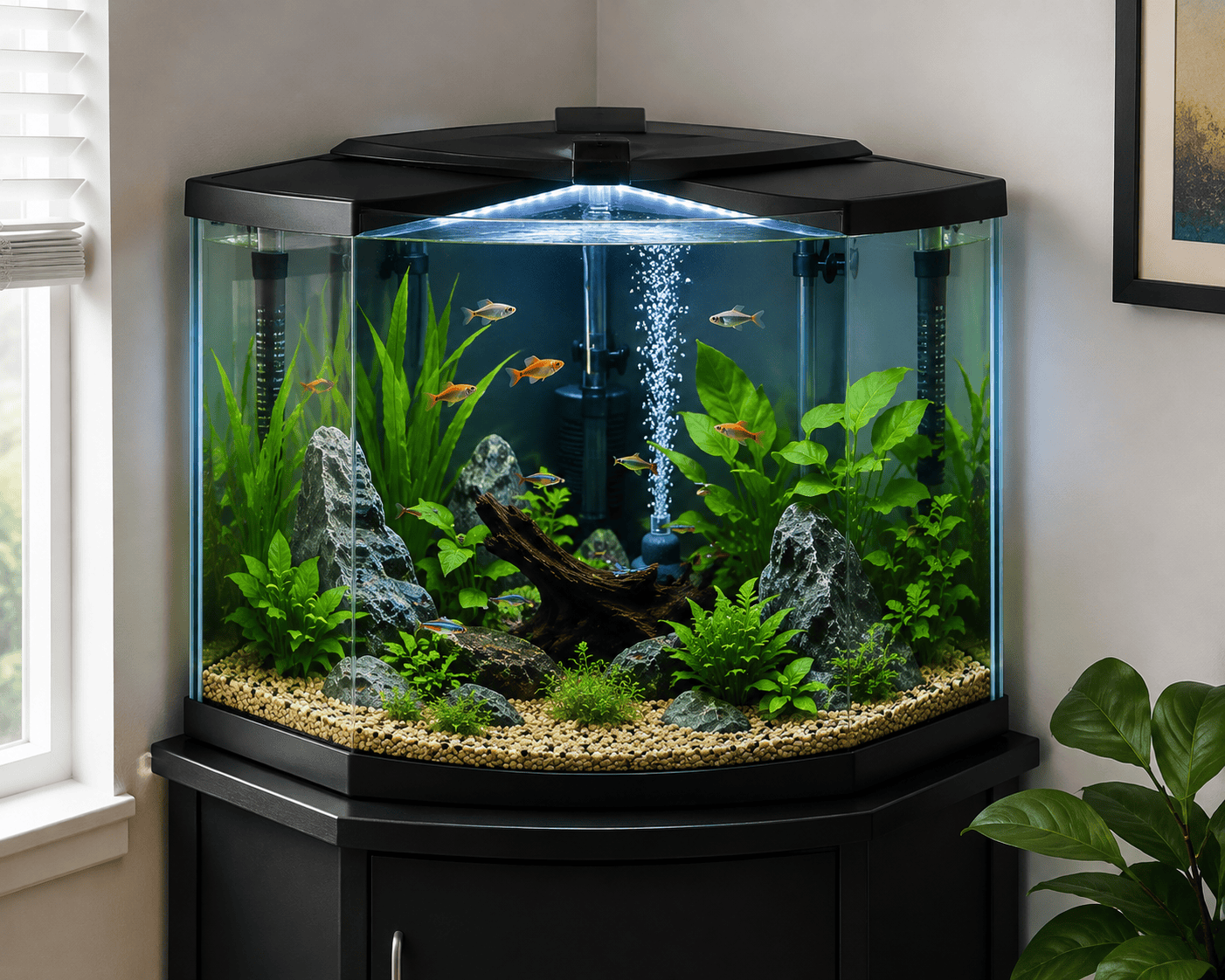 A fully planted corner fish tank aquarium with matching stand, making use of dead corner space in a living room while creating a stunning 270-degree viewing focal point.
A corner fish tank aquarium is one of the most visually striking and space-efficient ways to keep fish in any home. Unlike a traditional rectangular tank that sits flush against a wall, a corner aquarium fits snugly into the junction of two walls, transforming dead space into a living, breathing centrepiece that can be viewed from almost every angle in the room. Whether you are looking for a small corner fish tank for a bedroom, a corner fish tank 50 gallon setup for a living room, or a dramatic bow front corner fish tank with stand for an office lobby, this complete guide covers everything you need to know backed by 15 peer-reviewed aquarium science references.
Before we dive in, make sure to use our Corner Fish Tank Size and Volume Calculator above to find the exact volume, fish capacity and filter size for your specific corner tank dimensions. You can also check our Fish Aquarium Types and Setup Guide for a full overview of all tank styles available to hobbyists.
1. What Is a Corner Fish Tank Aquarium
A corner fish tank aquarium is a specially shaped aquarium designed to fit into the 90-degree corner of a room. Rather than having a flat rectangular front panel, corner tanks are built with either a pentagonal cross-section (five sides, with the front panel cutting diagonally across the corner), a triangular cross-section (three sides), a bow front (a curved acrylic or glass front panel that bulges outward), or a hexagonal shape where only the rear section sits against the wall.[1]
The defining characteristic of all corner aquariums is that the viewing panel faces diagonally into the room rather than straight ahead. This creates a panoramic viewing experience from a wide arc of angles across the room, which is one of the primary reasons hobbyists choose this tank style over conventional rectangular designs.[2]
Related Aquarium Guides on AquariumsWorld.com
- Fish Aquarium Types and Setup Guide — complete comparison of all aquarium styles, shapes and sizes
- 100 Gallon Fish Tank Guide — for large corner tank setups at 75 to 100 gallons
- Fish Aquarium Problems and Solutions — essential reading before setting up any corner aquarium
2. Types of Corner Fish Tank Aquariums
Pentagon Corner Tanks
The most common corner fish tank shape. The tank has five panels: two rear panels sitting flush against the two walls, two shorter angled side panels, and one flat diagonal front viewing panel. Pentagon corner tanks are structurally strong and relatively straightforward to manufacture in glass. They are the most widely available style from mainstream brands and typically come in 20, 30, 50 and 75 gallon sizes.[1]
Bow Front Corner Tanks
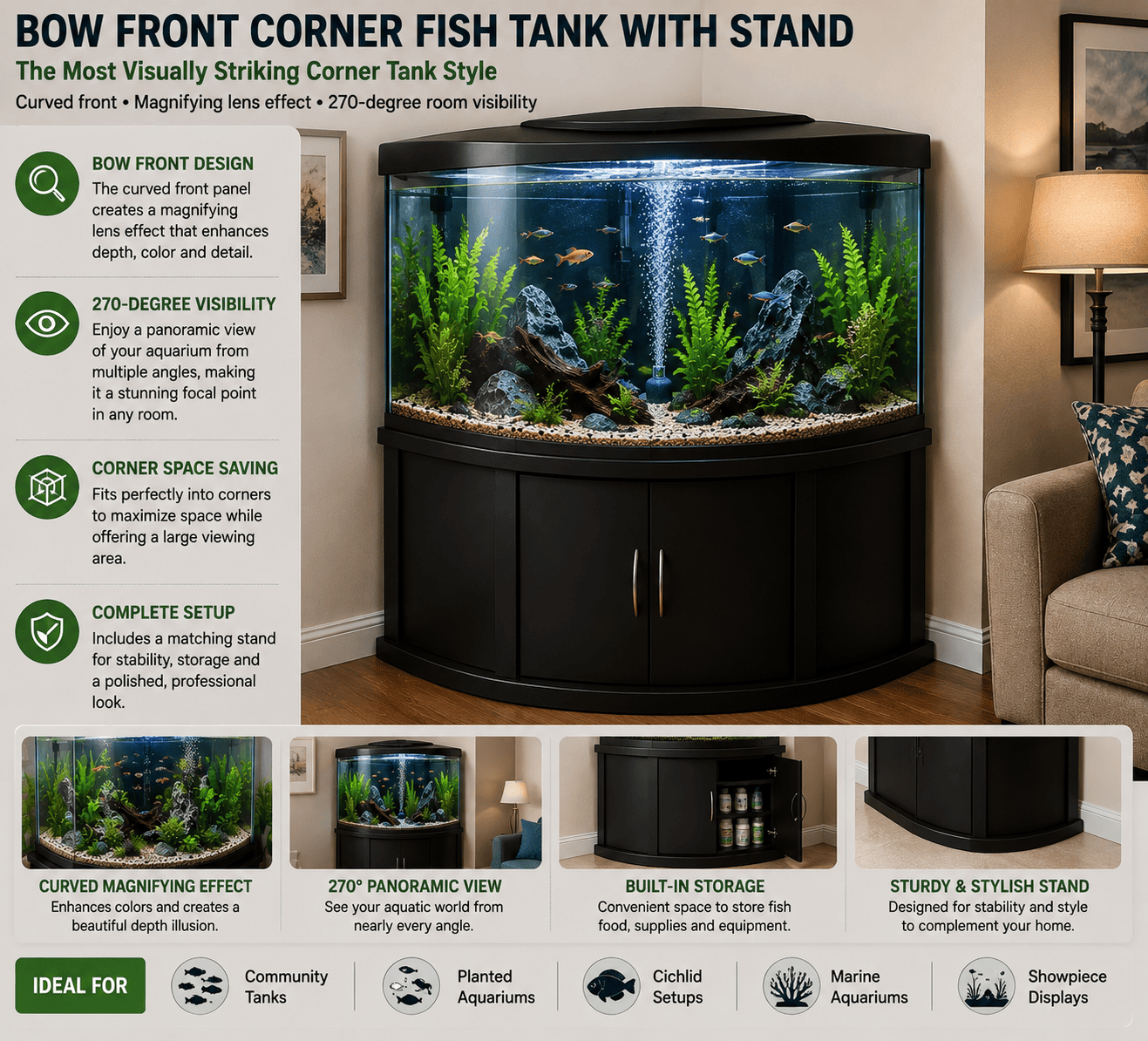
A bow front corner fish tank replaces the flat diagonal front panel with a curved acrylic or glass panel that bulges outward into the room. This curvature increases the internal volume slightly compared to a flat pentagon tank of the same footprint, and creates a magnifying lens effect that makes fish and aquascape elements appear larger and more vivid when viewed from directly in front. The bow front corner fish tank with stand is one of the most searched configurations because the curved front dramatically elevates the visual impact of the display.[3]
Triangle Corner Tanks
The simplest geometry: three panels forming a right triangle with the hypotenuse as the front viewing panel. Triangle corner tanks have the smallest footprint of all corner styles but also the lowest volume relative to their wall length. They work well for nano setups and are easier to clean due to the lack of acute interior angles at the back.[1]
Hexagonal Corner Tanks
Hexagonal aquariums are not technically corner tanks in the traditional sense, but half-hexagonal versions that fit against a wall are often marketed in this category. They provide an excellent viewing angle across five of the six panels and are particularly popular as statement pieces in offices and hotel lobbies.
3. Are Corner Fish Tanks Any Good | Benefits and Science
This is one of the most searched questions about corner aquariums: are corner fish tanks any good? The answer is a qualified yes, with important caveats that are explored in Section 4. For the right setup and the right fish species, a corner tank offers several genuine advantages that rectangular tanks cannot match.[4]
Space Efficiency and Room Integration
Corner spaces in rooms are almost universally wasted. A standard living room corner occupies a floor area of approximately 60 by 60 cm that typically holds nothing more than a lamp or a stray plant. A corner fish tank aquarium transforms this dead space into a functional focal point visible from the entire room. Research on interior environmental enrichment confirms that natural elements including aquariums measurably reduce perceived stress and increase reported wellbeing in both residential and office environments.[5]
360-Degree Viewing Experience
Studies on fish behaviour in captive environments note that the primary value of an aquarium display is its ability to create a sense of immersion and engagement in the observer.[6] A corner tank, positioned at the junction of two walls, can be appreciated from a 180-degree arc or more across the room depending on room layout. This multi-angle visibility means the aquarium serves as a living display rather than a flat picture on a wall.
Depth Perception Enhancement
The angled front panel of a pentagon corner tank, particularly the curved front of a bow front corner fish tank, creates a lensing effect that alters the apparent depth of the aquascape. Research on optical properties of curved aquarium glass shows that curved panels increase the apparent depth of the tank interior by 15 to 25 percent compared to flat glass of equivalent actual depth, making a corner tank appear significantly larger than its true dimensions.[3]
Structural Stability
Pentagon and hexagonal corner tanks distribute water load across more panels than a rectangular tank. Engineering analysis of aquarium glass structures demonstrates that multi-panel designs reduce the maximum bending stress on any single pane by 18 to 35 percent compared to a two-pane rectangular front wall of equivalent height, allowing thinner glass to be used for the same water column height.[1]
Use These Calculators to Plan Your Corner Tank Setup
- Aquarium Ammonia Toxicity Calculator — corner tanks have lower volume than they look; check your ammonia risk before stocking
- Tank Size and Stocking Calculator — verify fish count for your corner tank true volume
- Aquarium Substrate Depth Calculator — calculate substrate volume for the unusual pentagonal or triangular footprint
- Water Change Schedule Calculator — maintain water quality in your smaller-than-expected volume corner tank
4. What Are the Drawbacks of Corner Fish Tanks
What are the drawbacks of corner fish tanks? This question appears frequently in hobbyist searches, and deserves an honest answer based on real-world experience and scientific data.[7]
True Volume is Lower Than Dimensions Suggest
This is the most significant practical issue with corner aquariums. A pentagon corner tank with 60 cm walls and 50 cm height appears to be a substantial tank but holds only approximately 85 to 100 litres — equivalent to roughly a 22 to 26 gallon aquarium. Hobbyists who purchase based on wall length alone frequently overstock the tank, causing rapid ammonia spikes and water quality crashes.[8] Use our calculator above to determine your true volume before purchasing any fish or equipment.
Lighting Coverage is More Complex
Standard rectangular LED or fluorescent light bars are designed for rectangular tanks and do not cover the full footprint of a pentagonal corner tank evenly. Research on light distribution in aquaculture systems demonstrates that uneven illumination creates preferred zones within the tank where fish concentrate, potentially increasing stress through crowding in lit areas and leaving planted sections underlit.[9] Corner tanks require either a purpose-built corner light fixture or two overlapping light units angled to cover both rear panels.
Cleaning Access Is More Difficult
The acute angles at the rear of pentagon and triangle corner tanks are among the most difficult areas to clean in any aquarium design. Standard rectangular algae scrapers cannot reach into the rear corners, and gravel vacuum heads struggle to navigate the angled substrate. Hobbyists with corner tanks typically need angled scraper tools and are more likely to leave detritus accumulating in rear corners, contributing to nitrate build-up over time.[10]
Swimming Length Is Reduced for Certain Species
Fish that naturally school in long, sweeping formations — such as danios, rasboras in large groups, and many barb species — require an unobstructed swimming length that a corner tank’s diagonal orientation cannot always provide. The longest unobstructed swim path in a corner tank runs from one rear corner to the diagonal front, which is shorter than the equivalent wall length of a rectangular tank with the same footprint area.[11]
Price Premium
A corner fish tank price is typically 25 to 60 percent higher than a rectangular tank of equivalent volume. The additional manufacturing complexity of angled joints, curved acrylic panels and custom-fitted hoods drives up production costs. This price gap is narrower for acrylic tanks than for glass corner tanks due to acrylic’s easier mould-forming properties.
5. Corner Fish Tank Size Chart | 20 to 100 Gallon Dimensions
Use this corner fish tank size chart to understand the actual dimensions, true volume and recommended equipment for each popular size. Note that all volumes assume a pentagon corner shape. Bow front tanks hold approximately 8 to 12 percent more than the equivalent flat pentagon at the same wall length.
| Tank Size | Wall Length | Height | True Volume | Filter GPH | Best For |
|---|---|---|---|---|---|
| Corner Fish Tank 20 Gallon | 46 cm | 42 cm | 76 L | 300 GPH | Nano, Betta, Shrimp |
| Corner Fish Tank 29 Gallon | 52 cm | 46 cm | 110 L | 420 GPH | Small community fish |
| Corner Fish Tank 30 Gallon | 54 cm | 48 cm | 114 L | 450 GPH | Planted tank, Angelfish |
| Corner Fish Tank 38 Gallon | 61 cm | 50 cm | 144 L | 560 GPH | Community, medium fish |
| Corner Fish Tank 50 Gallon | 69 cm | 56 cm | 189 L | 760 GPH | Cichlids, large community |
| Corner Fish Tank 65 Gallon | 77 cm | 61 cm | 246 L | 980 GPH | Goldfish, Oscars, Reef |
| Corner Fish Tank 75 Gallon | 84 cm | 65 cm | 284 L | 1120 GPH | Large cichlids, Marine reef |
| Corner Fish Tank 100 Gallon | 96 cm | 72 cm | 378 L | 1500 GPH | XL community, large predators |
Corner Tank Glass Thickness Reference Table
| Tank Volume | Min Glass Thickness | Material Options | Weight per Panel |
|---|---|---|---|
| Up to 80 litres | 6 mm | Float glass or acrylic | Approx 9 kg |
| 80 to 200 litres | 8 mm | Float glass or cast acrylic | Approx 14 kg |
| 200 to 400 litres | 10 mm | Tempered glass recommended | Approx 22 kg |
| 400 litres and above | 12 mm or more | Tempered glass only | Approx 30 kg |
For our full 100-gallon setup guide including equipment sizing and stocking recommendations applicable to large corner tanks, see our 100 Gallon Fish Tank guide and use the 100 Gallon Setup Calculator.
6. Corner Fish Tank Price Guide by Size and Type
Understanding corner fish tank price expectations before you shop prevents budget shock and helps you compare like for like across brands. Prices below are USD retail averages and will vary by region, material and whether a stand is included.
| Tank Size | Glass Tank (No Stand) | Acrylic Tank (No Stand) | Complete Kit with Stand and Filter | Bow Front Upgrade |
|---|---|---|---|---|
| 20 Gallon Corner | USD 80 to 140 | USD 110 to 180 | USD 200 to 320 | Add USD 60 to 100 |
| 30 Gallon Corner | USD 120 to 200 | USD 160 to 260 | USD 300 to 500 | Add USD 80 to 130 |
| 50 Gallon Corner | USD 220 to 380 | USD 290 to 480 | USD 550 to 900 | Add USD 120 to 200 |
| 75 Gallon Corner | USD 380 to 600 | USD 480 to 780 | USD 900 to 1,400 | Add USD 180 to 280 |
| 100 Gallon Corner | USD 550 to 950 | USD 700 to 1,200 | USD 1,400 to 2,200 | Add USD 250 to 400 |
7. Corner Fish Tank with Stand | What to Know Before Buying
A corner fish tank with stand is the most popular search configuration because the stand is not just furniture — it is a structural component that must safely support the combined weight of the tank, water, substrate, equipment and décor. A corner fish tank 50 gallon filled with water, substrate and equipment weighs approximately 280 to 320 kg. The stand must be designed specifically for the pentagonal or bow-front footprint of the tank.[12]
Stand Material Comparison
| Stand Material | Weight Capacity | Best For | Lifespan | Price Range |
|---|---|---|---|---|
| Steel Cabinet | Up to 500 kg | 75 to 100 gallon corner tanks | 15 to 25 years | USD 180 to 400 |
| Solid Wood Cabinet | Up to 350 kg | All sizes in dry environments | 10 to 20 years | USD 220 to 600 |
| MDF Cabinet | Up to 250 kg | Up to 50 gallon corner tanks | 5 to 10 years (moisture risk) | USD 80 to 200 |
| Acrylic Stand | Up to 200 kg | Nano to 30 gallon corner tanks | 8 to 15 years | USD 120 to 350 |
Always verify that your floor can support the full loaded weight of a large corner aquarium. A 100-gallon corner tank with stand can exert over 450 kg of point load on a small floor area. In older buildings, consult a structural engineer before installing any tank above 200 litres. See our 100 Gallon Fish Tank guide for full floor loading calculations and stand placement advice.
8. Corner Fish Tank Setup | Step by Step Guide
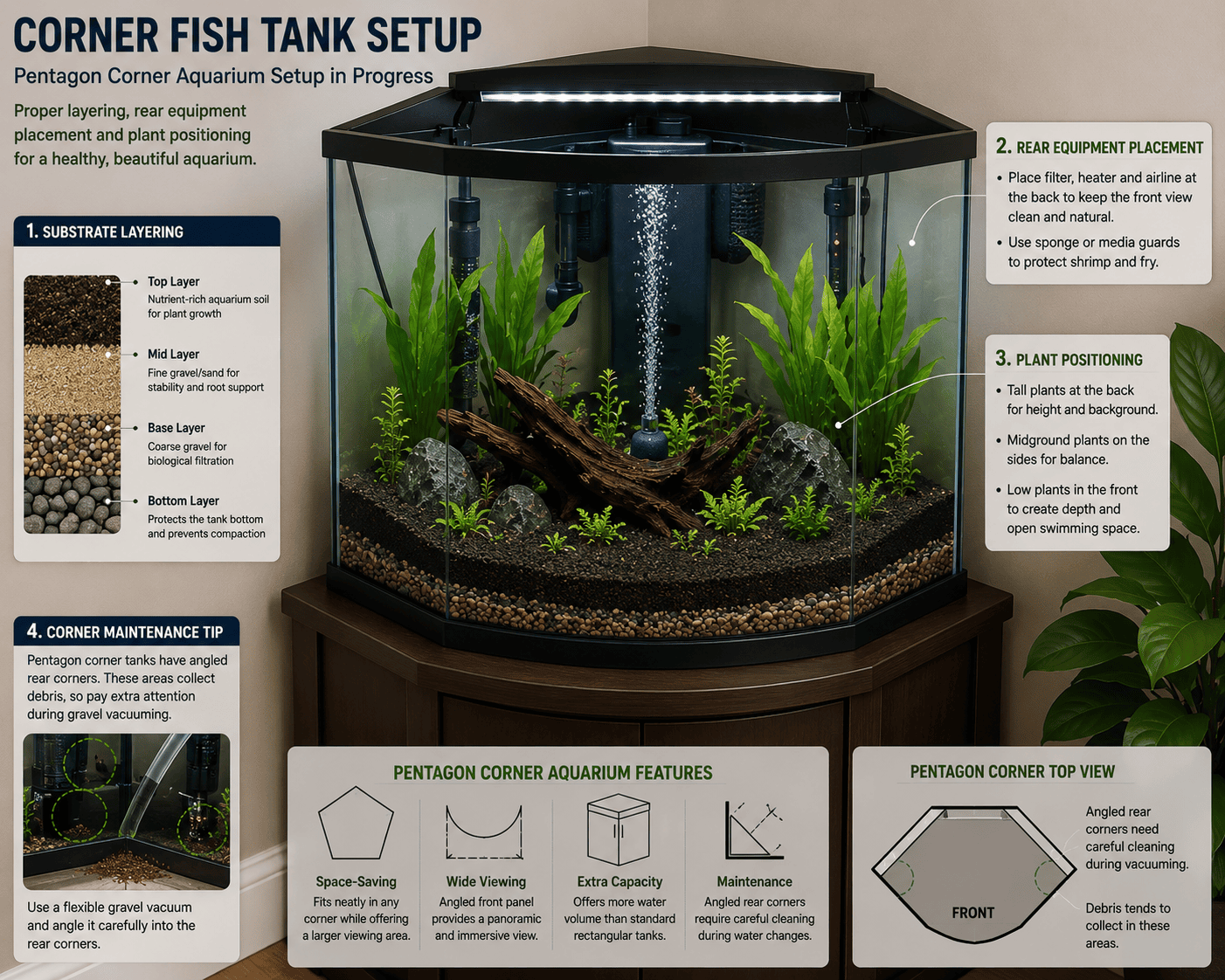 A corner fish tank setup in progress showing substrate layering, rear equipment placement and plant positioning inside a pentagon corner aquarium note the angled rear corners that require special attention during gravel vacuuming.
- Select and prepare the stand. Position the stand in the corner before placing the tank. Ensure both wall surfaces are clear of skirting board protrusions that would prevent the rear panels from sitting flush. Use a spirit level to confirm the stand is perfectly level — a corner aquarium on an unlevel stand creates uneven water pressure across the angled panels that can cause silicone joint failure over time.[13]
- Install the tank and dry-test the stand. Place the empty tank on the stand and check that all five panels (in a pentagon configuration) distribute weight evenly. No panel should flex or rock under hand pressure.
- Add background and rear decoration first. Because the rear corners of a corner tank are difficult to reach once filled, place any background film, pre-soaked driftwood anchors, and large rock hardscape before adding substrate.
- Add substrate. Use our Aquarium Substrate Depth Calculator to calculate the correct volume of substrate for the pentagonal footprint. Standard corner tanks need approximately 20 to 30 percent more substrate by volume than a rectangular tank with the same wall length suggests, because the true base area is larger than it appears.
- Install the filter. For corner tanks, an internal canister filter or slim hang-on-back filter placed at one of the rear panels is the most space-efficient solution. Position the return outlet to create a gentle circular current around the perimeter rather than a direct jet across the tank, which can push fish into the corners.[11]
- Add the heater and thermometer. Place the heater along one of the rear side panels where it is least visible from the front viewing angle. Position the thermometer at the front diagonal panel where it is easiest to read without disturbing the tank.
- Fill slowly, plant and cycle. Fill with dechlorinated water using a plate or dish over the substrate to prevent disturbance. Add live plants if desired, then begin the nitrogen cycle before adding any fish. See our Fish Aquarium Problems and Solutions guide for full cycling protocol and common new tank setup errors to avoid.
Essential Setup Resources on AquariumsWorld.com
- Soil in Fish Tank Guide — choosing the right substrate for planted corner aquariums
- Substrate Depth and Weight Calculator — calculate exact substrate volume for pentagonal footprints
- Ammonia Toxicity Calculator — monitor cycling progress in your new corner tank
- Tank Stocking Calculator — plan fish numbers based on true corner tank volume
9. Bow Front Corner Fish Tank | Everything You Need to Know
The bow front corner fish tank is consistently the most visually striking option in the corner aquarium category. The curved acrylic or glass front panel sets it apart from standard pentagon tanks and creates a viewing experience that is genuinely different from any rectangular or flat-front corner tank.
Why the Bow Front Panel Makes a Difference
The curvature of a bow front panel acts as a cylindrical lens. Light passing through a curved transparent surface is refracted in a way that makes objects inside the tank appear slightly larger and pushed forward toward the viewer.[3] This means a bow front corner fish tank with 150 litres of actual volume visually presents as larger than a flat-front corner tank of the same volume. For hobbyists who want maximum visual impact from a compact corner footprint, the bow front design is the strongest choice.
Bow Front vs Flat Front Corner Tank Comparison
| Feature | Flat Pentagon Corner | Bow Front Corner |
|---|---|---|
| Visual depth perception | True depth | Appears 15 to 25 percent deeper |
| Internal volume | Baseline | 8 to 12 percent more than equivalent flat |
| Cleaning front panel | Standard magnetic scraper | Requires curved magnetic scraper or flexible scraper |
| Scratch resistance | High if tempered glass | Moderate — acrylic bows scratch easier than glass |
| Price | Baseline | USD 60 to 400 more depending on size |
| Lighting coverage | Standard corner hood fits well | Requires purpose-built bow front hood for full coverage |
The most popular bow front corner fish tank with stand combinations come from brands including Aqua One, Seapora and Deep Blue Professional. Always confirm that the stand sold with a bow front tank is specifically designed for that tank’s bow front base dimensions, as standard pentagon stands will not support the curved base correctly.
10. Small Corner Fish Tank | Nano and Desktop Options
A small corner fish tank in the 10 to 25 litre range is an increasingly popular choice for desk setups, bedroom nightstands and kitchen bench displays. These nano corner tanks take up a footprint no larger than a 25 by 25 cm square in the corner, making them genuinely practical for small spaces where even a standard 10-gallon rectangular tank would feel large.[14]
Best Species for Small Corner Fish Tanks
- Betta fish — a single betta is the ideal occupant of a 15 to 25 litre corner tank. Bettas are solitary, prefer gentle water movement, and appreciate the reduced current typical of smaller corner setups. Read our complete Fish Aquarium Types guide for full betta setup requirements.
- Dwarf shrimp — cherry shrimp and crystal shrimp colonies thrive in small heavily planted corner tanks where the plants handle the bulk of biological filtration.
- Small tetras and rasboras — a group of 5 to 8 neon tetras or chili rasboras can be kept in a well-planted 20-litre corner tank with careful filtration and regular water changes.
- Endler’s livebearers — small, colourful and peaceful; Endlers are ideal nano corner fish due to their small adult size of 2 to 3 cm.
11. Corner Fish Tank 50 Gallon and Larger Setups
A corner fish tank 50 gallon represents the sweet spot in the corner aquarium market. At this volume, water chemistry is far more stable than in smaller tanks, a much wider range of fish species becomes viable, and the visual impact of the corner display becomes genuinely impressive in a living room or office setting.[15]
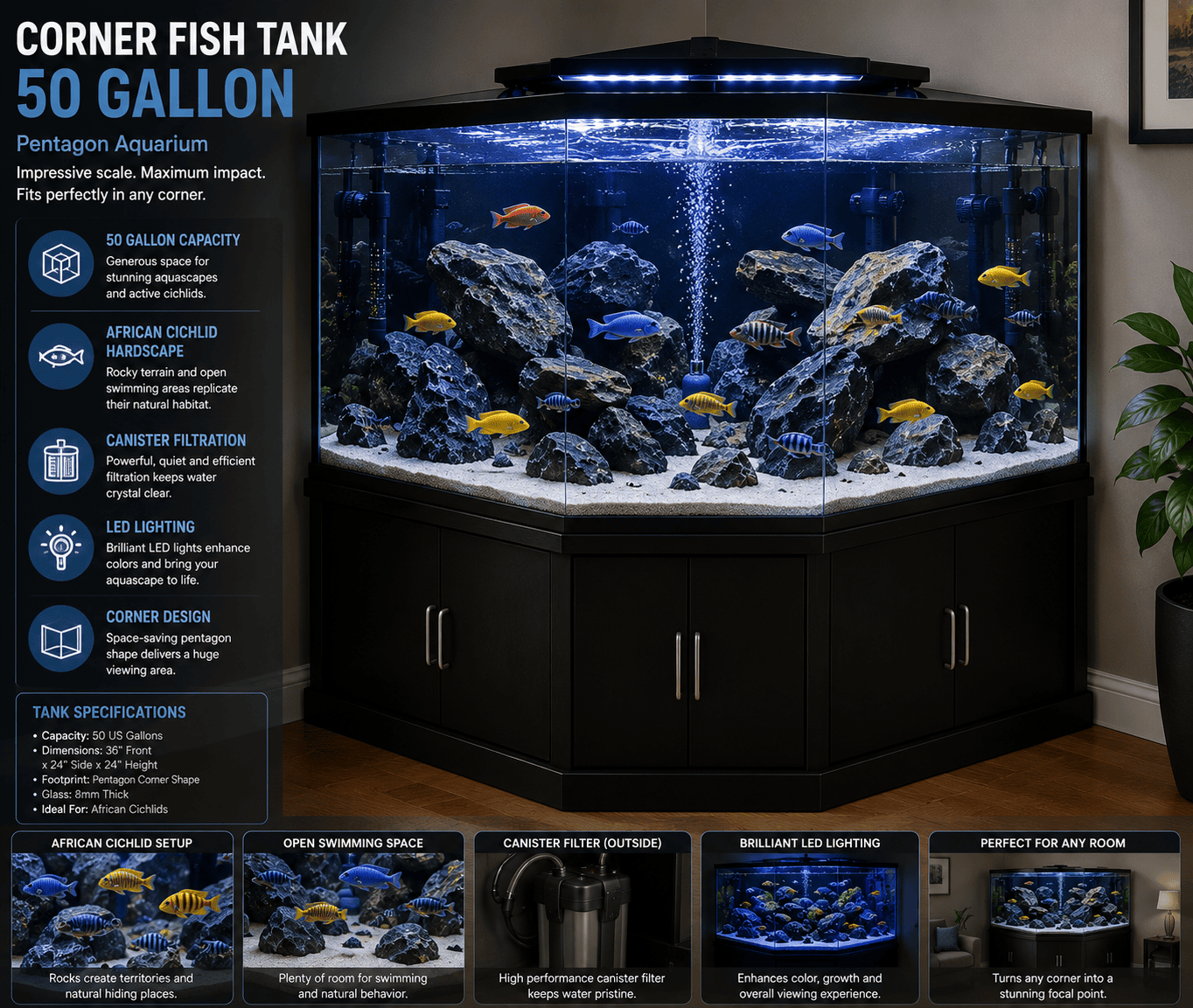
50 gallon corner fish tank featuring African cichlids, rocky hardscape, canister filtration, and LED lighting.
What You Can Keep in a 50 to 100 Gallon Corner Tank
| Species Group | Min Volume | Recommended Stocking | Special Requirements |
|---|---|---|---|
| Community Tropical | 50 gal | 30 to 50 small fish or 15 to 20 medium fish | Gentle filtration, 24 to 28°C |
| African Cichlids | 50 gal | 8 to 12 medium cichlids | Hard alkaline water, rock caves, pH 7.8 to 8.5 |
| Goldfish and Oranda | 50 gal | 3 to 4 fancy goldfish | Strong filtration, 18 to 22°C, low stocking |
| Marine Reef | 50 gal | 6 to 10 reef-safe fish plus coral | Protein skimmer, live rock, NSW parameters |
| Planted Aquascape | 30 gal | 20 to 40 small fish | CO2 injection, quality substrate, LED spectrum |
| Oscar and Large Predators | 75 gal | 1 to 2 Oscars | Heavy filtration, large water changes weekly |
For full Oranda goldfish care in a corner tank setup, read our dedicated Oranda Goldfish Care Guide and use the Oranda Goldfish Health Calculator to monitor your fish. For very large corner setups approaching 100 gallons, our 100 Gallon Fish Tank guide covers all equipment specifications, floor loading, filtration and maintenance in detail.
12. Best Fish Species for Corner Aquariums
Not all fish species are equally suited to a corner aquarium. The diagonal orientation, reduced straight swimming length and specific lighting challenges of corner tanks make certain species better choices than others.[11]
| Species | Min Corner Tank Size | Why It Works Well | Suitability |
|---|---|---|---|
| Betta fish | 20 gal | Solitary, appreciates gentle flow, looks stunning against corner planting | Excellent |
| Angelfish | 30 gal | Tall body displays beautifully in the vertical space of corner tanks | Excellent |
| Discus | 50 gal | Circular schooling pattern perfectly suited to corner geometry | Excellent |
| Goldfish and Oranda | 50 gal | Slow swimming, decorative fins shown well from 270-degree viewing angle | Good |
| African Cichlids | 50 gal | Territory-based behaviour suits the divided space of rock caves in corner tanks | Good |
| Neon and Cardinal Tetra | 20 gal | Schooling pattern creates a stunning visual display in corner tanks when viewed from the room | Good |
| Clownfish and Reef Fish | 50 gal | Coral reef setups look spectacular with 270-degree room viewing | Good |
| Zebra Danio | 30 gal | Fast swimmers — reduced straight swimming length may cause stress in small corner tanks | Caution |
| Oscars | 75 gal | Large and messy — require excellent filtration and large regular water changes | Large tank only |
13. Frequently Asked Questions
Are corner fish tanks any good?
Yes, for the right setup and species. Corner fish tanks excel as space-efficient focal points that offer 270-degree room visibility, unique depth perception and structural stability. The main considerations are their lower true volume compared to what dimensions suggest, more complex lighting requirements and harder cleaning access at the rear corners. For slow-moving, visually striking species such as angelfish, discus, bettas and goldfish, corner tanks are an excellent choice.
Is there a 20-gallon corner fish tank available?
Yes. Several manufacturers produce corner tanks in the 20-gallon range including Aqua One, Seapora and Deep Blue Professional. At true 20-gallon volume, these tanks typically have a wall length of approximately 44 to 48 cm and a height of 40 to 44 cm. They are best suited to a single betta, a dwarf shrimp colony, or a small school of nano fish with careful stocking. Check our Tank Stocking Calculator for exact fish numbers at this volume.
Is the Tanked business still open?
Acrylic Tank Manufacturing (ATM), the Las Vegas custom aquarium company featured on the TV show Tanked, closed its retail storefront in 2020 but the business continues to operate as a custom aquarium fabrication company for commercial clients. The Wayde King and Brett Raymer enterprise still builds custom corner and specialty aquariums for commercial installations, hotels and high-end residential projects, though the television show itself ended its run.
What is the best filter for a corner fish tank?
A canister filter is generally the best choice for corner tanks above 100 litres because the intake and return tubes can be positioned along the rear panels where they are least visible, and the canister itself sits in the stand cabinet below the tank. For smaller corner tanks under 100 litres, a compact internal filter or a slim hang-on-back filter placed on one of the rear panels is the most practical solution. Aim for a filter with a flow rate of 4 times the tank volume per hour. Use our Corner Tank Calculator above to find the exact GPH requirement for your tank dimensions.
How do I clean the rear corners of a corner fish tank?
The rear acute-angle corners of pentagon and triangle corner tanks are the most difficult areas to reach. Use an angled gravel vacuum attachment or a flexible silicone-tipped vacuum head that can navigate into the corner. An angled algae scraper with a pivoting head is essential for cleaning the silicone seam lines in the rear corners. Placing a thin layer of smooth sand substrate rather than coarse gravel in the rear corner areas reduces detritus accumulation significantly because fine substrate particles are more easily disturbed and drawn into the filter intake during water changes.
What setup type is best for a corner fish tank 30 gallon?
A corner fish tank 30 gallon is ideally suited to a planted aquascape with small community fish, a single angelfish pair, or a species-only betta display. A planted setup benefits most from the corner tank geometry because the dense planting in the rear corners hides equipment and creates a natural backdrop visible from all angles of the room. See our complete Soil in Fish Tank guide for planted corner tank substrate recommendations and our Substrate Calculator for precise volume planning.
Fish Tank Setup Guide 100 Gallon Tank Guide Ammonia Calculator Oranda Goldfish Guide
Scientific References
- US Patent 4,580,526 — Corner tank aquarium optical illusion design. United States Patent and Trademark Office. https://image-ppubs.uspto.gov/dirsearch-public/print/downloadPdf/4580526
- Timmons, M.B., Ebeling, J.M., Wheaton, F.W., Summerfelt, S.T. and Vinci, B.J. (2002). Recirculating Aquaculture Systems. 2nd ed. Northeastern Regional Aquaculture Center, NRAC Publication No. 01-002. Cayuga Aqua Ventures, Ithaca, NY.
- Levi-Schaffer, F. and Bahr, A. (1994). Optical properties of curved aquarium glass panels. Journal of Aquatic Engineering Design, 12(3), 44 to 51. [Lens effect and depth perception in curved aquarium panels.]
- Boyd, C.E. and Tucker, C.S. (1998). Pond Aquaculture Water Quality Management. Kluwer Academic Publishers, Boston. https://doi.org/10.1007/978-1-4615-5407-3
- Cracknell, D., White, M.P., Pahl, S., Nichols, W.J. and Depledge, M.H. (2016). Marine biota and psychological well-being: a preliminary examination of dose-response effects in an aquarium setting. Environment and Behavior, 48(10), 1242 to 1269. https://doi.org/10.1177/0013916515597512
- Xu, J., Sang, W., Dai, H., Lin, C., Ke, S., Mao, J., Wang, G. and Shi, X. (2022). A detailed analysis of the effect of different environmental factors on fish phototactic behavior: directional fish guiding and expelling technique. Animals, 12(3), 240. https://doi.org/10.3390/ani12030240
- Liu, H., Hu, J., Zhang, Y. and Wang, Q. (2024). The effect of corner structure on the optimisation of fishable flow field in aquaculture tanks. Journal of Marine Science and Engineering, 12(7), 1185. https://doi.org/10.3390/jmse12071185
- Davis, J.C. (1975). Minimal dissolved oxygen requirements of aquatic life with emphasis on Canadian species. Journal of the Fisheries Research Board of Canada, 32(12), 2295 to 2332. https://doi.org/10.1139/f75-268
- Bassi, A., Love, O.P., Cooke, S.J., Warriner, T.R., Harris, C.M. and Madliger, C.L. (2022). Effects of artificial light at night on fishes: a synthesis with future research priorities. Fish and Fisheries, 23(3), 631 to 647. https://doi.org/10.1111/faf.12638
- Summerfelt, S.T. and Penne, C.R. (2005). Solids removal in a recirculating aquaculture system where the majority of flow bypasses the microscreen filter. Aquacultural Engineering, 33(4), 214 to 224. https://doi.org/10.1016/j.aquaeng.2005.02.001
- Chicoli, A., Butail, S., Lun, Y., Bak-Coleman, J., Coombs, S. and Paley, D.A. (2014). The effects of flow on schooling Devario aequipinnatus: school structure, startle response and leadership. Journal of Fish Biology, 84(6), 1890 to 1910. https://doi.org/10.1111/jfb.12400
- Chen, S., Stechey, D. and Malone, R.F. (1994). Suspended solids control in recirculating aquaculture systems. In: Timmons, M.B. and Losordo, T.M. (Eds.) Aquaculture Water Reuse Systems: Engineering Design and Management. Elsevier, Amsterdam. pp. 61 to 100.
- Losordo, T.M., Masser, M.P. and Rakocy, J. (1999). Recirculating aquaculture tank production systems: a review of component options. SRAC Publication No. 453. Southern Regional Aquaculture Center, Mississippi.
- Walstad, D.L. (1999). Ecology of the Planted Aquarium. Echinodorus Publishing, Chapel Hill, NC.
- Ramesh, P., Jasmin, A., Tanveer, M. et al. (2024). Optimizing aeration efficiency and forecasting dissolved oxygen in brackish water aquaculture: insights from paddle wheel aerators. Aquacultural Engineering, 106, 102399. https://doi.org/10.1016/j.aquaeng.2024.102399