Tank Size Guide
Real dimensions, empty and filled weight, setup cost and stocking capacity for one of the largest tank sizes a home aquarist can realistically keep.
A 200 gallon fish tank sits at the point where a hobby aquarium becomes a genuine piece of furniture. It is large enough to house a full community of adult fish, but it also asks serious questions about floor space, floor strength and budget before you buy one. This guide answers the exact questions most new owners search for: how big is a 200 gallon fish tank, what does it weigh empty and full, and how much should you expect to spend. If you have not yet worked through the basics of choosing a tank and cycling it, our fish aquarium types and setup guide is the right starting point before scaling up to 200 gallons.
If you are still deciding between tank sizes, our 100 gallon fish tank guide and full aquarium types and setup guide are useful comparison points before committing to something this large.
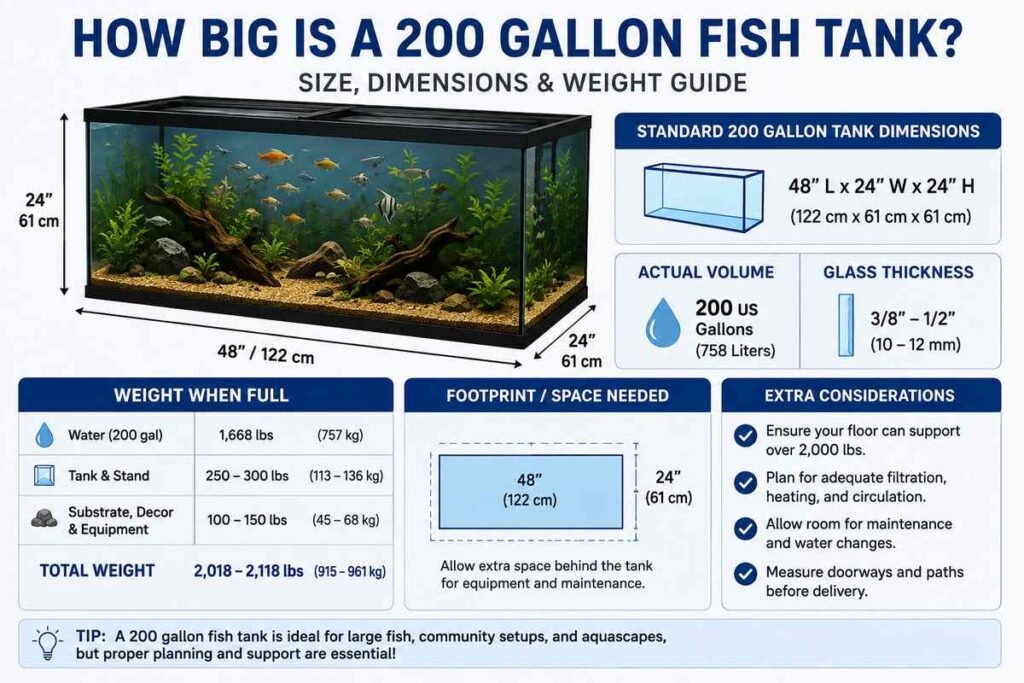
200 Gallon Fish Tank Dimensions in Feet and Inches
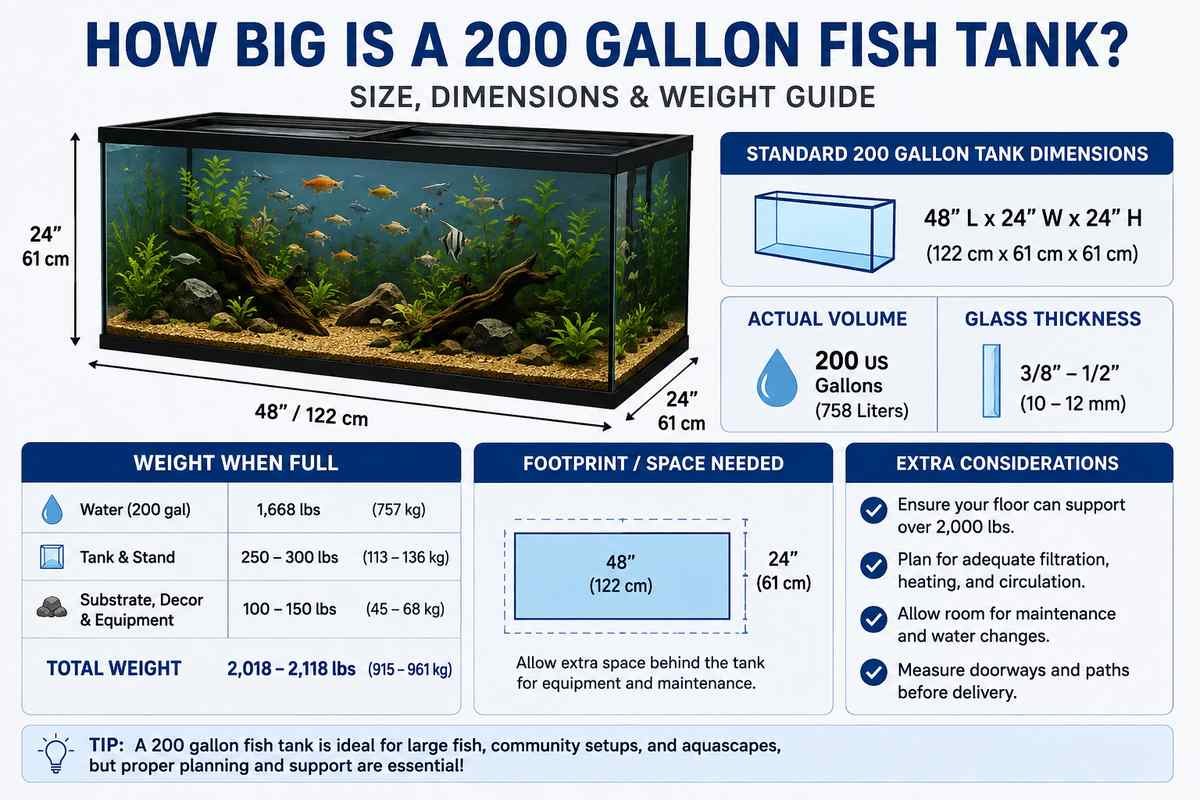
Unlike smaller tanks, there is no single official 200 gallon size. Manufacturers use several footprints depending on whether the tank is built for a display room, a fish room or a reef setup. The most common standard dimensions are:
| Configuration | Length x Width x Height (inches) | In Feet |
|---|---|---|
| Standard rectangle | 72 x 24 x 30 | 6 ft x 2 ft x 2.5 ft |
| Long and shallow | 96 x 18 x 25 | 8 ft x 1.5 ft x 2.1 ft |
| Deep footprint | 60 x 30 x 25 | 5 ft x 2.5 ft x 2.1 ft |
| Bowfront variant | 72 x 24 x 24 | 6 ft x 2 ft x 2 ft |
In practical terms, a 200 gallon tank runs about 6 to 8 feet long, meaning it needs a dedicated wall. Before buying, measure your doorway width too, since a 6 foot glass tank often will not turn corners easily during delivery. For a mid range comparison, our 100 gallon fish tank page and its built in size calculator are a good next step if 200 gallons turns out to be more space than you have. The general setup principles in our aquarium setup guide calculator also apply at this scale, just with larger numbers.
How Heavy Is a 200 Gallon Fish Tank, Empty and Full
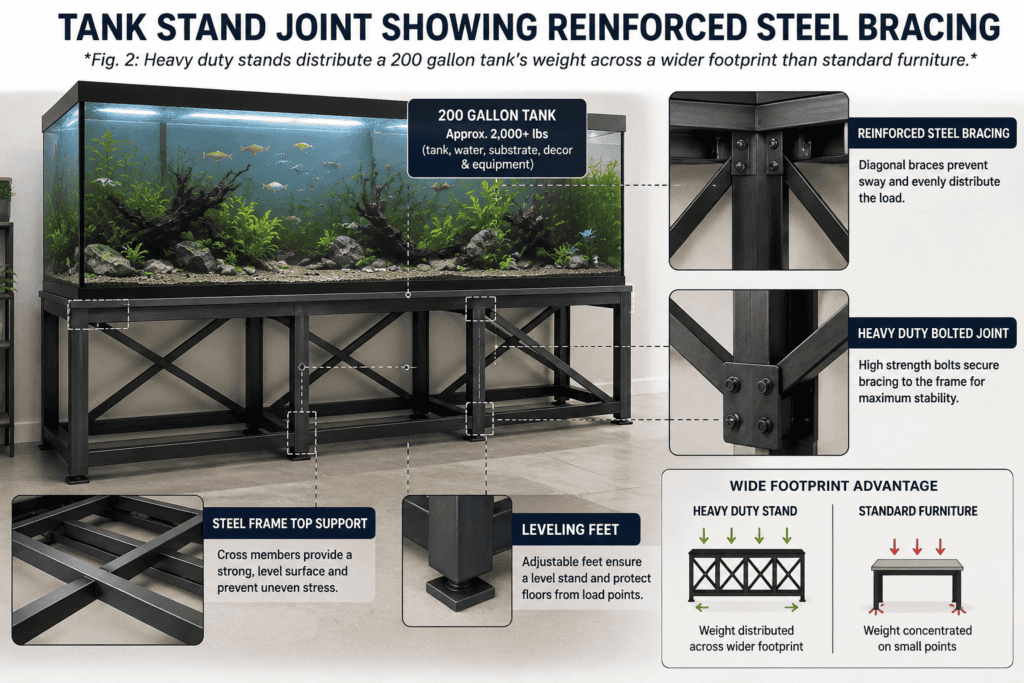
Weight is the number most buyers underestimate. Freshwater weighs approximately 8.34 pounds per US gallon, so the water alone in a 200 gallon tank comes to roughly 1,668 pounds. Add the glass or acrylic shell, substrate, rock and equipment, and a fully stocked 200 gallon setup regularly reaches 2,000 to 2,300 pounds.
| Component | Approximate Weight |
|---|---|
| Empty glass tank (no stand) | 350 to 450 lbs |
| Water at 8.34 lbs per gallon | ~1,668 lbs |
| Substrate (1 to 2 inch bed) | 150 to 250 lbs |
| Decor, rock and equipment | 50 to 150 lbs |
| Total filled weight | 2,200 to 2,500 lbs |
How Much Does a 200 Gallon Fish Tank Cost
Budget for a 200 gallon setup in three parts: the tank itself, the stand, and the equipment needed to run it safely.
| Item | Typical Cost Range |
|---|---|
| Tank only (glass, drilled or undrilled) | $800 to $2,500 |
| Reinforced stand | $300 to $900 |
| Filtration (canister or sump) | $250 to $700 |
| Heaters, lighting, test kit | $150 to $400 |
| Substrate and decor | $100 to $400 |
| Realistic total | $1,600 to $4,900 |
Custom acrylic builds and bowfront shapes sit at the top of that range, while a basic all glass rectangle from a value brand sits at the bottom. Delivery and in home assembly are frequently a separate line item at this size, so ask before you order. If your budget points you toward something smaller, revisit the cost breakdown on our 100 gallon fish tank guide for a more moderate starting point.
How Many Fish Can a 200 Gallon Tank Hold
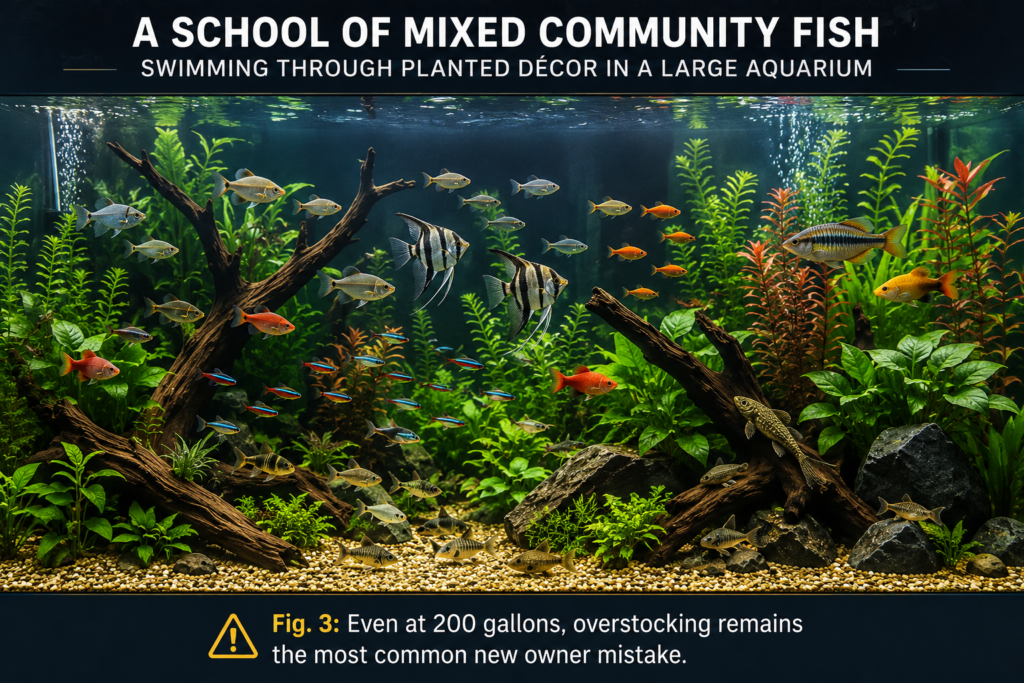
The old one inch of fish per gallon rule breaks down at large tank sizes, since it ignores bioload, swimming behavior and species specific space needs. Research on stocking density in farmed fish has repeatedly shown that space restriction, not just water volume, drives measurable stress responses through elevated cortisol and reduced growth1,2. A crowded 200 gallon tank can be just as stressful for its inhabitants as a crowded 20 gallon tank if fish are packed beyond their natural swimming range.
As a working guideline, a 200 gallon tank comfortably supports:
| Stocking Style | Approximate Capacity |
|---|---|
| Large community of small to mid size fish | 60 to 90 fish (2 to 3 inches each) |
| Semi aggressive cichlids | 15 to 25 adult cichlids |
| Fancy goldfish, including oranda varieties | 8 to 12 adult fancy goldfish |
| Single large specimen fish (oscars, large plecos) | 2 to 4 adults |
Goldfish are a common choice for tanks this size because their growth is directly tied to available space, not just water quality. Recent research on Carassius auratus found that restricted culture volume changed growth rate, cortisol levels and even muscle fat composition compared with fish given more room3, and environmental enrichment studies on the same species have linked more usable swimming space to improved learning and lower stress indicators4. If you are considering fancy varieties, our full oranda goldfish care guide and its dedicated oranda goldfish health calculator cover space and water quality needs species by species.
Filtration and Water Quality at 200 Gallons
A tank this size produces a proportionally large amount of ammonia from fish waste and uneaten food, so filtration has to scale with it. Ammonia is directly toxic to fish gill tissue and blood chemistry even at low concentrations5, which is why cycling a tank properly before adding fish matters more, not less, as tank size grows. The beneficial bacteria that convert ammonia into safer compounds establish over several weeks6, and skipping this step is the single most common cause of early fish loss in large new tanks.
For a full walkthrough of cycling, troubleshooting cloudy water, and diagnosing common large tank issues, see our aquarium problems and solutions guide, which includes a water change calculator sized for exactly this kind of volume. If you are running a planted substrate setup, our soil in fish tank guide explains how substrate choice affects water clarity and nutrient cycling at scale, and pairs well with the substrate calculator above when planning depth across a 6 to 8 foot footprint.
Frequently Asked Questions
How big is a 200 gallon fish tank in feet?
Most 200 gallon tanks measure 6 to 8 feet long, 1.5 to 2.5 feet wide, and 2 to 2.5 feet tall, depending on the exact footprint chosen.
How heavy is an empty 200 gallon fish tank?
An empty glass 200 gallon tank typically weighs 350 to 450 pounds before water, substrate or a stand are added.
How much does a full 200 gallon fish tank weigh?
Fully filled with water, substrate and decor, expect a total of roughly 2,200 to 2,500 pounds, so floor placement matters.
How much is a 200 gallon fish tank overall?
A complete setup, including stand, filtration and basic equipment, typically runs $1,600 to $4,900 depending on materials and brand. See our 100 gallon fish tank comparison if that budget is too high for your space.
Can I keep fancy goldfish in a 200 gallon tank?
Yes. A 200 gallon tank comfortably supports 8 to 12 adult fancy goldfish. See our oranda goldfish care guide and oranda goldfish health calculator for species specific stocking advice.
Where can I find more aquarium size and setup guides?
Our fish aquarium types and setup guide and problems and solutions guide cover every stage from choosing a tank to troubleshooting an established one.
Ready to Plan Your Own Large Aquarium Build
Browse our full range of size guides, calculators and species care pages to plan your setup from tank to first fish.
Scientific References
- Ellis, T., North, B., Scott, A. P., Bromage, N. R., Porter, M., & Gadd, D. (2002). The relationships between stocking density and welfare in farmed rainbow trout. Journal of Fish Biology, 61(3), 493 to 531. https://doi.org/10.1111/j.1095-8649.2002.tb00893.x
- Barton, B. A. (2002). Stress in fishes: A diversity of responses with particular reference to changes in circulating corticosteroids. Integrative and Comparative Biology, 42(3), 517 to 525. https://doi.org/10.1093/icb/42.3.517
- Zhang, H., Zhang, Y., Jiaqin, C., Zijun, W., Tan, H., & Luo, G. (2025). Spatial optimization in recirculating aquaculture systems: Cortisol mediated growth modulation and polyunsaturated fatty acid enrichment in Carassius auratus var. Pengze. https://doi.org/10.2139/ssrn.5217879
- Abreu, C. C., Fernandes, T. N., Henrique, E. P., et al. (2019). Small scale environmental enrichment and exercise enhance learning and spatial memory of Carassius auratus, and increase cell proliferation in the telencephalon. Brazilian Journal of Medical and Biological Research, 52(6). https://doi.org/10.1590/1414-431X20198026
- Randall, D. J., & Tsui, T. K. N. (2002). Ammonia toxicity in fish. Marine Pollution Bulletin, 45(1 to 12), 17 to 23. https://doi.org/10.1016/S0025-326X(02)00227-8
- Hovanec, T. A., & DeLong, E. F. (1996). Comparative analysis of nitrifying bacteria associated with freshwater and marine aquaria. Applied and Environmental Microbiology, 62(8), 2888 to 2896. https://doi.org/10.1128/aem.62.8.2888-2896.1996