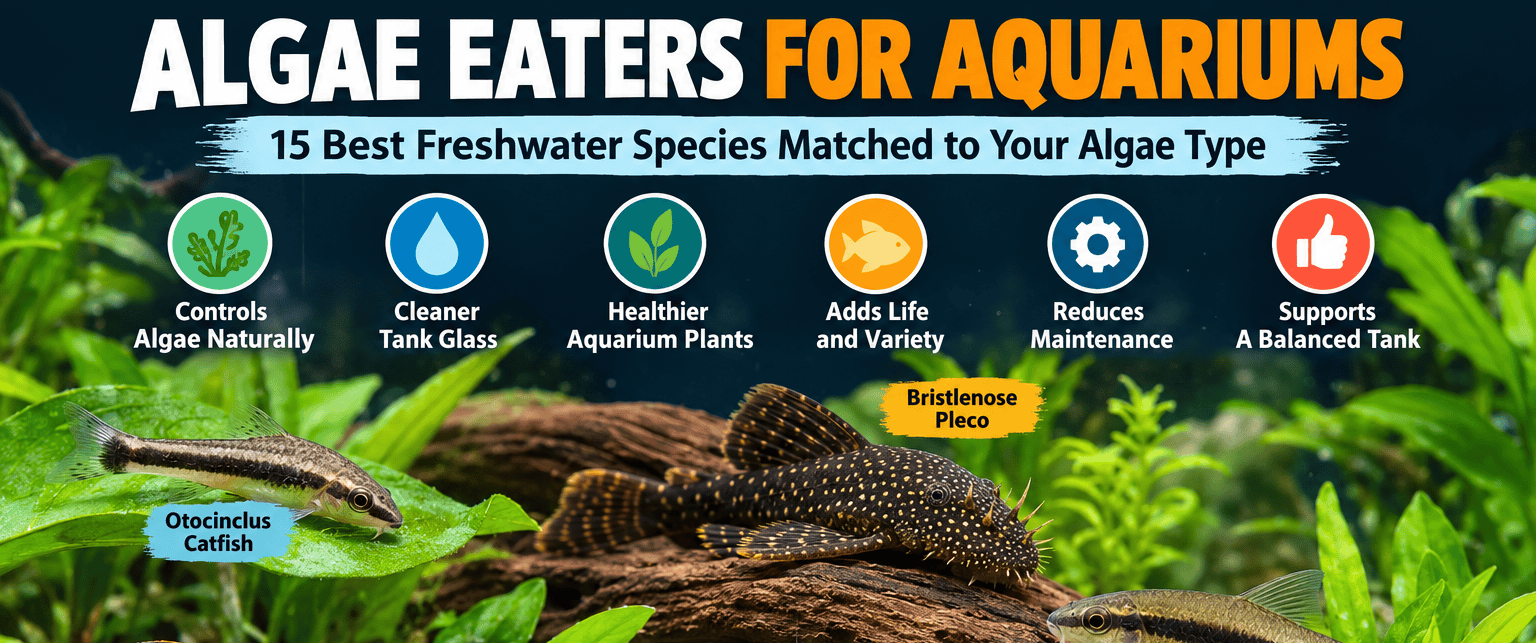
Algae Eaters for Aquariums | 15 Best Freshwater Species Matched to Your Algae Type
Introduction
Algae eaters for aquariums can help control unwanted growth on glass, plants, rocks and driftwood, but the best choice depends on the algae species and the aquarium itself. A small planted aquarium may benefit from carefully selected snails or shrimp, while a larger freshwater system could support a suitable algae-grazing fish. Choosing the wrong animal can create a bigger problem than the algae you intended to remove.
If you are comparing freshwater aquarium algae eaters, start by identifying the growth. Brown diatoms, green film, hard green spots, hair algae and black beard algae do not respond equally to every grazer. Some animals eat soft biofilm readily, while others ignore established growth or require supplemental food.
This guide compares 15 potential algae-eating species and explains their feeding behaviour, adult size, tank requirements and compatibility. It also covers small algae eating fish, algae eating snails, algae eating shrimp, aquarium cleaner fish and bottom feeders for aquariums. The objective is to help you select a suitable animal while correcting the environmental conditions that allow algae to return.
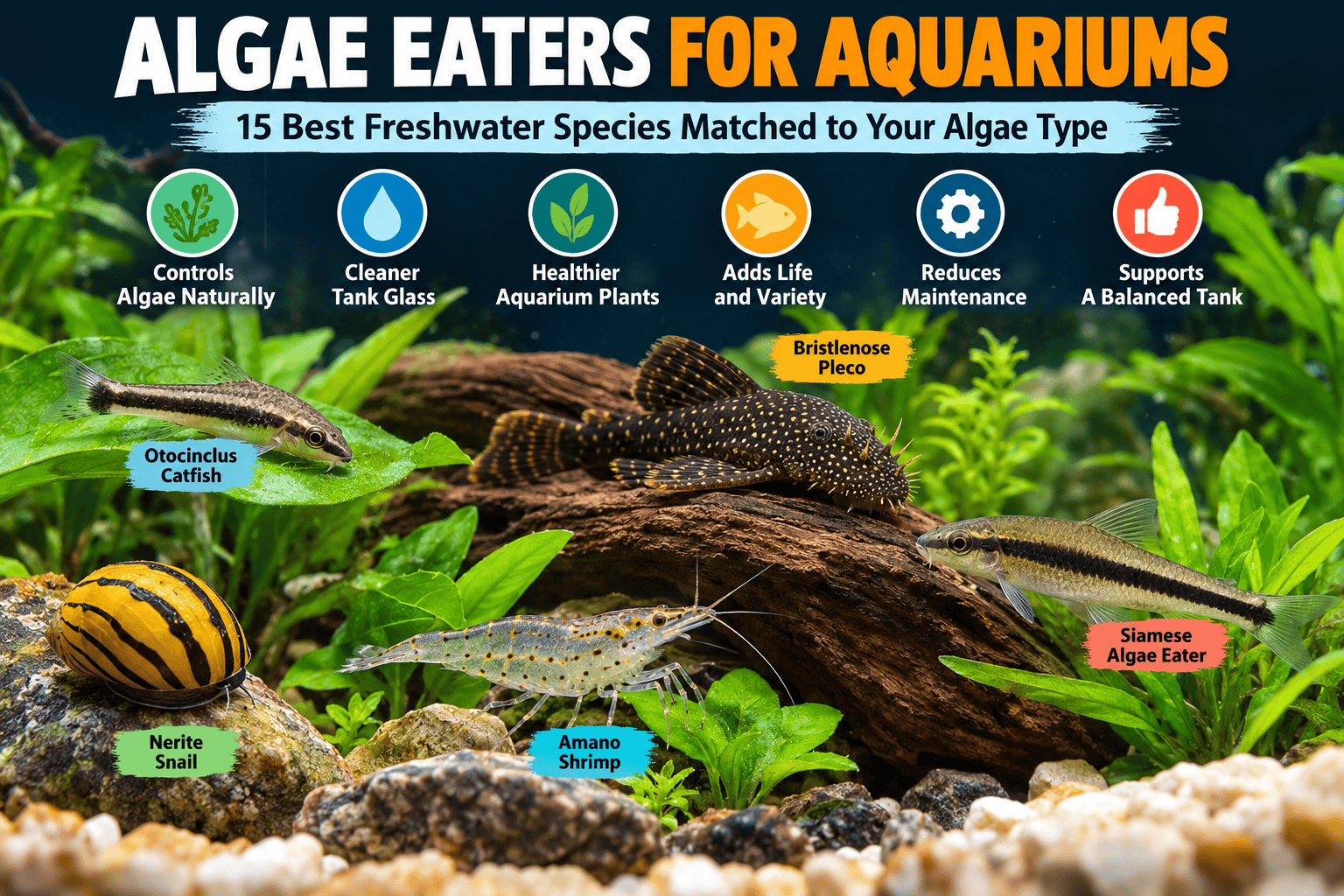
A planted freshwater aquarium with an Otocinclus catfish and a nerite snail grazing on natural surface growth. Replace this placeholder with a real photograph before publication.
For broader background, see the AquariumsWorld complete beginner’s guide to fish care and the aquarium problems and solutions guide. These resources help put algae control in the context of long-term fish welfare.
1. What Are Algae Eaters and How Do They Work?
An algae eater is an aquatic animal that consumes some algae, periphyton, biofilm or associated organic material. The category includes fish, shrimp and snails, but these animals do not share identical diets. Their feeding structures, preferred habitats and nutritional needs determine what they can graze effectively.
Periphyton is a community of algae, microbes and other organisms attached to submerged surfaces. Grazers can influence these communities, although the strength of the effect varies with grazer identity, food availability, habitat and environmental conditions. Hillebrand (2009) synthesised experimental evidence showing that grazing can influence periphyton biomass across aquatic ecosystems. Feminella and Hawkins (1995) likewise examined interactions between stream herbivores and periphyton, demonstrating why grazer effects should be understood in ecological context rather than treated as a universal cleaning service.
In an aquarium, an algae eater can reduce accessible growth without eliminating its source. Excessive light, inconsistent maintenance, accumulated waste, poor plant growth and nutrient imbalance can continue to support algae. A tank may therefore look cleaner for a short period while the underlying cause remains unchanged.
Do Catfish Eat Algae?
Some catfish consume algae, but the name catfish does not guarantee an algae-based diet. Loricariid catfishes include species with specialised feeding structures and varied trophic habits. Lujan, Winemiller and Armbruster (2012) documented substantial diversity in loricariid feeding ecology, cautioning against treating all members of the group as interchangeable algae cleaners.
Otocinclus and bristlenose plecos are commonly considered by freshwater aquarists because they graze surfaces. However, their needs differ substantially. Otocinclus are small, social fish that do best in established aquariums with suitable grazing surfaces. Bristlenose plecos grow larger, produce more waste and need more space and appropriate shelter.
Never buy a catfish simply because a retailer labels it a cleaner fish. Identify the species, check its adult size and research its full diet before purchase. For a related discussion of aquarium biology and beneficial bacteria, consult the AquariumsWorld guide to MICROBE-LIFT Nite-Out II and aquarium biological filtration.
2. Match Your Algae Eater to Your Algae Type
Identifying the algae is more useful than buying the most popular cleaner. Brown diatoms often appear as dusty coatings on glass, substrate and decorations. Green film develops on illuminated surfaces. Green spot algae forms hard circular spots, while hair algae grows into strands or tangled filaments. Black beard algae can appear as dark tufts attached to leaves and hardscape.
These visual descriptions are useful starting points, not definitive laboratory identification. Different organisms can look similar, and some growths occur together. Match a grazer to the growth it commonly consumes, then address the conditions encouraging that growth.
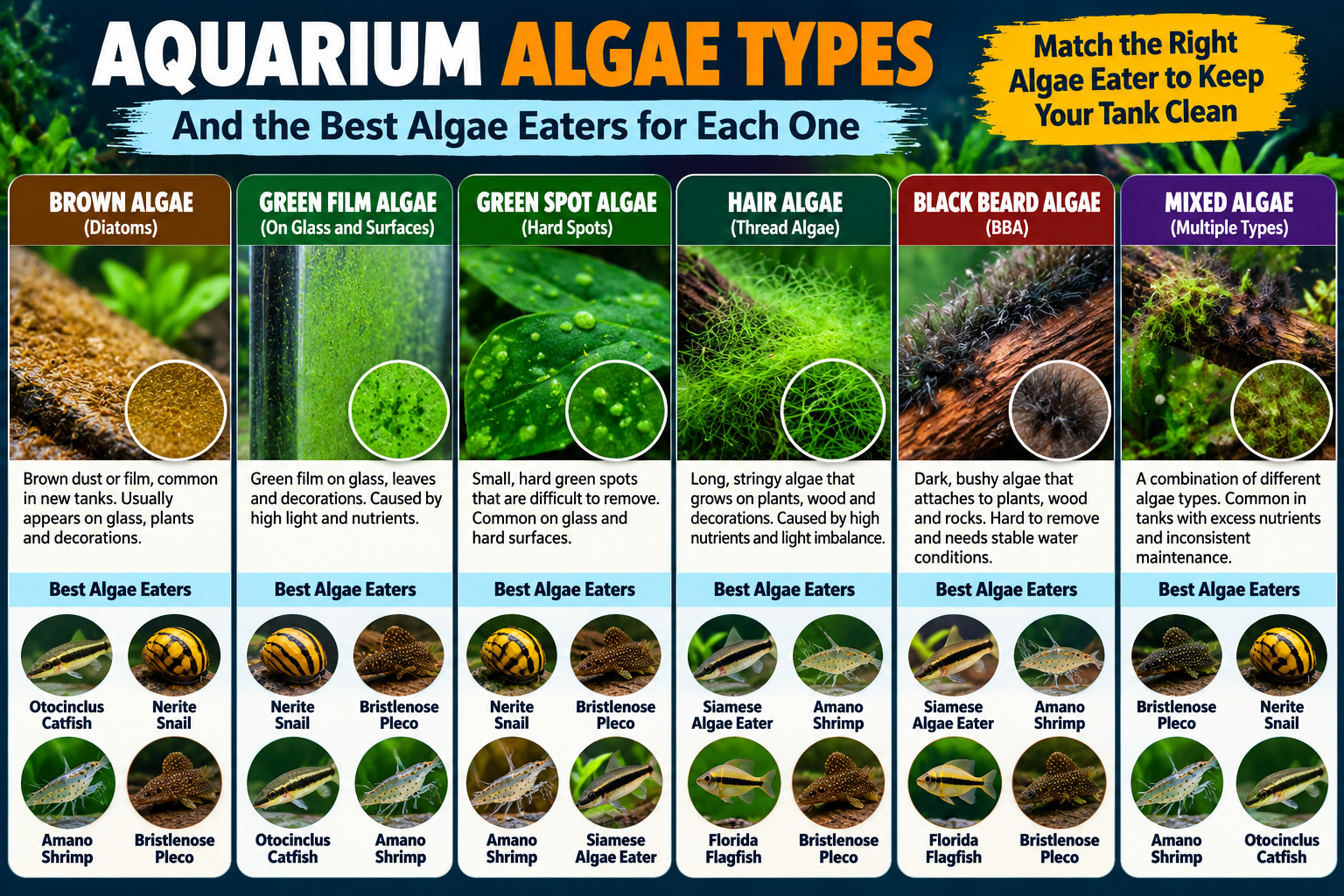
Common freshwater aquarium algae types. Use a real, clearly labelled comparison photograph showing brown diatoms, green film, green spot algae, hair algae and black beard algae.
| Algae type | Potential grazers | Important limitation | First maintenance step |
|---|---|---|---|
| Brown algae or diatoms | Otocinclus, nerite snails, suitable plecos | Effectiveness depends on the growth and animal species | Check tank maturity, lighting and maintenance |
| Green film on glass | Nerite snails, Otocinclus, Amano shrimp | Glass may still need manual cleaning | Review light duration and surface cleanliness |
| Green spot algae | Nerite snails may graze some growth | Hard spots can resist grazing | Scrape glass and review light and nutrient balance |
| Hair or thread algae | Amano shrimp, Florida flagfish, true Siamese algae eaters | Established strands may remain untouched | Remove excess growth and assess light and nutrients |
| Black beard algae | True Siamese algae eaters may graze some growth | Feeding varies; no guaranteed biological solution | Remove affected material and investigate tank conditions |
| Green water | No reliable aquarium grazer | Suspended microscopic algae is not solved by a normal cleanup crew | Investigate light, nutrients and filtration |
| Mixed algae | A combination of compatible grazers may help | More animals increase waste and care requirements | Identify each growth and correct shared causes |
What Eats Diatoms (Brown Algae)?
Brown coatings commonly called diatoms often appear in newly established aquariums. Nerite snails and Otocinclus may graze suitable diatom growth, while some other grazing fish consume it as part of a varied diet. The result depends on whether the growth is accessible and whether the animal is healthy and adequately fed.
Do not introduce sensitive fish into an unstable new aquarium just to remove brown growth. First confirm that the aquarium is cycled, that ammonia and nitrite are not detectable with an appropriate test, and that maintenance is consistent. Some brown growth declines as a system matures, but maturity alone is not a guarantee that every outbreak will disappear.
What Fish Eat Hair Algae?
Hair algae is a broad visual term for filamentous growth rather than a single organism. Amano shrimp may graze soft strands and associated biofilm. Florida flagfish can consume certain filamentous growths, and true Siamese algae eaters may help with some types of hair algae and related growth.
Success is inconsistent when strands become long, dense or difficult to graze. Remove the bulk manually before introducing a cleanup animal. If the algae repeatedly returns, assess lighting duration, intensity, plant health, fertiliser use, feeding and waste accumulation. An algae eater is best viewed as part of a management plan, not a substitute for it.
Algae on Glass in Aquarium Tanks
Soft green film on glass can be grazed by nerite snails and some fish. However, the cleanest solution may be a suitable magnetic glass cleaner combined with routine maintenance. Do not assume that a grazing animal will reach every corner, particularly where glass meets substrate, equipment or dense plants.
When selecting a manual tool, choose one designed for your aquarium material. Some glass tools can scratch acrylic, and trapped substrate particles can scratch glass. A magnetic cleaner is convenient, but it still requires careful use. See the aquarium water test kit comparison if you need help understanding how to monitor water quality while investigating recurring growth.
Black Beard and Green Spot Algae
Black beard algae often grows in dark tufts on leaves, wood and equipment. True Siamese algae eaters are frequently recommended, but individual feeding behaviour varies and mature growth may remain. Green spot algae forms hard green dots and can be difficult for many animals to remove completely.
For both types, combine targeted manual removal with a review of lighting and plant health. Avoid changing several variables drastically at once. Record the changes you make and observe whether growth slows over the following weeks. A stable, measured approach is generally more useful than repeatedly adding livestock or using treatments without identifying the cause.
3. Best Freshwater Aquarium Algae Eaters: Fish
The best fish tank algae eaters are species that fit the aquarium throughout their adult lives. Adult size, social needs, water conditions and temperament should be evaluated before feeding preferences. The following species are common candidates, but they are not all suitable for small tanks or inexperienced keepers.
An Otocinclus catfish grazing on a plant leaf. Use a real photograph showing the fish’s small body and typical surface-grazing posture.
1. Otocinclus Catfish
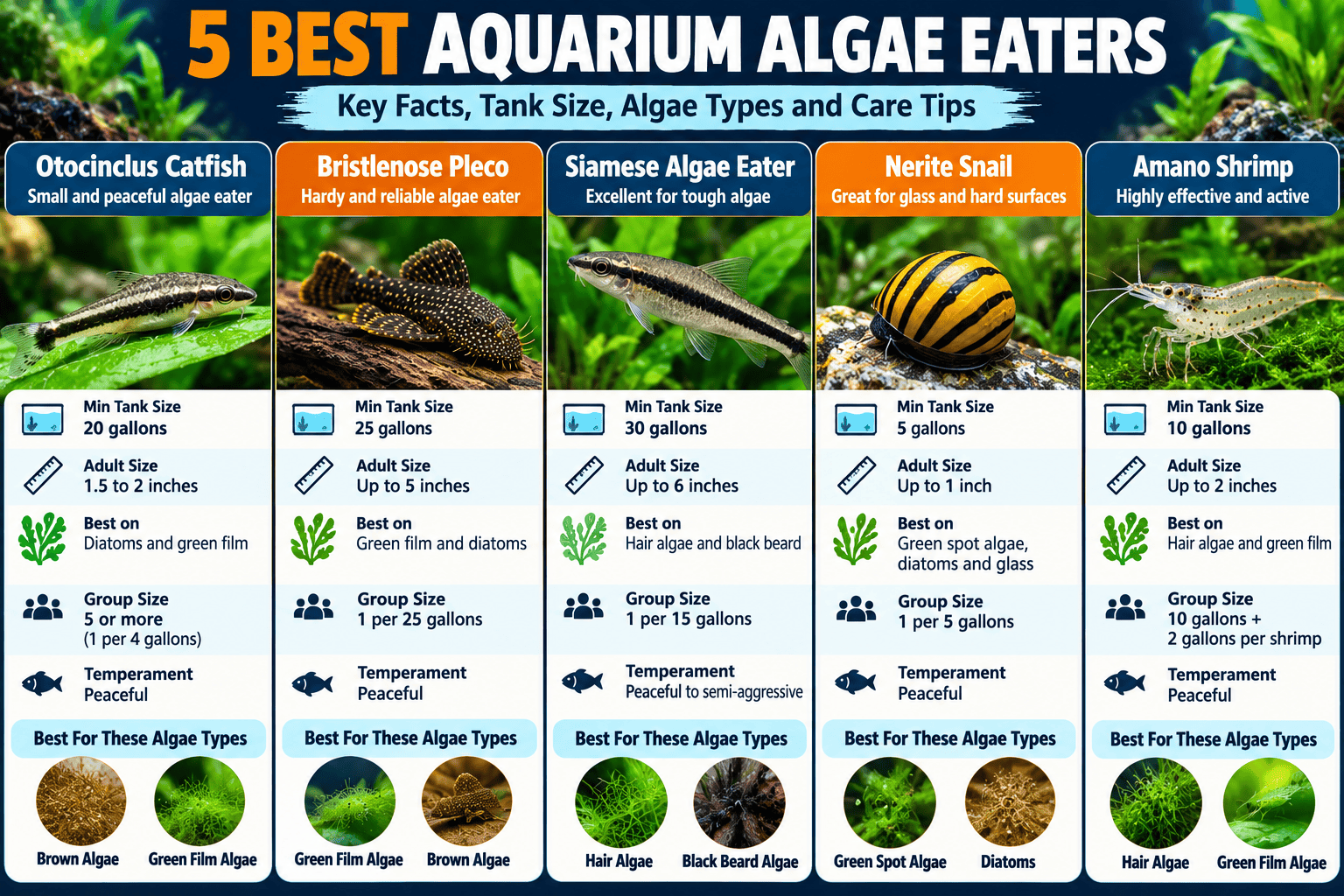
Otocinclus catfish are small South American grazers, usually around 1 to 2 inches long depending on species and individual growth. They are valued for feeding on soft algae and biofilm on leaves, glass and other surfaces. Their small size makes them attractive to planted-tank owners, but it does not make them effortless fish.
Otocinclus are social and should generally be kept in a suitable group, commonly at least five or six when aquarium size and conditions allow. The tank must provide adequate surface area, stable water quality, oxygenation and a reliable food supply. Newly imported or poorly acclimated fish may struggle in immature aquariums where grazing food is scarce.
A 20-gallon aquarium is a more practical starting point than a very small nano tank for many keepers planning an Otocinclus group. This is a conservative planning suggestion, not a universal minimum for every species or setup. Check the exact species and current husbandry guidance before purchasing.
Best match: soft diatoms, biofilm and green film in a mature planted aquarium.
Watch out: do not buy one Otocinclus for a new tank and expect it to live entirely on visible algae.
2. Bristlenose Pleco
Bristlenose plecos are popular loricariid catfish that graze surfaces and can help manage certain forms of soft algae and biofilm. Many adults reach approximately 4 to 6 inches, with around 5 inches commonly used as a planning estimate. They need a suitable aquarium, hiding places, good water quality and a varied diet.
A tank of around 25 gallons or larger is a common starting point for one bristlenose pleco, although the required footprint, filtration and individual species matter. Their adult waste production is greater than that of a tiny snail or shrimp. A tank that looks spacious when the fish is young may become harder to maintain as it grows.
Provide appropriate wood and shelters where required by the species, and offer a balanced diet rather than relying on algae. Many bristlenose plecos accept sinking foods and vegetables in addition to natural grazing. Remove uneaten fresh food promptly to prevent water quality deterioration.
Best match: accessible soft algae and biofilm in medium-sized freshwater aquariums.
Watch out: bristlenose plecos do not stay tiny and are not a universal cure for algae on every surface.
3. Siamese Algae Eater
The true Siamese algae eater, commonly identified as Crossocheilus oblongus in aquarium references, can grow to approximately 5 to 6 inches or more depending on identification and conditions. It is often considered for hair algae and some black beard algae. Correct identification matters because several unrelated fish are sold under similar common names.
Plan for a long aquarium with swimming space, suitable water movement and a secure environment. A tank around 30 gallons or larger may be a reasonable starting point for researching a single specimen, but adult size and activity can justify a larger aquarium. The number of fish must account for their social behaviour and the aquarium’s footprint rather than a simple gallon ratio.
Do not expect a Siamese algae eater to consume all black beard algae. Some individuals graze it more readily than others, and established growth may persist. A varied diet remains essential after algae becomes less available.
Best match: selected filamentous growth and some black beard algae.
Watch out: verify the species before purchase, and avoid placing an active adult fish in an undersized aquarium.
4. Florida Flagfish
The Florida flagfish, Jordanella floridae, is a North American killifish that may consume filamentous algae and other small food organisms. It can be useful in some freshwater systems where its requirements and temperament fit the existing community.
Adults are generally around 2 to 2.5 inches long. A tank of approximately 20 gallons or larger can be a starting point for planning, although footprint, group composition and compatibility determine whether the setup is appropriate. Florida flagfish may nip plants or show territorial behaviour, so they are not automatically suitable for delicate planted aquariums or peaceful communities.
Best match: selected hair algae and filamentous growth.
Watch out: consider plant damage, territorial behaviour and the needs of existing fish before introducing this species.
5. Siamese Flying Fox and Other Lookalikes
Several fish resemble Siamese algae eaters but have different feeding patterns, temperament or adult requirements. Flying foxes and other cyprinids may be confused with true Siamese algae eaters at retail. Common names alone are not reliable enough to determine whether a fish will eat a particular algae type.
Ask for the scientific name, compare identifying features and consult a trusted species reference. If the seller cannot identify the fish accurately, do not buy it solely for algae control. A wrong identification can lead to an animal that grows too large, becomes territorial or fails to eat the target growth.
6. Mollies
Mollies are omnivorous livebearers that may graze soft algae and biofilm while also eating prepared foods. They are not specialist cleaners, and their usefulness depends on the algae present, their diet and the environment. Some molly varieties prefer harder or more mineral-rich water than other community fish.
Choose mollies only when their water requirements, social needs and adult size suit the aquarium. Do not add them simply because the glass has become green. Their feeding behaviour may contribute to surface grazing, but manual cleaning and environmental management remain necessary.
For other livebearer behaviour and care considerations, read the AquariumsWorld guide to purple guppy fish varieties, care and breeding. Guppies are not specialist algae eaters, but this related guide helps readers understand the care commitments associated with common freshwater livebearers.
7. Common Pleco
Common plecos are frequently sold as small juveniles, leading buyers to underestimate their adult requirements. Depending on the species sold under this name, a fish can grow to well over a foot, and some large plecos approach or exceed two feet. A large adult may require an aquarium of 75 to 100 gallons or substantially more, depending on species and body size.
Common plecos produce considerable waste and need powerful filtration, appropriate shelter and a balanced diet. They are inappropriate for most small home aquariums. Do not purchase a juvenile without planning for the full adult animal, and never release an unwanted pleco into local waterways.
Best match: selected surface growth as one part of a large, appropriately maintained system.
Watch out: large adult size, waste production and long-term housing requirements make common plecos unsuitable for many aquariums.
8. Chinese Algae Eater
The Chinese algae eater, Gyrinocheilus aymonieri, is often sold as a small algae-eating fish. It can grow to approximately 8 to 10 inches in aquarium conditions and may become increasingly territorial as it matures. Its feeding habits also change, and adults are not dependable algae-control specialists.
This species can attach to other fish and may injure or stress tank mates. Its adult requirements and behaviour make it a poor choice for many peaceful community aquariums. It should not be purchased as a convenient alternative to a smaller, more suitable grazer.
9. Hillstream Loaches
Hillstream loaches graze biofilm and microorganisms from hard surfaces. Their flattened bodies and specialised fins are adapted to environments with flowing, oxygen-rich water. These requirements differ from those of many ordinary community fish.
A suitable aquarium needs strong oxygenation, appropriate current, stable water quality and surfaces that support grazing. They are not a universal solution for algae in a low-flow tropical tank. Research the exact species before purchase and ensure that its habitat needs can be met year-round.
10. Bristlenose and Other Suitable Dwarf Plecos
Some smaller pleco species may be suitable for medium-sized aquariums, but the label dwarf pleco is not sufficient identification. Different species vary in adult size, feeding habits, territorial behaviour and water requirements. A small adult species can still require more floor space and shelter than expected.
Choose a species with verified adult dimensions and a documented diet. Provide suitable sinking foods, not just algae, and ensure that the animal will not compete excessively with other bottom dwellers. The most responsible selection is the one that meets the animal’s needs even after the algae outbreak has ended.
11. Other Small Grazing Fish
Several small fish may consume biofilm or algae as part of an omnivorous diet, but many are not specialist algae eaters. Before considering any small species, confirm its adult size, group needs, water parameters and food requirements. Avoid interpreting the phrase small algae eating fish as a guarantee that a species is suitable for a five or ten-gallon tank.
A small aquarium has limited swimming space and less water volume to dilute waste. Even small animals can become unsuitable when their social requirements or adult stocking needs exceed the tank’s capacity. A compatible snail or carefully selected shrimp may be a better option than adding fish, but it still needs adequate food and stable conditions.
4. Best Algae Eating Snails and Shrimp
For many planted freshwater aquariums, snails and shrimp can be practical alternatives to larger fish. They graze surfaces that fish may miss and often have a smaller bioload. However, they are not maintenance-free, and they can be vulnerable to predation, poor acclimation and unsuitable water chemistry.
12. Nerite Snail
Nerite snails are among the most useful choices for algae on glass and hardscape. Depending on the species, adults are commonly around 1 inch in shell length. They can graze green film, diatoms and some green spot algae without reproducing into a freshwater population in the same way as many common aquarium snails.
A small aquarium may be able to support one nerite, provided it offers sufficient food, stable water quality and appropriate conditions. A five-gallon tank is a possible starting point for researching a single snail, not a guarantee that natural food will be abundant enough. An extremely clean tank can leave the snail without enough to eat.
Nerites may lay visible eggs on hard surfaces, even though successful reproduction generally requires conditions not normally present in freshwater aquariums. Their shells can deteriorate in unsuitable water chemistry, so calcium availability and stable mineral conditions matter.
Best match: green film, diatoms and some hard-surface algae.
Watch out: inspect the tank for adequate food, protect the snail from predators and avoid sudden changes in water chemistry.
13. Amano Shrimp
Amano shrimp, Caridina multidentata, are valued for grazing biofilm and selected soft algae, including some filamentous growth. Adults commonly approach 1.5 to 2 inches, and they can be useful in planted aquariums where fish cannot reach every narrow surface.
A 10-gallon aquarium can be a practical starting point for a small group when the habitat is stable and compatible. The exact number depends on food availability, filtration, tank footprint and other inhabitants. Amano shrimp are not a replacement for manual removal of established hair algae, and some types of algae may remain untouched.
They need suitable water conditions, hiding places and access to appropriate food. Larger fish may eat them, while aggressive tank mates can prevent normal feeding. Confirm that your aquarium can support shrimp before purchasing them.
Best match: soft biofilm, selected hair algae and fine organic growth.
Watch out: provide supplemental food and avoid keeping them with fish likely to prey on them.
14. Cherry Shrimp
Cherry shrimp, commonly varieties of Neocaridina davidi, graze biofilm, microorganisms and some soft algae. Their small size and varied colours make them popular in planted nano aquariums. They may reproduce readily in stable freshwater conditions, so population growth should be anticipated.
A group can be kept in a suitably established five-gallon or larger aquarium, but the amount of available grazing surface matters more than a simple rule of one or two shrimp per gallon. High stocking numbers can quickly exceed the food supply or the tank’s ability to maintain stable water quality.
Cherry shrimp are vulnerable to fish predation and can be sensitive to sudden changes in temperature, mineral content and water chemistry. Use a stable aquarium and provide a varied diet rather than expecting them to live on algae alone.
Best match: biofilm, fine surface growth and selected diatoms.
Watch out: avoid predatory fish and do not overcrowd the aquarium based on a generic shrimp-per-gallon calculation.
15. Other Freshwater Grazing Snails
Other freshwater snails, including some mystery and ramshorn snails, consume biofilm and organic material. Their effectiveness varies by species and individual. Some are more likely to consume decaying plant material and leftover food than to remove stubborn algae.
Snails can contribute to the breakdown of organic material, but they do not remove nutrients from a system simply by eating. Their waste returns nutrients to the aquarium. Excessive food and a growing snail population can increase maintenance requirements.
Choose a snail according to its adult size, feeding habits and reproduction pattern. If a snail needs more food than the aquarium provides, supply appropriate supplementary foods and remove leftovers. Do not buy a large number of snails as a quick response to a sudden algae outbreak.
Ecological research on freshwater snails and aquatic vegetation highlights the importance of species-specific interactions. Brönmark (1989) reviewed interactions among freshwater snails, aquatic plants and epiphytes. The practical implication is that the presence of a grazer can alter surface growth, but outcomes depend on the organisms and habitat involved.
5. How to Choose Among the 15 Species
Choosing among these species requires more than a ranking by algae-eating ability. Consider the aquarium’s mature size, water conditions, current fish, available food and long-term care demands. A useful comparison starts with the following questions.
- Does the animal eat the algae actually present in the tank?
- Will the aquarium meet its adult size and swimming-space requirements?
- Does it need a group or specific social conditions?
- Can it coexist with current fish and invertebrates?
- Will there be enough food after the visible algae decreases?
- Can the aquarium maintain stable water quality with the added bioload?
Do not combine multiple species simply because each appears on an algae-eater list. Several grazers may compete for the same food while increasing waste production. A single appropriate species, paired with regular cleaning and better control of lighting and nutrients, may be more effective than a large cleanup crew.
Compatibility is particularly important in tanks with large cichlids. For example, the care requirements for copper Oscar fish, blueberry Oscar fish and blue Oscar fish varieties illustrate why adult size and behaviour must be considered before adding smaller fish or shrimp.
Large predatory fish can consume small algae eaters. Even where an animal is not eaten, persistent chasing or territorial behaviour can prevent it from feeding. The apparent availability of a compatible species is not enough; the complete community and tank layout must be assessed.
6. How Many Fish Tank Algae Eaters Per Gallon?
There is no scientifically reliable universal formula for the number of algae eaters per gallon. Different species vary in adult size, social behaviour, feeding needs and waste production. A rule such as one cleaner fish per ten gallons can be unsafe when applied to fish with very different adult dimensions.
Use tank volume as an initial screening factor, not as proof that a particular number of animals can live comfortably in the aquarium. Consider floor area, swimming length, filtration, oxygenation, existing livestock, plant cover and the amount of natural grazing available.
| Species | Approximate adult size | Conservative planning starting point | Key stocking consideration |
|---|---|---|---|
| Otocinclus | About 1 to 2 inches | Consider a mature aquarium around 20 gallons or larger for a group | Social group and reliable grazing food |
| Bristlenose pleco | About 4 to 6 inches | About 25 gallons or larger as an initial planning guide | Adult footprint, shelters and waste production |
| Siamese algae eater | About 5 to 6 inches or more | About 30 gallons or larger as an initial planning guide | Swimming space, identification and activity |
| Florida flagfish | About 2 to 2.5 inches | About 20 gallons or larger as an initial planning guide | Temperament and possible plant damage |
| Nerite snail | Often around 1 inch | A suitably mature five-gallon aquarium may support one | Natural food supply and shell health |
| Amano shrimp | About 1.5 to 2 inches | A stable 10-gallon aquarium may suit a small group | Food availability and predation risk |
| Cherry shrimp | About 1 to 1.5 inches | A suitably established five-gallon aquarium may suit a small colony | Stable water chemistry and population growth |
| Common pleco | Potentially over 12 inches | Large aquarium, often 75 to 100 gallons or more depending on species | Species identification and adult size |
Algae Eaters for 10 Gallon Tank
A 10-gallon aquarium limits the number and type of animals that can be kept responsibly. A suitable nerite snail may be a practical option if enough natural food is available. Amano shrimp or cherry shrimp may also be appropriate when the tank is mature, water conditions are stable and the existing fish will not prey on them.
Do not treat a 10-gallon tank as a suitable home for every small algae-eating fish. Otocinclus need social companionship and stable conditions, while plecos and Siamese algae eaters grow too large for this setup. A small tank with insufficient natural food can also leave grazers hungry even if algae is visible on one surface.
When choosing a grazer for a small aquarium, ask whether manual cleaning and environmental adjustments would solve the problem more safely. A suitable magnetic glass cleaner and consistent maintenance may be preferable to adding livestock.
7. Feeding Algae Eaters When the Algae Runs Out
Algae eaters must continue to receive appropriate nutrition when the tank becomes cleaner. A common husbandry mistake is to assume that a grazing animal will always find enough food. A successful cleanup effort can remove the very food source on which the owner expected the animal to depend.
Supplemental feeding should match the species. Some plecos accept sinking algae wafers and suitable vegetable matter, while shrimp may graze biofilm and consume prepared shrimp foods. Otocinclus need reliable access to appropriate grazing and may accept suitable supplemental foods, but individual acceptance varies. Snails also require adequate food and minerals for healthy growth.
Hikari Tropical Algae Wafers are one product to research for species that accept sinking algae wafers. Check the current manufacturer’s feeding instructions, the needs of the specific animal and the suitability of the ingredients before purchasing.
Check Amazon for Hikari Tropical Algae Wafers.
Start with an appropriate small amount and observe whether the animals eat it. Remove uneaten food before it breaks down and degrades water quality. Feeding needs vary with the number and size of animals, their activity and the availability of natural grazing. Avoid overfeeding simply because an animal appears to be searching for food.
Never assume that all algae eaters require the same food. A pleco, shrimp and snail have different nutritional requirements. Some fish also need a substantial proportion of their diet from prepared foods rather than algae. Research the complete diet of every species before relying on a particular wafer or vegetable.
Monitor body condition, feeding behaviour and activity over time. If a grazer becomes thin or stops feeding, investigate its diet, competition, water quality and health rather than immediately adding more algae-producing light.
Consistent feeding is especially important in a well-maintained aquarium where glass and plants remain relatively clean. A tank that has little visible algae can still support a healthy grazer if the keeper supplies the correct supplementary food and maintains suitable conditions.
8. How to Get Rid of Brown Algae in an Aquarium
Brown algae in a freshwater aquarium is often associated with diatoms, which can form a dusty brown coating on glass, decorations, substrate and plants. It is common in some new tanks but may also persist in established aquariums. Identifying the cause requires attention to the tank’s maturity, light, nutrients, maintenance and water source rather than assuming one factor is responsible.
Step 1: Confirm What You Are Seeing
Observe the texture and location of the growth. Brown dust that wipes away easily may be consistent with diatoms, while other brown material may be detritus or a different growth. If the material is unusual, slimy or associated with distressed livestock, investigate further before buying an algae eater or adding a treatment.
Step 2: Remove Excess Growth Manually
Use an appropriate aquarium-safe scraper or cleaning pad on the glass. Gently remove growth from decorations and plant leaves without damaging delicate tissue. Siphon loose material during routine maintenance. Manual removal immediately reduces visible growth and helps prevent the material from accumulating elsewhere in the tank.
A magnetic glass cleaner can make regular maintenance easier. Select a product suitable for the tank material and avoid trapping sand or grit between the cleaning surface and the glass. A cleaner is a tool for removing growth, not a solution to the environmental conditions that cause it to return.

Check Amazon for the Flipper Cleaner Float magnetic glass cleaner.
Step 3: Review Lighting
Record the duration and intensity of aquarium lighting. Excessive or inconsistent illumination can contribute to algae problems, but simply reducing light to an extreme level may damage aquatic plants and disrupt the balance of the aquarium. Make measured changes and observe the result over time.
Consider ambient sunlight as well as the aquarium lamp. A tank placed beside a bright window may receive additional light that is not included in the normal lighting schedule. Use a consistent schedule and adjust it according to plant requirements, algae response and the tank’s overall condition.
Step 4: Review Nutrients and Maintenance
Fish waste, leftover food, decaying plant material and nutrient inputs can contribute to algae growth. Nitrogen and phosphorus are essential components of aquatic ecosystems, but their effects depend on concentration, availability, light and biological conditions. Camargo and Alonso (2006) reviewed the ecological and toxicological consequences of inorganic nitrogen pollution, while Smith (2003) discussed eutrophication as a broad problem in freshwater and coastal ecosystems.
These studies provide ecological context rather than a direct formula for diagnosing a home aquarium. A single nitrate reading cannot identify every cause of brown algae. Use consistent water testing, inspect the filter, remove waste and maintain an appropriate water-change schedule.
For a practical testing comparison, review the AquariumsWorld guides to freshwater aquarium test kits and marine aquarium water test kits. Choose tests suited to the aquarium and interpret readings in relation to the species being kept.

Check Amazon for the API Freshwater Master Test Kit.
Step 5: Protect the Biological Filter
Do not clean all filter media aggressively or replace it all at once in an attempt to remove algae. Biological filtration supports microorganisms that process fish waste, and careless cleaning can disrupt that process. Follow the filter manufacturer’s guidance and preserve established biological media wherever possible.
Test ammonia and nitrite when investigating a water quality problem, especially after major cleaning, livestock additions or a filter disruption. If either is detectable in an established aquarium, investigate promptly and take appropriate steps to protect the fish. Do not use algae treatments as a substitute for resolving a water quality emergency.
Step 6: Decide Whether a Grazer Is Appropriate
After correcting the underlying conditions, consider whether a suitable grazer would provide a useful additional benefit. Nerite snails and Otocinclus may consume accessible diatom growth, but they should only be introduced if the aquarium meets their needs. In some cases, the brown growth will decline without adding any animals.
Do not introduce a large pleco or several new fish to treat a temporary outbreak. More animals create additional waste, increase feeding requirements and may destabilise the tank. The best outcome is a manageable aquarium with stable conditions, suitable livestock and a realistic maintenance routine.
Environmental studies also show why algae control should not be reduced to a single nutrient or animal. Camargo and Alonso (2006) and Smith (2003) discuss nutrient pollution at ecosystem scales. In home aquariums, use those broader principles alongside species-specific care guidance and regular observation, rather than assuming that one parameter explains every outbreak.
9. Algae Eaters to Avoid in Most Home Tanks
Some fish are commonly sold as algae cleaners even though their adult requirements make them unsuitable for many home aquariums. Common plecos can grow extremely large, Chinese algae eaters may become territorial and less dependable as algae grazers, and incorrectly identified lookalikes may have different care needs.
Avoid any purchase that depends on an animal remaining small, eating only algae or living in a tank that cannot accommodate its adult size. Before buying, establish a long-term plan for housing the species and feeding it after algae becomes scarce.
Never release unwanted fish or invertebrates into ponds, rivers or lakes. Released aquarium animals may become invasive, spread disease or harm native ecosystems. If an animal becomes unsuitable, contact a responsible aquarium shop, experienced keeper or local aquarium club about rehoming. The AquariumsWorld guide on responsible Oscar fish rehoming discusses the broader principle of finding a safe alternative to release.
For more on responsible fishkeeping, the article about Koi and goldfish compatibility illustrates why species suitability and long-term housing matter more than appearance or convenience.
10. Compatibility and Responsible Stocking
Compatibility should be assessed before an algae eater enters the aquarium. A species may consume the target algae but still be unsuitable because an existing fish will attack it, its water requirements differ, or it needs more space than the aquarium provides. This is especially important when keeping large, territorial or predatory fish.
For example, Oscar fish grow large and can prey on smaller tank mates. Review the adult requirements of Oscar fish tank size and filtration before considering smaller fish or shrimp. A 55-gallon aquarium may not be appropriate for a full-grown Oscar over the long term, and adding a cleanup animal does not solve the underlying space requirement.
Colour forms and trade names do not change the fundamental care needs of a species. The AquariumsWorld guides to White Tiger Oscar fish and Bumblebee Oscar fish provide further context on identification, care and adult requirements.
Do not add a nerite snail or shrimp to a tank where it is likely to be eaten. Do not introduce a grazing fish that requires a group when the aquarium cannot support that group. A single animal should never be isolated simply because it is the only one that fits the available space.
Plant choice and aquascape design can also influence how manageable algae becomes. Healthy plant growth can compete with algae for resources, while plant leaves and hardscape provide grazing surfaces. For ideas on establishing planted freshwater aquariums, see the guide to the best plants for Betta fish tanks. Select plants according to your lighting, substrate and fish rather than treating plants as a guaranteed algae cure.
Finally, consider whether the aquarium is freshwater or marine. Freshwater algae-eating species should not be placed in saltwater systems, and marine grazers have their own care requirements. For example, Rose Bubble Tip Anemone care concerns a marine invertebrate with very different husbandry needs. Never transfer freshwater algae-control recommendations directly to a reef aquarium.
11. Frequently Asked Questions
What is the best algae eater for a fish tank?
The best algae eater depends on the algae type, aquarium size and compatible livestock. Nerite snails are useful for some glass and hardscape growth, Amano shrimp can graze biofilm and selected soft algae, Otocinclus can help with diatoms and soft film in mature tanks, and true Siamese algae eaters may consume some filamentous growth. No species controls every algae type, and each needs appropriate care and supplemental food.
What is the best algae eater for a small tank?
A suitable nerite snail or carefully selected shrimp may be more practical than an algae-eating fish in a small aquarium. The tank still needs stable water conditions and enough natural or supplemental food. Avoid choosing an animal based only on its juvenile size, and do not assume that a small tank can support a group of fish with social requirements.
Do algae eaters need to be fed?
Yes. Algae eaters often need a varied diet or species-appropriate supplemental foods, especially when the aquarium has little natural grazing. Plecos may accept suitable sinking wafers and vegetables, while shrimp need appropriate shrimp foods and access to biofilm. Observe feeding behaviour and remove uneaten food to protect water quality.
How many algae eaters should I have in my tank?
There is no universal number because species differ in size, social needs and waste production. Begin by identifying a suitable species, checking its adult requirements and evaluating the existing livestock. The calculator above can help screen possible candidates, but it cannot certify that a particular stocking level is safe. Tank footprint, filtration, water quality and food availability remain essential.
What eats brown algae in a fish tank?
Nerite snails and Otocinclus may graze suitable brown diatom growth, and some other grazing fish may consume it as part of their diet. Results depend on the species, algae and aquarium conditions. Brown growth in a new tank may also decline as the aquarium matures. Check water quality, lighting and maintenance before adding livestock.
Will an algae eater clean my whole tank?
No. Algae eaters generally graze selected surfaces and growth types. They may not reach every corner, remove hard green spots or consume established hair algae. Green water caused by suspended microscopic algae also requires a different approach. Manual cleaning, suitable lighting, controlled feeding, regular maintenance and water testing remain necessary.
12. Conclusion
The best algae eaters for aquariums are species matched to the growth present, the aquarium’s mature size and the needs of existing livestock. Nerite snails, Amano shrimp, Otocinclus and suitable Siamese algae eaters can all contribute to algae management under the right conditions, but none replaces regular maintenance.
Identify the algae, correct the underlying conditions and select an animal only when you can provide suitable long-term care. Use the algae eater stocking calculator as a first screening step, then verify species-specific requirements before purchasing livestock. A stable aquarium with a manageable feeding and maintenance routine is a better goal than a tank that depends on a large cleanup crew.
13. References
- Brönmark, C. (1989) ‘Interactions between epiphytes, macrophytes and freshwater snails: a review’, Journal of Molluscan Studies, 55(2), pp. 299–311. Available at: https://doi.org/10.1093/mollus/55.2.299.
- Camargo, J.A. and Alonso, A. (2006) ‘Ecological and toxicological effects of inorganic nitrogen pollution in aquatic ecosystems: a global assessment’, Environment International, 32(6), pp. 831–849. Available at: https://doi.org/10.1016/j.envint.2006.05.002.
- Camargo, J.A., Alonso, A. and Salamanca, A. (2005) ‘Nitrate toxicity to aquatic animals: a review with new data for freshwater invertebrates’, Chemosphere, 58(9), pp. 1255–1267. Available at: https://doi.org/10.1016/j.chemosphere.2004.10.044.
- Feminella, J.W. and Hawkins, C.P. (1995) ‘Interactions between stream herbivores and periphyton: a quantitative analysis of past experiments’, Journal of the North American Benthological Society, 14(4), pp. 465–509. Available at: https://doi.org/10.2307/1467536.
- Hillebrand, H. (2009) ‘Meta-analysis of grazer control of periphyton biomass across aquatic ecosystems’, Journal of Phycology, 45(4), pp. 798–806. Available at: https://doi.org/10.1111/j.1529-8817.2009.00702.x.
- Lujan, N.K., Winemiller, K.O. and Armbruster, J.W. (2012) ‘Trophic diversity in the evolution and community assembly of loricariid catfishes’, BMC Evolutionary Biology, 12, article 124. Available at: https://doi.org/10.1186/1471-2148-12-124.
- Power, M.E. (1990) ‘Effects of fish in river food webs’, Science, 250(4982), pp. 811–814. Available at: https://doi.org/10.1126/science.250.4982.811.
- Smith, V.H. (2003) ‘Eutrophication of freshwater and coastal marine ecosystems: a global problem’, Environmental Science and Pollution Research, 10(2), pp. 126–139. Available at: https://doi.org/10.1065/espr2002.12.142.
References provide ecological background on grazing, nutrient pollution, freshwater invertebrates and fish feeding ecology. They do not validate the calculator’s stocking recommendations or establish universal minimum tank sizes for the species discussed. Verify current species-specific husbandry information before purchasing animals.