Self Cleaning Betta Fish Tank | Do They Really Work? (2026 Guide)
A self cleaning betta fish tank sounds ideal: less scrubbing, fewer water changes, and perhaps even a plant growing above the aquarium. Products marketed as self cleaning fish tanks promise to simplify aquarium care, but the name can create unrealistic expectations. Fish still produce waste, and biological processes cannot make every contaminant disappear.
The good news is that an aquaponic betta tank, a gravity water change system, or a well-designed filtered aquarium can reduce particular maintenance tasks. The important question is what each design actually does, what it leaves behind, and whether it provides a suitable environment for a betta.
Short answer: self cleaning tanks can reduce some work, but they do not eliminate water testing, water changes, temperature control, or routine cleaning. For most keepers, a heated, cycled aquarium of at least 5 US gallons with gentle filtration is a more dependable starting point than a tiny tank sold as maintenance-free.
For broader setup advice, see our complete betta fish tank guide. This article focuses specifically on self cleaning designs, their limitations and a practical maintenance planning tool.
Estimates for one adult betta. Always confirm with a liquid test kit. This calculator uses a simplified heuristic supplied for planning, not a validated model of ammonia production or nitrate accumulation. Test results and fish welfare take priority over the calculated schedule.
Table of Contents
What Is a Self Cleaning Betta Fish Tank?
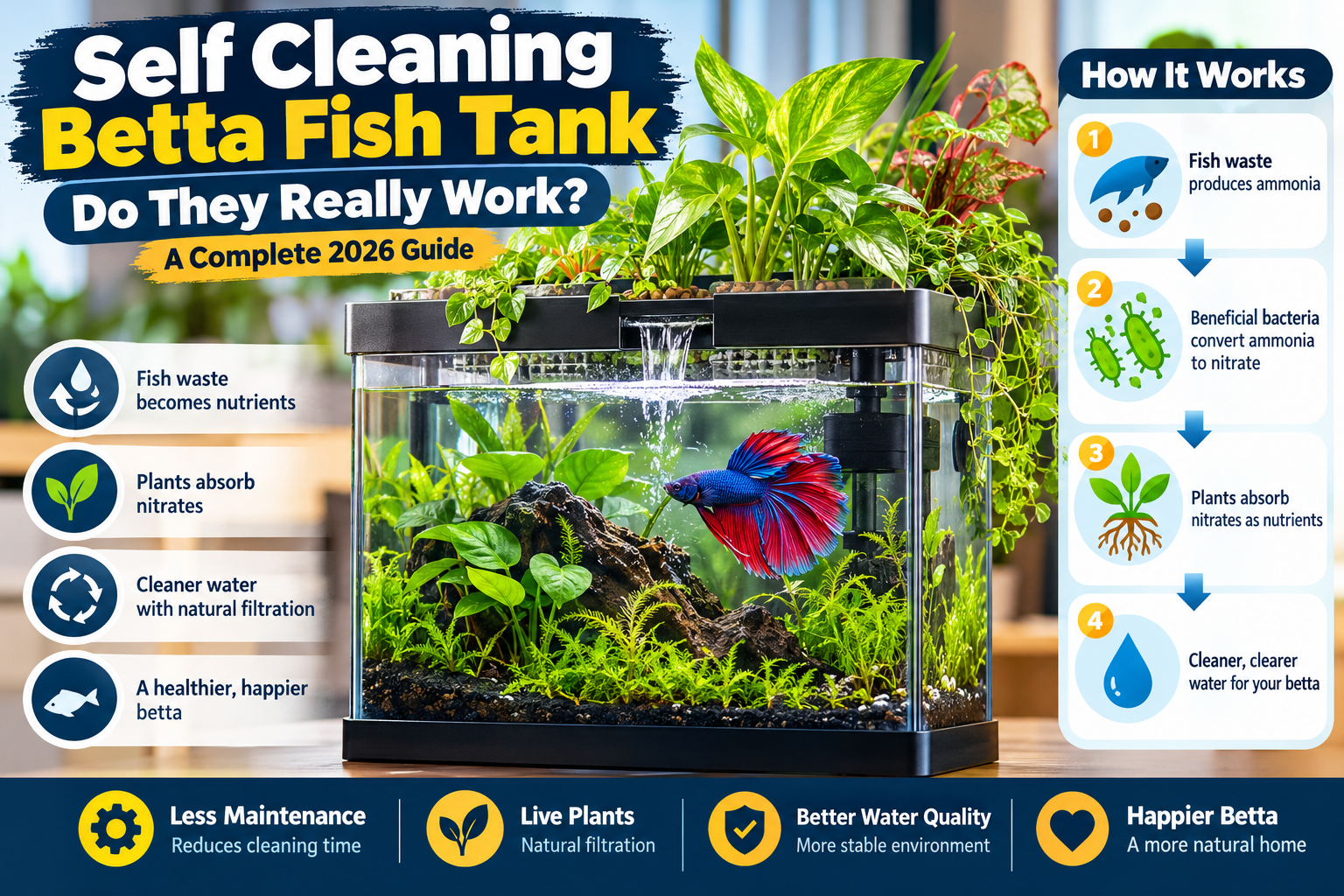
A self cleaning betta fish tank is an aquarium marketed to reduce routine cleaning through plant growth, a water displacement mechanism, or built-in filtration. Some systems combine fishkeeping with growing herbs, while others make water changes easier by directing displaced water into a separate container.
The phrase is a marketing description, not a scientific category. A tank does not become maintenance-free because it contains plants or has a special lid. Fish excrete waste, uneaten food decomposes, and dissolved compounds accumulate. Even a well-established biological filter transforms ammonia into nitrite and then nitrate; it does not automatically remove all nitrate from the water.
Think of these products as tools that may simplify one part of maintenance. They are not substitutes for a suitable aquarium, a cycled filter, a heater, water testing and planned water changes.
How Does a Self Cleaning Fish Tank Work?
Most self cleaning fish tanks use one of three approaches. Understanding the difference helps you decide whether a particular design genuinely fits your needs.
Aquaponic Betta Tank
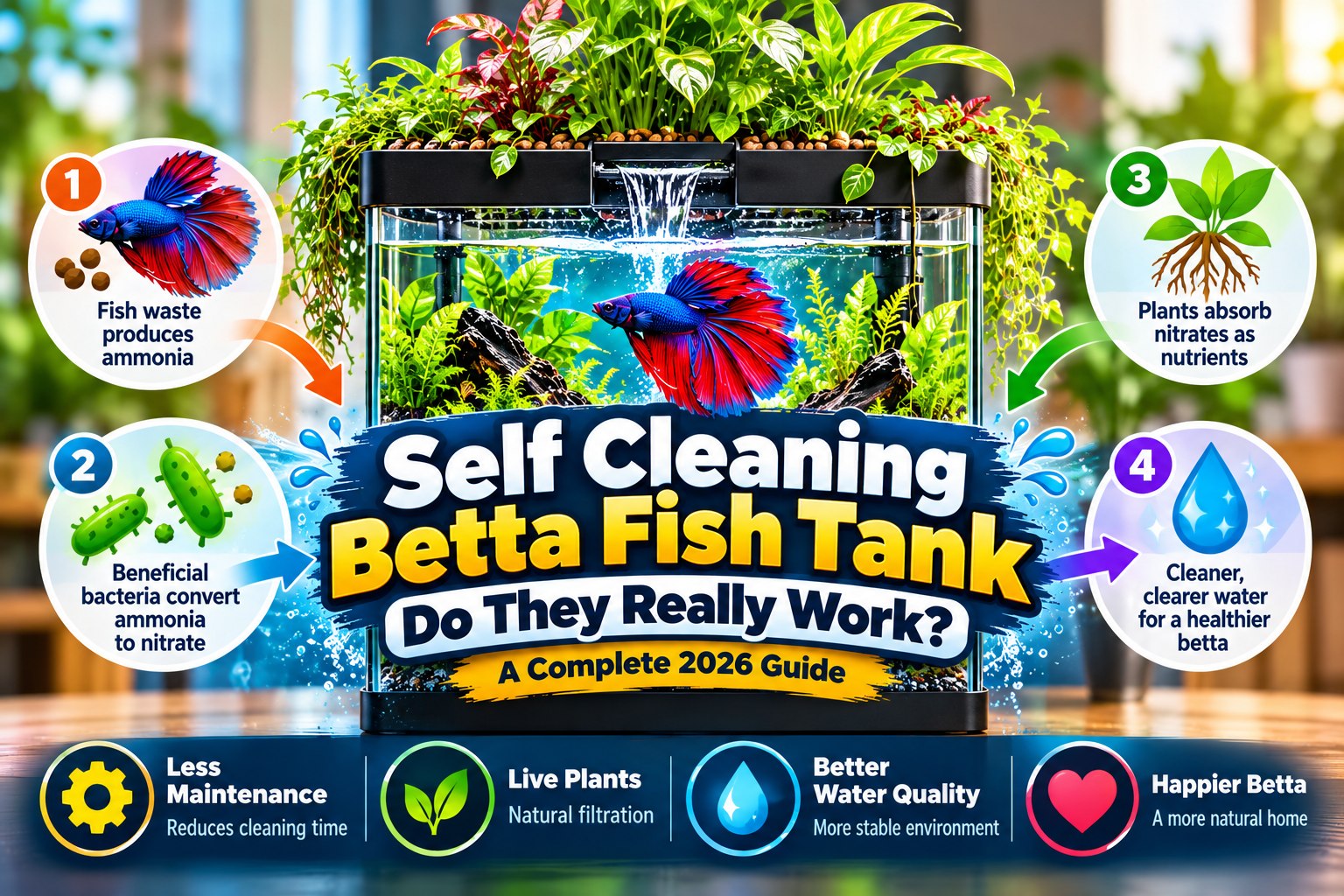
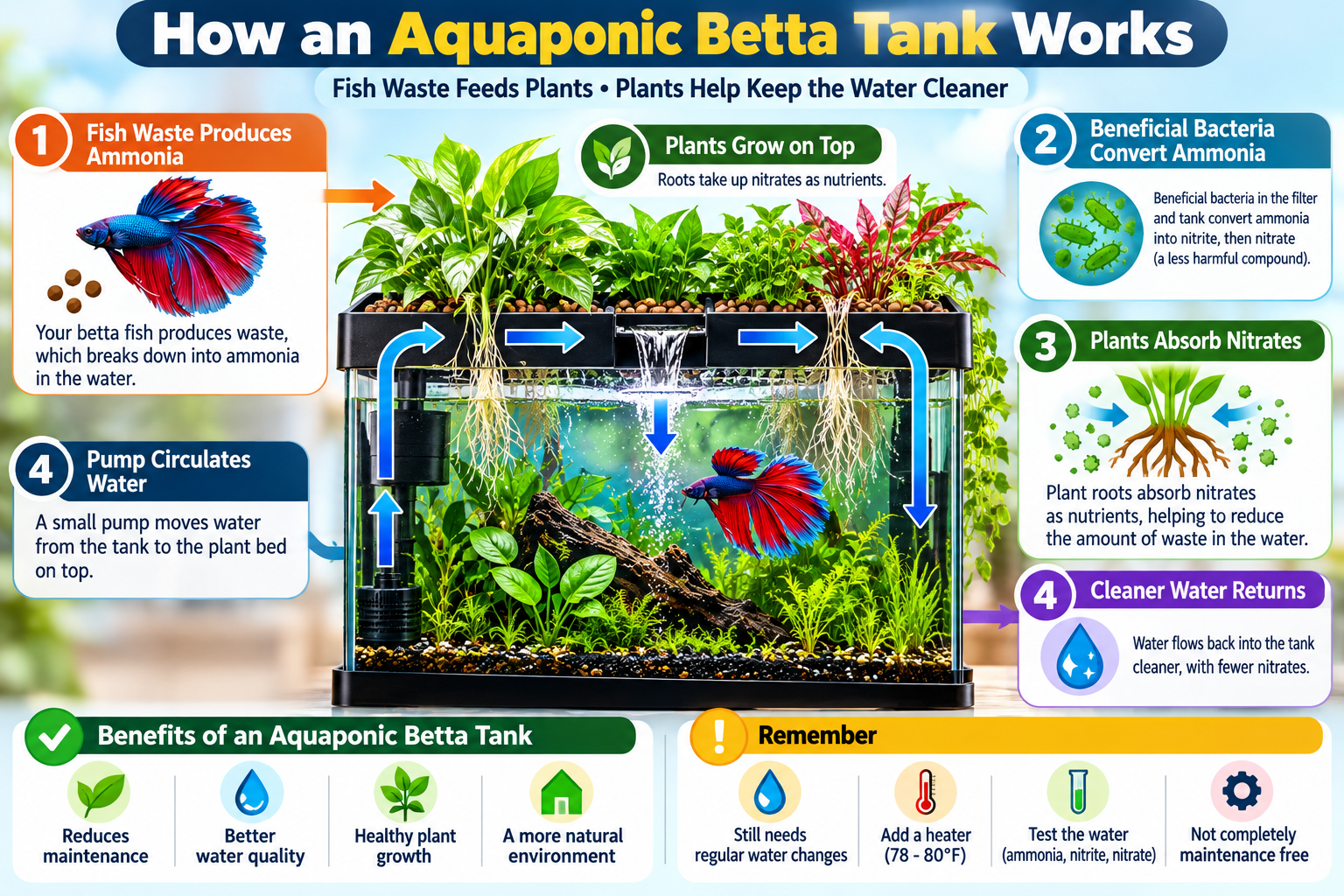
An aquaponic fish tank circulates water between the aquarium and a plant bed. Fish waste supplies nitrogen-containing compounds, while bacteria and plant roots help process or take up some of those nutrients. A small pump usually moves water to the grow area, where roots may be suspended in water or supported by a growing medium.
This is the familiar betta fish tank with plant on top design. It can look attractive on a desk and may support herbs or ornamental plants. However, plant uptake depends on the species, root development, light, nutrient availability, flow and the amount of waste produced. A small plant bed should not be assumed to handle every waste compound produced by a fish.
Research on aquaponic systems shows that plant species and system conditions influence nitrogen recovery. Commercial and home systems also face challenges involving water balance, filtration and nutrient management (Endut et al., 2010; Hu et al., 2015; Goddek et al., 2015).
Before choosing a plant, check whether it can grow with its roots in water and whether its leaves will receive enough light. Avoid allowing roots to block the pump intake or prevent the betta from reaching the surface. For more plant ideas, read our guide to the best plants for betta fish tanks.
Gravity Self Cleaning Fish Tank
A gravity self cleaning fish tank typically uses fresh water added to the aquarium to push some existing water into a drain or catch container. This can make a partial water change faster and reduce the need to siphon water manually.
However, the mechanism is still a water change, not waste elimination. The replacement water must be treated for chlorine or chloramine and brought close to the aquarium's temperature. The waste container must be emptied, and the tank still needs testing, substrate cleaning when necessary and inspection of the equipment.
Gravity designs can be convenient for people who find siphoning awkward, but convenience should not be confused with better water quality. Confirm how much water the system actually removes and whether the mechanism can accidentally lower the water level too far.
Built In Filter Easy Clean Tanks
Some small aquariums use a built-in filter, replaceable cartridge or simplified cleaning mechanism. A filter can trap suspended particles and, when it contains established biological media, support bacteria that process toxic ammonia and nitrite.
Cartridges still need maintenance, and replacing all filter media at once can remove much of the beneficial bacterial population. Small filters may also have limited media capacity or produce excessive current for a betta. Check the flow, the cost and availability of replacement media, and whether the unit can operate continuously.
Do Self Cleaning Tanks Really Work? What the Science Says
The underlying science supports partial waste management, not a maintenance-free aquarium. Fish release ammonia through normal metabolism, while uneaten food and decaying plant material add further organic waste. Ammonia toxicity depends on several factors, including pH and temperature, so even a modest reading deserves attention (Randall and Tsui, 2002).
In a cycled filter, specialised microorganisms oxidise ammonia to nitrite and then nitrate. This biological process is essential, but nitrate can continue to accumulate. Plants may use some nitrogen as they grow, yet the amount removed depends on their growth rate and the conditions in the system. A few roots above a small tank cannot guarantee safe water indefinitely.
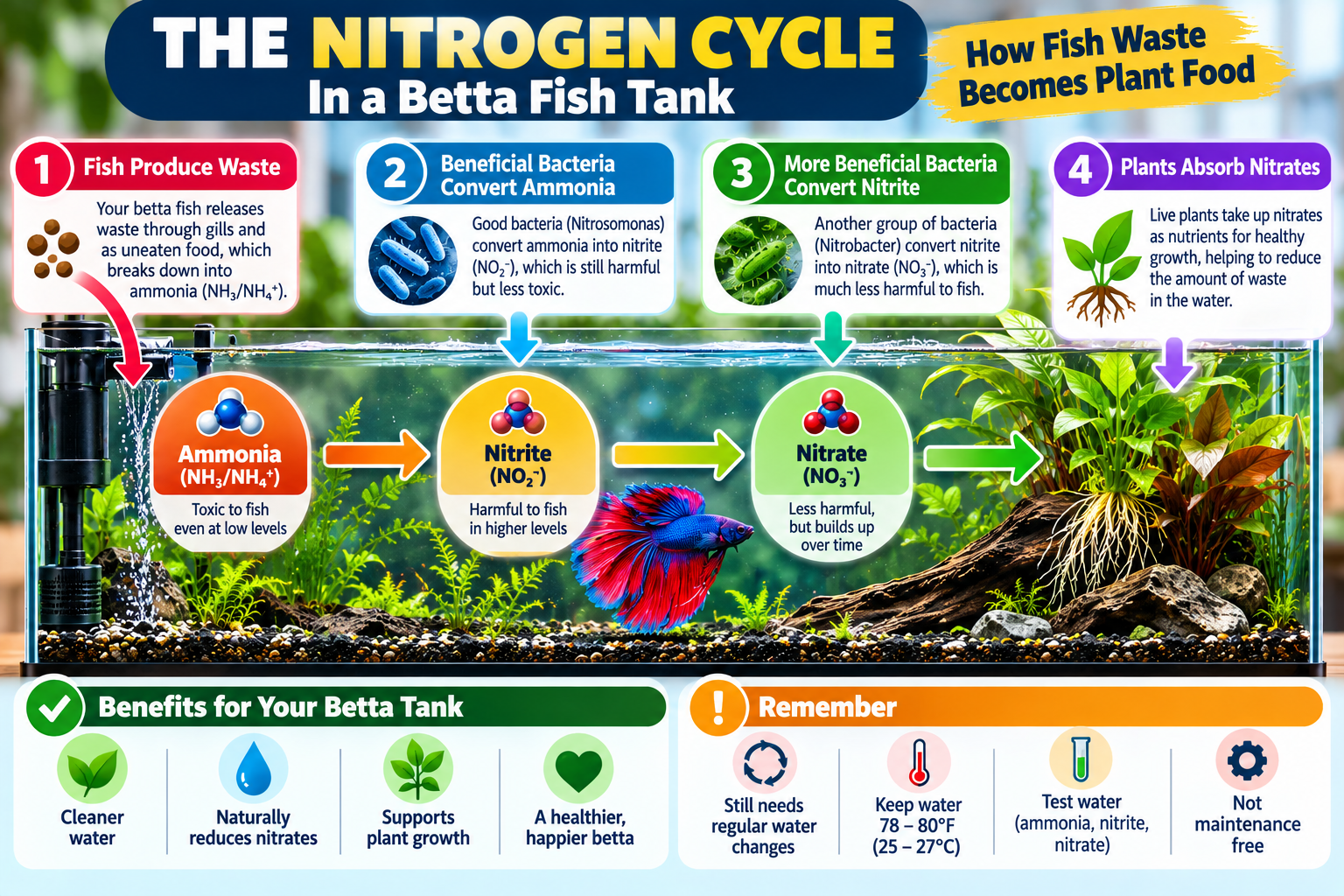
Nitrate is generally less acutely toxic than ammonia or nitrite, but elevated concentrations can still affect aquatic animals. Research reviews highlight that nitrate sensitivity varies between species and exposure conditions (Camargo et al., 2005). Do not treat a plant bed as a guarantee that nitrate will remain low.
The practical conclusion is straightforward: aquaponic plants may contribute to nutrient uptake, biological filtration converts toxic nitrogen compounds, and gravity mechanisms can simplify water replacement. Each process addresses a different task. None alone makes an aquarium self-sustaining under all conditions.
For routine testing, see our guides to choosing an aquarium water test kit and aquarium water testing equipment. The latter focuses on marine aquariums, but the general principle of monitoring water parameters applies across aquarium keeping.
Can a Betta Live Happily in a Self Cleaning Tank?
A betta can live in a self cleaning system only if the aquarium itself meets its needs. The label on the product does not determine whether the fish has enough space, stable temperature, suitable filtration or environmental enrichment.
Research on betta housing has found that space and furnishings can influence behaviour. Oldfield and Murphy (2024) discuss the importance of environmental conditions for betta welfare. A tank with plants, shelter and room to swim gives the fish more opportunities to explore and rest than a bare container with limited space.
Tank volume also affects how quickly water conditions and temperature can change. Small aquariums offer less dilution when waste enters the water, and they can warm or cool more rapidly than larger volumes. A small self cleaning kit may therefore require closer monitoring, even when its plant bed looks healthy.
For practical guidance on space and setup, read our science-backed guide to one-gallon betta tanks and the broader betta tank setup guide. These explain why survival in a small tank should not be mistaken for a suitable long-term environment.
Self Cleaning Betta Tank With Heater
Temperature control is one of the most important things to check before buying a self cleaning betta tank. Many compact kits do not include a heater, and a plant bed cannot keep the aquarium at a stable temperature.
Bettas are tropical fish and generally do best in consistently warm water around 78 to 80°F. Use an adjustable aquarium heater rated for the actual water volume, follow its installation instructions, and check the temperature with a separate thermometer. A heater must fit the tank safely and be used at the required water level.
Do not choose a heater based on wattage alone. Room temperature, aquarium volume and the heater manufacturer's recommendations all matter. A heater that is too powerful for a tiny tank may be difficult to regulate, while an undersized unit may struggle in a cold room.
If you already own a small self cleaning kit, consider whether a suitable heater can be installed without compromising water circulation or plant roots. If it cannot, upgrading to a conventional aquarium may be the safer and more practical choice.
Pros and Cons of Self Cleaning Betta Tanks
| Potential advantages | Limitations |
|---|---|
| Plant beds can provide an attractive aquaponic display. | Plant growth does not guarantee safe ammonia, nitrite or nitrate levels. |
| Gravity designs can simplify partial water changes. | Water still has to be treated, replaced and disposed of properly. |
| Built-in filters can provide mechanical and biological filtration. | Small filter media may need regular cleaning or replacement. |
| Compact systems may fit on a desk or shelf. | Limited water volume reduces the margin for mistakes and temperature changes. |
| Some kits combine fishkeeping and herb growing. | Lighting, pumps, roots and equipment may need extra monitoring. |
| Some designs reduce the effort involved in one maintenance task. | The term “self cleaning” can encourage owners to test or change water too infrequently. |
The best choice depends on what you want to simplify. If you struggle with siphoning, a gravity system may help. If you enjoy growing herbs, an aquaponic design may be appealing. If your priority is reliable fish care with minimal complications, a conventional filtered aquarium is often easier to manage in the long term.
Best Self Cleaning Fish Tank Options for Bettas
There is no single best self cleaning fish tank for every betta keeper. Before buying, check the actual water capacity, heater compatibility, filter type, replacement part availability and the space available for swimming and enrichment. Product specifications can change, so confirm the current listing before purchasing.
Back to the Roots Water Garden: An Honest Review
The Back to the Roots Water Garden is a well-known example of an aquaponic desktop kit. Its appeal is the combination of an aquarium below and a growing area above, where plants can use nutrients circulating through the system.
Its main attraction is the integrated display, rather than an ability to remove all aquarium maintenance. A small tank may be restrictive for a betta, and the kit may not include everything needed for stable tropical fish care. Before considering it, verify the current model's capacity, filtration arrangement, heater compatibility, lighting and plant-bed design.
Do not assume that herbs growing well above the tank mean the water is safe for fish. Test the water independently, keep the biological system established and perform water changes when needed. This type of kit is best considered by keepers who understand the additional equipment and maintenance requirements, not by anyone expecting a completely hands-off aquarium.
Product link: Add a verified retailer or affiliate link for the current Back to the Roots Water Garden listing here. Confirm the model and availability before publishing.
Better Alternative: 5 Gallon Betta Tank Kit
For many owners, a conventional 5-gallon betta tank kit is a more practical starting point. It offers more water volume than many compact self cleaning products and can accommodate a gentle filter, heater and live plants. A larger aquarium also gives the fish more room to move and the keeper more flexibility when arranging enrichment.
Look for a rectangular aquarium with a secure lid, a filter that can be adjusted or baffled to reduce current, and sufficient room for an appropriately sized heater. Confirm whether the kit includes a heater, because some aquarium kits include filtration and lighting but leave temperature control to the buyer.
A 5-gallon aquarium is not maintenance-free, but it can be easier to manage when properly cycled and maintained. A 10-gallon tank offers more flexibility if you have the space and budget. For a full setup walkthrough, use our complete guide to betta tank size and water quality.
Product link: Add a verified retailer or affiliate link for the Marineland Portrait 5 Gallon Glass Aquarium Kit here. Confirm current product details and whether a heater is included.
Maintenance a Self Cleaning Tank Still Needs
A reliable maintenance routine is more important than the product's marketing label. The exact frequency depends on tank volume, feeding, plant growth, filter maturity and measured water conditions. Treat the following as a practical checklist, then adjust it using test results.
- Check the fish daily: Observe swimming, appetite, breathing and fin condition. Investigate unusual behaviour promptly.
- Test the water: Monitor ammonia and nitrite, and check nitrate regularly. A liquid test kit is useful for tracking changes over time.
- Change water when needed: Use a partial water change appropriate to the test results and aquarium condition. Always treat replacement tap water with a suitable conditioner and match its temperature.
- Remove waste: Take out uneaten food, dead leaves and visible debris before they decompose.
- Inspect the filter: Confirm that the pump is running and the flow is not blocked by plant roots.
- Trim plants: Remove excessive growth and keep the surface open so the betta can reach atmospheric air.
- Check the heater: Compare the thermometer reading with the desired temperature range.
- Top up evaporation carefully: Use appropriately treated water. Topping up replaces lost water but does not remove the dissolved substances that remain behind.
Never replace all biological filter media at once unless the manufacturer and situation specifically require it. Much of the beneficial bacterial community lives on filter media and other aquarium surfaces. Cleaning or replacing everything at once can disrupt the biological cycle.
For more equipment and maintenance guidance, read our articles about Microbe-Lift Nite-Out II and aquarium bacteria and freshwater algae eaters. Bacterial products and algae-eating animals are not substitutes for testing, appropriate stocking or water changes.
Low Maintenance Betta Tank
The easiest aquarium to maintain is usually one that is appropriately sized, fully cycled, gently filtered and not overfed. Low-maintenance does not mean no maintenance. Instead, the goal is to create a stable setup that avoids sudden waste accumulation and unnecessary equipment problems.
Choose plants suited to your light level, such as Anubias or Java fern for lower-light aquariums. Floating plants can help absorb nutrients as they grow, but thin them regularly and leave open water at the surface. Avoid adding more plants than the tank can support or allowing roots to interfere with the filter.
Feed sensible portions and remove uneaten food. Test water regularly and keep a simple log of results, water changes and unusual behaviour. A predictable routine is more useful than relying on a self cleaning label or waiting for the water to look dirty.
For further care advice, see our betta plant guide and Halfmoon betta care guide. Bettas with long fins may benefit from gentle flow and carefully arranged resting areas.
Frequently Asked Questions
Do self-cleaning fish tanks really work?
They can simplify specific tasks, but they do not eliminate maintenance. Plants may take up some nutrients, filters process waste, and gravity systems can make water changes easier. Water testing, temperature control, appropriate feeding and partial water changes are still necessary.
Can a betta fish live in a self-cleaning tank?
Yes, if the tank provides suitable space, stable warm water, gentle filtration, a secure lid and enrichment. Many compact self cleaning kits need additional equipment or may be too restrictive. Check the actual setup rather than relying on the product name.
How does a self-cleaning fish tank work?
Most designs use plant-based nutrient uptake, a gravity mechanism that displaces old water, or a built-in filter. These mechanisms perform different jobs. None guarantees that ammonia, nitrite and nitrate will always remain at appropriate levels without monitoring.
How often do you clean a self-cleaning fish tank?
There is no universal schedule. Test water quality, observe the fish and adjust partial water changes to the aquarium's size, filter maturity and waste load. Clean visible debris and trim plants when needed. Never delay corrective water changes because a calculator or product label suggests the tank is self cleaning.
Do self-cleaning fish tanks need a filter?
Many do, and a cycled biological filter is a dependable way to process ammonia and nitrite. Plants can contribute to nutrient uptake but do not reliably replace biological filtration. If a system has no filter, it needs especially careful monitoring and water management.
What is the easiest fish tank to maintain?
A suitably sized, cycled aquarium with a reliable gentle filter, stable temperature and sensible stocking is generally easier to maintain than a tiny unfiltered tank. Live plants can help, but they should complement rather than replace proper equipment and routine care.
Final Verdict: Is a Self Cleaning Betta Fish Tank Worth It?
A self cleaning betta fish tank can be worth considering if you understand exactly what its mechanism does. An aquaponic tank can combine plants and fishkeeping, a gravity design can simplify water replacement, and a built-in filter can make waste processing more convenient. Each still has limitations.
For most betta keepers, the more dependable choice is a rectangular aquarium of at least 5 US gallons with a cycled filter, a suitable heater, plants and a secure lid. Choose a larger tank if you have the room and budget. Use the maintenance calculator as a planning aid, but let actual water tests and the fish's condition guide your routine.
The best low maintenance betta tank is not one that promises to clean itself. It is one designed to keep water conditions stable and make the essential maintenance simple enough to do consistently.
Explore our complete betta tank guide for further help with aquarium size, setup, filtration and water quality.
More AquariumsWorld Fishkeeping Guides
Explore these related guides from AquariumsWorld. Some cover other aquarium species and marine fishkeeping, so use the guide relevant to your setup.
References
The following sources support the general discussion of nitrogen processing, aquaponic system design, nitrate exposure and betta welfare. Consult the original publications for methods, study limitations and findings before using precise numerical claims.
- Camargo, J.A., Alonso, A. and Salamanca, A. (2005) 'Nitrate toxicity to aquatic animals: a review with new data for freshwater invertebrates', Chemosphere, 58(9), pp. 1255–1267. doi: 10.1016/j.chemosphere.2004.10.044.
- Endut, A., Jusoh, A., Ali, N., Wan Nik, W.B. and Hassan, A. (2010) 'A study on the optimal hydraulic loading rate and plant ratios in recirculation aquaponic system', Bioresource Technology, 101(5), pp. 1511–1517. doi: 10.1016/j.biortech.2009.09.040.
- Goddek, S., Delaide, B., Mankasingh, U., Ragnarsdottir, K.V., Jijakli, H. and Thorarinsdottir, R. (2015) 'Challenges of sustainable and commercial aquaponics', Sustainability, 7(4), pp. 4199–4224. doi: 10.3390/su7044199.
- Hu, Z., Lee, J.W., Chandran, K., Kim, S., Brotto, A.C. and Khanal, S.K. (2015) 'Effect of plant species on nitrogen recovery in aquaponics', Bioresource Technology, 188, pp. 92–98. doi: 10.1016/j.biortech.2015.01.013.
- Monvises, A., Nuangsaeng, B., Sriwattanarothai, N. and Panijpan, B. (2009) 'The Siamese fighting fish: well-known generally but little-known scientifically', ScienceAsia, 35(1), pp. 8–16. doi: 10.2306/scienceasia1513-1874.2009.35.008.
- Oldfield, R.G. and Murphy, E.K. (2024) 'Life in a fishbowl: space and environmental enrichment affect behaviour of Betta splendens', Animal Welfare, 33, e1. doi: 10.1017/awf.2024.1.
- Randall, D.J. and Tsui, T.K.N. (2002) 'Ammonia toxicity in fish', Marine Pollution Bulletin, 45(1–12), pp. 17–23. doi: 10.1016/S0025-326X(02)00227-8.
- Sari, A.P., Cokrowati, N. and Marzuki, M. (2022) 'Effect of different temperature on growth rate and survival betta fish fry (Betta splendens)', Indonesian Journal of Aquaculture Medium, 2(2), pp. 110–118. doi: 10.29303/mediaakuakultur.v2i2.1732.