Pond Salt Calculator | How Much Salt to Add to Your Koi Pond
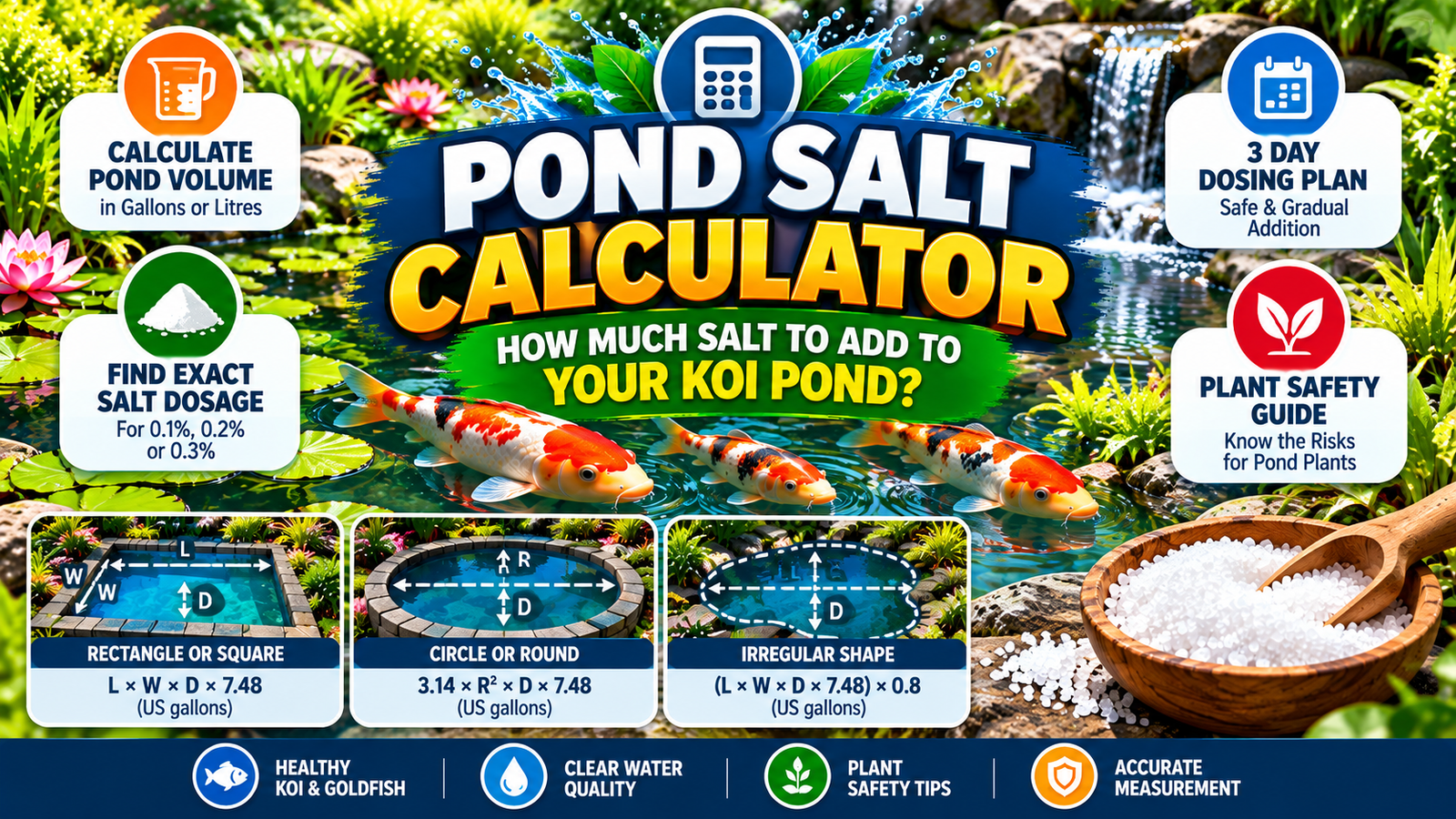
Use this pond salt calculator to estimate your pond volume, calculate the salt required to move from a measured starting concentration to a selected target, and plan gradual additions. It supports rectangular, circular and irregular ponds, plus known-volume entry in US gallons or litres.
Before adding salt, consider your fish species, aquatic plants, current water chemistry and reason for treatment. Salt is not a universal pond tonic, and the right concentration depends on the intended use and exposure time.
Free Pond Salt Calculator
Estimate pond volume, salt quantity and a gradual three-day schedule.
1. Choose your measurement units
Use average water depth, not the deepest point.
Enter US gallons.
Enter a measured level. 1 ppt is approximately 0.1% by mass.
Choose a target only when appropriate for your pond and intended use.
Calculator limit: 0.6%. This is not a declaration that this level is safe for your fish.
Optional: estimate the dilution from a partial water change.
Estimated result
Three-day addition estimate
If a gradual addition is appropriate, discuss the schedule with a fish-health professional.
Plant and livestock cautions
Water-change guidance
Evaporation does not remove salt. Replace evaporated water with fresh, appropriately dechlorinated water. Do not add salt to compensate for evaporation.
This calculator estimates salt by mass and assumes the entered concentration is a suitable approximation of the existing and target salt concentration. It does not measure salinity or diagnose fish disease. Verify the result with an appropriate salinity instrument and use the product label or professional guidance.
How this pond salt calculator works
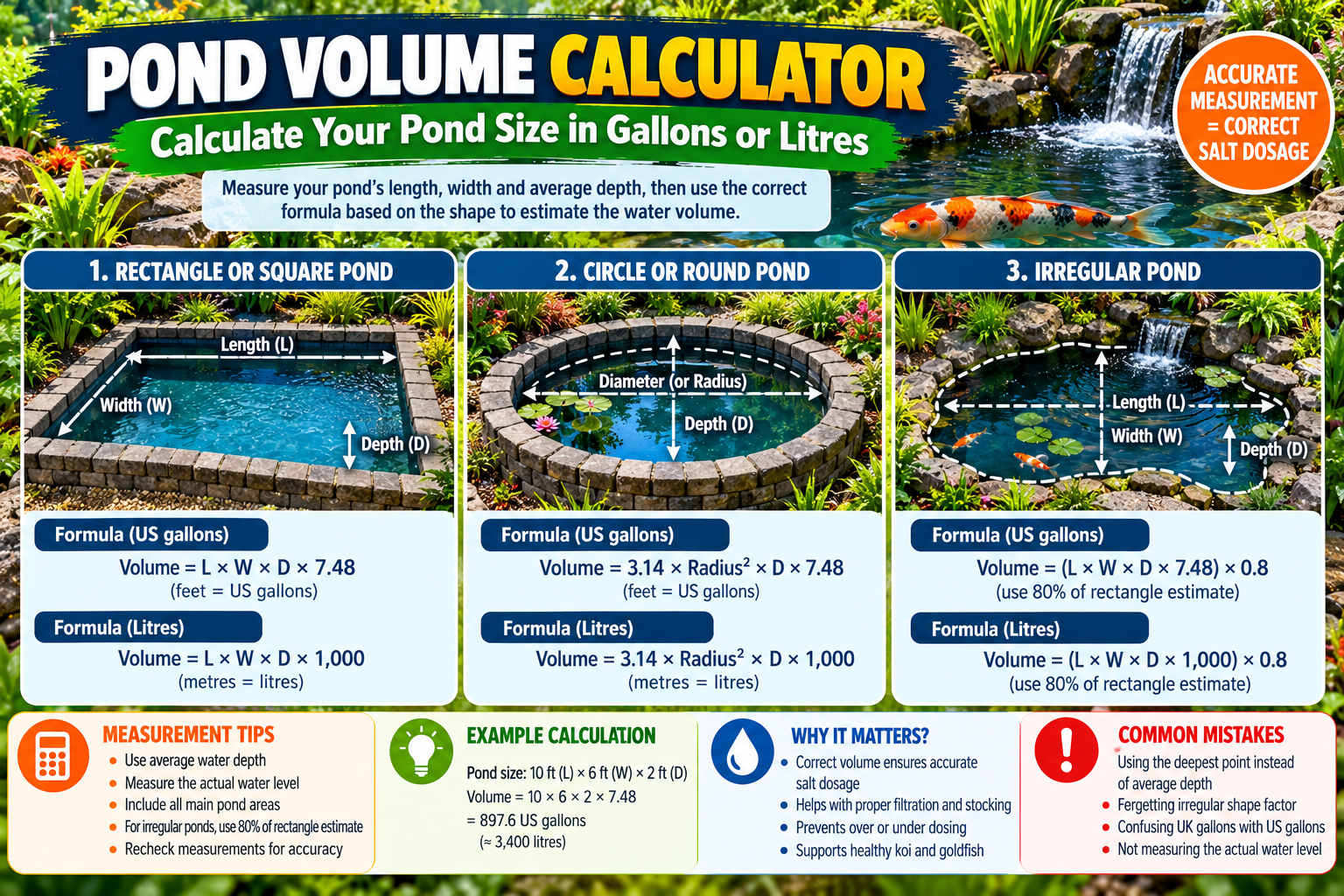
Rectangular pond, US units: length × width × average depth × 7.48 = approximate US gallons.
Rectangular pond, metric: length × width × average depth × 1,000 = approximate litres.
Round pond: 3.1416 × radius × radius × average depth. Multiply cubic feet by 7.48 for US gallons, or cubic metres by 1,000 for litres.
Irregular pond: the calculator uses 80% of the bounding rectangle estimate as a rough approximation. Measure the actual water volume when possible.
Salt mass: estimated salt in kilograms = pond litres × (target percentage − current percentage) ÷ 100. One kilogram per 1,000 litres increases concentration by approximately 0.1 percentage point.
These simplified conversions are suitable for estimates. The actual result depends on accurate dimensions, operating water level, existing dissolved salts and how the salt concentration is defined.
Reference: UF/IFAS, The Use of Salt in Aquaculture.
What Pond Salt Does in a Koi or Goldfish Pond
Pond salt is sodium chloride. In aquaculture, it can support freshwater fish during handling and transport, contribute to osmotic balance, and help manage certain external parasites under carefully selected conditions. Its effect depends on concentration, exposure time, fish species and the reason for using it. The University of Florida’s Institute of Food and Agricultural Sciences explains that different applications require very different concentrations, from low-level transport use to brief, much stronger parasite dips.
Salt should not be treated as a universal remedy. It does not replace adequate filtration, water testing, quarantine, correct nutrition or diagnosis of a sick fish. It is also not automatically needed in a healthy koi pond. Before calculating a dose, identify the problem you are trying to solve and establish the pond’s actual operating volume.
If you keep koi alongside goldfish, review this guide to koi and goldfish compatibility risks. Species compatibility, stocking density and water quality remain important even when salt is being considered.
How Much Salt for Koi Pond
The answer to “how much salt for koi pond” depends on the intended purpose. A concentration of 0.1% is equivalent to approximately 1 part per thousand (ppt), while 0.2% is about 2 ppt and 0.3% is about 3 ppt. UF/IFAS describes 0.1% to 0.3% as a range that may be used to reduce handling and transport stress in freshwater fish. That does not mean every pond should be maintained at these concentrations.
Some product labels give dosing instructions for specific pond uses, while fish-health extension guidance discusses treatment concentrations for different parasites and exposure periods. Those instructions are not interchangeable. Never transfer a short bath or dip concentration into a permanent pond, and do not choose a target simply because it is available in this calculator.
Salt also accumulates when it is repeatedly added without enough water being removed. Record each addition and measure the resulting concentration. A salinity meter can help estimate total salinity, but a chloride test may be more appropriate when the concern is nitrite toxicity. Use the test that matches the problem.
Koi Pond Salt for Parasites
Salt is used in some fish-health protocols against selected external parasites, including certain protozoans. However, the required concentration and exposure period depend on the parasite, fish species, water temperature and treatment method. A short dip is fundamentally different from raising the salt level throughout an entire pond. Some fish are salt-sensitive, and an incorrectly chosen concentration can cause additional stress.
White spots on a fish are not enough to confirm that salt is the correct treatment. A veterinarian or experienced aquatic-health professional can help distinguish ich from other conditions and select an appropriate plan. Review our guide to goldfish ich treatment, salt and water management as background, but do not use a general article as a substitute for diagnosis.
Extension research on salt treatments also shows why dose and duration must be considered together. A concentration effective for one fish or parasite may not be safe for another. If fish become distressed, lose balance or show abnormal breathing, stop the procedure and seek urgent fish-health advice.
Pond Salt Dosage Chart
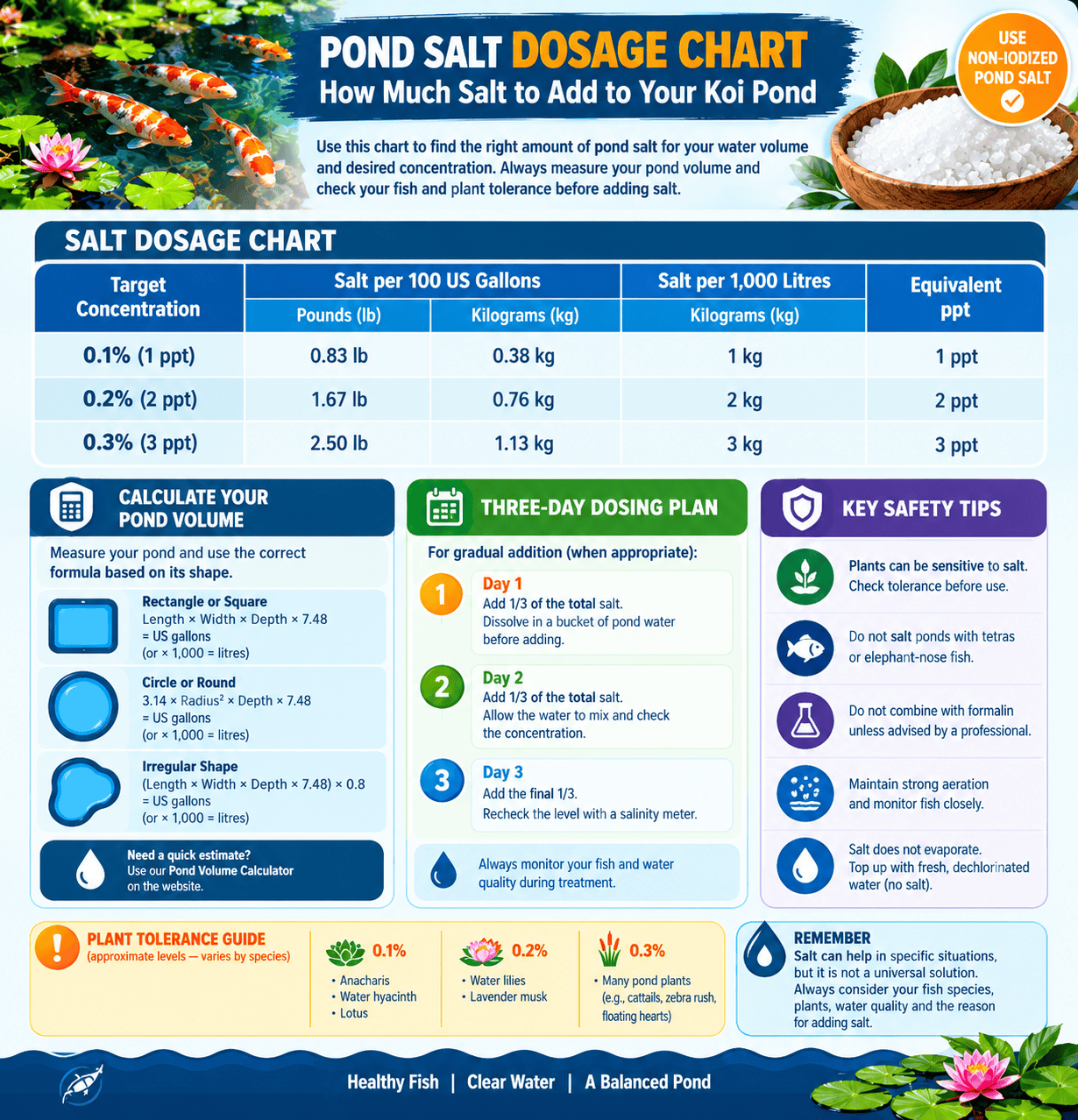
A dosage chart helps compare the amount of salt associated with a concentration, but it cannot determine whether that concentration is suitable for your pond. The following values are mathematical conversions based on approximate water volume. They assume the starting salt concentration is zero and that the target is expressed as a percentage by mass approximated using one litre of water as one kilogram.
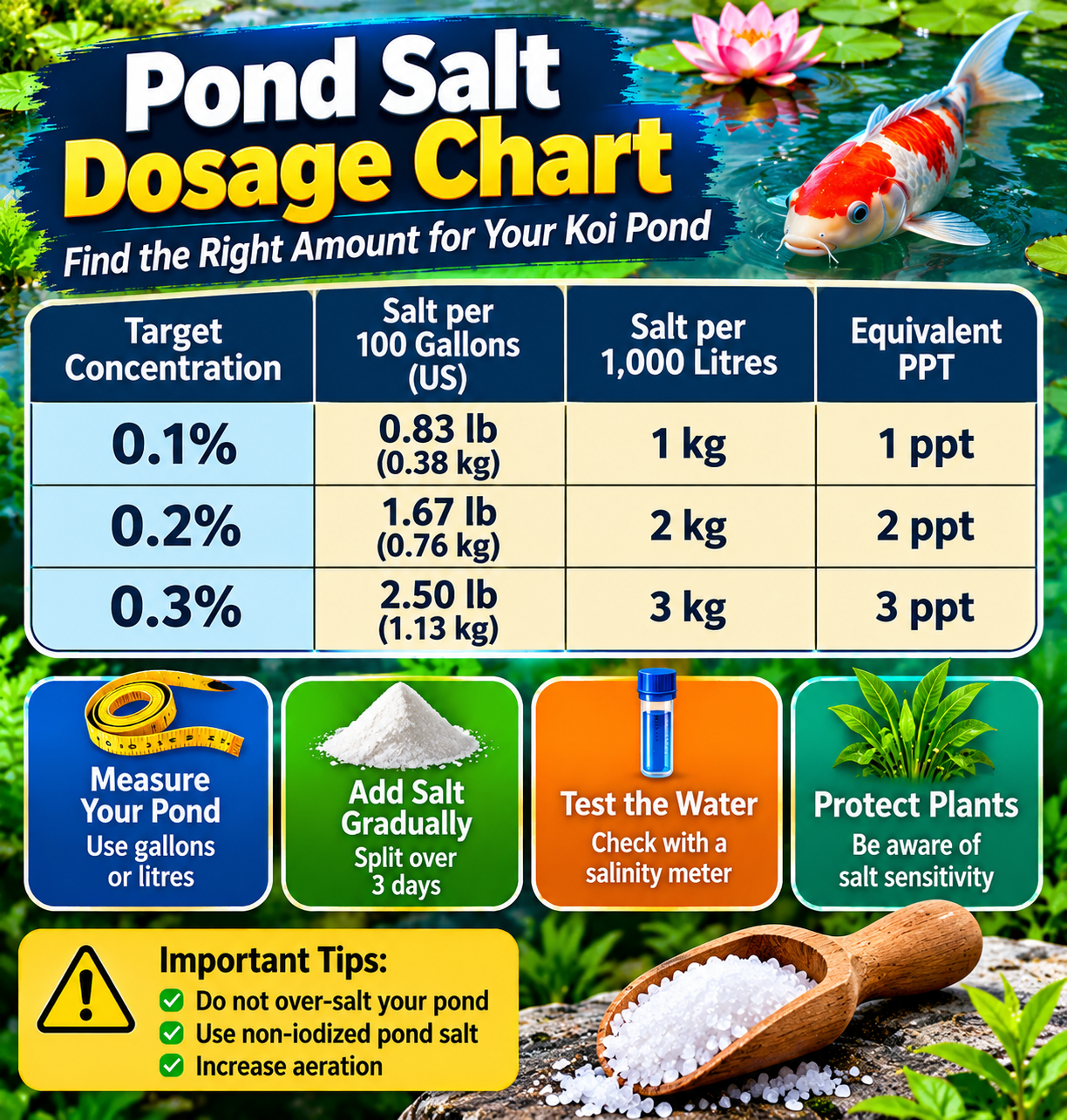
Pond Salt Dosage Chart per 100 Gallons and 1,000 Litres
| Target concentration | Approx. salt per 100 US gallons | Approx. salt per 1,000 litres | Equivalent ppt |
|---|---|---|---|
| 0.1% | 0.83 lb / 0.38 kg | 1 kg | 1 ppt |
| 0.2% | 1.67 lb / 0.76 kg | 2 kg | 2 ppt |
| 0.3% | 2.50 lb / 1.13 kg | 3 kg | 3 ppt |
These are target totals for the stated volume when starting from approximately zero salt. If salt is already present, calculate only the difference between the current measured level and the chosen target. Do not add the full table amount again. For example, a pond already at 0.1% does not need another full 0.1% dose to reach a 0.2% target.
Use a scale rather than measuring cups whenever possible. Salt crystal size and packing density vary, so the same cup volume can represent different masses. Also make sure that “gallons” means US gallons. An imperial gallon is larger, and confusing the two can produce a dosing error.
API Pond Salt Dosage
The API POND SALT label provides its own directions, including different cup quantities depending on whether aquatic plants are present. Follow the current package label for the product you have, rather than combining its cup-based instructions with a separate weight-based protocol without checking the difference.
Because volume measures vary, weighing the salt can improve repeatability. First establish the actual water volume, check the product label and confirm that salt is appropriate for your fish and plants. After any addition, allow the pond water to mix and measure the resulting level rather than assuming the calculated concentration was achieved exactly.
Product to consider: API POND SALT
Choose a pond salt product with clear instructions for the intended use. Confirm the current listing, package size and manufacturer directions before purchasing.

Pond Volume Calculator Gallons Method
An accurate pond volume estimate is the foundation of any salt calculation. Overestimating volume may lead to too much salt; underestimating it may lead to repeated additions that accumulate unexpectedly. Measure the water-filled dimensions, not just the outer dimensions of the pond. Account for shelves, sloping walls, rocks and any areas that are not filled to the same depth.
If your pond has a known operating volume from a reliable installation record, use that figure and check whether it includes the water held in filters, streams or connected tanks. Otherwise, measure the length, width and average water depth. For a pond with a complicated outline, the calculator’s irregular-shape estimate is only a starting point.
Rectangle, Circle and Irregular Pond Formulas
Rectangular pond: multiply length by width by average water depth in feet, then multiply the cubic-foot result by 7.48 to estimate US gallons. For example, a pond measuring 10 feet long, 6 feet wide and 2 feet deep has an estimated volume of 897.6 US gallons.
Round pond: multiply 3.1416 by the radius squared and then by average depth. If you measure diameter, divide it by two to get the radius. Multiply the cubic-foot result by 7.48 to convert to US gallons.
Irregular pond: one rough method is to calculate the volume of the rectangle that encloses the pond and multiply by 0.8. This factor is an approximation, not a universal rule. It may be inaccurate for narrow, curved, stepped or very irregular ponds. If salt treatment is being considered, improve the volume estimate rather than relying on a rough shape factor.
Pond Stocking Calculator: Get Volume First
Pond volume also supports stocking, filtration and feeding decisions. However, there is no single safe fish-per-gallon rule for every pond. Koi grow large and produce substantial waste, so filtration capacity, oxygenation, fish size, water temperature and maintenance matter alongside volume.
Use the measured volume as one input in your broader pond plan. For feeding routines, see our guide to an automatic fish feeder for ponds. Feeding equipment does not remove the need to monitor water quality and adjust feeding to the fish and season.
How to Add Salt to a Pond Safely
If salt has been selected for a clearly defined purpose, measure the pond volume, confirm the product and target, and calculate the difference from the existing concentration. Do not add salt by guesswork. Dissolve the measured amount in a suitable container of pond water before distributing it, following the product directions. Avoid pouring concentrated brine directly onto fish, plants or sensitive surfaces.
Maintain adequate aeration and observe the fish closely. Salt can affect sensitive species and plants, while handling and changes in water chemistry can create additional stress. If fish are already ill, identify the underlying water-quality or health problem rather than relying on salt alone.
Split the Dose Over Three Days
Gradual addition may be appropriate in some circumstances, but a three-day schedule is not suitable for every fish-health treatment. Some protocols have specific timing requirements, and a delay may be inappropriate if a professional has prescribed a different plan. Confirm the schedule before starting.
When a gradual schedule is confirmed as appropriate, the calculator divides the estimated total into three equal mathematical portions. Dissolve each portion before adding it, allow the water to mix, and recheck the concentration as directed. Do not automatically add the next portion if the measured concentration is already at or above the target, or if the fish show distress.
Measure with a Salinity Meter
A salinity meter can help verify the salt level, especially when previous additions or water changes make the starting concentration uncertain. Check the instrument’s units, calibration instructions and measurement range. Some meters display ppt, some display parts per million, and others display a percentage or conductivity value. Do not assume these values are interchangeable without understanding the instrument.
When nitrite is the concern, total salinity alone may not answer the question. UF/IFAS explains the role of chloride in reducing nitrite uptake and recommends measuring chloride for that application. Test ammonia, nitrite, pH and other relevant water-quality parameters as well.
Product to consider: Digital salinity tester
Look for a reliable instrument with a suitable range and clear calibration instructions. Confirm that its resolution is appropriate for the low salinity level you intend to measure.

Salt and Pond Plants
Salt can damage freshwater aquatic plants, and sensitivity differs by species, concentration and exposure duration. A concentration tolerated by one plant may injure another. The safest approach is to identify the plants in your pond before adding salt, especially when the pond contains lilies, floating plants or submerged vegetation.
Some pond-care guidance reports damage to sensitive plants at relatively low concentrations. Treat such figures as warnings rather than exact universal thresholds. Plant response also depends on the species, growth stage, water chemistry and duration of exposure. If preserving plants is important, do not assume that a fish treatment level is safe for the whole pond.
If a salt treatment is needed for fish but the pond contains sensitive plants, ask an aquatic veterinarian about a suitable alternative or a separate treatment system. Do not improvise a higher concentration to compensate for uncertain pond volume or an unclear diagnosis.
Removing Salt: Water Changes, Not Evaporation
Salt does not evaporate with pond water. When water is lost through evaporation, most dissolved salt remains behind, so the concentration may rise. Replace evaporated water with fresh, appropriately dechlorinated water, and do not add salt to make up for the water that evaporated.
Water changes physically remove some of the salt because salt-containing water leaves the pond. If the pond is well mixed, a 20% water change with replacement water containing no added salt will reduce a starting concentration by approximately 20%. For example, 0.2% would fall to roughly 0.16%, assuming the replacement water contributes negligible salt and no other factors change.
To calculate a replacement dose, first measure the concentration after the water change. Then consider only the volume of new water and the difference between the measured level and the appropriate target. Do not automatically replace the entire amount originally added, because that can cause salt to accumulate.
When Not to Use Pond Salt
Do not add salt without considering the fish species and treatment purpose. UF/IFAS specifically cautions against maintaining tetras and fish that navigate using electrical fields, such as elephant-nose fish, in salted systems. A mixed-species pond or connected system may therefore make salt unsuitable even if koi are present.
Do not combine salt with formalin or other treatments unless the relevant product instructions or an aquatic veterinarian establish a safe combination. Some chemical treatments interact with water conditions, fish physiology or oxygen availability. Maintain strong aeration and observe fish during any approved treatment.
Salt may be relevant to nitrite management because chloride competes with nitrite at the gills. However, adding salt is not a substitute for finding the source of nitrite, restoring biological filtration or carrying out appropriate water changes. Test ammonia and nitrite, review the filter’s condition and investigate overfeeding or excess waste. Our article on Microbe-Lift Nite-Out II covers a product associated with biological filtration, but no bottled product replaces water testing and proper system management.
Product to consider: API POND MASTER TEST KIT
A pond test kit can help assess important water-quality measures before you decide what action is appropriate. Check the current product specification to confirm which parameters it measures.

Frequently Asked Questions
How much salt do I put in my pond?
The amount depends on actual water volume, the measured salt level, the target concentration and the intended use. Calculate the difference rather than adding a full target dose to water that already contains salt. Check fish and plant tolerance before adding any salt.
How do I calculate how much salt my pond needs?
Estimate the pond’s operating volume, measure its current salt concentration and choose a suitable target. Multiply the volume in litres by the percentage-point difference and divide by 100 to estimate kilograms of salt. Verify the result with a suitable instrument and professional guidance where needed.
Does pond salt evaporate?
No. Water can evaporate, but dissolved salt generally remains in the pond, so the concentration may increase as the water level falls. Top off evaporated water with fresh, appropriately dechlorinated water and do not add salt for evaporation loss.
Will pond salt kill my plants?
It can. Freshwater plants differ in salt tolerance, and sensitive species may be damaged at relatively low concentrations. Identify your plants and consult reliable species-specific guidance before adding salt to a planted pond.
Can I use table salt in my pond?
Salt composition matters. UF/IFAS describes non-iodized salt or suitable rock salt for certain freshwater fish applications. Avoid products with unsuitable additives, and use a product appropriate for the intended treatment. Always check the directions and fish species before use.
How long should salt stay in a koi pond?
There is no single duration for every application. Some uses involve brief baths, while other protocols involve longer exposure at lower concentrations. Follow the treatment instructions for the diagnosed problem and monitor the fish. Salt remains until salt-containing water is removed or diluted.
Conclusion
A useful pond salt calculator starts with a reliable volume estimate, accounts for salt already in the water and calculates the difference to a selected target. The calculator above also helps compare US gallons with litres and provides a mathematical three-day split for situations where gradual addition has been confirmed as appropriate.
Before adding salt, check fish species, aquatic plants, water chemistry and the purpose of treatment. Measure the result rather than assuming the calculation is exact, and remember that water changes remove salt while evaporation does not. Use the calculator as a planning tool, not as a diagnosis or a guarantee of safety.
References
- Francis-Floyd, R. (n.d.) The Use of Salt in Aquaculture. University of Florida, IFAS Extension, EDIS VM007. Available at: https://ask.ifas.ufl.edu/publication/VM007.
- Swann, L. and Fitzgerald, S. (1991) The Use and Application of Salt in Aquaculture. Purdue University Cooperative Extension Service, AS-458. Verify the current extension publication record before citing or reproducing specific recommendations.
- Aquascape (n.d.) Water Volume in an Irregular Shaped Pond. Consult the manufacturer’s current support material for pond-volume estimation.
- Aquascape (n.d.) Is Salt Good for a Koi Pond?. Consult the current manufacturer’s guidance on salt use, pond plants and water changes.
- API (n.d.) POND SALT Pond Water Salt. Follow the current product label for directions, plant-related precautions and water-change dosing.
- All Pond Solutions (n.d.) Pond Salt Use and Dosage Guidance. Confirm the current page and product guidance before using species-specific plant tolerance figures.
- Harmon, T.S. (2009) ‘Methods for reducing stressors and maintaining water quality associated with live fish transport in tanks: a review of the basics’, Reviews in Aquaculture, 1(1), pp. 58–66. doi: 10.1111/j.1753-5131.2008.01003.x.
- Kroupova, H., Machova, J. and Svobodova, Z. (2005) ‘Nitrite influence on fish: a review’, Veterinární Medicína, 50(11), pp. 461–471. doi: 10.17221/5650-VETMED.
More AquariumsWorld Guides
The following links were supplied for internal linking. Some concern broader fishkeeping topics rather than pond salt. Retain only links that are live, useful to readers and appropriate for the site’s current content architecture.