Low Tech Plants for Planted Aquarium | 15 Easy No CO2 Picks
Want a beautiful planted tank without pressurised carbon dioxide, complicated dosing, or constant trimming? The best low tech plants for planted aquarium setups are those that match your light, substrate, and maintenance routine. This guide explains which plants to choose, how to grow them in gravel, and how to reduce avoidable algae problems.
Fertiliser approach
Consider root tabs near rooted plants according to the product label, plus a conservative all-in-one liquid fertiliser if needed. Reassess plant growth before increasing doses.
Estimated algae risk
Moderate
Monitor algae and plant growth weekly. Adjust light gradually and avoid changing several variables at once.
Jump to the 15 low-tech plants
This planner is an educational starting model, not a scientifically validated prediction. Plant portions are not standardised units: a portion could mean one rhizome plant, one rooted plant, a small stem bunch, or a small amount of floating plants. Actual needs depend on plant size, tank footprint, light coverage, water chemistry, nutrients, and maintenance.
What Is a Low Tech Planted Aquarium?
A low-tech planted aquarium grows live aquatic plants without injected CO2. It usually combines low-to-moderate lighting, manageable fertilisation, and species that tolerate the conditions available in an ordinary home aquarium. The aim is not to eliminate maintenance. It is to create a balanced setup that does not depend on complex equipment or rapid plant growth.
Many low maintenance aquarium plants grow slowly but remain attractive for years when attached or planted correctly. Anubias, Java fern, Java moss, Bucephalandra, and several Cryptocoryne species are common choices. Faster growers such as hornwort and water sprite can help use dissolved nutrients, although they may require more frequent trimming.
The phrase “low tech” does not mean no nutrients or no light. Plants need light, carbon, and mineral nutrients. Aquatic species can use dissolved inorganic carbon in different ways, and some can access bicarbonate under suitable conditions. Madsen and Sand-Jensen (1991) review carbon assimilation in aquatic macrophytes, illustrating why carbon availability and species biology influence growth.
The Walstad method is a more specific soil-based approach within the wider world of low-tech tanks. It uses a nutrient-bearing soil layer under an inert cap and relies heavily on plant growth and biological processes. It is not the only way to maintain a low-tech aquarium, and it still requires careful setup and observation.
Low Tech vs High Tech Planted Tank
| Feature | Low-tech setup | High-tech setup |
|---|---|---|
| CO2 | No injected CO2 | Usually injected CO2 |
| Lighting | Low to moderate, matched to plants | Often stronger and adjusted carefully |
| Fertiliser | Modest dosing based on plant needs | More deliberate nutrient management |
| Growth speed | Often slower | Can be faster when resources are balanced |
| Maintenance | Usually less intensive, but still regular | May require more trimming and monitoring |
Do not upgrade lighting simply to make a low-tech aquarium grow faster. More light can increase demand for carbon and nutrients. If you later decide to inject CO2, review the equipment and circulation requirements first. See our aquarium LED lighting and PAR guide and explore the site’s AquariumsWorld blog archive for related aquarium setup guides.
15 Best Low Tech Plants for Planted Aquarium
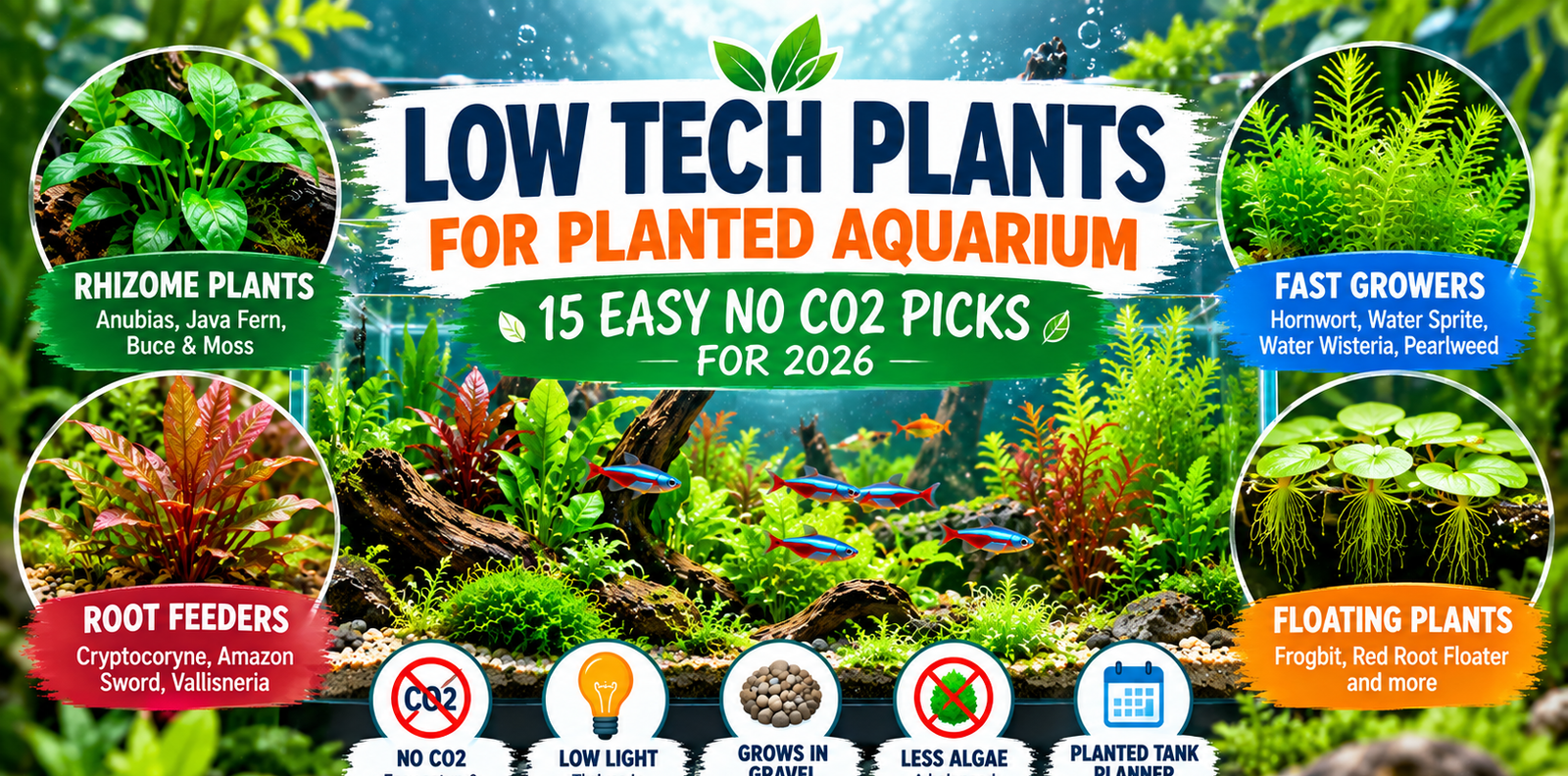
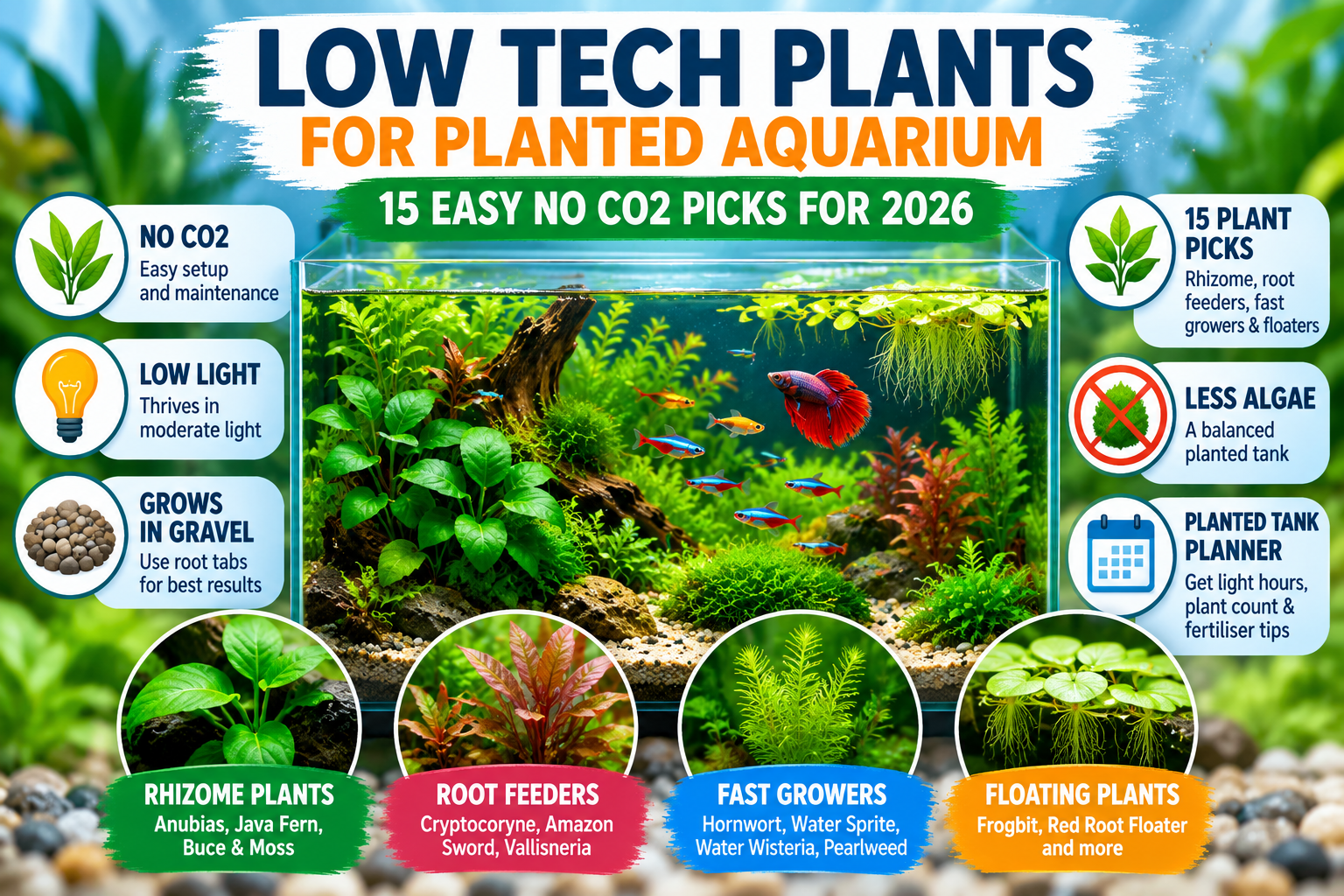
The most reliable plant selection uses several growth types rather than fifteen demanding species. Rhizome plants attach to hardscape, root feeders draw nutrients through their roots, fast-growing stems use nutrients from the water column, and floaters shade the surface. The following list gives beginners options for different tank areas and maintenance preferences.
Rhizome Aquarium Plants: Anubias, Java Fern, Bucephalandra and Java Moss
Rhizome plants are useful in low-light aquariums because many tolerate modest illumination and can be attached to rocks or wood. Their rhizomes must remain exposed rather than being buried under gravel or sand.
1. Anubias
Anubias is a slow-growing plant with thick leaves. Attach it to driftwood or rock using aquarium-safe thread or suitable adhesive. Keep its rhizome above the substrate. Its slow growth means algae can collect on older leaves if lighting and maintenance are poorly matched.
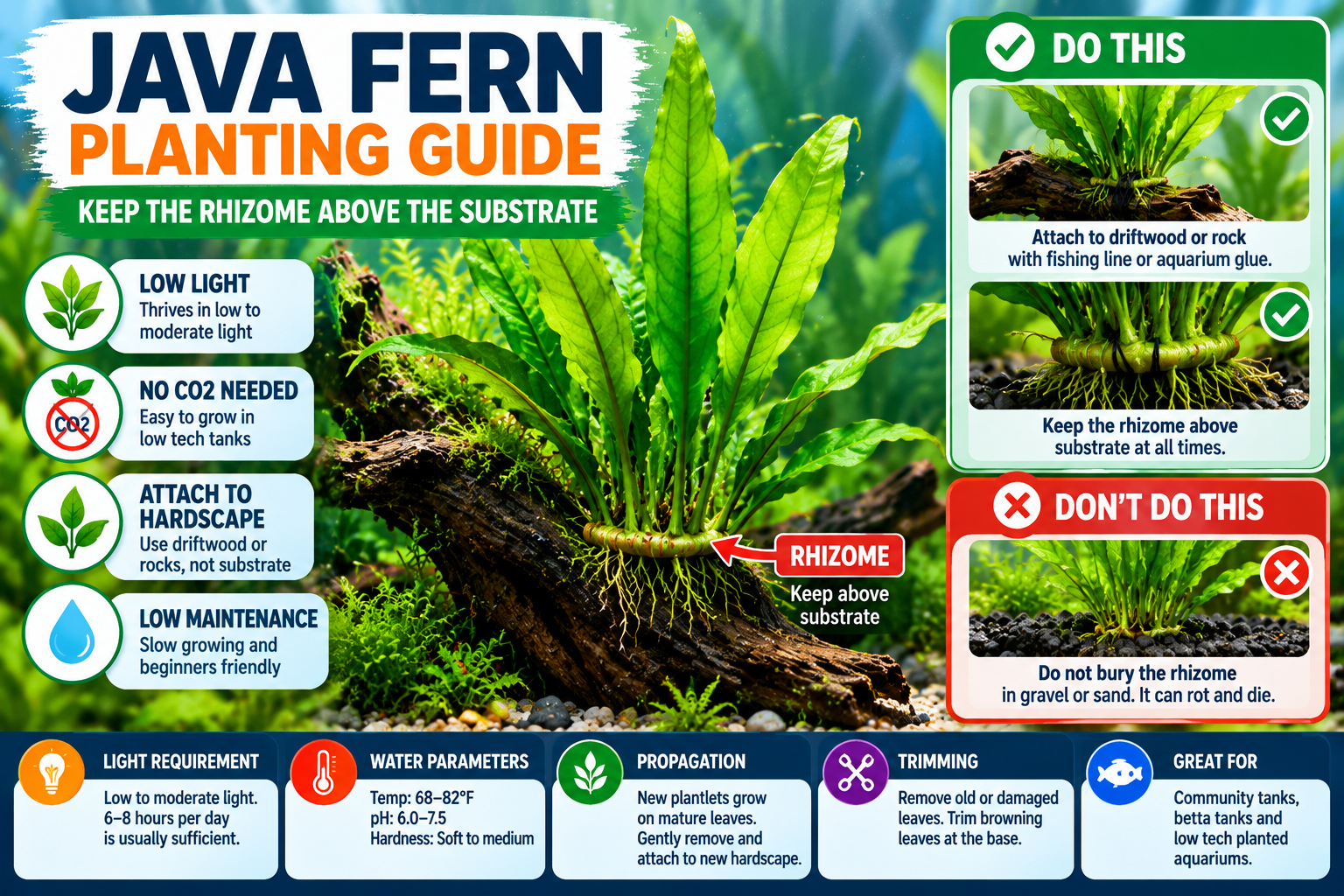
2. Java Fern
Java fern suits beginner tanks and can be attached to hardscape. Do not bury its horizontal rhizome. If it is covered by substrate, the plant may deteriorate. New plantlets can form on mature leaves and provide an easy way to expand the planting.
3. Bucephalandra
Bucephalandra offers varied leaf shapes and colours, but growth is often slow. Secure it to hardscape and avoid burying the rhizome. Choose healthy plants from a reputable aquatic plant seller, as some varieties are more sensitive to changes than common Anubias.
4. Java Moss
Java moss can be attached to wood, rock, or mesh. It provides fine structure for small invertebrates and young fish, but trapped debris can accumulate in dense mats. Trim it occasionally and keep water moving through thick growth.
5. Marimo Moss Ball
Marimo is a slow-growing spherical form of filamentous algae, rather than a true moss. It can be a decorative extra in suitable freshwater aquariums. Rotate it occasionally so its shape remains even, and buy from a responsible supplier.
Root Feeder Aquarium Plants: Cryptocoryne, Amazon Sword, Vallisneria and Dwarf Sagittaria
Root-feeding plants develop roots that absorb nutrients from the substrate. In plain gravel or sand, root tabs can provide nutrients near the roots. Barko and Smart (1986) discuss sediment-related limits on submerged plant growth, supporting the broader principle that substrate conditions influence rooted aquatic vegetation.
6. Cryptocoryne
Cryptocoryne species are popular midground plants. They often adapt to modest light, although their final size varies by species. After a change in water conditions or planting location, some leaves may melt back. Remove decaying leaves, maintain stable conditions, and allow healthy new growth to emerge rather than repeatedly uprooting the plant.
7. Amazon Sword
Amazon sword can become a large focal plant, so check its mature dimensions before placing it in a small tank. It benefits from a nutrient-rich root zone. A plain gravel substrate can work when root tabs are used appropriately, but its roots need enough space to spread.
8. Vallisneria
Vallisneria produces long, ribbon-like leaves that suit the background. It spreads through runners under favourable conditions. Avoid burying the crown too deeply, and allow space for its leaves to reach the surface. It can be a useful option where a tall green background is wanted.
9. Dwarf Sagittaria
Dwarf sagittaria can form a grassy foreground or midground when conditions suit it. Growth and height vary with light and substrate. Plant individual portions with room between them and avoid expecting an instant carpet in a low-tech setup.
Low Tech Aquarium Plants for Beginners: Hornwort, Water Sprite, Water Wisteria and Pearlweed
Fast-growing plants can be useful in new or lightly planted aquariums because they may take up dissolved nutrients as they grow. They do not replace cycling, water testing, or maintenance. Camargo and Alonso (2006) review the ecological and toxicological effects of inorganic nitrogen pollution, reinforcing why aquarium keepers should manage waste and nitrogen compounds instead of relying on plants alone.
10. Hornwort
Hornwort is a fast-growing stem plant that can float or be loosely anchored. It can provide cover and is easy to trim, but fragments may spread around the aquarium. Remove excess growth before it shades slower plants.
11. Water Sprite
Water sprite can be planted in the substrate or allowed to float. Its finely divided leaves provide shelter, and its growth can be substantial in favourable conditions. Thin it regularly so it does not cover every available area.
12. Water Wisteria
Water wisteria can create leafy background growth and responds to suitable light and nutrients. Give it space and trim the stems when they become too large. Confirm the plant’s identity with the seller because common names can vary across regions.
13. Pearlweed
Pearlweed can grow as a bushy stem plant or be trained into a low foreground under appropriate conditions. It may need more light and trimming than Anubias or Java fern. For a no-CO2 tank, begin with modest expectations and monitor whether lower leaves receive enough light.
Best Floating Plants for Aquarium: Frogbit and Red Root Floater
Floating plants draw nutrients directly from the water and shade the aquarium below. They can be useful for fish that prefer subdued light, but excessive surface cover can limit light reaching submerged plants and interfere with access to the surface for some fish. Leave open areas and remove excess growth regularly.
14. Amazon Frogbit
Amazon frogbit develops round leaves and dangling roots. It can provide shade and a natural appearance. Keep the leaves from being constantly splashed by filter outlets, as persistent wetting may damage them. Thin the plants so the surface does not become completely covered.
15. Red Root Floater
Red root floater can develop reddish roots and leaf undersides under suitable conditions. It generally benefits from a relatively calm surface and adequate light. It may be less forgiving of water movement than some other floaters, so position it where leaves are not continually pushed underwater.
For a practical beginner selection, combine a few attached rhizome plants, a small group of rooted plants, and one fast-growing species. Add floating plants only if their shade suits the aquarium. The aim is healthy growth and manageable maintenance, not maximum plant quantity.
Aquarium Plants Low Light: How Many Hours of Light?
Many aquarium plants low light setups can begin with approximately six to eight hours of light daily. This is a starting range, not a universal biological requirement. Plant species, fixture output, tank depth, floating cover, and nutrient availability affect how much light reaches the leaves.
The planner uses eight hours for low light, seven for medium light, and six for high light. For a new aquarium during its first four weeks, it subtracts one hour. These are conservative planning heuristics, not experimentally validated rules for every tank. Adjust gradually after observing plant health and algae development.
PAR, or photosynthetically active radiation, describes light in the wavelength range used by photosynthesis. A PAR reading at the substrate can be more useful than watts alone, but the reading does not capture every variable. Spectrum, coverage, daily exposure, carbon, and nutrients also matter.
A timer helps maintain a repeatable schedule. A midday break of two to three hours is optional; it is not a proven requirement for all aquariums and should not be treated as a guaranteed algae cure. Avoid changing both light intensity and duration dramatically at once.
Recommended Equipment: NICREW ClassicLED Plus Planted Aquarium Light
This light is a candidate for a beginner planted aquarium, but check the exact model, tank length, output controls, and current specifications before purchase. A fixture is suitable only if it provides appropriate coverage for your tank and plant selection.
Amazon link: Replace the placeholder below after verifying the current listing and ASIN.

For more detailed lighting guidance, read the live Aquarium Lighting LED for Plants: PAR, Spectrum and Schedule guide. Choose lighting that suits the plants you want to grow, rather than buying the strongest fixture available.
Can Aquarium Plants Grow in Gravel?
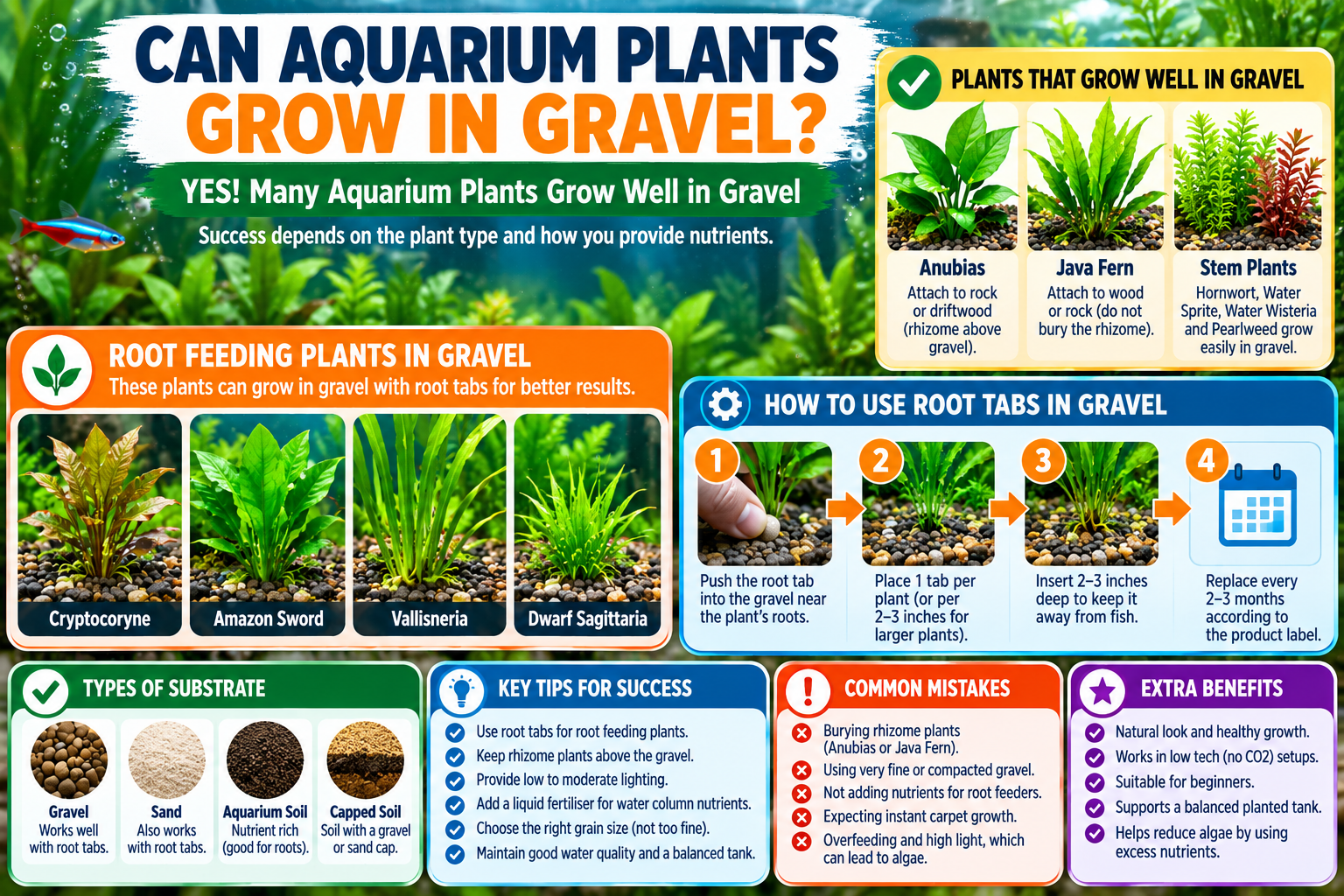
Yes, can aquarium plants grow in gravel is a question with a straightforward answer: many can, but success depends on the species and the way nutrients are supplied. Anubias and Java fern can be attached to hardscape and do not need to be buried in gravel. Hornwort can float or be loosely anchored. Rooted plants such as Cryptocoryne and Amazon sword may need additional nutrients when the gravel is inert.
Plain gravel is not inherently unsuitable for plants. Its main limitation is that it usually provides little nutrition by itself. Root tabs can place nutrients near rooted plants, while a suitable liquid fertiliser supplies nutrients through the water column. Choose grain size and depth that allow roots to develop without compacting the substrate excessively.
Sand can also support plants, but very fine or tightly compacted sand may make planting and root development more difficult. Root tabs can help with nutrient supply. Aquarium soil can provide a nutrient-rich substrate, although some active soils affect water chemistry or release ammonia during initial setup. Read the product information and test new tanks carefully.
For a deeper comparison of inert gravel, sand, and nutrient-rich substrates, see Soil in Fish Tank: Types, Problems and Plant Growth Guide. Barko, Gunnison and Carpenter (1991) discuss interactions between sediment and submerged macrophyte growth, supporting the importance of substrate conditions rather than a one-substrate-fits-all approach.
Root Supplement: Seachem Flourish Tabs
Root tabs are designed to supply nutrients near the root zone. They may be useful for rooted plants in inert gravel or sand. Check the manufacturer’s directions for placement and replacement intervals, and avoid treating a fixed three-month interval as suitable for every tank.
Root Tabs for Gravel and Liquid Fertiliser
Root tabs and liquid fertiliser serve related but different roles. Root tabs provide nutrients close to roots, while liquid products supply nutrients to the water column. Rhizome plants such as Anubias and Java fern mainly benefit from suitable water-column nutrition, while rooted plants such as swords and many Cryptocoryne can benefit from substrate nutrients.
Use the planner’s fertiliser suggestions as a starting framework, not as universal dosing instructions. Soil and capped soil may already contain nutrients, so additional root tabs may be unnecessary at first. Gravel and sand are often inert, so rooted plants may benefit from root tabs. High light does not automatically mean the tank needs a full dose of every nutrient; observe plant response and follow the product label.
Liquid Supplement: Seachem Flourish Comprehensive Supplement
An all-in-one micronutrient supplement may be useful where the aquarium’s plants need additional nutrients. It does not replace every macronutrient in all setups. Dose according to the label and the needs of the actual aquarium rather than assuming one schedule fits every planted tank.
How to Build a Heavily Planted Aquarium Without CO2
A heavily planted aquarium can be maintained without injected CO2 if the plant selection, light, and maintenance routine suit the available conditions. Dense planting is not the same as forcing as many plants as possible into a tank. Leave space for circulation, fish movement, and access for cleaning.
- Plan the layout. Use the planner as a rough starting point, then adjust plant portions according to mature size. A large Amazon sword occupies far more space than a small Anubias.
- Choose plants by role. Place rhizome plants on wood or rock, root feeders in the substrate, fast growers in open background areas, and floaters in a controlled part of the surface.
- Plant generously but sensibly. Aiming for substantial initial coverage can help the aquarium establish plant growth, but there is no universal 50% or 70% coverage rule that guarantees stability. Use the tank’s footprint and the plants’ mature size as your guide.
- Start with modest light. Use a timer and avoid increasing intensity just because plants have not grown rapidly in the first few days.
- Observe the first four weeks. Remove melting leaves, check water quality, and avoid repeatedly changing lighting, fertiliser, and substrate at the same time.
- Maintain the aquarium. Trim excess growth, remove decaying leaves, clean the filter as needed without destroying biological media, and carry out water changes appropriate to the aquarium.
Plants do not eliminate the need to cycle an aquarium or maintain its filter. If fish are present, test ammonia and nitrite when establishing the tank and respond promptly to unsafe readings. Add livestock gradually rather than assuming that dense planting makes immediate stocking safe.
Keeping Algae in Check in a Low Tech Tank
Algae is a normal part of aquatic ecosystems, and a small amount does not automatically mean the aquarium has failed. Problems are more likely when growth becomes excessive, covers plant leaves, or interferes with the appearance and maintenance of the tank. Review light, plant health, nutrient availability, feeding, and maintenance together instead of blaming one factor.
Start with a consistent photoperiod. If algae increases after a lighting change, reduce intensity or duration gradually and watch the response. Remove damaged leaves and excess algae manually. Avoid excessive feeding and keep filter maintenance consistent. Fast-growing plants may take up dissolved nutrients as they grow, but their presence does not guarantee algae control.
Research on aquatic plant allelopathy explores whether some plants release compounds that affect other organisms, including algae. Gross (2003), Hilt and Gross (2008), and van Donk and van de Bund (2002) discuss possible mechanisms and their ecological context. These studies do not prove that a particular aquarium plant will reliably suppress algae in every home tank.
Floating plants can shade parts of the aquarium and absorb nutrients, but excessive cover may shade slower plants. Keep some surface open and remove excess floaters. Algae-eating animals are not a substitute for balanced care, and every animal must be selected for its adult size, behaviour, and water requirements. Read our guide to the best freshwater algae eaters for aquariums before considering a cleanup species.
Walstad Method Aquarium: Is It Worth It?
The Walstad method uses a soil-based substrate capped with gravel or sand and relies on plant growth and biological processes to support a low-tech aquarium. It can be economical, but setup quality matters. Soil composition, cap depth, plant mass, and initial water conditions all affect the result.
Do not assume that a soil-based aquarium never needs water changes, testing, or intervention. Organic substrates can alter water conditions, especially early on. Test new setups and wait until the aquarium is stable before introducing livestock. For substrate options and setup considerations, read the AquariumsWorld aquarium soil guide.
Low Tech Plants for Betta Tanks
Betta aquariums can benefit from plants that tolerate modest light and provide cover without demanding injected CO2. Anubias, Java fern, Java moss, and selected floating plants are common options. Keep the water surface accessible because bettas need to reach the surface to breathe air. Avoid sharp hardscape and leave swimming space around dense planting.
For a more detailed plant selection, see Best Plants for Betta Fish Tanks and 15 Best Live Plants for Betta Fish. These guides provide a useful next step for readers designing a betta-focused layout.
Frequently Asked Questions
What are low tech aquarium plants?
Low-tech aquarium plants are species that can grow without injected CO2 and often tolerate modest lighting and straightforward fertilisation. Anubias, Java fern, Java moss, and many Cryptocoryne species are common choices. Success still depends on plant health, nutrients, light, and suitable water conditions.
What is the easiest plant for a planted aquarium?
Anubias and Java fern are often among the easiest choices because they tolerate modest light and can be attached to wood or rock. Keep their rhizomes exposed instead of burying them. Hornwort can also be easy to grow, but it may need frequent trimming.
Can aquarium plants grow in gravel?
Yes. Rhizome plants can be attached to hardscape, and many stem plants can grow in gravel. Rooted plants such as Amazon sword and Cryptocoryne may need root tabs when the gravel contains little nutrition. Match the substrate and fertiliser method to the species.
Do low tech planted tanks need fertilizer?
Many do, although the amount depends on the plants, substrate, livestock, and water conditions. Nutrient-rich soil may supply some nutrients, while inert gravel often needs supplementation for rooted plants. Start conservatively, follow product directions, and observe growth rather than automatically dosing heavily.
How many hours of light does a low tech planted tank need?
About six to eight hours daily is a practical starting range for many beginner setups, but it is not a universal rule. Adjust light according to plant response, tank depth, and algae development. A timer helps keep the schedule consistent.
Do floating plants help with algae?
Floating plants can absorb nutrients and shade parts of the aquarium, which may help manage conditions that favour some algae. They do not guarantee algae prevention. Thin them regularly, leave surface space open, and maintain appropriate lighting, feeding, filtration, and water changes.
Final Thoughts
The best low tech plants for planted aquarium setups are not necessarily the rarest or fastest-growing. Choose a mix of rhizome plants, root feeders, fast growers, and optionally floaters. Match lighting to the plants, use root tabs where rooted plants need substrate nutrition, and keep the maintenance routine consistent.
Start with the Low Tech Planted Tank Planner above, then adjust the recommendations to the actual size of each plant and the layout of your aquarium. Treat its outputs as starting estimates, not guarantees. Healthy growth comes from balancing light, carbon, nutrients, substrate, and water quality over time.
References
Barko, J.W. and Smart, R.M. (1986) ‘Sediment-related mechanisms of growth limitation in submersed macrophytes’, Ecology, 67(5), pp. 1328–1340. Available at: https://doi.org/10.2307/1938689.
Barko, J.W., Gunnison, D. and Carpenter, S.R. (1991) ‘Sediment interactions with submersed macrophyte growth and community dynamics’, Aquatic Botany, 41(1–3), pp. 41–65. Available at: https://doi.org/10.1016/0304-3770(91)90038-7.
Camargo, J.A. and Alonso, A. (2006) ‘Ecological and toxicological effects of inorganic nitrogen pollution in aquatic ecosystems: A global assessment’, Environment International, 32(6), pp. 831–849. Available at: https://doi.org/10.1016/j.envint.2006.05.002.
Gross, E.M. (2003) ‘Allelopathy of aquatic autotrophs’, Critical Reviews in Plant Sciences, 22(3–4), pp. 313–339. Available at: https://doi.org/10.1080/713610859.
Hilt, S. and Gross, E.M. (2008) ‘Can allelopathically active submerged macrophytes stabilise clear-water states in shallow lakes?’, Basic and Applied Ecology, 9(4), pp. 422–432. Available at: https://doi.org/10.1016/j.baae.2007.04.003.
Madsen, T.V. and Cedergreen, N. (2002) ‘Sources of nutrients to rooted submerged macrophytes growing in a nutrient-rich stream’, Freshwater Biology, 47(2), pp. 283–291. Available at: https://doi.org/10.1046/j.1365-2427.2002.00802.x.
Madsen, T.V. and Sand-Jensen, K. (1991) ‘Photosynthetic carbon assimilation in aquatic macrophytes’, Aquatic Botany, 41(1–3), pp. 5–40. Available at: https://doi.org/10.1016/0304-3770(91)90037-6.
van Donk, E. and van de Bund, W.J. (2002) ‘Impact of submerged macrophytes including charophytes on phyto- and zooplankton communities: Allelopathy versus other mechanisms’, Aquatic Botany, 72(3–4), pp. 261–274. Available at: https://doi.org/10.1016/S0304-3770(01)00205-4.