Goldfish Ich Treatment | Salt, Ich-X and a Safe Cold Water Plan
Finding tiny white spots on your goldfish can be worrying, especially when the fish starts rubbing against decorations, loses its appetite or breathes rapidly. Effective goldfish ich treatment depends on identifying the parasite, choosing a suitable treatment and continuing long enough to interrupt its life cycle. Simply removing the visible spots is not enough.
Ich, also called white spot disease, is caused by the ciliated parasite Ichthyophthirius multifiliis. It can spread quickly through freshwater aquariums and may become fatal when treatment is delayed. Goldfish need particular care because they are commonly maintained at cooler temperatures than tropical fish. Raising the temperature aggressively is not a universal solution and may create additional stress.
This guide explains how to treat ich in goldfish, compare aquarium salt and Ich-X, estimate treatment quantities and understand why cold water can extend treatment. It also covers fancy goldfish, water changes, biofilter monitoring and prevention.
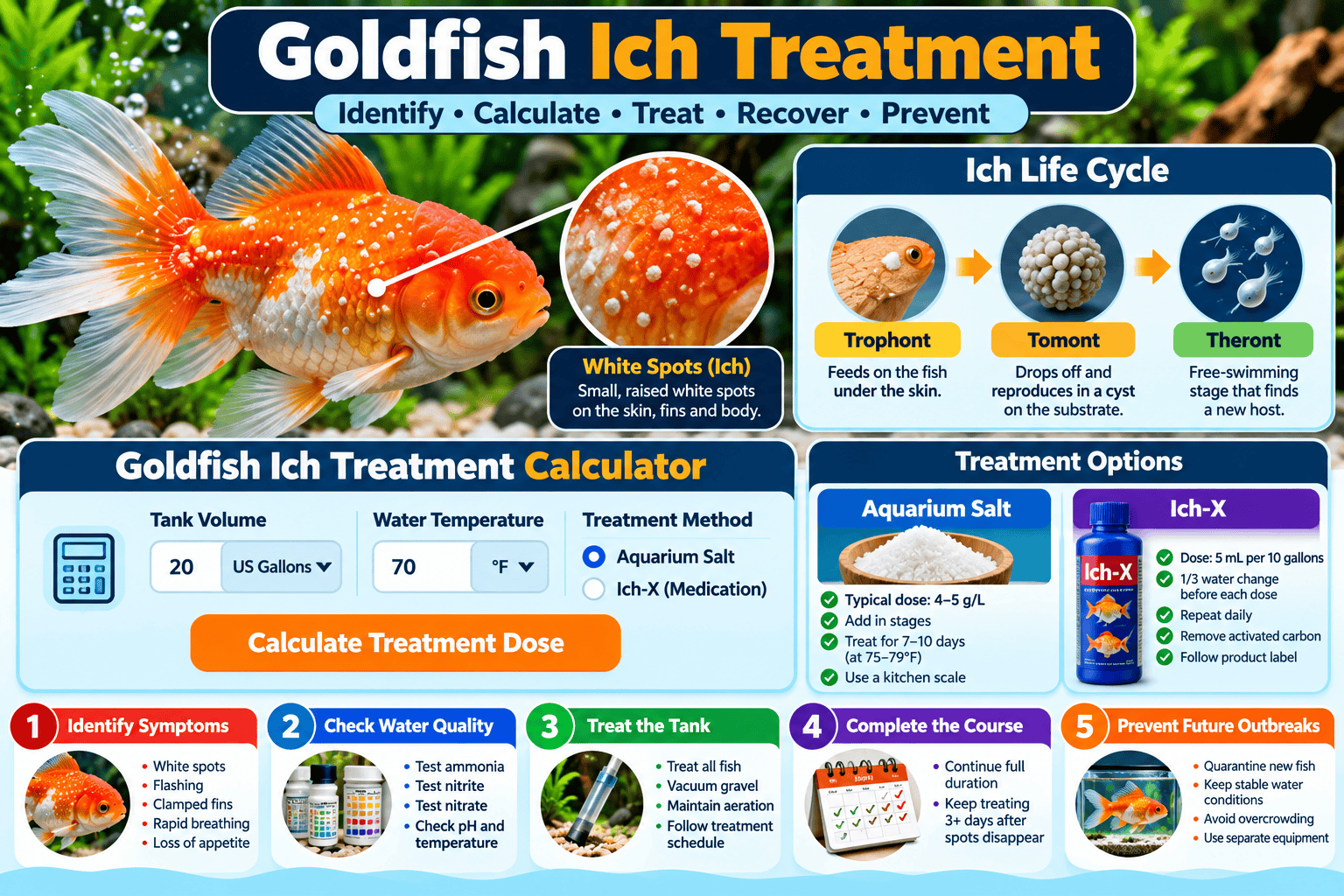
Goldfish Ich Treatment Calculator
Estimate treatment quantities using the actual water volume in your aquarium. This calculator is a planning aid, not a diagnosis or a replacement for the product label or aquatic-veterinary advice.
Safety: Do not combine salt with Ich-X or any other medication unless the product manufacturer or an aquatic veterinarian specifically confirms compatibility. Ich-X’s manufacturer instructs users not to use it with other medications. Plants and invertebrates may be harmed by elevated salt or medication. Maintain aeration and monitor fish closely.
What Is Ich in Goldfish?
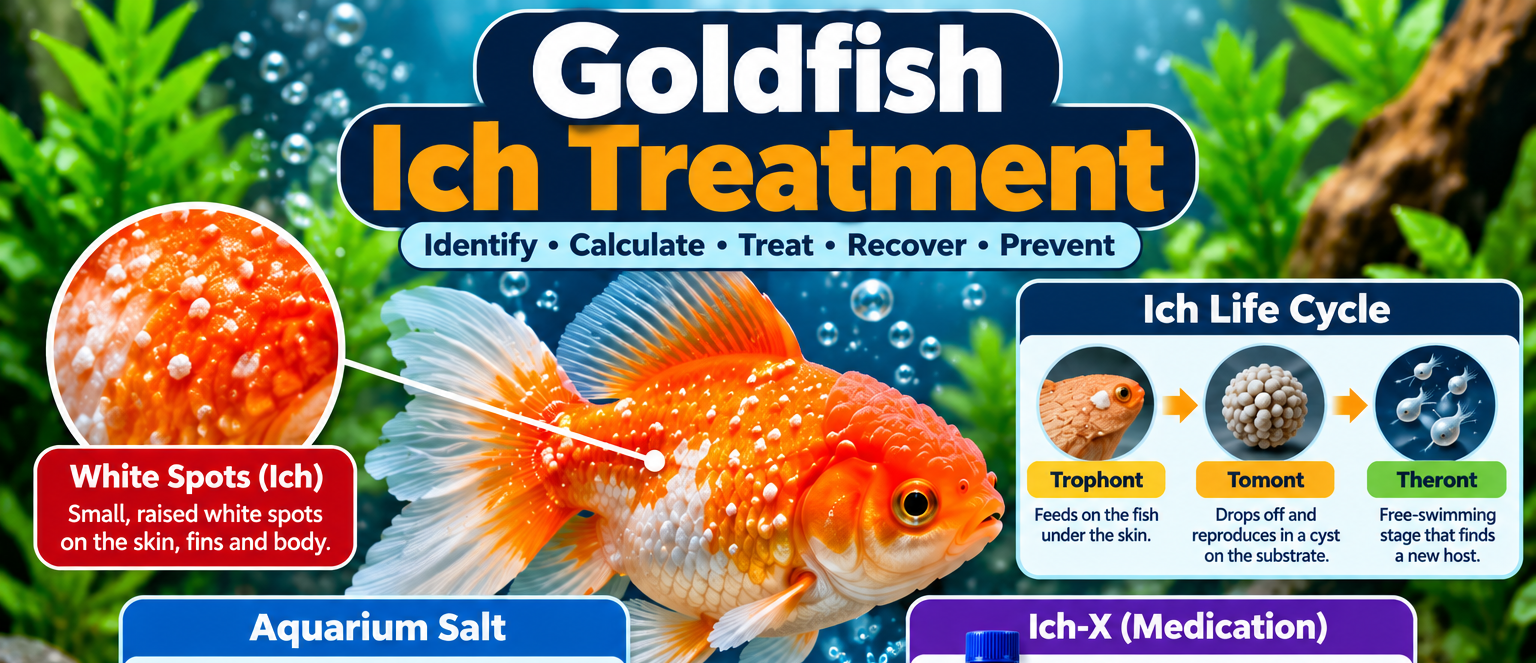
Ichthyophthiriasis is an infection caused by Ichthyophthirius multifiliis, a parasite that affects freshwater fish. Its most recognizable symptom is a scattering of small, raised white spots that resemble grains of salt on the skin and fins. Infected fish may also flash against objects, clamp their fins, become lethargic or lose interest in food. Gill infections can be serious even when obvious spots are absent.
Ich is contagious because the parasite reproduces in the aquarium environment and releases infective stages that seek fish hosts. Stress, crowding, poor water quality and recent fish introductions can contribute to outbreaks, but the presence of ich should not be attributed to one single cause. A microscope-based diagnosis is the most reliable way to distinguish it from look-alike conditions (Francis-Floyd, Yanong and Pouder, 2016; Matthews, 2005).
If the spots are accompanied by red lesions, ulcers or marked swelling, do not assume ich is the only problem. Compare symptoms with our goldfish red pest disease treatment guide and seek experienced fish-health advice where symptoms are severe.
Ich Goldfish vs Breeding Stars
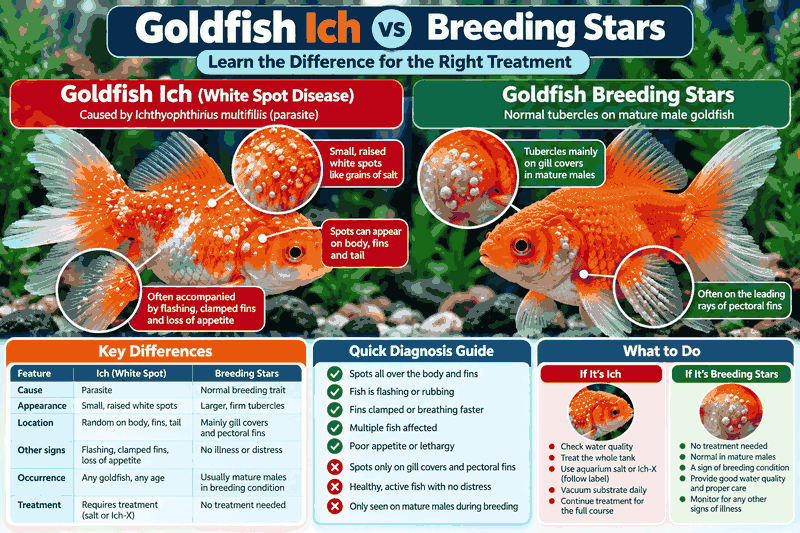
Breeding stars are small, pale tubercles that may appear on the gill covers and pectoral fins of mature male goldfish during breeding condition. Their location and relatively consistent appearance differ from the more widespread, randomly distributed spots often associated with ich. Breeding tubercles do not normally cause the repeated flashing, breathing distress or general illness that may accompany a significant parasite infection.
However, photographs alone cannot confirm every case. White patches, excess mucus, fungal growth and other parasites may be mistaken for ich. Observe the fish under good lighting, record water-test results and obtain expert confirmation if the diagnosis is uncertain.
Ich Life Cycle Stages
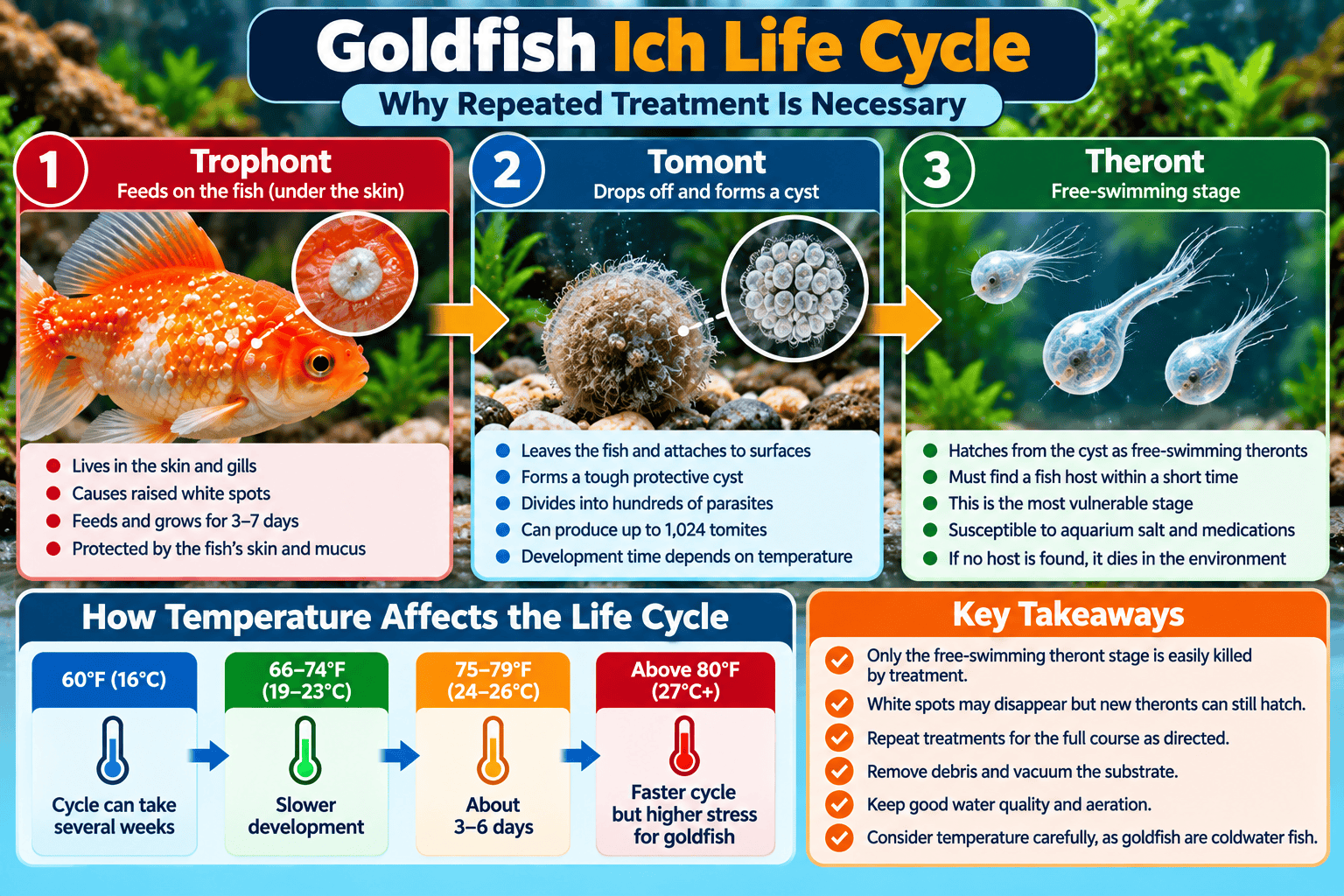
Understanding the ich life cycle helps explain why white spots may disappear before the infection is fully controlled. The parasite passes through three important stages:
- Trophont: The feeding parasite lives within the outer tissues of the fish. Its position beneath protective tissue and mucus makes it difficult for many treatments to reach.
- Tomont: The mature parasite leaves the fish, attaches to a surface or debris and forms a protective cyst. It divides to produce numerous daughter cells.
- Theront: The infective, free-swimming stage leaves the cyst and searches for a fish host. This exposed stage is particularly susceptible to appropriate chemical treatment.
Francis-Floyd, Yanong and Pouder (2016) explain that a tomont can divide repeatedly, producing as many as 1,024 daughter parasites. The timing depends heavily on temperature. A single treatment cannot reliably kill parasites still protected on fish or inside cysts. Repeated treatment and debris removal help target new theronts as they emerge.
How Temperature Changes Treatment Time
Goldfish ich temperature is a major factor in treatment planning. At approximately 75–79°F (24–26°C), the full parasite cycle may take around three to six days. In cooler water, development can take much longer. Research by Forwood et al. (2015) also demonstrates that development time changes substantially across a broad temperature range.
This does not mean that every goldfish aquarium should be heated to tropical temperatures. Goldfish are not tropical fish, and rapid temperature changes can create additional stress. If a modest increase is appropriate for the fish and treatment method, make changes gradually, monitor behaviour and maintain strong aeration. A gentle increase of around 1–2°F per day may be considered in some situations, but it is not a cure and should not override product instructions or veterinary guidance.
Do not aggressively heat a goldfish tank into the 80s°F simply to speed up ich. Some medication ingredients, including formalin-based treatments, require careful temperature and oxygen management. Never exceed the manufacturer’s temperature guidance.
For temperature-controlled equipment, compare the Fluval E Series Advanced Electronic Heater options. Confirm that any heater is suitable for your tank and can be set safely for goldfish. This is a product-search link, not a verified affiliate link.
How to Treat Ich in Goldfish Step by Step
When learning how to treat ich in goldfish without medication, remember that no single non-medication method is guaranteed to work in every aquarium. Salt may be appropriate in some systems, but it can damage sensitive plants and invertebrates. A suitable ich medication may be more practical in other cases. Severe disease warrants professional fish-health advice.
- Check the symptoms: Look for raised white spots, flashing, clamped fins, appetite loss and unusual breathing. Do not rely on spots alone.
- Test the water: Check ammonia, nitrite, nitrate, pH and temperature. Correct unsafe water quality without making abrupt changes.
- Estimate actual water volume: Deduct space occupied by substrate, rocks and decorations. Product doses should not be calculated from the aquarium’s advertised capacity alone.
- Choose one treatment: Select an appropriate salt protocol or a labelled ich medication. Do not combine salt and Ich-X unless a qualified professional and the product instructions explicitly permit it.
- Treat the affected system appropriately: Ich can spread between fish. A separate treatment tank may be recommended, but moving fish also creates handling stress and must not spread contaminated water or equipment.
- Remove debris: Gently vacuum the substrate and remove waste so cyst-containing debris is reduced. Avoid disturbing the fish unnecessarily.
- Maintain aeration and filtration: Keep oxygen available and preserve biological filtration unless the product label directs otherwise.
- Complete the treatment: Continue according to the selected product or protocol, even if the spots become less visible.
Fish that gasp at the surface, lose balance or deteriorate rapidly need urgent attention. Follow the manufacturer’s emergency instructions and seek an aquatic veterinarian or experienced fish-health professional.
Aquarium Salt Dosage for Ich
Aquarium salt means sodium chloride, not Epsom salt. UF/IFAS describes 4–5 grams per litre (4–5 g/L, or 4–5 parts per thousand) as a prolonged-bath option for 7–10 days at 75–79°F, provided the fish species can tolerate the salinity. This is a specific treatment context, not a universal instruction for every goldfish display aquarium (Francis-Floyd, Yanong and Pouder, 2016).
| Actual water volume | At 4 g/L | At 5 g/L |
|---|---|---|
| 10 US gallons (37.9 L) | About 152 g | About 189 g |
| 20 US gallons (75.7 L) | About 303 g | About 379 g |
| 30 US gallons (113.6 L) | About 454 g | About 568 g |
| 40 US gallons (151.4 L) | About 606 g | About 757 g |
These are mathematical conversions, not recommendations to add the listed amount automatically. Confirm the suitability of this concentration for your particular fish and aquarium. Use a kitchen scale rather than a spoon because crystal size and packing density vary. Dissolve measured salt in a separate container of aquarium water before adding it gradually.
Salt does not evaporate when water evaporates. During water changes, replace only the salt removed with the discarded water, using the same intended concentration. When ending a salt course, reduce salinity through appropriate water changes rather than making abrupt changes. Sensitive plants and some invertebrates may not tolerate elevated salt.
For supplies, see API Aquarium Salt options. Check the actual product composition and suitability before purchase. This is a search link, not a verified affiliate link.
Ich-X Dosage per Gallon
Hikari’s published aquarium directions specify 5 mL (one teaspoon) per 10 US gallons of actual aquarium water. The amount is therefore 0.5 mL per US gallon. For example, a system containing 20 gallons of actual water has a label-rate estimate of 10 mL per dose. This calculation does not replace the current bottle instructions.
The manufacturer directs users to perform at least a one-third water change before each dose, remove activated carbon, maintain filtration and repeat treatment according to the product directions. It also advises continuing uninterrupted treatment for three days after visible signs disappear. Follow the exact current label for timing and compatible water conditioners. Do not use Ich-X with other medications, and do not use sulfur- or sulfinate-based conditioners where the label warns against them (Hikari Sales USA, n.d.).
Ich-X contains formaldehyde and malachite green chloride. Use gloves, avoid skin and eye contact, keep the product away from children and follow all label precautions. It can stain aquarium silicone and some surfaces, and may harm certain invertebrates. Maintain good aeration and observe the fish closely.
Product information: Official Hikari Ich-X directions. To compare listings, use the Hikari Ich-X product search. This is not a verified affiliate link.
Water Changes During Ich Treatment
Water changes help remove suspended debris and maintain water quality, but the schedule depends on the treatment. For Ich-X, follow the manufacturer’s instruction to change at least one-third of the water before each dose. Treat replacement water with an appropriate conditioner and match its temperature to the aquarium.
With a salt protocol, water removed from the aquarium also removes salt. Calculate replacement salt from the volume of water changed, not the full tank volume, unless you are deliberately establishing a new concentration under an appropriate protocol. Avoid repeatedly adding the full original salt quantity after every partial water change, as this can create an unsafe concentration.
Use a dedicated siphon and equipment for the affected aquarium. Clean substrate carefully, dispose of waste safely and avoid splashing contaminated water into other tanks. Keep filtration running to preserve oxygen and biological activity unless the chosen product specifically requires a change.
Ich Treatment for Fancy Goldfish
Orandas, telescope goldfish and other fancy varieties can be especially vulnerable to handling stress because of their body shape, vision limitations or swimming ability. Avoid chasing fish around the tank, making sudden temperature changes or exposing them to strong currents they cannot manage.
For care-specific considerations, read our Oranda goldfish care guide and black telescope goldfish guide. Choose a treatment compatible with the fish and system, and seek specialist help if breathing is laboured or the fish cannot maintain normal balance.
Other species and aquarium setups have different requirements. Our guides to pigeon blood discus water parameters, plants for betta fish tanks and 15 live plants for bettas illustrate why treatment and environmental advice should not be copied blindly between aquarium types.
How Long Does Treatment Take?
How long does ich treatment take? There is no single duration that applies to every aquarium. Temperature, parasite development, the chosen treatment and the fish’s condition all influence the schedule. UF/IFAS describes daily chemical treatment with at least three to five treatments at 75–79°F, while at 60°F it describes treatments every three to five days with at least five treatments. These intervals are general guidance and must not override a product’s directions.
| Water temperature | Planning consideration |
|---|---|
| 75–79°F (24–26°C) | Life cycle may take about 3–6 days. Follow the selected treatment schedule and complete the required repeated treatments. |
| 66–74°F (19–23°C) | Development is generally slower. Do not assume that a short tropical-fish treatment schedule will be sufficient. |
| 60–65°F (16–18°C) | The cycle may be considerably longer. Treatment intervals must match the selected protocol. |
| Below 60°F (16°C) | Development may take weeks. Seek species-specific guidance before changing temperature or treatment timing. |
Continue for the duration specified by the selected treatment. The Ich-X manufacturer specifically advises uninterrupted treatment for three days after all visible signs cease. That instruction is product-specific; other methods may require different intervals. A disappearance of spots alone does not establish that the parasite has been eliminated.
Protecting the Biofilter After Treatment
The biofilter converts toxic ammonia into nitrite and then nitrate. Fish illness, reduced feeding, cleaning, medication and changes in filtration can all complicate water quality during recovery. Do not dismantle or replace all biological filter media unless there is a specific reason to do so.
Test ammonia and nitrite regularly during and after treatment. Both should remain at zero on a suitable aquarium test. If either becomes detectable, promptly assess the cause, carry out an appropriate conditioned water change and increase monitoring. Maintain aeration, remove uneaten food and avoid adding new fish while the aquarium is recovering.
Ich-X’s manufacturer advises users not to stop filtration because this can negatively affect the nitrogen cycle. For related product information, read our guide to Microbe-Lift Nite-Out II. A bacterial supplement does not replace water testing or correct treatment of the parasite.
Additional water-quality resources include our aquarium water test kit comparison and marine aquarium water test kit guide. The latter concerns marine systems, so use freshwater-compatible test instructions for a goldfish tank.
How to Prevent Ich in Goldfish
Prevention starts before a new fish enters the display aquarium. UF/IFAS recommends a minimum 30-day quarantine for incoming fish because infections may not become obvious immediately after transport. Use a separate tank, net, siphon and other equipment, and observe new arrivals for abnormal spots, flashing, appetite changes or breathing problems.
- Quarantine new fish for at least 30 days and extend observation if signs of illness appear.
- Keep water quality stable and avoid sudden temperature changes.
- Avoid overcrowding and provide suitable filtration and aeration.
- Do not share wet equipment between aquariums without suitable cleaning and disinfection.
- Inspect new plants and decorations, which can transfer contaminated material between systems.
- Remove dead fish and organic debris promptly and safely.
Good husbandry cannot guarantee that ich will never occur, but it reduces opportunities for introduction and helps fish cope with stress. Explore our guides to freshwater aquarium algae eaters, automatic aquarium feeders and automatic pond feeders for broader maintenance planning. Feeders can support routines during absences, but they do not replace daily observation during a disease outbreak.
Species-specific care also matters. Our articles on copper Oscar fish, blueberry Oscar fish, blue Oscar varieties, Oscar fish tank filtration, white tiger Oscars and bumblebee Oscar fish cover different needs and setups.
For further fishkeeping reading, explore our guides to halfmoon betta care, rose bubble anemone care, tiger parrot fish, parrot fish safety, saltwater parrot fish, parrot cichlid food, purple guppy varieties, queen angelfish care, responsible Oscar fish rehoming and koi and goldfish compatibility.
Our Oscar fish plush guide is a lighter, non-care-related read. You can also browse the AquariumsWorld blog archive and our October 2026 aquarium industry news page for additional content.
Frequently Asked Questions
How do you treat ich in goldfish?
Confirm the likely diagnosis, test water quality, calculate actual water volume and choose one suitable treatment. Aquarium salt may be appropriate under a defined protocol, while a labelled ich medication such as Ich-X may be another option. Follow the selected treatment’s instructions, maintain aeration and continue long enough to interrupt the parasite life cycle.
Can goldfish recover from ich on their own?
Do not rely on spontaneous recovery. Ich can multiply rapidly and cause serious losses. Fish that no longer show spots may still be associated with an ongoing infection. Begin appropriate treatment promptly and seek professional advice if symptoms are severe or the diagnosis is uncertain.
How long does it take for ich to go away in goldfish?
The duration depends on water temperature, the treatment method and the parasite’s life cycle. Cooler water generally prolongs development. Complete the full product or treatment protocol even when visible spots disappear, and continue monitoring fish and water quality.
Does aquarium salt cure ich in goldfish?
Salt can be effective under appropriate conditions and at a suitable concentration, but it is not safe for every plant, invertebrate or aquarium system. UF/IFAS describes a 4–5 g/L prolonged-bath option under specified temperature and duration conditions. Confirm that the method is appropriate before applying it.
Should I raise the temperature for goldfish with ich?
Do not automatically raise a goldfish aquarium to tropical-fish temperatures. Any change should be gradual, appropriate for the fish and compatible with the treatment label. Temperature alone does not eliminate ich, and good aeration is important during treatment.
Is Ich-X safe for goldfish?
Ich-X is marketed for treating ich in freshwater fish, and its manufacturer publishes a specific dose and precautions. Safety depends on correct dosing, actual water volume, compatible water conditioning, aeration and following the label. Do not combine it with other medications, and observe the fish closely for distress.
Conclusion
Successful goldfish ich treatment requires more than reacting to white spots. Identify the likely disease, check water quality, calculate the actual aquarium volume and select a suitable treatment protocol. Aquarium salt and Ich-X have different instructions, limitations and water-change requirements, so they should not be treated as interchangeable methods.
Most importantly, account for goldfish temperatures. Cooler water slows the ich life cycle, which can extend treatment. Maintain aeration and biological filtration, remove debris, monitor ammonia and nitrite, and complete the chosen protocol after the visible spots disappear. When symptoms are severe or the diagnosis is uncertain, consult an aquatic veterinarian or qualified fish-health professional.
For more practical aquarium and pond fishkeeping guides, visit AquariumsWorld or browse our complete blog archive.
References
- Bu, X. et al. (2025) ‘Effect of ectoparasite Ichthyophthirius multifiliis on the histopathology and gill and gut microbiota of goldfish (Carassius auratus)’, Frontiers in Veterinary Science, 12, 1539446. doi: 10.3389/fvets.2025.1539446.
- Dickerson, H.W. and Findly, R.C. (2014) ‘Immunity to Ichthyophthirius infections in fish: a synopsis’, Developmental and Comparative Immunology, 43(2), pp. 290–299. doi: 10.1016/j.dci.2013.06.004.
- Forwood, J.M., Harris, J.O., Landos, M. and Deveney, M.R. (2015) ‘Life cycle and settlement of an Australian isolate of Ichthyophthirius multifiliis Fouquet, 1876 from rainbow trout’, Folia Parasitologica, 62, 013. doi: 10.14411/fp.2015.013.
- Francis-Floyd, R., Yanong, R. and Pouder, D. (2016) ‘Ichthyophthirius multifiliis (White Spot) Infections in Fish’, UF/IFAS Extension, FA006. Available at: https://ask.ifas.ufl.edu/publication/FA006.
- Hikari Sales USA (n.d.) ‘Ich-X: Directions and precautions’. Available at: https://hikariusa.com/water_quality_folder/ich_x.html.
- Huang, K. et al. (2022) ‘In vitro assessment of berberine against Ichthyophthirius multifiliis in goldfish’, Pathogens, 11(10), 1207. doi: 10.3390/pathogens11101207.
- Jørgensen, L.v.G. (2017) ‘The fish parasite Ichthyophthirius multifiliis: host immunology, vaccines and novel treatments’, Fish and Shellfish Immunology, 67, pp. 586–595. doi: 10.1016/j.fsi.2017.06.044.
- Matthews, R.A. (2005) ‘Ichthyophthirius multifiliis Fouquet and ichthyophthiriosis in freshwater teleosts’, Advances in Parasitology, 59, pp. 159–241. doi: 10.1016/S0065-308X(05)59003-1.
- Picón-Camacho, S.M., Marcos-Lopez, M., Bron, J.E. and Shinn, A.P. (2012) ‘An assessment of the use of drug and non-drug interventions in the treatment of Ichthyophthirius multifiliis Fouquet, 1876, a protozoan parasite of freshwater fish’, Parasitology, 139(2), pp. 149–190. doi: 10.1017/S0031182011001867.