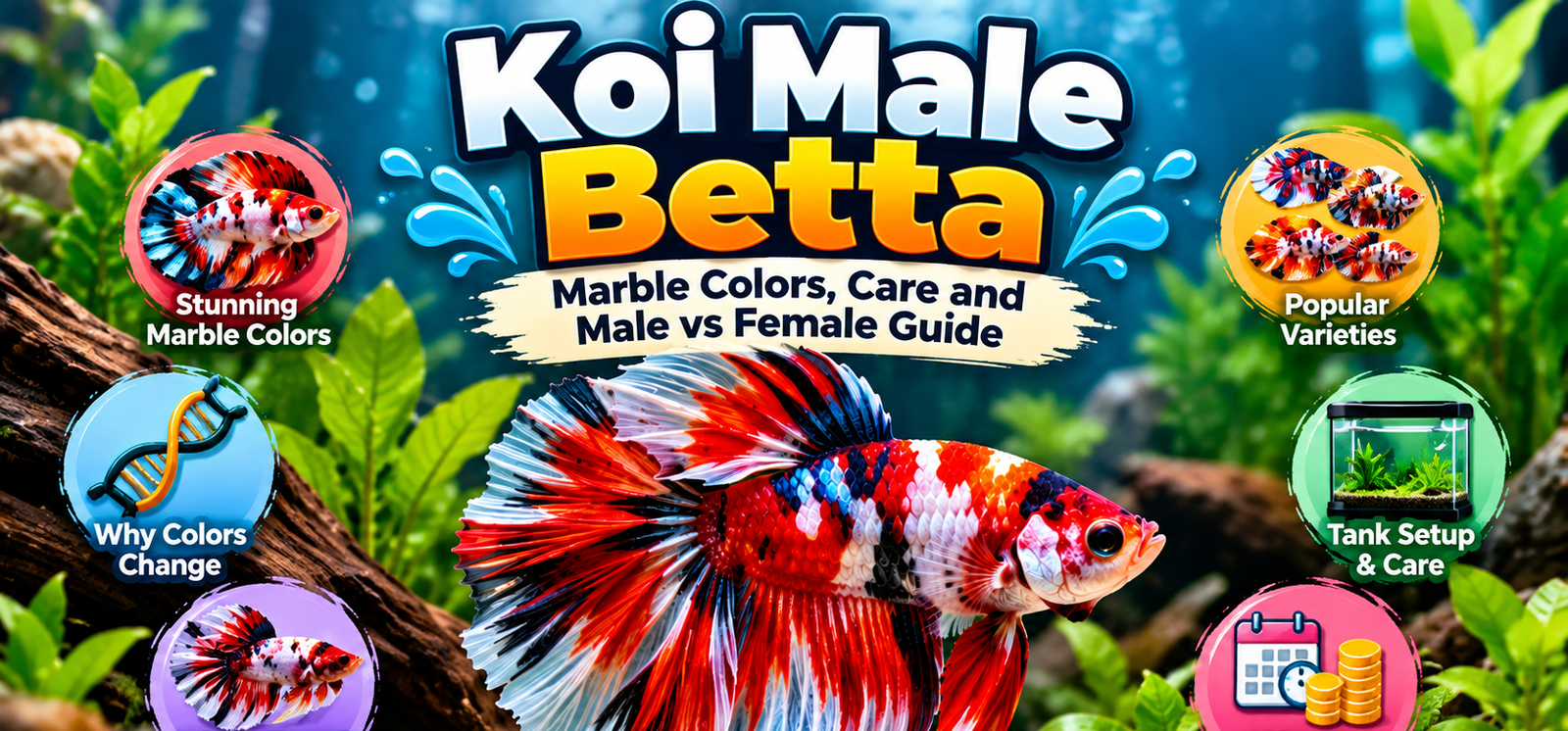
Koi Male Betta: Marble Colors, Care and Male vs Female Guide
A koi male betta is a selectively bred Siamese fighting fish known for patches of red, orange, white and black that resemble a koi carp. Its striking appearance comes from the colour patterns of Betta splendens, not from a cross between a betta and a koi carp. Many koi bettas also carry a marble-associated genetic trait that can make their colour patterns change over time.
Choosing a koi betta involves more than finding the brightest fish in a shop. You need to understand the difference between males and females, how galaxy and Nemo patterns compare, and why a koi plakat swims differently from a koi halfmoon. Appropriate housing is equally important. A heated, filtered aquarium with stable water conditions helps protect the fish’s health while allowing its colour to stand out.
This guide explains koi betta colours, the marble gene, sex identification, lifespan, price and practical care. It also includes a betta tank heater wattage calculator to help you estimate a suitable heater for your aquarium.
Betta Tank Heater Wattage Calculator
Enter your aquarium size and room temperature to estimate a starting heater size for a koi betta. This is a planning estimate, not a substitute for a heater manufacturer’s sizing chart or a separate aquarium thermometer.
Calculate a Starting Heater Size
Recommended starting heater size
Choose an adjustable heater and check the actual water temperature with a separate thermometer.
Important: Heater sizing varies with room conditions, tank shape, lid, insulation and heater design. The calculator uses a simplified estimate. It cannot guarantee a particular temperature or replace product-specific advice.
What Is a Koi Male Betta?
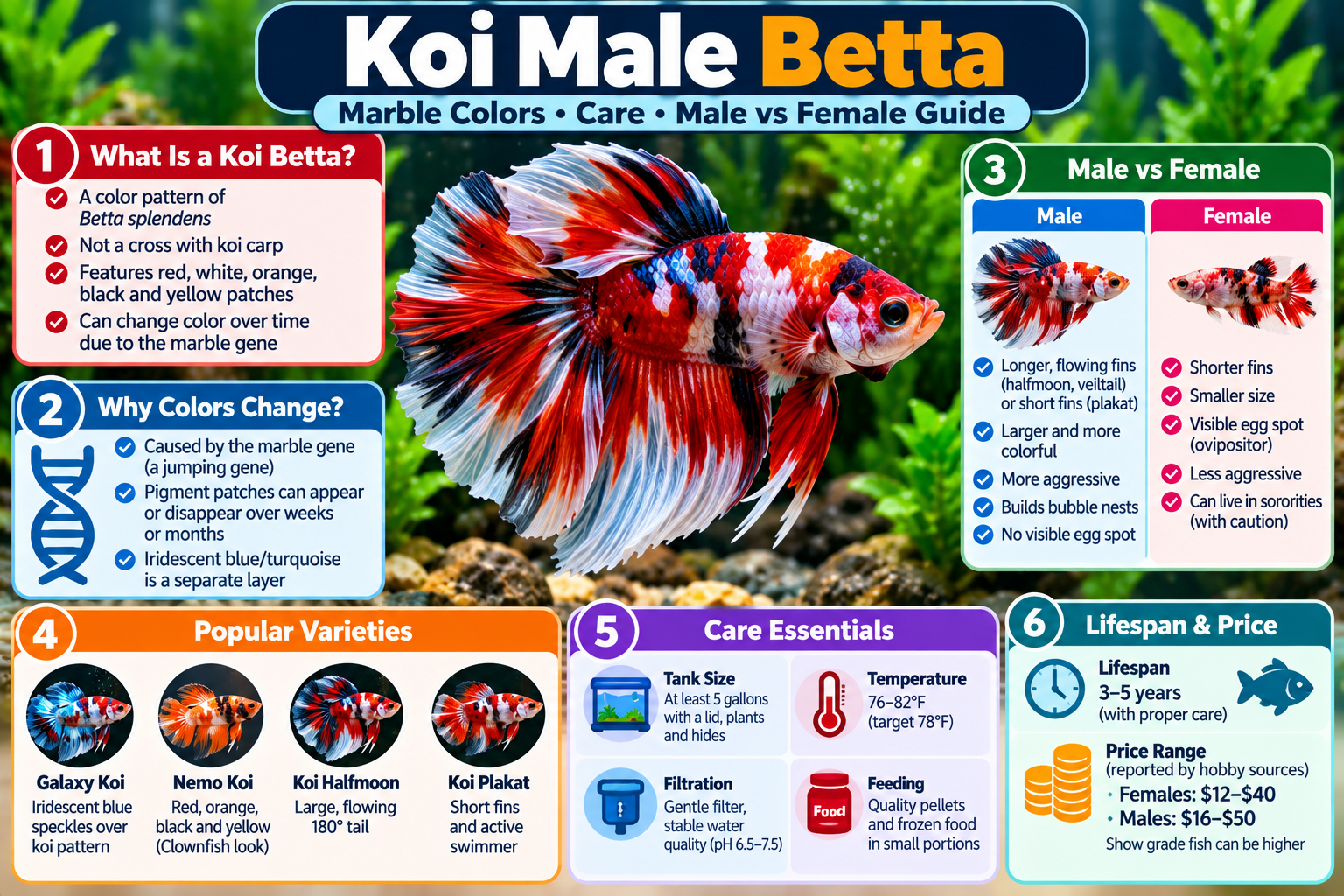
A koi betta is a colour pattern of the domesticated Siamese fighting fish, Betta splendens. The name describes its mottled patches rather than a separate species. Red, orange, white, black and sometimes yellow pigments create a pattern reminiscent of ornamental koi carp. The fish remains a betta in anatomy, behaviour and care requirements.
The male koi betta is especially popular because many males develop vivid colour, an expressive swimming style and distinctive fin shapes. However, the word “male” does not define the pattern. Koi-coloured females also exist, and colour alone is not a reliable method of sex identification.
Selective breeding has produced a wide range of betta body shapes, fin forms and colour combinations. Research into the domestication of Betta splendens shows how selective breeding has influenced traits that are important to the aquarium trade (Monvises et al., 2009; Kwon et al., 2022). The koi pattern is one example of how breeders select and reproduce desirable colour traits.
If you want to compare a koi pattern with a different ornamental fin type, read our Halfmoon Betta care guide. Remember that the tail shape and colour pattern are separate characteristics: a fish can be a koi halfmoon, koi plakat or another combination.
The Marble Gene: Why Koi Bettas Change Colour
One of the most fascinating features of koi bettas is that their pattern may change after purchase. A fish that begins with large white patches can develop more black or orange pigmentation over the following weeks or months. Another fish may lose some dark markings and develop a brighter appearance. These changes are often associated with the marble phenotype.
A transposon is a DNA sequence that can move or change position within a genome. In some colour-pattern systems, mobile genetic elements can influence whether pigment-related genes function normally. This is why the marble trait is commonly described in aquarium discussions as a “jumping gene.” The simplified phrase is useful, but colour inheritance is more complex than one switch controlling every patch.
Genomic studies of bettas have advanced understanding of the genetic diversity and traits shaped by domestication and selective breeding (Kwon et al., 2022; Wang et al., 2021). Nevertheless, a particular fish’s future pattern cannot be predicted precisely from a photograph or its shop label. Genetics, developmental processes and the fish’s individual biology all matter.
Colour change does not automatically mean illness. If the fish continues to eat, swims normally and has intact fins, gradual pattern changes may simply reflect its pigmentation. Sudden loss of colour accompanied by lethargy, clamped fins, abnormal breathing or appetite changes deserves closer attention to water quality and health.
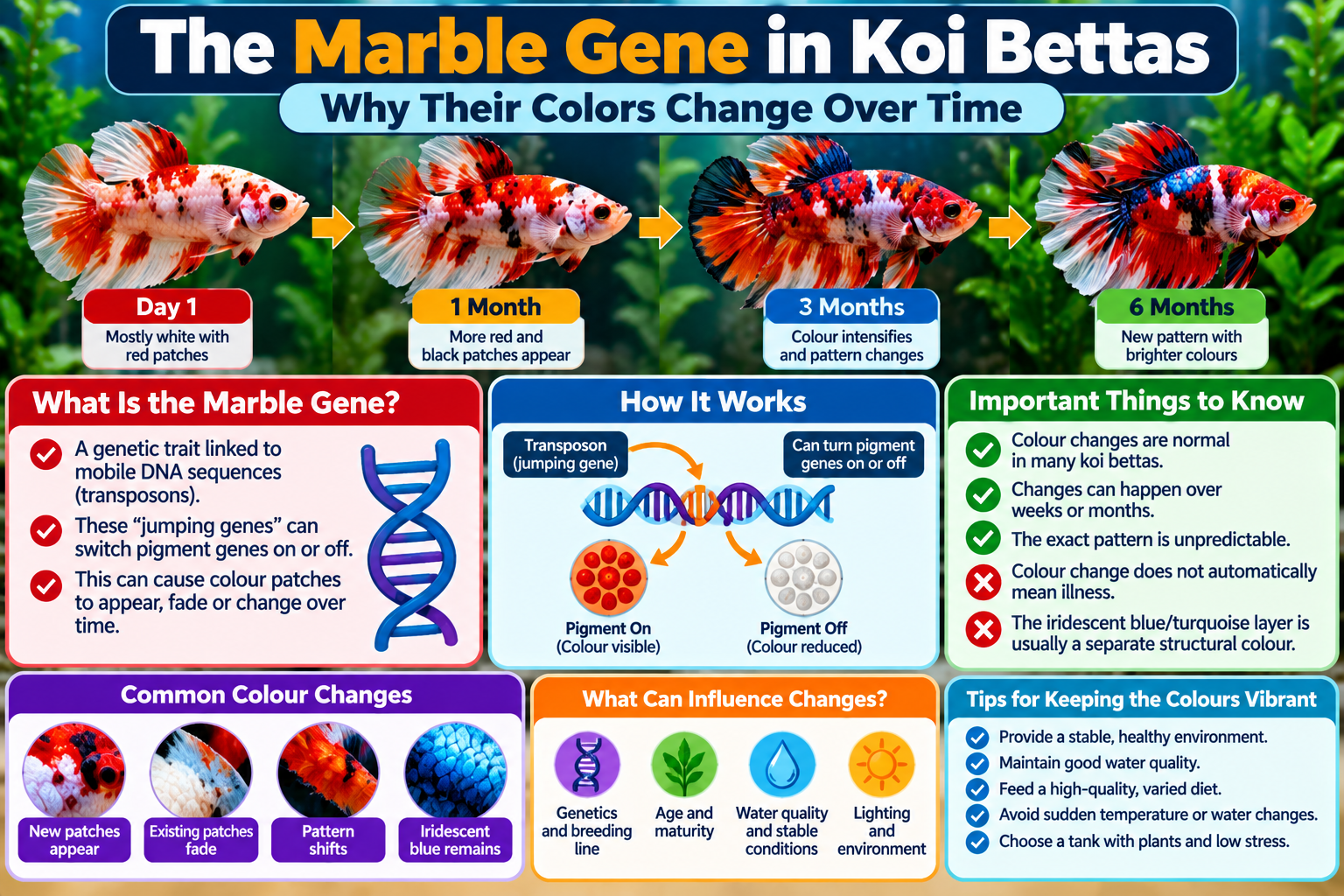
The iridescent blue or turquoise appearance in some fish is associated with structural colour in the scales rather than simply the same pigment responsible for red or black patches. This helps explain why two koi bettas can have similar base colours but very different visual effects.
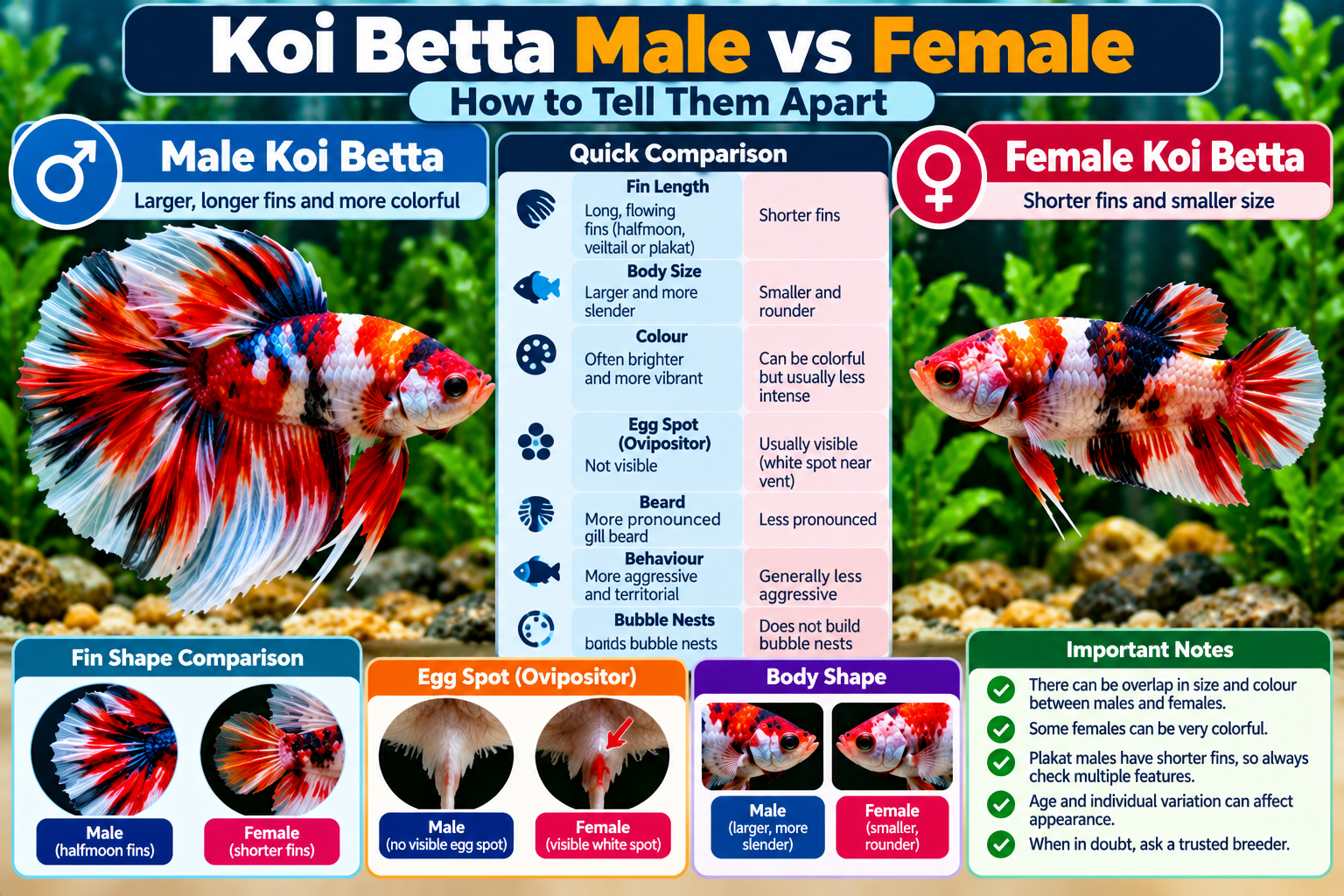
Koi Betta Male vs Female: How to Tell Them Apart
Identifying a koi betta’s sex can be difficult because breeders have produced many body and fin shapes. Some females have colourful bodies and relatively long fins, while male plakats have short fins that can resemble those of females. Use several characteristics together rather than relying on a single feature.
- Fin shape: Many males have longer or more elaborate fins, particularly in halfmoon and veiltail forms. Male plakats have shorter fins.
- Body shape: Males may appear larger or more streamlined, but individual variation makes body size an imperfect clue.
- Egg spot: Mature females may show a small ovipositor near the ventral area. Its visibility and appearance vary.
- Beard: The membrane beneath the gill covers may be more conspicuous in males, although it is not a definitive standalone test.
- Behaviour: Males often display or flare at perceived rivals, but females can also show aggression.
- Bubble nests: Males commonly build bubble nests, but nest building alone cannot confirm sex.
A koi betta female may have the same red, orange, white, black or galaxy-like pattern as a male. Ask the breeder for the fish’s age and sexing history, and inspect multiple physical features before choosing a fish for a breeding project.
Popular Koi Betta Varieties
Trade names help describe the appearance of koi bettas, but they are not always standardised across breeders. A fish may be advertised as galaxy, Nemo, candy or koi plakat depending on its colour combination and body form. Check photographs and the breeder’s description rather than assuming every seller uses each label identically.
Galaxy Koi Betta Male
A galaxy koi betta typically has iridescent blue or turquoise speckles over a koi-like base of red, orange, white or black. The reflective points can resemble stars against a darker background. The intensity and distribution of these speckles vary between individual fish, and the appearance can shift as the fish matures.
When selecting a galaxy koi betta male, assess the whole fish. Look for clear eyes, intact fins, steady swimming, normal breathing and an active response to food. A highly reflective pattern is attractive, but it should not take priority over signs of good health.
Nemo Galaxy Koi Betta
Nemo koi bettas are commonly described by their strong orange, red, yellow and black colour combinations, which can evoke the appearance of a clownfish. Some fish also have white markings or iridescent speckles and may be marketed as Nemo galaxy koi. The naming conventions vary among breeders, so use the actual colour pattern as your guide.
These fish need the same core husbandry as other Betta splendens. A special colour label does not mean the fish requires a different temperature, tank size or diet.
Koi Halfmoon Betta vs Koi Plakat
The main difference is fin form. A koi halfmoon betta is selected for a broad caudal fin that can spread into a near 180-degree fan when flared. A koi plakat betta has shorter, more compact fins. Both can display the same marbled colour combinations.
Shorter fins may allow a plakat to swim with less drag, while the broad fins of a halfmoon can be more vulnerable to tearing or damage. Neither type should be kept in a strong current. Choose a gentle filter, smooth decorations and adequate open swimming space.
For further guidance on fin structure and general betta husbandry, explore our Halfmoon Bettas complete care guide.
Avatar Betta Fish, White Betta Fish and Other Related Colours
People searching for an avatar betta fish are usually looking for a dramatic dark body with metallic blue or turquoise highlights. This look differs from the classic koi pattern, although breeders may produce fish with overlapping colour characteristics. The label “avatar” is a trade description rather than a separate species.
A white betta fish, sometimes searched for as a “white beta fish,” may be predominantly white or cream, with little visible red or black pigment. A red blue betta fish has contrasting warm and cool tones, while a purple betta fish female may show violet-looking iridescence or a blend of blue and red tones. Lighting, viewing angle and individual genetics influence how these colours appear.
Marble-pattern lines may change in appearance as pigmentation develops, but a breeder cannot guarantee that a fish will turn a particular shade. Buy based on the fish’s present appearance and health rather than promises that it will become a specific rare colour.
Koi Betta Fish Care
Good koi betta fish care begins with a stable aquarium, warm water, gentle filtration and a suitable diet. Although the colour pattern attracts attention, the fish’s welfare depends on the same basic conditions required by other domesticated bettas. Plan the aquarium before buying the fish, and allow time for the filter to establish its biological function.
Tank Size and Setup
A practical starting point for a koi male betta is an aquarium of at least 5 US gallons, with a larger, well-furnished tank offering more room for swimming and stable water conditions. Tiny bowls and one-gallon containers are difficult to keep stable and restrict opportunities for exploration. Research on betta housing indicates that space and environmental enrichment influence behaviour and welfare (Oldfield and Murphy, 2024).
Use a secure lid because bettas can jump. Provide smooth decorations, shaded areas and broad-leaved resting places without crowding the swimming area. Live plants can enrich the environment, provided their lighting and maintenance needs suit the setup.
See our guides to the best plants for betta fish tanks and 15 live plants for bettas for planting ideas. Our science-backed guide to one-gallon betta tanks explains why a very small tank is a poor long-term choice.
Water Temperature and Heater
Bettas are tropical fish. A commonly used target is around 78°F, within a general range of approximately 76–82°F. Stability matters: abrupt changes can stress fish, and an unheated room may become much cooler at night than it feels during the day.
Choose an adjustable aquarium heater rated for the tank volume and expected room-to-water temperature difference. Use a separate thermometer to check the actual water temperature instead of relying only on the heater dial. The calculator above provides an initial estimate, but the manufacturer’s instructions should determine the final selection and installation.
Keep the heater away from areas where the fish could become trapped against it, follow its minimum-water-level requirements and disconnect electrical equipment before performing maintenance that requires removing it from water. Do not use a heater that is cracked or has a damaged cable.
Water Quality and Filtration
A koi betta needs clean, conditioned water and a filter that moves water gently. A pH around 6.5–7.5 is a practical reference range for many betta setups, but consistency and the absence of toxic ammonia and nitrite are particularly important. Avoid making sudden chemical adjustments merely to chase one exact pH value.
Cycle the aquarium before introducing the fish whenever possible. Test ammonia and nitrite during cycling and after major maintenance or changes in stocking. Perform regular partial water changes based on test results, feeding, tank size and filter performance. Many established tanks use a weekly routine, but the required amount can vary.
Our aquarium water test kit comparison can help you choose testing equipment. For background on biological filtration, see our MICROBE-LIFT Nite-Out II overview. Bottled bacteria products do not replace testing or a properly managed aquarium cycle.
Feeding a Koi Male Betta
Bettas are carnivorous fish, so choose a complete, high-quality betta pellet as the staple diet. Supplement it with suitable frozen or live foods, such as appropriately sized brine shrimp or bloodworms, where these foods are safe and available. Offer small portions that the fish can consume without leaving excess food to decay.
Overfeeding can contribute to digestive problems and deteriorating water quality. Adjust portions to the fish’s body condition, age and activity rather than following a universal number of pellets for every product. Remove uneaten food and keep a consistent feeding schedule.
An automatic feeder can help maintain a routine during short periods away, but it should be tested in advance. Read our guide to an automatic aquarium fish feeder and the related automatic feeder guide. Neither a feeder nor a colour-enhancing food can guarantee a particular koi pattern.
Tank Mates and Temperament
Male bettas are known for territorial behaviour, especially toward other male bettas. A koi male betta should normally be housed alone rather than placed with another male. Do not assume that a large tank or abundant plants will prevent fighting.
Some peaceful invertebrates or carefully selected fish may coexist with a betta in a suitably sized, established aquarium, but compatibility is never guaranteed. Avoid fin-nippers, aggressive fish and species that need very different water conditions. A betta may also attack tank mates that resemble rivals or compete for feeding space.
Female bettas can also be territorial. A group of females is not automatically a peaceful community and requires specialist planning, space, monitoring and a way to separate individuals if aggression develops. For a first-time keeper, a dedicated betta aquarium is usually the simpler option.
Koi Betta Lifespan and Price
Many pet bettas live around three to five years with suitable care, although lifespan varies with genetics, early-life conditions, disease and husbandry. A fish that looks colourful at the shop may already be mature, so ask the seller about its approximate age where possible.
Prices vary with the breeder, pattern, fin type, age, rarity and location. Aquarium hobby sources report broad ranges of roughly $12–$40 for females and $16–$50 for males, with show-grade or unusually selected fish sometimes priced much higher. These figures are examples reported by hobby sources, not guaranteed current US retail prices.
When comparing listings, check whether the seller provides current photographs of the actual fish, a clear sex description, shipping conditions and a health or arrival policy. Do not pay a premium solely because a seller calls a colour “rare.” A healthy fish and a responsible source are more important than a label.
Frequently Asked Questions
Are koi bettas male or female?
Koi is a colour pattern, not a sex. Both male and female bettas can display koi markings. Use fin shape, the ovipositor, body features and other clues together, since short-finned males can be difficult to distinguish from females.
Do koi bettas change color?
Yes. Many koi bettas have marble-associated colour patterns that can change as they mature. Patches may appear, fade or shift over weeks or months. The exact result is unpredictable, and sudden colour loss with illness signs should prompt a health and water-quality check.
How long do koi bettas live?
A common lifespan estimate for a pet betta is around three to five years, although individual fish may live for less or more time. Stable warm water, good filtration, appropriate food and early attention to health problems support better long-term care.
How much is a koi betta fish?
Price depends on pattern, fin type, breeder, age and location. Hobby sources report many fish in the approximate $12–$50 range, while show-grade examples may cost more. Check current US listings rather than treating these broad figures as fixed prices.
Can a male koi betta live with a female?
Permanent cohabitation is not recommended. A male may injure or kill a female outside carefully managed breeding, and breeding itself carries risks. Keep them separately unless you have the experience and facilities to manage a controlled breeding attempt.
What is the rarest betta color?
There is no universally agreed single rarest colour. Some unusual purple, metallic, patterned or selectively bred lines may be uncommon, but rarity depends on the breeder and market. Trade labels do not guarantee genetic stability or future colour development.
Final Thoughts
A koi male betta combines a distinctive marbled colour pattern with the behaviour and care requirements of Betta splendens. Its colours may change, but responsible care remains consistent: choose a suitably sized aquarium, maintain stable warm water, use gentle filtration and feed a balanced diet. Compare male and female characteristics carefully, and treat breeder colour names as descriptions rather than guarantees.
Before buying your fish, use the heater calculator above and read our complete Halfmoon Betta care guide for additional setup and husbandry advice.
More Aquarium Guides from AquariumsWorld
The following pages cover other aquarium species, equipment, water quality and fish care topics. They are included as a broader site directory; not every page is directly related to koi betta care.
- Pigeon Blood Discus: Water Parameters and Breeding
- Rose Bubble Anemone: Lighting, Feeding and Clownfish Hosting
- Copper Oscar Fish: Colours, Tank Size and Diet
- Blueberry Oscar Fish: Colours and Size
- Blue Oscar Fish Varieties, Care and Genetics
- Oscar Fish Tank Size and Filtration
- White Tiger Oscar Fish: Colour, Diet and Lighting
- Bumblebee Oscar Fish Guide
- Marine Aquarium Water Test Kits
- Responsible Oscar Fish Rehoming
- Oscar Fish Plush and Gifts
- Parrot Fish: Food Safety and Ciguatera
- Tiger Parrot Fish Varieties and Tank Size
- Best Freshwater Algae Eaters
- Aquarium Industry News: October 2026
- Saltwater Parrot Fish Species and Care
- Parrot Fish Food Guide
- Goldfish Ich Treatment: Salt, Ich-X and a Water Plan
- Purple Guppy Fish: Varieties, Care and Breeding
- Queen Angelfish: Price, Care and Tank Size
Scientific References
- Fan, G. et al. (2018) ‘Chromosome-level reference genome of the Siamese fighting fish Betta splendens, a model species for the study of aggression’, GigaScience, 7(11), giy087. https://doi.org/10.1093/gigascience/giy087.
- França, I.F., Heluy, G.M., Schultz, E.B., Vianna, W.O., Pereira, M.M. and Ramos, L.R.V. (2021) ‘Sex reversal in Siamese fighting fish larvae by thermal management’, Boletim do Instituto de Pesca, 47, e676. https://doi.org/10.20950/1678-2305/bip.2021.47.e676.
- Kwon, Y.M. et al. (2022) ‘Genomic consequences of domestication of the Siamese fighting fish’, Science Advances, 8(10), eabm4950. https://doi.org/10.1126/sciadv.abm4950.
- Lichak, M.R., Barber, J.R., Kwon, Y.M., Francis, K.X. and Bendesky, A. (2022) ‘Care and use of Siamese fighting fish (Betta splendens) for research’, Comparative Medicine, 72(3), pp. 169–180. https://doi.org/10.30802/AALAS-CM-22-000051.
- Monvises, A., Nuangsaeng, B., Sriwattanarothai, N. and Panijpan, B. (2009) ‘The Siamese fighting fish: well-known generally but little-known scientifically’, ScienceAsia, 35(1), pp. 8–16. https://doi.org/10.2306/scienceasia1513-1874.2009.35.008.
- Oldfield, R.G. and Murphy, E.K. (2024) ‘Life in a fishbowl: space and environmental enrichment affect behaviour of Betta splendens’, Animal Welfare, 33, e1. https://doi.org/10.1017/awf.2024.1.
- Palmiotti, A., Lichak, M.R., Shih, P.Y., Kwon, Y.M. and Bendesky, A. (2023) ‘Genetic manipulation of betta fish’, Frontiers in Genome Editing, 5, 1167093. https://doi.org/10.3389/fgeed.2023.1167093.
- Wang, L. et al. (2021) ‘Genomic basis of striking fin shapes and colors in the fighting fish’, Molecular Biology and Evolution, 38(8), pp. 3383–3396. https://doi.org/10.1093/molbev/msab110.