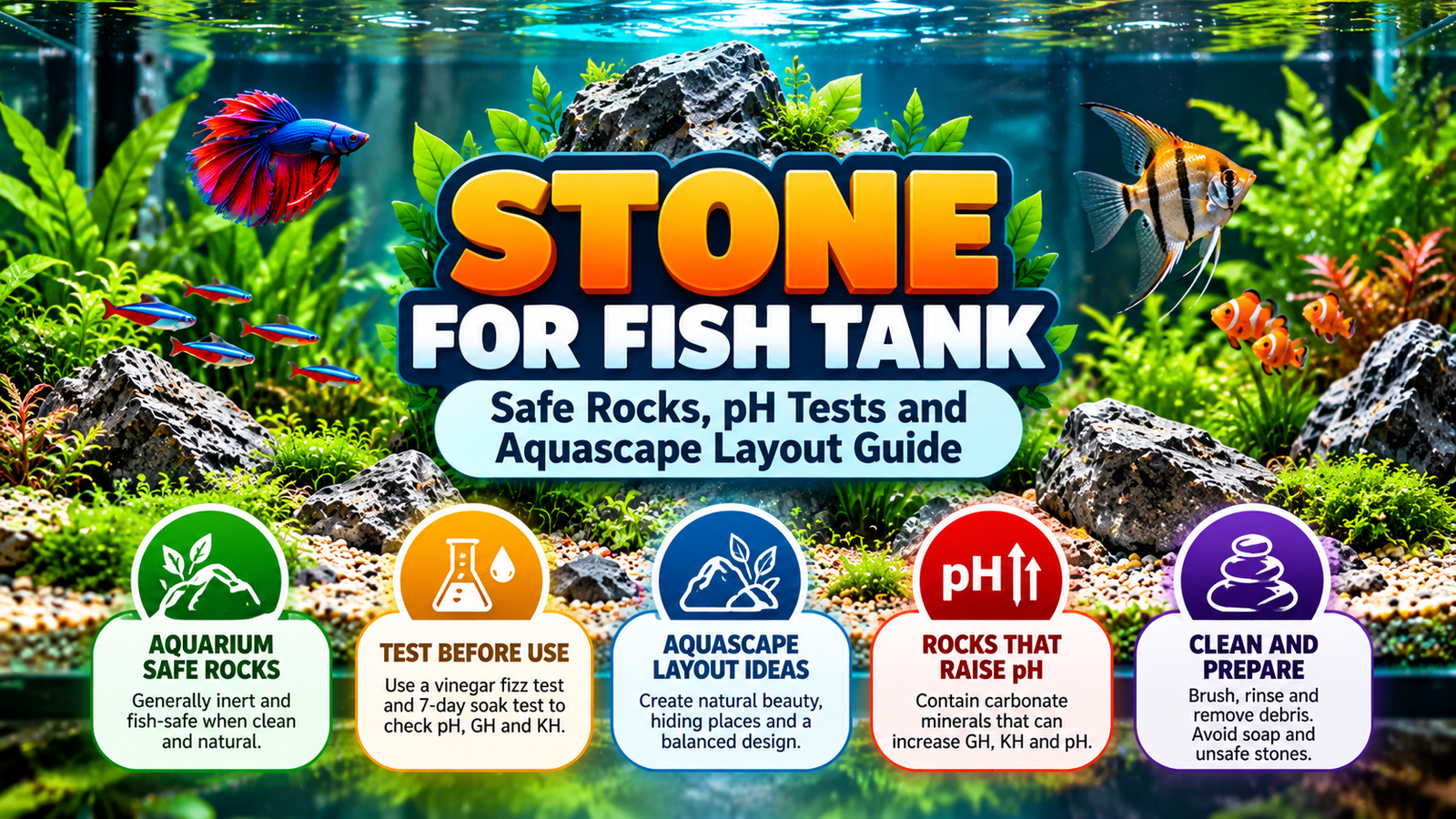
Stone for Fish Tank | Safe Rocks, pH Tests and Aquascape Layout Guide
Choosing the right stone for fish tank setups involves more than finding attractive aquarium rocks. Natural stone can provide shelter, create territories, support beneficial biofilm and transform a plain aquarium into a convincing underwater landscape. However, some rocks also change water chemistry by releasing carbonate minerals, increasing hardness and raising pH.
This guide explains which aquarium safe rocks suit freshwater tanks, how to identify rocks that raise pH in an aquarium, and how to test unfamiliar stones before adding fish. You will also learn how to estimate the quantity of rock required, prepare outdoor stones safely, and arrange aquarium hardscape into a balanced aquascape.
Aquarium Rock Weight Calculator
Estimate how much rock your aquascape may need. The result is an approximate purchasing range, not a precise measurement of irregular stones.
Your estimated rock requirement
Estimated weight range:
Suggested bags:
Use the estimate as a shopping guide. Rock density, voids, shape and the size of the main stone can change the final amount. Build a stable arrangement and avoid loading the aquarium glass with concentrated pressure.
What a Stone for Fish Tank Actually Does
A stone for fish tank design can serve practical and visual purposes. Caves and gaps give some fish places to retreat, while larger structures can break lines of sight and help establish territories. Research on environmental enrichment suggests that physical structures and substrate complexity can influence fish behaviour, although the ideal layout depends on species and individual needs (Näslund and Johnsson, 2016).
Rock surfaces also support biofilms: communities of microorganisms attached to submerged surfaces. These communities contribute to aquarium ecology, although rock should not be treated as a substitute for adequate biological filtration (Battin et al., 2016; Flemming and Wingender, 2010).
Before planning a hardscape, consider your substrate and planting choices. Our guide to AquariumsWorld aquarium guides provides a starting point, while the guide to plants for betta fish tanks explains how live plants can complement a freshwater layout.
Aquarium Safe Rocks for Freshwater Tanks
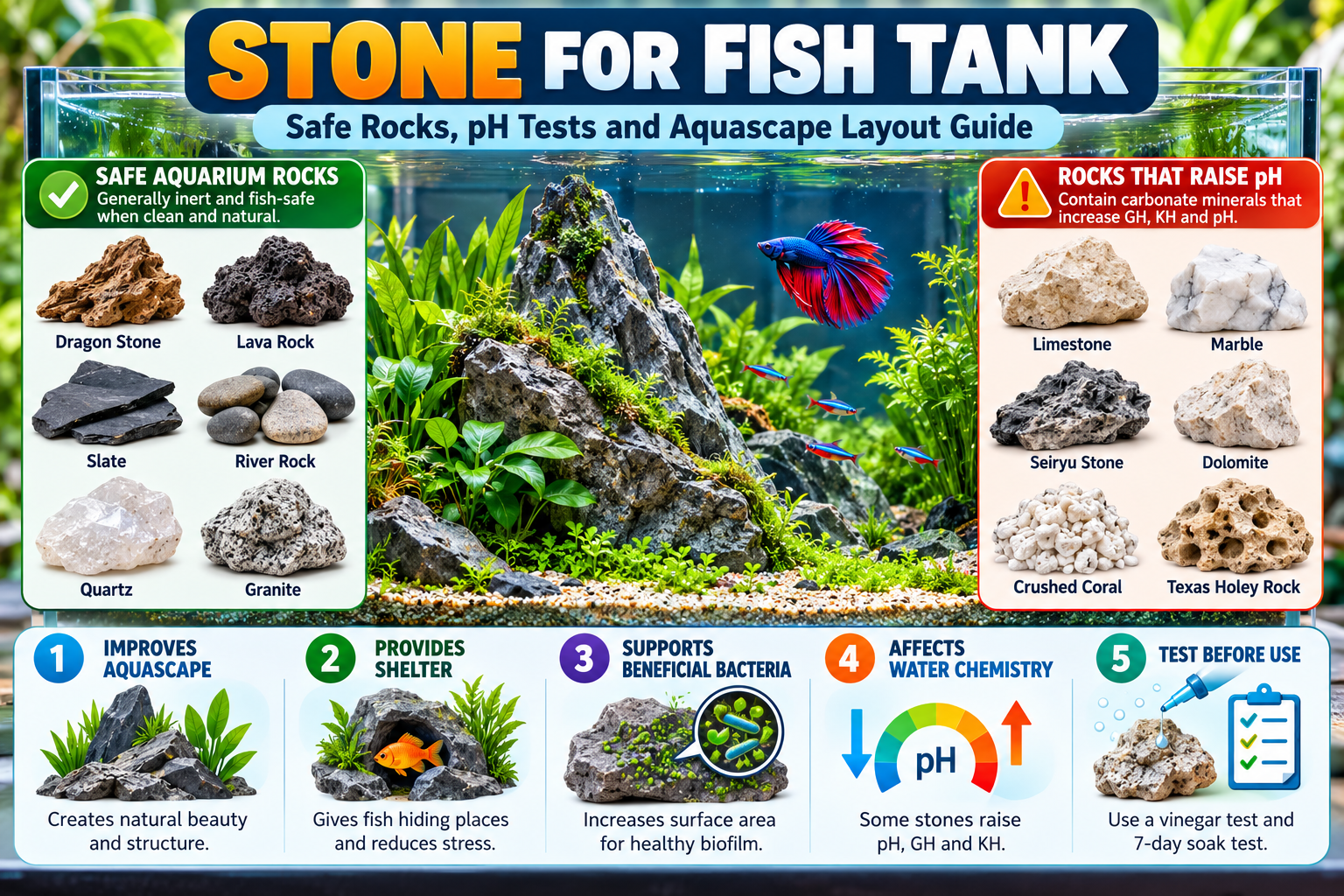
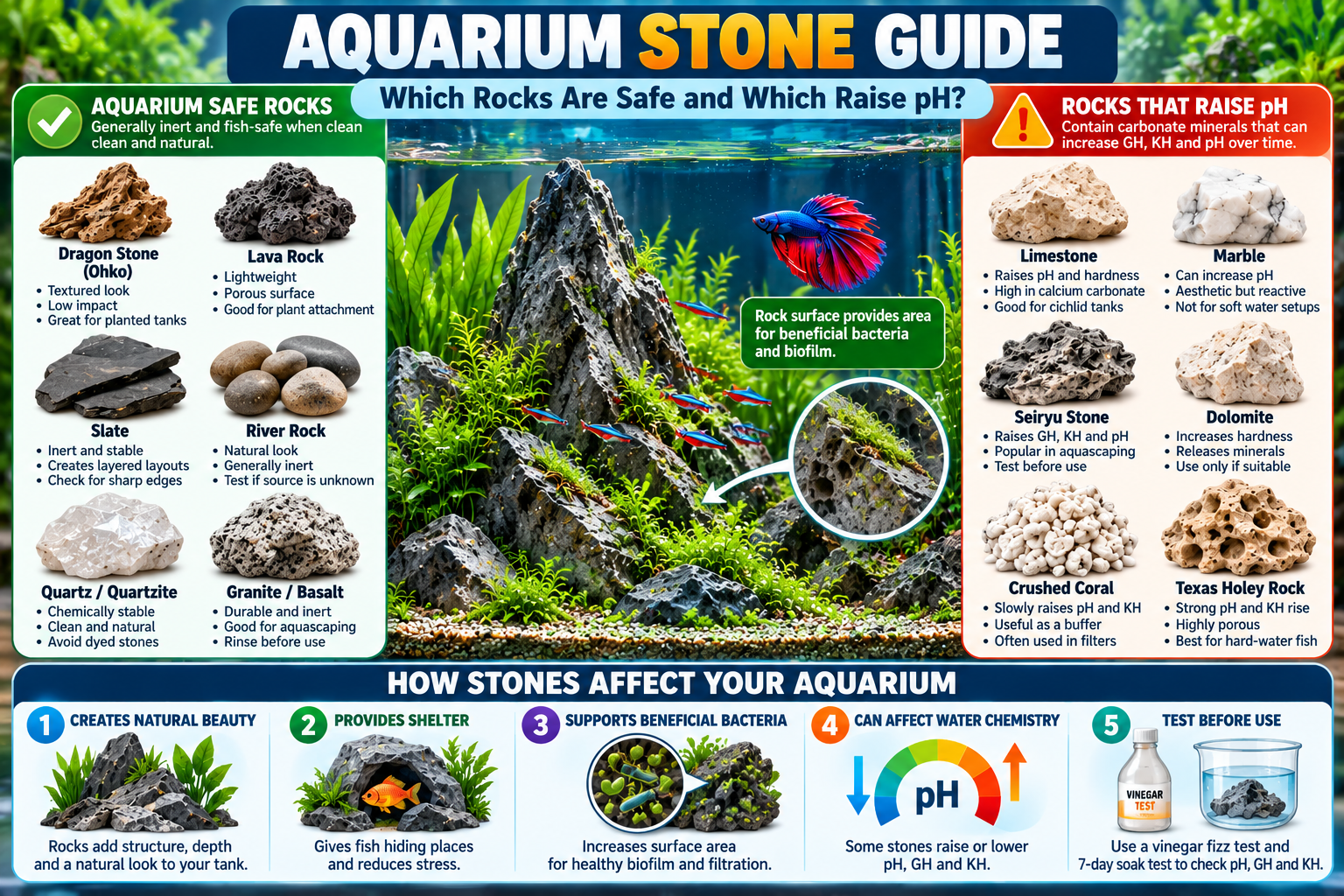
Not all natural stone behaves the same way in aquarium water. The table below offers a practical starting point, but the rock’s actual mineral composition and your water chemistry matter more than its commercial name.
| Rock type | Likely chemistry effect | Best use |
|---|---|---|
| Dragon stone (Ohko) | Usually low impact; test in very soft water | Textured planted layouts |
| Lava rock | Generally low impact | Porous hardscape and plant attachment |
| Slate | Usually low impact if clean and suitable | Layered formations |
| River rock | Depends on mineral composition | Natural, rounded layouts |
| Quartz or quartzite | Usually inert when genuine and untreated | Accent stones |
| Seiryu stone | Can raise GH, KH and pH | Hard-water-tolerant setups |
| Limestone or Texas holey rock | Can raise hardness and pH | Selected hard-water fish systems |
Dragon Stone Aquarium
Dragon stone, commonly sold as Ohko stone, is popular because its ridges, holes and weathered texture create depth without requiring a large number of different materials. It can look especially effective in planted aquariums, where small plants can soften the stone’s edges and moss can occupy crevices.
Rinse it thoroughly before use. The holes can hold clay, dust and loose particles, so use a soft brush and repeat the rinse until the runoff is clear. Dragon stone is often considered low impact, but that label is not a guarantee for every specimen or every source water. If your aquarium uses very soft water, run a soak test before adding a large quantity.

Consider a product sold specifically for aquarium use, with clear information about its origin and intended application. Check current availability and product details.
Lava Rock for Aquarium
Lava rock is lightweight for its volume and contains many pores. Its rough surface can provide attachment points for moss, Java fern and Anubias, although the plants should be secured without covering their rhizomes. Choose pieces without loose debris or dangerously sharp projections.
Inspect every piece closely. Porosity alone does not prove that a rock is safe: contamination, coatings and mineral inclusions still matter. Buy from a reliable aquarium supplier when possible, and test an unfamiliar batch before introducing it to an established tank.
Lava rock can create textured hardscape and provide attachment surfaces for aquarium plants.

Choose clean, untreated rock sold for aquariums or suitable horticultural use with verified composition. Check current product availability.
Aquarium Rocks Safe for Fish: Slate, River Rock and Quartz
Slate can create layered cliffs and shelves, but pieces must be stable and free from sharp edges that could injure fish. River rock offers a softer, rounded appearance; however, its composition varies by collection site. Do not assume that a smooth surface means the stone is chemically inert.
Quartz and quartzite are generally low-reactivity choices when genuine, clean and untreated. Avoid dyed decorative pebbles, painted stones, metallic inclusions and materials with unknown coatings. Granite and basalt may also be suitable when correctly identified and free from contaminants.
For a broader look at aquarium setup, compare your hardscape with the needs of the fish you keep. For example, pigeon blood discus water parameters can help you think about species-specific water requirements before selecting materials.
Seiryu Stone Aquarium: Safe With a Catch
Seiryu stone is valued in aquascaping for its grey-blue colour, ridges and contrasting white veins. Its carbonate-containing minerals can gradually dissolve, increasing general hardness (GH), carbonate hardness (KH) and sometimes pH. The effect depends on the stone, water chemistry, carbon dioxide and exposure time.
It is not automatically unsafe, but it may be unsuitable for fish or plants that require consistently soft, acidic water. Do not rely on an acid wash to permanently remove its buffering effect. If you want to use Seiryu, test a representative piece in your intended water and monitor changes over time.
Rocks That Raise pH in Aquarium
Limestone, marble, dolomite, crushed coral and Texas holey rock contain carbonate minerals that can dissolve and influence water chemistry. Seiryu stone can have a similar effect. The rate is not fixed: water with different acidity, dissolved carbon dioxide and mineral saturation can react differently with the same rock.
Carbonate dissolution is a well-studied geochemical process (Plummer, Wigley and Parkhurst, 1978; Morse and Arvidson, 2002). In an aquarium, the practical question is whether the resulting chemistry suits the fish, not whether a higher pH is inherently good or bad.
If you are dealing with pH too high in a fish tank, first test the source water and aquarium water. Check whether carbonate-rich rock, crushed coral, substrate or other buffering material is contributing to the change. Avoid sudden attempts to force pH downward, as rapid fluctuations can stress fish. Our AquariumsWorld blog archive is a useful starting point for related aquarium setup and water-quality topics.
Hard Water and Fish Tanks: When Calcareous Rock Helps
Calcareous rocks can be useful when the target species naturally benefits from mineral-rich water. Some African cichlid systems and livebearer aquariums are maintained with relatively higher hardness and alkalinity, although the exact target depends on the species and source water.
By contrast, some soft-water fish and many freshwater shrimp are more sensitive to mineral changes. Fish regulate salts and water movement across their gills and other tissues, so water chemistry influences physiological balance (Evans, Piermarini and Choe, 2005). Choose stone based on the animals’ requirements rather than a general belief that harder water is always healthier.
If you keep multiple species, check their compatibility before adjusting chemistry. Guides such as the halfmoon betta care guide illustrate why a fish’s care needs should guide aquarium design.
How to Raise KH in Aquarium With Rock
Carbonate hardness helps buffer changes in pH. If testing shows that KH is too low for your chosen species, suitable carbonate-rich rock or crushed coral in a filter compartment may raise it gradually. However, rock is not a precise dosing tool, and its effect can vary considerably.
Start with small changes, measure KH and pH regularly, and record the results. Do not add carbonate material simply because a generic guide recommends it. Match the target to the fish, plants and source water, and avoid abrupt changes that could destabilise the aquarium.
How to Test a Stone Before It Goes in Your Tank
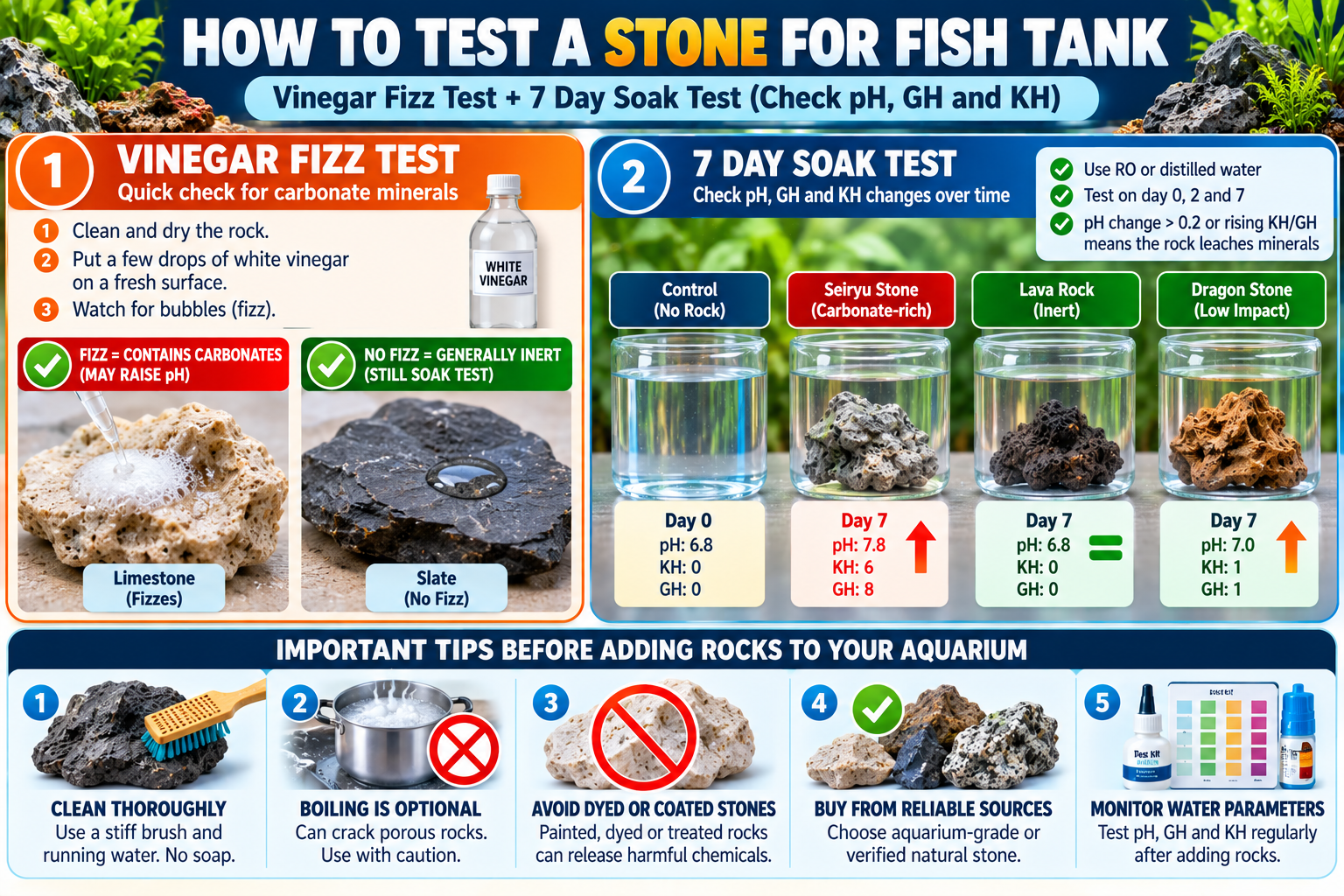
Two useful screening methods are the vinegar fizz test and a controlled soak test. The first can indicate the presence of reactive carbonate material; the second gives a better idea of how the stone affects water chemistry over time. Neither test detects every possible contaminant, so unknown outdoor rocks need additional caution.
The Vinegar Fizz Test
Begin with a clean, dry stone. Place a few drops of ordinary white vinegar on a fresh, exposed area and watch for bubbling. A visible fizz suggests that carbonate minerals may be present. Some stones react only weakly, so a lack of fizz does not prove that the rock is inert.
Do not perform this test inside an aquarium. Rinse the stone thoroughly afterwards, and remember that the test does not detect pesticides, metals, fuel residues or other contaminants. Treat it as a screening step, not a complete safety certification.
The 7 Day Soak Test for GH, KH and pH
A soak test provides a more useful indication of whether a rock changes your intended aquarium water. Use a clean container and reverse-osmosis or distilled water, then measure pH, GH and KH before adding the stone. Record the readings on day zero, day two and day seven. Use a control container without a rock if possible.
Keep the containers at a similar temperature and avoid adding substrate, fertiliser or other materials that could distort the result. A pH shift greater than about 0.2 units, or a clear rise in GH or KH, is a reason to investigate further. These are practical screening thresholds rather than universal scientific pass-or-fail standards. Extend the test if the readings are still changing.
Low pH can affect fish physiology, but the consequences depend on species, exposure and water chemistry (Kwong, Kumai and Perry, 2014). The aim is stability within an appropriate range, not chasing a single pH number.
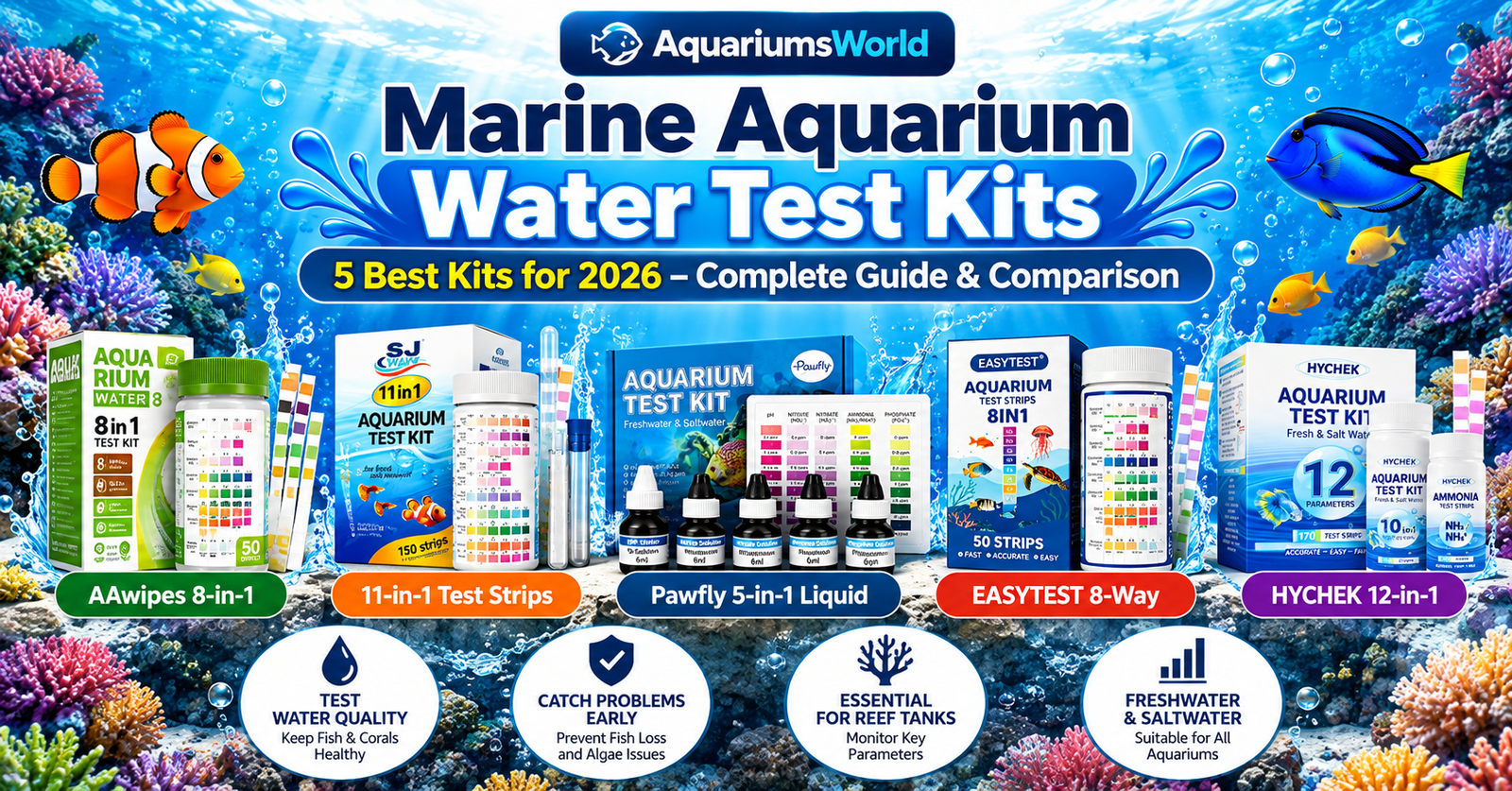
A suitable freshwater test kit can help you monitor hardness during a soak test and after adding rock to an aquarium. Confirm the kit’s current specifications and instructions before use. Check current product details.
For additional guidance, read our comparison of aquarium water test kits.
How to Clean and Prepare Aquarium Rocks
Start by removing loose dirt with a stiff brush dedicated to aquarium equipment. Rinse each piece under running water until loose particles are removed. Never use household soap, detergent or scented cleaning products: residues may remain in cracks and contaminate the aquarium.
Boiling is not automatically the safest method. Some rocks contain trapped moisture, fractures or porous structures that can crack when heated rapidly. Large stones can also be difficult to handle safely. Instead, scrub and rinse suitable rock, inspect it carefully, and use a controlled soak test before placing it in the aquarium.
For outdoor rocks that may have been exposed to biological contamination, some keepers use a carefully controlled diluted bleach treatment. This is not a way to make chemically unsuitable or contaminated rock safe. If a suitable rock is disinfected, use a properly measured solution, ensure complete rinsing and follow with a suitable aquarium dechlorinator according to its label. Never mix bleach with acids or other cleaners. When the rock’s history is uncertain, choosing aquarium-grade material is usually safer.
Can I Use Rocks From Outside in My Aquarium?
Sometimes, but an outdoor rock has an unknown history unless you know where it came from. It may have been exposed to pesticides, fertiliser, road runoff, industrial pollution or other contaminants. Some mineral veins also deserve caution. Pyrite can oxidise and produce acidic products under suitable conditions, while metal-bearing minerals may release elements into water (Nordstrom, 2011).
Avoid collecting rocks from protected areas, private land without permission, or locations where removal is prohibited. Do not collect from polluted waterways, roadsides, industrial sites or areas affected by mine waste. A vinegar test cannot establish that a wild rock is free from toxic contaminants.
- Identify the rock and its likely mineral composition.
- Reject stones with metallic veins, rusty inclusions, oily residue or unusual coatings.
- Avoid material from polluted or chemically treated sites.
- Brush and rinse without soap.
- Run the vinegar and soak tests where appropriate.
- Do not use a rock if its identity or safety remains uncertain.
Aquascaping Rocks: Layout Basics
Good aquascaping rocks create a visual structure without sacrificing fish welfare. Choose a clear focal point, vary stone sizes, and leave enough open area for swimming and maintenance. A layout should look balanced from the front and remain practical when you need to clean the glass, siphon substrate or reach the filter.
Use a consistent rock family where possible. Mixing too many colours, textures and geological styles can make the arrangement feel accidental. Think about the direction of the stone’s ridges and the way they lead the viewer’s eye across the aquarium.
Iwagumi Rock Placement Made Simple
Iwagumi is a Japanese-inspired aquascaping style built around a restrained group of stones. A common layout uses an odd number of stones, with one dominant stone called the Oyaishi. Smaller stones support the visual composition, while a subordinate stone may be positioned opposite the main stone to balance the scene.
Use the same or visually compatible stone type, keep the natural grain direction consistent, and avoid placing every stone at equal spacing. A slight off-centre focal point often looks more natural than a perfectly symmetrical arrangement.
Stability is more important than appearance. Position stones on a secure base before adding substrate when appropriate, and make sure the finished arrangement cannot topple if a fish digs or you move equipment. Our aquarium setup guides can help you plan a layout around the tank’s dimensions and equipment.
Design for Aquarium: Stability, Flow and Fish Safety
In a design for aquarium hardscape, use the rule of thirds as a starting point rather than a strict formula. Place the main stone slightly away from the centre and use smaller stones to guide the eye. Keep enough open space for fish to swim and for water to circulate around the structure.
Check that the stone does not press against the glass at a sharp point or create unstable overhangs. Consider a suitable protective base where necessary, but ensure it does not create uneven pressure or interfere with the aquarium’s design. Secure large structures before adding water, and test that they remain stable.
Use the rock calculator near the beginning of this article to estimate your purchasing quantity. If the layout requires heavy stone, check the aquarium stand, base and manufacturer’s load guidance before proceeding.
Frequently Asked Questions
What kind of rocks are safe for a fish tank?
Suitable lava rock, slate, granite, basalt, quartz, quartzite and some river stones are commonly used. Safety depends on accurate identification, cleanliness, coatings and mineral composition. Test unfamiliar material before use and choose stones that suit your fish’s water requirements.
Can I put rocks from outside in my fish tank?
Possibly, but outdoor rocks may contain pollutants, metal-bearing minerals or residues from roads, farms and industrial areas. Check local collecting rules, identify the stone, clean it without soap and test it. When its history is unknown, aquarium-grade rock is the safer choice.
How do you know if a rock is safe for an aquarium?
Identify the material, inspect it for metallic veins and coatings, and perform a vinegar screening test for carbonate minerals. Then soak it separately and compare pH, GH and KH readings over time. These checks cannot rule out every contaminant, so avoid suspicious or unidentified rocks.
What rocks raise pH in an aquarium?
Limestone, marble, dolomite, crushed coral and Texas holey rock can raise hardness and pH because they contain carbonate minerals. Seiryu stone can also affect GH, KH and pH. Their impact varies with water chemistry, so monitor readings rather than assuming a fixed result.
Do you need to boil rocks before putting them in an aquarium?
No. Boiling is not necessary for every suitable aquarium rock and can cause some stones to crack because of trapped moisture or thermal stress. Brush and rinse the material, inspect it and test it separately. Never use soap or household cleaners on aquarium rocks.
Is Seiryu stone safe for fish?
Seiryu stone can be used in aquariums where its effect on water chemistry suits the inhabitants. It may raise GH, KH and pH over time, making it less appropriate for some soft-water setups. Test a sample first and monitor hardness after adding it.
Final Thoughts on Choosing a Stone for Fish Tank
The best stone for fish tank setups is the one that suits your fish, water chemistry, layout and maintenance routine. Low-impact stones such as suitable lava rock, slate, quartz and granite provide many aquascaping options. Carbonate-rich rocks may be useful in selected hard-water systems, but can cause problems when they push chemistry away from the required range.
Identify and clean your rocks, test unfamiliar material, and monitor GH, KH and pH after installation. For a stable design, choose a secure arrangement, leave room for swimming and cleaning, and calculate your rock quantity before purchasing. A thoughtful hardscape should improve the aquarium without creating a chemistry or safety problem.
Further Reading from AquariumsWorld
The following links are provided as additional site reading. Some cover other fish species or aquarium topics rather than rock chemistry directly. Prioritise the most relevant guides for contextual links in the article body.
- Pigeon Blood Discus: Water Parameters and Breeding
- Best Plants for Betta Fish Tanks
- Rose Bubble Anemone: Lighting, Feeding and Care
- Copper Oscar Fish: Colours, Tank Size and Care
- Blueberry Oscar Fish: Colours and Size
- Blue Oscar Fish Varieties and Genetics
- Oscar Fish 55 Gallon Tank and Filtration
- White Tiger Oscar Fish Care
- Bumblebee Oscar Fish
- Marine Aquarium Water Test Kits
- Halfmoon Betta Care Guide
- Oscar Fish Rehoming Guide
- Test Kit for Aquarium Water
- Oscar Fish Plush Guide
- Can You Eat Parrot Fish?
- Tiger Parrot Fish Varieties and Tank Size
- Best Freshwater Algae Eaters
- 15 Best Live Plants for Betta Fish
- Aquarium Industry News: October 2026
- MICROBE-LIFT Nite-Out II Guide
- Saltwater Parrot Fish Species and Care
- Parrot Fish Food Guide
- Will Koi Fish Eat Goldfish?
- Automatic Fish Feeder for Ponds
- Automatic Fish Feeder for Aquariums
- Purple Guppy Fish Care and Breeding
- Queen Angelfish Care and Tank Size
- Browse All AquariumsWorld Articles
- koi-male-betta-marble-colors-care-male-female
References
- Battin, T.J., Besemer, K., Bengtsson, M.M., Romani, A.M. and Packmann, A.I. (2016) ‘The ecology and biogeochemistry of stream biofilms’, Nature Reviews Microbiology, 14(4), pp. 251–263. Available at: https://doi.org/10.1038/nrmicro.2016.15.
- Evans, D.H., Piermarini, P.M. and Choe, K.P. (2005) ‘The multifunctional fish gill: dominant site of gas exchange, osmoregulation, acid-base regulation, and excretion of nitrogenous waste’, Physiological Reviews, 85(1), pp. 97–177. Available at: https://doi.org/10.1152/physrev.00050.2003.
- Flemming, H.C. and Wingender, J. (2010) ‘The biofilm matrix’, Nature Reviews Microbiology, 8(9), pp. 623–633. Available at: https://doi.org/10.1038/nrmicro2415.
- Kwong, R.W.M., Kumai, Y. and Perry, S.F. (2014) ‘The physiology of fish at low pH: the zebrafish as a model system’, Journal of Experimental Biology, 217(5), pp. 651–662. Available at: https://doi.org/10.1242/jeb.091603.
- Morse, J.W. and Arvidson, R.S. (2002) ‘The dissolution kinetics of major sedimentary carbonate minerals’, Earth-Science Reviews, 58(1–2), pp. 51–84. Available at: https://doi.org/10.1016/S0012-8252(01)00083-6.
- Näslund, J. and Johnsson, J.I. (2016) ‘Environmental enrichment for fish in captive environments: effects of physical structures and substrates’, Fish and Fisheries, 17(1), pp. 1–30. Available at: https://doi.org/10.1111/faf.12088.
- Nordstrom, D.K. (2011) ‘Hydrogeochemical processes governing the origin, transport and fate of major and trace elements from mine wastes and mineralized rock to surface waters’, Applied Geochemistry, 26(11), pp. 1777–1791. Available at: https://doi.org/10.1016/j.apgeochem.2011.06.002.
- Plummer, L.N., Wigley, T.M.L. and Parkhurst, D.L. (1978) ‘The kinetics of calcite dissolution in CO2-water systems at 5 to 60 degrees C and 0.0 to 1.0 atm CO2’, American Journal of Science, 278(2), pp. 179–216. Available at: https://doi.org/10.2475/ajs.278.2.179.