The question of whether goldfish can live with Oscar fish comes up regularly in the aquarium hobby, often because both species are widely available, popular and commonly kept in freshwater aquariums.
The answer, backed by the biology of both species and confirmed by peer-reviewed research, is a clear no. Goldfish and Oscar fish cannot safely or responsibly live together, and understanding exactly why reveals important differences between two of freshwater fishkeeping’s most iconic species.
This guide covers the complete comparison between goldfish and Oscar fish including classification, natural habitat, temperature requirements, diet, behaviour, size, lifespan, tank requirements and the specific biological reasons why cohabitation causes harm to one or both species.
New to fishkeeping entirely? Our complete beginner’s guide to fish care is essential reading before setting up any freshwater aquarium.
- Can Goldfish Live with Oscar Fish — Direct Answer
- Classification and Species Background
- Natural Habitats — Where They Come From
- Temperature Requirements — The Core Incompatibility
- Water Parameters Compared
- Size and Growth Rate
- Goldfish Diet — What Do Goldfish Eat
- Oscar Fish Diet — What Do Oscar Fish Eat
- Diet Comparison Table
- Behaviour and Temperament
- Categories — What Kind of Fish Are They
- Similarities Between Goldfish and Oscar Fish
- Differences Between Goldfish and Oscar Fish
- Goldfish Tank Requirements
- Oscar Fish Tank Requirements
- Good Tank Mates for Goldfish
- Good Tank Mates for Oscar Fish
- Health and Disease Considerations
- Frequently Asked Questions
- Conclusion
- References
1. Can Goldfish Live with Oscar Fish — Direct Answer
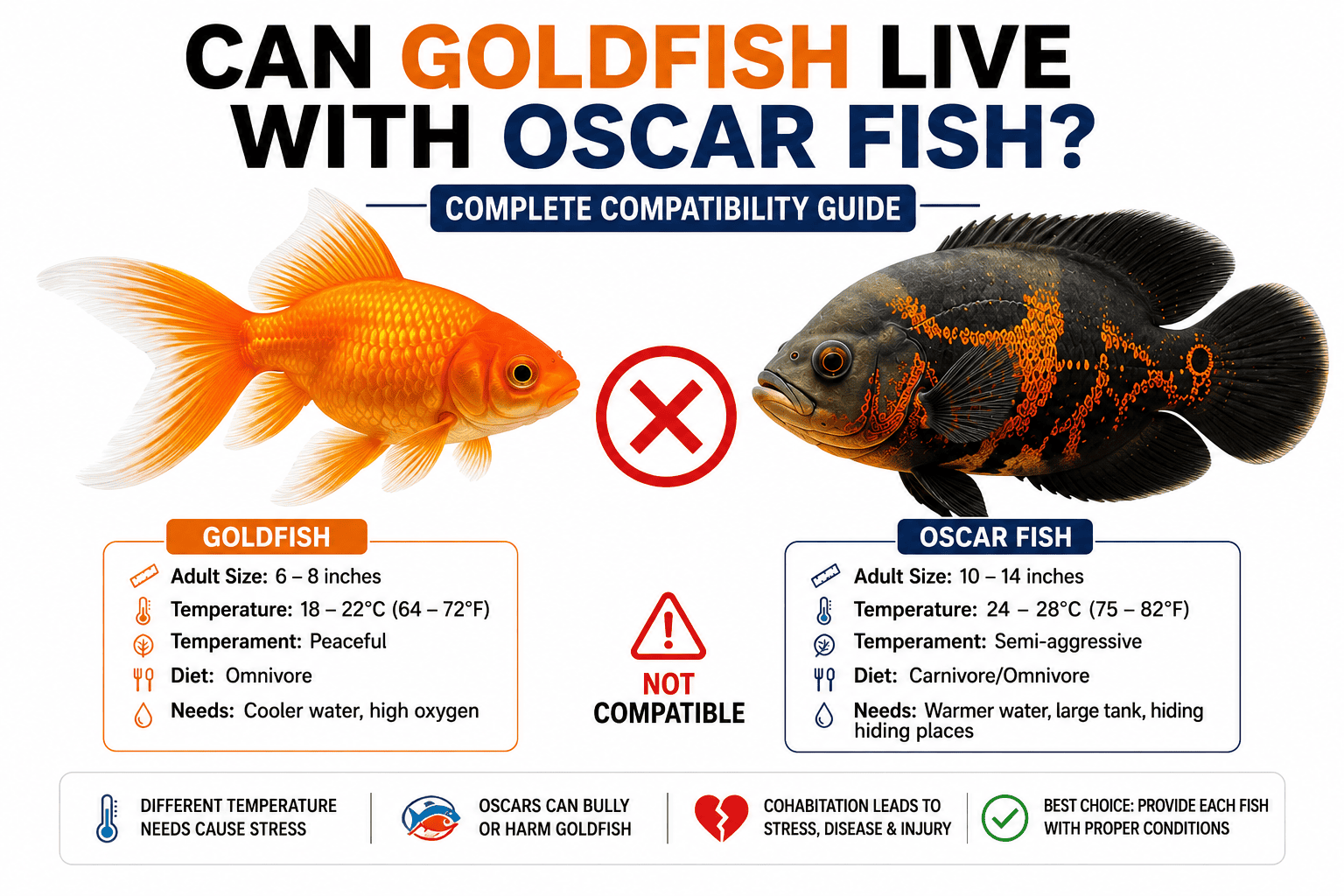
No — goldfish and Oscar fish cannot safely live together. The incompatibility is not a matter of preference or individual personality. It is rooted in fundamental biological differences between the two species that cannot be resolved by tank size, filtration or any other husbandry adjustment.
Three specific issues make cohabitation harmful:
- Temperature conflict — goldfish thrive at 12 to 22°C; Oscar fish thrive at 22 to 27°C. At the warmer end of goldfish tolerance, goldfish experience heat stress; at the cooler end of Oscar tolerance, Oscars experience immune suppression and metabolic failure (Farrell et al., 2014; Zare et al., 2024).
- Predation risk — Oscar fish are aggressive, predatory cichlids that actively hunt and consume any fish small enough to fit in their mouth. Adult Oscars reach 30 to 35 cm and may treat goldfish as prey (Aquahoy, 2026).
- Bioload and water chemistry mismatch — goldfish are extremely high-waste fish that can drive ammonia and nitrate levels rapidly. Oscars also produce a high bioload but require tropical temperatures and different husbandry conditions.
2. Classification and Species Background
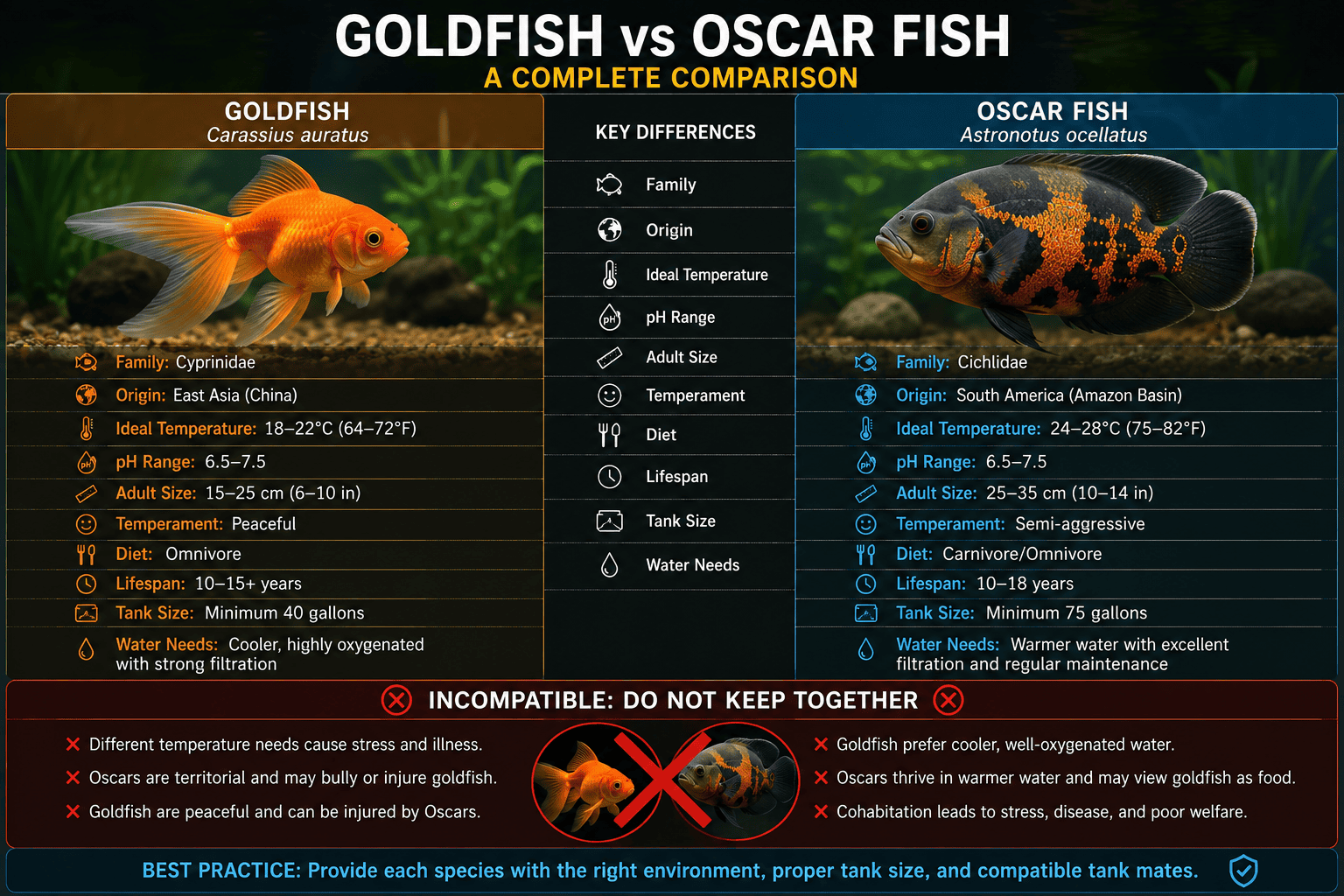
| Classification Level | Goldfish | Oscar Fish |
|---|---|---|
| Common Name | Goldfish | Oscar Fish, Tiger Oscar, Velvet Cichlid |
| Scientific Name | Carassius auratus | Astronotus ocellatus |
| Family | Cyprinidae (carp family) | Cichlidae (cichlid family) |
| Order | Cypriniformes | Perciformes |
| Origin | Eastern Asia (China, selective breeding from wild carp) | South America (Amazon Basin — Brazil, Peru, Colombia) |
| First kept in captivity | Over 1,000 years ago in China | 1950s in the ornamental trade |
| Wild status | Introduced globally as invasive species in many countries | Native to Amazon Basin; introduced populations in parts of Asia and USA |
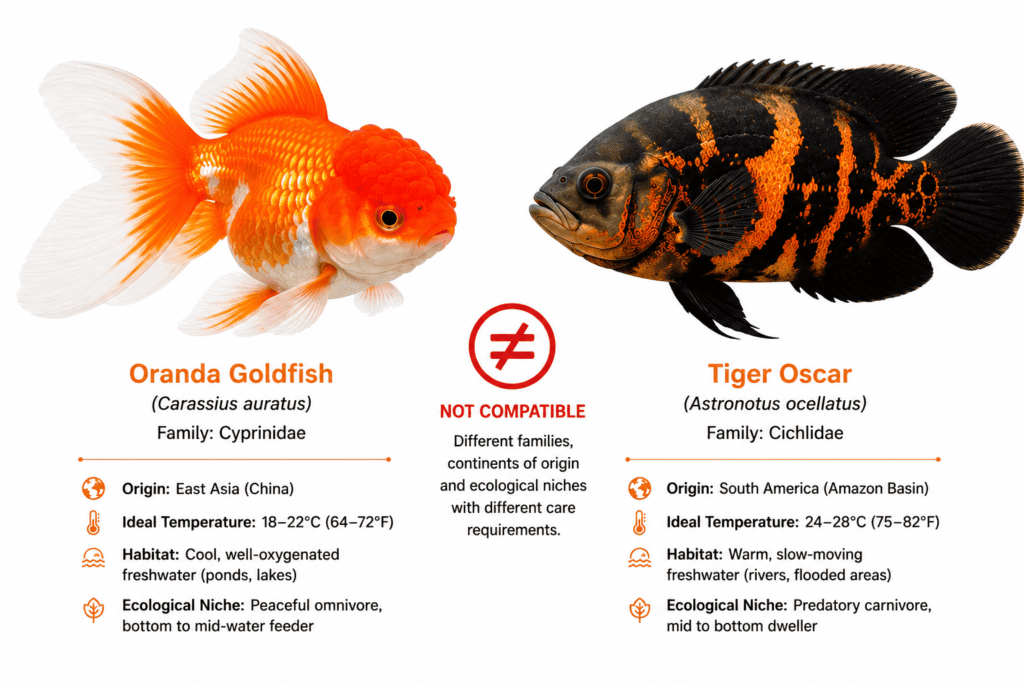
Goldfish and Oscar fish are not closely related. They belong to different orders of fish, evolved on different continents and developed in entirely different ecological niches. The only things they share are that both are freshwater fish, both are popular in the aquarium hobby and both grow larger than most beginners expect.
For a detailed guide to goldfish varieties and care, see our Oranda goldfish complete care guide .
3. Natural Habitats — Where They Come From
Goldfish Natural Habitat
Wild goldfish (Carassius auratus) are descended from wild carp native to eastern Asia, primarily China, and have been selectively bred for ornamental keeping for over a thousand years. In the wild, they inhabit slow-moving or still, warm temperate waters — ponds, lakes, slow rivers and flooded paddy fields — with muddy substrates and abundant aquatic vegetation.
These are temperate environments that experience genuine seasonal temperature variation, including cold winters. Wild goldfish are capable of surviving at extreme temperatures, though their optimal aerobic performance occurs between 19 and 22°C (Farrell et al., 2014; Nashrah et al., 2025).
Oscar Fish Natural Habitat
Oscar fish (Astronotus ocellatus) are native to the Amazon Basin in South America — specifically the slow-moving rivers, flooded forests and lake margins of Brazil, Peru and Colombia.
These are warm, tropical environments with consistently high temperatures year-round, abundant submerged vegetation and driftwood. Wild Oscars prefer calm, warm waters with a temperature range of 22 to 27°C optimal for growth, immunity and reproduction (Zare et al., 2024; Aquahoy, 2026).
4. Temperature Requirements — The Core Incompatibility
Temperature incompatibility is the single most important reason why goldfish and Oscar fish cannot live together. This is not a minor difference in preference — it is a fundamental physiological conflict backed by published science.
| Temperature Zone | Effect on Goldfish | Effect on Oscar Fish |
|---|---|---|
| Below 10°C | Slows metabolism; enters torpor — survives well | Fatal within days |
| 12 to 18°C | Healthy; active; optimal immune function | Chronic cold stress |
| 18 to 22°C | Upper comfortable range | Suboptimal |
| 22 to 27°C | Heat stress begins | Optimal |
| 28°C and above | Severe heat stress | Tolerable upper range |
The research is definitive. Farrell et al. (2014), publishing in Physiological and Biochemical Zoology, established goldfish optimal aerobic performance temperatures at approximately 19 to 22°C across acclimation conditions. Zare et al. (2024), publishing in Aquaculture, confirmed that Oscar fish exposed to colder conditions showed significant physiological compromise.
5. Water Parameters Compared
| Parameter | Goldfish | Oscar Fish | Compatible |
|---|---|---|---|
| Temperature | 12 to 22°C optimal | 22 to 27°C optimal | No — conflict |
| pH | 7.0 to 8.0 | 6.5 to 7.5 | Partial overlap |
| Hardness | Moderate to hard — 10 to 20 dGH preferred | Soft to moderate — 5 to 15 dGH preferred | Partial overlap |
| Ammonia | 0 ppm | 0 ppm | Same requirement |
| Nitrate tolerance | Moderate — sensitive at high levels | More tolerant — but 0 to 40 ppm recommended | Manageable |
| Bioload | Very high | Very high | Combined load is extreme |
6. Size and Growth Rate
| Feature | Goldfish | Oscar Fish |
|---|---|---|
| Average adult size | 15 to 30 cm depending on variety | 30 to 35 cm in captivity |
| Weight | 0.5 to 2 kg depending on variety | 1 to 1.5 kg in captivity |
| Growth rate | Slow to moderate | Fast — particularly as juveniles |
| Lifespan | 10 to 15 years | 10 to 15 years |
| Size at purchase | 3 to 8 cm typically | 3 to 8 cm typically |
The size comparison reveals another critical incompatibility. Even if a juvenile Oscar and an adult goldfish appear similarly sized when first introduced, this changes rapidly. Oscar fish grow quickly and can become capable of hunting smaller tank mates.
For large tank size reference, our 100 gallon fish tank guide covers the minimum setup adult Oscars realistically require.
7. Goldfish Diet — What Do Goldfish Eat
Goldfish (Carassius auratus) are omnivores with a strong preference for plant-based material balanced with protein from small invertebrates. Their digestive system is adapted to a high-fibre, varied diet.
Recommended Goldfish Diet
- High-quality sinking goldfish pellets — sinking pellets reduce the need for surface feeding.
- Blanched vegetables — zucchini, peas, spinach, cucumber and lettuce provide useful plant fibre.
- Bloodworm — frozen or live bloodworm provides supplemental protein.
- Brine shrimp — useful protein source and enrichment.
- Daphnia — useful as part of a varied feeding routine.
- Aquatic plants — goldfish naturally graze on soft-leaved plants in aquariums.
8. Oscar Fish Diet — What Do Oscar Fish Eat
Oscar fish (Astronotus ocellatus) are carnivorous predators with omnivorous tendencies. Their natural diet includes live invertebrates, smaller fish, crustaceans and insects.
Recommended Oscar Fish Diet
- High-quality cichlid pellets or sticks — a protein-rich cichlid-specific pellet can form the dietary staple.
- Frozen krill — useful protein source and enrichment.
- Frozen bloodworm — useful supplemental food.
- Earthworms — can provide natural feeding enrichment.
- Feeder fish — generally not recommended as a regular diet because of disease and nutritional risks.
- Mealworms and crickets — insects can provide additional feeding enrichment.
9. Diet Comparison Table
| Food Type | Goldfish | Oscar Fish | Notes |
|---|---|---|---|
| Pellets or sticks | Yes | Yes | Different species-specific formulas are preferred. |
| Frozen bloodworm | Yes | Yes | Useful protein supplement. |
| Live brine shrimp | Yes | Yes | Suitable as supplemental food. |
| Blanched vegetables | Important | Occasional | More important for goldfish. |
| Live earthworms | Accepted | Excellent | More useful as enrichment for Oscars. |
| Live feeder fish | No | Not recommended | Disease and nutritional risks. |
| Aquatic plants | Yes | Usually uprooted | Goldfish naturally graze on plants. |
10. Behaviour and Temperament
Goldfish Behaviour
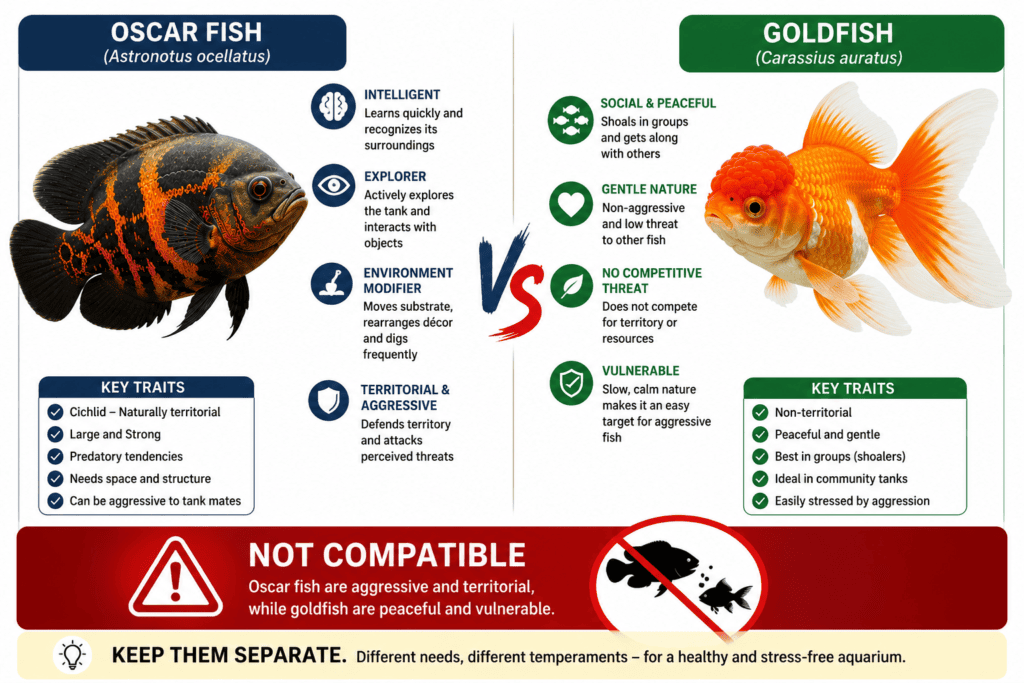
Goldfish are peaceful, social fish that thrive with suitable companions. They are active foragers that explore the substrate and plant life and respond strongly to feeding routines.
Their calm nature makes them appropriate for compatible community settings, but it also makes them vulnerable around large aggressive predators.
Oscar Fish Behaviour
Oscar fish are among the more behaviourally complex freshwater aquarium fish. They are intelligent, territorial and capable of displaying strong predatory behaviour.
Oscars may rearrange decorations, dig substrate and defend territory. They are therefore unsuitable tank mates for peaceful, slower-moving fish such as goldfish.
11. Categories — What Kind of Fish Are They
| Category | Goldfish | Oscar Fish |
|---|---|---|
| Fish category | Cyprinid | Cichlid |
| Water type | Freshwater temperate | Freshwater tropical |
| Feeding category | Omnivore — plant-heavy | Carnivore — protein-heavy |
| Temperament | Peaceful community fish | Semi-aggressive to aggressive |
| Keeping difficulty | Beginner to intermediate | Intermediate to advanced |
| Aquarium category | Coldwater or temperate | Tropical freshwater |
| Social category | Social and schooling | Semi-solitary or compatible pairs |
| Predator or prey | Generally non-predatory | Active predator |
12. Similarities Between Goldfish and Oscar Fish
Despite their fundamental incompatibility, goldfish and Oscar fish share several characteristics that explain why both remain popular freshwater aquarium fish.
- Both are freshwater fish.
- Both grow large.
- Both produce substantial bioload.
- Both can live for many years under good care.
- Both display recognisable behaviour to experienced keepers.
- Both are widely available in the aquarium trade.
- Both benefit from appropriately sized aquariums.
- Both can consume plant and animal material to varying degrees.
13. Differences Between Goldfish and Oscar Fish
| Feature | Goldfish | Oscar Fish |
|---|---|---|
| Family | Cyprinidae | Cichlidae |
| Origin | Eastern Asia | South America — Amazon Basin |
| Optimal temperature | 12 to 22°C | 22 to 27°C |
| Temperament | Peaceful | Territorial and predatory |
| Diet emphasis | Plant-heavy omnivore | Protein-heavy carnivore |
| Social structure | Social | Semi-solitary / territorial |
| Tank decor | May graze and uproot plants | Frequently digs and rearranges decor |
| Aquarium type | Cool or temperate freshwater | Tropical freshwater |
| Beginner suitability | Suitable with adequate setup | Requires more experience |
| Recommended tank | Large aquarium depending on variety | 55+ gallons for one adult; larger preferred |
| Behaviour toward other fish | Generally peaceful | Predatory toward smaller fish |
14. Goldfish Tank Requirements
Goldfish are frequently kept in tanks far too small for their actual needs. A fancy goldfish such as an Oranda requires substantial swimming space and strong filtration because of its high bioload.
For complete goldfish tank setup guidance, our Oranda goldfish complete care guide covers tank size, filtration, water parameters and compatible tank mates.
| Parameter | Goldfish Requirement |
|---|---|
| Temperature | 12 to 22°C |
| Minimum tank size | 30 gallons for one fancy goldfish; larger is preferable |
| pH | 7.0 to 8.0 |
| Filtration | Powerful filtration appropriate for high bioload |
| Water changes | 25 to 30 percent weekly minimum depending on water quality |
| Substrate | Smooth gravel or sand |
| Plants | Hardy varieties are preferable |
For tank size context, our 20 gallon fish tank guide explains why this common starter tank is marginal for goldfish keeping.
15. Oscar Fish Tank Requirements
Oscar fish are frequently sold as small juveniles without sufficient information about their eventual adult size, bioload and aggression level. An adult Oscar requires a large aquarium with strong filtration and adequate swimming space.
For large tank reference, see our 100 gallon fish tank complete guide .
| Parameter | Oscar Fish Requirement |
|---|---|
| Temperature | 22 to 27°C |
| Minimum tank size | 55 gallons for one Oscar; larger is strongly recommended |
| pH | 6.5 to 7.5 |
| Filtration | Very powerful filtration |
| Water changes | 25 to 30 percent weekly minimum depending on water quality |
| Substrate | Sand or smooth gravel |
| Plants | Robust decor is preferable because Oscars may uproot plants |
| Heater | Essential for maintaining tropical temperatures |
16. Good Tank Mates for Goldfish
Goldfish generally do best with companions that share their temperature requirements and peaceful temperament.
- Other fancy goldfish varieties — Oranda, Ryukin, Fantail, Black Moor and other compatible fancy varieties.
- White Cloud Mountain Minnows — peaceful temperate schooling fish where conditions are appropriate.
- Weather loach — peaceful bottom-dwelling fish for suitable cool-water setups.
- Rosy Barbs — active cool-water fish that can work in appropriately large aquariums.
- Apple snails — potentially suitable depending on species and size.
Goldfish and Related Guides on AquariumsWorld.com
17. Good Tank Mates for Oscar Fish
Finding compatible tank mates for Oscar fish is challenging because of their size, aggression and predatory nature. Suitable companions need to be appropriately sized and robust.
- Jack Dempsey cichlid — similarly sized and robust.
- Green Terror cichlid — requires a sufficiently large setup.
- Firemouth cichlid — compatibility should be monitored.
- Large Plecostomus species — armoured catfish can sometimes coexist with Oscars.
- Silver Dollar fish — fast-moving fish that may work in large aquariums.
- Bichir — large bottom-dwelling fish that can sometimes coexist with Oscars.
Aquarium Size Resources for Oscar Fish
18. Health and Disease Considerations
Common Goldfish Health Issues
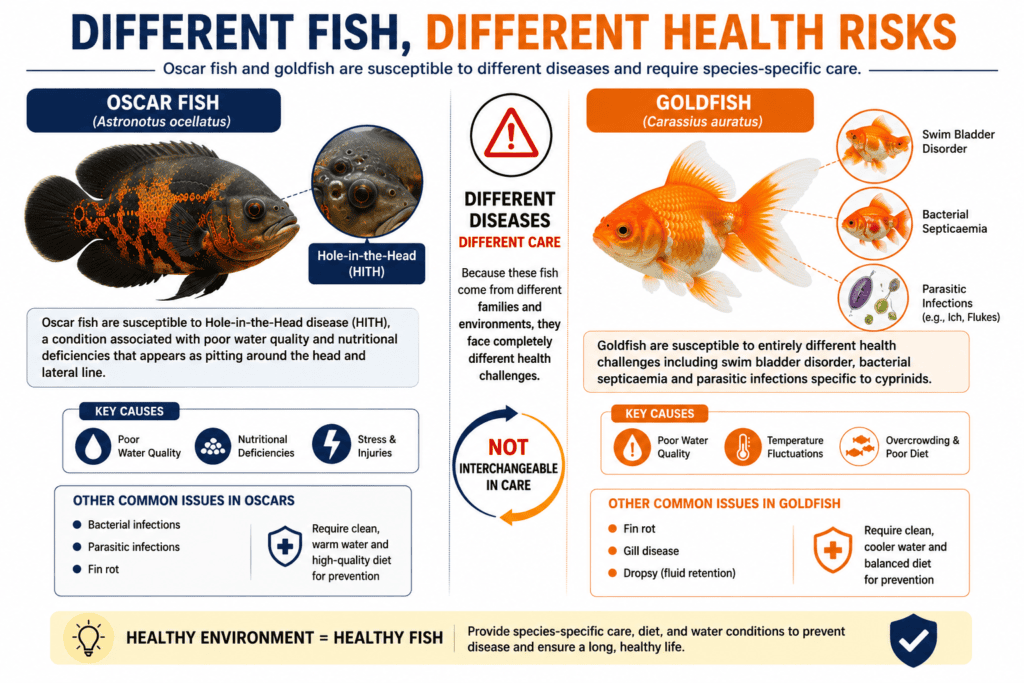
- Swim bladder disorder — particularly common in fancy round-bodied varieties.
- Bacterial septicaemia — may produce red streaking on fins and body.
- Ich — a common parasitic infection in freshwater aquariums.
- Fungal infections — often associated with injury or poor water quality.
- Dropsy — serious condition associated with fluid retention and underlying disease.
Common Oscar Fish Health Issues
- Hole-in-the-Head disease — associated with poor water quality and other husbandry factors.
- Ich — a common protozoan parasite.
- Fin and body injuries — particularly where aggression occurs.
- Bloat — can be associated with overfeeding or inappropriate feeding.
For general water quality troubleshooting applicable to both species, see our fish aquarium problems and solutions complete guide .
19. Frequently Asked Questions
Can goldfish live with Oscar fish?
No. Goldfish and Oscar fish are fundamentally incompatible because of conflicting temperature requirements, predation risk and their different husbandry needs. These two species should be kept in separate aquariums.
What temperature do goldfish need vs Oscar fish?
Goldfish are generally kept in cooler temperate conditions, while Oscar fish require tropical temperatures. Maintaining both species in the same aquarium would compromise the preferred conditions of at least one species.
Are goldfish and Oscar fish the same category of fish?
No. Goldfish belong to the family Cyprinidae, while Oscar fish belong to the family Cichlidae. They are not closely related and evolved in very different ecological environments.
What do goldfish eat?
Goldfish are omnivores that can eat sinking pellets, vegetables, bloodworm, brine shrimp and other appropriate foods as part of a varied diet.
What do Oscar fish eat?
Oscar fish benefit from high-quality cichlid pellets and appropriate protein-rich supplemental foods such as frozen foods and suitable invertebrates.
Can goldfish and Oscar fish be in the same tank briefly?
No. Even temporary cohabitation is not recommended because of the temperature conflict, predation risk and stress placed on the goldfish.
What fish can live with Oscars?
Potential Oscar companions include appropriately sized robust fish such as large cichlids, Plecostomus, Silver Dollars and Bichir, although compatibility always depends on individual fish and aquarium size.
What fish can live with goldfish?
Goldfish generally do best with compatible goldfish varieties and selected cool-water species that share similar environmental and behavioural requirements.
20. Conclusion
The question of whether goldfish can live with Oscar fish has a definitive answer: no. These two species are fundamentally incompatible because of conflicting temperature requirements, predation risk and different biological needs that cannot be reconciled in one aquarium.
Goldfish are temperate, peaceful cyprinids, while Oscar fish are tropical, predatory cichlids. Placing them together can compromise the welfare of one or both fish regardless of tank size, filtration quality or management effort.
Both species deserve properly planned, appropriately sized aquariums that meet their individual needs. The key is keeping them apart and providing each species with the environment its biology requires.
References
- Aquahoy (2026). Oscar fish (Astronotus ocellatus): A comprehensive guide to care, varieties, diseases, and compatibility. https://aquahoy.com/oscar-fish-types-feeding-reproduction-care/
- Bagchi, S., Vlaeminck, S.E., Sauder, L.A., Mosquera, M., Neufeld, J.D. and Boon, N. (2014). Temporal and spatial stability of ammonia-oxidizing archaea and bacteria in aquarium biofilters. PLOS ONE, 9(12), e113515. https://doi.org/10.1371/journal.pone.0113515
- Becker, A.G., Parodi, T.V., Hoshiba, M.A., Pedron, F., Souza, D.M. and Baldisserotto, B. (2012). Tolerance and growth of the silver catfish Rhamdia quelen exposed to different water pH levels and temperatures. Neotropical Ichthyology, 10(1), 119 to 126. https://doi.org/10.1590/S1679-62252012000100013
- Davis, J.C. (1975). Minimal dissolved oxygen requirements of aquatic life with emphasis on Canadian species. Journal of the Fisheries Research Board of Canada, 32(12), 2295 to 2332. https://doi.org/10.1139/f75-268
- Farrell, A.P., Eliason, E.J., Sandblom, E. and Clark, T.D. (2014). Thermal optima and tolerance in the eurythermic goldfish (Carassius auratus): relationships between whole-animal aerobic capacity and maximum heart rate. Physiological and Biochemical Zoology, 87(5), 693 to 704. https://doi.org/10.1086/677317
- Froese, R. and Pauly, D. (Eds.) (2024). FishBase — Carassius auratus and Astronotus ocellatus species profiles. World Wide Web electronic publication. https://www.fishbase.org
- Nashrah, N.A., Mandrak, N.E. and Massey, M.D. (2025). Invasive goldfish (Carassius auratus) maintain aerobic scope across acute warm water temperatures. Biology Open, 14(9), bio062160. https://doi.org/10.1242/bio.062160
- Pleeging, C.C.F. and Moons, C.P.H. (2017). Potential welfare issues of the Siamese fighting fish (Betta splendens) at the retailer and in the hobbyist aquarium. Vlaams Diergeneeskundig Tijdschrift, 86, 213 to 223. https://doi.org/10.21825/vdt.v86i4.16182
- Walster, C., Rasidi, E., Saint-Erne, N. and Loh, R. (2015). The welfare of ornamental fish in the home aquarium. Companion Animal, 20(5), 302 to 306. https://doi.org/10.12968/coan.2015.20.5.302
- Zare, M., Esmaeili, A.A., Safari, O. and Davoodi, R. (2024). Responses of oscar (Astronotus ocellatus) to different temperatures and its interaction with early mild stress. Aquaculture, 591, 741176. https://doi.org/10.1016/j.aquaculture.2024.741176